SB 7: Employment: automated decision systems.
- Session Year: 2025-2026
- House: Senate
- Latest Version Date: 2025-09-17
Current Status:
Failed
(2026-03-02: Stricken from file.)
Introduced
In Committee
Awaiting First Chamber Vote
Passed First Chamber
In Committee
Awaiting Second Chamber Vote
Passed Second Chamber
Enacted
What does this bill do?
This bill requires employers to notify workers and job applicants when automated decision systems (ADS)—computer or AI tools that give scores, classifications, or recommendations—are used for workplace decisions, keep a current list of ADS, and provide workers access to the past 12 months of their own data used by an ADS. It bars certain ADS uses (for example, inferring protected traits or using customer ratings as the only input), forbids relying only on ADS for discipline or firing without human review, protects workers from retaliation, and lets the Labor Commissioner enforce the rules with civil penalties.
The summary is provided by generative AI which can make mistakes. For original language, please view the details in the table below.
Existing law requires the Department of Technology to conduct, in coordination with other interagency bodies as it deems appropriate, a comprehensive inventory of all high-risk automated decision systems (ADS) that have been proposed for use, development, or procurement by, or are being used, developed, or procured by, any state agency.
Existing law establishes the Labor and Workforce Development Agency, which is composed of various departments responsible for protecting and promoting the rights and interests of workers in California, including the Division of Labor Standards Enforcement, led by the Labor Commissioner, within the Department of Industrial Relations.
This bill would require an employer to provide a written notice that an ADS, for the purpose of making employment-related decisions, not including hiring, is in use at the workplace to all workers that will foreseeably be directly affected by the ADS, as specified. The bill would require the employer to maintain an updated list of all ADS currently in use. The bill would require an employer to notify, as provided, a job applicant that the employer utilizes an ADS when making hiring decisions, if the employer will use the ADS in making decisions for that position. The bill would prohibit an employer from using an ADS that does certain functions and would limit the purposes and manner in which an ADS may be used to make decisions. The bill would authorize a worker to request, and require an employer to provide, a copy of the most recent 12 months of the workers own data primarily used by an ADS to make a discipline, termination, or deactivation decision, as specified. The bill would require an employer that primarily relied on an ADS to make a discipline, termination, or deactivation decision to provide the affected worker with a written notice, as specified.
This bill would prohibit an employer from discharging, threatening to discharge, demoting, suspending, or in any manner discriminating or retaliating against any worker for taking certain actions asserting their rights under the bill. The bill would require the Labor Commissioner to enforce the bills provisions, as specified, and would authorize a public prosecutor to bring a civil action. The bill would set forth specified types of relief that a plaintiff may seek and specified penalties that an employer that violates these provisions is subject to, including a $500 civil penalty. The bill would also provide that an employer who complies with the requirements related to notice in this bill is not required to comply with any substantially similar provisions under any other state law, except as specified. The bill would not apply to parties covered by a valid collective bargaining agreement if the agreement contains specified information, including an explicit waiver of the bills provisions. The bill would declare that its provisions do not prohibit any employer from complying with regulatory or contractual requirements in the provision of products or services to the federal government, as defined.
This bill would declare that its provisions are severable.
Existing law requires the Department of Technology to conduct, in coordination with other interagency bodies as it deems appropriate, a comprehensive inventory of all high-risk automated decision systems (ADS) that have been proposed for use, development, or procurement by, or are being used, developed, or procured by, any state agency.
Existing law establishes the Labor and Workforce Development Agency, which is composed of various departments responsible for protecting and promoting the rights and interests of workers in California, including the Division of Labor Standards Enforcement, led by the Labor Commissioner, within the Department of Industrial Relations.
This bill would require an employer to provide a written notice that an ADS, for the purpose of making employment-related decisions, not including hiring, is in use at the workplace to all workers that will foreseeably be directly affected by the ADS, as specified. The bill would require the employer to maintain an updated list of all ADS currently in use. The bill would require an employer to notify, as provided, a job applicant that the employer utilizes an ADS when making hiring decisions, if the employer will use the ADS in making decisions for that position. The bill would prohibit an employer from using an ADS that does certain functions and would limit the purposes and manner in which an ADS may be used to make decisions. The bill would authorize a worker to request, and require an employer to allow a worker to access their provide, a copy of the most recent 12 months of the workers own data collected or primarily used by an ADS and to correct errors in the workers data, as specified. ADS to make a discipline, termination, or deactivation decision, as specified. The bill would require an employer that primarily relied on an ADS to make a discipline, termination, or deactivation decision to provide the affected worker with a written notice, as specified.
This bill would prohibit an employer from discharging, threatening to discharge, demoting, suspending, or in any manner discriminating or retaliating against any worker for taking certain actions asserting their rights under the bill. The bill would require the Labor Commissioner to enforce the bills provisions, as specified, and would authorize a public prosecutor or any worker who has suffered a violation or their representative to bring a civil action. The bill would set forth specified types of relief that a plaintiff may seek and specified penalties that an employer that violates these provisions is subject to, including a $500 civil penalty. The bill would also provide that an employer who complies with the requirements related to notice in this bill is not required to comply with any substantially similar provisions under any other state law, except as specified. The bill would not apply to parties covered by a valid collective bargaining agreement if the agreement contains specified information, including an explicit waiver of the bills provisions. The bill would declare that its provisions do not prohibit any employer from complying with regulatory or contractual requirements in the provision of products or services to the federal government, as defined.
This bill would declare that its provisions are severable.
Existing law requires the Department of Technology to conduct, in coordination with other interagency bodies as it deems appropriate, a comprehensive inventory of all high-risk automated decision systems (ADS) that have been proposed for use, development, or procurement by, or are being used, developed, or procured by, any state agency.
Existing law establishes the Labor and Workforce Development Agency, which is composed of various departments responsible for protecting and promoting the rights and interests of workers in California, including the Division of Labor Standards Enforcement, led by the Labor Commissioner, within the Department of Industrial Relations.
This bill would require an employer to provide a written notice that an ADS, for the purpose of making employment-related decisions, not including hiring, is in use at the workplace to all workers that will foreseeably be directly affected by the ADS, as specified. The bill would require the employer to maintain an updated list of all ADS currently in use. The bill would require an employer to notify, as provided, a job applicant that the employer utilizes an ADS in when making hiring decisions, if the employer will use the ADS in making decisions for that position. The bill would prohibit an employer from using an ADS that does certain functions and would limit the purposes and manner in which an ADS may be used to make decisions. The bill would require an employer to allow a worker to access their data collected or used by an ADS and to correct errors in the workers data, as specified. The bill would require an employer that primarily relied on an ADS to make a discipline, termination, or deactivation decision to provide the affected worker with a written notice, as specified.
This bill would require an employer to provide a written notice to a worker that has been affected by a discipline, termination, or deactivation decision made by an ADS, and grant the worker who was subject to that decision the right to appeal the decision within 30 days of the notification. The bill would require an employer to provide an explanation for the decision within 14 business days of receiving an appeal, designate a human reviewer who meets specified criteria to objectively evaluate all evidence, and rectify the decision, as provided, within 21 business days if the human reviewer determines that the decision should be overturned.This bill would prohibit an employer from discharging, threatening to discharge, demoting, suspending, or in any manner discriminating or retaliating against any worker for taking certain actions asserting their rights under the bill. The bill would require the Labor Commissioner to enforce the bills provisions, as specified, and would authorize a public prosecutor or any worker who has suffered a violation or their representative to bring a civil action. The bill would set forth specified types of relief that a plaintiff may seek and specified penalties that an employer that violates these provisions is subject to, including a $500 civil penalty per violation. penalty. The bill would also provide that an employer who complies with the requirements related to notice and appeal in this bill is not required to comply with any substantially similar provisions under any other state law. law, except as specified. The bill would not apply to parties covered by a valid collective bargaining agreement if the agreement contains specified information, including an explicit waiver of the bills provisions.
This bill would declare that its provisions are severable.
Existing law requires the Department of Technology to conduct, in coordination with other interagency bodies as it deems appropriate, a comprehensive inventory of all high-risk automated decision systems (ADS) that have been proposed for use, development, or procurement by, or are being used, developed, or procured by, any state agency.
Existing law establishes the Labor and Workforce Development Agency, which is composed of various departments responsible for protecting and promoting the rights and interests of workers in California, including the Division of Labor Standards Enforcement, led by the Labor Commissioner, within the Department of Industrial Relations.
This bill would require an employer to provide a written notice that an ADS, for the purpose of making employment-related decisions, not including hiring, is in use at the workplace to all workers that will foreseeably be directly affected by the ADS, as specified. The bill would require the employer to maintain an updated list of all ADS currently in use and would require the notice to include the list. use. The bill would require an employer to notify, as provided, a job applicant that the employer utilizes an ADS in hiring decisions. decisions, if the employer will use the ADS in making decisions for that position. The bill would prohibit an employer from using an ADS that does certain functions and would limit the purposes and manner in which an ADS may be used to make decisions. The bill would require an employer to allow a worker to access their data collected or used by an ADS and to correct errors in data, as specified.
This bill would require an employer to provide a written notice to a worker that has been affected by a discipline, termination, or deactivation decision made by an ADS, and provide that worker with a form or a link to an electronic form grant the worker who was subject to that decision the right to appeal the decision within 30 days of the notification. The bill would require an employer to respond to an appeal provide an explanation for the decision within 14 business days, days of receiving an appeal, designate a human reviewer who meets specified criteria to objectively evaluate all evidence, and rectify the decision decision, as provided, within 21 business days if the human reviewer determines that the decision should be overturned.
This bill would prohibit an employer from discharging, threatening to discharge, demoting, suspending, or in any manner discriminating or retaliating against any worker for taking certain actions asserting their rights under the bill. The bill would require the Labor Commissioner to enforce the bills provisions, as specified, and would authorize a public prosecutor or any worker who has suffered a violation or their representative to bring a civil action. The bill would set forth specified types of relief that a plaintiff may seek and specified penalties that an employer that violates these provisions is subject to, including a $500 civil penalty per violation. The bill would also provide that an employer who complies with the requirements related to notice and appeal in this bill is not required to comply with any substantially similar provisions under any other state law.
This bill would declare that its provisions are severable.
Existing law requires the Department of Technology to conduct, in coordination with other interagency bodies as it deems appropriate, a comprehensive inventory of all high-risk automated decision systems (ADS) that have been proposed for use, development, or procurement by, or are being used, developed, or procured by, any state agency.
Existing law establishes the Labor and Workforce Development Agency, which is composed of various departments responsible for protecting and promoting the rights and interests of workers in California, including the Division of Labor Standards Enforcement, led by the Labor Commissioner, within the Department of Industrial Relations.
This bill would require an employer, or a vendor engaged by the employer, employer to provide a written notice that an ADS, for the purpose of making employment-related decisions, not including hiring, is in use at the workplace to all workers that will be directly or indirectly affected by the ADS, as specified. The bill would require the employer or vendor to maintain a an updated list of all ADS currently in use and would require the notice to include the updated list. The bill would require an employer or vendor to notify, as provided, a job applicant that the employer utilizes an ADS in hiring decisions. The bill would prohibit an employer or vendor from using an ADS that does certain functions and would limit the purposes and manner in which an ADS may be used to make decisions. The bill would require an employer to allow a worker to access data collected or used by an ADS and to correct errors in data, as specified.
This bill would require an employer or vendor to provide a written notice to a worker that has been affected by a nonhiring employment-related discipline, termination, or deactivation decision made by an ADS, and provide that worker with a form or a link to an electronic form to appeal the decision within 30 days of the notification. The bill would require an employer or vendor to respond to an appeal within 14 business days, designate a human reviewer who meets specified criteria to objectively evaluate all evidence, and rectify the decision within 21 business days if the human reviewer determines that the employment-related decision should be overturned.
This bill would prohibit an employer from discharging, threatening to discharge, demoting, suspending, or in any manner discriminating or retaliating against any worker for taking certain actions asserting their rights under the bill. The bill would require the Labor Commissioner to enforce the bills provisions, as specified, and would authorize a public prosecutor or any worker who has suffered a violation or their representative to bring a civil action. The bill would set forth specified types of relief that a plaintiff may seek and specified penalties that an employer that violates these provisions is subject to, including a $500 civil penalty per violation. The bill would also provide that an employer who complies with the requirements related to notice and appeal in this bill is not required to comply with any substantially similar provisions under any other state law.
This bill would declare that its provisions are severable.
Existing law requires the Department of Technology to conduct, in coordination with other interagency bodies as it deems appropriate, a comprehensive inventory of all high-risk automated decision systems (ADS) that have been proposed for use, development, or procurement by, or are being used, developed, or procured by, any state agency.
Existing law establishes the Labor and Workforce Development Agency, which is composed of various departments responsible for protecting and promoting the rights and interests of workers in California, including the Division of Labor Standards Enforcement, led by the Labor Commissioner, within the Department of Industrial Relations.
This bill would require an employer, or a vendor engaged by the employer, to provide a written notice that an ADS, for the purpose of making employment-related decisions, not including hiring, is in use at the workplace to all workers that will be directly or indirectly affected by the ADS, as specified. The bill would require the employer or vendor to maintain a list of all ADS currently in use and would require the notice to include the updated list. The bill would require an employer or vendor to notify, as provided, a job applicant that the employer utilizes an ADS in hiring decisions. The bill would prohibit an employer or vendor from using an ADS that does certain functions and would limit the purposes and manner in which an ADS may be used to make decisions. The bill would require an employer to allow a worker to access data collected or used by an ADS and to correct errors in data, as specified.
This bill would require an employer or vendor to provide a written notice to a worker that has been affected by an a nonhiring employment-related decision made by an ADS, and provide that worker with a form or a link to an electronic form to appeal the decision within 30 days of the notification. The bill would require an employer or vendor to respond to an appeal within 14 business days, designate a human reviewer who meets specified criteria to objectively evaluate all evidence, and rectify the decision within 21 business days if the human reviewer determines that the employment-related decision should be overturned.
This bill would prohibit an employer from discharging, threatening to discharge, demoting, suspending, or in any manner discriminating or retaliating against any worker for taking certain actions asserting their rights under the bill. The bill would require the Labor Commissioner to enforce the bills provisions, as specified, and would authorize a public prosecutor or any worker who has suffered a violation or their representative to bring a civil action. The bill would set forth specified types of relief that a plaintiff may seek and that an employer that violates these provisions is subject to, including a $500 civil penalty per violation.
This bill would declare that its provisions are severable.
Existing law requires the Department of Technology to conduct, in coordination with other interagency bodies as it deems appropriate, a comprehensive inventory of all high-risk automated decision systems (ADS) that have been proposed for use, development, or procurement by, or are being used, developed, or procured by, any state agency.
Existing law establishes the Labor and Workforce Development Agency, which is composed of various departments responsible for protecting and promoting the rights and interests of workers in California, including the Division of Labor Standards Enforcement, led by the Labor Commissioner, within the Department of Industrial Relations.
This bill would require an employer, or a vendor engaged by the employer, to provide a written notice that an ADS, for the purpose of making employment-related decisions, is in use at the workplace to all workers that will be directly or indirectly affected by the ADS, as specified. The bill would require the employer or vendor to maintain a list of all ADS currently in use and would require the notice to include the updated list. The bill would prohibit an employer or vendor from using an ADS that does certain functions and would limit the purposes and manner in which an ADS may be used to make decisions. The bill would require an employer to allow a worker to access data collected or used by an ADS and to correct errors in data, as specified.
This bill would require an employer or vendor to provide a written notice to a worker that has been affected by an employment-related decision made by an ADS, and provide that worker with a form or a link to an electronic form to appeal the decision within 30 days of the notification. The bill would require an employer or vendor to respond to an appeal within 14 business days, designate a human reviewer who meets specified criteria to objectively evaluate all evidence, and rectify the decision within 21 business days if the human reviewer determines that the employment-related decision should be overturned.
This bill would prohibit an employer from discharging, threatening to discharge, demoting, suspending, or in any manner discriminating or retaliating against any worker for taking certain actions asserting their rights under the bill. The bill would require the Labor Commissioner to enforce the bills provisions, as specified, and would authorize a public prosecutor or any worker who has suffered a violation or their representative to bring a civil action. The bill would set forth specified types of relief that a plaintiff may seek and that an employer that violates these provisions is subject to, including a $500 civil penalty per violation.
This bill would declare that its provisions are severable.
Existing law establishes within the Government Operations Agency the Department of Technology, which is supervised by the Director of Technology. Existing law authorizes the director and the department to exercise various powers in creating and managing the information technology policy of the state.This bill would declare the intent of the Legislature to enact legislation relating to artificial intelligence.Existing law establishes within the Government Operations Agency the Department of Technology, which is supervised by the Director of Technology. Existing law authorizes the director and the department to exercise various powers in creating and managing the information technology policy of the state.
This bill would declare the intent of the Legislature to enact legislation relating to artificial intelligence.
For purposes of this part, the following shall apply:
(a)Artificial intelligence means an engineered or machine-based system that varies in its level of autonomy and that can, for explicit or implicit objectives, infer from the input it receives how to generate outputs that can influence physical or virtual environments.
(b)Authorized representative means any person or organization appointed by the worker to serve as an agent of the worker. Authorized representative shall not include a workers employer.
(c)Automated decision system or ADS means any computational process derived from machine learning, statistical modeling, data analytics, or artificial intelligence that issues simplified output, including a score, classification, or recommendation, that is used to assist or replace human discretionary decisionmaking and materially impacts natural persons. An automated decision system does not include a spam email filter, firewall, antivirus software, identity and access management tools, calculator, database, dataset, or other compilation of data.
(d)ADS output means any information, data, assumptions, predictions, scoring, recommendations, decisions, or conclusions generated by an ADS.
(e)(1)Employer means any person who directly or indirectly, or through an agent or any other person, employs or exercises control over the wages, benefits, other compensation, hours, working conditions, access to work or job opportunities, or other terms or conditions of employment, of any worker. This shall include all branches of state government, or the several counties, cities and counties, and municipalities thereof, or any other political subdivision of the state, or a school district, or any special district, or any authority, commission, or board or any other agency or instrumentality thereof.
(2)Employer includes a labor contractor of a person defined as an employer under paragraph (1).
(f)Employment-related decision means any decision by an employer that materially impacts a workers wages, benefits, compensation, work hours, work schedule, performance evaluation, hiring, discipline, promotion, termination, job tasks, skill requirements, work responsibilities, assignment of work, access to work and training opportunities, productivity requirements, or workplace health and safety.
(g)Federal government shall have the same meaning as set forth in Section 52008 of the Government Code.
(h)Quota means a work standard under which an employee is assigned or required to perform at a specified productivity speed, to perform a quantified number of tasks, or to handle or produce a quantified amount of material, within a defined time period and under which the employee may suffer an adverse employment action if they fail to complete the performance standard.
(i)Worker means any natural person who is an employee of, or an independent contractor providing service to, or through, a business or a state or local governmental entity in any workplace.
(j)Worker data means any information that identifies, relates to, or describes a worker, regardless of how the information is collected, inferred, or obtained.
2.Automated Decision System Pre-Use Notice1522.(a)An employer shall provide a written notice that an ADS, for the purpose of making employment-related decisions, not including hiring, is in use at the workplace to a worker who will foreseeably be directly affected by the ADS, or their authorized representative, according to the following:
(1)At least 30 days before an ADS is first deployed by the employer.
(2)If the employer is using an ADS to assist in making employment-related decisions at the time this title takes effect, no later than April 1, 2026.
(3)To a new worker within 30 days of hiring the worker.
(b)An employer shall maintain an updated list of all ADS currently in use.
(c)A written notice required by this section shall be all of the following:
(1)Written in plain language as a separate, stand-alone communication.
(2)In the language in which routine communications and other information are provided to workers.
(3)Provided via a simple and easy-to-use method, including, but not limited to, an email, hyperlink, or other written format.
(d)An employer shall notify a job applicant upon receiving the application that the employer utilizes an ADS when making hiring decisions, if the employer will use the ADS in making decisions for that position. Notifications may be made using an automatic reply mechanism or on a job posting.
(e)A notice issued pursuant to subdivision (a) shall contain the following information:
(1)The type of employment-related decisions potentially affected by the ADS.
(2)A general description of the categories of worker input data the ADS will use, the sources of worker input data, and how worker input data will be collected.
(3)Any key parameters known to disproportionately affect the output of the ADS.
(4)The individuals, vendors, or entities that created the ADS.
(5)If applicable, a description of each quota set or measured by an ADS to which the worker is subject, including the quantified number of tasks to be performed or products to be produced, and any potential adverse employment action that could result from failure to meet the quota, as well as whether those quotas are subject to change and if any notice is given of changes in quotas.
(6)A description of the workers right to access and correct the workers data used by the ADS.
(7)That the employer is prohibited from retaliating against workers for exercising their rights described in paragraph (6).
3.Employer Requirements1524.(a)An employer shall not use an ADS to do any of the following:
(1)Prevent compliance with or violate any federal, state, or local labor, occupational health and safety, employment, or civil rights laws or regulations.
(2)Infer a workers protected status under Section 12940 of the Government Code.
(3)Identify, profile, predict, or take adverse action against a worker for exercising their legal rights, including, but not limited to, rights guaranteed by state and federal employment and labor law.
(b)An employer shall not use an ADS to collect worker data for a purpose that is not disclosed pursuant to the notice requirements in Chapter 2 (commencing with Section 1522).
(c)(1)An employer shall not rely solely on an ADS when making a discipline, termination, or deactivation decision.
(2)When an employer relies primarily on ADS output to make a discipline, termination, or deactivation decision, the employer shall use a human reviewer to review the ADS output and compile and review other information that is relevant to the decision, if any. For purposes of this paragraph, other information may include, but is not limited to, any of the following:
(A)Supervisory or managerial evaluations.
(B)Personnel files.
(C)Work product of workers.
(D)Peer reviews.
(E)Witness interviews, that may include relevant online customer reviews.
(d)An employer shall not use customer ratings as the only or primary input data for an ADS to make employment-related decisions.
(e)A worker shall have the right to request, and an employer shall provide, a copy of the most recent 12 months of the workers own data primarily used by an ADS to make a discipline, termination, or deactivation decision. A worker is limited to one request every 12 months for a copy of their own data used by an ADS to make a discipline, termination, or deactivation decision.
(f)For purposes of safeguarding the privacy rights of consumers, workers, and individuals, when an employer is required to provide worker data pursuant to this part, that worker data shall be provided in a manner that anonymizes the customers, other workers, or individuals personal information.
4.Automated Decision System Post-Use Notice1526.(a)An employer that primarily relied on an ADS to make a discipline, termination, or deactivation decision shall provide the affected worker with a written notice at the time the employer informs the worker of the decision. The notice shall be all of the following:
(1)Written in plain language as a separate, stand-alone communication.
(2)In the language in which routine communications and other information are provided to workers.
(3)Provided via a simple and easy-to-use method, including an email, hyperlink, or other written format.
(b)A notice issued pursuant to subdivision (a) shall contain all of the following information:
(1)The human to contact for more information about the decision and the ability to request a copy of the workers own worker data relied on in the decision.
(2)That the employer used an ADS to assist the employer in one or more discipline, termination, or deactivation decisions with respect to the worker.
(3)That the worker has the right to request a copy of the workers data used by the ADS.
(4)That the employer is prohibited from retaliating against the worker for exercising their rights under this part.
5.Enforcement1530.An employer shall not discharge, threaten to discharge, demote, suspend, or in any manner discriminate or retaliate against any worker for using or attempting to use their rights under this part, filing a complaint with the Labor Commissioner, alleging a violation of this part, cooperating in an investigation or prosecution of an alleged violation of this part, or any action taken by the worker to invoke or assist in any manner the enforcement of this part, or for exercising or attempting to exercise any right protected under this part.
1532.(a)The Labor Commissioner shall enforce this part, including investigating an alleged violation, and ordering appropriate temporary relief to mitigate a violation or maintain the status quo pending the completion of a full investigation or hearing through the procedures set forth in Section 98.3, 98.7, 98.74, or 1197.1, including issuing a citation against an employer who violates this part and filing a civil action. If a citation is issued, the procedures for issuing, contesting, and enforcing judgments for citations and civil penalties issued by the Labor Commissioner shall be the same as those set out in Section 98.74 or 1197.1, as applicable.
(b)This part may also alternatively be enforced by a public prosecutor pursuant to Chapter 8 (commencing with Section 180) of Division 1.
(c)In any civil action brought pursuant to paragraph (a) or (b) in superior court in any county wherein the violation in question is alleged to have occurred, or wherein the person resides or transacts business, the petitioner may seek appropriate temporary or preliminary injunctive relief, including punitive damages, and reasonable attorneys fees and costs as part of the costs of any such action for damages.
(d)An employer who violates this part shall be subject to a civil penalty of five hundred dollars ($500).
1534.This part does not preempt any city, county, or city and county ordinance that provides equal or greater protection to workers who are covered by this part.
1536.Except as set forth in Section 1537, an employer who complies with the requirements related to notice under this part is not required to comply with any substantially similar notice provisions related to automated decision systems used for employment-related decisions required under any other state law.
1537.Notwithstanding Section 1536, an employer that is a business subject to the California Consumer Privacy Act of 2018 (Title 1.81.5 (commencing with Section 1798.100) of Part 4 of Division 3 of the Civil Code) is subject to any privacy-related automated decisionmaking technology regulation duly adopted by the California Privacy Protection Agency pursuant to Section 1798.185 and subdivision (b) of Section 1798.199.40 of the Civil Code.
1538.The provisions of this part shall not apply to parties covered by a collective bargaining agreement if the agreement explicitly waives this part in clear and unambiguous terms, expressly provides for the wages or earning, working conditions, and other terms and conditions of work, and provides protection from algorithmic management.
1539.This part does not prohibit any employer from complying with regulatory or contractual requirements in the provision of products or services to the federal government.
SEC. 2.The provisions of this act are severable. If any provision of this act or its application is held invalid, that invalidity shall not affect other provisions or applications that can be given effect without the invalid provision or application.
For purposes of this part, the following shall apply:
(a)Artificial intelligence means an engineered or machine-based system that varies in its level of autonomy and that can, for explicit or implicit objectives, infer from the input it receives how to generate outputs that can influence physical or virtual environments.
(b)Authorized representative means any person or organization appointed by the worker to serve as an agent of the worker. Authorized representative shall not include a workers employer.
(c)Automated decision system or ADS means any computational process derived from machine learning, statistical modeling, data analytics, or artificial intelligence that issues simplified output, including a score, classification, or recommendation, that is used to assist or replace human discretionary decisionmaking and materially impacts natural persons. An automated decision system does not include a spam email filter, firewall, antivirus software, identity and access management tools, calculator, database, dataset, or other compilation of data.
(d)ADS output means any information, data, assumptions, predictions, scoring, recommendations, decisions, or conclusions generated by an ADS.
(e)(1)Employer means any person who directly or indirectly, or through an agent or any other person, employs or exercises control over the wages, benefits, other compensation, hours, working conditions, access to work or job opportunities, or other terms or conditions of employment, of any worker. This shall include all branches of state government, or the several counties, cities and counties, and municipalities thereof, or any other political subdivision of the state, or a school district, or any special district, or any authority, commission, or board or any other agency or instrumentality thereof.
(2)Employer includes a labor contractor of a person defined as an employer under paragraph (1).
(f)Employment-related decision means any decision by an employer that materially impacts a workers wages, benefits, compensation, work hours, work schedule, performance evaluation, hiring, discipline, promotion, termination, job tasks, skill requirements, work responsibilities, assignment of work, access to work and training opportunities, productivity requirements, or workplace health and safety.
(g)Federal government shall have the same meaning as set forth in Section 52008 of the Government Code.
(g)(h)Quota means a work standard under which an employee is assigned or required to perform at a specified productivity speed, to perform a quantified number of tasks, or to handle or produce a quantified amount of material, within a defined time period and under which the employee may suffer an adverse employment action if they fail to complete the performance standard.
(h)(i)Worker means any natural person who is an employee of, or an independent contractor providing service to, or through, a business or a state or local governmental entity in any workplace.
(i)(j)Worker data means any information that identifies, relates to, describes, is reasonably capable of being associated with, or could reasonably be linked, directly or indirectly, with, or describes a worker, regardless of how the information is collected, inferred, or obtained.
2.Automated Decision System Pre-Use Notice1522.(a)An employer shall provide a written notice that an ADS, for the purpose of making employment-related decisions, not including hiring, is in use at the workplace to a worker who will foreseeably be directly affected by the ADS, or their authorized representative, according to the following:
(1)At least 30 days before an ADS is first deployed by the employer.
(2)If the employer is using an ADS to assist in making employment-related decisions at the time this title takes effect, no later than April 1, 2026.
(3)To a new worker within 30 days of hiring the worker.
(b)An employer shall maintain an updated list of all ADS currently in use.
(c)A written notice required by this section shall be all of the following:
(1)Written in plain language as a separate, stand-alone communication.
(2)In the language in which routine communications and other information are provided to workers.
(3)Provided via a simple and easy-to-use method, including, but not limited to, an email, hyperlink, or other written format.
(d)An employer shall notify a job applicant upon receiving the application that the employer utilizes an ADS when making hiring decisions, if the employer will use the ADS in making decisions for that position. Notifications may be made using an automatic reply mechanism or on a job posting.
(e)A notice issued pursuant to subdivision (a) shall contain the following information:
(1)The type of employment-related decisions potentially affected by the ADS.
(2)A general description of the categories of worker input data the ADS will use, the sources of worker input data, and how worker input data will be collected.
(3)Any key parameters known to disproportionately affect the output of the ADS.
(4)The individuals, vendors, or entities that created the ADS.
(5)If applicable, a description of each quota set or measured by an ADS to which the worker is subject, including the quantified number of tasks to be performed or products to be produced, and any potential adverse employment action that could result from failure to meet the quota, as well as whether those quotas are subject to change and if any notice is given of changes in quotas.
(6)A description of the workers right to access and correct the workers data used by the ADS.
(7)That the employer is prohibited from retaliating against workers for exercising their rights described in paragraph (6).
3.Employer Requirements1524.(a)An employer shall not use an ADS to do any of the following:
(1)Prevent compliance with or violate any federal, state, or local labor, occupational health and safety, employment, or civil rights laws or regulations.
(2)Infer a workers protected status under Section 12940 of the Government Code.
(3)Identify, profile, predict, or take adverse action against a worker for exercising their legal rights, including, but not limited to, rights guaranteed by state and federal employment and labor law.
(b)An employer shall not use an ADS to collect worker data for a purpose that is not disclosed pursuant to the notice requirements in Chapter 2 (commencing with Section 1522).
(c)(1)An employer shall not rely solely on an ADS when making a discipline, termination, or deactivation decision.
(2)When an employer relies primarily on ADS output to make a discipline, termination, or deactivation decision, the employer shall use a human reviewer to review the ADS output and compile and review other information not used by the ADS that is relevant to the decision, if any. For purposes of this paragraph, other information may include, but is not limited to, any of the following:
(A)Supervisory or managerial evaluations.
(B)Personnel files.
(C)Work product of workers.
(D)Peer reviews.
(E)Witness interviews, that may include relevant online customer reviews.
(d)An employer shall not use customer ratings as the only or primary input data for an ADS to make employment-related decisions.
(e)An employer shall allow a worker to access their own worker data collected or used by an ADS and correct errors in the workers data used by the ADS.(e)A worker shall have the right to request, and an employer shall provide, a copy of the most recent 12 months of the workers own data primarily used by an ADS to make a discipline, termination, or deactivation decision. A worker is limited to one request every 12 months for a copy of their own data used by an ADS to make a discipline, termination, or deactivation decision.
(f)For purposes of safeguarding the privacy rights of consumers, workers, and individuals, when an employer is required to provide worker data pursuant to this part, that worker data shall be provided in a manner that anonymizes the customers, other workers, or individuals personal information.
4.Automated Decision System Post-Use Notice1526.(a)An employer that primarily relied on an ADS to make a discipline, termination, or deactivation decision shall provide the affected worker with a written notice at the time the employer informs the worker of the decision. The notice shall be all of the following:
(1)Written in plain language as a separate, stand-alone communication.
(2)In the language in which routine communications and other information are provided to workers.
(3)Provided via a simple and easy-to-use method, including an email, hyperlink, or other written format.
(b)A notice issued pursuant to subdivision (a) shall contain all of the following information:
(1)The human to contact for more information, including for access to the workers input data used by the ADS that contributed to the decision. information about the decision and the ability to request a copy of the workers own worker data relied on in the decision.
(2)That the employer used an ADS to assist the employer in one or more discipline, termination, or deactivation decisions with respect to the worker.
(3)That the worker has the right to correct errors in the workers input request a copy of the workers data used by the ADS.
(4)That the employer is prohibited from retaliating against the worker for exercising their rights under this part.
5.Enforcement1530.An employer shall not discharge, threaten to discharge, demote, suspend, or in any manner discriminate or retaliate against any worker for using or attempting to use their rights under this part, filing a complaint with the Labor Commissioner, alleging a violation of this part, cooperating in an investigation or prosecution of an alleged violation of this part, or any action taken by the worker to invoke or assist in any manner the enforcement of this part, or for exercising or attempting to exercise any right protected under this part.
1532.(a)The Labor Commissioner shall enforce this part, including investigating an alleged violation, and ordering appropriate temporary relief to mitigate a violation or maintain the status quo pending the completion of a full investigation or hearing through the procedures set forth in Section 98.3, 98.7, 98.74, or 1197.1, including issuing a citation against an employer who violates this part and filing a civil action. If a citation is issued, the procedures for issuing, contesting, and enforcing judgments for citations and civil penalties issued by the Labor Commissioner shall be the same as those set out in Section 98.74 or 1197.1, as applicable.
(b)Alternatively to subdivision (a), any worker, or their exclusive representative, who has suffered a violation of this part may bring a civil action in a court of competent jurisdiction for damages caused by that adverse action, including punitive damages.(c)(b)This part may also alternatively be enforced by a public prosecutor pursuant to Chapter 8 (commencing with Section 180) of Division 1.
(d)(c)In any civil action brought pursuant to paragraph (a), (b), or (c) (a) or (b) in superior court in any county wherein the violation in question is alleged to have occurred, or wherein the person resides or transacts business, the petitioner may seek appropriate temporary or preliminary injunctive relief, including punitive damages, and reasonable attorneys fees and costs as part of the costs of any such action for damages.
(e)(d)An employer who violates this part shall be subject to a civil penalty of five hundred dollars ($500).
1534.This part does not preempt any city, county, or city and county ordinance that provides equal or greater protection to workers who are covered by this part.
1536.Except as set forth in Section 1537, an employer who complies with the requirements related to notice under this part is not required to comply with any substantially similar notice provisions related to automated decision systems used for employment-related decisions required under any other state law.
1537.Notwithstanding Section 1536, an employer that is a business subject to the California Consumer Privacy Act of 2018 (Title 1.81.5 (commencing with Section 1798.100) of Part 4 of Division 3 of the Civil Code) is subject to any privacy-related automated decisionmaking technology regulation duly adopted by the California Privacy Protection Agency pursuant to Section 1798.185 and subdivision (b) of Section 1798.199.40 of the Civil Code.
1538.The provisions of this part shall not apply to parties covered by a collective bargaining agreement if the agreement explicitly waives this part in clear and unambiguous terms, expressly provides for the wages or earning, working conditions, and other terms and conditions of work, and provides protection from algorithmic management.
1539.This part does not prohibit any employer from complying with regulatory or contractual requirements in the provision of products or services to the federal government.
SEC. 2.The provisions of this act are severable. If any provision of this act or its application is held invalid, that invalidity shall not affect other provisions or applications that can be given effect without the invalid provision or application.
For purposes of this part, the following shall apply:
(a)Artificial intelligence means an engineered or machine-based system that varies in its level of autonomy and that can, for explicit or implicit objectives, infer from the input it receives how to generate outputs that can influence physical or virtual environments.
(b)Authorized representative means any person or organization appointed by the worker to serve as an agent of the worker. Authorized representative shall not include a workers employer.
(c)Automated decision system or ADS means any computational process derived from machine learning, statistical modeling, data analytics, or artificial intelligence that issues simplified output, including a score, classification, or recommendation, that is used to assist or replace human discretionary decisionmaking and materially impacts natural persons. An automated decision system does not include a spam email filter, firewall, antivirus, antivirus software, identity and access management tools, calculator, database, dataset, or other compilation of data.
(d)ADS output means any information, data, assumptions, predictions, scoring, recommendations, decisions, or conclusions generated by an ADS.
(e)(1)Employer means any person who directly or indirectly, or through an agent or any other person, employs or exercises control over the wages, benefits, other compensation, hours, working conditions, access to work or job opportunities, or other terms or conditions of employment, of any worker. This shall include all branches of state government, or the several counties, cities and counties, and municipalities thereof, or any other political subdivision of the state, or a school district, or any special district, or any authority, commission, or board or any other agency or instrumentality thereof.
(2)Employer includes a labor contractor of a person defined as an employer under paragraph (1).
(f)Employment-related decision means any decision by an employer that materially impacts a workers wages, wage setting, benefits, compensation, work hours, work schedule, performance evaluation, hiring, discipline, promotion, termination, job tasks, skill requirements, work responsibilities, assignment of work, access to work and training opportunities, productivity requirements, or workplace health and safety, and any other terms or conditions of employment. safety.
(g)Individualized means specific to an individual or group, band, class, or tier of individuals with particular personal characteristics, behaviors, or biometrics.(h)Predictive behavior analysis means any system or tool that predicts or infers a workers behavior, beliefs, intentions, personality, emotional state, or other characteristics or behavior.(i)(g)Quota means a work standard under which an employee is assigned or required to perform at a specified productivity speed, to perform a quantified number of tasks, or to handle or produce a quantified amount of material, within a defined time period and under which the employee may suffer an adverse employment action if they fail to complete the performance standard.
(j)(h)Worker means any natural person who is an employee of, or an independent contractor providing service to, or through, a business or a state or local governmental entity in any workplace.
(k)(i)Worker data means any information that identifies, relates to, describes, is reasonably capable of being associated with, or could reasonably be linked, directly or indirectly, with, a worker, regardless of how the information is collected, inferred, or obtained.
2.Automated Decision System Pre-Use Notice1522.(a)An employer shall provide a written notice that an ADS, for the purpose of making employment-related decisions, not including hiring, is in use at the workplace to a worker who will foreseeably be directly affected by the ADS, or their authorized representative, according to the following:
(1)At least 30 days before the deployment of the ADS. an ADS is first deployed by the employer.
(2)If the employer is using an existing ADS to assist in making employment-related decisions at the time this title takes effect, no later than April 1, 2026.
(3)To a new worker within 30 days of hiring the worker if an existing ADS is in place. worker.
(4)Within 30 days of any significant updates or changes to the ADS, or a significant change in how the employer is using ADS.(b)An employer shall maintain an updated list of all ADS currently in use.
(c)The A written notice required by this section shall be all of the following:
(1)Written in plain language as a separate, stand-alone communication.
(2)In the language in which routine communications and other information are provided to workers.
(3)Provided via a simple and easy-to-use method, including, but not limited to, an email, hyperlink, or other written format.
(d)An employer shall notify a job applicant upon receiving the application that the employer utilizes an ADS in when making hiring decisions, if the employer will use the ADS in making decisions for that position. Notifications may be made using an automatic reply mechanism or on a job posting.
(e)A notice issued pursuant to subdivision (a) shall contain the following information:
(1)A plain language explanation of the nature, purpose, and scope of the decisions for which the ADS will be used, including the specific The type of employment-related decisions potentially affected. affected by the ADS.
(2)The specific category and sources A general description of the categories of worker input data that the ADS will use use, the sources of worker input data, and how that worker input data will be collected.
(3)Any key parameters known to disproportionately affect the output of the ADS.
(4)The individuals, vendors, or entities that created the ADS and the individuals, vendors, and entities that will run, manage, or interpret the results of the ADS output. ADS.
(5)If applicable, a description of each quota set or measured by an ADS to which the worker is subject, including the quantified number of tasks to be performed or products to be produced, and any potential adverse employment action that could result from failure to meet the quota, as well as whether those quotas are subject to change and if any notice is given of changes in quotas.
(6)A description of the workers right to access information about the employers use of ADS to make an employment-related decision.(7)With respect to an ADS used for a discipline, termination, or deactivation decision, a description of the workers rights to appeal a decision for which the ADS will be used.(8)(6)A description of the workers right to access and correct the workers data used by the ADS.
(9)(7)That the employer is prohibited from retaliating against workers for exercising their rights described in paragraphs (6), (7), and (8). paragraph (6).
3.Employer Requirements1524.(a)An employer shall not use an ADS that does to do any of the following:
(1)Prevents Prevent compliance with or results in a violation of violate any federal, state, or local labor, occupational health and safety, employment, or civil rights laws or regulations.
(2)Infers Infer a workers immigration status, veteran status, ancestral history, religious or political beliefs, health or reproductive status, history, or plan, emotional or psychological state, neural data, sexual or gender orientation, disability, criminal record, credit history, or any status protected protected status under Section 12940 of the Government Code.
(3)Conducts predictive behavior analysis on a worker.(4)Identifies, profiles, predicts, or takes(3)Identify, profile, predict, or take adverse action against a worker for exercising their legal rights, including, but not limited to, rights guaranteed by state and federal employment and labor law.
(5)Uses or relies on individualized worker data as inputs or outputs to inform compensation, unless the employer can clearly demonstrate that any differences in compensation for substantially similar or comparable work assignments are based on cost differentials in performing the tasks involved, or that the data was directly related to the tasks the worker was hired to perform.(b)An employer shall not use an ADS to collect worker data for a purpose that is not disclosed pursuant to the notice requirements in Chapter 2 (commencing with Section 1522).
(c)(1)An employer shall not rely primarily solely on an ADS when making a discipline, termination, or deactivation decisions. decision.
(2)An When an employer relies primarily on ADS output to make a discipline, termination, or deactivation decision, the employer shall use a human reviewer to conduct its own investigation and compile corroborating or supporting information for the decision. This information review the ADS output and compile and review other information not used by the ADS that is relevant to the decision, if any. For purposes of this paragraph, other information may include, but is not limited to, any of the following:
(A)Supervisory or managerial evaluations.
(B)Personnel files.
(C)Work product of workers.
(D)Peer reviews.
(E)Witness interviews, that may include relevant online customer reviews.
(d)An employer shall not use customer ratings as the only or primary input data for an ADS to make employment-related decisions.
(e)An employer shall allow a worker to access their own worker data collected or used by an ADS and correct errors in any input or output the workers data used by or produced by the ADS or used as corroborating evidence by a human reviewer. the ADS.
(f)An employer shall allow a worker to appeal a discipline, termination, or deactivation decision for which the ADS was used pursuant to Chapter 5 (commencing with Section 1528).4.Automated Decision System Post-Use Notice1526.(a)An employer that has used primarily relied on an ADS to make a discipline, termination, or deactivation decision shall provide the affected worker with a written notice at the time the employer informs the worker of the decision. The notice shall be all of the following:
(1)Written in plain language as a separate, stand-alone communication.
(2)In the language in which routine communications and other information are provided to workers.
(3)Provided via a simple and easy-to-use method, including an email, hyperlink, or other written format.
(b)A notice issued pursuant to subdivision (a) shall contain all of the following information:
(1)The human to contact for more information, including corroborating evidence found by a human reviewer, for access to the workers input data used to make by the ADS that contributed to the decision, or to appeal the decision.
(2)That the employer used an ADS to make assist the employer in one or more discipline, termination, or deactivation decisions with respect to the worker.
(3)That the worker has the right to appeal the decision pursuant to Chapter 5 (commencing with Section 1528).(4)(3)That the worker has the right to correct errors in any the workers input or output data used by or produced by the ADS or used as corroborating evidence by the human reviewer if the data is the workers own worker data. the ADS.
(5)A form or a link to an electronic form for the worker to file an appeal or request more information on the data used in the decision.(6)(4)That the employer is prohibited from retaliating against the worker for exercising their rights under this part.
5.Right to Appeal Discipline, Termination, or Deactivation Decisions1528.(a)A worker who is the subject of a discipline, termination, or deactivation decision made by an ADS has the right to appeal the decision within 30 days of receiving the notice of the decision pursuant to Chapter 4 (commencing with Section 1526). The appeal form provided to the worker in the notice shall include all of the following:(1)The option to request access to the data used as input to or as output from the ADS.(2)The option to request access to any corroborating or supporting evidence provided by a human reviewer used to make the decision.(3)The workers reason or justification for an appeal and any evidence to support the appeal.(4)The option for a worker to designate an authorized representative that can also access the data.(b)If a worker requests information listed in paragraph (1) or (2) of subdivision (a), a worker shall be given 15 additional days to appeal the decision.(c)Within 14 business days of receiving an appeal form submitted by or on behalf of the worker, the employer shall provide the worker with an explanation of the employers decision on the appeal.(1)To make its decision on the appeal, the employer shall designate a human reviewer who is required to objectively evaluate all evidence, has sufficient authority, discretion, and resources to evaluate the decision, and has the authority to overturn the decision. The employer shall not designate a person who was involved in the decision that is the subject of the appeal.(2)The explanation of the decision provided to the worker shall be a clear, written document describing the result of the appeal and the reasons for that result.(3)If the human reviewer determines that the decision should be overturned, the employer shall rectify the decision within 21 business days in the following ways:(A)For workers who have been terminated, reinstating workers to their former positions at the same pay rate and work schedule.(B)For workers who have been disciplined, halting the disciplinary action immediately and erasing it from their personnel record.6.5.Enforcement1530.An employer shall not discharge, threaten to discharge, demote, suspend, or in any manner discriminate or retaliate against any worker for using or attempting to use their rights under this part, filing a complaint with the Labor Commissioner, alleging a violation of this part, cooperating in an investigation or prosecution of an alleged violation of this part, or any action taken by the worker to invoke or assist in any manner the enforcement of this part, or for exercising or attempting to exercise any right protected under this part.
1532.(a)The Labor Commissioner shall enforce this part, including investigating an alleged violation, and ordering appropriate temporary relief to mitigate a violation or maintain the status quo pending the completion of a full investigation or hearing through the procedures set forth in Section 98.3, 98.7, 98.74, or 1197.1, including issuing a citation against an employer who violates this part and filing a civil action. If a citation is issued, the procedures for issuing, contesting, and enforcing judgments for citations and civil penalties issued by the Labor Commissioner shall be the same as those set out in Section 98.74 or 1197.1, as applicable.
(b)Alternatively to subdivision (a), any worker, or their exclusive representative, who has suffered a violation of this part may bring a civil action in a court of competent jurisdiction for damages caused by that adverse action, including punitive damages.
(c)This part may also alternatively be enforced by a public prosecutor pursuant to Chapter 8 (commencing with Section 180) of Division 1.
(d)In any civil action brought pursuant to paragraph (a), (b), or (c) in superior court in any county wherein the violation in question is alleged to have occurred, or wherein the person resides or transacts business, the petitioner may seek appropriate temporary or preliminary injunctive relief, including punitive damages, and reasonable attorneys fees and costs as part of the costs of any such action for damages.
(e)An employer who violates this part shall be subject to a civil penalty of five hundred dollars ($500) per violation. ($500).
1534.This part does not preempt any city, county, or city and county ordinance that provides equal or greater protection to workers who are covered by this part.
1536.An Except as set forth in Section 1537, an employer who complies with the requirements related to notice and appeal under this part is not required to comply with any substantially similar notice and appeal provisions related to automated decision systems used for employment-related decisions required under any other state law.
1537.Notwithstanding Section 1536, an employer that is a business subject to the California Consumer Privacy Act of 2018 (Title 1.81.5 (commencing with Section 1798.100) of Part 4 of Division 3 of the Civil Code) is subject to any privacy-related automated decisionmaking technology regulation duly adopted by the California Privacy Protection Agency pursuant to Section 1798.185 and subdivision (b) of Section 1798.199.40 of the Civil Code.
1538.The provisions of this part shall not apply to parties covered by a collective bargaining agreement if the agreement explicitly waives this part in clear and unambiguous terms, expressly provides for the wages or earning, working conditions, and other terms and conditions of work, and provides protection from algorithmic management.
SEC. 2.The provisions of this act are severable. If any provision of this act or its application is held invalid, that invalidity shall not affect other provisions or applications that can be given effect without the invalid provision or application.
For purposes of this part, the following shall apply:
(a)Artificial intelligence means an engineered or machine-based system that varies in its level of autonomy and that can, for explicit or implicit objectives, infer from the input it receives how to generate outputs that can influence physical or virtual environments.
(b)Authorized representative means any person or organization appointed by the worker to serve as an agent of the worker. Authorized representative shall not include a workers employer.
(c)Automated decision system or ADS means any computational process derived from machine learning, statistical modeling, data analytics, or artificial intelligence that issues simplified output, including a score, classification, or recommendation, that is used to assist or replace human discretionary decisionmaking and materially impacts natural persons. An automated decision system does not include a spam email filter, firewall, antivirus, software, identity and access management tools, calculator, database, dataset, or other compilation of data.
(d)ADS output means any information, data, assumptions, predictions, scoring, recommendations, decisions, or conclusions generated by an ADS.
(e)(1)Employer means any person who directly or indirectly, or through an agent or any other person, employs or exercises control over the wages, benefits, other compensation, hours, working conditions, access to work or job opportunities, or other terms or conditions of employment, of any worker. This shall include all branches of state government, or the several counties, cities and counties, and municipalities thereof, or any other political subdivision of the state, or a school district, or any special district, or any authority, commission, or board or any other agency or instrumentality thereof.
(2)Employer includes a labor contractor of a person defined as an employer under paragraph (1).
(f)Employment-related decision means any decision by an employer that impacts wages, wage setting, benefits, compensation, work hours, work schedule, performance evaluation, hiring, discipline, promotion, termination, job tasks, skill requirements, work responsibilities, assignment of work, access to work and training opportunities, productivity requirements, workplace health and safety, and any other terms or conditions of employment.
(g)Individualized means specific to an individual or group, band, class, or tier of individuals with particular personal characteristics, behaviors, or biometrics.
(h)Predictive behavior analysis means any system or tool that predicts or infers a workers behavior, beliefs, intentions, personality, emotional state, or other characteristics or behavior.
(i)Quota means a work standard under which an employee is assigned or required to perform at a specified productivity speed, to perform a quantified number of tasks, or to handle or produce a quantified amount of material, within a defined time period and under which the employee may suffer an adverse employment action if they fail to complete the performance standard.
(i)(j)Worker means any natural person who is an employee of, or an independent contractor providing service to, or through, a business or a state or local governmental entity in any workplace.
(j)(k)Worker data means any information that identifies, relates to, describes, is reasonably capable of being associated with, or could reasonably be linked, directly or indirectly, with, a worker, regardless of how the information is collected, inferred, or obtained.
2.Automated Decision System Pre-Use Notice1522.(a)An employer shall provide a written notice that an ADS, for the purpose of making employment-related decisions, not including hiring, is in use at the workplace to a worker who will foreseeably be directly affected by the ADS, or their authorized representative, according to the following:
(1)At least 30 days before the deployment of the ADS.
(2)If the employer is using an existing ADS at the time this title takes effect, no later than February April 1, 2026.
(3)To a new worker within 30 days of hiring the worker if an existing ADS is in place.
(4)Within 30 days of any significant updates or changes to the ADS, or a significant change in how the employer is using ADS.
(b)An employer shall maintain an updated list of all ADS currently in use and include that list in the notice required under subdivision (a). use.
(c)The written notice required by this section shall be all of the following:
(1)Written in plain language as a separate, stand-alone communication.
(2)In the language in which routine communications and other information are provided to workers.
(3)Provided via a simple and easy-to-use method, including, but not limited to, an email, hyperlink, or other written format.
(d)An employer shall notify a job applicant upon receiving the application that the employer utilizes an ADS in hiring decisions. decisions, if the employer will use the ADS in making decisions for that position. Notifications may be made using an automatic reply mechanism. mechanism or on a job posting.
(e)A notice issued pursuant to subdivision (a) shall contain the following information:
(1)A plain language explanation of the nature, purpose, and scope of the decisions for which the ADS will be used, including the specific employment-related decisions potentially affected.
(2)The specific category and sources of worker input data that the ADS will use and how that data will be collected.
(3)Any key parameters known to disproportionately affect the output of the ADS.
(4)The individuals, vendors, or entities that created the ADS and the individuals, vendors, and entities that will run, manage, or interpret the results of the ADS output.
(5)For each performance metric, quota, or other related measure, a description of how the performance standard is measured, how data is collected, and any adverse consequences or incentives associated with the performance standard.(5)If applicable, a description of each quota set or measured by an ADS to which the worker is subject, including the quantified number of tasks to be performed or products to be produced, and any potential adverse employment action that could result from failure to meet the quota, as well as whether those quotas are subject to change and if any notice is given of changes in quotas.
(6)A description of the workers right to access information about the employers use of ADS to make an employment-related decision.
(7)A With respect to an ADS used for a discipline, termination, or deactivation decision, a description of the workers rights to appeal a decision for which the ADS was used and will be used.
(8)A description of the workers right to correct data used by the ADS.
(8)(9)That the employer is prohibited from retaliating against workers for exercising their rights described in paragraph (7). paragraphs (6), (7), and (8).
3.Employer Requirements1524.(a)An employer shall not use an ADS that does any of the following:
(1)Prevents compliance with or results in a violation of any federal, state, or local labor, occupational health and safety, employment, or civil rights laws or regulations.
(2)Infers a workers immigration status, veteran status, ancestral history, religious or political beliefs, health or reproductive status, history, or plan, emotional or psychological state, neural data, sexual or gender orientation, disability, criminal record, credit history, or statuses any status protected under Section 12940 of the Government Code.
(3)Conducts predictive behavior analysis. analysis on a worker.
(4)Identifies, profiles, predicts, or takes adverse action against a worker for exercising their legal rights, including, but not limited to, rights guaranteed by state and federal employment and labor law.
(5)Uses or relies on individualized worker data as inputs or outputs to inform compensation, unless the employer can clearly demonstrate that any differences in compensation for substantially similar or comparable work assignments are based on cost differentials in performing the tasks involved, or that the data was directly related to the tasks the worker was hired to perform.
(b)An employer shall not use an ADS to collect worker data for a purpose that is not disclosed pursuant to the notice requirements in Chapter 2 (commencing with Section 1522).
(c)(1)An employer shall not rely primarily on an ADS when making discipline, termination, or deactivation decisions.
(2)An employer shall use a human reviewer to conduct its own investigation and compile corroborating or supporting information for the decision. This information may include, but is not limited to, any of the following:
(A)Supervisory or managerial evaluations.
(B)Personnel files.
(C)Employee work products.(C)Work product of workers.
(D)Peer reviews.
(d)An employer shall not use customer ratings as the only or primary input data for an ADS to make employment-related decisions.
(e)An employer shall allow a worker to access their own worker data collected or used by an ADS and correct errors in any input or output data used by or produced by the ADS or used as corroborating evidence by a human reviewer.
(f)An employer shall allow a worker to appeal an employment-related a discipline, termination, or deactivation decision for which the ADS was used pursuant to Chapter 5 (commencing with Section 1528).
4.Automated Decision System Post-Use Notice1526.(a)An employer that has used an ADS to make a discipline, termination, or deactivation decision shall provide the affected worker with a written notice at the time the employer informs the worker of the decision. The notice shall be all of the following:
(1)Written in plain language as a separate, stand-alone communication.
(2)In the language in which routine communications and other information are provided to workers.
(3)Provided via a simple and easy-to-use method, including an email, hyperlink, or other written format.
(b)A notice issued pursuant to subdivision (a) shall contain all of the following information:
(1)The human to contact for more information, including corroborating evidence found by a human reviewer, for access to data used to make the decision, or to appeal the decision.
(2)That the employer used an ADS to make one or more discipline, termination, or deactivation decisions with respect to the worker.
(3)That the worker has the right to appeal the decision pursuant to Chapter 5 (commencing with Section 1528).
(4)That the worker has the right to correct errors in any input or output data used by or produced by the ADS or used as corroborating evidence by the human reviewer. reviewer if the data is the workers own worker data.
(5)A form or a link to an electronic form for the worker to file an appeal or request more information on the data used in the decision.
(6)That the employer is prohibited from retaliating against the worker for exercising their rights under this part.
5.Right to Appeal Employment-Related Discipline, Termination, or Deactivation Decisions1528.(a)An employer that uses an ADS to make A worker who is the subject of a discipline, termination, or deactivation decision shall provide an affected worker with a form or a link to an electronic form made by an ADS has the right to appeal the decision within 30 days from the date that the worker is notified of receiving the notice of the decision pursuant to Chapter 4 (commencing with Section 1526). The appeal form provided to an affected worker the worker in the notice shall include all of the following:
(1)The option to request access to the data used as input to or as output from the ADS.
(2)The option to request access to any corroborating or supporting evidence provided by a human reviewer to verify output from the ADS. used to make the decision.
(3)The workers reason or justification for an appeal and any evidence to support the appeal.
(4)Designation of The option for a worker to designate an authorized representative that can also access the data.
(b)An employer shall respond to an appeal within 14 business days.(b)If a worker requests information listed in paragraph (1) or (2) of subdivision (a), a worker shall be given 15 additional days to appeal the decision.
(c)Within 14 business days of receiving an appeal form submitted by or on behalf of the worker, the employer shall provide the worker with an explanation of the employers decision on the appeal.
(1)In responding to an To make its decision on the appeal, the employer shall designate a human reviewer who is required to objectively evaluate all evidence, has sufficient authority, discretion, and resources to evaluate the decision, and has the authority to overturn the decision. The employer shall not designate a person who was involved in the decision that the worker is appealing. is the subject of the appeal.
(2)The response explanation of the decision provided to the worker shall be a clear, written document describing the result of the appeal and the reasons for that result.
(3)If the human reviewer determines that the decision should be overturned, the employer shall rectify the decision within 21 business days. days in the following ways:
(A)For workers who have been terminated, reinstating workers to their former positions at the same pay rate and work schedule.
(B)For workers who have been disciplined, halting the disciplinary action immediately and erasing it from their personnel record.
6.Enforcement1530.An employer shall not discharge, threaten to discharge, demote, suspend, or in any manner discriminate or retaliate against any worker for using or attempting to use their rights under this part, filing a complaint with the Labor Commissioner, alleging a violation of this part, cooperating in an investigation or prosecution of an alleged violation of this part, or any action taken by the worker to invoke or assist in any manner the enforcement of this part, or for exercising or attempting to exercise any right protected under this part.
1532.(a)The Labor Commissioner shall enforce this part, including investigating an alleged violation, and ordering appropriate temporary relief to mitigate a violation or maintain the status quo pending the completion of a full investigation or hearing through the procedures set forth in Section 98.3, 98.7, 98.74, or 1197.1, including issuing a citation against an employer who violates this part and filing a civil action. If a citation is issued, the procedures for issuing, contesting, and enforcing judgments for citations and civil penalties issued by the Labor Commissioner shall be the same as those set out in Section 98.74 or 1197.1, as applicable.
(b)Alternatively to subdivision (a), any worker, or their exclusive representative, who has suffered a violation of this part may bring a civil action in a court of competent jurisdiction for damages caused by that adverse action, including punitive damages.
(c)This part may also alternatively be enforced by a public prosecutor pursuant to Chapter 8 (commencing with Section 180) of Division 1.
(d)In any civil action brought pursuant to paragraph (a), (b), or (c) in superior court in any county wherein the violation in question is alleged to have occurred, or wherein the person resides or transacts business, the petitioner may seek appropriate temporary or preliminary injunctive relief, including punitive damages, and reasonable attorneys fees and costs as part of the costs of any such action for damages.
(e)An employer who violates this part shall be subject to a civil penalty of five hundred dollars ($500) per violation.
1534.This part does not preempt any city, county, or city and county ordinance that provides equal or greater protection to workers who are covered by this part.
1536.An employer who complies with the requirements related to notice and appeal under this part is not required to comply with any substantially similar notice and appeal provisions related to automated decision systems used for employment-related decisions required under any other state law.
SEC. 2.The provisions of this act are severable. If any provision of this act or its application is held invalid, that invalidity shall not affect other provisions or applications that can be given effect without the invalid provision or application.
For purposes of this part, the following shall apply:
(a)Artificial intelligence means an engineered or machine-based system that varies in its level of autonomy and that can, for explicit or implicit objectives, infer from the input it receives how to generate outputs that can influence physical or virtual environments.
(b)Authorized representative means any person or organization appointed by the worker to serve as an agent of the worker. Authorized representative shall not include a workers employer.
(c)Automated decision system or ADS means any computational process derived from machine learning, statistical modeling, data analytics, or artificial intelligence that issues simplified output, including a score, classification, or recommendation, that is used to assist or replace human discretionary decisionmaking and materially impacts natural persons. An automated decision system does not include a spam email filter, firewall, antivirus, software, identity and access management tools, calculator, database, dataset, or other compilation of data.
(d)ADS output means any information, data, assumptions, predictions, scoring, recommendations, decisions, or conclusions generated by an ADS.
(e)(1)Employer means any person who directly or indirectly, or through an agent or any other person, employs or exercises control over the wages, benefits, other compensation, hours, working conditions, access to work or job opportunities, or other terms or conditions of employment, of any worker. This shall include all branches of state government, or the several counties, cities and counties, and municipalities thereof, or any other political subdivision of the state, or a school district, or any special district, or any authority, commission, or board or any other agency or instrumentality thereof.
(2)Employer includes a labor contractor of a person defined as an employer under paragraph (1).
(f)Employment-related decision means any decision by an employer that impacts wages, wage setting, benefits, compensation, work hours, work schedule, performance evaluation, hiring, discipline, promotion, termination, job tasks, skill requirements, work responsibilities, assignment of work, access to work and training opportunities, productivity requirements, workplace health and safety, and any other terms or conditions of employment.
(g)Individualized means specific to an individual or group, band, class, or tier of individuals with particular personal characteristics, behaviors, or biometrics.
(h)Predictive behavior analysis means any system or tool that predicts or infers a workers behavior, beliefs, intentions, personality, emotional state, or other characteristics or behavior.
(i)Vendor means a third party, subcontractor, or entity engaged by an employer or an employers labor contractors to provide software, technology, or a related service that is used to collect, store, analyze, or interpret worker data or worker information.(j)(i)Worker means any natural person who is an employee of, or an independent contractor providing service to, or through, a business or a state or local governmental entity in any workplace.
(k)(j)Worker data means any information that identifies, relates to, describes, is reasonably capable of being associated with, or could reasonably be linked, directly or indirectly, with, a worker, regardless of how the information is collected, inferred, or obtained.
2.Automated Decision System Pre-Use Notice1522.(a)An employer, or a vendor engaged by the employer, employer shall provide a written notice that an ADS, for the purpose of making employment-related decisions, not including hiring, is in use at the workplace to a worker who will be directly or indirectly affected by the ADS, or their authorized representative, according to the following:
(1)At least 30 days before the introduction deployment of the ADS.
(2)If the employer or vendor is using an existing ADS at the time this title takes effect, no later than February 1, 2026.
(3)To a new worker within 30 days of hiring the worker if an existing ADS is in place.
(4)Within 30 days of any significant updates or changes to the ADS, or a significant change in how the employer is using ADS.
(b)An employer, or a vendor engaged by the employer, employer shall maintain an updated list of all ADS currently in use and include that list in the notice required under subdivision (a).
(c)The written notice required by this section shall be all of the following:
(1)Written in plain language as a separate, stand-alone communication.
(2)In the language in which routine communications and other information are provided to workers.
(3)Provided via a simple and easy-to-use method, including including, but not limited to, an email, hyperlink, or other written format.
(d)An employer, or a vendor engaged by the employer, employer shall notify a job applicant upon receiving the application that the employer utilizes an ADS in hiring decisions. Notifications may be made using an automatic reply mechanism.
(e)A notice issued pursuant to subdivision (a) shall contain the following information:
(1)A plain language explanation of the nature, purpose, and scope of the decisions for which the ADS will be used, including the specific employment-related decisions potentially affected.
(2)The specific category and sources of worker input data that the ADS will use and how that data will be collected.
(3)Any key parameters known to disproportionately affect the output of the ADS.
(4)The individuals, vendors, or entities that created the ADS and the individuals, vendors, and entities that will run, manage, or interpret the results of the ADS output.
(5)For each performance metric, quota, or other related measure, a description of how the performance standard is measured, how data is collected, and any adverse consequences or incentives associated with the performance standard.
(6)A description of the workers right to access information about the employers use of ADS to make an employment-related decision.
(7)A description of the workers rights to appeal a decision for which the ADS was used and to correct data used by the ADS.
(8)That the employer is prohibited from retaliating against workers for exercising their rights described in paragraph (7).
1524.A notice issued pursuant to subdivision (a) of Section 1522 shall contain the following information:(a)A plain language explanation of the nature, purpose, and scope of the decisions for which the ADS will be used, including the specific employment-related decisions potentially affected.(b)The specific category and sources of worker input data that the ADS will use and how that data will be collected.(c)The logic used in the ADS, including the key parameters that affect the output of the ADS, and the type of outputs the ADS will produce.(d)The individuals, vendors, or entities that created the ADS and the individuals, vendors, and entities that will run, manage, or interpret the results of the ADS output.(e)For each performance metric, quota, or other related measure, a description of how the performance standard is measured, how data is collected, and any adverse consequences or incentives associated with the performance standard.(f)A description of the workers right to access information about the employers use of ADS to make an employment-related decision.(g)A description of the workers rights to appeal a decision for which the ADS was used and to correct data used by the ADS.(h)That the employer is prohibited from retaliating against workers for exercising their rights described in subdivision (g).3.Employer Requirements1526.1524.(a)An employer, or a vendor engaged by the employer, employer shall not use an ADS that does any of the following:
(1)Prevents compliance with or results in a violation of any federal, state, or local labor, occupational health and safety, employment, or civil rights laws or regulations.
(2)Infers a workers immigration status, veteran status, ancestral, ancestral history, religious or political beliefs, health or reproductive status, history, or plan, emotional or psychological state, neural data, sexual or gender orientation, disability, criminal record, credit history, or statuses protected under Section 12940 of the Government Code.
(3)Conducts predictive behavior analysis.
(4)Identifies, profiles, predicts, or takes adverse action against a worker for exercising their legal rights, including, but not limited to, rights guaranteed by state and federal employment and labor law.
(5)Uses or relies on individualized worker data as inputs or outputs to inform compensation, unless the employer can clearly demonstrate that any differences in compensation for substantially similar or comparable work assignments are based on cost differentials in performing the tasks involved, or that the data was directly related to the tasks the worker was hired to perform.
(b)An employer, or a vendor engaged by the employer, employer shall not use an ADS to collect data for a purpose that is not disclosed pursuant to the notice requirements in Chapter 2 (commencing with Section 1522).
(c)(1)An employer, or a vendor engaged by the employer, employer shall not rely primarily on an ADS when making promotion, discipline, or termination termination, or deactivation decisions.
(2)An employer, or a vendor engaged by the employer, employer shall use a human reviewer to conduct its own investigation and compile corroborating or supporting information for the decision. This information may include, but is not limited to, any of the following:
(A)Supervisory or managerial evaluations.
(B)Personnel files.
(C)Employee work products.
(D)Peer reviews.
(d)An employer, or a vendor engaged by the employer, employer shall not use customer ratings as the only or primary input data for an ADS to make employment-related decisions.
(e)An employer shall allow a worker to access worker data collected or used by an ADS and correct errors in any input or output data used by or produced by the ADS or used as corroborating evidence by a human reviewer.
(f)An employer shall allow a worker to appeal an employment-related decision for which the ADS was used pursuant to Chapter 5 (commencing with Section 1532). 1528).
4.Automated Decision System Post-Use Notice1528.1526.(a)An employer, or a vendor engaged by the employer, employer that has used an ADS to make an employment-related decision, not including hiring, a discipline, termination, or deactivation decision shall provide the affected worker with a written notice at the time the employer informs the worker of the decision. The notice shall be all of the following:
(a)(1)Written in plain language as a separate, stand-alone communication.
(b)(2)In the language in which routine communications and other information are provided to workers.
(c)(3)Provided via a simple and easy-to-use method, including an email, hyperlink, or other written format.
(b)A notice issued pursuant to subdivision (a) shall contain all of the following information:
(1)The human to contact for more information, including corroborating evidence found by a human reviewer, for access to data used to make the decision, or to appeal the decision.
(2)That the employer used an ADS to make one or more discipline, termination, or deactivation decisions with respect to the worker.
(3)That the worker has the right to appeal the decision pursuant to Chapter 5 (commencing with Section 1528).
(4)That the worker has the right to correct errors in any input or output data used by or produced by the ADS or used as corroborating evidence by the human reviewer.
(5)A form or a link to an electronic form for the worker to file an appeal or request more information on the data used in the decision.
(6)That the employer is prohibited from retaliating against the worker for exercising their rights under this part.
1530.A notice issued pursuant to Section 1528 shall contain the following information:(a)The human to contact for more information, including corroborating evidence found by a human reviewer, for access to data used to make the decision, or to appeal the decision.(b)That the employer or vendor used an ADS to make one or more employment-related decisions with respect to the worker.(c)That the worker has the right to appeal the decision pursuant to Chapter 5 (commencing with Section 1532).(d)That the worker has the right to correct errors in any input or output data used by or produced by the ADS or used as corroborating evidence by the human reviewer.(e)A form or a link to an electronic form for the worker to file an appeal or request more information on the data used in the decision.(f)That the employer is prohibited from retaliating against the worker for exercising their rights under this part.5.Right to Appeal Employment-Related Decisions1532.1528.(a)An employer, or a vendor engaged by the employer, employer that uses an ADS to make an employment-related decision, not including hiring, a discipline, termination, or deactivation decision shall provide an affected worker with a form or a link to an electronic form to appeal the decision within 30 days from the date that the worker is notified pursuant to Chapter 4 (commencing with Section 1528). 1526). The appeal form provided to an affected worker shall include all of the following:
(1)The option to request access to the data used as input to or as output from the ADS.
(2)The option to request access to any corroborating or supporting evidence provided by a human reviewer to verify output from the ADS.
(3)The workers reason or justification for an appeal and any evidence to support the appeal.
(4)Designation of an authorized representative that can also access the data.
(b)An employer, or a vendor engaged by the employer, employer shall respond to an appeal within 14 business days.
(1)In responding to an appeal, the employer or vendor shall designate a human reviewer who is required to objectively evaluate all evidence, has sufficient authority, discretion, and resources to evaluate the decision, and has the authority to overturn the decision. The employer or vendor shall not designate a person who was involved in the decision that the worker is appealing.
(2)The response provided to the worker shall be a clear, written document describing the result of the appeal and the reasons for that result.
(3)If the human reviewer determines that the employment-related decision should be overturned, the employer or vendor shall rectify the decision within 21 business days.
6.Enforcement1534.1530.An employer shall not discharge, threaten to discharge, demote, suspend, or in any manner discriminate or retaliate against any worker for using or attempting to use their rights under this part, filing a complaint with the Labor Commissioner, alleging a violation of this part, cooperating in an investigation or prosecution of an alleged violation of this part, or any action taken by the worker to invoke or assist in any manner the enforcement of this part, or for exercising or attempting to exercise any right protected under this part.
1536.1532.(a)The Labor Commissioner shall enforce this part, including investigating an alleged violation, and ordering appropriate temporary relief to mitigate a violation or maintain the status quo pending the completion of a full investigation or hearing through the procedures set forth in Section 98.3, 98.7, 98.74, or 1197.1, including issuing a citation against an employer who violates this part and filing a civil action. If a citation is issued, the procedures for issuing, contesting, and enforcing judgments for citations and civil penalties issued by the Labor Commissioner shall be the same as those set out in Section 98.74 or 1197.1, as applicable.
(b)Alternatively to subdivision (a), any worker, or their exclusive representative, who has suffered a violation of this part may bring a civil action in a court of competent jurisdiction for damages caused by that adverse action, including punitive damages.
(c)This part may also alternatively be enforced by a public prosecutor pursuant to Chapter 8 (commencing with Section 180) of Division 1.
(d)In any civil action brought pursuant to paragraph (a), (b), or (c) in superior court in any county wherein the violation in question is alleged to have occurred, or wherein the person resides or transacts business, the petitioner may seek appropriate temporary or preliminary injunctive relief, including punitive damages, and reasonable attorneys fees and costs as part of the costs of any such action for damages.
(e)An employer who violates this part shall be subject to a civil penalty of five hundred dollars ($500) per violation.
1538.1534.This part does not preempt any city, county, or city and county ordinance that provides equal or greater protection to workers who are covered by this part.
1536.An employer who complies with the requirements related to notice and appeal under this part is not required to comply with any substantially similar notice and appeal provisions related to automated decision systems required under any other state law.
SEC. 2.The provisions of this act are severable. If any provision of this act or its application is held invalid, that invalidity shall not affect other provisions or applications that can be given effect without the invalid provision or application.
For purposes of this part, the following shall apply:
(a)Artificial intelligence means an engineered or machine-based system that varies in its level of autonomy and that can, for explicit or implicit objectives, infer from the input it receives how to generate outputs that can influence physical or virtual environments.
(b)Authorized representative means any person or organization appointed by the worker to serve as an agent of the worker. Authorized representative shall not include a workers employer.
(c)Automated decision system or ADS means any computational process derived from machine learning, statistical modeling, data analytics, or artificial intelligence that issues simplified output, including a score, classification, or recommendation, that is used to assist or replace human discretionary decisionmaking and materially impacts natural persons. An automated decision system does not include a spam email filter, firewall, antivirus, software, identity and access management tools, calculator, database, dataset, or other compilation of data.
(d)ADS output means any information, data, assumptions, predictions, scoring, recommendations, decisions, or conclusions generated by an ADS.
(e)(1)Employer means any person who directly or indirectly, or through an agent or any other person, employs or exercises control over the wages, benefits, other compensation, hours, working conditions, access to work or job opportunities, or other terms or conditions of employment, of any worker. This shall include all branches of state government, or the several counties, cities and counties, and municipalities thereof, or any other political subdivision of the state, or a school district, or any special district, or any authority, commission, or board or any other agency or instrumentality thereof.
(2)Employer includes a labor contractor of a person defined as an employer under paragraph (1).
(f)Employment-related decision means any decision by an employer that impacts wages, wage setting, benefits, compensation, work hours, work schedule, performance evaluation, hiring, discipline, promotion, termination, job tasks, skill requirements, work responsibilities, assignment of work, access to work and training opportunities, productivity requirements, workplace health and safety, and any other terms or conditions of employment.
(g)Individualized means specific to an individual or group, band, class, or tier of individuals with particular personal characteristics, behaviors behaviors, or biometrics.
(h)Predictive behavior analysis means any system or tool that predicts or infers a workers behavior, beliefs, intentions, personality, emotional state, or other characteristics or behavior.
(i)Vendor means a third party, subcontractor, or entity engaged by an employer or an employers labor contractors to provide software, technology, or a related service that is used to collect, store, analyze, or interpret worker data or worker information.
(j)Worker means any natural person who is a job applicant to, an employee of, or an independent contractor providing service to, or through, a business or a state or local governmental entity in any workplace.
(k)Worker data means any information that identifies, relates to, describes, is reasonably capable of being associated with, or could reasonably be linked, directly or indirectly, with, a worker, regardless of how the information is collected, inferred, or obtained.
2.Automated Decision System Pre-Use Notice1522.(a)An employer, or a vendor engaged by the employer, shall provide a written notice that an ADS, for the purpose of making employment-related decisions, not including hiring, is in use at the workplace to a worker who will be directly or indirectly affected by the ADS, or their authorized representative, according to the following:
(1)At least 30 days before the introduction of the ADS.
(2)If the employer or vendor is using an existing ADS at the time this title takes effect, no later than February 1, 2026.
(3)To a new worker within 30 days of hiring the worker if an existing ADS is in place.
(4)Within 30 days of any significant updates or changes to the ADS, or a significant change in how the employer is using ADS.
(b)An employer, or a vendor engaged by the employer, shall maintain an updated list of all ADS currently in use and include that list in the notice required under subdivision (a).
(c)The written notice required by this section shall be all of the following:
(1)Written in plain language as a separate, stand-alone communication.
(2)In the language in which routine communications and other information are provided to workers.
(3)Provided via a simple and easy-to-use method, including an email, hyperlink, or other written format.
(d)An employer, or a vendor engaged by the employer, shall notify a job applicant upon receiving the application that the employer utilizes an ADS in hiring decisions. Notifications may be made using an automatic reply mechanism.
1524.A notice issued pursuant to subdivision (a) of Section 1522 shall contain the following information:
(a)A plain language explanation of the nature, purpose, and scope of the decisions for which the ADS will be used, including the specific employment-related decisions potentially affected.
(b)The specific category and sources of worker input data that the ADS will use and how that data will be collected.
(c)The logic used in the ADS, including the key parameters that affect the output of the ADS, and the type of outputs the ADS will produce.
(d)The individuals, vendors, and or entities that created the ADS and the individuals, vendors, and entities that will run, manage, or interpret the results of the ADS output.
(e)For each performance metric, quota, or other related measure, a description of how the performance standard is measured, how data is collected, and any adverse consequences or incentives associated with the performance standard.
(f)A description of the workers right to access information about the employers use of ADS to make an employment-related decision.
(g)A description of the workers rights to appeal a decision for which the ADS was used and to correct data used by the ADS.
(h)That the employer is prohibited from retaliating against workers for exercising their rights described in subdivision (g).
3.Employer Requirements1526.(a)An employer, or a vendor engaged by the employer, shall not use an ADS that does any of the following:
(1)Prevents compliance with or results in a violation of any federal, state, or local labor, occupational health and safety, employment, or civil rights laws or regulations.
(2)Obtains or infers Infers a workers immigration status, veteran status, ancestral, history, religious or political beliefs, health or reproductive status, history, or plan, emotional or psychological state, neural data, sexual or gender orientation, disability, criminal record, credit history, or statuses protected under Section 12940 of the Government Code.
(3)Conducts predictive behavior analysis.
(4)Identifies, profiles, predicts, or takes adverse action against a worker for exercising their legal rights, including, but not limited to, rights guaranteed by state and federal employment and labor law.
(5)Uses or relies on individualized worker data as inputs or outputs to inform compensation, unless the employer can clearly demonstrate that any differences in compensation for substantially similar or comparable work assignments are based on cost differentials in performing the tasks involved, or that the data was directly related to the tasks the worker was hired to perform.
(b)An employer, or a vendor engaged by the employer, shall not use an ADS to collect data for a purpose that is not disclosed pursuant to the notice requirements in Chapter 2 (commencing with Section 1522).
(c)(1)An employer, or a vendor engaged by the employer, shall not rely primarily on an ADS when making hiring, promotion, discipline, or termination decisions.
(2)An employer, or a vendor engaged by the employer, shall use a human reviewer to conduct its own investigation and compile corroborating or supporting information for the decision. This information may include, but is not limited to, any of the following:
(A)Supervisory or managerial evaluations.
(B)Personnel files.
(C)Employee work products.
(D)Peer reviews.
(d)An employer, or a vendor engaged by the employer, shall not use customer ratings as the only or primary input data for an ADS to make employment-related decisions.
(e)An employer shall allow a worker to access worker data collected or used by an ADS and correct errors in any input or output data used by or produced by the ADS or used as corroborating evidence by a human reviewer.
(f)An employer shall allow a worker to appeal an employment-related decision for which the ADS was used pursuant to Chapter 5 (commencing with Section 1532).
4.Automated Decision System Post-Use Notice1528.An employer, or a vendor engaged by the employer, that has used an ADS to make an employment-related decision decision, not including hiring, shall provide the affected worker with a written notice at the time the employer informs the worker of the decision. The notice shall be all of the following:
(a)Written in plain language as a separate, stand-alone communication.
(b)In the language in which routine communications and other information are provided to workers.
(c)Provided via a simple and easy-to-use method, including an email, hyperlink, or other written format.
1530.A notice issued pursuant to Section 1528 shall contain the following information:
(a)The human to contact for more information, including corroborating evidence found by a human reviewer, for access to data used to make the decision, or to appeal the decision.
(b)That the employer or vendor used an ADS to make one or more employment-related decisions with respect to the worker.
(c)That the worker has the right to appeal the decision pursuant to Chapter 5 (commencing with Section 1532).
(d)That the worker has the right to correct errors in any input or output data used by or produced by the ADS or used as corroborating evidence by the human reviewer.
(e)A form or a link to an electronic form for the worker to file an appeal or request more information on the data used in the decision.
(f)That the employer is prohibited from retaliating against the worker for exercising their rights under this part.
5.Right to Appeal Employment-Related Decisions1532.(a)An employer, or a vendor engaged by the employer, that uses an ADS to make an employment-related decision decision, not including hiring, shall provide an affected worker with a form or a link to an electronic form to appeal the decision within 30 days from the date that the worker is notified pursuant to Chapter 4 (commencing with Section 1528). The appeal form provided to an affected worker shall include all of the following:
(1)The option to request access to the data used as input to or as output from the ADS.
(2)The option to request access to any corroborating or supporting evidence provided by a human reviewer to verify output from the ADS.
(3)The workers reason or justification for an appeal and any evidence to support the appeal.
(4)Designation of an authorized representative that can also access the data.
(b)An employer, or a vendor engaged by the employer, shall respond to an appeal within 14 business days.
(1)In responding to an appeal, the employer or vendor shall designate a human reviewer who is required to objectively evaluate all evidence, has sufficient authority, discretion, and resources to evaluate the decision, and has the authority to overturn the decision. The employer or vendor shall not designate a person who was involved in the decision that the worker is appealing.
(2)The response provided to the worker shall be a clear, written document describing the result of the appeal and the reasons for that result.
(3)If the human reviewer determines that the employment-related decision should be overturned, the employer or vendor shall rectify the decision within 21 business days.
6.Enforcement1534.An employer shall not discharge, threaten to discharge, demote, suspend, or in any manner discriminate or retaliate against any worker for using or attempting to use their rights under this part, filing a complaint with the Labor Commissioner, alleging a violation of this part, cooperating in an investigation or prosecution of an alleged violation of this part, or any action taken by the worker to invoke or assist in any manner the enforcement of this part, or for exercising or attempting to exercise any right protected under this part.
1536.(a)The Labor Commissioner shall enforce this part, including investigating an alleged violation, and ordering appropriate temporary relief to mitigate a violation or maintain the status quo pending the completion of a full investigation or hearing through the procedures set forth in Section 98.3, 98.7, 98.74, or 1197.1, including issuing a citation against an employer who violates this part and filing a civil action. If a citation is issued, the procedures for issuing, contesting, and enforcing judgments for citations and civil penalties issued by the Labor Commissioner shall be the same as those set out in Section 98.74 or 1197.1, as applicable.
(b)Alternatively to subdivision (a), any worker, or their exclusive representative, who has suffered a violation of this part may bring a civil action in a court of competent jurisdiction for damages caused by that adverse action, including punitive damages.
(c)This part may also alternatively be enforced by a public prosecutor pursuant to Chapter 8 (commencing with Section 180) of Division 1.
(d)In any civil action brought pursuant to paragraph (a), (b), or (c) in superior court in any county wherein the violation in question is alleged to have occurred, or wherein the person resides or transacts business, the petitioner may seek appropriate temporary or preliminary injunctive relief, including punitive damages, and reasonable attorneys fees and costs as part of the costs of any such action for damages.
(e)An employer who violates this part shall be subject to a civil penalty of five hundred dollars ($500) per violation.
1538.This part does not preempt any city, county, or city and county ordinance that provides equal or greater protection to workers who are covered by this part.
SEC. 2.The provisions of this act are severable. If any provision of this act or its application is held invalid, that invalidity shall not affect other provisions or applications that can be given effect without the invalid provision or application.
For purposes of this part, the following shall apply:
(a)Artificial intelligence means an engineered or machine-based system that varies in its level of autonomy and that can, for explicit or implicit objectives, infer from the input it receives how to generate outputs that can influence physical or virtual environments.
(b)Authorized representative means any person or organization appointed by the worker to serve as an agent of the worker. Authorized representative shall not include a workers employer.
(c)Automated decision system or ADS means any computational process derived from machine learning, statistical modeling, data analytics, or artificial intelligence that issues simplified output, including a score, classification, or recommendation, that is used to assist or replace human discretionary decisionmaking and materially impacts natural persons. An automated decision system does not include a spam email filter, firewall, antivirus, software, identity and access management tools, calculator, database, dataset, or other compilation of data.
(d)ADS output means any information, data, assumptions, predictions, scoring, recommendations, decisions, or conclusions generated by an ADS.
(e)(1)Employer means any person who directly or indirectly, or through an agent or any other person, employs or exercises control over the wages, benefits, other compensation, hours, working conditions, access to work or job opportunities, or other terms or conditions of employment, of any worker. This shall include all branches of state government, or the several counties, cities and counties, and municipalities thereof, or any other political subdivision of the state, or a school district, or any special district, or any authority, commission, or board or any other agency or instrumentality thereof.
(2)Employer includes a labor contractor of a person defined as an employer under paragraph (1).
(f)Employment-related decision means any decision by an employer that impacts wages, wage setting, benefits, compensation, work hours, work schedule, performance evaluation, hiring, discipline, promotion, termination, job tasks, skill requirements, work responsibilities, assignment of work, access to work and training opportunities, productivity requirements, workplace health and safety, and any other terms or conditions of employment.
(g)Individualized means specific to an individual or group, band, class, or tier of individuals with particular personal characteristics, behaviors or biometrics.
(h)Predictive behavior analysis means any system or tool that predicts or infers a workers behavior, beliefs, intentions, personality, emotional state, or other characteristics or behavior.
(i)Vendor means a third party, subcontractor, or entity engaged by an employer or an employers labor contractors to provide software, technology, or a related service that is used to collect, store, analyze, or interpret worker data or worker information.
(j)Worker means any natural person who is a job applicant to, an employee of, or an independent contractor providing service to, or through, a business or a state or local governmental entity in any workplace.
(k)Worker data means any information that identifies, relates to, describes, is reasonably capable of being associated with, or could reasonably be linked, directly or indirectly, with, a worker, regardless of how the information is collected, inferred, or obtained.
2.Automated Decision System Pre-Use Notice1522.(a)An employer, or a vendor engaged by the employer, shall provide a written notice that an ADS, for the purpose of making employment-related decisions, is in use at the workplace to a worker who will be directly or indirectly affected by the ADS, or their authorized representative, according to the following:
(1)At least 30 days before the introduction of the ADS.
(2)If the employer or vendor is using an existing ADS at the time this title takes effect, no later than February 1, 2026.
(3)To a new worker within 30 days of hiring the worker if an existing ADS is in place.
(4)Within 30 days of any significant updates or changes to the ADS, or a significant change in how the employer is using ADS.
(b)An employer, or a vendor engaged by the employer, shall maintain an updated list of all ADS currently in use and include that list in the notice required under subdivision (a).
(c)The written notice required by this section shall be all of the following:
(1)Written in plain language as a separate, stand-alone communication.
(2)In the language in which routine communications and other information are provided to workers.
(3)Provided via a simple and easy-to-use method, including an email, hyperlink, or other written format.
1524.A notice issued pursuant to Section 1522 shall contain the following information:
(a)A plain language explanation of the nature, purpose, and scope of the decisions for which the ADS will be used, including the specific employment-related decisions potentially affected.
(b)The specific category and sources of worker input data that the ADS will use and how that data will be collected.
(c)The logic used in the ADS, including the key parameters that affect the output of the ADS, and the type of outputs the ADS will produce.
(d)The individuals, vendors, and entities that created the ADS and the individuals, vendors, and entities that will run, manage, or interpret the results of the ADS output.
(e)For each performance metric, quota, or other related measure, a description of how the performance standard is measured, how data is collected, and any adverse consequences or incentives associated with the performance standard.
(f)A description of the workers right to access information about the employers use of ADS to make an employment-related decision.
(g)A description of the workers rights to appeal a decision for which the ADS was used and to correct data used by the ADS.
(h)That the employer is prohibited from retaliating against workers for exercising their rights described in subdivision (g).
3.Employer Requirements1526.(a)An employer, or a vendor engaged by the employer, shall not use an ADS that does any of the following:
(1)Prevents compliance with or results in a violation of any federal, state, or local labor, occupational health and safety, employment, or civil rights laws or regulations.
(2)Obtains or infers a workers immigration status, veteran status, ancestral, history, religious or political beliefs, health or reproductive status, history, or plan, emotional or psychological state, neural data, sexual or gender orientation, disability, criminal record, credit history, or statuses protected under Section 12940 of the Government Code.
(3)Conducts predictive behavior analysis.
(4)Identifies, profiles, predicts, or takes adverse action against a worker for exercising their legal rights, including, but not limited to, rights guaranteed by state and federal employment and labor law.
(5)Uses or relies on individualized worker data as inputs or outputs to inform compensation, unless the employer can clearly demonstrate that any differences in compensation for substantially similar or comparable work assignments are based on cost differentials in performing the tasks involved, or that the data was directly related to the tasks the worker was hired to perform.
(b)An employer, or a vendor engaged by the employer, shall not use an ADS to collect data for a purpose that is not disclosed pursuant to the notice requirements in Chapter 2 (commencing with Section 1522).
(c)(1)An employer, or a vendor engaged by the employer, shall not rely primarily on an ADS when making hiring, promotion, discipline, or termination decisions.
(2)An employer, or a vendor engaged by the employer, shall use a human reviewer to conduct its own investigation and compile corroborating or supporting information for the decision. This information may include, but is not limited to, any of the following:
(A)Supervisory or managerial evaluations.
(B)Personnel files.
(C)Employee work products.
(D)Peer reviews.
(d)An employer, or a vendor engaged by the employer, shall not use customer ratings as the only or primary input data for an ADS to make employment-related decisions.
(e)An employer shall allow a worker to access worker data collected or used by an ADS and correct errors in any input or output data used by or produced by the ADS or used as corroborating evidence by a human reviewer.
(f)An employer shall allow a worker to appeal an employment-related decision for which the ADS was used pursuant to Chapter 5 (commencing with Section 1532).
4.Automated Decision System Post-Use Notice1528.An employer, or a vendor engaged by the employer, that has used an ADS to make an employment-related decision shall provide the affected worker with a written notice at the time the employer informs the worker of the decision. The notice shall be all of the following:
(a)Written in plain language as a separate, stand-alone communication.
(b)In the language in which routine communications and other information are provided to workers.
(c)Provided via a simple and easy-to-use method, including an email, hyperlink, or other written format.
1530.A notice issued pursuant to Section 1528 shall contain the following information:
(a)The human to contact for more information, including corroborating evidence found by a human reviewer, for access to data used to make the decision, or to appeal the decision.
(b)That the employer or vendor used an ADS to make one or more employment-related decisions with respect to the worker.
(c)That the worker has the right to appeal the decision pursuant to Chapter 5 (commencing with Section 1532).
(d)That the worker has the right to correct errors in any input or output data used by or produced by the ADS or used as corroborating evidence by the human reviewer.
(e)A form or a link to an electronic form for the worker to file an appeal or request more information on the data used in the decision.
(f)That the employer is prohibited from retaliating against the worker for exercising their rights under this part.
5.Right to Appeal Employment-Related Decisions1532.(a)An employer, or a vendor engaged by the employer, that uses an ADS to make an employment-related decision shall provide an affected worker with a form or a link to an electronic form to appeal the decision within 30 days from the date that the worker is notified pursuant to Chapter 4 (commencing with Section 1528). The appeal form provided to an affected worker shall include all of the following:
(1)The option to request access to the data used as input to or as output from the ADS.
(2)The option to request access to any corroborating or supporting evidence provided by a human reviewer to verify output from the ADS.
(3)The workers reason or justification for an appeal and any evidence to support the appeal.
(4)Designation of an authorized representative that can also access the data.
(b)An employer, or a vendor engaged by the employer, shall respond to an appeal within 14 business days.
(1)In responding to an appeal, the employer or vendor shall designate a human reviewer who is required to objectively evaluate all evidence, has sufficient authority, discretion, and resources to evaluate the decision, and has the authority to overturn the decision. The employer or vendor shall not designate a person who was involved in the decision that the worker is appealing.
(2)The response provided to the worker shall be a clear, written document describing the result of the appeal and the reasons for that result.
(3)If the human reviewer determines that the employment-related decision should be overturned, the employer or vendor shall rectify the decision within 21 business days.
6.Enforcement1534.An employer shall not discharge, threaten to discharge, demote, suspend, or in any manner discriminate or retaliate against any worker for using or attempting to use their rights under this part, filing a complaint with the Labor Commissioner, alleging a violation of this part, cooperating in an investigation or prosecution of an alleged violation of this part, or any action taken by the worker to invoke or assist in any manner the enforcement of this part, or for exercising or attempting to exercise any right protected under this part.
1536.(a)The Labor Commissioner shall enforce this part, including investigating an alleged violation, and ordering appropriate temporary relief to mitigate a violation or maintain the status quo pending the completion of a full investigation or hearing through the procedures set forth in Section 98.3, 98.7, 98.74, or 1197.1, including issuing a citation against an employer who violates this part and filing a civil action. If a citation is issued, the procedures for issuing, contesting, and enforcing judgments for citations and civil penalties issued by the Labor Commissioner shall be the same as those set out in Section 98.74 or 1197.1, as applicable.
(b)Alternatively to subdivision (a), any worker, or their exclusive representative, who has suffered a violation of this part may bring a civil action in a court of competent jurisdiction for damages caused by that adverse action, including punitive damages.
(c)This part may also alternatively be enforced by a public prosecutor pursuant to Chapter 8 (commencing with Section 180) of Division 1.
(d)In any civil action brought pursuant to paragraph (a), (b), or (c) in superior court in any county wherein the violation in question is alleged to have occurred, or wherein the person resides or transacts business, the petitioner may seek appropriate temporary or preliminary injunctive relief, including punitive damages, and reasonable attorneys fees and costs as part of the costs of any such action for damages.
(e)An employer who violates this part shall be subject to a civil penalty of five hundred dollars ($500) per violation.
1538.This part does not preempt any city, county, or city and county ordinance that provides equal or greater protection to workers who are covered by this part.
SEC. 2.The provisions of this act are severable. If any provision of this act or its application is held invalid, that invalidity shall not affect other provisions or applications that can be given effect without the invalid provision or application.
SECTION 1.It is the intent of the Legislature to enact legislation relating to artificial intelligence.It is the intent of the Legislature to enact legislation relating to artificial intelligence.
|
Date
|
Status
|
|---|---|
| Mar 2, 2026 | Veto sustained. |
| Mar 2, 2026 | Stricken from file. |
| Oct 13, 2025 | In Senate. Consideration of Governor's veto pending. |
| Oct 13, 2025 | Vetoed by the Governor. |
| Sep 23, 2025 | Enrolled and presented to the Governor at 2 p.m. |
| Sep 12, 2025 | Assembly amendments concurred in. (Ayes 28. Noes 9. Page 2988.) Ordered to engrossing and enrolling. |
| Sep 12, 2025 | In Senate. Concurrence in Assembly amendments pending. |
| Sep 11, 2025 | Read third time. Passed. (Ayes 45. Noes 17. Page 3338.) Ordered to the Senate. |
| Sep 5, 2025 | Read third time and amended. |
| Sep 5, 2025 | Assembly Rule 69(b)(1) suspended. |
| Sep 5, 2025 | Ordered to third reading. |
| Sep 3, 2025 | Read second time. Ordered to third reading. |
| Sep 2, 2025 | Read second time and amended. Ordered to second reading. |
| Aug 29, 2025 | From committee: Do pass as amended. (Ayes 10. Noes 4.) (August 29). |
| Aug 20, 2025 | August 20 set for first hearing. Placed on APPR. suspense file. |
| Jul 17, 2025 | From committee: Do pass and re-refer to Com. on APPR. (Ayes 9. Noes 4.) (July 16). Re-referred to Com. on APPR. |
| Jul 9, 2025 | July 8 hearing postponed by committee. |
| Jul 9, 2025 | From committee with author's amendments. Read second time and amended. Re-referred to Com. on P. & C.P. |
| Jun 26, 2025 | From committee: Do pass and re-refer to Com. on P. & C.P. (Ayes 5. Noes 0.) (June 25). Re-referred to Com. on P. & C.P. |
| Jun 19, 2025 | From committee with author's amendments. Read second time and amended. Re-referred to Com. on L. & E. |
| Jun 9, 2025 | Referred to Coms. on L. & E., P. & C.P., and JUD. |
| Jun 3, 2025 | In Assembly. Read first time. Held at Desk. |
| Jun 2, 2025 | Read third time. Passed. (Ayes 27. Noes 10. Page 1388.) Ordered to the Assembly. |
| May 23, 2025 | Read second time. Ordered to third reading. |
| May 23, 2025 | From committee: Do pass. (Ayes 5. Noes 1. Page 1187.) (May 23). |
| May 20, 2025 | Set for hearing May 23. |
| May 19, 2025 | May 19 hearing: Placed on APPR. suspense file. |
| May 9, 2025 | Set for hearing May 19. |
| May 1, 2025 | Read second time and amended. Re-referred to Com. on APPR. |
| Apr 30, 2025 | From committee: Do pass as amended and re-refer to Com. on APPR. (Ayes 11. Noes 2. Page 937.) (April 29). |
| Apr 10, 2025 | Set for hearing April 29. |
| Apr 9, 2025 | From committee: Do pass and re-refer to Com. on JUD. (Ayes 4. Noes 1. Page 739.) (April 9). Re-referred to Com. on JUD. |
| Mar 26, 2025 | Set for hearing April 9. |
| Mar 19, 2025 | Re-referred to Coms. on L., P.E. & R. and JUD. |
| Mar 6, 2025 | From committee with author's amendments. Read second time and amended. Re-referred to Com. on RLS. |
| Jan 29, 2025 | Referred to Com. on RLS. |
| Dec 3, 2024 | From printer. May be acted upon on or after January 2. |
| Dec 2, 2024 | Introduced. Read first time. To Com. on RLS. for assignment. To print. |
|
Date
|
Description
|
Location
|
Votes
|
|
|---|---|---|---|---|
| Sep 12, 2025 | Unfinished Business SB7 McNerney et al. Concurrence | Senate Floor |
Passed |
|
| Sep 11, 2025 | SB 7 McNerney Senate Third Reading By Ward | Assembly Floor |
Passed |
|
| Aug 29, 2025 | Do pass as amended. | Assembly Standing Committee on Appropriations |
Passed |
|
| Jul 16, 2025 | Do pass and be re-referred to the Committee on [Appropriations] | Assembly Standing Committee on Privacy and Consumer Protection |
Passed |
|
| Jun 25, 2025 | Do pass and be re-referred to the Committee on [Privacy and Consumer Protection] | Assembly Standing Committee on Labor and Employment |
Passed |
|
| Jun 2, 2025 | Senate 3rd Reading SB7 McNerney et al. | Senate Floor |
Passed |
|
| May 23, 2025 | Do pass | Senate Standing Committee on Appropriations |
Passed |
|
| May 19, 2025 | Placed on suspense file | Senate Standing Committee on Appropriations |
Passed |
|
| Apr 29, 2025 | Do pass as amended, but first amend, and re-refer to the Committee on [Appropriations] | Senate Standing Committee on Judiciary |
Passed |
|
| Apr 9, 2025 | Do pass, but first be re-referred to the Committee on [Judiciary] | Senate Standing Committee on Labor, Public Employment and Retirement |
Passed |
This list shows positions taken on this bill by organizations on the date displayed, which is linked to the original source.
Positions by individuals are not included.
|
Organization
|
Position
|
Date
|
|---|---|---|
| a coalition of business organizations | ** Against | |
| Acclamation Insurance Management Services | ** Against | |
| Allied Managed Care | ** Against | |
| American Federation of State, County & Municipal Employees of California | ** Support | |
| American Staffing Association | ** Against | |
| Associated General Contractors - San Diego Chapter | ** Against | |
| Associated General Contractors Of California | ** Against | |
| Association of California Healthcare Districts | ** Against | |
| Brea Chamber of Commerce | ** Against | |
| Burbank Chamber of Commerce | ** Against | |
| Cal Asian Chamber of Commerce | ** Against | |
| California Alliance For Retired Americans | ** Support | |
| California Apartment Association | ** Against | |
| California Association Of Winegrape Growers | ** Against | |
| California Chamber Of Commerce | ** Against | |
| California Coalition For Worker Power | ** Support | |
| California Community Foundation | ** Support | |
| California Conference Board Of The Amalgamated Transit Union | ** Support | |
| California Conference Of Machinists | ** Support | |
| California Credit Union League | ** Against | |
| California Democratic Party | ** Support | |
| California Employment Lawyers Association | ** Support | |
| California Federation of Labor Unions, Afl-cio | ** Support | |
| California Federation Of Teachers | ** Support | |
| California Grocers Association | ** Against | |
| California Hospital Association | ** Against | |
| California Immigrant Policy Center | ** Support | |
| California League of Food Producers | ** Against | |
| California Manufacturers And Technology Association | ** Against | |
| California Nurses Association/National Nurses United | ** Support | |
| California Professional Firefighters | ** Support | |
| California Retailers Association | ** Against | |
| California School Employees Association | ** Support | |
| California Special Districts Association | ** Against | |
| California State Association Of Counties | ** Against | |
| California State Legislative Board of the SMART – Transportation Division | ** Support | |
| California State University Employees Union | ** Support | |
| California Teamsters Public Affairs Council | ** Support | |
| Carlsbad Chamber of Commerce | ** Against | |
| Center for Democracy & Technology | ** Support | |
| Center for Inclusive Change | ** Support | |
| Center on Policy Initiatives | ** Support | |
| Chamber Of Progress | ** Against | |
| Coalition for Humane Immigrant Rights | ** Support | |
| Coalition of Black Trade Unionists, San Diego County Chapter | ** Support | |
| Coalition of Black Trades Unionists, San Diego Chapter | ** Support | |
| Coalition of Small and Disabled Veteran Businesses | ** Against | |
| Communications Workers of America, District 9 | ** Support | |
| Community Agency For Resources Advocacy And Services | ** Support | |
| Community Agency for Resources, Advocacy, and Services | ** Support | |
| Consumer Attorneys Of California | ** Support | |
| Consumer Federation Of California | ** Support | |
| Consumer Technology Association | ** Against | |
| Corona Chamber of Commerce | ** Against | |
| County of Riverside | ** Against | |
| Culver City Democratic Club | ** Support | |
| El Dorado County Chamber of Commerce | ** Against | |
| El Dorado Hills Chamber of Commerce | ** Against | |
| Elk Grove Chamber Of Commerce | ** Against | |
| Engineers and Scientists of California, IFPTE Local 20, AFL-CIO | ** Support | |
| Flasher Barricade Association | ** Against | |
| Folsom Chamber Of Commerce | ** Against | |
| Gilroy Chamber of Commerce | ** Against | |
| Greater Coachella Valley Chamber of Commerce | ** Against | |
| Greater Conejo Valley Chamber of Commerce | ** Against | |
| Greater High Desert Chamber of Commerce | ** Against | |
| Greater Riverside Chambers of Commerce | ** Against | |
| Greater San Fernando Valley Chamber of Commerce | ** Against | |
| Inland Empire Labor Council, AFL-CIO | ** Support | |
| Insights Association | ** Against | |
| International Cinematographers Guild, Local 600, IATSE | ** Support | |
| International Lawyers Assisting Workers Network | ** Support | |
| Lake Elsinore Valley Chamber of Commerce | ** Against | |
| lincoln area chamber of commerce | ** Against | |
| Long Beach Area Chamber of Commerce | ** Against | |
| Los Angeles Alliance for a New Economy | ** Support | |
| Los Angeles Area Chamber Of Commerce | ** Against | |
| Los Angeles County Business Federation | ** Against | |
| Los Angeles County Democratic Party | ** Support | |
| Mission Viejo Chamber of Commerce | ** Against | |
| Murrieta/Wildomar Chamber of Commerce | ** Against | |
| National Employment Law Project | ** Support | |
| National Union Of Healthcare Workers | ** Support | |
| Northern CA District Council of the Intl. Longshore and Warehouse Union | ** Support | |
| Oceanside Chamber of Commerce | ** Against | |
| Omidyar Network | ** Support | |
| Orange County Business Council | ** Against | |
| Pacific Association Of Building Service Contractors | ** Against | |
| Pillars of the Community | ** Support | |
| Powerswitch Action | ** Support | |
| Public Risk Innovation Solutions and Management | ** Against | |
| Rancho Cucamonga Chamber of Commerce | ** Against | |
| Rancho Mirage Chamber of Commerce | ** Against | |
| Rise Economy | ** Support | |
| Rocklin Area Chamber of Commerce | ** Against | |
| Roseville Area Chamber Of Commerce | ** Against | |
| Rural County Representatives of California | ** Against | |
| San Diego Black Workers Center | ** Support | |
| San Diego Regional Chamber Of Commerce | ** Against | |
| San Francisco Chamber of Commerce | ** Against | |
| San Francisco Womens Political Committee | ** Support | |
| Santa Clarita Valley Chamber of Commerce | ** Against | |
| Santa Monica Democratic Club | ** Support | |
| Santee Chamber of Commerce | ** Against | |
| Security Industry Association | ** Against | |
| SEIU California State Council | ** Support | |
| Shingle Springs/cameron Park Chamber of Commerce | ** Against | |
| Society For Human Resource Management | ** Against | |
| Southwest California Legislative Council | ** Against | |
| Surveillance Resistance Lab | ** Support | |
| Techequity Action | ** Support | |
| Technet | ** Against | |
| The California State Legislative Board of the Sheet Metal, Air, Rail and Transportation Workers – Transportation Division | ** Support | |
| The Workers Lab | ** Support | |
| Torrance Area Chamber of Commerce | ** Against | |
| Tri County Chamber Alliance | ** Against | |
| Uber Technologies, Inc. | ** Against | |
| UNITE HERE, AFL-CIO | ** Support | |
| Unite Here, Local 11 | ** Support | |
| United Chamber Advocacy Network | ** Against | |
| United Food And Commercial Workers, Western States Council | ** Support | |
| Urban Counties of California | ** Against | |
| Utility Workers Union of America | ** Support | |
| VALLEY INDUSTRY AND COMMERCE ASSOCIATION | ** Against | |
| Warehouse Worker Resource Center | ** Support | |
| Western Car Wash Association | ** Against | |
| Workers' Algorithm Observatory | ** Support | |
| Working Partnerships USA | ** Support | |
| Worksafe | ** Support | |
| Yuba Sutter Chamber of Commerce | ** Against |
SENATE RULES COMMITTEE Office of Senate Floor Analyses (916) 651-1520 Fax: (916) 327-4478 | SB 7 |
VETO
Bill No: SB 7
Author: McNerney (D), et al.
Enrolled: 9/17/25
Vote: 27
SENATE LABOR, PUB. EMP. & RET. COMMITTEE: 4-1, 4/9/25
AYES: Smallwood-Cuevas, Cortese, Durazo, Laird
NOES: Strickland
SENATE JUDICIARY COMMITTEE: 11-2, 4/29/25
AYES: Umberg, Allen, Arreguín, Ashby, Caballero, Durazo, Laird, Stern, Wahab, Weber Pierson, Wiener
NOES: Niello, Valladares
SENATE APPROPRIATIONS COMMITTEE: 5-1, 5/23/25
AYES: Caballero, Cabaldon, Grayson, Richardson, Wahab
NOES: Seyarto
NO VOTE RECORDED: Dahle
SENATE FLOOR: 28-9, 9/12/25
AYES: Allen, Archuleta, Arreguín, Ashby, Becker, Blakespear, Caballero, Cervantes, Cortese, Durazo, Grayson, Hurtado, Laird, Limón, McGuire, McNerney, Menjivar, Padilla, Pérez, Reyes, Richardson, Rubio, Smallwood-Cuevas, Stern, Umberg, Wahab, Weber Pierson, Wiener
NOES: Alvarado-Gil, Dahle, Grove, Jones, Niello, Ochoa Bogh, Seyarto, Strickland, Valladares
NO VOTE RECORDED: Cabaldon, Choi, Gonzalez
ASSEMBLY FLOOR: 45-17, 9/11/25 - See last page for vote
SUBJECT: Employment: automated decision systems
SOURCE: California Federation of Labor Unions, AFL-CIO
DIGEST:
This bill regulates the use of automated decision systems (ADS) in the employment setting. Among other things, this bill 1) requires an employer to provide a written notice that an ADS is in use at the workplace to all workers that will foreseeably be directly affected by the ADS; 2) prohibits in some instances and in others limits the use of an ADS by an employer, as specified; 3) provides worker anti-retaliation protections for exercising their rights under these provisions; and 4) specifies enforcement provisions that include penalties and relief for violations.
Assembly Amendments
, among other things, 1) remove the application of these prohibitions on vendors of an ADS and limited all provisions to employers; 2) modified the written notification requirements and removed several provisions previously required to be included in the notices; 3) removed provisions previously prohibiting employers from using ADS for specified purposes, including for the use of predictive behavior; 4) add requirements that the notice include, if applicable, a description of quotas set or measured by the ADS to which the worker is subject; 5) remove the worker’s right to appeal decisions made by the ADS, as specified, but retained a worker’s right to know the type of employment-related decisions potentially affected by the ADS; 6) limit workers to accessing their own worker data collected and used by the ADS to make discipline, termination, or deactivation decisions, but remove their right to correct errors; 7) modify the civil penalty provisions to a flat amount instead of specifying it applies per violation; and 8) remove the worker’s private right of action.
ANALYSIS:
Existing law:
- Requires the Department of Technology to conduct, in coordination with other interagency bodies, as it deems appropriate, a comprehensive inventory of all high-risk ADS that have been proposed for use, development, or procurement by, or are being used, developed, or procured by, any state agency. As part of this review, requires the analysis to include descriptions of any alternatives to its use, the categories of data and personal information the ADS uses to make decisions, and measures that are in place to mitigate the risks of its use, including cybersecurity risk and the risk of inaccurate, unfairly discriminatory, or biased decisions of the ADS. (Government Code §11546.45.5)
- Defines the following terms:
- “Artificial intelligence” (AI) means an engineered or machine-based system that varies in its level of autonomy and that can, for explicit or implicit objectives, infer from the input it receives how to generate outputs that can influence physical or virtual environments.
- “Automated decision system” means a computational process derived from machine learning, statistical modeling, data analytics, or AI that issues simplified output, including a score, classification, or recommendation, that is used to assist or replace human discretionary decisionmaking and materially impacts natural persons. “Automated decision system” does not include a spam email filter, firewall, antivirus software, identity and access management tools, calculator, database, dataset, or other compilation of data.
(Government Code §11546.45.5)
- Establishes the California Consumer Privacy Act (CCPA), which grants consumers certain rights with regard to their personal information, including enhanced notice, access, and disclosure; the right to deletion; the right to restrict the sale of information; and protection from discrimination for exercising these rights. It places attendant obligations on businesses to respect those rights. (Civil Code §1798.100 et seq.)
- Establishes the Consumer Privacy Rights Act (CPRA), which amends the CCPA and creates the California Privacy Protection Agency (PPA), which is charged with implementing these privacy laws, promulgating regulations, and carrying out enforcement actions. (Civil Code §1798.100 et seq.; Proposition 24 (2020))
- Requires the Attorney General to adopt regulations governing access and opt-out rights with respect to businesses’ use of automated decisionmaking technology, including profiling and requiring businesses’ response to access requests to include meaningful information about the logic involved in those decisionmaking processes, as well as a description of the likely outcome of the process with respect to the consumer. (Civil Code §1798.185)
- Establishes the Department of Industrial Relations (DIR) in the Labor and Workforce Development Agency (LWDA), and vests it with various powers and duties to foster, promote, and develop the welfare of the wage earners of California, to improve their working conditions, and to advance their opportunities for profitable employment. (Labor Code §50.5)
- Establishes within the DIR, various entities including the Division of Labor Standards Enforcement (DLSE) under the direction of the Labor Commissioner (LC), and empowers the LC with ensuring a just day’s pay in every workplace and promotes economic justice through robust enforcement of labor laws. (Labor Code §79-107)
- Requires employers to provide to each employee, upon hire, a written description of each quota to which the employee is subject, including the quantified number of tasks to be performed or materials to be produced or handled, within the defined time period, and any potential adverse employment action that could result from failure to meet the quota. (Labor Code §2101)
- Prohibits an employer from requiring an employee to meet a quota that prevents compliance with meal or rest periods, use of bathroom facilities, including reasonable travel time to and from bathroom facilities, or occupational health and safety laws in the Labor Code or division standards. Additionally, prohibits an employer from taking adverse employment actions against an employee for failure to meet a quota that does not allow a worker to comply with meal and rest periods, or occupational health and safety laws in the Labor Code or division standards, or for failure to meet a quota that has not been disclosed to the employee pursuant to Labor Code Section 2101. (Labor Code §2101)
This bill:
- Defines, among others, the following terms:
- “Automated decision system” or “ADS” means any computational process derived from machine learning, statistical modeling, data analytics, or AI that issues simplified output, including a score, classification, or recommendation, that is used to assist or replace human discretionary decisionmaking and materially impacts natural persons. An automated decision system does not include a spam email filter, firewall, antivirus software, identity and access management tools, calculator, database, dataset, or other compilation of data.
- “ADS output” means any information, data, assumptions, predictions, scoring, recommendations, decisions, or conclusions generated by an ADS.
- “Employer” means any person who directly or indirectly, or through an agent or any other person, employs or exercises control over the wages, benefits, other compensation, hours, working conditions, access to work or job opportunities, or other terms or conditions of employment, of any worker. This shall include all branches of state government, or the several counties, cities and counties, and municipalities thereof, or any other political subdivision of the state, or a school district, or any special district, or any authority, commission, or board or any other agency or instrumentality thereof. “Employer” includes a labor contractor of a person defined as an employer.
- “Employment-related decision” means any decision by an employer that materially impacts a worker’s wages, benefits, compensation, work hours, work schedule, performance evaluation, hiring, discipline, promotion, termination, job tasks, skill requirements, work responsibilities, assignment of work, access to work and training opportunities, productivity requirements, or workplace health and safety.
- “Worker” means any natural person who is an employee of, or an independent contractor providing service to, or through, a business or a state or local governmental entity in any workplace.
- “Worker data” means any information that identifies, relates to, or describes a worker, regardless of how the information is collected, inferred, or obtained.
- Requires an employer to provide a written notice that an ADS, for the purpose of making employment-related decisions, not including hiring, is in use at the workplace to a worker who will foreseeably be directly affected by the ADS, or their authorized representative, according to the following:
- At least 30 days before an ADS is first deployed by an employer.
- No later than April 1, 2026, if an employer is using an ADS to assist in making employment-related decisions at the time this bill takes effect.
- To a new worker within 30 days of hiring the worker.
- Requires the written notice to be all of the following:
- In plain language as a separate, stand-alone communication.
- In the language in which routine communications and other information are provided.
- Provided via a simple and easy-to-use method, as specified.
- Requires the employer to maintain an updated list of all ADS currently in use.
- Requires the written notice to contain the following information:
- The type of employment-related decisions potentially affected by the ADS.
- A general description of the categories of worker input data the ADS will use, the sources of the data, and how worker input data will be collected.
- Any key parameters known to disproportionately affect the output of the ADS.
- The individuals, vendors, or entities that created the ADS.
- If applicable, a description of each quota set or measured by an ADS to which the worker is subject, as specified, and any potential adverse employment action that could result from failure to meet the quota, as well as whether those quotas are subject to change and if any notice is given of changes in quotas.
- A description of the worker’s right to access and correct the worker’s data used by the ADS.
- That the employer is prohibited from retaliating against workers for exercising their rights to access and correct their data used by the ADS.
- Requires an employer to notify a job applicant upon receiving the application that the employer utilizes an ADS when making hiring decisions, if the employer will use the ADS in making decisions for that position. Notifications may be made using an automatic reply mechanism or on a job posting.
- Prohibits an employer from using an ADS to do any of the following:
- Prevent compliance with or violate any federal, state, or local labor, occupational health and safety, employment, or civil rights laws or regulations.
- Infer a worker’s protected status under Section 12940 of the Government Code.
- Identify, profile, predict, or take adverse action against a worker for exercising their legal rights, including, but not limited to, rights guaranteed by state and federal employment and labor law.
- Prohibits an employer from using an ADS to collect worker data for a purpose not previously disclosed in the required written notice specified above.
- Prohibits an employer from relying solely on an ADS when making a discipline, termination, or deactivation decision.
- When an employer relies primarily on ADS output to make a discipline, termination, or deactivation decision, requires the employer to use a human reviewer to review the ADS output and compile and review other information that is relevant to the decision, if any. Specifies, that for these purposes, “other information” may include, but is not limited to, any of the following:
- Supervisory or managerial evaluations.
- Personnel files.
- Work product of workers.
- Peer reviews.
- Witness interviews that may include relevant online customer reviews.
- Prohibits an employer from using customer ratings as the only or primary input data for an ADS to make employment-related decisions.
- Grants workers the right to request, and requires an employer to provide, a copy of the most recent 12 months of the worker’s own data primarily used by an ADS to make a discipline, termination, or deactivation decision, but limits a worker to one request every 12 months.
- Specifies that, for purposes of safeguarding the privacy rights of consumers, workers, and individuals, when an employer is required to provide worker data pursuant to these provisions, that data shall be provided in a manner that anonymizes the customer’s, other worker’s, or individual’s personal information.
- Requires an employer that primarily relied on an ADS to make a discipline, termination, or deactivation decision to provide the affected worker with a written notice, as specified, at the time the employer informs the worker of the decision.
- Requires the notice to contain the following information:
- The human to contact for more information about the decision and the ability to request a copy of the worker’s own data relied on in the decision.
- That the employer used an ADS to assist the employer in one or more discipline, termination, or deactivation decisions with respect to the worker.
- That the worker has the right to request a copy of the worker’s data used by the ADS.
- That the employer is prohibited from retaliating against the worker for exercising their rights under this part.
- Prohibits an employer from discharging, threatening to discharge, demoting, suspending, or in any manner discriminating or retaliating against any worker for using or attempting to use their rights under these provisions, including the filing a complaint with the Labor Commissioner, as specified.
- Requires the Labor Commissioner to enforce these provisions, including investigating an alleged violation, and ordering appropriate temporary relief to mitigate a violation or maintain the status quo pending the completion of a full investigation or hearing, pursuant to existing Labor Code provisions, including issuing a citation against an employer who violates these provisions and filing a civil action.
- Specifies that if a citation is issued, the procedures for issuing, contesting, and enforcing judgments for citations and civil penalties issued by the LC shall be the same as those set out in Section 98.74 or 1197.1, as applicable.
- Alternatively to enforcement by the LC, authorizes public prosecutors to enforce these provisions pursuant to existing Labor Code Chapter 8 (commencing with Section 180) of Division 1.
- Specifies that in any civil action brought to enforce these provisions in superior court, as specified, the petitioner may seek appropriate temporary or preliminary injunctive relief, including punitive damages, and reasonable attorney’s fees and costs as part of the costs of any such action for damages.
- Subjects an employer who violates these provisions to a civil penalty of five hundred dollars ($500).
- Provides that these provisions do not preempt any city, county, or city and county ordinance that provides equal or greater protection to workers who are covered by this part.
- Except as specified below, provides that an employer who complies with the requirements related to notice under these provisions is not required to comply with any substantially similar notice and appeal provisions related to ADS’ used for employment-related decisions required under any other state law.
- Specifies that an employer that is a business subject to the California Consumer Privacy Act of 2018, as specified, is subject to any privacy-related automated decisionmaking technology regulation duly adopted by the California Privacy Protection Agency, as specified.
- Exempts from these provisions parties covered by a collective bargaining agreement if the agreement explicitly waives this part in clear and unambiguous terms, expressly provides for the wages or earning, working conditions, and other terms and conditions of work, and provides protection from algorithmic management.
- Specifies that these provisions do not prohibit any employer from complying with regulatory or contractual requirements in the provision of products or services to the federal government.
- Provides that these provisions are severable and if any provision or its application is held invalid, that invalidity shall not affect other provisions or applications that can be given effect without the invalid provision or application.
Background
Artificial Intelligence and Automated Decision Systems. With technological advancements happening faster than humans can react, we often miss opportunities to pause and evaluate its impact. Until recently, advancements in technology often automated physical tasks, such as those performed on factory floors or self-checkouts, but AI functions more like human brainpower. AI can use algorithms to accomplish tasks faster and sometimes at a lower cost than human workers can. As this technology develops, so do fears of worker displacement in more areas and industries.
The use of AI-powered ADS is particularly challenging in the employment setting. ADS are computer programs that analyze data (in employment settings, this can be anything from tracking attendance to work product delivery or even worker behavior) to find patterns or correlations and produce outputs for employer use. The use of ADS can pose several challenges including bias and discrimination in its development and use.
Over the last several years, the Legislature has considered a multitude of bills aimed at regulating AI and its use to ensure that the privacy rights of Californians continue to be protected.
Need for this bill?
According to the author:
“Employers are increasingly using automated decision-making systems to surveil, manage, and replace workers in pursuit of maximizing productivity and reducing costs. While the passage of AB 701 (Chapter 197, Statutes of 2021) has prohibited employers from setting productivity demands at the expense of health and safety, "robo-bosses" continue to pose a threat to workers. Unregulated employer use of ADS leaves workers vulnerable to discrimination, lower pay, dangerous working conditions, and high risk of unjust termination.
SB 7 ensures human oversight of automated decision-making systems when making decisions that impact workers’ working conditions and livelihoods and increases transparency for workers of the automated systems that are managing their work and making decisions about their employment. SB 7 will prevent the outsourcing of decisions that impact workers’ lives to machines. It allows for the use of technology and tools to make workplaces more productive and efficient but ensures human oversight to prevent abuse and mistakes.”
[NOTE: Please see the Senate Labor, Public Employment and Retirement Committee analysis on this bill for more background information and information on prior legislation.]
Related/Prior Legislation
AB 1018 (Bauer-Kahan, 2025) would, among other things, regulate the development and deployment of an ADS used to make consequential decisions, as defined.
AB 1331 (Elhawary, 2025) would limit the use of workplace surveillance tools, as defined, by employers, including by prohibiting an employer from monitoring or surveilling workers in private, off-duty areas, as specified, and requiring workplace surveillance tools to be disabled during off-duty hours, as specified, and subjects violators to specified penalties.
FISCAL EFFECT: Appropriation: No Fiscal Com.: Yes Local: No
According to the Assembly Appropriations Committee:
- Costs (General Fund, special funds) of an unknown but likely significant amount to each state entity that uses ADS for employment decisions and must comply with the bill’s requirements as an employer. Each affected agency will face significant workload costs to provide the required notices, ensure its use of ADS complies with the bill’s use requirements, and fulfill the bill’s appeal requirements. Incidence of these systems in state agencies is unknown; actual costs will depend on the number of affected agencies, the number of workers in each affected agency, and the number of appeals. By way of illustration, if 10 state entities must each hire two additional employees to fulfill these requirements, at a cost of approximately $150,000 per employee for salary and benefits, the resulting cost would be $3 million annually ongoing.
- Likely significant, non-reimbursable costs to local entities that use ADS for employment decisions and must comply with the bill’s requirements as employers.
- Costs to the Labor Commissioner’s Office (LCO) (Labor and Enforcement Compliance Fund) to enforce the bill’s requirements, possibly in the hundreds of thousands to millions of dollars annually. LCO anticipates minimum costs of approximately $603,000 in the first year of implementation and $570,000 ongoing annually thereafter. However, if LCO must handle “more than a few dozen” complaints each year, or needs additional technical expertise related to ADS, LCO reports it will need additional funding. The actual number of workers affected by this bill is unknown, but there are nearly 17 million Californians who work for wages or salaries in the state – a few dozen complaints per year is likely a low estimate. If so, the LCO will need additional resources above this minimum estimate.
- Possible costs (General Fund, special funds) to the Department of Justice (DOJ) of an unknown amount. Actual costs will depend on whether the Attorney General pursues enforcement actions, and, if so, the level of additional staffing DOJ needs to handle the related workload. If DOJ hires staff to handle enforcement actions authorized by this bill, the department would incur significant costs, likely in the low hundreds of thousands of dollars annually at a minimum. If DOJ does not pursue enforcement as authorized by this bill, the department would likely not incur any costs.
- Cost pressures (Trial Court Trust Fund, General Fund) of an unknown but potentially significant amount to the courts to adjudicate enforcement actions. Actual costs will depend on the number of cases filed and the amount of court time needed to resolve each case. It generally costs approximately $1,000 to operate a courtroom for one hour. Although courts are not funded on the basis of workload, increased pressure on the Trial Court Trust Fund may create a demand for increased funding for courts from the General Fund. The fiscal year 2025-26 state budget provides $82 million ongoing General Fund to the Trial Court Trust Fund for court operations.
SUPPORT: (Verified 10/16/25)
California Federation of Labor Unions, AFL-CIO (Source)
American Federation of State, County, & Municipal Employees California
California Alliance for Retired Americans
California Coalition for Worker Power
California Community Foundation
California Conference Board of The Amalgamated Transit Union
California Conference of Machinists
California Democratic Party
California Employment Lawyers Association
California Federation of Teachers
California Immigrant Policy Center
California Nurses Association/National Nurses United
California Professional Firefighters
California School Employees Association
California State Legislative Board of the SMART - Transportation Division
California State University Employees Union
California Teamsters Public Affairs Council
Center for Democracy & Technology
Center for Inclusive Change
Center on Policy Initiatives
Coalition for Humane Immigrant Rights
Coalition of Black Trades Unionists, San Diego Chapter
Communications Workers of America, District 9
Community Agency for Resources, Advocacy, and Services
Consumer Attorneys of California
Consumer Federation of California
Culver City Democratic Club
Engineers and Scientists of California, IFPTE Local 20, AFL-CIO
Inland Empire Labor Council, AFL-CIO
International Cinematographers Guild, Local 600, IATSE
International Lawyers Assisting Workers Network
Los Angeles Alliance for a New Economy
Los Angeles County Democratic Party
National Employment Law Project
National Union of Healthcare Workers
Northern CA District Council of the Intl. Longshore and Warehouse Union
Omidyar Network
Pillars of the Community
PowerSwitch Action
Rise Economy
San Diego Black Worker Center
San Francisco Women’s Political Committee
Santa Monica Democratic Club
SEIU California State Council
Surveillance Resistance Lab
TechEquity Action
The Workers Lab
UNITE HERE, AFL-CIO
UNITE HERE, Local 11
United Food and Commercial Workers, Western States Council
Utility Workers Union of America
Warehouse Worker Resource Center
Workers’ Algorithm Observatory
Working Partnerships USA
Worksafe
OPPOSITION: (Verified 10/16/25)
Acclamation Insurance Management Services
Allied Managed Care
American Staffing Association
Associated General Contractors of California
Associated General Contractors - San Diego Chapter
Association of California Healthcare Districts
Brea Chamber of Commerce
Burbank Chamber of Commerce
California Apartment Association
California Association of Winegrape Growers
California Chamber of Commerce
California Credit Union League
California Grocers Association
California Hospital Association
California League of Food Producers
California Manufacturers and Technology Association
California Retailers Association
California Special Districts Association
California State Association of Counties
Carlsbad Chamber of Commerce
Chamber of Progress
Coalition of Small and Disabled Veteran Businesses
Consumer Technology Association
Corona Chamber of Commerce
County of Riverside
El Dorado County Chamber of Commerce
El Dorado Hills Chamber of Commerce
Elk Grove Chamber of Commerce
Flasher Barricade Association
Folsom Chamber of Commerce
Gilroy Chamber of Commerce
Greater Coachella Valley Chamber of Commerce
Greater Conejo Valley Chamber of Commerce
Greater High Desert Chamber of Commerce
Greater Riverside Chambers of Commerce
Greater San Fernando Valley Chamber of Commerce
Insights Association
Lake Elsinore Valley Chamber of Commerce
Lincoln Area Chamber of Commerce
Los Angeles Area Chamber of Commerce
Los Angeles County Business Federation
Long Beach Area Chamber of Commerce
Mission Viejo Chamber of Commerce
Murrieta/Wildomar Chamber of Commerce
Oceanside Chamber of Commerce
Orange County Business Council
Pacific Association of Building Service Contractors
Public Risk Innovation, Solutions, and Management
Rancho Cucamonga Chamber of Commerce
Rancho Mirage Chamber of Commerce
Rocklin Area Chamber of Commerce
Roseville Area Chamber of Commerce
Rural County Representatives of California
San Diego Regional Chamber of Commerce
San Francisco Chamber of Commerce
Santa Clarita Valley Chamber of Commerce
Santee Chamber of Commerce
Security Industry Association
Shingle Springs/Cameron Park Chamber of Commerce
Society for Human Resource Management
Southwest California Legislative Council
TechNet
Torrance Area Chamber of Commerce
Tri County Chamber Alliance
Uber Technologies, INC.
United Chamber Advocacy Network
Urban Counties of California
Valley Industry and Commerce Association
Western Car Wash Association
Yuba Sutter Chamber of Commerce
ARGUMENTS IN SUPPORT:
According to the sponsors of the measure:
“In order to protect workers from automated discrimination, SB 7, the No Robot Bosses Act, will ensure human oversight of automated decision-making systems when making decisions affecting a worker’s livelihood. SB 7 puts in place pre- and post-use notification to workers of the use of ADS to increase transparency. When an ADS is used to make an employment related decision, the bill establishes a process for workers to appeal the decision and to correct any erroneous data used as input. The bill also prohibits employers from uses of ADS that are potentially discriminatory, invasive, or unproven. Lastly, SB 7 requires human oversight of decisions made by an ADS to prevent the emergence of Robo-bosses. It requires employers to provide independent, corroborating evidence when employers use an ADS for firing, promotions, or discipline decisions–-those decisions that most impact a worker’s life and livelihood.”
ARGUMENTS IN OPPOSITION:
A coalition of employer organization, including the California Chamber of Commerce, are opposed, arguing that the bill needs significant amendments to be workable. Their outstanding concerns include:
- “Broad access and correction requirements: Section 1524(e) contains a vague, broad requirement to allow workers to “access” and “correct” all data collected or used by an ADS. This is not limited in any way. It would apply to any minor use of ADS for a low-risk decision. Further, the worker would then simply have the right to “correct” the data. There is nothing in the bill about how this works or what occurs if the requested “correction” is disputed. For example, a worker could go in and correct all time entries stating they clocked in late.
- Overly broad definitions: ADS is defined as any system that merely “assists” someone in making a decision, no matter how minor. An “employment-related decision” includes low-level decisions like scheduling or task allocation.
- Enforcement: SB 7 creates a new private right of action, including penalties.
Independent contractors: SB 7 treats employees and independent contractors the same. An independent contractor’s contract will dictate the terms of the job, the circumstances under which the relationship may be terminated, and other provisions that SB 7 will impact. For example, SB 7 significantly limits the ability of an ADS to consider customer reviews/ratings. That may be one of the only performance metrics of a contractor that is available. It also does not make sense to pepper them with lengthy notices.”
GOVERNOR'S VETO MESSAGE:
This bill would establish new rules for employers using automated decision systems (ADS) to make employment-related decisions. Proposed rules include requiring the employer to notify a worker before deploying an ADS that makes employment-related decisions, prohibiting an employer from relying solely on an ADS when making a disciplinary, termination, or deactivation decision, and giving a worker the right to request data used by the ADS to help make such a decision.
I share the author's concern that in certain cases unregulated use of ADS by employers can be harmful to workers. However, rather than addressing the specific ways employers misuse this technology, the bill imposes unfocused notification requirements on any business using even the most innocuous tools. This proposed solution fails to directly address incidents of misuse.
Moreover, this measure proposes overly broad restrictions on how employers may use ADS tools. For example, prohibiting an employer from using customer ratings as the primary input data for an ADS takes away a potentially valuable tool for rewarding high-performing employees. To the extent that customer reviews are unfairly or inappropriately used to make decisions about a worker, legislation should address those specific scenarios rather than ban this practice altogether.
Finally, I share the author's concern about situations where an employer uses an ADS to make disciplinary, termination, or deactivation decisions. Such situations are partially covered by forthcoming California Privacy Protection Agency regulations, which would allow employees and independent contractors to better understand how their personal data is used by automated decision technology. Before enacting new legislation in this space, we should assess the efficacy of these regulations to address these concerns.
For these reasons, I cannot sign this bill.
ASSEMBLY FLOOR: 45-17, 9/11/25
AYES: Addis, Aguiar-Curry, Alvarez, Arambula, Bains, Bauer-Kahan, Bennett, Berman, Boerner, Bonta, Bryan, Calderon, Caloza, Carrillo, Connolly, Elhawary, Fong, Gabriel, Garcia, Gipson, Mark González, Haney, Hart, Kalra, Krell, Lee, Lowenthal, McKinnor, Muratsuchi, Ortega, Papan, Patel, Pellerin, Ransom, Celeste Rodriguez, Rogers, Schiavo, Schultz, Sharp-Collins, Solache, Stefani, Ward, Wicks, Zbur, Rivas
NOES: Alanis, Ávila Farías, DeMaio, Dixon, Ellis, Gallagher, Jeff Gonzalez, Hadwick, Hoover, Johnson, Lackey, Macedo, Patterson, Sanchez, Ta, Tangipa, Wallis
NO VOTE RECORDED: Ahrens, Castillo, Chen, Davies, Flora, Harabedian, Irwin, Jackson, Nguyen, Pacheco, Petrie-Norris, Quirk-Silva, Ramos, Michelle Rodriguez, Blanca Rubio, Soria, Valencia, Wilson
Prepared by: Alma Perez-Schwab / L., P.E. & R. / (916) 651-1556
10/20/25 9:47:24
**** END ****
SENATE RULES COMMITTEE Office of Senate Floor Analyses (916) 651-1520 Fax: (916) 327-4478 | SB 7 |
UNFINISHED BUSINESS
Bill No: SB 7
Author: McNerney (D), et al.
Amended: 9/5/25 in Assembly
Vote: 21
SENATE LABOR, PUB. EMP. & RET. COMMITTEE: 4-1, 4/9/25
AYES: Smallwood-Cuevas, Cortese, Durazo, Laird
NOES: Strickland
SENATE JUDICIARY COMMITTEE: 11-2, 4/29/25
AYES: Umberg, Allen, Arreguín, Ashby, Caballero, Durazo, Laird, Stern, Wahab, Weber Pierson, Wiener
NOES: Niello, Valladares
SENATE APPROPRIATIONS COMMITTEE: 5-1, 5/23/25
AYES: Caballero, Cabaldon, Grayson, Richardson, Wahab
NOES: Seyarto
NO VOTE RECORDED: Dahle
SENATE FLOOR: 27-10, 6/2/25
AYES: Allen, Archuleta, Arreguín, Ashby, Blakespear, Cabaldon, Caballero, Cervantes, Cortese, Durazo, Gonzalez, Grayson, Laird, Limón, McGuire, McNerney, Menjivar, Padilla, Pérez, Richardson, Rubio, Smallwood-Cuevas, Stern, Umberg, Wahab, Weber Pierson, Wiener
NOES: Alvarado-Gil, Choi, Dahle, Grove, Jones, Niello, Ochoa Bogh, Seyarto, Strickland, Valladares
NO VOTE RECORDED: Becker, Hurtado, Reyes
ASSEMBLY FLOOR: 45-17, 9/11/25 - See last page for vote
SUBJECT: Employment: automated decision systems
SOURCE: California Federation of Labor Unions, AFL-CIO
DIGEST:
This bill regulates the use of automated decision systems (ADS) in the employment setting. Among other things, this bill 1) requires an employer to provide a written notice that an ADS is in use at the workplace to all workers that will foreseeably be directly affected by the ADS; 2) prohibits in some instances and in others limits the use of an ADS by an employer, as specified; 3) provides worker anti-retaliation protections for exercising their rights under these provisions; and 4) specifies enforcement provisions that include penalties and relief for violations.
Assembly Amendments
, among other things, 1) removed the application of these prohibitions on vendors of an ADS and limited all provisions to employers; 2) modified the written notification requirements and removed several provisions previously required to be included in the notices; 3) removed provisions previously prohibiting employers from using ADS for specified purposes, including for the use of predictive behavior; 4) added requirements that the notice include, if applicable, a description of quotas set or measured by the ADS to which the worker is subject; 5) removed the worker’s right to appeal decisions made by the ADS, as specified, but retained a worker’s right to know the type of employment-related decisions potentially affected by the ADS; 6) limited workers to accessing their own worker data collected and used by the ADS to make discipline, termination, or deactivation decisions, but removed their right to correct errors; 7) modified the civil penalty provisions to a flat amount instead of specifying it applies per violation; and 8) removed the worker’s private right of action.
ANALYSIS:
Existing law:
- Requires the Department of Technology to conduct, in coordination with other interagency bodies, as it deems appropriate, a comprehensive inventory of all high-risk ADS that have been proposed for use, development, or procurement by, or are being used, developed, or procured by, any state agency. As part of this review, requires the analysis to include descriptions of any alternatives to its use, the categories of data and personal information the ADS uses to make decisions, and measures that are in place to mitigate the risks of its use, including cybersecurity risk and the risk of inaccurate, unfairly discriminatory, or biased decisions of the ADS. (Government Code §11546.45.5)
- Defines the following terms:
- “Artificial intelligence” means an engineered or machine-based system that varies in its level of autonomy and that can, for explicit or implicit objectives, infer from the input it receives how to generate outputs that can influence physical or virtual environments.
- “Automated decision system” means a computational process derived from machine learning, statistical modeling, data analytics, or artificial intelligence that issues simplified output, including a score, classification, or recommendation, that is used to assist or replace human discretionary decisionmaking and materially impacts natural persons. “Automated decision system” does not include a spam email filter, firewall, antivirus software, identity and access management tools, calculator, database, dataset, or other compilation of data.
(Government Code §11546.45.5)
- Establishes the California Consumer Privacy Act (CCPA), which grants consumers certain rights with regard to their personal information, including enhanced notice, access, and disclosure; the right to deletion; the right to restrict the sale of information; and protection from discrimination for exercising these rights. It places attendant obligations on businesses to respect those rights. (Civil Code §1798.100 et seq.)
- Establishes the Consumer Privacy Rights Act (CPRA), which amends the CCPA and creates the California Privacy Protection Agency (PPA), which is charged with implementing these privacy laws, promulgating regulations, and carrying out enforcement actions. (Civil Code §1798.100 et seq.; Proposition 24 (2020))
- Requires the Attorney General to adopt regulations governing access and opt-out rights with respect to businesses’ use of automated decisionmaking technology, including profiling and requiring businesses’ response to access requests to include meaningful information about the logic involved in those decisionmaking processes, as well as a description of the likely outcome of the process with respect to the consumer. (Civil Code §1798.185)
- Establishes the Department of Industrial Relations (DIR) in the Labor and Workforce Development Agency (LWDA), and vests it with various powers and duties to foster, promote, and develop the welfare of the wage earners of California, to improve their working conditions, and to advance their opportunities for profitable employment. (Labor Code §50.5)
- Establishes within the DIR, various entities including the Division of Labor Standards Enforcement (DLSE) under the direction of the Labor Commissioner (LC), and empowers the LC with ensuring a just day’s pay in every workplace and promotes economic justice through robust enforcement of labor laws. (Labor Code §79-107)
- Requires employers to provide to each employee, upon hire, a written description of each quota to which the employee is subject, including the quantified number of tasks to be performed or materials to be produced or handled, within the defined time period, and any potential adverse employment action that could result from failure to meet the quota. (Labor Code §2101)
- Prohibits an employer from requiring an employee to meet a quota that prevents compliance with meal or rest periods, use of bathroom facilities, including reasonable travel time to and from bathroom facilities, or occupational health and safety laws in the Labor Code or division standards. Additionally, prohibits an employer from taking adverse employment actions against an employee for failure to meet a quota that does not allow a worker to comply with meal and rest periods, or occupational health and safety laws in the Labor Code or division standards, or for failure to meet a quota that has not been disclosed to the employee pursuant to Labor Code Section 2101. (Labor Code §2101)
This bill:
- Defines, among others, the following terms:
- “Automated decision system” or “ADS” means any computational process derived from machine learning, statistical modeling, data analytics, or artificial intelligence that issues simplified output, including a score, classification, or recommendation, that is used to assist or replace human discretionary decisionmaking and materially impacts natural persons. An automated decision system does not include a spam email filter, firewall, antivirus software, identity and access management tools, calculator, database, dataset, or other compilation of data.
- “ADS output” means any information, data, assumptions, predictions, scoring, recommendations, decisions, or conclusions generated by an ADS.
- “Employer” means any person who directly or indirectly, or through an agent or any other person, employs or exercises control over the wages, benefits, other compensation, hours, working conditions, access to work or job opportunities, or other terms or conditions of employment, of any worker. This shall include all branches of state government, or the several counties, cities and counties, and municipalities thereof, or any other political subdivision of the state, or a school district, or any special district, or any authority, commission, or board or any other agency or instrumentality thereof. “Employer” includes a labor contractor of a person defined as an employer.
- “Employment-related decision” means any decision by an employer that materially impacts a worker’s wages, benefits, compensation, work hours, work schedule, performance evaluation, hiring, discipline, promotion, termination, job tasks, skill requirements, work responsibilities, assignment of work, access to work and training opportunities, productivity requirements, or workplace health and safety.
- “Worker” means any natural person who is an employee of, or an independent contractor providing service to, or through, a business or a state or local governmental entity in any workplace.
- “Worker data” means any information that identifies, relates to, or describes a worker, regardless of how the information is collected, inferred, or obtained.
- Requires an employer to provide a written notice that an ADS, for the purpose of making employment-related decisions, not including hiring, is in use at the workplace to a worker who will foreseeably be directly affected by the ADS, or their authorized representative, according to the following:
- At least 30 days before an ADS is first deployed by an employer.
- No later than April 1, 2026, if an employer is using an ADS to assist in making employment-related decisions at the time this bill takes effect.
- To a new worker within 30 days of hiring the worker.
- Requires the written notice to be all of the following:
- In plain language as a separate, stand-alone communication.
- In the language in which routine communications and other information are provided.
- Provided via a simple and easy-to-use method, as specified.
- Requires the employer to maintain an updated list of all ADS currently in use.
- Requires the written notice to contain the following information:
- The type of employment-related decisions potentially affected by the ADS.
- A general description of the categories of worker input data the ADS will use, the sources of the data, and how worker input data will be collected.
- Any key parameters known to disproportionately affect the output of the ADS.
- The individuals, vendors, or entities that created the ADS.
- If applicable, a description of each quota set or measured by an ADS to which the worker is subject, as specified, and any potential adverse employment action that could result from failure to meet the quota, as well as whether those quotas are subject to change and if any notice is given of changes in quotas.
- A description of the worker’s right to access and correct the worker’s data used by the ADS.
- That the employer is prohibited from retaliating against workers for exercising their rights to access and correct their data used by the ADS.
- Requires an employer to notify a job applicant upon receiving the application that the employer utilizes an ADS when making hiring decisions, if the employer will use the ADS in making decisions for that position. Notifications may be made using an automatic reply mechanism or on a job posting.
- Prohibits an employer from using an ADS to do any of the following:
- Prevent compliance with or violate any federal, state, or local labor, occupational health and safety, employment, or civil rights laws or regulations.
- Infer a worker’s protected status under Section 12940 of the Government Code.
- Identify, profile, predict, or take adverse action against a worker for exercising their legal rights, including, but not limited to, rights guaranteed by state and federal employment and labor law.
- Prohibits an employer from using an ADS to collect worker data for a purpose not previously disclosed in the required written notice specified above.
- Prohibits an employer from relying solely on an ADS when making a discipline, termination, or deactivation decision.
- When an employer relies primarily on ADS output to make a discipline, termination, or deactivation decision, requires the employer to use a human reviewer to review the ADS output and compile and review other information that is relevant to the decision, if any. Specifies, that for these purposes, “other information” may include, but is not limited to, any of the following:
- Supervisory or managerial evaluations.
- Personnel files.
- Work product of workers.
- Peer reviews.
- Witness interviews that may include relevant online customer reviews.
- Prohibits an employer from using customer ratings as the only or primary input data for an ADS to make employment-related decisions.
- Grants workers the right to request, and requires an employer to provide, a copy of the most recent 12 months of the worker’s own data primarily used by an ADS to make a discipline, termination, or deactivation decision, but limits a worker to one request every 12 months.
- Specifies that, for purposes of safeguarding the privacy rights of consumers, workers, and individuals, when an employer is required to provide worker data pursuant to these provisions, that data shall be provided in a manner that anonymizes the customer’s, other worker’s, or individual’s personal information.
- Requires an employer that primarily relied on an ADS to make a discipline, termination, or deactivation decision to provide the affected worker with a written notice, as specified, at the time the employer informs the worker of the decision.
- Requires the notice to contain the following information:
- The human to contact for more information about the decision and the ability to request a copy of the worker’s own data relied on in the decision.
- That the employer used an ADS to assist the employer in one or more discipline, termination, or deactivation decisions with respect to the worker.
- That the worker has the right to request a copy of the worker’s data used by the ADS.
- That the employer is prohibited from retaliating against the worker for exercising their rights under this part.
- Prohibits an employer from discharging, threatening to discharge, demoting, suspending, or in any manner discriminating or retaliating against any worker for using or attempting to use their rights under these provisions, including the filing a complaint with the Labor Commissioner, as specified.
- Requires the Labor Commissioner to enforce these provisions, including investigating an alleged violation, and ordering appropriate temporary relief to mitigate a violation or maintain the status quo pending the completion of a full investigation or hearing, pursuant to existing Labor Code provisions, including issuing a citation against an employer who violates these provisions and filing a civil action.
- Specifies that if a citation is issued, the procedures for issuing, contesting, and enforcing judgments for citations and civil penalties issued by the LC shall be the same as those set out in Section 98.74 or 1197.1, as applicable.
- Alternatively to enforcement by the LC, authorizes public prosecutors to enforce these provisions pursuant to existing Labor Code Chapter 8 (commencing with Section 180) of Division 1.
- Specifies that in any civil action brought to enforce these provisions in superior court, as specified, the petitioner may seek appropriate temporary or preliminary injunctive relief, including punitive damages, and reasonable attorney’s fees and costs as part of the costs of any such action for damages.
- Subjects an employer who violates these provisions to a civil penalty of five hundred dollars ($500).
- Provides that these provisions do not preempt any city, county, or city and county ordinance that provides equal or greater protection to workers who are covered by this part.
- Except as specified below, provides that an employer who complies with the requirements related to notice under these provisions is not required to comply with any substantially similar notice and appeal provisions related to ADS’ used for employment-related decisions required under any other state law.
- Specifies that an employer that is a business subject to the California Consumer Privacy Act of 2018, as specified, is subject to any privacy-related automated decisionmaking technology regulation duly adopted by the California Privacy Protection Agency, as specified.
- Exempts from these provisions parties covered by a collective bargaining agreement if the agreement explicitly waives this part in clear and unambiguous terms, expressly provides for the wages or earning, working conditions, and other terms and conditions of work, and provides protection from algorithmic management.
- Specifies that these provisions do not prohibit any employer from complying with regulatory or contractual requirements in the provision of products or services to the federal government.
- Provides that these provisions are severable and if any provision or its application is held invalid, that invalidity shall not affect other provisions or applications that can be given effect without the invalid provision or application.
Background
Artificial Intelligence and Automated Decision Systems. With technological advancements happening faster than humans can react, we often miss opportunities to pause and evaluate its impact. Until recently, advancements in technology often automated physical tasks, such as those performed on factory floors or self-checkouts, but artificial intelligence (AI) functions more like human brainpower. AI can use algorithms to accomplish tasks faster and sometimes at a lower cost than human workers can. As this technology develops, so do fears of worker displacement in more areas and industries.
The use of AI-powered automated decision systems (ADS) is particularly challenging in the employment setting. ADS are computer programs that analyze data (in employment settings, this can be anything from tracking attendance to work product delivery or even worker behavior) to find patterns or correlations and produce outputs for employer use. The use of ADS can pose several challenges including bias and discrimination in its development and use.
Over the last several years, the Legislature has considered a multitude of bills aimed at regulating AI and its use to ensure that the privacy rights of Californians continue to be protected.
Need for this bill? According to the author:
“Employers are increasingly using automated decision-making systems to surveil, manage, and replace workers in pursuit of maximizing productivity and reducing costs. While the passage of AB 701 (Chapter 197, Statutes of 2021) has prohibited employers from setting productivity demands at the expense of health and safety, "robo-bosses" continue to pose a threat to workers. Unregulated employer use of ADS leaves workers vulnerable to discrimination, lower pay, dangerous working conditions, and high risk of unjust termination.
SB 7 ensures human oversight of automated decision-making systems when making decisions that impact workers’ working conditions and livelihoods and increases transparency for workers of the automated systems that are managing their work and making decisions about their employment. SB 7 will prevent the outsourcing of decisions that impact workers’ lives to machines. It allows for the use of technology and tools to make workplaces more productive and efficient but ensures human oversight to prevent abuse and mistakes.”
[NOTE: Please see the Senate Labor, Public Employment and Retirement Committee analysis on this bill for more background information and information on prior legislation.]
Related/Prior Legislation
AB 1018 (Bauer-Kahan, 2025) would, among other things, regulate the development and deployment of an ADS used to make consequential decisions, as defined.
AB 1331 (Elhawary, 2025) would limit the use of workplace surveillance tools, as defined, by employers, including by prohibiting an employer from monitoring or surveilling workers in private, off-duty areas, as specified, and requiring workplace surveillance tools to be disabled during off-duty hours, as specified, and subjects violators to specified penalties.
FISCAL EFFECT: Appropriation: No Fiscal Com.: Yes Local: No
According to the Assembly Appropriations Committee:
- Costs (General Fund, special funds) of an unknown but likely significant amount to each state entity that uses ADS for employment decisions and must comply with the bill’s requirements as an employer. Each affected agency will face significant workload costs to provide the required notices, ensure its use of ADS complies with the bill’s use requirements, and fulfill the bill’s appeal requirements. Incidence of these systems in state agencies is unknown; actual costs will depend on the number of affected agencies, the number of workers in each affected agency, and the number of appeals. By way of illustration, if 10 state entities must each hire two additional employees to fulfill these requirements, at a cost of approximately $150,000 per employee for salary and benefits, the resulting cost would be $3 million annually ongoing.
- Likely significant, non-reimbursable costs to local entities that use ADS for employment decisions and must comply with the bill’s requirements as employers.
- Costs to the Labor Commissioner’s Office (LCO) (Labor and Enforcement Compliance Fund) to enforce the bill’s requirements, possibly in the hundreds of thousands to millions of dollars annually. LCO anticipates minimum costs of approximately $603,000 in the first year of implementation and $570,000 ongoing annually thereafter. However, if LCO must handle “more than a few dozen” complaints each year, or needs additional technical expertise related to ADS, LCO reports it will need additional funding. The actual number of workers affected by this bill is unknown, but there are nearly 17 million Californians who work for wages or salaries in the state – a few dozen complaints per year is likely a low estimate. If so, the LCO will need additional resources above this minimum estimate.
- Possible costs (General Fund, special funds) to the Department of Justice (DOJ) of an unknown amount. Actual costs will depend on whether the Attorney General pursues enforcement actions, and, if so, the level of additional staffing DOJ needs to handle the related workload. If DOJ hires staff to handle enforcement actions authorized by this bill, the department would incur significant costs, likely in the low hundreds of thousands of dollars annually at a minimum. If DOJ does not pursue enforcement as authorized by this bill, the department would likely not incur any costs.
- Cost pressures (Trial Court Trust Fund, General Fund) of an unknown but potentially significant amount to the courts to adjudicate enforcement actions. Actual costs will depend on the number of cases filed and the amount of court time needed to resolve each case. It generally costs approximately $1,000 to operate a courtroom for one hour. Although courts are not funded on the basis of workload, increased pressure on the Trial Court Trust Fund may create a demand for increased funding for courts from the General Fund. The fiscal year 2025-26 state budget provides $82 million ongoing General Fund to the Trial Court Trust Fund for court operations.
SUPPORT: (Verified 9/11/25)
California Federation of Labor Unions, AFL-CIO (Source)
American Federation of State, County, & Municipal Employees California
California Alliance for Retired Americans
California Coalition for Worker Power
California Community Foundation
California Conference Board of The Amalgamated Transit Union
California Conference of Machinists
California Democratic Party
California Employment Lawyers Association
California Federation of Teachers
California Immigrant Policy Center
California Nurses Association/National Nurses United
California Professional Firefighters
California School Employees Association
California State Legislative Board of the SMART - Transportation Division
California State University Employees Union
California Teamsters Public Affairs Council
Center for Democracy & Technology
Center for Inclusive Change
Center on Policy Initiatives
Coalition for Humane Immigrant Rights
Coalition of Black Trades Unionists, San Diego Chapter
Communications Workers of America, District 9
Community Agency for Resources, Advocacy, and Services
Consumer Attorneys of California
Consumer Federation of California
Culver City Democratic Club
Engineers and Scientists of California, IFPTE Local 20, AFL-CIO
Inland Empire Labor Council, AFL-CIO
International Cinematographers Guild, Local 600, IATSE
International Lawyers Assisting Workers Network
Los Angeles Alliance for a New Economy
Los Angeles County Democratic Party
National Employment Law Project
National Union of Healthcare Workers
Northern CA District Council of the Intl. Longshore and Warehouse Union
Omidyar Network
Pillars of the Community
PowerSwitch Action
Rise Economy
San Diego Black Worker Center
San Francisco Women’s Political Committee
Santa Monica Democratic Club
SEIU California State Council
Surveillance Resistance Lab
TechEquity Action
The Workers Lab
UNITE HERE, AFL-CIO
UNITE HERE, Local 11
United Food and Commercial Workers, Western States Council
Utility Workers Union of America
Warehouse Worker Resource Center
Workers’ Algorithm Observatory
Working Partnerships USA
Worksafe
OPPOSITION: (Verified 9/11/25)
Acclamation Insurance Management Services
Allied Managed Care
American Staffing Association
Associated General Contractors of California
Associated General Contractors - San Diego Chapter
Association of California Healthcare Districts
Brea Chamber of Commerce
Burbank Chamber of Commerce
California Apartment Association
California Association of Winegrape Growers
California Chamber of Commerce
California Credit Union League
California Grocers Association
California Hospital Association
California League of Food Producers
California Manufacturers and Technology Association
California Retailers Association
California Special Districts Association
California State Association of Counties
Carlsbad Chamber of Commerce
Chamber of Progress
Coalition of Small and Disabled Veteran Businesses
Consumer Technology Association
Corona Chamber of Commerce
County of Riverside
El Dorado County Chamber of Commerce
El Dorado Hills Chamber of Commerce
Elk Grove Chamber of Commerce
Flasher Barricade Association
Folsom Chamber of Commerce
Gilroy Chamber of Commerce
Greater Coachella Valley Chamber of Commerce
Greater Conejo Valley Chamber of Commerce
Greater High Desert Chamber of Commerce
Greater Riverside Chambers of Commerce
Greater San Fernando Valley Chamber of Commerce
Insights Association
Lake Elsinore Valley Chamber of Commerce
Lincoln Area Chamber of Commerce
Los Angeles Area Chamber of Commerce
Los Angeles County Business Federation
Long Beach Area Chamber of Commerce
Mission Viejo Chamber of Commerce
Murrieta/Wildomar Chamber of Commerce
Oceanside Chamber of Commerce
Orange County Business Council
Pacific Association of Building Service Contractors
Public Risk Innovation, Solutions, and Management (PRISM)
Rancho Cucamonga Chamber of Commerce
Rancho Mirage Chamber of Commerce
Rocklin Area Chamber of Commerce
Roseville Area Chamber of Commerce
Rural County Representatives of California
San Diego Regional Chamber of Commerce
San Francisco Chamber of Commerce
Santa Clarita Valley Chamber of Commerce
Santee Chamber of Commerce
Security Industry Association
Shingle Springs/Cameron Park Chamber of Commerce
Society for Human Resource Management
Southwest California Legislative Council
TechNet
Torrance Area Chamber of Commerce
Tri County Chamber Alliance
Uber Technologies, INC.
United Chamber Advocacy Network
Urban Counties of California
Valley Industry and Commerce Association
Western Car Wash Association
Yuba Sutter Chamber of Commerce
ARGUMENTS IN SUPPORT:
According to the sponsors of the measure:
“In order to protect workers from automated discrimination, SB 7, the No Robot Bosses Act, will ensure human oversight of automated decision-making systems when making decisions affecting a worker’s livelihood. SB 7 puts in place pre- and post-use notification to workers of the use of ADS to increase transparency. When an ADS is used to make an employment related decision, the bill establishes a process for workers to appeal the decision and to correct any erroneous data used as input. The bill also prohibits employers from uses of ADS that are potentially discriminatory, invasive, or unproven. Lastly, SB 7 requires human oversight of decisions made by an ADS to prevent the emergence of Robo-bosses. It requires employers to provide independent, corroborating evidence when employers use an ADS for firing, promotions, or discipline decisions–-those decisions that most impact a worker’s life and livelihood.”
A coalition of employer organization, including the California Chamber of Commerce, are opposed, arguing that the bill needs significant amendments to be workable. Their outstanding concerns include:
- “Broad access and correction requirements: Section 1524(e) contains a vague, broad requirement to allow workers to “access” and “correct” all data collected or used by an ADS. This is not limited in any way. It would apply to any minor use of ADS for a low-risk decision. Further, the worker would then simply have the right to “correct” the data. There is nothing in the bill about how this works or what occurs if the requested “correction” is disputed. For example, a worker could go in and correct all time entries stating they clocked in late.
- Overly broad definitions: ADS is defined as any system that merely “assists” someone in making a decision, no matter how minor. An “employment-related decision” includes low-level decisions like scheduling or task allocation.
- Enforcement: SB 7 creates a new private right of action, including penalties.
- Independent contractors: SB 7 treats employees and independent contractors the same. An independent contractor’s contract will dictate the terms of the job, the circumstances under which the relationship may be terminated, and other provisions that SB 7 will impact. For example, SB 7 significantly limits the ability of an ADS to consider customer reviews/ratings. That may be one of the only performance metrics of a contractor that is available. It also does not make sense to pepper them with lengthy notices.”
ASSEMBLY FLOOR 45-17, 9/11/25:
Ayes: Addis, Aguiar-Curry, Alvarez, Arambula, Bains, Bauer-Kahan, Bennett, Berman, Boerner, Bonta, Bryan, Calderon, Caloza, Carrillo, Connolly, Elhawary, Fong, Gabriel, Garcia, Gipson, Mark González, Haney, Hart, Kalra, Krell, Lee, Lowenthal, McKinnor, Muratsuchi, Ortega, Papan, Patel, Pellerin, Ransom, Celeste Rodriguez, Rogers, Schiavo, Schultz, Sharp-Collins, Solache, Stefani, Ward, Wicks, Zbur, Rivas
Noes: Alanis, Ávila Farías, DeMaio, Dixon, Ellis, Gallagher, Jeff Gonzalez, Hadwick, Hoover, Johnson, Lackey, Macedo, Patterson, Sanchez, Ta, Tangipa, Wallis
No Vote Recorded: Ahrens, Castillo, Chen, Davies, Flora, Harabedian, Irwin, Jackson, Nguyen, Pacheco, Petrie-Norris, Quirk-Silva, Ramos, Michelle Rodriguez, Blanca Rubio, Soria, Valencia, Wilson
Prepared by: Alma Perez-Schwab / L., P.E. & R. / (916) 651-1556
9/12/25 9:37:15
**** END ****
SENATE THIRD READING
STR Bill Id:SB 7
Author:(McNerney)
As Amended Ver:September 02, 2025
Majority vote
SUMMARY
Imposes specified notice and use requirements on employers that use automated decision systems (ADS) affecting workers.
Major Provisions
- Requires an employer to provide a written notice that an ADS, for the purpose of making employment-related decisions not including hiring, is in use at the workplace to a worker who will foreseeably be directly affected by the ADS, or their authorized representative, according to specified time frames.
- Requires an employer to maintain an updated list of all ADS currently in use.
- Requires a written notice described above to be written in plain language as a separate, stand-alone communication, in the language in which routine communications and other information are provided to workers, and provided via a simple and easy-to-use method.
- Requires that the notice contain certain information, including the type of employment-related decisions potentially affected by the ADS; a general description of the categories of worker input data the ADS will use, the sources of worker input data and how they will be collected; any key parameters known to disproportionately affect the output of the ADS; the individuals, vendors, or entities that created the ADS; a description of each quota that the ADS is used to set or measure, if applicable; a description of the worker′s right to access and correct the worker′s data used by the ADS; and a statement that the employer is prohibited from retaliating against workers for exercising their right to access and correct the worker′s data used by the ADS.
- Requires an employer to notify a job applicant upon receiving the application that the employer utilizes an ADS when making hiring decisions, if the employer will use the ADS in making decisions for that position.
- Prohibits an employer from using an ADS to do any of the following: prevent compliance with or violate any federal, state, or local labor, occupational health and safety, employment, or civil rights laws or regulations; infer a worker′s protected status under existing law; identify, profile, predict, or take adverse action against a worker for exercising their legal rights, including rights guaranteed by state and federal employment and labor law; collect worker data for a purpose that is not disclosed pursuant to the notice requirements above.
- Prohibits an employer from relying solely on an ADS when making a discipline, termination, or deactivation decision.
- Requires an employer, when it relies primarily on ADS output to make a discipline, termination or deactivation decision, to use a human reviewer to review the ADS output and compile and review other information not used by the ADS that is relevant to the decision, if any.
- Provides that other information may include, but is not limited to, supervisory or managerial evaluations, personnel files, work product of workers, peer reviews, and witness interviews that may include relevant online customer reviews.
- Prohibits an employer from using customer ratings as the only or primary input data for an ADS to make employment-related decisions.
- Requires an employer to allow a worker to access their own worker data collected or used by an ADS and correct errors in the worker′s data used by the ADS.
- Requires an employer that has primarily relied on an ADS to make a discipline, termination, or deactivation decision to provide the affected worker with a written notice when the employer informs the worker of the decision; requires the notice to be written in plain language as a separate, stand-alone communication, in the language in which routine communications and other information are provided to workers, and provided via a simple and easy-to-use method.
- Requires a notice issued pursuant to (11) above to contain all of the following information:
- The human to contact for more information, including for access to the worker′s input data used by the ADS that contributed to the decision.
- That the employer used an ADS to assist the employer in one or more discipline, termination, or deactivation decisions with respect to the worker.
- That the worker has the right to correct errors in the worker′s input data used by the ADS.
- That the employer is prohibited from retaliating against the worker for exercising these rights.
- Prohibits employer retaliation, as specified.
- Provides for enforcement by the Labor Commissioner (LC), as specified.
- Authorizes, alternatively to LC enforcement, any worker, or their exclusive representative, who has suffered a violation of this bill to bring a civil action for damages, as specified.
- Authorizes the bill to alternatively be enforced by a public prosecutor.
- Authorizes, in any civil action brought pursuant to (14), (15) or (16) above in superior court, as specified, the petitioner to seek appropriate temporary or preliminary injunctive relief, including punitive damages, and reasonable attorney′s fees and costs.
- Subjects an employer who violates this bill to a civil penalty of $500.
- Provides that this bill does not preempt any city, county, or city and county ordinance that provides equal or greater protection to workers who are covered by this bill.
- Provides, except as set forth in (21) below, that an employer who complies with the notice requirements under this bill is not required to comply with any substantially similar notice provisions related to ADS used for employment-related decisions required under other state laws.
- Provides that, notwithstanding (20) above, an employer that is a business subject to the California Consumer Privacy Act of 2018 is subject to any privacy-related automated decision-making technology regulation duly adopted by the California Privacy Protection Agency pursuant to existing law.
- Prohibits the provisions of this bill from being applied to parties covered by a collective bargaining agreement if the agreement explicitly waives this part in clear and unambiguous terms, expressly provides for the wages or earning, working conditions, and other terms and conditions of work, and provides protection from algorithmic management.
- Defines certain terms.
COMMENTS
Employers are increasingly using workplace surveillance such as electronic monitoring, as well as ADS, to not only surveil and collect data on workers, but to manage, and even terminate, workers. According to the UC Berkeley Labor Center, ″Employers use electronic monitoring and automated decision systems to make a wide range of decisions about workers (including employees, independent contractors, and job applicants):
- Wages and benefits
- Hours and work schedules
- Performance evaluations
- Hiring, firing, discipline, and promotion
- Job content, tasks, and responsibilities
- Productivity requirements
- Access to training opportunities
- Workplace health and safety
Concrete examples of these decisions include terminating gig workers based on customer ratings, using wearable devices on construction sites to detect worker fatigue, setting daily productivity quotas in warehouses, and filtering out job candidates with flagged social media content.
Many workplace ADS tools make predictions about workers′ future behavior or characteristics. These computer programs identify patterns or correlations in large datasets about workers, and based on those patterns make predictions about an individual worker in a given workplace. Examples of these predictions include the probability that a worker will quit a job, struggle with performance, succeed in a promotion or work team, experience stress, join a union, pose a safety risk, or become pregnant.″[1]
The author provides examples of ADS use in the employment setting:
- Nurses who work through gig-nursing apps, such as ShiftKey, have had their wages and hours set by an algorithm, which has led to disparate pay between equally qualified nurses without any justification or reasoning.
- A database developed by Coworker.org identified over 550 products currently available to employers for workforce management, including products that allow them to outsource decisions about workers′ working conditions, wages, and livelihoods to machines.[2]
- The ADS used by the employer of a California-based software developer terminated him due to an error in the system′s data. The system removed the worker′s access to enter the office space and his workstation, all without human intervention. The termination was ultimately resolved but not until after the worker missed three weeks of work without pay.[3]
According to the Author
″Businesses are increasingly using AI to boost efficiency and productivity in the workplace. But there are currently no safeguards to prevent machines from unjustly or illegally impacting workers′ livelihoods and working conditions. SB 7 does not prohibit ADS in the workplace, rather it will establish guardrails to ensure that California businesses are not operated by robo bosses, because there will be a human in the loop. AI must remain a tool controlled by humans, not the other way around.″
Arguments in Support
A coalition of labor unions and workers′ rights organizations, including the California Federation of Labor Unions, state in support that ″one report from a national survey in 2024 found that 40 percent of workers experience some form of automated task management. However, Black and Latino workers report higher rates of automated management technologies in their workplace, with 63 percent of Black and 52 percent of Latino workers versus only 35 percent of White workers subject to automated management. The pursuit of efficiency by a machine can do serious harm to workers. Eliminating routine tasks and increasing work speeds can lead to fatigue, burn-out, excessive injuries, and other harm, as seen in Amazon warehouses.″
Arguments in Opposition
A coalition of business organizations, including the California Chamber of Commerce, are in opposition and state that ″while we appreciate concerns over employees being disciplined or terminated solely based on automated tools, SB 7 is not tailored to those scenarios and does not consider the benefits of ADS technology. Unfortunately, even with recent amendments, we believe SB 7 will have an undesired chilling effect on the technology and make it that much harder to develop the very tools that can help combat bias in decision making.″
FISCAL COMMENTS
According to the Assembly Appropriations Committee:
- Costs (General Fund, special funds) of an unknown but likely significant amount to each state entity that uses ADS for employment decisions and must comply with the bill′s requirements as an employer. Each affected agency will face significant workload costs to provide the required notices, provide access to worker data, and ensure its use of ADS complies with the bill′s use requirements. Incidence of these systems in state agencies is unknown; actual costs will depend on the number of affected agencies, the number of workers in each affected agency, and the number of appeals.By way of illustration, if 10 state entities must each hire an additional employee to fulfill these requirements, at a cost of approximately $150,000 per employee for salary and benefits, the resulting cost would be $1.5 million annually ongoing.
- Likely significant, non-reimbursable costs to local entities that use ADS for employment decisions and must comply with the bill′s requirements as employers.
- Costs (Labor and Enforcement Compliance Fund) of an unknown but likely significant amount to the Labor Commissioner′s Office (LCO) to enforce the bill′s requirements, possibly in the hundreds of thousands to low millions of dollars annually.
- Possible costs (General Fund, special funds) to the Department of Justice (DOJ) of an unknown amount. Actual costs will depend on whether the Attorney General pursues enforcement actions, and, if so, the level of additional staffing DOJ needs to handle the related workload. If DOJ hires staff to handle enforcement actions authorized by this bill, the department would incur significant costs, likely in the low hundreds of thousands of dollars annually at a minimum. If DOJ does not pursue enforcement as authorized by this bill, the department would likely not incur any costs.
- Cost pressures (Trial Court Trust Fund, General Fund) of an unknown but potentially significant amount to the courts to adjudicate enforcement actions. Actual costs will depend on the number of cases filed and the amount of court time needed to resolve each case. It generally costs approximately $1,000 to operate a courtroom for one hour. Although courts are not funded on the basis of workload, increased pressure on the Trial Court Trust Fund may create a demand for increased funding for courts from the General Fund. The fiscal year 2025-26 state budget provides $82 million ongoing General Fund to the Trial Court Trust Fund for court operations.
VOTES
SENATE FLOOR: 27-10-3
YES: Allen, Archuleta, Arreguín, Ashby, Blakespear, Cabaldon, Caballero, Cervantes, Cortese, Durazo, Gonzalez, Grayson, Laird, Limón, McGuire, McNerney, Menjivar, Padilla, Pérez, Richardson, Rubio, Smallwood-Cuevas, Stern, Umberg, Wahab, Weber Pierson, Wiener
NO: Alvarado-Gil, Choi, Dahle, Grove, Jones, Niello, Ochoa Bogh, Seyarto, Strickland, Valladares
ABS, ABST OR NV: Becker, Hurtado, Reyes
ASM LABOR AND EMPLOYMENT: 5-0-2
YES: Ortega, Elhawary, Kalra, Lee, Ward
ABS, ABST OR NV: Flora, Chen
ASM PRIVACY AND CONSUMER PROTECTION: 9-4-2
YES: Bauer-Kahan, Bryan, Irwin, Lowenthal, McKinnor, Ortega, Pellerin, Ward, Wicks
NO: Dixon, DeMaio, Macedo, Patterson
ABS, ABST OR NV: Petrie-Norris, Wilson
ASM APPROPRIATIONS: 10-4-1
YES: Wicks, Arambula, Calderon, Caloza, Elhawary, Fong, Mark González, Ahrens, Pellerin, Solache
NO: Sanchez, Dixon, Ta, Tangipa
ABS, ABST OR NV: Pacheco
UPDATED
VERSION: September 02, 2025
CONSULTANT: Erin Hickey / L. & E. / (916) 319-2091 FN: 0001446
Bernhardt, Annette and Lisa Kresge. (2025). UC Berkeley Labor Center. “Electronic Monitoring and Automated Data Systems FAQs.” https://laborcenter.berkeley.edu/wp-content/uploads/2025/05/Electronic-Monitoring-and-Automated-Decision-Systems-FAQ.pdf ↑
Coworker.org. (2021). “Bossware and Employment Tech Database” https://home.coworker.org/worktech ↑
Wakefield, Jane. (2018). “The man who was fired by a machine.” BBC. https://www.bbc.com/news/technology-44561838 ↑
SENATE THIRD READING
STR Bill Id:SB 7
Author:(McNerney)
As Amended Ver:September 5, 2025
Majority vote
SUMMARY
Imposes specified notice and use requirements on employers that use automated decision systems (ADS) affecting workers.
Major Provisions
- Requires an employer to provide a written notice that an ADS, for the purpose of making employment-related decisions not including hiring, is in use at the workplace to a worker who will foreseeably be directly affected by the ADS, or their authorized representative, according to specified time frames.
- Requires an employer to maintain an updated list of all ADS currently in use.
- Requires a written notice described above to be written in plain language as a separate, stand-alone communication, in the language in which routine communications and other information are provided to workers, and provided via a simple and easy-to-use method.
- Requires that the notice contain certain information, including the type of employment-related decisions potentially affected by the ADS; a general description of the categories of worker input data the ADS will use, the sources of worker input data and how they will be collected; any key parameters known to disproportionately affect the output of the ADS; the individuals, vendors, or entities that created the ADS; a description of each quota that the ADS is used to set or measure, if applicable; a description of the worker′s right to access and correct the worker′s data used by the ADS; and a statement that the employer is prohibited from retaliating against workers for exercising their right to access and correct the worker′s data used by the ADS.
- Requires an employer to notify a job applicant upon receiving the application that the employer utilizes an ADS when making hiring decisions, if the employer will use the ADS in making decisions for that position.
- Prohibits an employer from using an ADS to do any of the following: prevent compliance with or violate any federal, state, or local labor, occupational health and safety, employment, or civil rights laws or regulations; infer a worker′s protected status under existing law; identify, profile, predict, or take adverse action against a worker for exercising their legal rights, including rights guaranteed by state and federal employment and labor law; collect worker data for a purpose that is not disclosed pursuant to the notice requirements above.
- Prohibits an employer from relying solely on an ADS when making a discipline, termination, or deactivation decision.
- Requires an employer, when it relies primarily on ADS output to make a discipline, termination or deactivation decision, to use a human reviewer to review the ADS output and compile and review other information that is relevant to the decision, if any.
- Provides that other information may include, but is not limited to, supervisory or managerial evaluations, personnel files, work product of workers, peer reviews, and witness interviews that may include relevant online customer reviews.
- Prohibits an employer from using customer ratings as the only or primary input data for an ADS to make employment-related decisions.
- Requires a worker to have the right to request, and requires an employer to provide, a copy of the most recent 12 months of the worker's own data primarily used by an ADS to make a discipline, termination or deactivation decision. Provides that a worker is limited to one request every 12 months. Requires an employer to provide access to the data in a manner that anonymizes the customer's, other worker's, or individual's personal information.
- Requires an employer that has primarily relied on an ADS to make a discipline, termination, or deactivation decision to provide the affected worker with a written notice when the employer informs the worker of the decision; requires the notice to be written in plain language as a separate, stand-alone communication, in the language in which routine communications and other information are provided to workers, and provided via a simple and easy-to-use method.
- Requires a notice issued pursuant to (11) above to contain all of the following information:
- The human to contact for more information about the decision and the ability to request a copy of the worker's own worker data relied on in the decision.
- That the employer used an ADS to assist the employer in one or more discipline, termination, or deactivation decisions with respect to the worker.
- That the worker has the right to request a copy of the worker's data used by the ADS.
- That the employer is prohibited from retaliating against the worker for exercising these rights.
- Prohibits employer retaliation, as specified.
- Provides for enforcement by the Labor Commissioner (LC), as specified.
- Authorizes the bill to alternatively be enforced by a public prosecutor.
- Authorizes, in any civil action brought pursuant to (14) or (15) above in superior court, as specified, the petitioner to seek appropriate temporary or preliminary injunctive relief, including punitive damages, and reasonable attorney′s fees and costs.
- Subjects an employer who violates this bill to a civil penalty of $500.
- Provides that this bill does not preempt any city, county, or city and county ordinance that provides equal or greater protection to workers who are covered by this bill.
- Provides, except as set forth in (20) below, that an employer who complies with the notice requirements under this bill is not required to comply with any substantially similar notice provisions related to ADS used for employment-related decisions required under other state laws.
- Provides that, notwithstanding (19) above, an employer that is a business subject to the California Consumer Privacy Act of 2018 is subject to any privacy-related automated decision-making technology regulation duly adopted by the California Privacy Protection Agency pursuant to existing law.
- Prohibits the provisions of this bill from being applied to parties covered by a collective bargaining agreement if the agreement explicitly waives this part in clear and unambiguous terms, expressly provides for the wages or earning, working conditions, and other terms and conditions of work, and provides protection from algorithmic management.
- Provides that the provisions of this bill do not prohibit any employer from complying with regulatory or contractual requirements in the provision of products or services to the federal government.
- Includes a severability clause.
- Defines certain terms.
COMMENTS
Employers are increasingly using workplace surveillance such as electronic monitoring, as well as ADS, to not only surveil and collect data on workers, but to manage, and even terminate, workers. According to the UC Berkeley Labor Center, ″Employers use electronic monitoring and automated decision systems to make a wide range of decisions about workers (including employees, independent contractors, and job applicants):
- Wages and benefits
- Hours and work schedules
- Performance evaluations
- Hiring, firing, discipline, and promotion
- Job content, tasks, and responsibilities
- Productivity requirements
- Access to training opportunities
- Workplace health and safety
Concrete examples of these decisions include terminating gig workers based on customer ratings, using wearable devices on construction sites to detect worker fatigue, setting daily productivity quotas in warehouses, and filtering out job candidates with flagged social media content.
Many workplace ADS tools make predictions about workers′ future behavior or characteristics. These computer programs identify patterns or correlations in large datasets about workers, and based on those patterns make predictions about an individual worker in a given workplace. Examples of these predictions include the probability that a worker will quit a job, struggle with performance, succeed in a promotion or work team, experience stress, join a union, pose a safety risk, or become pregnant.″[1]
The author provides examples of ADS use in the employment setting:
- Nurses who work through gig-nursing apps, such as ShiftKey, have had their wages and hours set by an algorithm, which has led to disparate pay between equally qualified nurses without any justification or reasoning.
- A database developed by Coworker.org identified over 550 products currently available to employers for workforce management, including products that allow them to outsource decisions about workers′ working conditions, wages, and livelihoods to machines.[2]
- The ADS used by the employer of a California-based software developer terminated him due to an error in the system′s data. The system removed the worker′s access to enter the office space and his workstation, all without human intervention. The termination was ultimately resolved but not until after the worker missed three weeks of work without pay.[3]
According to the Author
″Businesses are increasingly using AI to boost efficiency and productivity in the workplace. But there are currently no safeguards to prevent machines from unjustly or illegally impacting workers′ livelihoods and working conditions. SB 7 does not prohibit ADS in the workplace, rather it will establish guardrails to ensure that California businesses are not operated by robo bosses, because there will be a human in the loop. AI must remain a tool controlled by humans, not the other way around.″
Arguments in Support
A coalition of labor unions and workers′ rights organizations, including the California Federation of Labor Unions, state in support that ″one report from a national survey in 2024 found that 40% of workers experience some form of automated task management. However, Black and Latino workers report higher rates of automated management technologies in their workplace, with 63 percent of Black and 52% of Latino workers versus only 35% of White workers subject to automated management. The pursuit of efficiency by a machine can do serious harm to workers. Eliminating routine tasks and increasing work speeds can lead to fatigue, burn-out, excessive injuries, and other harm, as seen in Amazon warehouses.″
Arguments in Opposition
A coalition of business organizations, including the California Chamber of Commerce, are in opposition and state that ″while we appreciate concerns over employees being disciplined or terminated solely based on automated tools, SB 7 is not tailored to those scenarios and does not consider the benefits of ADS technology. Unfortunately, even with recent amendments, we believe SB 7 will have an undesired chilling effect on the technology and make it that much harder to develop the very tools that can help combat bias in decision making.″
FISCAL COMMENTS
According to the Assembly Appropriations Committee:
- Costs (General Fund, special funds) of an unknown but likely significant amount to each state entity that uses ADS for employment decisions and must comply with the bill′s requirements as an employer. Each affected agency will face significant workload costs to provide the required notices, provide access to worker data, and ensure its use of ADS complies with the bill′s use requirements. Incidence of these systems in state agencies is unknown; actual costs will depend on the number of affected agencies, the number of workers in each affected agency, and the number of appeals. By way of illustration, if 10 state entities must each hire an additional employee to fulfill these requirements, at a cost of approximately $150,000 per employee for salary and benefits, the resulting cost would be $1.5 million annually ongoing.
- Likely significant, non-reimbursable costs to local entities that use ADS for employment decisions and must comply with the bill′s requirements as employers.
- Costs (Labor and Enforcement Compliance Fund) of an unknown but likely significant amount to the Labor Commissioner′s Office (LCO) to enforce the bill′s requirements, possibly in the hundreds of thousands to low millions of dollars annually.
- Possible costs (General Fund, special funds) to the Department of Justice (DOJ) of an unknown amount. Actual costs will depend on whether the Attorney General pursues enforcement actions, and, if so, the level of additional staffing DOJ needs to handle the related workload. If DOJ hires staff to handle enforcement actions authorized by this bill, the department would incur significant costs, likely in the low hundreds of thousands of dollars annually at a minimum. If DOJ does not pursue enforcement as authorized by this bill, the department would likely not incur any costs.
- Cost pressures (Trial Court Trust Fund, General Fund) of an unknown but potentially significant amount to the courts to adjudicate enforcement actions. Actual costs will depend on the number of cases filed and the amount of court time needed to resolve each case. It generally costs approximately $1,000 to operate a courtroom for one hour. Although courts are not funded on the basis of workload, increased pressure on the Trial Court Trust Fund may create a demand for increased funding for courts from the General Fund. The fiscal year 2025-26 state budget provides $82 million ongoing General Fund to the Trial Court Trust Fund for court operations.
VOTES
SENATE FLOOR: 27-10-3
YES: Allen, Archuleta, Arreguín, Ashby, Blakespear, Cabaldon, Caballero, Cervantes, Cortese, Durazo, Gonzalez, Grayson, Laird, Limón, McGuire, McNerney, Menjivar, Padilla, Pérez, Richardson, Rubio, Smallwood-Cuevas, Stern, Umberg, Wahab, Weber Pierson, Wiener
NO: Alvarado-Gil, Choi, Dahle, Grove, Jones, Niello, Ochoa Bogh, Seyarto, Strickland, Valladares
ABS, ABST OR NV: Becker, Hurtado, Reyes
ASM LABOR AND EMPLOYMENT: 5-0-2
YES: Ortega, Elhawary, Kalra, Lee, Ward
ABS, ABST OR NV: Flora, Chen
ASM PRIVACY AND CONSUMER PROTECTION: 9-4-2
YES: Bauer-Kahan, Bryan, Irwin, Lowenthal, McKinnor, Ortega, Pellerin, Ward, Wicks
NO: Dixon, DeMaio, Macedo, Patterson
ABS, ABST OR NV: Petrie-Norris, Wilson
ASM APPROPRIATIONS: 10-4-1
YES: Wicks, Arambula, Calderon, Caloza, Elhawary, Fong, Mark González, Ahrens, Pellerin, Solache
NO: Sanchez, Dixon, Ta, Tangipa
ABS, ABST OR NV: Pacheco
UPDATED
VERSION: September 5, 2025
CONSULTANT: Erin Hickey / L. & E. / (916) 319-2091 FN: 0001787
Bernhardt, Annette and Lisa Kresge. (2025). UC Berkeley Labor Center. "Electronic Monitoring and Automated Data Systems FAQs." https://laborcenter.berkeley.edu/wp-content/uploads/2025/05/Electronic-Monitoring-and-Automated-Decision-Systems-FAQ.pdf ↑
Coworker.org. (2021). "Bossware and Employment Tech Database" https://home.coworker.org/worktech ↑
Wakefield, Jane. (2018). "The man who was fired by a machine." BBC. https://www.bbc.com/news/technology-44561838 ↑
SENATE THIRD READING
STR Bill Id:SB 7
Author:(McNerney)
As Amended Ver: August 29, 2025
Majority vote
SUMMARY
Imposes specified notice and use requirements on employers that use automated decision systems (ADS) affecting workers.
Major Provisions
- Requires an employer to provide a written notice that an ADS, for the purpose of making employment-related decisions not including hiring, is in use at the workplace to a worker who will foreseeably be directly affected by the ADS, or their authorized representative, according to specified time frames.
- Requires an employer to maintain an updated list of all ADS currently in use.
- Requires a written notice described above to be written in plain language as a separate, stand-alone communication, in the language in which routine communications and other information are provided to workers, and provided via a simple and easy-to-use method.
- Requires that the notice contain certain information, including the type of employment-related decisions potentially affected by the ADS; a general description of the categories of worker input data the ADS will use, the sources of worker input data and how they will be collected; any key parameters known to disproportionately affect the output of the ADS; the individuals, vendors, or entities that created the ADS; a description of each quota that the ADS is used to set or measure, if applicable; a description of the worker′s right to access and correct the worker′s data used by the ADS; and a statement that the employer is prohibited from retaliating against workers for exercising their right to access and correct the worker′s data used by the ADS.
- Requires an employer to notify a job applicant upon receiving the application that the employer utilizes an ADS when making hiring decisions, if the employer will use the ADS in making decisions for that position.
- Prohibits an employer from using an ADS to do any of the following: prevent compliance with or violate any federal, state, or local labor, occupational health and safety, employment, or civil rights laws or regulations; infer a worker′s protected status under existing law; identify, profile, predict, or take adverse action against a worker for exercising their legal rights, including rights guaranteed by state and federal employment and labor law; collect worker data for a purpose that is not disclosed pursuant to the notice requirements above.
- Prohibits an employer from relying solely on an ADS when making a discipline, termination, or deactivation decision.
- Requires an employer, when it relies primarily on ADS output to make a discipline, termination or deactivation decision, to use a human reviewer to review the ADS output and compile and review other information not used by the ADS that is relevant to the decision, if any.
- Provides that other information may include, but is not limited to, supervisory or managerial evaluations, personnel files, work product of workers, peer reviews, and witness interviews that may include relevant online customer reviews.
- Prohibits an employer from using customer ratings as the only or primary input data for an ADS to make employment-related decisions.
- Requires an employer to allow a worker to access their own worker data collected or used by an ADS and correct errors in the worker′s data used by the ADS.
- Requires an employer that has primarily relied on an ADS to make a discipline, termination, or deactivation decision to provide the affected worker with a written notice when the employer informs the worker of the decision; requires the notice to be written in plain language as a separate, stand-alone communication, in the language in which routine communications and other information are provided to workers, and provided via a simple and easy-to-use method.
- Requires a notice issued pursuant to (11) above to contain all of the following information:
- The human to contact for more information, including for access to the worker′s input data used by the ADS that contributed to the decision.
- That the employer used an ADS to assist the employer in one or more discipline, termination, or deactivation decisions with respect to the worker.
- That the worker has the right to correct errors in the worker′s input data used by the ADS.
- That the employer is prohibited from retaliating against the worker for exercising these rights.
- Prohibits employer retaliation, as specified.
- Provides for enforcement by the Labor Commissioner (LC), as specified.
- Authorizes, alternatively to LC enforcement, any worker, or their exclusive representative, who has suffered a violation of this bill to bring a civil action for damages, as specified.
- Authorizes the bill to alternatively be enforced by a public prosecutor.
- Authorizes, in any civil action brought pursuant to (14), (15) or (16) above in superior court, as specified, the petitioner to seek appropriate temporary or preliminary injunctive relief, including punitive damages, and reasonable attorney′s fees and costs.
- Subjects an employer who violates this bill to a civil penalty of $500.
- Provides that this bill does not preempt any city, county, or city and county ordinance that provides equal or greater protection to workers who are covered by this bill.
- Provides, except as set forth in (21) below, that an employer who complies with the notice requirements under this bill is not required to comply with any substantially similar notice provisions related to ADS used for employment-related decisions required under other state laws.
- Provides that, notwithstanding (20) above, an employer that is a business subject to the California Consumer Privacy Act of 2018 is subject to any privacy-related automated decision-making technology regulation duly adopted by the California Privacy Protection Agency pursuant to existing law.
- Prohibits the provisions of this bill from being applied to parties covered by a collective bargaining agreement if the agreement explicitly waives this part in clear and unambiguous terms, expressly provides for the wages or earning, working conditions, and other terms and conditions of work, and provides protection from algorithmic management.
- Defines certain terms.
COMMENTS
Employers are increasingly using workplace surveillance such as electronic monitoring, as well as ADS, to not only surveil and collect data on workers, but to manage, and even terminate, workers. According to the UC Berkeley Labor Center, ″Employers use electronic monitoring and automated decision systems to make a wide range of decisions about workers (including employees, independent contractors, and job applicants):
- Wages and benefits
- Hours and work schedules
- Performance evaluations
- Hiring, firing, discipline, and promotion
- Job content, tasks, and responsibilities
- Productivity requirements
- Access to training opportunities
- Workplace health and safety
Concrete examples of these decisions include terminating gig workers based on customer ratings, using wearable devices on construction sites to detect worker fatigue, setting daily productivity quotas in warehouses, and filtering out job candidates with flagged social media content.
Many workplace ADS tools make predictions about workers′ future behavior or characteristics. These computer programs identify patterns or correlations in large datasets about workers, and based on those patterns make predictions about an individual worker in a given workplace. Examples of these predictions include the probability that a worker will quit a job, struggle with performance, succeed in a promotion or work team, experience stress, join a union, pose a safety risk, or become pregnant.″[1]
The author provides examples of ADS use in the employment setting:
- Nurses who work through gig-nursing apps, such as ShiftKey, have had their wages and hours set by an algorithm, which has led to disparate pay between equally qualified nurses without any justification or reasoning.
- A database developed by Coworker.org identified over 550 products currently available to employers for workforce management, including products that allow them to outsource decisions about workers′ working conditions, wages, and livelihoods to machines.[2]
- The ADS used by the employer of a California-based software developer terminated him due to an error in the system′s data. The system removed the worker′s access to enter the office space and his workstation, all without human intervention. The termination was ultimately resolved but not until after the worker missed three weeks of work without pay.[3]
According to the Author
″Businesses are increasingly using AI to boost efficiency and productivity in the workplace. But there are currently no safeguards to prevent machines from unjustly or illegally impacting workers′ livelihoods and working conditions. SB 7 does not prohibit ADS in the workplace, rather it will establish guardrails to ensure that California businesses are not operated by robo bosses, because there will be a human in the loop. AI must remain a tool controlled by humans, not the other way around.″
Arguments in Support
A coalition of labor unions and workers′ rights organizations, including the California Federation of Labor Unions, state in support that ″one report from a national survey in 2024 found that 40 percent of workers experience some form of automated task management. However, Black and Latino workers report higher rates of automated management technologies in their workplace, with 63 percent of Black and 52 percent of Latino workers versus only 35 percent of White workers subject to automated management. The pursuit of efficiency by a machine can do serious harm to workers. Eliminating routine tasks and increasing work speeds can lead to fatigue, burn-out, excessive injuries, and other harm, as seen in Amazon warehouses.″
Arguments in Opposition
A coalition of business organizations, including the California Chamber of Commerce, are in opposition and state that ″while we appreciate concerns over employees being disciplined or terminated solely based on automated tools, SB 7 is not tailored to those scenarios and does not consider the benefits of ADS technology. Unfortunately, even with recent amendments, we believe SB 7 will have an undesired chilling effect on the technology and make it that much harder to develop the very tools that can help combat bias in decision making.″
FISCAL COMMENTS
According to the Assembly Appropriations Committee:
- Costs (General Fund, special funds) of an unknown but likely significant amount to each state entity that uses ADS for employment decisions and must comply with the bill′s requirements as an employer. Each affected agency will face significant workload costs to provide the required notices, provide access to worker data, and ensure its use of ADS complies with the bill′s use requirements. Incidence of these systems in state agencies is unknown; actual costs will depend on the number of affected agencies, the number of workers in each affected agency, and the number of appeals.By way of illustration, if 10 state entities must each hire an additional employee to fulfill these requirements, at a cost of approximately $150,000 per employee for salary and benefits, the resulting cost would be $1.5 million annually ongoing.
- Likely significant, non-reimbursable costs to local entities that use ADS for employment decisions and must comply with the bill′s requirements as employers.
- Costs (Labor and Enforcement Compliance Fund) of an unknown but likely significant amount to the Labor Commissioner′s Office (LCO) to enforce the bill′s requirements, possibly in the hundreds of thousands to low millions of dollars annually.
- Possible costs (General Fund, special funds) to the Department of Justice (DOJ) of an unknown amount. Actual costs will depend on whether the Attorney General pursues enforcement actions, and, if so, the level of additional staffing DOJ needs to handle the related workload. If DOJ hires staff to handle enforcement actions authorized by this bill, the department would incur significant costs, likely in the low hundreds of thousands of dollars annually at a minimum. If DOJ does not pursue enforcement as authorized by this bill, the department would likely not incur any costs.
- Cost pressures (Trial Court Trust Fund, General Fund) of an unknown but potentially significant amount to the courts to adjudicate enforcement actions. Actual costs will depend on the number of cases filed and the amount of court time needed to resolve each case. It generally costs approximately $1,000 to operate a courtroom for one hour. Although courts are not funded on the basis of workload, increased pressure on the Trial Court Trust Fund may create a demand for increased funding for courts from the General Fund. The fiscal year 2025-26 state budget provides $82 million ongoing General Fund to the Trial Court Trust Fund for court operations.
VOTES
SENATE FLOOR: 27-10-3
YES: Allen, Archuleta, Arreguín, Ashby, Blakespear, Cabaldon, Caballero, Cervantes, Cortese, Durazo, Gonzalez, Grayson, Laird, Limón, McGuire, McNerney, Menjivar, Padilla, Pérez, Richardson, Rubio, Smallwood-Cuevas, Stern, Umberg, Wahab, Weber Pierson, Wiener
NO: Alvarado-Gil, Choi, Dahle, Grove, Jones, Niello, Ochoa Bogh, Seyarto, Strickland, Valladares
ABS, ABST OR NV: Becker, Hurtado, Reyes
ASM LABOR AND EMPLOYMENT: 5-0-2
YES: Ortega, Elhawary, Kalra, Lee, Ward
ABS, ABST OR NV: Flora, Chen
ASM PRIVACY AND CONSUMER PROTECTION: 9-4-2
YES: Bauer-Kahan, Bryan, Irwin, Lowenthal, McKinnor, Ortega, Pellerin, Ward, Wicks
NO: Dixon, DeMaio, Macedo, Patterson
ABS, ABST OR NV: Petrie-Norris, Wilson
ASM APPROPRIATIONS: 10-4-1
YES: Wicks, Arambula, Calderon, Caloza, Elhawary, Fong, Mark González, Ahrens, Pellerin, Solache
NO: Sanchez, Dixon, Ta, Tangipa
ABS, ABST OR NV: Pacheco
UPDATED
VERSION: August 29, 2025
CONSULTANT: Erin Hickey / L. & E. / (916) 319-2091 FN: 0001446
Bernhardt, Annette and Lisa Kresge. (2025). UC Berkeley Labor Center. “Electronic Monitoring and Automated Data Systems FAQs.” https://laborcenter.berkeley.edu/wp-content/uploads/2025/05/Electronic-Monitoring-and-Automated-Decision-Systems-FAQ.pdf ↑
Coworker.org. (2021). “Bossware and Employment Tech Database” https://home.coworker.org/worktech ↑
Wakefield, Jane. (2018). “The man who was fired by a machine.” BBC. https://www.bbc.com/news/technology-44561838 ↑
Date of Hearing: August 20, 2025
ASSEMBLY COMMITTEE ON APPROPRIATIONS
Buffy Wicks, Chair
SBPCA Bill Id:SB 7
Author:(McNerney) – As Amended Ver:July 9, 2025
Policy Committee: | Labor and Employment | Vote: | 5 - 0 |
Privacy and Consumer Protection | 9 - 4 | ||
|
|
Urgency: No State Mandated Local Program: No Reimbursable: No
SUMMARY:
This bill imposes notice, use, and appeal requirements on an employer that uses an automated decision system (ADS) that affects workers.
Specifically, among other provisions, this bill:
- Requires an employer to provide written notice, as specified, to workers who will foreseeably be directly affected by an ADS used in the workplace for employment-related decisions other than hiring.
- Prohibits an employer from using an ADS with certain data inputs and for certain uses, including an ADS that infers certain protected characteristics about a worker, conducts predictive behavior analysis, or identifies, profiles, predicts, or takes adverse action against a worker for exercising their legal rights, including rights guaranteed by state and federal employment and labor law, among others.
- Requires an employer to allow a worker to access their own worker data collected or used by an ADS and correct errors in any input or output data used by or produced by the ADS or used as corroborating evidence by a human reviewer if the data is the worker’s own data.
- Prohibits an employer from relying primarily on an ADS to make a discipline, termination, or deactivation decision.
- Requires an employer to use a human reviewer to conduct its own investigation and compile corroborating or supporting information about a discipline, termination, or deactivation decision made with an ADS.
- Requires an employer to allow a worker to appeal a discipline, termination, or deactivation decision for which an ADS was used, and establishes an appeal process that, among other elements:
- Requires the employer to provide notice to the affected worker that the decision was made with an ADS.
- Requires the employer to provide an appeal form to the affected worker, which includes information about the worker’s option to request the input or output data from the ADS decision and the worker’s option to request access to the corroborating or supporting information from the human reviewer who reviewed the ADS decision.
- Provides timelines in which the worker may appeal the decision or request additional information.
- Requires an employer to designate a human reviewer to objectively evaluate all evidence and determine whether to overturn the decision on appeal. Specifies the employer may not designate a person who was involved in the original decision.
- Establishes anti-retaliation protections for a worker who attempt to exercise their rights under the bill.
- Authorizes civil enforcement by the Labor Commissioner, specified public prosecutors, or through a private right of action by a worker who suffers a violation of the bill’s provisions, with specified remedies.
- Provides that it does not preempt any city, county, or city and county ordinance that provides equal or greater protection to workers who are covered by the bill.
- Specifies that an employer who complies with the requirements related to notice and appeal under the bill is not required to comply with any substantially similar notice and appeal provisions related to ADS used in employment-related decisions required under any other state law.
FISCAL EFFECT:
- Costs (General Fund, special funds) of an unknown but likely significant amount to each state entity that uses ADS for employment decisions and must comply with the bill’s requirements as an employer. Each affected agency will face significant workload costs to provide the required notices, ensure its use of ADS complies with the bill’s use requirements, and fulfill the bill’s appeal requirements. Incidence of these systems in state agencies is unknown; actual costs will depend on the number of affected agencies, the number of workers in each affected agency, and the number of appeals. By way of illustration, if 10 state entities must each hire two additional employees to fulfill these requirements, at a cost of approximately $150,000 per employee for salary and benefits, the resulting cost would be $3 million annually ongoing.
- Likely significant, non-reimbursable costs to local entities that use ADS for employment decisions and must comply with the bill’s requirements as employers.
- Costs to the Labor Commissioner’s Office (LCO) (Labor and Enforcement Compliance Fund) to enforce the bill’s requirements, possibly in the hundreds of thousands to millions of dollars annually. LCO anticipates minimum costs of approximately $603,000 in the first year of implementation and $570,000 ongoing annually thereafter. However, if LCO must handle “more than a few dozen” complaints each year, or needs additional technical expertise related to ADS, LCO reports it will need additional funding. The actual number of workers affected by this bill is unknown, but there are nearly 17 million Californians who work for wages or salaries in the state – a few dozen complaints per year is likely a low estimate. If so, the LCO will need additional resources above this minimum estimate.
- Possible costs (General Fund, special funds) to the Department of Justice (DOJ) of an unknown amount. Actual costs will depend on whether the Attorney General pursues enforcement actions, and, if so, the level of additional staffing DOJ needs to handle the related workload. If DOJ hires staff to handle enforcement actions authorized by this bill, the department would incur significant costs, likely in the low hundreds of thousands of dollars annually at a minimum. If DOJ does not pursue enforcement as authorized by this bill, the department would likely not incur any costs.
- Cost pressures (Trial Court Trust Fund, General Fund) of an unknown but potentially significant amount to the courts to adjudicate enforcement actions. Actual costs will depend on the number of cases filed and the amount of court time needed to resolve each case. It generally costs approximately $1,000 to operate a courtroom for one hour. Although courts are not funded on the basis of workload, increased pressure on the Trial Court Trust Fund may create a demand for increased funding for courts from the General Fund. The fiscal year 2025-26 state budget provides $82 million ongoing General Fund to the Trial Court Trust Fund for court operations.
COMMENTS:
- Background. ADS, and artificial intelligence more generally, are widely used in increasingly sophisticated ways to help companies and government agencies make decisions. For example, in the employment context, ADS is used to help screen resumes for job openings, detect patterns that indicate fraud by employees, and set workers’ hours and pay rates. However, as detailed in the policy committee analyses of this bill, research shows these systems can reproduce historical patterns of discrimination, stereotype, and bias.
This bill is sponsored by the California Federation of Labor Unions and supported by a number of labor organizations. According to the author:
Businesses are increasingly using AI to boost efficiency and productivity in the workplace. But there are currently no safeguards to prevent machines from unjustly or illegally impacting workers’ livelihoods and working conditions. SB 7 does not prohibit ADS in the workplace, rather it will establish guardrails to ensure that California businesses are not operated by robo bosses, because there will be a human in the loop. AI must remain a tool controlled by humans, not the other way around.
This bill establishes notice, use, and appeal requirements for any employer that uses ADS when making specified employment-related decisions. These requirements are imposed on both private and public employers. Under this bill, “worker” means an employee or independent contractor.
- Related Legislation. AB 1018 (Bauer-Kahan) establishes requirements for the developer and deployer of an ADS used to make or facilitate a consequential decision, including a decision relating to employment. AB 1018 is pending in the Senate Appropriations Committee.
Analysis Prepared by: Annika Carlson / APPR. / (916) 319-2081
Date of Hearing: July 16, 2025
Fiscal:
ASSEMBLY COMMITTEE ON PRIVACY AND CONSUMER PROTECTION
Rebecca Bauer-Kahan, Chair
SBPCA Bill Id:SB 7
Author:(McNerney) – As Amended Ver:July 9, 2025
SENATE VOTE: 27-10
SUBJECT: Employment: automated decision systems
SYNOPSIS
Automated Decision Systems (ADS) typically use artificial intelligence (AI) that produce simplified outputs – such as scores, classifications, or recommendations – to assist or replace human discretionary decisionmaking. ADS can process enormous datasets, identify hidden patterns, and make decisions with efficiency and scale that vastly exceeds human capabilities. But relying on ADS to make life-impacting decisions can be hazardous if deployed without proper oversight: the datasets they are trained on are often unrepresentative or contaminated with bias, the inferences they draw from those datasets are often inscrutable, and these systems can fail to accurately account for the complexity of human behavior. Without human-centered oversight, particularly in consequential contexts such as employment, housing, healthcare, and criminal justice, these impacts can be irreparable.
One especially impactful area in which ADS are being deployed at scale is employment. Employers are increasingly using ADS to manage workforce operations, including hiring, setting schedules, assigning tasks, and tracking performances, as well as for disciplinary purposes, such as automated tracking of workplace violations. This bill, the No Robot Bosses Act, would establish a comprehensive set of requirements governing the use of ADS in the workplace by requiring human oversight and independent corroboration when employers use ADS for decisions that impact workers’ livelihoods. Before using ADS for employment-related decisions other than hiring, employers must provide notice containing specified information to directly affected workers. Certain types of ADS, such as those that infer sensitive information about workers or attempt to predict their behavior, are prohibited. And with respect to especially consequential decisions involving discipline, termination, or deactivation, the bill: prohibits employers from relying primarily on the ADS to make the decision; requires employers to provide workers notice after use of the ADS; and requires employers to grant workers a right to appeal the decision. The bill also establishes anti-retaliation protections for workers and provides for enforcement by the Labor Commissioner, affected workers or their representatives, and public prosecutors.
This bill is co-sponsored by the California Federation of Labor Unions AFL-CIO and California Teamsters Public Affairs Council. It is supported by a large coalition of labor organizations and advocacy groups, including the California Nurses Association and the Coalition for Humane Immigrant Rights. Opponents include a broad coalition of industry groups, led by California Chamber of Commerce, and local government organizations.
This bill was previously heard by the Labor Committee, where it passed on a 5-0 vote.
THIS BILL:
- Defines, among other terms:
- “Automated decision system” or “ADS” as any computational process derived from machine learning, statistical modeling, data analytics, or artificial intelligence that issues simplified output, including a score, classification, or recommendation, that is used to assist or replace human discretionary decisionmaking and materially impacts natural persons. An automated decision system does not include a spam email filter, firewall, antivirus, software, identity and access management tools, calculator, database, dataset, or other compilation of data.
- “Employer” as any person who directly or indirectly, or through an agent or any other person, employs or exercises control over the wages, benefits, other compensation, hours, working conditions, access to work or job opportunities, or other terms or conditions of employment, of any worker. This shall include all branches of state government, or the several counties, cities and counties, and municipalities thereof, or any other political subdivision of the state, or a school district, or any special district, or any authority, commission, or board or any other agency or instrumentality thereof. “Employer” includes a labor contractor of an employer.
- “Employment-related decision” as any decision by an employer that impacts wages, wage setting, benefits, compensation, work hours, work schedule, performance evaluation, hiring, discipline, promotion, termination, job tasks, skill requirements, work responsibilities, assignment of work, access to work and training opportunities, productivity requirements, workplace health and safety, and any other terms or conditions of employment.
- “Quota” as a work standard under which an employee is assigned or required to perform at a specified productivity speed, to perform a quantified number of tasks, or to handle or produce a quantified amount of material, within a defined time period and under which the employee may suffer an adverse employment action if they fail to complete the performance standard.
- “Worker” as any natural person who is an employee of, or an independent contractor providing service to, or through, a business or a state or local governmental entity in any workplace.
- “Worker data” as any information that identifies, relates to, describes, is reasonably capable of being associated with, or could reasonably be linked, directly or indirectly, with, a worker, regardless of how the information is collected, inferred, or obtained.
- With respect to ADS used for employment-related decisions, other than hiring, requires written notice to be provided to workers who will foreseeably be directly affected by the ADS, or their representatives, that the ADS is used in the workplace in the following circumstances:
- At least 30 days before deploying the ADS.
- No later than April 1, 2026, if the employer is using an ADS when the bill takes effect.
- To a new worker within 30 days of hiring the worker if an existing ADS is used when the worker is hired.
- Within 30 days of any significant updates or changes to the ADS, or a significant change in how the employer uses the ADS.
- An employer must maintain an updated list of all ADS it uses.
- Requires that the notice be written in plain language as a separate, stand-alone communication; in the language in which routine communications are provided to workers; and provided via a simple and easy-to-use method, such as an email, hyperlink, or other written format.
- Requires that the notice contain certain information, including an explanation of the nature, purpose, and scope of decisions for which the ADS will be used; the category and sources of worker input data the ADS will use and how it will be used; any key parameters known to disproportionately affect the output of the ADS; the individuals, vendors, or entities that created and run, manage, or interpret the results of the ADS output; a description of each quota that the ADS is used to set or measure; a description of the worker’s right to access information about the employer’s use of ADS to make an employment-related decision; a description of the worker’s rights to appeal a decision for which the ADS was used and to correct data used by the ADS; and a statement that the employer is prohibited from retaliating against workers for exercising their rights.
- Requires that, upon receiving a job application, an employer who uses ADS in hiring must notify the applicant that the employer uses ADS in hiring decisions. Such notice may be provided through an automatic reply mechanism or on job postings.
- Prohibits an employer from using an ADS that does any of the following:
- Prevents compliance with or results in a violation of any federal, state, or local labor, occupational and safety, employment, or civil rights laws or regulations.
- Infers certain protected characteristics about a worker.
- Conducts predictive behavior analysis, defined as any system or tool that predicts or infers a worker’s behavior, beliefs, intentions, personality, emotional state, or other characteristics or behavior.
- Identifies, profiles, predicts, or takes adverse action against a worker for exercising their legal rights, including rights guaranteed by state and federal employment and labor law.
- Uses or relies on individualized worker data as inputs or outputs to inform compensation, unless the employer can clearly demonstrate that any differences in compensation for substantially similar or comparable work assignments are based on cost differentials in performing the tasks involved, or that the data was directly related to the tasks the worker was hired to perform.
- Collects data for a purpose not disclosed pursuant to the above-mentioned notice requirements.
- Makes employment-related decisions using customer ratings as the only or primary input data for an ADS to make employment-related decisions.
- Requires an employer to allow a worker to access their own worker data collected or used by an ADS and correct errors in any input or output data used by or produced by the ADS or used as corroborating evidence by a human reviewer if the data is the worker’s own data.
- With respect to ADS used to make a discipline, termination, or deactivation decision, provides that the employer must:
- Not rely primarily on the ADS when making such decision decisions. Employers must use human reviewers to conduct their own investigation and compile corroborating or supporting information for the decision.
- Provide the affected worker with a written notice at the time the employer informs the worker of the decision. The notice must meet certain requirements and contain certain information, including: the contact information of a human and corroborating evidence found by a human reviewer; information about the use of the ADS and the worker’s rights to appeal and correct errors, and the form for the worker to appeal or request more information on the data used in the decision; and that the employer is prohibited from retaliating against the worker for exercising their rights under the bill.
- Allow the worker who is the subject of a discipline, termination, or deactivation decision made by an ADS to appeal the decision within 30 days of receiving the notice described above. The appeal form must include the option to access to data used as input to or output from the ADS; the option to request access to corroborating or supporting evidence provided by a human reviewer used to make the decision; the worker’s reason or justification for an appeal and any evidence to support it; and the option to designate the worker’s authorized representative who can also access the data. If the worker requests information related to the ADS or the decision, the worker has an additional 15 days to appeal the decision.
- Within 14 business days of receiving an appeal form submitted by or on behalf of the worker, the employer must provide the worker with an explanation of the employer’s decision on the appeal. The decision must be made by an objective human reviewer who has the authority to overturn the decision and who was not involved in the decision.
- If the decision is overturned, the employer must, within 21 business days, rectify the decision. For terminated workers, the employer must reinstate the worker to their former position. For disciplined workers, the employer must halt the disciplinary action immediately and erase it from the personnel record.
- Establishes anti-retaliation protections for workers who attempt to use their rights provided under the bill, as specified.
- Grants enforcement authority to the Labor Commissioner, or, alternatively, civil actions by workers or their exclusive representatives, or public prosecutors. An employer is subject to $500 per violation and claimants may seek damages, including punitive damages, injunctive relief, and fees and costs.
- Provides that it does not preempt any city, county, or city and county ordinance that provides equal or greater protection to workers who are covered by the bill.
- Specifies that an employer who complies with the requirements related to notice and appeal under the bill is not required to comply with any substantially similar notice and appeal provisions related to automated decision systems used in employment-related decisions required under any other state law.
EXISTING LAW:
- Establishes the California Privacy Protection Agency (Privacy Agency) and vests it with full administrative power, authority, and jurisdiction to implement and enforce the California Consumer Privacy Act of 2018. (Civ. Code § 1798.199.10.)
- Requires the California Privacy Protection Agency to issue regulations governing access and opt-out rights with respect to businesses’ use of automated decisionmaking technology. (Civ. Code § 1798.185.)
- Establishes the Civil Rights Department, and sets forth its statutory functions, duties, and powers. (Gov. Code § 12930.)
- Establishes the Fair Employment and Housing Act. (Gov. Code § 12900 et seq.) Makes it an unlawful employment practice, unless based upon a bona fide occupational qualification, for an employer to refuse to hire or employ the person or to refuse to select the person for a training program leading to employment, or to bar or discharge the person from employment or from a training program leading to employment, or to discriminate against the person in compensation or in terms, conditions, or privileges of employment based upon specified characteristics, including race, religious creed, color, national origin, ancestry, physical disability, mental disability, reproductive health decisionmaking, medical condition, genetic information, marital status, sex, gender, gender identity, gender expression, age, sexual orientation, or veteran or military status. (Gov. Code § 12940.)
- Requires the California Department of Technology to conduct a comprehensive inventory of all high-risk ADS that have been proposed for use, development, or procurement by, or are being used, developed, or procured by, any state agency. Defines the following terms:
- “Automated decision system” means a computational process derived from machine learning, statistical modeling, data analytics, or artificial intelligence that issues simplified output, including a score, classification, or recommendation, that is used to assist or replace human discretionary decisionmaking and materially impacts natural persons. “Automated decision system” does not include a spam email filter, firewall, antivirus software, identity and access management tools, calculator, database, dataset, or other compilation of data.
- “High-risk automated decision system” means an ADS that is used to assist or replace human discretionary decisions that have a legal or similarly significant effect, including decisions that materially impact access to, or approval for, housing or accommodations, education, employment, credit, health care, and criminal justice. (Gov. Code § 11546.45.5.)
COMMENTS:
1) Author’s statement. According to the author:
Businesses are increasingly using AI to boost efficiency and productivity in the workplace. But there are currently no safeguards to prevent machines from unjustly or illegally impacting workers’ livelihoods and working conditions. SB 7 does not prohibit ADS in the workplace, rather it will establish guardrails to ensure that California businesses are not operated by robo bosses, because there will be a human in the loop. AI must remain a tool controlled by humans, not the other way around.
2) Artificial intelligence. AI refers to the mimicking of human intelligence by artificial systems such as computers.[1] AI uses algorithms – sets of rules – to transform inputs into outputs. Inputs and outputs can be anything a computer can process: numbers, text, audio, video, or movement. AI is not fundamentally different from other computer functions; unlike other computer functions, however, AI is able to accomplish tasks that are normally performed by humans.
Most modern AI tools are created through a process known as “machine learning.” Machine learning involves techniques that enable AI tools to learn the relationship between inputs and outputs without being explicitly programmed.[2] The process of exposing a naïve AI to data is known as “training.” The algorithm that an AI develops during training is known as its “model.” At its core, training is an optimization problem: machine learning attempts to identify model parameters – weights – that minimize the difference between predicted outcomes and actual outcomes. During training, these weights are continuously adjusted to improve the model’s performance by minimizing the difference between predicted outcomes and actual outcomes. Once trained, the model can process new, never-before-seen data.[3]
Models trained on small, specific datasets in order to make recommendations and predictions are sometimes referred to as “predictive AI.” This differentiates them from generative AI (GenAI) which are trained on massive datasets in order to produce detailed text, images, audio, and video. When ChatGPT generates text in clear, concise paragraphs, it uses GenAI that is trained on the written contents of the internet.[4] When Netflix suggests content to a viewer, its recommendation is produced by predictive AI that is trained on the viewing habits of Netflix users.[5]
3) Automated decision systems. Automated decision systems (ADS) typically use predictive AI to produce simplified outputs – such as scores, classifications, or recommendations – to assist or replace human discretionary decisionmaking.[6] ADS can process enormous datasets, identify hidden patterns, and make decisions with efficiency and scale that vastly exceeds human capabilities. This has led to profoundly beneficial applications and breakthroughs.[7]
But relying on ADS can be hazardous if the systems are not trained carefully or tested thoroughly: the datasets they are trained on are often unrepresentative or contaminated with bias, the inferences ADS draw from those datasets are often inscrutable, and these systems can fail to accurately account for the complexity of human behavior. When deployed without proper oversight in consequential contexts such as employment, housing, healthcare, and criminal justice, the impacts of flawed ADS can be devastating. The following sections examine two key risks associated with ADS: algorithmic discrimination and unsafe or ineffective systems.
Algorithmic discrimination. There is a well-known saying in computer science: “garbage in, garbage out.” The performance of an ADS is directly impacted by the quality, quantity, and relevance of the data used to train it.[8] If the data used to train the ADS contain bias, the tool’s outputs will be similarly biased, leading to “algorithmic discrimination”:
Algorithmic discrimination occurs when automated systems contribute to unjustified different treatment or impacts disfavoring people based on their race, color, ethnicity, sex (including pregnancy, childbirth, and related medical conditions, gender identity, intersex status, and sexual orientation), religion, age, national origin, disability, veteran status, genetic information, or any other classification protected by law.[9]
Over the past thirty years, several industries and governmental entities have been forced to contend with this problem as they have attempted to introduce ADS into their workflows.
In 2015, Amazon opted against automating their hiring process when they realized that their ADS-enabled system was excluding women from the pool of acceptable candidates because it had been trained to vet applicants by observing patterns in resumés submitted to the company over a 10-year period. Most came from men, a reflection of inequities across the tech industry.[10]
Unsafe or ineffective systems. In addition to discriminatory outcomes, some ADS are unsafe or ineffective regardless of who the subjects of the tool’s prediction are. As Princeton researchers Arvind Narayanan and Sayash Kapoor put it bluntly in AI Snake Oil: “In contrast to generative AI, predictive AI often does not work at all.”[11]
For example, the correlations that machine-learning ADS rely on may have little to do with the attributes they purportedly measure. Some hiring tools trained on videos of successful employees are used to assess the fitness of job applicants who are required to record video responses to specific prompts. Researchers have found that such tools can easily be gamed by making simple changes to the subject’s appearance (such as wearing glasses) or to the background of the room (such as adding more books to a bookshelf), leading to increased scores. Journalist Hilke Schellmann found she was able to obtain consistently high scores despite responding to a hiring tool’s prompt by reading an irrelevant Wikipedia entry in German.[12]
In another case, “[a] company installed AI-powered cameras in its delivery vans in order to evaluate the road safety habits of its drivers, but the system incorrectly penalized drivers when other cars cut them off or when other events beyond their control took place on the road. As a result, drivers were incorrectly ineligible to receive a bonus.”[13]
Especially questionable are ADS that purportedly forecast individual human behavior. A recently released study compiled a list of 47 applications of ADS that use machine learning to predict the future behavior or outcomes for individuals in eight domains: criminal justice, healthcare, welfare, finance, education, workplace, marketing, and recommender systems. The study concluded that such tools frequently fall well short of their purported benefits. The authors argue that developers and deployers of such systems should have the burden of demonstrating that their tools are not harmful.[14] As Narayanan and Kapoor write: “Accurately predicting people’s social behavior is not a solvable technology problem and determining people’s life chance on the basis of inherently faulty predictions will always be morally problematic.”[15]
4) Robot bosses. Employers are increasingly using ADS to manage workforce operations, including hiring, setting schedules, assigning tasks, and tracking performances. Three key functions are 1) ranking workers, 2) predicting their future behavior or characteristics, and 3) giving directions to workers.
ADS tools that rank workers do so by scoring or comparing their performance, behavior, or traits using metrics such as productivity, accuracy, manager evaluations, and customer ratings. These systems often generate alerts or recommendations for employers, such as coaching prompts and suggested interventions. According to the UC Berkeley Labor Center, examples of these tools include:
- Centrical: A platform that collects real-time data on worker task completion, accuracy, training progress, and sales, and generates worker rankings, gamified scoring systems, and performance dashboards for managers.
- WorkTime: A platform that monitors office workers’ computer activity and generates productivity and distraction score rankings, with team and individual performance comparisons displayed on leaderboards or manager dashboards.
- Harver: A hiring platform that uses behavioral and personality assessments to score and rank job candidates by predicted fit, enabling employers to set cutoff thresholds and identify top job matches.[16]
ADS tools that make predictions about worker behavior or characteristics use personal information to identify patterns and correlations in datasets about other workers to predict things such as performance, ability to work on teams, stress tolerance, likelihood of joining a union, or becoming pregnant. For example, Perceptryx “analyzes employee surveys and HR data to predict engagement, retention risk, and vulnerability to union organizing, using tools like a Union Vulnerability Index to flag high-risk groups or locations and inform employer response strategies.”[17]
ADS tools that give workers directions about their job tasks use data from workplace surveillance devices to deliver real-time instructions on which tasks to perform and in what order. Examples, as described by the UC Berkeley Labor Center, include:
- Amadeus HoTSOS: A system used in hotels to direct housekeeping, maintenance, and guest service tasks. The platform sends real-time instructions to workers based on guest check-ins, service requests, or sensor data. As conditions shift, the system reorders tasks and reassigns them among staff.
- Trackforce: A system used in the security sector to dispatch real-time instructions to security guards. It assigns patrols, alarm responses, or site-specific checks based on live inputs like incidents or visitor activity. As new issues arise, the system updates workflows, verifies task completion order, and alerts supervisors to delays or deviations.[18]
The bill’s sponsors write:
The pursuit of efficiency by a machine can do serious harm to workers. Eliminating routine tasks and increasing work speeds can lead to fatigue, burn-out, excessive injuries, and other harm, as seen in Amazon warehouses. Amazon uses surveillance and algorithmic management to push workers to work harder, faster, and longer–often automatically firing them if they violate set rules.
In addition to swiftly firing a worker, ADS can also include bias and potentially discriminate based on the pre-set rules that are deemed proprietary to conduct predictive behavior analysis to prevent “undesirable worker outcomes.” For example, Teramind offers employers with advisory service algorithms to detect potential employee fraud by analyzing information such as a worker’s debt history or their spending habits in order to flag a worker as being susceptible to committing fraud and stealing from the company.
5) Blueprint for an AI Bill of Rights. In 2022, the White House Office of Science and Technology Policy released the Blueprint for an AI Bill of Rights, which identifies five principles that should “guide the design, use, and deployment of automated systems to protect the American public in the age of artificial intelligence.”[19] As summarized in the Blueprint, the principles are as follows:
- Safe and Effective Systems: You should be protected from unsafe or ineffective systems. Automated systems should be developed with consultation from diverse communities, stakeholders, and domain experts to identify concerns, risks, and potential impacts of the system. Systems should undergo pre-deployment testing, risk identification and mitigation, and ongoing monitoring that demonstrate they are safe and effective based on their intended use, mitigation of unsafe outcomes including those beyond the intended use, and adherence to domain-specific standards. Outcomes of these protective measures should include the possibility of not deploying the system or removing a system from use. Automated systems should not be designed with an intent or reasonably foreseeable possibility of endangering your safety or the safety of your community. They should be designed to proactively protect you from harms stemming from unintended, yet foreseeable, uses or impacts of automated systems. You should be protected from inappropriate or irrelevant data use in the design, development, and deployment of automated systems, and from the compounded harm of its reuse. Independent evaluation and reporting that confirms that the system is safe and effective, including reporting of steps taken to mitigate potential harms, should be performed and the results made public whenever possible.
- Algorithmic Discrimination Protections: You should not face discrimination by algorithms and systems should be used and designed in an equitable way. . . . Designers, developers, and deployers of automated systems should take proactive and continuous measures to protect individuals and communities from algorithmic discrimination and to use and design systems in an equitable way. This protection should include proactive equity assessments as part of the system design, use of representative data and protection against proxies for demographic features, ensuring accessibility for people with disabilities in design and development, pre-deployment and ongoing disparity testing and mitigation, and clear organizational oversight. Independent evaluation and plain language reporting in the form of an algorithmic impact assessment, including disparity testing results and mitigation information, should be performed and made public whenever possible to confirm these protections.
- Data Privacy: [. . .] Designers, developers, and deployers of automated systems should seek your permission and respect your decisions regarding collection, use, access, transfer, and deletion of your data in appropriate ways and to the greatest extent possible; where not possible, alternative privacy by design safeguards should be used [. . .] Enhanced protections and restrictions for data and inferences related to sensitive domains, including health, work, education, criminal justice, and finance, and for data pertaining to youth should put you first. In sensitive domains, your data and related inferences should only be used for necessary functions, and you should be protected by ethical review and use prohibitions. [. . .]
- Notice and Explanation: You should know that an automated system is being used and understand how and why it contributes to outcomes that impact you. Designers, developers, and deployers of automated systems should provide generally accessible plain language documentation including clear descriptions of the overall system functioning and the role automation plays, notice that such systems are in use, the individual or organization responsible for the system, and explanations of outcomes that are clear, timely, and accessible. Such notice should be kept up-to-date and people impacted by the system should be notified of significant use case or key functionality changes. You should know how and why an outcome impacting you was determined by an automated system, including when the automated system is not the sole input determining the outcome. [ . . . ]
- Human Alternatives, Consideration, and Fallback: You should be able to opt out from automated systems in favor of a human alternative, where appropriate. Appropriateness should be determined based on reasonable expectations in a given context and with a focus on ensuring broad accessibility and protecting the public from especially harmful impacts. [ . . .]
The Legislature, via SCR 17 (Dodd, 2023), adopted these principles. These principles inform efforts to regulate ADS, including in this bill and other related bills such as AB 1018 (Bauer-Kahan, 2025).
6) What this bill would do. This bill would establish a comprehensive set of requirements governing the use of ADS in the workplace by requiring human oversight and independent corroboration when employers use ADS for decisions that impact workers’ livelihoods. Under the bill, “employers” means any person who directly or indirectly, or through an agent or any other person, employs or exercises control over the wages, benefits, other compensation, hours, working conditions, access to work or job opportunities, or other terms or conditions of employment, of any worker. Employers include labor contractors of employers. “Workers” includes employees and independent contractors. Key aspects of the bill follow.
Pre-use notice. With respect to ADS used for hiring decisions, the bill requires employers to notify an applicant that the employer uses ADS in hiring decisions upon receiving a job application. Such notice may be provided through an automatic reply mechanism or on a job posting.
With respect to ADS used for all other employment-related decisions, the bill requires that notice with specified information be provided to workers who will foreseeably be directly affected, or their representatives, in the following circumstances:
- At least 30 days before deploying the ADS.
- No later than April 1, 2026, if the employer is using an ADS when the bill takes effect.
- To a new worker within 30 days of hiring the worker if an existing ADS is used when the worker is hired.
- Within 30 days of any significant updates or changes to the ADS, or a significant change in how the employer uses the ADS.
“Employment-related decision” means, in effect, any decision by an employer that impacts any terms or conditions of employment, including several enumerated examples, such as wages, work hours and schedule, job tasks, productivity requirements, and workplace health and safety. Information that must be in the notice includes explanations of how the ADS is used, how it works, and a description of the worker’s rights under the bill.
Prohibited uses of ADS. The bill prohibits an employer from using an ADS that does any of the following:
- Prevents compliance with or results in a violation labor, occupational and safety, employment, or civil rights laws or regulations.
- Infers certain protected characteristics about a worker.
- Conducts predictive behavior analysis – defined as any system or tool that predicts or infers a worker’s behavior, beliefs, intentions, personality, emotional state, or other characteristics or behavior – on a worker.
- Identifies, profiles, predicts, or takes adverse action against a worker for exercising their legal rights.
- Uses or relies on individualized worker data as inputs or outputs to inform compensation, unless the employer can clearly demonstrate that any differences in compensation for substantially similar or comparable work assignments are based on cost differentials in performing the tasks involved, or that the data was directly related to the tasks the worker was hired to perform.
- Collects worker data for a purpose not disclosed pursuant to the above-mentioned notice requirements.
- Makes employment-related decisions using customer ratings as the only or primary input data for an ADS to make employment-related decisions.
Right to access and correct data. Additionally, the bill requires an employer to allow a worker to access their own worker data collected or used by an ADS and correct errors in any input or output data used by or produced by the ADS or used as corroborating evidence by a human reviewer.
Provisions governing discipline, termination, or deactivation decisions. With respect to decisions involving discipline, termination, or deactivation, the bill requires employers to:
- Refrain from relying primarily on the ADS when making such decisions. Employers must use human reviewers to conduct their own investigation and compile corroborating or supporting information for the decision.
- Provide the affected worker with a written notice at the time the employer informs the worker of the decision and provides specified information relating to their right to appeal and correct.
- Allow the worker who is the subject of a discipline, termination, or deactivation decision made by an ADS to appeal the decision within 30 days of receiving the notice described above. If the worker requests information related to the ADS or the decision, the worker has an additional 15 days to appeal the decision.
- Provide the worker with an explanation of the employer’s decision on the appeal within 14 business days of receiving the worker’s appeal form. The decision must be made by an objective human reviewer who has the authority to overturn the decision and who was not involved in the decision. If the decision is overturned, the employer must, within 21 business day, rectify the decision. For terminated workers, the employer must reinstate the worker to their former position. For disciplined workers, the employer must halt the disciplinary action immediately and erase it from the personnel record.
Anti-retaliation provisions and enforcement. The bill establishes anti-retaliation protections for workers who attempt to use their rights provided under the bill, as specified. The bill grants enforcement authority to the Labor Commissioner, or, alternatively, civil actions by workers or their exclusive representatives, or public prosecutors. An employer is subject to $500 per violation and claimants may seek damages, including punitive damages, injunctive relief, and fees and costs.
7) Opposition concerns. Opponents include a broad coalition of industry groups, led by California Chamber of Commerce. They argue:
The bill broadly targets businesses of all sizes, across every industry, and regulates even low-risk applications of automated decision systems (ADS) or where there is human involvement in a decision in addition to the ADS. Many of the bill’s requirements are onerous and impractical. SB 7 would impose significant compliance burdens and any misstep would lead to costly litigation for even the smallest of employers. Because of SB 7’s broad application, an economic analysis by Encina Advisors, LLC estimates that if even just a fraction of employees utilized the bill’s appeals process or request to access data that the annual increased administrative costs to California businesses would be more than $1 billion.
While we appreciate concerns over employees being disciplined or terminated solely based on automated tools, SB 7 is not tailored to those scenarios and does not consider the benefits of ADS technology. Unfortunately, even with recent amendments, we believe SB 7 will have an undesired chilling effect on the technology and make it that much harder to develop the very tools that can help combat bias in decision making.
A selection of key issues for opponents, and sponsors’ responses, follow:
- Notice requirements are excessive: Opponents argue that the broad definition of “employment-related decisions” will result in a high volume of notices, which, in opponents’ view, will dilute the overall effectiveness of notice requirements. They also argue that employers may not necessarily know all of the information required in the notice, which could prove especially burdensome for small businesses.
- The sponsors respond: “Employers are only required to provide a single notice when an ADS, that impacts workers, is implemented in the workplace. All other notifications would be limited to decisions related to discipline or termination, decisions that ultimately do not occur frequently, and which a worker deserves to know whether an ADS was utilized. Additionally, pre-use notification notices require information such as how an employer will use the ADS, what type of worker information will be used by the ADS, and whether worker productivity quotas will be set by or altered by the system – obtainable information that an employer who has the resources to purchase an ADS should have the ability to provide.”
- Certain behavioral prediction ADS should be allowed: Opponents argue that ADS should be allowed for certain predictive purposes, such as assessing a person’s risk of engaging in unlawful activities.
- The sponsors respond: “Predictive behavior analysis is a pseudo-scientific method of determining future outcomes. An employer using an ADS to predict whether a worker will engage in unlawful activities is riddled with potentially discriminatory assumptions such as where a worker lives or their socioeconomic background – all of which can be considered by an ADS when predicting future behavior.”
- The rights to access and correct information are overly burdensome: Opponents argue the right to access information could result in a high volume of documents and may be intertwined with information of other individuals or information that is otherwise confidential or proprietary.
- The sponsors respond: “The ability to appeal a decision is limited to only firing or disciplinary decisions. A worker is only likely to request access or correction of data in those limited instances, thus reducing the burden on employers.”
- Some ADS should be allowed to “primarily” make the decision. Opponents assert that in certain scenarios, such as those involving safety requirements, ADS can detect workplace violations and that it is overly cumbersome to independently corroborate the violation before undertaking disciplinary measures. As for the right to correct, opponents argue the bill is unclear as to what this right entails.
- The sponsors respond: “SB 7 allows an employer to use an ADS for less consequential decisions such as setting a worker’s schedule. However consequential decisions, such as firing and disciplinary decisions, impact the livelihood of a worker to a degree that warrants the need for providing easily accessible information - such as work product, evaluations, and peer reviews – to prevent unjustified disciplinary decisions. Regarding the ability to correct, many employers use productivity trackers such as key stroke trackers to monitor workers. If a worker doesn’t meet a certain productivity quota due to an emergency, the worker should have the ability to clarify why that quota was not met.”
- The right of appeal should be omitted: Opponents argue that the right of appeal is not necessary to ensuring a human is in the loop, that it undermines the principle of “at-will” employment, and would “grind workplaces to a halt and create unnecessary hurdles to everyday decisions.”
- The sponsors respond: “The right to appeal is essential to prevent confirmation bias and ensure proper corroborating evidence was gathered when the employer made the firing or disciplinary decision. An ADS can be used to make swift decisions at a massive scale. Providing workers with an opportunity to appeal serves as a necessary backstop to prevent abusive uses of this technology.”
ARGUMENTS IN SUPPORT: A broad coalition of supporters, including co-sponsors California Federation of Labor Unions and California Teamsters Public Affairs Council, write:
Employers’ drive to increase worker productivity and lower costs is nothing new. In the early 1900s, Frederick Taylor introduced scientific management, often known as Taylorism, into plants and factories. His method closely monitored workers to maximize productivity through speeding up, automating, and tightly controlling worker movements using a stopwatch. In 1913, Henry Ford built upon Taylorism to introduce the assembly line in auto plants to further speed up and deskill work.
What is different today is the power, speed, and secrecy of emerging workplace technologies such as automated decision-making systems (ADS), often used for algorithmic or automated management. ADS encompasses any system that uses automated processing, like algorithms or machine learning, to make decisions about an individual without significant human involvement. The systems can be used to outsource and automate decisions ranging from task and schedule assignments to discipline and termination decisions. What that means is that machines are now managing, disciplining, and firing workers often driving humans to work like machines.
Employer use of ADS in the workplace is widespread. One report from a national survey in 2024 found that 40 percent of workers experience some form of automated task management. However, Black and Latino workers report higher rates of automated management technologies in their workplace, with 63 percent of Black and 52 percent of Latino workers versus only 35 percent of White workers subject to automated management.
The pursuit of efficiency by a machine can do serious harm to workers. Eliminating routine tasks and increasing work speeds can lead to fatigue, burn-out, excessive injuries, and other harm, as seen in Amazon warehouses. Amazon uses surveillance and algorithmic management to push workers to work harder, faster, and longer–often automatically firing them if they violate set rules.
In addition to swiftly firing a worker, ADS can also include bias and potentially discriminate based on the pre-set rules that are deemed proprietary to conduct predictive behavior analysis to prevent “undesirable worker outcomes.” For example, Teramind, offers employers with advisory service algorithms to detect potential employee fraud by analyzing information such as a worker’s debt history or their spending habits in order to flag a worker as being susceptible to committing fraud and stealing from the company.
TechEquity Action writes:
Automated Decision Systems (ADS) are already being used to aid or make decisions about the most important areas of everyday people’s lives. These systems affect workers’ wages and working conditions, race and gender equity, job security, health and safety, their right to organize, and autonomy and dignity. The imbalance of power between workers and employers makes the regulation of ADS urgent and critical. Without proper guardrails, this technology can enforce and exacerbate existing harms and biases at a speed and scale never seen before.
At TechEquity, we have conducted participatory research with contract workers in the tech industry. Many of these workers are the humans behind AI—doing everything from training search algorithms, to moderating content online, to cleaning and labeling data that power AI systems. While they build the technology, they are also managed through technologies like ADS that control their workload, performance ratings, and at times, their pay. In repeated interviews, we heard workers share similar patterns where they worked for a tech company through a third party employer and their work product was reviewed and assessed by an algorithmic or automated process. In some instances, that automated process denied workers pay, deemed their work product insufficient or low quality, or created a quota system for work production based on unknown information that was often unsustainable for workers.
ARGUMENTS IN OPPOSITION: A broad coalition of opponents, led by California Chamber of Commerce, writes:
SB 7’s ADS Pre-Use and Post-Use Notice Requirements Raise Several Concerns
As a general matter, we do not object to the concept of disclosing information about the use of ADS when that ADS can result in employee discipline or termination. However, we have concerns with the breadth of the notices required under SB 7. Examples include:
- SB 7’s definition of ADS includes language that we have consistently argued is too broad. It includes tools that “assist” human decision making with regard to any “employment-related decision,” which includes everything from simple scheduling software to task allocation. Therefore, SB 7 would result in such a high volume of notices that their usefulness would be diminished. For that reason, required notices should be limited to information about consequential, high-risk decisions such as termination or discipline that directly impact the employee.
- An employer may not know all of the information required under proposed Section 1522, especially if they are a small business. For example, an employer may not know what logic is used in the ADS or the names of all individuals, vendors, or entities that created the ADS unless that information is provided by the developer. Even if an employer can communicate with the developer, the developer or their vendors may consider that information proprietary.
- Proposed Section 1522’s requirements will be overly complex for many small businesses and some businesses may not be aware of the information required such as the individuals who created the ADS. Small businesses often do not have an HR department or legal counsel. If they use anything like a scheduling software or resume screening software, they would be covered under SB 7. Not only would it be difficult for them to track down, but to spend the time synthesizing such complex information would be a significant burden.
- Regarding the pre-use notices for applicants, we believe the statute should also allow for notice via information on the employer’s website or in a job posting. As the language presently reads, the notice is required if the employer uses ADS in hiring decisions at all, regardless of whether ADS is used on that specific applicant. If someone applies under a non-formal setting such as sending their resume to a friend at a company that uses ADS, there would be an obligation to respond with this notice. Therefore, it makes sense to provide several options for notice to applicants.
- As explained below, we have concerns with the vaguely referenced right to “access” or “correct” data as outlined in the post-use notice requirements.
SB 7’s Ban on Certain ADS Uses Will Have Unintended Consequences
Proposed Section 1527(c)(1) provides that an employer cannot make discipline, termination, or deactivation decisions that rely “primarily” on ADS. Consider that there are many scenarios in which ADS is used for safety purposes. For example, some tools can detect when an employee is not utilizing proper PPE or other safety measures and reports that information internally. Again, while we are sympathetic to not terminating someone solely based on ADS output, SB 7 would limit an employer’s ability to promptly address issues. An employer would never be allowed to discipline an employee for their actions unless they can independently corroborate the violations via human supervision and an extensive investigation under (c)(2), resulting in safety concerns.
Another example would be work productivity. Unless a supervisor is micro-managing every one of their employees, many workplaces will rely “primarily” on productivity-type tracking that may fall under the definition of ADS. It is not practical to have every employee observed at all times by a supervisor. Similarly, the ban on using customer ratings as a “primary” input data to make an employment decision does not always make sense. An employee who is consistently receiving complaints from customers is likely to receive a disciplinary action. There are scenarios where a manager or someone else is not always present with an employee and therefore must primarily rely on data like consumer ratings or reviews. Relying “primarily” on such data is different than relying “solely” on that data and the bill should account for these scenarios.
Further, there is concern about a complete ban of the use of ADS to predict behaviors. For example, financial institutions sometimes use ADS for predictive purposes for assessing risk of fraud or other unlawful activities. Any security breaches or fraud would have detrimental impacts on consumers. ADS tools help protect against those types of activities. Also, it should be noted that proposed Section (a)(3) does not specifically say that it applies only to workers and not consumers. We assume the intent is that it applies only to workers, but it is unclear.
As drafted, proposed Section (a)(5) is vague and it is unclear which scenarios it is trying to prevent. We want to ensure, for example, that it would not prohibit situations like rewarding top performers based on productivity. To the extent this is related to paying workers less based on ADS outputs unrelated to their job performance, California has existing laws that already cover discrimination of this type, such as FEHA or the Equal Pay Act.
SB 7’s Right of Access, Correction, and Appeal is Problematic
SB 7 allows a worker to access and correct worker data collected by an ADS. Given the breadth of the definitions in the bill, the access requirement could result in a high volume of documents and may necessarily include information about other employees and/or confidential, proprietary, or privileged information. It is also unclear what it means to “correct” information. For example, the CCPA contains clear guidelines regarding how and under what circumstances a consumer can request access to data or correct inaccurate data. Importantly, the CCPA and accompanying regulations include exceptions as well as make clear that data should only be provided “upon receipt of a verifiable consumer request from the consumer” to prevent bad actors from obtaining private data. This is also a reason why an “authorized representative” should not be in the definition of “worker” and given this right to access other people’s information.
Regarding the right to appeal, we do not think the appeal is necessary if the goal of the bill is to ensure that there is a human in the loop on employment decisions. To allow every disciplinary decision or termination to be subject to appeal when those must have some human involvement in the first place is contrary to at-will employment, a cornerstone of California employment law. And, as written, the appeal right applies even where ADS was hardly used at all in the decision-making process. This would grind workplaces to a halt and create unnecessary hurdles to everyday decisions. Further, it is unrealistic that small businesses can have someone who was not involved at all in the original decision evaluate the appeal. A small restaurant with just a few employees likely has one manager who may also be the owner. That person would be involved in all decisions. Under SB 7, they would have to contract out with someone to review the appeal, which would be a significant cost.
Independent Contractors Should Not Be Included in The Definition of “Worker”
The bill’s definition of “worker” includes independent contractors, which should be removed from the bill. Contractors are often limited-term workers who are performing a specific job for a company. Their contract will dictate the terms of that job, under what circumstances the relationship may be terminated, and more. They do not need to receive disclosures or have a lengthy appeals process as outlined in SB 7. It does not make sense to include them in this bill.
Proposed Section 1532(d) is Vague
Proposed section 1532(d) describes where a civil action under SB 7 may be brought. It includes a provision that states the civil action may be filed “wherein the person resides or transacts business.” It is unclear who a “person” is under this subdivision and appears to be more broad than existing California Code of Civil Procedure Section 395 regarding proper venue. We want to ensure that this provision does not broaden the scope of where civil actions can be filed beyond existing venue rules so as not to encourage forum shopping.
A coalition of local government organizations, in opposition, writes:
Local governments are responsible for operating and securing critical infrastructure, jails, hospitals, and police and fire departments. It is not difficult to envision scenarios where the requirements of SB 7 would impede local government operations. For example, as the definitions are sweeping, health care providers using ADS for basic functions such as scheduling, billing, clinical recommendations and workplace safety initiatives, would be severely limited in doing so. This significant shift will lead to increased costs to public health care providers and create disparate outcomes across patients and providers, without a meaningful reason to do so. In addition, many counties rely on ADS to manage the daily scheduling and operations of public safety personnel. Meeting the requirements of this bill may prove challenging—particularly given the current timelines, the complexity of overlapping laws, and the potential need for costly system modifications. These challenges could place a significant strain on already limited county budgets. As a result, counties may be forced to temporarily rely on alternative— and potentially less efficient—methods to carry out routine tasks while working toward full compliance
For public employers with represented workforces, use of technology tools is often bargained between employees and public employers based on local conditions, security needs, and the concerns of the public workforce. State law already prohibits public employers from using workplace technology tools like ADS to deter or discourage union membership. Specifically, Government Code § 3550 provides that a public employer shall not deter or discourage public employees, or applicants to be public employees, from becoming or remaining members of an employee organization. Section 3551.5 imposes significant penalties for violations of § 3550 and grants employee organizations standing to bring the claims. Because of the existing protections already afforded to public employees, we have concerns regarding the likelihood of overlapping or conflicting requirements introduced by this bill that will create uncertainty and liability for local agencies.
Put simply, for public employers, the burdens potentially imposed by this bill exceed any need. We urge the author to amend the bill to remove public agencies entirely from its provisions.
REGISTERED SUPPORT / OPPOSITION:
Support
California Federation of Labor Unions, Afl-cio (Co-Sponsor)
California Teamsters Public Affairs Council (Co-Sponsor)
Afscme California
California Alliance for Retired Americans (CARA)
California Coalition for Worker Power
California Employment Lawyers Association
California Federation of Teachers Afl-cio
California Immigrant Policy Center
California Nurses Association
California Professional Firefighters
California School Employees Association
California State Legislative Board of the Smart - Transportation Division
California State University Employees Union (CSUEU)
Center for Democracy and Technology
Center for Inclusive Change
Center on Policy Initiatives
Coalition for Humane Immigrant Rights (CHIRLA)
Coalition of Black Trade Unionists, San Diego County Chapter
Communications Workers of America, District 9
Community Agency for Resources, Advocacy and Services
Consumer Federation of California
Culver City Democratic Club
International Cinematographers Guild Local 600
International Lawyers Assisting Workers (ILAW) Network
Los Angeles Alliance for a New Economy (LAANE)
Los Angeles County Democratic Party
National Employment Law Project
National Union of Healthcare Workers (NUHW)
Northern California District Council of the International Longshore and Warehouse Union (ILWU)
Pillars of the Community
Powerswitch Action
Rise Economy
San Diego Black Workers Center
San Francisco Women's Political Committee
Santa Monica Democratic Club
Seiu California State Council
Surveillance Resistance Lab
Techequity Action
The Workers Lab
Unite Here, Local 11
United Food and Commercial Workers, Western States Council
Warehouse Worker Resource Center
Workers' Algorithm Observatory
Working Partnerships USA
Worksafe
Oppose
Acclamation Insurance Management Services
Allied Managed Care
Associated General Contractors
Associated General Contractors of California
Associated General Contractors-san Diego Chapter
Association of California Healthcare Districts (ACHD)
Brea Chamber of Commerce
Burbank Chamber of Commerce
California Apartment Assocation
California Association of Winegrape Growers
California Chamber of Commerce
California Credit Union League
California Grocers Association
California Hospital Association
California League of Food Producers
California Manufacturers and Technology Association
California Retailers Associaiton
California Retailers Association
California Special Districts Association
California State Association of Counties (CSAC)
Carlsbad Chamber of Commerce
Coalition of Small and Disabled Veteran Businesses
Corona Chamber of Commerce
Flasher Barricade Association
Gilroy Chamber of Commerce
Greater Coachella Valley Chamber of Commerce
Greater Conejo Valley Chamber of Commerce
Greater High Desert Chamber of Commerce
Greater Riverside Chambers of Commerce
Insights Association
Lake Elsinore Valley Chamber of Commerce
Long Beach Area Chamber of Commerce
Mission Viejo Chamber of Commerce
Murrieta Wildomar Chamber of Commerce
Oceanside Chamber of Commerce
Orange County Business Council
Pacific Association of Building Service Contractors
Public Risk Innovation, Solutions, and Management (PRISM)
Rancho Cucamonga Chamber of Commerce
Rancho Mirage Chamber of Commerce
Roseville Area Chamber of Commerce
Rural County Representatives of California (RCRC)
San Diego Regional Chamber of Commerce
Santa Clarita Valley Chamber of Commerce
Santee Chamber of Commerce
Security Industry Association
Southwest California Legislative Council
Technet
Torrance Area Chamber of Commerce
Urban Counties of California (UCC)
Valley Industry and Commerce Association
Western Car Wash Association
Analysis Prepared by: Josh Tosney / P. & C.P. / (916) 319-2200
AB 2885 (Bauer-Kahan, Stats. 2024, Ch. 843) defined the term as “an engineered or machine-based system that varies in its level of autonomy and that can, for explicit or implicit objectives, infer from the input it receives how to generate outputs that can influence physical or virtual environments.” ↑
IBM, What is machine learning?, www.ibm.com/topics/machine-learning. ↑
Ibid. ↑
OpenAI, How ChatGPT and Our Language Models Are Developed, https://help.openai.com/en/articles/7842364-how-chatgpt-and-our-foundation-models-are-developed. ↑
Netflix, How Netflix’s Recommendations System Works, https://help.netflix.com/en/node/100639. ↑
Government Code section 11546.45.5(a)(1) defines an ADS as “a computational process derived from machine learning, statistical modeling, data analytics, or artificial intelligence that issues simplified output, including a score, classification, or recommendation, that is used to assist or replace human discretionary decisionmaking and materially impacts natural persons.” ↑
See e.g. Santariano & Metz, “Using A.I. to Detect Breast Cancer That Doctors Miss,” New York Times (Mar. 5, 2023), https://www.nytimes.com/2023/03/05/technology/artificial-intelligence-breast-cancer-detection.html. ↑
Rohit Sehgal, “AI Needs Data More Than Data Needs AI,” Forbes (Oct. 5, 2023), https://www.forbes.com/sites/forbestechcouncil/2023/10/05/ai-needs-data-more-than-data-needs-ai/. ↑
White House Archives, “Algorithmic Discrimination,” https://bidenwhitehouse.archives.gov/ostp/ai-bill-of-rights/algorithmic-discrimination-protections/. ↑
Jeffrey Dastin, “Amazon scraps secret AI recruiting tool that showed bias against women,” Reuters (Oct. 9, 2018), https://www.reuters.com/article/amazoncom-jobs-automation/insight-amazon-scraps-secret-ai-recruiting-tool-that-showed-bias-against-women-idUSL2N1VB1FQ/. ↑
AI Snake Oil, supra, at p. 9. ↑
See Hilke Schellmann, The Algorithm: How AI Decides Who Gets Hired, Monitored, Promoted, and Fired and Why We Need to Fight Back Now (1st ed. 2024). ↑
Blueprint, supra, p. 17. ↑
Angelina Wang et al. 2023. “Against predictive optimization: On the legitimacy of decision-making algorithms that optimize predictive accuracy.” In Proceedings of the 2023 ACM Conference on Fairness, Accountability, and Transparency (Chicago, IL, USA: ACM, 2023), 626. ↑
AI Snake Oil, supra, at p 15. ↑
Annette Bernhardt & Lisa Krege, “Electronic Monitoring and Automated Decision Systems: Frequently Asked Questions,” UC Berkeley Labor Center (May 2025), p. 2, https://laborcenter.berkeley.edu/wp-content/uploads/2025/05/Electronic-Monitoring-and-Automated-Decision-Systems-FAQ.pdf. ↑
Id. at p. 3. ↑
Ibid. ↑
The White House, Blueprint for an AI Bill of Rights, (Oct. 2022), p. 14, https://bidenwhitehouse.archives.gov/ostp/ai-bill-of-rights/ (Blueprint). Despite the use of the term “AI” in its title, the Blueprint focuses on ADS. ↑
Date of Hearing: June 25, 2025
ASSEMBLY COMMITTEE ON LABOR AND EMPLOYMENT
Liz Ortega, Chair
SBPCA Bill Id:SB 7
Author:(McNerney) – As Amended Ver:June 19, 2025
SENATE VOTE: 27-10
SUBJECT: Employment: automated decision systems
SUMMARY: Requires an employer to provide a written notice that an automated decision system (ADS) is in use at the workplace to all workers directly affected by the ADS; prohibits certain uses of ADS by an employer and limits other uses, as specified; requires post-use notices and provides appeal rights for certain employment-related decisions made by an ADS, as specified; prohibits retaliation by employers; and provides for enforcement and penalties for violations. Specifically, this bill:
Requires an employer to provide a written notice that an ADS is in use at the workplace to all workers directly affected by the ADS:
- Requires an employer to provide a written notice that an ADS, for the purpose of making employment-related decisions, not including hiring, is in use at the workplace to a worker who will be directly affected by the ADS, or their authorized representative, according to the following:
- At least 30 days before the deployment of the ADS.
- If the employer is using an existing ADS at the time this title takes effect, no later than February 1, 2026.
- To a new worker within 30 days of hiring the worker if an existing ADS is in place.
- Within 30 days of any significant updates or changes to the ADS, or a significant change in how the employer is using ADS.
- Requires an employer to maintain an updated list of all ADS currently in use and include that list in the notice required under (1) above.
- Requires the written notice required by (1) above to be all of the following:
- Written in plain language as a separate, stand-alone communication.
- In the language in which routine communications and other information are provided to workers.
- Provided via a simple and easy-to-use method, including, but not limited to, an email, hyperlink, or other written format.
- Requires an employer to notify a job applicant upon receiving the application that the employer utilizes an ADS in hiring decisions.
- Authorizes notifications to be made using an automatic reply mechanism.
- Requires the notice issued pursuant to (1) above to contain the following information:
- A plain language explanation of the nature, purpose, and scope of the decisions for which the ADS will be used, including the specific employment-related decisions potentially affected.
- The specific category and sources of worker input data that the ADS will use and how that data will be collected.
- Any key parameters known to disproportionately affect the output of the ADS.
- The individuals, vendors, or entities that created the ADS and the individuals, vendors, and entities that will run, manage, or interpret the results of the ADS output.
- For each performance metric, quota, or other related measure, a description of how the performance standard is measured, how data is collected, and any adverse consequences or incentives associated with the performance standard.
- A description of the worker’s right to access information about the employer’s use of ADS to make an employment-related decision.
- A description of the worker’s rights to appeal a decision for which the ADS was used and to correct data used by the ADS.
- That the employer is prohibited from retaliating against workers for exercising their rights described in (g) above.
Prohibits certain uses of ADS by an employer and limits other uses:
- Prohibits an employer from using an ADS that does any of the following:
- Prevents compliance with or results in a violation of any federal, state, or local labor, occupational health and safety, employment, or civil rights laws or regulations.
- Infers a worker’s immigration status, veteran status, ancestral history, religious or political beliefs, health or reproductive status, history, or plan, emotional or psychological state, neural data, sexual or gender orientation, disability, criminal record, credit history, or statuses protected under Section 12940 of the Government Code.
- Conducts predictive behavior analysis.
- Identifies, profiles, predicts, or takes adverse action against a worker for exercising their legal rights, including, but not limited to, rights guaranteed by state and federal employment and labor law.
- Uses or relies on individualized worker data as inputs or outputs to inform compensation, unless the employer can clearly demonstrate that any differences in compensation for substantially similar or comparable work assignments are based on cost differentials in performing the tasks involved, or that the data was directly related to the tasks the worker was hired to perform.
- Prohibits an employer from using an ADS to collect data for a purpose that is not disclosed pursuant to the notice requirements in (1)-(5) above.
- Prohibits an employer from relying primarily on an ADS when making discipline, termination, or deactivation decisions.
- Requires an employer to use a human reviewer to conduct its own investigation and compile corroborating or supporting information for the decision. This information may include, but is not limited to, any of the following:
- Supervisory or managerial evaluations.
- Personnel files.
- Employee work products.
- Peer reviews.
- Requires an employer to use a human reviewer to conduct its own investigation and compile corroborating or supporting information for the decision. This information may include, but is not limited to, any of the following:
- Prohibits an employer from using customer ratings as the only or primary input data for an ADS to make employment-related decisions.
- Requires an employer to allow a worker to access worker data collected or used by an ADS and correct errors in any input or output data used by or produced by the ADS or used as corroborating evidence by a human reviewer.
- Requires an employer to allow a worker to appeal an employment-related decision for which the ADS was used pursuant to (14)-(16) below.
Requires post-use notice by employers for certain employment-related decisions made by an ADS:
- Requires an employer that has used an ADS to make a discipline, termination, or deactivation decision to provide the affected worker with a written notice at the time the employer informs the worker of the decision. The notice shall be all of the following:
- Written in plain language as a separate, stand-alone communication.
- In the language in which routine communications and other information are provided to workers.
- Provided via a simple and easy-to-use method, including an email, hyperlink, or other written format.
- Requires a notice issued pursuant to (12) above to contain all of the following information:
- The human to contact for more information, including corroborating evidence found by a human reviewer, for access to data used to make the decision, or to appeal the decision.
- That the employer used an ADS to make one or more discipline, termination, or deactivation decisions with respect to the worker.
- That the worker has the right to appeal the decision pursuant to (14)-(16) below.
- That the worker has the right to correct errors in any input or output data used by or produced by the ADS or used as corroborating evidence by the human reviewer.
- A form or a link to an electronic form for the worker to file an appeal or request more information on the data used in the decision.
- That the employer is prohibited from retaliating against the worker for exercising their rights under this bill.
Provides appeal rights for certain employment-related decisions made by an ADS:
- Requires an employer that uses an ADS to make a discipline, termination, or deactivation decision to provide an affected worker with a form or a link to an electronic form to appeal the decision within 30 days from the date that the worker is notified pursuant to (12)-(13) above.
- Requires the appeal form provided to an affected worker to include all of the following:
- The option to request access to the data used as input to or as output from the ADS.
- The option to request access to any corroborating or supporting evidence provided by a human reviewer to verify output from the ADS.
- The worker’s reason or justification for an appeal and any evidence to support the appeal.
- Designation of an authorized representative that can also access the data.
- Requires an employer to respond to an appeal within 14 business days.
- Requires an employer, in responding to an appeal, to designate a human reviewer who is required to objectively evaluate all evidence, has sufficient authority, discretion, and resources to evaluate the decision, and has the authority to overturn the decision. Prohibits the employer from designating a person who was involved in the decision that the worker is appealing.
- Requires the response provided to the worker to be a clear, written document describing the result of the appeal and the reasons for that result.
- Requires, if the human reviewer determines that the decision should be overturned, the employer to rectify the decision within 21 business days.
Prohibits retaliation, and provides for enforcement and penalties for violations:
- Prohibits employer retaliation, as specified.
- Provides for enforcement by the Labor Commissioner (LC), as specified.
- Authorizes, alternatively to LC enforcement, any worker, or their exclusive representative, who has suffered a violation of this bill to bring a civil action in a court of competent jurisdiction for damages caused by that adverse action, including punitive damages.
- Authorizes the bill to alternatively be enforced by a public prosecutor.
- Authorizes, in any civil action brought pursuant to paragraph (18), (19) or (20) above in superior court, as specified, the petitioner to seek appropriate temporary or preliminary injunctive relief, including punitive damages, and reasonable attorney’s fees and costs as part of the costs of any such action for damages.
- Subjects an employer who violates this bill to a civil penalty of $500 per violation.
- Provides that this bill does not preempt any city, county, or city and county ordinance that provides equal or greater protection to workers who are covered by this bill.
- Provides that an employer who complies with the requirements related to notice and appeal under this bill is not required to comply with any substantially similar notice and appeal provisions related to ADS required under any other state law.
- Provides that the provisions of this bill are severable and that, if any provision of this bill or its application is held invalid, that invalidity shall not affect other provisions or applications that can be given effect without the invalid provision or application.
Definitions:
- Defines “artificial intelligence” to have the same meaning as in existing law (see (8) below).
- Defines “authorized representative” to mean any person or organization appointed by the worker to serve as an agent of the worker but provides that authorized representative shall not include a worker’s employer.
- Defines “automated decision system” or “ADS” to have the same meaning as in existing law (see (8) below).
- Defines “ADS output” to mean any information, data, assumptions, predictions, scoring, recommendations, decisions, or conclusions generated by an ADS.
- Defines “employer” to mean any person who directly or indirectly, or through an agent or any other person, employs or exercises control over the wages, benefits, other compensation, hours, working conditions, access to work or job opportunities, or other terms or conditions of employment, of any worker. This shall include all branches of state government, or the several counties, cities and counties, and municipalities thereof, or any other political subdivision of the state, or a school district, or any special district, or any authority, commission, or board or any other agency or instrumentality thereof.
- Provides that “employer” includes a labor contractor of a person defined above.
- Defines “employment-related decision” to mean any decision by an employer that impacts wages, wage setting, benefits, compensation, work hours, work schedule, performance evaluation, hiring, discipline, promotion, termination, job tasks, skill requirements, work responsibilities, assignment of work, access to work and training opportunities, productivity requirements, workplace health and safety, and any other terms or conditions of employment.
- Defines “individualized” to mean specific to an individual or group, band, class, or tier of individuals with particular personal characteristics, behaviors, or biometrics.
- Defines “predictive behavior analysis” to mean any system or tool that predicts or infers a worker’s behavior, beliefs, intentions, personality, emotional state, or other characteristics or behavior.
- Defines “worker” to mean any natural person who is an employee of, or an independent contractor providing service to, or through, a business or a state or local governmental entity in any workplace.
- Defines “worker data” to mean any information that identifies, relates to, describes, is reasonably capable of being associated with, or could reasonably be linked, directly or indirectly, with, a worker, regardless of how the information is collected, inferred, or obtained.
EXISTING LAW:
- Establishes the Division of Labor Standards Enforcement (DLSE), under the direction of the LC, within the Department of Industrial Relations (DIR) and sets forth its powers and duties regarding the enforcement of labor laws. Labor Code § 79 et seq.
- Establishes the California Consumer Privacy Act (CCPA), which grants consumers certain rights with regard to their personal information, including enhanced notice, access, and disclosure; the right to deletion; the right to restrict the sale of information; and protection from discrimination for exercising these rights. It places attendant obligations on businesses to respect those rights. Civil Code § 1798.100 et seq.
- Establishes the Consumer Privacy Rights Act (CPRA), which amends the CCPA and creates the California Privacy Protection Agency (PPA), which is charged with implementing these privacy laws, promulgating regulations, and carrying out enforcement actions. Civil Code § 1798.100 et seq.; Proposition 24 (2020).
- Requires the PPA to adopt regulations governing access and opt-out rights with respect to businesses’ use of automated decisionmaking technology, including profiling and requiring businesses’ response to access requests to include meaningful information about the logic involved in those decisionmaking processes, as well as a description of the likely outcome of the process with respect to the consumer. Civil Code § 1798.185(a)(15) and (d).
- Establishes the Fair Employment and Housing Act (FEHA). Government Code § 12900 et seq.
- Makes it an unlawful employment practice, under FEHA, unless based upon a bona fide occupational qualification, for an employer to refuse to hire or employ the person or to refuse to select the person for a training program leading to employment, or to bar or discharge the person from employment or from a training program leading to employment, or to discriminate against the person in compensation or in terms, conditions, or privileges of employment based upon specified characteristics, including race, religious creed, color, national origin, ancestry, physical disability, mental disability, reproductive health decisionmaking, medical condition, genetic information, marital status, sex, gender, gender identity, gender expression, age, sexual orientation, or veteran or military status. Government Code § 12940.
- Requires the Department of Technology to conduct, in coordination with other interagency bodies, as it deems appropriate, a comprehensive inventory of all high-risk ADS that have been proposed for use, development, or procurement by, or are being used, developed, or procured by, any state agency. As part of this review, requires the analysis to include descriptions of any alternatives to its use, the categories of data and personal information the ADS uses to make decisions, and measures that are in place to mitigate the risks of its use, including cybersecurity risk and the risk of inaccurate, unfairly discriminatory, or biased decisions of the ADS. Government Code § 11546.45.5.
- Defines the following terms:
- “Artificial intelligence” means an engineered or machine-based system that varies in its level of autonomy and that can, for explicit or implicit objectives, infer from the input it receives how to generate outputs that can influence physical or virtual environments.
- “Automated decision system” means a computational process derived from machine learning, statistical modeling, data analytics, or artificial intelligence that issues simplified output, including a score, classification, or recommendation, that is used to assist or replace human discretionary decisionmaking and materially impacts natural persons. “Automated decision system” does not include a spam email filter, firewall, antivirus software, identity and access management tools, calculator, database, dataset, or other compilation of data. Government Code § 11546.45.5.
FISCAL EFFECT: According to the Senate Appropriations Committee:
- The Department of Industrial Relations (DIR) indicates that it would incur annual costs in the millions of dollars, minimally, to implement the provisions of the bill (Labor Enforcement and Compliance Fund).
- This bill could result in an increased number of civil actions. Consequently, the bill could result in potentially significant cost pressures to the courts; the magnitude is unknown (Trial Court Trust Fund (TCTF)). The specific number of new actions that could be filed under the bill also is unknown; however, it generally costs about $10,500 to operate a courtroom for an eight-hour day. Courts are not funded on the basis of workload, and increased pressure on TCTF may create a need for increased funding for courts from the General Fund. The proposed 2025-26 budget includes $40 million in ongoing support from the General Fund to help pay for increased trial court operation costs beginning in 2025-26. The May Revision includes total funding of $5.2 billion ($3.2 billion General Fund) in 2025-26 for the Judicial Branch, of which $2.9 billion is provided to support trial court operations.
- This bill could result in increased penalty revenue to the State. The magnitude is unknown.
COMMENTS: Note: this bill is triple referred to the Assembly Privacy and Consumer Protection Committee, and the Assembly Judiciary Committee upon passage out of this Committee.
Employers are increasingly using workplace surveillance such as electronic monitoring, as well as ADS, to not only surveil and collect data on workers, but to manage, and even terminate, workers.
According to the UC Berkeley Labor Center, “Employers use electronic monitoring and automated decision systems to make a wide range of decisions about workers (including employees, independent contractors, and job applicants):
- Wages and benefits
- Hours and work schedules
- Performance evaluations
- Hiring, firing, discipline, and promotion
- Job content, tasks, and responsibilities
- Productivity requirements
- Access to training opportunities
- Workplace health and safety
Concrete examples of these decisions include terminating gig workers based on customer ratings, using wearable devices on construction sites to detect worker fatigue, setting daily productivity quotas in warehouses, and filtering out job candidates with flagged social media content.
Many workplace ADS tools make predictions about workers’ future behavior or characteristics. These computer programs identify patterns or correlations in large datasets about workers, and based on those patterns make predictions about an individual worker in a given workplace. Examples of these predictions include the probability that a worker will quit a job, struggle with performance, succeed in a promotion or work team, experience stress, join a union, pose a safety risk, or become pregnant.”[1]
The author provides examples of ADS use in the employment setting:
- Nurses who work through gig-nursing apps, such as ShiftKey, have had their wages and hours set by an algorithm, which has led to disparate pay between equally qualified nurses without any justification or reasoning.
- A database developed by Coworker.org identified over 550 products currently available to employers for workforce management, including products that allow them to outsource decisions about workers’ working conditions, wages, and livelihoods to machines.[2]
- The ADS used by the employer of a California-based software developer terminated him due to an error in the system’s data. The system removed the worker’s access to enter the office space and his workstation, all without human intervention. The termination was ultimately resolved but not until after the worker missed three weeks of work without pay.[3]
According to the author:
“Businesses are increasingly using AI to boost efficiency and productivity in the workplace. But there are currently no safeguards to prevent machines from unjustly or illegally impacting workers’ livelihoods and working conditions. SB 7 does not prohibit ADS in the workplace, rather it will establish guardrails to ensure that California businesses are not operated by robo bosses, because there will be a human in the loop. AI must remain a tool controlled by humans, not the other way around.”
The author adds that this bill promotes equity solutions in that “Predictive behavior analysis means any system or tool that predicts or infers a worker’s behavior, beliefs, intentions, personality, emotional state, or other characteristics or behavior. Predictive behavior analysis can be used to infer a worker’s immigration status, veteran status, ancestral, history, religious or political beliefs, health or reproductive status, history, or plan, emotional or psychological state, neural data, sexual or gender orientation, disability, criminal record or credit history. Predictive behavior analysis often results in discriminatory results which harms underserved and marginalized communities. SB 7 prohibits conducting predictive behavior analysis which protects our most vulnerable individuals from workplace discrimination.”
Arguments in Support
A coalition of labor unions and workers’ rights organizations, including the California Federation of Labor Unions, state in support that “one report from a national survey in 2024 found that 40 percent of workers experience some form of automated task management. However, Black and Latino workers report higher rates of automated management technologies in their workplace, with 63 percent of Black and 52 percent of Latino workers versus only 35 percent of White workers subject to automated management. The pursuit of efficiency by a machine can do serious harm to workers. Eliminating routine tasks and increasing work speeds can lead to fatigue, burn-out, excessive injuries, and other harm, as seen in Amazon warehouses.”
Arguments in Opposition
A coalition of business organizations, including the California Chamber of Commerce, are in opposition and state that “while we appreciate concerns over employees being disciplined or terminated solely based on automated tools, SB 7 is not tailored to those scenarios and does not consider the benefits of ADS technology. Unfortunately, even with recent amendments, we believe SB 7 will have an undesired chilling effect on the technology and make it that much harder to develop the very tools that can help combat bias in decision making.”
Prior and Related Legislation
AB 1018 (Bauer-Kahan) of 2025 would create a comprehensive regime designed to ensure human oversight over ADS that are used in "consequential decisions" – those that materially impact an individual's rights, opportunities, or access to critical resources or services – in order to mitigate bias and unreliability in these systems. This bill is pending in the Senate Judiciary Committee.
AB 1331 (Elhawary) of 2025 would prohibit an employer from using a workplace surveillance tool to monitor workers in off-duty areas, including their personal residence and vehicle, with an exception for worker safety purposes, and provides a civil penalty for each employee per violation. This bill is pending in the Senate Labor, Public Employment and Retirement Committee.
SB 420 (Padilla) of 2025 would regulate the use of “high-risk ADS.” This includes requirements on developers and deployers to perform impact assessments on their systems. The bill would establish the right of individuals to know when an ADS has been used, details about the systems, and an opportunity to appeal ADS decisions, where technically feasible. SB 420 is pending in the Assembly Privacy and Consumer Protection Committee.
AB 1221 (Bryan) of 2025 would have required an employer, at least 30 days before introducing a workplace surveillance tool, as defined, to provide a worker who will be affected a written notice that includes specified disclosures; created certain prohibitions and requirements related to the use of worker data, as defined; prohibits employers from using workplace surveillance tools in specified ways; and provided for enforcement by the LC, employees and representatives, and public prosecutors, and subjected employers in violation to a civil penalty. Held in the Assembly Appropriations Committee.
SB 468 (Becker) of 2025 would have imposed a duty on a business that deploys a high-risk artificial intelligence system, or high-risk ADS, that processes personal information to protect that information and required such a deployer to maintain a comprehensive information security program that meets specified requirements. Held in the Senate Appropriations Committee.
AB 2885 (Bauer-Kahan & Umberg), Chapter 843, Statutes of 2024, established a uniform definition for “artificial intelligence” in California’s code.
AB 2930 (Bauer-Kahan) of 2024 would have regulated the use of ADS in order to prevent “algorithmic discrimination,” as specified. Died in the Senate inactive file.
SB 892 (Padilla) of 2024 would have required CDT to develop and adopt regulations to create an ADS procurement standard, as specified, and prohibited a state agency from procuring ADS, entering into a contract for ADS, or any service that utilizes ADS, until CDT has adopted regulations creating an ADS procurement standard, as specified. Vetoed by Governor Newsom.
AB 302 (Ward), Chapter 800, Statutes of 2023 required CDT, on or before September 1, 2024, to conduct a comprehensive inventory of all high-risk ADS that have been proposed for use, development, or procurement by, or are being used, developed, or procured by, any state agency.
AB 331 (Bauer-Kahan) of 2023 would have prohibited “algorithmic discrimination,” that is, use of an automated decision tool to contribute to unjustified differential treatment or outcomes that may have a significant effect on a person’s life. Died in the Assembly Appropriations Committee.
AB 701 (Gonzalez), Chapter 197, Statutes of 2021, requires specified employers of 100 or more nonexempt employees at a single warehouse distribution center or 1000 or more nonexempt employees at one or more warehouse distribution centers in the state to provide each employee with a written description of each quota they are subject to within a defined time period and any potential adverse action that could result from a failure to meet the quota.
REGISTERED SUPPORT / OPPOSITION:
*Note: support and opposition lists were updated June 24, 2025 at 11:20 a.m. to reflect timely submitted letters
Support
AFCSME California
California Alliance for Retired Americans (CARA)
California Coalition for Worker Power
California Conference Board of the Amalgamated Transit Union
California Conference of Machinists
California Employment Lawyers Association
California Federation of Labor Unions, AFL-CIO
California Federation of Teachers
California Immigrant Policy Center
California Nurses Association
California Professional Firefighters
California School Employees Association
California State Legislative Board of the Sheet Metal, Air, Rail and Transportation Workers - Transportation Division (SMART-TD)
California State Legislative Board of the Smart - Transportation Division
California State University Employees Union (CSUEU)
California State University Employees Union, SEIU Local 2579
California Teamsters Public Affairs Council
Center for Democracy and Technology
Center for Inclusive Change
Center on Policy Initiatives
CFT- a Union of Educators & Classified Professionals, AFT, AFL-CIO
Coalition for Humane Immigrant Rights (CHIRLA)
Coalition of Black Trade Unionists, San Diego County Chapter
Communications Workers of America, District 9
Community Agency for Resources, Advocacy and Services
Consumer Attorneys of California
Consumer Federation of California
Culver City Democratic Club
Engineers and Scientists of California, IFPTE Local 20, AFL-CIO
International Cinematographers Guild Local 600
International Lawyers Assisting Workers (ILAW) Network
Laane
Los Angeles Alliance for a New Economy (LAANE)
Los Angeles County Democratic Party
National Employment Law Project
National Union of Healthcare Workers (NUHW)
Northern California District Council of the International Longshore and Warehouse Union (ILWU)
Pillars of the Community
Powerswitch Action
Rise Economy
San Diego Black Workers Center
Santa Monica Democratic Club
Seiu California State Council
Surveillance Resistance Lab
Teamsters California
Tech Equity
Techequity Action
The Workers Lab
Unite Here International Union, AFL-CIO
Unite Here, Local 11
United Food and Commercial Workers Union, Western States Council
Utility Workers Union of America
Warehouse Worker Resource Center
Workers' Algorithm Observatory
Working Partnerships USA
Worksafe
Oppose
Acclamation Insurance Management Services
Allied Managed Care
American Staffing Association
Associated General Contractors
Associated General Contractors of California
Associated General Contractors San Diego
Association of California Healthcare Districts
Brea Chamber of Commerce
Cal Asian Chamber of Commerce
California Apartment Association
California Association of Winegrape Growers
California Chamber of Commerce
California Credit Union League
California Grocers Association
California Hospital Association
California League of Food Producers
California Manufacturers & Technology Association
California Retailers Association
California Special Districts Association
California State Association of Counties
Carlsbad Chamber of Commerce
Chamber of Progress
Coalition of Small and Disabled Veteran Businesses
Corona Chamber of Commerce
Flasher Barricade Association
Gilroy Chamber of Commerce
Greater Coachella Valley Chamber of Commerce
Greater Conejo Valley Chamber of Commerce
Greater High Desert Chamber of Commerce
Greater Riverside Chambers of Commerce
Greater San Fernando Valley Chamber of Commerce
Insights Association
Lake Elsinore Valley Chamber of Commerce
Long Beach Area Chamber of Commerce
Los Angeles County Business Federation (BIZFED) (UNREG)
Mission Viejo Chamber of Commerce
Murrieta Wildomar Chamber of Commerce
Oceanside Chamber of Commerce
Orange County Business Council
Public Risk Innovation, Solutions, and Management (PRISM)
Rancho Cucamonga Chamber of Commerce
Rancho Mirage Chamber of Commerce
Roseville Area Chamber of Commerce
Rural County Representatives of California
San Diego Regional Chamber of Commerce
Santa Clarita Valley Chamber of Commerce
Santee Chamber of Commerce
Security Industry Association
Southwest California Legislative Council
Technet
Torrance Area Chamber of Commerce
Tri County Chamber Alliance
Urban Counties of California
Valley Industry and Commerce Association
Western Car Wash Association
Analysis Prepared by: Erin Hickey / L. & E. /
Bernhardt, Annette and Lisa Kresge. (2025). UC Berkeley Labor Center. “Electronic Monitoring and Automated Data Systems FAQs.” https://laborcenter.berkeley.edu/wp-content/uploads/2025/05/Electronic-Monitoring-and-Automated-Decision-Systems-FAQ.pdf ↑
Coworker.org. (2021). “Bossware and Employment Tech Database” https://home.coworker.org/worktech ↑
Wakefield, Jane. (2018). “The man who was fired by a machine.” BBC. https://www.bbc.com/news/technology-44561838 ↑
Date of Hearing: June 25, 2025
ASSEMBLY COMMITTEE ON LABOR AND EMPLOYMENT
Liz Ortega, Chair
SBPCA Bill Id:SB 7
Author:(McNerney) – As Amended Ver:June 19, 2025
SENATE VOTE: 27-10
SUBJECT: Employment: automated decision systems
SUMMARY: Requires an employer to provide a written notice that an automated decision system (ADS) is in use at the workplace to all workers directly affected by the ADS; prohibits certain uses of ADS by an employer and limits other uses, as specified; requires post-use notices and provides appeal rights for certain employment-related decisions made by an ADS, as specified; prohibits retaliation by employers; and provides for enforcement and penalties for violations. Specifically, this bill:
Requires an employer to provide a written notice that an ADS is in use at the workplace to all workers directly affected by the ADS:
- Requires an employer to provide a written notice that an ADS, for the purpose of making employment-related decisions, not including hiring, is in use at the workplace to a worker who will be directly affected by the ADS, or their authorized representative, according to the following:
- At least 30 days before the deployment of the ADS.
- If the employer is using an existing ADS at the time this title takes effect, no later than February 1, 2026.
- To a new worker within 30 days of hiring the worker if an existing ADS is in place.
- Within 30 days of any significant updates or changes to the ADS, or a significant change in how the employer is using ADS.
- Requires an employer to maintain an updated list of all ADS currently in use and include that list in the notice required under (1) above.
- Requires the written notice required by (1) above to be all of the following:
- Written in plain language as a separate, stand-alone communication.
- In the language in which routine communications and other information are provided to workers.
- Provided via a simple and easy-to-use method, including, but not limited to, an email, hyperlink, or other written format.
- Requires an employer to notify a job applicant upon receiving the application that the employer utilizes an ADS in hiring decisions.
- Authorizes notifications to be made using an automatic reply mechanism.
- Requires the notice issued pursuant to (1) above to contain the following information:
- A plain language explanation of the nature, purpose, and scope of the decisions for which the ADS will be used, including the specific employment-related decisions potentially affected.
- The specific category and sources of worker input data that the ADS will use and how that data will be collected.
- Any key parameters known to disproportionately affect the output of the ADS.
- The individuals, vendors, or entities that created the ADS and the individuals, vendors, and entities that will run, manage, or interpret the results of the ADS output.
- For each performance metric, quota, or other related measure, a description of how the performance standard is measured, how data is collected, and any adverse consequences or incentives associated with the performance standard.
- A description of the worker’s right to access information about the employer’s use of ADS to make an employment-related decision.
- A description of the worker’s rights to appeal a decision for which the ADS was used and to correct data used by the ADS.
- That the employer is prohibited from retaliating against workers for exercising their rights described in (g) above.
Prohibits certain uses of ADS by an employer and limits other uses:
- Prohibits an employer from using an ADS that does any of the following:
- Prevents compliance with or results in a violation of any federal, state, or local labor, occupational health and safety, employment, or civil rights laws or regulations.
- Infers a worker’s immigration status, veteran status, ancestral history, religious or political beliefs, health or reproductive status, history, or plan, emotional or psychological state, neural data, sexual or gender orientation, disability, criminal record, credit history, or statuses protected under Section 12940 of the Government Code.
- Conducts predictive behavior analysis.
- Identifies, profiles, predicts, or takes adverse action against a worker for exercising their legal rights, including, but not limited to, rights guaranteed by state and federal employment and labor law.
- Uses or relies on individualized worker data as inputs or outputs to inform compensation, unless the employer can clearly demonstrate that any differences in compensation for substantially similar or comparable work assignments are based on cost differentials in performing the tasks involved, or that the data was directly related to the tasks the worker was hired to perform.
- Prohibits an employer from using an ADS to collect data for a purpose that is not disclosed pursuant to the notice requirements in (1)-(5) above.
- Prohibits an employer from relying primarily on an ADS when making discipline, termination, or deactivation decisions.
- Requires an employer to use a human reviewer to conduct its own investigation and compile corroborating or supporting information for the decision. This information may include, but is not limited to, any of the following:
- Supervisory or managerial evaluations.
- Personnel files.
- Employee work products.
- Peer reviews.
- Requires an employer to use a human reviewer to conduct its own investigation and compile corroborating or supporting information for the decision. This information may include, but is not limited to, any of the following:
- Prohibits an employer from using customer ratings as the only or primary input data for an ADS to make employment-related decisions.
- Requires an employer to allow a worker to access worker data collected or used by an ADS and correct errors in any input or output data used by or produced by the ADS or used as corroborating evidence by a human reviewer.
- Requires an employer to allow a worker to appeal an employment-related decision for which the ADS was used pursuant to (14)-(16) below.
Requires post-use notice by employers for certain employment-related decisions made by an ADS:
- Requires an employer that has used an ADS to make a discipline, termination, or deactivation decision to provide the affected worker with a written notice at the time the employer informs the worker of the decision. The notice shall be all of the following:
- Written in plain language as a separate, stand-alone communication.
- In the language in which routine communications and other information are provided to workers.
- Provided via a simple and easy-to-use method, including an email, hyperlink, or other written format.
- Requires a notice issued pursuant to (12) above to contain all of the following information:
- The human to contact for more information, including corroborating evidence found by a human reviewer, for access to data used to make the decision, or to appeal the decision.
- That the employer used an ADS to make one or more discipline, termination, or deactivation decisions with respect to the worker.
- That the worker has the right to appeal the decision pursuant to (14)-(16) below.
- That the worker has the right to correct errors in any input or output data used by or produced by the ADS or used as corroborating evidence by the human reviewer.
- A form or a link to an electronic form for the worker to file an appeal or request more information on the data used in the decision.
- That the employer is prohibited from retaliating against the worker for exercising their rights under this bill.
Provides appeal rights for certain employment-related decisions made by an ADS:
- Requires an employer that uses an ADS to make a discipline, termination, or deactivation decision to provide an affected worker with a form or a link to an electronic form to appeal the decision within 30 days from the date that the worker is notified pursuant to (12)-(13) above.
- Requires the appeal form provided to an affected worker to include all of the following:
- The option to request access to the data used as input to or as output from the ADS.
- The option to request access to any corroborating or supporting evidence provided by a human reviewer to verify output from the ADS.
- The worker’s reason or justification for an appeal and any evidence to support the appeal.
- Designation of an authorized representative that can also access the data.
- Requires an employer to respond to an appeal within 14 business days.
- Requires an employer, in responding to an appeal, to designate a human reviewer who is required to objectively evaluate all evidence, has sufficient authority, discretion, and resources to evaluate the decision, and has the authority to overturn the decision. Prohibits the employer from designating a person who was involved in the decision that the worker is appealing.
- Requires the response provided to the worker to be a clear, written document describing the result of the appeal and the reasons for that result.
- Requires, if the human reviewer determines that the decision should be overturned, the employer to rectify the decision within 21 business days.
Prohibits retaliation, and provides for enforcement and penalties for violations:
- Prohibits employer retaliation, as specified.
- Provides for enforcement by the Labor Commissioner (LC), as specified.
- Authorizes, alternatively to LC enforcement, any worker, or their exclusive representative, who has suffered a violation of this bill to bring a civil action in a court of competent jurisdiction for damages caused by that adverse action, including punitive damages.
- Authorizes the bill to alternatively be enforced by a public prosecutor.
- Authorizes, in any civil action brought pursuant to paragraph (18), (19) or (20) above in superior court, as specified, the petitioner to seek appropriate temporary or preliminary injunctive relief, including punitive damages, and reasonable attorney’s fees and costs as part of the costs of any such action for damages.
- Subjects an employer who violates this bill to a civil penalty of $500 per violation.
- Provides that this bill does not preempt any city, county, or city and county ordinance that provides equal or greater protection to workers who are covered by this bill.
- Provides that an employer who complies with the requirements related to notice and appeal under this bill is not required to comply with any substantially similar notice and appeal provisions related to ADS required under any other state law.
- Provides that the provisions of this bill are severable and that, if any provision of this bill or its application is held invalid, that invalidity shall not affect other provisions or applications that can be given effect without the invalid provision or application.
Definitions:
- Defines “artificial intelligence” to have the same meaning as in existing law (see (8) below).
- Defines “authorized representative” to mean any person or organization appointed by the worker to serve as an agent of the worker but provides that authorized representative shall not include a worker’s employer.
- Defines “automated decision system” or “ADS” to have the same meaning as in existing law (see (8) below).
- Defines “ADS output” to mean any information, data, assumptions, predictions, scoring, recommendations, decisions, or conclusions generated by an ADS.
- Defines “employer” to mean any person who directly or indirectly, or through an agent or any other person, employs or exercises control over the wages, benefits, other compensation, hours, working conditions, access to work or job opportunities, or other terms or conditions of employment, of any worker. This shall include all branches of state government, or the several counties, cities and counties, and municipalities thereof, or any other political subdivision of the state, or a school district, or any special district, or any authority, commission, or board or any other agency or instrumentality thereof.
- Provides that “employer” includes a labor contractor of a person defined above.
- Defines “employment-related decision” to mean any decision by an employer that impacts wages, wage setting, benefits, compensation, work hours, work schedule, performance evaluation, hiring, discipline, promotion, termination, job tasks, skill requirements, work responsibilities, assignment of work, access to work and training opportunities, productivity requirements, workplace health and safety, and any other terms or conditions of employment.
- Defines “individualized” to mean specific to an individual or group, band, class, or tier of individuals with particular personal characteristics, behaviors, or biometrics.
- Defines “predictive behavior analysis” to mean any system or tool that predicts or infers a worker’s behavior, beliefs, intentions, personality, emotional state, or other characteristics or behavior.
- Defines “worker” to mean any natural person who is an employee of, or an independent contractor providing service to, or through, a business or a state or local governmental entity in any workplace.
- Defines “worker data” to mean any information that identifies, relates to, describes, is reasonably capable of being associated with, or could reasonably be linked, directly or indirectly, with, a worker, regardless of how the information is collected, inferred, or obtained.
EXISTING LAW:
- Establishes the Division of Labor Standards Enforcement (DLSE), under the direction of the LC, within the Department of Industrial Relations (DIR) and sets forth its powers and duties regarding the enforcement of labor laws. Labor Code § 79 et seq.
- Establishes the California Consumer Privacy Act (CCPA), which grants consumers certain rights with regard to their personal information, including enhanced notice, access, and disclosure; the right to deletion; the right to restrict the sale of information; and protection from discrimination for exercising these rights. It places attendant obligations on businesses to respect those rights. Civil Code § 1798.100 et seq.
- Establishes the Consumer Privacy Rights Act (CPRA), which amends the CCPA and creates the California Privacy Protection Agency (PPA), which is charged with implementing these privacy laws, promulgating regulations, and carrying out enforcement actions. Civil Code § 1798.100 et seq.; Proposition 24 (2020).
- Requires the PPA to adopt regulations governing access and opt-out rights with respect to businesses’ use of automated decisionmaking technology, including profiling and requiring businesses’ response to access requests to include meaningful information about the logic involved in those decisionmaking processes, as well as a description of the likely outcome of the process with respect to the consumer. Civil Code § 1798.185(a)(15) and (d).
- Establishes the Fair Employment and Housing Act (FEHA). Government Code § 12900 et seq.
- Makes it an unlawful employment practice, under FEHA, unless based upon a bona fide occupational qualification, for an employer to refuse to hire or employ the person or to refuse to select the person for a training program leading to employment, or to bar or discharge the person from employment or from a training program leading to employment, or to discriminate against the person in compensation or in terms, conditions, or privileges of employment based upon specified characteristics, including race, religious creed, color, national origin, ancestry, physical disability, mental disability, reproductive health decisionmaking, medical condition, genetic information, marital status, sex, gender, gender identity, gender expression, age, sexual orientation, or veteran or military status. Government Code § 12940.
- Requires the Department of Technology to conduct, in coordination with other interagency bodies, as it deems appropriate, a comprehensive inventory of all high-risk ADS that have been proposed for use, development, or procurement by, or are being used, developed, or procured by, any state agency. As part of this review, requires the analysis to include descriptions of any alternatives to its use, the categories of data and personal information the ADS uses to make decisions, and measures that are in place to mitigate the risks of its use, including cybersecurity risk and the risk of inaccurate, unfairly discriminatory, or biased decisions of the ADS. Government Code § 11546.45.5.
- Defines the following terms:
- “Artificial intelligence” means an engineered or machine-based system that varies in its level of autonomy and that can, for explicit or implicit objectives, infer from the input it receives how to generate outputs that can influence physical or virtual environments.
- “Automated decision system” means a computational process derived from machine learning, statistical modeling, data analytics, or artificial intelligence that issues simplified output, including a score, classification, or recommendation, that is used to assist or replace human discretionary decisionmaking and materially impacts natural persons. “Automated decision system” does not include a spam email filter, firewall, antivirus software, identity and access management tools, calculator, database, dataset, or other compilation of data. Government Code § 11546.45.5.
FISCAL EFFECT: According to the Senate Appropriations Committee:
- The Department of Industrial Relations (DIR) indicates that it would incur annual costs in the millions of dollars, minimally, to implement the provisions of the bill (Labor Enforcement and Compliance Fund).
- This bill could result in an increased number of civil actions. Consequently, the bill could result in potentially significant cost pressures to the courts; the magnitude is unknown (Trial Court Trust Fund (TCTF)). The specific number of new actions that could be filed under the bill also is unknown; however, it generally costs about $10,500 to operate a courtroom for an eight-hour day. Courts are not funded on the basis of workload, and increased pressure on TCTF may create a need for increased funding for courts from the General Fund. The proposed 2025-26 budget includes $40 million in ongoing support from the General Fund to help pay for increased trial court operation costs beginning in 2025-26. The May Revision includes total funding of $5.2 billion ($3.2 billion General Fund) in 2025-26 for the Judicial Branch, of which $2.9 billion is provided to support trial court operations.
- This bill could result in increased penalty revenue to the State. The magnitude is unknown.
COMMENTS: Note: this bill is triple referred to the Assembly Privacy and Consumer Protection Committee, and the Assembly Judiciary Committee upon passage out of this Committee.
Employers are increasingly using workplace surveillance such as electronic monitoring, as well as ADS, to not only surveil and collect data on workers, but to manage, and even terminate, workers.
According to the UC Berkeley Labor Center, “Employers use electronic monitoring and automated decision systems to make a wide range of decisions about workers (including employees, independent contractors, and job applicants):
- Wages and benefits
- Hours and work schedules
- Performance evaluations
- Hiring, firing, discipline, and promotion
- Job content, tasks, and responsibilities
- Productivity requirements
- Access to training opportunities
- Workplace health and safety
Concrete examples of these decisions include terminating gig workers based on customer ratings, using wearable devices on construction sites to detect worker fatigue, setting daily productivity quotas in warehouses, and filtering out job candidates with flagged social media content.
Many workplace ADS tools make predictions about workers’ future behavior or characteristics. These computer programs identify patterns or correlations in large datasets about workers, and based on those patterns make predictions about an individual worker in a given workplace. Examples of these predictions include the probability that a worker will quit a job, struggle with performance, succeed in a promotion or work team, experience stress, join a union, pose a safety risk, or become pregnant.”[1]
The author provides examples of ADS use in the employment setting:
- Nurses who work through gig-nursing apps, such as ShiftKey, have had their wages and hours set by an algorithm, which has led to disparate pay between equally qualified nurses without any justification or reasoning.
- A database developed by Coworker.org identified over 550 products currently available to employers for workforce management, including products that allow them to outsource decisions about workers’ working conditions, wages, and livelihoods to machines.[2]
- The ADS used by the employer of a California-based software developer terminated him due to an error in the system’s data. The system removed the worker’s access to enter the office space and his workstation, all without human intervention. The termination was ultimately resolved but not until after the worker missed three weeks of work without pay.[3]
According to the author:
“Businesses are increasingly using AI to boost efficiency and productivity in the workplace. But there are currently no safeguards to prevent machines from unjustly or illegally impacting workers’ livelihoods and working conditions. SB 7 does not prohibit ADS in the workplace, rather it will establish guardrails to ensure that California businesses are not operated by robo bosses, because there will be a human in the loop. AI must remain a tool controlled by humans, not the other way around.”
The author adds that this bill promotes equity solutions in that “Predictive behavior analysis means any system or tool that predicts or infers a worker’s behavior, beliefs, intentions, personality, emotional state, or other characteristics or behavior. Predictive behavior analysis can be used to infer a worker’s immigration status, veteran status, ancestral, history, religious or political beliefs, health or reproductive status, history, or plan, emotional or psychological state, neural data, sexual or gender orientation, disability, criminal record or credit history. Predictive behavior analysis often results in discriminatory results which harms underserved and marginalized communities. SB 7 prohibits conducting predictive behavior analysis which protects our most vulnerable individuals from workplace discrimination.”
Arguments in Support
A coalition of labor unions and workers’ rights organizations, including the California Federation of Labor Unions, state in support that “one report from a national survey in 2024 found that 40 percent of workers experience some form of automated task management. However, Black and Latino workers report higher rates of automated management technologies in their workplace, with 63 percent of Black and 52 percent of Latino workers versus only 35 percent of White workers subject to automated management. The pursuit of efficiency by a machine can do serious harm to workers. Eliminating routine tasks and increasing work speeds can lead to fatigue, burn-out, excessive injuries, and other harm, as seen in Amazon warehouses.”
Arguments in Opposition
A coalition of business organizations, including the California Chamber of Commerce, are in opposition and state that “while we appreciate concerns over employees being disciplined or terminated solely based on automated tools, SB 7 is not tailored to those scenarios and does not consider the benefits of ADS technology. Unfortunately, even with recent amendments, we believe SB 7 will have an undesired chilling effect on the technology and make it that much harder to develop the very tools that can help combat bias in decision making.”
Prior and Related Legislation
AB 1018 (Bauer-Kahan) of 2025 would create a comprehensive regime designed to ensure human oversight over ADS that are used in "consequential decisions" – those that materially impact an individual's rights, opportunities, or access to critical resources or services – in order to mitigate bias and unreliability in these systems. This bill is pending in the Senate Judiciary Committee.
AB 1331 (Elhawary) of 2025 would prohibit an employer from using a workplace surveillance tool to monitor workers in off-duty areas, including their personal residence and vehicle, with an exception for worker safety purposes, and provides a civil penalty for each employee per violation. This bill is pending in the Senate Labor, Public Employment and Retirement Committee.
SB 420 (Padilla) of 2025 would regulate the use of “high-risk ADS.” This includes requirements on developers and deployers to perform impact assessments on their systems. The bill would establish the right of individuals to know when an ADS has been used, details about the systems, and an opportunity to appeal ADS decisions, where technically feasible. SB 420 is pending in the Assembly Privacy and Consumer Protection Committee.
AB 1221 (Bryan) of 2025 would have required an employer, at least 30 days before introducing a workplace surveillance tool, as defined, to provide a worker who will be affected a written notice that includes specified disclosures; created certain prohibitions and requirements related to the use of worker data, as defined; prohibits employers from using workplace surveillance tools in specified ways; and provided for enforcement by the LC, employees and representatives, and public prosecutors, and subjected employers in violation to a civil penalty. Held in the Assembly Appropriations Committee.
SB 468 (Becker) of 2025 would have imposed a duty on a business that deploys a high-risk artificial intelligence system, or high-risk ADS, that processes personal information to protect that information and required such a deployer to maintain a comprehensive information security program that meets specified requirements. Held in the Senate Appropriations Committee.
AB 2885 (Bauer-Kahan & Umberg), Chapter 843, Statutes of 2024, established a uniform definition for “artificial intelligence” in California’s code.
AB 2930 (Bauer-Kahan) of 2024 would have regulated the use of ADS in order to prevent “algorithmic discrimination,” as specified. Died in the Senate inactive file.
SB 892 (Padilla) of 2024 would have required CDT to develop and adopt regulations to create an ADS procurement standard, as specified, and prohibited a state agency from procuring ADS, entering into a contract for ADS, or any service that utilizes ADS, until CDT has adopted regulations creating an ADS procurement standard, as specified. Vetoed by Governor Newsom.
AB 302 (Ward), Chapter 800, Statutes of 2023 required CDT, on or before September 1, 2024, to conduct a comprehensive inventory of all high-risk ADS that have been proposed for use, development, or procurement by, or are being used, developed, or procured by, any state agency.
AB 331 (Bauer-Kahan) of 2023 would have prohibited “algorithmic discrimination,” that is, use of an automated decision tool to contribute to unjustified differential treatment or outcomes that may have a significant effect on a person’s life. Died in the Assembly Appropriations Committee.
AB 701 (Gonzalez), Chapter 197, Statutes of 2021, requires specified employers of 100 or more nonexempt employees at a single warehouse distribution center or 1000 or more nonexempt employees at one or more warehouse distribution centers in the state to provide each employee with a written description of each quota they are subject to within a defined time period and any potential adverse action that could result from a failure to meet the quota.
REGISTERED SUPPORT / OPPOSITION:
Support
AFCSME California
California Alliance for Retired Americans (CARA)
California Coalition for Worker Power
California Conference Board of the Amalgamated Transit Union
California Conference of Machinists
California Employment Lawyers Association
California Federation of Labor Unions, AFL-CIO
California Federation of Teachers
California Immigrant Policy Center
California Nurses Association
California Professional Firefighters
California School Employees Association
California State Legislative Board of the Sheet Metal, Air, Rail and Transportation Workers - Transportation Division (SMART-TD)
California State Legislative Board of the Smart - Transportation Division
California State University Employees Union (CSUEU)
California State University Employees Union, SEIU Local 2579
California Teamsters Public Affairs Council
Center for Democracy and Technology
Center for Inclusive Change
Center on Policy Initiatives
CFT- a Union of Educators & Classified Professionals, AFT, AFL-CIO
Coalition for Humane Immigrant Rights (CHIRLA)
Coalition of Black Trade Unionists, San Diego County Chapter
Communications Workers of America, District 9
Community Agency for Resources, Advocacy and Services
Consumer Attorneys of California
Consumer Federation of California
Culver City Democratic Club
Engineers and Scientists of California, IFPTE Local 20, AFL-CIO
International Cinematographers Guild Local 600
International Lawyers Assisting Workers (ILAW) Network
Laane
Los Angeles Alliance for a New Economy (LAANE)
Los Angeles County Democratic Party
National Employment Law Project
National Union of Healthcare Workers (NUHW)
Northern California District Council of the International Longshore and Warehouse Union (ILWU)
Pillars of the Community
Powerswitch Action
Rise Economy
San Diego Black Workers Center
Santa Monica Democratic Club
Seiu California State Council
Surveillance Resistance Lab
Teamsters California
Tech Equity
Techequity Action
The Workers Lab
Unite Here International Union, AFL-CIO
Unite Here, Local 11
United Food and Commercial Workers Union, Western States Council
Utility Workers Union of America
Warehouse Worker Resource Center
Workers' Algorithm Observatory
Working Partnerships USA
Worksafe
Oppose
Acclamation Insurance Management Services
Allied Managed Care
American Staffing Association
Associated General Contractors
Associated General Contractors of California
Associated General Contractors San Diego
Brea Chamber of Commerce
Cal Asian Chamber of Commerce
California Apartment Association
California Association of Winegrape Growers
California Chamber of Commerce
California Credit Union League
California Grocers Association
California Hospital Association
California League of Food Producers
California Manufacturers & Technology Association
California Retailers Association
Carlsbad Chamber of Commerce
Chamber of Progress
Coalition of Small and Disabled Veteran Businesses
Corona Chamber of Commerce
Flasher Barricade Association
Gilroy Chamber of Commerce
Greater Coachella Valley Chamber of Commerce
Greater Conejo Valley Chamber of Commerce
Greater High Desert Chamber of Commerce
Greater Riverside Chambers of Commerce
Greater San Fernando Valley Chamber of Commerce
Insights Association
Lake Elsinore Valley Chamber of Commerce
Long Beach Area Chamber of Commerce
Los Angeles County Business Federation (BIZFED) (UNREG)
Mission Viejo Chamber of Commerce
Murrieta Wildomar Chamber of Commerce
Oceanside Chamber of Commerce
Orange County Business Council
Public Risk Innovation, Solutions, and Management (PRISM)
Rancho Cucamonga Chamber of Commerce
Rancho Mirage Chamber of Commerce
Roseville Area Chamber of Commerce
San Diego Regional Chamber of Commerce
Santa Clarita Valley Chamber of Commerce
Santee Chamber of Commerce
Security Industry Association
Southwest California Legislative Council
Technet
Torrance Area Chamber of Commerce
Tri County Chamber Alliance
Valley Industry and Commerce Association
Western Car Wash Association
Analysis Prepared by: Erin Hickey / L. & E. /
Bernhardt, Annette and Lisa Kresge. (2025). UC Berkeley Labor Center. “Electronic Monitoring and Automated Data Systems FAQs.” https://laborcenter.berkeley.edu/wp-content/uploads/2025/05/Electronic-Monitoring-and-Automated-Decision-Systems-FAQ.pdf ↑
Coworker.org. (2021). “Bossware and Employment Tech Database” https://home.coworker.org/worktech ↑
Wakefield, Jane. (2018). “The man who was fired by a machine.” BBC. https://www.bbc.com/news/technology-44561838 ↑
SENATE RULES COMMITTEE Office of Senate Floor Analyses (916) 651-1520 Fax: (916) 327-4478 | SB 7 |
THIRD READING
Bill No: SB 7
Author: McNerney (D), et al.
Amended: 5/1/25
Vote: 21
SENATE LABOR, PUB. EMP. & RET. COMMITTEE: 4-1, 4/9/25
AYES: Smallwood-Cuevas, Cortese, Durazo, Laird
NOES: Strickland
SENATE JUDICIARY COMMITTEE: 11-2, 4/29/25
AYES: Umberg, Allen, Arreguín, Ashby, Caballero, Durazo, Laird, Stern, Wahab, Weber Pierson, Wiener
NOES: Niello, Valladares
SENATE APPROPRIATIONS COMMITTEE: 5-1, 5/23/25
AYES: Caballero, Cabaldon, Grayson, Richardson, Wahab
NOES: Seyarto
NO VOTE RECORDED: Dahle
SUBJECT: Employment: automated decision systems
SOURCE: California Federation of Labor Unions, AFL-CIO
DIGEST:
This bill regulates the use of automated decision systems (ADS) in the employment setting. Among other things, this bill 1) requires an employer to provide a written notice that an ADS is in use at the workplace to all workers directly or indirectly affected by the ADS; 2) prohibits in some instances and in others limits the use of an ADS by an employer or vendor, as specified; 3) includes appeal rights for employment-related decisions made by an ADS, as specified; 4) provides worker anti-retaliation protections; and 5) specifies enforcement provisions that include penalties and relief for violations.
ANALYSIS:
Existing law:
- Requires the Department of Technology to conduct, in coordination with other interagency bodies, as it deems appropriate, a comprehensive inventory of all high-risk ADS that have been proposed for use, development, or procurement by, or are being used, developed, or procured by, any state agency. As part of this review, requires the analysis to include descriptions of any alternatives to its use, the categories of data and personal information the ADS uses to make decisions, and measures that are in place to mitigate the risks of its use, including cybersecurity risk and the risk of inaccurate, unfairly discriminatory, or biased decisions of the ADS. (Government Code §11546.45.5)
- Defines the following terms:
- “Artificial intelligence” means an engineered or machine-based system that varies in its level of autonomy and that can, for explicit or implicit objectives, infer from the input it receives how to generate outputs that can influence physical or virtual environments.
- “Automated decision system” means a computational process derived from machine learning, statistical modeling, data analytics, or artificial intelligence that issues simplified output, including a score, classification, or recommendation, that is used to assist or replace human discretionary decisionmaking and materially impacts natural persons. “Automated decision system” does not include a spam email filter, firewall, antivirus software, identity and access management tools, calculator, database, dataset, or other compilation of data.
(Government Code §11546.45.5)
- Establishes the California Consumer Privacy Act (CCPA), which grants consumers certain rights with regard to their personal information, including enhanced notice, access, and disclosure; the right to deletion; the right to restrict the sale of information; and protection from discrimination for exercising these rights. It places attendant obligations on businesses to respect those rights. (Civil Code §1798.100 et seq.)
- Establishes the Consumer Privacy Rights Act (CPRA), which amends the CCPA and creates the California Privacy Protection Agency (PPA), which is charged with implementing these privacy laws, promulgating regulations, and carrying out enforcement actions. (Civil Code §1798.100 et seq.; Proposition 24 (2020))
- Requires the Attorney General to adopt regulations governing access and opt-out rights with respect to businesses’ use of automated decisionmaking technology, including profiling and requiring businesses’ response to access requests to include meaningful information about the logic involved in those decisionmaking processes, as well as a description of the likely outcome of the process with respect to the consumer. (Civil Code §1798.185)
- Establishes the Department of Industrial Relations (DIR) in the Labor and Workforce Development Agency (LWDA), and vests it with various powers and duties to foster, promote, and develop the welfare of the wage earners of California, to improve their working conditions, and to advance their opportunities for profitable employment. (Labor Code §50.5)
- Establishes within the DIR, various entities including the Division of Labor Standards Enforcement (DLSE) under the direction of the Labor Commissioner (LC), and empowers the LC with ensuring a just day’s pay in every workplace and promotes economic justice through robust enforcement of labor laws. (Labor Code §79-107)
- Requires employers to provide to each employee, upon hire, a written description of each quota to which the employee is subject, including the quantified number of tasks to be performed or materials to be produced or handled, within the defined time period, and any potential adverse employment action that could result from failure to meet the quota. (Labor Code §2101)
- Prohibits an employer from requiring an employee to meet a quota that prevents compliance with meal or rest periods, use of bathroom facilities, including reasonable travel time to and from bathroom facilities, or occupational health and safety laws in the Labor Code or division standards. Additionally, prohibits an employer from taking adverse employment actions against an employee for failure to meet a quota that does not allow a worker to comply with meal and rest periods, or occupational health and safety laws in the Labor Code or division standards, or for failure to meet a quota that has not been disclosed to the employee pursuant to Labor Code Section 2101. (Labor Code §2101)
This bill:
- Defines, among others, the following terms:
- “Automated decision system” or “ADS” means any computational process derived from machine learning, statistical modeling, data analytics, or artificial intelligence that issues simplified output, including a score, classification, or recommendation, that is used to assist or replace human discretionary decisionmaking and materially impacts natural persons. An automated decision system does not include a spam email filter, firewall, antivirus software, identity and access management tools, calculator, database, dataset, or other compilation of data.
- “ADS output” means any information, data, assumptions, predictions, scoring, recommendations, decisions, or conclusions generated by an ADS.
- “Employer” means any person who directly or indirectly, or through an agent or any other person, employs or exercises control over the wages, benefits, other compensation, hours, working conditions, access to work or job opportunities, or other terms or conditions of employment, of any worker. This shall include all branches of state government, or the several counties, cities and counties, and municipalities thereof, or any other political subdivision of the state, or a school district, or any special district, or any authority, commission, or board or any other agency or instrumentality thereof. “Employer” includes a labor contractor of a person defined as an employer.
- “Employment-related decision” means any decision by an employer that impacts wages, wage setting, benefits, compensation, work hours, work schedule, performance evaluation, hiring, discipline, promotion, termination, job tasks, skill requirements, work responsibilities, assignment of work, access to work and training opportunities, productivity requirements, workplace health and safety, and any other terms or conditions of employment.
- “Predictive behavior analysis” means any system or tool that predicts or infers a worker’s behavior, beliefs, intentions, personality, emotional state, or other characteristics or behavior.
- “Vendor” means a third party, subcontractor, or entity engaged by an employer or an employer’s labor contractors to provide software, technology, or a related service that is used to collect, store, analyze, or interpret worker data or worker information.
- “Worker” means any natural person who is an employee of, or an independent contractor providing service to, or through, a business or a state or local governmental entity in any workplace.
- “Worker data” means any information that identifies, relates to, describes, is reasonably capable of being associated with, or could reasonably be linked, directly or indirectly, with, a worker, regardless of how the information is collected, inferred, or obtained.
- Requires an employer, or a vendor engaged by the employer, to provide a written notice that an ADS, for the purpose of making employment-related decisions, not including hiring, is in use at the workplace to a worker who will be directly or indirectly affected by the ADS, or their authorized representative, according to the following:
- At least 30 days before the introduction of the ADS.
- No later than February 1, 2026 (if an ADS is already in use at the time these provisions take effect).
- To a new worker within 30 days of hiring if an existing ADS is in place.
- Within 30 days of any significant updates or changes to the ADS, or a significant change in how the employer is using ADS.
- Requires the written notice to be all of the following:
- In plain language as a separate, stand-alone communication.
- In the language in which routine communications and other information are provided.
- Provided via a simple and easy-to-use method, as specified.
- Requires the written notice to contain the following information:
- An explanation of the nature, purpose, and scope of the decisions for which the ADS will be used, including the specific employment-related decisions potentially affected.
- The specific category and sources of worker input data that the ADS will use and how that data will be collected.
- The logic used in the ADS, including the key parameters that affect the output of the ADS, and the type of outputs the ADS will produce.
- The individuals, vendors, or entities that created the ADS and the individuals, vendors, and entities that will run, manage, or interpret the results of the ADS output.
- For each performance metric, quota, or other related measure, a description of how the performance standard is measured, how data is collected, and any adverse consequences or incentives associated with the performance standard.
- A description of the worker’s right to access information about the employer’s use of ADS to make an employment-related decision.
- A description of the worker’s rights to appeal a decision for which the ADS was used and to correct data used by the ADS.
- That the employer is prohibited from retaliating against workers for exercising these rights.
- An updated list of all ADS currently in use by the employer, as specified.
- Requires an employer, or a vendor engaged by the employer, to notify a job applicant upon receiving the application that the employer utilizes an ADS in hiring decisions. Notifications may be made using an automatic reply mechanism.
- Prohibits an employer, or a vendor engaged by the employer, from using an ADS that does any of the following:
- Prevents compliance with or results in a violation of any federal, state, or local labor, occupational health and safety, employment, or civil rights laws or regulations.
- Infers a worker’s immigration status, veteran status, ancestral, history, religious or political beliefs, health or reproductive status, history, or plan, emotional or psychological state, neural data, sexual or gender orientation, disability, criminal record, credit history, or statuses protected under Section 12940 of the Government Code.
- Conducts predictive behavior analysis.
- Identifies, profiles, predicts, or takes adverse action against a worker for exercising their legal rights, including, but not limited to, rights guaranteed by state and federal employment and labor law.
- Uses or relies on individualized worker data as inputs or outputs to inform compensation, unless the employer can clearly demonstrate that any differences in compensation for substantially similar or comparable work assignments are based on cost differentials in performing the tasks involved, or that the data was directly related to the tasks the worker was hired to perform.
- Prohibits an employer, or a vendor engaged by the employer, from using an ADS to collect data for a purpose not previously disclosed in the required written notice specified above.
- Prohibits an employer, or a vendor engaged by the employer, from relying primarily on an ADS when making promotion, discipline, or termination decisions and instead requires a human reviewer to conduct its own investigation and compile corroborating or supporting information for the decision. This information may include, but is not limited to, any of the following:
- Supervisory or managerial evaluations.
- Personnel files.
- Employee work products.
- Peer reviews.
- Prohibits an employer or vendor from using customer ratings as the only or primary input data for an ADS to make employment-related decisions.
- Requires an employer to allow a worker to access worker data collected or used by an ADS and correct errors in any input or output data used by or produced by the ADS or used as corroborating evidence by a human reviewer.
- Requires an employer to allow a worker to appeal an employment-related decision for which the ADS was used, as specified below.
- Requires an employer or vendor that has used an ADS to make an employment-related decision, not including hiring, to provide the affected worker with a written notice, as specified, at the time the employer informs the worker of the decision.
- Requires the notice to contain the following information:
- The human to contact for more information, including corroborating evidence found by a human reviewer, for access to data used to make the decision, or to appeal the decision.
- That the employer or vendor used an ADS to make one or more employment-related decisions with respect to the worker.
- That the worker has the right to appeal the decision pursuant to Chapter 5 (commencing with Section 1532).
- That the worker has the right to correct errors in any input or output data used by or produced by the ADS or used as corroborating evidence by the human reviewer.
- A form or a link to an electronic form for the worker to file an appeal or request more information on the data used in the decision.
- That the employer is prohibited from retaliating against the worker for exercising their rights under this part.
- Requires an employer or vendor, that uses an ADS to make an employment-related decision, not including hiring, to provide affected workers with the right to appeal that decision within 30 days from the date that the worker was given written notice, per the above requirements.
- Requires the employer to provide workers with an appeal form, or a link to an electronic form, that includes all of the following:
- The option to request access to the data used as input to or as output from the ADS.
- The option to request access to any corroborating or supporting evidence provided by a human reviewer to verify output from the ADS.
- The worker’s reason or justification for an appeal and any supporting evidence.
- Designation of an authorized representative that can also access the data.
- Requires the employer or vendor to respond to an appeal within 14 business days and specifies the following:
- Requires the employer or vendor to designate a human reviewer who is required to objectively evaluate all evidence, has sufficient authority, discretion, and resources to evaluate the decision, and has the authority to overturn the decision.
- The employer or vendor shall not designate a person who was involved in the decision that the worker is appealing.
- The response provided to the worker shall be a clear, written document describing the result of the appeal and the reasons for that result.
- If the human reviewer determines that the employment-related decision should be overturned, the employer or vendor shall rectify the decision within 21 business days.
- Requires the employer or vendor to designate a human reviewer who is required to objectively evaluate all evidence, has sufficient authority, discretion, and resources to evaluate the decision, and has the authority to overturn the decision.
- Prohibits an employer from discharging, threatening to discharge, demoting, suspending, or in any manner discriminating or retaliating against any worker for using or attempting to use their rights under these provisions, filing a complaint with the Labor Commissioner, alleging a violation of these rights, cooperating in an investigation or prosecution of an alleged violation, or any action taken by the worker to invoke or assist in any manner the enforcement of this part, or for exercising or attempting to exercise any right protected under this part.
- Requires the Labor Commissioner to enforce these provisions, including investigating an alleged violation, and ordering appropriate temporary relief to mitigate a violation or maintain the status quo pending the completion of a full investigation or hearing, pursuant to existing Labor Code provisions, including issuing a citation against an employer who violates these provisions and filing a civil action.
- Specifies that if a citation is issued, the procedures for issuing, contesting, and enforcing judgments for citations and civil penalties issued by the LC shall be the same as those set out in Section 98.74 or 1197.1, as applicable.
- Authorizes any worker, or their exclusive representative, who has suffered a violation of these provisions to, alternatively to enforcement by the LC, bring a civil action in a court of competent jurisdiction for damages caused by that adverse action, including punitive damages.
- Alternatively, to enforcement by the LC or bringing a civil action, authorizes public prosecutors to enforce these provisions pursuant to existing Labor Code Chapter 8 (commencing with Section 180) of Division 1.
- Specifies that in any action brought to enforce these provisions in superior court in any county wherein the violation in question is alleged to have occurred, or wherein the person resides or transacts business, the petitioner may seek appropriate temporary or preliminary injunctive relief, including punitive damages, and reasonable attorney’s fees and costs as part of the costs of any such action for damages.
- Subjects an employer who violates these provisions to a civil penalty of five hundred dollars ($500) per violation.
- Provides that these provisions do not preempt any city, county, or city and county ordinance that provides equal or greater protection to workers who are covered by this part.
- Provides that these provisions are severable and if any provision or its application is held invalid, that invalidity shall not affect other provisions or applications that can be given effect without the invalid provision or application.
Background
Artificial Intelligence and Automated Decision Systems. With technological advancements happening faster than humans can react, we often miss opportunities to pause and evaluate its impact. Until recently, advancements in technology often automated physical tasks, such as those performed on factory floors or self-checkouts, but artificial intelligence (AI) functions more like human brainpower. AI can use algorithms to accomplish tasks faster and sometimes at a lower cost than human workers can. As this technology develops, so do fears of worker displacement in more areas and industries.
The use of AI-powered automated decision systems (ADS) is particularly challenging in the employment setting. ADS are computer programs that analyze data (in employment settings, this can be anything from tracking attendance to work product delivery or even worker behavior) to find patterns or correlations and produce outputs for employer use. The use of ADS can pose several challenges including bias and discrimination in its development and use.
Over the last several years, the Legislature has considered a multitude of bills aimed at regulating AI and its use to ensure that the privacy rights of Californians continue to be protected.
Need for this bill?. According to the author:
“Employers are increasingly using automated decision-making systems to surveil, manage, and replace workers in pursuit of maximizing productivity and reducing costs. While the passage of AB 701 (Chapter 197, Statutes of 2021) has prohibited employers from setting productivity demands at the expense of health and safety, "robo-bosses" continue to pose a threat to workers. Unregulated employer use of ADS leaves workers vulnerable to discrimination, lower pay, dangerous working conditions, and high risk of unjust termination.
SB 7 ensures human oversight of automated decision-making systems when making decisions that impact workers’ working conditions and livelihoods and increases transparency for workers of the automated systems that are managing their work and making decisions about their employment. SB 7 will prevent the outsourcing of decisions that impact workers’ lives to machines. It allows for the use of technology and tools to make workplaces more productive and efficient but ensures human oversight to prevent abuse and mistakes.”
[NOTE: Please see the Senate Labor, Public Employment and Retirement Committee analysis on this bill for more background information and information on prior legislation.]
Related/Prior Legislation
AB 1018 (Bauer-Kahan, 2025) would, among other things, regulate the development and deployment of an ADS used to make consequential decisions, as defined.
AB 1221 (Bryan, 2025) would require an employer, at least 30 days before introducing a workplace surveillance tool, as defined, to provide a worker who will be affected with a written notice that includes, among other things, a description of the data to be collected, the intended purpose, and how this form of worker surveillance is necessary to meet that purpose.
AB 1331 (Elhawary, 2025) would limit the use of workplace surveillance tools, as defined, by employers, including by prohibiting an employer from monitoring or surveilling workers in private, off-duty areas, as specified, and requiring workplace surveillance tools to be disabled during off-duty hours, as specified, and subjects violators to specified penalties.
FISCAL EFFECT: Appropriation: No Fiscal Com.: Yes Local: No
According to the Senate Appropriations Committee:
- The Department of Industrial Relations (DIR) indicates that it would incur annual costs in the millions of dollars, minimally, to implement the provisions of this bill (Labor Enforcement and Compliance Fund).
- This bill could result in an increased number of civil actions. Consequently, this bill could result in potentially significant cost pressures to the courts; the magnitude is unknown (Trial Court Trust Fund (TCTF)). The specific number of new actions that could be filed under this bill also is unknown; however, it generally costs about $10,500 to operate a courtroom for an eight-hour day. Courts are not funded on the basis of workload, and increased pressure on TCTF may create a need for increased funding for courts from the General Fund. The proposed 2025-26 budget includes $40 million in ongoing support from the General Fund to help pay for increased trial court operation costs beginning in 2025-26. The May Revision includes total funding of $5.2 billion ($3.2 billion General Fund) in 2025-26 for the Judicial Branch, of which $2.9 billion is provided to support trial court operations.
- This bill could result in increased penalty revenue to the State. The magnitude is unknown.
SUPPORT: (Verified 5/23/25)
California Federation of Labor Unions, AFL-CIO (Source)
American Federation of State, County, & Municipal Employees California
California Alliance for Retired Americans
California Coalition for Worker Power
California Conference Board of The Amalgamated Transit Union
California Conference of Machinists
California Employment Lawyers Association
California Federation of Teachers
California Immigrant Policy Center
California Nurses Association/National Nurses United
California Professional Firefighters
California School Employees Association
California State Legislative Board of the SMART - Transportation Division
California State University Employees Union
California Teamsters Public Affairs Council
Center for Democracy & Technology
Center for Inclusive Change
Center on Policy Initiatives
Coalition for Humane Immigrant Rights
Coalition of Black Trades Unionists, San Diego Chapter
Communications Workers of America, District 9
Community Agency for Resources, Advocacy, and Services
Consumer Attorneys of California
Consumer Federation of California
Culver City Democratic Club
Engineers and Scientists of California, IFPTE Local 20, AFL-CIO
International Cinematographers Guild, Local 600, IATSE
International Lawyers Assisting Workers Network
Los Angeles Alliance for a New Economy
Los Angeles County Democratic Party
National Employment Law Project
National Union of Healthcare Workers
Northern CA District Council of the Intl. Longshore and Warehouse Union
Pillars of the Community
PowerSwitch Action
Rise Economy
San Diego Black Worker Center
Santa Monica Democratic Club
Service Employees International Union, California State Council
Surveillance Resistance Lab
TechEquity Action
The Workers Lab
UNITE HERE, AFL-CIO
UNITE HERE, Local 11
United Food and Commercial Workers, Western States Council
Utility Workers Union of America
Workers’ Algorithm Observatory
Working Partnerships USA
Worksafe
OPPOSITION: (Verified 5/23/25)
Acclamation Insurance Management Services
Allied Managed Care
American Staffing Association
Associated General Contractors of California
Associated General Contractors - San Diego Chapter
Brea Chamber of Commerce
California Apartment Association
California Association of Winegrape Growers
California Chamber of Commerce
California Credit Union League
California Grocers Association
California Hospital Association
California League of Food Producers
California Manufacturers and Technology Association
California Retailers Association
Carlsbad Chamber of Commerce
Coalition of Small and Disabled Veteran Businesses
Corona Chamber of Commerce
Flasher Barricade Association
Gilroy Chamber of Commerce
Greater Coachella Valley Chamber of Commerce
Greater Conejo Valley Chamber of Commerce
Greater High Desert Chamber of Commerce
Greater Riverside Chambers of Commerce
Greater San Fernando Valley Chamber of Commerce
Insights Association
Lake Elsinore Valley Chamber of Commerce
Long Beach Area Chamber of Commerce
Mission Viejo Chamber of Commerce
Murrieta/Wildomar Chamber of Commerce
Oceanside Chamber of Commerce
Orange County Business Council
Public Risk Innovation, Solutions, and Management (PRISM)
Rancho Cucamonga Chamber of Commerce
Rancho Mirage Chamber of Commerce
Roseville Area Chamber of Commerce
San Diego Regional Chamber of Commerce
Santa Clarita Valley Chamber of Commerce
Santee Chamber of Commerce
Security Industry Association
Southwest California Legislative Council
TechNet
Torrance Area Chamber of Commerce
Tri County Chamber Alliance
Valley Industry and Commerce Association
ARGUMENTS IN SUPPORT:
According to the sponsors of the measure:
“In order to protect workers from automated discrimination, SB 7, the No Robot Bosses Act, will ensure human oversight of automated decision-making systems when making decisions affecting a worker’s livelihood. SB 7 puts in place pre- and post-use notification to workers of the use of ADS to increase transparency. When an ADS is used to make an employment related decision, the bill establishes a process for workers to appeal the decision and to correct any erroneous data used as input. The bill also prohibits employers from uses of ADS that are potentially discriminatory, invasive, or unproven. Lastly, SB 7 requires human oversight of decisions made by an ADS to prevent the emergence of Robo-bosses. It requires employers to provide independent, corroborating evidence when employers use an ADS for firing, promotions, or discipline decisions–-those decisions that most impact a worker’s life and livelihood.”
ARGUMENTS IN OPPOSITION:
A coalition of employer organization, including the California Chamber of Commerce, are opposed arguing:
“The bill broadly targets businesses of all sizes, across every industry, and regulates even low-risk applications of automated decision systems (ADS) or where there is human involvement in a decision in addition to the ADS. Many of the bill’s requirements are onerous and impractical, especially when it comes to the use of ADS in hiring. SB 7 would impose significant compliance burdens and any misstep would lead to costly litigation for even the smallest of employers. While we appreciate concerns over employees being disciplined or terminated solely based on automated tools, SB 7 is not tailored to those scenarios and does not consider the benefits of ADS technology. Unfortunately, we believe SB 7 will have an undesired chilling effect on the technology and make it that much harder to develop the very tools that can help combat bias in decision making.”
Prepared by: Alma Perez-Schwab / L., P.E. & R. / (916) 651-1556
5/24/25 23:27:55
**** END ****
SENATE COMMITTEE ON APPROPRIATIONS
Senator Anna Caballero, Chair
2025 - 2026 Regular Session
SB 7 (McNerney) - Employment: automated decision systems
Version: May 1, 2025 | Policy Vote: L., P.E. & R. 4 - 1, JUD. 11 - 2 |
Urgency: No | Mandate: No |
Hearing Date: May 19, 2025 | Consultant: Robert Ingenito |
Bill Summary:
SB 7 would make specified changes with respect to the use of automated decision systems (ADS) in the workplace.
Fiscal Impact:
- The Department of Industrial Relations (DIR) indicates that it would incur annual costs in the millions of dollars, minimally, to implement the provisions of the bill (Labor Enforcement and Compliance Fund).
- This bill could result in an increased number of civil actions. Consequently, the bill could result in potentially significant cost pressures to the courts; the magnitude is unknown (Trial Court Trust Fund (TCTF)). The specific number of new actions that could be filed under the bill also is unknown; however, it generally costs about $10,500 to operate a courtroom for an eight-hour day. Courts are not funded on the basis of workload, and increased pressure on TCTF may create a need for increased funding for courts from the General Fund. The proposed 2025-26 budget includes $40 million in ongoing support from the General Fund to help pay for increased trial court operation costs beginning in 2025-26. The May Revision includes total funding of $5.2 billion ($3.2 billion General Fund) in 2025-26 for the Judicial Branch, of which $2.9 billion is provided to support trial court operations.
- This bill could result in increased penalty revenue to the State. The magnitude is unknown.
Background:
Workplace surveillance tools are technologies used by employers to monitor and evaluate things such as workflow and employee activities and performance. Common examples include keystroke logging software, which tracks keyboard activity to gauge productivity, and screen monitoring tools that capture screenshots or live feeds of employee screens. Email and communication monitoring systems are also widely used to scan messages for sensitive information or inappropriate content. GPS tracking is used to monitor employees’ location and movement, both in the field and in factories and other workplaces. Additionally, video surveillance cameras in offices or warehouses can monitor physical behavior and security. In recent years, some employers are even requiring workers to wear tracking tools that monitor not only location and movement, but biometric information. These tools aim to enhance productivity and security; at the same time, however, they raise concerns in several areas, including privacy.
Proposed Law:
This bill, among other things, would do the following:
- Define the following relevant terms:
- “Employment-related decision” means any decision by an employer that impacts wages, wage setting, benefits, compensation, work hours, work schedule, performance evaluation, hiring, discipline, promotion, termination, job tasks, skill requirements, work responsibilities, assignment of work, access to work and training opportunities, productivity requirements, workplace health and safety, and any other terms or conditions of employment.
- “Predictive behavior analysis” means any system or tool that predicts or infers a worker’s behavior, beliefs, intentions, personality, emotional state, or other characteristics or behavior.
- “Automated decision system” or “ADS” means any computational process derived from machine learning, statistical modeling, data analytics, or artificial intelligence that issues simplified output, including a score, classification, or recommendation, that is used to assist or replace human discretionary decisionmaking and materially impacts natural persons. An automated decision system does not include a spam email filter, firewall, antivirus, software, identity and access management tools, calculator, database, dataset, or other compilation of data.
- “ADS output” means any information, data, assumptions, predictions, scoring, recommendations, decisions, or conclusions generated by an ADS.
- “Vendor” means a third party, subcontractor, or entity engaged by an employer or an employer’s labor contractors to provide software, technology, or a related service that is used to collect, store, analyze, or interpret worker data or worker information.
- “Worker” means any natural person who is an employee of, or an independent contractor providing service to, or through, a business or a state or local governmental entity in any workplace.
- Require an employer, or a vendor engaged by the employer, to provide a written notice that an ADS, for the purpose of making employment-related decisions, is in use at the workplace to a worker who will be directly or indirectly affected by the ADS, or their authorized representative, according to the following: (1) at least 30 days before the introduction of the ADS, (2) if the employer or vendor is using an existing ADS at the time this title takes effect, no later than February 1, 2026, (3) to a new worker within 30 days of hiring the worker if an existing ADS is in place, and (4) within 30 days of any significant updates or changes to the ADS, or a significant change in how the employer is using ADS.
- Require the notice to contain the following information: (1) an updated list of all ADS currently in use, that the employer shall maintain, (2) a plain language explanation of the nature, purpose, and scope of the decisions for which the ADS will be used, including the specific employment-related decisions potentially affected, (3) the specific category and sources of worker input data that the ADS will use and how that data will be collected, (4) the logic used in the ADS, including the key parameters that affect the output of the ADS, and the type of outputs the ADS will produce, (5) the individuals, vendors, and entities that created the ADS and the individuals, vendors, and entities that will run, manage, or interpret the results of the ADS output, (6) for each performance metric, quota, or other related measure, a description of how the performance standard is measured, how data is collected, and any adverse consequences or incentives associated with the performance standard, (7) a description of the worker’s right to access information about the employer’s use of ADS to make an employment-related decision, (8) a description of the worker’s rights to appeal a decision for which the ADS was used and to correct data used by the ADS, and (9) that the employer is prohibited from retaliating against workers for exercising their rights.
- Provide that an employer, or a vendor engaged by the employer, shall notify a job applicant upon receiving the application that the employer utilizes an ADS in hiring decisions, as specified.
- Provide that an employer or vendor cannot use an ADS to collect data for a purpose not disclosed within the specified notice.
- Require an employer or vendor to also provide a written post-use notice to the affected worker at the time the employer informs the worker of the decision that contains specified information.
- Prohibits an employer, or a vendor engaged by the employer, from using an ADS that does any of the following: (1) prevents compliance with or results in a violation of any federal, state, or local labor, occupational health and safety, employment, or civil rights laws or regulations, (2) infers a worker’s immigration status; veteran status; ancestral, history; religious or political beliefs; health or reproductive status, history, or plan; emotional or psychological state; neural data; sexual or gender orientation; disability; criminal record; credit history; or statuses protected under Section 12940 of the Government Code, (3) conducts predictive behavior analysis, (4) identifies, profiles, predicts, or takes adverse action against a worker for exercising their legal rights, including, but not limited to, rights guaranteed by state and federal employment and labor law, or (5) uses or relies on individualized worker data as inputs or outputs to inform compensation, unless the employer can clearly demonstrate that any differences in compensation for substantially similar or comparable work assignments are based on cost differentials in performing the tasks involved, or that the data was directly related to the tasks the worker was hired to perform.
- Prohibits an employer or vendor from relying primarily on an ADS when making promotion, discipline, or termination decisions. Rather, they are required to use a human reviewer to conduct its own investigation and compile corroborating or supporting information for the decision, as specified
- Prohibit the use of ADS to make employment-related decisions when customer ratings are the only or primary input data.
- Require an employer to allow a worker to access worker data collected or used by an ADS and to correct errors in any input or output data used by or produced by the ADS or used as corroborating evidence by a human reviewer. Employees have the right to appeal an employment-related decision for which the ADS was used.
- Require an employer or vendor to provide an affected worker with a form or a link to an electronic form to appeal the decision within 30 days from the date that the worker is notified, as specified.
- Provide that an employer shall respond to an appeal within 14 business days, as specified.
- Provide that an employer shall not discharge, threaten to discharge, demote, suspend, or in any manner discriminate or retaliate against any worker for using or attempting to use their rights hereunder, filing a complaint with the Labor Commissioner, alleging a violation hereof, cooperating in an investigation or prosecution of an alleged violation, or any action taken by the worker to invoke or assist in any manner the enforcement hereof, or for exercising or attempting to exercise any right protected hereunder.
- Authorize the Labor Commissioner with enforcement, including investigating an alleged violation, and ordering appropriate temporary relief to mitigate a violation or maintain the status quo pending the completion of a full investigation or hearing through the procedures, as specified, including issuing a citation against an employer in violation and filing a civil action. If a citation is issued, the procedures for issuing, contesting, and enforcing judgments for citations and civil penalties issued by the Labor Commissioner are the same as specified under current law.
- Authorize, alternatively, any worker, or their exclusive representative, who has suffered a violation, or a public prosecutor, to bring a civil action in a court of competent jurisdiction for damages caused by that adverse action, including punitive damages.
- Provide that in any such civil action, the petitioner may seek appropriate temporary or preliminary injunctive relief, including punitive damages, and reasonable attorney’s fees and costs as part of the costs of any such action for damages
- Subject an employer in violation to a civil penalty of $500 per violation.
Related Legislation:
- SB 53 (Wiener) establishes a consortium tasked with developing a framework for a public cloud computing cluster that advances the ethical development and deployment of AI that is safe, ethical, equitable, and sustainable. This bill creates protections for whistleblowers working with specified AI models when reporting on “critical risks” and requires developers to provide processes for anonymous reporting of activities posing such risks. The bill is currently pending in this Committee.
- SB 503 (Weber Pierson) would require the Department of Health Care Access and Information and the Department of Technology to establish an advisory board related to the use of AI in health care services. Specifically, the bill would require the advisory board to perform specified duties, including, but not limited to, developing a standardized testing system with criteria for developers to test AI models or AI systems for biased impacts. The bill is currently pending in this Committee.
- AB 1018 (Bauer-Kahan) would, among other things, regulate the development and deployment of an ADS used to make consequential decisions, as defined. Among other things, this bill would require a developer of a covered ADS to conduct performance evaluations of the ADS, require a deployer to provide certain disclosures to a subject of a consequential decision made or facilitated by the ADS, provide the subject an opportunity to opt out of the use of the ADS, provide the subject with an opportunity to appeal the outcome of the consequential decision, and submit the covered ADS to third-party audits, as prescribed. This bill is pending in the Assembly Appropriations Committee.
- AB 1221 (Bryan) would require an employer, at least 30 days before introducing a workplace surveillance tool, as defined, to provide a worker who will be affected with a written notice that includes, among other things, a description of the data to be collected, the intended purpose, and how this form of worker surveillance is necessary to meet that purpose. The bill would prohibit an employer from using certain workplace surveillance tools, including one that incorporates facial, gait, or emotion recognition technology. The bill would require the Labor Commissioner to enforce these provisions, authorize an employee to bring a civil action for violations, and authorize a public prosecutor to enforce the provisions. This bill is currently pending in the Assembly Appropriations Committee.
- AB 1331 (Elhawary) would limit the use of workplace surveillance tools, as defined, by employers, including by prohibiting an employer from monitoring or surveilling workers in private, off-duty areas, as specified, and requiring workplace surveillance tools to be disabled during off-duty hours, as specified, and subjects violators to specified penalties. This bill is currently pending in the Assembly Appropriations Committee.
- SB 442 (Smallwood-Cuevas) would prohibit a grocery retail store or retail drug establishment from providing a self-service checkout option for customers unless specified conditions are met, including that at least one manual checkout station be staffed by an employee. This bill includes specified civil penalties for violations of these provisions and authorizes enforcement by the Division of Labor Standards Enforcement and public prosecutors. The bill is currently pending in this Committee.
- AB 2885 (Bauer-Kahan, Chapter 843, Statutes of 2024) established a uniform definition for “artificial intelligence,” “automated decision system,” and “high-risk automated decision system” in California law.
- AB 2930 (Bauer-Kahan, 2024) would have regulated the use of ADSs in order to prevent “algorithmic discrimination.” This includes requirements on developers and deployers that make and use these tools to make “consequential decisions” to perform impact assessments on ADSs. This bill establishes the right of individuals to know when an ADS is being used, the right to opt out of its use, and an explanation of how it is used. The bill died on the Senate inactive file.
- SB 1446 (Smallwood-Cuevas, 2024) would have prohibited a grocery or retail drug establishment from providing a self-service checkout option for customers unless specified conditions are met. SB 1446 also included a requirement that a grocery retail store or retail drug establishment that intended to implement a consequential workplace technology, as defined, must notify workers, their collective bargaining representatives, and the public at least 60 days in advance of the implementation of the technology with a general description of the technology and the intended purpose of the technology, as specified. SB 1446 also included remedies and penalties for a violation of the bill’s provisions, including a civil penalty of $100 for each day in violation, not to exceed an aggregate penalty of $10,000. The bill was held in the Assembly Rules Committee.
-- END --
Senator Thomas Umberg, Chair
2025-2026 Regular Session
Bill No: SB 7 (Author:McNerney)
Version: March 6, 2025
Hearing Date: April 29, 2025
Fiscal: Yes
Urgency: No
Consultant: CK
SUBJECT
Employment: automated decision systems
DIGEST
This bill regulates the use of automated decision systems (ADS) in the employment context.
EXECUTIVE SUMMARY
ADS powered by AI are being increasingly deployed in a multitude of contexts, including employment. Major transparency and fairness concerns have been raised about the use of ADS to make consequential decisions, essentially determinations with significant legal or other material effect on people’s lives. This includes choosing or interviewing applicants through ADS to using ADS to determine compensation or termination decisions. This bill seeks to regulate the use of ADS in this context by requiring employers and their vendors to provide pre- and post-use notices that inform workers, including applicants, that they are subject to ADS and of the ADS details. The bill provides a series of prohibited uses, such as where it may interfere with existing labor protections or where it conducts predictive behavior analysis, as defined. Workers have the right to access information used by the ADS, to correct that information, and to appeal any decision made by ADS. The bill can be enforced through civil actions brought by the Labor Commissioner, public prosecutors, and workers or their representatives who are harmed by violations.
This bill is sponsored by the California Federation of Labor Unions AFL-CIO. It is supported by a wide coalition of labor organizations and advocacy groups, including the California Nurses Association and the Coalition for Humane Immigrant Rights. It is opposed by a broad coalition of industry groups, including TechNet and the California Apartment Association. The bill passed out of the Senate Labor, Public Employment and Retirement Committee on a 4 to 1 vote.
PROPOSED CHANGES TO THE LAW
Existing law:
- Establishes the California Consumer Privacy Act (CCPA), which grants consumers certain rights with regard to their personal information, including enhanced notice, access, and disclosure; the right to deletion; the right to restrict the sale of information; and protection from discrimination for exercising these rights. It places attendant obligations on businesses to respect those rights. (Civ. Code § 1798.100 et seq.)
- Establishes the Consumer Privacy Rights Act (CPRA), which amends the CCPA and creates the California Privacy Protection Agency (PPA), which is charged with implementing these privacy laws, promulgating regulations, and carrying out enforcement actions. (Civ. Code § 1798.100 et seq.; Proposition 24 (2020).)
- Requires the PPA to adopt regulations governing access and opt-out rights with respect to businesses’ use of automated decisionmaking technology, including profiling and requiring businesses’ response to access requests to include meaningful information about the logic involved in those decisionmaking processes, as well as a description of the likely outcome of the process with respect to the consumer. (Civ. Code § 1798.185(a)(15), (d).)
- Establishes the Fair Employment and Housing Act (“FEHA”). (Gov. Code § 12900 et seq.)
- Makes it an unlawful employment practice, unless based upon a bona fide occupational qualification, for an employer to refuse to hire or employ the person or to refuse to select the person for a training program leading to employment, or to bar or discharge the person from employment or from a training program leading to employment, or to discriminate against the person in compensation or in terms, conditions, or privileges of employment based upon specified characteristics, including race, religious creed, color, national origin, ancestry, physical disability, mental disability, reproductive health decisionmaking, medical condition, genetic information, marital status, sex, gender, gender identity, gender expression, age, sexual orientation, or veteran or military status. (Gov. Code § 12940.)
- Requires the California Department of Technology (CDT) to conduct a comprehensive inventory of all high-risk ADS that have been proposed for use, development, or procurement by, or are being used, developed, or procured by, any state agency. It defines the relevant terms:
- “Automated decision system” means a computational process derived from machine learning, statistical modeling, data analytics, or artificial intelligence that issues simplified output, including a score, classification, or recommendation, that is used to assist or replace human discretionary decisionmaking and materially impacts natural persons. “Automated decision system” does not include a spam email filter, firewall, antivirus software, identity and access management tools, calculator, database, dataset, or other compilation of data.
- “High-risk automated decision system” means an ADS that is used to assist or replace human discretionary decisions that have a legal or similarly significant effect, including decisions that materially impact access to, or approval for, housing or accommodations, education, employment, credit, health care, and criminal justice. (Gov. Code § 11546.45.5.)
This bill:
- Requires an employer, or a vendor engaged by the employer, to provide a written notice that an ADS, for the purpose of making employment-related decisions, is in use at the workplace to a worker who will be directly or indirectly affected by the ADS, or their authorized representative, according to the following:
- At least 30 days before the introduction of the ADS.
- If the employer or vendor is using an existing ADS at the time this title takes effect, no later than February 1, 2026.
- To a new worker within 30 days of hiring the worker if an existing ADS is in place.
- Within 30 days of any significant updates or changes to the ADS, or a significant change in how the employer is using ADS.
- Requires the notice to contain the following information:
- An updated list of all ADS currently in use, that the employer shall maintain.
- A plain language explanation of the nature, purpose, and scope of the decisions for which the ADS will be used, including the specific employment-related decisions potentially affected.
- The specific category and sources of worker input data that the ADS will use and how that data will be collected.
- The logic used in the ADS, including the key parameters that affect the output of the ADS, and the type of outputs the ADS will produce.
- The individuals, vendors, and entities that created the ADS and the individuals, vendors, and entities that will run, manage, or interpret the results of the ADS output.
- For each performance metric, quota, or other related measure, a description of how the performance standard is measured, how data is collected, and any adverse consequences or incentives associated with the performance standard.
- A description of the worker’s right to access information about the employer’s use of ADS to make an employment-related decision.
- A description of the worker’s rights to appeal a decision for which the ADS was used and to correct data used by the ADS.
- That the employer is prohibited from retaliating against workers for exercising their rights.
- Provides that an employer or vendor cannot use an ADS to collect data for a purpose not disclosed within the above notice.
- Requires an employer or vendor to also provide a written post-use notice to the affected worker at the time the employer informs the worker of the decision that contains the following information:
- The human to contact for more information, including corroborating evidence found by a human reviewer, for access to data used to make the decision, or to appeal the decision.
- That the employer or vendor used an ADS to make one or more employment-related decisions with respect to the worker.
- That the worker has the right to appeal the decision.
- That the worker has the right to correct errors.
- A form or a link to an electronic form for the worker to file an appeal or request more information on the data used in the decision.
- That the employer is prohibited from retaliating against the worker for exercising their rights
- Provides that the written notices shall be:
- Written in plain language as a separate, stand-alone communication.
- In the language in which routine communications and other information are provided to workers.
- Provided via a simple and easy-to-use method, including an email, hyperlink, or other written format.
- Prohibits an employer, or a vendor engaged by the employer, from using an ADS that does any of the following:
- Prevents compliance with or results in a violation of any federal, state, or local labor, occupational health and safety, employment, or civil rights laws or regulations.
- Obtains or infers a worker’s immigration status; veteran status; ancestral, history; religious or political beliefs; health or reproductive status, history, or plan; emotional or psychological state; neural data; sexual or gender orientation; disability; criminal record; credit history; or statuses protected under Section 12940 of the Government Code.
- Conducts predictive behavior analysis.
- Identifies, profiles, predicts, or takes adverse action against a worker for exercising their legal rights, including, but not limited to, rights guaranteed by state and federal employment and labor law.
- Uses or relies on individualized worker data as inputs or outputs to inform compensation, unless the employer can clearly demonstrate that any differences in compensation for substantially similar or comparable work assignments are based on cost differentials in performing the tasks involved, or that the data was directly related to the tasks the worker was hired to perform.
- Prohibits an employer or vendor from relying primarily on an ADS when making hiring, promotion, discipline, or termination decisions. Rather, they are required to use a human reviewer to conduct its own investigation and compile corroborating or supporting information for the decision. This information may include, but is not limited to, any of the following:
- Supervisory or managerial evaluations.
- Personnel files.
- Employee work products.
- Peer reviews.
- Prohibits the use of ADS to make employment-related decisions when customer ratings are the only or primary input data.
- Requires an employer to allow a worker to access worker data collected or used by an ADS and to correct errors in any input or output data used by or produced by the ADS or used as corroborating evidence by a human reviewer. Employees have the right to appeal an employment-related decision for which the ADS was used.
- Requires an employer or vendor to provide an affected worker with a form or a link to an electronic form to appeal the decision within 30 days from the date that the worker is notified that shall include all of the following:
- The option to request access to the data used as input to or as output from the ADS.
- The option to request access to any corroborating or supporting evidence provided by a human reviewer to verify output from the ADS.
- The worker’s reason or justification for an appeal and any evidence to support the appeal.
- Designation of an authorized representative that can also access the data.
- Provides that an employer shall respond to an appeal within 14 business days. In responding, the employer shall designate a human reviewer not involved in the relevant decisionmaking who is required to objectively evaluate all evidence, has sufficient authority, discretion, and resources to evaluate the decision, and has the authority to overturn the decision. The response provided to the worker shall be a clear, written document describing the result of the appeal and the reasons for that result. If the human reviewer determines that the employment-related decision should be overturned, the employer or vendor shall rectify the decision within 21 business days.
- Provides that an employer shall not discharge, threaten to discharge, demote, suspend, or in any manner discriminate or retaliate against any worker for using or attempting to use their rights hereunder, filing a complaint with the Labor Commissioner, alleging a violation hereof, cooperating in an investigation or prosecution of an alleged violation, or any action taken by the worker to invoke or assist in any manner the enforcement hereof, or for exercising or attempting to exercise any right protected hereunder.
- Authorizes the Labor Commissioner to enforce this part, including investigating an alleged violation, and ordering appropriate temporary relief to mitigate a violation or maintain the status quo pending the completion of a full investigation or hearing through the procedures, as specified, including issuing a citation against an employer in violation and filing a civil action. If a citation is issued, the procedures for issuing, contesting, and enforcing judgments for citations and civil penalties issued by the Labor Commissioner are the same as specified under current law.
- Authorizes, alternatively, any worker, or their exclusive representative, who has suffered a violation, or a public prosecutor, to bring a civil action in a court of competent jurisdiction for damages caused by that adverse action, including punitive damages.
- Provides that in any such civil action, the petitioner may seek appropriate temporary or preliminary injunctive relief, including punitive damages, and reasonable attorney’s fees and costs as part of the costs of any such action for damages.
- Subjects an employer in violation to a civil penalty of $500 per violation.
- Specifies that it does not preempt any city, county, or city and county ordinance that provides equal or greater protection to workers who are covered by this part.
- Includes a severability clause.
- Defines the relevant terms, including:
- “Employment-related decision” means any decision by an employer that impacts wages, wage setting, benefits, compensation, work hours, work schedule, performance evaluation, hiring, discipline, promotion, termination, job tasks, skill requirements, work responsibilities, assignment of work, access to work and training opportunities, productivity requirements, workplace health and safety, and any other terms or conditions of employment.
- “Predictive behavior analysis” means any system or tool that predicts or infers a worker’s behavior, beliefs, intentions, personality, emotional state, or other characteristics or behavior.
- “Automated decision system” or “ADS” means any computational process derived from machine learning, statistical modeling, data analytics, or artificial intelligence that issues simplified output, including a score, classification, or recommendation, that is used to assist or replace human discretionary decisionmaking and materially impacts natural persons. An automated decision system does not include a spam email filter, firewall, antivirus, software, identity and access management tools, calculator, database, dataset, or other compilation of data.
- “ADS output” means any information, data, assumptions, predictions, scoring, recommendations, decisions, or conclusions generated by an ADS.
- “Vendor” means a third party, subcontractor, or entity engaged by an employer or an employer’s labor contractors to provide software, technology, or a related service that is used to collect, store, analyze, or interpret worker data or worker information.
- “Worker” means any natural person who is a job applicant to, an employee of, or an independent contractor providing service to, or through, a business or a state or local governmental entity in any workplace.
COMMENTS
- Considerations for deployment of ADS
With recent dramatic advances in the capabilities of AI systems, the need for regulatory frameworks for accountability and responsible development and deployment have become ever more urgent. This is especially true with respect to AI-powered ADS that are used to make, or assist in making, decisions that have a legal or other significant effect.
ADS introduce several concerning issues when deployed across various sectors. Bias and discrimination represent perhaps the most significant problem, as AI systems frequently reflect and amplify historical biases present in their training data. This can lead to unfair outcomes based on protected characteristics like race, gender, and socioeconomic status, particularly in sensitive domains such as lending, housing allocation, and criminal justice.
The lack of transparency in many AI systems compounds these concerns. These technologies often function as “black boxes” where the rationale behind specific decisions remains obscure even to their developers. This opacity makes it exceptionally difficult for affected individuals to understand why they were denied a loan, were passed over for a job opportunity, or received an unfavorable outcome. Such obscurity directly challenges meaningful accountability when harmful outcomes inevitably occur.
Accuracy and reliability issues also persist even in sophisticated AI systems. These technologies can make confident but incorrect predictions, with errors often disproportionately affecting already marginalized groups. Performance demonstrated in controlled testing environments frequently fails to translate to complex real-world scenarios, leading to unexpected and harmful outcomes.
Accountability gaps emerge when determining responsibility for AI-caused harms. The complex relationship between developers, deployers, and users makes liability difficult to establish. Legal frameworks consistently lag behind rapidly advancing technological capabilities, creating environments where harms can occur without clear recourse.
By reducing complex human situations to algorithmic outputs, ADS risk eliminating human judgment, empathy, and contextual understanding from important processes. Many people report feeling powerless when facing decisions made by automated systems, especially when those systems lack transparency or meaningful appeal mechanisms. The incidence of ADS deployment in the employment context is on the rise. According to a U.C. Berkeley Labor Center report:
Across the country, employers are increasingly using data and algorithms in ways that stand to have profound consequences for wages, working conditions, race and gender equity, and worker power. How employers use these digital technologies is not always obvious or even visible to workers or policymakers. For example, hiring software by the company HireVue generates scores of job applicants based on their tone of voice and word choices captured during video interviews. Algorithms are being used to predict whether workers will quit or become pregnant or try to organize a union, affecting employers’ decisions about job assignment and promotion. Call center technologies are analyzing customer calls and nudging workers in real time to adjust their behavior. And grocery platforms like Instacart are monitoring workers and calculating metrics on their speed as they fill shopping lists.[1]
Amazon’s deployment of ADS for hiring purposes provides an example of how bias can be built into these systems:
Amazon.com Inc’s machine-learning specialists uncovered a big problem: their new recruiting engine did not like women.
The team had been building computer programs since 2014 to review job applicants’ resumes with the aim of mechanizing the search for top talent, five people familiar with the effort told Reuters.
Automation has been key to Amazon’s e-commerce dominance, be it inside warehouses or driving pricing decisions. The company’s experimental hiring tool used artificial intelligence to give job candidates scores ranging from one to five stars - much like shoppers rate products on Amazon, some of the people said.
“Everyone wanted this holy grail,” one of the people said. “They literally wanted it to be an engine where I’m going to give you 100 resumes, it will spit out the top five, and we’ll hire those.”
But by 2015, the company realized its new system was not rating candidates for software developer jobs and other technical posts in a gender-neutral way.
That is because Amazon’s computer models were trained to vet applicants by observing patterns in resumes submitted to the company over a 10-year period. Most came from men, a reflection of male dominance across the tech industry.[2]
Another troubling example comes out of Los Angeles where once ADS triggered a termination process, there was no way to correct it:
The story of Mr. Diallo’s sacking by machine began when his entry pass to the Los Angeles skyscraper where his office was based failed to work, forcing him to rely on the security guard to allow him entry. Then he noticed that he was logged out of his work system and a colleague told Mr. Diallo that the word “Inactive” was listed alongside his name.
His day got worse. After lunch - and a 10-minute wait for a co-worker to let him back into his office - he was told by his recruiter that she had received an email saying his contract was terminated. She promised to sort out the problem.
The next day he had been locked out of every single system “except my Linux machine” and then, after lunch, two people appeared at his desk. Mr. Diallo was told that an email had been received telling them to escort him from the building.
His boss was confused but helpless as Mr. Diallo recalls: “I was fired. There was nothing my manager could do about it. There was nothing the director could do about it. They stood powerless as I packed my stuff and left the building.”
At the time, he was eight months into a three-year contract and over the next three weeks he was copied into emails about his case. “I watched it be escalated to bigger and more powerful titles over and over, yet no-one could do anything about it. From time-to-time, they would attach a system email. “It was soulless and written in red as it gave orders that dictated my fate. Disable this, disable that, revoke access here, revoke access there, escort out of premises, etc. “The system was out for blood and I was its very first victim.”
It took Mr. Diallo’s bosses three weeks to find out why he had been sacked. His firm was going through changes, both in terms of the systems it used and the people it employed. His original manager had been recently laid off and sent to work from home for the rest of his time at the firm and in that period he had not renewed Mr. Diallo’s contract in the new system.
After that, machines took over - flagging him as an ex-employee. “All the necessary orders are sent automatically and each order completion triggers another order. Although Mr. Diallo was allowed back to work, he had missed out on three weeks’ worth of pay and been escorted from the building “like a thief”.
His story should serve as a cautionary tale about the human-machine relationship, thinks AI expert Dave Coplin. “It’s another example of a failure of human thinking where they allow it to be humans versus machines rather than humans plus machines,” he said. “One of the fundamental skills for all humans in an AI world is accountability - just because the algorithm says it’s the answer, it doesn’t mean it actually is.”[3]
In response to growing concerns about the increased deployment of ever-advanced ADS, the Biden Administration published a Blueprint for an AI Bill of Rights, which is a set of principles and associated practices to help guide the design, use, and deployment of AI to protect the rights of the American public. Of note, the Blueprint specifically called for notice and explanation rights:
Notice and Explanation: You should know that an automated system is being used and understand how and why it contributes to outcomes that impact you. Designers, developers, and deployers of automated systems should provide generally accessible plain language documentation including clear descriptions of the overall system functioning and the role automation plays, notice that such systems are in use, the individual or organization responsible for the system, and explanations of outcomes that are clear, timely, and accessible. Such notice should be kept up-to-date and people impacted by the system should be notified of significant use case or key functionality changes. You should know how and why an outcome impacting you was determined by an automated system, including when the automated system is not the sole input determining the outcome.[4]
This bill looks to address the incidence of ADS deployment in the hiring and general employment context by providing more transparency, subject control, and accountability.
- Creating a regulatory framework for ADS in the workplace
This bill provides a comprehensive set of rules and prohibitions for the use of ADS in the workplace. This includes disclosures to workers along with other rights with respect to ADS deployment. There are also a set of prohibitions on using ADS that rely on certain criteria or carrying out specified decisionmaking activities.
According to the author:
Businesses are increasingly using AI to boost efficiency and productivity in the workplace. But there are currently no safeguards to prevent machines from unjustly or illegally impacting workers’ livelihoods and working conditions. SB 7 does not prohibit ADS in the workplace, rather it will establish guardrails to ensure that California businesses are not operated by robo bosses, because there will be a human in the loop. AI must remain a tool controlled by humans, not the other way around.
- Written notice and explanation of ADS use
First, this bill requires a written notice from employers and their vendors that ADS is in use in the workplace for the purpose of making employment-related decisions, as specified. “Employment-related decisions” means any decision by an employer that impacts wages, wage setting, benefits, compensation, work hours, work schedule, performance evaluation, hiring, discipline, promotion, termination, job tasks, skill requirements, work responsibilities, assignment of work, access to work and training opportunities, productivity requirements, workplace health and safety, and any other terms or conditions of employment.
The notice needs to be provided to every worker who is affected by the ADS and made at least 30 days before introduction, within 30 days of hire for new employees, and within 30 days of any significant updates, informing the worker of their rights.
The notice needs to explain the critical elements of the ADS, including the nature, purpose, and scope of the decisions the ADS will assist in making. There must also be details on the inputs and outputs and the logic used in the ADS. An employer or vendor cannot use an ADS to collect data for a purpose not disclosed in the notice.
The bill also requires an employer or vendor to provide a written post-use notice to the affected worker at the time the employer informs the worker of the decision. This includes not only notice that ADS was used but notice of the employee’s rights with respect to the ADS deployment and necessary information to exercise those rights, such as a contact person and a form or link to use.
Concerns have been raised about the feasibility of these notice requirements. In their opposition letter, the American Staffing Association explains the systematic utilization of ADS to create efficiencies in finding qualified candidates and then argues these notices are impossible:
Impossibility of Pre-Use Notice: Providing temporary job candidates with “pre-use notice” of ADS use is practically impossible. In each of the three search methods described above, staffing agencies already have used ADS to conduct the initial search, whether the resumes come from a job board, their own website or candidate pool, or from an internet search. In each case, it is not possible to provide advance notice because the ADS has already been used. Before using ADS in the initial stages of any search, agencies would have to provide notice to the entire universe of potential applicants or candidate pool—a literal impossibility.
The practical solution is to amend SB 7 to allow staffing agencies to comply with any notice requirement via a “pop-up” notice in the employment section of their websites which all job candidates would see when they access the site. New York City adopted such an approach in regulations issued last year allowing employers to post website notices to candidates for employment. Alternatively, staffing agencies could include language in their online job applications advising applicants that ADS will be used in making employment decisions.
If an agency uses a job board, the notice requirement should be satisfied by a job board notice informing candidates who post their job qualifications on the board that their applications or resumes will be selected using job board ADS based on criteria provided by prospective employers.
Inability to Comply with Post-Use Notice: There also is no feasible way for any but the smallest employers to comply with the post-decision requirements. As currently written, the bill would require every individual in a staffing agency’s candidate pool, or who posted their information on a job board, or somewhere on the internet, to receive a detailed, personalized, notice every time an ADS was used to make a selection that did not include them, including the right to appeal the decision based on the candidate’s perception that the decision was based on incorrect data. This would require sending thousands of notices to applicants, and potential appeals every day. Because ADS uses key word searches to filter candidates by job industry sectors – for instance, “light industrial” candidates from “information technology” candidates – such notices would be required even for applicants that are patently ineligible for a particular assignment. No law has ever required employers to provide personalized notices and explanations to the vast majority of applicants who are not selected for a position.
A coalition led by the Chamber of Commerce also raises “significant concerns” with this section and asserts that “hiring therefore deserves distinct consideration.”
In response to these and other concerns, the author has agreed to amendments that remove hiring from much of the bill. This includes removing job applicants from the definition of “worker.” This change addresses the issues with providing post-use notices and appeal rights to candidates. The amendments still require pre-use notifications, but provide an alternative compliance measure that requires an employer or vendor to notify a job applicant upon receiving an application that the employer utilizes ADS in hiring decisions, but allows for this to be accomplished by using an automatic reply mechanism. This avoids curtailing any beneficial efficiencies without sacrificing the baseline protection of ensuring applicants are made aware ADS is in use.
- Prohibitions
The bill also prohibits use of ADS in the workplace that undertakes certain actions. This includes preventing compliance with existing labor and civil rights laws or regulations. The ADS cannot profile, predict, or take adverse action against a worker for exercising their legal rights. The bill also prohibits ADS from obtaining or inferring information about a worker’s protected classifications, such as immigration status, health, sexual orientation, criminal record, or credit history.
ADS cannot be used if it conducts “predictive behavior analysis,” which is defined as any system or tool that predicts or infers a worker’s behavior, beliefs, intentions, personality, emotional state, or other characteristics or behavior. This is a broad definition that likely encompasses many ADS currently in use as it captures any predictions or inferences of any of a worker’s characteristics. However, serious concerns have been raised in connection with utilizing such tools, especially in the employment context. A report examined these tools and their potential to perpetuate discriminatory practices and concluded:
Legal scholars have aptly noted that “although algorithms offer the potential for avoiding or minimizing bias, the real question is how the biases they may introduce compare with the human biases they avoid.” Our research did not convince us that sufficient safeguards yet exist to ensure this balance will tip in favor of equity.
Because of the inherent weaknesses in nearly all workforce data, predictive hiring tools are prone to be biased by default. Legal and regulatory protections from technology-enabled discriminatory recruitment practices remain largely untested, and in the worst case, they are unsuited to contend with the sort of predictive tools described in this report. Stakeholders are flying blind when it comes to assessing fairness and equity. Jobseekers have little visibility into the tools that are being used to assess them. Employers can have little insight into how their vendors’ proprietary tools actually work. Regulators lack the legal authority, resources, and expertise needed to oversee the growing landscape of predictive hiring technologies. Moreover, modern predictive tools do not fit neatly into established understandings of employment law concepts.
But the picture is not entirely grim: Vendors have rolled out some promising features that reflect at least some awareness of the deep and systemic inequalities that continue to distort hiring dynamics. Measures like these could ultimately help pull hiring technologies in a more constructive direction, but much more work is needed.[5]
ADS are also prohibited if they use or rely on individualized worker data as inputs or outputs to inform compensation, unless the employer can clearly demonstrate that any differences in compensation for substantially similar or comparable work assignments are based on cost differentials in performing the tasks involved, or that the data was directly related to the tasks the worker was hired to perform. They also cannot rely solely or primarily on customer ratings to make employment-related decisions.
Employers cannot rely primarily on an ADS when making hiring, promotion, discipline, or termination decisions, rather, they must use human reviewers to conduct their own investigation and compile corroborating or supporting information for the decision, including from evaluations and the employee’s work product.
A coalition in opposition, led by the California Chamber of Commerce, argue these provisions will stifle the efficiencies provided by ADS and could undermine many beneficial use cases:
Section 1526(a) provides that ADS cannot be used to obtain or infer a variety of information about employees, such as religious or political beliefs, veteran status, health status, and more. Practically speaking, this is not possible. For example, job applicants will have volunteer work, military service, or prior jobs on their resume that will include information about these topics. The political beliefs of a job applicant for the California Democratic Party with a work history for a Democratic Senator or College Democrats club will be apparent from their resume alone and the fact that they are applying for a job with a specific political party. And that makes sense because the applicant’s political beliefs would be highly relevant to determining whether that applicant is well-suited for that position. The Fair Employment and Housing Act (FEHA) very clearly outlines which classes of people are protected from discrimination. If the use of ADS results in unlawful discrimination, employees already have the right to bring a claim under FEHA.
In response to concerns about this provision, the author has agreed to an amendment that removes the prohibition on ADS obtaining such information.
- Employee rights: access, correction, and appeal
The bill also grants specific rights to employees in connection with ADS deployment in the workplace, including access rights and the right to correct and appeal decisions.
Employers must provide workers access to the data collected and used by an ADS. In addition, workers must be given an opportunity to correct any incorrect information in the inputs, outputs, or corroborating materials used by the human reviewer. The worker is to be given information on a human to contact to exercise these rights. When an employment-related decision is made, the worker is granted the right to appeal and must be given a form or link to accomplish this, which must be provided in the above notices. The appeal form provided to an affected worker shall include all of the following:
- The option to request access to the data used as input to or as output from the ADS.
- The option to request access to any corroborating or supporting evidence provided by a human reviewer to verify output from the ADS.
- The worker’s reason or justification for an appeal and any evidence to support the appeal.
- Designation of an authorized representative that can also access the data.
The worker shall be given 30 days to appeal and a decision must be made within 14 business days. In responding to an appeal, the employer or vendor shall designate a human reviewer not involved in the relevant decisionmaking who is required to objectively evaluate all evidence, has sufficient authority, discretion, and resources to evaluate the decision, and has the authority to overturn the decision.
The response provided to the worker shall be a clear, written document describing the result of the appeal and the reasons for that result. If the human reviewer determines that the employment-related decision should be overturned, the employer or vendor shall rectify the decision within 21 business days.
The coalition in opposition asserts that the appeals process is overly broad and unworkable:
Allowing a right to appeal in the hiring context obviates the usefulness of ADS. For example, say a medium-sized company receives 100 resumes for one position. It is likely that company has only one, maybe two human resources professionals. That person would be required to issue individualized notices to all 100 applicants. After the position is filled, they would be required to issue 99 more individualized notices. Those notices would include a 30-day right to appeal a decision about a job that is now being performed by another person. If anyone does appeal, the one HR professional must then respond in fourteen days and find someone who was not involved in the hiring process to evaluate the resume independently. That reviewer may not have looked at anyone else in the candidate pool. Not only does this add an extremely onerous process to hiring, but it is unclear exactly how the appeals process would play out because someone has been hired for the position. To overturn that decision would necessarily require revoking an offer or terminating a recently hired employee.
As discussed above, the author has agreed to an amendment that removes hiring from the requirement to provide an appeal.
- Enforcement
The bill explicitly provides that an employer shall not take specified adverse action against a worker for exercising the rights provided hereunder.
The Labor Commissioner is tasked with enforcing the provisions of the bill and is granted investigatory authority, as provided. The Commissioner is authorized to order appropriate temporary relief to mitigate a violation or maintain the status quo pending the completion of a full investigation or hearing, including issuing a citation against an employer and filing a civil action.
Alternatively, public prosecutors and any worker, or their exclusive representative, who has suffered a violation of this part may bring a civil action for damages caused by that adverse action, including punitive damages. The person or entity bringing the action may seek appropriate temporary or preliminary injunctive relief, including punitive damages, and reasonable attorney’s fees and costs. Employers are subject to a civil penalty of $500 for each violation.
- Stakeholder support
The California Federation of Labor Unions, the sponsor of the bill, makes the case:
Employer use of ADS in the workplace is widespread. One report from a national survey in 2024 found that 40 percent of workers experience some form of automated task management. However, Black and Latino workers report higher rates of automated management technologies in their workplace, with 63 percent of Black and 52 percent of Latino workers versus only 35 percent of White workers subject to automated management.
The pursuit of efficiency by a machine can do serious harm to workers. Eliminating routine tasks and increasing work speeds can lead to fatigue, burn-out, excessive injuries, and other harm, as seen in Amazon warehouses. Amazon uses surveillance and algorithmic management to push workers to work harder, faster, and longer–often automatically firing them if they violate set rules.
In addition to swiftly firing a worker, ADS can also include bias and potentially discriminate based on the pre-set rules that are deemed proprietary to conduct predictive behavior analysis to prevent “undesirable worker outcomes.” For example, Teramind offers employers with advisory service algorithms to detect potential employee fraud by analyzing information such as a worker’s debt history or their spending habits in order to flag a worker as being susceptible to committing fraud and stealing from the company.
In order to protect workers from automated discrimination, SB 7 (McNerney), the No Robot Bosses Act, will ensure human oversight of automated decision-making systems when making decisions affecting a worker’s livelihood. SB 7 puts in place pre- and post-use notification to workers of the use of ADS to increase transparency. When an ADS is used to make an employment related decision, the bill establishes a process for workers to appeal the decision and to correct any erroneous data used as input. The bill also prohibits employers from uses of ADS that are potentially discriminatory, invasive, or unproven.
TechEquity Action writes in support:
SB 7 requires human oversight of decisions made by an ADS to prevent the emergence of Robo-bosses. It requires employers to provide independent, corroborating evidence when employers use an ADS for hiring, firing, promotions or discipline decisions–those decisions that most impact a worker’s life and livelihood. Technology can be a powerful tool to support and assist workers and managers when proper guardrails are in place. This bill balances innovation with human oversight to identify potential bias, errors and to prevent management that requires workers to perform like machines.
SUPPORT
California Federation of Labor Unions AFL-CIO (sponsor)
AFSCME California
California Alliance for Retired Americans (CARA)
California Coalition for Worker Power
California Employment Lawyers Association
California Federation of Labor Unions, AFL-CIO
California Federation of Teachers, AFL-CIO
California Immigrant Policy Center
California Nurses Association
California School Employees Association
California State Legislative Board of the Smart - Transportation Division
California Teamsters Public Affairs Council
CFT — A Union of Educators & Classified Professionals, AFT, AFL-CIO
Center for Inclusive Change
Coalition for Humane Immigrant Rights (CHIRLA)
Communications Workers of America, District 9
Community Agency for Resources, Advocacy and Services
Consumer Attorneys of California
Consumer Federation of California
International Lawyers Assisting Workers (ILAW) Network
LAANE
Los Angeles County Democratic Party
National Employment Law Project
National Union of Healthcare Workers (NUHW)
Northern California District Council of the International Longshore and Warehouse Union (ILWU)
Pillars of the Community
Powerswitch Action
Rise Economy
San Diego Black Workers Center
SEIU California State Council
Surveillance Resistance Lab
TechEquity Action
The Workers Lab
UNITE Here, Local 11
United Food and Commercial Workers, Western States Council
Workers’ Algorithm Observatory
Working Partnerships USA
Worksafe
OPPOSITION
American Staffing Association
Acclamation Insurance Management Services
Allied Managed Care
American Staffing Association
Associated General Contractors
Associated General Contractors San Diego
Brea Chamber of Commerce
California Apartment Association
California Association of Winegrape Growers
California Chamber of Commerce
California Credit Union League
California Grocers Association
California Hospital Association
California League of Food Producers
California Manufacturers and Technology Association
California Retailers Association
Carlsbad Chamber of Commerce
Coalition of Small and Disabled Veteran Businesses
Corona Chamber of Commerce
Flasher Barricade Association
Gilroy Chamber of Commerce
Greater Coachella Valley Chamber of Commerce
Greater Conejo Valley Chamber of Commerce
Greater High Desert Chamber of Commerce
Greater Riverside Chambers of Commerce
Insights Association
Lake Elsinore Valley Chamber of Commerce
Long Beach Area Chamber of Commerce
Mission Viejo Chamber of Commerce
Murrieta Wildomar Chamber of Commerce
Oceanside Chamber of Commerce
Orange County Business Council
Public Risk Innovation, Solutions, and Management (PRISM)
Rancho Cucamonga Chamber of Commerce
Rancho Mirage Chamber of Commerce
Roseville Area Chamber of Commerce
San Diego Regional Chamber of Commerce
Santa Clarita Valley Chamber of Commerce
Santee Chamber of Commerce
Security Industry Association
Southwest California Legislative Council
Technet
Torrance Area Chamber of Commerce
Valley Industry and Commerce Association
RELATED LEGISLATION
Pending Legislation:
SB 420 (Padilla, 2025) regulates the use of “high-risk automated decision systems (ADS).” This includes requirements on developers and deployers to perform impact assessments on their systems. The bill establishes the right of individuals to know when an ADS has been used, details about the systems, and an opportunity to appeal ADS decisions, where technically feasible. SB 420 is currently in the Senate Appropriations Committee.
SB 468 (Becker, 2025) imposes a duty on a business that deploys a high-risk artificial intelligence system, or high-risk ADS, that processes personal information to protect that information and requires such a deployer to maintain a comprehensive information security program that meets specified requirements. SB 468 is currently in the Senate Appropriations Committee.
AB 1018 (Bauer-Kahan, 2025) requires a developer of a covered ADS to take certain actions, including conduct performance evaluations of the ADS, submit to third-party audits, and provide deployers to whom the developer transfers the covered ADS with certain information, including the results of those performance evaluations. It requires a deployer of a covered ADS to take certain actions, including provide certain disclosures to a subject of a consequential decision made or facilitated by the covered ADS, provide the subject an opportunity to opt out of the use of the covered ADS, provide the subject with an opportunity to correct erroneous personal information used by the ADS, and to appeal the outcome of the consequential decision, and submit the covered ADS to third-party audits, as prescribed. AB 1018 is currently in the Assembly Privacy and Consumer Protection Committee.
Prior Legislation:
SB 892 (Padilla, 2024) would have required CDT to develop and adopt regulations to create an ADS procurement standard, as specified, and prohibited a state agency from procuring ADS, entering into a contract for ADS, or any service that utilizes ADS, until CDT has adopted regulations creating an ADS procurement standard, as specified. SB 892 was vetoed by Governor Newsom, who stated in his veto message that aspects of the bill would disrupt ongoing work, “including existing information technology modernization efforts, which would lead to implementation delays and higher expenses for critical projects.”
AB 2885 (Bauer-Kahan & Umberg, Ch. 843, Stats. 2024) established a uniform definition for “artificial intelligence” in California’s code, which is used in this bill.
AB 2930 (Bauer-Kahan, 2024) would have regulated the use of ADS in order to prevent “algorithmic discrimination.” This includes requirements on developers and deployers that make and use these tools to make “consequential decisions” to perform impact assessments on ADSs. It would have established the right of individuals to know when an ADS is being used, the right to opt out of its use, and an explanation of how it is used. AB 2930 died without a vote on the Senate Floor.
AB 302 (Ward, Ch. 800, Stats. 2023) required CDT, on or before September 1, 2024, to conduct a comprehensive inventory of all high-risk ADS that have been proposed for use, development, or procurement by, or are being used, developed, or procured by, any state agency.
AB 331 (Bauer-Kahan, 2023) was substantially similar to AB 2930. AB 331 died in the Assembly Appropriations Committee.
PRIOR VOTES:
Senate Labor, Public Employment and Retirement Committee (Ayes 4, Noes 1)
**************
Annette Bernhardt, Lisa Kresge & Reem Suleiman, Data and Algorithms at Work: The Case for Worker Technology Rights (November 2021) U.C. Berkeley Labor Center, https://laborcenter.berkeley.edu/wp-content/uploads/2021/11/Data-and-Algorithms-at-Work.pdf. All internet citations are current as of April 19, 2025. ↑
Jeffrey Dastin, Insight - Amazon scraps secret AI recruiting tool that showed bias against women (October 10, 2018) Reuters, https://www.reuters.com/article/us-amazon-com-jobs-automation-insight/amazon-scraps-secret-ai-recruiting-tool-that-showed-bias-against-women-idUSKCN1MK08G/. ↑
Jane Wakefield, The man who was fired by a machine (June 21, 2018) BBC, https://www.bbc.com/news/technology-44561838 (omissions not noted). ↑
Blueprint For An AI Bill Of Rights (October 2022) Office of Science and Technology Policy, https://www.whitehouse.gov/wp-content/uploads/2022/10/Blueprint-for-an-AI-Bill-of-Rights.pdf. ↑
Miranda Bogen & Aaron Rieke, Help Wanted: An Examination of Hiring Algorithms, Equity, and Bias (December 2018) Upturn, https://www.upturn.org/work/help-wanted/. ↑
SENATE COMMITTEE ON LABOR, PUBLIC EMPLOYMENT AND RETIREMENT
Senator Lola Smallwood-Cuevas, Chair
2025 - 2026 Regular
Bill No: SB 7 Hearing Date: April 9, 2025
Author: | McNerney | ||
Version: | March 6, 2025 | ||
Urgency: | No | Fiscal: | Yes |
Consultant: | Alma Perez-Schwab | ||
SUBJECT: Employment: automated decision systems
KEY ISSUES
This bill 1) requires an employer, or a vendor engaged by the employer, to provide a written notice that an automated decision system (ADS) is in use at the workplace to all workers that will be directly or indirectly affected by the ADS, as specified; 2) prohibits an employer or vendor from using an ADS that does certain functions and would limit the purposes and manner in which an ADS may be used to make employment-related decisions; 3) grants a worker access to data collected or used by an ADS and to correct errors; 4) requires an employer or vendor to provide a written notice to a worker that has been affected by an employment-related decision made by an ADS, and grants the worker the right to appeal the decision; 5) requires an employer or vendor to respond to an appeal, and to review and rectify the decision if found necessary; 6) includes worker anti-retaliation provisions for exercising these rights; 7) requires the Labor Commissioner (LC) to enforce these provisions; 8) authorizes the LC, a public prosecutor, or any worker who has suffered a violation, or their representative, to bring a civil action; and 9) includes specified penalties and relief for violations.
ANALYSIS
Existing law:
- Establishes the Department of Technology, within the Government Operations Agency, and tasks it with, among other things, advising the Governor on the strategic management and direction of the state’s information technology resources. (Government Code §11545 et seq.)
- Requires the Department of Technology to conduct, in coordination with other interagency bodies, as it deems appropriate, a comprehensive inventory of all high-risk automated decision systems (ADS) that have been proposed for use, development, or procurement by, or are being used, developed, or procured by, any state agency. As part of this review, requires the analysis to include descriptions of any alternatives to its use, the categories of data and personal information the ADS uses to make decisions, and measures that are in place to mitigate the risks of its use, including cybersecurity risk and the risk of inaccurate, unfairly discriminatory, or biased decisions of the ADS. (Government Code §11546.45.5)
- Defines the following terms:
- “Artificial intelligence” means an engineered or machine-based system that varies in its level of autonomy and that can, for explicit or implicit objectives, infer from the input it receives how to generate outputs that can influence physical or virtual environments.
- “Automated decision system” means a computational process derived from machine learning, statistical modeling, data analytics, or artificial intelligence that issues simplified output, including a score, classification, or recommendation, that is used to assist or replace human discretionary decisionmaking and materially impacts natural persons. “Automated decision system” does not include a spam email filter, firewall, antivirus software, identity and access management tools, calculator, database, dataset, or other compilation of data.
(Government Code §11546.45.5)
- Establishes the California Consumer Privacy Act (CCPA), which grants consumers certain rights with regard to their personal information, including enhanced notice, access, and disclosure; the right to deletion; the right to restrict the sale of information; and protection from discrimination for exercising these rights. It places attendant obligations on businesses to respect those rights. (Civil Code §1798.100 et seq.)
- Establishes the Consumer Privacy Rights Act (CPRA), which amends the CCPA and creates the California Privacy Protection Agency (PPA), which is charged with implementing these privacy laws, promulgating regulations, and carrying out enforcement actions. (Civil Code §1798.100 et seq.; Proposition 24 (2020))
- Requires the Attorney General to adopt regulations governing access and opt-out rights with respect to businesses’ use of automated decisionmaking technology, including profiling and requiring businesses’ response to access requests to include meaningful information about the logic involved in those decisionmaking processes, as well as a description of the likely outcome of the process with respect to the consumer. (Civil Code §1798.185)
- Establishes the Department of Industrial Relations (DIR) in the Labor and Workforce Development Agency (LWDA), and vests it with various powers and duties to foster, promote, and develop the welfare of the wage earners of California, to improve their working conditions, and to advance their opportunities for profitable employment. (Labor Code §50.5)
- Establishes within the DIR, various entities including the Division of Labor Standards Enforcement (DLSE) under the direction of the Labor Commissioner (LC), and empowers the LC with ensuring a just day’s pay in every workplace and promotes economic justice through robust enforcement of labor laws. (Labor Code §79-107)
- Requires employers to provide to each employee, upon hire, a written description of each quota to which the employee is subject, including the quantified number of tasks to be performed or materials to be produced or handled, within the defined time period, and any potential adverse employment action that could result from failure to meet the quota. (Labor Code §2101)
- Prohibits an employer from requiring an employee to meet a quota that prevents compliance with meal or rest periods, use of bathroom facilities, including reasonable travel time to and from bathroom facilities, or occupational health and safety laws in the Labor Code or division standards. Additionally, prohibits an employer from taking adverse employment actions against an employee for failure to meet a quota that does not allow a worker to comply with meal and rest periods, or occupational health and safety laws in the Labor Code or division standards, or for failure to meet a quota that has not been disclosed to the employee pursuant to Labor Code Section 2101. (Labor Code §2101)
This bill:
- Defines, among others, the following terms:
- “Automated decision system” or “ADS” means any computational process derived from machine learning, statistical modeling, data analytics, or artificial intelligence that issues simplified output, including a score, classification, or recommendation, that is used to assist or replace human discretionary decisionmaking and materially impacts natural persons. An automated decision system does not include a spam email filter, firewall, antivirus software, identity and access management tools, calculator, database, dataset, or other compilation of data.
- “ADS output” means any information, data, assumptions, predictions, scoring, recommendations, decisions, or conclusions generated by an ADS.
- “Employer” means any person who directly or indirectly, or through an agent or any other person, employs or exercises control over the wages, benefits, other compensation, hours, working conditions, access to work or job opportunities, or other terms or conditions of employment, of any worker. This shall include all branches of state government, or the several counties, cities and counties, and municipalities thereof, or any other political subdivision of the state, or a school district, or any special district, or any authority, commission, or board or any other agency or instrumentality thereof. “Employer” includes a labor contractor of a person defined as an employer.
- “Employment-related decision” means any decision by an employer that impacts wages, wage setting, benefits, compensation, work hours, work schedule, performance evaluation, hiring, discipline, promotion, termination, job tasks, skill requirements, work responsibilities, assignment of work, access to work and training opportunities, productivity requirements, workplace health and safety, and any other terms or conditions of employment.
- “Predictive behavior analysis” means any system or tool that predicts or infers a worker’s behavior, beliefs, intentions, personality, emotional state, or other characteristics or behavior.
- “Vendor” means a third party, subcontractor, or entity engaged by an employer or an employer’s labor contractors to provide software, technology, or a related service that is used to collect, store, analyze, or interpret worker data or worker information.
- “Worker” means any natural person who is a job applicant to, an employee of, or an independent contractor providing service to, or through, a business or a state or local governmental entity in any workplace.
- “Worker data” means any information that identifies, relates to, describes, is reasonably capable of being associated with, or could reasonably be linked, directly or indirectly, with, a worker, regardless of how the information is collected, inferred, or obtained.
ADS Pre-Use Worker Notification
- Requires an employer, or a vendor engaged by the employer, to provide a written notice that an ADS, for the purpose of making employment-related decisions, is in use at the workplace to a worker who will be directly or indirectly affected by the ADS, or their authorized representative, according to the following:
- At least 30 days before the introduction of the ADS.
- No later than February 1, 2026 (if an ADS is already in use at the time these provisions take effect).
- To a new worker within 30 days of hiring if an existing ADS is in place.
- Within 30 days of any significant updates or changes to the ADS, or a significant change in how the employer is using ADS.
- Requires the written notice to be all of the following:
- In plain language as a separate, stand-alone communication.
- In the language in which routine communications and other information are provided.
- Provided via a simple and easy-to-use method, as specified.
- Requires the written notice to contain the following information:
- An explanation of the nature, purpose, and scope of the decisions for which the ADS will be used, including the specific employment-related decisions potentially affected.
- The specific category and sources of worker input data that the ADS will use and how that data will be collected.
- The logic used in the ADS, including the key parameters that affect the output of the ADS, and the type of outputs the ADS will produce.
- The individuals, vendors, and entities that created the ADS and the individuals, vendors, and entities that will run, manage, or interpret the results of the ADS output.
- For each performance metric, quota, or other related measure, a description of how the performance standard is measured, how data is collected, and any adverse consequences or incentives associated with the performance standard.
- A description of the worker’s right to access information about the employer’s use of ADS to make an employment-related decision.
- A description of the worker’s rights to appeal a decision for which the ADS was used and to correct data used by the ADS.
- That the employer is prohibited from retaliating against workers for exercising these rights.
- An updated list of all ADS currently in use by the employer, as specified.
Prohibitions and Requirements
- Prohibits an employer, or a vendor engaged by the employer, from using an ADS that does any of the following:
- Prevents compliance with or results in a violation of any federal, state, or local labor, occupational health and safety, employment, or civil rights laws or regulations.
- Obtains or infers a worker’s immigration status, veteran status, ancestral, history, religious or political beliefs, health or reproductive status, history, or plan, emotional or psychological state, neural data, sexual or gender orientation, disability, criminal record, credit history, or statuses protected under Section 12940 of the Government Code.
- Conducts predictive behavior analysis.
- Identifies, profiles, predicts, or takes adverse action against a worker for exercising their legal rights, including, but not limited to, rights guaranteed by state and federal employment and labor law.
- Uses or relies on individualized worker data as inputs or outputs to inform compensation, unless the employer can clearly demonstrate that any differences in compensation for substantially similar or comparable work assignments are based on cost differentials in performing the tasks involved, or that the data was directly related to the tasks the worker was hired to perform.
- Prohibits an employer, or a vendor engaged by the employer, from using an ADS to collect data for a purpose not previously disclosed in the required written notice specified above.
- Prohibits an employer, or a vendor engaged by the employer, from relying primarily on an ADS when making hiring, promotion, discipline, or termination decisions and instead requires a human reviewer to conduct its own investigation and compile corroborating or supporting information for the decision. This information may include, but is not limited to, any of the following:
- Supervisory or managerial evaluations.
- Personnel files.
- Employee work products.
- Peer reviews.
- Prohibits an employer or vendor from using customer ratings as the only or primary input data for an ADS to make employment-related decisions.
- Requires an employer to allow a worker to access worker data collected or used by an ADS and correct errors in any input or output data used by or produced by the ADS or used as corroborating evidence by a human reviewer.
- Requires an employer to allow a worker to appeal an employment-related decision for which the ADS was used, as specified below.
ADS Post-Use Notification
- Requires an employer or vendor that has used an ADS to make an employment-related decision to provide the affected worker with a written notice, as specified, at the time the employer informs the worker of the decision.
- Requires the notice to contain the following information:
- The human to contact for more information, including corroborating evidence found by a human reviewer, for access to data used to make the decision, or to appeal the decision.
- That the employer or vendor used an ADS to make one or more employment-related decisions with respect to the worker.
- That the worker has the right to appeal the decision pursuant to Chapter 5 (commencing with Section 1532).
- That the worker has the right to correct errors in any input or output data used by or produced by the ADS or used as corroborating evidence by the human reviewer.
- A form or a link to an electronic form for the worker to file an appeal or request more information on the data used in the decision.
- That the employer is prohibited from retaliating against the worker for exercising their rights under this part.
Right to Appeal ADS Assisted Employment-Related Decisions
- Requires an employer or vendor, that uses an ADS to make an employment-related decision, to provide affected workers with the right to appeal that decision within 30 days from the date that the worker was given written notice, per the above requirements.
- Requires the employer to provide workers with an appeal form, or a link to an electronic form, that includes all of the following:
- The option to request access to the data used as input to or as output from the ADS.
- The option to request access to any corroborating or supporting evidence provided by a human reviewer to verify output from the ADS.
- The worker’s reason or justification for an appeal and any supporting evidence.
- Designation of an authorized representative that can also access the data.
- Requires the employer or vendor to respond to an appeal within 14 business days and specifies the following:
- Requires the employer or vendor to designate a human reviewer who is required to objectively evaluate all evidence, has sufficient authority, discretion, and resources to evaluate the decision, and has the authority to overturn the decision.
- The employer or vendor shall not designate a person who was involved in the decision that the worker is appealing.
- The response provided to the worker shall be a clear, written document describing the result of the appeal and the reasons for that result.
- If the human reviewer determines that the employment-related decision should be overturned, the employer or vendor shall rectify the decision within 21 business days.
- Requires the employer or vendor to designate a human reviewer who is required to objectively evaluate all evidence, has sufficient authority, discretion, and resources to evaluate the decision, and has the authority to overturn the decision.
Enforcement Provisions
- Prohibits an employer from discharging, threatening to discharge, demoting, suspending, or in any manner discriminating or retaliating against any worker for using or attempting to use their rights under these provisions, filing a complaint with the Labor Commissioner, alleging a violation of these rights, cooperating in an investigation or prosecution of an alleged violation, or any action taken by the worker to invoke or assist in any manner the enforcement of this part, or for exercising or attempting to exercise any right protected under this part.
- Requires the Labor Commissioner to enforce these provisions, including investigating an alleged violation, and ordering appropriate temporary relief to mitigate a violation or maintain the status quo pending the completion of a full investigation or hearing, pursuant to existing Labor Code provisions, including issuing a citation against an employer who violates these provisions and filing a civil action.
- Specifies that if a citation is issued, the procedures for issuing, contesting, and enforcing judgments for citations and civil penalties issued by the LC shall be the same as those set out in Section 98.74 or 1197.1, as applicable.
- Authorizes any worker, or their exclusive representative, who has suffered a violation of these provisions to, alternatively to enforcement by the LC, bring a civil action in a court of competent jurisdiction for damages caused by that adverse action, including punitive damages.
- Alternatively, to enforcement by the LC or bringing a civil action, authorizes public prosecutors to enforce these provisions pursuant to existing Labor Code Chapter 8 (commencing with Section 180) of Division 1.
- Specifies that in any action brought to enforce these provisions in superior court in any county wherein the violation in question is alleged to have occurred, or wherein the person resides or transacts business, the petitioner may seek appropriate temporary or preliminary injunctive relief, including punitive damages, and reasonable attorney’s fees and costs as part of the costs of any such action for damages.
- Subjects an employer who violates these provisions to a civil penalty of five hundred dollars ($500) per violation.
- Provides that these provisions do not preempt any city, county, or city and county ordinance that provides equal or greater protection to workers who are covered by this part.
- Provides that these provisions are severable and if any provision or its application is held invalid, that invalidity shall not affect other provisions or applications that can be given effect without the invalid provision or application.
COMMENTS
1. Background:
Artificial Intelligence and Automated Decision Systems
With technological advancements happening faster than humans can react, we often miss opportunities to pause and evaluate its impact. Until recently, advancements in technology often automated physical tasks, such as those performed on factory floors or self-checkouts, but artificial intelligence (AI) functions more like human brainpower. AI can use algorithms to accomplish tasks faster and sometimes at a lower cost than human workers can. As this technology develops, so do fears of worker displacement in more areas and industries.
According to the Pew Research Center, in 2022, 19 percent of American workers were in jobs in which the most important activities may be either replaced or assisted by AI.[1] Because technology can be used to either replace or complement the work of employees, it is difficult to identify which industries or occupations will be most impacted. What’s worse, recent trends on the use of AI in employment has been reminiscent of a Hollywood movie – both fantastical and horrifying.
Bill Gates himself has warned that over the next decade, advances in artificial intelligence will mean that humans will no longer be needed “for most things” in the world.[2] Given these realities, what does the future of AI and its capabilities mean for workers? As we speak, employers are deploying AI-powered tools that monitor and manage workers, including by tracking their locations, activities, and productivity. Even more alarmingly, we are seeing employers use AI powered systems to make decisions on workers’ schedules, tasks, compensation, promotions, and even disciplinary actions.
In February of 2019, Data & Society, an independent non-profit research institute, published a study evaluating the impact of algorithmic management on the workforce. The study highlights several examples where algorithmic management is becoming more common. In the delivery industry, companies from UPS to Amazon to grocery chains are using automated systems to optimize delivery workers’ daily routes. In other industries, trends show an increase in remote tracking and managing using AI software. In retail and service jobs, automated scheduling is replacing managers’ discretion over employee schedules, while the work of evaluating employees is being transferred to consumer-sourced rating systems.[3]
At least, these examples appear to complement the tasks of workers. Below are several other examples highlighted in a 2021 UC Berkeley study that should make us pause[4]:
- Hiring software by the company HireVue generates scores of job applicants based on their tone of voice and word choices captured during video interviews.
- Algorithms are being used to predict whether workers will quit, become pregnant, or try to organize a union, which influence employers’ decisions about job assignment and promotion.
- Call center technologies are analyzing customer calls and nudging workers in real time to adjust their behavior, like coaching them to express more empathy, pace the call more efficiently, or exude more confidence and professionalism.
- Grocery platforms like Instacart are monitoring workers and calculating metrics on their speed as they fill shopping lists.
- Robots, like, for example, “smart cart” service robots in health care, are being used to transport materials (e.g., linens, meals, lab specimens) to other workers. Meanwhile, floor cleaning robots vacuum or scrub floors along a preset route programmed by workers, who also monitor and support their operation.
- In remote workers’ homes, AI software is being used to track computer keystrokes.
The growing use of these AI tools raises several questions:
- Can AI tools ensure worker safety or do they push workers to work at a dangerous pace?
- Should workers know about AI powered tools monitoring their work?
- Do these AI tools protect against bias and discrimination?
- Should these AI tools be allowed to manage and fire a worker?
- Who or how are AI decisions monitored and evaluated?
- Do our current regulatory and legal structures protect workers exposed to decisions made by AI tools?
- How much should government regulate the use of these tools?
Now is the time to ensure that as AI enters our workforce, it is used to complement the tasks of a worker – rather than replacing them – without sacrificing worker safety, living wages, and protections against discrimination and abuse.
As noted in the UC Berkeley report, “technology is not inherently bad, but neither is it neutral: the role of workplace regulation is to ensure that technologies serve and respond to workers’ interests and to prevent negative impacts. Regulation is all the more important because employers themselves often do not understand the systems they are using. What we need, then, is a new set of 21st century labor standards establishing worker rights and employer responsibilities for the data-driven workplace.”[5]
Recent Efforts to Regulate AI and ADSs
Over the last several years, the Legislature has considered a multitude of bills aimed at regulating AI and its use to ensure that the privacy rights of Californians continue to be protected. AB 2885 (Bauer-Kahan, Chapter 843, Statutes of 2024) was a crucial first step in regulating this technology. AB 2885 established key definitions, including a uniform definition for “artificial intelligence,” “automated decision system,” and “high-risk automated decision system.”
Other efforts attempted to regulate the industry by establishing requirements on the use of AI. AB 2930 (Bauer-Kahan, 2024), which died on the Senate inactive file, for example, would have established the right of individuals to know when an ADS is being used, the right to opt out of its use, and an explanation of how it is used. Specifically, the bill would have:
- Required a developer and deployer of such a system that makes or uses these tools to make “consequential decisions” to conduct impact assessments before the system is first deployed and annually thereafter.
- Required the impact assessment to include, among other things, a statement of the purpose of the ADS and its intended benefits, uses, and deployment contexts.
- Required a deployer, prior to an ADS making a consequential decision or being a substantial factor in making a consequential decision, to notify any natural person that is subject to the consequential decision that an ADS is being used and to provide that person with specified information.
- Required a deployer of an ADS used to make a consequential decision concerning a natural person, to provide that person, among other things, with an opportunity to correct any incorrect personal data.
There were several other attempts to regulate the use of AI in 2024, although the focus has mostly been on consumers and their technology rights, whether it be the data social media companies collect and sell or the manipulation of elections news via fake postings. In the area of private sector labor and employment specifically, only one bill has attempted to regulate the use of AI.
SB 1446 (Smallwood-Cuevas, 2024) attempted to address the issue by requiring, among other things, that a grocery retail store or retail drug establishment that intended to implement a consequential workplace technology, as defined, notify workers, their collective bargaining representatives, and the public at least 60 days in advance of the implementation of the technology with a general description of the technology and the intended purpose of the technology, as specified. SB 1446 was held in the Assembly Rules Committee.
This bill [SB 7] would be the first attempt at regulating the use of ADS in the workplace in such a comprehensive way. Several other bills regulating AI are pending this year, including AB 1018 (Bauer-Kahan, 2025) which would, among other things, regulate the development and deployment of an ADS used to make consequential decisions, as defined. Similar to this bill, AB 1018 would require certain notifications to a subject of a consequential decision made or facilitated by a covered ADS, as well as provide the subject with an opportunity to opt out of its use and ability to appeal its outcome.
AB 1221 (Bryan, 2025) would require an employer, at least 30 days before introducing a workplace surveillance tool, as defined, to provide a worker who will be affected with a written notice that includes, among other things, a description of the worker data to be collected, the intended purpose of the workplace surveillance tool, and how this form of worker surveillance is necessary to meet that purpose. Additionally, the bill would prohibit an employer from using certain workplace surveillance tools, including a workplace surveillance tool that incorporates facial, gait, or emotion recognition technology.
Finally, AB 1331 (Elhawary, 2025) would limit the use of workplace surveillance tools, as defined, by employers, including by prohibiting an employer from monitoring or surveilling workers in private, off-duty areas, as specified, and requiring workplace surveillance tools to be disabled during off-duty hours, as specified.
2. Need for this bill?
According to the author:
“Employers are increasingly using automated decision-making systems to surveil, manage, and replace workers in pursuit of maximizing productivity and reducing costs. While the passage of AB 701 (Chapter 197, Statutes of 2021) has prohibited employers from setting productivity demands at the expense of health and safety, "robo-bosses" continue to pose a threat to workers. Unregulated employer use of ADS leaves workers vulnerable to discrimination, lower pay, dangerous working conditions, and high risk of unjust termination.
SB 7 ensures human oversight of automated decision-making systems when making decisions that impact workers’ working conditions and livelihoods and increases transparency for workers of the automated systems that are managing their work and making decisions about their employment. SB 7 will prevent the outsourcing of decisions that impact workers’ lives to machines. It allows for the use of technology and tools to make workplaces more productive and efficient but ensures human oversight to prevent abuse and mistakes.”
3. Proponent Arguments:
According to the sponsors of the measure, the California Federation of Labor Unions:
“Employer use of ADS in the workplace is widespread. One report from a national survey in 2024 found that 40 percent of workers experience some form of automated task management. However, Black and Latino workers report higher rates of automated management technologies in their workplace, with 63 percent of Black and 52 percent of Latino workers versus only 35 percent of White workers subject to automated management.
The pursuit of efficiency by a machine can do serious harm to workers. Eliminating routine tasks and increasing work speeds can lead to fatigue, burn-out, excessive injuries, and other harm, as seen in Amazon warehouses. Amazon uses surveillance and algorithmic management to push workers to work harder, faster, and longer—often automatically firing them if they violate set rules.
In addition to swiftly firing a worker, ADS can also include bias and potentially discriminate based on the pre-set rules that are deemed proprietary to conduct predictive behavior analysis to prevent ‘undesirable worker outcomes.’ For example, Teramind offers employers with advisory service algorithms to detect potential employee fraud by analyzing information such as a worker’s debt history or their spending habits in order to flag a worker as being susceptible to committing fraud and stealing from the company.
In order to protect workers from automated discrimination, SB 7, the No Robot Bosses Act, will ensure human oversight of automated decision-making systems when making decisions affecting a worker’s livelihood. SB 7 puts in place pre- and post-use notification to workers of the use of ADS to increase transparency. When an ADS is used to make an employment related decision, the bill establishes a process for workers to appeal the decision and to correct any erroneous data used as input. The bill also prohibits employers from uses of ADS that are potentially discriminatory, invasive, or unproven.
Lastly, SB 7 requires human oversight of decisions made by an ADS to prevent the emergence of Robo-bosses. It requires employers to provide independent, corroborating evidence when employers use an ADS for hiring, firing, promotions, or discipline decisions–-those decisions that most impact a worker’s life and livelihood.
Technology can be a powerful tool to support and assist workers and managers when proper guardrails are in place. This bill balances innovation with human oversight to identify potential bias, errors, and to prevent management that requires workers to perform like machines.”
4. Opponent Arguments:
A coalition of employer organization, including the California Chamber of Commerce, are opposed to the measure arguing:
“The bill broadly targets businesses of all sizes, across every industry, and regulates even low-risk applications of automated decision systems (ADS) or where there is human involvement in a decision in addition to the ADS. Many of the bill’s requirements are onerous and impractical, especially when it comes to the use of ADS in hiring. SB 7 would impose significant compliance burdens and any misstep would lead to costly litigation for even the smallest of employers. While we appreciate concerns over employees being disciplined or terminated solely based on automated tools, SB 7 is not tailored to those scenarios and does not consider the benefits of ADS technology. Unfortunately, we believe SB 7 will have an undesired chilling effect on the technology and make it that much harder to develop the very tools that can help combat bias in decision making.”
Below is a summary of the oppositions specific arguments to various provisions of the bill:
- Proposed Section 1527(c)(1) effectively bans any sort of resume filtering software. They argue that these tools increase efficiency, allows them to reduce the time it takes to fill open positions, reduces potential bias and allows them to identify more diverse, underrepresented candidates.
- Under SB 7, a “job applicant” would have the same rights and receive the same notices as current employees. This raises significant concerns including:
- Notices: SB 7 would require employers to send disclosures to every job seeker. A 30-day pre-use notice would be impractical because that effectively creates a one-month waiting period before the company can even run a resume through an ADS, plus it captures every single applicant, of which there may be thousands…. Regarding the post-use notices, that means the employer would be required to send every applicant who did not receive the job a notice which is impractical.
- Appeals: Allowing a right to appeal in the hiring context obviates the usefulness. For example, medium-sized company receives 100 resumes for one position. It is likely that company has only one, maybe two human resources professionals. That person would have to issue individualized notices to all 100 applicants. After the position is filled, they would be required to issue 99 more notices including a 30-day right to appeal a decision about a job that is now being performed by another person.
- Proposed Section 1526(a) provides that ADS cannot be used to obtain or infer a variety of information about employees, such as religious or political beliefs, veteran status, health status, and more. Practically speaking, this is not possible. For example, job applicants will have volunteer work, military service, or prior jobs on their resume that will include information about these topics…The Fair Employment and Housing Act (FEHA) very clearly outlines which classes of people are protected from discrimination. If the use of ADS results in unlawful discrimination, employees already have the right to bring a claim under FEHA.
- As a general matter, they do not object to the concept of disclosing information about the use of ADS when that ADS can result in employee discipline or termination. However, they argue that the “indirectly” language implies that the bill also applies to secondary or downstream impacts.
- They argue that the required notices should be limited to consequential, high-risk decisions such as termination or discipline that directly impact the employee.
- Regarding the information on who developed the ADS, they argue that an employer may not know all of the information required, for example, they may not know what logic is used in the ADS or the names of all individuals, vendors, or entities that created the ADS unless that information is provided by the developer.
- Proposed Section 1527(c)(1) provides that an employer cannot make hiring, promotion, discipline, or termination decisions that rely “primarily” on ADS.
- They argue that unless a supervisor is micro-managing every one of their employees, many workplaces will rely “primarily” on productivity-type tracking that may fall under the definition of ADS. There are scenarios where a manager is not always present with an employee and therefore must primarily rely on data like consumer ratings or reviews. Relying “primarily” on such data does not mean there is no human review component to that decision and it should not be treated as such.
- Further, there is concern about a complete ban of the use of ADS to predict behaviors. For example, financial institutions sometimes use ADS for predictive purposes for assessing risk of fraud or other unlawful activities.
- Regarding the use of data for compensation, they want to ensure, for example, that it would not prohibit situations like rewarding top performers based on productivity (although (c)(1) does appear to prohibit this). To the extent this is related to paying workers less based on ADS outputs unrelated to their job performance, existing laws already cover discrimination of this type, such as FEHA or the Equal Pay Act.
- Regarding SB 7’s right of access, they argue that given the breadth of the definitions in the bill, the access requirement could result in a high volume of documents and may include information about other employees and/or confidential, proprietary, or privileged information. It is also unclear what it means to “correct” information...the CCPA and accompanying regulations include exceptions as well as make clear that data should only be provided “upon receipt of a verifiable consumer request from the consumer” to prevent bad actors from obtaining private data. They argue that this is also a reason why an “authorized representative” should not be in the definition of “worker” and given this right to access other people’s information.
- Regarding SB 7’s right of appeal, they argue it just does not make sense given the breadth of circumstances to which SB 7 applies. Every single scheduling decision, for example, would require a post-use notice and could be appealed under this 65-day appeals process. This would grind workplaces to a halt and create unnecessary hurdles to everyday decisions.
- Even in scenarios where a right for the worker to challenge the decision may be appropriate, it is unrealistic that small businesses can have someone who was not involved at all in the original decision evaluate the appeal. Under SB 7, they would have to contract out with someone to review the appeal, which would be a significant cost.
- The bill’s definition of “worker” includes independent contractors, which should be removed from the bill. Contractors are often limited-term workers who are performing a specific job for a company. Their contract will dictate the terms of that job, under what circumstances the relationship may be terminated, and more. They do not need to receive disclosures or have a lengthy appeals process as outlined in SB 7.
- Proposed section 1536(d) describes where a civil action under SB 7 may be brought. It includes a provision that states the civil action may be filed “wherein the person resides or transacts business.” It is unclear who a “person” is under this subdivision and appears to be more broad than existing California Code of Civil Procedure Section 395 regarding proper venue. We want to ensure that this provision does not broaden the scope of where civil actions can be filed beyond existing venue rules so as not to encourage forum shopping.
5. Staff Comments:
As noted above, AI is being used in new ways not previously contemplated in current law. This bill attempts to curve that use by imposing various requirements and prohibitions on employers’ use of an ADS to make employment-related decisions. As previously mentioned, this bill is the first attempt at regulating the use of AI in the workplace. Although this bill includes many provisions, some posing more challenges than others, the reality is that it starts a conversation around an issue in desperate need of regulation. It is imperative, for the sake of our workers and their livelihoods, that the Legislature take a proactive and measured approach to address the issue.
As conversations on this bill continue, the author and sponsors may wish to consider the following:
- The opposition points out that the use of ADS in hiring can help human resources professionals filter through hundreds or thousands of applications at much faster rates than human workers may be able to. Opposition notes that it would be impractical to require notification of the use of an ADS to all job applicants prior to use and then after use if they were not selected for the position. Furthermore, they argue that the appeal process would also pose a challenge as an applicant would have the opportunity to appeal a decision, correct errors, enlist another individual to review and potentially overturn a decision, in which case the solution may be displacing the person already hired for that position.
Should the provisions of this bill apply to both current employees and job applicants?
Should there be a different process specific to job applicants that takes into account these challenges, specifically around the appeals process?
Should the notification requirements be limited to only certain employment-related activities, like discipline or termination?
- If the appeal finds that a hiring decision made by an ADS was discriminatory, the bill requires the employer or vendor to rescind the decision, but it does not direct the employer or vendor to stop use of the ADS, or switch to a different ADS.
Should the bill include direction for employers to stop the use of ADS software if its algorithm is found to be discriminatory?
- With regards to the appeals process, the bill requires the employer or vendor to designate a human reviewer who is required to objectively evaluate all evidence, has sufficient authority, discretion, and resources to evaluate the decision, and has the authority to overturn the decision. The employer cannot designate a person who was involved in the decision that the worker is appealing.
Should there be an exemption from these requirements for small businesses who may not have multiple HR specialists to do these reviews and would be forced to contract this out to a third party evaluator?
Regarding the information that a worker can ask to see in order to correct mistakes, should there be special considerations for confidential, proprietary, or privileged information that could be released?
- Regarding the information required to be included in the notices, the bill requires it include the logic used in the ADS, including key parameters that affect the output of the ADS, as well as the names of the individuals, vendors, and entities that created the ADS and the individuals, vendors, and entities that will run, manage, or interpret the results of the ADS.
Should employers be required to include this kind of detail – especially when they may simply be buying a program or contracting for a service, but they may not know which individuals specifically created the ADS?
6. Double Referral:
This bill has been double referred and if approved by this Committee today, will be sent to Senate Judiciary Committee for a hearing.
7. Prior/Related Legislation:
SB 53 (Wiener, 2025) establishes a consortium tasked with developing a framework for a public cloud computing cluster that advances the ethical development and deployment of AI that is safe, ethical, equitable, and sustainable. This bill creates protections for whistleblowers working with specified AI models when reporting on “critical risks” and requires developers to provide processes for anonymous reporting of activities posing such risks. SB 53 is pending in the Senate Judiciary Committee.
SB 503 (Weber Pierson, 2025) would require the Department of Health Care Access and Information and the Department of Technology to establish an advisory board related to the use of AI in health care services. Specifically, the bill would require the advisory board to perform specified duties, including, but not limited to, developing a standardized testing system with criteria for developers to test AI models or AI systems for biased impacts. SB 503 is pending in the Senate Health Committee.
AB 1018 (Bauer-Kahan, 2025) would, among other things, regulate the development and deployment of an ADS used to make consequential decisions, as defined. Among other things, this bill would require a developer of a covered ADS to conduct performance evaluations of the ADS, require a deployer to provide certain disclosures to a subject of a consequential decision made or facilitated by the ADS, provide the subject an opportunity to opt out of the use of the ADS, provide the subject with an opportunity to appeal the outcome of the consequential decision, and submit the covered ADS to third-party audits, as prescribed. AB 1018 is pending in the Assembly Privacy and Consumer Protection Committee.
AB 1221 (Bryan, 2025) would require an employer, at least 30 days before introducing a workplace surveillance tool, as defined, to provide a worker who will be affected with a written notice that includes, among other things, a description of the data to be collected, the intended purpose, and how this form of worker surveillance is necessary to meet that purpose. The bill would prohibit an employer from using certain workplace surveillance tools, including one that incorporates facial, gait, or emotion recognition technology. The bill would require the Labor Commissioner to enforce these provisions, authorize an employee to bring a civil action for violations, and authorize a public prosecutor to enforce the provisions. AB 1221 is pending in the Assembly Privacy and Consumer Protection Committee.
AB 1331 (Elhawary, 2025) would limit the use of workplace surveillance tools, as defined, by employers, including by prohibiting an employer from monitoring or surveilling workers in private, off-duty areas, as specified, and requiring workplace surveillance tools to be disabled during off-duty hours, as specified, and subjects violators to specified penalties. AB 1331 is pending in the Assembly Privacy and Consumer Protection Committee.
SB 442 (Smallwood-Cuevas, 2025) would prohibit a grocery retail store or retail drug establishment from providing a self-service checkout option for customers unless specified conditions are met, including that at least one manual checkout station be staffed by an employee. This bill includes specified civil penalties for violations of these provisions and authorizes enforcement by the Division of Labor Standards Enforcement and public prosecutors. SB 442 is pending in the Senate Judiciary Committee.
AB 2885 (Bauer-Kahan, Chapter 843, Statutes of 2024) established a uniform definition for “artificial intelligence,” “automated decision system,” and “high-risk automated decision system” in California law.
AB 2930 (Bauer-Kahan, 2024) would have regulated the use of ADSs in order to prevent “algorithmic discrimination.” This includes requirements on developers and deployers that make and use these tools to make “consequential decisions” to perform impact assessments on ADSs. This bill establishes the right of individuals to know when an ADS is being used, the right to opt out of its use, and an explanation of how it is used. AB 2930 died on the Senate inactive file.
SB 1446 (Smallwood-Cuevas, 2024) would have prohibited a grocery or retail drug establishment from providing a self-service checkout option for customers unless specified conditions are met. SB 1446 also included a requirement that a grocery retail store or retail drug establishment that intended to implement a consequential workplace technology, as defined, must notify workers, their collective bargaining representatives, and the public at least 60 days in advance of the implementation of the technology with a general description of the technology and the intended purpose of the technology, as specified. SB 1446 also included remedies and penalties for a violation of the bill’s provisions, including a civil penalty of $100 for each day in violation, not to exceed an aggregate penalty of $10,000. SB 1446 was held in the Assembly Rules Committee.
Several other bills in 2024 addressed related AI issues including: SB 892 (Padilla), SB 893 (Padilla), SB 896 (Dodd), SB 942 (Becker), SB 1047 (Wiener), and AB 2013 (Irwin).
AB 331 (Bauer-Kahan, 2023) would have prohibit “algorithmic discrimination,” that is, use of an automated decision tool to contribute to unjustified differential treatment or outcomes that may have a significant effect on a person’s life. AB 331 was held under submission in Assembly Appropriations Committee. AB 331 was held under submission in the Assembly Appropriations Committee.
AB 302 (Ward, Ch. 800, Stats. 2023) required the California Department of Technology (CDT), in coordination with other interagency bodies, to conduct a comprehensive inventory of all high-risk automated decision systems (ADS) used by state agencies on or before September 1, 2024, and report the findings to the Legislature by January 1, 2025, and annually thereafter, as specified.
AB 701 (Gonzalez, Chapter 197, Statutes of 2021) proposed a series of provisions designed to ensure that the use of job performance quotas at large warehouse facilities do not penalize workers for complying with health and safety standards or taking meal and rest breaks. Among other things, this bill (1) required warehouse employers to disclose quotas and pace-of-work standards to workers, (2) prohibited employers from counting time that workers spend complying with health and safety laws as “time off task,” and (3) required the Labor Commissioner to enforce these provisions.
AB 13 (Chau, 2021) would have established the Automated Decision Systems Accountability Act, which would have promoted oversight over ADS that pose a high risk of adverse impacts on individual rights. This bill was eventually gutted and amended to address a different topic.
AB 1576 (Calderon, 2019) would have required the Secretary of Government Operations to appoint participants to an AI working group to evaluate the uses, risks, benefits, and legal implications associated with the development and deployment of AI by California-based businesses. The bill was held under submission in the Senate Appropriations Committee.
SUPPORT
California Federation of Labor Unions, AFL-CIO (Sponsor)
American Federation of State, County, & Municipal Employees California
California Alliance for Retired Americans
California Coalition for Worker Power
California Conference Board of The Amalgamated Transit Union
California Conference of Machinists
California Employment Lawyers Association
California Federation of Teachers
California Immigrant Policy Center
California Nurses Association/National Nurses United
California Professional Firefighters
California School Employees Association
California State Legislative Board of The Sheet Metal, Air, Rail and Transportation Workers - Transportation Division (SMART-TD)
California Teamsters Public Affairs Council
Coalition for Humane Immigrant Rights (CHIRLA)
Communications Workers of America, District 9
Engineers and Scientists of California, IFPTE Local 20, AFL-CIO
National Union of Healthcare Workers
Northern CA District Council of the International Longshore and Warehouse Union
Service Employees International Union, California State Council
Surveillance Resistance Lab
TechEquity Action
UNITE HERE, AFL-CIO
UNITE HERE, Local 11
United Food and Commercial Workers, Western States Council
Utility Workers Union of America
Worksafe
OPPOSITION
Acclamation Insurance Management Services
Allied Managed Care
Associated General Contractors of California
Associated General Contractors - San Diego Chapter
California Apartment Association
California Association of Winegrape Growers
California Chamber of Commerce
California Credit Union League
California Grocers Association
California Hospital Association
California League of Food Producers
California Retailers Association
Carlsbad Chamber of Commerce
Coalition of Small and Disabled Veteran Businesses
Corona Chamber of Commerce
Flasher Barricade Association
Gilroy Chamber of Commerce
Greater Conejo Valley Chamber of Commerce
Greater High Desert Chamber of Commerce
Insights Association
Lake Elsinore Valley Chamber of Commerce
Long Beach Area Chamber of Commerce
Mission Viejo Chamber of Commerce
Oceanside Chamber of Commerce
Public Risk Innovation, Solutions, and Management (PRISM)
Roseville Area Chamber of Commerce
San Diego Regional Chamber of Commerce
Santa Clarita Valley Chamber of Commerce
Santee Chamber of Commerce
Security Industry Association
TechNet
Valley Industry and Commerce Association
-- END --
“Which U.S. Workers Are More Exposed to AI on Their Jobs?” Pew Research Center, Washington, D.C. (July 26, 2023) https://www.pewresearch.org/social-trends/2023/07/26/which-u-s-workers-are-more-exposed-to-ai-on-their-jobs/ ↑
Huddleston, T. Jr. “Bill Gates: Within 10 years, AI will replace many doctors and teachers – humans won’t be needed ‘for most things.’’(March 26, 2025) https://www.cnbc.com/2025/03/26/bill-gates-on-ai-humans-wont-be-needed-for-most-things.html ↑
Alexandra Mateescu, Aiha Nguyen, 2019. Data & Society. “Explainer: Algorithmic Management in the Workplace.” https://datasociety.net/wp-content/uploads/2019/02/DS_Algorithmic_Management_Explainer.pdf ↑
Annette Bernhardt, Lisa Kresge, Reem Suleiman, 2021. UC Berkeley Labor Center. “Data and Algorithms at Work: The Case for Worker Technology Rights.” https://laborcenter.berkeley.edu/data-algorithms-at-work/ ↑
Ibid. ↑
Discussed in Hearing
 1MIN
Senate Floor
 17MIN
Assembly Floor
 17MIN
Assembly Standing Committee on Privacy and Consumer Protection
 13MIN
Assembly Standing Committee on Labor and Employment
 3MIN
Senate Floor
 15MIN
Senate Standing Committee on Judiciary
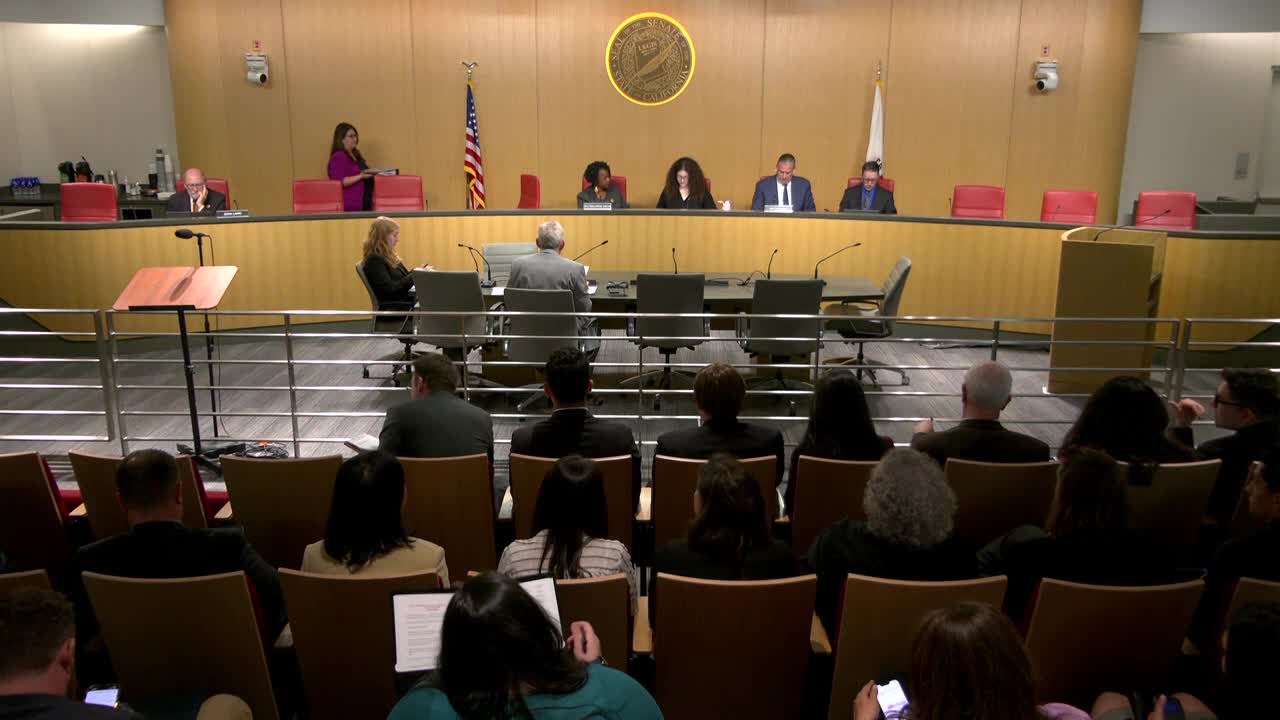 17MIN
Senate Standing Committee on Labor, Public Employment and Retirement
Bill Author