SB 703: Ports: truck drivers.
- Session Year: 2025-2026
- House: Senate
- Latest Version Date: 2025-09-18
Current Status:
Failed
(2026-03-02: Stricken from file.)
Introduced
In Committee
Awaiting First Chamber Vote
Passed First Chamber
In Committee
Awaiting Second Chamber Vote
Passed Second Chamber
Enacted
Existing law regulates the operation of ports and harbors. Existing law requires a person providing labor or services for remuneration to be considered an employee rather than an independent contractor unless the hiring entity demonstrates that certain conditions are satisfied, including that the person is free from the control and direction of the hiring entity in connection with the performance of the work, both under the contract for the performance of the work and in fact.
This bill would require a trucking company, and a truck driver who is not classified as an employee by a trucking company, to provide to a port, defined to mean the Port of Long Beach or the Port of Los Angeles, certain information, including, with respect to a trucking company, a sworn affirmation by the trucking company that the trucking company is withholding all required taxes from the wages of any truck driver who is considered an employee under state law, as specified. By expanding the scope of the crime of perjury, this bill would impose a state-mandated local program. The bill would also require, beginning January 1, 2027, that information to be made publicly available by the port. The bill would require a trucking company to update a port within 30 days of a change to its operation that results in more than 50% of its employees being replaced by independent contractors and would impose a civil penalty of $5,000 for failure to do so. The bill would make a person who provides false or misleading information for the purpose of representing compliance with those requirements liable for a civil penalty of $20,000, as prescribed.
This bill would require, beginning January 1, 2027, a port, on a quarterly basis, to publish on its internet website specified information regarding each truck that entered the port during the prior quarter. The bill would require a port, upon request of the Labor Commissioner, to provide to the Labor Commissioner additional information in the possession of the port regarding a truck that entered the port.
By imposing new duties on a port, this bill would impose a state-mandated local program.
This bill would make legislative findings and declarations as to the necessity of a special statute for the Port of Long Beach and the Port of Los Angeles.
The California Constitution requires the state to reimburse local agencies and school districts for certain costs mandated by the state. Statutory provisions establish procedures for making that reimbursement.
This bill would provide that with regard to certain mandates no reimbursement is required by this act for a specified reason.
With regard to any other mandates, this bill would provide that, if the Commission on State Mandates determines that the bill contains costs so mandated by the state, reimbursement for those costs shall be made pursuant to the statutory provisions noted above.
Existing law regulates the operation of ports and harbors. Existing law requires a person providing labor or services for remuneration to be considered an employee rather than an independent contractor unless the hiring entity demonstrates that certain conditions are satisfied, including that the person is free from the control and direction of the hiring entity in connection with the performance of the work, both under the contract for the performance of the work and in fact.
This bill would require a trucking company, and a truck driver who is not classified as an employee by a trucking company, to provide to a port, defined to mean the Port of Long Beach or the Port of Los Angeles, before an applicable truck driver enters the port, certain information, including, with respect to a trucking company, a sworn affirmation by the trucking company that the trucking company is withholding all required taxes from the wages of any truck driver who is considered an employee under state law, as specified. By expanding the scope of the crime of perjury, this bill would impose a state-mandated local program. The bill would also require require, beginning January 1, 2027, that information to be made publicly available. available by the port. The bill would require a trucking company to update a port within 30 days of a change to its operation that results in more than 50% of its employees being replaced by independent contractors and would impose a civil penalty of $5,000 for failure to do so. The bill would make a person who provides false or misleading information for the purpose of representing compliance with those requirements liable for a civil penalty of $20,000, as prescribed.
This bill would require require, beginning January 1, 2027, a port, on a quarterly basis, to publish on its internet website specified information regarding each truck that entered the port during the prior quarter. The bill would require a port, upon request of the Labor Commissioner, to provide to the Labor Commissioner additional information in the possession of the port regarding a truck that entered the port.
By imposing new duties on a port, this bill would impose a state-mandated local program.
This bill would make legislative findings and declarations as to the necessity of a special statute for the Port of Long Beach and the Port of Los Angeles.
The California Constitution requires the state to reimburse local agencies and school districts for certain costs mandated by the state. Statutory provisions establish procedures for making that reimbursement.
This bill would provide that with regard to certain mandates no reimbursement is required by this act for a specified reason.
With regard to any other mandates, this bill would provide that, if the Commission on State Mandates determines that the bill contains costs so mandated by the state, reimbursement for those costs shall be made pursuant to the statutory provisions noted above.
Existing law regulates the operation of ports and harbors. Existing law requires a person providing labor or services for remuneration to be considered an employee rather than an independent contractor unless the hiring entity demonstrates that certain conditions are satisfied, including that the person is free from the control and direction of the hiring entity in connection with the performance of the work, both under the contract for the performance of the work and in fact.
This bill would require a trucking company, and a truck driver who is not classified as an employee by a trucking company, to provide to specified ports, a port, defined to mean the Port of Long Beach or the Port of Los Angeles, before an applicable truck driver enters those ports, the port, certain information, including, with respect to a trucking company, a sworn affirmation by the trucking company that the trucking company is withholding all required taxes from the wages of any truck driver who is considered an employee under state law, as specified. By expanding the scope of the crime of perjury, this bill would impose a state-mandated local program. The bill would also require that information to be made publicly available. The bill would require a trucking company to update a port within 30 days of a change to its operation that results in more than 50% of its employees being replaced by independent contractors and would impose a civil penalty of $5,000 for failure to do so. The bill would make a person who provides false or misleading information for the purpose of representing compliance with those requirements liable for a civil penalty of $20,000, as prescribed.
This bill would require those ports to disclose, in a prominent place on their internet websites, the information provided to them pursuant to the requirements described above, as prescribed.This bill would require those ports, a port, on or before the 15th of each month, a quarterly basis, to provide to the Labor Commissioner publish on its internet website specified information regarding each truck that entered the ports port during the prior month. quarter. The bill would require those ports, a port, upon request of the Labor Commissioner, to provide additional information in the possession of the port regarding a truck that entered the ports. port.
By imposing new duties on the specified ports, a port, this bill would impose a state-mandated local program.
This bill would make legislative findings and declarations as to the necessity of a special statute for the Port of Long Beach and the Port of Los Angeles.
The California Constitution requires the state to reimburse local agencies and school districts for certain costs mandated by the state. Statutory provisions establish procedures for making that reimbursement.
This bill would provide that with regard to certain mandates no reimbursement is required by this act for a specified reason.
With regard to any other mandates, this bill would provide that, if the Commission on State Mandates determines that the bill contains costs so mandated by the state, reimbursement for those costs shall be made pursuant to the statutory provisions noted above.
Existing law regulates the operation of ports and harbors. Existing law requires a person providing labor or services for remuneration to be considered an employee rather than an independent contractor unless the hiring entity demonstrates that certain conditions are satisfied, including that the person is free from the control and direction of the hiring entity in connection with the performance of the work, both under the contract for the performance of the work and in fact.
This bill would require a trucking company, and a truck driver who is not classified as an employee by a trucking company, to provide to specified ports, before an employee an applicable truck driver enters those ports, certain information, including including, with respect to a trucking company, a sworn affirmation by the trucking company that the trucking company is withholding all required taxes from the wages of any truck driver who is considered an employee under state law, as specified. By expanding the scope of the crime of perjury, this bill would impose a state-mandated local program. The bill would require a trucking company to update a port within 30 days of a change to its operation that results in more than 50% of its employees being replaced by independent contractors and would impose a civil penalty of $5,000 for failure to do so. The bill would make a person who provides false or misleading information for the purpose of representing compliance with those requirements liable for a civil penalty of $100,000, $20,000, as prescribed.
This bill would require those ports to disclose, in a prominent place on their internet websites, the information provided to them pursuant to the requirements described above, as prescribed.
This bill would require those ports, on or before the 15th of each month, to provide to the Labor Commissioner specified information regarding each truck that entered the ports during the prior month. The bill would require those ports, upon request of the Labor Commissioner, to provide additional information regarding a truck that entered the ports.
By imposing new duties on the specified ports, this bill would impose a state-mandated local program.
This bill would make legislative findings and declarations as to the necessity of a special statute for the Port of Long Beach, Beach and the Port of Los Angeles, and the Port of Oakland. Angeles.
The California Constitution requires the state to reimburse local agencies and school districts for certain costs mandated by the state. Statutory provisions establish procedures for making that reimbursement.
This bill would provide that with regard to certain mandates no reimbursement is required by this act for a specified reason.
With regard to any other mandates, this bill would provide that, if the Commission on State Mandates determines that the bill contains costs so mandated by the state, reimbursement for those costs shall be made pursuant to the statutory provisions noted above.
Existing law regulates the operation of ports and harbors. Existing law requires a person providing labor or services for remuneration to be considered an employee rather than an independent contractor unless the hiring entity demonstrates that certain conditions are satisfied, including that the person is free from the control and direction of the hiring entity in connection with the performance of the work, both under the contract for the performance of the work and in fact.
This bill would require a trucking company company, and a truck driver who is not classified as an employee by a trucking company company, to provide to a port, specified ports, before a an employee truck driver enters the port, those ports, certain information related to the truck drivers legal classification as either an employee or an independent contractor, information, including a sworn affirmation by a the trucking company that the trucking company is withholding all required taxes from the wages of any truck driver who is considered an employee under state law. law, as specified. By expanding the scope of the crime of perjury, this bill would impose a state-mandated local program. The bill would punish make a person who provides false or misleading information for the purpose of representing compliance with the bill with a certain those requirements liable for a civil penalty, penalty of $100,000, as prescribed.
This bill would require a port those ports to disclose, in a prominent place on its their internet website, websites, the information provided to the port them pursuant to the provision requirements described above, as prescribed.
This bill would require a port, those ports, on or before the 15th of each month, to provide to the Labor Commissioner specified information regarding each truck that entered the port ports during the prior month. The bill would require a port, those ports, upon request of the Labor Commissioner, to provide additional information regarding a truck that entered the port. ports.
By imposing new duties on the specified ports, this bill would impose a state-mandated local program.
This bill would make legislative findings and declarations as to the necessity of a special statute for the Port of Long Beach, the Port of Los Angeles, and the Port of Oakland.
The California Constitution requires the state to reimburse local agencies and school districts for certain costs mandated by the state. Statutory provisions establish procedures for making that reimbursement.
This bill would provide that with regard to certain mandates no reimbursement is required by this act for a specified reason.
With regard to any other mandates, this bill would provide that, if the Commission on State Mandates determines that the bill contains costs so mandated by the state, reimbursement for those costs shall be made pursuant to the statutory provisions noted above.
Existing law regulates the operation of ports and harbors. Existing law requires a person providing labor or services for remuneration to be considered an employee rather than an independent contractor unless the hiring entity demonstrates that certain conditions are satisfied, including that the person is free from the control and direction of the hiring entity in connection with the performance of the work, both under the contract for the performance of the work and in fact.
This bill would require a trucking company and a truck driver who is not classified as an employee by a trucking company to provide to a port, before a truck driver enters the port, certain information related to the truck drivers legal classification as either an employee or an independent contractor, including a sworn affirmation by a trucking company that the trucking company is withholding all required taxes from the wages of any truck driver who is considered an employee under state law. By expanding the scope of the crime of perjury, this bill would impose a state-mandated local program. The bill would punish a person who provides false or misleading information for the purpose of representing compliance with the bill with a certain civil penalty, as prescribed.
This bill would require a port to disclose, in a prominent place on its internet website, information provided by a trucking company that uses the port, including, but not limited to, whether the trucking company uses employees, independent contractors, or both. The bill would prohibit a port from granting entry to a trucking company if the trucking company has not provided to the port the information that is required to be disclosed on the ports internet website. The bill would impose a penalty of $60,000 on a port for each trucking company that is granted entry to the port in violation of that prohibition. to the port pursuant to the provision described above, as prescribed.
This bill would require a port, on or before the 15th of each month, to provide to the Labor Commissioner specified information regarding each truck that entered the port during the prior month. The bill would require a port, upon request of the Labor Commissioner, to provide additional information regarding a truck that entered the port.
By imposing new duties on ports, this bill would impose a state-mandated local program.
The California Constitution requires the state to reimburse local agencies and school districts for certain costs mandated by the state. Statutory provisions establish procedures for making that reimbursement.
This bill would provide that with regard to certain mandates no reimbursement is required by this act for a specified reason.
With regard to any other mandates, this bill would provide that, if the Commission on State Mandates determines that the bill contains costs so mandated by the state, reimbursement for those costs shall be made pursuant to the statutory provisions noted above.
Existing law regulates the operation of ports and harbors. Existing law requires a person providing labor or services for remuneration to be considered an employee rather than an independent contractor unless the hiring entity demonstrates that certain conditions are satisfied, including that the person is free from the control and direction of the hiring entity in connection with the performance of the work, both under the contract for the performance of the work and in fact.
This bill would require a trucking company and a truck driver who is not classified as an employee by a trucking company to provide to a port, before a truck driver enters the port, certain information related to the truck drivers legal classification as either an employee or an independent contractor, including a sworn affirmation by a trucking company that the trucking company is withholding all required taxes from the wages of any truck driver who is considered an employee under state law. By expanding the scope of the crime of perjury, this bill would impose a state-mandated local program. The bill would punish a person who provides false or misleading information for the purpose of representing compliance with the bill with a certain civil penalty, as prescribed.
This bill would require a port to disclose, in a prominent place on its internet website, information provided by a trucking company that uses the port, including, but not limited to, whether the trucking company uses employees, independent contractors, or both. The bill would prohibit a port from granting entry to a trucking company if the trucking company has not provided to the port the information that is required to be disclosed on the ports internet website. The bill would impose a penalty of $60,000 on a port for each trucking company that is granted entry to the port in violation of that prohibition.
This bill would require a port, on or before the 15th of each month, to provide to the Labor Commissioner specified information regarding each truck that entered the port during the prior month. The bill would require a port, upon request of the Labor Commissioner, to provide additional information regarding a truck that entered the port.
By imposing new duties on ports, this bill would impose a state-mandated local program.
The California Constitution requires the state to reimburse local agencies and school districts for certain costs mandated by the state. Statutory provisions establish procedures for making that reimbursement.
This bill would provide that with regard to certain mandates no reimbursement is required by this act for a specified reason.
With regard to any other mandates, this bill would provide that, if the Commission on State Mandates determines that the bill contains costs so mandated by the state, reimbursement for those costs shall be made pursuant to the statutory provisions noted above.
Unless the context otherwise requires, the definitions in this chapter apply to this part.
2001.Port means either of the following:
(a)The Port of Long Beach.
(b)The Port of Los Angeles.
2002.SCAC has the same meaning as defined in Section 2790 of the Labor Code.
2003.Trucking company has the same meaning as defined in Section 2790 of the Labor Code.
2.Trucking Companies2050.(a)Beginning January 1, 2027, a port shall, on a quarterly basis, publish on its internet website all of the following information regarding each truck that entered the port during the prior quarter:
(1)The name of the port and gate used for entry.
(2)The date and time of entry.
(3)The name of the owner of the truck.
(4)The standard SCAC, if any, and the owner of the SCAC.
(5)Whose authority was used for entry.
(6)The named insured on the insurance policy that covered the truck.
(7)The United States Department of Transportation registration number on the truck and the name of the individual who is associated with that registration.
(b)Upon request by the Labor Commissioner, a port shall provide to the Labor Commissioner additional information in the possession of the port regarding a truck that entered the port.
(c)A port is not required to verify the accuracy of any information provided or published pursuant to this chapter that it received from a third party.
SEC. 2.Article 1.6 (commencing with Section 2790) is added to Chapter 2 of Division 3 of the Labor Code, to read:1.6.Truck Drivers at Ports2790.As used in this article:
(a)Port means either of the following:
(1)The Port of Long Beach.
(2)The Port of Los Angeles.
(b)SCAC means a Standard Carrier Alpha Code issued by the National Motor Freight Traffic Association, Inc.
(c)Trucking company means a port drayage motor carrier, as defined in Section 2810.4, who employs, or contracts with, truck drivers to move cargo to or from a port for the companys customers under the companys state or federal operating authority or using the companys SCAC.
(d)Truck driver has the same meaning as commercial driver, as defined in Section 2810.4.
2790.1.(a)A trucking company shall provide to a port, and the port shall receive, all of the following with respect to that trucking companys employee truck drivers on an annual basis:
(1)A workers compensation insurance policy that covers all employee truck drivers.
(2)The number of employee truck drivers covered by the workers compensation insurance policy.
(3)A sworn affirmation that the trucking company is withholding all required taxes from the wages of any truck driver who is considered an employee under state law.
(b)A truck driver who is not an employee shall provide to a port on an annual basis all of the following:
(1)Proof of insurance.
(2)The truck drivers federal operating authority, commonly referred to as a Motor Carrier (MC) number.
(3)The truck drivers Department of Transportation (DOT) number issued by the Federal Department of Transportation.
(4)The truck drivers California number issued by the Department of the California Highway Patrol.
(5)The truck drivers California motor carrier permit.
(6)The truck drivers SCAC or the identity of the owner of the SCAC being used.
(7)The trucks registration with the Department of Transportation.
(c)A trucking company shall update the port within 30 days of a change to its operation that results in more than 50 percent of its employees being replaced by independent contractors.
(d)Beginning January 1, 2027, any information collected pursuant to this section shall be made publicly available by the port.
(e)In order to facilitate efficient and cost-effective information collection pursuant to this section, a port may develop a simplified form that can be completed online.
2790.2.(a)A person who provides false or misleading information for the purpose of representing compliance with this article shall be liable for a civil penalty in the amount of twenty thousand dollars ($20,000).
(b)A person who fails to comply with subdivision (c) of Section 2790.1 shall be liable for a civil penalty in the amount of five thousand dollars ($5,000).
SEC. 3.The Legislature finds and declares that a special statute is necessary and that a general statute cannot be made applicable within the meaning of Section 16 of Article IV of the California Constitution because the uniquely high volumes of goods processed at the Port of Long Beach and the Port of Los Angeles require the additional process required pursuant to this act to protect workers.
SEC. 4.No reimbursement is required by this act pursuant to Section 6 of Article XIIIB of the California Constitution for certain costs that may be incurred by a local agency or school district because, in that regard, this act creates a new crime or infraction, eliminates a crime or infraction, or changes the penalty for a crime or infraction, within the meaning of Section 17556 of the Government Code, or changes the definition of a crime within the meaning of Section 6 of Article XIIIB of the California Constitution.
However, if the Commission on State Mandates determines that this act contains other costs mandated by the state, reimbursement to local agencies and school districts for those costs shall be made pursuant to Part 7 (commencing with Section 17500) of Division 4 of Title 2 of the Government Code.
Unless the context otherwise requires, the definitions in this chapter apply to this part.
2001.Port means either of the following:
(a)The Port of Long Beach.
(b)The Port of Los Angeles.
2002.SCAC has the same meaning as defined in Section 2790 of the Labor Code.
2003.Trucking company has the same meaning as defined in Section 2790 of the Labor Code.
2.Trucking Companies2050.(a)A Beginning January 1, 2027, a port shall, on a quarterly basis, publish on its internet website all of the following information regarding each truck that entered the port during the prior quarter:
(1)The name of the port and gate used for entry.
(2)The date and time of entry.
(3)The name of the owner of the truck.
(4)The standard SCAC, if any, and the owner of the SCAC.
(5)Whose authority was used for entry.
(6)The named insured on the insurance policy that covered the truck.
(7)The United States Department of Transportation registration number on the truck and the name of the individual who is associated with that registration.
(b)Upon request by the Labor Commissioner, a port shall provide to the Labor Commissioner additional information in the possession of the port regarding a truck that entered the port.
(c)A port is not required to verify the accuracy of any information provided or published pursuant to this chapter that it receives received from a third party.
SEC. 2.Article 1.6 (commencing with Section 2790) is added to Chapter 2 of Division 3 of the Labor Code, to read:1.6.Truck Drivers at Ports2790.As used in this article:
(a)Port means either of the following:
(1)The Port of Long Beach.
(2)The Port of Los Angeles.
(b)SCAC means a Standard Carrier Alpha Code issued by the National Motor Freight Traffic Association, Inc.
(c)Trucking company means a port drayage motor carrier, as defined in Section 2810.4, who employs, or contracts with, truck drivers to move cargo to or from a port for the companys customers under the companys state or federal operating authority or using the companys SCAC.
(d)Truck driver has the same meaning as commercial driver, as defined in Section 2810.4.
2790.1.(a)A trucking company shall provide to a port, and the port shall receive, all of the following with respect to that trucking companys employee truck drivers before entering a port for the first time and on an annual basis thereafter: basis:
(1)A workers compensation insurance policy that covers all employee truck drivers.
(2)The number of employee truck drivers covered by the workers compensation insurance policy.
(3)A sworn affirmation that the trucking company is withholding all required taxes from the wages of any truck driver who is considered an employee under state law.
(b)A truck driver who is not an employee shall provide to a port, before entering the port for the first time and port on an annual basis thereafter, all of the following:
(1)Proof of insurance.
(2)The truck drivers federal operating authority, commonly referred to as a Motor Carrier (MC) number.
(3)The truck drivers Department of Transportation (DOT) number issued by the Federal Department of Transportation.
(4)The truck drivers California number issued by the Department of the California Highway Patrol.
(5)The truck drivers California motor carrier permit.
(6)The truck drivers SCAC or the identity of the owner of the SCAC being used.
(7)The trucks registration with the Department of Transportation.
(c)A trucking company shall update the port within 30 days of a change to its operation that results in more than 50 percent of its employees being replaced by independent contractors.
(d)Any Beginning January 1, 2027, any information collected pursuant to this section shall be made publicly available. available by the port.
(e)In order to facilitate efficient and cost-effective information collection pursuant to this section, a port may develop a simplified form that can be completed online.
2790.2.(a)A person who provides false or misleading information for the purpose of representing compliance with this article shall be liable for a civil penalty in the amount of twenty thousand dollars ($20,000).
(b)A person who fails to comply with subdivision (c) of Section 2790.1 shall be liable for a civil penalty in the amount of five thousand dollars ($5,000).
SEC. 3.The Legislature finds and declares that a special statute is necessary and that a general statute cannot be made applicable within the meaning of Section 16 of Article IV of the California Constitution because the uniquely high volumes of goods processed at the Port of Long Beach and the Port of Los Angeles require the additional process required pursuant to this act to protect workers.
SEC. 4.No reimbursement is required by this act pursuant to Section 6 of Article XIIIB of the California Constitution for certain costs that may be incurred by a local agency or school district because, in that regard, this act creates a new crime or infraction, eliminates a crime or infraction, or changes the penalty for a crime or infraction, within the meaning of Section 17556 of the Government Code, or changes the definition of a crime within the meaning of Section 6 of Article XIIIB of the California Constitution.
However, if the Commission on State Mandates determines that this act contains other costs mandated by the state, reimbursement to local agencies and school districts for those costs shall be made pursuant to Part 7 (commencing with Section 17500) of Division 4 of Title 2 of the Government Code.
Unless the context otherwise requires, the definitions in this chapter apply to this part.
2001.Port means either of the following:
(a)The Port of Long Beach.
(b)The Port of Los Angeles.
2002.SCAC has the same meaning as defined in Section 2790 of the Labor Code.
2003.Trucking company has the same meaning as defined in Section 2790 of the Labor Code.
2.Trucking Companies2050.A port shall disclose, in a prominent place on its internet website, the information provided to the port by a trucking company pursuant to Section 2790.1 of the Labor Code.2051. 2050.(a)A port shall, on or before the 15th of each month, provide to the Labor Commissioner a quarterly basis, publish on its internet website all of the following information regarding each truck that entered the port during the prior month: quarter:
(1)The name of the port and gate used for entry.
(2)The date and time of entry.
(3)The name of the truck driver and the truck drivers authority information.(4)(3)The name of the owner of the truck.
(5)The name of the owner of the cargo moved by the truck.(6)(4)The standard SCAC, if any, and the owner of the SCAC.
(7)(5)Whose authority was used for entry.
(8)(6)The named insured on the insurance policy that covered the truck.
(9)(7)The United States Department of Transportation registration number on the truck and the name of the individual who is associated with that registration.
(b)Upon request by the Labor Commissioner, a port shall provide additional information in the possession of the port regarding a truck that entered the port.
(c)A port is not required to verify the accuracy of any information provided pursuant to this chapter that it receives from a third party.
SEC. 2.Article 1.6 (commencing with Section 2790) is added to Chapter 2 of Division 3 of the Labor Code, to read:1.6.Truck Drivers at Ports2790.As used in this article:
(a)Port means either of the following:
(1)The Port of Long Beach.
(2)The Port of Los Angeles.
(b)SCAC means a Standard Carrier Alpha Code issued by the National Motor Freight Traffic Association, Inc.
(c)Trucking company means a company port drayage motor carrier, as defined in Section 2810.4, who employs, or contracts with, truck drivers to move cargo to or from a port for the companys customers under the companys state or federal operating authority or using the companys SCAC.
(d)Truck driver has the same meaning as commercial driver, as defined in Section 2810.4.
2790.1.(a)A trucking company shall provide to a port, and the port shall receive, all of the following with respect to that trucking companys employee truck drivers before entering a port for the first time and on an annual basis thereafter:
(1)A workers compensation insurance policy that covers all employee truck drivers.
(2)The number of employee truck drivers covered by the workers compensation insurance policy.
(3)A sworn affirmation that the trucking company is withholding all required taxes from the wages of any truck driver who is considered an employee under state law.
(b)A truck driver who is not an employee shall provide to a port, before entering the port for the first time and on an annual basis thereafter, all of the following:
(1)Proof of insurance.
(2)The truck drivers federal operating authority, commonly referred to as a Motor Carrier (MC) number.
(3)The truck drivers Department of Transportation (DOT) number issued by the Federal Department of Transportation.
(4)The truck drivers California number issued by the Department of the California Highway Patrol.
(5)The truck drivers California motor carrier permit.
(6)The truck drivers SCAC or the identity of the owner of the SCAC being used.
(7)The trucks registration with the Department of Transportation.
(c)A trucking company shall update the port within 30 days of a change to its operation that results in more than 50 percent of its employees being replaced by independent contractors.
(d)Any information collected pursuant to this section shall be made publicly available.
2790.2.(a)A person who provides false or misleading information for the purpose of representing compliance with this article shall be liable for a civil penalty in the amount of twenty thousand dollars ($20,000).
(b)A person who fails to comply with subdivision (c) of Section 2790.1 shall be liable for a civil penalty in the amount of five thousand dollars ($5,000).
SEC. 3.The Legislature finds and declares that a special statute is necessary and that a general statute cannot be made applicable within the meaning of Section 16 of Article IV of the California Constitution because the uniquely high volumes of goods processed at the Port of Long Beach and the Port of Los Angeles require the additional process required pursuant to this act to protect workers.
SEC. 4.No reimbursement is required by this act pursuant to Section 6 of Article XIIIB of the California Constitution for certain costs that may be incurred by a local agency or school district because, in that regard, this act creates a new crime or infraction, eliminates a crime or infraction, or changes the penalty for a crime or infraction, within the meaning of Section 17556 of the Government Code, or changes the definition of a crime within the meaning of Section 6 of Article XIIIB of the California Constitution.
However, if the Commission on State Mandates determines that this act contains other costs mandated by the state, reimbursement to local agencies and school districts for those costs shall be made pursuant to Part 7 (commencing with Section 17500) of Division 4 of Title 2 of the Government Code.
Unless the context otherwise requires, the definitions in this chapter apply to this part.
2001.Port means any either of the following:
(a)The Port of Long Beach.
(b)The Port of Los Angeles.
(c)The Port of Oakland.2002.SCAC has the same meaning as defined in Section 2790 of the Labor Code.
2003.Trucking company has the same meaning as defined in Section 2790 of the Labor Code.
2.Trucking Companies2050.A port shall disclose, in a prominent place on its internet website, the information provided to the port by a trucking company pursuant to Section 2790.1 of the Labor Code.
2051.(a)A port shall, on or before the 15th of each month, provide to the Labor Commissioner all of the following information regarding each truck that entered the port during the prior month:
(1)The name of the port and gate used for entry.
(2)The date and time of entry.
(3)The name of the truck driver and the truck drivers authority information.
(4)The name of the owner of the truck.
(5)The name of the owner of the cargo moved by the truck.
(6)The standard SCAC, if any, and the owner of the SCAC.
(7)Whose authority was used for entry.
(8)The named insured on the insurance policy that covered the truck.
(9)The United States Department of Transportation registration number on the truck and the name of the individual who is associated with that registration.
(b)Upon request by the Labor Commissioner, a port shall provide additional information regarding a truck that entered the port.
SEC. 2.Article 1.6 (commencing with Section 2790) is added to Chapter 2 of Division 3 of the Labor Code, to read:1.6.Truck Drivers at Ports2790.As used in this article:
(a)Port means any either of the following:
(1)The Port of Long Beach.
(2)The Port of Los Angeles.
(3)The Port of Oakland.(b)SCAC means a Standard Carrier Alpha Code issued by the National Motor Freight Traffic Association, Inc.
(c)Trucking company means a company who employs, or contracts with, truck drivers to move cargo for the companys customers under the companys state or federal operating authority or using the companys SCAC.
2790.1.(a)A trucking company shall provide to a port, and the port shall receive, before any employee truck driver enters a port, receive, all of the following with respect to that trucking companys employee truck drivers: drivers before entering a port for the first time and on an annual basis thereafter:
(1)A workers compensation insurance policy that covers all employee truck drivers.
(2)The number of employee truck drivers covered by the workers compensation insurance policy.
(3)A sworn affirmation that the trucking company is withholding all required taxes from the wages of any truck driver who is considered an employee under state law.
(b)A truck driver who is not an employee shall provide to a port, before entering the port, port for the first time and on an annual basis thereafter, all of the following:
(1)Proof of insurance.
(2)The truck drivers federal operating authority, commonly referred to as a Motor Carrier (MC) number.
(3)The truck drivers Department of Transportation (DOT) number issued by the Federal Department of Transportation.
(4)The truck drivers California number issued by the Department of the California Highway Patrol.
(5)The truck drivers California motor carrier permit.
(6)The truck drivers SCAC or the identity of the owner of the SCAC being used.
(7)The trucks registration with the Department of Transportation.
(c)A trucking company shall update the port within 30 days of a change to its operation that results in more than 50 percent of its employees being replaced by independent contractors.
2790.2.(a)A person who provides false or misleading information for the purpose of representing compliance with this article shall be liable for a civil penalty in the amount of one hundred twenty thousand dollars ($100,000). ($20,000).
(b)A person who fails to comply with subdivision (c) of Section 2790.1 shall be liable for a civil penalty in the amount of five thousand dollars ($5,000).
SEC. 3.The Legislature finds and declares that a special statute is necessary and that a general statute cannot be made applicable within the meaning of Section 16 of Article IV of the California Constitution because the uniquely high volumes of goods processed at the Port of Long Beach, Beach and the Port of Los Angeles, and the Port of Oakland Angeles require the additional process required pursuant to this act to protect workers.
SEC. 4.No reimbursement is required by this act pursuant to Section 6 of Article XIIIB of the California Constitution for certain costs that may be incurred by a local agency or school district because, in that regard, this act creates a new crime or infraction, eliminates a crime or infraction, or changes the penalty for a crime or infraction, within the meaning of Section 17556 of the Government Code, or changes the definition of a crime within the meaning of Section 6 of Article XIIIB of the California Constitution.
However, if the Commission on State Mandates determines that this act contains other costs mandated by the state, reimbursement to local agencies and school districts for those costs shall be made pursuant to Part 7 (commencing with Section 17500) of Division 4 of Title 2 of the Government Code.
Unless the context otherwise requires, the definitions in this chapter apply to this part.
2001.Port means a port in the state, including, but not limited to, all any of the following:
(a)The Port of Benicia.(b)The Port of Hueneme.(c)(a)The Port of Long Beach.
(d)(b)The Port of Los Angeles.
(e)(c)The Port of Oakland.
(f)The Port of Redwood City.(g)The Port of Richmond.(h)The Port of San Diego.(i)The Port of San Francisco.(j)The Port of Stockton.(k)The Port of West Sacramento.(l)The Humboldt Bay Harbor District.2002.SCAC has the same meaning as defined in Section 2790 of the Labor Code.
2002.2003.Trucking company has the same meaning as defined in Section 2790 of the Labor Code.
2003.SCAC means a Standard Carrier Alpha Code issued by the National Motor Freight Traffic Association, Inc.2.Trucking Companies2050.As used in this chapter, port means any of the following:(a)The Port of Long Beach.(b)The Port of Los Angeles.(c)The Port of Oakland.2051.2050.A port shall disclose, in a prominent place on its internet website, the information provided to the port by a trucking company pursuant to Section 2790.1 of the Labor Code.
2052.2051.(a)A port shall, on or before the 15th of each month, provide to the Labor Commissioner all of the following information regarding each truck that entered the port during the prior month:
(1)The name of the port and gate used for entry.
(2)The date and time of entry.
(3)The name of the truck driver and the truck drivers authority information.
(4)The name of the owner of the truck.
(5)The name of the owner of the cargo moved by the truck.
(6)The standard SCAC, if any, and the owner of the SCAC.
(7)Whose authority was used for entry.
(8)The named insured on the insurance policy that covered the truck.
(9)The United States Department of Transportation registration number on the truck and the name of the individual who is associated with that registration.
(b)Upon request by the Labor Commissioner, a port shall provide additional information regarding a truck that entered the port.
SEC. 2.Article 1.6 (commencing with Section 2790) is added to Chapter 2 of Division 3 of the Labor Code, to read:1.6.Truck Drivers at Ports2790.As used in this article:
(a)Employee means a truck driver who is an employee of a trucking company or a truck driver who is unable to comply with subdivision (b) of Section 2790.1.(b)(a)Port means any of the following:
(1)The Port of Long Beach.
(2)The Port of Los Angeles.
(3)The Port of Oakland.
(c)(b)SCAC means a Standard Carrier Alpha Code issued by the National Motor Freight Traffic Association, Inc.
(d)(c)Trucking company means a company who employs, or contracts with, truck drivers to move cargo for the companys customers under the companys state or federal operating authority or using the companys SCAC.
2790.1.(a)A trucking company shall provide to a port, and the port shall receive, before any employee truck driver enters a port, all of the following with respect to that entitys trucking companys employee truck drivers:
(1)A workers compensation insurance policy that covers all employee truck drivers.
(2)The number of trucker driver employees employee truck drivers covered by the workers compensation insurance policy.
(3)A sworn affirmation that the trucking company is withholding all required taxes from the wages of any truck driver who is considered an employee under state law.
(b)A truck driver who is not an employee shall provide to a port, before entering the port, all of the following:
(1)Proof of insurance.
(2)The truck drivers federal operating authority, commonly referred to as a Motor Carrier (MC) number.
(3)The truck drivers Department of Transportation (DOT) number issued by the Federal Department of Transportation.
(4)The truck drivers California number issued by the Department of the California Highway Patrol.
(5)The truck drivers California motor carrier permit.
(6)The truck drivers SCAC or the identity of the owner of the SCAC being used.
(7)The trucks registration with the Department of Transportation.
2790.2.A person who provides false or misleading information for the purpose of representing compliance with this article shall be liable for a civil penalty in the amount of one hundred thousand dollars ($100,000).
SEC. 3.The Legislature finds and declares that a special statute is necessary and that a general statute cannot be made applicable within the meaning of Section 16 of Article IV of the California Constitution because the uniquely high volumes of goods processed at the Port of Long Beach, the Port of Los Angeles, and the Port of Oakland require the additional process required pursuant to this act to protect workers.
SEC. 3.SEC. 4.No reimbursement is required by this act pursuant to Section 6 of Article XIIIB of the California Constitution for certain costs that may be incurred by a local agency or school district because, in that regard, this act creates a new crime or infraction, eliminates a crime or infraction, or changes the penalty for a crime or infraction, within the meaning of Section 17556 of the Government Code, or changes the definition of a crime within the meaning of Section 6 of Article XIIIB of the California Constitution.
However, if the Commission on State Mandates determines that this act contains other costs mandated by the state, reimbursement to local agencies and school districts for those costs shall be made pursuant to Part 7 (commencing with Section 17500) of Division 4 of Title 2 of the Government Code.
Unless the context otherwise requires, the definitions in this chapter apply to this part.
2001.Port means a port in the state, including, but not limited to, all of the following:
(a)The Port of Benicia.
(b)The Port of Hueneme.
(c)The Port of Long Beach.
(d)The Port of Los Angeles.
(e)The Port of Oakland.
(f)The Port of Redwood City.
(g)The Port of Richmond.
(h)The Port of San Diego.
(i)The Port of San Francisco.
(j)The Port of Stockton.
(k)The Port of West Sacramento.
(l)The Humboldt Bay Harbor District.
2002.Trucking company has the same meaning as Section 2790 of the Labor Code.
2003.SCAC means a Standard Carrier Alpha Code issued by the National Motor Freight Traffic Association, Inc.
2.Trucking Companies2050.As used in this chapter, port means any of the following:
(a)The Port of Long Beach.
(b)The Port of Los Angeles.
(c)The Port of Oakland.
2050.2051.A port shall disclose, in a prominent place on its internet website, the information provided to the port by a trucking company pursuant to Section 2790.1 of the Labor Code.
2051.(a) A port shall not grant entry to a trucking company if the trucking company has not complied with Section 2790.1 of the Labor Code.(b)A port shall be subject to a penalty of sixty thousand dollars ($60,000) for each trucking company that is granted entry to the port in violation of subdivision (a) unless that entry was gained through the trucking company providing false or misleading information.(c)A penalty under this section shall be assessed and collected by the Labor Commissioner.2052.(a)A port shall, on or before the 15th of each month, provide to the Labor Commissioner all of the following information regarding each truck that entered the port during the prior month:
(1)The name of the port and gate used for entry.
(2)The date and time of entry.
(3)The name of the truck driver and the truck drivers authority information.
(4)The name of the owner of the truck.
(5)The name of the owner of the cargo moved by the truck.
(6)The standard SCAC, if any, and the owner of the SCAC.
(7)Whose authority was used for entry.
(8)The named insured on the insurance policy that covered the truck.
(9)The United States Department of Transportation registration number on the truck and the name of the individual who is associated with that registration.
(b)Upon request by the Labor Commissioner, a port shall provide additional information regarding a truck that entered the port.
SEC. 2.Article 1.6 (commencing with Section 2790) is added to Chapter 2 of Division 3 of the Labor Code, to read:1.6.Truck Drivers at Ports2790.As used in this article:
(a)Employee means a truck driver who is an employee of a trucking company or a truck driver who is unable to comply with subdivision (b) of Section 2790.1.
(b)Port means any of the following:
(1)The Port of Long Beach.
(2)The Port of Los Angeles.
(3)The Port of Oakland.
(b)(c)SCAC means a Standard Carrier Alpha Code issued by the National Motor Freight Traffic Association, Inc.
(c)(d)Trucking company means a company who employs, or contracts with, truck drivers to move cargo for the companys customers under the companys state or federal operating authority or using the companys SCAC.
2790.1.(a)A trucking company shall provide to a port, port, and the port shall receive, before any employee enters a port, all of the following with respect to that entitys employee truck drivers:
(1)A workers compensation insurance policy that covers all employee truck drivers.
(2)The number of trucker driver employees covered by the workers compensation insurance policy.
(3)A sworn affirmation that the trucking company is withholding all required taxes from the wages of any driver who is considered an employee under state law.
(b)(1)A truck driver who is not an employee shall provide to a port, before entering the port, all of the following:
(A)(1)Proof of insurance.
(B)(2)The truck drivers federal operating authority, commonly referred to as a Motor Carrier (MC) number.
(C)(3)The truck drivers Department of Transportation (DOT) number issued by the Federal Department of Transportation.
(D)(4)The truck drivers California number issued by the Department of the California Highway Patrol.
(E)(5)The truck drivers California motor carrier permit.
(F)(6)The truck drivers SCAC. SCAC or the identity of the owner of the SCAC being used.
(G)(7)The trucks registration with the Department of Transportation.
(2)A truck driver who is not classified as an employee by a trucking company shall pick up a container only using the truck drivers own SCAC.(3)A truck driver who is not an employee shall display the name of the trucking company with which the truck driver contracts or that the truck driver owns on the doors of the truck before entering, and while on the premises of, a port.2790.2.(a)A person who provides false or misleading information for the purpose of representing compliance with this article shall be liable for a civil penalty in the amount of one hundred thousand dollars ($100,000).
(b)A person who, by providing false or misleading information for the purpose of representing compliance with this article, gains entry to a port shall be additionally liable for a civil penalty in the amount of sixty thousand dollars ($60,000).SEC. 3.No reimbursement is required by this act pursuant to Section 6 of Article XIIIB of the California Constitution for certain costs that may be incurred by a local agency or school district because, in that regard, this act creates a new crime or infraction, eliminates a crime or infraction, or changes the penalty for a crime or infraction, within the meaning of Section 17556 of the Government Code, or changes the definition of a crime within the meaning of Section 6 of Article XIIIB of the California Constitution.
However, if the Commission on State Mandates determines that this act contains other costs mandated by the state, reimbursement to local agencies and school districts for those costs shall be made pursuant to Part 7 (commencing with Section 17500) of Division 4 of Title 2 of the Government Code.
Unless the context otherwise requires, the definitions in this chapter apply to this part.
2001.Port means a port in the state, including, but not limited to, all of the following:
(a)The Port of Benicia.
(b)The Port of Hueneme.
(c)The Port of Long Beach.
(d)The Port of Los Angeles.
(e)The Port of Oakland.
(f)The Port of Redwood City.
(g)The Port of Richmond.
(h)The Port of San Diego.
(i)The Port of San Francisco.
(j)The Port of Stockton.
(k)The Port of West Sacramento.
(l)The Humboldt Bay Harbor District.
2002.Trucking company has the same meaning as Section 2790 of the Labor Code.
2003.SCAC means a Standard Carrier Alpha Code issued by the National Motor Freight Traffic Association, Inc.
2.Trucking Companies2050.A port shall disclose, in a prominent place on its internet website, the information provided to the port by a trucking company pursuant to Section 2790.1 of the Labor Code.
2051.(a) A port shall not grant entry to a trucking company if the trucking company has not complied with Section 2790.1 of the Labor Code.
(b)A port shall be subject to a penalty of sixty thousand dollars ($60,000) for each trucking company that is granted entry to the port in violation of subdivision (a) unless that entry was gained through the trucking company providing false or misleading information.
(c)A penalty under this section shall be assessed and collected by the Labor Commissioner.
2052.(a)A port shall, on or before the 15th of each month, provide to the Labor Commissioner all of the following information regarding each truck that entered the port during the prior month:
(1)The name of the port and gate used for entry.
(2)The date and time of entry.
(3)The name of the truck driver and the truck drivers authority information.
(4)The name of the owner of the truck.
(5)The name of the owner of the cargo moved by the truck.
(6)The standard SCAC, if any, and the owner of the SCAC.
(7)Whose authority was used for entry.
(8)The named insured on the insurance policy that covered the truck.
(9)The United States Department of Transportation registration number on the truck and the name of the individual who is associated with that registration.
(b)Upon request by the Labor Commissioner, a port shall provide additional information regarding a truck that entered the port.
SEC. 2.Article 1.6 (commencing with Section 2790) is added to Chapter 2 of Division 3 of the Labor Code, to read:1.6.Truck Drivers at Ports2790.As used in this article:
(a)Employee means a truck driver who is an employee of a trucking company or a truck driver who is unable to comply with subdivision (b) of Section 2790.1.
(b)SCAC means a Standard Carrier Alpha Code issued by the National Motor Freight Traffic Association, Inc.
(c)Trucking company means a company who employs, or contracts with, truck drivers to move cargo for the companys customers under the companys state or federal operating authority or using the companys SCAC.
2790.1.(a)A trucking company shall provide to a port, before any employee enters a port, all of the following with respect to that entitys employee truck drivers:
(1)A workers compensation insurance policy that covers all employee truck drivers.
(2)The number of trucker driver employees covered by the workers compensation insurance policy.
(3)A sworn affirmation that the trucking company is withholding all required taxes from the wages of any driver who is considered an employee under state law.
(b)(1)A truck driver who is not an employee shall provide to a port, before entering the port, all of the following:
(A)Proof of insurance.
(B)The truck drivers federal operating authority, commonly referred to as a Motor Carrier (MC) number.
(C)The truck drivers Department of Transportation (DOT) number issued by the Federal Department of Transportation.
(D)The truck drivers California number issued by the Department of the California Highway Patrol.
(E)The truck drivers California motor carrier permit.
(F)The truck drivers SCAC.
(G)The trucks registration with the Department of Transportation.
(2)A truck driver who is not classified as an employee by a trucking company shall pick up a container only using the truck drivers own SCAC.
(3)A truck driver who is not an employee shall display the name of the trucking company with which the truck driver contracts or that the truck driver owns on the doors of the truck before entering, and while on the premises of, a port.
2790.2.(a)A person who provides false or misleading information for the purpose of representing compliance with this article shall be liable for a civil penalty in the amount of one hundred thousand dollars ($100,000).
(b)A person who, by providing false or misleading information for the purpose of representing compliance with this article, gains entry to a port shall be additionally liable for a civil penalty in the amount of sixty thousand dollars ($60,000).
SEC. 3.No reimbursement is required by this act pursuant to Section 6 of Article XIIIB of the California Constitution for certain costs that may be incurred by a local agency or school district because, in that regard, this act creates a new crime or infraction, eliminates a crime or infraction, or changes the penalty for a crime or infraction, within the meaning of Section 17556 of the Government Code, or changes the definition of a crime within the meaning of Section 6 of Article XIIIB of the California Constitution.
However, if the Commission on State Mandates determines that this act contains other costs mandated by the state, reimbursement to local agencies and school districts for those costs shall be made pursuant to Part 7 (commencing with Section 17500) of Division 4 of Title 2 of the Government Code.
|
Date
|
Status
|
|---|---|
| Mar 2, 2026 | Veto sustained. |
| Mar 2, 2026 | Stricken from file. |
| Oct 13, 2025 | In Senate. Consideration of Governor's veto pending. |
| Oct 13, 2025 | Vetoed by the Governor. |
| Sep 23, 2025 | Enrolled and presented to the Governor at 2 p.m. |
| Sep 13, 2025 | Assembly amendments concurred in. (Ayes 29. Noes 8. Page 3025.) Ordered to engrossing and enrolling. |
| Sep 12, 2025 | In Senate. Concurrence in Assembly amendments pending. |
| Sep 12, 2025 | Read third time. Passed. (Ayes 66. Noes 10. Page 3399.) Ordered to the Senate. |
| Sep 3, 2025 | Read second time. Ordered to third reading. |
| Sep 2, 2025 | Read second time and amended. Ordered to second reading. |
| Aug 29, 2025 | From committee: Do pass as amended. (Ayes 11. Noes 3.) (August 29). |
| Aug 20, 2025 | August 20 set for first hearing. Placed on APPR. suspense file. |
| Jul 16, 2025 | Read second time and amended. Re-referred to Com. on APPR. |
| Jul 15, 2025 | From committee: Do pass as amended and re-refer to Com. on APPR. (Ayes 14. Noes 1.) (July 14). |
| Jun 26, 2025 | From committee: Do pass and re-refer to Com. on TRANS. (Ayes 7. Noes 0.) (June 25). Re-referred to Com. on TRANS. |
| Jun 16, 2025 | From committee with author's amendments. Read second time and amended. Re-referred to Com. on L. & E. |
| Jun 12, 2025 | Re-referred to Coms. on L. & E. and TRANS. pursuant to Assembly Rule 96. |
| Jun 9, 2025 | Referred to Coms. on TRANS. and L. & E. |
| Jun 3, 2025 | In Assembly. Read first time. Held at Desk. |
| Jun 2, 2025 | Read third time. Passed. (Ayes 28. Noes 10. Page 1396.) Ordered to the Assembly. |
| May 23, 2025 | Read second time. Ordered to third reading. |
| May 23, 2025 | From committee: Do pass. (Ayes 5. Noes 1. Page 1210.) (May 23). |
| May 16, 2025 | Set for hearing May 23. |
| May 12, 2025 | May 12 hearing: Placed on APPR. suspense file. |
| May 6, 2025 | Set for hearing May 12. |
| May 1, 2025 | Read second time and amended. Re-referred to Com. on APPR. |
| Apr 30, 2025 | From committee: Do pass as amended and re-refer to Com. on APPR. (Ayes 4. Noes 1. Page 967.) (April 30). |
| Apr 21, 2025 | From committee with author's amendments. Read second time and amended. Re-referred to Com. on L., P.E. & R. |
| Apr 11, 2025 | Set for hearing April 30. |
| Apr 9, 2025 | From committee: Do pass and re-refer to Com. on L., P.E. & R. (Ayes 11. Noes 3. Page 711.) (April 8). Re-referred to Com. on L., P.E. & R. |
| Mar 25, 2025 | Set for hearing April 8. |
| Mar 13, 2025 | Withdrawn from committee. |
| Mar 13, 2025 | Re-referred to Coms. on TRANS. and L., P.E. & R. |
| Mar 12, 2025 | Referred to Coms. on L., P.E. & R. and TRANS. |
| Feb 24, 2025 | Read first time. |
| Feb 24, 2025 | From printer. May be acted upon on or after March 24. |
| Feb 21, 2025 | Introduced. To Com. on RLS. for assignment. To print. |
|
Date
|
Description
|
Location
|
Votes
|
|
|---|---|---|---|---|
| Sep 13, 2025 | Unfinished Business SB703 Richardson Concurrence | Senate Floor |
Passed |
|
| Sep 12, 2025 | SB 703 Richardson Senate Third Reading By Bryan | Assembly Floor |
Passed |
|
| Sep 12, 2025 | Unfinished Business SB703 Richardson Concurrence | Senate Floor |
Passed |
|
| Aug 29, 2025 | Do pass as amended. | Assembly Standing Committee on Appropriations |
Passed |
|
| Jul 14, 2025 | Do pass as amended and be re-referred to the Committee on [Appropriations] | Assembly Standing Committee on Transportation |
Passed |
|
| Jun 25, 2025 | Do pass and be re-referred to the Committee on [Transportation] | Assembly Standing Committee on Labor and Employment |
Passed |
|
| Jun 2, 2025 | Senate 3rd Reading SB703 Richardson | Senate Floor |
Passed |
|
| May 23, 2025 | Do pass | Senate Standing Committee on Appropriations |
Passed |
|
| May 12, 2025 | Placed on suspense file | Senate Standing Committee on Appropriations |
Passed |
|
| Apr 30, 2025 | Do pass as amended, but first amend, and re-refer to the Committee on [Appropriations] | Senate Standing Committee on Labor, Public Employment and Retirement |
Passed |
|
| Apr 8, 2025 | Do pass, but first be re-referred to the Committee on [Labor, Public Employment and Retirement ] | Senate Standing Committee on Transportation |
Passed |
This list shows positions taken on this bill by organizations on the date displayed, which is linked to the original source.
Positions by individuals are not included.
|
Organization
|
Position
|
Date
|
|---|---|---|
| California Association of Port Authorities (Unless Amended) | ** Against | |
| California Chamber Of Commerce | ** Against | |
| California Federation of Labor Unions, Afl-cio | ** Support | |
| California Retailers Association | ** Against | |
| California Teamsters Public Affairs Council | ** Support | |
| California Trucking Association | ** Against | |
| Harbor Trucking Association | ** Against | |
| Heavy Load Transfer | ** Support | |
| Intermodal Association of North America | ** Against | |
| Intermodal Motor Carriers Conference | ** Against | |
| Pac9 | ** Support | |
| Port of Long Beach (Unless Amended) | ** Against | |
| Port of Los Angeles (Unless Amended) | ** Against | |
| Sea Logix | ** Support | |
| Shippers Transport Express | ** Support | |
| Taylored | ** Support | |
| Teamsters California | ** Support | |
| the ports | ** Against | |
| Western States Trucking Association | ** Against |
SENATE RULES COMMITTEE Office of Senate Floor Analyses (916) 651-1520 Fax: (916) 327-4478 | SB 703 |
VETO
Bill No: SB 703
Author: Richardson (D)
Enrolled: 9/18/25
Vote: 27
SENATE TRANSPORTATION COMMITTEE: 11-3, 4/8/25
AYES: Cortese, Archuleta, Arreguín, Blakespear, Cervantes, Gonzalez, Grayson, Limón, Menjivar, Richardson, Umberg
NOES: Strickland, Dahle, Valladares
NO VOTE RECORDED: Seyarto
SENATE LABOR, PUB. EMP. & RET. COMMITTEE: 4-1, 4/30/25
AYES: Smallwood-Cuevas, Cortese, Durazo, Laird
NOES: Strickland
SENATE APPROPRIATIONS COMMITTEE: 5-1, 5/23/25
AYES: Caballero, Cabaldon, Grayson, Richardson, Wahab
NOES: Seyarto
NO VOTE RECORDED: Dahle
SENATE FLOOR: 29-8, 9/13/25
AYES: Allen, Archuleta, Arreguín, Ashby, Becker, Blakespear, Cabaldon, Caballero, Cervantes, Cortese, Durazo, Grayson, Hurtado, Laird, Limón, McGuire, McNerney, Menjivar, Padilla, Pérez, Reyes, Richardson, Rubio, Smallwood-Cuevas, Stern, Umberg, Wahab, Weber Pierson, Wiener
NOES: Alvarado-Gil, Dahle, Grove, Jones, Niello, Ochoa Bogh, Seyarto, Strickland
NO VOTE RECORDED: Choi, Gonzalez, Valladares
ASSEMBLY FLOOR: 66-10, 9/12/25 - See last page for vote
SUBJECT: Ports: truck drivers
SOURCE: Author
DIGEST:
This bill requires a trucking company and certain truck drivers to provide the Port of Long Beach or the Port of Los Angeles (Ports) specific driver information, as specified and requires the Ports to publically publish driver information on trucks entering the Ports a quarterly basis.
ANALYSIS:
Existing Law:
- Regulates the operation of ports and harbors, as specified.
- Defines “Port drayage motor carrier” to mean an individual or entity that hires or engages commercial drivers in the port drayage industry. “Port drayage motor carrier” also means a registered owner, lessee, licensee, or bailee of a commercial motor vehicle that operates or directs the operation of a commercial motor vehicle by a commercial driver on a for-hire or not-for-hire basis to perform port drayage services in the port drayage industry.
- Defines “Port drayage services” to mean the movement within California of cargo or intermodal equipment by a commercial motor vehicle whose point-to point movement has either its origin or destination at a port. It does not include employees performing the intra-port or inter-port movement of cargo or cargo handling equipment under the control of their employers.
- Requires a person providing labor or services for remuneration to be considered an employee rather than an independent contractor unless the hiring entity demonstrates that certain conditions are satisfied, including that the person is free from the control and direction of the hiring entity in connection with the performance of the work, both under the contract for the performance of the work and in fact.
- At the federal level, the Federal Aviation Administration Authorization Act of 1994 regulates various aspects of the transportation sector, including, but not limited to, motor carriers and further specifies this Act preempts State’s authority over the price, route, and service of motor carriers.
This bill:
- Requires a trucking company to provide the ports certain information relating to the company's employee truck drivers, such as a sworn affirmation that the company is withholding all required taxes from wages, prior to the company's employee drivers entering the ports for the first time and annually thereafter. Similarly, a truck driver not classified as an employee by a trucking company must provide the ports certain identifying information prior to entering the ports for the first time and annually thereafter.
- Requires a trucking company to update the ports within 30 days of a change to the company's operation that results in more than 50% of employees being replaced by independent contractors. A person who fails to comply with this notice requirement is liable for a civil penalty of $5,000.
- Provides that a person who gives false or misleading compliance information to the ports is liable for a civil penalty of $20,000. The ports are not required to verify the accuracy of third-party information they receive, but must make all collected information publicly available.
- Beginning January 1, 2027 requires the ports to publish online certain information regarding each truck that entered the ports during the prior quarter, such as the named insured on the truck's insurance policy.
- Requires the ports to provide additional information regarding a truck that entered the ports upon request by the Labor Commissioner (LC), if the ports possess the information.
- Specifies that to facilitate efficient and cost-effective information collection, a port may develop a simplified form that can be completed online.
Comments
- Purpose of this bill. According to the author, “For too long, unscrupulous employers have misclassified truck drivers at ports as independent contractors, denying them fair wages, essential benefits, and workplace protections. While 82% of port truck drivers are labeled as independent contractors, studies indicate that over 80% of them are, in reality, misclassified employees.[1] This practice not only harms workers, but also undermines law-abiding businesses, weakens supply chain efficiency, and slows progress toward our environmental goals. California has taken significant action in recent years to combat this, yet enforcement challenges remain due to a critical lack of data. Without clear information on trucking companies’ business structures—whether they employ drivers or rely on independent contractors—state agencies and cargo owners cannot fully ensure compliance with labor laws. This information will allow enforcement agencies to better identify violations and ensure that cargo owners do not unknowingly contract with bad actors. By closing this gap in data collection, we can strengthen enforcement mechanisms, promote fair competition, and protect hardworking truck drivers from exploitation.”
- Seaports in California. California has 12 seaports (11 public, 1 private), through which large volumes of goods are both imported and exported internationally. The 12 seaports vary in size, operations, and finances. For example, California contains the nation’s two largest seaports, the Port of Los Angeles (POLA) and the Port of Long Beach—both operated by public entities—as well as a smaller ports, such as the Port of Benicia (private).
With respects to International Commerce and volume, according to a 2022 report by the Legislative Analyst Office, “ports are facilities where goods are loaded and unloaded from ships, as well as where goods are processed and prepared for further distribution to retailers and consumers. Ports handle a significant portion of international commerce. For example, waterborne vessels were the leading transportation mode for international freight in 2020, moving 40 percent of U.S. international freight value (worth more than $1.5 trillion) and 70 percent of freight by weight (almost 1.5 trillion tons). Specifically, for 2023, the POLA alone processed 8.6 million twenty-foot equivalent (TEU) containers with its top five trading partners including China (#1), Japan, Vietnam, and Taiwan.
- Port Drayage. Port drayage services refer to the movement of cargo or intermodal equipment by a commercial motor vehicle between ports and warehouses for conveyance onto ships, trucks, or retail cars. Simply put, drayage is an essential logistical function that ensures freight moves from its origin point to its destination. As mentioned, California has 12 ports through which large volumes of goods are both imported and exported internationally. These ports vary in size, operations, and finances, but combined, they process about 40% of all containerized imports and 30% of all exports in the United States. Port truckers make this movement of goods possible, with approximately 33,500 drayage trucks servicing California’s seaports and railyards annually. The port trucking industry is worth upwards of $12 billion per year.
- Worker Misclassification. Although California’s port truckers are an integral part of the nation’s supply chains, many of them are victims of exploitative labor practices and misclassification. Decades-long efforts to undercut port trucker wages, rights, and livelihoods have had serious consequences. Misclassification is particularly harmful because independent contractors do not enjoy the same protections employees do. For example, employees must be paid at least the minimum wage, are due overtime, generally cannot be forced to pay for equipment needed to do the job, must be covered by workers’ compensation, and are entitled to unemployment and disability insurance. A 2014 National Employment Law Project (NELP) report found that approximately 49,000 of the 75,000 port truck drivers in the US are misclassified as independent contractors. In driver surveys, independent contractors reported an average net income 18% lower than that of employee drivers. Independent contractors were also two-and-a-half times less likely than employee drivers to have health insurance and almost three times less likely to have retirement benefits. A 2017 investigative report by USA Today found that port trucking companies in Southern California spent decades forcing drivers to finance their own trucks by taking on debt they could not afford. Companies then used that debt to extract forced labor, even taking steps to physically bar workers from leaving. Port congestion during the Covid-19 pandemic only worsened the conditions described above.
In recent years, the Labor Commissioner’s office has awarded more than $50 million to some 500 truckers who claimed they were deprived of wages through misclassification. One of the world’s largest trucking companies, XPO Logistics agreed to pay $30 million in 2021 to settle class-action lawsuits filed by drivers who said they earned less than the minimum wage delivering goods for major retailers from the ports of Los Angeles and Long Beach.
The impact of misclassification has ramifications outside of the workers and their families. When employers misclassify employees, they deprive the state of revenue all while expanding participation in public safety net programs. Additionally, it makes it difficult for the state to meet its green economy goals and to cut down on air pollution related to port activities. Lastly, misclassification hurts law-abiding employers who have to compete with bad actors that avoid obligations to contribute to California safety net programs and comply with labor law.
FISCAL EFFECT: Appropriation: No Fiscal Com.: Yes Local: Yes
According to the Assembly Appropriations Committee:
- One-time costs of approximately $1.8 million each to the Port of Long Beach and Port of Los Angeles to modify existing truck registration systems, develop a new truck driver registration system, and link all systems to meet quarterly reporting requirements. Additionally, each port would incur annual costs of approximately $700,000 for the Port of Long Beach and $500,000 for the Port of Los Angeles for ongoing maintenance and related staff workload. If the Commission on State Mandates determines this bill's requirements to be a reimbursable state mandate, the state would need to reimburse these costs to the ports (General Fund).
- Minor and absorbable costs to the Labor Commissioner to provide enforcement if a company or driver fails to provide the required information and notice, potentially offset by penalty revenue.
SUPPORT: (Verified 10/16/25)
California Federation of Labor Unions, Afl-cio
California Teamsters Public Affairs Council
Heavy Load Transfer
Pac9
Sea Logix
Shippers Transport Express
Taylored
Teamsters California
OPPOSITION: (Verified 10/16/25)
Western States Trucking Association
California Association of Port Authorities (Unless Amended)
Port of Long Beach (Unless Amended)
Port of Los Angeles (Unless Amended)
GOVERNOR'S VETO MESSAGE:
This bill would require trucking companies and independent contractor truckers to annually provide the Ports of Long Beach and Los Angeles with information about their business structure and employees. It would also require each port to collect truck-related data, including the name listed on the truck's insurance policy. The ports would then publish both sets of information.
I appreciate the author's concern about the misclassification of truckers operating at the Port of Los Angeles and the Port of Long Beach. However, this bill would significantly disrupt port operations by requiring these ports to collect and retain information on thousands of trucks each day. Given the variety of information required to be collected, this process will be challenging to automate or streamline.
For these reasons, I cannot sign this bill.
ASSEMBLY FLOOR: 66-10, 9/12/25
AYES: Addis, Aguiar-Curry, Ahrens, Alanis, Alvarez, Arambula, Bains, Bauer-Kahan, Bennett, Berman, Boerner, Bonta, Bryan, Calderon, Caloza, Carrillo, Chen, Connolly, Davies, Elhawary, Flora, Fong, Gabriel, Garcia, Gipson, Jeff Gonzalez, Mark González, Haney, Harabedian, Hart, Hoover, Irwin, Jackson, Kalra, Krell, Lee, Lowenthal, McKinnor, Muratsuchi, Nguyen, Ortega, Pacheco, Papan, Patel, Pellerin, Petrie-Norris, Quirk-Silva, Ramos, Ransom, Celeste Rodriguez, Michelle Rodriguez, Rogers, Blanca Rubio, Schiavo, Schultz, Sharp-Collins, Solache, Soria, Stefani, Valencia, Wallis, Ward, Wicks, Wilson, Zbur, Rivas
NOES: Ávila Farías, DeMaio, Dixon, Ellis, Gallagher, Hadwick, Johnson, Macedo, Sanchez, Tangipa
NO VOTE RECORDED: Castillo, Lackey, Patterson, Ta
Prepared by: Manny Leon / TRANS. / (916) 651-4121
10/17/25 9:44:22
**** END ****
REBECCA SMITH ET AL., THE BIG RIG OVERHAUL 32 (2014), https://www.laane.org/wp-content/uploads/2014/02/BigRigOverhaul2014.Pdf (citing GAO, GAO-09-717, Employee Misclassification 10 (2009) ↑
SENATE RULES COMMITTEE Office of Senate Floor Analyses (916) 651-1520 Fax: (916) 327-4478 | SB 703 |
UNFINISHED BUSINESS
Bill No: SB 703
Author: Richardson (D)
Amended: 9/2/25 in Assembly
Vote: 21
SENATE TRANSPORTATION COMMITTEE: 11-3, 4/8/25
AYES: Cortese, Archuleta, Arreguín, Blakespear, Cervantes, Gonzalez, Grayson, Limón, Menjivar, Richardson, Umberg
NOES: Strickland, Dahle, Valladares
NO VOTE RECORDED: Seyarto
SENATE LABOR, PUB. EMP. & RET. COMMITTEE: 4-1, 4/30/25
AYES: Smallwood-Cuevas, Cortese, Durazo, Laird
NOES: Strickland
SENATE APPROPRIATIONS COMMITTEE: 5-1, 5/23/25
AYES: Caballero, Cabaldon, Grayson, Richardson, Wahab
NOES: Seyarto
NO VOTE RECORDED: Dahle
SENATE FLOOR: 28-10, 6/2/25
AYES: Allen, Archuleta, Arreguín, Ashby, Becker, Blakespear, Cabaldon, Caballero, Cervantes, Cortese, Durazo, Gonzalez, Grayson, Laird, Limón, McGuire, McNerney, Menjivar, Padilla, Pérez, Richardson, Rubio, Smallwood-Cuevas, Stern, Umberg, Wahab, Weber Pierson, Wiener
NOES: Alvarado-Gil, Choi, Dahle, Grove, Jones, Niello, Ochoa Bogh, Seyarto, Strickland, Valladares
NO VOTE RECORDED: Hurtado, Reyes
ASSEMBLY FLOOR: 49-8, 9/12/25 – Roll call not available
SUBJECT: Ports: truck drivers
SOURCE: Author
DIGEST:
This bill requires a trucking company and certain truck drivers to provide the Port of Long Beach or the Port of Los Angeles ("Ports") specific driver information, as specified and requires the Ports to publically publish driver information on trucks entering the Ports a quarterly basis.
Assembly Amendments
narrow the ports subject to the provisions specified in this bill to the Ports of Long Beach and Los Angeles, requires driver information submitted to the Ports to be made publically available, changes Port publishing requirements to be uploaded on a quarterly basis, and delays reporting / publishing requirements to January 1, 2027.
ANALYSIS:
Existing Law:
- Regulates the operation of ports and harbors, as specified.
- Defines “Port drayage motor carrier” to mean an individual or entity that hires or engages commercial drivers in the port drayage industry. “Port drayage motor carrier” also means a registered owner, lessee, licensee, or bailee of a commercial motor vehicle that operates or directs the operation of a commercial motor vehicle by a commercial driver on a for-hire or not-for-hire basis to perform port drayage services in the port drayage industry.
- Defines “Port drayage services” to mean the movement within California of cargo or intermodal equipment by a commercial motor vehicle whose point-to point movement has either its origin or destination at a port. It does not include employees performing the intra-port or inter-port movement of cargo or cargo handling equipment under the control of their employers.
- Requires a person providing labor or services for remuneration to be considered an employee rather than an independent contractor unless the hiring entity demonstrates that certain conditions are satisfied, including that the person is free from the control and direction of the hiring entity in connection with the performance of the work, both under the contract for the performance of the work and in fact.
- At the federal level, the Federal Aviation Administration Authorization Act of 1994 regulates various aspects of the transportation sector, including, but not limited to, motor carriers and further specifies this Act preempts State’s authority over the price, route, and service of motor carriers.
This bill:
- Requires a trucking company to provide the ports certain information relating to the company's employee truck drivers, such as a sworn affirmation that the company is withholding all required taxes from wages, prior to the company's employee drivers entering the ports for the first time and annually thereafter. Similarly, a truck driver not classified as an employee by a trucking company must provide the ports certain identifying information prior to entering the ports for the first time and annually thereafter.
- Requires a trucking company to update the ports within 30 days of a change to the company's operation that results in more than 50% of employees being replaced by independent contractors. A person who fails to comply with this notice requirement is liable for a civil penalty of $5,000.
- Provides that a person who gives false or misleading compliance information to the ports is liable for a civil penalty of $20,000. The ports are not required to verify the accuracy of third-party information they receive, but must make all collected information publicly available.
- Beginning January 1, 2027 requires the ports to publish online certain information regarding each truck that entered the ports during the prior quarter, such as the named insured on the truck's insurance policy.
- Requires the ports to provide additional information regarding a truck that entered the ports upon request by the Labor Commissioner (LC), if the ports possess the information.
- Specifies that to facilitate efficient and cost-effective information collection, a port may develop a simplified form that can be completed online.
Comments
- Purpose of this bill. According to the author, “For too long, unscrupulous employers have misclassified truck drivers at ports as independent contractors, denying them fair wages, essential benefits, and workplace protections. While 82% of port truck drivers are labeled as independent contractors, studies indicate that over 80% of them are, in reality, misclassified employees.[1] This practice not only harms workers, but also undermines law-abiding businesses, weakens supply chain efficiency, and slows progress toward our environmental goals. California has taken significant action in recent years to combat this, yet enforcement challenges remain due to a critical lack of data. Without clear information on trucking companies’ business structures—whether they employ drivers or rely on independent contractors—state agencies and cargo owners cannot fully ensure compliance with labor laws. This information will allow enforcement agencies to better identify violations and ensure that cargo owners do not unknowingly contract with bad actors. By closing this gap in data collection, we can strengthen enforcement mechanisms, promote fair competition, and protect hardworking truck drivers from exploitation.”
- Seaports in California. California has 12 seaports (11 public, 1 private), through which large volumes of goods are both imported and exported internationally. The 12 seaports vary in size, operations, and finances. For example, California contains the nation’s two largest seaports, the Port of Los Angeles (POLA) and the Port of Long Beach—both operated by public entities—as well as a smaller ports, such as the Port of Benicia (private).
With respects to International Commerce and volume, according to a 2022 report by the Legislative Analyst Office, “ports are facilities where goods are loaded and unloaded from ships, as well as where goods are processed and prepared for further distribution to retailers and consumers. Ports handle a significant portion of international commerce. For example, waterborne vessels were the leading transportation mode for international freight in 2020, moving 40 percent of U.S. international freight value (worth more than $1.5 trillion) and 70 percent of freight by weight (almost 1.5 trillion tons). Specifically, for 2023, the POLA alone processed 8.6 million twenty-foot equivalent (TEU) containers with its top five trading partners including China (#1), Japan, Vietnam, and Taiwan.
- Port Drayage. Port drayage services refer to the movement of cargo or intermodal equipment by a commercial motor vehicle between ports and warehouses for conveyance onto ships, trucks, or retail cars. Simply put, drayage is an essential logistical function that ensures freight moves from its origin point to its destination. As mentioned, California has 12 ports through which large volumes of goods are both imported and exported internationally. These ports vary in size, operations, and finances, but combined, they process about 40 percent of all containerized imports and 30 percent of all exports in the United States. Port truckers make this movement of goods possible, with approximately 33,500 drayage trucks servicing California’s seaports and railyards annually. The port trucking industry is worth upwards of $12 billion per year.
- Worker Misclassification. Although California’s port truckers are an integral part of the nation’s supply chains, many of them are victims of exploitative labor practices and misclassification. Decades-long efforts to undercut port trucker wages, rights, and livelihoods have had serious consequences. Misclassification is particularly harmful because independent contractors do not enjoy the same protections employees do. For example, employees must be paid at least the minimum wage, are due overtime, generally cannot be forced to pay for equipment needed to do the job, must be covered by workers’ compensation, and are entitled to unemployment and disability insurance. A 2014 National Employment Law Project (NELP) report found that approximately 49,000 of the 75,000 port truck drivers in the US are misclassified as independent contractors. In driver surveys, independent contractors reported an average net income 18 percent lower than that of employee drivers. Independent contractors were also two-and-a-half times less likely than employee drivers to have health insurance and almost three times less likely to have retirement benefits. A 2017 investigative report by USA Today found that port trucking companies in Southern California spent decades forcing drivers to finance their own trucks by taking on debt they could not afford. Companies then used that debt to extract forced labor, even taking steps to physically bar workers from leaving. Port congestion during the Covid-19 pandemic only worsened the conditions described above.
In recent years, the Labor Commissioner’s office has awarded more than $50 million to some 500 truckers who claimed they were deprived of wages through misclassification. One of the world’s largest trucking companies, XPO Logistics agreed to pay $30 million in 2021 to settle class-action lawsuits filed by drivers who said they earned less than the minimum wage delivering goods for major retailers from the ports of Los Angeles and Long Beach.
The impact of misclassification has ramifications outside of the workers and their families. When employers misclassify employees, they deprive the state of revenue all while expanding participation in public safety net programs. Additionally, it makes it difficult for the state to meet its green economy goals and to cut down on air pollution related to port activities. Lastly, misclassification hurts law-abiding employers who have to compete with bad actors that avoid obligations to contribute to California safety net programs and comply with labor law.
FISCAL EFFECT: Appropriation: No Fiscal Com.: Yes Local: Yes
According to the Assembly Appropriations Committee:
- One-time costs of approximately $1.8 million each to the Port of Long Beach and Port of Los Angeles to modify existing truck registration systems, develop a new truck driver registration system, and link all systems to meet quarterly reporting requirements. Additionally, each port would incur annual costs of approximately $700,000 for the Port of Long Beach and $500,000 for the Port of Los Angeles for ongoing maintenance and related staff workload. If the Commission on State Mandates determines this bill's requirements to be a reimbursable state mandate, the state would need to reimburse these costs to the ports (General Fund).
- Minor and absorbable costs to the Labor Commissioner to provide enforcement if a company or driver fails to provide the required information and notice, potentially offset by penalty revenue.
SUPPORT: (Verified 9/12/25)
California Federation of Labor Unions, Afl-cio
California Teamsters Public Affairs Council
Heavy Load Transfer
Pac9
Sea Logix
Shippers Transport Express
Taylored
Teamsters California
OPPOSITION: (Verified 9/12/25)
Western States Trucking Association
California Association of Port Authorities (Unless Amended)
Port of Long Beach (Unless Amended)
Port of Los Angeles (Unless Amended)
Prepared by: Manny Leon / TRANS. / (916) 651-4121
9/12/25 17:18:11
REBECCA SMITH ET AL., THE BIG RIG OVERHAUL 32 (2014), https://www.laane.org/wp-content/uploads/2014/02/BigRigOverhaul2014.Pdf (citing GAO, GAO-09-717, Employee Misclassification 10 (2009) ↑
SENATE THIRD READING
STR Bill Id:SB 703
Author:(Richardson)
As Amended Ver:September 02, 2025
Majority vote
SUMMARY
Requires a trucking company and certain truck drivers to provide the Port of Long Beach or the Port of Los Angeles ("ports") specified information on an annual basis.
Major Provisions
- Requires a trucking company to provide the ports certain information relating to the company's employee truck drivers, such as a sworn affirmation that the company is withholding all required taxes from wages, prior to the company's employee drivers entering the ports for the first time and annually thereafter. Similarly, a truck driver not classified as an employee by a trucking company must provide the ports certain identifying information prior to entering the ports for the first time and annually thereafter.
- Requires a trucking company to update the ports within 30 days of a change to the company's operation that results in more than 50% of employees being replaced by independent contractors. A person who fails to comply with this notice requirement is liable for a civil penalty of $5,000.
- Provides that a person who gives false or misleading compliance information to the ports is liable for a civil penalty of $20,000. The ports are not required to verify the accuracy of third-party information they receive, but must make all collected information publicly available.
- Beginning January 1, 2027 requires the ports to publish online certain information regarding each truck that entered the ports during the prior quarter, such as the named insured on the truck's insurance policy.
- Requires the ports to provide additional information regarding a truck that entered the ports upon request by the Labor Commissioner (LC), if the ports possess the information.
Specifies that to facilitate efficient and cost-effective information collection, a port may develop a simplified form that can be completed online.
COMMENTS
California has 12 seaports (11 public, one private) which vary in size, operations, and finances, due to the types of goods imported and exported or if the port operates publicly or privately. For example, POLA and POLB, the largest ports in the country, are port landlords and maintain agreements with private terminal operators, the Port of Hueneme directly operates the seaport, shares the port with the United States Navy, and with companies and terminals operating outside of the port boundaries or gates, and the Port of Benicia is privately operated and operated. California's ports process approximately 40% of all containerized imports and 30% of all exports in the United States. Port truckers move these goods, with approximately 33,500 drayage trucks servicing California's seaports and railyards annually.
Port drayage, also known simply as drayage, refers to the short-distance transportation of freight, typically containers, using trucks. It usually involves moving goods between a port and another location, such as a rail yard, warehouse, or distribution center. Drayage operations in California are subject to regulations aimed at reducing emissions and improving air quality, particularly in communities near ports.
Drayage and freight operations are different between ports. POLA and the Port of Oakland maintain concession agreements with licensed motor carriers (LMC) for truckers entering and exiting their respective ports, while the POLB does not have a formal concession agreement but rather administers a drayage truck registry. Both the concession agreements and registries are the primary tools used to ensure compliance with the port's clean trucks programs. On the other hand, many of the smaller ports do not administer concession agreements or registries, rather, the private terminal operators set up agreements with or employ drayage trucks and its drivers. In these instances, the ports collect very minimal truck driver or trucking company information as the responsibility is on the companies to collect any required driver information for security clearances.
Identifying trucks and drivers. Operators of commercial vehicles, outside of and within the port, must carry the following documents, and show them if law enforcement requests them: driver's license, registration documents, proof of insurance, special permits for oversize and overweight loads, hazardous materials shipping papers, fuel tax permits, hours of service records, bills showing content and origin of agricultural products, and proof of sales tax payment.
Drayage and freight trucks operating at California seaports or intermodal railyards have additional requirements for documentation, including; registration with the California Air Resources Board (CARB) through the Truck Regulations Upload, Compliance, and Reporting System (TRUCRS) system, a Transportation Worker Identification Credential (TWIC) for unescorted access to secure areas, potential port-specific requirements like Clean Trucks Program registration or port authority identifications, the contract between the shipper and carrier, and a document of title.
A SCAC is a unique code used in the goods movement industry as an identification tool primarily used by freight carriers. The National Motor Freight Traffic Association (NMFTA) assigns SCAC codes and they used for a variety operational tasks at seaports such as carrier identification, compliance with certain United States customs regulations, and intermodal transport to identify containers, trailers, and chassis. Not every seaport in California uses SCACs as part of their port operations.
Terminal operators at a California port are required to report specific information to the Labor Commissioner (LC) particularly concerning employees working under contract or through third-party arrangements. Existing law requires the public listing of port drayage motor carriers with specific unsatisfied judgments or liens. Additionally, the California Wage Theft Prevention Act (CAWTPA), mandates that employers, including port terminal operators, provide their employees with certain information in writing such as the employee's pay rate and allowances counted towards the minimum wage like meal or lodging benefits. Businesses using workers from a labor contractor can share civil liability for wage and hour and workers' compensation violations.
Misclassification of drivers. Wage theft occurs when an employer does not pay a worker the amount the worker is due, or does not pay the worker for all of their working hours. California has enacted a variety of laws aimed at preventing wage theft, however, misclassification of workers can also lead to wage theft. Misclassification is when an employer incorrectly classifies an employee as an independent contractor. Independent contractors do not maintain the same protections under the law as full-time employees such as the ability to file wage and benefit claims, and to be covered by workers' compensation insurance
A 2019 UC Berkeley study found that 23% of truck drivers in California were classified as independent contractors. It is important to note that this study estimated the number of drivers classified as independent contractors, but it did not provide a specific percentage for those misclassified as independent contractor. In driver surveys, independent contractors reported an average net income 18% lower than that of employee drivers. Independent contractors were also over twice less likely than employee drivers to have health insurance and almost three times less likely to have retirement benefits.
This bill seeks to make certain information about trucking companies and their employees' public in order to better assess misclassification of truck drivers at POLA and POLB.
According to the Author
"For too long, we've allowed a system to persist that exploits hardworking truck drivers by misclassifying them as independent contractors. This illegal practice robs them of basic workplace protections and puts the burden of operating cost on their shoulders, all while companies profit. SB 703 is a straightforward, data-driven solution that empowers our enforcement agencies to finally see who is operating within the system, and how. By requiring the state's largest ports to collect key information about trucking company operations, we can identify bad actors, ensure labor laws are upheld, and protect compliant businesses that are being undercut by those breaking the rules."
Arguments in Support
Teamsters California writes, "There is no data collection on whether trucking companies utilize employee drivers or independent contractors have individual operating authority to actually conduct trucking business. This missing information is not only critical to enforcement, but also necessary for cargo owners so they do not find themselves holding the bag for trucking company's illegal conduct."
Arguments in Opposition
Western States Trucking Association writes, "In a state where the cost of goods continues to escalate, further jeopardizing affordability for Californians, the Legislature continues to drive these prices up by curtailing the use of independent contractor owner-operators within the trucking. Instead of creating further obstacles to cost-effective goods movement, like with SB 703, the Legislature should focus its efforts on crafting a workable trucking carveout to the ABC test, which actually facilitates the use of legitimate owner-operators instead of abolishing them."
FISCAL COMMENTS
According to the Assembly Committee on Appropriations:
- "One-time costs of approximately $1.8 million each to the Port of Long Beach and Port of Los Angeles to modify existing truck registration systems, develop a new truck driver registration system, and link all systems to meet quarterly reporting requirements. Additionally, each port would incur annual costs of approximately $700,000 for the Port of Long Beach and $500,000 for the Port of Los Angeles for ongoing maintenance and related staff workload. If the Commission on State Mandates determines this bill's requirements to be a reimbursable state mandate, the state would need to reimburse these costs to the ports (General Fund).
- Minor and absorbable costs to the LC to provide enforcement if a company or driver fails to provide the required information and notice, potentially offset by penalty revenue."
VOTES
SENATE FLOOR: 28-10-2
YES: Allen, Archuleta, Arreguín, Ashby, Becker, Blakespear, Cabaldon, Caballero, Cervantes, Cortese, Durazo, Gonzalez, Grayson, Laird, Limón, McGuire, McNerney, Menjivar, Padilla, Pérez, Richardson, Rubio, Smallwood-Cuevas, Stern, Umberg, Wahab, Weber Pierson, Wiener
NO: Alvarado-Gil, Choi, Dahle, Grove, Jones, Niello, Ochoa Bogh, Seyarto, Strickland, Valladares
ABS, ABST OR NV: Hurtado, Reyes
ASM LABOR AND EMPLOYMENT: 7-0-0
YES: Ortega, Flora, Chen, Elhawary, Kalra, Lee, Ward
ASM TRANSPORTATION: 14-1-1
YES: Wilson, Davies, Aguiar-Curry, Ahrens, Carrillo, Harabedian, Hart, Hoover, Jackson, Lowenthal, Papan, Ransom, Rogers, Ward
NO: Macedo
ABS, ABST OR NV: Lackey
ASM APPROPRIATIONS: 11-3-1
YES: Wicks, Arambula, Calderon, Caloza, Elhawary, Fong, Mark González, Ahrens, Pacheco, Pellerin, Solache
NO: Sanchez, Dixon, Tangipa
ABS, ABST OR NV: Ta
UPDATED
VERSION: September 02, 2025
CONSULTANT: Julia Kingsley / TRANS. / (916) 319-2093 FN: 0001462
Date of Hearing: August 20, 2025
ASSEMBLY COMMITTEE ON APPROPRIATIONS
Buffy Wicks, Chair
SBPCA Bill Id:SB 703
Author:(Richardson) – As Amended Ver:July 16, 2025
Policy Committee: | Labor and Employment | Vote: | 7 - 0 |
Transportation | 14 - 1 | ||
|
|
Urgency: No State Mandated Local Program: Yes Reimbursable: Yes
SUMMARY:
This bill requires a trucking company and certain truck drivers to provide specified information to the Port of Long Beach or Port of Los Angeles (“ports”) before a truck driver enters the ports.
Specifically, this bill:
- Requires a trucking company to provide the ports certain information relating to the company’s employee truck drivers, such as a sworn affirmation that the company is withholding all required taxes from wages, prior to the company’s employee drivers entering the ports for the first time and annually thereafter. Similarly, a truck driver not classified as an employee by a trucking company must provide the ports certain identifying information prior to entering the ports for the first time and annually thereafter.
- Requires a trucking company to update the ports within 30 days of a change to the company’s operation that results in more than 50% of employees being replaced by independent contractors. A person who fails to comply with this notice requirement is liable for a civil penalty of $5,000.
- Provides that a person who gives false or misleading compliance information to the ports is liable for a civil penalty of $20,000. The ports are not required to verify the accuracy of third-party information they receive, but must make all collected information publicly available.
- Requires the ports to publish online certain information regarding each truck that entered the ports during the prior quarter, such as the named insured on the truck’s insurance policy.
- Requires the ports to provide additional information regarding a truck that entered the ports upon request by the Labor Commissioner (LC), if the ports possess the information.
FISCAL EFFECT:
- One-time costs of approximately $1.8 million each to the Port of Long Beach and Port of Los Angeles to modify existing truck registration systems, develop a new truck driver registration system, and link all systems to meet quarterly reporting requirements. Additionally, each port would incur annual costs of approximately $700,000 for the Port of Long Beach and $500,000 for the Port of Los Angeles for ongoing maintenance and related staff workload. If the Commission on State Mandates determines this bill’s requirements to be a reimbursable state mandate, the state would need to reimburse these costs to the ports (General Fund).
- Minor and absorbable costs to the LC to provide enforcement if a company or driver fails to provide the required information and notice, potentially offset by penalty revenue.
COMMENTS:
- Purpose. According to the author:
For too long, we’ve allowed a system to persist that exploits hardworking truck drivers by misclassifying them as independent contractors. This illegal practice robs them of basic workplace protections and puts the burden of operating cost on their shoulders, all while companies profit. SB 703 is a straightforward, data-driven solution that empowers our enforcement agencies to finally see who is operating within the system, and how. By requiring the state’s largest ports to collect key information about trucking company operations, we can identify bad actors, ensure labor laws are upheld, and protect compliant businesses that are being undercut by those breaking the rules.
- Background. Truck Driver Misclassification. Port drayage motor carriers transport goods by road to and from ports, with the work generally performed by commercial trucking operations. Misclassified port truck drivers are those whose employer incorrectly labeled them as independent contractors instead of employees. Misclassification prevents the driver from receiving certain legal protections, such as minimum wage requirements, meal and rest breaks, and overtime pay. Additionally, an employer is required to maintain certain workplace safety standards and are subject to per-employee payroll taxes that help fund unemployment insurance, among other public programs.
Carrier Liability. The Legislature has enacted several laws aimed at addressing misclassification in the port drayage industry. SB 1402 (Lara), Chapter 702, Statutes of 2018, requires the Division of Labor Standards Enforcement (DLSE) to publish online a list of port drayage motor carriers with unsatisfied final judgements owed for wage, tax, and workers’ compensation violations. When a carrier is placed on this list, the carrier’s customers become jointly and severally liable for the carrier’s violations on the job. SB 338 (Gonzalez), Chapter 333, Statutes of 2021, expanded the types of violations that qualify a carrier for the DLSE list. However, AB 2754 (Rendon), Chapter 739, Statutes of 2024, now requires a customer of a port drayage motor carrier to share all civil liability with the carrier, regardless of whether the carrier is on the DLSE list.
This bill inserts the ports into industry oversight efforts by requiring a trucking company and non-employee truck driver to provide specified information to the Port of Long Beach or Port of Los Angeles before a truck driver enters the ports, and requiring a trucking company to update the ports if a change to the company’s operation results in more than 50% of employees being replaced by independent contractors. The ports must make such information publicly available, as well as additional quarterly information regarding each truck that enters the ports, and must make even more information available to the LC upon request. According to the Assembly Transportation Committee’s analysis of this bill, “this bill poses an administrative burden on [the ports] to collect and maintain data” and the “the author and sponsor will be continuing to work on” these provisions.
- Support and Opposition. This bill is sponsored by the California Teamsters Public Affairs Council, which argues the information collected by the ports “would be minimal and collected as part of the existing port concession agreements” and “help identify which companies are operating illegally.” This bill is also supported by other labor organizations and various trucking companies.
This bill is opposed by the Western States Trucking Association, which argues, “SB 703 raises significant privacy, economic freedom, and cost concerns that will unfortunately have the effect of further eroding the ability for small owner-operator port trucking businesses to operate in California.” This bill is also opposed by the ports and California Association of Port Authorities, unless amended to shift data management duties to the LC.
Analysis Prepared by: Irene Ho / APPR. / (916) 319-2081
Date of Hearing: July 14, 2025
ASSEMBLY COMMITTEE ON TRANSPORTATION
Lori D. Wilson, Chair
SBPCA Bill Id:SB 703
Author:(Richardson) – As Amended Ver:June 16, 2025
SENATE VOTE: 28-10
SUBJECT: Ports: truck drivers
SUMMARY: Requires trucking companies and truck drivers to provide information to the Port of Long Beach (POLB) and the Port of Los Angeles (POLA) and requires the ports to provide information to the Labor Commissioner (LC) on a monthly basis. Specifically, this bill:
- Requires a trucking company to provide to a port all of the following information, with respect to that trucking company’s employee truck drivers, before entering a port for the first time and on an annual basis thereafter:
- A worker’s compensation insurance policy that covers all employee truck drivers;
- The number of employee truck drivers covered by the worker’s compensation insurance policy; and,
- A sworn affirmation that the trucking company is withholding all required taxes from the wages of any truck driver who is considered an employee under state law.
- Requires a truck driver, who is not an employee, to provide to a port before entering the port for the first time and on an annual basis, all of the following:
- Proof of insurance;
- The truck driver’s federal operating authority, commonly referred to as a Motor Carrier (MC) number;
- The truck driver’s Department of Transportation (DOT) number issued by the Federal DOT;
- The truck driver’s California number issued by the Department of the California Highway Patrol (CHP);
- The truck driver’s California motor carrier permit;
- The truck driver’s Standard Carrier Alpha Code (SCAC) or the identity of the owner of the SCAC being used; and,
- The truck’s registration with the DOT.
- Requires a trucking company to update the port within 30 days of a change to its operation that results in more than 50% of its employees being replaced by independent contractors.
- Requires a person who provides false or misleading information for the purpose of representing compliance with the above requirements to be liable for a civil penalty in the amount of $20,000.
- Requires a person who fails to comply with 3) above to be liable for a civil penalty in the amount of $5,000.
- Requires a port to disclose, in a prominent place on its website, the information provided to the port by a trucking company.
- Requires a port to, on or before the 15th of each month, provide to the LC all of the following information regarding each truck that entered the port during the prior month:
- The name of the port and gate used for entry;
- The date and time of entry;
- The name of the truck driver and the truck driver’s authority information;
- The name of the owner of the truck;
- The name of the owner of the cargo moved by the truck;
- The standard SCAC, if any, and the owner of the SCAC;
- Whose authority was used for entry;
- The named insured on the insurance policy that covered the truck; and,
- The United States DOT registration number on the truck and the name of the individual who is associated with that registration.
- Requires, upon request by the LC, a port to provide additional information regarding a truck that entered the port.
- Defines “port” to mean the POLB and the POLA.
- Defines “SCAC” to mean a Standard Carrier Alpha Code issued by the National Motor Freight Traffic Association, Inc.
- Defines “trucking company” to mean a company who employs, or contracts with, truck drivers to move cargo for the company’s customers under the company’s state or federal operating authority or using the company’s SCAC.
EXISTING LAW:
- Establishes the Division of Labor Standards Enforcement (DLSE), under the direction of the LC, within the Department of Industrial Relations (DIR) and sets forth its powers and duties regarding the enforcement of labor laws. (Labor Code Section (LAB) 79)
- Requires a person providing labor or services for remuneration to be considered an employee rather than an independent contractor unless the hiring entity demonstrates that certain conditions are satisfied, including that the person is free from the control and direction of the hiring entity in connection with the performance of the work. (LAB 2775)
- Prohibits a person or entity from entering into a contract or agreement for labor or services with a construction, farm labor, garment, janitorial, security guard, port drayage motor carrier, or warehouse contractor, if the person or entity knows or should know that the contract or agreement does not include funds sufficient to allow the contractor to comply with all applicable local, state, and federal laws or regulations governing the labor or services to be provided. (LAB 2810)
- Defines “port drayage motor carrier” to mean an individual or entity that hires or engages commercial drivers in the port drayage industry. “Port drayage motor carrier” also means a registered owner, lessee, licensee, or bailee of a commercial motor vehicle that operates or directs the operation of a commercial motor vehicle by a commercial driver on a for-hire or not-for-hire basis to perform port drayage services in the port drayage industry. (LAB 2810.4)
- Defines “port drayage services” to mean the movement within California of cargo or intermodal equipment by a commercial motor vehicle whose point-to point movement has either its origin or destination at a port. It does not include employees performing the intra-port or inter-port movement of cargo or cargo handling equipment under the control of their employers. (LAB 2810.4)
- Requires, on and after January 1, 2025, a customer that, as part of its business, engages uses a port drayage motor carrier to share with the motor carrier or the motor carrier’s successor all civil legal responsibility and civil liability owed to a port drayage driver or the state arising out of the motor carrier’s misclassification of the driver as an independent contractor. (LAB 2810.4)
- Directs the DLSE to post on its website the names, addresses, and essential information for a port drayage motor carrier with an unsatisfied final court judgment, tax assessment, or tax lien that may be released to the public under federal and state disclosure laws, including any order, decision, or award obtained by a public or private person or entity finding that a port drayage motor carrier has engaged in illegal conduct. (LAB 2810.4)
- Requires a person operating a commercial motor vehicle to possess a valid commercial driver’s license of the appropriate class. (Vehicle Code Section (VEH) 15250)
- Requires a commercial motor vehicle operating on any public highway to register with the California Highway Patrol (CHP), obtain a carrier identification number, and hold a valid motor carrier permit issued to that motor carrier by the CHP. (VEH 34620)
- Requires every motor carrier operating a vehicle to complete inspection, maintenance, and lubrication services required of all motor carriers, and be inspected at least every 90 days, or more often if necessary to ensure safe operation. This inspection shall include, but not be limited to, all of the following:
- Brake adjustment;
- Brake system components and leaks;
- Steering and suspension systems;
- Tires and wheels; and,
- Vehicle connecting devices. (VEH Section 34505.9)
FISCAL EFFECT: According to the Senate Committee on Appropriations:
“Administrative costs to the Department of Industrial Relations (DIR) have yet to be identified, but could potentially exceed $150,000 annually (special fund).
By imposing new duties on specified ports, this bill creates a state-mandated local program. To the extent the Commission on State Mandates determines that the provisions of this bill create a new program or impose a higher level of service on local agencies, local agencies could claim reimbursement of those costs. The magnitude is unknown, but potentially in excess of $50,000 annually (General Fund).
This bill could result in increased penalty revenue, the magnitude of which is unknown.”
COMMENTS: California has 12 seaports (11 public, one private) which vary in size, operations, and finances, due to the types of goods imported and exported or if the port operates publicly or privately. For example, POLA and POLB, the largest ports in the country, are port landlords and maintain agreements with private terminal operators, the Port of Hueneme directly operates the seaport, shares the port with the United States Navy, and with companies and terminals operating outside of the port boundaries or gates, and the Port of Benicia is privately operated and operated. California’s ports process approximately 40% of all containerized imports and 30% of all exports in the United States. Port truckers move these goods, with approximately 33,500 drayage trucks servicing California’s seaports and railyards annually.
Port drayage, also known simply as drayage, refers to the short-distance transportation of freight, typically containers, using trucks. It usually involves moving goods between a port and another location, such as a rail yard, warehouse, or distribution center. Drayage operations in California are subject to regulations aimed at reducing emissions and improving air quality, particularly in communities near ports.
Drayage and freight operations are different between ports. POLA and the Port of Oakland maintain concession agreements with licensed motor carriers (LMC) for truckers entering and exiting their respective ports, while the POLB does not have a formal concession agreement but rather administers a drayage truck registry. Both the concession agreements and registries are the primary tools used to ensure compliance with the port’s clean trucks programs. On the other hand, many of the smaller ports do not administer concession agreements or registries, rather, the private terminal operators set up agreements with or employ drayage trucks and its drivers. In these instances, the ports collect very minimal truck driver or trucking company information as the responsibility is on the companies to collect any required driver information for security clearances.
Identifying trucks and drivers. Operators of commercial vehicles, outside of and within the port, must carry the following documents, and show them if law enforcement requests them: driver’s license, registration documents, proof of insurance, special permits for oversize and overweight loads, hazardous materials shipping papers, fuel tax permits, hours of service records, bills showing content and origin of agricultural products, and proof of sales tax payment.
Drayage and freight trucks operating at California seaports or intermodal railyards have additional requirements for documentation, including; registration with the California Air Resources Board (CARB) through the Truck Regulations Upload, Compliance, and Reporting System (TRUCRS) system, a Transportation Worker Identification Credential (TWIC) for unescorted access to secure areas, potential port-specific requirements like Clean Trucks Program registration or port authority identifications, the contract between the shipper and carrier, and a document of title.
A SCAC is a unique code used in the goods movement industry as an identification tool primarily used by freight carriers. The National Motor Freight Traffic Association (NMFTA) assigns SCAC codes and they used for a variety operational tasks at seaports such as carrier identification, compliance with certain United States customs regulations, and intermodal transport to identify containers, trailers, and chassis. Not every seaport in California uses SCACs as part of their port operations.
Terminal operators at a California port are required to report specific information to the Labor Commissioner (LC) particularly concerning employees working under contract or through third-party arrangements. Existing law requires the public listing of port drayage motor carriers with specific unsatisfied judgments or liens. Additionally, the California Wage Theft Prevention Act (CAWTPA), mandates that employers, including port terminal operators, provide their employees with certain information in writing such as the employee's pay rate and allowances counted towards the minimum wage like meal or lodging benefits. Businesses using workers from a labor contractor can share civil liability for wage and hour and workers' compensation violations.
Misclassification of drivers. Wage theft occurs when an employer does not pay a worker the amount the worker is due, or does not pay the worker for all of their working hours. California has enacted a variety of laws aimed at preventing wage theft, however, misclassification of workers can also lead to wage theft. Misclassification is when an employer incorrectly classifies an employee as an independent contractor. Independent contractors do not maintain the same protections under the law as full-time employees such as the ability to file wage and benefit claims, and to be covered by workers’ compensation insurance
A 2019 UC Berkeley study found that 23% of truck drivers in California were classified as independent contractors. It is important to note that this study estimated the number of drivers classified as independent contractors, but it did not provide a specific percentage for those misclassified as independent contractor. In driver surveys, independent contractors reported an average net income 18% lower than that of employee drivers. Independent contractors were also over twice less likely than employee drivers to have health insurance and almost three times less likely to have retirement benefits.
This bill seeks to make certain information about trucking companies and their employees’ public in order to better assess misclassification of truck drivers at POLA and POLB.
According to the author. “SB 703 brings long-overdue accountability and transparency to California’s port trucking industry. For too long, we’ve allowed a system to persist that exploits hardworking truck drivers by misclassifying them as independent contractors. This illegal practice robs them of basic workplace protections and puts the burden of operating costs on their shoulders, all while companies profit. SB 703 is a straightforward, data-driven solution that empowers our enforcement agencies to finally see who is operating within the system, and how. By requiring the state’s largest ports to collect key information about trucking company operations, we can identify bad actors, ensure labor laws are upheld, and protect compliant businesses that are being undercut by those breaking the rules. This bill builds on years of work to close loopholes that have allowed misclassification to thrive and will give cargo owners the tools they need to make lawful choices about who they hire. It also supports our broader goals around environmental justice and supply chain efficiency. SB 703 is about fairness, accountability, and restoring dignity to the drivers who keep our ports—and our economy—moving.”
Committee comments. This bill requires POLA and POLB to report on information they obtain from drayage and freight trucking companies and drayage and freight truck drivers such as worker’s compensation, insurance, and vehicle identification. To obtain this information, these ports would have to develop and implement a new data collection process to collect and submit data to the LC. Terminal operators using the port facility likely have most of the information required in the bill; however, it is likely terminal operators employ misclassified contract workers. In order to better accommodate a reporting process with information the ports have access to, and specify this applies to port drayage motor carrier operators, the committee may wish to make the following amendments:
- Strike Harbors and Navigator Code Section (HNC) 2050.
A port shall disclose, in a prominent place on its internet website, the information provided to the port by a trucking company pursuant to Section 2790.1 of the Labor Code. - Amend HNC 2051 as follows:
(a) A port shall, on a quarterly basis or before the 15th of each month, provide to the Labor Commissioner post on its website all of the following information regarding each truck that entered the port during the prior month:
(1) The name of the port and gate used for entry.
(2) The date and time of entry.
(3) The name of the truck driver and the truck driver’s authority information.
(4) (3) The name of the owner of the truck.
(5) The name of the owner of the cargo moved by the truck.
(6) (4) The standard SCAC, if any, and the owner of the SCAC.
(7) (5) Whose authority was used for entry.
(8) (6) The named insured on the insurance policy that covered the truck.
(9) (7) The United States Department of Transportation registration number on the truck and the name of the individual who is associated with that registration.
(b) Upon request by the Labor Commissioner, a port shall provide additional information in possession of the port regarding a truck that entered the port.
(c) A port is not required to verify the accuracy of any information provided pursuant to this chapter that it receives from third parties.
- Amend LAB 2790 as follows:
(c) “Trucking company” means a company port drayage motor carrier, as defined in Section 2810.4, who employs, or contracts with, truck drivers to move cargo to or from a port for the company’s customers under the company’s state or federal operating authority or using the company’s SCAC.
(d) “Truck driver” has the same meaning as commercial driver, as defined in Section 2810.4.
Even with suggested amendments, this bill poses an administrative burden on POLA and POLB to collect and maintain data related to worker’s compensation insurance policy, the number of employee truck drivers covered by the policy, proof of insurance, among others. It is the understanding of the committee that the author and sponsor will be continuing to work on LAB 2790.1, and will keep the committee updated on progress and changes.
In support, Teamsters California writes, “There is no data collection on whether trucking companies utilize employee drivers or independent contractors have individual operating authority to actually conduct trucking business. This missing information is not only critical to enforcement, but also necessary for cargo owners so they do not find themselves holding the bag for trucking company’s illegal conduct.”
In opposition, the Western States Trucking Association writes, “In a state where the cost of goods continues to escalate, further jeopardizing affordability for Californians, the Legislature continues to drive these prices up by curtailing the use of independent contractor owner-operators within the trucking. Instead of creating further obstacles to cost-effective goods movement, like with SB 703, the Legislature should focus its efforts on crafting a workable trucking carveout to the ABC test, which actually facilitates the use of legitimate owner-operators instead of abolishing them.”
Previous legislation. SB 809 (Durazo of 2025) would promote compliance with the ABC test in the construction trucking industry by 1) creating the Construction Trucking Employee Amnesty Program to relieve eligible construction contractors of liability for statutory or civil penalties associated with misclassification, as specified and 2) establishing the use of a “two-check” system to compensate construction drivers. This measure is pending before this Committee.
AB 2754 (Rendon), Chapter 739, Statutes of 2024 among other things, requires on or after January 1, 2025 a customer that uses a port drayage motor carrier to share all civil legal responsibility and civil liability regardless of whether or not the port drayage motor carrier is on the DLSE list.
SB 338 (Gonzalez), Chapter 333, Statutes of 2021 expands the set of violations that can cause port drayage contractors to be placed on a DLSE list that extends joint liability for future violations to customers of that contractor.
SB 1402 (Lara), Chapter 702, Statutes of 2018 requires joint and several liability for customers who contract with port drayage services who have unpaid wage, tax and workers’ compensation liability.
AB 469 (Swanson), Chapter 655, Statues of 2011 among other provisions, requires an employer to provide each employee, at the time of hiring, with a notice that specifies the rate and the basis, whether hourly, salary, commission, or otherwise, of the employee’s wages and to notify each employee in writing of any changes to the information set forth in the notice within seven calendar days of the changes unless such changes are reflected on a timely wage statement or another writing, as specified.
REGISTERED SUPPORT / OPPOSITION:
Support
California Federation of Labor Unions, AFL-CIO
Heavy Load Transfer
Pac9
Sea Logix
Shippers Transport Express
Taylored
Teamsters California
Oppose
Western States Trucking Association
Analysis Prepared by: Julia Kingsley / TRANS. / (916) 319-2093
Date of Hearing: July 14, 2025
ASSEMBLY COMMITTEE ON TRANSPORTATION
Lori D. Wilson, Chair
SBPCA Bill Id:SB 703
Author:(Richardson) – As Amended Ver:May 1, 2025
SENATE VOTE: 28-10
SUBJECT: Ports: truck drivers
SUMMARY: Requires trucking companies and truck drivers to provide information to the Port of Long Beach (POLB) and the Port of Los Angeles (POLA) and requires the ports to provide information to the Labor Commissioner (LC) on a monthly basis. Specifically, this bill:
- Requires a trucking company to provide to a port all of the following information, with respect to that trucking company’s employee truck drivers, before entering a port for the first time and on an annual basis thereafter:
- A worker’s compensation insurance policy that covers all employee truck drivers;
- The number of employee truck drivers covered by the worker’s compensation insurance policy; and,
- A sworn affirmation that the trucking company is withholding all required taxes from the wages of any truck driver who is considered an employee under state law.
- Requires a truck driver, who is not an employee, to provide to a port before entering the port for the first time and on an annual basis, all of the following:
- Proof of insurance;
- The truck driver’s federal operating authority, commonly referred to as a Motor Carrier (MC) number;
- The truck driver’s Department of Transportation (DOT) number issued by the Federal DOT;
- The truck driver’s California number issued by the Department of the California Highway Patrol (CHP);
- The truck driver’s California motor carrier permit;
- The truck driver’s Standard Carrier Alpha Code (SCAC) or the identity of the owner of the SCAC being used; and,
- The truck’s registration with the DOT.
- Requires a trucking company to update the port within 30 days of a change to its operation that results in more than 50% of its employees being replaced by independent contractors.
- Requires a person who provides false or misleading information for the purpose of representing compliance with the above requirements to be liable for a civil penalty in the amount of $20,000.
- Requires a person who fails to comply with 3) above to be liable for a civil penalty in the amount of $5,000.
- Requires a port to disclose, in a prominent place on its website, the information provided to the port by a trucking company.
- Requires a port to, on or before the 15th of each month, provide to the LC all of the following information regarding each truck that entered the port during the prior month:
- The name of the port and gate used for entry;
- The date and time of entry;
- The name of the truck driver and the truck driver’s authority information;
- The name of the owner of the truck;
- The name of the owner of the cargo moved by the truck;
- The standard SCAC, if any, and the owner of the SCAC;
- Whose authority was used for entry;
- The named insured on the insurance policy that covered the truck; and,
- The United States DOT registration number on the truck and the name of the individual who is associated with that registration.
- Requires, upon request by the LC, a port to provide additional information regarding a truck that entered the port.
- Defines “port” to mean the POLB and the POLA.
- Defines “SCAC” to mean a Standard Carrier Alpha Code issued by the National Motor Freight Traffic Association, Inc.
- Defines “trucking company” to mean a company who employs, or contracts with, truck drivers to move cargo for the company’s customers under the company’s state or federal operating authority or using the company’s SCAC.
EXISTING LAW:
- Establishes the Division of Labor Standards Enforcement (DLSE), under the direction of the LC, within the Department of Industrial Relations (DIR) and sets forth its powers and duties regarding the enforcement of labor laws. (Labor Code Section (LAB) 79)
- Requires a person providing labor or services for remuneration to be considered an employee rather than an independent contractor unless the hiring entity demonstrates that certain conditions are satisfied, including that the person is free from the control and direction of the hiring entity in connection with the performance of the work. (LAB 2775)
- Prohibits a person or entity from entering into a contract or agreement for labor or services with a construction, farm labor, garment, janitorial, security guard, port drayage motor carrier, or warehouse contractor, if the person or entity knows or should know that the contract or agreement does not include funds sufficient to allow the contractor to comply with all applicable local, state, and federal laws or regulations governing the labor or services to be provided. (LAB 2810)
- Defines “port drayage motor carrier” to mean an individual or entity that hires or engages commercial drivers in the port drayage industry. “Port drayage motor carrier” also means a registered owner, lessee, licensee, or bailee of a commercial motor vehicle that operates or directs the operation of a commercial motor vehicle by a commercial driver on a for-hire or not-for-hire basis to perform port drayage services in the port drayage industry. (LAB 2810.4)
- Defines “port drayage services” to mean the movement within California of cargo or intermodal equipment by a commercial motor vehicle whose point-to point movement has either its origin or destination at a port. It does not include employees performing the intra-port or inter-port movement of cargo or cargo handling equipment under the control of their employers. (LAB 2810.4)
- Requires, on and after January 1, 2025, a customer that, as part of its business, engages uses a port drayage motor carrier to share with the motor carrier or the motor carrier’s successor all civil legal responsibility and civil liability owed to a port drayage driver or the state arising out of the motor carrier’s misclassification of the driver as an independent contractor. (LAB 2810.4)
- Directs the DLSE to post on its website the names, addresses, and essential information for a port drayage motor carrier with an unsatisfied final court judgment, tax assessment, or tax lien that may be released to the public under federal and state disclosure laws, including any order, decision, or award obtained by a public or private person or entity finding that a port drayage motor carrier has engaged in illegal conduct. (LAB 2810.4)
- Requires a person operating a commercial motor vehicle to possess a valid commercial driver’s license of the appropriate class. (Vehicle Code Section (VEH) 15250)
- Requires a commercial motor vehicle operating on any public highway to register with the California Highway Patrol (CHP), obtain a carrier identification number, and hold a valid motor carrier permit issued to that motor carrier by the CHP. (VEH 34620)
- Requires every motor carrier operating a vehicle to complete inspection, maintenance, and lubrication services required of all motor carriers, and be inspected at least every 90 days, or more often if necessary to ensure safe operation. This inspection shall include, but not be limited to, all of the following:
- Brake adjustment;
- Brake system components and leaks;
- Steering and suspension systems;
- Tires and wheels; and,
- Vehicle connecting devices. (VEH Section 34505.9)
FISCAL EFFECT: According to the Senate Committee on Appropriations:
“Administrative costs to the Department of Industrial Relations (DIR) have yet to be identified, but could potentially exceed $150,000 annually (special fund).
By imposing new duties on specified ports, this bill creates a state-mandated local program. To the extent the Commission on State Mandates determines that the provisions of this bill create a new program or impose a higher level of service on local agencies, local agencies could claim reimbursement of those costs. The magnitude is unknown, but potentially in excess of $50,000 annually (General Fund).
This bill could result in increased penalty revenue, the magnitude of which is unknown.”
COMMENTS: California has 12 seaports (11 public, one private) which vary in size, operations, and finances, due to the types of goods imported and exported or if the port operates publicly or privately. For example, POLA and POLB, the largest ports in the country, are port landlords and maintain agreements with private terminal operators, the Port of Hueneme directly operates the seaport, shares the port with the United States Navy, and with companies and terminals operating outside of the port boundaries or gates, and the Port of Benicia is privately operated and operated. California’s ports process approximately 40% of all containerized imports and 30% of all exports in the United States. Port truckers move these goods, with approximately 33,500 drayage trucks servicing California’s seaports and railyards annually.
Port drayage, also known simply as drayage, refers to the short-distance transportation of freight, typically containers, using trucks. It usually involves moving goods between a port and another location, such as a rail yard, warehouse, or distribution center. Drayage operations in California are subject to regulations aimed at reducing emissions and improving air quality, particularly in communities near ports.
Drayage and freight operations are different between ports. POLA and the Port of Oakland maintain concession agreements with licensed motor carriers (LMC) for truckers entering and exiting their respective ports, while the POLB does not have a formal concession agreement but rather administers a drayage truck registry. Both the concession agreements and registries are the primary tools used to ensure compliance with the port’s clean trucks programs. On the other hand, many of the smaller ports do not administer concession agreements or registries, rather, the private terminal operators set up agreements with or employ drayage trucks and its drivers. In these instances, the ports collect very minimal truck driver or trucking company information as the responsibility is on the companies to collect any required driver information for security clearances.
Identifying trucks and drivers. Operators of commercial vehicles, outside of and within the port, must carry the following documents, and show them if law enforcement requests them: driver’s license, registration documents, proof of insurance, special permits for oversize and overweight loads, hazardous materials shipping papers, fuel tax permits, hours of service records, bills showing content and origin of agricultural products, and proof of sales tax payment.
Drayage and freight trucks operating at California seaports or intermodal railyards have additional requirements for documentation, including; registration with the California Air Resources Board (CARB) through the Truck Regulations Upload, Compliance, and Reporting System (TRUCRS) system, a Transportation Worker Identification Credential (TWIC) for unescorted access to secure areas, potential port-specific requirements like Clean Trucks Program registration or port authority identifications, the contract between the shipper and carrier, and a document of title.
A SCAC is a unique code used in the goods movement industry as an identification tool primarily used by freight carriers. The National Motor Freight Traffic Association (NMFTA) assigns SCAC codes and they used for a variety operational tasks at seaports such as carrier identification, compliance with certain United States customs regulations, and intermodal transport to identify containers, trailers, and chassis. Not every seaport in California uses SCACs as part of their port operations.
Terminal operators at a California port are required to report specific information to the Labor Commissioner (LC) particularly concerning employees working under contract or through third-party arrangements. Existing law requires the public listing of port drayage motor carriers with specific unsatisfied judgments or liens. Additionally, the California Wage Theft Prevention Act (CAWTPA), mandates that employers, including port terminal operators, provide their employees with certain information in writing such as the employee's pay rate and allowances counted towards the minimum wage like meal or lodging benefits. Businesses using workers from a labor contractor can share civil liability for wage and hour and workers' compensation violations.
Misclassification of drivers. Wage theft occurs when an employer does not pay a worker the amount the worker is due, or does not pay the worker for all of their working hours. California has enacted a variety of laws aimed at preventing wage theft, however, misclassification of workers can also lead to wage theft. Misclassification is when an employer incorrectly classifies an employee as an independent contractor. Independent contractors do not maintain the same protections under the law as full-time employees such as the ability to file wage and benefit claims, and to be covered by workers’ compensation insurance
A 2019 UC Berkeley study found that 23% of truck drivers in California were classified as independent contractors. It is important to note that this study estimated the number of drivers classified as independent contractors, but it did not provide a specific percentage for those misclassified as independent contractor. In driver surveys, independent contractors reported an average net income 18% lower than that of employee drivers. Independent contractors were also over twice less likely than employee drivers to have health insurance and almost three times less likely to have retirement benefits.
This bill seeks to make certain information about trucking companies and their employees’ public in order to better assess misclassification of truck drivers at POLA and POLB.
According to the author. “SB 703 brings long-overdue accountability and transparency to California’s port trucking industry. For too long, we’ve allowed a system to persist that exploits hardworking truck drivers by misclassifying them as independent contractors. This illegal practice robs them of basic workplace protections and puts the burden of operating costs on their shoulders, all while companies profit. SB 703 is a straightforward, data-driven solution that empowers our enforcement agencies to finally see who is operating within the system, and how. By requiring the state’s largest ports to collect key information about trucking company operations, we can identify bad actors, ensure labor laws are upheld, and protect compliant businesses that are being undercut by those breaking the rules. This bill builds on years of work to close loopholes that have allowed misclassification to thrive and will give cargo owners the tools they need to make lawful choices about who they hire. It also supports our broader goals around environmental justice and supply chain efficiency. SB 703 is about fairness, accountability, and restoring dignity to the drivers who keep our ports—and our economy—moving.”
Committee comments. This bill requires POLA and POLB to report on information they obtain from drayage and freight trucking companies and drayage and freight truck drivers such as worker’s compensation, insurance, and vehicle identification. To obtain this information, these ports would have to develop and implement a new data collection process to collect and submit data to the LC. Terminal operators using the port facility likely have most of the information required in the bill; however, it is likely terminal operators employ misclassified contract workers. In order to better accommodate a reporting process with information the ports have access to, and specify this applies to port drayage motor carrier operators, the committee may wish to make the following amendments:
- Strike Harbors and Navigator Code Section (HNC) 2050.
A port shall disclose, in a prominent place on its internet website, the information provided to the port by a trucking company pursuant to Section 2790.1 of the Labor Code. - Amend HNC 2051 as follows:
(a) A port shall, on a quarterly basis or before the 15th of each month, provide to the Labor Commissioner post on its website all of the following information regarding each truck that entered the port during the prior month:
(1) The name of the port and gate used for entry.
(2) The date and time of entry.
(3) The name of the truck driver and the truck driver’s authority information.
(4) (3) The name of the owner of the truck.
(5) The name of the owner of the cargo moved by the truck.
(6) (4) The standard SCAC, if any, and the owner of the SCAC.
(7) (5) Whose authority was used for entry.
(8) (6) The named insured on the insurance policy that covered the truck.
(9) (7) The United States Department of Transportation registration number on the truck and the name of the individual who is associated with that registration.
(b) Upon request by the Labor Commissioner, a port shall provide additional information in possession of the port regarding a truck that entered the port.
(c) A port is not required to verify the accuracy of any information provided pursuant to this chapter that it receives from third parties.
- Amend LAB 2790 as follows:
(c) “Trucking company” means a company port drayage motor carrier, as defined in Section 2810.4, who employs, or contracts with, truck drivers to move cargo to or from a port for the company’s customers under the company’s state or federal operating authority or using the company’s SCAC.
(d) “Truck driver” has the same meaning as commercial driver, as defined in Section 2810.4.
Even with suggested amendments, this bill poses an administrative burden on POLA and POLB to collect and maintain data related to worker’s compensation insurance policy, the number of employee truck drivers covered by the policy, proof of insurance, among others. It is the understanding of the committee that the author and sponsor will be continuing to work on LAB 2790.1, and will keep the committee updated on progress and changes.
In support, Teamsters California writes, “There is no data collection on whether trucking companies utilize employee drivers or independent contractors have individual operating authority to actually conduct trucking business. This missing information is not only critical to enforcement, but also necessary for cargo owners so they do not find themselves holding the bag for trucking company’s illegal conduct.”
In opposition, the Western States Trucking Association writes, “In a state where the cost of goods continues to escalate, further jeopardizing affordability for Californians, the Legislature continues to drive these prices up by curtailing the use of independent contractor owner-operators within the trucking. Instead of creating further obstacles to cost-effective goods movement, like with SB 703, the Legislature should focus its efforts on crafting a workable trucking carveout to the ABC test, which actually facilitates the use of legitimate owner-operators instead of abolishing them.”
Previous legislation. SB 809 (Durazo of 2025) would promote compliance with the ABC test in the construction trucking industry by 1) creating the Construction Trucking Employee Amnesty Program to relieve eligible construction contractors of liability for statutory or civil penalties associated with misclassification, as specified and 2) establishing the use of a “two-check” system to compensate construction drivers. This measure is pending before this Committee.
AB 2754 (Rendon), Chapter 739, Statutes of 2024 among other things, requires on or after January 1, 2025 a customer that uses a port drayage motor carrier to share all civil legal responsibility and civil liability regardless of whether or not the port drayage motor carrier is on the DLSE list.
SB 338 (Gonzalez), Chapter 333, Statutes of 2021 expands the set of violations that can cause port drayage contractors to be placed on a DLSE list that extends joint liability for future violations to customers of that contractor.
SB 1402 (Lara), Chapter 702, Statutes of 2018 requires joint and several liability for customers who contract with port drayage services who have unpaid wage, tax and workers’ compensation liability.
AB 469 (Swanson), Chapter 655, Statues of 2011 among other provisions, requires an employer to provide each employee, at the time of hiring, with a notice that specifies the rate and the basis, whether hourly, salary, commission, or otherwise, of the employee’s wages and to notify each employee in writing of any changes to the information set forth in the notice within seven calendar days of the changes unless such changes are reflected on a timely wage statement or another writing, as specified.
REGISTERED SUPPORT / OPPOSITION:
Support
California Federation of Labor Unions, AFL-CIO
Heavy Load Transfer
Pac9
Sea Logix
Shippers Transport Express
Taylored
Teamsters California
Oppose
Western States Trucking Association
Analysis Prepared by: Julia Kingsley / TRANS. / (916) 319-2093
Date of Hearing: June 25, 2025
ASSEMBLY COMMITTEE ON LABOR AND EMPLOYMENT
Liz Ortega, Chair
SBPCA Bill Id:SB 703
Author:(Richardson) – As Amended Ver:June 16, 2025
SENATE VOTE: 28-10
SUBJECT: Ports: truck drivers
SUMMARY: Requires trucking companies and truck drivers to provide specified information to the Port of Long Beach and the Port of Los Angeles before entering the ports for the first time and on an annual basis; also requires the two ports to post specified information on their websites and provide information to the Labor Commissioner (LC) on a monthly basis regarding each truck that entered the ports. Specifically, this bill:
- Requires a trucking company to provide to a port, and requires the port to receive, all of the following with respect to that trucking company’s employee truck drivers before entering a port for the first time and on an annual basis thereafter:
- A worker’s compensation insurance policy that covers all employee truck drivers.
- The number of employee truck drivers covered by the worker’s compensation insurance policy.
- A sworn affirmation that the trucking company is withholding all required taxes from the wages of any truck driver who is considered an employee under state law.
- Requires a truck driver who is not an employee to provide to a port, before entering the port for the first time and on an annual basis, all of the following:
- Proof of insurance.
- The truck driver’s federal operating authority, commonly referred to as a Motor Carrier (MC) number.
- The truck driver’s Department of Transportation (DOT) number issued by the Federal DOT.
- The truck driver’s California number issued by the Department of the California Highway Patrol.
- The truck driver’s California motor carrier permit.
- The truck driver’s Standard Carrier Alpha Code (SCAC) or the identity of the owner of the SCAC being used.
- The truck’s registration with the DOT.
- Requires a trucking company to update the port within 30 days of a change to its operation that results in more than 50 percent of its employees being replaced by independent contractors.
- Requires a person who provides false or misleading information for the purpose of representing compliance with the above requirements to be liable for a civil penalty in the amount of $20,000.
- Requires a person who fails to comply with 3) above to be liable for a civil penalty in the amount of $5,000.
- Requires a port to disclose, in a prominent place on its website, the information provided to the port by a trucking company pursuant to (1)-(3) above.
- Requires a port to, on or before the 15th of each month, provide to the LC all of the following information regarding each truck that entered the port during the prior month:
- The name of the port and gate used for entry.
- The date and time of entry.
- The name of the truck driver and the truck driver’s authority information.
- The name of the owner of the truck.
- The name of the owner of the cargo moved by the truck.
- The standard SCAC, if any, and the owner of the SCAC.
- Whose authority was used for entry.
- The named insured on the insurance policy that covered the truck.
- The United States DOT registration number on the truck and the name of the individual who is associated with that registration.
- Requires, upon request by the LC, a port to provide additional information regarding a truck that entered the port.
- Defines “port” to mean the Port of Long Beach and the Port of Los Angeles.
- Defines “SCAC” to mean a Standard Carrier Alpha Code issued by the National Motor Freight Traffic Association, Inc.
- Defines “trucking company” to mean a company who employs, or contracts with, truck drivers to move cargo for the company’s customers under the company’s state or federal operating authority or using the company’s SCAC.
EXISTING FEDERAL LAW:
- Regulates, through the Federal Aviation Administration Authorization Act of 1994, various aspects of the transportation sector, including, but not limited to, motor carriers and further specifies the Act preempts states’ authority over the price, route, and service of motor carriers. 49 U.S.C. § 14501.
EXISTING STATE LAW:
- Establishes the Division of Labor Standards Enforcement (DLSE), under the direction of the LC, within the Department of Industrial Relations (DIR) and sets forth its powers and duties regarding the enforcement of labor laws. Labor Code § 79 et seq.
- Requires a person providing labor or services for remuneration to be considered an employee rather than an independent contractor unless the hiring entity demonstrates that certain conditions are satisfied, including that the person is free from the control and direction of the hiring entity in connection with the performance of the work, both under the contract for the performance of the work and in fact. Labor Code § 2775(b).
- Prohibits a person or entity from entering into a contract or agreement for labor or services with a construction, farm labor, garment, janitorial, security guard, port drayage motor carrier, or warehouse contractor, if the person or entity knows or should know that the contract or agreement does not include funds sufficient to allow the contractor to comply with all applicable local, state, and federal laws or regulations governing the labor or services to be provided. Labor Code § 2810(a).
- Defines “port drayage motor carrier” to mean an individual or entity that hires or engages commercial drivers in the port drayage industry. “Port drayage motor carrier” also means a registered owner, lessee, licensee, or bailee of a commercial motor vehicle that operates or directs the operation of a commercial motor vehicle by a commercial driver on a for-hire or not-for-hire basis to perform port drayage services in the port drayage industry. Labor Code § 2810.4(a)(5).
- Defines “port drayage services” to mean the movement within California of cargo or intermodal equipment by a commercial motor vehicle whose point-to point movement has either its origin or destination at a port. It does not include employees performing the intra-port or inter-port movement of cargo or cargo handling equipment under the control of their employers. Labor Code § 2810.4(a)(7).
- Requires, on and after January 1, 2025, a customer that, as part of its business, engages uses a port drayage motor carrier to share with the motor carrier or the motor carrier’s successor all civil legal responsibility and civil liability owed to a port drayage driver or the state arising out of the motor carrier’s misclassification of the driver as an independent contractor, regardless of whether or not the port drayage motor carrier is on the list established pursuant to (10) and (11) below. Labor Code §2810.4(b).
- Provides that a customer shall have no liability pursuant to (7) above, under either of the following circumstances:
- The motor carrier utilizes its own employee drivers to perform services for the customer.
- The motor carrier utilizes bona fide independent contractors to perform services for the customer where each independent contractor possesses their own operating authority and has a business relationship with the motor carrier that meets the California legal standard for being determined an independent contractor. Labor Code § 2810.4(b).
- Provides a series of exemptions for customers from the joint and several liability pursuant to (7) above, including where the carrier’s employees are covered by a collective bargaining agreement, as specified. Labor Code § 2810.4(e).
- Directs the DLSE to post on its website the names, addresses, and essential information for a port drayage motor carrier with an unsatisfied final court judgment, tax assessment, or tax lien that may be released to the public under federal and state disclosure laws, including any order, decision, or award obtained by a public or private person or entity finding that a port drayage motor carrier has engaged in illegal conduct, as specified. Labor Code §2810.4(c)(1)(A).
- Directs the DLSE to post on its website a list consisting of the names, addresses, and essential information for a prior offender with a subsequent judgment, ruling, citation, order, decision, or award finding that the port drayage motor carrier has violated a labor or employment law or regulation, even if all periods for appeals have not expired. Labor Code §2810.4(c)(1)(B).
FISCAL EFFECT: According to the Senate Appropriations Committee:
- Administrative costs to the Department of Industrial Relations (DIR) have yet to be identified, but could potentially exceed $150,000 annually (special fund).
- By imposing new duties on specified ports, this bill creates a state-mandated local program. To the extent the Commission on State Mandates determines that the provisions of this bill create a new program or impose a higher level of service on local agencies, local agencies could claim reimbursement of those costs. The magnitude is unknown, but potentially in excess of $50,000 annually (General Fund).
- This bill could result in increased penalty revenue, the magnitude of which is unknown.
COMMENTS: Note: This bill is double referred to the Assembly Judiciary Committee upon passage out of this Committee.
Misclassification in port drayage trucking:
A 2015 report by the National Employment Law Project revealed widespread misclassification of port truck drivers, including finding that:
- An estimated 82 percent of the nation’s 110,000 port truck drivers are treated as independent contractors.
- Trucking companies, through independent contracting agreements, leases, and other employment arrangements, make drivers responsible for all truck-related expenses, such as purchase, gas, taxes, insurance, maintenance, and repair costs.
- In driver surveys, independent contractors reported average net incomes 18 percent lower than employee drivers.
- Employee drivers were two-and-a-half times more likely to have health insurance than independent contractors and almost three times more likely to have retirement benefits.[1]
Repercussions of misclassification:
Misclassification in trucking hurts workers by depriving them of the state employment protections that the Legislature has developed over decades, while also making them bear the costs and responsibility of truck purchase, maintenance, and upkeep. Drivers who are misclassified as independent contractors lose essential rights enjoyed by employees, such as the ability to file wage and benefit claims, and to be covered by workers’ compensation insurance.
Misclassification also hurts law-abiding employers. Employers who misclassify employees gain an unfair advantage, in part by avoiding their obligations to contribute to California safety net systems, such as workers’ compensation insurance and unemployment insurance. Additionally, misclassification impacts the State in that it deprives it of revenue and requires it to cover services when misclassified workers need to use the state’s social services.
Legislative actions to address misclassification in port drayage trucking:
Over the years the Legislature has passed several laws aimed at addressing the widespread misclassification in the port drayage industry.
In 2018, the legislature passed SB 1402 (Lara), which required the DLSE to list the names and other information of port drayage motor carriers with unsatisfied judgements, assessments, or other awards against it for labor violations including failure to pay wages and misclassification of employees, as specified. The law extended joint and several liability for unpaid wage, tax and workers’ compensation liabilities to customers that use motor carriers on the list.
The Legislature built upon this law in 2021 with SB 338 (Gonzalez), which expanded the set of violations that cause port drayage contractors to be placed on the DLSE list, included “prior offenders” on the list, and required companies to show they have remedied violations to be removed from the list.
The Legislature last session passed AB 2754 (Rendon), which, among other things, required on or after January 1, 2025, a customer that uses a port drayage motor carrier to share all civil legal responsibility and civil liability regardless of whether or not the port drayage motor carrier is on the DLSE list.
According to the Author:
“SB 703 brings long-overdue accountability and transparency to California’s port trucking industry. For too long, we’ve allowed a system to persist that exploits hardworking truck drivers by misclassifying them as independent contractors. This illegal practice robs them of basic workplace protections and puts the burden of operating costs on their shoulders, all while companies profit. SB 703 is a straightforward, data-driven solution that empowers our enforcement agencies to finally see who is operating within the system, and how. By requiring the state’s largest ports to collect key information about trucking company operations, we can identify bad actors, ensure labor laws are upheld, and protect compliant businesses that are being undercut by those breaking the rules. This bill builds on years of work to close loopholes that have allowed misclassification to thrive and will give cargo owners the tools they need to make lawful choices about who they hire. It also supports our broader goals around environmental justice and supply chain efficiency. SB 703 is about fairness, accountability, and restoring dignity to the drivers who keep our ports—and our economy—moving.”
The author adds that the measure maximizes benefits for underserved and marginalized communities: “Overall, SB 703 is likely to produce broad and equitable benefits, particularly for low-income workers of color in port-adjacent communities. By making employer practices more transparent and enforceable, the bill strengthens worker protections across multiple demographics and helps address long-standing structural inequities in the port trucking sector.”
Committee Comments:
The Senate Labor, Public Employment and Retirement Committee pointed out some issues with the bill’s language with which this Committee agrees:
- The Port of Long Beach and the Port of Los Angeles would be required to transmit monthly to the LC information on nine separate topics, including the name of the port and gate used for entry, the name of the owner of the cargo moved by the truck, the standard SCAC, if any, and the owner of the SCAC, whose authority was used for entry, the US DOT registration number on the truck and the name of the individual who is associated with that registration.
- How will this information be transmitted to the LC? Should the LC develop a template form to assist with compliance?
- Does the LC need all of the information provided under this bill to pursue a wage theft or misclassification claim in the port drayage industry? Given the LC’s staffing challenges, should the transmitted information be narrowed? The author may wish to consult with the LC to determine what information included in this bill is most useful.
- The two ports specified in the bill would be required to disclose, in a prominent place on their internet websites, the information provided to the port by a trucking company. How often should ports update this information?
Arguments in Support
The California Teamsters Public Affairs Council, sponsor of this measure, writes that “enforcement tools are only useful if enforcement entities have access to adequate information on the regulated community. In this instance, ports collect some information on trucking companies accessing their facilities, but do not collect specific information related to how each trucking company is organized. There is no data collection on whether trucking companies utilize employee drivers or independent contractors or if those independent contractors have individual operating authority to actually conduct trucking business. This missing information is not only critical to enforcement, but also necessary for cargo owners so they do not find themselves holding the bag for a trucking company’s illegal conduct.”
Arguments in Opposition
The Intermodal Association of North America writes in opposition that “The proposed legislation would require ports, motor carriers, and truck, drivers to assume new and costly administrative burdens that do not advance a compelling public interest. For example: SB 703 effectively appropriates port websites for the state by requiring California ports to create or modify their websites to house “in a prominent place” a new repository of information. The legislation requires that this repository must contain at least a dozen data elements that must be constantly updated to remain in compliance, from the worker’s compensation policy of the motor carrier to the name of the driver who is a non-employee. Creating this brand-new repository of extensive information and the technical infrastructure necessary to keep it updated and operative in real-time on a port’s website is highly burdensome.”
Prior and Related Legislation
SB 809 (Durazo) of 2025 would promote compliance with the ABC test in the construction trucking industry by 1) creating the Construction Trucking Employee Amnesty Program to relieve eligible construction contractors of liability for statutory or civil penalties associated with misclassification, as specified and 2) establishing the use of a “two-check” system to compensate construction drivers. This measure is pending before this Committee.
AB 2754 (Rendon), Chapter 739, Statutes of 2024, among other things, required on or after January 1, 2025 a customer that uses a port drayage motor carrier to share all civil legal responsibility and civil liability regardless of whether or not the port drayage motor carrier is on the DLSE list.
SB 338 (Gonzalez), Chapter 333, Statutes of 2021, expanded the set of violations that can cause port drayage contractors to be placed on a DLSE list that extends joint liability for future violations to customers of that contractor.
SB 1402 (Lara), Chapter 702, Statutes of 2018, required joint and several liability for customers who contract with port drayage services who have unpaid wage, tax and workers’ compensation liability.
REGISTERED SUPPORT / OPPOSITION:
Support
California Teamsters Public Affairs Council (Sponsor)
California Federation of Labor Unions, AFL-CIO
Heavy Load Transfer
Pac9
Sea Logix
Shippers Transport Express
Taylored
Oppose
California Chamber of Commerce
California Retailers Association
California Trucking Association
Harbor Trucking Association
Intermodal Association of North America
Intermodal Motor Carriers Conference
Western States Trucking Association
Analysis Prepared by: Erin Hickey / L. & E. /
Smith, Rebecca, Dr. David Bensman and Paul Alexander Marvy (2015). “The BIG RIG Poverty, Pollution, and the Misclassification of Truck Drivers at America’s Ports a survey and research report.” National Employment Law Project. https://www.nelp.org/app/uploads/2015/03/PovertyPollutionandMisclassification.pdf ↑
SENATE RULES COMMITTEE Office of Senate Floor Analyses (916) 651-1520 Fax: (916) 327-4478 | SB 703 |
THIRD READING
Bill No: SB 703
Author: Richardson (D)
Amended: 5/1/25
Vote: 21
SENATE TRANSPORTATION COMMITTEE: 11-3, 4/8/25
AYES: Cortese, Archuleta, Arreguín, Blakespear, Cervantes, Gonzalez, Grayson, Limón, Menjivar, Richardson, Umberg
NOES: Strickland, Dahle, Valladares
NO VOTE RECORDED: Seyarto
SENATE LABOR, PUB. EMP. & RET. COMMITTEE: 4-1, 4/30/25
AYES: Smallwood-Cuevas, Cortese, Durazo, Laird
NOES: Strickland
SENATE APPROPRIATIONS COMMITTEE: 5-1, 5/23/25
AYES: Caballero, Cabaldon, Grayson, Richardson, Wahab
NOES: Seyarto
NO VOTE RECORDED: Dahle
SUBJECT: Ports: truck drivers
SOURCE: Author
DIGEST:
This bill requires the Ports of Los Angeles, Long Beach, and Oakland to collect and post certain information from truck drivers and trucking companies entering their facilities and to further provide certain truck driver information to the State Labor Commissioner on a monthly basis, as specified.
ANALYSIS:
Existing law:
- Regulates the operation of ports and harbors, as specified.
- Defines “Port drayage motor carrier” to mean an individual or entity that hires or engages commercial drivers in the port drayage industry. “Port drayage motor carrier” also means a registered owner, lessee, licensee, or bailee of a commercial motor vehicle that operates or directs the operation of a commercial motor vehicle by a commercial driver on a for-hire or not-for-hire basis to perform port drayage services in the port drayage industry.
- Defines “Port drayage services” to mean the movement within California of cargo or intermodal equipment by a commercial motor vehicle whose point-to point movement has either its origin or destination at a port. It does not include employees performing the intra-port or inter-port movement of cargo or cargo handling equipment under the control of their employers.
- Requires a person providing labor or services for remuneration to be considered an employee rather than an independent contractor unless the hiring entity demonstrates that certain conditions are satisfied, including that the person is free from the control and direction of the hiring entity in connection with the performance of the work, both under the contract for the performance of the work and in fact.
- Regulates, at the federal level, the Federal Aviation Administration Authorization Act of 1994 various aspects of the transportation sector, including, but not limited to, motor carriers and further specifies this Act preempts State’s authority over the price, route, and service of motor carriers.
This bill:
- For purposes of this measure, defines “port” as any of the following:
- The Port of Long Beach
- The Port of Los Angeles
- The Port of Oakland
- Defines “SCAC” as a Standard Carrier Alpha Code issued by the National Motor Freight Traffic Association, Inc.
- Defines “trucking company” as a company who employs, or contracts with, truck drivers to move cargo for the company’s customers under the company’s state or federal operating authority or using the company’s SCAC.
- Requires a trucking company to provide to a port, and the port to receive, before an employee truck driver enters a port, all of the following with respect to that trucking company’s employee truck drivers:
- A worker’s compensation insurance policy that covers all employee truck drivers;
- The number of employee truck drivers covered by the worker’s compensation insurance policy; and,
- A sworn affirmation that the trucking company is withholding all required taxes from the wages of any truck driver who is considered an employee under state law.
- Requires a truck driver who is not an employee to provide to a port, before entering the port, and the port to receive, all of the following:
- Proof of insurance;
- The truck driver’s federal operating authority, commonly referred to as a Motor Carrier number;
- The truck driver’s Department of Transportation number issued by the Federal Department of Transportation;
- The truck driver’s California number issued by the Department of the California Highway Patrol;
- The truck driver’s California motor carrier permit;
- The truck driver’s SCAC or the identity of the owner of the SCAC being used; and,
- The truck’s registration with the Department of Transportation.
- Stipulates that a person who provides false or misleading information for the purpose of representing compliance with the provisions specified in this bill, be liable for a civil penalty in the amount of one hundred thousand dollars ($100,000).
- Requires a port to disclose, in a prominent place on its internet website, the abovementioned truck driver information provided to the port by a trucking company.
- Requires a port, on or before the 15th of each month, to provide to the Labor Commissioner all of the following information regarding each truck that entered the port during the prior month:
- The name of the port and gate used for entry;
- The date and time of entry;
- The name of the truck driver and the truck driver’s authority information;
- The name of the owner of the truck;
- The name of the owner of the cargo moved by the truck;
- The standard SCAC, if any, and the owner of the SCAC;
- Whose authority was used for entry;
- The named insured on the insurance policy that covered the truck; and,
- The United States Department of Transportation registration number on the truck and the name of the individual who is associated with that registration.
- Requires, upon request by the Labor Commissioner, a port to provide additional information regarding a truck that entered the port.
Comments
- Purpose of this bill: According to the author, “For too long, unscrupulous employers have misclassified truck drivers at ports as independent contractors, denying them fair wages, essential benefits, and workplace protections. While 82% of port truck drivers are labeled as independent contractors, studies indicate that over 80% of them are, in reality, misclassified employees.[1] This practice not only harms workers, but also undermines law-abiding businesses, weakens supply chain efficiency, and slows progress toward our environmental goals. California has taken significant action in recent years to combat this, yet enforcement challenges remain due to a critical lack of data. Without clear information on trucking companies’ business structures—whether they employ drivers or rely on independent contractors—state agencies and cargo owners cannot fully ensure compliance with labor laws. This information will allow enforcement agencies to better identify violations and ensure that cargo owners do not unknowingly contract with bad actors. By closing this gap in data collection, we can strengthen enforcement mechanisms, promote fair competition, and protect hardworking truck drivers from exploitation.”
- Seaports in California: California has 12 seaports (11 public, 1 private), through which large volumes of goods are both imported and exported internationally. The 12 seaports vary in size, operations, and finances. For example, California contains the nation’s two largest seaports, the Port of Los Angeles (POLA) and the Port of Long Beach—both operated by public entities—as well as a smaller ports, such as the Port of Benicia (private).
With respects to International Commerce and volume, according to a 2022 report by the Legislative Analyst Office, “ports are facilities where goods are loaded and unloaded from ships, as well as where goods are processed and prepared for further distribution to retailers and consumers. Ports handle a significant portion of international commerce. For example, waterborne vessels were the leading transportation mode for international freight in 2020, moving 40 percent of U.S. international freight value (worth more than $1.5 trillion) and 70 percent of freight by weight (almost 1.5 trillion tons). Specifically, for 2023, the POLA alone processed 8.6 million twenty-foot equivalent (TEU) containers with its top five trading partners including China (#1), Japan, Vietnam, and Taiwan.
- Port Drayage: Port drayage services refer to the movement of cargo or intermodal equipment by a commercial motor vehicle between ports and warehouses for conveyance onto ships, trucks, or retail cars. Simply put, drayage is an essential logistical function that ensures freight moves from its origin point to its destination. As mentioned, California has 12 ports through which large volumes of goods are both imported and exported internationally. These ports vary in size, operations, and finances, but combined, they process about 40% of all containerized imports and 30% of all exports in the United States. Port truckers make this movement of goods possible, with approximately 33,500 drayage trucks servicing California’s seaports and railyards annually. The port trucking industry is worth upwards of $12 billion per year.
- Worker Misclassification: Although California’s port truckers are an integral part of the nation’s supply chains, many of them are victims of exploitative labor practices and misclassification. Decades-long efforts to undercut port trucker wages, rights, and livelihoods have had serious consequences. Misclassification is particularly harmful because independent contractors do not enjoy the same protections employees do. For example, employees must be paid at least the minimum wage, are due overtime, generally cannot be forced to pay for equipment needed to do the job, must be covered by workers’ compensation, and are entitled to unemployment and disability insurance. A 2014 National Employment Law Project (NELP) report found that approximately 49,000 of the 75,000 port truck drivers in the US are misclassified as independent contractors. In driver surveys, independent contractors reported an average net income 18 percent lower than that of employee drivers. Independent contractors were also two-and-a-half times less likely than employee drivers to have health insurance and almost three times less likely to have retirement benefits. A 2017 investigative report by USA Today found that port trucking companies in Southern California spent decades forcing drivers to finance their own trucks by taking on debt they could not afford. Companies then used that debt to extract forced labor, even taking steps to physically bar workers from leaving. Port congestion during the Covid-19 pandemic only worsened the conditions described above.
In recent years, the Labor Commissioner’s office has awarded more than $50 million to some 500 truckers who claimed they were deprived of wages through misclassification. One of the world’s largest trucking companies, XPO Logistics agreed to pay $30 million in 2021 to settle class-action lawsuits filed by drivers who said they earned less than the minimum wage delivering goods for major retailers from the ports of Los Angeles and Long Beach.
The impact of misclassification has ramifications outside of the workers and their families. When employers misclassify employees, they deprive the state of revenue all while expanding participation in public safety net programs. Additionally, it makes it difficult for the state to meet its green economy goals and to cut down on air pollution related to port activities. Lastly, misclassification hurts law-abiding employers who have to compete with bad actors that avoid obligations to contribute to California safety net programs and comply with labor law.
FISCAL EFFECT: Appropriation: No Fiscal Com.: Yes Local: Yes
According to the Senate Appropriations Committee:
- Administrative costs to the Department of Industrial Relations (DIR) have yet to be identified, but could potentially exceed $150,000 annually (special fund).
- By imposing new duties on specified ports, this bill creates a state-mandated local program. To the extent the Commission on State Mandates determines that the provisions of this bill create a new program or impose a higher level of service on local agencies, local agencies could claim reimbursement of those costs. The magnitude is unknown, but potentially in excess of $50,000 annually (General Fund).
- This bill could result in increased penalty revenue, the magnitude of which is unknown.
SUPPORT: (Verified 5/23/25)
California Federation of Labor Unions, AFL-CIO
California Teamsters Public Affairs Council
OPPOSITION: (Verified 5/23/25)
California Chamber of Commerce
California Retailers Association
California Trucking Association
Harbor Trucking Association
Intermodal Association of North America
Intermodal Motor Carriers Conference
Western States Trucking Association
Prepared by: Manny Leon / TRANS. / (916) 651-4121
5/26/25 15:57:45
**** END ****
REBECCA SMITH ET AL., THE BIG RIG OVERHAUL 32 (2014), https://www.laane.org/wp-content/uploads/2014/02/BigRigOverhaul2014.Pdf (citing GAO, GAO-09-717, Employee Misclassification 10 (2009) ↑
SENATE COMMITTEE ON APPROPRIATIONS
Senator Anna Caballero, Chair
2025 - 2026 Regular Session
SB 703 (Richardson) - Ports: truck drivers
Version: May 1, 2025 | Policy Vote: TRANS. 11 - 3, L., P.E. & R. 4 - 1 |
Urgency: No | Mandate: Yes |
Hearing Date: May 12, 2025 | Consultant: Robert Ingenito |
Bill Summary:
SB 703 would (1) require trucking companies and truck drivers to provide specified information to the Port of Long Beach, the Port of Los Angeles, and the Port of Oakland before entering, and (2) require the three ports to post specified information on their website and provide information to the Labor Commissioner monthly on each entering truck.
Fiscal Impact:
- Administrative costs to the Department of Industrial Relations (DIR) have yet to be identified, but could potentially exceed $150,000 annually (special fund).
- By imposing new duties on specified ports, this bill creates a state-mandated local program. To the extent the Commission on State Mandates determines that the provisions of this bill create a new program or impose a higher level of service on local agencies, local agencies could claim reimbursement of those costs. The magnitude is unknown, but potentially in excess of $50,000 annually (General Fund).
- This bill could result in increased penalty revenue, the magnitude of which is unknown.
Background:
Port drayage services refer to the movement of cargo or intermodal equipment by a commercial motor vehicle between ports and warehouses for conveyance onto ships, trucks, or retail cars. Drayage is a critical logistical function that ensures freight moves from its origin point to its destination. California has 12 ports, through which large volumes of goods are both imported and exported internationally. These ports vary in size, operations, and finances, but combined, they process about 40 percent of all containerized imports and 30 percent of all exports in the United States. The two largest ports in the nation, the Port of Los Angeles and the Port of Long Beach, are also located within the state. Port truckers make this movement of goods possible, with approximately 33,500 drayage trucks servicing California’s seaports and railyards annually. The port trucking industry is worth upwards of $12 billion per year.
California has enacted a variety of laws aimed at protecting employees in the State and ensuring they can be made whole when they are wronged by their employer. Nevertheless, wage theft, in which an employer does not pay a worker the amount the worker is due, or does not pay the worker for all of their working hours, continues to be a major issue in the State.
Wage theft and labor violations also can occur through misclassification of workers, in which an employer incorrectly classifies an employee as an independent contractor. Doing so can deny that employee the wage and hour, overtime, and other protections that classification as an employee provides. In addition, it allows employers to unlawfully charge employees for the tools required for their job, and deny them vital benefits. . In addition, when an employer violates labor law, it places law-abiding employers at a disadvantage, and if violations are not enforced, it incentivizes a race to the bottom as employers try to compete with their competitors in the market. One study found that 90 percent of businesses inspected by the State were out of compliance with worker classification laws.
California’s port truckers are often victims of misclassification as independent contractors. For example, a 2014 National Employment Law Project (NELP) report found that approximately 49,000 of the 75,000 port truck drivers in the US are misclassified as independent contractors. In driver surveys, independent contractors reported an average net income 18 percent lower than that of employee drivers. Independent contractors were also two-and-a-half times less likely than employee drivers to have health insurance and almost three times less likely to have retirement benefits. In recent years, DIR’s Division of Labor Standards Enforcement (DLSE), headed by the Labor Commissioner (LC), has awarded more than $50 million to some 500 truckers who claimed they were deprived of wages through misclassification.
In response to well-documented labor abuses in the port drayage industry, SB 1402 (Lara, 2018) established a new enforcement mechanism. It required DLSE to list the names and other information of port drayage motor carriers with unsatisfied judgements, assessments, or other awards against it based on illegal conduct, including failure to pay wages and misclassification of employees, as specified. Customers working with such carriers that are placed on the list are subject to joint and several liability with the carrier for relevant liabilities, including unpaid wages and assessed penalties.
SB 338 (Gonzalez, 2021) strengthened the protections enacted under SB 1402 by among other things, (1) designating DIR’s Division of Occupation Safety and Health (Cal/OSHA) violations as triggers that put trucking companies on the DLSE list, including “prior offenders” on the list, and (2) requiring companies to show they have remedied violations to be removed from the list. Unlike first time offenders, prior offenders can be added to the DLSE list before all periods for appeals expire.
Under both of these measures, customers that use a port drayage motor carrier that is on the DLSE list share with the motor carrier all civil legal responsibility and civil liability owed to a port drayage driver or to the state for port drayage services obtained after the date the motor carrier appeared on the list. Finally, AB 2754 (Rendon, 2024), among other things, required on or after January 1, 2025 a customer that uses a port drayage motor carrier to share all civil legal responsibility and civil liability regardless of whether or not the port drayage motor carrier is on the DLSE list.
Proposed Law:
This bill, among other things, would do the following:
- Define "port" as (1) the Port of Long Beach, (2) the Port of Los Angeles, and (3) the Port of Oakland.
- Require a trucking company (as defined) to provide to a port, and the port to receive, before any employee (as defined) enters a port, all of the following with respect to that entity's employee truck drivers: (1) a worker's compensation insurance policy that covers all employee truck drivers, (2) the number of employee trucker drivers covered by the worker's compensation insurance policy, and (3) a sworn affirmation that the trucking company is withholding all required taxes from the wages of any driver who is considered an employee under state law.
- Require a truck driver who is not an employee to provide to a port, before entering the port, and the port to receive, all of the following: (1) proof of insurance, (2) the truck driver's federal operating authority, commonly referred to as a Motor Carrier number, (3) the truck driver's Department of Transportation number issued by the Federal Department of Transportation, (4) the truck driver's California number issued by the Department of the California Highway Patrol, (5) the truck driver's California motor carrier permit, (6) the truck driver's SCAC or the identity of the owner of the SCAC being used, (7) the truck's registration with the Department of Transportation.
- Provide that a person who provides false or misleading information for the purpose of representing specified compliance would be liable for a civil penalty in the amount of $100,000.
- Require a port to disclose, in a prominent place on its internet website, the specified information provided to the port by a trucking company.
- Require a port, on or before the 15th of each month, to provide to the LC all of the following information regarding each truck that entered the port during the prior month: (1) the name of the port and gate used for entry, (2) the date and time of entry, (3) the name of the truck driver and the truck driver's authority information, (4) the name of the owner of the truck, (5) the name of the owner of the cargo moved by the truck, (6) the standard SCAC, if any, and the owner of the SCAC, (7) whose authority was used for entry, (8) the named insured on the insurance policy that covered the truck, and (9) the United States Department of Transportation registration number on the truck and the name of the individual who is associated with that registration.
- Require, upon request by the LC, a port to provide additional information regarding a truck that entered the port.
Related Legislation:
- SB 826 (Richardson) would direct the Labor Workforce and Development Agency and the California Workforce Development Board to oversee a stakeholder process to support the development of findings and recommendations on how to best mitigate the national security, cybersecurity, workforce, and economic impacts of automation at California seaports, as specified. The bill is currently pending in this Committee.
- AB 2754 (Rendon, Chapter 739, Statutes of 2024) addressed the issue of worker misclassification in the port drayage industry by (1) prohibiting port drayage motor carriers from entering into contracts for services if they knew or should have known that the contract was insufficient to comply with labor laws, as specified; and (2) requiring on or after January 1, 2025, a customer that uses a port drayage motor carrier to share all civil legal responsibility and civil liability, as specified, regardless of whether or not the port drayage motor carrier is on DLSE’s list of carriers that have engaged in illegal conduct.
- AB 2057 (Carrillo, Chapter 458, Statutes of 2022) required Caltrans to post on its’ internet website links to existing registries and databases related to drayage trucks from certain sources, as specified. It also further required certain high volume seaports to anonymously survey trucking companies every two years on the classification of drivers as employees or contractors and post the survey data on the ports’ website. Additionally, the bill required DIR to provide information to Caltrans as specified.
- SB 338 (Gonzalez, Chapter 333, Statutes of 2021) expanded the set of violations that can cause port drayage contractors to be placed on a DLSE list that extends joint liability for future violations to customers of that contractor.
- SB 1402 (Lara, Chapter 702, Statutes of 2018) required DLSE to list the names and other information of port drayage motor carriers with unsatisfied judgments, assessments, or other awards against it based on illegal conduct, including failure to pay wages and misclassification of employees, as specified. It also required joint and several liability for customers who contract with port drayage services who have unpaid wage, tax and workers’ compensation liability.
- AB 1897 (Roger Hernández, Chapter 728, Statutes of 2014) required a client employer, as defined, to share with a labor contractor, as defined, all civil legal responsibility and civil liability for 1) payment of wages to workers provided by a labor contractor; 2) failure to report and pay all required employer contributions, worker contributions, and personal income tax withholdings as required by the Unemployment Insurance Code; and 3) failure to secure valid workers’ compensation coverage.
- SB 459 (Corbett, Chapter 706, Statutes of 2011) prohibited any person or employer from engaging in willful misclassification of an employee as an independent contractor and provided for civil penalties.
Staff Comments: Any local government costs resulting from the changes this bill would make to the definition of a crime are not state-reimbursable.
-- END --
SENATE COMMITTEE ON LABOR, PUBLIC EMPLOYMENT AND RETIREMENT
Senator Lola Smallwood-Cuevas, Chair
2025 - 2026 Regular
Bill No: SB 703 Hearing Date: April 30, 2025
Author: | Richardson | ||
Version: | April 21, 2025 | ||
Urgency: | No | Fiscal: | Yes |
Consultant: | Emma Bruce | ||
SUBJECT: Ports: truck drivers
KEY ISSUE
This bill aims to address employee misclassification by requiring trucking companies and truck drivers to provide specified information to the Port of Long Beach, the Port of Los Angeles, and the Port of Oakland before entering. This bill also requires the three ports to post specified information on their website and provide information to the Labor Commissioner monthly on each truck that entered the port.
ANALYSIS
Existing law:
- Establishes within the Department of Industrial Relations (DIR), various entities including the Division of Labor Standards Enforcement (DLSE) under the direction of the Labor Commissioner (LC), and empowers the LC with ensuring a just day’s pay in every workplace and promoting economic justice through robust enforcement of labor laws. (Labor Code §79-107)
- Provides that for purposes of the Labor Code and the Unemployment Insurance Code, where another definition of “employee” is not otherwise specified, and for the wage orders of the Industrial Welfare Commission, a person providing labor or services for remuneration shall be considered an employee unless the hiring entity satisfies the 3-part ABC test (per Dynamex Operations West, Inc. v. Superior Court (2018) 4 Cal.5th 903):
- The person is free from the control and direction of the hiring entity in connection with the performance of the work, both under the contract for the performance of the work and in fact.
- The person performs work that is outside the usual course of the hiring entity’s business.
- The person is customarily engaged in an independently established trade, occupation, or business of the same nature as that involved in the work performed.
(Labor Code §2775)
- Defines “port drayage motor carrier” as an individual or entity that hires or engages commercial drivers in the port drayage industry. It also means a registered owner, lessee, licensee, or bailee of a commercial motor vehicle, as specified, that operates or directs the operation of a commercial motor vehicle by a commercial driver on a for-hire or not-for-hire basis to perform port drayage services in the port drayage industry. It also means an entity or individual who succeeds in the interest and operation of a predecessor port drayage motor carrier, as specified. (Labor Code §2810.4(a)(5))
- Defines “port drayage services” as the movement within California of cargo or intermodal equipment by a commercial motor vehicle whose point-to-point movement has either its origin or destination at a port. It does not include employees performing the intra-port or inter-port movement of cargo or cargo handling equipment under the control of their employers. (Labor Code §2810.4(a)(7))
- Prohibits a person or entity from entering into a contract or agreement for labor or services with a construction, farm labor, garment, janitorial, security guard, port drayage motor carrier, or warehouse contractor, if the person or entity knows or should know that the contract or agreement does not include funds sufficient to allow the contractor to comply with all applicable local, state, and federal laws or regulations governing the labor or services to be provided. (Labor Code §2810(a))
- Directs the DLSE to post on its internet webpage the names, addresses, and essential information for a port drayage motor carrier with an unsatisfied final court judgment, tax assessment, or tax lien that may be released to the public under federal and state disclosure laws, including any order, decision, or award obtained by a public or private person or entity finding that a port drayage motor carrier has engaged in illegal conduct, as specified. (Labor Code §2810.4(c)(1)(A))
- Directs DLSE to post on its internet webpage a list consisting of the names, addresses, and essential information for a prior offender with a subsequent judgment, ruling, citation, order, decision, or award finding that the port drayage motor carrier has violated a labor or employment law or regulation, even if all periods for appeals have not expired. (Labor Code §2810.4(c)(1)(B))
- Requires, on and after January 1, 2025, a customer that, as part of its business, engages uses a port drayage motor carrier to share with the motor carrier or the motor carrier’s successor all civil legal responsibility and civil liability owed to a port drayage driver or the state arising out of the motor carrier’s misclassification of the driver as an independent contractor, regardless of whether or not the port drayage motor carrier is on the list established pursuant to 6) and 7), above. (Labor Code §2810.4(b))
- Provides that a customer shall have no liability pursuant to 8), above, under either of the following circumstances:
- The motor carrier utilizes its own employee drivers to perform services for the customer.
- The motor carrier utilizes bona fide independent contractors to perform services for the customer where each independent contractor possesses their own operating authority and has a business relationship with the motor carrier that meets the California legal standard for being determined an independent contractor.
(Labor Code §2810.4(b))
- Provides a series of exemptions for customers from the joint and several liability, including where the carrier’s employees are covered by a collective bargaining agreement, as specified. (Labor Code §2810.4(e))
This bill:
- Defines “port” as any of the following:
- The Port of Long Beach
- The Port of Los Angeles
- The Port of Oakland
- Defines “SCAC” as a Standard Carrier Alpha Code issued by the National Motor Freight Traffic Association, Inc.
- Defines “trucking company” as a company who employs, or contracts with, truck drivers to move cargo for the company’s customers under the company’s state or federal operating authority or using the company’s SCAC.
- Defines “employee” as a truck driver who is an employee of a trucking company or a truck driver who is unable to comply with the reporting requirements in 6), below.
- Requires a trucking company to provide to a port, and the port to receive, before any employee enters a port, all of the following with respect to that entity’s employee truck drivers:
- A worker’s compensation insurance policy that covers all employee truck drivers.
- The number of trucker driver employees covered by the worker’s compensation insurance policy.
- A sworn affirmation that the trucking company is withholding all required taxes from the wages of any driver who is considered an employee under state law.
- Requires a truck driver who is not an employee to provide to a port, before entering the port, and the port to receive, all of the following:
- Proof of insurance.
- The truck driver’s federal operating authority, commonly referred to as a Motor Carrier number.
- The truck driver’s Department of Transportation number issued by the Federal Department of Transportation.
- The truck driver’s California number issued by the Department of the California Highway Patrol.
- The truck driver’s California motor carrier permit.
- The truck driver’s SCAC or the identity of the owner of the SCAC being used.
- The truck’s registration with the Department of Transportation.
- Provides that a person who provides false or misleading information for the purpose of representing compliance with 5) and 6), above, be liable for a civil penalty in the amount of one hundred thousand dollars ($100,000).
- Requires a port to disclose, in a prominent place on its internet website, the information provided to the port by a trucking company pursuant to 5), above.
- Requires a port, on or before the 15th of each month, to provide to the LC all of the following information regarding each truck that entered the port during the prior month:
- The name of the port and gate used for entry.
- The date and time of entry.
- The name of the truck driver and the truck driver’s authority information.
- The name of the owner of the truck.
- The name of the owner of the cargo moved by the truck.
- The standard SCAC, if any, and the owner of the SCAC.
- Whose authority was used for entry.
- The named insured on the insurance policy that covered the truck.
- The United States Department of Transportation registration number on the truck and the name of the individual who is associated with that registration.
- Requires, upon request by the LC, a port to provide additional information regarding a truck that entered the port.
COMMENTS
1. Background:
Please see the Senate Transportation Committee’s analysis of SB 703 for background on port operations and SCAC codes.
Port Drayage
Port drayage services refer to the movement of cargo or intermodal equipment by a commercial motor vehicle between ports and warehouses for conveyance onto ships, trucks, or retail cars. Simply put, drayage is an essential logistical function that ensures freight moves from its origin point to its destination. California has 12 ports, through which large volumes of goods are both imported and exported internationally. These ports vary in size, operations, and finances, but combined, they process about 40 percent of all containerized imports and 30 percent of all exports in the United States.[1] The two largest ports in the nation, the Port of Los Angeles and the Port of Long Beach, are also located within the state.[2] Port truckers make this movement of goods possible, with approximately 33,500 drayage trucks servicing California’s seaports and railyards annually.[3] The port trucking industry is worth upwards of $12 billion per year.[4]
Worker Misclassification
Although California’s port truckers are an integral part of the nation’s supply chains, many of them are victims of exploitative labor practices and misclassification. Decades-long efforts to undercut port trucker wages, rights, and livelihoods have had serious consequences. Misclassification is particularly harmful because independent contractors do not enjoy the same protections employees do. For example, employees must be paid at least the minimum wage, are due overtime, generally cannot be forced to pay for equipment needed to do the job, must be covered by workers’ compensation, and are entitled to unemployment and disability insurance. A 2014 National Employment Law Project (NELP) report found that approximately 49,000 of the 75,000 port truck drivers in the US are misclassified as independent contractors.[5] In driver surveys, independent contractors reported an average net income 18 percent lower than that of employee drivers. Independent contractors were also two-and-a-half times less likely than employee drivers to have health insurance and almost three times less likely to have retirement benefits.[6] A 2017 investigative report by USA Today found that port trucking companies in Southern California spent decades forcing drivers to finance their own trucks by taking on debt they could not afford. Companies then used that debt to extract forced labor, even taking steps to physically bar workers from leaving.[7] Port congestion during the Covid-19 pandemic only worsened the conditions described above.
In recent years, the LC’s Office has awarded more than $50 million to some 500 truckers who claimed they were deprived of wages through misclassification.[8] One of the world’s largest trucking companies, XPO Logistics agreed to pay $30 million in 2021 to settle class-action lawsuits filed by drivers who said they earned less than the minimum wage delivering goods for major retailers from the ports of Los Angeles and Long Beach.
The impact of misclassification has ramifications outside of the workers and their families. When employers misclassify employees, they deprive the state of revenue all while expanding participation in public safety net programs. Additionally, it makes it difficult for the state to meet its green economy goals and to cut down on air pollution related to port activities. Lastly, misclassification hurts law-abiding employers who have to compete with bad actors that avoid obligations to contribute to California safety net programs and comply with labor law.
Legislative Attempts to Curb Misclassification
In response to well-documented labor abuses in the port drayage industry, SB 1402 (Lara, Chapter 702, Statutes of 2018) established a new enforcement mechanism. It required DLSE to list the names and other information of port drayage motor carriers with unsatisfied judgements, assessments, or other awards against it based on illegal conduct, including failure to pay wages and misclassification of employees, as specified. Customers working with such carriers that are placed on the list are subject to joint and several liability with the carrier for relevant liabilities, including unpaid wages and assessed penalties.
SB 338 (Gonzalez, Chapter 333, Statutes of 2021) strengthened the protections enacted under SB 1402 by among other things, designating Cal/OSHA violations as triggers that put trucking companies on the DLSE list, including “prior offenders” on the list, and requiring companies to show they have remedied violations to be removed from the list. Unlike first time offenders, prior offenders can be added to the DLSE list before all periods for appeals expire.
Under both of these measures, customers that use a port drayage motor carrier that is on the DLSE list share with the motor carrier all civil legal responsibility and civil liability owed to a port drayage driver or to the state for port drayage services obtained after the date the motor carrier appeared on the list.
AB 2754 (Rendon, Chapter 739, Statutes of 2024), among other things, required on or after January 1, 2025 a customer that uses a port drayage motor carrier to share all civil legal responsibility and civil liability regardless of whether or not the port drayage motor carrier is on the DLSE list.
Wage Theft and DLSE
Although California leads the nation with some of the strongest workplace protections, wage theft remains rampant. In the 2022-23 fiscal year alone, the LC received about 39,000 wage claims.[9] The majority of these claims are filed by the state’s lowest earners and most vulnerable workers. Wage theft encompasses many different violations of the Labor Code, including employee misclassification, which this bill addresses. Filing a wage claim is the start of a long process that can take years. On average, the LC needed 890 days to issue a decision in response to the above-mentioned 39,000 wage claims.[10] Even when a decision is issued, recovering wages can be difficult. In the meantime, victims of wage theft must find ways to survive amidst rising costs for groceries and housing. Without robust implementation and enforcement, the state’s workplace protections are hollow.
On May 29, 2024, the California State Auditor released a report summarizing the findings of an audit of DLSE. The State Auditor reviewed the backlog of wage claims submitted by workers from fiscal years 2017-18 through 2022-23, and determined that the LC is not providing timely adjudication of wage claims primarily because of insufficient staffing.[11]
This Bill
The author and sponsors of this bill, SB 703, argue that the above-mentioned enforcement mechanisms are only useful if the LC has access to adequate data on the port drayage industry. SB 703 would require a trucking company and truck drivers to provide specified information to the Port of Long Beach, the Port of Los Angeles, and the Port of Oakland before entering. In turn, the three ports would have to post specified information on their websites and provide information to the LC monthly on each truck that entered the port. Any person who provides false or misleading information would be subject to a $100,000 civil penalty.
2. Committee Comments:
As noted above, misclassification is pervasive in the port drayage industry. However, past legislative efforts have made progress in curtailing the practice. This bill proposes to support those efforts by requiring the collection and distribution of data from trucking companies and nonemployee truck drivers. As conversations on this bill continue, the author may wish to consider the following:
- The Port of Long Beach, the Port of Los Angeles, and the Port of Oakland would be required to transmit monthly to the LC information on nine separate topics, including the name of the port and gate used for entry, the name of the owner of the cargo moved by the truck, the standard SCAC, if any, and the owner of the SCAC, whose authority was used for entry, the US Department of Transportation registration number on the truck and the name of the individual who is associated with that registration. How will this information be transmitted to the LC? Should the LC develop a template form to assist with compliance?
- The LC’s mission is to ensure a just day’s pay in every workplace. This includes investigating wage theft and misclassification complaints. Does the LC need all of the information provided under this bill to pursue a wage theft or misclassification claim in the port drayage industry? Given the LC’s staffing challenges, should the transmitted information be narrowed? The author may wish to consult with the LC to determine what information included in this bill is most useful.
- The three ports specified in the bill would be required to disclose, in a prominent place on their internet websites, the information provided to the port by a trucking company. How often should ports update this information?
3. Committee Amendments:
An earlier version of SB 703 applied its provisions to all ports in California. Amendments agreed to in Senate Transportation Committee narrowed the scope of the bill’s application to the Port of Long Beach, the Port of Los Angeles, and the Port of Oakland. Committee amendments address a drafting error by deleting a list of ports no longer subject to the bill’s provisions.
Additionally, committee amendments narrow the bill’s definition of “employee” so that it does not conflict with the definition of employee provided by the ABC Test (AB 5, Gonzalez, Chapter 296, Statutes of 2019).
4. Need for this bill?
According to the author:
“Widespread misclassification of workers as independent contractors deprives them of essential employment protections while giving noncompliant employers an unfair advantage. This issue is particularly pervasive in the commercial trucking and freight industry, where studies show at ports nationwide, approximately 82% of all drivers are labeled ‘independent contractors’ but over 80% are actually misclassified employees.
Misclassification harms workers by stripping them of wages and protections while forcing them to bear truck-related costs. It also deprives the state of revenue, weakens supply chain efficiency, and undermines climate goals, as misclassified drivers struggle to afford cleaner trucks. This problem is not limited to just port trucking. For-hire trucking includes ‘both long-haul trucking and short-haul trucking . . . [and both of these segments are] plagued by significant misclassification problems.’
SB 703 requires ports to collect detailed data on trucking companies accessing their facilities to facilitate the identification of businesses operating in violation of labor laws.”
5. Proponent Arguments:
According to the sponsors of the measure, the Teamsters:
“SB 703 would require the ports to collect specific information on trucking companies entering their facilities to help identify which companies are operating illegally. This information would be minimal and collected as part of the existing port concession agreements…
Recognizing the critical role that cargo owners can and must play in ending truck driver misclassification, the Legislature passed SB 1402 and SB 338 as attempts to bring these cargo owners-who contract with trucking companies in the port trucking industry-into the fold. SB 1402 created a public 'bad actor' list comprised of port trucking companies who had unpaid final judgments, and any cargo owners who continued to contract with that motor carrier would be jointly liable for any new violations committed by the trucking company. Unfortunately, bad actors were able to circumvent the intent of the law and get themselves off the bad actors list merely by paying the judgment against them, while continuing the misclassification and other practices leading to those violations in the first place. SB 338 then expanded that bad actors list to include not only trucking companies with currently unsatisfied judgments, but also recidivist lawbreakers [who] had been shown on more than one occasion to have misclassified drivers…
Finally, last year the Legislature passed and the Governor signed AB 2754 which ended the loopholes in joint liability and holds cargo owners at the ports responsible for hiring legitimate trucking companies that do not engage in misclassification.
These enforcement tools are only useful if enforcement entities have access to adequate information on the regulated community. In this instance, the ports collect some information on trucking companies accessing their facilities, but do not collect specific information related to how each trucking company is organized. There is no data collection on whether trucking companies utilize employee drivers or independent contractors or if those independent contractors have individual operating authority to actually conduct trucking business. This missing information is not only critical to enforcement, but also necessary for cargo owners so they do not find themselves holding the bag for a trucking company's illegal conduct.”
6. Opponent Arguments:
The Intermodal Association of North America opposes the bill, arguing:
“The proposed legislation would require ports, motor carriers, and truck drivers to assume new and costly administrative burdens that do not advance a compelling public interest. For example:
- SB 703 effectively appropriates port websites for the state by requiring California ports to create or modify their websites to house “in a prominent place” a new repository of information… Creating this brand-new repository of extensive information and the technical infrastructure necessary to keep it updated and operative in real-time on a port’s website is highly burdensome on California ports, which are a lynchpin in the intermodal supply chain.
- For a port even to be able to create the website required by SB 703, a port must necessarily first collect all the information described above. As a result, ports will have to use resources and manpower to fulfill nonsensical data collection rather than efficiently serve the port through the loading and unloading of cargo…
- SB 703 imposes an affirmative duty upon every California port to submit to the Labor Commissioner a monthly report containing at least fifteen (15) data points that serve no useful purpose, from the gate that the trucking company used for entry to the ‘authority’ (undefined) used by the trucking company for entry, and the name of the person ‘associated’ with the USDOT number. Further, the state reserves the right at any time to require a port to provide ‘additional information,’ which is undefined. All this amounts to an expensive recordkeeping mandate, with the net impact of creating supply chain dysfunction.
- Finally, trucking companies themselves, whether they use employee drivers or not, will likewise incur substantial burdens providing all this information to the ports. Moreover, the proposed legislation imposes strict liability for non-compliance. A driver who makes one hyper-technical mistake (not subject to a reasonableness standard) when sharing one single item of the voluminous data points described above is subject to a $100,000 civil penalty, compounded by an additional $60,000 civil penalty if that person actually entered the port. The need for such punitive civil penalties for what might otherwise amount to a non-negligent, technical record-keeping oversight is inexplicable.”
*Every opposition letter on file for SB 703 was submitted in response to an earlier version of the bill, thus many of the letters reference provisions of the bill that have since been deleted.
5. Dual Referral:
The Senate Rules Committee referred this bill to the Senate Transportation Committee, where it passed on an 11-3 vote, and to the Senate Labor, Public Employment and Retirement Committee.
6. Prior/ Related Legislation:
SB 826 (Richardson, 2025) would direct the Labor Workforce and Development Agency and the California Workforce Development Board to oversee a stakeholder process to support the development of findings and recommendations on how to best mitigate the national security, cybersecurity, workforce, and economic impacts of automation at California seaports, as specified. SB 826 is currently pending before the Senate Labor, Public Employment and Retirement Committee.
AB 2754 (Rendon, Chapter 739, Statutes of 2024) addressed the issue of worker misclassification in the port drayage industry by 1) prohibiting port drayage motor carriers from entering into contracts for services if they knew or should have known that the contract was insufficient to comply with labor laws, as specified; and 2) requiring on or after January 1, 2025, a customer that uses a port drayage motor carrier to share all civil legal responsibility and civil liability, as specified, regardless of whether or not the port drayage motor carrier is on DLSE’s list of carriers that have engaged in illegal conduct.
AB 2057 (Carrillo, Chapter 458, Statutes of 2022) required Caltrans to post on its’ internet website links to existing registries and databases related to drayage trucks from certain sources, as specified. It also further required certain high volume seaports to anonymously survey trucking companies every two years on the classification of drivers as employees or contractors and post the survey data on the ports’ website. Additionally, the bill required DIR to provide information to Caltrans as specified.
SB 338 (Gonzalez, Chapter 333, Statutes of 2021) expanded the set of violations that can cause port drayage contractors to be placed on a DLSE list that extends joint liability for future violations to customers of that contractor.
SB 1402 (Lara, Chapter 702, Statutes of 2018) required DLSE to list the names and other information of port drayage motor carriers with unsatisfied judgments, assessments, or other awards against it based on illegal conduct, including failure to pay wages and misclassification of employees, as specified. It also required joint and several liability for customers who contract with port drayage services who have unpaid wage, tax and workers’ compensation liability.
AB 1897 (Roger Hernández, Chapter 728, Statutes of 2014) required a client employer, as defined, to share with a labor contractor, as defined, all civil legal responsibility and civil liability for 1) payment of wages to workers provided by a labor contractor; 2) failure to report and pay all required employer contributions, worker contributions, and personal income tax withholdings as required by the Unemployment Insurance Code; and 3) failure to secure valid workers’ compensation coverage.
SB 459 (Corbett, Chapter 706, Statutes of 2011) prohibited any person or employer from engaging in willful misclassification of an employee as an independent contractor and provided for civil penalties.
SUPPORT
Teamsters (Sponsor)
California Federation of Labor Unions
OPPOSITION
California Chamber of Commerce
California Retailers Association
California Trucking Association
Harbor Trucking Association
Intermodal Association of North America
Intermodal Motor Carriers Conference
Western States Trucking Association
Individuals: 6
-- END --
Eunice Roh, “Overview of California Ports,” LAO, August 23, 2022, https://lao.ca.gov/Publications/Report/4618 ↑
Ibid. ↑
Ibid. ↑
Erica Phillips, Port-Trucking Firms Run Into Labor Dispute (May 11, 2016) Wall Street Journal, https://www.wsj.com/articles/port-trucking-firms-run-into-labor-dispute-1462959003. ↑
Smith, Rebecca, Paul Marvy, and Jon Zerolnick. "The Big Rig Overhaul: Restoring Middle-Class Jobs at America's Ports Through Labor Law Enforcement." National Employment Law Project, Change to Win, Los Angeles Alliance for a New Economy, February 2014. https://www.nelp.org/wp-content/uploads/2015/03/Big-Rig-Overhaul-Misclassification-Port-Truck-Drivers-Labor-Law-Enforcement.pdf; ↑
Ibid. ↑
Brett Murphy, “Rigged: Forced Into Debt. Worked Past Exhaustion. Left With Nothing.,” USA Today, June 16, 2017, https://www.usatoday.com/pages/interactives/news/rigged-forced-into-debt-worked-past-exhaustion-left-with-nothing/ ↑
Margot Roosevelt, “Port Truckers Win $30 Million in Wage Theft Settlement,” Los Angeles Times, October 13, 2021, Port truckers win $30 million in wage theft settlements - Los Angeles Times (latimes.com) ↑
Auditor of the State of California, “The California Labor Commissioner’s Office: Inadequate Staffing and Poor Oversight Have Weakened Protections for Workers,” Report 2023-104 , May 2024, https://www.auditor.ca.gov/wp-content/uploads/2024/05/2023-104-Report.pdf ↑
Ibid. ↑
Auditor of the State of California, “The California Labor Commissioner’s Office: Inadequate Staffing and Poor Oversight Have Weakened Protections for Workers,” Report 2023-104 , May 2024, https://www.auditor.ca.gov/wp-content/uploads/2024/05/2023-104-Report.pdf ↑
SENATE COMMITTEE ON TRANSPORTATION
Senator Dave Cortese, Chair
2025 - 2026 Regular
Bill No: SB 703 Hearing Date: 4/8/25
Author: | Richardson | ||
Version: | 2/21/2025 Introduced | ||
Urgency: | No | Fiscal: | Yes |
Consultant: | Manny Leon | ||
SUBJECT: Ports: truck drivers
DIGEST: This bill requires seaports to collect and post certain information from truck drivers and trucking companies entering their facilities and to further provide certain truck driver information to the State Labor Commissioner, as specified.
ANALYSIS:
Existing law:
- Regulates the operation of ports and harbors, as specified.
- Defines “Port drayage motor carrier” to mean an individual or entity that hires or engages commercial drivers in the port drayage industry. “Port drayage motor carrier” also means a registered owner, lessee, licensee, or bailee of a commercial motor vehicle that operates or directs the operation of a commercial motor vehicle by a commercial driver on a for-hire or not-for-hire basis to perform port drayage services in the port drayage industry.
- Defines “Port drayage services” to mean the movement within California of cargo or intermodal equipment by a commercial motor vehicle whose point-to point movement has either its origin or destination at a port. It does not include employees performing the intra-port or inter-port movement of cargo or cargo handling equipment under the control of their employers.
- Requires a person providing labor or services for remuneration to be considered an employee rather than an independent contractor unless the hiring entity demonstrates that certain conditions are satisfied, including that the person is free from the control and direction of the hiring entity in connection with the performance of the work, both under the contract for the performance of the work and in fact.
- At the federal level, the Federal Aviation Administration Authorization Act of 1994 regulates various aspects of the transportation sector, including, but not limited to, motor carriers and further specifies this Act preempts State’s authority over the price, route, and service of motor carriers.
This bill:
- Requires a trucking company and a truck driver who is not classified as an employee by a trucking company to provide to a port, before a truck driver enters the port, certain information related to the truck driver’s legal classification as either an employee or an independent contractor, as specified.
- Requires a trucking company to provide a port the following information of an employee prior to a driver being allowed to enter a port:
- Worker’s compensation insurance policy, as specified;
- Number of employee truck drivers the abovementioned policy covers; and,
- A sworn affirmation that the trucking company is withholding required taxes from a driver who is considered an employee, as specified.
- Requires a non-employee truck driver to provide a port the following information prior to a driver being allowed to enter a port:
- Proof of insurance;
- Federal motor carrier permit number;
- Federal Department of Transportation number;
- State carrier number issued by the California Highway Patrol;
- State motor carrier permit number;
- Standard Carrier Alpha Code (SCAC); and,
- Truck registration.
- Prohibits port entry to a trucking company and its drivers if the company has not complied with providing the abovementioned driver information to the port, as specified.
- Requires a port to disclose the abovementioned driver information on its website, as specified.
- Requires a non-employee driver to pick up containers at a port only using a drivers own SCAC, as specified.
- Requires a non-employee driver to display the name of its trucking company, as specified, while on the premise of a port.
- Imposes a $60,000 fine by the State Labor Commissioner to a port for each trucking company that is granted entry but is not in compliance with the reporting requirements of this measure.
- Imposes a $100,000 civil penalty to a driver / person who provides false or misleading information for purposes of representing compliance with the provisions proposed in this measure.
- Imposes an additional $60,000 civil penalty to a driver / person who provides false or misleading information for purposes of representing compliance with the provisions proposed in this measure and gains entry to a port.
- Requires a port on, or before the 15th of each month, to provide the State Labor Commissioner with the following information for each truck that was granted entry the prior month, as specified:
- Port’s name and gate used for entry;
- Time and date of entry;
- Name of truck driver;
- Name of truck owner;
- Name of owner of the cargo moved by the truck;
- SCAC and name of SCAC owner;
- Authority used for entry;
- Name insured on truck’s insurance policy; and,
- Truck’s registration number and name of individual who is associated with registration.
COMMENTS:
- Purpose of the bill. According to the author, “For too long, unscrupulous employers have misclassified truck drivers at ports as independent contractors, denying them fair wages, essential benefits, and workplace protections. While 82% of port truck drivers are labeled as independent contractors, studies indicate that over 80% of them are, in reality, misclassified employees.[1] This practice not only harms workers, but also undermines law-abiding businesses, weakens supply chain efficiency, and slows progress toward our environmental goals. California has taken significant action in recent years to combat this, yet enforcement challenges remain due to a critical lack of data. Without clear information on trucking companies’ business structures—whether they employ drivers or rely on independent contractors—state agencies and cargo owners cannot fully ensure compliance with labor laws. This information will allow enforcement agencies to better identify violations and ensure that cargo owners do not unknowingly contract with bad actors. By closing this gap in data collection, we can strengthen enforcement mechanisms, promote fair competition, and protect hardworking truck drivers from exploitation.”
- Seaports in California: California has 12 seaports (11 public, 1 private), through which large volumes of goods are both imported and exported internationally. The 12 seaports vary in size, operations, and finances. For example, California contains the nation’s two largest seaports, the Port of Los Angeles (POLA) and the Port of Long Beach—both operated by public entities—as well as a smaller ports, such as the Port of Benicia (private).
With respects to International Commerce and volume, according to a 2022 report by the Legislative Analyst Office, “ports are facilities where goods are loaded and unloaded from ships, as well as where goods are processed and prepared for further distribution to retailers and consumers. Ports handle a significant portion of international commerce. For example, waterborne vessels were the leading transportation mode for international freight in 2020, moving 40 percent of U.S. international freight value (worth more than $1.5 trillion) and 70 percent of freight by weight (almost 1.5 trillion tons). Specifically, for 2023, the POLA alone processed 8.6 million twenty-foot equivalent (TEU) containers with its top five trading partners including China (#1), Japan, Vietnam, and Taiwan.
- Port Operations. In California, no one seaport carries out its operations in the same manner. This is for a variety of reasons including, but not limited to, the types of goods being imported / exported or how the port was initially constructed (i.e. publicly or privately), etc. For example, while the two largest seaports (Los Angeles and Long Beach) are port landlords that have agreements with private terminal operators, the Port of Hueneme directly operates the seaport, shares the port with the United States Navy, and with companies and terminals operating outside of the port boundaries / gates. Moreover, POLA and Oakland have various types of concession agreements with licensed motor carriers (LMC) for truckers entering / exiting their respective ports, while the Port of Long Beach does not have a formal concession agreement but rather administers a drayage truck registry. Both the concession agreements and registries are the primary tools used to ensure compliance with the port’s clean trucks programs. On the other hand, many of the smaller ports do not administer concession agreements or registries, rather, the private terminal operators / companies set up agreements with / employ drayage trucks and its drivers. In these instances, the ports will collect very minimal (if any) trucker / trucking information as the responsibility will be on the companies to collect any required driver information / security clearances.
- What is a SCAC? A SCAC is a unique code used in the goods movement industry as an identification tool primarily used by freight carriers. The codes are assigned by the National Motor Freight Traffic Association (NMFTA) and, many times, used in seaport operations and shipping logistics. SCAC codes are used for a variety operational tasks such as carrier identification, compliance with certain United States customs regulations, and intermodal transport (e.g. identification of containers, trailers, and chassis). In many instances, the utilization of a SCAC code assists with improving efficiency in a freight carrier’s operation by streamlining documentation processing, improved communication between carriers and shipping companies, and enhanced tracking of goods. It’s important to note that not every seaport in California uses SCACs as part of their port operations.
- Reasonable ask? The provisions specified in this bill would require California seaports to collect and verify a significant amount of trucking company and truck driver information, post certain truck driver information on their websites, and submit specified information to the State Labor Commissioner on a monthly basis. While some ports collect limited information through their concession agreements / registries (motor carrier number, business address, company type, etc.), most seaports (smaller ports in particular) do not collect or have agreements established with tucking companies / truckers to collect the information proposed in this measure. As a result, seaports would need to develop and implement a new data collection process to collect and submit data to the State Labor Commissioner. Additionally, as mentioned, many ports do not utilize SCACs in their port operations and therefore would also need to incorporate this new process into their operations as this bill not only requires ports to collect SCAC data, but also prohibits any truck from entering a port that does not possess a SCAC. Lastly, it’s unclear if federal law, specifically provisions in the Federal Aviation Administration Authorization Act and case law from a number of federal court decisions, will allow for ports to comply with this measure if enacted as federal law preempts state laws and regulations concerning the transportation of property including price, route, and service of motor carriers.
- Double Referral. This bill is doubled referred to both the Senate Transportation Committee and the Senate Labor, Public Employment, and Retirement Committee and will be heard in that committee should the measure be passed out of this committee.
Related/previous Legislation:
AB 2057 (Carrillo, Chapter 458, Statutes of 2022), requires Caltrans to post on its’ internet website links to existing registries and databases related to drayage trucks from certain sources, as specified. Further requires certain high volume seaports to anonymously survey trucking companies every two years on the classification of drivers as employees or contractors and post the survey data on the ports’ website. Additionally, requires the Department of Industrial Relations (DIR) to provide information to Caltrans as specified.
FISCAL EFFECT: Appropriation: Fiscal Com.: Local:
POSITIONS: (Communicated to the committee before noon on Wednesday,
April 2, 2025.)
SUPPORT:
California Teamsters Public Affairs Council (Sponsor)
California Federation of Labor Unions, AFL-CIO
OPPOSITION:
California Chamber of Commerce
California Retailers Association
California Trucking Association
Harbor Trucking Association
Intermodal Association of North America
Intermodal Motor Carriers Conference
Western States Trucking Association
ARGUMENTS IN SUPPORT: Writing in support, the California Teamsters Public Affairs Council notes, “The Teamsters strongly support and are proud to sponsor SB 703 by Senator Laura Richardson. SB 703would require the ports to collect specific information on trucking companies entering their facilities to help identify which companies are operating illegally. This information would be minimal and collected as part of the existing port concession agreements.”
ARGUMENTS IN OPPOSITION: Writing in opposition, the California Trucking Association notes, CTA “must unfortunately OPPOSE SB 703 (Richardson). SB 703 will create needless litigation between truckers and port authorities due to federal preemption of several provisions of the bill and improperly tasks port authorities with responsibility to enforce labor law and safety provisions which are in conflict with Federal Motor Carrier Safety Regulations (FMCSRs).”
-- END --
REBECCA SMITH ET AL., THE BIG RIG OVERHAUL 32 (2014), https://www.laane.org/wp-content/uploads/2014/02/BigRigOverhaul2014.Pdf (citing GAO, GAO-09-717, Employee Misclassification 10 (2009) ↑
Discussed in Hearing
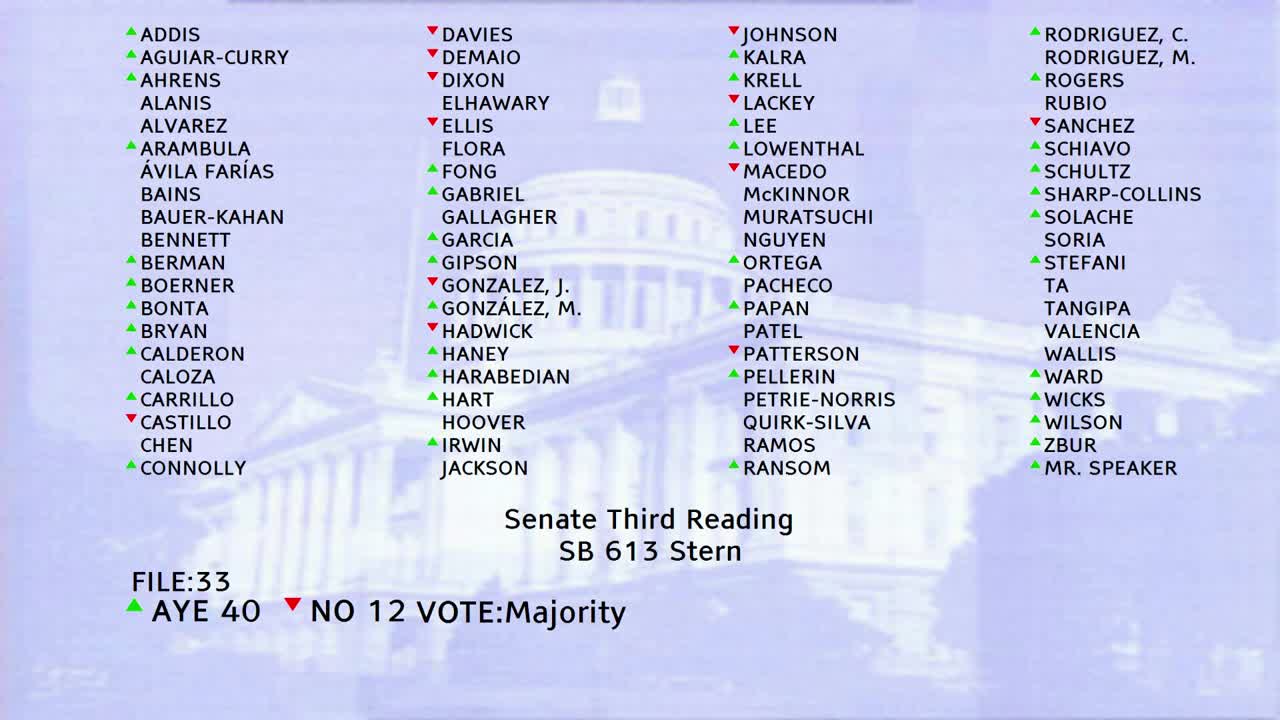 48SEC
Assembly Floor
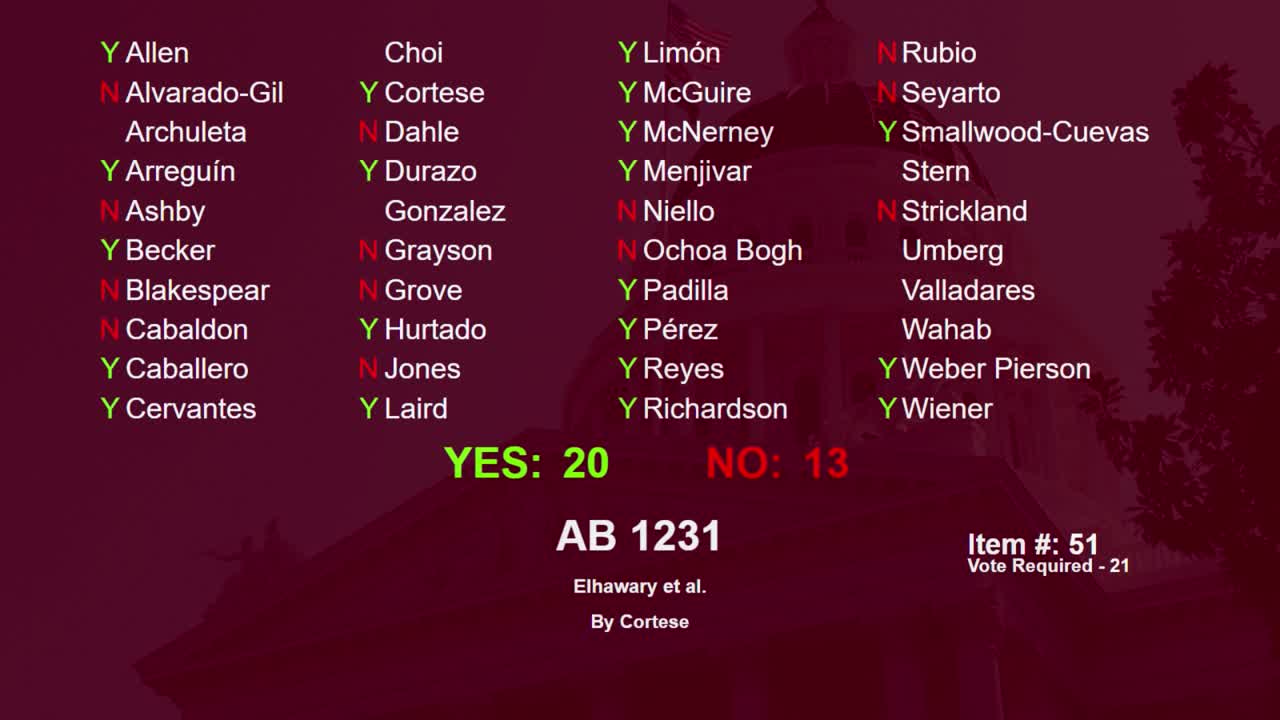 1MIN
Senate Floor
 19MIN
Assembly Standing Committee on Transportation
 9MIN
Assembly Standing Committee on Labor and Employment
 2MIN
Senate Floor
 15MIN
Senate Standing Committee on Labor, Public Employment and Retirement
 17MIN
Senate Standing Committee on Transportation
Bill Author
Bill Co-Author(s):