SB 720: Automated traffic enforcement system programs.
- Session Year: 2025-2026
- House: Senate
- Latest Version Date: 2025-10-13
Current Status:
Passed
(2025-10-13: Chaptered by Secretary of State. Chapter 782, Statutes of 2025.)
Introduced
In Committee
Awaiting First Chamber Vote
Passed First Chamber
In Committee
Awaiting Second Chamber Vote
Passed Second Chamber
Enacted
Existing law authorizes the limit line, intersection, or other places where a driver is required to stop to be equipped with an automated traffic enforcement system if the governmental agency utilizing the system meets certain requirements, including identifying the system with signs and ensuring that the system meets specified criteria on minimum yellow light change intervals. Existing law authorizes, until January 1, 2032, the Cities of Los Angeles, San Jose, Oakland, Glendale, and Long Beach, and the City and County of San Francisco to establish a speed safety system pilot program for speed enforcement that utilizes a speed safety system in specified areas, if the system meets specified requirements. Existing law prescribes specified requirements for a notice of violation issued pursuant to these provisions, and requires a violation of a speed law that is recorded by a speed safety system to be subject only to a specified civil penalty.
This bill would additionally authorize a city, county, or city and county to establish an automated traffic enforcement system program to use those systems to detect a violation of a traffic control signal, if the system meets specified requirements. The bill would require a violation of a traffic control signal that is recorded by an automated traffic enforcement system to be subject to escalating civil penalties, as specified. The bill would, among other things, provide for the issuance of a notice of violation, an initial review, an administrative hearing, and an appeals process, as specified, for a violation under this program. The bill would clarify that a local jurisdiction may utilize an automated traffic enforcement system pursuant to these provisions or the above-described provisions authorizing the utilization of an automated traffic enforcement system. The bill would require a local jurisdiction utilizing the above-described provisions to take into account the relative risk to traffic and pedestrian safety posed by prohibited right turns on red compared to proceeding through the intersection against a red signal.
Existing law establishes a $25 filing fee for specified appeals and petitions.
This bill would require a $25 filing fee for an appeal challenging a notice of violation issued as a result of an automated traffic enforcement system.
Existing provisions require that a statute that limits the right of access to the meetings of public bodies or the writings of public officials and agencies be adopted with findings demonstrating the interest protected by the limitation and the need for protecting that interest.
This bill would make legislative findings to that effect.
This bill would incorporate additional changes to Section 70615 of the Government Code proposed by AB 289 to be operative only if this bill and AB 289 are enacted and this bill is enacted last.
Existing law authorizes the limit line, intersection, or other places where a driver is required to stop to be equipped with an automated traffic enforcement system if the governmental agency utilizing the system meets certain requirements, including identifying the system with signs and ensuring that the system meets specified criteria on minimum yellow light change intervals. Existing law authorizes, until January 1, 2032, the Cities of Los Angeles, San Jose, Oakland, Glendale, and Long Beach, and the City and County of San Francisco to establish a speed safety system pilot program for speed enforcement that utilizes a speed safety system in specified areas, if the system meets specified requirements. Existing law prescribes specified requirements for a notice of violation issued pursuant to these provisions, and requires a violation of a speed law that is recorded by a speed safety system to be subject only to a specified civil penalty.
This bill would additionally authorize a city, county, or city and county to establish an automated traffic enforcement system program to use those systems to detect a violation of a traffic control signal, if the system meets specified requirements. The bill would require a violation of a traffic control signal that is recorded by an automated traffic enforcement system to be subject to escalating civil penalties, as specified. The bill would, among other things, provide for the issuance of a notice of violation, an initial review, an administrative hearing, and an appeals process, as specified, for a violation under this program. The bill would clarify that a local jurisdiction may utilize an automated traffic enforcement system pursuant to these provisions or the above-described provisions authorizing the utilization of an automated traffic enforcement system. The bill would require a local jurisdiction utilizing the above-described provisions to take into account the relative risk to traffic and pedestrian safety posed by prohibited right turns on red compared to proceeding through the intersection against a red signal.
Existing law establishes a $25 filing fee for specified appeals and petitions.
This bill would require a $25 filing fee for an appeal challenging a notice of violation issued as a result of an automated traffic enforcement system.
Existing provisions require that a statute that limits the right of access to the meetings of public bodies or the writings of public officials and agencies be adopted with findings demonstrating the interest protected by the limitation and the need for protecting that interest.
This bill would make legislative findings to that effect.
Existing law authorizes the limit line, intersection, or other places where a driver is required to stop to be equipped with an automated traffic enforcement system if the governmental agency utilizing the system meets certain requirements, including identifying the system with signs and ensuring that the system meets specified criteria on minimum yellow light change intervals. Existing law authorizes, until January 1, 2032, the Cities of Los Angeles, San Jose, Oakland, Glendale, and Long Beach, and the City and County of San Francisco to establish a speed safety system pilot program for speed enforcement that utilizes a speed safety system in specified areas, if the system meets specified requirements. Existing law prescribes specified requirements for a notice of violation issued pursuant to these provisions, and requires a violation of a speed law that is recorded by a speed safety system to be subject only to a specified civil penalty.
This bill would additionally authorize a city, county, or city and county to establish an automated traffic enforcement system program to use those systems to detect a violation of a traffic control signal, if the system meets specified requirements. The bill would require a violation of a traffic control signal that is recorded by an automated traffic enforcement system to be subject only to a $100 civil penalty, to escalating civil penalties, as specified. The bill would, among other things, provide for the issuance of a notice of violation, an initial review, an administrative hearing, and an appeals process, as specified, for a violation under this program. The bill would clarify that a local jurisdiction may utilize an automated traffic enforcement system pursuant to these provisions or the above-described provisions authorizing the utilization of an automated traffic enforcement system.
Existing law establishes a $25 filing fee for specified appeals and petitions.
This bill would require a $25 filing fee for an appeal challenging a notice of violation issued as a result of an automated traffic enforcement system.
Existing provisions require that a statute that limits the right of access to the meetings of public bodies or the writings of public officials and agencies be adopted with findings demonstrating the interest protected by the limitation and the need for protecting that interest.
This bill would make legislative findings to that effect.
Existing law authorizes the limit line, intersection, or other places where a driver is required to stop to be equipped with an automated traffic enforcement system if the governmental agency utilizing the system meets certain requirements, including identifying the system with signs and ensuring that the system meets specified criteria on minimum yellow light change intervals. Existing law authorizes, until January 1, 2032, the Cities of Los Angeles, San Jose, Oakland, Glendale, and Long Beach, and the City and County of San Francisco to establish a speed safety system pilot program for speed enforcement that utilizes a speed safety system in specified areas, if the system meets specified requirements. Existing law prescribes specified requirements for a notice of violation issued pursuant to these provisions, and requires a violation of a speed law that is recorded by a speed safety system to be subject only to a specified civil penalty.
This bill would additionally authorize a city, county, or city and county to establish an automated traffic enforcement system program to use those systems to detect a violation of a traffic control signal, if the system meets specified requirements. The bill would require a violation of a traffic control signal that is recorded by an automated traffic enforcement system to be subject only to a $100 civil penalty, as specified. The bill would, among other things, provide for the issuance of a notice of violation, an initial review, an administrative hearing, and an appeals process, as specified, for a violation under this program. The bill would clarify that a local jurisdiction may utilize an automated traffic enforcement system pursuant to these provisions or the above-described provisions authorizing the utilization of an automated traffic enforcement system.
Existing law establishes a $25 filing fee for specified appeals and petitions.
This bill would require a $25 filing fee for an appeal challenging a notice of violation issued as a result of an automated traffic enforcement system.
Existing provisions require that a statute that limits the right of access to the meetings of public bodies or the writings of public officials and agencies be adopted with findings demonstrating the interest protected by the limitation and the need for protecting that interest.
This bill would make legislative findings to that effect.
Existing law authorizes the limit line, intersection, or other places where a driver is required to stop to be equipped with an automated traffic enforcement system if the governmental agency utilizing the system meets certain requirements, including identifying the system with signs and ensuring that the system meets specified criteria on minimum yellow light change intervals. Existing law authorizes, until January 1, 2032, the Cities of Los Angeles, San Jose, Oakland, Glendale, and Long Beach, and the City and County of San Francisco to establish a speed safety system pilot program for speed enforcement that utilizes a speed safety system in specified areas, if the system meets specified requirements. Existing law prescribes specified requirements for a notice of violation issued pursuant to these provisions, and requires a violation of a speed law that is recorded by a speed safety system to be subject only to a specified civil penalty.
This bill would additionally authorize a city, county, or city and county to establish an automated traffic enforcement system program to use those systems to detect a violation of a traffic control signal, if the system meets specified requirements. The bill would require a violation of a traffic control signal that is recorded by an automated traffic enforcement system to be subject only to a $100 civil penalty, as specified. The bill would, among other things, provide for the issuance of a notice of violation, an initial review, an administrative hearing, and an appeals process, as specified, for a violation under this program.
Existing law establishes a $25 filing fee for specified appeals and petitions.
This bill would require a $25 filing fee for an appeal challenging a notice of violation issued as a result of an automated traffic enforcement system.
Existing provisions require that a statute that limits the right of access to the meetings of public bodies or the writings of public officials and agencies be adopted with findings demonstrating the interest protected by the limitation and the need for protecting that interest.
This bill would make legislative findings to that effect.
The Legislature finds and declares all of the following:
(a)Red light running is a major factor in traffic collisions that result in fatalities or injuries.
(b)State and local agencies employ a variety of methods to reduce red light running, including traffic engineering, education, and enforcement.
(c)Red light running enforcement is critical to efforts in California to reduce factors that contribute to traffic collisions that result in fatalities or injuries.
(d)However, traditional enforcement methods have had a well-documented disparate impact on communities of color, and implicit or explicit racial bias in police traffic stops puts drivers of color at risk.
(e)Additional tools, including automated traffic enforcement systems, are available to assist cities and counties in addressing red light running and related crashes.
(f)Automated traffic enforcement systems offer a high rate of detection, and, in conjunction with education and traffic engineering, can significantly reduce red light running, improve traffic safety, and prevent traffic-related fatalities and injuries, including motorist, pedestrian, and bicyclist fatalities.
(g)Multiple automated traffic enforcement system programs implemented in other states and cities outside of California have proven successful in reducing red light running and addressing traffic safety concerns.
(h)The Insurance Institute for Highway Safety (IIHS) reports that 1,149 people were killed and more than 107,000 people were injured in red light running crashes in 2022. An IIHS study found that cameras reduced the fatal red light running crash rate of large cities by 21 percent, and the rate of all types of fatal crashes at signalized intersections by 14 percent.
(i)The National Highway Traffic Safety Administration (NHTSA) reports the use of camera systems for the enforcement of red light violations at signalized intersections is increasingly widespread in the United States. State and local agencies have found that the use of red light camera systems can reduce red light running by motorists and, more importantly, reduce the number of crashes attributable to red light violations.
(j)Automated traffic enforcement systems can advance equity by improving reliability and fairness in traffic enforcement while making enforcement of violations of traffic control signals more predictable, effective, and broadly implemented, all of which help change driver behavior.
(k)Enforcing violations of traffic control signals at intersections where drivers create dangerous roadway environments is a reliable and cost-effective means to prevent further fatalities and injuries.
SEC. 2.Section 70615 of the Government Code, as amended by Section 2 of Chapter 631 of the Statutes of 2024, is amended to read:70615.The fee for filing any of the following appeals to the superior court is twenty-five dollars ($25):
(a)An appeal of a local agencys decision regarding an administrative fine or penalty under Section 53069.4.
(b)An appeal under Section 40230 of the Vehicle Code of an administrative agencys decision regarding a parking violation.
(c)An appeal under Section 99582 of the Public Utilities Code of a hearing officers determination regarding an administrative penalty for fare evasion or a passenger conduct violation.
(d)A petition under Section 186.35 of the Penal Code challenging a law enforcement agencys inclusion of a persons information in a shared gang database.
(e)An appeal under Section 22428 of the Vehicle Code of a hearing officers determination regarding a civil penalty for an automated speed violation, as defined in Section 22425 of the Vehicle Code.
(f)An appeal under Section 22438 of the Vehicle Code of a hearing officers determination regarding a civil penalty for an automated speed violation, as defined in Section 22435 of the Vehicle Code.
(g)An appeal under Section 21455.9 of the Vehicle Code of a hearing officers determination regarding a civil penalty for an automated traffic enforcement violation, as defined in Section 21455.9 of the Vehicle Code.
(h)This section shall remain in effect only until January 1, 2032, and as of that date is repealed.
SEC. 2.5.Section 70615 of the Government Code, as amended by Section 2 of Chapter 631 of the Statutes of 2024, is amended to read:70615.The fee for filing any of the following appeals to the superior court is twenty-five dollars ($25):
(a)An appeal of a local agencys decision regarding an administrative fine or penalty under Section 53069.4.
(b)An appeal under Section 40230 of the Vehicle Code of an administrative agencys decision regarding a parking violation.
(c)An appeal under Section 99582 of the Public Utilities Code of a hearing officers determination regarding an administrative penalty for fare evasion or a passenger conduct violation.
(d)A petition under Section 186.35 of the Penal Code challenging a law enforcement agencys inclusion of a persons information in a shared gang database.
(e)An appeal under Section 22428 of the Vehicle Code of a hearing officers determination regarding a civil penalty for an automated speed violation, as defined in Section 22425 of the Vehicle Code.
(f)An appeal under Section 22438 of the Vehicle Code of a hearing officers determination regarding a civil penalty for an automated speed violation, as defined in Section 22435 of the Vehicle Code.
(g)An appeal under Section 21455.9 of the Vehicle Code of a hearing officers determination regarding a civil penalty for an automated traffic enforcement violation, as defined in Section 21455.9 of the Vehicle Code.
(h)An appeal under Section 22445.3 of the Vehicle Code of a hearing officers determination regarding a civil penalty for an automated speed violation, as defined in Section 22445 of the Vehicle Code.
(i)This section shall remain in effect only until January 1, 2032, and as of that date is repealed.
SEC. 3.Section 70615 of the Government Code, as added by Section 3 of Chapter 808 of the Statutes of 2023, is amended to read:70615.The fee for filing any of the following appeals to the superior court is twenty-five dollars ($25):
(a)An appeal of a local agencys decision regarding an administrative fine or penalty under Section 53069.4.
(b)An appeal under Section 40230 of the Vehicle Code of an administrative agencys decision regarding a parking violation.
(c)An appeal under Section 99582 of the Public Utilities Code of a hearing officers determination regarding an administrative penalty for fare evasion or a passenger conduct violation.
(d)A petition under Section 186.35 of the Penal Code challenging a law enforcement agencys inclusion of a persons information in a shared gang database.
(e)An appeal under Section 21455.9 of the Vehicle Code of a hearing officers determination regarding a civil penalty for an automated traffic enforcement violation, as defined in Section 21455.9 of the Vehicle Code.
(f)This section shall become operative on January 1, 2032.
SEC. 4.Section 21455.5 of the Vehicle Code is amended to read:21455.5.(a)The limit line, the intersection, or a place designated in Section 21455, where a driver is required to stop, may be equipped with an automated traffic enforcement system if the governmental agency utilizing the system meets both of the following requirements:
(1)Identifies the system by signs posted within 200 feet of an intersection where a system is operating that clearly indicate the systems presence and are visible to traffic approaching from all directions in which the automated traffic enforcement system is being utilized to issue citations. A governmental agency utilizing this type of system does not need to post signs visible to traffic approaching the intersection from directions not subject to the automated traffic enforcement system.
(2)Locates the system at an intersection and ensures that the system meets the criteria specified in Section 21455.7.
(b)Before issuing citations under this section, a local jurisdiction utilizing an automated traffic enforcement system shall commence a program to issue only warning notices for 30 days. The local jurisdiction shall also make a public announcement of the automated traffic enforcement system at least 30 days before commencing the enforcement program.
(c)Only a governmental agency, in cooperation with a law enforcement agency, may operate an automated traffic enforcement system. A governmental agency that operates an automated traffic enforcement system shall do both of the following:
(1)Develop uniform guidelines for screening and issuing violations, including a violation for a prohibited right turn at a steady circular red signal, which shall take into account the relative risk to traffic and pedestrian safety posed by right turns on red compared to proceeding through the intersection against a red signal, and for the processing and storage of confidential information, and establish procedures to ensure compliance with those guidelines.
(2)Perform administrative functions and day-to-day functions, including, but not limited to, all of the following:
(A)Establishing guidelines for the selection of a location. Before installing an automated traffic enforcement system, the governmental agency shall make and adopt a finding of fact establishing that the system is needed at a specific location for reasons related to safety.
(B)Ensuring that the equipment is regularly inspected.
(C)Certifying that the equipment is properly installed and calibrated, and is operating properly.
(D)Regularly inspecting and maintaining warning signs placed under paragraph (1) of subdivision (a).
(E)Overseeing the establishment or change of signal phases and the timing thereof.
(F)Maintaining controls necessary to ensure that only those citations that have been reviewed and approved by law enforcement are delivered to violators.
(d)The activities listed in subdivision (c) that relate to the operation of the system may be contracted out by the governmental agency, if it maintains overall control and supervision of the system. However, the activities listed in paragraph (1) of, and subparagraphs (A), (D), (E), and (F) of paragraph (2) of, subdivision (c) shall not be contracted out to the manufacturer or supplier of the automated traffic enforcement system.
(e)The printed representation of computer-generated information, video, or photographic images stored by an automated traffic enforcement system does not constitute an out-of-court hearsay statement by a declarant under Division 10 (commencing with Section 1200) of the Evidence Code.
(f)(1)Notwithstanding Article 1 (commencing with Section 7922.500) and Article 2 (commencing with Section 7922.525) of Chapter 1 of Part 3 of Division 10 of Title 1 of the Government Code, or any other law, photographic records made by an automated traffic enforcement system shall be confidential, and shall be made available only to governmental agencies and law enforcement agencies and only for the purposes of this article.
(2)Confidential information obtained from the Department of Motor Vehicles for the administration or enforcement of this article shall be held confidential, and shall not be used for any other purpose.
(3)Except for court records described in Section 68152 of the Government Code, the confidential records and information described in paragraphs (1) and (2) may be retained for up to six months from the date the information was first obtained, or until final disposition of the citation, whichever date is later, after which time the information shall be destroyed in a manner that shall preserve the confidentiality of a person included in the record or information.
(g)Notwithstanding subdivision (f), the registered owner or an individual identified by the registered owner as the driver of the vehicle at the time of the alleged violation shall be permitted to review the photographic evidence of the alleged violation.
(h)(1)A contract between a governmental agency and a manufacturer or supplier of automated traffic enforcement equipment shall not include provision for the payment or compensation to the manufacturer or supplier based on the number of citations generated, or as a percentage of the revenue generated, as a result of the use of the equipment authorized under this section.
(2)Paragraph (1) does not apply to a contract that was entered into by a governmental agency and a manufacturer or supplier of automated traffic enforcement equipment before January 1, 2004, unless that contract is renewed, extended, or amended on or after January 1, 2004.
(3)A governmental agency that proposes to install or operate an automated traffic enforcement system shall not consider revenue generation, beyond recovering its actual costs of operating the system, as a factor when considering whether or not to install or operate a system within its local jurisdiction.
(i)A manufacturer or supplier that operates an automated traffic enforcement system pursuant to this section shall, in cooperation with the governmental agency, submit an annual report to the Judicial Council that includes all of the following information if this information is in the possession of, or readily available to, the manufacturer or supplier:
(1)The number of alleged violations captured by the systems they operate.
(2)The number of citations issued by a law enforcement agency based on information collected from the automated traffic enforcement system.
(3)For citations identified in paragraph (2), the number of violations that involved traveling straight through the intersection, turning right, and turning left.
(4)The number and percentage of citations that are dismissed by the court.
(5)The number of traffic collisions at each intersection that occurred before and after the installation of the automated traffic enforcement system.
(j)This section does not affect a local jurisdiction that utilizes an automated traffic enforcement system pursuant to Section 21455.9. A local jurisdiction may utilize an automated traffic enforcement system pursuant to this section or Section 21455.9.
SEC. 5.Section 21455.7 of the Vehicle Code is amended to read:21455.7.(a)At an intersection at which there is an automated traffic enforcement system in operation pursuant to Section 21455.5 or 21455.9, the minimum yellow light change interval shall be established in accordance with the California Manual on Uniform Traffic Control Devices.
(b)For purposes of subdivision (a), the minimum yellow light change intervals relating to designated approach speeds provided in the California Manual on Uniform Traffic Control Devices are mandatory minimum yellow light intervals.
(c)A yellow light change interval may exceed the minimum interval established pursuant to subdivision (a).
SEC. 6.Section 21455.9 is added to the Vehicle Code, to read:21455.9.(a)As used in this section, the following definitions apply:
(1)Automated traffic enforcement system or system means a fixed system that utilizes automated equipment to detect a violation of a traffic control signal and obtains a clear photograph of the detected vehicles license and video recording of the violation.
(2)Automated traffic enforcement violation means a violation of a traffic control signal detected by an automated traffic enforcement system operated pursuant to this section.
(3)Designated jurisdiction means any city, county, or city and county in the state.
(4)A person is indigent if either of the following conditions is met:
(A)The person meets the income criteria set forth in subdivision (b) of Section 68632 of the Government Code.
(B)The person receives public benefits from a program listed in subdivision (a) of Section 68632 of the Government Code.
(5)Local department of transportation means a designated jurisdictions department of transportation or, if a designated jurisdiction does not have a department of transportation, their administrative division, including, but not limited to, a public works department that administers transportation and traffic matters under this code.
(6)Traffic control signal means an official traffic control signal, as defined in Section 445.
(b)(1)A designated jurisdiction may establish a program for traffic control signal enforcement that utilizes an automated traffic enforcement system, to be operated by a local department of transportation, at the limit line, the intersection, where a driver is required to stop, if the program meets all of the following requirements:
(A)(i)Identifies the system by signs that clearly indicate the systems presence, are visible to traffic approaching from all directions in which the automated traffic enforcement system is being utilized to issue citations, and are posted within the following distances:
(I)On roads with speed limits of 45 miles per hour or less, one sign within 200 to 300 feet, inclusive, of an intersection where a system is operating.
(II)On roads with speed limits over 45 miles per hour, two signs within 200 to 500 feet, inclusive, of an intersection where a system is operating, with at least 100 feet between the signs.
(ii)A program does not need to post signs visible to traffic approaching the intersection from directions not subject to the automated traffic enforcement system.
(B)Locates the system at an intersection and ensures that the system meets the criteria specified in Section 21455.7. A designated jurisdiction shall not reduce the yellow light interval durations after placement of the system.
(2)An automated traffic enforcement system program developed pursuant to paragraph (1) shall place the systems in locations that are geographically and socioeconomically diverse. The designated jurisdiction shall describe how it has complied with this provision in the automated traffic enforcement system impact report described in subdivision (c).
(3)A designated jurisdiction shall consider traffic data or other evidence supporting the installation and operation of each automated traffic enforcement system and determine that the intersection where an automated traffic enforcement system is to be placed or installed constitutes a heightened safety risk that warrants additional enforcement measures. A designated jurisdiction shall consider placing an automated traffic enforcement system on a street that has had a high number of incidents for motor vehicle contests or motor vehicle exhibitions of speed. For the purposes of this provision, a high number of incidents shall be calls for law enforcement to respond to the area for at least four separate incidences of a motor vehicle contest or motor vehicle exhibition of speed within the last two years before the placement of the automated traffic enforcement system.
(c)(1)For programs implemented after January 1, 2026, the governing body of the designated jurisdiction shall approve an automated traffic enforcement system impact report. The automated traffic enforcement system impact report shall include all of the following information:
(A)Assessment of potential impact of the automated traffic enforcement system on civil liberties and civil rights and any plans to safeguard those public rights.
(B)Description of the automated traffic enforcement system and how it works.
(C)Fiscal costs for the automated traffic enforcement system, including program establishment costs, ongoing costs, and program funding.
(D)If potential deployment locations of systems are predominantly in low-income neighborhoods, a determination of why these locations experience high fatality and injury collisions due to traffic control signal violations at intersections.
(E)Locations where the system may be deployed and traffic data for these locations, including the intersection where the cameras will be located.
(F)Proposed purpose of the automated traffic enforcement system.
(2)The automated traffic enforcement system impact report shall be made available for public review at least 30 calendar days prior to adoption by the governing body at a public hearing.
(3)The governing body of the designated jurisdiction shall consult and work collaboratively with relevant local stakeholder organizations, including racial equity, privacy protection, and economic justice groups, in developing the automated traffic enforcement system impact report.
(d)(1)A designated jurisdiction that operates an automated traffic enforcement system shall do both of the following:
(A)Develop uniform guidelines, consistent with the provisions of this section, for both of the following:
(i)The screening and issuing of notices of violation.
(ii)The processing and storage of confidential information and procedures to ensure compliance with confidentiality requirements.
(B)Perform administrative functions and day-to-day functions, including, but not limited to, all of the following:
(i)Establishing guidelines for the selection of a location. Prior to installing an automated traffic enforcement system after January 1, 2026, the designated jurisdiction shall make and adopt a finding of fact establishing that the system is needed at a specific location for reasons related to safety.
(ii)Ensuring that the equipment is regularly inspected, but at least annually.
(iii)Calibrating the equipment in accordance with the manufacturers instructions upon installation.
(iv)Regularly inspecting and maintaining warning signs placed under paragraph (1) of subdivision (b).
(v)Overseeing the establishment or change of signal phases and the timing thereof.
(vi)Maintaining controls necessary to ensure that only those citations that have been reviewed and approved by the issuing agency are delivered to violators.
(2)The activities listed in paragraph (1) that relate to the operation of the system may be contracted out by a designated jurisdiction, if it maintains overall control and supervision of the system. However, the activities listed in subparagraph (A) of, and clauses (iv), (v), and (vi) of subparagraph (B) of, paragraph (1) shall not be contracted out to the manufacturer or supplier of the automated traffic enforcement system.
(e)(1)A contract between a designated jurisdiction and a manufacturer or supplier of automated traffic enforcement equipment or a company providing maintenance and processing services shall not include provision for the payment or compensation to the manufacturer, supplier, or company based on the number of citations generated, or as a percentage of the revenue generated, as a result of the use of the equipment authorized under this section.
(2)A designated jurisdiction that proposes to install or operate an automated traffic enforcement system shall not consider revenue generation, beyond recovering its actual costs of operating the system, as a factor when considering whether or not to install or operate a system within its local jurisdiction
(f)A designated jurisdiction that operates an automated traffic enforcement system pursuant to this section shall, in cooperation with the manufacturer or supplier, publish a report that includes, but is not limited to, all of the following information:
(1)The number of alleged violations captured by the systems they operate.
(2)The number of citations issued by the issuing agency based on information collected from the automated traffic enforcement system.
(3)For citations identified in paragraph (2), the number of violations that involved traveling straight through the intersection, turning right, and turning left.
(4)The number and percentage of citations that are dismissed.
(5)The funds generated from the automated traffic enforcement systems.
(g)(1)Prior to issuing citations under this section, a designated jurisdiction utilizing an automated traffic enforcement system shall commence a program to issue only warning notices for 60 days. The designated jurisdiction shall also make a public announcement of the automated traffic enforcement system at least 30 days prior to the commencement of the enforcement program.
(2)A notice of violation issued pursuant to this section shall include a clear photograph of the license plate and rear of the vehicle only, and identify the specific section of the Vehicle Code violated, the camera location, and the date and time when the violation occurred. A notice of violation shall, when practical, exclude images inside of the rear window area of the vehicle. A notice of violation issued from an automated traffic enforcement system that was installed prior to January 1, 2026, may continue to include pictures of the driver at the discretion of the designated jurisdiction.
(3)The photographic and video evidence stored by an automated traffic enforcement system does not constitute an out-of-court hearsay statement by a declarant under Division 10 (commencing with Section 1200) of the Evidence Code.
(4)(A)Notwithstanding any provision of the California Public Records Act, or any other law, photographic, video, and administrative records made by a system shall be confidential. Public agencies shall use and allow access to these records only for the purposes authorized by this section or to assess the impacts of the system. Data about the number of violations issued is not considered an administrative record required to be disclosed by this section.
(B)Confidential information obtained from the Department of Motor Vehicles for the administration of automated traffic enforcement systems and enforcement of this article shall be held confidential and shall not be used for any other purpose. Designated jurisdictions agents shall establish procedures to protect the confidentiality of these records consistent with Section 1808.47.
(C)Except for court records described in Section 68152 of the Government Code, or as provided in subparagraph (D), the confidential records and evidence described in subparagraphs (A) and (B) may be retained for up to 60 days after final disposition of the notice of violation. The designated jurisdiction may retain information that a vehicle has been cited and fined for a violation for up to three years. The designated jurisdiction may adopt a retention period of less than 60 days. Administrative records described in subparagraph (A) may be retained for up to 120 days after final disposition of the notice of violation. Notwithstanding any other law, the confidential records and evidence shall be destroyed in a manner that maintains the confidentiality of any person included in the record or evidence.
(D)Photographic and video evidence that is obtained from an automated traffic enforcement system that does not result in the issuance of a notice of violation shall be destroyed within five business days after the decision to not issue a citation has been made. The use of facial recognition technology in conjunction with an automated traffic enforcement system shall be prohibited.
(E)Information collected and maintained by a designated jurisdiction to administer a program shall only be used to administer the program, and shall not be disclosed to any other persons, including, but not limited to, any other state or federal government agency or official for any other purpose, except as required by state or federal law, court order, or in response to a subpoena in an individual case or proceeding.
(5)Notwithstanding paragraph (4), the registered owner or an individual identified by the registered owner as the driver of the vehicle at the time of the alleged violation shall be permitted to review and obtain a copy of the photographic or video evidence of the alleged violation.
(h)(1)Notwithstanding any other law, a violation of a traffic control signal law pursuant to this chapter that is recorded by an automated traffic enforcement system authorized pursuant to this section shall be subject only to a civil penalty, as provided in paragraph (3), and shall not result in the department suspending or revoking the privilege of a violator to drive a motor vehicle or in a violation point being assessed against the violator.
(2)The automated traffic enforcement system shall capture images of the rear license plate of vehicles that are violating the traffic control signal, and a notice of violation shall only be issued to registered owners of those vehicles based on that evidence.
(3)(A)A civil penalty shall be assessed as follows:
(i)For a violation where no fine has been assessed within the previous three years, by a fine of one hundred dollars ($100).
(ii)For a violation that occurred within three years after a separate previous violation, by a fine of two hundred dollars ($200).
(iii)For a violation that occurred within three years after two separate previous violations, by a fine of three hundred fifty dollars ($350).
(iv)For a violation that occurred within three years after three or more separate previous violations, by a fine of five hundred dollars ($500).
(B)No additional processing fees, other than electronic payment processing fees, may be included.
(C)Late fees for unpaid penalties shall not exceed fifty dollars ($50) for the first late fee and one hundred dollars ($100) for any subsequent late fees for the same violation.
(4)A civil penalty shall not be assessed against an authorized emergency vehicle.
(5)A person shall not be assessed a civil penalty if they are subject to criminal penalties for the same act.
(6)The notice of violation shall be in writing and issued to the registered owner of the vehicle within 15 calendar days of the date of the violation. The notice of violation shall include all of the following information:
(A)The violation, including reference to the traffic control signal law that was violated.
(B)The date, approximate time, and location where the violation occurred.
(C)The vehicle license number and the name and address of the registered owner of the vehicle.
(D)A clear photograph of the traffic control signal and an internet address where they can access the video recording of the violation based on a unique citation number.
(E)A statement that payment is required to be made no later than 30 calendar days from the date of mailing of the notice of violation, or that the violation may be contested pursuant to subdivision (j).
(F)The amount of the civil penalty due for that violation and the procedures for the payment of the civil penalty or for contesting the notice of violation.
(G)An affidavit of nonliability, and information of what constitutes nonliability, information as to the effect of executing the affidavit, and instructions for returning the affidavit to the processor. If the affidavit of nonliability is returned to the processing agency within 30 calendar days of the mailing of the notice of violation, together with proof of a written lease or rental agreement between a bona fide rental company, as defined in Section 1939.01 of the Civil Code, or a personal vehicle sharing program, as defined in Section 11580.24 of the Insurance Code, that identifies the renter or lessee, the processing agency shall serve or mail a notice of violation to the renter or lessee identified in the affidavit of nonliability. If the affidavit of nonliability is returned to the processing agency within 30 calendar days of the mailing of the notice of violation, together with proof of a copy of a police report indicating the vehicle had been stolen at the time of the violation, the processing agency shall not subject the registered owner to a civil penalty and may issue the notice of violation to the identified renter or lessee.
(H)The processing agency shall mail to the registered owner of a vehicle committing a violation of the traffic control signal law a notice of violation by depositing the notice in the United States mail no later than 15 days after the date of the alleged violation. The processing agency shall maintain proof of mailing demonstrating that the notice of violation was mailed to that address. If the registered owner or coowner of the vehicle, or the person designated as having care, custody, or control of the motor vehicle at the time of the violation pursuant to subparagraph (G), initiates a proceeding to challenge the violation pursuant to subdivision (j), such person waives any challenge or dispute as to the delivery of the notice of violation.
(I)An affidavit from a designated jurisdiction that the yellow light change interval was established in accordance with the California Manual on Uniform Traffic Control Devices, as required by Section 21455.7.
(i)(1)Revenues derived from any program utilizing an automated traffic enforcement system shall first be used to recover program costs. Program costs include, but are not limited to, the construction of traffic-calming measures, the installation of automated traffic enforcement systems, the adjudication of violations, and reporting requirements, as specified in this section.
(2)Designated jurisdictions shall maintain their existing commitment of local funds for traffic-calming measures, and shall annually expend not less than the annual average of expenditures for traffic-calming measures during the 202021, 202122, and 202223 fiscal years. For purposes of this subdivision, in calculating average expenditures on traffic-calming measures, restricted funds that may not be available on an ongoing basis, including those from voter-approved bond issuances or tax measures, shall not be included. Any excess revenue shall be used for traffic-calming measures within three years of the end of the fiscal year in which the excess revenue was received. If traffic-calming measures are not planned or constructed after the third year, excess revenue shall revert to the Active Transportation Program established pursuant to Chapter 8 (commencing with Section 2380) of the Streets and Highways Code, to be allocated by the California Transportation Commission pursuant to Section 2381 of the Streets and Highways Code.
(3)Traffic-calming measures include, but are not limited to, all of the following:
(A)Bicycle lanes.
(B)Chicanes.
(C)Chokers.
(D)Curb extensions.
(E)Median islands.
(F)Raised crosswalks.
(G)Road diets.
(H)Roundabouts.
(I)Speed humps or speed tables.
(J)Traffic circles.
(j)(1)No later than 30 calendar days from the date of mailing of a notice of violation, the recipient may request an initial review of the notice by the issuing agency. The request may be made by telephone, in writing, electronically, or in person. There shall be no charge for this review. If, following the initial review, the issuing agency is satisfied that the violation did not occur, or that extenuating circumstances make cancellation of the notice of violation appropriate in the interest of justice, the issuing agency shall cancel the notice of violation. The issuing agency shall advise the processing agency, if any, of the cancellation. The issuing agency or the processing agency shall mail the results of the initial review to the person contesting the notice within 60 days of receipt of the recipients request for an initial review, and, if cancellation of the notice does not occur following that review, include a reason for that denial, notification of the ability to request an administrative hearing, and notice of the procedures adopted by the designated jurisdiction for the administrative hearing, including for waiving prepayment of the civil penalty based upon an inability to pay pursuant to subparagraph (B) of paragraph (2).
(2)(A)If the person contesting the notice of violation is dissatisfied with the results of the initial review, the person may, no later than 21 calendar days following the mailing of the results of the issuing agencys initial review, request an administrative hearing of the violation. The request may be made by telephone, in writing, electronically, or in person.
(B)The person requesting an administrative hearing shall pay the amount of the civil penalty to the processing agency. The issuing agency shall adopt a written procedure to allow a person to request an administrative hearing without payment of the civil penalty upon satisfactory proof of an inability to pay the amount due.
(C)The administrative hearing shall be held within 90 calendar days following the receipt of a request for an administrative hearing. The person requesting the hearing may request one continuance, not to exceed 21 calendar days.
(3)The administrative hearing process shall include all of the following:
(A)The person requesting a hearing shall have the choice of a hearing upon written declaration, video conference, or in person. An in-person hearing shall be conducted within the jurisdiction of the issuing agency.
(B)If the person requesting a hearing is an unemancipated minor, that person shall be permitted to appear at a hearing or admit responsibility for the automated traffic enforcement violation without the appointment of a guardian. The processing agency may proceed against the minor in the same manner as against an adult.
(C)The administrative hearing shall be conducted in accordance with written procedures established by the issuing agency and approved by the governing body or chief executive officer of the issuing agency. The hearing shall provide an independent, objective, fair, and impartial review of contested automated traffic enforcement violations.
(D)(i)The issuing agencys governing body or chief executive officer of the designated jurisdiction shall appoint or contract with qualified independent examiners or administrative hearing providers that employ qualified independent examiners to conduct the administrative hearings. Examiners shall demonstrate the qualifications, training, and objectivity necessary to conduct a fair and impartial review, and shall meet the minimum requirements specified in clause (ii). The examiner shall be separate and independent from the notice of violation issuing and processing functions. An examiners continued employment, performance evaluation, compensation, and benefits shall not, directly or indirectly, be linked to the amount of civil penalties upheld by the examiner or the number or percentage of violations upheld by the examiner.
(ii)(I)Examiners shall have a minimum of 20 hours of training. The examiner, unless an employee of the designated jurisdiction, is responsible for the costs of the training. The issuing agency may reimburse the examiner for those costs. Training may be provided through any of the following:
(ia)An accredited college or university.
(ib)A program conducted by the Commission on Peace Officer Standards and Training.
(ic)A program conducted by the American Arbitration Association or a similar organization.
(id)Any program approved by the governing body or chief executive officer of the issuing agency, including a program developed and provided by, or for, the agency.
(II)Training programs shall include topics relevant to the administrative hearing, including, but not limited to, applicable laws and regulations, enforcement procedures, due process, evaluation of evidence, hearing procedures, and effective oral and written communication. Upon the approval of the governing body or chief executive officer of the issuing agency, up to 12 hours of relevant experience may be substituted for up to 12 hours of training. Up to eight hours of the training requirements described in this clause may be credited to an individual, at the discretion of the governing body or chief executive officer of the issuing agency, based upon training programs or courses described in this subparagraph that the individual attended within the last five years.
(E)The employee of the designated jurisdiction who issues a notice of violation shall not be required to participate in an administrative hearing. To establish a violation, the issuing agency shall not be required to produce any evidence other than, in proper form, the notice of violation or copy thereof, including the photograph of the vehicles license plate, a video recording of the violation, and information received from the Department of Motor Vehicles identifying the registered owner of the vehicle. The documentation in proper form shall be prima facie evidence of the violation. If the designated jurisdiction meets its initial burden, the recipient of the notice of violation may present any evidence and argument in defense.
(F)The examiners final decision following the administrative hearing may be personally delivered to the person by the examiner or sent by first-class mail within 60 days of the date of the conclusion of the administrative hearing.
(G)Following a determination by the examiner that a person has committed the violation, the examiner may, consistent with the written guidelines established by the issuing agency, allow payment of the civil penalty in installments, or an issuing agency may allow for deferred payment or payments in installments, if the person provides evidence satisfactory to the examiner or the issuing agency, as the case may be, of an inability to pay the civil penalty in full. If authorized by the governing body of the issuing agency, the examiner may permit the performance of community service in lieu of payment of the civil penalty.
(H)If a notice of violation is dismissed following an administrative hearing, any civil penalty, if paid, shall be refunded by the issuing agency within 30 days.
(k)(1)Within 30 days after personal delivery or mailing of the final decision described in paragraph (3) of subdivision (j), the contestant may seek review by filing an appeal to the small claims division of the superior court or the traffic division of the superior court, where the case shall be heard de novo, except that the contents of the processing agencys file in the case on appeal shall be lodged by the designated agency at the designated agencys expense and be received into evidence. Notwithstanding any other law, a copy of the notice of violation shall be presumptively admissible as evidence of the facts stated in the notice. A copy of the notice of appeal shall be served in person or by certified first-class mail with return receipt upon the processing agency by the appellant. For purposes of computing the 30-day period, Section 1013 of the Code of Civil Procedure shall be applicable. A proceeding under this paragraph is a limited civil case.
(2)The fee for filing the notice of appeal shall be as provided in Section 70615 of the Government Code. Upon receipt of the notice of appeal, the designated jurisdiction shall lodge its administrative record for the case with the court within 15 calendar days. The court shall notify the appellant of the appearance date by mail or personal delivery. The court shall retain the fee under Section 70615 of the Government Code regardless of the outcome of the appeal. If the appellant prevails, this fee and any payment of the civil penalty shall be promptly refunded by the issuing agency in accordance with the judgment of the court.
(3)The conduct of the hearing on appeal under this section is a subordinate judicial duty that may be performed by a commissioner or other subordinate judicial officer at the direction of the presiding judge of the court.
(4)If a notice of appeal of the examiners decision is not filed within the period set forth in paragraph (1), the decision shall be deemed final.
(5)If the civil penalty has not been paid and the final decision is adverse to the appellant, the processing agency may, promptly after the decision becomes final, proceed to collect the civil penalty under subdivision (h).
(l)(1)A designated jurisdiction shall offer a diversion program for indigent automated traffic enforcement violation recipients, to perform community service in lieu of paying the penalty for an automated traffic enforcement violation.
(2)A designated jurisdiction shall offer the ability for indigent automated traffic enforcement system violation recipients to pay applicable fines and penalties over a period of time under a payment plan with monthly installments of no more than twenty-five dollars ($25) and shall limit the processing fee to participate in a payment plan to five dollars ($5) or less.
(3)Notwithstanding paragraphs (1) and (2), a designated jurisdiction shall reduce the applicable fines and penalties by 80 percent for indigent persons, and by 50 percent for individuals up to 250 percent above the federal poverty level.
(4)The person may demonstrate that they are indigent or make up to 250 percent above the poverty level or less by providing either of the following information, as applicable:
(A)Proof of income from a pay stub or another form of proof of earnings, such as a bank statement, that shows that the person meets the income criteria set forth in subdivision (b) of Section 68632 of the Government Code, subject to review and approval by the processing agency or its designee. The processing agency or its designee shall not unreasonably withhold its approval.
(B)Proof of receipt of benefits under the programs described in subdivision (a) of Section 68632 of the Government Code, including, but not limited to, an electronic benefits transfer card or another card, subject to review and approval by the processing agency. The processing agency or its designee shall not unreasonably withhold its approval.
(m)This section does not affect a designated jurisdiction that utilizes an automated traffic enforcement system pursuant to Section 21455.5. A designated jurisdiction may utilize an automated traffic enforcement system pursuant to this section or Section 21455.5.
(n)The automated traffic enforcement system, to the extent feasible, shall be angled and focused so as to only capture photographs of the rear license plate and evidence that the vehicle violated the traffic control system and shall not capture identifying images of other drivers or vehicles.
(o)A person shall not be accessed a civil penalty if they are subject to criminal penalties for the same act.
SEC. 7.The Legislature finds and declares that Section 6 of this act, which adds Section 21455.9 to the Vehicle Code, imposes a limitation on the publics right of access to the meetings of public bodies or the writings of public officials and agencies within the meaning of Section 3 of Article I of the California Constitution. Pursuant to that constitutional provision, the Legislature makes the following findings to demonstrate the interest protected by this limitation and the need for protecting that interest:
To protect the privacy interests of persons who are issued notices of violation under an automated traffic enforcement system program, the Legislature finds and declares that the photographic, video, or administrative records generated by the program shall be confidential, and shall be made available only to alleged violators and to governmental agencies solely for the purpose of enforcing these violations and assessing the impact of the use of an automated traffic enforcement system, as required by this act.
SEC. 8.Section 2.5 of this bill incorporates amendments to Section 70615 of the Government Code proposed by both this bill and AB 289. That section of this bill shall only become operative if (1) both bills are enacted and become effective on or before January 1, 2026, (2) each bill amends Section 70615 of the Government Code, and (3) this bill is enacted after AB 289, in which case Section 2 of this bill shall not become operative.
The Legislature finds and declares all of the following:
(a)Red light running is a major factor in traffic collisions that result in fatalities or injuries.
(b)State and local agencies employ a variety of methods to reduce red light running, including traffic engineering, education, and enforcement.
(c)Red light running enforcement is critical to efforts in California to reduce factors that contribute to traffic collisions that result in fatalities or injuries.
(d)However, traditional enforcement methods have had a well-documented disparate impact on communities of color, and implicit or explicit racial bias in police traffic stops puts drivers of color at risk.
(e)Additional tools, including automated traffic enforcement systems, are available to assist cities and counties in addressing red light running and related crashes.
(f)Automated traffic enforcement systems offer a high rate of detection, and, in conjunction with education and traffic engineering, can significantly reduce red light running, improve traffic safety, and prevent traffic-related fatalities and injuries, including motorist, pedestrian, and bicyclist fatalities.
(g)Multiple automated traffic enforcement system programs implemented in other states and cities outside of California have proven successful in reducing red light running and addressing traffic safety concerns.
(h)The Insurance Institute for Highway Safety (IIHS) reports that 1,149 people were killed and more than 107,000 people were injured in red light running crashes in 2022. An IIHS study found that cameras reduced the fatal red light running crash rate of large cities by 21 percent, and the rate of all types of fatal crashes at signalized intersections by 14 percent.
(i)The National Highway Traffic Safety Administration (NHTSA) reports the use of camera systems for the enforcement of red light violations at signalized intersections is increasingly widespread in the United States. State and local agencies have found that the use of red light camera systems can reduce red light running by motorists and, more importantly, reduce the number of crashes attributable to red light violations.
(j)Automated traffic enforcement systems can advance equity by improving reliability and fairness in traffic enforcement while making enforcement of violations of traffic control signals more predictable, effective, and broadly implemented, all of which help change driver behavior.
(k)Enforcing violations of traffic control signals at intersections where drivers create dangerous roadway environments is a reliable and cost-effective means to prevent further fatalities and injuries.
SEC. 2.Section 70615 of the Government Code, as amended by Section 2 of Chapter 631 of the Statutes of 2024, is amended to read:70615.The fee for filing any of the following appeals to the superior court is twenty-five dollars ($25):
(a)An appeal of a local agencys decision regarding an administrative fine or penalty under Section 53069.4.
(b)An appeal under Section 40230 of the Vehicle Code of an administrative agencys decision regarding a parking violation.
(c)An appeal under Section 99582 of the Public Utilities Code of a hearing officers determination regarding an administrative penalty for fare evasion or a passenger conduct violation.
(d)A petition under Section 186.35 of the Penal Code challenging a law enforcement agencys inclusion of a persons information in a shared gang database.
(e)An appeal under Section 22428 of the Vehicle Code of a hearing officers determination regarding a civil penalty for an automated speed violation, as defined in Section 22425 of the Vehicle Code.
(f)An appeal under Section 22438 of the Vehicle Code of a hearing officers determination regarding a civil penalty for an automated speed violation, as defined in Section 22435 of the Vehicle Code.
(g)An appeal under Section 21455.9 of the Vehicle Code of a hearing officers determination regarding a civil penalty for an automated traffic enforcement violation, as defined in Section 21455.9 of the Vehicle Code.
(h)This section shall remain in effect only until January 1, 2032, and as of that date is repealed.
SEC. 2.5.Section 70615 of the Government Code, as amended by Section 2 of Chapter 631 of the Statutes of 2024, is amended to read:70615.The fee for filing any of the following appeals to the superior court is twenty-five dollars ($25):
(a)An appeal of a local agencys decision regarding an administrative fine or penalty under Section 53069.4.
(b)An appeal under Section 40230 of the Vehicle Code of an administrative agencys decision regarding a parking violation.
(c)An appeal under Section 99582 of the Public Utilities Code of a hearing officers determination regarding an administrative penalty for fare evasion or a passenger conduct violation.
(d)A petition under Section 186.35 of the Penal Code challenging a law enforcement agencys inclusion of a persons information in a shared gang database.
(e)An appeal under Section 22428 of the Vehicle Code of a hearing officers determination regarding a civil penalty for an automated speed violation, as defined in Section 22425 of the Vehicle Code.
(f)An appeal under Section 22438 of the Vehicle Code of a hearing officers determination regarding a civil penalty for an automated speed violation, as defined in Section 22435 of the Vehicle Code.
(g)An appeal under Section 21455.9 of the Vehicle Code of a hearing officers determination regarding a civil penalty for an automated traffic enforcement violation, as defined in Section 21455.9 of the Vehicle Code.
(h)An appeal under Section 22445.3 of the Vehicle Code of a hearing officers determination regarding a civil penalty for an automated speed violation, as defined in Section 22445 of the Vehicle Code.
(g)(i)This section shall remain in effect only until January 1, 2032, and as of that date is repealed.
SEC. 3.Section 70615 of the Government Code, as added by Section 3 of Chapter 808 of the Statutes of 2023, is amended to read:70615.The fee for filing any of the following appeals to the superior court is twenty-five dollars ($25):
(a)An appeal of a local agencys decision regarding an administrative fine or penalty under Section 53069.4.
(b)An appeal under Section 40230 of the Vehicle Code of an administrative agencys decision regarding a parking violation.
(c)An appeal under Section 99582 of the Public Utilities Code of a hearing officers determination regarding an administrative penalty for fare evasion or a passenger conduct violation.
(d)A petition under Section 186.35 of the Penal Code challenging a law enforcement agencys inclusion of a persons information in a shared gang database.
(e)An appeal under Section 21455.9 of the Vehicle Code of a hearing officers determination regarding a civil penalty for an automated traffic enforcement violation, as defined in Section 21455.9 of the Vehicle Code.
(f)This section shall become operative on January 1, 2032.
SEC. 4.Section 21455.5 of the Vehicle Code is amended to read:21455.5.(a)The limit line, the intersection, or a place designated in Section 21455, where a driver is required to stop, may be equipped with an automated traffic enforcement system if the governmental agency utilizing the system meets both of the following requirements:
(1)Identifies the system by signs posted within 200 feet of an intersection where a system is operating that clearly indicate the systems presence and are visible to traffic approaching from all directions in which the automated traffic enforcement system is being utilized to issue citations. A governmental agency utilizing this type of system does not need to post signs visible to traffic approaching the intersection from directions not subject to the automated traffic enforcement system.
(2)Locates the system at an intersection and ensures that the system meets the criteria specified in Section 21455.7.
(b)Before issuing citations under this section, a local jurisdiction utilizing an automated traffic enforcement system shall commence a program to issue only warning notices for 30 days. The local jurisdiction shall also make a public announcement of the automated traffic enforcement system at least 30 days before commencing the enforcement program.
(c)Only a governmental agency, in cooperation with a law enforcement agency, may operate an automated traffic enforcement system. A governmental agency that operates an automated traffic enforcement system shall do both of the following:
(1)Develop uniform guidelines for screening and issuing violations, including a violation for a prohibited right turn at a steady circular red signal, which shall take into account the relative risk to traffic and pedestrian safety posed by right turns on red compared to proceeding through the intersection against a red signal, and for the processing and storage of confidential information, and establish procedures to ensure compliance with those guidelines.
(2)Perform administrative functions and day-to-day functions, including, but not limited to, all of the following:
(A)Establishing guidelines for the selection of a location. Before installing an automated traffic enforcement system, the governmental agency shall make and adopt a finding of fact establishing that the system is needed at a specific location for reasons related to safety.
(B)Ensuring that the equipment is regularly inspected.
(C)Certifying that the equipment is properly installed and calibrated, and is operating properly.
(D)Regularly inspecting and maintaining warning signs placed under paragraph (1) of subdivision (a).
(E)Overseeing the establishment or change of signal phases and the timing thereof.
(F)Maintaining controls necessary to ensure that only those citations that have been reviewed and approved by law enforcement are delivered to violators.
(d)The activities listed in subdivision (c) that relate to the operation of the system may be contracted out by the governmental agency, if it maintains overall control and supervision of the system. However, the activities listed in paragraph (1) of, and subparagraphs (A), (D), (E), and (F) of paragraph (2) of, subdivision (c) shall not be contracted out to the manufacturer or supplier of the automated traffic enforcement system.
(e)The printed representation of computer-generated information, video, or photographic images stored by an automated traffic enforcement system does not constitute an out-of-court hearsay statement by a declarant under Division 10 (commencing with Section 1200) of the Evidence Code.
(f)(1)Notwithstanding Article 1 (commencing with Section 7922.500) and Article 2 (commencing with Section 7922.525) of Chapter 1 of Part 3 of Division 10 of Title 1 of the Government Code, or any other law, photographic records made by an automated traffic enforcement system shall be confidential, and shall be made available only to governmental agencies and law enforcement agencies and only for the purposes of this article.
(2)Confidential information obtained from the Department of Motor Vehicles for the administration or enforcement of this article shall be held confidential, and shall not be used for any other purpose.
(3)Except for court records described in Section 68152 of the Government Code, the confidential records and information described in paragraphs (1) and (2) may be retained for up to six months from the date the information was first obtained, or until final disposition of the citation, whichever date is later, after which time the information shall be destroyed in a manner that shall preserve the confidentiality of a person included in the record or information.
(g)Notwithstanding subdivision (f), the registered owner or an individual identified by the registered owner as the driver of the vehicle at the time of the alleged violation shall be permitted to review the photographic evidence of the alleged violation.
(h)(1)A contract between a governmental agency and a manufacturer or supplier of automated traffic enforcement equipment shall not include provision for the payment or compensation to the manufacturer or supplier based on the number of citations generated, or as a percentage of the revenue generated, as a result of the use of the equipment authorized under this section.
(2)Paragraph (1) does not apply to a contract that was entered into by a governmental agency and a manufacturer or supplier of automated traffic enforcement equipment before January 1, 2004, unless that contract is renewed, extended, or amended on or after January 1, 2004.
(3)A governmental agency that proposes to install or operate an automated traffic enforcement system shall not consider revenue generation, beyond recovering its actual costs of operating the system, as a factor when considering whether or not to install or operate a system within its local jurisdiction.
(i)A manufacturer or supplier that operates an automated traffic enforcement system pursuant to this section shall, in cooperation with the governmental agency, submit an annual report to the Judicial Council that includes all of the following information if this information is in the possession of, or readily available to, the manufacturer or supplier:
(1)The number of alleged violations captured by the systems they operate.
(2)The number of citations issued by a law enforcement agency based on information collected from the automated traffic enforcement system.
(3)For citations identified in paragraph (2), the number of violations that involved traveling straight through the intersection, turning right, and turning left.
(4)The number and percentage of citations that are dismissed by the court.
(5)The number of traffic collisions at each intersection that occurred before and after the installation of the automated traffic enforcement system.
(j)This section does not affect a local jurisdiction that utilizes an automated traffic enforcement system pursuant to Section 21455.9. A local jurisdiction may utilize an automated traffic enforcement system pursuant to this section or Section 21455.9.
SEC. 5.Section 21455.7 of the Vehicle Code is amended to read:21455.7.(a)At an intersection at which there is an automated traffic enforcement system in operation pursuant to Section 21455.5 or 21455.9, the minimum yellow light change interval shall be established in accordance with the California Manual on Uniform Traffic Control Devices.
(b)For purposes of subdivision (a), the minimum yellow light change intervals relating to designated approach speeds provided in the California Manual on Uniform Traffic Control Devices are mandatory minimum yellow light intervals.
(c)A yellow light change interval may exceed the minimum interval established pursuant to subdivision (a).
SEC. 6.Section 21455.9 is added to the Vehicle Code, to read:21455.9.(a)As used in this section, the following definitions apply:
(1)Automated traffic enforcement system or system means a fixed system that utilizes automated equipment to detect a violation of a traffic control signal and obtains a clear photograph of the detected vehicles license and video recording of the violation.
(2)Automated traffic enforcement violation means a violation of a traffic control signal detected by an automated traffic enforcement system operated pursuant to this section.
(3)Designated jurisdiction means any city, county, or city and county in the state.
(4)A person is indigent if either of the following conditions is met:
(A)The person meets the income criteria set forth in subdivision (b) of Section 68632 of the Government Code.
(B)The person receives public benefits from a program listed in subdivision (a) of Section 68632 of the Government Code.
(5)Local department of transportation means a designated jurisdictions department of transportation or, if a designated jurisdiction does not have a department of transportation, their administrative division, including, but not limited to, a public works department that administers transportation and traffic matters under this code.
(6)Traffic control signal means an official traffic control signal, as defined in Section 445.
(b)(1)A designated jurisdiction may establish a program for traffic control signal enforcement that utilizes an automated traffic enforcement system, to be operated by a local department of transportation, at the limit line, the intersection, where a driver is required to stop, if the program meets all of the following requirements:
(A)(i)Identifies the system by signs that clearly indicate the systems presence, are visible to traffic approaching from all directions in which the automated traffic enforcement system is being utilized to issue citations, and are posted within the following distances:
(I)On roads with speed limits of 45 miles per hour or less, one sign within 200 to 300 feet, inclusive, of an intersection where a system is operating.
(II)On roads with speed limits over 45 miles per hour, two signs within 200 to 500 feet, inclusive, of an intersection where a system is operating, with at least 100 feet between the signs.
(ii)A program does not need to post signs visible to traffic approaching the intersection from directions not subject to the automated traffic enforcement system.
(B)Locates the system at an intersection and ensures that the system meets the criteria specified in Section 21455.7. A designated jurisdiction shall not reduce the yellow light interval durations after placement of the system.
(2)An automated traffic enforcement system program developed pursuant to paragraph (1) shall place the systems in locations that are geographically and socioeconomically diverse. The designated jurisdiction shall describe how it has complied with this provision in the automated traffic enforcement system impact report described in subdivision (c).
(3)A designated jurisdiction shall consider traffic data or other evidence supporting the installation and operation of each automated traffic enforcement system and determine that the intersection where an automated traffic enforcement system is to be placed or installed constitutes a heightened safety risk that warrants additional enforcement measures. A designated jurisdiction shall consider placing an automated traffic enforcement system on a street that has had a high number of incidents for motor vehicle contests or motor vehicle exhibitions of speed. For the purposes of this provision, a high number of incidents shall be calls for law enforcement to respond to the area for at least four separate incidences of a motor vehicle contest or motor vehicle exhibition of speed within the last two years before the placement of the automated traffic enforcement system.
(c)(1)For programs implemented after January 1, 2026, the governing body of the designated jurisdiction shall approve an automated traffic enforcement system impact report. The automated traffic enforcement system impact report shall include all of the following information:
(A)Assessment of potential impact of the automated traffic enforcement system on civil liberties and civil rights and any plans to safeguard those public rights.
(B)Description of the automated traffic enforcement system and how it works.
(C)Fiscal costs for the automated traffic enforcement system, including program establishment costs, ongoing costs, and program funding.
(D)If potential deployment locations of systems are predominantly in low-income neighborhoods, a determination of why these locations experience high fatality and injury collisions due to traffic control signal violations at intersections.
(E)Locations where the system may be deployed and traffic data for these locations, including the intersection where the cameras will be located.
(F)Proposed purpose of the automated traffic enforcement system.
(2)The automated traffic enforcement system impact report shall be made available for public review at least 30 calendar days prior to adoption by the governing body at a public hearing.
(3)The governing body of the designated jurisdiction shall consult and work collaboratively with relevant local stakeholder organizations, including racial equity, privacy protection, and economic justice groups, in developing the automated traffic enforcement system impact report.
(d)(1)A designated jurisdiction that operates an automated traffic enforcement system shall do both of the following:
(A)Develop uniform guidelines, consistent with the provisions of this section, for both of the following:
(i)The screening and issuing of notices of violation.
(ii)The processing and storage of confidential information and procedures to ensure compliance with confidentiality requirements.
(B)Perform administrative functions and day-to-day functions, including, but not limited to, all of the following:
(i)Establishing guidelines for the selection of a location. Prior to installing an automated traffic enforcement system after January 1, 2026, the designated jurisdiction shall make and adopt a finding of fact establishing that the system is needed at a specific location for reasons related to safety.
(ii)Ensuring that the equipment is regularly inspected, but at least annually.
(iii)Calibrating the equipment in accordance with the manufacturers instructions upon installation.
(iv)Regularly inspecting and maintaining warning signs placed under paragraph (1) of subdivision (b).
(v)Overseeing the establishment or change of signal phases and the timing thereof.
(vi)Maintaining controls necessary to ensure that only those citations that have been reviewed and approved by the issuing agency are delivered to violators.
(2)The activities listed in paragraph (1) that relate to the operation of the system may be contracted out by a designated jurisdiction, if it maintains overall control and supervision of the system. However, the activities listed in subparagraph (A) of, and clauses (iv), (v), and (vi) of subparagraph (B) of, paragraph (1) shall not be contracted out to the manufacturer or supplier of the automated traffic enforcement system.
(e)(1)A contract between a designated jurisdiction and a manufacturer or supplier of automated traffic enforcement equipment or a company providing maintenance and processing services shall not include provision for the payment or compensation to the manufacturer, supplier, or company based on the number of citations generated, or as a percentage of the revenue generated, as a result of the use of the equipment authorized under this section.
(2)A designated jurisdiction that proposes to install or operate an automated traffic enforcement system shall not consider revenue generation, beyond recovering its actual costs of operating the system, as a factor when considering whether or not to install or operate a system within its local jurisdiction
(f)A designated jurisdiction that operates an automated traffic enforcement system pursuant to this section shall, in cooperation with the manufacturer or supplier, publish a report that includes, but is not limited to, all of the following information:
(1)The number of alleged violations captured by the systems they operate.
(2)The number of citations issued by the issuing agency based on information collected from the automated traffic enforcement system.
(3)For citations identified in paragraph (2), the number of violations that involved traveling straight through the intersection, turning right, and turning left.
(4)The number and percentage of citations that are dismissed.
(5)The funds generated from the automated traffic enforcement systems.
(g)(1)Prior to issuing citations under this section, a designated jurisdiction utilizing an automated traffic enforcement system shall commence a program to issue only warning notices for 60 days. The designated jurisdiction shall also make a public announcement of the automated traffic enforcement system at least 30 days prior to the commencement of the enforcement program.
(2)A notice of violation issued pursuant to this section shall include a clear photograph of the license plate and rear of the vehicle only, and identify the specific section of the Vehicle Code violated, the camera location, and the date and time when the violation occurred. A notice of violation shall, when practical, exclude images inside of the rear window area of the vehicle. A notice of violation issued from an automated traffic enforcement system that was installed prior to January 1, 2026, may continue to include pictures of the driver at the discretion of the designated jurisdiction.
(3)The photographic and video evidence stored by an automated traffic enforcement system does not constitute an out-of-court hearsay statement by a declarant under Division 10 (commencing with Section 1200) of the Evidence Code.
(4)(A)Notwithstanding any provision of the California Public Records Act, or any other law, photographic, video, and administrative records made by a system shall be confidential. Public agencies shall use and allow access to these records only for the purposes authorized by this section or to assess the impacts of the system. Data about the number of violations issued is not considered an administrative record required to be disclosed by this section.
(B)Confidential information obtained from the Department of Motor Vehicles for the administration of automated traffic enforcement systems and enforcement of this article shall be held confidential and shall not be used for any other purpose. Designated jurisdictions agents shall establish procedures to protect the confidentiality of these records consistent with Section 1808.47.
(C)Except for court records described in Section 68152 of the Government Code, or as provided in subparagraph (D), the confidential records and evidence described in subparagraphs (A) and (B) may be retained for up to 60 days after final disposition of the notice of violation. The designated jurisdiction may retain information that a vehicle has been cited and fined for a violation for up to three years. The designated jurisdiction may adopt a retention period of less than 60 days. Administrative records described in subparagraph (A) may be retained for up to 120 days after final disposition of the notice of violation. Notwithstanding any other law, the confidential records and evidence shall be destroyed in a manner that maintains the confidentiality of any person included in the record or evidence.
(D)Photographic and video evidence that is obtained from an automated traffic enforcement system that does not result in the issuance of a notice of violation shall be destroyed within five business days after the decision to not issue a citation has been made. The use of facial recognition technology in conjunction with an automated traffic enforcement system shall be prohibited.
(E)Information collected and maintained by a designated jurisdiction to administer a program shall only be used to administer the program, and shall not be disclosed to any other persons, including, but not limited to, any other state or federal government agency or official for any other purpose, except as required by state or federal law, court order, or in response to a subpoena in an individual case or proceeding.
(5)Notwithstanding paragraph (4), the registered owner or an individual identified by the registered owner as the driver of the vehicle at the time of the alleged violation shall be permitted to review and obtain a copy of the photographic or video evidence of the alleged violation.
(h)(1)Notwithstanding any other law, a violation of a traffic control signal law pursuant to this chapter that is recorded by an automated traffic enforcement system authorized pursuant to this section shall be subject only to a civil penalty, as provided in paragraph (3), and shall not result in the department suspending or revoking the privilege of a violator to drive a motor vehicle or in a violation point being assessed against the violator.
(2)The automated traffic enforcement system shall capture images of the rear license plate of vehicles that are violating the traffic control signal, and a notice of violation shall only be issued to registered owners of those vehicles based on that evidence.
(3)(A)A civil penalty shall be assessed as follows:
(i)For a violation where no fine has been assessed within the previous three years, by a fine of one hundred dollars ($100).
(ii)For a violation that occurred within three years after a separate previous violation, by a fine of two hundred dollars ($200).
(iii)For a violation that occurred within three years after two separate previous violations, by a fine of three hundred fifty dollars ($350).
(iv)For a violation that occurred within three years after three or more separate previous violations, by a fine of five hundred dollars ($500).
(B)No additional processing fees, other than electronic payment processing fees, may be included.
(C)Late fees for unpaid penalties shall not exceed fifty dollars ($50) for the first late fee and one hundred dollars ($100) for any subsequent late fees for the same violation.
(4)A civil penalty shall not be assessed against an authorized emergency vehicle.
(5)A person shall not be assessed a civil penalty if they are subject to criminal penalties for the same act.
(6)The notice of violation shall be in writing and issued to the registered owner of the vehicle within 15 calendar days of the date of the violation. The notice of violation shall include all of the following information:
(A)The violation, including reference to the traffic control signal law that was violated.
(B)The date, approximate time, and location where the violation occurred.
(C)The vehicle license number and the name and address of the registered owner of the vehicle.
(D)A clear photograph of the traffic control signal and an internet address where they can access the video recording of the violation based on a unique citation number.
(E)A statement that payment is required to be made no later than 30 calendar days from the date of mailing of the notice of violation, or that the violation may be contested pursuant to subdivision (j).
(F)The amount of the civil penalty due for that violation and the procedures for the payment of the civil penalty or for contesting the notice of violation.
(G)An affidavit of nonliability, and information of what constitutes nonliability, information as to the effect of executing the affidavit, and instructions for returning the affidavit to the processor. If the affidavit of nonliability is returned to the processing agency within 30 calendar days of the mailing of the notice of violation, together with proof of a written lease or rental agreement between a bona fide rental company, as defined in Section 1939.01 of the Civil Code, or a personal vehicle sharing program, as defined in Section 11580.24 of the Insurance Code, that identifies the renter or lessee, the processing agency shall serve or mail a notice of violation to the renter or lessee identified in the affidavit of nonliability. If the affidavit of nonliability is returned to the processing agency within 30 calendar days of the mailing of the notice of violation, together with proof of a copy of a police report indicating the vehicle had been stolen at the time of the violation, the processing agency shall not subject the registered owner to a civil penalty and may issue the notice of violation to the identified renter or lessee.
(H)The processing agency shall mail to the registered owner of a vehicle committing a violation of the traffic control signal law a notice of violation by depositing the notice in the United States mail no later than 15 days after the date of the alleged violation. The processing agency shall maintain proof of mailing demonstrating that the notice of violation was mailed to that address. If the registered owner or coowner of the vehicle, or the person designated as having care, custody, or control of the motor vehicle at the time of the violation pursuant to subparagraph (G), initiates a proceeding to challenge the violation pursuant to subdivision (j), such person waives any challenge or dispute as to the delivery of the notice of violation.
(I)An affidavit from a designated jurisdiction that the yellow light change interval was established in accordance with the California Manual on Uniform Traffic Control Devices, as required by Section 21455.7.
(i)(1)Revenues derived from any program utilizing an automated traffic enforcement system shall first be used to recover program costs. Program costs include, but are not limited to, the construction of traffic-calming measures, the installation of automated traffic enforcement systems, the adjudication of violations, and reporting requirements, as specified in this section.
(2)Designated jurisdictions shall maintain their existing commitment of local funds for traffic-calming measures, and shall annually expend not less than the annual average of expenditures for traffic-calming measures during the 202021, 202122, and 202223 fiscal years. For purposes of this subdivision, in calculating average expenditures on traffic-calming measures, restricted funds that may not be available on an ongoing basis, including those from voter-approved bond issuances or tax measures, shall not be included. Any excess revenue shall be used for traffic-calming measures within three years of the end of the fiscal year in which the excess revenue was received. If traffic-calming measures are not planned or constructed after the third year, excess revenue shall revert to the Active Transportation Program established pursuant to Chapter 8 (commencing with Section 2380) of the Streets and Highways Code, to be allocated by the California Transportation Commission pursuant to Section 2381 of the Streets and Highways Code.
(3)Traffic-calming measures include, but are not limited to, all of the following:
(A)Bicycle lanes.
(B)Chicanes.
(C)Chokers.
(D)Curb extensions.
(E)Median islands.
(F)Raised crosswalks.
(G)Road diets.
(H)Roundabouts.
(I)Speed humps or speed tables.
(J)Traffic circles.
(j)(1)No later than 30 calendar days from the date of mailing of a notice of violation, the recipient may request an initial review of the notice by the issuing agency. The request may be made by telephone, in writing, electronically, or in person. There shall be no charge for this review. If, following the initial review, the issuing agency is satisfied that the violation did not occur, or that extenuating circumstances make cancellation of the notice of violation appropriate in the interest of justice, the issuing agency shall cancel the notice of violation. The issuing agency shall advise the processing agency, if any, of the cancellation. The issuing agency or the processing agency shall mail the results of the initial review to the person contesting the notice within 60 days of receipt of the recipients request for an initial review, and, if cancellation of the notice does not occur following that review, include a reason for that denial, notification of the ability to request an administrative hearing, and notice of the procedures adopted by the designated jurisdiction for the administrative hearing, including for waiving prepayment of the civil penalty based upon an inability to pay pursuant to subparagraph (B) of paragraph (2).
(2)(A)If the person contesting the notice of violation is dissatisfied with the results of the initial review, the person may, no later than 21 calendar days following the mailing of the results of the issuing agencys initial review, request an administrative hearing of the violation. The request may be made by telephone, in writing, electronically, or in person.
(B)The person requesting an administrative hearing shall pay the amount of the civil penalty to the processing agency. The issuing agency shall adopt a written procedure to allow a person to request an administrative hearing without payment of the civil penalty upon satisfactory proof of an inability to pay the amount due.
(C)The administrative hearing shall be held within 90 calendar days following the receipt of a request for an administrative hearing. The person requesting the hearing may request one continuance, not to exceed 21 calendar days.
(3)The administrative hearing process shall include all of the following:
(A)The person requesting a hearing shall have the choice of a hearing upon written declaration, video conference, or in person. An in-person hearing shall be conducted within the jurisdiction of the issuing agency.
(B)If the person requesting a hearing is an unemancipated minor, that person shall be permitted to appear at a hearing or admit responsibility for the automated traffic enforcement violation without the appointment of a guardian. The processing agency may proceed against the minor in the same manner as against an adult.
(C)The administrative hearing shall be conducted in accordance with written procedures established by the issuing agency and approved by the governing body or chief executive officer of the issuing agency. The hearing shall provide an independent, objective, fair, and impartial review of contested automated traffic enforcement violations.
(D)(i)The issuing agencys governing body or chief executive officer of the designated jurisdiction shall appoint or contract with qualified independent examiners or administrative hearing providers that employ qualified independent examiners to conduct the administrative hearings. Examiners shall demonstrate the qualifications, training, and objectivity necessary to conduct a fair and impartial review, and shall meet the minimum requirements specified in clause (ii). The examiner shall be separate and independent from the notice of violation issuing and processing functions. An examiners continued employment, performance evaluation, compensation, and benefits shall not, directly or indirectly, be linked to the amount of civil penalties upheld by the examiner or the number or percentage of violations upheld by the examiner.
(ii)(I)Examiners shall have a minimum of 20 hours of training. The examiner, unless an employee of the designated jurisdiction, is responsible for the costs of the training. The issuing agency may reimburse the examiner for those costs. Training may be provided through any of the following:
(ia)An accredited college or university.
(ib)A program conducted by the Commission on Peace Officer Standards and Training.
(ic)A program conducted by the American Arbitration Association or a similar organization.
(id)Any program approved by the governing body or chief executive officer of the issuing agency, including a program developed and provided by, or for, the agency.
(II)Training programs shall include topics relevant to the administrative hearing, including, but not limited to, applicable laws and regulations, enforcement procedures, due process, evaluation of evidence, hearing procedures, and effective oral and written communication. Upon the approval of the governing body or chief executive officer of the issuing agency, up to 12 hours of relevant experience may be substituted for up to 12 hours of training. Up to eight hours of the training requirements described in this clause may be credited to an individual, at the discretion of the governing body or chief executive officer of the issuing agency, based upon training programs or courses described in this subparagraph that the individual attended within the last five years.
(E)The employee of the designated jurisdiction who issues a notice of violation shall not be required to participate in an administrative hearing. To establish a violation, the issuing agency shall not be required to produce any evidence other than, in proper form, the notice of violation or copy thereof, including the photograph of the vehicles license plate, a video recording of the violation, and information received from the Department of Motor Vehicles identifying the registered owner of the vehicle. The documentation in proper form shall be prima facie evidence of the violation. If the designated jurisdiction meets its initial burden, the recipient of the notice of violation may present any evidence and argument in defense.
(F)The examiners final decision following the administrative hearing may be personally delivered to the person by the examiner or sent by first-class mail within 60 days of the date of the conclusion of the administrative hearing.
(G)Following a determination by the examiner that a person has committed the violation, the examiner may, consistent with the written guidelines established by the issuing agency, allow payment of the civil penalty in installments, or an issuing agency may allow for deferred payment or payments in installments, if the person provides evidence satisfactory to the examiner or the issuing agency, as the case may be, of an inability to pay the civil penalty in full. If authorized by the governing body of the issuing agency, the examiner may permit the performance of community service in lieu of payment of the civil penalty.
(H)If a notice of violation is dismissed following an administrative hearing, any civil penalty, if paid, shall be refunded by the issuing agency within 30 days.
(k)(1)Within 30 days after personal delivery or mailing of the final decision described in paragraph (3) of subdivision (j), the contestant may seek review by filing an appeal to the small claims division of the superior court or the traffic division of the superior court, where the case shall be heard de novo, except that the contents of the processing agencys file in the case on appeal shall be lodged by the designated agency at the designated agencys expense and be received into evidence. Notwithstanding any other law, a copy of the notice of violation shall be presumptively admissible as evidence of the facts stated in the notice. A copy of the notice of appeal shall be served in person or by certified first-class mail with return receipt upon the processing agency by the appellant. For purposes of computing the 30-day period, Section 1013 of the Code of Civil Procedure shall be applicable. A proceeding under this paragraph is a limited civil case.
(2)The fee for filing the notice of appeal shall be as provided in Section 70615 of the Government Code. Upon receipt of the notice of appeal, the designated jurisdiction shall lodge its administrative record for the case with the court within 15 calendar days. The court shall notify the appellant of the appearance date by mail or personal delivery. The court shall retain the fee under Section 70615 of the Government Code regardless of the outcome of the appeal. If the appellant prevails, this fee and any payment of the civil penalty shall be promptly refunded by the issuing agency in accordance with the judgment of the court.
(3)The conduct of the hearing on appeal under this section is a subordinate judicial duty that may be performed by a commissioner or other subordinate judicial officer at the direction of the presiding judge of the court.
(4)If a notice of appeal of the examiners decision is not filed within the period set forth in paragraph (1), the decision shall be deemed final.
(5)If the civil penalty has not been paid and the final decision is adverse to the appellant, the processing agency may, promptly after the decision becomes final, proceed to collect the civil penalty under subdivision (h).
(l)(1)A designated jurisdiction shall offer a diversion program for indigent automated traffic enforcement violation recipients, to perform community service in lieu of paying the penalty for an automated traffic enforcement violation.
(2)A designated jurisdiction shall offer the ability for indigent automated traffic enforcement system violation recipients to pay applicable fines and penalties over a period of time under a payment plan with monthly installments of no more than twenty-five dollars ($25) and shall limit the processing fee to participate in a payment plan to five dollars ($5) or less.
(3)Notwithstanding paragraphs (1) and (2), a designated jurisdiction shall reduce the applicable fines and penalties by 80 percent for indigent persons, and by 50 percent for individuals up to 250 percent above the federal poverty level.
(4)The person may demonstrate that they are indigent or make up to 250 percent above the poverty level or less by providing either of the following information, as applicable:
(A)Proof of income from a pay stub or another form of proof of earnings, such as a bank statement, that shows that the person meets the income criteria set forth in subdivision (b) of Section 68632 of the Government Code, subject to review and approval by the processing agency or its designee. The processing agency or its designee shall not unreasonably withhold its approval.
(B)Proof of receipt of benefits under the programs described in subdivision (a) of Section 68632 of the Government Code, including, but not limited to, an electronic benefits transfer card or another card, subject to review and approval by the processing agency. The processing agency or its designee shall not unreasonably withhold its approval.
(m)This section does not affect a designated jurisdiction that utilizes an automated traffic enforcement system pursuant to Section 21455.5. A designated jurisdiction may utilize an automated traffic enforcement system pursuant to this section or Section 21455.5.
(n)The automated traffic enforcement system, to the extent feasible, shall be angled and focused so as to only capture photographs of the rear license plate and evidence that the vehicle violated the traffic control system and shall not capture identifying images of other drivers or vehicles.
(o)A person shall not be accessed a civil penalty if they are subject to criminal penalties for the same act.
SEC. 7.The Legislature finds and declares that Section 6 of this act, which adds Section 21455.9 to the Vehicle Code, imposes a limitation on the publics right of access to the meetings of public bodies or the writings of public officials and agencies within the meaning of Section 3 of Article I of the California Constitution. Pursuant to that constitutional provision, the Legislature makes the following findings to demonstrate the interest protected by this limitation and the need for protecting that interest:
To protect the privacy interests of persons who are issued notices of violation under an automated traffic enforcement system program, the Legislature finds and declares that the photographic, video, or administrative records generated by the program shall be confidential, and shall be made available only to alleged violators and to governmental agencies solely for the purpose of enforcing these violations and assessing the impact of the use of an automated traffic enforcement system, as required by this act.
SEC. 8.Section 2.5 of this bill incorporates amendments to Section 70615 of the Government Code proposed by both this bill and AB 289. That section of this bill shall only become operative if (1) both bills are enacted and become effective on or before January 1, 2026, (2) each bill amends Section 70615 of the Government Code, and (3) this bill is enacted after AB 289, in which case Section 2 of this bill shall not become operative.
The Legislature finds and declares all of the following:
(a)Red light running is a major factor in traffic collisions that result in fatalities or injuries.
(b)State and local agencies employ a variety of methods to reduce red light running, including traffic engineering, education, and enforcement.
(c)Red light running enforcement is critical to efforts in California to reduce factors that contribute to traffic collisions that result in fatalities or injuries.
(d)However, traditional enforcement methods have had a well-documented disparate impact on communities of color, and implicit or explicit racial bias in police traffic stops puts drivers of color at risk.
(e)Additional tools, including automated traffic enforcement systems, are available to assist cities and counties in addressing red light running and related crashes.
(f)Automated traffic enforcement systems offer a high rate of detection, and, in conjunction with education and traffic engineering, can significantly reduce red light running, improve traffic safety, and prevent traffic-related fatalities and injuries, including motorist, pedestrian, and bicyclist fatalities.
(g)Multiple automated traffic enforcement system programs implemented in other states and cities outside of California have proven successful in reducing red light running and addressing traffic safety concerns.
(h)The Insurance Institute for Highway Safety (IIHS) reports that 1,149 people were killed and more than 107,000 people were injured in red light running crashes in 2022. An IIHS study found that cameras reduced the fatal red light running crash rate of large cities by 21 percent, and the rate of all types of fatal crashes at signalized intersections by 14 percent.
(i)The National Highway Traffic Safety Administration (NHTSA) reports the use of camera systems for the enforcement of red light violations at signalized intersections is increasingly widespread in the United States. State and local agencies have found that the use of red light camera systems can reduce red light running by motorists and, more importantly, reduce the number of crashes attributable to red light violations.
(j)Automated traffic enforcement systems can advance equity by improving reliability and fairness in traffic enforcement while making enforcement of violations of traffic control signals more predictable, effective, and broadly implemented, all of which help change driver behavior.
(k)Enforcing violations of traffic control signals at intersections where drivers create dangerous roadway environments is a reliable and cost-effective means to prevent further fatalities and injuries.
SEC. 2.Section 70615 of the Government Code, as amended by Section 2 of Chapter 631 of the Statutes of 2024, is amended to read:70615.The fee for filing any of the following appeals to the superior court is twenty-five dollars ($25):
(a)An appeal of a local agencys decision regarding an administrative fine or penalty under Section 53069.4.
(b)An appeal under Section 40230 of the Vehicle Code of an administrative agencys decision regarding a parking violation.
(c)An appeal under Section 99582 of the Public Utilities Code of a hearing officers determination regarding an administrative penalty for fare evasion or a passenger conduct violation.
(d)A petition under Section 186.35 of the Penal Code challenging a law enforcement agencys inclusion of a persons information in a shared gang database.
(e)An appeal under Section 22428 of the Vehicle Code of a hearing officers determination regarding a civil penalty for an automated speed violation, as defined in Section 22425 of the Vehicle Code.
(f)An appeal under Section 22438 of the Vehicle Code of a hearing officers determination regarding a civil penalty for an automated speed violation, as defined in Section 22435 of the Vehicle Code.
(g)An appeal under Section 21455.9 of the Vehicle Code of a hearing officers determination regarding a civil penalty for an automated traffic enforcement violation, as defined in Section 21455.9 of the Vehicle Code.
(h)This section shall remain in effect only until January 1, 2032, and as of that date is repealed.
SEC. 3.Section 70615 of the Government Code, as added by Section 3 of Chapter 808 of the Statutes of 2023, is amended to read:70615.The fee for filing any of the following appeals to the superior court is twenty-five dollars ($25):
(a)An appeal of a local agencys decision regarding an administrative fine or penalty under Section 53069.4.
(b)An appeal under Section 40230 of the Vehicle Code of an administrative agencys decision regarding a parking violation.
(c)An appeal under Section 99582 of the Public Utilities Code of a hearing officers determination regarding an administrative penalty for fare evasion or a passenger conduct violation.
(d)A petition under Section 186.35 of the Penal Code challenging a law enforcement agencys inclusion of a persons information in a shared gang database.
(e)An appeal under Section 21455.9 of the Vehicle Code of a hearing officers determination regarding a civil penalty for an automated traffic enforcement violation, as defined in Section 21455.9 of the Vehicle Code.
(f)This section shall become operative on January 1, 2032.
SEC. 4.Section 21455.5 of the Vehicle Code is amended to read:21455.5.(a)The limit line, the intersection, or a place designated in Section 21455, where a driver is required to stop, may be equipped with an automated traffic enforcement system if the governmental agency utilizing the system meets both of the following requirements:
(1)Identifies the system by signs posted within 200 feet of an intersection where a system is operating that clearly indicate the systems presence and are visible to traffic approaching from all directions in which the automated traffic enforcement system is being utilized to issue citations. A governmental agency utilizing this type of system does not need to post signs visible to traffic approaching the intersection from directions not subject to the automated traffic enforcement system.
(2)Locates the system at an intersection and ensures that the system meets the criteria specified in Section 21455.7.
(b)Before issuing citations under this section, a local jurisdiction utilizing an automated traffic enforcement system shall commence a program to issue only warning notices for 30 days. The local jurisdiction shall also make a public announcement of the automated traffic enforcement system at least 30 days before commencing the enforcement program.
(c)Only a governmental agency, in cooperation with a law enforcement agency, may operate an automated traffic enforcement system. A governmental agency that operates an automated traffic enforcement system shall do both of the following:
(1)Develop uniform guidelines for screening and issuing violations, including a violation for a prohibited right turn at a steady circular red signal, which shall take into account the relative risk to traffic and pedestrian safety posed by right turns on red compared to proceeding through the intersection against a red signal, and for the processing and storage of confidential information, and establish procedures to ensure compliance with those guidelines.
(2)Perform administrative functions and day-to-day functions, including, but not limited to, all of the following:
(A)Establishing guidelines for the selection of a location. Before installing an automated traffic enforcement system, the governmental agency shall make and adopt a finding of fact establishing that the system is needed at a specific location for reasons related to safety.
(B)Ensuring that the equipment is regularly inspected.
(C)Certifying that the equipment is properly installed and calibrated, and is operating properly.
(D)Regularly inspecting and maintaining warning signs placed under paragraph (1) of subdivision (a).
(E)Overseeing the establishment or change of signal phases and the timing thereof.
(F)Maintaining controls necessary to ensure that only those citations that have been reviewed and approved by law enforcement are delivered to violators.
(d)The activities listed in subdivision (c) that relate to the operation of the system may be contracted out by the governmental agency, if it maintains overall control and supervision of the system. However, the activities listed in paragraph (1) of, and subparagraphs (A), (D), (E), and (F) of paragraph (2) of, subdivision (c) shall not be contracted out to the manufacturer or supplier of the automated traffic enforcement system.
(e)The printed representation of computer-generated information, video, or photographic images stored by an automated traffic enforcement system does not constitute an out-of-court hearsay statement by a declarant under Division 10 (commencing with Section 1200) of the Evidence Code.
(f)(1)Notwithstanding Article 1 (commencing with Section 7922.500) and Article 2 (commencing with Section 7922.525) of Chapter 1 of Part 3 of Division 10 of Title 1 of the Government Code, or any other law, photographic records made by an automated traffic enforcement system shall be confidential, and shall be made available only to governmental agencies and law enforcement agencies and only for the purposes of this article.
(2)Confidential information obtained from the Department of Motor Vehicles for the administration or enforcement of this article shall be held confidential, and shall not be used for any other purpose.
(3)Except for court records described in Section 68152 of the Government Code, the confidential records and information described in paragraphs (1) and (2) may be retained for up to six months from the date the information was first obtained, or until final disposition of the citation, whichever date is later, after which time the information shall be destroyed in a manner that shall preserve the confidentiality of a person included in the record or information.
(g)Notwithstanding subdivision (f), the registered owner or an individual identified by the registered owner as the driver of the vehicle at the time of the alleged violation shall be permitted to review the photographic evidence of the alleged violation.
(h)(1)A contract between a governmental agency and a manufacturer or supplier of automated traffic enforcement equipment shall not include provision for the payment or compensation to the manufacturer or supplier based on the number of citations generated, or as a percentage of the revenue generated, as a result of the use of the equipment authorized under this section.
(2)Paragraph (1) does not apply to a contract that was entered into by a governmental agency and a manufacturer or supplier of automated traffic enforcement equipment before January 1, 2004, unless that contract is renewed, extended, or amended on or after January 1, 2004.
(3)A governmental agency that proposes to install or operate an automated traffic enforcement system shall not consider revenue generation, beyond recovering its actual costs of operating the system, as a factor when considering whether or not to install or operate a system within its local jurisdiction.
(i)A manufacturer or supplier that operates an automated traffic enforcement system pursuant to this section shall, in cooperation with the governmental agency, submit an annual report to the Judicial Council that includes all of the following information if this information is in the possession of, or readily available to, the manufacturer or supplier:
(1)The number of alleged violations captured by the systems they operate.
(2)The number of citations issued by a law enforcement agency based on information collected from the automated traffic enforcement system.
(3)For citations identified in paragraph (2), the number of violations that involved traveling straight through the intersection, turning right, and turning left.
(4)The number and percentage of citations that are dismissed by the court.
(5)The number of traffic collisions at each intersection that occurred before and after the installation of the automated traffic enforcement system.
(j)This section does not affect a local jurisdiction that utilizes an automated traffic enforcement system pursuant to Section 21455.9. A local jurisdiction may utilize an automated traffic enforcement system pursuant to this section or Section 21455.9.
SEC. 5.Section 21455.7 of the Vehicle Code is amended to read:21455.7.(a)At an intersection at which there is an automated traffic enforcement system in operation pursuant to Section 21455.5 or 21455.9, the minimum yellow light change interval shall be established in accordance with the California Manual on Uniform Traffic Control Devices.
(b)For purposes of subdivision (a), the minimum yellow light change intervals relating to designated approach speeds provided in the California Manual on Uniform Traffic Control Devices are mandatory minimum yellow light intervals.
(c)A yellow light change interval may exceed the minimum interval established pursuant to subdivision (a).
SEC. 6.Section 21455.9 is added to the Vehicle Code, to read:21455.9.(a)As used in this section, the following definitions apply:
(1)Automated traffic enforcement system or system means a fixed system that utilizes automated equipment to detect a violation of a traffic control signal and obtains a clear photograph of the detected vehicles license and video recording of the violation.
(2)Automated traffic enforcement violation means a violation of a traffic control signal detected by an automated traffic enforcement system operated pursuant to this section.
(3)Designated jurisdiction means any city, county, or city and county in the state.
(4)A person is indigent if either of the following conditions is met:
(A)The person meets the income criteria set forth in subdivision (b) of Section 68632 of the Government Code.
(B)The person receives public benefits from a program listed in subdivision (a) of Section 68632 of the Government Code.
(5)Local department of transportation means a designated jurisdictions department of transportation or, if a designated jurisdiction does not have a department of transportation, their administrative division, including, but not limited to, a public works department that administers transportation and traffic matters under this code.
(6)Traffic control signal means an official traffic control signal, as defined in Section 445.
(b)(1)A designated jurisdiction may establish a program for traffic control signal enforcement that utilizes an automated traffic enforcement system, to be operated by a local department of transportation, at the limit line, the intersection, where a driver is required to stop, if the program meets all of the following requirements:
(A)(i)Identifies the system by signs that clearly indicate the systems presence, are visible to traffic approaching from all directions in which the automated traffic enforcement system is being utilized to issue citations, and are posted within the following distances:
(I)On roads with speed limits of 45 miles per hour or less, one sign within 200 to 300 feet, inclusive, of an intersection where a system is operating.
(II)On roads with speed limits over 45 miles per hour, two signs within 200 to 500 feet, inclusive, of an intersection where a system is operating, with at least 100 feet between the signs.
(ii)A program does not need to post signs visible to traffic approaching the intersection from directions not subject to the automated traffic enforcement system.
(B)Locates the system at an intersection and ensures that the system meets the criteria specified in Section 21455.7. A designated jurisdiction shall not reduce the yellow light interval durations after placement of the system.
(2)An automated traffic enforcement system program developed pursuant to paragraph (1) shall place the systems in locations that are geographically and socioeconomically diverse. The designated jurisdiction shall describe how it has complied with this provision in the automated traffic enforcement system impact report described in subdivision (c).
(3)A designated jurisdiction shall consider traffic data or other evidence supporting the installation and operation of each automated traffic enforcement system and determine that the intersection where an automated traffic enforcement system is to be placed or installed constitutes a heightened safety risk that warrants additional enforcement measures. A designated jurisdiction shall consider placing an automated traffic enforcement system on a street that has had a high number of incidents for motor vehicle contests or motor vehicle exhibitions of speed. For the purposes of this provision, a high number of incidents shall be calls for law enforcement to respond to the area for at least four separate incidences of a motor vehicle contest or motor vehicle exhibition of speed within the last two years before the placement of the automated traffic enforcement system.
(c)(1)For programs implemented after January 1, 2026, the governing body of the designated jurisdiction shall approve an automated traffic enforcement system impact report. The automated traffic enforcement system impact report shall include all of the following information:
(A)Assessment of potential impact of the automated traffic enforcement system on civil liberties and civil rights and any plans to safeguard those public rights.
(B)Description of the automated traffic enforcement system and how it works.
(C)Fiscal costs for the automated traffic enforcement system, including program establishment costs, ongoing costs, and program funding.
(D)If potential deployment locations of systems are predominantly in low-income neighborhoods, a determination of why these locations experience high fatality and injury collisions due to traffic control signal violations at intersections.
(E)Locations where the system may be deployed and traffic data for these locations, including the intersection where the cameras will be located.
(F)Proposed purpose of the automated traffic enforcement system.
(2)The automated traffic enforcement system impact report shall be made available for public review at least 30 calendar days prior to adoption by the governing body at a public hearing.
(3)The governing body of the designated jurisdiction shall consult and work collaboratively with relevant local stakeholder organizations, including racial equity, privacy protection, and economic justice groups, in developing the automated traffic enforcement system impact report.
(d)(1)A designated jurisdiction that operates an automated traffic enforcement system shall do both of the following:
(A)Develop uniform guidelines, consistent with the provisions of this section, for both of the following:
(i)The screening and issuing of notices of violation.
(ii)The processing and storage of confidential information and procedures to ensure compliance with confidentiality requirements.
(B)Perform administrative functions and day-to-day functions, including, but not limited to, all of the following:
(i)Establishing guidelines for the selection of a location. Prior to installing an automated traffic enforcement system after January 1, 2026, the designated jurisdiction shall make and adopt a finding of fact establishing that the system is needed at a specific location for reasons related to safety.
(ii)Ensuring that the equipment is regularly inspected, but at least annually.
(iii)Calibrating the equipment in accordance with the manufacturers instructions upon installation.
(iv)Regularly inspecting and maintaining warning signs placed under paragraph (1) of subdivision (b).
(v)Overseeing the establishment or change of signal phases and the timing thereof.
(vi)Maintaining controls necessary to ensure that only those citations that have been reviewed and approved by the issuing agency are delivered to violators.
(2)The activities listed in paragraph (1) that relate to the operation of the system may be contracted out by a designated jurisdiction, if it maintains overall control and supervision of the system. However, the activities listed in subparagraph (A) of, and clauses (iv), (v), and (vi) of subparagraph (B) of, paragraph (1) shall not be contracted out to the manufacturer or supplier of the automated traffic enforcement system.
(e)(1)A contract between a designated jurisdiction and a manufacturer or supplier of automated traffic enforcement equipment or a company providing maintenance and processing services shall not include provision for the payment or compensation to the manufacturer, supplier, or company based on the number of citations generated, or as a percentage of the revenue generated, as a result of the use of the equipment authorized under this section.
(2)A designated jurisdiction that proposes to install or operate an automated traffic enforcement system shall not consider revenue generation, beyond recovering its actual costs of operating the system, as a factor when considering whether or not to install or operate a system within its local jurisdiction
(f)A designated jurisdiction that operates an automated traffic enforcement system pursuant to this section shall, in cooperation with the manufacturer or supplier, publish a report that includes, but is not limited to, all of the following information:
(1)The number of alleged violations captured by the systems they operate.
(2)The number of citations issued by the issuing agency based on information collected from the automated traffic enforcement system.
(3)For citations identified in paragraph (2), the number of violations that involved traveling straight through the intersection, turning right, and turning left.
(4)The number and percentage of citations that are dismissed.
(5)The funds generated from the automated traffic enforcement systems.
(g)(1)Prior to issuing citations under this section, a designated jurisdiction utilizing an automated traffic enforcement system shall commence a program to issue only warning notices for 60 days. The designated jurisdiction shall also make a public announcement of the automated traffic enforcement system at least 30 days prior to the commencement of the enforcement program.
(2)A notice of violation issued pursuant to this section shall include a clear photograph of the license plate and rear of the vehicle only, and identify the specific section of the Vehicle Code violated, the camera location, and the date and time when the violation occurred. A notice of violation shall, when practical, exclude images inside of the rear window area of the vehicle. A notice of violation issued from an automated traffic enforcement system that was installed prior to January 1, 2026, may continue to include pictures of the driver at the discretion of the designated jurisdiction.
(3)The photographic and video evidence stored by an automated traffic enforcement system does not constitute an out-of-court hearsay statement by a declarant under Division 10 (commencing with Section 1200) of the Evidence Code.
(4)(A)Notwithstanding any provision of the California Public Records Act, or any other law, photographic, video, and administrative records made by a system shall be confidential. Public agencies shall use and allow access to these records only for the purposes authorized by this section or to assess the impacts of the system. Data about the number of violations issued is not considered an administrative record required to be disclosed by this section.
(B)Confidential information obtained from the Department of Motor Vehicles for the administration of automated traffic enforcement systems and enforcement of this article shall be held confidential and shall not be used for any other purpose. Designated jurisdictions agents shall establish procedures to protect the confidentiality of these records consistent with Section 1808.47.
(C)Except for court records described in Section 68152 of the Government Code, or as provided in subparagraph (D), the confidential records and evidence described in subparagraphs (A) and (B) may be retained for up to 60 days after final disposition of the notice of violation. The designated jurisdiction may retain information that a vehicle has been cited and fined for a violation for up to three years. The designated jurisdiction may adopt a retention period of less than 60 days. Administrative records described in subparagraph (A) may be retained for up to 120 days after final disposition of the notice of violation. Notwithstanding any other law, the confidential records and evidence shall be destroyed in a manner that maintains the confidentiality of any person included in the record or evidence.
(D)Photographic and video evidence that is obtained from an automated traffic enforcement system that does not result in the issuance of a notice of violation shall be destroyed within five business days after the decision to not issue a citation has been made. The use of facial recognition technology in conjunction with an automated traffic enforcement system shall be prohibited.
(E)Information collected and maintained by a designated jurisdiction to administer a program shall only be used to administer the program, and shall not be disclosed to any other persons, including, but not limited to, any other state or federal government agency or official for any other purpose, except as required by state or federal law, court order, or in response to a subpoena in an individual case or proceeding.
(5)Notwithstanding paragraph (4), the registered owner or an individual identified by the registered owner as the driver of the vehicle at the time of the alleged violation shall be permitted to review and obtain a copy of the photographic or video evidence of the alleged violation.
(h)(1)Notwithstanding any other law, a violation of a traffic control signal law pursuant to this chapter that is recorded by an automated traffic enforcement system authorized pursuant to this section shall be subject only to a civil penalty, as provided in paragraph (3), and shall not result in the department suspending or revoking the privilege of a violator to drive a motor vehicle or in a violation point being assessed against the violator.
(2)The automated traffic enforcement system shall capture images of the rear license plate of vehicles that are violating the traffic control signal, and a notice of violation shall only be issued to registered owners of those vehicles based on that evidence.
(3)(A)A civil penalty shall be assessed as follows:
(i)For a violation where no fine has been assessed within the previous three years, by a fine of one hundred dollars ($100).
(ii)For a violation that occurred within three years after a separate previous violation, by a fine of two hundred dollars ($200).
(iii)For a violation that occurred within three years after two separate previous violations, by a fine of three hundred fifty dollars ($350).
(iv)For a violation that occurred within three years after three or more separate previous violations, by a fine of five hundred dollars ($500).
(B)No additional processing fees, other than electronic payment processing fees, may be included.
(C)Late fees for unpaid penalties shall not exceed fifty dollars ($50) for the first late fee and one hundred dollars ($100) for any subsequent late fees for the same violation.
(4)A civil penalty shall not be assessed against an authorized emergency vehicle.
(5)A person shall not be assessed a civil penalty if they are subject to criminal penalties for the same act.
(6)The notice of violation shall be in writing and issued to the registered owner of the vehicle within 15 calendar days of the date of the violation. The notice of violation shall include all of the following information:
(A)The violation, including reference to the traffic control signal law that was violated.
(B)The date, approximate time, and location where the violation occurred.
(C)The vehicle license number and the name and address of the registered owner of the vehicle.
(D)A clear photograph of the traffic control signal and an internet address where they can access the video recording of the violation based on a unique citation number.
(E)A statement that payment is required to be made no later than 30 calendar days from the date of mailing of the notice of violation, or that the violation may be contested pursuant to subdivision (j).
(F)The amount of the civil penalty due for that violation and the procedures for the payment of the civil penalty or for contesting the notice of violation.
(G)An affidavit of nonliability, and information of what constitutes nonliability, information as to the effect of executing the affidavit, and instructions for returning the affidavit to the processor. If the affidavit of nonliability is returned to the processing agency within 30 calendar days of the mailing of the notice of violation, together with proof of a written lease or rental agreement between a bona fide rental company, as defined in Section 1939.01 of the Civil Code, or a personal vehicle sharing program, as defined in Section 11580.24 of the Insurance Code, that identifies the renter or lessee, the processing agency shall serve or mail a notice of violation to the renter or lessee identified in the affidavit of nonliability. If the affidavit of nonliability is returned to the processing agency within 30 calendar days of the mailing of the notice of violation, together with proof of a copy of a police report indicating the vehicle had been stolen at the time of the violation, the processing agency shall not subject the registered owner to a civil penalty and may issue the notice of violation to the identified renter or lessee.
(H)The processing agency shall mail to the registered owner of a vehicle committing a violation of the traffic control signal law a notice of violation by depositing the notice in the United States mail no later than 15 days after the date of the alleged violation. The processing agency shall maintain proof of mailing demonstrating that the notice of violation was mailed to that address. If the registered owner or coowner of the vehicle, or the person designated as having care, custody, or control of the motor vehicle at the time of the violation pursuant to subparagraph (G), initiates a proceeding to challenge the violation pursuant to subdivision (j), such person waives any challenge or dispute as to the delivery of the notice of violation.
(I)An affidavit from a designated jurisdiction that the yellow light change interval was established in accordance with the California Manual on Uniform Traffic Control Devices, as required by Section 21455.7.
(i)(1)Revenues derived from any program utilizing an automated traffic enforcement system shall first be used to recover program costs. Program costs include, but are not limited to, the construction of traffic-calming measures, the installation of automated traffic enforcement systems, the adjudication of violations, and reporting requirements, as specified in this section.
(2)Designated jurisdictions shall maintain their existing commitment of local funds for traffic-calming measures, and shall annually expend not less than the annual average of expenditures for traffic-calming measures during the 202021, 202122, and 202223 fiscal years. For purposes of this subdivision, in calculating average expenditures on traffic-calming measures, restricted funds that may not be available on an ongoing basis, including those from voter-approved bond issuances or tax measures, shall not be included. Any excess revenue shall be used for traffic-calming measures within three years of the end of the fiscal year in which the excess revenue was received. If traffic-calming measures are not planned or constructed after the third year, excess revenue shall revert to the Active Transportation Program established pursuant to Chapter 8 (commencing with Section 2380) of the Streets and Highways Code, to be allocated by the California Transportation Commission pursuant to Section 2381 of the Streets and Highways Code.
(3)Traffic-calming measures include, but are not limited to, all of the following:
(A)Bicycle lanes.
(B)Chicanes.
(C)Chokers.
(D)Curb extensions.
(E)Median islands.
(F)Raised crosswalks.
(G)Road diets.
(H)Roundabouts.
(I)Speed humps or speed tables.
(J)Traffic circles.
(j)(1)No later than 30 calendar days from the date of mailing of a notice of violation, the recipient may request an initial review of the notice by the issuing agency. The request may be made by telephone, in writing, electronically, or in person. There shall be no charge for this review. If, following the initial review, the issuing agency is satisfied that the violation did not occur, or that extenuating circumstances make cancellation of the notice of violation appropriate in the interest of justice, the issuing agency shall cancel the notice of violation. The issuing agency shall advise the processing agency, if any, of the cancellation. The issuing agency or the processing agency shall mail the results of the initial review to the person contesting the notice within 60 days of receipt of the recipients request for an initial review, and, if cancellation of the notice does not occur following that review, include a reason for that denial, notification of the ability to request an administrative hearing, and notice of the procedures adopted by the designated jurisdiction for the administrative hearing, including for waiving prepayment of the civil penalty based upon an inability to pay pursuant to subparagraph (B) of paragraph (2).
(2)(A)If the person contesting the notice of violation is dissatisfied with the results of the initial review, the person may, no later than 21 calendar days following the mailing of the results of the issuing agencys initial review, request an administrative hearing of the violation. The request may be made by telephone, in writing, electronically, or in person.
(B)The person requesting an administrative hearing shall pay the amount of the civil penalty to the processing agency. The issuing agency shall adopt a written procedure to allow a person to request an administrative hearing without payment of the civil penalty upon satisfactory proof of an inability to pay the amount due.
(C)The administrative hearing shall be held within 90 calendar days following the receipt of a request for an administrative hearing. The person requesting the hearing may request one continuance, not to exceed 21 calendar days.
(3)The administrative hearing process shall include all of the following:
(A)The person requesting a hearing shall have the choice of a hearing upon written declaration, video conference, or in person. An in-person hearing shall be conducted within the jurisdiction of the issuing agency.
(B)If the person requesting a hearing is an unemancipated minor, that person shall be permitted to appear at a hearing or admit responsibility for the automated traffic enforcement violation without the appointment of a guardian. The processing agency may proceed against the minor in the same manner as against an adult.
(C)The administrative hearing shall be conducted in accordance with written procedures established by the issuing agency and approved by the governing body or chief executive officer of the issuing agency. The hearing shall provide an independent, objective, fair, and impartial review of contested automated traffic enforcement violations.
(D)(i)The issuing agencys governing body or chief executive officer of the designated jurisdiction shall appoint or contract with qualified independent examiners or administrative hearing providers that employ qualified independent examiners to conduct the administrative hearings. Examiners shall demonstrate the qualifications, training, and objectivity necessary to conduct a fair and impartial review, and shall meet the minimum requirements specified in clause (ii). The examiner shall be separate and independent from the notice of violation issuing and processing functions. An examiners continued employment, performance evaluation, compensation, and benefits shall not, directly or indirectly, be linked to the amount of civil penalties upheld by the examiner or the number or percentage of violations upheld by the examiner.
(ii)(I)Examiners shall have a minimum of 20 hours of training. The examiner, unless an employee of the designated jurisdiction, is responsible for the costs of the training. The issuing agency may reimburse the examiner for those costs. Training may be provided through any of the following:
(ia)An accredited college or university.
(ib)A program conducted by the Commission on Peace Officer Standards and Training.
(ic)A program conducted by the American Arbitration Association or a similar organization.
(id)Any program approved by the governing body or chief executive officer of the issuing agency, including a program developed and provided by, or for, the agency.
(II)Training programs shall include topics relevant to the administrative hearing, including, but not limited to, applicable laws and regulations, enforcement procedures, due process, evaluation of evidence, hearing procedures, and effective oral and written communication. Upon the approval of the governing body or chief executive officer of the issuing agency, up to 12 hours of relevant experience may be substituted for up to 12 hours of training. Up to eight hours of the training requirements described in this clause may be credited to an individual, at the discretion of the governing body or chief executive officer of the issuing agency, based upon training programs or courses described in this subparagraph that the individual attended within the last five years.
(E)The employee of the designated jurisdiction who issues a notice of violation shall not be required to participate in an administrative hearing. To establish a violation, the issuing agency shall not be required to produce any evidence other than, in proper form, the notice of violation or copy thereof, including the photograph of the vehicles license plate, a video recording of the violation, and information received from the Department of Motor Vehicles identifying the registered owner of the vehicle. The documentation in proper form shall be prima facie evidence of the violation. If the designated jurisdiction meets its initial burden, the recipient of the notice of violation may present any evidence and argument in defense.
(F)The examiners final decision following the administrative hearing may be personally delivered to the person by the examiner or sent by first-class mail within 60 days of the date of the conclusion of the administrative hearing.
(G)Following a determination by the examiner that a person has committed the violation, the examiner may, consistent with the written guidelines established by the issuing agency, allow payment of the civil penalty in installments, or an issuing agency may allow for deferred payment or payments in installments, if the person provides evidence satisfactory to the examiner or the issuing agency, as the case may be, of an inability to pay the civil penalty in full. If authorized by the governing body of the issuing agency, the examiner may permit the performance of community service in lieu of payment of the civil penalty.
(H)If a notice of violation is dismissed following an administrative hearing, any civil penalty, if paid, shall be refunded by the issuing agency within 30 days.
(k)(1)Within 30 days after personal delivery or mailing of the final decision described in paragraph (3) of subdivision (j), the contestant may seek review by filing an appeal to the small claims division of the superior court or the traffic division of the superior court, where the case shall be heard de novo, except that the contents of the processing agencys file in the case on appeal shall be lodged by the designated agency at the designated agencys expense and be received into evidence. Notwithstanding any other law, a copy of the notice of violation shall be presumptively admissible as evidence of the facts stated in the notice. A copy of the notice of appeal shall be served in person or by certified first-class mail with return receipt upon the processing agency by the appellant. For purposes of computing the 30-day period, Section 1013 of the Code of Civil Procedure shall be applicable. A proceeding under this paragraph is a limited civil case.
(2)The fee for filing the notice of appeal shall be as provided in Section 70615 of the Government Code. Upon receipt of the notice of appeal, the designated jurisdiction shall lodge its administrative record for the case with the court within 15 calendar days. The court shall notify the appellant of the appearance date by mail or personal delivery. The court shall retain the fee under Section 70615 of the Government Code regardless of the outcome of the appeal. If the appellant prevails, this fee and any payment of the civil penalty shall be promptly refunded by the issuing agency in accordance with the judgment of the court.
(3)The conduct of the hearing on appeal under this section is a subordinate judicial duty that may be performed by a commissioner or other subordinate judicial officer at the direction of the presiding judge of the court.
(4)If a notice of appeal of the examiners decision is not filed within the period set forth in paragraph (1), the decision shall be deemed final.
(5)If the civil penalty has not been paid and the final decision is adverse to the appellant, the processing agency may, promptly after the decision becomes final, proceed to collect the civil penalty under subdivision (h).
(l)(1)A designated jurisdiction shall offer a diversion program for indigent automated traffic enforcement violation recipients, to perform community service in lieu of paying the penalty for an automated traffic enforcement violation.
(2)A designated jurisdiction shall offer the ability for indigent automated traffic enforcement system violation recipients to pay applicable fines and penalties over a period of time under a payment plan with monthly installments of no more than twenty-five dollars ($25) and shall limit the processing fee to participate in a payment plan to five dollars ($5) or less.
(3)Notwithstanding paragraphs (1) and (2), a designated jurisdiction shall reduce the applicable fines and penalties by 80 percent for indigent persons, and by 50 percent for individuals up to 250 percent above the federal poverty level.
(4)The person may demonstrate that they are indigent or make up to 250 percent above the poverty level or less by providing either of the following information, as applicable:
(A)Proof of income from a pay stub or another form of proof of earnings, such as a bank statement, that shows that the person meets the income criteria set forth in subdivision (b) of Section 68632 of the Government Code, subject to review and approval by the processing agency or its designee. The processing agency or its designee shall not unreasonably withhold its approval.
(B)Proof of receipt of benefits under the programs described in subdivision (a) of Section 68632 of the Government Code, including, but not limited to, an electronic benefits transfer card or another card, subject to review and approval by the processing agency. The processing agency or its designee shall not unreasonably withhold its approval.
(m)This section does not affect a designated jurisdiction that utilizes an automated traffic enforcement system pursuant to Section 21455.5. A designated jurisdiction may utilize an automated traffic enforcement system pursuant to this section or Section 21455.5.
(n)The automated traffic enforcement system, to the extent feasible, shall be angled and focused so as to only capture photographs of the rear license plate and evidence that the vehicle violated the traffic control system and shall not capture identifying images of other drivers or vehicles.
(o)A person shall not be accessed a civil penalty if they are subject to criminal penalties for the same act.
SEC. 7.The Legislature finds and declares that Section 6 of this act, which adds Section 21455.9 to the Vehicle Code, imposes a limitation on the publics right of access to the meetings of public bodies or the writings of public officials and agencies within the meaning of Section 3 of Article I of the California Constitution. Pursuant to that constitutional provision, the Legislature makes the following findings to demonstrate the interest protected by this limitation and the need for protecting that interest:
To protect the privacy interests of persons who are issued notices of violation under an automated traffic enforcement system program, the Legislature finds and declares that the photographic, video, or administrative records generated by the program shall be confidential, and shall be made available only to alleged violators and to governmental agencies solely for the purpose of enforcing these violations and assessing the impact of the use of an automated traffic enforcement system, as required by this act.
The Legislature finds and declares all of the following:
(a)Red light running is a major factor in traffic collisions that result in fatalities or injuries.
(b)State and local agencies employ a variety of methods to reduce red light running, including traffic engineering, education, and enforcement.
(c)Red light running enforcement is critical to efforts in California to reduce factors that contribute to traffic collisions that result in fatalities or injuries.
(d)However, traditional enforcement methods have had a well-documented disparate impact on communities of color, and implicit or explicit racial bias in police traffic stops puts drivers of color at risk.
(e)Additional tools, including automated traffic enforcement systems, are available to assist cities and counties in addressing red light running and related crashes.
(f)Automated traffic enforcement systems offer a high rate of detection, and, in conjunction with education and traffic engineering, can significantly reduce red light running, improve traffic safety, and prevent traffic-related fatalities and injuries, including motorist, pedestrian, and bicyclist fatalities.
(g)Multiple automated traffic enforcement system programs implemented in other states and cities outside of California have proven successful in reducing red light running and addressing traffic safety concerns.
(h)The Insurance Institute for Highway Safety (IIHS) reports that 1,149 people were killed and more than 107,000 people were injured in red light running crashes in 2022. An IIHS study found that cameras reduced the fatal red light running crash rate of large cities by 21 percent, and the rate of all types of fatal crashes at signalized intersections by 14 percent.
(i)The National Highway Traffic Safety Administration (NHTSA) reports the use of camera systems for the enforcement of red light violations at signalized intersections is increasingly widespread in the United States. State and local agencies have found that the use of red light camera systems can reduce red light running by motorists and, more importantly, reduce the number of crashes attributable to red light violations.
(j)Automated traffic enforcement systems can advance equity by improving reliability and fairness in traffic enforcement while making enforcement of violations of traffic control signals more predictable, effective, and broadly implemented, all of which help change driver behavior.
(k)Enforcing violations of traffic control signals at intersections where drivers create dangerous roadway environments is a reliable and cost-effective means to prevent further fatalities and injuries.
SEC. 2.Section 70615 of the Government Code, as amended by Section 2 of Chapter 631 of the Statutes of 2024, is amended to read:70615.The fee for filing any of the following appeals to the superior court is twenty-five dollars ($25):
(a)An appeal of a local agencys decision regarding an administrative fine or penalty under Section 53069.4.
(b)An appeal under Section 40230 of the Vehicle Code of an administrative agencys decision regarding a parking violation.
(c)An appeal under Section 99582 of the Public Utilities Code of a hearing officers determination regarding an administrative penalty for fare evasion or a passenger conduct violation.
(d)A petition under Section 186.35 of the Penal Code challenging a law enforcement agencys inclusion of a persons information in a shared gang database.
(e)An appeal under Section 22428 of the Vehicle Code of a hearing officers determination regarding a civil penalty for an automated speed violation, as defined in Section 22425 of the Vehicle Code.
(f)An appeal under Section 22438 of the Vehicle Code of a hearing officers determination regarding a civil penalty for an automated speed violation, as defined in Section 22435 of the Vehicle Code.
(g)An appeal under Section 21455.9 of the Vehicle Code of a hearing officers determination regarding a civil penalty for an automated traffic enforcement violation, as defined in Section 21455.9 of the Vehicle Code.
(h)This section shall remain in effect only until January 1, 2032, and as of that date is repealed.
SEC. 3.Section 70615 of the Government Code, as added by Section 3 of Chapter 808 of the Statutes of 2023, is amended to read:70615.The fee for filing any of the following appeals to the superior court is twenty-five dollars ($25):
(a)An appeal of a local agencys decision regarding an administrative fine or penalty under Section 53069.4.
(b)An appeal under Section 40230 of the Vehicle Code of an administrative agencys decision regarding a parking violation.
(c)An appeal under Section 99582 of the Public Utilities Code of a hearing officers determination regarding an administrative penalty for fare evasion or a passenger conduct violation.
(d)A petition under Section 186.35 of the Penal Code challenging a law enforcement agencys inclusion of a persons information in a shared gang database.
(e)An appeal under Section 21455.9 of the Vehicle Code of a hearing officers determination regarding a civil penalty for an automated traffic enforcement violation, as defined in Section 21455.9 of the Vehicle Code.
(f)This section shall become operative on January 1, 2032.
SEC. 4.Section 21455.5 of the Vehicle Code is amended to read:21455.5.(a)The limit line, the intersection, or a place designated in Section 21455, where a driver is required to stop, may be equipped with an automated traffic enforcement system if the governmental agency utilizing the system meets both of the following requirements:
(1)Identifies the system by signs posted within 200 feet of an intersection where a system is operating that clearly indicate the systems presence and are visible to traffic approaching from all directions in which the automated traffic enforcement system is being utilized to issue citations. A governmental agency utilizing this type of system does not need to post signs visible to traffic approaching the intersection from directions not subject to the automated traffic enforcement system.
(2)Locates the system at an intersection and ensures that the system meets the criteria specified in Section 21455.7.
(b)Before issuing citations under this section, a local jurisdiction utilizing an automated traffic enforcement system shall commence a program to issue only warning notices for 30 days. The local jurisdiction shall also make a public announcement of the automated traffic enforcement system at least 30 days before commencing the enforcement program.
(c)Only a governmental agency, in cooperation with a law enforcement agency, may operate an automated traffic enforcement system. A governmental agency that operates an automated traffic enforcement system shall do both of the following:
(1)Develop uniform guidelines for screening and issuing violations violations, including a violation for a prohibited right turn at a steady circular red signal, and for the processing and storage of confidential information, and establish procedures to ensure compliance with those guidelines.
(2)Perform administrative functions and day-to-day functions, including, but not limited to, all of the following:
(A)Establishing guidelines for the selection of a location. Before installing an automated traffic enforcement system, the governmental agency shall make and adopt a finding of fact establishing that the system is needed at a specific location for reasons related to safety.
(B)Ensuring that the equipment is regularly inspected.
(C)Certifying that the equipment is properly installed and calibrated, and is operating properly.
(D)Regularly inspecting and maintaining warning signs placed under paragraph (1) of subdivision (a).
(E)Overseeing the establishment or change of signal phases and the timing thereof.
(F)Maintaining controls necessary to ensure that only those citations that have been reviewed and approved by law enforcement are delivered to violators.
(d)The activities listed in subdivision (c) that relate to the operation of the system may be contracted out by the governmental agency, if it maintains overall control and supervision of the system. However, the activities listed in paragraph (1) of, and subparagraphs (A), (D), (E), and (F) of paragraph (2) of, subdivision (c) shall not be contracted out to the manufacturer or supplier of the automated traffic enforcement system.
(e)The printed representation of computer-generated information, video, or photographic images stored by an automated traffic enforcement system does not constitute an out-of-court hearsay statement by a declarant under Division 10 (commencing with Section 1200) of the Evidence Code.
(f)(1)Notwithstanding Article 1 (commencing with Section 7922.500) and Article 2 (commencing with Section 7922.525) of Chapter 1 of Part 3 of Division 10 of Title 1 of the Government Code, or any other law, photographic records made by an automated traffic enforcement system shall be confidential, and shall be made available only to governmental agencies and law enforcement agencies and only for the purposes of this article.
(2)Confidential information obtained from the Department of Motor Vehicles for the administration or enforcement of this article shall be held confidential, and shall not be used for any other purpose.
(3)Except for court records described in Section 68152 of the Government Code, the confidential records and information described in paragraphs (1) and (2) may be retained for up to six months from the date the information was first obtained, or until final disposition of the citation, whichever date is later, after which time the information shall be destroyed in a manner that shall preserve the confidentiality of a person included in the record or information.
(g)Notwithstanding subdivision (f), the registered owner or an individual identified by the registered owner as the driver of the vehicle at the time of the alleged violation shall be permitted to review the photographic evidence of the alleged violation.
(h)(1)A contract between a governmental agency and a manufacturer or supplier of automated traffic enforcement equipment shall not include provision for the payment or compensation to the manufacturer or supplier based on the number of citations generated, or as a percentage of the revenue generated, as a result of the use of the equipment authorized under this section.
(2)Paragraph (1) does not apply to a contract that was entered into by a governmental agency and a manufacturer or supplier of automated traffic enforcement equipment before January 1, 2004, unless that contract is renewed, extended, or amended on or after January 1, 2004.
(3)A governmental agency that proposes to install or operate an automated traffic enforcement system shall not consider revenue generation, beyond recovering its actual costs of operating the system, as a factor when considering whether or not to install or operate a system within its local jurisdiction.
(i)A manufacturer or supplier that operates an automated traffic enforcement system pursuant to this section shall, in cooperation with the governmental agency, submit an annual report to the Judicial Council that includes all of the following information if this information is in the possession of, or readily available to, the manufacturer or supplier:
(1)The number of alleged violations captured by the systems they operate.
(2)The number of citations issued by a law enforcement agency based on information collected from the automated traffic enforcement system.
(3)For citations identified in paragraph (2), the number of violations that involved traveling straight through the intersection, turning right, and turning left.
(4)The number and percentage of citations that are dismissed by the court.
(5)The number of traffic collisions at each intersection that occurred before and after the installation of the automated traffic enforcement system.
(j)This section does not affect a local jurisdiction that utilizes an automated traffic enforcement system pursuant to Section 21455.9. A local jurisdiction may utilize an automated traffic enforcement system pursuant to this section or Section 21455.9.
SEC. 5.Section 21455.7 of the Vehicle Code is amended to read:21455.7.(a)At an intersection at which there is an automated traffic enforcement system in operation, operation pursuant to Section 21455.5 or 21455.9, the minimum yellow light change interval shall be established in accordance with the California Manual on Uniform Traffic Control Devices.
(b)For purposes of subdivision (a), the minimum yellow light change intervals relating to designated approach speeds provided in the California Manual on Uniform Traffic Control Devices are mandatory minimum yellow light intervals.
(c)A yellow light change interval may exceed the minimum interval established pursuant to subdivision (a).
SEC. 5.SEC. 6.Section 21455.9 is added to the Vehicle Code, to read:21455.9.(a)As used in this section, the following definitions apply:
(1)Automated traffic enforcement system or system means a fixed system that utilizes automated equipment to detect a violation of a traffic control signal and obtains a clear photograph of the detected vehicles license plate. and video recording of the violation.
(2)Automated traffic enforcement violation means a violation of a traffic control signal detected by an automated traffic enforcement system operated pursuant to this section.
(3)Designated jurisdiction means any city, county, or city and county in the state.
(4)A person is indigent if either of the following conditions is met:
(A)The person meets the income criteria set forth in subdivision (b) of Section 68632 of the Government Code.
(B)The person receives public benefits from a program listed in subdivision (a) of Section 68632 of the Government Code.
(5)Local department of transportation means a designated jurisdictions department of transportation or, if a designated jurisdiction does not have a department of transportation, their administrative division, including, but not limited to, a public works department that administers transportation and traffic matters under this code.
(6)Traffic control signal means an official traffic control signal, as defined in Section 445.
(b)(1)A designated jurisdiction may establish a program for traffic control signal enforcement that utilizes an automated traffic enforcement system, to be operated by a local department of transportation, at the limit line, the intersection, or a place designated in Section 21455, where a driver is required to stop, if the program meets all of the following requirements:
(A)(i)Identifies the system by signs that clearly indicate the systems presence, are visible to traffic approaching from all directions in which the automated traffic enforcement system is being utilized to issue citations, and are posted within the following distances:
(I)On roads with speed limits of 45 miles per hour or less, one sign within 200 to 300 feet, inclusive, of an intersection where a system is operating.
(II)On roads with speed limits over 45 miles per hour, two signs within 200 to 500 feet, inclusive, of an intersection where a system is operating, with at least 100 feet between the signs.
(ii)A program does not need to post signs visible to traffic approaching the intersection from directions not subject to the automated traffic enforcement system.
(B)Locates the system at an intersection and ensures that the system meets the criteria specified in Section 21455.7. A designated jurisdiction shall not reduce the yellow light interval durations after placement of the system.
(2)An automated traffic enforcement system program developed pursuant to paragraph (1) shall place the systems in locations that are geographically and socioeconomically diverse. The designated jurisdiction shall describe how it has complied with this provision in the automated traffic enforcement system impact report described in subdivision (c).
(3)A designated jurisdiction shall consider traffic data or other evidence supporting the installation and operation of each automated traffic enforcement system and determine that the intersection where an automated traffic enforcement system is to be placed or installed constitutes a heightened safety risk that warrants additional enforcement measures. A designated jurisdiction shall consider placing an automated traffic enforcement system on a street that has had a high number of incidents for motor vehicle contests or motor vehicle exhibitions of speed. For the purposes of this provision, a high number of incidents shall be calls for law enforcement to respond to the area for at least four separate incidences of a motor vehicle contest or motor vehicle exhibition of speed within the last two years before the placement of the automated traffic enforcement system.
(c)(1)For programs implemented after January 1, 2026, the governing body of the designated jurisdiction shall approve an automated traffic enforcement system impact report. The automated traffic enforcement system impact report shall include all of the following information:
(A)Assessment of potential impact of the automated traffic enforcement system on civil liberties and civil rights and any plans to safeguard those public rights.
(B)Description of the automated traffic enforcement system and how it works.
(C)Fiscal costs for the automated traffic enforcement system, including program establishment costs, ongoing costs, and program funding.
(D)If potential deployment locations of systems are predominantly in low-income neighborhoods, a determination of why these locations experience high fatality and injury collisions due to traffic control signal violations at intersections.
(E)Locations where the system may be deployed and traffic data for these locations, including the intersection where the cameras will be located.
(F)Proposed purpose of the automated traffic enforcement system.
(2)The automated traffic enforcement system impact report shall be made available for public review at least 30 calendar days prior to adoption by the governing body at a public hearing.
(3)The governing body of the designated jurisdiction shall consult and work collaboratively with relevant local stakeholder organizations, including racial equity, privacy protection, and economic justice groups, in developing the automated traffic enforcement system impact report.
(d)(1)A designated jurisdiction that operates an automated traffic enforcement system shall do both of the following:
(A)Develop uniform guidelines, consistent with the provisions of this section, for both of the following:
(i)The screening and issuing of notices of violation.
(ii)The processing and storage of confidential information and procedures to ensure compliance with confidentiality requirements.
(B)Perform administrative functions and day-to-day functions, including, but not limited to, all of the following:
(i)Establishing guidelines for the selection of a location. Prior to installing an automated traffic enforcement system after January 1, 2026, the designated jurisdiction shall make and adopt a finding of fact establishing that the system is needed at a specific location for reasons related to safety.
(ii)Ensuring that the equipment is regularly inspected, but at least annually.
(iii)Calibrating the equipment in accordance with the manufacturers instructions upon installation.
(iv)Regularly inspecting and maintaining warning signs placed under paragraph (1) of subdivision (b).
(v)Overseeing the establishment or change of signal phases and the timing thereof.
(vi)Maintaining controls necessary to ensure that only those citations that have been reviewed and approved by the issuing agency are delivered to violators.
(2)The activities listed in paragraph (1) that relate to the operation of the system may be contracted out by a designated jurisdiction, if it maintains overall control and supervision of the system. However, the activities listed in subparagraph (A) of, and clauses (iv), (v), and (vi) of subparagraph (B) of, paragraph (1) shall not be contracted out to the manufacturer or supplier of the automated traffic enforcement system.
(e)(1)A contract between a designated jurisdiction and a manufacturer or supplier of automated traffic enforcement equipment or a company providing maintenance and processing services shall not include provision for the payment or compensation to the manufacturer, supplier, or company based on the number of citations generated, or as a percentage of the revenue generated, as a result of the use of the equipment authorized under this section.
(2)A designated jurisdiction that proposes to install or operate an automated traffic enforcement system shall not consider revenue generation, beyond recovering its actual costs of operating the system, as a factor when considering whether or not to install or operate a system within its local jurisdiction
(f)A designated jurisdiction that operates an automated traffic enforcement system pursuant to this section shall, in cooperation with the manufacturer or supplier, publish a report that includes, but is not limited to, all of the following information:
(1)The number of alleged violations captured by the systems they operate.
(2)The number of citations issued by the issuing agency based on information collected from the automated traffic enforcement system.
(3)For citations identified in paragraph (2), the number of violations that involved traveling straight through the intersection, turning right, and turning left.
(4)The number and percentage of citations that are dismissed.
(5)The funds generated from the automated traffic enforcement systems.
(g)(1)Prior to issuing citations under this section, a designated jurisdiction utilizing an automated traffic enforcement system shall commence a program to issue only warning notices for 60 days. The designated jurisdiction shall also make a public announcement of the automated traffic enforcement system at least 30 days prior to the commencement of the enforcement program.
(2)A notice of violation issued pursuant to this section shall include a clear photograph of the license plate and rear of the vehicle only, and identify the specific section of the Vehicle Code violated, the camera location, and the date and time when the violation occurred. A notice of violation shall, when practical, exclude images inside of the rear window area of the vehicle. A notice of violation issued from an automated traffic enforcement system that was installed prior to January 1, 2026, may continue to include pictures of the driver at the discretion of the designated jurisdiction.
(3)The photographic and video evidence stored by an automated traffic enforcement system does not constitute an out-of-court hearsay statement by a declarant under Division 10 (commencing with Section 1200) of the Evidence Code.
(4)(A)Notwithstanding any provision of the California Public Records Act, or any other law, photographic or photographic, video, and administrative records made by a system shall be confidential. Public agencies shall use and allow access to these records only for the purposes authorized by this section or to assess the impacts of the system. Data about the number of violations issued is not considered an administrative record required to be disclosed by this section.
(B)Confidential information obtained from the Department of Motor Vehicles for the administration of automated traffic enforcement systems and enforcement of this article shall be held confidential and shall not be used for any other purpose. Designated jurisdictions agents shall establish procedures to protect the confidentiality of these records consistent with Section 1808.47.
(C)Except for court records described in Section 68152 of the Government Code, or as provided in subparagraph (D), the confidential records and evidence described in subparagraphs (A) and (B) may be retained for up to 60 days after final disposition of the notice of violation. The designated jurisdiction may retain information that a vehicle has been cited and fined for a violation for up to three years. The designated jurisdiction may adopt a retention period of less than 60 days. Administrative records described in subparagraph (A) may be retained for up to 120 days after final disposition of the notice of violation. Notwithstanding any other law, the confidential records and evidence shall be destroyed in a manner that maintains the confidentiality of any person included in the record or evidence.
(D)Photographic and video evidence that is obtained from an automated traffic enforcement system that does not result in the issuance of a notice of violation shall be destroyed within five business days after the decision to not issue a citation has been made. The use of facial recognition technology in conjunction with an automated traffic enforcement system shall be prohibited.
(E)Information collected and maintained by a designated jurisdiction to administer a program shall only be used to administer the program, and shall not be disclosed to any other persons, including, but not limited to, any other state or federal government agency or official for any other purpose, except as required by state or federal law, court order, or in response to a subpoena in an individual case or proceeding.
(5)Notwithstanding paragraph (4), the registered owner or an individual identified by the registered owner as the driver of the vehicle at the time of the alleged violation shall be permitted to review and obtain a copy of the photographic or video evidence of the alleged violation.
(h)(1)Notwithstanding any other law, a violation of a traffic control signal law pursuant to this chapter that is recorded by an automated traffic enforcement system authorized pursuant to this section shall be subject only to a civil penalty, as provided in paragraph (3), and shall not result in the department suspending or revoking the privilege of a violator to drive a motor vehicle or in a violation point being assessed against the violator.
(2)The automated traffic enforcement system shall capture images of the rear license plate of vehicles that are violating the traffic control signal, and a notice of violation shall only be issued to registered owners of those vehicles based on that evidence.
(3)(A)A civil penalty of one hundred dollars ($100) shall be assessed. shall be assessed as follows:
(i)For a violation where no fine has been assessed within the previous three years, by a fine of one hundred dollars ($100).
(ii)For a violation that occurred within three years after a separate previous violation, by a fine of two hundred dollars ($200).
(iii)For a violation that occurred within three years after two separate previous violations, by a fine of three hundred fifty dollars ($350).
(iv)For a violation that occurred within three years after three or more separate previous violations, by a fine of five hundred dollars ($500).
(B)No additional processing fees, other than electronic payment processing fees, may be included.
(C)Late fees for unpaid penalties shall not exceed 50 percent of the penalty. fifty dollars ($50) for the first late fee and one hundred dollars ($100) for any subsequent late fees for the same violation.
(4)A civil penalty shall not be assessed against an authorized emergency vehicle.
(5)A person shall not be assessed a civil penalty if they are subject to criminal penalties for the same act.
(6)The notice of violation shall be in writing and issued to the registered owner of the vehicle within 15 calendar days of the date of the violation. The notice of violation shall include all of the following information:
(A)The violation, including reference to the traffic control signal law that was violated.
(B)The date, approximate time, and location where the violation occurred.
(C)The vehicle license number and the name and address of the registered owner of the vehicle.
(D)A clear photograph of the traffic control signal. signal and an internet address where they can access the video recording of the violation based on a unique citation number.
(E)A statement that payment is required to be made no later than 30 calendar days from the date of mailing of the notice of violation, or that the violation may be contested pursuant to subdivision (j).
(F)The amount of the civil penalty due for that violation and the procedures for the payment of the civil penalty or for contesting the notice of violation.
(G)An affidavit of nonliability, and information of what constitutes nonliability, information as to the effect of executing the affidavit, and instructions for returning the affidavit to the processor. If the affidavit of nonliability is returned to the processing agency within 30 calendar days of the mailing of the notice of violation, together with proof of a written lease or rental agreement between a bona fide rental company, as defined in section Section 1939.01 of the Civil Code, or a personal vehicle sharing program, as defined in Section 11580.24 of the Insurance Code, that identifies the renter or lessee, the processing agency shall serve or mail a notice of violation to the renter or lessee identified in the affidavit of nonliability. If the affidavit of nonliability is returned to the processing agency within 30 calendar days of the mailing of the notice of violation, together with proof of a copy of a police report indicating the vehicle had been stolen at the time of the violation, the processing agency shall not subject the registered owner to a civil penalty and may issue the notice of violation to the identified renter or lessee.
(H)The processing agency shall mail to the registered owner of a vehicle committing a violation of the traffic control signal law a notice of violation by depositing the notice in the United States mail no later than 15 days after the date of the alleged violation. The processing agency shall maintain proof of mailing demonstrating that the notice of violation was mailed to that address. If the registered owner or coowner of the vehicle, or the person designated as having care, custody, or control of the motor vehicle at the time of the violation pursuant to subparagraph (G), initiates a proceeding to challenge the violation pursuant to subdivision (j), such person waives any challenge or dispute as to the delivery of the notice of violation.
(I)An affidavit from a designated jurisdiction that the yellow light change interval was established in accordance with the California Manual on Uniform Traffic Control Devices, as required by Section 21455.7.
(i)(1)Revenues derived from any program utilizing an automated traffic enforcement system shall first be used to recover program costs. Program costs include, but are not limited to, the construction of traffic-calming measures, the installation of automated traffic enforcement systems, the adjudication of violations, and reporting requirements, as specified in this section.
(2)Designated jurisdictions shall maintain their existing commitment of local funds for traffic-calming measures, and shall annually expend not less than the annual average of expenditures for traffic-calming measures during the 202021, 202122, and 202223 fiscal years. For purposes of this subdivision, in calculating average expenditures on traffic-calming measures, restricted funds that may not be available on an ongoing basis, including those from voter-approved bond issuances or tax measures, shall not be included. Any excess revenue shall be used for traffic-calming measures within three years of the end of the fiscal year in which the excess revenue was received. If traffic-calming measures are not planned or constructed after the third year, excess revenue shall revert to the Active Transportation Program established pursuant to Chapter 8 (commencing with Section 2380) of the Streets and Highways Code, to be allocated by the California Transportation Commission pursuant to Section 2381 of the Streets and Highways Code.
(3)Traffic-calming measures include, but are not limited to, all of the following:
(A)Bicycle lanes.
(B)Chicanes.
(C)Chokers.
(D)Curb extensions.
(E)Median islands.
(F)Raised crosswalks.
(G)Road diets.
(H)Roundabouts.
(I)Speed humps or speed tables.
(J)Traffic circles.
(j)(1)No later than 30 calendar days from the date of mailing of a notice of violation, the recipient may request an initial review of the notice by the issuing agency. The request may be made by telephone, in writing, electronically, or in person. There shall be no charge for this review. If, following the initial review, the issuing agency is satisfied that the violation did not occur, or that extenuating circumstances make cancellation of the notice of violation appropriate in the interest of justice, the issuing agency shall cancel the notice of violation. The issuing agency shall advise the processing agency, if any, of the cancellation. The issuing agency or the processing agency shall mail the results of the initial review to the person contesting the notice within 60 days of receipt of the recipients request for an initial review, and, if cancellation of the notice does not occur following that review, include a reason for that denial, notification of the ability to request an administrative hearing, and notice of the procedures adopted by the designated jurisdiction for the administrative hearing, including for waiving prepayment of the civil penalty based upon an inability to pay pursuant to subparagraph (B) of paragraph (2).
(2)(A)If the person contesting the notice of violation is dissatisfied with the results of the initial review, the person may, no later than 21 calendar days following the mailing of the results of the issuing agencys initial review, request an administrative hearing of the violation. The request may be made by telephone, in writing, electronically, or in person.
(B)The person requesting an administrative hearing shall pay the amount of the civil penalty to the processing agency. The issuing agency shall adopt a written procedure to allow a person to request an administrative hearing without payment of the civil penalty upon satisfactory proof of an inability to pay the amount due.
(C)The administrative hearing shall be held within 90 calendar days following the receipt of a request for an administrative hearing. The person requesting the hearing may request one continuance, not to exceed 21 calendar days.
(3)The administrative hearing process shall include all of the following:
(A)The person requesting a hearing shall have the choice of a hearing upon written declaration, video conference, or in person. An in-person hearing shall be conducted within the jurisdiction of the issuing agency.
(B)If the person requesting a hearing is an unemancipated minor, that person shall be permitted to appear at a hearing or admit responsibility for the automated traffic enforcement violation without the appointment of a guardian. The processing agency may proceed against the minor in the same manner as against an adult.
(C)The administrative hearing shall be conducted in accordance with written procedures established by the issuing agency and approved by the governing body or chief executive officer of the issuing agency. The hearing shall provide an independent, objective, fair, and impartial review of contested automated traffic enforcement violations.
(D)(i)The issuing agencys governing body or chief executive officer of the designated jurisdiction shall appoint or contract with qualified independent examiners or administrative hearing providers that employ qualified independent examiners to conduct the administrative hearings. Examiners shall demonstrate the qualifications, training, and objectivity necessary to conduct a fair and impartial review, and shall meet the minimum requirements specified in clause (ii). The examiner shall be separate and independent from the notice of violation issuing and processing functions. An examiners continued employment, performance evaluation, compensation, and benefits shall not, directly or indirectly, be linked to the amount of civil penalties upheld by the examiner or the number or percentage of violations upheld by the examiner.
(ii)(I)Examiners shall have a minimum of 20 hours of training. The examiner, unless an employee of the designated jurisdiction, is responsible for the costs of the training. The issuing agency may reimburse the examiner for those costs. Training may be provided through any of the following:
(ia)An accredited college or university.
(ib)A program conducted by the Commission on Peace Officer Standards and Training.
(ic)A program conducted by the American Arbitration Association or a similar organization.
(id)Any program approved by the governing body or chief executive officer of the issuing agency, including a program developed and provided by, or for, the agency.
(II)Training programs shall include topics relevant to the administrative hearing, including, but not limited to, applicable laws and regulations, enforcement procedures, due process, evaluation of evidence, hearing procedures, and effective oral and written communication. Upon the approval of the governing body or chief executive officer of the issuing agency, up to 12 hours of relevant experience may be substituted for up to 12 hours of training. Up to eight hours of the training requirements described in this clause may be credited to an individual, at the discretion of the governing body or chief executive officer of the issuing agency, based upon training programs or courses described in this subparagraph that the individual attended within the last five years.
(E)The employee of the designated jurisdiction who issues a notice of violation shall not be required to participate in an administrative hearing. To establish a violation, the issuing agency shall not be required to produce any evidence other than, in proper form, the notice of violation or copy thereof, including the photograph of the vehicles license plate, a video recording of the violation, and information received from the Department of Motor Vehicles identifying the registered owner of the vehicle. The documentation in proper form shall be prima facie evidence of the violation. If the designated jurisdiction meets its initial burden, the recipient of the notice of violation may present any evidence and argument in defense.
(F)The examiners final decision following the administrative hearing may be personally delivered to the person by the examiner or sent by first-class mail within 60 days of the date of the conclusion of the administrative hearing.
(G)Following a determination by the examiner that a person has committed the violation, the examiner may, consistent with the written guidelines established by the issuing agency, allow payment of the civil penalty in installments, or an issuing agency may allow for deferred payment or payments in installments, if the person provides evidence satisfactory to the examiner or the issuing agency, as the case may be, of an inability to pay the civil penalty in full. If authorized by the governing body of the issuing agency, the examiner may permit the performance of community service in lieu of payment of the civil penalty.
(H)If a notice of violation is dismissed following an administrative hearing, any civil penalty, if paid, shall be refunded by the issuing agency within 30 days.
(k)(1)Within 30 days after personal delivery or mailing of the final decision described in paragraph (3) of subdivision (j), the contestant may seek review by filing an appeal to the small claims division of the superior court or the traffic division of the superior court, where the case shall be heard de novo, except that the contents of the processing agencys file in the case on appeal shall be lodged by the designated agency at the designated agencys expense and be received into evidence. Notwithstanding any other law, a copy of the notice of violation shall be presumptively admissible as evidence of the facts stated in the notice. A copy of the notice of appeal shall be served in person or by certified first-class mail with return receipt upon the processing agency by the appellant. For purposes of computing the 30-day period, Section 1013 of the Code of Civil Procedure shall be applicable. A proceeding under this paragraph is a limited civil case.
(2)The fee for filing the notice of appeal shall be as provided in Section 70615 of the Government Code. Upon receipt of the notice of appeal, the designated jurisdiction shall lodge its administrative record for the case with the court within 15 calendar days. The court shall notify the appellant of the appearance date by mail or personal delivery. The court shall retain the fee under Section 70615 of the Government Code regardless of the outcome of the appeal. If the appellant prevails, this fee and any payment of the civil penalty shall be promptly refunded by the issuing agency in accordance with the judgment of the court.
(3)The conduct of the hearing on appeal under this section is a subordinate judicial duty that may be performed by a commissioner or other subordinate judicial officer at the direction of the presiding judge of the court.
(4)If a notice of appeal of the examiners decision is not filed within the period set forth in paragraph (1), the decision shall be deemed final.
(5)If the civil penalty has not been paid and the final decision is adverse to the appellant, the processing agency may, promptly after the decision becomes final, proceed to collect the civil penalty under subdivision (h).
(l)(1)A designated jurisdiction shall offer a diversion program for indigent automated traffic enforcement violation recipients, to perform community service in lieu of paying the penalty for an automated traffic enforcement violation.
(2)A designated jurisdiction shall offer the ability for indigent automated traffic enforcement system violation recipients to pay applicable fines and penalties over a period of time under a payment plan with monthly installments of no more than twenty-five dollars ($25) and shall limit the processing fee to participate in a payment plan to five dollars ($5) or less.
(3)Notwithstanding paragraphs (1) and (2), a designated jurisdiction shall reduce the applicable fines and penalties by 80 percent for indigent persons, and by 50 percent for individuals up to 250 percent above the federal poverty level.
(4)The person may demonstrate that they are indigent or make up to 250 percent above the poverty level or less by providing either of the following information, as applicable:
(A)Proof of income from a pay stub or another form of proof of earnings, such as a bank statement, that shows that the person meets the income criteria set forth in subdivision (b) of Section 68632 of the Government Code, subject to review and approval by the processing agency or its designee. The processing agency or its designee shall not unreasonably withhold its approval.
(B)Proof of receipt of benefits under the programs described in subdivision (a) of Section 68632 of the Government Code, including, but not limited to, an electronic benefits transfer card or another card, subject to review and approval by the processing agency. The processing agency or its designee shall not unreasonably withhold its approval.
(m)This section does not affect a designated jurisdiction that utilizes an automated traffic enforcement system pursuant to Section 21455.5. A designated jurisdiction may utilize an automated traffic enforcement system pursuant to this section or Section 21455.5.
(n)The automated traffic enforcement system, to the extent feasible, shall be angled and focused so as to only capture photographs of the rear license plate and evidence that the vehicle violated the traffic control system and shall not capture identifying images of other drivers or vehicles.
(o)A person shall not be accessed a civil penalty if they are subject to criminal penalties for the same act.
SEC. 6.SEC. 7.The Legislature finds and declares that Section 4 6 of this act, which adds Section 21455.9 to the Vehicle Code, imposes a limitation on the publics right of access to the meetings of public bodies or the writings of public officials and agencies within the meaning of Section 3 of Article I of the California Constitution. Pursuant to that constitutional provision, the Legislature makes the following findings to demonstrate the interest protected by this limitation and the need for protecting that interest:
To protect the privacy interests of persons who are issued notices of violation under an automated traffic enforcement system program, the Legislature finds and declares that the photographic photographic, video, or administrative records generated by the program shall be confidential, and shall be made available only to alleged violators and to governmental agencies solely for the purpose of enforcing these violations and assessing the impact of the use of an automated traffic enforcement system, as required by this act.
The Legislature finds and declares all of the following:
(a)Red light running is a major factor in traffic collisions that result in fatalities or injuries.
(b)State and local agencies employ a variety of methods to reduce red light running, including traffic engineering, education, and enforcement.
(c)Red light running enforcement is critical to efforts in California to reduce factors that contribute to traffic collisions that result in fatalities or injuries.
(d)However, traditional enforcement methods have had a well-documented disparate impact on communities of color, and implicit or explicit racial bias in police traffic stops puts drivers of color at risk.
(e)Additional tools, including automated traffic enforcement systems, are available to assist cities and counties in addressing red light running and related crashes.
(f)Automated traffic enforcement systems offer a high rate of detection, and, in conjunction with education and traffic engineering, can significantly reduce red light running, improve traffic safety, and prevent traffic-related fatalities and injuries, including motorist, pedestrian, and bicyclist fatalities.
(g)Multiple automated traffic enforcement system programs implemented in other states and cities outside of California have proven successful in reducing red light running and addressing traffic safety concerns.
(h)The Insurance Institute for Highway Safety (IIHS) reports that 1,149 people were killed and more than 107,000 people were injured in red light running crashes in 2022. An IIHS study found that cameras reduced the fatal red light running crash rate of large cities by 21 percent, and the rate of all types of fatal crashes at signalized intersections by 14 percent.
(i)The National Highway Traffic Safety Administration (NHTSA) reports the use of camera systems for the enforcement of red light violations at signalized intersections is increasingly widespread in the United States. State and local agencies have found that the use of red light camera systems can reduce red light running by motorists and, more importantly, reduce the number of crashes attributable to red light violations.
(j)Automated traffic enforcement systems can advance equity by improving reliability and fairness in traffic enforcement while making enforcement of violations of traffic control signals more predictable, effective, and broadly implemented, all of which help change driver behavior.
(k)Enforcing violations of traffic control signals at intersections where drivers create dangerous roadway environments is a reliable and cost-effective means to prevent further fatalities and injuries.
SEC. 2.Section 70615 of the Government Code, as amended by Section 2 of Chapter 631 of the Statutes of 2024, is amended to read:70615.The fee for filing any of the following appeals to the superior court is twenty-five dollars ($25):
(a)An appeal of a local agencys decision regarding an administrative fine or penalty under Section 53069.4.
(b)An appeal under Section 40230 of the Vehicle Code of an administrative agencys decision regarding a parking violation.
(c)An appeal under Section 99582 of the Public Utilities Code of a hearing officers determination regarding an administrative penalty for fare evasion or a passenger conduct violation.
(d)A petition under Section 186.35 of the Penal Code challenging a law enforcement agencys inclusion of a persons information in a shared gang database.
(e)An appeal under Section 22428 of the Vehicle Code of a hearing officers determination regarding a civil penalty for an automated speed violation, as defined in Section 22425 of the Vehicle Code.
(f)An appeal under Section 22438 of the Vehicle Code of a hearing officers determination regarding a civil penalty for an automated speed violation, as defined in Section 22435 of the Vehicle Code.
(g)An appeal under Section 21455.9 of the Vehicle Code of a hearing officers determination regarding a civil penalty for an automated traffic enforcement violation, as defined in Section 21455.9 of the Vehicle Code.
(h)This section shall remain in effect only until January 1, 2032, and as of that date is repealed.
SEC. 3.Section 70615 of the Government Code, as added by Section 3 of Chapter 808 of the Statutes of 2023, is amended to read:70615.The fee for filing any of the following appeals to the superior court is twenty-five dollars ($25):
(a)An appeal of a local agencys decision regarding an administrative fine or penalty under Section 53069.4.
(b)An appeal under Section 40230 of the Vehicle Code of an administrative agencys decision regarding a parking violation.
(c)An appeal under Section 99582 of the Public Utilities Code of a hearing officers determination regarding an administrative penalty for fare evasion or a passenger conduct violation.
(d)A petition under Section 186.35 of the Penal Code challenging a law enforcement agencys inclusion of a persons information in a shared gang database.
(e)An appeal under Section 21455.9 of the Vehicle Code of a hearing officers determination regarding a civil penalty for an automated traffic enforcement violation, as defined in Section 21455.9 of the Vehicle Code.
(f)This section shall become operative on January 1, 2032.
SEC. 4.Section 21455.5 of the Vehicle Code is amended to read:21455.5.(a)The limit line, the intersection, or a place designated in Section 21455, where a driver is required to stop, may be equipped with an automated traffic enforcement system if the governmental agency utilizing the system meets both of the following requirements:
(1)Identifies the system by signs posted within 200 feet of an intersection where a system is operating that clearly indicate the systems presence and are visible to traffic approaching from all directions in which the automated traffic enforcement system is being utilized to issue citations. A governmental agency utilizing this type of system does not need to post signs visible to traffic approaching the intersection from directions not subject to the automated traffic enforcement system.
(2)Locates the system at an intersection and ensures that the system meets the criteria specified in Section 21455.7.
(b)Before issuing citations under this section, a local jurisdiction utilizing an automated traffic enforcement system shall commence a program to issue only warning notices for 30 days. The local jurisdiction shall also make a public announcement of the automated traffic enforcement system at least 30 days before commencing the enforcement program.
(c)Only a governmental agency, in cooperation with a law enforcement agency, may operate an automated traffic enforcement system. A governmental agency that operates an automated traffic enforcement system shall do both of the following:
(1)Develop uniform guidelines for screening and issuing violations and for the processing and storage of confidential information, and establish procedures to ensure compliance with those guidelines.
(2)Perform administrative functions and day-to-day functions, including, but not limited to, all of the following:
(A)Establishing guidelines for the selection of a location. Before installing an automated traffic enforcement system, the governmental agency shall make and adopt a finding of fact establishing that the system is needed at a specific location for reasons related to safety.
(B)Ensuring that the equipment is regularly inspected.
(C)Certifying that the equipment is properly installed and calibrated, and is operating properly.
(D)Regularly inspecting and maintaining warning signs placed under paragraph (1) of subdivision (a).
(E)Overseeing the establishment or change of signal phases and the timing thereof.
(F)Maintaining controls necessary to ensure that only those citations that have been reviewed and approved by law enforcement are delivered to violators.
(d)The activities listed in subdivision (c) that relate to the operation of the system may be contracted out by the governmental agency, if it maintains overall control and supervision of the system. However, the activities listed in paragraph (1) of, and subparagraphs (A), (D), (E), and (F) of paragraph (2) of, subdivision (c) shall not be contracted out to the manufacturer or supplier of the automated traffic enforcement system.
(e)The printed representation of computer-generated information, video, or photographic images stored by an automated traffic enforcement system does not constitute an out-of-court hearsay statement by a declarant under Division 10 (commencing with Section 1200) of the Evidence Code.
(f)(1)Notwithstanding Article 1 (commencing with Section 7922.500) and Article 2 (commencing with Section 7922.525) of Chapter 1 of Part 3 of Division 10 of Title 1 of the Government Code, or any other law, photographic records made by an automated traffic enforcement system shall be confidential, and shall be made available only to governmental agencies and law enforcement agencies and only for the purposes of this article.
(2)Confidential information obtained from the Department of Motor Vehicles for the administration or enforcement of this article shall be held confidential, and shall not be used for any other purpose.
(3)Except for court records described in Section 68152 of the Government Code, the confidential records and information described in paragraphs (1) and (2) may be retained for up to six months from the date the information was first obtained, or until final disposition of the citation, whichever date is later, after which time the information shall be destroyed in a manner that shall preserve the confidentiality of a person included in the record or information.
(g)Notwithstanding subdivision (f), the registered owner or an individual identified by the registered owner as the driver of the vehicle at the time of the alleged violation shall be permitted to review the photographic evidence of the alleged violation.
(h)(1)A contract between a governmental agency and a manufacturer or supplier of automated traffic enforcement equipment shall not include provision for the payment or compensation to the manufacturer or supplier based on the number of citations generated, or as a percentage of the revenue generated, as a result of the use of the equipment authorized under this section.
(2)Paragraph (1) does not apply to a contract that was entered into by a governmental agency and a manufacturer or supplier of automated traffic enforcement equipment before January 1, 2004, unless that contract is renewed, extended, or amended on or after January 1, 2004.
(3)A governmental agency that proposes to install or operate an automated traffic enforcement system shall not consider revenue generation, beyond recovering its actual costs of operating the system, as a factor when considering whether or not to install or operate a system within its local jurisdiction.
(i)A manufacturer or supplier that operates an automated traffic enforcement system pursuant to this section shall, in cooperation with the governmental agency, submit an annual report to the Judicial Council that includes all of the following information if this information is in the possession of, or readily available to, the manufacturer or supplier:
(1)The number of alleged violations captured by the systems they operate.
(2)The number of citations issued by a law enforcement agency based on information collected from the automated traffic enforcement system.
(3)For citations identified in paragraph (2), the number of violations that involved traveling straight through the intersection, turning right, and turning left.
(4)The number and percentage of citations that are dismissed by the court.
(5)The number of traffic collisions at each intersection that occurred before and after the installation of the automated traffic enforcement system.
(j)This section does not affect a local jurisdiction that utilizes an automated traffic enforcement system pursuant to Section 21455.9. A local jurisdiction may utilize an automated traffic enforcement system pursuant to this section or Section 21455.9.
SEC. 5.Section 21455.9 is added to the Vehicle Code, to read:21455.9.(a)As used in this section, the following definitions apply:
(1)Automated traffic enforcement system or system means a fixed system that utilizes automated equipment to detect a violation of a traffic control signal and obtains a clear photograph of the detected vehicles license plate.
(2)Automated traffic enforcement violation means a violation of a traffic control signal detected by an automated traffic enforcement system operated pursuant to this section.
(3)Designated jurisdiction means any city, county, or city and county in the state.
(4)A person is indigent if either of the following conditions is met:
(A)The person meets the income criteria set forth in subdivision (b) of Section 68632 of the Government Code.
(B)The person receives public benefits from a program listed in subdivision (a) of Section 68632 of the Government Code.
(5)Local department of transportation means a designated jurisdictions department of transportation or, if a designated jurisdiction does not have a department of transportation, their administrative division, including, but not limited to, a public works department that administers transportation and traffic matters under this code.
(6)Traffic control signal means an official traffic control signal, as defined in Section 445.
(b)(1)A designated jurisdiction may establish a program for traffic control signal enforcement that utilizes an automated traffic enforcement system, to be operated by a local department of transportation, at the limit line, the intersection, or a place designated in Section 21455, where a driver is required to stop, if the program meets all of the following requirements:
(A)(i)Identifies the system by signs that clearly indicate the systems presence, are visible to traffic approaching from all directions in which the automated traffic enforcement system is being utilized to issue citations, and are posted within the following distances:
(I)On roads with speed limits of 45 miles per hour or less, one sign within 200 to 300 feet, inclusive, of an intersection where a system is operating.
(II)On roads with speed limits over 45 miles per hour, two signs within 200 to 500 feet, inclusive, of an intersection where a system is operating, with at least 100 feet between the signs.
(ii)A program does not need to post signs visible to traffic approaching the intersection from directions not subject to the automated traffic enforcement system.
(B)Locates the system at an intersection and ensures that the system meets the criteria specified in Section 21455.7. A designated jurisdiction shall not reduce the yellow light interval durations after placement of the system.
(2)An automated traffic enforcement system program developed pursuant to paragraph (1) shall place the systems in locations that are geographically and socioeconomically diverse. The designated jurisdiction shall describe how it has complied with this provision in the automated traffic enforcement system impact report described in subdivision (c).
(3)A designated jurisdiction shall consider traffic data or other evidence supporting the installation and operation of each automated traffic enforcement system and determine that the intersection where an automated traffic enforcement system is to be placed or installed constitutes a heightened safety risk that warrants additional enforcement measures. A designated jurisdiction shall consider placing an automated traffic enforcement system on a street that has had a high number of incidents for motor vehicle contests or motor vehicle exhibitions of speed. For the purposes of this provision, a high number of incidents shall be calls for law enforcement to respond to the area for at least four separate incidences of a motor vehicle contest or motor vehicle exhibition of speed within the last two years before the placement of the automated traffic enforcement system.
(c)(1)For programs implemented after January 1, 2026, the governing body of the designated jurisdiction shall approve an automated traffic enforcement system impact report. The automated traffic enforcement system impact report shall include all of the following information:
(A)Assessment of potential impact of the automated traffic enforcement system on civil liberties and civil rights and any plans to safeguard those public rights.
(B)Description of the automated traffic enforcement system and how it works.
(C)Fiscal costs for the automated traffic enforcement system, including program establishment costs, ongoing costs, and program funding.
(D)If potential deployment locations of systems are predominantly in low-income neighborhoods, a determination of why these locations experience high fatality and injury collisions due to traffic control signal violations at intersections.
(E)Locations where the system may be deployed and traffic data for these locations, including the intersection where the cameras will be located.
(F)Proposed purpose of the automated traffic enforcement system.
(2)The automated traffic enforcement system impact report shall be made available for public review at least 30 calendar days prior to adoption by the governing body at a public hearing.
(3)The governing body of the designated jurisdiction shall consult and work collaboratively with relevant local stakeholder organizations, including racial equity, privacy protection, and economic justice groups, in developing the automated traffic enforcement system impact report.
(d)(1)A designated jurisdiction that operates an automated traffic enforcement system shall do both of the following:
(A)Develop uniform guidelines, consistent with the provisions of this section, for both of the following:
(i)The screening and issuing of notices of violation.
(ii)The processing and storage of confidential information and procedures to ensure compliance with confidentiality requirements.
(B)Perform administrative functions and day-to-day functions, including, but not limited to, all of the following:
(i)Establishing guidelines for the selection of a location. Prior to installing an automated traffic enforcement system after January 1, 2026, the designated jurisdiction shall make and adopt a finding of fact establishing that the system is needed at a specific location for reasons related to safety.
(ii)Ensuring that the equipment is regularly inspected, but at least annually.
(iii)Calibrating the equipment in accordance with the manufacturers instructions upon installation.
(iv)Regularly inspecting and maintaining warning signs placed under paragraph (1) of subdivision (b).
(v)Overseeing the establishment or change of signal phases and the timing thereof.
(vi)Maintaining controls necessary to ensure that only those citations that have been reviewed and approved by the issuing agency are delivered to violators.
(2)The activities listed in paragraph (1) that relate to the operation of the system may be contracted out by a designated jurisdiction, if it maintains overall control and supervision of the system. However, the activities listed in subparagraph (A) of, and clauses (iv), (v), and (vi) of subparagraph (B) of, paragraph (1) shall not be contracted out to the manufacturer or supplier of the automated traffic enforcement system.
(e)(1)A contract between a designated jurisdiction and a manufacturer or supplier of automated traffic enforcement equipment or a company providing maintenance and processing services shall not include provision for the payment or compensation to the manufacturer, supplier, or company based on the number of citations generated, or as a percentage of the revenue generated, as a result of the use of the equipment authorized under this section.
(2)A designated jurisdiction that proposes to install or operate an automated traffic enforcement system shall not consider revenue generation, beyond recovering its actual costs of operating the system, as a factor when considering whether or not to install or operate a system within its local jurisdiction
(f)A designated jurisdiction that operates an automated traffic enforcement system pursuant to this section shall, in cooperation with the manufacturer or supplier, publish a report that includes, but is not limited to, all of the following information, if this information is in the possession of, or readily available to, the designated jurisdiction: information:
(1)The number of alleged violations captured by the systems they operate.
(2)The number of citations issued by the issuing agency based on information collected from the automated traffic enforcement system.
(3)For citations identified in paragraph (2), the number of violations that involved traveling straight through the intersection, turning right, and turning left.
(4)The number and percentage of citations that are dismissed.
(5)The funds generated from the automated traffic enforcement systems.
(g)(1)Prior to issuing citations under this section, a designated jurisdiction utilizing an automated traffic enforcement system shall commence a program to issue only warning notices for 60 days. The designated jurisdiction shall also make a public announcement of the automated traffic enforcement system at least 30 days prior to the commencement of the enforcement program.
(2)A notice of violation issued pursuant to this section shall include a clear photograph of the license plate and rear of the vehicle only, and identify the specific section of the Vehicle Code violated, the camera location, and the date and time when the violation occurred. A notice of violation shall, when practical, exclude images inside of the rear window area of the vehicle. A notice of violation issued from an automated traffic enforcement system that was installed prior to January 1, 2026, may continue to include pictures of the driver at the discretion of the designated jurisdiction.
(3)The photographic evidence stored by an automated traffic enforcement system does not constitute an out-of-court hearsay statement by a declarant under Division 10 (commencing with Section 1200) of the Evidence Code.
(4)(A)Notwithstanding any provision of the California Public Records Act, or any other law, photographic or administrative records made by a system shall be confidential. Public agencies shall use and allow access to these records only for the purposes authorized by this section or to assess the impacts of the system. Data about the number of violations issued is not considered an administrative record required to be disclosed by this section.
(B)Confidential information obtained from the Department of Motor Vehicles for the administration of automated traffic enforcement systems and enforcement of this article shall be held confidential and shall not be used for any other purpose. Designated jurisdictions agents shall establish procedures to protect the confidentiality of these records consistent with Section 1808.47.
(C)Except for court records described in Section 68152 of the Government Code, or as provided in subparagraph (D), the confidential records and evidence described in subparagraphs (A) and (B) may be retained for up to 60 days after final disposition of the notice of violation. The designated jurisdiction may retain information that a vehicle has been cited and fined for a violation for up to three years. The designated jurisdiction may adopt a retention period of less than 60 days. Administrative records described in subparagraph (A) may be retained for up to 120 days after final disposition of the notice of violation. Notwithstanding any other law, the confidential records and evidence shall be destroyed in a manner that maintains the confidentiality of any person included in the record or evidence.
(D)Photographic evidence that is obtained from an automated traffic enforcement system that does not result in the issuance of a notice of violation shall be destroyed within five business days after the decision to not issue a citation has been made. The use of facial recognition technology in conjunction with an automated traffic enforcement system shall be prohibited.
(E)Information collected and maintained by a designated jurisdiction to administer a program shall only be used to administer the program, and shall not be disclosed to any other persons, including, but not limited to, any other state or federal government agency or official for any other purpose, except as required by state or federal law, court order, or in response to a subpoena in an individual case or proceeding.
(5)Notwithstanding paragraph (4), the registered owner or an individual identified by the registered owner as the driver of the vehicle at the time of the alleged violation shall be permitted to review and obtain a copy of the photographic evidence of the alleged violation.
(h)(1)Notwithstanding any other law, a violation of a traffic control signal law pursuant to this chapter that is recorded by an automated traffic enforcement system authorized pursuant to this section shall be subject only to a civil penalty, as provided in paragraph (3), and shall not result in the department suspending or revoking the privilege of a violator to drive a motor vehicle or in a violation point being assessed against the violator.
(2)The automated traffic enforcement system shall capture images of the rear license plate of vehicles that are violating the traffic control signal, and a notice of violation shall only be issued to registered owners of those vehicles based on that evidence.
(3)(A)A civil penalty of one hundred dollars ($100) shall be assessed.
(B)No additional processing fees, other than electronic payment processing fees, may be included.
(C)Late fees for unpaid penalties shall not exceed 50 percent of the penalty.
(4)A civil penalty shall not be assessed against an authorized emergency vehicle.
(5)A person shall not be assessed a civil penalty if they are subject to criminal penalties for the same act.
(6)The notice of violation shall be in writing and issued to the registered owner of the vehicle within 15 calendar days of the date of the violation. The notice of violation shall include all of the following information:
(A)The violation, including reference to the traffic control signal law that was violated.
(B)The date, approximate time, and location where the violation occurred.
(C)The vehicle license number and the name and address of the registered owner of the vehicle.
(D)A clear photograph of the traffic control signal.
(E)A statement that payment is required to be made no later than 30 calendar days from the date of mailing of the notice of violation, or that the violation may be contested pursuant to subdivision (j).
(F)The amount of the civil penalty due for that violation and the procedures for the payment of the civil penalty or for contesting the notice of violation.
(G)An affidavit of nonliability, and information of what constitutes nonliability, information as to the effect of executing the affidavit, and instructions for returning the affidavit to the processor. If the affidavit of nonliability is returned to the processing agency within 30 calendar days of the mailing of the notice of violation, together with proof of a written lease or rental agreement between a bona fide rental company, as defined in section 1939.01 of the Civil Code, or a personal vehicle sharing program, as defined in Section 11580.24 of the Insurance Code, that identifies the renter or lessee, the processing agency shall serve or mail a notice of violation to the renter or lessee identified in the affidavit of nonliability. If the affidavit of nonliability is returned to the processing agency within 30 calendar days of the mailing of the notice of violation, together with proof of a copy of a police report indicating the vehicle had been stolen at the time of the violation, the processing agency shall not subject the registered owner to a civil penalty and may issue the notice of violation to the identified renter or lessee.
(H)The processing agency shall mail to the registered owner of a vehicle committing a violation of the traffic control signal law a notice of violation by depositing the notice in the United States mail no later than 15 days after the date of the alleged violation. The processing agency shall maintain proof of mailing demonstrating that the notice of violation was mailed to that address. If the registered owner or coowner of the vehicle, or the person designated as having care, custody, or control of the motor vehicle at the time of the violation pursuant to subparagraph (G), initiates a proceeding to challenge the violation pursuant to subdivision (j), such person waives any challenge or dispute as to the delivery of the notice of violation.
(i)(1)Revenues derived from any program utilizing an automated traffic enforcement system shall first be used to recover program costs. Program costs include, but are not limited to, the construction of traffic-calming measures, the installation of automated traffic enforcement systems, the adjudication of violations, and reporting requirements, as specified in this section.
(2)Designated jurisdictions shall maintain their existing commitment of local funds for traffic-calming measures, and shall annually expend not less than the annual average of expenditures for traffic-calming measures during the 202021, 202122, and 202223 fiscal years. For purposes of this subdivision, in calculating average expenditures on traffic-calming measures, restricted funds that may not be available on an ongoing basis, including those from voter-approved bond issuances or tax measures, shall not be included. Any excess revenue shall be used for traffic-calming measures within three years of the end of the fiscal year in which the excess revenue was received. If traffic-calming measures are not planned or constructed after the third year, excess revenue shall revert to the Active Transportation Program established pursuant to Chapter 8 (commencing with Section 2380) of the Streets and Highways Code, to be allocated by the California Transportation Commission pursuant to Section 2381 of the Streets and Highways Code.
(3)Traffic-calming measures include, but are not limited to, all of the following:
(A)Bicycle lanes.
(B)Chicanes.
(C)Chokers.
(D)Curb extensions.
(E)Median islands.
(F)Raised crosswalks.
(G)Road diets.
(H)Roundabouts.
(I)Speed humps or speed tables.
(J)Traffic circles.
(j)(1)No later than 30 calendar days from the date of mailing of a notice of violation, the recipient may request an initial review of the notice by the issuing agency. The request may be made by telephone, in writing, electronically, or in person. There shall be no charge for this review. If, following the initial review, the issuing agency is satisfied that the violation did not occur, or that extenuating circumstances make cancellation of the notice of violation appropriate in the interest of justice, the issuing agency shall cancel the notice of violation. The issuing agency shall advise the processing agency, if any, of the cancellation. The issuing agency or the processing agency shall mail the results of the initial review to the person contesting the notice within 60 days of receipt of the recipients request for an initial review, and, if cancellation of the notice does not occur following that review, include a reason for that denial, notification of the ability to request an administrative hearing, and notice of the procedures adopted by the designated jurisdiction for the administrative hearing, including for waiving prepayment of the civil penalty based upon an inability to pay pursuant to subparagraph (B) of paragraph (2).
(2)(A)If the person contesting the notice of violation is dissatisfied with the results of the initial review, the person may, no later than 21 calendar days following the mailing of the results of the issuing agencys initial review, request an administrative hearing of the violation. The request may be made by telephone, in writing, electronically, or in person.
(B)The person requesting an administrative hearing shall pay the amount of the civil penalty to the processing agency. The issuing agency shall adopt a written procedure to allow a person to request an administrative hearing without payment of the civil penalty upon satisfactory proof of an inability to pay the amount due.
(C)The administrative hearing shall be held within 90 calendar days following the receipt of a request for an administrative hearing. The person requesting the hearing may request one continuance, not to exceed 21 calendar days.
(3)The administrative hearing process shall include all of the following:
(A)The person requesting a hearing shall have the choice of a hearing upon written declaration, video conference, or in person. An in-person hearing shall be conducted within the jurisdiction of the issuing agency.
(B)If the person requesting a hearing is an unemancipated minor, that person shall be permitted to appear at a hearing or admit responsibility for the automated traffic enforcement violation without the appointment of a guardian. The processing agency may proceed against the minor in the same manner as against an adult.
(C)The administrative hearing shall be conducted in accordance with written procedures established by the issuing agency and approved by the governing body or chief executive officer of the issuing agency. The hearing shall provide an independent, objective, fair, and impartial review of contested automated traffic enforcement violations.
(D)(i)The issuing agencys governing body or chief executive officer of the designated jurisdiction shall appoint or contract with qualified independent examiners or administrative hearing providers that employ qualified independent examiners to conduct the administrative hearings. Examiners shall demonstrate the qualifications, training, and objectivity necessary to conduct a fair and impartial review, and shall meet the minimum requirements specified in clause (ii). The examiner shall be separate and independent from the notice of violation issuing and processing functions. An examiners continued employment, performance evaluation, compensation, and benefits shall not, directly or indirectly, be linked to the amount of civil penalties upheld by the examiner or the number or percentage of violations upheld by the examiner.
(ii)(I)Examiners shall have a minimum of 20 hours of training. The examiner, unless an employee of the designated jurisdiction, is responsible for the costs of the training. The issuing agency may reimburse the examiner for those costs. Training may be provided through any of the following:
(ia)An accredited college or university.
(ib)A program conducted by the Commission on Peace Officer Standards and Training.
(ic)A program conducted by the American Arbitration Association or a similar organization.
(id)Any program approved by the governing body or chief executive officer of the issuing agency, including a program developed and provided by, or for, the agency.
(II)Training programs shall include topics relevant to the administrative hearing, including, but not limited to, applicable laws and regulations, enforcement procedures, due process, evaluation of evidence, hearing procedures, and effective oral and written communication. Upon the approval of the governing body or chief executive officer of the issuing agency, up to 12 hours of relevant experience may be substituted for up to 12 hours of training. Up to eight hours of the training requirements described in this clause may be credited to an individual, at the discretion of the governing body or chief executive officer of the issuing agency, based upon training programs or courses described in this subparagraph that the individual attended within the last five years.
(E)The employee of the designated jurisdiction who issues a notice of violation shall not be required to participate in an administrative hearing. To establish a violation, the issuing agency shall not be required to produce any evidence other than, in proper form, the notice of violation or copy thereof, including the photograph of the vehicles license plate, and information received from the Department of Motor Vehicles identifying the registered owner of the vehicle. The documentation in proper form shall be prima facie evidence of the violation. If the designated jurisdiction meets its initial burden, the recipient of the notice of violation may present any evidence and argument in defense.
(F)The examiners final decision following the administrative hearing may be personally delivered to the person by the examiner or sent by first-class mail within 60 days of the date of the conclusion of the administrative hearing.
(G)Following a determination by the examiner that a person has committed the violation, the examiner may, consistent with the written guidelines established by the issuing agency, allow payment of the civil penalty in installments, or an issuing agency may allow for deferred payment or payments in installments, if the person provides evidence satisfactory to the examiner or the issuing agency, as the case may be, of an inability to pay the civil penalty in full. If authorized by the governing body of the issuing agency, the examiner may permit the performance of community service in lieu of payment of the civil penalty.
(H)If a notice of violation is dismissed following an administrative hearing, any civil penalty, if paid, shall be refunded by the issuing agency within 30 days.
(k)(1)Within 30 days after personal delivery or mailing of the final decision described in paragraph (3) of subdivision (j), the contestant may seek review by filing an appeal to the small claims division of the superior court or the traffic division of the superior court, where the case shall be heard de novo, except that the contents of the processing agencys file in the case on appeal shall be lodged by the designated agency at the designated agencys expense and be received into evidence. A Notwithstanding any other law, a copy of the notice of violation shall be admitted into evidence as prima facie presumptively admissible as evidence of the facts stated in the notice. A copy of the notice of appeal shall be served in person or by certified first-class mail with return receipt upon the processing agency by the appellant. For purposes of computing the 30-day period, Section 1013 of the Code of Civil Procedure shall be applicable. A proceeding under this paragraph is a limited civil case.
(2)The fee for filing the notice of appeal shall be as provided in Section 70615 of the Government Code. Upon receipt of the notice of appeal, the designated jurisdiction shall lodge its administrative record for the case with the court within 15 calendar days. The court shall notify the appellant of the appearance date by mail or personal delivery. The court shall retain the fee under Section 70615 of the Government Code regardless of the outcome of the appeal. If the appellant prevails, this fee and any payment of the civil penalty shall be promptly refunded by the issuing agency in accordance with the judgment of the court.
(3)The conduct of the hearing on appeal under this section is a subordinate judicial duty that may be performed by a commissioner or other subordinate judicial officer at the direction of the presiding judge of the court.
(4)If a notice of appeal of the examiners decision is not filed within the period set forth in paragraph (1), the decision shall be deemed final.
(5)If the civil penalty has not been paid and the final decision is adverse to the appellant, the processing agency may, promptly after the decision becomes final, proceed to collect the civil penalty under subdivision (h).
(l)(1)A designated jurisdiction shall offer a diversion program for indigent automated traffic enforcement violation recipients, to perform community service in lieu of paying the penalty for an automated traffic enforcement violation.
(2)A designated jurisdiction shall offer the ability for indigent automated traffic enforcement system violation recipients to pay applicable fines and penalties over a period of time under a payment plan with monthly installments of no more than twenty-five dollars ($25) and shall limit the processing fee to participate in a payment plan to five dollars ($5) or less.
(3)Notwithstanding paragraphs (1) and (2), a designated jurisdiction shall reduce the applicable fines and penalties by 80 percent for indigent persons, and by 50 percent for individuals up to 250 percent above the federal poverty level.
(4)The person may demonstrate that they are indigent or make up to 250 percent above the poverty level or less by providing either of the following information, as applicable:
(A)Proof of income from a pay stub or another form of proof of earnings, such as a bank statement, that shows that the person meets the income criteria set forth in subdivision (b) of Section 68632 of the Government Code, subject to review and approval by the processing agency or its designee. The processing agency or its designee shall not unreasonably withhold its approval.
(B)Proof of receipt of benefits under the programs described in subdivision (a) of Section 68632 of the Government Code, including, but not limited to, an electronic benefits transfer card or another card, subject to review and approval by the processing agency. The processing agency or its designee shall not unreasonably withhold its approval.
(m)This section does not affect a designated jurisdiction that utilizes an automated traffic enforcement system pursuant to Section 21455.5. A designated jurisdiction may utilize an automated traffic enforcement system pursuant to this section or Section 21455.5.
SEC. 6.The Legislature finds and declares that Section 4 of this act, which adds Section 21455.9 to the Vehicle Code, imposes a limitation on the publics right of access to the meetings of public bodies or the writings of public officials and agencies within the meaning of Section 3 of Article I of the California Constitution. Pursuant to that constitutional provision, the Legislature makes the following findings to demonstrate the interest protected by this limitation and the need for protecting that interest:
To protect the privacy interests of persons who are issued notices of violation under an automated traffic enforcement system program, the Legislature finds and declares that the photographic or administrative records generated by the program shall be confidential, and shall be made available only to alleged violators and to governmental agencies solely for the purpose of enforcing these violations and assessing the impact of the use of automated traffic enforcement system, as required by this act.
The Legislature finds and declares all of the following:
(a)Red light running is a major factor in traffic collisions that result in fatalities or injuries.
(b)State and local agencies employ a variety of methods to reduce red light running, including traffic engineering, education, and enforcement.
(c)Red light running enforcement is critical to efforts in California to reduce factors that contribute to traffic collisions that result in fatalities or injuries.
(d)However, traditional enforcement methods have had a well-documented disparate impact on communities of color, and implicit or explicit racial bias in police traffic stops puts drivers of color at risk.
(e)Additional tools, including automated traffic enforcement systems, are available to assist cities and counties in addressing red light running and related crashes.
(f)Automated traffic enforcement systems offer a high rate of detection, and, in conjunction with education and traffic engineering, can significantly reduce red light running, improve traffic safety, and prevent traffic-related fatalities and injuries, including motorist, pedestrian, and bicyclist fatalities.
(g)Multiple automated traffic enforcement system programs implemented in other states and cities outside of California have proven successful in reducing red light running and addressing traffic safety concerns.
(h)The Insurance Institute for Highway Safety (IIHS) reports that 1,149 people were killed and more than 107,000 people were injured in red light running crashes in 2022. An IIHS study found that cameras reduced the fatal red light running crash rate of large cities by 21 percent, and the rate of all types of fatal crashes at signalized intersections by 14 percent.
(i)The National Highway Traffic Safety Administration (NHTSA) reports the use of camera systems for the enforcement of red light violations at signalized intersections is increasingly widespread in the United States. State and local agencies have found that the use of red light camera systems can reduce red light running by motorists and, more importantly, reduce the number of crashes attributable to red light violations.
(j)Automated traffic enforcement systems can advance equity by improving reliability and fairness in traffic enforcement while making enforcement of violations of traffic control signals more predictable, effective, and broadly implemented, all of which help change driver behavior.
(k)Enforcing violations of traffic control signals at intersections where drivers create dangerous roadway environments is a reliable and cost-effective means to prevent further fatalities and injuries.
SEC. 2.Section 70615 of the Government Code, as amended by Section 2 of Chapter 631 of the Statutes of 2024, is amended to read:70615.The fee for filing any of the following appeals to the superior court is twenty-five dollars ($25):
(a)An appeal of a local agencys decision regarding an administrative fine or penalty under Section 53069.4.
(b)An appeal under Section 40230 of the Vehicle Code of an administrative agencys decision regarding a parking violation.
(c)An appeal under Section 99582 of the Public Utilities Code of a hearing officers determination regarding an administrative penalty for fare evasion or a passenger conduct violation.
(d)A petition under Section 186.35 of the Penal Code challenging a law enforcement agencys inclusion of a persons information in a shared gang database.
(e)An appeal under Section 22428 of the Vehicle Code of a hearing officers determination regarding a civil penalty for an automated speed violation, as defined in Section 22425 of the Vehicle Code.
(f)An appeal under Section 22438 of the Vehicle Code of a hearing officers determination regarding a civil penalty for an automated speed violation, as defined in Section 22435 of the Vehicle Code.
(g)An appeal under Section 21455.9 of the Vehicle Code of a hearing officers determination regarding a civil penalty for an automated traffic enforcement violation, as defined in Section 21455.9 of the Vehicle Code.
(h)This section shall remain in effect only until January 1, 2032, and as of that date is repealed.
SEC. 3.Section 70615 of the Government Code, as added by Section 3 of Chapter 808 of the Statutes of 2023, is amended to read:70615.The fee for filing any of the following appeals to the superior court is twenty-five dollars ($25):
(a)An appeal of a local agencys decision regarding an administrative fine or penalty under Section 53069.4.
(b)An appeal under Section 40230 of the Vehicle Code of an administrative agencys decision regarding a parking violation.
(c)An appeal under Section 99582 of the Public Utilities Code of a hearing officers determination regarding an administrative penalty for fare evasion or a passenger conduct violation.
(d)A petition under Section 186.35 of the Penal Code challenging a law enforcement agencys inclusion of a persons information in a shared gang database.
(e)An appeal under Section 21455.9 of the Vehicle Code of a hearing officers determination regarding a civil penalty for an automated traffic enforcement violation, as defined in Section 21455.9 of the Vehicle Code.
(f)This section shall become operative on January 1, 2032.
SEC. 4.Section 21455.5 of the Vehicle Code is amended to read:21455.5.(a)The limit line, the intersection, or a place designated in Section 21455, where a driver is required to stop, may be equipped with an automated traffic enforcement system if the governmental agency utilizing the system meets all both of the following requirements:
(1)Identifies the system by signs posted within 200 feet of an intersection where a system is operating that clearly indicate the systems presence and are visible to traffic approaching from all directions in which the automated traffic enforcement system is being utilized to issue citations. A governmental agency utilizing this type of system does not need to post signs visible to traffic approaching the intersection from directions not subject to the automated traffic enforcement system. Automated traffic enforcement systems installed as of January 1, 2013, shall be identified no later than January 1, 2014.
(2)Locates the system at an intersection and ensures that the system meets the criteria specified in Section 21455.7.
(b)Prior to Before issuing citations under this section, a local jurisdiction utilizing an automated traffic enforcement system shall commence a program to issue only warning notices for 30 days. The local jurisdiction shall also make a public announcement of the automated traffic enforcement system at least 30 days prior to the commencement of before commencing the enforcement program.
(c)Only a governmental agency, in cooperation with a law enforcement agency, may operate an automated traffic enforcement system. A governmental agency that operates an automated traffic enforcement system shall do all both of the following:
(1)Develop uniform guidelines for screening and issuing violations and for the processing and storage of confidential information, and establish procedures to ensure compliance with those guidelines. For systems installed as of January 1, 2013, a governmental agency that operates an automated traffic enforcement system shall establish those guidelines by January 1, 2014.
(2)Perform administrative functions and day-to-day functions, including, but not limited to, all of the following:
(A)Establishing guidelines for the selection of a location. Prior to Before installing an automated traffic enforcement system after January 1, 2013, system, the governmental agency shall make and adopt a finding of fact establishing that the system is needed at a specific location for reasons related to safety.
(B)Ensuring that the equipment is regularly inspected.
(C)Certifying that the equipment is properly installed and calibrated, and is operating properly.
(D)Regularly inspecting and maintaining warning signs placed under paragraph (1) of subdivision (a).
(E)Overseeing the establishment or change of signal phases and the timing thereof.
(F)Maintaining controls necessary to ensure that only those citations that have been reviewed and approved by law enforcement are delivered to violators.
(d)The activities listed in subdivision (c) that relate to the operation of the system may be contracted out by the governmental agency, if it maintains overall control and supervision of the system. However, the activities listed in paragraph (1) of, and subparagraphs (A), (D), (E), and (F) of paragraph (2) of, subdivision (c) shall not be contracted out to the manufacturer or supplier of the automated traffic enforcement system.
(e)The printed representation of computer-generated information, video, or photographic images stored by an automated traffic enforcement system does not constitute an out-of-court hearsay statement by a declarant under Division 10 (commencing with Section 1200) of the Evidence Code.
(f)(1)Notwithstanding Article 1 (commencing with Section 7922.500) and Article 2 (commencing with Section 7922.525) of Chapter 1 of Part 3 of Division 10 of Title 1 of the Government Code, or any other law, photographic records made by an automated traffic enforcement system shall be confidential, and shall be made available only to governmental agencies and law enforcement agencies and only for the purposes of this article.
(2)Confidential information obtained from the Department of Motor Vehicles for the administration or enforcement of this article shall be held confidential, and shall not be used for any other purpose.
(3)Except for court records described in Section 68152 of the Government Code, the confidential records and information described in paragraphs (1) and (2) may be retained for up to six months from the date the information was first obtained, or until final disposition of the citation, whichever date is later, after which time the information shall be destroyed in a manner that will shall preserve the confidentiality of any a person included in the record or information.
(g)Notwithstanding subdivision (f), the registered owner or any an individual identified by the registered owner as the driver of the vehicle at the time of the alleged violation shall be permitted to review the photographic evidence of the alleged violation.
(h)(1)A contract between a governmental agency and a manufacturer or supplier of automated traffic enforcement equipment shall not include provision for the payment or compensation to the manufacturer or supplier based on the number of citations generated, or as a percentage of the revenue generated, as a result of the use of the equipment authorized under this section.
(2)Paragraph (1) does not apply to a contract that was entered into by a governmental agency and a manufacturer or supplier of automated traffic enforcement equipment before January 1, 2004, unless that contract is renewed, extended, or amended on or after January 1, 2004.
(3)A governmental agency that proposes to install or operate an automated traffic enforcement system shall not consider revenue generation, beyond recovering its actual costs of operating the system, as a factor when considering whether or not to install or operate a system within its local jurisdiction.
(i)A manufacturer or supplier that operates an automated traffic enforcement system pursuant to this section shall, in cooperation with the governmental agency, submit an annual report to the Judicial Council that includes, but is not limited to, includes all of the following information if this information is in the possession of, or readily available to, the manufacturer or supplier:
(1)The number of alleged violations captured by the systems they operate.
(2)The number of citations issued by a law enforcement agency based on information collected from the automated traffic enforcement system.
(3)For citations identified in paragraph (2), the number of violations that involved traveling straight through the intersection, turning right, and turning left.
(4)The number and percentage of citations that are dismissed by the court.
(5)The number of traffic collisions at each intersection that occurred prior to, before and after the installation of, of the automated traffic enforcement system.
(j)If a governmental agency utilizing an automated traffic enforcement system has posted signs on or before January 1, 2013, that met the requirements of paragraph (1) of subdivision (a) of this section, as it read on January 1, 2012, the governmental agency shall not remove those signs until signs are posted that meet the requirements specified in this section, as it reads on January 1, 2013.(j)This section does not affect a local jurisdiction that utilizes an automated traffic enforcement system pursuant to Section 21455.9. A local jurisdiction may utilize an automated traffic enforcement system pursuant to this section or Section 21455.9.
SEC. 4.SEC. 5.Section 21455.9 is added to the Vehicle Code, to read:21455.9.(a)As used in this section, the following definitions apply:
(1)Automated traffic enforcement system or system means a fixed system that utilizes automated equipment to detect a violation of a traffic control signal and obtains a clear photograph of the detected vehicles license plate.
(2)Automated traffic enforcement violation means a violation of a traffic control signal detected by an automated traffic enforcement system operated pursuant to this section.
(3)Designated jurisdiction means any city, county, or city and county in the state.
(4)A person is indigent if either of the following conditions is met:
(A)The person meets the income criteria set forth in subdivision (b) of Section 68632 of the Government Code.
(B)The person receives public benefits from a program listed in subdivision (a) of Section 68632 of the Government Code.
(5)Local department of transportation means a designated jurisdictions department of transportation or, if a designated jurisdiction does not have a department of transportation, their administrative division, including, but not limited to, a public works department that administers transportation and traffic matters under this code.
(6)Traffic control signal means an official traffic control signal, as defined in Section 445.
(b)(1)A designated jurisdiction may establish a program for traffic control signal enforcement that utilizes an automated traffic enforcement system, to be operated by a local department of transportation, at the limit line, the intersection, or a place designated in Section 21455, where a driver is required to stop, if the program meets all of the following requirements:
(A)(i)Identifies the system by signs that clearly indicate the systems presence, are visible to traffic approaching from all directions in which the automated traffic enforcement system is being utilized to issue citations, and are posted within the following distances:
(I)On roads with speed limits of 45 miles per hour or less, one sign within 200 to 300 feet, inclusive, of an intersection where a system is operating.
(II)On roads with speed limits over 45 miles per hour, two signs within 200 to 500 feet, inclusive, of an intersection where a system is operating, with at least 100 feet between the signs.
(ii)A program does not need to post signs visible to traffic approaching the intersection from directions not subject to the automated traffic enforcement system.
(B)Locates the system at an intersection and ensures that the system meets the criteria specified in Section 21455.7. A designated jurisdiction shall not reduce the yellow light interval durations after placement of the system.
(2)An automated traffic enforcement system program developed pursuant to paragraph (1) shall place the systems in locations that are geographically and socioeconomically diverse. The designated jurisdiction shall describe how it has complied with this provision in the automated traffic enforcement system impact report described in subdivision (c).
(3)A designated jurisdiction shall consider traffic data or other evidence supporting the installation and operation of each automated traffic enforcement system and determine that the intersection where an automated traffic enforcement system is to be placed or installed constitutes a heightened safety risk that warrants additional enforcement measures. A designated jurisdiction shall consider placing an automated traffic enforcement system on a street that has had a high number of incidents for motor vehicle contests or motor vehicle exhibitions of speed. For the purposes of this provision, a high number of incidents shall be calls for law enforcement to respond to the area for at least four separate incidences of a motor vehicle contest or motor vehicle exhibition of speed within the last two years before the placement of the automated traffic enforcement system.
(c)(1)For programs implemented after January 1, 2026, the governing body of the designated jurisdiction shall approve an automated traffic enforcement system impact report. The automated traffic enforcement system impact report shall include all of the following information:
(A)Assessment of potential impact of the automated traffic enforcement system on civil liberties and civil rights and any plans to safeguard those public rights.
(B)Description of the automated traffic enforcement system and how it works.
(C)Fiscal costs for the automated traffic enforcement system, including program establishment costs, ongoing costs, and program funding.
(D)If potential deployment locations of systems are predominantly in low-income neighborhoods, a determination of why these locations experience high fatality and injury collisions due to traffic control signal violations at intersections.
(E)Locations where the system may be deployed and traffic data for these locations, including the intersection where the cameras will be located.
(F)Proposed purpose of the automated traffic enforcement system.
(2)The automated traffic enforcement system impact report shall be made available for public review at least 30 calendar days prior to adoption by the governing body at a public hearing.
(3)The governing body of the designated jurisdiction shall consult and work collaboratively with relevant local stakeholder organizations, including racial equity, privacy protection, and economic justice groups, in developing the automated traffic enforcement system impact report.
(d)(1)A designated jurisdiction that operates an automated traffic enforcement system shall do both of the following:
(A)Develop uniform guidelines, consistent with the provisions of this section, for both of the following:
(i)The screening and issuing of notices of violation.
(ii)The processing and storage of confidential information and procedures to ensure compliance with confidentiality requirements.
(B)Perform administrative functions and day-to-day functions, including, but not limited to, all of the following:
(i)Establishing guidelines for the selection of a location. Prior to installing an automated traffic enforcement system after January 1, 2026, the designated jurisdiction shall make and adopt a finding of fact establishing that the system is needed at a specific location for reasons related to safety.
(ii)Ensuring that the equipment is regularly inspected, but at least annually.
(iii)Calibrating the equipment in accordance with the manufacturers instructions upon installation.
(iv)Regularly inspecting and maintaining warning signs placed under paragraph (1) of subdivision (b).
(v)Overseeing the establishment or change of signal phases and the timing thereof.
(vi)Maintaining controls necessary to ensure that only those citations that have been reviewed and approved by the issuing agency are delivered to violators.
(2)The activities listed in paragraph (1) that relate to the operation of the system may be contracted out by a designated jurisdiction, if it maintains overall control and supervision of the system. However, the activities listed in subparagraph (A) of, and clauses (iv), (v), and (vi) of subparagraph (B) of, paragraph (1) shall not be contracted out to the manufacturer or supplier of the automated traffic enforcement system.
(e)(1)A contract between a designated jurisdiction and a manufacturer or supplier of automated traffic enforcement equipment or a company providing maintenance and processing services shall not include provision for the payment or compensation to the manufacturer, supplier, or company based on the number of citations generated, or as a percentage of the revenue generated, as a result of the use of the equipment authorized under this section.
(2)A designated jurisdiction that proposes to install or operate an automated traffic enforcement system shall not consider revenue generation, beyond recovering its actual costs of operating the system, as a factor when considering whether or not to install or operate a system within its local jurisdiction
(f)A designated jurisdiction that operates an automated traffic enforcement system pursuant to this section shall, in cooperation with the manufacturer or supplier, publish a report that includes, but is not limited to, all of the following information, if this information is in the possession of, or readily available to, the designated jurisdiction:
(1)The number of alleged violations captured by the systems they operate.
(2)The number of citations issued by the issuing agency based on information collected from the automated traffic enforcement system.
(3)For citations identified in paragraph (2), the number of violations that involved traveling straight through the intersection, turning right, and turning left.
(4)The number and percentage of citations that are dismissed.
(5)The funds generated from the automated traffic enforcement systems.
(g)(1)Prior to issuing citations under this section, a designated jurisdiction utilizing an automated traffic enforcement system shall commence a program to issue only warning notices for 60 days. The designated jurisdiction shall also make a public announcement of the automated traffic enforcement system at least 30 days prior to the commencement of the enforcement program.
(2)A notice of violation issued pursuant to this section shall include a clear photograph of the license plate and rear of the vehicle only, and identify the specific section of the Vehicle Code violated, the camera location, and the date and time when the violation occurred. A notice of violation shall, when practical, exclude images inside of the rear window area of the vehicle. A notice of violation issued from an automated traffic enforcement system that was installed prior to January 1, 2026, may continue to include pictures of the driver at the discretion of the designated jurisdiction.
(3)The photographic evidence stored by an automated traffic enforcement system does not constitute an out-of-court hearsay statement by a declarant under Division 10 (commencing with Section 1200) of the Evidence Code.
(4)(A)Notwithstanding any provision of the California Public Records Act, or any other law, photographic or administrative records made by a system shall be confidential. Public agencies shall use and allow access to these records only for the purposes authorized by this section or to assess the impacts of the system. Data about the number of violations issued and the speeds at which they were issued is not considered an administrative record required to be disclosed by this section.
(B)Confidential information obtained from the Department of Motor Vehicles for the administration of automated traffic enforcement systems and enforcement of this article shall be held confidential and shall not be used for any other purpose. Designated jurisdictions agents shall establish procedures to protect the confidentiality of these records consistent with Section 1808.47.
(C)Except for court records described in Section 68152 of the Government Code, or as provided in subparagraph (D), the confidential records and evidence described in subparagraphs (A) and (B) may be retained for up to 60 days after final disposition of the notice of violation. The designated jurisdiction may retain information that a vehicle has been cited and fined for a violation for up to three years. The designated jurisdiction may adopt a retention period of less than 60 days. Administrative records described in subparagraph (A) may be retained for up to 120 days after final disposition of the notice of violation. Notwithstanding any other law, the confidential records and evidence shall be destroyed in a manner that maintains the confidentiality of any person included in the record or evidence.
(D)Photographic evidence that is obtained from an automated traffic enforcement system that does not result in the issuance of a notice of violation shall be destroyed within five business days after the decision to not issue a citation has been made. The use of facial recognition technology in conjunction with an automated traffic enforcement system shall be prohibited.
(E)Information collected and maintained by a designated jurisdiction to administer a program shall only be used to administer the program, and shall not be disclosed to any other persons, including, but not limited to, any other state or federal government agency or official for any other purpose, except as required by state or federal law, court order, or in response to a subpoena in an individual case or proceeding.
(5)Notwithstanding paragraph (4), the registered owner or an individual identified by the registered owner as the driver of the vehicle at the time of the alleged violation shall be permitted to review and obtain a copy of the photographic evidence of the alleged violation.
(h)(1)Notwithstanding any other law, a violation of a traffic control signal law pursuant to this chapter that is recorded by an automated traffic enforcement system authorized pursuant to this section shall be subject only to a civil penalty, as provided in paragraph (3), and shall not result in the department suspending or revoking the privilege of a violator to drive a motor vehicle or in a violation point being assessed against the violator.
(2)The automated traffic enforcement system shall capture images of the rear license plate of vehicles that are violating the traffic control signal, and a notice of violation shall only be issued to registered owners of those vehicles based on that evidence.
(3)(A)A civil penalty of one hundred dollars ($100) shall be assessed.
(B)No additional processing fees, other than electronic payment processing fees, may be included.
(C)Late fees for unpaid penalties shall not exceed 50 percent of the penalty.
(4)A civil penalty shall not be assessed against an authorized emergency vehicle.
(5)A person shall not be assessed a civil penalty if they are subject to criminal penalties for the same act.
(6)The notice of violation shall be in writing and issued to the registered owner of the vehicle within 15 calendar days of the date of the violation. The notice of violation shall include all of the following information:
(A)The violation, including reference to the traffic control signal law that was violated.
(B)The date, approximate time, and location where the violation occurred.
(C)The vehicle license number and the name and address of the registered owner of the vehicle.
(D)A clear photograph of the traffic control signal.
(E)A statement that payment is required to be made no later than 30 calendar days from the date of mailing of the notice of violation, or that the violation may be contested pursuant to subdivision (j).
(F)The amount of the civil penalty due for that violation and the procedures for the payment of the civil penalty or for contesting the notice of violation.
(G)An affidavit of nonliability, and information of what constitutes nonliability, information as to the effect of executing the affidavit, and instructions for returning the affidavit to the processor. If the affidavit of nonliability is returned to the processing agency within 30 calendar days of the mailing of the notice of violation, together with proof of a written lease or rental agreement between a bona fide rental company, as defined in section 1939.01 of the Civil Code, or a personal vehicle sharing program, as defined in Section 11580.24 of the Insurance Code, that identifies the renter or lessee, the processing agency shall serve or mail a notice of violation to the renter or lessee identified in the affidavit of nonliability. If the affidavit of nonliability is returned to the processing agency within 30 calendar days of the mailing of the notice of violation, together with proof of a copy of a police report indicating the vehicle had been stolen at the time of the violation, the processing agency shall not subject the registered owner to a civil penalty and may issue the notice of violation to the identified renter or lessee.
(H)The processing agency shall mail to the registered owner of a vehicle committing a violation of the traffic control signal law a notice of violation by depositing the notice in the United States mail no later than 15 days after the date of the alleged violation. The processing agency shall maintain proof of mailing demonstrating that the notice of violation was mailed to that address. If the registered owner or coowner of the vehicle, or the person designated as having care, custody, or control of the motor vehicle at the time of the violation pursuant to subparagraph (G), initiates a proceeding to challenge the violation pursuant to subdivision (j), such person waives any challenge or dispute as to the delivery of the notice of violation.
(i)(1)Revenues derived from any program utilizing an automated traffic enforcement system for speed limit enforcement shall first be used to recover program costs. Program costs include, but are not limited to, the construction of traffic-calming measures, the installation of automated traffic enforcement systems, the adjudication of violations, and reporting requirements, as specified in this section.
(2)Designated jurisdictions shall maintain their existing commitment of local funds for traffic-calming measures, and shall annually expend not less than the annual average of expenditures for traffic-calming measures during the 202021, 202122, and 202223 fiscal years. For purposes of this subdivision, in calculating average expenditures on traffic-calming measures, restricted funds that may not be available on an ongoing basis, including those from voter-approved bond issuances or tax measures, shall not be included. Any excess revenue shall be used for traffic-calming measures within three years of the end of the fiscal year in which the excess revenue was received. If traffic-calming measures are not planned or constructed after the third year, excess revenue shall revert to the Active Transportation Program established pursuant to Chapter 8 (commencing with Section 2380) of the Streets and Highways Code, to be allocated by the California Transportation Commission pursuant to Section 2381 of the Streets and Highways Code.
(3)Traffic-calming measures include, but are not limited to, all of the following:
(A)Bicycle lanes.
(B)Chicanes.
(C)Chokers.
(D)Curb extensions.
(E)Median islands.
(F)Raised crosswalks.
(G)Road diets.
(H)Roundabouts.
(I)Speed humps or speed tables.
(J)Traffic circles.
(j)(1)No later than 30 calendar days from the date of mailing of a notice of violation, the recipient may request an initial review of the notice by the issuing agency. The request may be made by telephone, in writing, electronically, or in person. There shall be no charge for this review. If, following the initial review, the issuing agency is satisfied that the violation did not occur, or that extenuating circumstances make cancellation of the notice of violation appropriate in the interest of justice, the issuing agency shall cancel the notice of violation. The issuing agency shall advise the processing agency, if any, of the cancellation. The issuing agency or the processing agency shall mail the results of the initial review to the person contesting the notice within 60 days of receipt of the recipients request for an initial review, and, if cancellation of the notice does not occur following that review, include a reason for that denial, notification of the ability to request an administrative hearing, and notice of the procedures adopted by the designated jurisdiction for the administrative hearing, including for waiving prepayment of the civil penalty based upon an inability to pay pursuant to subparagraph (B) of paragraph (2).
(2)(A)If the person contesting the notice of violation is dissatisfied with the results of the initial review, the person may, no later than 21 calendar days following the mailing of the results of the issuing agencys initial review, request an administrative hearing of the violation. The request may be made by telephone, in writing, electronically, or in person.
(B)The person requesting an administrative hearing shall pay the amount of the civil penalty to the processing agency. The issuing agency shall adopt a written procedure to allow a person to request an administrative hearing without payment of the civil penalty upon satisfactory proof of an inability to pay the amount due.
(C)The administrative hearing shall be held within 90 calendar days following the receipt of a request for an administrative hearing. The person requesting the hearing may request one continuance, not to exceed 21 calendar days.
(3)The administrative hearing process shall include all of the following:
(A)The person requesting a hearing shall have the choice of a hearing upon written declaration, video conference, or in person. An in-person hearing shall be conducted within the jurisdiction of the issuing agency.
(B)If the person requesting a hearing is an unemancipated minor, that person shall be permitted to appear at a hearing or admit responsibility for the automated traffic enforcement violation without the appointment of a guardian. The processing agency may proceed against the minor in the same manner as against an adult.
(C)The administrative hearing shall be conducted in accordance with written procedures established by the issuing agency and approved by the governing body or chief executive officer of the issuing agency. The hearing shall provide an independent, objective, fair, and impartial review of contested automated traffic enforcement violations.
(D)(i)The issuing agencys governing body or chief executive officer of the designated jurisdiction shall appoint or contract with qualified independent examiners or administrative hearing providers that employ qualified independent examiners to conduct the administrative hearings. Examiners shall demonstrate the qualifications, training, and objectivity necessary to conduct a fair and impartial review, and shall meet the minimum requirements specified in clause (ii). The examiner shall be separate and independent from the notice of violation issuing and processing functions. An examiners continued employment, performance evaluation, compensation, and benefits shall not, directly or indirectly, be linked to the amount of civil penalties upheld by the examiner or the number or percentage of violations upheld by the examiner.
(ii)(I)Examiners shall have a minimum of 20 hours of training. The examiner, unless an employee of the designated jurisdiction, is responsible for the costs of the training. The issuing agency may reimburse the examiner for those costs. Training may be provided through any of the following:
(ia)An accredited college or university.
(ib)A program conducted by the Commission on Peace Officer Standards and Training.
(ic)A program conducted by the American Arbitration Association or a similar organization.
(id)Any program approved by the governing body or chief executive officer of the issuing agency, including a program developed and provided by, or for, the agency.
(II)Training programs shall include topics relevant to the administrative hearing, including, but not limited to, applicable laws and regulations, enforcement procedures, due process, evaluation of evidence, hearing procedures, and effective oral and written communication. Upon the approval of the governing body or chief executive officer of the issuing agency, up to 12 hours of relevant experience may be substituted for up to 12 hours of training. Up to eight hours of the training requirements described in this clause may be credited to an individual, at the discretion of the governing body or chief executive officer of the issuing agency, based upon training programs or courses described in this subparagraph that the individual attended within the last five years.
(E)The employee of the designated jurisdiction who issues a notice of violation shall not be required to participate in an administrative hearing. To establish a violation, the issuing agency shall not be required to produce any evidence other than, in proper form, the notice of violation or copy thereof, including the photograph of the vehicles license plate, and information received from the Department of Motor Vehicles identifying the registered owner of the vehicle. The documentation in proper form shall be prima facie evidence of the violation. If the designated jurisdiction meets its initial burden, the recipient of the notice of violation may present any evidence and argument in defense.
(F)The examiners final decision following the administrative hearing may be personally delivered to the person by the examiner or sent by first-class mail within 60 days of the date of the conclusion of the administrative hearing.
(G)Following a determination by the examiner that a person has committed the violation, the examiner may, consistent with the written guidelines established by the issuing agency, allow payment of the civil penalty in installments, or an issuing agency may allow for deferred payment or payments in installments, if the person provides evidence satisfactory to the examiner or the issuing agency, as the case may be, of an inability to pay the civil penalty in full. If authorized by the governing body of the issuing agency, the examiner may permit the performance of community service in lieu of payment of the civil penalty.
(H)If a notice of violation is dismissed following an administrative hearing, any civil penalty, if paid, shall be refunded by the issuing agency within 30 days.
(k)(1)Within 30 days after personal delivery or mailing of the final decision described in paragraph (3) of subdivision (j), the contestant may seek review by filing an appeal to the superior court, where the case shall be heard de novo, except that the contents of the processing agencys file in the case on appeal shall be lodged by the designated agency at the designated agencys expense and be received into evidence. A copy of the notice of violation shall be admitted into evidence as prima facie evidence of the facts stated in the notice. A copy of the notice of appeal shall be served in person or by certified first-class mail with return receipt upon the processing agency by the appellant. For purposes of computing the 30-day period, Section 1013 of the Code of Civil Procedure shall be applicable. A proceeding under this paragraph is a limited civil case.
(2)The fee for filing the notice of appeal shall be as provided in Section 70615 of the Government Code. Upon receipt of the notice of appeal, the designated jurisdiction shall lodge its administrative record for the case with the court within 15 calendar days. The court shall notify the appellant of the appearance date by mail or personal delivery. The court shall retain the fee under Section 70615 of the Government Code regardless of the outcome of the appeal. If the appellant prevails, this fee and any payment of the civil penalty shall be promptly refunded by the issuing agency in accordance with the judgment of the court.
(3)The conduct of the hearing on appeal under this section is a subordinate judicial duty that may be performed by a commissioner or other subordinate judicial officer at the direction of the presiding judge of the court.
(4)If a notice of appeal of the examiners decision is not filed within the period set forth in paragraph (1), the decision shall be deemed final.
(5)If the civil penalty has not been paid and the final decision is adverse to the appellant, the processing agency may, promptly after the decision becomes final, proceed to collect the civil penalty under subdivision (h).
(l)(1)A designated jurisdiction shall offer a diversion program for indigent automated traffic enforcement violation recipients, to perform community service in lieu of paying the penalty for an automated traffic enforcement violation.
(2)A designated jurisdiction shall offer the ability for indigent automated traffic enforcement system violation recipients to pay applicable fines and penalties over a period of time under a payment plan with monthly installments of no more than twenty-five dollars ($25) and shall limit the processing fee to participate in a payment plan to five dollars ($5) or less.
(3)Notwithstanding paragraphs (1) and (2), a designated jurisdiction shall reduce the applicable fines and penalties by 80 percent for indigent persons, and by 50 percent for individuals up to 250 percent above the federal poverty level.
(4)The person may demonstrate that they are indigent or make up to 250 percent above the poverty level or less by providing either of the following information, as applicable:
(A)Proof of income from a pay stub or another form of proof of earnings, such as a bank statement, that shows that the person meets the income criteria set forth in subdivision (b) of Section 68632 of the Government Code, subject to review and approval by the processing agency or its designee. The processing agency or its designee shall not unreasonably withhold its approval.
(B)Proof of receipt of benefits under the programs described in subdivision (a) of Section 68632 of the Government Code, including, but not limited to, an electronic benefits transfer card or another card, subject to review and approval by the processing agency. The processing agency or its designee shall not unreasonably withhold its approval.
(m)This section does not affect a designated jurisdiction that utilizes an automated traffic enforcement system pursuant to Section 21455.5. A designated jurisdiction may utilize an automated traffic enforcement system pursuant to this section or Section 21455.5.
SEC. 5.SEC. 6.The Legislature finds and declares that Section 4 of this act, which adds Section 21455.9 to the Vehicle Code, imposes a limitation on the publics right of access to the meetings of public bodies or the writings of public officials and agencies within the meaning of Section 3 of Article I of the California Constitution. Pursuant to that constitutional provision, the Legislature makes the following findings to demonstrate the interest protected by this limitation and the need for protecting that interest:
To protect the privacy interests of persons who are issued notices of violation under an automated traffic enforcement system program, the Legislature finds and declares that the photographic or administrative records generated by the program shall be confidential, and shall be made available only to alleged violators and to governmental agencies solely for the purpose of enforcing these violations and assessing the impact of the use of automated traffic enforcement system, as required by this act.
The Legislature finds and declares all of the following:
(a)Red light running is a major factor in traffic collisions that result in fatalities or injuries.
(b)State and local agencies employ a variety of methods to reduce red light running, including traffic engineering, education, and enforcement.
(c)Red light running enforcement is critical to efforts in California to reduce factors that contribute to traffic collisions that result in fatalities or injuries.
(d)However, traditional enforcement methods have had a well-documented disparate impact on communities of color, and implicit or explicit racial bias in police traffic stops puts drivers of color at risk.
(e)Additional tools, including automated traffic enforcement systems, are available to assist cities and counties in addressing red light running and related crashes.
(f)Automated traffic enforcement systems offer a high rate of detection, and, in conjunction with education and traffic engineering, can significantly reduce red light running, improve traffic safety, and prevent traffic-related fatalities and injuries, including motorist, pedestrian, and bicyclist fatalities.
(g)Multiple automated traffic enforcement system programs implemented in other states and cities outside of California have proven successful in reducing red light running and addressing traffic safety concerns.
(h)The Insurance Institute for Highway Safety (IIHS) reports that 1,149 people were killed and more than 107,000 people were injured in red light running crashes in 2022. An IIHS study found that cameras reduced the fatal red light running crash rate of large cities by 21 percent, and the rate of all types of fatal crashes at signalized intersections by 14 percent.
(i)The National Highway Traffic Safety Administration (NHTSA) reports the use of camera systems for the enforcement of red light violations at signalized intersections is increasingly widespread in the United States. State and local agencies have found that the use of red light camera systems can reduce red light running by motorists and, more importantly, reduce the number of crashes attributable to red light violations.
(j)Automated traffic enforcement systems can advance equity by improving reliability and fairness in traffic enforcement while making enforcement of violations of traffic control signals more predictable, effective, and broadly implemented, all of which help change driver behavior.
(k)Enforcing violations of traffic control signals at intersections where drivers create dangerous roadway environments is a reliable and cost-effective means to prevent further fatalities and injuries.
SEC. 2.Section 70615 of the Government Code, as amended by Section 2 of Chapter 631 of the Statutes of 2024, is amended to read:70615.The fee for filing any of the following appeals to the superior court is twenty-five dollars ($25):
(a)An appeal of a local agencys decision regarding an administrative fine or penalty under Section 53069.4.
(b)An appeal under Section 40230 of the Vehicle Code of an administrative agencys decision regarding a parking violation.
(c)An appeal under Section 99582 of the Public Utilities Code of a hearing officers determination regarding an administrative penalty for fare evasion or a passenger conduct violation.
(d)A petition under Section 186.35 of the Penal Code challenging a law enforcement agencys inclusion of a persons information in a shared gang database.
(e)An appeal under Section 22428 of the Vehicle Code of a hearing officers determination regarding a civil penalty for an automated speed violation, as defined in Section 22425 of the Vehicle Code.
(f)An appeal under Section 22438 of the Vehicle Code of a hearing officers determination regarding a civil penalty for an automated speed violation, as defined in Section 22435 of the Vehicle Code.
(g)An appeal under Section 21455.9 of the Vehicle Code of a hearing officers determination regarding a civil penalty for an automated traffic enforcement violation, as defined in Section 21455.9 of the Vehicle Code.
(g)(h)This section shall remain in effect only until January 1, 2032, and as of that date is repealed.
SEC. 3.Section 70615 of the Government Code, as added by Section 3 of Chapter 808 of the Statutes of 2023, is amended to read:70615.The fee for filing any of the following appeals to the superior court is twenty-five dollars ($25):
(a)An appeal of a local agencys decision regarding an administrative fine or penalty under Section 53069.4.
(b)An appeal under Section 40230 of the Vehicle Code of an administrative agencys decision regarding a parking violation.
(c)An appeal under Section 99582 of the Public Utilities Code of a hearing officers determination regarding an administrative penalty for fare evasion or a passenger conduct violation.
(d)A petition under Section 186.35 of the Penal Code challenging a law enforcement agencys inclusion of a persons information in a shared gang database.
(e)An appeal under Section 21455.9 of the Vehicle Code of a hearing officers determination regarding a civil penalty for an automated traffic enforcement violation, as defined in Section 21455.9 of the Vehicle Code.
(e)(f)This section shall become operative on January 1, 2032.
SEC. 4.Section 21455.9 is added to the Vehicle Code, to read:21455.9.(a)As used in this section, the following definitions apply:
(1)Automated traffic enforcement system or system means a fixed system that utilizes automated equipment to detect a violation of a traffic control signal and obtains a clear photograph of the detected vehicles license plate.
(2)Automated traffic enforcement violation means a violation of a traffic control signal detected by an automated traffic enforcement system operated pursuant to this section.
(3)Designated jurisdiction means any city, county, or city and county in the state.
(4)A person is indigent if either of the following conditions is met:
(A)The person meets the income criteria set forth in subdivision (b) of Section 68632 of the Government Code.
(B)The person receives public benefits from a program listed in subdivision (a) of Section 68632 of the Government Code.
(5)Local department of transportation means a designated jurisdictions department of transportation or, if a designated jurisdiction does not have a department of transportation, their administrative division, including, but not limited to, a public works department that administers transportation and traffic matters under this code.
(6)Traffic control signal means an official traffic control signal, as defined in Section 445.
(b)(1)A designated jurisdiction may establish a program for traffic control signal enforcement that utilizes an automated traffic enforcement system, to be operated by a local department of transportation, at the limit line, the intersection, or a place designated in Section 21455, where a driver is required to stop, if the program meets all of the following requirements:
(A)(i)Identifies the system by signs that clearly indicate the systems presence, are visible to traffic approaching from all directions in which the automated traffic enforcement system is being utilized to issue citations, and are posted within the following distances:
(I)On roads with speed limits of 45 miles per hour or less, one sign within 200 to 300 feet, inclusive, of an intersection where a system is operating.
(II)On roads with speed limits over 45 miles per hour, two signs within 200 to 500 feet, inclusive, of an intersection where a system is operating, with at least 100 feet between the signs.
(ii)A program does not need to post signs visible to traffic approaching the intersection from directions not subject to the automated traffic enforcement system.
(B)Locates the system at an intersection and ensures that the system meets the criteria specified in Section 21455.7. A designated jurisdiction shall not reduce the yellow light interval durations after placement of the system.
(2)An automated traffic enforcement system program developed pursuant to paragraph (1) shall place the systems in locations that are geographically and socioeconomically diverse. The designated jurisdiction shall describe how it has complied with this provision in the automated traffic enforcement system impact report described in subdivision (c).
(3)A designated jurisdiction shall consider traffic data or other evidence supporting the installation and operation of each automated traffic enforcement system and determine that the intersection where an automated traffic enforcement system is to be placed or installed constitutes a heightened safety risk that warrants additional enforcement measures.
(c)(1)For programs implemented after January 1, 2026, the governing body of the designated jurisdiction shall approve an automated traffic enforcement system impact report. The automated traffic enforcement system impact report shall include all of the following information:
(A)Assessment of potential impact of the automated traffic enforcement system on civil liberties and civil rights and any plans to safeguard those public rights.
(B)Description of the automated traffic enforcement system and how it works.
(C)Fiscal costs for the automated traffic enforcement system, including program establishment costs, ongoing costs, and program funding.
(D)If potential deployment locations of systems are predominantly in low-income neighborhoods, a determination of why these locations experience high fatality and injury collisions due to traffic control signal violations at intersections.
(E)Locations where the system may be deployed and traffic data for these locations, including the intersection where the cameras will be located.
(F)Proposed purpose of the automated traffic enforcement system.
(2)The automated traffic enforcement system impact report shall be made available for public review at least 30 calendar days prior to adoption by the governing body at a public hearing.
(3)The governing body of the designated jurisdiction shall consult and work collaboratively with relevant local stakeholder organizations, including racial equity, privacy protection, and economic justice groups, in developing the automated traffic enforcement system impact report.
(d)(1)A designated jurisdiction that operates an automated traffic enforcement system shall do both of the following:
(A)Develop uniform guidelines, consistent with the provisions of this section, for both of the following:
(i)The screening and issuing of notices of violation.
(ii)The processing and storage of confidential information and procedures to ensure compliance with confidentiality requirements.
(B)Perform administrative functions and day-to-day functions, including, but not limited to, all of the following:
(i)Establishing guidelines for the selection of a location. Prior to installing an automated traffic enforcement system after January 1, 2026, the designated jurisdiction shall make and adopt a finding of fact establishing that the system is needed at a specific location for reasons related to safety.
(ii)Ensuring that the equipment is regularly inspected, but at least annually.
(iii)Calibrating the equipment in accordance with the manufacturers instructions upon installation.
(iv)Regularly inspecting and maintaining warning signs placed under paragraph (1) of subdivision (b).
(v)Overseeing the establishment or change of signal phases and the timing thereof.
(vi)Maintaining controls necessary to ensure that only those citations that have been reviewed and approved by the issuing agency are delivered to violators.
(2)The activities listed in paragraph (1) that relate to the operation of the system may be contracted out by a designated jurisdiction, if it maintains overall control and supervision of the system. However, the activities listed in subparagraph (A) of, and clauses (iv), (v), and (vi) of subparagraph (B) of, paragraph (1) shall not be contracted out to the manufacturer or supplier of the automated traffic enforcement system.
(e)(1)A contract between a designated jurisdiction and a manufacturer or supplier of automated traffic enforcement equipment or a company providing maintenance and processing services shall not include provision for the payment or compensation to the manufacturer, supplier, or company based on the number of citations generated, or as a percentage of the revenue generated, as a result of the use of the equipment authorized under this section.
(2)A designated jurisdiction that proposes to install or operate an automated traffic enforcement system shall not consider revenue generation, beyond recovering its actual costs of operating the system, as a factor when considering whether or not to install or operate a system within its local jurisdiction
(f)A designated jurisdiction that operates an automated traffic enforcement system pursuant to this section shall, in cooperation with the manufacturer or supplier, publish a report that includes, but is not limited to, all of the following information, if this information is in the possession of, or readily available to, the designated jurisdiction:
(1)The number of alleged violations captured by the systems they operate.
(2)The number of citations issued by the issuing agency based on information collected from the automated traffic enforcement system.
(3)For citations identified in paragraph (2), the number of violations that involved traveling straight through the intersection, turning right, and turning left.
(4)The number and percentage of citations that are dismissed.
(5)The funds generated from the automated traffic enforcement systems.
(g)(1)Prior to issuing citations under this section, a designated jurisdiction utilizing an automated traffic enforcement system shall commence a program to issue only warning notices for 60 days. The designated jurisdiction shall also make a public announcement of the automated traffic enforcement system at least 30 days prior to the commencement of the enforcement program.
(2)A notice of violation issued pursuant to this section shall include a clear photograph of the license plate and rear of the vehicle only, and identify the specific section of the Vehicle Code violated, the camera location, and the date and time when the violation occurred. A notice of violation shall, when practical, exclude images inside of the rear window area of the vehicle. A notice of violation issued from an automated traffic enforcement system that was installed prior to January 1, 2026, may continue to include pictures of the driver at the discretion of the designated jurisdiction.
(3)The photographic evidence stored by an automated traffic enforcement system does not constitute an out-of-court hearsay statement by a declarant under Division 10 (commencing with Section 1200) of the Evidence Code.
(4)(A)Notwithstanding any provision of the California Public Records Act, or any other law, photographic or administrative records made by a system shall be confidential. Public agencies shall use and allow access to these records only for the purposes authorized by this section or to assess the impacts of the system. Data about the number of violations issued and the speeds at which they were issued is not considered an administrative record required to be disclosed by this section.
(B)Confidential information obtained from the Department of Motor Vehicles for the administration of automated traffic enforcement systems and enforcement of this article shall be held confidential and shall not be used for any other purpose. Designated jurisdictions agents shall establish procedures to protect the confidentiality of these records consistent with Section 1808.47.
(C)Except for court records described in Section 68152 of the Government Code, or as provided in subparagraph (D), the confidential records and evidence described in subparagraphs (A) and (B) may be retained for up to 60 days after final disposition of the notice of violation. The designated jurisdiction may retain information that a vehicle has been cited and fined for a violation for up to three years. The designated jurisdiction may adopt a retention period of less than 60 days. Administrative records described in subparagraph (A) may be retained for up to 120 days after final disposition of the notice of violation. Notwithstanding any other law, the confidential records and evidence shall be destroyed in a manner that maintains the confidentiality of any person included in the record or evidence.
(D)Photographic evidence that is obtained from an automated traffic enforcement system that does not result in the issuance of a notice of violation shall be destroyed within five business days after the decision to not issue a citation has been made. The use of facial recognition technology in conjunction with an automated traffic enforcement system shall be prohibited.
(E)Information collected and maintained by a designated jurisdiction to administer a program shall only be used to administer the program, and shall not be disclosed to any other persons, including, but not limited to, any other state or federal government agency or official for any other purpose, except as required by state or federal law, court order, or in response to a subpoena in an individual case or proceeding.
(5)Notwithstanding paragraph (4), the registered owner or an individual identified by the registered owner as the driver of the vehicle at the time of the alleged violation shall be permitted to review and obtain a copy of the photographic evidence of the alleged violation.
(h)(1)Notwithstanding any other law, a violation of a traffic control signal law pursuant to this chapter that is recorded by an automated traffic enforcement system authorized pursuant to this section shall be subject only to a civil penalty, as provided in paragraph (3), and shall not result in the department suspending or revoking the privilege of a violator to drive a motor vehicle or in a violation point being assessed against the violator.
(2)The automated traffic enforcement system shall capture images of the rear license plate of vehicles that are violating the traffic control signal, and a notice of violation shall only be issued to registered owners of those vehicles based on that evidence.
(3)(A)A civil penalty of one hundred dollars ($100) shall be assessed.
(B)No additional processing fees, other than electronic payment processing fees, may be included.
(C)Late fees for unpaid penalties shall not exceed 50 percent of the penalty.
(4)A civil penalty shall not be assessed against an authorized emergency vehicle.
(5)A person shall not be assessed a civil penalty if they are subject to criminal penalties for the same act.
(6)The notice of violation shall be in writing and issued to the registered owner of the vehicle within 15 calendar days of the date of the violation. The notice of violation shall include all of the following information:
(A)The violation, including reference to the traffic control signal law that was violated.
(B)The date, approximate time, and location where the violation occurred.
(C)The vehicle license number and the name and address of the registered owner of the vehicle.
(D)A clear photograph of the traffic control signal.
(E)A statement that payment is required to be made no later than 30 calendar days from the date of mailing of the notice of violation, or that the violation may be contested pursuant to subdivision (j).
(F)The amount of the civil penalty due for that violation and the procedures for the payment of the civil penalty or for contesting the notice of violation.
(G)An affidavit of nonliability, and information of what constitutes nonliability, information as to the effect of executing the affidavit, and instructions for returning the affidavit to the processor. If the affidavit of nonliability is returned to the processing agency within 30 calendar days of the mailing of the notice of violation, together with proof of a written lease or rental agreement between a bona fide rental company, as defined in section 1939.01 of the Civil Code, or a personal vehicle sharing program, as defined in Section 11580.24 of the Insurance Code, that identifies the renter or lessee, the processing agency shall serve or mail a notice of violation to the renter or lessee identified in the affidavit of nonliability. If the affidavit of nonliability is returned to the processing agency within 30 calendar days of the mailing of the notice of violation, together with proof of a copy of a police report indicating the vehicle had been stolen at the time of the violation, the processing agency shall not subject the registered owner to a civil penalty and may issue the notice of violation to the identified renter or lessee.
(H)The processing agency shall mail to the registered owner of a vehicle committing a violation of the traffic control signal law a notice of violation by depositing the notice in the United States mail no later than 15 days after the date of the alleged violation. The processing agency shall maintain proof of mailing demonstrating that the notice of violation was mailed to that address. If the registered owner or coowner of the vehicle, or the person designated as having care, custody, or control of the motor vehicle at the time of the violation pursuant to subparagraph (G), initiates a proceeding to challenge the violation pursuant to subdivision (j), such person waives any challenge or dispute as to the delivery of the notice of violation.
(i)(1)Revenues derived from any program utilizing an automated traffic enforcement system for speed limit enforcement shall first be used to recover program costs. Program costs include, but are not limited to, the construction of traffic-calming measures, the installation of automated traffic enforcement systems, the adjudication of violations, and reporting requirements, as specified in this section.
(2)Designated jurisdictions shall maintain their existing commitment of local funds for traffic-calming measures, and shall annually expend not less than the annual average of expenditures for traffic-calming measures during the 202021, 202122, and 202223 fiscal years. For purposes of this subdivision, in calculating average expenditures on traffic-calming measures, restricted funds that may not be available on an ongoing basis, including those from voter-approved bond issuances or tax measures, shall not be included. Any excess revenue shall be used for traffic-calming measures within three years of the end of the fiscal year in which the excess revenue was received. If traffic-calming measures are not planned or constructed after the third year, excess revenue shall revert to the Active Transportation Program established pursuant to Chapter 8 (commencing with Section 2380) of the Streets and Highways Code, to be allocated by the California Transportation Commission pursuant to Section 2381 of the Streets and Highways Code.
(3)Traffic-calming measures include, but are not limited to, all of the following:
(A)Bicycle lanes.
(B)Chicanes.
(C)Chokers.
(D)Curb extensions.
(E)Median islands.
(F)Raised crosswalks.
(G)Road diets.
(H)Roundabouts.
(I)Speed humps or speed tables.
(J)Traffic circles.
(j)(1)No later than 30 calendar days from the date of mailing of a notice of violation, the recipient may request an initial review of the notice by the issuing agency. The request may be made by telephone, in writing, electronically, or in person. There shall be no charge for this review. If, following the initial review, the issuing agency is satisfied that the violation did not occur, or that extenuating circumstances make cancellation of the notice of violation appropriate in the interest of justice, the issuing agency shall cancel the notice of violation. The issuing agency shall advise the processing agency, if any, of the cancellation. The issuing agency or the processing agency shall mail the results of the initial review to the person contesting the notice within 60 days of receipt of the recipients request for an initial review, and, if cancellation of the notice does not occur following that review, include a reason for that denial, notification of the ability to request an administrative hearing, and notice of the procedures adopted by the designated jurisdiction for the administrative hearing, including for waiving prepayment of the civil penalty based upon an inability to pay pursuant to subparagraph (B) of paragraph (2).
(2)(A)If the person contesting the notice of violation is dissatisfied with the results of the initial review, the person may, no later than 21 calendar days following the mailing of the results of the issuing agencys initial review, request an administrative hearing of the violation. The request may be made by telephone, in writing, electronically, or in person.
(B)The person requesting an administrative hearing shall pay the amount of the civil penalty to the processing agency. The issuing agency shall adopt a written procedure to allow a person to request an administrative hearing without payment of the civil penalty upon satisfactory proof of an inability to pay the amount due.
(C)The administrative hearing shall be held within 90 calendar days following the receipt of a request for an administrative hearing. The person requesting the hearing may request one continuance, not to exceed 21 calendar days.
(3)The administrative hearing process shall include all of the following:
(A)The person requesting a hearing shall have the choice of a hearing upon written declaration, video conference, or in person. An in-person hearing shall be conducted within the jurisdiction of the issuing agency.
(B)If the person requesting a hearing is an unemancipated minor, that person shall be permitted to appear at a hearing or admit responsibility for the automated traffic enforcement violation without the appointment of a guardian. The processing agency may proceed against the minor in the same manner as against an adult.
(C)The administrative hearing shall be conducted in accordance with written procedures established by the issuing agency and approved by the governing body or chief executive officer of the issuing agency. The hearing shall provide an independent, objective, fair, and impartial review of contested automated traffic enforcement violations.
(D)(i)The issuing agencys governing body or chief executive officer of the designated jurisdiction shall appoint or contract with qualified independent examiners or administrative hearing providers that employ qualified independent examiners to conduct the administrative hearings. Examiners shall demonstrate the qualifications, training, and objectivity necessary to conduct a fair and impartial review, and shall meet the minimum requirements specified in clause (ii). The examiner shall be separate and independent from the notice of violation issuing and processing functions. An examiners continued employment, performance evaluation, compensation, and benefits shall not, directly or indirectly, be linked to the amount of civil penalties upheld by the examiner or the number or percentage of violations upheld by the examiner.
(ii)(I)Examiners shall have a minimum of 20 hours of training. The examiner, unless an employee of the designated jurisdiction, is responsible for the costs of the training. The issuing agency may reimburse the examiner for those costs. Training may be provided through any of the following:
(ia)An accredited college or university.
(ib)A program conducted by the Commission on Peace Officer Standards and Training.
(ic)A program conducted by the American Arbitration Association or a similar organization.
(id)Any program approved by the governing body or chief executive officer of the issuing agency, including a program developed and provided by, or for, the agency.
(II)Training programs shall include topics relevant to the administrative hearing, including, but not limited to, applicable laws and regulations, enforcement procedures, due process, evaluation of evidence, hearing procedures, and effective oral and written communication. Upon the approval of the governing body or chief executive officer of the issuing agency, up to 12 hours of relevant experience may be substituted for up to 12 hours of training. Up to eight hours of the training requirements described in this clause may be credited to an individual, at the discretion of the governing body or chief executive officer of the issuing agency, based upon training programs or courses described in this subparagraph that the individual attended within the last five years.
(E)The employee of the designated jurisdiction who issues a notice of violation shall not be required to participate in an administrative hearing. To establish a violation, the issuing agency shall not be required to produce any evidence other than, in proper form, the notice of violation or copy thereof, including the photograph of the vehicles license plate, and information received from the Department of Motor Vehicles identifying the registered owner of the vehicle. The documentation in proper form shall be prima facie evidence of the violation. If the designated jurisdiction meets its initial burden, the recipient of the notice of violation may present any evidence and argument in defense.
(F)The examiners final decision following the administrative hearing may be personally delivered to the person by the examiner or sent by first-class mail within 60 days of the date of the conclusion of the administrative hearing.
(G)Following a determination by the examiner that a person has committed the violation, the examiner may, consistent with the written guidelines established by the issuing agency, allow payment of the civil penalty in installments, or an issuing agency may allow for deferred payment or payments in installments, if the person provides evidence satisfactory to the examiner or the issuing agency, as the case may be, of an inability to pay the civil penalty in full. If authorized by the governing body of the issuing agency, the examiner may permit the performance of community service in lieu of payment of the civil penalty.
(H)If a notice of violation is dismissed following an administrative hearing, any civil penalty, if paid, shall be refunded by the issuing agency within 30 days.
(k)(1)Within 30 days after personal delivery or mailing of the final decision described in paragraph (3) of subdivision (j), the contestant may seek review by filing an appeal to the superior court, where the case shall be heard de novo, except that the contents of the processing agencys file in the case on appeal shall be lodged by the designated agency at the designated agencys expense and be received into evidence. A copy of the notice of violation shall be admitted into evidence as prima facie evidence of the facts stated in the notice. A copy of the notice of appeal shall be served in person or by certified first-class mail with return receipt upon the processing agency by the appellant. For purposes of computing the 30-day period, Section 1013 of the Code of Civil Procedure shall be applicable. A proceeding under this paragraph is a limited civil case.
(2)The fee for filing the notice of appeal shall be as provided in Section 70615 of the Government Code. Upon receipt of the notice of appeal, the designated jurisdiction shall lodge its administrative record for the case with the court within 15 calendar days. The court shall notify the appellant of the appearance date by mail or personal delivery. The court shall retain the fee under Section 70615 of the Government Code regardless of the outcome of the appeal. If the appellant prevails, this fee and any payment of the civil penalty shall be promptly refunded by the issuing agency in accordance with the judgment of the court.
(3)The conduct of the hearing on appeal under this section is a subordinate judicial duty that may be performed by a commissioner or other subordinate judicial officer at the direction of the presiding judge of the court.
(4)If a notice of appeal of the examiners decision is not filed within the period set forth in paragraph (1), the decision shall be deemed final.
(5)If the civil penalty has not been paid and the final decision is adverse to the appellant, the processing agency may, promptly after the decision becomes final, proceed to collect the civil penalty under subdivision (h).
(l)(1)A designated jurisdiction shall offer a diversion program for indigent automated traffic enforcement violation recipients, to perform community service in lieu of paying the penalty for an automated traffic enforcement violation.
(2)A designated jurisdiction shall offer the ability for indigent automated traffic enforcement system violation recipients to pay applicable fines and penalties over a period of time under a payment plan with monthly installments of no more than twenty-five dollars ($25) and shall limit the processing fee to participate in a payment plan to five dollars ($5) or less.
(3)Notwithstanding paragraphs (1) and (2), a designated jurisdiction shall reduce the applicable fines and penalties by 80 percent for indigent persons, and by 50 percent for individuals up to 250 percent above the federal poverty level.
(4)The person may demonstrate that they are indigent or make up to 250 percent above the poverty level or less by providing either of the following information, as applicable:
(A)Proof of income from a pay stub or another form of proof of earnings, such as a bank statement, that shows that the person meets the income criteria set forth in subdivision (b) of Section 68632 of the Government Code, subject to review and approval by the processing agency or its designee. The processing agency or its designee shall not unreasonably withhold its approval.
(B)Proof of receipt of benefits under the programs described in subdivision (a) of Section 68632 of the Government Code, including, but not limited to, an electronic benefits transfer card or another card, subject to review and approval by the processing agency. The processing agency or its designee shall not unreasonably withhold its approval.
SEC. 5.The Legislature finds and declares that Section 4 of this act, which adds Section 21455.9 to the Vehicle Code, imposes a limitation on the publics right of access to the meetings of public bodies or the writings of public officials and agencies within the meaning of Section 3 of Article I of the California Constitution. Pursuant to that constitutional provision, the Legislature makes the following findings to demonstrate the interest protected by this limitation and the need for protecting that interest:
To protect the privacy interests of persons who are issued notices of violation under an automated traffic enforcement system program, the Legislature finds and declares that the photographic or administrative records generated by the program shall be confidential, and shall be made available only to alleged violators and to governmental agencies solely for the purpose of enforcing these violations and assessing the impact of the use of automated traffic enforcement system, as required by this act.
|
Date
|
Status
|
|---|---|
| Oct 13, 2025 | Chaptered by Secretary of State. Chapter 782, Statutes of 2025. |
| Oct 13, 2025 | Approved by the Governor. |
| Sep 23, 2025 | Enrolled and presented to the Governor at 2 p.m. |
| Sep 13, 2025 | Assembly amendments concurred in. (Ayes 33. Noes 3. Page 3026.) Ordered to engrossing and enrolling. |
| Sep 12, 2025 | In Senate. Concurrence in Assembly amendments pending. |
| Sep 12, 2025 | Read third time. Passed. (Ayes 68. Noes 8. Page 3399.) Ordered to the Senate. |
| Sep 4, 2025 | Read third time and amended. |
| Sep 4, 2025 | Ordered to third reading. |
| Sep 3, 2025 | Read second time. Ordered to third reading. |
| Sep 2, 2025 | Read second time and amended. Ordered to second reading. |
| Aug 29, 2025 | From committee: Do pass as amended. (Ayes 12. Noes 3.) (August 29). |
| Aug 20, 2025 | August 20 set for first hearing. Placed on APPR. suspense file. |
| Jul 17, 2025 | Read second time and amended. Re-referred to Com. on APPR. |
| Jul 17, 2025 | From committee: Do pass as amended and re-refer to Com. on APPR. (Ayes 13. Noes 2.) (July 16). |
| Jul 17, 2025 | Assembly Rule 63 suspended. (Ayes 49. Noes 15. Page 2578.) |
| Jul 15, 2025 | From committee: Do pass and re-refer to Com. on P. & C.P. (Ayes 15. Noes 0.) (July 14). Re-referred to Com. on P. & C.P. |
| Jul 2, 2025 | July 7 hearing postponed by committee. |
| Jun 27, 2025 | Assembly Rule 56 suspended. |
| Jun 9, 2025 | Referred to Coms. on TRANS. and P. & C.P. |
| Jun 4, 2025 | In Assembly. Read first time. Held at Desk. |
| Jun 3, 2025 | Read third time. Passed. (Ayes 31. Noes 3. Page 1445.) Ordered to the Assembly. |
| May 23, 2025 | Read second time. Ordered to third reading. |
| May 23, 2025 | From committee: Do pass. (Ayes 4. Noes 2. Page 1211.) (May 23). |
| May 20, 2025 | Set for hearing May 23. |
| May 19, 2025 | May 19 hearing: Placed on APPR. suspense file. |
| May 9, 2025 | Set for hearing May 19. |
| May 1, 2025 | Read second time and amended. Re-referred to Com. on APPR. |
| Apr 30, 2025 | From committee: Do pass as amended and re-refer to Com. on APPR. (Ayes 13. Noes 0. Page 942.) (April 29). |
| Apr 17, 2025 | Set for hearing April 29. |
| Apr 9, 2025 | From committee: Do pass and re-refer to Com. on JUD. (Ayes 12. Noes 0. Page 711.) (April 8). Re-referred to Com. on JUD. |
| Mar 26, 2025 | From committee with author's amendments. Read second time and amended. Re-referred to Com. on TRANS. |
| Mar 25, 2025 | Set for hearing April 8. |
| Mar 12, 2025 | Referred to Coms. on TRANS. and JUD. |
| Feb 24, 2025 | Read first time. |
| Feb 24, 2025 | From printer. May be acted upon on or after March 24. |
| Feb 21, 2025 | Introduced. To Com. on RLS. for assignment. To print. |
|
Date
|
Description
|
Location
|
Votes
|
|
|---|---|---|---|---|
| Sep 13, 2025 | Unfinished Business SB720 Ashby et al. Concurrence | Senate Floor |
Passed |
|
| Sep 12, 2025 | SB 720 Ashby Senate Third Reading By Pellerin | Assembly Floor |
Passed |
|
| Sep 12, 2025 | Unfinished Business SB720 Ashby et al. Concurrence | Senate Floor |
Passed |
|
| Aug 29, 2025 | Do pass as amended. | Assembly Standing Committee on Appropriations |
Passed |
|
| Jul 16, 2025 | Do pass as amended and be re-referred to the Committee on [Appropriations] | Assembly Standing Committee on Privacy and Consumer Protection |
Passed |
|
| Jul 14, 2025 | Do pass and be re-referred to the Committee on [Privacy and Consumer Protection] | Assembly Standing Committee on Transportation |
Passed |
|
| Jun 3, 2025 | Senate 3rd Reading SB720 Ashby | Senate Floor |
Passed |
|
| May 23, 2025 | Do pass | Senate Standing Committee on Appropriations |
Passed |
|
| May 19, 2025 | Placed on suspense file | Senate Standing Committee on Appropriations |
Passed |
|
| Apr 29, 2025 | Do pass as amended, but first amend, and re-refer to the Committee on [Appropriations] | Senate Standing Committee on Judiciary |
Passed |
|
| Apr 8, 2025 | Do pass, but first be re-referred to the Committee on [Judiciary] | Senate Standing Committee on Transportation |
Passed |
This list shows positions taken on this bill by organizations on the date displayed, which is linked to the original source.
Positions by individuals are not included.
|
Organization
|
Position
|
Date
|
|---|---|---|
| Active San Gabriel Valley | ** Support | |
| Bicycle Solutions | ** Support | |
| Bike LA | ** Support | |
| Bike Long Beach | ** Support | |
| Bike SLO County | ** Support | |
| Bike Sunnyvale | ** Support | |
| California Contract Cities Association | ** Support | |
| Car-Lite Long Beach | ** Support | |
| Circulate San Diego | ** Support | |
| City Of Sacramento | ** Support | |
| City Of San Diego | ** Support | |
| Consumers For Auto Reliability & Safety | ** Support | |
| Costa Mesa Alliance for Better Streets | ** Support | |
| East Bay for Everyone | ** Support | |
| Families for Safe Streets San Diego | ** Support | |
| League Of California Cities | ** Support | |
| Livable Communities Initiative | ** Support | |
| Los Angeles Neighborhood Initiative | ** Support | |
| Los Angeles Walks | ** Support | |
| Malibu; City Of | ** Support | |
| Marin County Bicycle Coalition | ** Support | |
| Move LA | ** Support | |
| Move Santa Barbara County | ** Support | |
| Mujeres de la Tierra | ** Support | |
| National Coalition for Safer Roads | ** Support | |
| National Motorist Association | ** Against | |
| National Motorists Assoc | ** Against | |
| National Motorists Association | ** Against | |
| Norwalk Unides | ** Support | |
| Pasadena Complete Streets Coalition | ** Support | |
| PeopleforBikes | ** Support | |
| Sacramento Area Bicycle Advocates | ** Support | |
| San Diego County Bicycle Coalition | ** Support | |
| San Francisco Bicycle Coalition | ** Support | |
| Santa Monica Families for Safe Streets | ** Support | |
| Santa Monica Safe Streets Alliance | ** Support | |
| Santa Monica Spoke | ** Support | |
| Slow Down Sacramento | ** Support | |
| So Cal Cycling | ** Support | |
| Sonoma County Bicycle Coalition | ** Support | |
| Street Racing Kills | ** Support | |
| Streets Are For Everyone | ** Support | |
| Streets for All | ** Support | |
| Strong Towns Artesia | ** Support | |
| Strong Towns Santa Barbara | ** Support | |
| Walk San Francisco | ** Support | |
| West Hollywood Bicycle Coalition | ** Support | |
| West Hollywood City Of | ** Support | |
| West Hollywood, City of | ** Support | |
| Western States Trucking Association | ** Against |
SENATE RULES COMMITTEE Office of Senate Floor Analyses (916) 651-1520 Fax: (916) 327-4478 | SB 720 |
UNFINISHED BUSINESS
Bill No: SB 720
Author: Ashby (D), et al.
Amended: 10/13/25
Vote: 21
SENATE TRANSPORTATION COMMITTEE: 12-0, 4/8/25
AYES: Strickland, Archuleta, Arreguín, Blakespear, Cervantes, Dahle, Gonzalez, Grayson, Limón, Menjivar, Richardson, Umberg
NO VOTE RECORDED: Cortese, Seyarto, Valladares
SENATE JUDICIARY COMMITTEE: 13-0, 4/29/25
AYES: Umberg, Niello, Allen, Arreguín, Ashby, Caballero, Durazo, Laird, Stern, Valladares, Wahab, Weber Pierson, Wiener
SENATE APPROPRIATIONS COMMITTEE: 4-2, 5/23/25
AYES: Caballero, Cabaldon, Grayson, Richardson
NOES: Seyarto, Wahab
NO VOTE RECORDED: Dahle
SENATE FLOOR: 31-3, 6/3/25
AYES: Allen, Archuleta, Arreguín, Ashby, Becker, Blakespear, Cabaldon, Caballero, Cervantes, Choi, Dahle, Durazo, Gonzalez, Grayson, Laird, Limón, McGuire, McNerney, Menjivar, Niello, Padilla, Pérez, Richardson, Rubio, Smallwood-Cuevas, Stern, Strickland, Umberg, Valladares, Weber Pierson, Wiener
NOES: Alvarado-Gil, Jones, Seyarto
NO VOTE RECORDED: Cortese, Grove, Hurtado, Ochoa Bogh, Reyes, Wahab
ASSEMBLY FLOOR: 68-8, 9/12/25 - See last page for vote
SUBJECT: Automated traffic enforcement system programs
SOURCE: Sacramento Area Bicycle Advocates
Streets are For Everyone
Streets for All
DIGEST:
This bill establishes an alternative automated traffic enforcement program for local governments to enforce red light violations.
Assembly Amendments
of 9/4/25 require video evidence of the violation, add privacy protections related to photographs and video recordings, add provisions ensuring automated enforcement systems are only placed in intersections with a yellow light change interval in accordance with the California Manual on Uniform Traffic Control Devices (CA MUTCD), create a tiered penalty schedule with increased fines for each subsequent red light offense within a three year period, provide that a person shall not be accessed a civil penalty if they are subject to criminal penalties for the same act, require local jurisdictions to develop guidelines related to violations for right turns on red, and make other technical and clarifying changes.
ANALYSIS:
Existing law:
- Authorizes the use of automated traffic enforcement systems (i.e., red light cameras) at railroad crossings and intersections to record violations of unlawful grade crossings and running of red lights. (Vehicle Code (VEH) 21455.5)
- Conditions the use of red light cameras on several requirements and procedures, including the following:
- Only a governmental agency in cooperation with a law enforcement agency may operate a system.
- Intersections equipped with the enforcement systems must be identified by signs visible to traffic in all directions or by signs posted at all major entrances to the participating city.
- The city council or county board of supervisors must conduct a public hearing on the proposed use of an automated enforcement system.
- The governmental agency that proposes to install or operate an automated traffic enforcement system may not consider revenue generation, beyond recovering its actual costs of operating the system, as a factor when considering whether or not to install or operate a system within its local jurisdiction.
- Use of the system must be preceded by public notice by the local jurisdiction at least 30 days in advance, and only warning notices may be issued to violators during the first 30 days of the system’s operation, after which citations may be issued.
- All photographic records are confidential and shall be made available only to the affected governmental agencies for enforcement purposes.
- Requires a peace officer or “qualified employee” of a law enforcement agency to review the photograph taken by an automated traffic enforcement system and issue a citation, as appropriate.
- Any driver alleged to be a violator of the red light provisions or the vehicle’s registered owner is permitted to review the photographic evidence of the alleged violation.
- Requires a manufacturer or supplier that operates an automated traffic enforcement system, in cooperation with the governmental agency to submit an annual report to the Judicial Council that includes, the number of alleged violations captured by the system, the number of citations issued by a law enforcement agency based on information collected from the system, the types of violations, the number and percentage of citations that are dismissed by the court, and the number of traffic collisions at each intersection that occurred prior to, and after the installation of, the automated traffic enforcement system. (VEH 21455.5)
This bill:
- Authorizes local jurisdictions to use an alternative automated camera program to enforce red light violations.
- Requires that a violation recorded by the automated traffic enforcement system to be subject only to a civil penalty, and that the violation not result in the Department of Motor Vehicles suspending or revoking the privilege of a violator to drive a motor vehicle or in a violation point being assessed against the violator.
- Requires automated red light systems to be placed in locations that are geographically and socioeconomically diverse, and at intersections where data indicates there is a heightened safety risk that warrants additional enforcement measures. The designated jurisdiction shall describe how it has complied with this provision.
- Requires signage indicating the use of the automated enforcement cameras.
- Prohibits a designated jurisdiction from reducing yellow light interval durations after the placement of the systems.
- Provides for a fine to the registered owner of the vehicle of $100 for the first offense, $200 for a second offense, $350 for a third offense and $500 for all subsequent offenses. If an individual is indigent, as defined, the individual must be offered community service in lieu of the fine, or the fine is reduced by 80%. The fine is reduced by 50% if the individual makes up to 250% above the federal poverty level.
- Authorizes a late fee of $50 for the first offense and $100 for subsequent offenses.
- Provides that the revenue from the fines remain with the cities and shall pay for the installation of the cameras, the adjudication of violations, and construction of traffic calming measures to improve traffic safety. If traffic calming measures aren't deployed within three years the funds revert to the state for use in the Active Transportation Program (ATP).
- Establishes that the photos, videos and administrative records shall be confidential, and that public agencies shall use and allow access to these records only for the purposes of the automated enforcement system. Limits on how long records can be retained are established and disclosures to others prohibited.
- Provides that a person will not be subject to a civil violation if there is proof the vehicle was being used by someone sharing their vehicle in a personal vehicle sharing program or if proof of a copy of a police report indicating the vehicle had been stolen at the time of the violation, in addition to the existing provision for the owner of a rental car.
- Incorporates changes from AB 289 (Haney, 2025) should both bills be enacted.
Comments
- Purpose of this bill. According to the author, “Every year, roughly 4,000 people lose their lives to unsafe driving on California streets. SB 720 establishes the Safer Streets Act, which is a critical step towards reducing traffic accidents and fatalities. This bill allows cities to opt in to a new red light camera system in high collision areas. SB 720 changes the violation from a criminal penalty to a civil penalty - easing insurance prices for drivers and creating a more equitable framework in a space historically associated heavily with bias and over criminalization. The Safer Streets Act ensures that revenue generated from the new program funds local safety initiatives, including vital road infrastructure improvements. SB 720 ensures that cities have the tools to create safer streets and to invest in local pedestrian and motorist safety measures.”
- Current red light cameras. California has an existing automated red light enforcement program which authorizes local jurisdictions to record red light violations with automated enforcement cameras. This bill does not repeal the current red light camera statute, meaning that local jurisdictions would be authorized to choose which program to utilize should they decide to implement red light cameras. Under the existing program, a violation is issued to the driver of the car, meaning that a photo must be taken of the vehicle’s license plate and the driver. Then, the issuing agency must verify the identity of the person in the photograph. Tickets issued through this program start typically between $400 - $500 and assess a point on a driver’s license. A number of local jurisdictions across the state have discontinued their red light camera programs for a variety of reasons, many of which center on infeasibility.
- Shifting perspective on automated enforcement. Automated enforcement has recently surged in popularity. Two years ago AB 645 (Friedman, Chapter 808, Statutes of 2023) established a speed safety system program in California and authorized the cities of Los Angeles, San Jose, San Francisco, Oakland, Long Beach, and Glendale to operate a limited number of speed safety systems for five years, or until January 1, 2032, whichever is sooner. SB 1297 (Allen, Chapter 631, Statutes of 2024) expanded the authorization to the City of Malibu along the Pacific Coast Highway. These bills included an array of provisions to address the equity and privacy concerns associated with automated enforcement. Many of these privacy and equity-focused provisions are mirrored in this bill.
- A new framework for red light camera violations. In line with provisions within recently chaptered automated speed enforcement legislation, this bill authorizes a city to issue a civil violation instead of a criminal violation from an automated red light camera violation. Furthermore, in contrast to the existing automated red light camera program, the new red light program created through this bill would allow tickets to be issued to the registered owner of the vehicle, instead of the driver. This would eliminate the burdensome driver verification process for operators. While this provision may be appealing to local jurisdictions, it marks a shift from driver responsibility for red light violations to owner responsibility. The lower fine and reduction to an administrative violation (meaning no point would be assessed on a driver’s license) may make this provision more palatable for vehicle owners picking up that tab for a red light violation they did not commit. These deviations from the current program mirror the provisions of the speed camera statues.
- Fine structure. This bill generally includes lower fines than the current red light camera violations. Amendments in the Assembly established a tiered penalty schedule with increased fines for each subsequent violation within three years. The penalty is $100 when no penalty has been assessed in the prior three years, $200 when there are two violations within three years, $350 when there are three violations within a three year period, and $500 for four or more violations within three years. If an individual is indigent, they individual must be offered community service in lieu of the fine, or the fine is reduced by 80%. The fine is reduced by 50% if the individual makes up to 250% above the federal poverty level.
Unlike a traditional criminal ticket, cities will retain all of the revenue from the red light camera ticket. However, cities will only be able to use the tickets to pay for the cost of the program and traffic safety features to make roads safer.
FISCAL EFFECT: Appropriation: No Fiscal Com.: Yes Local: No
According to the Assembly Appropriations Committee:
- The primary fiscal effect, for purposes of this analysis, is in foregone revenue the state would otherwise receive for criminal runnings of red lights captured by cameras that, pursuant to this bill, are instead civil runnings of red lights. Under this bill, the state would receive no revenue from a civil running of a red light, whereas each such violation that is a criminal violation results in the following assessments and fees, approximately $286 of which goes to the state:
- $40—Court Operations Assessment.
- $35—Conviction Assessment Fee.
- $1 Night Court Fee.
- Various assessments per each $10 of base fine:
- $10 State Penalty Assessment.
- $7 County Penalty Assessment.
- $5 Court Construction Penalty Assessment.
- $1 Proposition 69 DNA Penalty Assessment.
- $4 DNA Identification Fund Penalty Assessment.
- $2 Emergency Medical Services Penalty Assessment.
- 20% of base fine State Surcharge.
The committee has no basis on which to estimate either the number of jurisdictions that will implement civil ATE systems pursuant to this bill instead of implementing criminal ATE systems pursuant to existing law, nor on which to estimate the amount of violations that will occur under the civil system that otherwise would have occurred under the criminal system. Therefore, the committee is unable to estimate the amount of revenue the state is likely to forgo.
- Annual cost pressures (General Fund (GF) or Trial Court Trust Fund (TCTF)) of an unknown, but potentially significant amount, to the courts in additional workload resulting from appeals of hearing officer decisions. It is unclear how many appeals may be filed statewide, but the estimated workload cost of one hour of court time is $1,000. Although courts are not funded on the basis of workload, increased pressure on staff and the TCTF may create a demand for increased court funding from the GF to perform existing duties. The Budget Act of 2025 provides $82 million ongoing GF to the TCTF for court operations.
The state would not need to reimburse any local costs resulting from this bill because any such costs would result from the locals discretionary actions and not from mandates by the state.
SUPPORT: (Verified 9/8/25)
Streets are For Everyone (co-source)
Streets for All (co-source)
Sacramento Area Bicycle Advocates (co-source)
Active San Gabriel Valley
Bicycle Solutions
Bike LA
Bike Long Beach
Bike Slo County
Bike Sunnyvale
California Contract Cities Association
Car-lite Long Beach
Circulate San Diego
City of Sacramento
City of San Diego
Consumers for Auto Reliability & Safety
Costa Mesa Alliance for Better Streets
East Bay for Everyone
Families for Safe Streets San Diego
League of California Cities
Livable Communities Initiative
Los Angeles Neighborhood Initiative
Los Angeles Walks
Malibu; City of
Move LA
Move Santa Barbara County
Mujeres De LA Tierra
National Coalition for Safer Roads
Norwalk Unides
Pasadena Complete Streets Coalition
Peopleforbikes
San Diego County Bicycle Coalition
San Francisco Bicycle Coalition
Santa Monica Families for Safe Streets
Santa Monica Safe Streets Alliance
Santa Monica Spoke
Slow Down Sacramento
So Cal Cycling
Sonoma County Bicycle Coalition
Street Racing Kills
Strong Towns Artesia
Strong Towns Santa Barbara
Walk San Francisco
West Hollywood Bicycle Coalition
West Hollywood, City of
OPPOSITION: (Verified 9/8/25)
National Motorists Association
ARGUMENTS IN SUPPORT: Writing in support, the League of California Cities states, “[t]he implementation of automated traffic enforcement systems offers numerous potential benefits, including improving public safety by reducing red-light running and decrease intersection-related accidents. By discouraging reckless behavior, these systems help protect pedestrians, cyclists, and motorists alike. Also, by utilizing automated enforcement technology, law enforcement officers can focus on other critical public safety duties rather than routine traffic monitoring, leading to more effective policing efforts. Additionally, this measure imposes a maximum civil penalty of $100 for violations detected by automated red-light traffic enforcement systems. Finally, SB 720 is completely permissive, allowing cities to decide if they want to establish the use of these automated enforcement programs.”
ARGUMENTS IN OPPOSITION: Writing in opposition, the National Motorists Association states, “The National Motorists Association (NMA), representing the interests of over 27 million licensed drivers in California, must strongly oppose SB-720. This bill eliminates citizens' right to a court trial and to makes the vehicle owner responsible for the actions of others. Additionally, the bill imposes a fine on citizens who are unable or unwilling to provide testimony or evidence against others. This runs counter to our system of justice where defendants are entitled to due process and to be free from government coercion to provide information on the alleged wrongdoing of others.”
ASSEMBLY FLOOR: 68-8, 9/12/25
AYES: Addis, Aguiar-Curry, Ahrens, Alanis, Alvarez, Arambula, Ávila Farías, Bauer-Kahan, Bennett, Berman, Boerner, Bonta, Bryan, Calderon, Caloza, Carrillo, Chen, Connolly, Davies, Dixon, Elhawary, Ellis, Flora, Fong, Gabriel, Garcia, Gipson, Jeff Gonzalez, Mark González, Haney, Harabedian, Hart, Hoover, Irwin, Kalra, Krell, Lee, Lowenthal, Macedo, McKinnor, Muratsuchi, Nguyen, Ortega, Pacheco, Papan, Patel, Pellerin, Petrie-Norris, Quirk-Silva, Ramos, Ransom, Celeste Rodriguez, Michelle Rodriguez, Rogers, Blanca Rubio, Schiavo, Schultz, Sharp-Collins, Solache, Soria, Stefani, Valencia, Wallis, Ward, Wicks, Wilson, Zbur, Rivas
NOES: Bains, DeMaio, Gallagher, Johnson, Patterson, Sanchez, Ta, Tangipa
NO VOTE RECORDED: Castillo, Hadwick, Jackson, Lackey
Prepared by: Isabelle LaSalle / TRANS. / (916) 651-4121
7/20/26 11:33:56
**** END ****
SENATE RULES COMMITTEE Office of Senate Floor Analyses (916) 651-1520 Fax: (916) 327-4478 | SB 720 |
UNFINISHED BUSINESS
Bill No: SB 720
Author: Ashby (D), et al.
Amended: 9/4/25 in Assembly
Vote: 21
SENATE TRANSPORTATION COMMITTEE: 12-0, 4/8/25
AYES: Strickland, Archuleta, Arreguín, Blakespear, Cervantes, Dahle, Gonzalez, Grayson, Limón, Menjivar, Richardson, Umberg
NO VOTE RECORDED: Cortese, Seyarto, Valladares
SENATE JUDICIARY COMMITTEE: 13-0, 4/29/25
AYES: Umberg, Niello, Allen, Arreguín, Ashby, Caballero, Durazo, Laird, Stern, Valladares, Wahab, Weber Pierson, Wiener
SENATE APPROPRIATIONS COMMITTEE: 4-2, 5/23/25
AYES: Caballero, Cabaldon, Grayson, Richardson
NOES: Seyarto, Wahab
NO VOTE RECORDED: Dahle
SENATE FLOOR: 31-3, 6/3/25
AYES: Allen, Archuleta, Arreguín, Ashby, Becker, Blakespear, Cabaldon, Caballero, Cervantes, Choi, Dahle, Durazo, Gonzalez, Grayson, Laird, Limón, McGuire, McNerney, Menjivar, Niello, Padilla, Pérez, Richardson, Rubio, Smallwood-Cuevas, Stern, Strickland, Umberg, Valladares, Weber Pierson, Wiener
NOES: Alvarado-Gil, Jones, Seyarto
NO VOTE RECORDED: Cortese, Grove, Hurtado, Ochoa Bogh, Reyes, Wahab
ASSEMBLY FLOOR: 56-6, 9/12/25 – Roll call not available.
SUBJECT: Automated traffic enforcement system programs
SOURCE: Sacramento Area Bicycle Advocates
Streets are For Everyone
Streets for All
DIGEST:
This bill establishes an alternative automated traffic enforcement program for local governments to enforce red light violations.
Assembly Amendments
of 9/4/25 require video evidence of the violation, add privacy protections related to photographs and video recordings, add provisions ensuring automated enforcement systems are only placed in intersections with a yellow light change interval in accordance with the California Manual on Uniform Traffic Control Devices (CA MUTCD), create a tiered penalty schedule with increased fines for each subsequent red light offense within a three year period, provide that a person shall not be accessed a civil penalty if they are subject to criminal penalties for the same act, require local jurisdictions to develop guidelines related to violations for right turns on red, and make other technical and clarifying changes.
ANALYSIS:
Existing law:
- Authorizes the use of automated traffic enforcement systems (i.e., red light cameras) at railroad crossings and intersections to record violations of unlawful grade crossings and running of red lights. (Vehicle Code (VEH) 21455.5)
- Conditions the use of red light cameras on several requirements and procedures, including the following:
- Only a governmental agency in cooperation with a law enforcement agency may operate a system.
- Intersections equipped with the enforcement systems must be identified by signs visible to traffic in all directions or by signs posted at all major entrances to the participating city.
- The city council or county board of supervisors must conduct a public hearing on the proposed use of an automated enforcement system.
- The governmental agency that proposes to install or operate an automated traffic enforcement system may not consider revenue generation, beyond recovering its actual costs of operating the system, as a factor when considering whether or not to install or operate a system within its local jurisdiction.
- Use of the system must be preceded by public notice by the local jurisdiction at least 30 days in advance, and only warning notices may be issued to violators during the first 30 days of the system’s operation, after which citations may be issued.
- All photographic records are confidential and shall be made available only to the affected governmental agencies for enforcement purposes.
- Requires a peace officer or “qualified employee” of a law enforcement agency to review the photograph taken by an automated traffic enforcement system and issue a citation, as appropriate.
- Any driver alleged to be a violator of the red light provisions or the vehicle’s registered owner is permitted to review the photographic evidence of the alleged violation.
- Requires a manufacturer or supplier that operates an automated traffic enforcement system, in cooperation with the governmental agency to submit an annual report to the Judicial Council that includes, the number of alleged violations captured by the system, the number of citations issued by a law enforcement agency based on information collected from the system, the types of violations, the number and percentage of citations that are dismissed by the court, and the number of traffic collisions at each intersection that occurred prior to, and after the installation of, the automated traffic enforcement system. (VEH 21455.5)
This bill:
- Authorizes local jurisdictions to use an alternative automated camera program to enforce red light violations.
- Requires that a violation recorded by the automated traffic enforcement system to be subject only to a civil penalty, and that the violation not result in the Department of Motor Vehicles suspending or revoking the privilege of a violator to drive a motor vehicle or in a violation point being assessed against the violator.
- Requires automated red light systems to be placed in locations that are geographically and socioeconomically diverse, and at intersections where data indicates there is a heightened safety risk that warrants additional enforcement measures. The designated jurisdiction shall describe how it has complied with this provision.
- Requires signage indicating the use of the automated enforcement cameras.
- Prohibits a designated jurisdiction from reducing yellow light interval durations after the placement of the systems.
- Provides for a fine to the registered owner of the vehicle of $100 for the first offense, $200 for a second offense, $350 for a third offense and $500 for all subsequent offenses. If an individual is indigent, as defined, the individual must be offered community service in lieu of the fine, or the fine is reduced by 80%. The fine is reduced by 50% if the individual makes up to 250% above the federal poverty level.
- Authorizes a late fee of $50 for the first offense and $100 for subsequent offenses.
- Provides that the revenue from the fines remain with the cities and shall pay for the installation of the cameras, the adjudication of violations, and construction of traffic calming measures to improve traffic safety. If traffic calming measures aren't deployed within three years the funds revert to the state for use in the Active Transportation Program (ATP).
- Establishes that the photos, videos and administrative records shall be confidential, and that public agencies shall use and allow access to these records only for the purposes of the automated enforcement system. Limits on how long records can be retained are established and disclosures to others prohibited.
- Provides that a person will not be subject to a civil violation if there is proof the vehicle was being used by someone sharing their vehicle in a personal vehicle sharing program or if proof of a copy of a police report indicating the vehicle had been stolen at the time of the violation, in addition to the existing provision for the owner of a rental car.
- Incorporates changes from AB 289 (Haney, 2025) should both bills be enacted.
Comments
- Purpose of this bill. According to the author, “Every year, roughly 4,000 people lose their lives to unsafe driving on California streets. SB 720 establishes the Safer Streets Act, which is a critical step towards reducing traffic accidents and fatalities. This bill allows cities to opt in to a new red light camera system in high collision areas. SB 720 changes the violation from a criminal penalty to a civil penalty - easing insurance prices for drivers and creating a more equitable framework in a space historically associated heavily with bias and over criminalization. The Safer Streets Act ensures that revenue generated from the new program funds local safety initiatives, including vital road infrastructure improvements. SB 720 ensures that cities have the tools to create safer streets and to invest in local pedestrian and motorist safety measures.”
- Current red light cameras. California has an existing automated red light enforcement program which authorizes local jurisdictions to record red light violations with automated enforcement cameras. This bill does not repeal the current red light camera statute, meaning that local jurisdictions would be authorized to choose which program to utilize should they decide to implement red light cameras. Under the existing program, a violation is issued to the driver of the car, meaning that a photo must be taken of the vehicle’s license plate and the driver. Then, the issuing agency must verify the identity of the person in the photograph. Tickets issued through this program start typically between $400 - $500 and assess a point on a driver’s license. A number of local jurisdictions across the state have discontinued their red light camera programs for a variety of reasons, many of which center on infeasibility.
- Shifting perspective on automated enforcement. Automated enforcement has recently surged in popularity. Two years ago AB 645 (Friedman, Chapter 808, Statutes of 2023) established a speed safety system program in California and authorized the cities of Los Angeles, San Jose, San Francisco, Oakland, Long Beach, and Glendale to operate a limited number of speed safety systems for five years, or until January 1, 2032, whichever is sooner. SB 1297 (Allen, Chapter 631, Statutes of 2024) expanded the authorization to the City of Malibu along the Pacific Coast Highway. These bills included an array of provisions to address the equity and privacy concerns associated with automated enforcement. Many of these privacy and equity-focused provisions are mirrored in this bill.
- A new framework for red light camera violations. In line with provisions within recently chaptered automated speed enforcement legislation, this bill authorizes a city to issue a civil violation instead of a criminal violation from an automated red light camera violation. Furthermore, in contrast to the existing automated red light camera program, the new red light program created through this bill would allow tickets to be issued to the registered owner of the vehicle, instead of the driver. This would eliminate the burdensome driver verification process for operators. While this provision may be appealing to local jurisdictions, it marks a shift from driver responsibility for red light violations to owner responsibility. The lower fine and reduction to an administrative violation (meaning no point would be assessed on a driver’s license) may make this provision more palatable for vehicle owners picking up that tab for a red light violation they did not commit. These deviations from the current program mirror the provisions of the speed camera statues.
- Fine structure. This bill generally includes lower fines than the current red light camera violations. Amendments in the Assembly established a tiered penalty schedule with increased fines for each subsequent violation within three years. The penalty is $100 when no penalty has been assessed in the prior three years, $200 when there are two violations within three years, $350 when there are three violations within a three year period, and $500 for four or more violations within three years. If an individual is indigent, they individual must be offered community service in lieu of the fine, or the fine is reduced by 80%. The fine is reduced by 50% if the individual makes up to 250% above the federal poverty level.
Unlike a traditional criminal ticket, cities will retain all of the revenue from the red light camera ticket. However, cities will only be able to use the tickets to pay for the cost of the program and traffic safety features to make roads safer.
FISCAL EFFECT: Appropriation: No Fiscal Com.: Yes Local: No
According to the Assembly Appropriations Committee:
- The primary fiscal effect, for purposes of this analysis, is in foregone revenue the state would otherwise receive for criminal runnings of red lights captured by cameras that, pursuant to this bill, are instead civil runnings of red lights. Under this bill, the state would receive no revenue from a civil running of a red light, whereas each such violation that is a criminal violation results in the following assessments and fees, approximately $286 of which goes to the state:
- $40—Court Operations Assessment.
- $35—Conviction Assessment Fee.
- $1 Night Court Fee.
- Various assessments per each $10 of base fine:
- $10 State Penalty Assessment.
- $7 County Penalty Assessment.
- $5 Court Construction Penalty Assessment.
- $1 Proposition 69 DNA Penalty Assessment.
- $4 DNA Identification Fund Penalty Assessment.
- $2 Emergency Medical Services Penalty Assessment.
- 20% of base fine State Surcharge.
The committee has no basis on which to estimate either the number of jurisdictions that will implement civil ATE systems pursuant to this bill instead of implementing criminal ATE systems pursuant to existing law, nor on which to estimate the amount of violations that will occur under the civil system that otherwise would have occurred under the criminal system. Therefore, the committee is unable to estimate the amount of revenue the state is likely to forgo.
- Annual cost pressures (General Fund (GF) or Trial Court Trust Fund (TCTF)) of an unknown, but potentially significant amount, to the courts in additional workload resulting from appeals of hearing officer decisions. It is unclear how many appeals may be filed statewide, but the estimated workload cost of one hour of court time is $1,000. Although courts are not funded on the basis of workload, increased pressure on staff and the TCTF may create a demand for increased court funding from the GF to perform existing duties. The Budget Act of 2025 provides $82 million ongoing GF to the TCTF for court operations.
The state would not need to reimburse any local costs resulting from this bill because any such costs would result from the locals discretionary actions and not from mandates by the state.
SUPPORT: (Verified 9/8/25)
Streets are For Everyone (co-source)
Streets for All (co-source)
Sacramento Area Bicycle Advocates (co-source)
Active San Gabriel Valley
Bicycle Solutions
Bike LA
Bike Long Beach
Bike Slo County
Bike Sunnyvale
California Contract Cities Association
Car-lite Long Beach
Circulate San Diego
City of Sacramento
City of San Diego
Consumers for Auto Reliability & Safety
Costa Mesa Alliance for Better Streets
East Bay for Everyone
Families for Safe Streets San Diego
League of California Cities
Livable Communities Initiative
Los Angeles Neighborhood Initiative
Los Angeles Walks
Malibu; City of
Move LA
Move Santa Barbara County
Mujeres De LA Tierra
National Coalition for Safer Roads
Norwalk Unides
Pasadena Complete Streets Coalition
Peopleforbikes
San Diego County Bicycle Coalition
San Francisco Bicycle Coalition
Santa Monica Families for Safe Streets
Santa Monica Safe Streets Alliance
Santa Monica Spoke
Slow Down Sacramento
So Cal Cycling
Sonoma County Bicycle Coalition
Street Racing Kills
Strong Towns Artesia
Strong Towns Santa Barbara
Walk San Francisco
West Hollywood Bicycle Coalition
West Hollywood, City of
OPPOSITION: (Verified 9/8/25)
National Motorists Association
ARGUMENTS IN SUPPORT: Writing in support, the League of California Cities states, “[t]he implementation of automated traffic enforcement systems offers numerous potential benefits, including improving public safety by reducing red-light running and decrease intersection-related accidents. By discouraging reckless behavior, these systems help protect pedestrians, cyclists, and motorists alike. Also, by utilizing automated enforcement technology, law enforcement officers can focus on other critical public safety duties rather than routine traffic monitoring, leading to more effective policing efforts. Additionally, this measure imposes a maximum civil penalty of $100 for violations detected by automated red-light traffic enforcement systems. Finally, SB 720 is completely permissive, allowing cities to decide if they want to establish the use of these automated enforcement programs.”
ARGUMENTS IN OPPOSITION: Writing in opposition, the National Motorists Association states, “The National Motorists Association (NMA), representing the interests of over 27 million licensed drivers in California, must strongly oppose SB-720. This bill eliminates citizens' right to a court trial and to makes the vehicle owner responsible for the actions of others. Additionally, the bill imposes a fine on citizens who are unable or unwilling to provide testimony or evidence against others. This runs counter to our system of justice where defendants are entitled to due process and to be free from government coercion to provide information on the alleged wrongdoing of others.”
Prepared by: Isabelle LaSalle / TRANS. / (916) 651-4121
9/12/25 17:13:24
**** END ****
SENATE THIRD READING
STR Bill Id:SB 720
Author:(Ashby)
As Amended Ver:September4, 2025
Majority vote
SUMMARY
Authorizes a local government to use automated traffic enforcement (ATE) systems to detect violations of traffic control signals, and differs from current law by authorizing a local government to use an ATE system for the same purpose and make a violation subject to a civil penalty instead of a criminal penalty.
Major Provisions
- Requires that a violation recorded by the automated traffic enforcement system to be subject only to a civil penalty, and that the violation not result in the Department of Motor Vehicles suspending or revoking the privilege of a violator to drive a motor vehicle or in a violation point being assessed against the violator.
- Requires automated red light systems to be placed in locations that are geographically and socioeconomically diverse, and at intersections where data indicates there is a heightened safety risk that warrants additional enforcement measures. The designated jurisdiction shall describe how it has complied with this provision.
- Requires signage indicating the use of the automated enforcement cameras.
- Prohibits a designated jurisdiction from reducing yellow light interval durations after the placement of the systems.
- Provides for a fine to the registered owner of the vehicle of $100 for the first offense, $200 for a second offense, $350 for a third offense and $500 for all subsequent offenses. If an individual is indigent, as defined, the individual must be offered community service in lieu of the fine, or the fine is reduced by 80%. The fine is reduced by 50% if the individual makes up to 250% above the federal poverty level.
- Authorizes a late fee of $50 for the first offense and $100 for subsequent offenses.
- Provides that the revenue from the fines remain with the cities and shall pay for the installation of the cameras, the adjudication of violations, and construction of traffic calming measures to improve traffic safety. If traffic calming measures aren't deployed within three years the funds revert to the state for use in the Active Transportation Program (ATP).
- Establishes that the photos, videos and administrative records shall be confidential, and that public agencies shall use and allow access to these records only for the purposes of the automated enforcement system. Limits on how long records can be retained are established and disclosures to others prohibited.
- Provides that a person will not be subject to a civil violation if there is proof the vehicle was being used by someone sharing their vehicle in a personal vehicle sharing program or if proof of a copy of a police report indicating the vehicle had been stolen at the time of the violation, in addition to the existing provision for the owner of a rental car
- Incorporates changes from AB 289 (Haney) should both bills be enacted.
COMMENTS
According to California Highway Patrol (CHP) data between 2013 and 2022 1,245 people in California lost their lives as a result of someone running a red light. Most of those deaths were people inside of a vehicle (974 of the 1,245 deaths). In that same time period, 6,872 people were seriously injured (more than 5,500 within their vehicle and 848 on a bicycle) by someone running a red light.
Red light deaths and serious injuries have been on the rise. In 2012, 106 people died and 467 people were seriously injured as a result of red light running. By 2022, that number has risen to 171 deaths and 927 serious injuries. Nationally 1,149 people were killed as a result of someone running a red light (red light running deaths are 27% higher than expected in California based on its population share).
Effectiveness of red light cameras: Automated enforcement for reducing red light violations has been shown to be effective. According to the Insurance Institute for Highway Safety (IIHS), "Institute studies in Oxnard, California, and Fairfax, Virginia, reported reductions in red light violation rates of about 40% after the introduction of red light safety cameras (Retting et al., 1999; Retting et al., 1999). In addition to the decrease in red light running at camera-equipped sites, the effect carried over to nearby signalized intersections not equipped with cameras.
"When it comes to crash reductions, an IIHS study comparing large cities with red light safety cameras to those without found the devices reduced the fatal red light running crash rate by 21% and the rate of all types of fatal crashes at signalized intersections by 14% (Hu & Cicchino, 2017).
Previous research in Oxnard, California, found significant citywide crash reductions followed the introduction of red light safety cameras, and injury crashes at intersections with traffic signals were reduced by 29% (Retting & Kyrychenko, 2002). Front-into-side collisions — the crash type most closely associated with red light running — at these intersections declined by 32% overall, and front-into-side crashes involving injuries fell 68%."
Dangers of turning cameras off: A large number of California cities have turned their red light cameras off for financial reasons. Most recently, the Sacramento Sheriff's Department turned off 24 red light cameras in 2024 due to budget constraints. The City of Los Angeles turned off their red light cameras in 2011 as a result of the cost to operate and unfair adjudication of cases (see below).
An IIHS study compared large cities that turned off red light safety cameras with those with continuous camera programs. "In 14 cities that shut down their programs during 2010-14, the fatal red light running crash rate was 30% higher than would have been expected if they had left the cameras on. The rate of fatal crashes at signalized intersections was 16% higher (Hu & Cicchino, 2017). A study in Houston, which turned off red light safety cameras in 2011, found that camera deactivation was associated with a 23% increase in right-angle red light running crashes at the intersections that previously had cameras (Ko et al., 2017)."
Civil vs. criminal penalties: Twenty three states currently operate a red light camera program. Almost all of those states besides California treat red light camera violations as a civil violation without accessing points on your license. California has recently shifted towards permitting traffic violations captured by automated enforcement to be civil and not criminal violations, including speed cameras, bus and bike lane parking enforcement cameras, and toll violations.
A criminal violation for running a red light in California results in a fine close to $500 in most counties, in addition to other court costs to take traffic violator school to remove the point on your license. Two points on a person's license can result in a 20% increase in insurance rates, and four points can result in a suspension of a person's license.
As a result of the violation being criminal, the state has to prove beyond a reasonable doubt who is behind the wheel at the time of the violation (this has resulted in individuals covering their face to avoid a red light camera ticket). Failing to appear in court for any violation, including a traffic infraction, is a misdemeanor with an additional $300 civil penalty. As a result, several county court houses have felt uncomfortable enforcing red light camera violations because there is insufficient evidence that the person has notice of the violation and knows they have to appear in court. The City of Los Angeles removed their red light camera program in part because the city council felt uncomfortable with the notion that only people without knowledge of this fact were paying for red light camera violations.
This bill authorizes a city to issue a civil violation instead of a criminal violation and to utilize the same enforcement system as a parking ticket. The violation is against the car, not the driver. This bill creates a process for non-liability for rental cars. Points will not be accessed against the owner of the vehicle, aligned with most states that operate red light cameras. A two month warning period will be in effect when the new cameras start issuing tickets. Low-income violators will be provided the opportunity to reduce the cost of their tickets. No points will be accessed against a violator which is consistent with other states that issue red light camera violations. Unlike a traditional criminal ticket, cities will retain all of the revenue from the red light camera ticket. However, cities will only be able to use the tickets to pay for the cost of the program and traffic safety features to make roads safer.
Red light camera abuse by cities. The red light camera program had a rocky history in California leading to the perception that camera enforcement was designed for revenue and not for safety purposes. SB 667 (Peace), Chapter 496, Statutes of 2001 required that at intersections with an automated enforcement system the minimum yellow light change intervals are established in accordance with the MUTCD. This was a result of a report released by the Red Light Camera Defense Team, which evaluated San Diego's red light camera program and found that the city was installing red lights at intersections with extremely short yellow lights and high traffic volume. One camera was installed in the city at an intersection that had a single collision, but was generating more than $6.7 million in fine revenue in part because of the shortened yellow light.
According to the Author
"Every year, roughly 4,000 people lose their lives to unsafe driving on California streets. SB 720 establishes the Safer Streets Act, which is a critical step towards reducing traffic accidents and fatalities. This bill allows cities to opt in to a new red light camera system in high collision areas. SB 720 changes the violation from a criminal penalty to a civil penalty - easing insurance prices for drivers and creating a more equitable framework in a space historically associated heavily with bias and over criminalization. The Safer Streets Act ensures that revenue generated from the new program funds local safety initiatives, including vital road infrastructure improvements. SB 720 ensures that cities have the tools to create safer streets and to invest in local pedestrian and motorist safety measures."
Arguments in Support
Streets are for Everyone, the sponsors of this bill, argue "SB 720 would establish an opt-in red light camera program for local jurisdictions to use called the Safer Streets Program, which is designed to save lives, improve privacy and security, and eliminate costly fines. The Safer Streets Program would issue civil violations (similar to a parking ticket) to the owners of vehicles that run red lights. It wouldn't affect one's driving record and wouldn't result in higher insurance. It has stronger privacy provisions since a photo of the driver's face is no longer required. It also has a way for low-income drivers to reduce their fines automatically. Any profit generated by the Safer Streets Program must first be used for program cost recovery and any remaining funds can only be utilized for safer streets initiatives, including pedestrian, cyclist, and vehicle safety improvements."
Arguments in Opposition
The National Motorist Association, writing in opposition of this bill, argue "SB-720 transforms red-light camera programs into high-volume, low-oversight ticketing operations. Camera vendors benefit from reduced operational costs—no need to identify drivers or prepare evidence—and cities benefit from a steady revenue stream. As past program data shows, jurisdictions tend to increase ticket volume by targeting minor violations rather than dangerous behavior. Cities that don't generate enough revenue through these tactics often end their programs, confirming that financial viability—not safety—is the driving force."
FISCAL COMMENTS
- The primary fiscal effect, for purposes of this analysis, is in foregone revenue the state would otherwise receive for criminal runnings of red lights captured by cameras that, pursuant to this bill, are instead civil runnings of red lights. Under this bill, the state would receive no revenue from a civil running of a red light, whereas each such violation that is a criminal violation results in the following assessments and fees, approximately $286 of which goes to the state:
- $40—Court Operations Assessment.
- $35—Conviction Assessment Fee.
- $1 Night Court Fee.
- Various assessments per each $10 of base fine:
- $10 State Penalty Assessment.
- $7 County Penalty Assessment.
- $5 Court Construction Penalty Assessment.
- $1 Proposition 69 DNA Penalty Assessment.
- $4 DNA Identification Fund Penalty Assessment.
- $2 Emergency Medical Services Penalty Assessment.
- 20% of base fine State Surcharge.
The committee has no basis on which to estimate either the number of jurisdictions that will implement civil ATE systems pursuant to this bill instead of implementing criminal ATE systems pursuant to existing law, nor on which to estimate the amount of violations that will occur under the civil system that otherwise would have occurred under the criminal system. Therefore, the committee is unable to estimate the amount of revenue the state is likely to forgo.
- Annual cost pressures (General Fund (GF) or Trial Court Trust Fund (TCTF)) of an unknown, but potentially significant amount, to the courts in additional workload resulting from appeals of hearing officer decisions. It is unclear how many appeals may be filed statewide, but the estimated workload cost of one hour of court time is $1,000. Although courts are not funded on the basis of workload, increased pressure on staff and the TCTF may create a demand for increased court funding from the GF to perform existing duties. The Budget Act of 2025 provides $82 million ongoing GF to the TCTF for court operations.
The state would not need to reimburse any local costs resulting from this bill because any such costs would result from the locals discretionary actions and not from mandates by the state.
VOTES
SENATE FLOOR: 31-3-6
YES: Allen, Archuleta, Arreguín, Ashby, Becker, Blakespear, Cabaldon, Caballero, Cervantes, Choi, Dahle, Durazo, Gonzalez, Grayson, Laird, Limón, McGuire, McNerney, Menjivar, Niello, Padilla, Pérez, Richardson, Rubio, Smallwood-Cuevas, Stern, Strickland, Umberg, Valladares, Weber Pierson, Wiener
NO: Alvarado-Gil, Jones, Seyarto
ABS, ABST OR NV: Cortese, Grove, Hurtado, Ochoa Bogh, Reyes, Wahab
ASM TRANSPORTATION: 15-0-1
YES: Wilson, Davies, Aguiar-Curry, Ahrens, Carrillo, Harabedian, Hart, Hoover, Jackson, Lowenthal, Macedo, Papan, Ransom, Rogers, Ward
ABS, ABST OR NV: Lackey
ASM PRIVACY AND CONSUMER PROTECTION: 13-2-0
YES: Bauer-Kahan, Dixon, Bryan, Irwin, Lowenthal, Macedo, McKinnor, Ortega, Pellerin, Petrie-Norris, Ward, Wicks, Wilson
NO: DeMaio, Patterson
ASM APPROPRIATIONS: 12-3-0
YES: Wicks, Arambula, Calderon, Caloza, Dixon, Elhawary, Fong, Mark González, Ahrens, Pacheco, Pellerin, Solache
NO: Sanchez, Ta, Tangipa
UPDATED
VERSION: September 4, 2025
CONSULTANT: David Sforza / TRANS. / (916) 319-2093 FN: 0001669
SENATE THIRD READING
STR Bill Id:SB 720
Author:(Ashby)
As Amended Ver:September 02, 2025
Majority vote
SUMMARY
Authorizes a local government to use automated traffic enforcement (ATE) systems to detect violations of traffic control signals, and differs from current law by authorizing a local government to use an ATE system for the same purpose and make a violation subject to a civil penalty instead of a criminal penalty.
Major Provisions
- Requires that a violation recorded by the automated traffic enforcement system to be subject only to a civil penalty, and that the violation not result in the Department of Motor Vehicles suspending or revoking the privilege of a violator to drive a motor vehicle or in a violation point being assessed against the violator.
- Requires automated red light systems to be placed in locations that are geographically and socioeconomically diverse, and at intersections where data indicates there is a heightened safety risk that warrants additional enforcement measures. The designated jurisdiction shall describe how it has complied with this provision.
- Requires signage indicating the use of the automated enforcement cameras.
- Prohibits a designated jurisdiction from reducing yellow light interval durations after the placement of the systems.
- Provides for a fine to the registered owner of the vehicle of $100 for the first offense, $200 for a second offense, $350 for a third offense and $500 for all subsequent offenses. If an individual is indigent, as defined, the individual must be offered community service in lieu of the fine, or the fine is reduced by 80%. The fine is reduced by 50% if the individual makes up to 250% above the federal poverty level.
- Authorizes a late fee of $50 for the first offense and $100 for subsequent offenses.
- Provides that the revenue from the fines remain with the cities and shall pay for the installation of the cameras, the adjudication of violations, and construction of traffic calming measures to improve traffic safety. If traffic calming measures aren't deployed within three years the funds revert to the state for use in the Active Transportation Program (ATP).
- Establishes that the photos, videos and administrative records shall be confidential, and that public agencies shall use and allow access to these records only for the purposes of the automated enforcement system. Limits on how long records can be retained are established and disclosures to others prohibited.
- Provides that a person will not be subject to a civil violation if there is proof the vehicle was being used by someone sharing their vehicle in a personal vehicle sharing program or if proof of a copy of a police report indicating the vehicle had been stolen at the time of the violation, in addition to the existing provision for the owner of a rental car.
COMMENTS
According to California Highway Patrol (CHP) data between 2013 and 2022 1,245 people in California lost their lives as a result of someone running a red light. Most of those deaths were people inside of a vehicle (974 of the 1,245 deaths). In that same time period, 6,872 people were seriously injured (more than 5,500 within their vehicle and 848 on a bicycle) by someone running a red light.
Red light deaths and serious injuries have been on the rise. In 2012, 106 people died and 467 people were seriously injured as a result of red light running. By 2022, that number has risen to 171 deaths and 927 serious injuries. Nationally 1,149 people were killed as a result of someone running a red light (red light running deaths are 27% higher than expected in California based on its population share).
Effectiveness of red light cameras: Automated enforcement for reducing red light violations has been shown to be effective. According to the Insurance Institute for Highway Safety (IIHS), "Institute studies in Oxnard, California, and Fairfax, Virginia, reported reductions in red light violation rates of about 40% after the introduction of red light safety cameras (Retting et al., 1999; Retting et al., 1999). In addition to the decrease in red light running at camera-equipped sites, the effect carried over to nearby signalized intersections not equipped with cameras.
"When it comes to crash reductions, an IIHS study comparing large cities with red light safety cameras to those without found the devices reduced the fatal red light running crash rate by 21% and the rate of all types of fatal crashes at signalized intersections by 14% (Hu & Cicchino, 2017).
Previous research in Oxnard, California, found significant citywide crash reductions followed the introduction of red light safety cameras, and injury crashes at intersections with traffic signals were reduced by 29% (Retting & Kyrychenko, 2002). Front-into-side collisions — the crash type most closely associated with red light running — at these intersections declined by 32% overall, and front-into-side crashes involving injuries fell 68%."
Dangers of turning cameras off: A large number of California cities have turned their red light cameras off for financial reasons. Most recently, the Sacramento Sheriff's Department turned off 24 red light cameras in 2024 due to budget constraints. The City of Los Angeles turned off their red light cameras in 2011 as a result of the cost to operate and unfair adjudication of cases (see below).
An IIHS study compared large cities that turned off red light safety cameras with those with continuous camera programs. "In 14 cities that shut down their programs during 2010-14, the fatal red light running crash rate was 30% higher than would have been expected if they had left the cameras on. The rate of fatal crashes at signalized intersections was 16% higher (Hu & Cicchino, 2017). A study in Houston, which turned off red light safety cameras in 2011, found that camera deactivation was associated with a 23% increase in right-angle red light running crashes at the intersections that previously had cameras (Ko et al., 2017)."
Civil vs. criminal penalties: Twenty three states currently operate a red light camera program. Almost all of those states besides California treat red light camera violations as a civil violation without accessing points on your license. California has recently shifted towards permitting traffic violations captured by automated enforcement to be civil and not criminal violations, including speed cameras, bus and bike lane parking enforcement cameras, and toll violations.
A criminal violation for running a red light in California results in a fine close to $500 in most counties, in addition to other court costs to take traffic violator school to remove the point on your license. Two points on a person's license can result in a 20% increase in insurance rates, and four points can result in a suspension of a person's license.
As a result of the violation being criminal, the state has to prove beyond a reasonable doubt who is behind the wheel at the time of the violation (this has resulted in individuals covering their face to avoid a red light camera ticket). Failing to appear in court for any violation, including a traffic infraction, is a misdemeanor with an additional $300 civil penalty. As a result, several county court houses have felt uncomfortable enforcing red light camera violations because there is insufficient evidence that the person has notice of the violation and knows they have to appear in court. The City of Los Angeles removed their red light camera program in part because the city council felt uncomfortable with the notion that only people without knowledge of this fact were paying for red light camera violations.
This bill authorizes a city to issue a civil violation instead of a criminal violation and to utilize the same enforcement system as a parking ticket. The violation is against the car, not the driver. This bill creates a process for non-liability for rental cars. Points will not be accessed against the owner of the vehicle, aligned with most states that operate red light cameras. A two month warning period will be in effect when the new cameras start issuing tickets. Low-income violators will be provided the opportunity to reduce the cost of their tickets. No points will be accessed against a violator which is consistent with other states that issue red light camera violations. Unlike a traditional criminal ticket, cities will retain all of the revenue from the red light camera ticket. However, cities will only be able to use the tickets to pay for the cost of the program and traffic safety features to make roads safer.
Red light camera abuse by cities. The red light camera program had a rocky history in California leading to the perception that camera enforcement was designed for revenue and not for safety purposes. SB 667 (Peace), Chapter 496, Statutes of 2001 required that at intersections with an automated enforcement system the minimum yellow light change intervals are established in accordance with the MUTCD. This was a result of a report released by the Red Light Camera Defense Team, which evaluated San Diego's red light camera program and found that the city was installing red lights at intersections with extremely short yellow lights and high traffic volume. One camera was installed in the city at an intersection that had a single collision, but was generating more than $6.7 million in fine revenue in part because of the shortened yellow light.
According to the Author
"Every year, roughly 4,000 people lose their lives to unsafe driving on California streets. SB 720 establishes the Safer Streets Act, which is a critical step towards reducing traffic accidents and fatalities. This bill allows cities to opt in to a new red light camera system in high collision areas. SB 720 changes the violation from a criminal penalty to a civil penalty - easing insurance prices for drivers and creating a more equitable framework in a space historically associated heavily with bias and over criminalization. The Safer Streets Act ensures that revenue generated from the new program funds local safety initiatives, including vital road infrastructure improvements. SB 720 ensures that cities have the tools to create safer streets and to invest in local pedestrian and motorist safety measures."
Arguments in Support
Streets are for Everyone, the sponsors of this bill, argue "SB 720 would establish an opt-in red light camera program for local jurisdictions to use called the Safer Streets Program, which is designed to save lives, improve privacy and security, and eliminate costly fines. The Safer Streets Program would issue civil violations (similar to a parking ticket) to the owners of vehicles that run red lights. It wouldn't affect one's driving record and wouldn't result in higher insurance. It has stronger privacy provisions since a photo of the driver's face is no longer required. It also has a way for low-income drivers to reduce their fines automatically. Any profit generated by the Safer Streets Program must first be used for program cost recovery and any remaining funds can only be utilized for safer streets initiatives, including pedestrian, cyclist, and vehicle safety improvements."
Arguments in Opposition
The National Motorist Association, writing in opposition of this bill, argue "SB-720 transforms red-light camera programs into high-volume, low-oversight ticketing operations. Camera vendors benefit from reduced operational costs—no need to identify drivers or prepare evidence—and cities benefit from a steady revenue stream. As past program data shows, jurisdictions tend to increase ticket volume by targeting minor violations rather than dangerous behavior. Cities that don't generate enough revenue through these tactics often end their programs, confirming that financial viability—not safety—is the driving force."
FISCAL COMMENTS
- The primary fiscal effect, for purposes of this analysis, is in foregone revenue the state would otherwise receive for criminal runnings of red lights captured by cameras that, pursuant to this bill, are instead civil runnings of red lights. Under this bill, the state would receive no revenue from a civil running of a red light, whereas each such violation that is a criminal violation results in the following assessments and fees, approximately $286 of which goes to the state:
- $40—Court Operations Assessment.
- $35—Conviction Assessment Fee.
- $1 Night Court Fee.
- Various assessments per each $10 of base fine:
- $10 State Penalty Assessment.
- $7 County Penalty Assessment.
- $5 Court Construction Penalty Assessment.
- $1 Proposition 69 DNA Penalty Assessment.
- $4 DNA Identification Fund Penalty Assessment.
- $2 Emergency Medical Services Penalty Assessment.
- 20% of base fine State Surcharge.
The committee has no basis on which to estimate either the number of jurisdictions that will implement civil ATE systems pursuant to this bill instead of implementing criminal ATE systems pursuant to existing law, nor on which to estimate the amount of violations that will occur under the civil system that otherwise would have occurred under the criminal system. Therefore, the committee is unable to estimate the amount of revenue the state is likely to forgo.
- Annual cost pressures (General Fund (GF) or Trial Court Trust Fund (TCTF)) of an unknown, but potentially significant amount, to the courts in additional workload resulting from appeals of hearing officer decisions. It is unclear how many appeals may be filed statewide, but the estimated workload cost of one hour of court time is $1,000. Although courts are not funded on the basis of workload, increased pressure on staff and the TCTF may create a demand for increased court funding from the GF to perform existing duties. The Budget Act of 2025 provides $82 million ongoing GF to the TCTF for court operations.
The state would not need to reimburse any local costs resulting from this bill because any such costs would result from the locals discretionary actions and not from mandates by the state.
VOTES
SENATE FLOOR: 31-3-6
YES: Allen, Archuleta, Arreguín, Ashby, Becker, Blakespear, Cabaldon, Caballero, Cervantes, Choi, Dahle, Durazo, Gonzalez, Grayson, Laird, Limón, McGuire, McNerney, Menjivar, Niello, Padilla, Pérez, Richardson, Rubio, Smallwood-Cuevas, Stern, Strickland, Umberg, Valladares, Weber Pierson, Wiener
NO: Alvarado-Gil, Jones, Seyarto
ABS, ABST OR NV: Cortese, Grove, Hurtado, Ochoa Bogh, Reyes, Wahab
ASM TRANSPORTATION: 15-0-1
YES: Wilson, Davies, Aguiar-Curry, Ahrens, Carrillo, Harabedian, Hart, Hoover, Jackson, Lowenthal, Macedo, Papan, Ransom, Rogers, Ward
ABS, ABST OR NV: Lackey
ASM PRIVACY AND CONSUMER PROTECTION: 13-2-0
YES: Bauer-Kahan, Dixon, Bryan, Irwin, Lowenthal, Macedo, McKinnor, Ortega, Pellerin, Petrie-Norris, Ward, Wicks, Wilson
NO: DeMaio, Patterson
ASM APPROPRIATIONS: 12-3-0
YES: Wicks, Arambula, Calderon, Caloza, Dixon, Elhawary, Fong, Mark González, Ahrens, Pacheco, Pellerin, Solache
NO: Sanchez, Ta, Tangipa
UPDATED
VERSION: September 02, 2025
CONSULTANT: David Sforza / TRANS. / (916) 319-2093 FN: 0001417
Date of Hearing: August 20, 2025
ASSEMBLY COMMITTEE ON APPROPRIATIONS
Buffy Wicks, Chair
SBPCA Bill Id:SB 720
Author:(Ashby) – As Amended Ver:July 17, 2025
Policy Committee: | Transportation | Vote: | 15 - 0 |
Privacy and Consumer Protection | 13 - 2 | ||
|
|
Urgency: No State Mandated Local Program: No Reimbursable: No
SUMMARY:
This bill authorizes a local government to use cameras and similar equipment, referred to as an “automated traffic enforcement system” (ATE system) to automatically detect and record violations of traffic control signal requirements, such as running a red light, and subjects such a violation detected and recorded by an ATE system a civil penalty. This differs from current law, which authorizes a local government to use an ATE system for the same purpose, but makes a violation subject to criminal penalty.
Specifically, this bill, among other things:
- Authorizes a local government—a city or county—to establish a program for traffic control signal enforcement that utilizes an ATE system, to be operated by a local department of transportation, at the limit line where a driver is required to stop, provided the program meets specific requirements regarding ATE system placement, signage and operation.
- Requires the governing body of a local government that, after January 1, 2026, implements a program to use an ATE system to—among other things, and in consultation with relevant local stakeholder organizations, including racial equity, privacy protection, and economic justice groups—approve an ATE system impact report, to be made available for public review at least 30 calendar days prior to adoption by the governing body at a public hearing, that includes the following: (a) assessment of potential impact of the ATE system on civil liberties and civil rights and any plans to safeguard those public rights, (b) description of the ATE system and how it works, (c) fiscal costs for the ATE system, (d) whether potential deployment locations of the ATE system are predominantly in low-income neighborhoods and a determination of why these locations experience high fatality and injury collisions, (e) locations where the ATE system may be deployed and traffic data for these locations, and (f) proposed purpose of the ATE system.
- Requires a local government, prior to installation of an ATE system after January 1, 2026, to make and adopt a finding of fact that the ATE system is needed at a specific location for reasons related to safety.
- Requires a local government that operates an ATE system to develop uniform guidelines for the system regarding screening and notice of violations, processing and storage of confidential information in manners consistent with the requirements of this bill, and selection of location of ATE system installation.
- Makes numerous and specific requirements regarding a local government’s operation of its ATE system or contracting for those functions; privacy, confidentiality and records retention; and notice of violation and review and appeals options available to a registered owner of a vehicle that receives such a notice.
- States that an ATE system is to capture images of the rear license plate of a vehicle that is violating the traffic control signal and, to the extent feasible, not capture images of other vehicles or drivers, and that a notice of violation shall be issued only to registered owners of a vehicle based solely on the evidence captured by the ATE system.
- Provides that a violation of traffic control law recorded by an ATE system is subject only to a civil penalty and is not to result in the Department of Motor Vehicles (DMV) suspending or revoking the privilege of a violator to drive a motor vehicle or in a violation point being assessed against the violator, and sets several civil penalty amounts for a violation of between $100 for a first violation within three years and $500 for a third or subsequent violation within three years, and limits payment fees to between $50 and $100.
- Exempts an authorized emergency vehicle from civil penalty and provides a person is not to be assessed a civil penalty if they are subject to criminal penalties for the same act.
- Requires revenues from use of an ATE system first be used to recover program costs, including the construction of traffic-calming measures, and that a local government that uses an ATE system is to maintain its existing commitment of local funds for traffic-calming measures annually expend not less than the annual average of expenditures for traffic-calming measures during the 2020-21, 2021-22 and 2022-23 fiscal years.
- Requires a local government that uses an ATE system to offer to an indigent person, as defined, subject to civil penalty a diversion program and an installment payment plan and, for an indigent person or a person with specified low income, to reduce civil penalties by specified amounts.
FISCAL EFFECT:
- The primary fiscal effect, for purposes of this analysis, is in foregone revenue the state would otherwise receive for criminal runnings of red lights captured by cameras that, pursuant to this bill, are instead civil runnings of red lights. Under this bill, the state would receive no revenue from a civil running of a red light, whereas each such violation that is a criminal violation results in the following assessments and fees, approximately $286 of which goes to the state:
- $40—Court Operations Assessment.
- $35—Conviction Assessment Fee.
- $1 Night Court Fee.
- Various assessments per each $10 of base fine:
- $10 State Penalty Assessment.
- $7 County Penalty Assessment.
- $5 Court Construction Penalty Assessment.
- $1 Proposition 69 DNA Penalty Assessment.
- $4 DNA Identification Fund Penalty Assessment.
- $2 Emergency Medical Services Penalty Assessment.
- 20% of base fine State Surcharge.
The committee has no basis on which to estimate either the number of jurisdictions that will implement civil ATE systems pursuant to this bill instead of implementing criminal ATE systems pursuant to existing law, nor on which to estimate the amount of violations that will occur under the civil system that otherwise would have occurred under the criminal system. Therefore, the committee is unable to estimate the amount of revenue the state is likely to forgo.
- Annual cost pressures (General Fund (GF) or Trial Court Trust Fund (TCTF)) of an unknown, but potentially significant amount, to the courts in additional workload resulting from appeals of hearing officer decisions. It is unclear how many appeals may be filed statewide, but the estimated workload cost of one hour of court time is $1,000. Although courts are not funded on the basis of workload, increased pressure on staff and the TCTF may create a demand for increased court funding from the GF to perform existing duties. The Budget Act of 2025 provides $82 million ongoing GF to the TCTF for court operations.
The state would not need to reimburse any local costs resulting from this bill because any such costs would result from the locals discretionary actions and not from mandates by the state.
COMMENTS:
- Purpose. The author intends this bill to reduce traffic accidents and deaths through the greater use of red light cameras by, primarily, subjecting a violation captured by such a camera to a civil penalty instead of a criminal penalty. According to the author, this change will have the effect of “easing insurance prices for drivers and creating a more equitable framework in a space historically associated heavily with bias and over criminalization.”
- Background. Existing law allows a governmental agency to install and use red light cameras to record violations of traffic signals, provided the agency meets specified notification, location and operational requirements. Over the years, the Legislature has approved measures to strengthen and specify these requirements, generally with the intent of protection of privacy and due process, and with ensuring use of such cameras is in the interest in safety and not in the interest of revenue generation or some other purpose. As substantiated in the policy committee analyses of this bill, use of red light cameras may reduce red light violations, as well as related collisions, injuries and deaths, and cessation of use of red light cameras may lead to increased related collisions and fatalities.
In California, running a red light is a criminal offense (an infraction), which means, generally, the prosecuting agency must be prepared to prove, beyond a reasonable doubt, that the person cited for running a red light committed the offense. In practice, this means a California jurisdiction that operates a red light camera captures images of both the license plate of the vehicle that runs the red light and the face of the driver of the vehicle. A violator is subject to a base fine of $100, though, in practice, the actual amount such violator must pay is close to $500 after the addition of surcharges and fees, as described above. A violator is also subject to DMV assigning violation points to the violator’s driver license.
Several California jurisdictions that have operated red light cameras have ceased their operation, several citing the net financial cost of operating them. In 2011, the Los Angeles City Council ended the city’s red light camera program, in large part because the city was unable to collect fines from the owners of vehicles that had been issued violations. As the Los Angeles Times reported at the time:
There has been an uproar in recent days from drivers who diligently paid their fines. Some drivers have unsuccessfully demanded refunds and contemplated the possibility of a class-action lawsuit to recover fines and fees that can top $500.
Court officials have chosen not to aggressively enforce penalties for camera tickets when the recipient fails to respond. They note the tickets are mailed to a vehicle’s registered owner, who may not be the person who committed the violation. The only potential problem for those who do not respond to the tickets, officials said, would be the appearance of a delinquent traffic violation on a background search of court files.
(See “L.A. City Council shuts down red-light cameras,” Los Angeles Times, July 28, 2011.)
This bill leaves unaffected California law that allows a jurisdiction to operate an ATE system that issues criminal violations. However, it creates new law that also allows a jurisdiction to operate an ATE system that issues civil violations. Statute makes other violations of the Vehicle Code, like illegal parking, civil violations. Generally, the burden of proof on an agency alleging a civil violation is less than the burden such an agency faces when trying to prove a criminal violation. For this reason, many civil violations of vehicle code are said to be “against the vehicle, not the driver,” meaning a citation is issued to the vehicle’s registered owner, with ownership of the vehicle establishing guilt, unless the vehicle owner can prove otherwise.
Accordingly, this bill (a) requires an ATE system established pursuant to it to capture images of the rear license plate of a vehicle that is violating the traffic control signal and, to the extent feasible, not capture images of other vehicles or drivers, and (b) provides that a notice of violation shall be issued only to registered owners of a vehicle based on solely on the evidence captured by the ATE system. Presumably, this means it will be much more difficult to challenge a red light violation captured by an automated camera under the provisions of this bill.
- Prior and Related Legislation. Recently, the Legislature approved use of systems to automatically detect and issue violations for excessive speed on California roadways. Specifically, in 2023, the Legislature authorized the implementation of automated speed detection systems on a pilot basis in the cities of Glendale, Long Beach, Los Angeles, Oakland and San Jose and in the City and County of San Francisco (see AB 645 (Friedman), Chapter 808, Statutes of 2023). In 2024, the Legislature approved the use of such a system in the City of Malibu on the Pacific Coast Highway (see SB 1297 (Allen), Chapter 631, Statutes of 2024).
Similarly, this legislative session, the Legislature is considering approval of two proposals that would expand the use of automated speed detection systems. Specifically, AB 1379 (Nguyen) would add Sacramento to the list of cities authorized to establish an automated speed detection system on a pilot basis—the bill is in the Assembly Committee on Transportation—and AB 289 (Haney) would authorize the Department of Transportation to use speed detection systems on state highway construction or maintenance areas—the bill is in the Senate Appropriations Committee.
Analysis Prepared by: Jay Dickenson / APPR. / (916) 319-2081
Date of Hearing: July 16, 2025
Fiscal:
ASSEMBLY COMMITTEE ON PRIVACY AND CONSUMER PROTECTION
Rebecca Bauer-Kahan, Chair
SBPCA Bill Id:SB 720
Author:(Ashby) – As Amended Ver:May 1, 2025
SENATE VOTE: 31-3
AS PROPOSED TO BE AMENDED
SUBJECT: Automated traffic enforcement system programs
SYNOPSIS
This bill establishes an alternative automated traffic enforcement program for the enforcement of red light violations.
The question before this Committee is whether gathering additional license plate information using red light cameras constitutes an unnecessary privacy risk for drivers in California. The author has included the same privacy protections that this Committee has required for other traffic surveillance technologies, including speed cameras. These provisions ensure that personal information related to the location of drivers passing through intersections remains protected.
This bill is co-sponsored by Sacramento Area Bicycle Advocates, Streets for All, and Streets are for Everyone (SAFE). It also enjoys the support of a large number of roadway safety organizations, including Families for Safe Streets San Diego and Move LA. It is opposed by the National Motorists Association and Western States Trucking Association.
This bill was previously heard by the Transportation Committee. The author agreed to amendments requested by that Committee. However, given the short time period between that Committee’s hearing and this Committee’s hearing, this Committee will be processing the Transportation Committee amendments. This analysis reflects the updated language in the bill.
THIS BILL:
- Authorizes an alternative automated traffic enforcement system to that existing under current law. “Automated traffic enforcement system” or “system” means a fixed system that utilizes automated equipment to detect a violation of a traffic control signal and obtains a clear photograph of the detected vehicle’s rear license plate and video recording of the violation.
- Provides that such a system may be operated by a local department of transportation, at the limit line, the intersection, or a place designated, where a driver is required to stop, if the program meets specified requirements, including:
- Identifies the system by signs that clearly indicate the system’s presence, are visible to traffic approaching from all directions in which the system is being utilized to issue citations, and are posted within specified distances.
- Locates the system at an intersection and ensures that the system meets the specified criteria. Further prohibits a designated jurisdiction from reducing the yellow light interval durations after placement of the system.
- Requires the systems to be placed in locations that are geographically and socioeconomically diverse. Further requires the designated jurisdiction to describe how it has complied with this provision.
- Requires a designated jurisdiction to consider traffic data or other evidence supporting the installation and operation of each system and determine that the intersection where a system is to be placed or installed constitutes a heightened safety risk that warrants additional enforcement measures.
- Requires the governing body of the designated jurisdiction to approve an automated traffic enforcement system impact report, which shall be made available to the public at least 30 days before adoption by the governing body at a public hearing. The governing body must collaborate with relevant local stakeholders, including racial equity, privacy protection, and economic justice groups, in developing the report.
- Provides that the jurisdiction shall develop uniform guidelines for screening and issuing notices of violations, including a violation for a prohibited right turn, and the processing and storage of confidential information. Requires the jurisdiction to also perform the following functions:
- Establishing guidelines for the selection of a location. Prior to installing an automated traffic enforcement system after January 1, 2026, requires the designated jurisdiction to make and adopt a finding of fact establishing that the system is needed at a specific location for reasons related to safety.
- Ensuring that the equipment is regularly inspected, but at least annually.
- Calibrating the equipment in accordance with the manufacturer’s instructions upon installation.
- Regularly inspecting and maintaining warning signs.
- Overseeing the establishment or change of signal phases and the timing thereof.
- Maintaining controls necessary to ensure that only those citations that have been reviewed and approved by the issuing agency are delivered to violators.
- Prohibits contractual arrangements with third parties that provide for payment or other compensation based on the number of citations or as a percentage of revenue generated. Further prohibits a designated jurisdiction that proposes to install or operate an automated traffic enforcement system from considering revenue generation, beyond recovering its actual costs of operating the system, as a factor when considering whether or not to install or operate a system within its local jurisdiction.
- Requires a designated jurisdiction to publish a report that includes, but is not limited to, all of the following information, if this information is in the possession of, or readily available to, the designated jurisdiction:
- The number of alleged violations captured by the systems they operate.
- The number of citations issued by the issuing agency based on information collected from the automated traffic enforcement system.
- For citations identified, the number of violations that involved traveling straight through the intersection, turning right, and turning left.
- The number and percentage of citations that are dismissed.
- The funds generated from the automated traffic enforcement systems.
- Requires the program to only issue warning notices for the first 60 days and to publicly announce the program at least 30 days prior to commencement.
- Requires that photographic evidence that is obtained from an automated traffic enforcement system that does not result in the issuance of a notice of violation to be destroyed within five business days after the decision to not issue a citation has been made.
- Prohibits the use of facial recognition technology in conjunction with an automated traffic enforcement system.
- Requires a notice of violation to include a clear photograph of the license plate and rear of the vehicle only, and identify the specific section of the Vehicle Code violated, the camera location, and the date and time when the violation occurred.
- Requires a notice of violation to, when practical, exclude images inside of the rear window area of the vehicle. A notice of violation issued from an automated traffic enforcement system that was installed prior to January 1, 2026, may continue to include pictures of the driver at the discretion of the designated jurisdiction.
- Exempts the photographic and video evidence stored by an automated traffic enforcement system from evidentiary hearsay rules. Exempts photographic, video, or administrative records made by a system from the California Public Records Act.
- Requires, to the extent feasible, the traffic enforcement system to be angled and focused so as to only capture photographs of the rear license plate and evidence that the vehicle violated the traffic control system.
- Prohibits capturing identifying images of other vehicles or drivers.
- Declares that the photographic, video, or administrative records generated by the program shall be confidential and only made available to alleged violators and to government agencies solely for the purpose of enforcing violations and assessing the impact of the system.
- Provides that the registered owner or an individual identified by the registered owner as the driver shall be permitted to review and obtain a copy of the photographic, video, and administrative evidence of the alleged violation.
- Subjects violations to the following civil penalties:
- $100 when no penalty has been assessed in the prior three years.
- $200 when there are two violations within three years.
- $350 when there are three violations within a three year period.
- $500 for four or more violations within three years.
- Prohibits charging any additional processing fees other than electronic payment processing fees.
- Prohibits the suspension of license or assessing a violation point.
- Limits late fees to $50 for the first violation and $100 for every subsequent violation.
- Requires the system to capture images of the rear license plate of vehicles that are violating the traffic control signal, and a notice of violation to only be issued to registered owners of those vehicles based on that evidence.
- Requires the notice of violation to be in writing and issued to the registered owner of the vehicle within 15 calendar days of the date of the violation include specified information.
- Authorizes a recipient, no later than 30 calendar days from the date of mailing of a notice of violation, to request an initial review of the notice by the issuing agency.
- Permits a person contesting the notice of violation who is dissatisfied with the results of the initial review to request an administrative hearing.
- Requires the administrative hearing to be held within 90 calendar days, as provided. Further requires the administrative hearing process include specified features.
- Establishes an appeals process.
- Requires a designated jurisdiction to offer the ability for indigent automated traffic enforcement system violation recipients to pay applicable fines and penalties over a period of time under a payment plan with monthly installments and to limit the processing fee.
EXISTING LAW:
- Authorizes the use of an automated enforcement system for enforcement of red light violations by a governmental agency, subject to specific requirements and limitations. (Veh. Code § 21455.5.)
- Establishes the Active Transportation Program (ATP), a grant program administered by the California Transportation Commission (CTC) to encourage increased use of active modes of transportation, such as walking and biking. (Sts. & Hy. Code § 2380.)
- Authorizes the designation of “safety corridors” for up to one-fifth of a local jurisdiction’s streets with the highest number of injuries and fatalities. Authorizes jurisdictions to lower speed limits in safety corridors by 5 mph from the existing speed limit established by an engineering and traffic survey. (Veh. Code § 22358.7.)
- Provides that a person is “indigent” for purposes of parking violations if the person meets specified income criteria or the person receives specified public benefits. (Veh. Code § 40220(c).)
- Authorizes a public transit operator to install automated forward facing parking control devices on city-owned or district-owned public transit vehicles for the purpose of video imaging parking violations occurring in transit-only traffic lanes and at transit stops. Existing law defines a “transit-only traffic lane” to mean any designated transit-only lane on which use is restricted to mass transit vehicles, or other designated vehicles including taxis and vanpools, during posted times. (Veh. Code § 40240(a), (h).)
- States that citations shall only be issued for violations captured during the posted hours of operation for a transit-only traffic lane. Existing law requires designated employees to review video image recordings for the purpose of determining whether a parking violation occurred in a transit-only traffic lane, and permits alleged violators to review the video image evidence of the alleged violation during normal business hours at no cost. (Veh. Code § 40240(a), (c), (d).)
- Requires automated forward facing parking control devices to be angled and focused so as to capture video images of parking violations and not unnecessarily capture identifying images of other drivers, vehicles, and pedestrians. Existing law requires the devices to record the date and time of the violation at the same time video images are captured, and provides that video image records are confidential and prohibits such recordings from being used or accessed for any purposes not related to the enforcement of parking violations occurring in transit-only traffic lanes. (Veh. Code § 40240(a), (f).)
COMMENTS:
1) Author’s statement. According to the author:
Every year, roughly 4,000 people lose their lives to unsafe driving on California streets. SB 720 establishes the Safer Streets Act, which is a critical step towards reducing traffic accidents and fatalities. This bill allows cities to opt in to a new red light camera system in high collision areas. SB 720 changes the violation from a criminal penalty to a civil penalty - easing insurance prices for drivers and creating a more equitable framework in a space historically associated heavily with bias and over criminalization. The Safer Streets Act ensures that revenue generated from the new program funds local safety initiatives, including vital road infrastructure improvements. SB 720 ensures that cities have the tools to create safer streets and to invest in local pedestrian and motorist safety measures.
In short, SB 720:
- Reduces traffic accidents, saving lives;
- Addresses broad historic bias in policing;
- Decriminalizes traffic violations;
- Eases insurance burdens and costs; and
- Creates a revenue source for local entities to build improved multimodal infrastructure.
2) Background. According to the thorough Transportation Committee analysis:
According to California Highway Patrol (CHP) data between 2013 and 2022 1,245 people in California lost their lives as a result of someone running a red light. Most of those deaths were people inside of a vehicle (974 of the 1,245 deaths). In that same time period, 6,872 people were seriously injured (more than 5,500 within their vehicle and 848 on a bicycle) by someone running a red light.
Red light deaths and serious injuries have been on the rise. In 2012, 106 people died and 467 people were seriously injured as a result of red light running. By 2022, that number has risen to 171 deaths and 927 serious injuries. Nationally 1,149 people were killed as a result of someone running a red light (red light running deaths are 27% higher than expected in California based on its population share).
Effectiveness of red light cameras: Automated enforcement for reducing red light violations has been shown to be effective. According to the Insurance Institute for Highway Safety (IIHS), “Institute studies in Oxnard, California, and Fairfax, Virginia, reported reductions in red light violation rates of about 40% after the introduction of red light safety cameras (Retting et al., 1999; Retting et al., 1999). In addition to the decrease in red light running at camera-equipped sites, the effect carried over to nearby signalized intersections not equipped with cameras.
“When it comes to crash reductions, an IIHS study comparing large cities with red light safety cameras to those without found the devices reduced the fatal red light running crash rate by 21% and the rate of all types of fatal crashes at signalized intersections by 14% (Hu & Cicchino, 2017).
Previous research in Oxnard, California, found significant citywide crash reductions followed the introduction of red light safety cameras, and injury crashes at intersections with traffic signals were reduced by 29% (Retting & Kyrychenko, 2002). Front-into-side collisions — the crash type most closely associated with red light running — at these intersections declined by 32% overall, and front-into-side crashes involving injuries fell 68%.
“A study sponsored by the Federal Highway Administration evaluated red light safety camera programs in seven cities (Council et al., 2005). It found that, overall, right-angle crashes decreased by 25% while rear-end collisions increased by 15%. Results showed a positive aggregate economic benefit of more than $18.5 million in the seven communities. The authors concluded that the economic costs from the increase in rear-end crashes were more than offset by the economic benefits from the decrease in right-angle crashes targeted by cameras.”
3) Privacy concerns related to technology that collects location information. Americans leave a trail of personal data with almost every action they take either in the physical or digital world, including every website visited, credit card payment, and browser search.[1] As the author notes, Californians are more vulnerable to digital exploitation than ever before.
In the physical world, we can no longer step out of our homes without being monitored and tracked. Cars collect location data everywhere we drive. Phones, our constant companions, collect location data everywhere we go. If a car is too old to collect location data and a person leaves their phone at home, license plate readers and traffic cameras are at virtually every intersection, on freeways, at the entrances of parking garages, in store parking lots, and on toll roads. These devices are tracking the movement of every single car that passes by. It has become virtually impossible for people to move through the United States without being tracked.
The gradual erosion of privacy through the collection of seemingly relatively small pieces of personal information may not cause people to be overly concerned. However, those pieces of information are being amassed into dossiers that disclose every aspect of the lives of everyone in the United States. The fact that these dossiers are being made available to individuals, private companies, and local, state, and federal government agencies should be cause for alarm. University of Virginia Law Professor Danielle Citron warned in a 2022 interview with The Guardian, “We don’t viscerally appreciate the ways in which companies and governments surveil our lives by amassing intimate information about our bodies, our health, our closest relationships, our sexual activities and our innermost thoughts. Companies are selling this information to data brokers, who are compiling dossiers with about 3,000 data points on each of us.”[2]
As it pertains to this bill, adding the installation of red light cameras introduces yet another method for tracking people in California because the cameras not only capture the license plate information in a photograph, they also collect the exact time, date, and location of each image. However, if the bill appropriately limits the collection, storage, and retention of the data, the information should be adequately protected from being accessed by data brokers, who can combine the information with thousands of other data points related to the registered owner of the vehicle.
4) Privacy protections contained in this bill. The bill currently restricts the collection and use of the data in the following ways:
- Establishes that the photos, videos and administrative records are confidential, and requires that public agencies use and allow access to these records only for the purposes of the automated speed enforcement system.
- Prohibits the use of facial recognition technology.
- Requires that images or video recordings that are obtained from the system that do not result in the issuance of a notice of violation must be destroyed within five business days after the image was taken.
- Requires, to the extent feasible, for the speed safety system camera to be angled and focused so as to only capture photographs, video recordings, or other visual images of red light violations and not capture identifying images of other drivers or vehicles.
5) Analysis. The question before this Committee is whether gathering additional license plate information using red light cameras constitutes an unnecessary privacy risk for drivers in California. The author has included similar privacy protections in this bill as were included in SB 1297 (Allen) and in AB 645 (Friedman), which were passed by this Committee in 2024 and 2023, respectively. These provisions ensure that the personal information related to the location of drivers passing through intersections remains protected.
6) Larger policy questions. As it stands now, the continued proliferation of surveillance technology, including speed safety cameras, red light cameras, public surveillance cameras, public and private security cameras, including cameras built into doorbells, and automated license plate recognition tools means that whenever someone steps out the front door of their home, any expectation of privacy vanishes. Should Californians simply accept the complete loss of privacy as people move through their lives in public and private spaces?
Much like the focus that is being placed on the impact of social media, advances in artificial intelligence technology, the collection and sale of personal information for profit, and the constant surveillance by private individuals, businesses, and government has a profound impact on Californians’ lives. Rather than considering the risks of one device or technological advancement at a time, at some point, it might behoove the Legislature, and this Committee in particular, to explore the larger surveillance policy questions, including the dangers associated with the unchecked proliferation of surveillance tools and their impact on Californians’ privacy rights enshrined in the state’s constitution.
7) Amendments. The author agreed to amendments requested by the Transportation Committee. However, given the short time period between that Committee’s hearing and this Committee’s hearing, this Committee will be processing the Transportation Committee amendments. This analysis reflects the updated language in the bill.
ARGUMENTS IN SUPPORT: Sacramento Bicycle Advocates, co-sponsors of the bill, and a coalition of street safety organizations write in support:
Drivers running red lights is a major factor resulting in serious injuries and deaths in the State of California. In 2023, data from Berkeley’s Transportation Injury Mapping System (TIMS) revealed that over 167 traffic fatalities and 985 severe injuries were linked to red light running and traffic signal violations. While this marks a decrease from the previous year, which saw 228 fatalities and 1,058 severe injuries, it still highlights a significant and ongoing road safety concern and issue. The data from 2021 further demonstrates this concern, with 188 fatalities and 988 severe injuries attributed to red light and traffic light violations.
Red light running is not just a problem for vehicle-on-vehicle collisions but continues to be a disproportionate risk faced by vulnerable populations, such as pedestrians, cyclists, and children traveling to school.
California’s red light traffic enforcement system has not been updated since 1995 and contains several outdated features. It requires capturing a photo of the driver, raising concerns regarding data collection and storage, and imposes one of the highest fines in the country, up to $500. California is currently the only state in the US that still issues moving violations to drivers caught by red light traffic enforcement systems. This has proven problematic in a court of law.
SB 720 would establish an opt-in red light camera program for local jurisdictions to use called the Safer Streets Program, which is designed to save lives, improve privacy and security, and eliminate costly fines. The Safer Streets Program would issue civil violations (similar to a parking ticket) to the owners of vehicles that run red lights. The fi ne is $100, with no additional administrative fees allowed. It wouldn’t affect one’s driving record and wouldn’t result in higher insurance. It has stronger privacy provisions since a photo of the driver’s face is no longer required. It also has a way for low-income drivers to reduce their fines automatically. Any profit generated by the Safer Streets Program must first be used for program cost recovery and any remaining funds can only be utilized for safer streets initiatives, including pedestrian, cyclist, and vehicle safety improvements.
ARGUMENTS IN OPPOSITION: In opposition to the bill, the National Motorists Organization argues:
This bill eliminates citizens' right to a court trial and to makes the vehicle owner responsible for the actions of others. SB-720 further undermines due process rights by treating the government’s accusation as sufficient evidence of guilt, offering no meaningful opportunity to challenge the citation. The accused are denied access to witnesses, the ability to cross-examine, or any practical means of defending themselves—effectively replacing proof with assumption. Additionally, the bill imposes a fine on citizens who are unable or unwilling to provide testimony or evidence against others. This runs counter to our system of justice where defendants are entitled to due process and to be free from government coercion to provide information on the alleged wrongdoing of others.
Misinformation in the Fact Sheet
The fact sheet in support of SB-720 contains several misleading and inaccurate claims that overstate the necessity for this legislation. Below, we clarify these statements with accurate data to ensure a more informed discussion of the bill’s true impact.
Claim: In 2021 alone, 4,258 Californians lost their lives to traffic collisions. Over a quarter of these deaths occurred due to drivers who ran red lights. The Truth: This is blatantly FALSE. Fatalities due to red light running represent about 2.5% - 5% of fatal collisions in California and throughout the nation. Data from the SWITRS Database and NHTSA prove this fact. Data is available upon request.
Claim: Difficulties in enforcing and recouping funds under the current system have forced many cities to abandon their programs, worsening road safety for pedestrians, cyclists, and drivers. The Truth: The vast majority of programs in CA have ended because the cameras did not provide the safety benefits promised or the program was losing money due to engineering solutions imposed on the cities running the programs for profit. In 2013, Caltrans updated the protocols for setting yellow light times, requiring a longer yellow interval. As a result, through violations plummeted in many cities with red light cameras. Once the cities started losing money and canceled their programs, all their claims that the program was only intended for safety were shown to be disingenuous. The only cities still running programs are those who issue massive numbers of tickets for slow rolling-right-turns that don’t cause any accidents or follow-through left turns on too short yellow lights.
Claim: California now ranks in the top five states in the nation for fatal crashes. The Truth: NOT EVEN CLOSE. Data from the Insurance Institute for Highway Safety shows that California ranks 20th in fatal collisions based on deaths per 100 million vehicle miles traveled. See https://www.iihs.org/topics/fatality-statistics/detail/state-by-state
Claim: Cameras are often placed in neighborhoods with predominantly Black and Latino populations, raising equity concerns with already marginalized communities. The Truth: While often true, the Author’s solution seems to be to make it easier to run these abusive camera programs with only a $100 fine. If the Author is concerned about “Equity”, why run a bill that takes away virtually all due process rights from members of “already marginalized communities”?
REGISTERED SUPPORT / OPPOSITION:
Support
Sacramento Area Bicycle Advocates (Co-Sponsor)
Streets are for Everyone (SAFE) (ORG) (Co-Sponsor)
Streets for All (Co-Sponsor)
3 Individuals
Active San Gabriel Valley
Bicycle Solutions
Bike LA
Bike Long Beach
Bike Slo County
Bike Sunnyvale
Car-lite Long Beach
Circulate San Diego
City of Sacramento
City of San Diego
Costa Mesa Alliance for Better Streets
East Bay for Everyone
Families for Safe Streets San Diego
League of California Cities
Livable Communities Initiative
Los Angeles Neighborhood Initiative
Los Angeles Walks
Malibu; City of
Marin County Bicycle Coalition
Move LA
Move Santa Barbara County
Mujeres De LA Tierra
National Coalition for Safer Roads
Norwalk Unides
Pasadena Complete Streets Coalition
Peopleforbikes
San Diego County Bicycle Coalition
San Francisco Bicycle Coalition
Santa Monica Families for Safe Streets
Santa Monica Safe Streets Alliance
Santa Monica Spoke
Slow Down Sacramento
So Cal Cycling
Sonoma County Bicycle Coalition
Street Racing Kills
Strong Towns Artesia
Strong Towns Santa Barbara
Walk San Francisco
West Hollywood Bicycle Coalition
West Hollywood/hernan Molina, Governmental Affairs Liaison
Oppose
National Motorists Association
Western States Trucking Association
Analysis Prepared by: Julie Salley / P. & C.P. / (916) 319-2200
Emile Ayoub and Elizabeth Goitein. Closing the Data Broker Loophole, The Brennan Center for Justice (Feb. 13, 2024). ↑
Laurie Clarke. “Interview - Law professor Danielle Citron: ‘Privacy is essential to human flourishing,’” The Guardian (Oct. 2, 2022) https://www.theguardian.com/technology/2022/oct/02/danielle-citron-privacy-is-essential-to-human-flourishing. ↑
Date of Hearing: July 7, 2025
ASSEMBLY COMMITTEE ON TRANSPORTATION
Lori D. Wilson, Chair
SBPCA Bill Id:SB 720
Author:(Ashby) – As Amended Ver:May 1, 2025
SENATE VOTE: 31-3
SUBJECT: Automated traffic enforcement system programs
SUMMARY: Authorizes the use of automated traffic enforcement systems to detect violations of traffic control signals. Specifically, this bill:
- Requires that a violation recorded by the automated traffic enforcement system to be subject only to a civil penalty, and that the violation not result in the Department of Motor Vehicles suspending or revoking the privilege of a violator to drive a motor vehicle or in a violation point being assessed against the violator.
- Requires automated red light systems to be placed in locations that are geographically and socioeconomically diverse, and at intersections where data indicates there is a heightened safety risk that warrants additional enforcement measures. The designated jurisdiction shall describe how it has complied with this provision.
- Authorizes a local authority to issue a ticket to the registered owner of the vehicle based on a photograph of the detected vehicle’s license plate.
- Requires signage indicating the use of the automated enforcement cameras.
- Prohibits a designated jurisdiction from reducing yellow light interval durations after the placement of the systems.
- Requires the local authority to develop an Automated Traffic Enforcement System Impact Report prior to implementing the program which assesses any impact on civil liberties, a description of the program, program cost, if potential deployment locations are predominantly in low-income neighborhoods, and the locations where a system will be deployed with traffic data for these locations. The report must be available for public review prior to adoption and consultation with racial equity, privacy protection, and economic justice groups is required.
- Requires that a public information program be commenced for at least 30 days prior to the implementation of the camera program and that for the first 60 days of enforcement only warning notices be issued.
- Requires that the local authority establish guidelines for the screening and issuing of notices of violation, the inspection and maintenance of the equipment, and for the processing and storage of confidential information.
- Requires that the notice of violation, which shall be sent within 15 days of the violation, shall include a clear photograph of the license plate, rear of the vehicle, and traffic control signal, the Vehicle Code violation, the location, the date and time the violation occurred, an affidavit that the signal conformed with the yellow light interval established by the MUTCD, and a web address link to the video of the violation.
- Provides for a fine to the registered owner of the vehicle of $100 if an individual is indigent, as defined, the individual must be offered community service in lieu of the fine, or the fine is reduced by 80%. The fine is reduced by 50% if the individual makes up to 250% above the federal poverty level.
- Authorizes a late penalty of $50.
- Provides that the revenue from the fines remain with the cities and shall pay for the installation of the cameras, the adjudication of violations, and construction of traffic calming measures to improve traffic safety. If traffic calming measures aren’t deployed within three years the funds revert to the state for use in the Active Transportation Program (ATP).
- Establishes a process where the registered owner can request a review of the fine by the issuing agency and a hearing on the fine by the issuing agency.
- Establishes that the photos and administrative records shall be confidential, and that public agencies shall use and allow access to these records only for the purposes of the automated enforcement system. Limits on how long records can be retained are established and disclosures to others prohibited.
- Provides that a person will not be subject to a civil violation if there is proof the vehicle was being used by someone sharing their vehicle in a personal vehicle sharing program or if proof of a copy of a police report indicating the vehicle had been stolen at the time of the violation, in addition to the existing provision for the owner of a rental car.
- Requires the local authority to publish an annual report that includes, the number of alleged violations captured by the system, the number of citations issued by a law enforcement agency based on information collected from the system, the types of violations, and the number and percentage of citations that are dismissed by the court.
EXISTING LAW:
- Authorizes the use of automated traffic enforcement systems (i.e., red light cameras) at railroad crossings and intersections to record violations of unlawful grade crossings and running of red lights. (Vehicle Code section (VEH) 21455.5)
- Conditions the use of red light cameras on several requirements and procedures, including the following:
- Only a governmental agency in cooperation with a law enforcement agency may operate a system;
- Intersections equipped with the enforcement systems must be identified by signs visible to traffic in all directions or by signs posted at all major entrances to the participating city;
- The city council or county board of supervisors must conduct a public hearing on the proposed use of an automated enforcement system;
- The governmental agency that proposes to install or operate an automated traffic enforcement system may not consider revenue generation, beyond recovering its actual costs of operating the system, as a factor when considering whether or not to install or operate a system within its local jurisdiction;
- Use of the system must be preceded by public notice by the local jurisdiction at least 30 days in advance, and only warning notices may be issued to violators during the first 30 days of the system’s operation, after which citations may be issued;
- All photographic records are confidential and shall be made available only to the affected governmental agencies for enforcement purposes;
- Requires a peace officer or “qualified employee” of a law enforcement agency to review the photograph taken by an automated traffic enforcement system and issue a citation, as appropriate;
- Any driver alleged to be a violator of the red light provisions or the vehicle’s registered owner is permitted to review the photographic evidence of the alleged violation;
- Citations must be delivered to the driver within 15 days of the alleged violations, with a certificate of mailing obtained as evidence of service, and must include specified information, including how, when, and where the citation may be challenged; and,
- A contract between a governmental agency and a manufacturer or supplier of automated traffic enforcement equipment shall not include a provision for the payment or compensation to the manufacturer or supplier based on the number of citations generated, or as a percentage of the revenue generated. (VEH 21455.5)
- Requires a manufacturer or supplier that operates an automated traffic enforcement system, in cooperation with the governmental agency to submit an annual report to the Judicial Council that includes, the number of alleged violations captured by the system, the number of citations issued by a law enforcement agency based on information collected from the system, the types of violations, the number and percentage of citations that are dismissed by the court, and the number of traffic collisions at each intersection that occurred prior to, and after the installation of, the automated traffic enforcement system. (VEH 21455.5)
FISCAL EFFECT:
According to Senate Appropriations Committee:
- Unknown, potentially significant court workload cost pressures for superior courts to hear and adjudicate appeals of hearing officer determinations that are brought under the provisions of this bill. These costs would be partially offset by the $25 fees for filing appeals. There could be further offsetting court costs to the extent that violations issued pursuant to the bill supplant other red light violations that must be adjudicated in traffic court. See Staff Comments. (Trial Court Trust Fund, General Fund).
- Unknown, potentially significant loss of state and local penalty assessment revenues, to the extent that enforcement of red light violations under the bill (which result in a notice of violation subject to a flat civil penalty of $100) supplant enforcement of red light violations by law enforcement or current automated enforcement systems (which result in a traffic citation, subject to a base fine of $100, additional penalty fees and assessments, and a violation point on a driver’s record). These revenue losses are unquantifiable and would depend upon how many alternative automated enforcement systems are installed following the bill’s enactment, and how many notices of violations are issued that would otherwise have been enforced by means authorized under current law. See staff comments. (General Fund, local funds, and various special funds)
- Unknown, significant local costs for the specified cities to establish and administer automated traffic enforcement systems, including adopting specified policies and guidelines prior to implementing a program, conducting a public information campaign, entering into contracts with suppliers of camera enforcement systems, identifying sites, installing signage and infrastructure, adjudicating violations, establishing a diversion program for indigent violation recipients, and evaluating and reporting the systems’ impacts. Staff notes that any costs incurred by local agencies to establish and administer an automated speed enforcement system would not be state-reimbursable because those costs would be attributable to a discretionary action, rather than a state mandated local program. In addition, any local costs are likely to be fully offset by revenue gains from civil penalties paid by violators of speed laws in enforcement zones. (local funds)
COMMENTS: According to California Highway Patrol (CHP) data between 2013 and 2022 1,245 people in California lost their lives as a result of someone running a red light. Most of those deaths were people inside of a vehicle (974 of the 1,245 deaths). In that same time period, 6,872 people were seriously injured (more than 5,500 within their vehicle and 848 on a bicycle) by someone running a red light.
Red light deaths and serious injuries have been on the rise. In 2012, 106 people died and 467 people were seriously injured as a result of red light running. By 2022, that number has risen to 171 deaths and 927 serious injuries. Nationally 1,149 people were killed as a result of someone running a red light (red light running deaths are 27% higher than expected in California based on its population share).
Effectiveness of red light cameras: Automated enforcement for reducing red light violations has been shown to be effective. According to the Insurance Institute for Highway Safety (IIHS), “Institute studies in Oxnard, California, and Fairfax, Virginia, reported reductions in red light violation rates of about 40% after the introduction of red light safety cameras (Retting et al., 1999; Retting et al., 1999). In addition to the decrease in red light running at camera-equipped sites, the effect carried over to nearby signalized intersections not equipped with cameras.
“When it comes to crash reductions, an IIHS study comparing large cities with red light safety cameras to those without found the devices reduced the fatal red light running crash rate by 21% and the rate of all types of fatal crashes at signalized intersections by 14% (Hu & Cicchino, 2017).
Previous research in Oxnard, California, found significant citywide crash reductions followed the introduction of red light safety cameras, and injury crashes at intersections with traffic signals were reduced by 29% (Retting & Kyrychenko, 2002). Front-into-side collisions — the crash type most closely associated with red light running — at these intersections declined by 32% overall, and front-into-side crashes involving injuries fell 68%.
“A study sponsored by the Federal Highway Administration evaluated red light safety camera programs in seven cities (Council et al., 2005). It found that, overall, right-angle crashes decreased by 25% while rear-end collisions increased by 15%. Results showed a positive aggregate economic benefit of more than $18.5 million in the seven communities. The authors concluded that the economic costs from the increase in rear-end crashes were more than offset by the economic benefits from the decrease in right-angle crashes targeted by cameras.”
Dangers of turning cameras off: A large number of California cities have turned their red light cameras off for financial reasons. Most recently, the Sacramento Sheriff’s Department turned off 24 red light cameras in 2024 due to budget constraints. The City of Los Angeles turned off their red light cameras in 2011 as a result of the cost to operate and unfair adjudication of cases (see below).
An IIHS study compared large cities that turned off red light safety cameras with those with continuous camera programs. “In 14 cities that shut down their programs during 2010-14, the fatal red light running crash rate was 30% higher than would have been expected if they had left the cameras on. The rate of fatal crashes at signalized intersections was 16% higher (Hu & Cicchino, 2017). A study in Houston, which turned off red light safety cameras in 2011, found that camera deactivation was associated with a 23% increase in right-angle red light running crashes at the intersections that previously had cameras (Ko et al., 2017).”
Civil vs. criminal penalties: Twenty three states currently operate a red light camera program. Almost all of those states besides California treat red light camera violations as a civil violation without accessing points on your license. California has recently shifted towards permitting traffic violations captured by automated enforcement to be civil and not criminal violations, including speed cameras, bus and bike lane parking enforcement cameras, and toll violations.
A criminal violation for running a red light in California results in a fine close to $500 in most counties, in addition to other court costs to take traffic violator school to remove the point on your license. Two points on a person’s license can result in a 20% increase in insurance rates, and four points can result in a suspension of a person’s license.
As a result of the violation being criminal, the state has to prove beyond a reasonable doubt who is behind the wheel at the time of the violation (this has resulted in individuals covering their face to avoid a red light camera ticket). Failing to appear in court for any violation, including a traffic infraction, is a misdemeanor with an additional $300 civil penalty. As a result, several county court houses have felt uncomfortable enforcing red light camera violations because there is insufficient evidence that the person has notice of the violation and knows they have to appear in court. The City of Los Angeles removed their red light camera program in part because the city council felt uncomfortable with the notion that only people without knowledge of this fact were paying for red light camera violations.
This bill authorizes a city to issue a civil violation instead of a criminal violation and to utilize the same enforcement system as a parking ticket. The violation is against the car, not the driver. This bill creates a process for non-liability for rental cars. Points will not be accessed against the owner of the vehicle, aligned with most states that operate red light cameras. A two month warning period will be in effect when the new cameras start issuing tickets. Low-income violators will be provided the opportunity to reduce the cost of their tickets. No points will be accessed against a violator which is consistent with other states that issue red light camera violations. Unlike a traditional criminal ticket, cities will retain all of the revenue from the red light camera ticket. However, cities will only be able to use the tickets to pay for the cost of the program and traffic safety features to make roads safer.
Red light camera abuse by cities. The red light camera program had a rocky history in California leading to the perception that camera enforcement was designed for revenue and not for safety purposes. SB 667 (Peace), Chapter 496, Statutes of 2001 required that at intersections with an automated enforcement system the minimum yellow light change intervals are established in accordance with the MUTCD. This was a result of a report released by the Red Light Camera Defense Team, which evaluated San Diego’s red light camera program and found that the city was installing red lights at intersections with extremely short yellow lights and high traffic volume. One camera was installed in the city at an intersection that had a single collision, but was generating more than $6.7 million in fine revenue in part because of the shortened yellow light.
Recent amendments conform the civil right light camera program with SB 667 and require cities to provide an affidavit that the law was complied with for every violation issued.
According to the author, “Every year, roughly 4,000 people lose their lives to unsafe driving on California streets. SB 720 establishes the Safer Streets Act, which is a critical step towards reducing traffic accidents and fatalities. This bill allows cities to opt in to a new red light camera system in high collision areas. SB 720 changes the violation from a criminal penalty to a civil penalty - easing insurance prices for drivers and creating a more equitable framework in a space historically associated heavily with bias and over criminalization. The Safer Streets Act ensures that revenue generated from the new program funds local safety initiatives, including vital road infrastructure improvements. SB 720 ensures that cities have the tools to create safer streets and to invest in local pedestrian and motorist safety measures.”
Streets are for Everyone, the sponsors of this bill, argue “Red light running is not just a problem for vehicle-on-vehicle collisions but continues to be a disproportionate risk faced by vulnerable populations, such as pedestrians, cyclists, and children traveling to school.
“California’s red light traffic enforcement system has not been updated since 1995 and contains several outdated features. It requires capturing a photo of the driver, raising concerns regarding data collection and storage, and imposes one of the highest fines in the country, up to $500. California is currently the only state in the US that still issues moving violations to drivers caught by red light traffic enforcement systems. This has proven problematic in a court of law.
“SB 720 would establish an opt-in red light camera program for local jurisdictions to use called the Safer Streets Program, which is designed to save lives, improve privacy and security, and eliminate costly fines. The Safer Streets Program would issue civil violations (similar to a parking ticket) to the owners of vehicles that run red lights. It wouldn’t affect one’s driving record and wouldn’t result in higher insurance. It has stronger privacy provisions since a photo of the driver’s face is no longer required. It also has a way for low-income drivers to reduce their fines automatically. Any profit generated by the Safer Streets Program must first be used for program cost recovery and any remaining funds can only be utilized for safer streets initiatives, including pedestrian, cyclist, and vehicle safety improvements.
“SB 720 has been designed in alignment with the Automated Enforcement Program Checklist, a checklist co-written by the National Safety Council, Governor Highway Safety Association, The Automobile Club of America, and several other organizations as the best way to implement automated enforcement programs as a tool to prevent traffic violence.”
The National Motorist Association, writing in opposition of this bill, argue “SB-720 transforms red-light camera programs into high-volume, low-oversight ticketing operations. Camera vendors benefit from reduced operational costs—no need to identify drivers or prepare evidence—and cities benefit from a steady revenue stream. As past program data shows, jurisdictions tend to increase ticket volume by targeting minor violations rather than dangerous behavior. Cities that don’t generate enough revenue through these tactics often end their programs, confirming that financial viability—not safety—is the driving force.”
Committee concerns: Under the provisions of this bill, the only evidence admissible to prove a violation is a picture of a license plate. This evidence is only sufficient to prove a vehicle was at an intersection, and creates no opportunity for a person to contest that they violated the law.
SB 667 (Peace), Chapter 496, Statutes of 2001 required that at intersections with an automated enforcement system the minimum yellow light change intervals are established in accordance with the MUTCD. This bill does not require the new red light camera program to conform to this requirement. Further, in a criminal proceeding, a person can require a traffic engineer testify that this law was in fact complied with.
The penalty in this bill is $100 for running a red light. This penalty would be one fifth of the fine that exists today for running a red light. The penalty would also be as low as many parking tickets in this state. (Parking tickets in San Francisco are over $100.) Considering the severity of the offense, the Legislature may want to consider if $100 is an appropriate fine. This bill provides for lowered fines for individuals 250% above the poverty line or less (50% reduction) and 200% above the poverty line or less (80% reduction).
The Legislature has changed few traffic violations from a criminal offense to a civil offense. When that change has been made, the Legislature has generally included a clause that a person cannot receive both a criminal offense and a civil offense for the same offense, and in that instance favors the criminal offense since it is against the actual driver and not the vehicle. This bill does not include such a clause.
This bill would allow for automated enforcement at freeway meters. The author’s office has indicated that provision was not part of their original intent.
The author has also indicated the desire for local authorities to come up with a separate policy related to making right turns on red lights without stopping first. There have been several jurisdictions that have eliminated right turn on red violations for automated enforcement or have set a speed threshold for the violation.
Therefore, the committee recommends the following amendments:
- Require video evidence of the offense and provide appropriate language to protect an individual’s privacy consistent with this bill and other automated traffic enforcement laws.
- Require the new automated enforcement conform with SB 677 (Peace) and require local authorities to provide an affidavit attesting that the traffic signal conforms with the yellow light change interval in accordance with the MUTCD.
- Create a tiered approach for penalties for running a red light in the following manner:
$100 for the first offense, then
$200 for the second offense.
$350 for the third offense.
$500 for the fourth and subsequent offenses.
- Provide that a person shall not be accessed a civil penalty if they are subject to criminal penalties for the same act.
- Require local jurisdictions to come up with guidelines related to violations for right turns on red.
Previous and related legislation: AB 1379 (Nguyen of 2025) would expand the list of cities authorized to establish a speed safety system pilot program to include the City of Sacramento. This bill is currently in this committee.
AB 289 (Haney of 2025) would authorize Caltrans to use automated speed enforcement cameras on state highway construction or maintenance areas. This bill is currently in the Senate Judiciary Committee.
SB 1297 (Allen), Chapter 631, Statutes of 2024 authorized the City of Malibu to establish an automated speed enforcement system on the Pacific Coast Highway.
AB 645 (Friedman), Chapter 808, Statutes of 2023 authorized, until January 1, 2032, the Cities of Los Angeles, San Jose, Oakland, Glendale, and Long Beach, and the City and County of San Francisco to establish a Speed Safety System Pilot Program if the system meets specified requirements.
SB 1079 (Portantino), Chapter 449, Statutes of 2022 required the CHP to evaluate the efficacy of sound-activated automated enforcement devices.
SB 1303 (Simitian), Chapter 735, Statutes of 2012 changed the laws governing automated traffic enforcement systems to ensure that red light camera programs maximize traffic safety and are implemented in a lawful and transparent manner.
AB 1022 (Oropeza), Chapter 511, Statutes of 2003, added conditions and restrictions to the use of automated traffic enforcement systems.
SB 667 (Peace) Chapter 496, statutes of 2001 required intersections where there is an automated enforcement system that the minimum yellow light change intervals are established in accordance with the MUTCD.
SB 1136 (Kopp) Chapter 54, Statutes of 1998, repealed the January 1, 1999, sunset date, and extended indefinitely provisions that allow the use of automated traffic enforcement systems at official traffic control signals.
SB 833 (Kopp) Chapter 922, Statutes of 1995, authorized a three-year demonstration period to test the use and effectiveness of automated traffic enforcement systems in reducing the incidence of drivers running red lights at roadway intersections.
SB 1216 (Rosenthal) Chapter 1216, Statutes of 1994, originally authorized automated enforcement at rail crossings.
REGISTERED SUPPORT / OPPOSITION:
Support
Active San Gabriel Valley
Bicycle Solutions
Bike LA
Bike Long Beach
Bike SLO County
Bike Sunnyvale
Car-lite Long Beach
Circulate San Diego
City of Malibu
City of Sacramento
City of San Diego
City of West Hollywood
Consumers for Auto Reliability & Safety
Costa Mesa Alliance for Better Streets
East Bay for Everyone
Families for Safe Streets San Diego
League of California Cities
Livable Communities Initiative
Los Angeles Neighborhood Initiative
Los Angeles Walks
Move LA
Move Santa Barbara County
Mujeres De LA Tierra
National Coalition for Safer Roads
Norwalk Unides
Pasadena Complete Streets Coalition
PeopleForBikes
Sacramento Area Bicycle Advocates
San Diego County Bicycle Coalition
San Francisco Bicycle Coalition
Santa Monica Families for Safe Streets
Santa Monica Safe Streets Alliance
Santa Monica Spoke
Slow Down Sacramento
So Cal Cycling
Sonoma County Bicycle Coalition
Street Racing Kills
Streets are for Everyone
Streets for All
Strong Towns Artesia
Strong Towns Santa Barbara
Walk San Francisco
West Hollywood Bicycle Coalition
Opposition
National Motorists Association
Analysis Prepared by: David Sforza / TRANS. / (916) 319-2093
SENATE RULES COMMITTEE Office of Senate Floor Analyses (916) 651-1520 Fax: (916) 327-4478 | SB 720 |
THIRD READING
Bill No: SB 720
Author: Ashby (D)
Amended: 5/1/25
Vote: 21
SENATE TRANSPORTATION COMMITTEE: 12-0, 4/8/25
AYES: Strickland, Archuleta, Arreguín, Blakespear, Cervantes, Dahle, Gonzalez, Grayson, Limón, Menjivar, Richardson, Umberg
NO VOTE RECORDED: Cortese, Seyarto, Valladares
SENATE JUDICIARY COMMITTEE: 13-0, 4/29/25
AYES: Umberg, Niello, Allen, Arreguín, Ashby, Caballero, Durazo, Laird, Stern, Valladares, Wahab, Weber Pierson, Wiener
SENATE APPROPRIATIONS COMMITTEE: 4-2, 5/23/25
AYES: Caballero, Cabaldon, Grayson, Richardson
NOES: Seyarto, Wahab
NO VOTE RECORDED: Dahle
SUBJECT: Automated traffic enforcement system programs
SOURCE: Sacramento Bike Advocates
Streets are For Everyone
Streets for All
DIGEST:
This bill establishes an alternative automated traffic enforcement program for the enforcement of red light violations.
ANALYSIS:
Existing law:
- Authorizes the use of automated traffic enforcement systems (i.e., red light cameras) at railroad crossings and intersections to record violations of unlawful grade crossings and running of red lights. (Vehicle Code (VEH) § 21455.5)
- Conditions the use of red light cameras on several requirements and procedures, including the following:
- Only a governmental agency in cooperation with a law enforcement agency may operate a system.
- Intersections equipped with the enforcement systems must be identified by signs visible to traffic in all directions or by signs posted at all major entrances to the participating city.
- The city council or county board of supervisors must conduct a public hearing on the proposed use of an automated enforcement system.
- The governmental agency that proposes to install or operate an automated traffic enforcement system may not consider revenue generation, beyond recovering its actual costs of operating the system, as a factor when considering whether or not to install or operate a system within its local jurisdiction.
- Use of the system must be preceded by public notice by the local jurisdiction at least 30 days in advance, and only warning notices may be issued to violators during the first 30 days of the system’s operation, after which citations may be issued.
- All photographic records are confidential and shall be made available only to the affected governmental agencies for enforcement purposes.
- Requires a peace officer or “qualified employee” of a law enforcement agency to review the photograph taken by an automated traffic enforcement system and issue a citation, as appropriate.
- Any driver alleged to be a violator of the red light provisions or the vehicle’s registered owner is permitted to review the photographic evidence of the alleged violation.
- Citations must be delivered to the driver within 15 days of the alleged violations, with a certificate of mailing obtained as evidence of service, and must include specified information, including how, when, and where the citation may be challenged.
- A contract between a governmental agency and a manufacturer or supplier of automated traffic enforcement equipment shall not include a provision for the payment or compensation to the manufacturer or supplier based on the number of citations generated, or as a percentage of the revenue generated. (VEH § 21455.5)
- Requires a manufacturer or supplier that operates an automated traffic enforcement system, in cooperation with the governmental agency to submit an annual report to the Judicial Council that includes, the number of alleged violations captured by the system, the number of citations issued by a law enforcement agency based on information collected from the system, the types of violations, the number and percentage of citations that are dismissed by the court, and the number of traffic collisions at each intersection that occurred prior to, and after the installation of, the automated traffic enforcement system. (VEH § 21455.5)
- Authorizes a public transit operator to install automated forward facing parking control devices on city-owned or district-owned public transit vehicles for the purpose of video imaging parking violations occurring in transit-only traffic lanes and at transit stops. Existing law defines a “transit-only traffic lane” to mean any designated transit-only lane on which use is restricted to mass transit vehicles, or other designated vehicles including taxis and vanpools, during posted times. (VEH § 40240(a), (h).)
This bill:
- Authorizes local jurisdictions to use an alternative automated camera program to enforce red light violations.
- Requires that a violation recorded by the automated traffic enforcement system shall be subject only to a civil penalty, and shall not result in the Department of Motor Vehicles suspending or revoking the privilege of a violator to drive a motor vehicle or in a violation point being assessed against the violator.
- Requires automated red light systems to be placed in locations that are geographically and socioeconomically diverse, and at intersections where data indicates there is a heightened safety risk that warrants additional enforcement measures. The designated jurisdiction shall describe how it has complied with this provision.
- Authorizes a local authority to issue a ticket to the registered owner of the vehicle based on a photograph of the detected vehicle’s license plate.
- Requires signage indicating the use of the automated enforcement cameras.
- Prohibits a designated jurisdiction from reducing yellow light interval durations after the placement of the systems.
- Requires the local authority to develop an Automated Traffic Enforcement System Impact Report prior to implementing the program which assesses any impact on civil liberties, a description of the program, program cost, if potential deployment locations are predominantly in low-income neighborhoods, and the locations where a system will be deployed with traffic data for these locations. The report must be available for public review prior to adoption and consultation with racial equity, privacy protection, and economic justice groups is required.
- Requires that a public information program be commenced for at least 30 days prior to the implementation of the camera program and that for the first 60 days of enforcement only warning notices be issued.
- Requires that the local authority establish guidelines for the screening and issuing of notices of violation, the inspection and maintenance of the equipment, and for the processing and storage of confidential information.
- Requires that the notice of violation, which shall be sent within 15 days of the violation, shall include a clear photograph of the license plate, rear of the vehicle, and traffic control signal, the Vehicle Code violation, the location, and the date and time the violation occurred.
- Provides for a fine to the registered owner of the vehicle of $100 for a red light violation. If an individual is indigent, as defined, the individual must be offered community service in lieu of the fine, or the fine is reduced by 80%. The fine is reduced by 50% if the individual makes 250% above the federal poverty level.
- Provides that the revenue from the fines remain with the cities and shall pay for the installation of the cameras, the adjudication of violations, and construction of traffic calming measures to improve traffic safety. If traffic calming measures aren’t deployed within three years the funds revert to the state for use in the Active Transportation Program (ATP).
- Establishes a process where the registered owner can request a review of the fine by the issuing agency and a hearing on the fine by the issuing agency.
- Establishes that the photos and administrative records shall be confidential, and that public agencies shall use and allow access to these records only for the purposes of the automated enforcement system. Limits on how long records can be retained are established and disclosures to others prohibited.
- Provides that a person will not be subject to a civil violation if there is proof the vehicle was being used by someone sharing their vehicle in a personal vehicle sharing program or if proof of a copy of a police report indicating the vehicle had been stolen at the time of the violation, in addition to the existing provision for the owner of a rental car;
- Requires the local authority to publish an annual report that includes, the number of alleged violations captured by the system, the number of citations issued by a law enforcement agency based on information collected from the system, the types of violations, and the number and percentage of citations that are dismissed by the court.
Comments
- Purpose of the bill. According to the author, “Every year, roughly 4,000 people lose their lives to unsafe driving on California streets. SB 720 establishes the Safer Streets Act, which is a critical step towards reducing traffic accidents and fatalities. This bill allows cities to opt in to a new red light camera system in high collision areas. SB 720 changes the violation from a criminal penalty to a civil penalty - easing insurance prices for drivers and creating a more equitable framework in a space historically associated heavily with bias and over criminalization. The Safer Streets Act ensures that revenue generated from the new program funds local safety initiatives, including vital road infrastructure improvements. SB 720 ensures that cities have the tools to create safer streets and to invest in local pedestrian and motorist safety measures.”
- Increasing use of photo and video enforcement. Automated enforcement systems were originally authorized in California by SB 1802 (Rosenthal, Chapter 1216, Statutes of 1994), to enforce rail crossings. Two years later, SB 833 (Kopp, Chapter 922, Statutes of 1995) authorized a three-year demonstration period to test the use and effectiveness of similar systems in reducing the incidence of drivers running red lights at roadway intersections and in identifying the drivers committing such violations and the vehicles involved. The installation of these systems was considered justified primarily because red light running is considered a serious traffic problem that can result in deadly accidents. After reviewing the operations and effectiveness of the pilot program, the Legislature enacted SB 1136 (Kopp, Chapter 54, Statutes of 1998) to indefinitely authorize the use of red light cameras at intersections. In response to concerns about the misuse of red light cameras, the Legislature passed SB 1303 (Simitian, Chapter 735, Statutes of 2012) in 2012 which prohibited the use of automated systems for the purpose of raising revenue, required that governmental agencies demonstrate a safety need when approving the use of such systems, strengthened signage requirements, and improved the means by which a person may challenge citations issued in error.
Automated enforcement beyond red light cameras has recently surged. Two years ago AB 645 (Friedman, Chapter 808, Statutes of 2023) established a speed safety system program in California and authorized the cities of Los Angeles, San Jose, San Francisco, Oakland, Long Beach, and Glendale to operate a limited number of speed safety systems for five years, or until January 1, 2032, whichever is sooner. SB 1297 (Allen, Chapter 631, Statutes of 2024) expanded the authorization to the City of Malibu along the Pacific Coast Highway. AB 645 included an array of provisions to address the equity and privacy concerns associated with automated enforcement—many of which are mirrored in this bill.
- Two parallel programs. California has an existing red light automated traffic enforcement program which authorizes local jurisdictions to record red light violations with automated enforcement cameras. The bill does not repeal the current red light camera statute, meaning that local jurisdictions would be authorized to choose which program to utilize should they decide to implement red light cameras. Under the existing program, a violation is issued to the driver of the car, meaning that a photo must be taken of the vehicle’s license plate and the driver. Then, the issuing agency must verify the identity of the person in the photograph. Tickets issued through this program start typically between $400 - $500 and assess a point on a driver’s license. A number of local jurisdictions across the state have discontinued their red light camera programs for a variety of reasons, many of which center on infeasibility.
In contrast to the existing program, the new red light program created through this bill would allow tickets to be issued to the registered owner of the vehicle, instead of the driver. This would eliminate the burdensome driver verification process for operators. While this provision may be appealing to local jurisdictions, this bill also significantly lowers fines that may be issued for the violations, which may contribute to the financial infeasibility of the program. These deviations from the current program mirror the provisions of the speed camera statues.
- Warnings and penalties. This bill requires a 30-day public information campaign before installing the automated cameras, a 60-day period where only warning notices are issued, and signage warning of the use of the automated enforcement system. Existing law is nearly identical, except that it only requires a 30-day period when warning notices are issued. This bill includes significantly lower fines than the current red light camera violations ($100 vs over $400), and provides for an 80% reduction in the fines for indigent individuals and a 50% reduction for individuals earning 250% or less of the federal poverty line.
- How to choose where to locate. The location of automated enforcement cameras has been a topic of much debate. Automated enforcement can be seen as a neutral traffic enforcement tool. However, the location of the cameras plays an essential role in their equitable usage. If, for example, all the cameras were installed in disadvantaged communities, or on streets where people living in disadvantaged communities were more likely to travel, then the ticketing could disproportionately target those communities. SB 720 seeks to address these concerns by requiring that the automated traffic enforcement systems be placed in locations that are geographically and socioeconomically diverse. The bill also specifies that the local jurisdiction must determine that the intersection constitutes a heightened safety risk and that they must consider prioritizing streets with high numbers of motor vehicle exhibitions of speed, commonly known as side shows.
- Where does the money go? Mirroring the policy within the speed camera program, the fines collected under the program created by this bill first must go to the cost of the program, with any excess revenue directed to traffic calming measures within the city. These are physical changes to the road, such as speed tables, raised crosswalks and curb extensions, which improve traffic and pedestrian safety. As an incentive for cities to deploy these measures, if the funds aren’t spent within three years they revert to the state for the ATP, which funds statewide bicycle and pedestrian projects.
- Owner, not driver, pays. One of the most significant changes drivers would experience under SB 720’s new red light camera program is the shift to owner responsibility, rather than driver responsibility. Similar to a parking ticket, the owner of the ticketed vehicle would not be able to contest that they were not the driver to appeal the ticket. The lower fine and reduction to an administrative violation (meaning no point would be assessed on driver’s license) may make this provision more palatable for vehicle owners picking up that tab for a red light violation they did not commit. There may be additional confusion created by the two different programs—meaning someone could receive a red light ticket in one city assigned to the driver, but in an adjacent city the ticket is assigned to the vehicle owner. This bill includes a process to exempt rental cars or stolen vehicles through an affidavit of nonliability form.
- Reporting. As with current law, this bill requires the designated jurisdiction operating the red light cameras to report on the system’s outcomes. Both the current and new program require reporting on the number of alleged violations captured by the system, the number of citations issued by a law enforcement agency based on information collected from the system, the types of violations, and the number and percentage of citations that are dismissed by the court. The current systems must also report on the number of traffic collisions at each intersection that occurred prior to, and after the installation of, the automated traffic enforcement system. This requirement is not included in SB 720. Another difference between the two programs is that the existing programs report to the Judicial Council and the information is not publically posted. In contrast, this bill would require the reports to be published publically.
Related/Pior Legislation
AB 1379 (Nguyen) of the current legislative session expands the list of cities authorized to establish a speed safety system pilot program to include the City of Sacramento. This bill was held in the Assembly Transportation Committee this year.
AB 289 (Haney) of the current legislative session authorizes the California Department of Transportations to use automated speed enforcement cameras on state highway construction or maintenance areas. This bill is currently on the Assembly Floor.
SB 1297 (Allen, Chapter 631, Statutes of 2024) -- Authorized the City of Malibu to establish an automated speed enforcement system on the Pacific Coast Highway.
AB 645 (Friedman, Chapter 808, Statutes of 2023) – Authorized, until January 1, 2032, the Cities of Los Angeles, San Jose, Oakland, Glendale, and Long Beach, and the City and County of San Francisco to establish a Speed Safety System Pilot Program if the system meets specified requirements.
SB 1079 (Portantino, Chapter 449, Statutes of 2022) – Required the California Highway Patrol to evaluate the efficacy of sound-activated automated enforcement devices.
SB 1303 (Simitian, Chapter 735, Statutes of 2012) – Changed the laws governing automated traffic enforcement systems to ensure that red light camera programs maximize traffic safety and are implemented in a lawful and transparent manner.
FISCAL EFFECT: Appropriation: No Fiscal Com.: Yes Local: No
According to the Senate Appropriations Committee:
- Unknown, potentially significant court workload cost pressures for superior courts to hear and adjudicate appeals of hearing officer determinations that are brought under the provisions of this bill. These costs would be partially offset by the $25 fees for filing appeals. There could be further offsetting court costs to the extent that violations issued pursuant to the bill supplant other red light violations that must be adjudicated in traffic court. See Staff Comments. (Trial Court Trust Fund, General Fund).
- Unknown, potentially significant loss of state and local penalty assessment revenues, to the extent that enforcement of red light violations under the bill (which result in a notice of violation subject to a flat civil penalty of $100) supplant enforcement of red light violations by law enforcement or current automated enforcement systems (which result in a traffic citation, subject to a base fine of $100, additional penalty fees and assessments, and a violation point on a driver’s record). These revenue losses are unquantifiable and would depend upon how many alternative automated enforcement systems are installed following the bill’s enactment, and how many notices of violations are issued that would otherwise have been enforced by means authorized under current law. See staff comments. (General Fund, local funds, and various special funds)
- Unknown, significant local costs for the specified cities to establish and administer automated traffic enforcement systems, including adopting specified policies and guidelines prior to implementing a program, conducting a public information campaign, entering into contracts with suppliers of camera enforcement systems, identifying sites, installing signage and infrastructure, adjudicating violations, establishing a diversion program for indigent violation recipients, and evaluating and reporting the systems’ impacts. Staff notes that any costs incurred by local agencies to establish and administer an automated speed enforcement system would not be state-reimbursable because those costs would be attributable to a discretionary action, rather than a state mandated local program. In addition, any local costs are likely to be fully offset by revenue gains from civil penalties paid by violators of speed laws in enforcement zones. (local funds)
SUPPORT: (Verified 5/23/25)
Sacramento Area Bicycle Advocates (co-source)
Streets are For Everyone (co-source)
Streets for All (co-source)
Active San Gabriel Valley
Bicycle Solutions
Bike LA
Bike Long Beach
Bike Slo County
Bike Sunnyvale
Car-lite Long Beach
Circulate San Diego
City of Sacramento
City of San Diego
Consumers for Auto Reliability & Safety
Costa Mesa Alliance for Better Streets
East Bay for Everyone
Families for Safe Streets San Diego
Livable Communities Initiative
Los Angeles Neighborhood Initiative
Los Angeles Walks
Move LA
Move Santa Barbara County
Mujeres De LA Tierra
National Coalition for Safer Roads
Norwalk Unides
Pasadena Complete Streets Coalition
Peopleforbikes
San Diego County Bicycle Coalition
San Francisco Bicycle Coalition
Santa Monica Families for Safe Streets
Santa Monica Safe Streets Alliance
Santa Monica Spoke
Slow Down Sacramento
So Cal Cycling
Sonoma County Bicycle Coalition
Street Racing Kills
Strong Towns Artesia
Strong Towns Santa Barbara
West Hollywood Bicycle Coalition
West Hollywood/hernan Molina, Governmental Affairs Liaison
OPPOSITION: (Verified 5/23/25)
National Motorists Assoc.
Prepared by: Isabelle LaSalle / TRANS. / (916) 651-4121
5/26/25 13:45:44
**** END ****
SENATE COMMITTEE ON APPROPRIATIONS
Senator Anna Caballero, Chair
2025 - 2026 Regular Session
SB 720 (Ashby) - Automated traffic enforcement system programs
Version: May 1, 2025 | Policy Vote: TRANS. 12 - 0, JUD. 13 - 0 |
Urgency: No | Mandate: No |
Hearing Date: May 19, 2025 | Consultant: Mark McKenzie |
Bill Summary:
SB 720 would authorize cities and counties to establish alternative automated traffic enforcement systems to detect red light violations, as specified.
Fiscal Impact:
- Unknown, potentially significant court workload cost pressures for superior courts to hear and adjudicate appeals of hearing officer determinations that are brought under the provisions of this bill. These costs would be partially offset by the $25 fees for filing appeals. There could be further offsetting court costs to the extent that violations issued pursuant to the bill supplant other red light violations that must be adjudicated in traffic court. See Staff Comments. (Trial Court Trust Fund, General Fund).
- Unknown, potentially significant loss of state and local penalty assessment revenues, to the extent that enforcement of red light violations under the bill (which result in a notice of violation subject to a flat civil penalty of $100) supplant enforcement of red light violations by law enforcement or current automated enforcement systems (which result in a traffic citation, subject to a base fine of $100, additional penalty fees and assessments, and a violation point on a driver’s record). These revenue losses are unquantifiable and would depend upon how many alternative automated enforcement systems are installed following the bill’s enactment, and how many notices of violations are issued that would otherwise have been enforced by means authorized under current law. See staff comments. (General Fund, local funds, and various special funds)
- Unknown, significant local costs for the specified cities to establish and administer automated traffic enforcement systems, including adopting specified policies and guidelines prior to implementing a program, conducting a public information campaign, entering into contracts with suppliers of camera enforcement systems, identifying sites, installing signage and infrastructure, adjudicating violations, establishing a diversion program for indigent violation recipients, and evaluating and reporting the systems’ impacts. Staff notes that any costs incurred by local agencies to establish and administer an automated speed enforcement system would not be state-reimbursable because those costs would be attributable to a discretionary action, rather than a state mandated local program. In addition, any local costs are likely to be fully offset by revenue gains from civil penalties paid by violators of speed laws in enforcement zones. (local funds)
Background:
Existing law requires a driver to stop at an intersection when faced with a steady red light or red arrow, and to remain stopped until an indication to proceed is shown. Except where a sign is in place prohibiting a turn, a driver facing a red light who has come to a complete stop may turn right or turn left from a one-way street onto another one-way street. A driver making such a turn must yield right-of-way to pedestrians in an adjacent crosswalk and to vehicles approaching until the driver can proceed with reasonable safety. Failure to stop at a red light is an infraction punishable by a base fine of $100. .
In addition to base fines for traffic violations, existing law imposes numerous additional penalty assessments, fees, and surcharges for convictions of these infractions, all of which significantly increase the total bail owed as a result of violations. For example, the total bail on a violation with a base fine of $100 is $486 (not including fees associated with traffic violator schools). Existing law specifies a complex process for the distribution of fine and fee revenues to numerous state and local funds. Some of these add-on fines and fees were enacted to fund specific activities, such as emergency medical services or DNA-related activities, while others support general court operations, court facilities construction, or state and local general funds.
The following assessments and fees are a flat charge per conviction: a $40 Court Operations Assessment; A $35 Conviction Assessment Fee; and a $1 Night Court Fee. The following charges, however, are dependent upon amount of the base fine:
- State Penalty Assessment: $10 for every $10 of a base fine*
- County Penalty Assessment: $7 for every $10 of a base fine*
- Court Construction Penalty Assessment: $5 for every $10 of a base fine*
- Proposition 69 DNA Penalty Assessment: $1 for every $10 of a base fine*
- DNA Identification Fund Penalty Assessment: $4 for every $10 of a base fine*
- Emergency Medical Services Penalty Assessment: $2 for every $10 of a base fine*
- State Surcharge: 20% of a base fine
(* the base fines are rounded up to the next $10 increment for purposes of calculating the assessment)
Existing law authorizes the use of automated traffic enforcement systems (red light cameras) at railroad crossings and intersections to record violations of unlawful grade crossings and red light running. Only a governmental agency, in cooperation with law enforcement, may operate an automated enforcement system. Existing law authorizes a governmental agency to contract out its duties to certify that the equipment is installed and operating properly and regularly inspected, provided the agency maintains overall supervision and control of the system. Existing law also prohibits a contract between a government agency and an automated traffic enforcement system vendor that provides compensation to the vendor based on the number of citations issued or revenue generated by the system.
Under the existing red light camera program, a violation is issued to the driver of the car, meaning that a photo must be taken of the vehicle’s license plate and the driver. Then, the issuing agency must verify the identity of the person in the photograph. As noted above, a red light violation is an infraction punishable by a base fine of $100, which results in a total bail of $486, and assessment of a violation point on a driver’s record. A number of local jurisdictions across the state have discontinued their red light camera programs for a variety of reasons, many of which center on infeasibility. Last year Sacramento County ended their red light camera program which included 23 cameras through the city and county. The County reported discontinuing the program because it generated less revenue than it costs to operate. Sacramento County’s decision aligns with a growing number of cities that have taken similar actions over the last fifteen years, including the cities of Los Angeles and Fresno, among others.
In 2023, automated traffic enforcement was expanded by AB 645 (Friedman), Chap. 808/2023, which established a five-year pilot program until January 1, 2032 authorizing six local jurisdictions to establish automated speed safety systems on a limited number of designated “safety corridor” roadways, school zones, and streets that a local authority has determined to have a high number of incidents of motor vehicle speed contests or exhibitions of speed, as specified. Subsequently, SB 1297 (Allen), Chap. 631/2024 was enacted to authorize the City of Malibu to join the pilot program and install speed cameras along the Pacific Coast Highway. Many of the provisions of the pilot program are proposed in this bill.
Proposed Law:
SB 720 would authorize cities and counties to establish a program for traffic control signal enforcement that utilizes an automated traffic enforcement system. Specifically this bill would:
- Authorize an automated traffic enforcement system to be operated by a local jurisdiction’s department of transportation, at the limit line, the intersection, or a place designated, where a driver is required to stop.
- Require specified signage indicating the system’s presence that is visible to traffic approaching from all directions in which the automated enforcement system is being utilized to issue citations, as specified.
- Prohibit a designated jurisdiction from reducing yellow light interval durations after the placement of the system.
- Require the systems to be places in locations that are geographically and socioeconomically diverse, as specified.
- Require a designated jurisdiction to consider traffic data or other evidence to support the installation and operation of each automated traffic enforcement system and determine that the intersection where a proposed system is to be installed constitutes a heightened safety risk that warrants additional enforcement measures.
- Require a designated jurisdiction to consider placing an automated traffic enforcement system on a street that has had a high number of incidents for motor vehicle contests or motor vehicle exhibitions of speed, as specified.
- Require the local jurisdiction’s governing body to approve an automated traffic enforcement system impact report prior to implementing the program which would assess any impact on civil liberties, a description of the program, program cost, if potential deployment locations are predominantly in low-income neighborhoods, and a determination of why those locations experience high fatality and injury collisions due to red light violations at intersections. The report shall be available for public review prior to adoption at a public hearing, and consultation with racial equity, privacy protection, and economic groups is required.
- Prohibit a contract between a designated jurisdiction and a manufacturer or supplier of an automated enforcement system from including provision for the payment or compensation to the manufacturer or supplier based on the number of citations generated, or as a percentage of the revenue generated as a result of the used of the equipment.
- Prohibit a designated jurisdiction from considering revenue generation, beyond system cost recovery, as a factor when considering whether or not to install or operate a system.
- Require that a public information program be commenced for at least 30 days prior to the implementation of the camera program and that for the first 60 days of enforcement only warning notices be issued.
- Require the automated enforcement system to capture images of the rear license plate of the vehicles that are violating the traffic control signal, and a notice of violation must only be issued to registered vehicle owners based on that evidence.
- Specify that a red light violation captured by an automated traffic enforcement system is subject to a civil penalty assessed to the registered owner of the vehicle in the amount of $100, and would not result in a driver’s license suspension or revocation or in a violation point being assessed against the violator.
- Require the notice of violation to be issued in writing within 15 calendar days of the violation and include: the violation, including reference to the traffic control signal law that was violated; the date, time, and location of the violation; the vehicle license number and the name and address of the registered owner; a clear photograph of the traffic control signal; a statement that payment is required within 30 days; the amount of civil penalty that is due; and a specified affidavit of nonliability.
- Require revenues from automated enforcement violation penalties to first be used to recover program costs, including installation of cameras, adjudication of violations, reporting requirements, and the construction of traffic calming measures. If traffic calming measures are not deployed within three years, the funds revert to the state for the Active Transportation Program, as specified.
- Prescribe a process for contesting a violation, including requesting an initial review of the notice of violation by the issuing agency, conducting an administrative hearing, and authorization for a violator to pay a $25 fee and file an appeal with the small claims division or traffic division of the superior court if the person is not satisfied with the results of the administrative hearing, as specified.
- Require a jurisdiction to: (1) offer a diversion program for an indigent person, as defined, to perform community service in lieu of paying a civil penalty for an automated speed system violation; (2) offer a payment plan to pay fines in monthly installments of no more than $25 with a processing fee of no more than $5; and (3) reduces the applicable fines and penalties by 80% for indigent persons and by 50% for persons up to 250% above the federal poverty level.
- Establish that the photos and administrative records shall be confidential, and that public agencies shall use and allow access to these records only for the purposes of the automated speed enforcement system. Limits on how long records can be retained are established and disclosures to others prohibited.
- Require the local authority, in cooperation with the manufacturer or supplier of the automated system, to publish a report that includes: the number of alleged violations captured by the systems they operate; the number of citations issued by the issuing agency based on information collected from the automated enforcement system, including the number of violations that involved traveling straight through an intersection, turning right, or turning left; the number and percentage of citations that are dismissed; and the funds generated from the automated traffic enforcement systems.
Staff Comments:
It is unknown how many additional actions will be brought in superior court to appeal hearing officer determinations as a result of this bill. It generally costs about $10,500 to operate a courtroom for one eight-hour day. If civil cases brought as a result of this bill take an additional 40 hours of court time in the aggregate in a given year, the cost pressures to the courts would surpass the Suspense File threshold. Court costs would be partially offset by the $25 filing fees specified in the bill. There could also be avoided court costs overall to the extent that the bill results in fewer overall violations being adjudicated in traffic court. Although courts are not funded on the basis of workload, increased staff time and resources may create a need for increased funding for courts from the General Fund to perform existing duties. The 2025-26 Budget includes $40 million in ongoing support from the General Fund costs to backfill the fund imbalance in the Trial Court Trust Fund (TCTF) and help pay for trial court operations. The May Revision includes total funding of $5.2 billion ($3.2 billion General Fund) in 2025-26 for the Judicial Branch, of which $2.9 billion is provided to support trial court operations.
This bill establishes several key distinctions from automated traffic signal enforcement systems authorized in current law. For instance, this bill requires a notice of violation to only record the rear license plate of the vehicle and issuance of that notice to the registered owner of the vehicle, which may not be the actual driver who committed the violation. Under current automated red light camera enforcement, the photographic evidence must identify the driver of the vehicle. In addition, this bill only assesses a $100 civil penalty, payable to the local jurisdiction, rather than a $100 fine, plus specified penalty assessments and fees, and a violation point that comes with a traffic ticket issued by law enforcement or through the current automated enforcement red light cameras. Staff notes that this bill would likely result in state and local revenue losses, as noted in the fiscal impacts above, to the extent that a notice of violation issued pursuant to this bill supplants enforcement of red light violations by law enforcement or current automated enforcement systems. The magnitude of this loss of state and local penalty revenues is unquantifiable. Staff notes that for each notice of violation that supplants a traffic ticket issued under current law, there would be a loss of $386 in state ($286) and local ($100) penalty assessments and fees that would otherwise accrue to the state for specified purposes.
-- END --
Senator Thomas Umberg, Chair
2025-2026 Regular Session
Bill No: SB 720 (Author:Ashby)
Version: March 26, 2025
Hearing Date: April 29, 2025
Fiscal: Yes
Urgency: No
Consultant: CK
SUBJECT
Automated traffic enforcement system programs
DIGEST
This bill establishes an alternative automated traffic enforcement program for the enforcement of red light violations.
EXECUTIVE SUMMARY
California has taken an incremental approach at phasing in automated enforcement of certain laws. Starting in 1994, the Legislature authorized automated rail crossing enforcement systems, recognizing the potential fatal consequences of the relevant violations. Over the following years, the trend moved to red-light cameras under a trial basis that was then made permanent. Next, a very limited pilot was authorized in San Francisco to install cameras on public transit vehicles, for the first time explicitly authorizing automated enforcement of parking violations, but limited to transit-only lanes. This law has since been extended state-wide indefinitely. Current law also authorizes cameras on street sweeping vehicles, and just last session, a pilot project was authorized in six cities to deploy automated speed enforcement systems.
Automated enforcement can provide more thorough enforcement of certain laws and reduce the need for employees conducting such enforcement, a cost savings measure. However, with these benefits come concerns regarding due process, privacy, and equity. Furthering the reach of automated surveillance should arguably be gradual, thoughtful, and done with an understanding of, and countermeasures to prevent, potential unintended consequences. Such enforcement gathers personal data, may reduce the judicious enforcement of relevant laws, and has the ability to create a perverse incentive for governments that stand to financially benefit from increased citations.
This bill establishes an alternative automated traffic enforcement program for the enforcement of red light violations. It is sponsored by Streets are for Everyone, Sacramento Area Bicycle Advocates, and Streets for All. It is supported by a number of bike advocacy groups, local governments, and others, including Slow Down Sacramento and the City of San Diego. It is opposed by the National Motorists Association. It passed out of the Senate Transportation Committee on a 12 to 0 vote.
PROPOSED CHANGES TO THE LAW
Existing law:
- Authorizes the use of an automated enforcement system for enforcement of red light violations by a governmental agency, subject to specific requirements and limitations. (Veh. Code § 21455.5.)
- Establishes the Active Transportation Program (ATP), a grant program administered by the California Transportation Commission (CTC) to encourage increased use of active modes of transportation, such as walking and biking. (Sts. & Hy. Code § 2380.)
- Authorizes the designation of “safety corridors” for up to one-fifth of a local jurisdiction’s streets with the highest number of injuries and fatalities. Authorizes jurisdictions to lower speed limits in safety corridors by 5 mph from the existing speed limit established by an engineering and traffic survey. (Veh. Code § 22358.7.)
- Provides that a person is “indigent” for purposes of parking violations if the person meets specified income criteria or the person receives specified public benefits. (Veh. Code § 40220(c).)
- Authorizes a public transit operator to install automated forward facing parking control devices on city-owned or district-owned public transit vehicles for the purpose of video imaging parking violations occurring in transit-only traffic lanes and at transit stops. Existing law defines a “transit-only traffic lane” to mean any designated transit-only lane on which use is restricted to mass transit vehicles, or other designated vehicles including taxis and vanpools, during posted times. (Veh. Code § 40240(a), (h).)
- States that citations shall only be issued for violations captured during the posted hours of operation for a transit-only traffic lane. Existing law requires designated employees to review video image recordings for the purpose of determining whether a parking violation occurred in a transit-only traffic lane, and permits alleged violators to review the video image evidence of the alleged violation during normal business hours at no cost. (Veh. Code § 40240(a), (c), (d).)
- Requires automated forward facing parking control devices to be angled and focused so as to capture video images of parking violations and not unnecessarily capture identifying images of other drivers, vehicles, and pedestrians. Existing law requires the devices to record the date and time of the violation at the same time video images are captured, and provides that video image records are confidential and shall not be used or accessed for any purposes not related to the enforcement of parking violations occurring in transit-only traffic lanes. (Veh. Code § 40240(a), (f).)
This bill:
- Authorizes an alternative automated traffic enforcement system to that existing under current law. “Automated traffic enforcement system” or “system” means a fixed system that utilizes automated equipment to detect a violation of a traffic control signal and obtains a clear photograph of the detected vehicle’s license plate.
- Provides that such a system may be operated by a local department of transportation, at the limit line, the intersection, or a place designated, where a driver is required to stop, if the program meets specified requirements, including:
- Identifies the system by signs that clearly indicate the system’s presence, are visible to traffic approaching from all directions in which the system is being utilized to issue citations, and are posted within specified distances.
- Locates the system at an intersection and ensures that the system meets the specified criteria. A designated jurisdiction shall not reduce the yellow light interval durations after placement of the system.
- Requires the systems to be placed in locations that are geographically and socioeconomically diverse. The designated jurisdiction shall describe how it has complied with this provision.
- Requires a designated jurisdiction to consider traffic data or other evidence supporting the installation and operation of each system and determine that the intersection where a system is to be placed or installed constitutes a heightened safety risk that warrants additional enforcement measures. A designated jurisdiction shall consider placing a system on a street that has had a high number of incidents for motor vehicle contests or exhibitions of speed. A high number of incidents shall be calls for law enforcement to respond to the area for at least four separate incidences within the last two years before the placement of the automated traffic enforcement system.
- Requires the governing body of the designated jurisdiction to approve an automated traffic enforcement system impact report, which shall be made available to the public at least 30 days before adoption by the governing body at a public hearing. The governing body must collaborate with relevant local stakeholders, including racial equity, privacy protection, and economic justice groups, in developing the report.
- Requires the report to include all of the following information:
- Assessment of potential impact of the automated traffic enforcement system on civil liberties and civil rights and any plans to safeguard those public rights.
- Description of the automated traffic enforcement system and how it works.
- Fiscal costs for the automated traffic enforcement system, including program establishment costs, ongoing costs, and program funding.
- If potential deployment locations of systems are predominantly in low-income neighborhoods, a determination of why these locations experience high fatality and injury collisions due to traffic control signal violations at intersections.
- Locations where the system may be deployed and traffic data for these locations, including the intersection where the cameras will be located.
- Proposed purpose of the automated traffic enforcement system.
- Provides that the jurisdiction shall develop uniform guidelines for screening and issuing notices of violation and the processing and storage of confidential information. It shall also perform the following functions:
- Establishing guidelines for the selection of a location. Prior to installing an automated traffic enforcement system after January 1, 2026, the designated jurisdiction shall make and adopt a finding of fact establishing that the system is needed at a specific location for reasons related to safety.
- Ensuring that the equipment is regularly inspected, but at least annually.
- Calibrating the equipment in accordance with the manufacturer’s instructions upon installation.
- Regularly inspecting and maintaining warning signs.
- Overseeing the establishment or change of signal phases and the timing thereof.
- Maintaining controls necessary to ensure that only those citations that have been reviewed and approved by the issuing agency are delivered to violators.
- Prohibits contractual arrangements with third parties that provide for payment or other compensation based on the number of citations or as a percentage of revenue generated. A designated jurisdiction that proposes to install or operate an automated traffic enforcement system shall not consider revenue generation, beyond recovering its actual costs of operating the system, as a factor when considering whether or not to install or operate a system within its local jurisdiction.
- Requires a designated jurisdiction to publish a report that includes, but is not limited to, all of the following information, if this information is in the possession of, or readily available to, the designated jurisdiction:
- The number of alleged violations captured by the systems they operate.
- The number of citations issued by the issuing agency based on information collected from the automated traffic enforcement system.
- For citations identified, the number of violations that involved traveling straight through the intersection, turning right, and turning left.
- The number and percentage of citations that are dismissed.
- The funds generated from the automated traffic enforcement systems.
- Requires the program to only issue warning notices for the first 60 days and to publicly announce the program at least 30 days prior to commencement.
- Requires a notice of violation to include a clear photograph of the license plate and rear of the vehicle only, and identify the specific section of the Vehicle Code violated, the camera location, and the date and time when the violation occurred. A notice of violation shall, when practical, exclude images inside of the rear window area of the vehicle. A notice of violation issued from an automated traffic enforcement system that was installed prior to January 1, 2026, may continue to include pictures of the driver at the discretion of the designated jurisdiction.
- Exempts the photographic evidence stored by an automated traffic enforcement system from evidentiary hearsay rules. Exempts photographic or administrative records made by a system from the California Public Records Act.
- Provides that the registered owner or an individual identified by the registered owner as the driver shall be permitted to review and obtain a copy of the photographic evidence of the alleged violation.
- Subjects violations to a $100 civil penalty and not suspension of license or a violation point. Late fees shall not exceed 50 percent of the penalty. Only processing fees for electronic payment may be added.
- Requires the system to capture images of the rear license plate of vehicles that are violating the traffic control signal, and a notice of violation shall only be issued to registered owners of those vehicles based on that evidence.
- Requires the notice of violation to be in writing and issued to the registered owner of the vehicle within 15 calendar days of the date of the violation. The notice of violation shall include specified information, including:
- The violation, including reference to the traffic control signal law that was violated.
- The date, approximate time, and location where the violation occurred.
- The vehicle license number and the name and address of the registered owner of the vehicle.
- A clear photograph of the traffic control signal.
- A statement that payment is required to be made no later than 30 calendar days from the date of mailing, or that the violation may be contested.
- The amount of the civil penalty due and the procedures for payment of the civil penalty or for contesting the notice of violation.
- An affidavit of nonliability, and information of what constitutes nonliability, information as to the effect of executing the affidavit, and instructions for returning the affidavit to the processor.
- Provides that revenues derived from any program utilizing an automated traffic enforcement system shall first be used to recover program costs.
- Authorizes a recipient, no later than 30 calendar days from the date of mailing of a notice of violation, to request an initial review of the notice by the issuing agency. The request may be made by telephone, in writing, electronically, or in person. There shall be no charge for this review. If, following the initial review, the issuing agency is satisfied that the violation did not occur, or that extenuating circumstances make cancellation of the notice of violation appropriate in the interest of justice, the issuing agency shall cancel the notice of violation. The results of the initial review shall be mailed to the person contesting the notice within 60 days, and, if cancellation of the notice does not occur following that review, include a reason for that denial, notification of the ability to request an administrative hearing, and notice of the procedures.
- Permits a person contesting the notice of violation who is dissatisfied with the results of the initial review to request an administrative hearing. The person is still required to pay the amount of the civil penalty to the processing agency. The issuing agency shall adopt a written procedure to allow a person to request an administrative hearing without payment of the civil penalty upon satisfactory proof of an inability to pay the amount due.
- Requires the administrative hearing to be held within 90 calendar days, as provided. The administrative hearing process shall include specified features, including:
- The person requesting a hearing shall have the choice of a hearing upon written declaration, video conference, or in person.
- The administrative hearing shall be conducted in accordance with written procedures established by the issuing agency and approved by the governing body or chief executive officer of the issuing agency. The hearing shall provide an independent, objective, fair, and impartial review of contested automated traffic enforcement violations.
- Examiners shall have a minimum of 20 hours of training, which can be accomplish through a program developed and provided by, or for, the agency.
- Provides that the employee of the designated jurisdiction who issues a notice of violation shall not be required to participate in an administrative hearing. To establish a violation, the issuing agency shall not be required to produce any evidence other than, in proper form, the notice of violation or copy thereof, including the photograph of the vehicle’s license plate, and information received from the Department of Motor Vehicles identifying the registered owner of the vehicle. The documentation in proper form shall be prima facie evidence of the violation. If the designated jurisdiction meets its initial burden, the recipient of the notice of violation may present any evidence and argument in defense.
- Provides that within 30 days after personal delivery or mailing of the final decision, the contestant may seek review by filing an appeal to the superior court, where the case shall be heard de novo, except that the contents of the processing agency’s file in the case on appeal shall be lodged by the designated agency at the designated agency’s expense and be received into evidence. A copy of the notice of violation shall be admitted into evidence as prima facie evidence of the facts stated in the notice.
- Provides that the conduct of the hearing on appeal is a subordinate judicial duty that may be performed by a commissioner or other subordinate judicial officer at the direction of the presiding judge of the court.
- Requires a designated jurisdiction to offer the ability for indigent automated traffic enforcement system violation recipients to pay applicable fines and penalties over a period of time under a payment plan with monthly installments and shall limit the processing fee.
- Clarifies that it does not affect a designated jurisdiction that utilizes an automated traffic enforcement system pursuant to Section 21455.5 of the Vehicle Code. A designated jurisdiction may utilize an automated traffic enforcement system pursuant to this section or Section 21455.5.
- Establishes fees for an appeal of a hearing officer’s determination regarding a civil penalty for an automated traffic enforcement violation.
COMMENTS
- The history of automated enforcement
While some counties may have installed automated traffic enforcement systems at an earlier date, legislative authorization for automated enforcement procedures relating to traffic violations began in 1994 with SB 1802 (Rosenthal, Ch. 1216, Stats. 1994). That bill authorized the use of “automated rail crossing enforcement systems” to enforce prohibitions on drivers from passing around or under rail crossings while the gates are closed. (Veh. Code § 22451.) Those systems functioned by photographing the front license plate and the driver of vehicles who proceeded around closed rail crossing gates in violation of the Vehicle Code provisions. The drivers of photographed vehicles, in turn, received citations for their violations.
In 1995, the Legislature authorized a three-year trial for red light camera enforcement programs. (SB 833, Kopp, Ch. 922, Stats. 1995.) Using similar technology, that program used sensors connected to cameras to take photographs of the front license plate and driver upon entering an intersection on a red light. That program was permanently extended in 1998 by SB 1136 (Kopp, Ch. 54, Stats. 1998).
In 2007, the Legislature authorized a four-year pilot project where San Francisco was authorized to install video cameras on city-owned public transit vehicles for the purpose of video imaging parking violations occurring in transit-only traffic lanes. (AB 101, Ma, Ch. 377, Stats. 2007.) Three years later, the Legislature authorized a five-year statewide pilot project to allow local public agencies to use automated parking enforcement systems for street sweeping-related violations. (AB 2567, Bradford, Ch. 471, Stats. 2010.) In 2011, the Legislature extended San Francisco’s automated transit-only lane enforcement program for an additional year, and required the City and County to provide a report to the Transportation and Judiciary Committees of the Legislature no later than March 1, 2015, describing the effectiveness of the pilot program and its impact on privacy. (AB 1041, Ma, Ch. 325, Stats. 2011.) Following the receipt of that report, San Francisco’s transit-only lane enforcement program was permanently extended in AB 1287 (Chiu, Ch. 485, Stats. 2015).
The following year, AB 1051 (Hancock, Ch. 427, Stats. 2016) authorized AC Transit to operate an automated transit-only lane enforcement program similar to San Francisco’s with a sunset on January 1, 2022. AC Transit was required to provide to the Transportation, Privacy and Consumer Protection, and Judiciary Committees of the Legislature an evaluation report of the enforcement system’s effectiveness, impact on privacy, cost to implement, and generation of revenue, no later than January 1, 2021. (Veh. Code § 40240.5.) AB 917 (Bloom, Ch. 709, Stats. 2021) expanded automated enforcement of parking violations using forward-facing cameras on transit vehicles to include both transit-only lanes and transit stops and extended the authorization statewide until January 1, 2027.
Last session, AB 645 (Friedman, Ch. 808, Stats. 2023) authorized six localities to deploy speed safety systems in designated roadways, namely official “safety corridors,” school zones, and streets a local authority has determined to have had a high number of incidents for motor vehicle speed contests or motor vehicle exhibitions of speed.
- Expanding automated enforcement to speed violations
This bill establishes an alternative automated enforcement system to that existing in current law for monitoring traffic signals. It closely models recent laws with a number of features requested by this Committee to address some of the equity and privacy concerns. This includes involvement of local groups focused on racial equity, privacy protection, and economic justice in developing the required system report. Locations must be identified in an equitable manner taking into consideration quantitative data about relevant incidents. Contractual provisions that tie compensation to number of citations or a percentage of revenue generated by the system are prohibited. Notice must be provided to the public and day-to-day oversight needs to ensure proper functioning and overall compliance. The bill also includes a required report to indicate the number of alleged violations, the number and type of citations issued, the number of citations dismissed, and the funds generated. However, this information is only required to be included if this information is “in the possession of, or readily available to, the designated jurisdiction.” Given the importance of this data to proper evaluation and oversight of these programs, the author has agreed to amendments that remove this condition.
However, there are a few key differences that should be noted. This alternative system does not require cooperation of law enforcement and turns this into a civil enforcement scheme. Only civil penalties can be assessed and violations can not result in suspension of a license or in a violation point being assessed against the violator. The system can enforce the citation against the registered owner rather than the actual driver.
Initial review is provided through an administrative process conducted pursuant to procedures established by the issuing agency in front of an examiner who may be an employee and who only needs 20 hours of training, which may be accomplished through a program developed by the agency. The employee of the agency who issues a notice of violation is not required to participate in the hearing. To establish a violation, the issuing agency cannot be required to produce any evidence other than:
- a notice of violation;
- a photograph of the vehicle’s license plate,
- and DMV information identifying the registered owner of the vehicle.
This alone constitutes prima facie evidence of the violation. If the agency meets this initial burden, the recipient of the notice of violation must present any evidence and argument in defense.
An appeal can be taken in the courts, but a copy of the notice of violation shall be admitted into evidence as prima facie evidence of the facts stated therein. To get around evidentiary issues, the bill exempts its photographic evidence from relevant hearsay rules. In addition, the appeal need not be in front of a judge, as the bill deems it a subordinate judicial duty that may be performed by a commissioner or other subordinate judicial officer at the direction of the presiding judge of the court. The author has agreed to amend the provision regarding the notice of violation to instead provide a presumption of admissibility rather than as prima facie evidence of the facts stated therein. In addition, amendments provide for the appeal to be taken in small claims court where registered owners may be more comfortable pleading their case.
Concerns have been raised about these differences and the arguably insufficient due process afforded. Writing in opposition, the National Motorists Association argues:
I. SB-720 Makes The Vehicle Owner Responsible for the Ticket Even When Someone Else Was Driving
1) The bill eliminates the requirement that the red light camera system produce a clear photo of the driver, or any photo of the driver for that matter. Under SB-720, even if an innocent vehicle owner wishes to identify the person driving their vehicle at the time of the alleged violations, they may not be able to. They will have to pay the fine themselves.
2) Since the driver is not identified, they will not be subject to a point on their license, preventing the State from holding accountable drivers who are truly a danger on our roadway.
II. Eliminates Your Right to a Trial if You Get a Red Light Camera Ticket
1) Tickets will be handled in an administrative hearing where the jurisdiction running the ticketing program makes up the rules under which defendants' cases will be handled. This unacceptably removes the separation of powers between the legislative and judicial branches of government.
2) The hearing officer deciding guilt or innocence will be hired and paid for by the jurisdiction. This also removes the separation of powers between the legislative and judicial branches of government. Defendants are entitled to have their cases heard by an impartial and independent entity, not an employee of the entity accusing them. Furthermore, the hearing officer will likely not be a judge and will only have 20 hours of training, some of which can be substituted by “relevant experience”.
3) SB-720 makes the ticket itself prima facie evidence. Defendants are assumed guilty and will have to prove their innocence. This removes one of the most sacred tenants of our judicial system, that a defendant is to be considered innocent until proven guilty
4) The ticket itself is the only evidence needed for a conviction. No other evidence is required.
5) No one is required to testify against the defendant. Defendants will have no right to face their accuser. They will have no right to cross examine anyone.
6) Formal rules of evidence will not apply in the administrative hearing.
7) SB-720 eliminates the right to discovery of evidence.
8) SB-720 eliminates the right to subpoena witnesses.
9) SB-720 lowers the standard of proof from “beyond a reasonable doubt” to “preponderance of the evidence”.
SB-720 establishes a system in which the burden of proof is effectively reversed. A notice of violation need only include a photo of the vehicle’s license plate, the alleged Vehicle Code section violated, the camera location, and the date and time of the incident. This minimal information is deemed prima facie evidence, and the issuing agency is not required to provide further proof—such as video of the event or confirmation of what actually occurred. There is no obligation to show the specific infraction, present witnesses, or provide access to additional evidence. The accused cannot subpoena witnesses, cross-examine anyone involved, or meaningfully challenge the citation. In effect, the government’s accusation is accepted as fact, and the vehicle owner is left with no practical way to defend themselves. The notice becomes a demand for payment, not based on proof, but on assumption. This structure eliminates the presumption of innocence and denies basic due process. It invites error, discourages accountability, and undermines public trust in the legal system.
According to the author:
Every year, roughly 4,000 people lose their lives to unsafe driving on California streets. SB 720 establishes the Safer Streets Act, which is a critical step towards reducing traffic accidents and fatalities. This bill allows cities to opt in to a new red light camera system in high collision areas. SB 720 changes the violation from a criminal penalty to a civil penalty – easing insurance prices for drivers and creating a more equitable framework in a space historically associated heavily with bias and over criminalization. The Safer Streets Act ensures that revenue generated from the new program funds local safety initiatives, including vital road infrastructure improvements. SB 720 ensures that cities have the tools to create safer streets and to invest in local pedestrian and motorist safety measures.
A coalition of groups in support, including People for Bikes, writes:
SB 720 would establish an opt-in red light camera program for local jurisdictions to use called the Safer Streets Program, which is designed to save lives, improve privacy and security, and eliminate costly fines. The Safer Streets Program would issue civil violations (similar to a parking ticket) to the owners of vehicles that run red lights. The fine is $100, with no additional administrative fees allowed. It wouldn’t affect one’s driving record and wouldn’t result in higher insurance. It has stronger privacy provisions since a photo of the driver’s face is no longer required. It also has a way for low-income drivers to reduce their fines automatically. Any profit generated by the Safer Streets Program must first be used for program cost recovery and any remaining funds can only be utilized for safer streets initiatives, including pedestrian, cyclist, and vehicle safety improvements.
SUPPORT
Active San Gabriel Valley
Bike LA
Bike Long Beach
Bike Slo County
Car-lite Long Beach
Circulate San Diego
City of Sacramento
City of San Diego
City of West Hollywood
Costa Mesa Alliance for Better Streets
East Bay for Everyone
Livable Communities Initiative
Los Angeles Neighborhood Initiative
Los Angeles Walks
Move LA
Move Santa Barbara County
Mujeres De LA Tierra
Norwalk Unides
Pasadena Complete Streets Coalition
Peopleforbikes
Sacramento Area Bicycle Advocates
San Diego County Bicycle Coalition
San Francisco Bicycle Coalition
Santa Monica Families for Safe Streets
Santa Monica Safe Streets Alliance
Santa Monica Spoke
Slow Down Sacramento
So Cal Cycling
Sonoma County Bicycle Coalition
Streets are for Everyone (SAFE) (ORG)
Streets for All
Strong Towns Artesia
Strong Towns Santa Barbara
West Hollywood Bicycle Coalition
OPPOSITION
National Motorists Association
RELATED LEGISLATION
Pending Legislation: AB 1379 (Nguyen, 2025) expands the list of cities authorized to establish a speed safety system pilot program to include the City of Sacramento. AB 1379 is currently in the Assembly Transportation Committee.
Prior Legislation:
AB 645 (Friedman, Ch. 808, Stats. 2023) See Comment 1.
AB 550 (Chiu, 2021) would have authorized a pilot program for automated speed enforcement in several cities in California. AB 550 was held in the Assembly Appropriations Committee.
AB 917 (Bloom, Ch. 709, Stats. 2021) See Comment 1.
AB 1051 (Hancock, Ch. 427, Stats. 2016) See Comment 1.
AB 1287 (Chiu, Ch. 485, Stats. 2015) See Comment 1.
AB 1041 (Ma, Ch. 325, Stats. 2011) See Comment 1.
AB 2567 (Bradford, Ch. 471, Stats. 2010) See Comment 1.
AB 101 (Ma, Ch. 377, Stats. 2007) See Comment 1.
SB 1136 (Kopp, Ch. 54, Stats. 1998) See Comment 1.
SB 833 (Kopp, Ch. 922, Stats. 1995) See Comment 1.
SB 1802 (Rosenthal, Ch. 1216, Stats. 1994) See Comment 1.
PRIOR VOTES:
Senate Transportation Committee (Ayes 12, Noes 0)
**************
SENATE COMMITTEE ON TRANSPORTATION
Senator Dave Cortese, Chair
2025 - 2026 Regular
Bill No: SB 720 Hearing Date: 04/08/2025
Author: | Ashby | ||
Version: | 3/26/2025 Amended | ||
Urgency: | No | Fiscal: | Yes |
Consultant: | Isabelle LaSalle | ||
SUBJECT: Automated traffic enforcement system programs
DIGEST: This bill establishes an alternative automated traffic enforcement program for the enforcement of red light violations.
ANALYSIS:
Existing law:
- Authorizes the use of automated traffic enforcement systems (i.e., red light cameras) at railroad crossings and intersections to record violations of unlawful grade crossings and running of red lights. (VEH 21455.5)
- Conditions the use of red light cameras on several requirements and procedures, including the following:
- Only a governmental agency in cooperation with a law enforcement agency may operate a system.
- Intersections equipped with the enforcement systems must be identified by signs visible to traffic in all directions or by signs posted at all major entrances to the participating city.
- The city council or county board of supervisors must conduct a public hearing on the proposed use of an automated enforcement system.
- The governmental agency that proposes to install or operate an automated traffic enforcement system may not consider revenue generation, beyond recovering its actual costs of operating the system, as a factor when considering whether or not to install or operate a system within its local jurisdiction.
- Use of the system must be preceded by public notice by the local jurisdiction at least 30 days in advance, and only warning notices may be issued to violators during the first 30 days of the system’s operation, after which citations may be issued.
- All photographic records are confidential and shall be made available only to the affected governmental agencies for enforcement purposes.
- Requires a peace officer or “qualified employee” of a law enforcement agency to review the photograph taken by an automated traffic enforcement system and issue a citation, as appropriate.
- Any driver alleged to be a violator of the red light provisions or the vehicle’s registered owner is permitted to review the photographic evidence of the alleged violation.
- Citations must be delivered to the driver within 15 days of the alleged violations, with a certificate of mailing obtained as evidence of service, and must include specified information, including how, when, and where the citation may be challenged.
- A contract between a governmental agency and a manufacturer or supplier of automated traffic enforcement equipment shall not include a provision for the payment or compensation to the manufacturer or supplier based on the number of citations generated, or as a percentage of the revenue generated. (VEH 21455.5)
- Requires a manufacturer or supplier that operates an automated traffic enforcement system, in cooperation with the governmental agency to submit an annual report to the Judicial Council that includes, the number of alleged violations captured by the system, the number of citations issued by a law enforcement agency based on information collected from the system, the types of violations, the number and percentage of citations that are dismissed by the court, and the number of traffic collisions at each intersection that occurred prior to, and after the installation of, the automated traffic enforcement system. (VEH 21455.5)
This bill:
- Authorizes local jurisdictions to use an alternative automated camera program to enforce red light violations.
- Requires that a violation recorded by the automated traffic enforcement system shall be subject only to a civil penalty, and shall not result in the Department of Motor Vehicles (DMV) suspending or revoking the privilege of a violator to drive a motor vehicle or in a violation point being assessed against the violator.
- Requires automated red light systems to be placed in locations that are geographically and socioeconomically diverse, and at intersections where data indicates there is a heightened safety risk that warrants additional enforcement measures.
- Authorizes a local authority to issue a ticket to the registered owner of the vehicle based on a photograph of the detected vehicle’s license plate.
- Requires signage indicating the use of the automated enforcement cameras.
- Prohibits a designated jurisdiction from reducing yellow light interval durations after the placement of the systems.
- Requires the local authority to develop an Automated Traffic Enforcement System Impact Report prior to implementing the program which assesses any impact on civil liberties, a description of the program, program cost, if potential deployment locations are predominantly in low-income neighborhoods, and the locations where a system will be deployed with traffic data for these locations. The report shall be available for public review prior to adoption and consultation with racial equity, privacy protection, and economic groups is required.
- Requires that a public information program be commenced for at least 30 days prior to the implementation of the camera program and that for the first 60 days of enforcement only warning notices be issued.
- Requires that the local authority establish guidelines for the screening and issuing of notices of violation, the inspection and maintenance of the equipment, and for the processing and storage of confidential information. The notice, which shall be sent within 15 days of the violation, shall include a clear photograph of the license plate, rear of the vehicle, and traffic control signal, the Vehicle Code violation, the location, and the date and time the violation occurred.
- Provides for a fine to the registered owner of the vehicle of $100 for a red light violation. If an individual is indigent, as defined, the individual must be offered community service in lieu of the fine, or the fine is reduced by 80%. The fine is reduced by 50% if the individual makes 250% above the federal poverty level.
- Provides that the revenue from the fines remain with the cities and shall pay for the installation of the cameras, the adjudication of violations, and construction of traffic calming measures to improve traffic safety. If traffic calming measures aren’t deployed within three years the funds revert to the state for use in the Active Transportation Program (ATP).
- Establishes a process where the registered owner can request a review of the fine by the issuing agency and a hearing on the fine by the issuing agency.
- Establishes that the photos and administrative records shall be confidential, and that public agencies shall use and allow access to these records only for the purposes of the automated enforcement system. Limits on how long records can be retained are established and disclosures to others prohibited.
- Provides that a person will not be subject to a civil violation if there is proof the vehicle was being used by someone sharing their vehicle in a personal vehicle sharing program or if proof of a copy of a police report indicating the vehicle had been stolen at the time of the violation, in addition to the existing provision for the owner of a rental car;
- Requires the local authority to publish an annual report that includes, the number of alleged violations captured by the system, the number of citations issued by a law enforcement agency based on information collected from the system, the types of violations, and the number and percentage of citations that are dismissed by the court.
COMMENTS:
- Purpose of the bill. According to the author, “Every year, roughly 4,000 people lose their lives to unsafe driving on California streets. SB 720 establishes the Safer Streets Act, which is a critical step towards reducing traffic accidents and fatalities. This bill allows cities to opt in to a new red light camera system in high collision areas. SB 720 changes the violation from a criminal penalty to a civil penalty - easing insurance prices for drivers and creating a more equitable framework in a space historically associated heavily with bias and over criminalization. The Safer Streets Act ensures that revenue generated from the new program funds local safety initiatives, including vital road infrastructure improvements. SB 720 ensures that cities have the tools to create safer streets and to invest in local pedestrian and motorist safety measures.
In short, SB 720:
- Reduces traffic accidents, saving lives;
- Addresses broad historic bias in policing;
- Decriminalizes traffic violations;
- Eases insurance burdens and costs; and
- Creates a revenue source for local entities to build improved multimodal infrastructure.”
- Increasing use of photo and video enforcement. Automated enforcement systems were originally authorized in California by SB 1802 (Rosenthal) Chapter 1216, Statutes of 1994, to enforce rail crossings. Two years later, SB 833 (Kopp, Chapter 922, Statutes of 1995) authorized a three-year demonstration period to test the use and effectiveness of similar systems in reducing the incidence of drivers running red lights at roadway intersections and in identifying the drivers committing such violations and the vehicles involved. The installation of these systems was considered justified primarily because red light running is considered a serious traffic problem that can result in deadly accidents. After reviewing the operations and effectiveness of the pilot program, the Legislature enacted SB 1136 (Kopp, Chapter 54, Statutes of 1998) to indefinitely authorize the use of red light cameras at intersections. In response to concerns about the misuse of red light cameras, the Legislature passed SB 1303 (Simitian, Chapter 735, Statutes of 2012) in 2012 which prohibited the use of automated systems for the purpose of raising revenue, required that governmental agencies demonstrate a safety need when approving the use of such systems, strengthened signage requirements, and improved the means by which a person may challenge citations issued in error.
Automated enforcement beyond red light cameras has recently surged. Two years ago AB 645 (Friedman, Chapter 808, Statutes of 2023) established a speed safety system program in California and authorized the cities of Los Angeles, San Jose, San Francisco, Oakland, Long Beach and Glendale to operate a limited number of speed safety systems for five years, or until January 1, 2032, whichever is sooner. SB 1297 (Allen, Chapter 631, Statutes of 2024) expanded the authorization to the City of Malibu along the Pacific Coast Highway. The City/County of San Francisco began operating a speed safety camera program at 33 locations throughout the city on March 20, 2025. AB 645 included an array of provisions to address the equity and privacy concerns associated with automated enforcement—many of which are mirrored in this bill.
- Two parallel programs. California has an existing red light automated traffic enforcement program which authorizes local jurisdictions to record red light violations with automated enforcement cameras. The bill does not repeal the current red light camera statute, meaning that local jurisdictions would be authorized to choose which program to utilize should they decide to implement red light cameras. Under the existing program, a violation is issued to the driver of the car, meaning that a photo must be taken of the vehicle’s license plate and the driver. Then, the issuing agency must verify the identity of the person in the photograph. Tickets issued through this program start typically between $400 - $500 and assess a point on a driver’s license. A number of local jurisdictions across the state have discontinued their red light camera programs for a variety of reasons, many of which center on infeasibility. Last year Sacramento County ended their red light camera program which included 23 cameras through the city and county. The County reported discontinuing the program because it generated less revenue than it cost to operate. Sacramento County’s decision aligns with a growing number of cities that have taken similar actions over the last fifteen years, including the cities of Los Angeles and Fresno, among others.
In contrast to the existing program, the new red light program created through this bill would allow tickets to be issued to the registered owner of the vehicle, instead of the driver. This would eliminate the burdensome driver verification process for operators. However, while this provision may be appealing to local jurisdictions, this bill significantly lowers fines that may be issued for the violations, which may contribute to the financial infeasibility of the program. These deviations from the current program mirror the provisions of the speed camera statues.
- Warnings and penalties. This bill requires a 30-day public information campaign before installing the automated cameras, a 60-day period where only warning notices are issued, and signage warning of the use of the automated enforcement system. Existing law is nearly identical, except that it only requires a 30-day period when warning notices are issued. This bill includes significantly lower fines than the current red light camera violations ($100 vs over $400), and provides for an 80% reduction in the fines for indigent individuals and a 50% reduction for individuals earning 250% or less of the federal poverty line.
- How to choose where to locate. The location of automated enforcement cameras has been a topic of much debate. Automated enforcement can be seen as a neutral traffic enforcement tool. However, the location of the cameras plays an essential role in their equitable usage. If, for example, all the cameras were installed in disadvantaged communities, or on streets where people living in disadvantaged communities were more likely to travel, then the ticketing could disproportionately target those communities. SB 720 seeks to address these concerns by requiring that the automated traffic enforcement systems be placed in locations that are geographically and socioeconomically diverse. The bill also specifies that the local jurisdiction must determine that the intersection constitutes a heightened safety risk and that they must consider prioritizing streets with high numbers of motor vehicle exhibitions of speed, commonly known as side shows.
- Where does the money go? Mirroring the policy within the speed camera program, the fines collected under the program created by this bill first must go to the cost of the program, with any excess revenue directed to traffic calming measures within the city. These are physical changes to the road, such as speed tables, raised crosswalks and curb extensions, which improve traffic and pedestrian safety. As an incentive for cities to deploy these measures, if the funds aren’t spent within three years they revert to the state for the ATP, which funds statewide bicycle and pedestrian projects.
- Owner, not driver, pays. One of the most significant changes drivers would experience under SB 720’s new red light camera program is the shift to owner responsibility, rather than driver responsibility. Similar to a parking ticket, the owner of the ticketed vehicle would not be able to contest that they were not the driver to appeal the ticket. The lower fine and reduction to an administrative violation (meaning no point would be assessed on driver’s license) may make this provision more palatable for vehicle owners picking up that tab for a red light violation they did not commit. There may be additional confusion created by the two different programs—meaning someone could receive a red light ticket in one city assigned to the driver, but in an adjacent city the ticket is assigned to the vehicle owner. The bill does have a process to exempt rental cars or stolen vehicles through an affidavit of nonliability form.
- Reporting. As with current law, this bill requires the designated jurisdiction operating the red light cameras to report on the system’s outcomes. Both the current and new program require reporting on the number of alleged violations captured by the system, the number of citations issued by a law enforcement agency based on information collected from the system, the types of violations, and the number and percentage of citations that are dismissed by the court. The current systems must also report on the number of traffic collisions at each intersection that occurred prior to, and after the installation of, the automated traffic enforcement system. This requirement is not included in SB 720. Another difference between the two programs is that the existing programs report to the Judicial Council and the information is not publically posted. In contrast, this bill would require the reports to be published publically.
- Double referral. This bill has been double-referred to the Senate Judiciary Committee.
Related/PREVIOUS Legislation:
AB 1379 (Nguyen) would expand the list of cities authorized to establish a speed safety system pilot program to include the City of Sacramento. This bill is currently in the Assembly Transportation Committee.
AB 289 (Haney) would authorize Caltrans to use automated speed enforcement cameras on state highway construction or maintenance areas. This bill is currently in the Assembly Transportation Committee.
SB 1297 (Allen, Chapter 631, Statutes of 2024) -- Authorized the City of Malibu to establish an automated speed enforcement system on the Pacific Coast Highway.
AB 645 (Friedman, Chapter 808, Statutes of 2023) -- Authorized, until January 1, 2032, the Cities of Los Angeles, San Jose, Oakland, Glendale, and Long Beach, and the City and County of San Francisco to establish a Speed Safety System Pilot Program if the system meets specified requirements.
SB 1079 (Portantino, Chapter 449, Statutes of 2022) -- Required the CHP to evaluate the efficacy of sound-activated automated enforcement devices.
SB 1303 (Simitian, Chapter 735, Statutes of 2012) – Changed the laws governing automated traffic enforcement systems to ensure that red light camera programs maximize traffic safety and are implemented in a lawful and transparent manner.
FISCAL EFFECT: Appropriation: Fiscal Com.: Local:
POSITIONS: (Communicated to the committee before noon on Wednesday, April 2, 2025.)
SUPPORT:
Active San Gabriel Valley
Bike LA
Bike Long Beach
Bike Slo County
Car-lite Long Beach
Circulate San Diego
City of Sacramento
City of San Diego
Costa Mesa Alliance for Better Streets
Livable Communities Initiative
Los Angeles Neighborhood Initiative
Los Angeles Walks
Move LA
Move Santa Barbara County
Mujeres De LA Tierra
Norwalk Unides
Pasadena Complete Streets Coalition
Peopleforbikes
Sacramento Area Bicycle Advocates
San Diego County Bicycle Coalition
San Francisco Bicycle Coalition
Santa Monica Families for Safe Streets
Santa Monica Safe Streets Alliance
Santa Monica Spoke
Slow Down Sacramento
So Cal Cycling
Sonoma County Bicycle Coalition
Streets are For Everyone (SAFE) (ORG)
Streets for All
Strong Towns Artesia
Strong Towns Santa Barbara
West Hollywood Bicycle Coalition
OPPOSITION:
National Motorists Assoc
-- END --
Discussed in Hearing
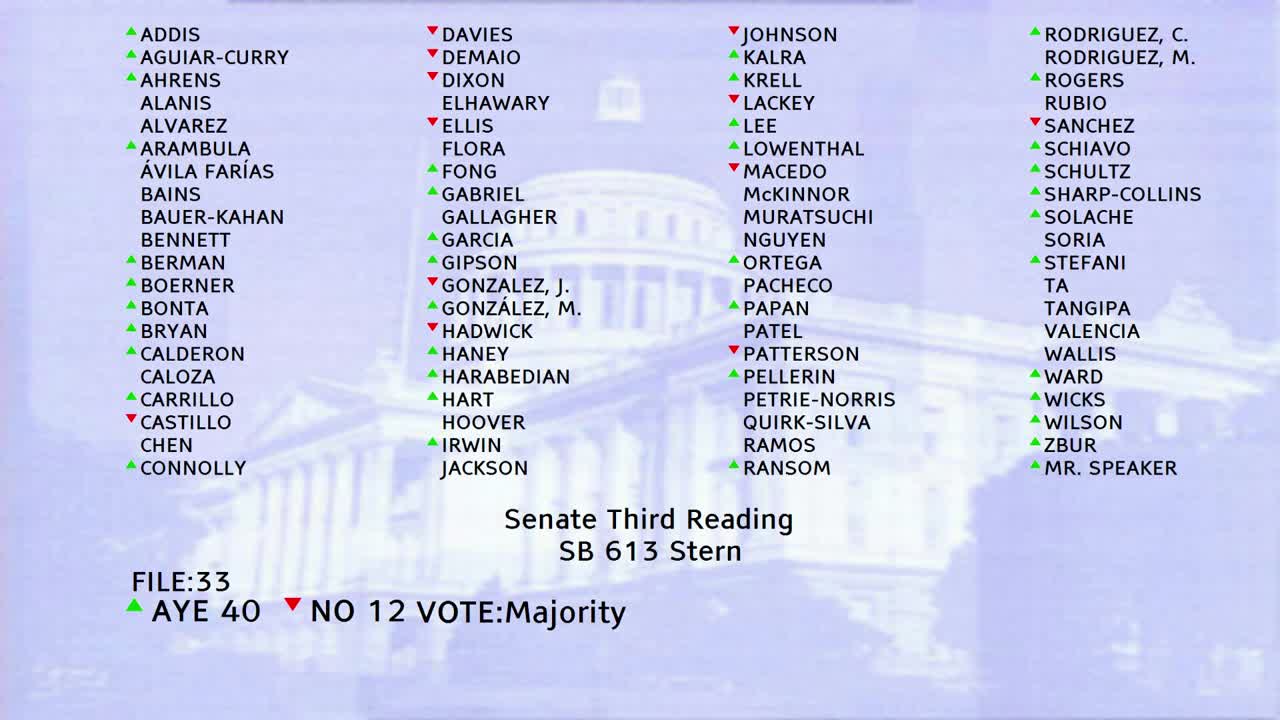 2MIN
Assembly Floor
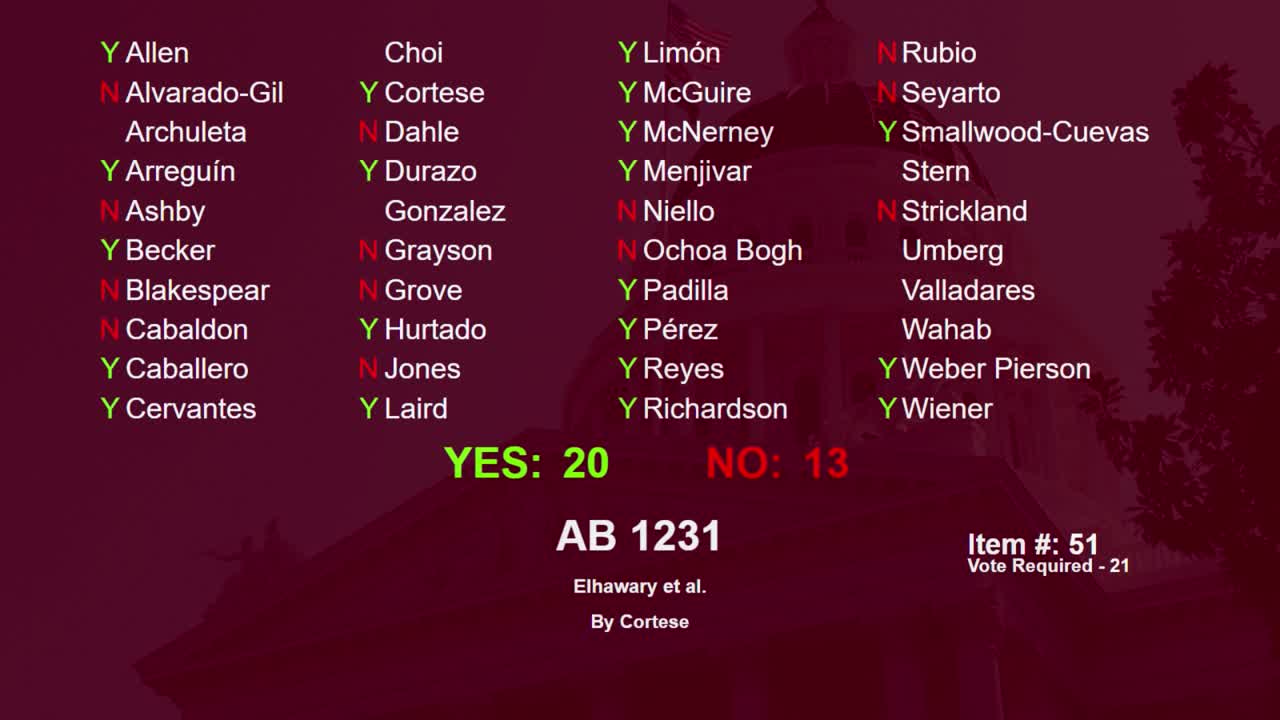 1MIN
Senate Floor
 22MIN
Assembly Standing Committee on Privacy and Consumer Protection
 18MIN
Assembly Standing Committee on Transportation
 8MIN
Senate Floor
 20MIN
Senate Standing Committee on Judiciary
 21MIN
Senate Standing Committee on Transportation
Bill Author