SB 766: California Combating Auto Retail Scams (CARS) Act.
- Session Year: 2025-2026
- House: Senate
- Latest Version Date: 2025-10-06
Current Status:
Passed
(2025-10-06: Chaptered by Secretary of State. Chapter 354, Statutes of 2025.)
Introduced
In Committee
Awaiting First Chamber Vote
Passed First Chamber
In Committee
Awaiting Second Chamber Vote
Passed Second Chamber
Enacted
Existing law governs motor vehicle conditional sale contracts, as defined, and requires a seller, prior to the execution of a conditional sale contract, to make certain disclosures to the buyer, including a description and the price of each item sold if the contract includes a charge for the item, and the sum of all of those charges.
Existing law prohibits a dealer from selling specified used vehicles at retail to an individual for personal, family, or household use without offering the buyer a contract cancellation option agreement that allows the buyer to return the vehicle without cause. Existing law sets forth certain requirements for the contract cancellation option agreement, including prescribing the purchase price for the contract cancellation option and requiring specified disclosures.
This bill would enact the California Combating Auto Retail Scams (CARS) Act. The bill would define the terms vehicle and used vehicle for these purposes. The bill would make it a violation of the act for a dealer to make any misrepresentation regarding material information about specified matters relating to the vehicle sale, including the costs or terms of purchasing, financing, or leasing a vehicle, the availability of vehicles at a total price communicated by the dealer, and the remedy available if a dealer fails to sell or lease a vehicle at the total price, as defined. The bill would also make it a violation of the act for a dealer to fail to make certain disclosures clear and conspicuous, including specified information relating to the total price and any add-on products or services, and would exempt from that provision a used vehicle sold at an auction, as defined. The bill would make it a violation of the act for a dealer, in connection with the sale or financing of a vehicle, to charge for certain items, including an add-on product or service if the vehicle purchaser or lessee would not benefit from the add-on product or service. The bill would repeal the above-described contract cancellation option agreement requirement and would instead prohibit a dealer from selling or leasing specified used vehicles without providing the purchaser or lessee a 3-day right to cancel the purchase or lease, as provided. The bill would require a dealer to create and retain, for a period of 2 years from the date the record is created, all records necessary to demonstrate compliance with the act, including specified records.
The bill would make its provisions operative on October 1, 2026.
The bill would make related conforming changes.
Existing law governs motor vehicle conditional sale contracts, as defined, and requires a seller, prior to the execution of a conditional sale contract, to make certain disclosures to the buyer, including a description and the price of each item sold if the contract includes a charge for the item, and the sum of all of those charges.
Existing law prohibits a dealer from selling specified used vehicles at retail to an individual for personal, family, or household use without offering the buyer a contract cancellation option agreement that allows the buyer to return the vehicle without cause. Existing law sets forth certain requirements for the contract cancellation option agreement, including prescribing the purchase price for the contract cancellation option and requiring specified disclosures.
This bill would enact the California Combating Auto Retail Scams (CARS) Act. The bill would define the terms vehicle and used vehicle for these purposes. The bill would make it a violation of the act for a dealer to make any misrepresentation regarding material information about specified matters relating to the vehicle sale, including the costs or terms of purchasing, financing, or leasing a vehicle, the availability of vehicles at a total price communicated by the dealer, and the remedy available if a dealer fails to sell or lease a vehicle at the total price, as defined. The bill would also make it a violation of the act for a dealer to fail to make certain disclosures clear and conspicuous, including specified information relating to the total price and any add-on products or services, and would exempt from that provision a used vehicle sold at an auction, as defined. The bill would make it a violation of the act for a dealer, in connection with the sale or financing of a vehicle, to charge for certain items, including an add-on product or service if the vehicle purchaser or lessee would not benefit from the add-on product or service. The bill would repeal the above-described contract cancellation option agreement requirement and would instead prohibit a dealer from selling or leasing specified used vehicles without providing the purchaser or lessee a 3-day right to cancel the purchase or lease, as provided. The bill would require a dealer to create and retain, for a period of 2 years from the date the record is created, all records necessary to demonstrate compliance with the act, including specified records.
The bill would make its provisions operative on October 1, 2026.
The bill would make related conforming changes.
Existing law governs motor vehicle conditional sale contracts, as defined, and requires a seller, prior to the execution of a conditional sale contract, to make certain disclosures to the buyer, including a description and the price of each item sold if the contract includes a charge for the item, and the sum of all of those charges.
Existing law prohibits a dealer from selling specified used vehicles at retail to an individual for personal, family, or household use without offering the buyer a contract cancellation option agreement that allows the buyer to return the vehicle without cause. Existing law sets forth certain requirements for the contract cancellation option agreement, including prescribing the purchase price for the contract cancellation option and requiring specified disclosures.
This bill would enact the California Combating Auto Retail Scams (CARS) Act. The bill would define the terms vehicle and used vehicle vehicle and used vehicle for these purposes. The bill would make it a violation of the act for a dealer to make any misrepresentation regarding material information about specified matters relating to the vehicle sale, including the costs or terms of purchasing, financing, or leasing a vehicle, the availability of vehicles at a total price communicated by the dealer, and the remedy available if a dealer fails to sell or lease a vehicle at the total price, as defined. The bill would also make it a violation of the act for a dealer to fail to make certain disclosures clear and conspicuous, including specified information relating to the total price and any add-on products or services, and would exempt from that provision a used vehicle sold at an auction, as defined. The bill would make it a violation of the act for a dealer, in connection with the sale or financing of a vehicle, to charge for certain items, including an add-on product or service if the vehicle purchaser or lessee would not benefit from the add-on product or service. The bill would repeal the above-described contract cancellation option agreement requirement and would instead prohibit a dealer from selling or leasing specified used vehicles without providing the purchaser or lessee a 3-day right to cancel the purchase or lease, as provided. The bill would require a dealer to create and retain, for a period of 2 years from the date the record is created, all records necessary to demonstrate compliance with the act, including specified records.
The bill would make its provisions operative on October 1, 2026.
The bill would make related conforming changes.
Existing law governs motor vehicle conditional sale contracts, as defined, and requires a seller, prior to the execution of a conditional sale contract, to make certain disclosures to the buyer, including a description and the price of each item sold if the contract includes a charge for the item, and the sum of all of those charges.
Existing law prohibits a dealer from selling specified used vehicles at retail to an individual for personal, family, or household use without offering the buyer a contract cancellation option agreement that allows the buyer to return the vehicle without cause. Existing law sets forth certain requirements for the contract cancellation option agreement, including prescribing the purchase price for the contract cancellation option and requiring specified disclosures.
This bill would enact the California Combating Auto Retail Scams (CARS) Act. The bill would define the terms vehicle and used vehicle for these purposes. The bill would make it a violation of the act for a dealer to make any misrepresentation regarding material information about specified matters relating to the vehicle sale, including the costs or terms of purchasing, financing, or leasing a vehicle, the availability of vehicles at a total price communicated by the dealer, and the remedy available if a dealer fails to sell or lease a vehicle at the total price, as defined. The bill would also make it a violation of the act for a dealer to fail to make certain disclosures clear and conspicuous, including specified information relating to the total price and any add-on products or services, and would exempt from that provision a used vehicle sold at an auction, as defined. The bill would make it a violation of the act for a dealer, in connection with the sale or financing of a vehicle, to charge for certain items, including an add-on product or service if the vehicle purchaser or lessee would not benefit from the add-on product or service. The bill would repeal the above-described contract cancellation option agreement requirement and would instead prohibit a dealer from selling or leasing specified used vehicles without providing the purchaser or lessee a 3-day right to cancel the purchase or lease, as provided. The bill would require a dealer to create and retain, for a period of 2 years from the date the record is created, all records necessary to demonstrate compliance with the act, including specified records.
The bill would make its provisions operative on October 1, 2026.
The bill would make related conforming changes.
Existing law governs motor vehicle conditional sale contracts, as defined, and requires a seller, prior to the execution of a conditional sale contract, to make certain disclosures to the buyer, including a description and the price of each item sold if the contract includes a charge for the item, and the sum of all of those charges.
Existing law prohibits a dealer from selling specified used vehicles at retail to an individual for personal, family, or household use without offering the buyer a contract cancellation option agreement that allows the buyer to return the vehicle without cause. Existing law sets forth certain requirements for the contract cancellation option agreement, including prescribing the purchase price for the contract cancellation option and requiring specified disclosures.
This bill would enact the California Combating Auto Retail Scams (CARS) Act. The bill would define the terms vehicle and used vehicle for these purposes. The bill would make it a violation of the act for a dealer to make any misrepresentation regarding material information about specified matters relating to the vehicle sale, including the costs or terms of purchasing, financing, or leasing a vehicle, the availability of vehicles at a total price communicated by the dealer, and the remedy available if a dealer fails to sell or lease a vehicle at the total price, as defined. The bill would also make it a violation of the act for a dealer to fail to make certain disclosures clear and conspicuous, including specified information relating to the total price and any add-on products or services, and would exempt from that provision a used vehicle sold at an auction, as defined. The bill would make it a violation of the act for a dealer, in connection with the sale or financing of a vehicle, to charge for certain items, including an add-on product or service if the vehicle purchaser or lessee would not benefit from the add-on product or service. The bill would repeal the above-described contract cancellation option agreement requirement and would instead prohibit a dealer from selling or leasing specified used vehicles without providing the purchaser or lessee a 3-business-day 3-day right to cancel the purchase or lease, as provided. The bill would require a dealer to create and retain, for a period of 2 years from the date the record is created, all records necessary to demonstrate compliance with the act, including specified records.
The bill would make its provisions operative on October 1, 2026.
The bill would make related conforming changes.
Existing law governs motor vehicle conditional sale contracts, as defined, and requires a seller, prior to the execution of a conditional sale contract, to make certain disclosures to the buyer, including a description and the price of each item sold if the contract includes a charge for the item, and the sum of all of those charges.
Existing law prohibits a dealer from selling specified used vehicles at retail to an individual for personal, family, or household use without offering the buyer a contract cancellation option agreement that allows the buyer to return the vehicle without cause. Existing law sets forth certain requirements for the contract cancellation option agreement, including prescribing the purchase price for the contract cancellation option and requiring specified disclosures.
This bill would enact the California Combating Auto Retail Scams (CARS) Act. The bill would define the terms vehicle and used vehicle for these purposes. The bill would make it a violation of the act for a dealer to make any misrepresentation regarding material information about specified matters relating to the vehicle sale, including the costs or terms of purchasing, financing, or leasing a vehicle, the availability of vehicles at a total price communicated by the dealer, and the remedy available if a dealer fails to sell or lease a vehicle at the total price, as defined. The bill would also make it a violation of the act for a dealer to fail to make certain disclosures clear and conspicuous, including specified information relating to the total price and any add-on products or services, and would exempt from that provision a used vehicle sold at an auction, as defined. The bill would make it a violation of the act for a dealer, in connection with the sale or financing of a vehicle, to charge for certain items, including an add-on product or service if the vehicle purchaser or lessee would not benefit from the add-on product or service. The bill would repeal the above-described contract cancellation option agreement requirement and would instead prohibit a dealer from selling or leasing specified used vehicles without providing the purchaser or lessee a 3-business-day right to cancel the purchase or lease, as provided. The bill would require a dealer to create and retain, for a period of 2 years from the date the record is created, all records necessary to demonstrate compliance with the act, including specified records.
The bill would make its provisions operative on October 1, 2026.
The bill would make related conforming changes.
Existing law governs motor vehicle conditional sale contracts, as defined, and requires a seller, prior to the execution of a conditional sale contract, to make certain disclosures to the buyer, including a description and the price of each item sold if the contract includes a charge for the item, and the sum of all of those charges.
Existing law prohibits a dealer from selling specified used vehicles at retail to an individual for personal, family, or household use without offering the buyer a contract cancellation option agreement that allows the buyer to return the vehicle without cause. Existing law sets forth certain requirements for the contract cancellation option agreement, including prescribing the purchase price for the contract cancellation option and requiring specified disclosures.
This bill would enact the California Combating Auto Retail Scams (CARS) Act. The bill would make it a violation of the act for a dealer to make any misrepresentation regarding material information about specified matters relating to the vehicle sale, including the costs or terms of purchasing, financing, or leasing a vehicle, the availability of vehicles at an advertised price, a total price communicated by the dealer, and the remedy available if a dealer fails to sell or lease a vehicle at the total price, as defined. The bill would also make it a violation of the act for a dealer to fail to make certain disclosures clear and conspicuous, including specified information relating to the total price and any add-on products or services. services, and would exempt from that provision a used vehicle sold at an auction, as defined. The bill would make it a violation of the act for a dealer, in connection with the sale or financing of a vehicle, to charge for certain items, including an add-on product or service if the vehicle purchaser or lessee would not benefit from the add-on product or service. The bill would repeal the above-described contract cancellation option agreement requirement and would instead prohibit a dealer from selling or leasing specified used vehicles without providing the purchaser or lessee a 3-business-day right to cancel the purchase or lease, as provided. The bill would require a dealer to create and retain, for a period of 2 years from the date the record is created, all records necessary to demonstrate compliance with the act, including specified records.
The bill would make related conforming changes.
Existing law governs motor vehicle conditional sale contracts, as defined, and requires a seller, prior to the execution of a conditional sale contract, to make certain disclosures to the buyer, including a description and the price of each item sold if the contract includes a charge for the item, and the sum of all of those charges.
Existing law prohibits a dealer from selling specified used vehicles at retail to an individual for personal, family, or household use without offering the buyer a contract cancellation option agreement that allows the buyer to return the vehicle without cause. Existing law sets forth certain requirements for the contract cancellation option agreement, including prescribing the purchase price for the contract cancellation option and requiring specified disclosures.
This bill would enact the California Combating Auto Retail Scams (CARS) Act. The bill would make it a violation of the act for a dealer to make any misrepresentation regarding material information about specified matters relating to the vehicle sale, including the costs or terms of purchasing, financing, or leasing a vehicle, the availability of vehicles at an advertised price, and the remedy available if a dealer fails to sell or lease a vehicle at the total price, as defined. The bill would also make it a violation of the act for a dealer to fail to make certain disclosures clear and conspicuous, including specified information relating to the total price and any add-on product or services. products or services. The bill would make it a violation of the act for a dealer, in connection with the sale or financing of a vehicle, to charge for certain items, including an add-on product or service if the vehicle purchaser or lessee would not benefit from the add-on product or service. The bill would repeal the above-described contract cancellation option agreement requirement and would instead prohibit a dealer from selling or leasing specified used vehicles without providing the purchaser or lessee a 3-business-day right to cancel the purchase or lease, as provided. The bill would require a dealer to create and retain, for a period of 2 years from the date the record is created, all records necessary to demonstrate compliance with the act, including specified records.
The bill would make related conforming changes.
Existing law governs motor vehicle conditional sale contracts, as defined, and requires a seller, prior to the execution of a conditional sale contract, to make certain disclosures to the buyer, including a description and the price of each item sold if the contract includes a charge for the item, and the sum of all of those charges.
Existing law prohibits a dealer from selling specified used vehicles at retail to an individual for personal, family, or household use without offering the buyer a contract cancellation option agreement that allows the buyer to return the vehicle without cause. Existing law sets forth certain requirements for the contract cancellation option agreement, including prescribing the purchase price for the contract cancellation option and requiring specified disclosures.
This bill would enact the California Combating Auto Retail Scams (CARS) Act. The bill would make it a violation of the act for a dealer to make any misrepresentation regarding material information about specified matters relating to the vehicle sale, including the costs or terms of purchasing, financing, or leasing a vehicle, the availability of vehicles at an advertised price, and the remedy available if a dealer fails to sell or lease a vehicle at the total price, as defined. The bill would also make it a violation of the act for a dealer to fail to make certain disclosures clear and conspicuous, including specified information relating to the total price and any add-on product or services. The bill would make it a violation of the act for a dealer, in connection with the sale or financing of a vehicle, to charge for certain items, including an add-on product or service if the vehicle purchaser or lessee would not benefit from the add-on product or service. The bill would repeal the above-described contract cancellation option agreement requirement and would instead prohibit a dealer from selling or leasing specified used vehicles without providing the purchaser or lessee a 3-business-day right to cancel the purchase or lease, as provided. The bill would require a dealer to create and retain, for a period of 2 years from the date the record is created, all records necessary to demonstrate compliance with the act, including specified records.
The bill would make related conforming changes.
Existing law governs motor vehicle conditional sale contracts, as defined, and requires a seller, prior to the execution of a conditional sale contract, to make certain disclosures to the buyer, including a description and the price of each item sold if the contract includes a charge for the item, and the sum of all of those charges.
Existing law prohibits a dealer from selling specified used vehicles at retail to an individual for personal, family, or household use without offering the buyer a contract cancellation option agreement that allows the buyer to return the vehicle without cause. Existing law sets forth certain requirements for the contract cancellation option agreement, including prescribing the purchase price for the contract cancellation option and requiring specified disclosures.
This bill would enact the California Combating Auto Retail Scams (CARS) Act. The bill would make it a violation of the act for a dealer to make any misrepresentation regarding material information about specified matters relating to the vehicle sale, including the costs or terms of purchasing, financing, or leasing a vehicle, the availability of vehicles at an advertised price, and the remedy available if a dealer fails to sell or lease a vehicle at the offering price. total price, as defined. The bill would also make it a violation of the act for a dealer to fail to make certain disclosures clear and conspicuous, including specified information relating to the offering total price and any add-on product or services. The bill would make it a violation of the act for a dealer, in connection with the sale or financing of a vehicle, to charge for certain items, including an add-on product or service if the vehicle purchaser or lessee would not benefit from the add-on product or service. The bill would repeal the above-described contract cancellation option agreement requirement and would instead prohibit a dealer from selling or leasing specified used vehicles without providing the purchaser or lessee a 3-business-day right to cancel the purchase or lease, as provided. The bill would require a dealer to create and retain, for a period of 2 years from the date the record is created, all records necessary to demonstrate compliance with the act, including specified records.
The bill would make related conforming changes.
Existing law governs motor vehicle conditional sale contracts, as defined, and requires a seller, prior to the execution of a conditional sale contract, to make certain disclosures to the buyer, including a description and the price of each item sold if the contract includes a charge for the item, and the sum of all of those charges.
This bill would repeal those disclosure requirements.Existing law prohibits a dealer from selling a used vehicle, as defined, that is subject to registration, specified used vehicles at retail to an individual for personal, family, or household use without offering the buyer a contract cancellation option agreement that allows the buyer to return the vehicle without cause. Existing law sets forth certain requirements for the contract cancellation option agreement, including prescribing the purchase price for the contract cancellation option and requiring specified disclosures.
This bill would repeal those provisions relating to a contract cancellation option agreement.This bill would enact the California Combating Auto Retail Scams (CARS) Act. The bill would make it a violation of the act for a dealer to make any misrepresentation regarding material information about specified matters relating to the vehicle sale, including the costs or terms of purchasing, financing, or leasing a vehicle, the availability of vehicles at an advertised price, and the remedy available if a dealer fails to sell or lease a vehicle at the offering price. The bill would also make it a violation of the act for a dealer to fail to make certain disclosures clear and conspicuous, including specified information relating to the offering price and any add-on product or services. The bill would make it a violation of the act for a dealer, in connection with the sale or financing of a vehicle, to charge for certain items, including an add-on product or service if the vehicle purchaser or lessee would not benefit from the add-on product or service. The bill would repeal the above-described contract cancellation option agreement requirement and would instead prohibit a dealer from selling or leasing a used vehicle specified used vehicles without providing the purchaser or lessee a 10 day 3-business-day right to cancel the purchase or lease, as provided. The bill would require a dealer to create and retain, for a period of 7 2 years from the date the record is created, all records necessary to demonstrate compliance with the act, including specified records.
The bill would make related conforming changes.
Existing law governs motor vehicle conditional sale contracts, as defined, and requires a seller, prior to the execution of a conditional sale contract, to make certain disclosures to the buyer, including a description and the price of each item sold if the contract includes a charge for the item, and the sum of all of those charges.
This bill would repeal those disclosure requirements.
Existing law prohibits a dealer from selling a used vehicle, as defined, that is subject to registration, at retail to an individual for personal, family, or household use without offering the buyer a contract cancellation option agreement that allows the buyer to return the vehicle without cause. Existing law sets forth certain requirements for the contract cancellation option agreement, including prescribing the purchase price for the contract cancellation option and requiring specified disclosures.
This bill would repeal those provisions relating to a contract cancellation option agreement.
This bill would enact the California Combating Auto Retail Scams (CARS) Act. The bill would make it a violation of the act for a dealer to make any misrepresentation regarding material information about specified matters relating to the vehicle sale, including the costs or terms of purchasing, financing, or leasing a vehicle, the availability of vehicles at an advertised price, and the remedy available if a dealer fails to sell or lease a vehicle at the offering price. The bill would also make it a violation of the act for a dealer to fail to make certain disclosures clear and conspicuous, including specified information relating to the offering price and any add-on product or services. The bill would make it a violation of the act for a dealer, in connection with the sale or financing of a vehicle, to charge for certain items, including an add-on product or service if the vehicle purchaser or lessee would not benefit from the add-on product or service. The bill would prohibit a dealer from selling or leasing a used vehicle without providing the purchaser or lessee a 10 day right to cancel the purchase or lease, as provided. The bill would require a dealer to create and retain, for a period of 7 years from the date the record is created, all records necessary to demonstrate compliance with the act, including specified records.
The bill would make related conforming changes.
This title shall be known, and may be cited, as the California Combating Auto Retail Scams (CARS) Act.
1784.21.Any waiver by a consumer of the provisions of this title is contrary to public policy and is unenforceable and void.
1784.22.The provisions of this title are not exclusive. The remedies provided in this title for a violation of this title or for conduct proscribed by this title shall be in addition to any other remedies available under other law. This title does not limit or alter the remedies and liabilities set forth in other laws that may apply.
1784.23.If any provision of this title or the application of this title to any person or circumstance is held to be unconstitutional or otherwise deemed to be invalid, the remainder of the title and the application of the provision to other persons or circumstances shall not be affected.
1784.28.This title shall become operative on October 1, 2026.
2.Construction and Definitions1784.30.This title shall be liberally construed and applied to promote its underlying purposes, which are to protect purchasers and lessees of new or used motor vehicles against unfair and deceptive business practices and to provide efficient and economical procedures to secure that protection.
1784.31.The following definitions apply for purposes of this title:
(a)Add-on or add-on product or service means any product or service not provided to the purchaser or lessee or installed on the vehicle by the vehicle manufacturer and for which the dealer, directly or indirectly, charges a purchaser or lessee in connection with a vehicle sale, lease, or financing transaction.
(b)Auction means a sale transaction conducted by means of oral, written, or electronic exchanges whereby offers are solicited from one or more potential purchasers in the form of bids in an effort to advance the amount of the bids to obtain the highest and most favorable offer.
(c)Dealer means a licensed California motor vehicle dealer or a dealer as defined in Section 285 of the Vehicle Code.
(d)GAP agreement means an agreement for either of the following:
(1)To indemnify a vehicle purchaser or lessee for the difference between the actual cash value of the vehicle in the event of an unrecovered theft or total loss and the amount owed on the vehicle pursuant to the terms of a loan, lease agreement, or installment sales contract used to purchase or lease the vehicle.
(2)To waive the unpaid difference between money received from the purchasers or lessees vehicle insurer and some or all of the amount owed on the vehicle at the time of the unrecovered theft or total loss, including products or services titled guaranteed automobile protection agreement, guaranteed asset protection agreement, GAP insurance, or GAP waiver.
(e)Material or materially means likely to affect a persons choice of, or conduct regarding, goods or services.
(f)(1)Motor vehicle or vehicle means a motor vehicle as defined by Section 415 of the Vehicle Code.
(2)Notwithstanding paragraph (1), motor vehicle or vehicle does not include any of the following:
(A)Vehicles that are sold wholesale. For purposes of this subparagraph, wholesale means sale of a vehicle that does not constitute a retail sale, as defined in Section 6007 of the Revenue and Taxation Code.
(B)Vehicles that are not required to be registered under the Vehicle Code.
(C)Fleet sale transactions. For purposes of this subparagraph, fleet sale means the sale of more than one vehicle as part of a single transaction for use primarily for business or commercial purposes.
(D)Sales to commercial purchasers. For the purposes of this subparagraph, commercial purchasers means a person that purchases five or more vehicles from the dealer per year for use primarily for business or commercial purposes.
(E)A vehicle that has a gross vehicle weight rating of 10,000 pounds or more.
(g)Restocking fee means the following fees that the dealer may charge a buyer or lessee who exercises the three-day right to cancel:
(1)(A)One and one-half percent of the sale price of the vehicle, but not less than two hundred dollars ($200) and not more than six hundred dollars ($600).
(B)In lieu of the fee in subparagraph (A), a dealer that charged the buyer or lessee a shipping fee for transporting the vehicle may retain the cost the dealer actually incurred for shipping, provided that the amount retained does not exceed the amount that would otherwise be permitted under subparagraph (A). The dealer shall refund to the buyer or lessee the balance, if any, between the amounts charged and retained.
(2)If the vehicle has been driven over 250 miles, the dealer may also charge the buyer or lessee an additional one dollar ($1) for each mile over 250 miles, but this amount shall not exceed one hundred fifty dollars ($150).
(h)Service contract includes products that provide consumers with some type of benefit or payment for repair, maintenance, or service on the vehicle purchased or leased.
(i)(1)Three-day, as used in the phrase three-day right to cancel, means the period in which a buyer or lessee of a used vehicle may exercise the right to cancel the purchase or lease as provided in Section 1784.43. Except as provided in paragraph (2), this period consists of the three calendar day period commencing the calendar day after the purchase or lease is executed.
(2)If the third day in the three calendar day period described in paragraph (1) falls on a day the dealership is closed to the public, the three-day right to cancel period extends to the next day the dealership is open to the public.
(3)The three-day right to cancel ends at the close of business on the last day of the period described in this subdivision.
(j)(1)Total price means the total sale price of a vehicle, excluding the taxes, fees, and charges described in subdivision (e) of Section 11713.1 of the Vehicle Code.
(2)Total price includes any dealer price adjustment and the cost of any item installed on the vehicle at the time of the advertisement or communication.
(3)Total price does not include any deduction for a rebate.
(k)(1)Used motor vehicle or used vehicle means a vehicle, as defined by subdivision (f), that also satisfies the definition of a used vehicle as defined in Section 665 of the Vehicle Code.
(2)Used motor vehicle does not include a motorcycle, as defined in Section 400 of the Vehicle Code.
3.Prohibited Conduct and Consumer Rights 1784.40.It is a violation of this title for any dealer to make any misrepresentation regarding material information about any of the following:
(a)The costs or terms of purchasing, financing, or leasing a vehicle.
(b)Any costs, limitation, benefit, or any other aspect of an add-on product or service.
(c)Whether the final contract is for the lease or sale of a motor vehicle. This subdivision shall not be construed to restrict the ability of a dealer to present multiple financing and lease payment options to the customer prior to the sale or lease of a motor vehicle.
(d)The availability of vehicles at a total price communicated by the dealer. A dealer is not in violation of this subdivision if the advertisement in question is withdrawn following the sale of the vehicle in compliance with subdivision (c) of Section 11713 of the Vehicle Code.
(e)Whether any consumer has been or will be preapproved or guaranteed for any product, service, or term.
(f)Information on or about a consumers application for financing.
(g)Whether the dealer will keep cash downpayments or trade-in vehicles, charge fees, or initiate legal process, or any action if a transaction is not finalized or if the consumer does not go forward with the transaction.
(h)Whether, and if so, when, a dealer will pay off some or all of the financing or a lease on a consumers trade-in vehicle, and what happens if a dealer fails to pay off the trade-in vehicle within the time period required by Section 11709.4 of the Vehicle Code.
(i)The remedy available if a dealer fails to sell or lease a vehicle at the total price.
(j)Whether the dealer or any of the dealers personnel or products or services is or was affiliated with, endorsed or approved by, or otherwise associated with the United States government or any federal, state, or local governmental agency, unit, or department, including the United States Department of Defense or its military departments.
(k)Whether, or under what circumstances, a vehicle may be repossessed.
(l)Whether a vehicle can be moved outside of California or outside of the United States.
(m)Any of the required disclosures identified in this title.
1784.41.It is a violation of this title for any dealer to fail to make any disclosure required by this section clearly and conspicuously.
(a)In connection with the sale or financing of a vehicle, a vehicles total price shall be disclosed as follows:
(1)In any advertisement that references a specific vehicle for sale.
(2)In any advertisement that represents any monetary amount or financing term for a specific vehicle.
(3)In the first written communication with a consumer that includes a reference regarding a specific vehicle for sale, or any monetary amount or financing term for any vehicle. With respect to the first written communication, both of the following apply:
(A)The total price for the vehicle shall be disclosed at least once in the dealers first response regarding that specific vehicle to the consumer.
(B)A dealer shall retain a copy of the communication identified by this paragraph for at least two years and shall provide a copy of the communication to the customer upon written request.
(b)When making any written representation during the negotiation to purchase or lease a specific vehicle about an add-on product or service, the dealer shall disclose at least once that the add-on is not required and the consumer can purchase or lease the vehicle without the add-on. This disclosure shall be in writing and shall be clear and conspicuous. If the transaction is negotiated primarily in a language identified by subdivision (b) of Section 1632, the disclosure required by this paragraph shall also be provided in that language.
(c)(1)When making any written representation during the negotiation to purchase or lease a specific vehicle about a monthly payment for any vehicle, the dealer shall disclose at least once, clearly and conspicuously and in writing, the total amount the consumer will pay to purchase or lease the vehicle at that monthly payment after making all payments as scheduled.
(2)If the total amount disclosed assumes the consumer will provide consideration, including in the form of a cash downpayment or trade-in valuation, the dealer shall disclose the amount of consideration to be provided by the consumer. This disclosure shall be in writing and shall be clear and conspicuous. If the transaction is negotiated primarily in a language identified by subdivision (b) of Section 1632, the disclosure required by this paragraph shall also be provided in that language.
(d)If the dealer makes any written comparison between payment options during the negotiation to purchase or lease a specific vehicle that includes discussion of lower monthly payments, the dealer shall disclose that lower monthly payments often increase the total amount the consumer will pay to purchase or lease the vehicle. Use of an internet-based tool that allows consumers to adjust financing parameters shall not constitute a violation of this section.
(e)The disclosures required by subdivisions (b), (c), and (d) may be incorporated into a document that includes the written disclosures required by Section 2982.2.
(f)Subdivision (a) shall not be construed to modify vehicle advertising requirements in Section 11713.1 or Section 11713.16 of the Vehicle Code. This includes, but is not limited to, the advertisement or communication of rebates and incentives that are disclosed separately from a vehicles total price.
(g)This section shall not apply to a used vehicle sold at an auction.
1784.42.It is a violation of this title for any dealer, in connection with the sale or financing of vehicles, to charge for any of the following.
(a)A dealer may not charge for an add-on product or service if the vehicle purchaser or lessee would not benefit from the add-on product or service, including, as applicable, any of the following:
(1)Nitrogen-filled tire-related products or services that contain less than 95-percent nitrogen purity.
(2)Products or services that do not provide coverage for the vehicle, the consumer, or the transaction.
(3)A GAP agreement that is not in compliance with Section 2982, 2982.2, or 2982.12.
(4)A service contract if the service contract is void due to preexisting conditions, including prior damage from a crash or flood or preexisting mechanical conditions.
(5)Oil changes for electric vehicles.
(6)Catalytic converter markings for a vehicle that does not have a catalytic converter.
(7)Surface protection product that renders the manufacturers warranty for the paint job void.
(b)A dealer shall pay the person or entity who is supposed to provide the benefit of the add-on within 10 days of the date when the car buyer or lessee signs the purchase or lease, unless the dealer has an agreement with the person or entity that provides for payment at a later date and the buyers or lessees coverage is not impacted by the later payment.
(c)This section does not prohibit a dealer from charging for an add-on product or service, such as a service contract, if the add-on product or service is selected by, and would benefit, the vehicle purchaser or lessee, even if the vehicle purchaser or lessee ultimately does not choose to use the add-on product or service, and even if the vehicle purchaser or lessee does not use the add-on product or service because a coverage event does not occur.
1784.43.(a)(1)(A)A dealer shall not sell or lease a used vehicle at retail at a price equal to or less than fifty thousand dollars ($50,000) without providing the buyer or lessee with a three-day right to cancel the purchase or lease.
(B)The right to cancel does not apply if the used vehicle has been driven more than 400 miles between the execution of the sale or lease agreement and the date on which the buyer or lessee attempts to exercise the right.
(2)(A)A dealer may charge a buyer or lessee who exercises the right to cancel a restocking fee. Except as provided in subparagraph (B), the dealer may collect the restocking fee on the date the buyer or lessee exercises the right to cancel.
(B)(i)If the buyer or lessee is entitled to any refund, the restocking fee shall be deducted from the refund.
(ii)If the refund does not cover the full amount of the restocking fee, the balance is due at the time the buyer or lessee exercises the right to cancel.
(3)(A)If the right to cancel is exercised, the dealer shall return the buyers or lessees trade-in vehicle and all keys the buyer or lessee provided, if any, unless the dealer has sold or otherwise initiated the process to transfer the title of the trade-in vehicle, in which case the refund for the trade-in vehicle is the greater of the following:
(i)The agreed-upon value of the trade-in vehicle in the sales or lease agreement.
(ii)The amount for which the dealer sold the trade-in vehicle.
(iii)The fair market value of the trade-in vehicle.
(B)The dealer may deduct from the amount required by subparagraph (A) the amount necessary to satisfy outstanding indebtedness secured by the trade-in vehicle. The dealer shall provide the buyer or lessee a receipt documenting the cancellation that includes an itemized breakdown of the basis for each deduction. The receipt shall include the date and time when the buyer or lessee exercised the right to cancel.
(C)For the purposes of clause (iii) of subparagraph (A), the dealer shall have a rebuttable presumption of establishing the fair market value by either of the two valuation methods:
(i)The valuation equals the amount identified in a written offer to purchase the trade-in vehicle received by the buyer or lessee, and honored by the dealer, and that offer is valid for at least seven days.
(ii)The valuation equals the vehicles trade-in valuation when the right to cancel was exercised, as identified in a nationally recognized pricing guide selected by the dealer, and considering the vehicles condition at the time the vehicle was traded in. For the purposes of this clause, nationally recognized pricing guide has the same meaning as paragraph (2) of subdivision (c) of Section 11950 of the Vehicle Code.
(b)Notwithstanding Section 2981.9 of the Civil Code, a dealer shall provide the buyer or lessee of a used vehicle subject to the right to cancel a copy of a disclosure titled 3-Day Right to Cancel Used Car Purchase or Lease on a separate document. If the transaction is negotiated primarily in a language identified by subdivision (b) of Section 1632, the disclosure required by this subdivision shall also be provided in that language. The disclosure shall clearly and conspicuously contain all of the following:
(1)The name of the selling or leasing dealer and the buyer or lessee.
(2)A description and the vehicle identification number of the vehicle purchased.
(3)A statement specifying the time within which the buyer or lessee must exercise the right to cancel the sale or lease and return the vehicle to the dealer.
(4)A statement that although the dealer cannot charge the buyer or lessee for the right to cancel the purchase or lease, the dealer may charge the buyer or lessee a restocking fee. The statement shall describe how both components of the restocking fee are calculated.
(5)A statement that the buyer or lessee cannot exercise the right to cancel if the vehicle has been driven more than 400 miles.
(6)A statement that the right to cancel applies only if all of the following are personally delivered to the selling or leasing dealer during business hours by the buyer or lessee at the time the right to cancel is exercised:
(A)Restocking fees, except to the extent they are deducted from any refund as required by this section.
(B)The vehicle, meeting both of the following:
(i)Free of all liens and encumbrances, other than any lien or encumbrance created by or incidental to the sales or lease transaction.
(ii)In the same condition as when it was delivered by the dealer to the buyer or lessee, except reasonable wear and tear and any defect or mechanical problem that manifests or becomes evident after delivery that was not caused by the buyer or lessee. The dealer shall maintain documentation describing any damage beyond reasonable wear and tear.
(C)Any other cash or items received by the buyer or lessee in connection with the sale or lease of the vehicle.
(7)A statement that the dealer may require the buyer or lessee to execute documents reasonably necessary to effectuate the cancellation and refund and as reasonably required to comply with applicable law.
(8)(A)A statement that if the dealer has sold or otherwise initiated the process to transfer title of the buyers or lessees trade-in vehicle, the dealer shall pay the buyer or lessee the greater of the following:
(i)The agreed-upon value of the trade-in vehicle in the sales or lease agreement.
(ii)The amount for which the dealer sold the trade-in vehicle.
(iii)The fair market value of the trade-in vehicle.
(B)A statement that the amount of the refund may be reduced as necessary to satisfy outstanding indebtedness secured by the trade-in vehicle.
(9)A statement that if the dealer represents to the buyer or lessee that it sold the trade-in vehicle, it must provide the buyer or lessee a copy of the document showing the sale of the trade-in vehicle. The dealer shall redact the personal information of the person or entity to whom the trade-in vehicle was sold.
(c)It is a violation of this title for any dealer, in connection with a buyer or lessee exercising the right to cancel, to do any of the following:
(1)Anything to impede a buyer or lessee from exercising the right to cancel the purchase or lease of a vehicle as provided in this title.
(2)Overcharge the buyer or lessee for the restocking fee.
(3)Withhold the buyers or lessees downpayment or trade-in vehicle after the right to cancel has been exercised.
(4)Fail to timely refund the buyers or lessees downpayment after the right to cancel has been exercised.
(5)Fail to refund the amount owed for the buyers or lessees trade-in vehicle if the trade-in vehicle has been sold.
(6)Fail to provide the buyer or lessee the receipt or contract for the sale of the buyers or lessees trade-in vehicle.
(7)Claim damage to the vehicle in excess of reasonable wear and tear without reasonable basis.
(8)Claim the person authorized to return the buyers or lessees downpayment or trade-in vehicle is not available.
(d)(1)No later than 48 hours after the buyer or lessee exercises the right to cancel pursuant to this section, the dealer shall cancel the contract and provide the buyer or lessee with a full refund, minus any deduction allowed by this section. The dealer is not responsible for any delays outside the control of the dealer, including delays attributable to the processing of a refund by a bank, credit card company, or other financial institution.
(2)Notwithstanding paragraph (1), in the event the buyer or lessee made a payment through a method that does not result in an immediate verified transfer of funds to the dealer, such as a check, the dealer may delay providing the refund until two business days after the buyer or lessees payment is verified. The dealer shall provide the buyer or lessee with documentation showing when the verification occurred.
(e)The dealer will clearly and conspicuously disclose on the first page of the purchase or lease agreement the following:
CALIFORNIA DOES NOT HAVE A COOLING-OFF PERIOD FOR NEW VEHICLES. HOWEVER, IF YOU PURCHASED
OR LEASED A USED VEHICLE FOR $50,000 OR LESS, YOU HAVE 3 DAYS TO CANCEL THIS CONTRACT FOR ANY REASON. ADDITIONAL RESTRICTIONS MAY APPLY, INCLUDING A RESTOCKING FEE.
You have up to 3 days to return the vehicle to the dealer and cancel this contract and obtain a refund. Please review the disclosure, which the dealer is required by law to provide, for the details about this right and how to exercise it.
(f)This section does not affect the ability of a buyer to rescind the contract or revoke acceptance under any other law.
(g)This section does not apply to a used vehicle with a purchase price greater than fifty thousand dollars ($50,000).
(h)This section does not apply to the sale of a leased vehicle to the lessee if the lessee is in possession of the vehicle prior to the time of the sale.
(i)This section does not apply to a used vehicle sold at an auction, provided the used vehicle is in compliance with the requirements of Division 12 (commencing with Section 24000) of the Vehicle Code.
(j)This section shall not be construed to limit the ability of a dealer to offer a right to cancel that provides greater consumer protections than those outlined in this section, including a right to cancel for additional vehicles, a longer return period, or reduced restocking fees. In such circumstances, the dealer may elect to make corresponding changes that describe these greater consumer protections in any consumer notice required by this section or Section 11709.2 of the Vehicle Code.
1784.44.(a)A dealer subject to this title shall create and retain, for a period of two years from the date the record is created, all records necessary to demonstrate compliance with this title, including the following records:
(1)Records demonstrating that communications and advertisements of a vehicles total price meet the requirements of subdivision (a) of Section 1784.41. For purposes of this paragraph, advertisement includes internet-based listings that display a vehicles total price, features, or financing terms disseminated by the dealer. This paragraph shall not require retention of records generated solely by interactive tools that allow consumers to adjust variables such as downpayment, credit tier, interest rate, or loan term to receive personalized financing estimates, provided the tools do not alter or misrepresent the vehicles total price as advertised.
(2)Copies of all purchase orders, financing and lease documents with the dealer signed by the consumer, whether or not final approval or assignment of the contract is received from a financing or lease transaction, and all written communications relating to sales, financing, or leasing between the dealer and any car buyer or lessee who signs a purchase order or financing or lease contract with the dealer.
(3)Records demonstrating that add-ons in a consumers contract meet the requirements of Section 1784.42, including copies of all service contracts, GAP agreements, proof of timely payment for add-ons, and calculations of loan-to-value ratios in contracts including GAP agreements.
(4)Copies of all cancellation requests, proof of refunds of downpayments or other consideration provided in the purchase of a vehicle, and proof of return of trade-in vehicles.
(5)Copies of all written complaints sent by car buyers or lessees to the dealer relating to sales, financing, leasing, or cancellation requests under Section 1784.43, written inquiries related to add-ons, and written inquiries and responses about vehicles referenced in Section 1784.41. For the purposes of this paragraph, complaints does not include responses to customer surveys or reviews, or testimonials posted on the internet.
(b)A dealer subject to this part may keep the records required by subdivision (a) in any legible form, and in the same manner, format, or place as they already keep records in the ordinary course of business. Failure to keep all records required under subdivision (a) is a violation of this title.
(c)This section does not limit the requirements imposed by Section 2984.5.
SEC. 2.Section 2982 of the Civil Code is amended to read:2982.A conditional sale contract subject to this chapter shall contain the disclosures required by Regulation Z, whether or not Regulation Z applies to the transaction. In addition, to the extent applicable, the contract shall contain the other disclosures and notices required by, and shall satisfy the requirements and limitations of, this section. The disclosures required by subdivision (a) may be itemized or subtotaled to a greater extent than as required by that subdivision and shall be made together and in the sequence set forth in that subdivision. All other disclosures and notices may appear in the contract in any location or sequence and may be combined or interspersed with other provisions of the contract.
(a)The contract shall contain the following disclosures, as applicable, which shall be labeled itemization of the amount financed:
(1)(A)The cash price, exclusive of document processing charges, charges to electronically register or transfer the vehicle, taxes imposed on the sale, pollution control certification fees, prior credit or lease balance on property being traded in, the amount charged for a service contract, the amount charged for a theft deterrent system, the amount charged for a surface protection product, the amount charged for an optional debt cancellation agreement or guaranteed asset protection waiver, and the amount charged for a contract cancellation option agreement.
(B)The charge to be retained by the seller for document processing authorized pursuant to Section 4456.5 of the Vehicle Code.
(C)The fee charged by the seller for certifying that the motor vehicle complies with applicable pollution control requirements.
(D)A charge for a theft deterrent device.
(E)A charge for a surface protection product.
(F)The total amount charged by the seller for an electric vehicle charging station, which may include only the charges for the electric vehicle charging station device, any materials and wiring, and any installation services. The total amount shall be labeled EV Charging Station.
(G)Taxes imposed on the sale.
(H)The charge to electronically register or transfer the vehicle authorized pursuant to Section 4456.5 of the Vehicle Code.
(I)The amount charged for a service contract.
(J)The prior credit or lease balance remaining on property being traded in, as required by paragraph (6). The disclosure required by this subparagraph shall be labeled prior credit or lease balance (see downpayment and trade-in calculation).
(K)Any charge for an optional debt cancellation agreement or guaranteed asset protection waiver.
(L)Any charge for a used vehicle contract cancellation option agreement.
(M) The total cash price, which is the sum of subparagraphs (A) to (L), inclusive.
(N) The disclosures described in subparagraphs (D), (E), and (L) are not required on contracts involving the sale of a motorcycle, as defined in Section 400 of the Vehicle Code, or on contracts involving the sale of an off-highway motor vehicle that is subject to identification under Section 38010 of the Vehicle Code, and the amounts of those charges, if any, are not required to be reflected in the total price under subparagraph (M).
(2)Amounts paid to public officials for the following:
(A)Vehicle license fees.
(B)Registration, transfer, and titling fees.
(C)California tire fees imposed pursuant to Section 42885 of the Public Resources Code.
(3)The aggregate amount of premiums agreed, upon execution of the contract, to be paid for policies of insurance included in the contract, excluding the amount of any insurance premium included in the finance charge.
(4)The amount of the state fee for issuance of a certificate of compliance, noncompliance, exemption, or waiver pursuant to any applicable pollution control statute.
(5)A subtotal representing the sum of the amounts described in paragraphs (1) to (4), inclusive.
(6)The amount of the buyers downpayment itemized to show the following:
(A)The agreed value of the property being traded in.
(B)The prior credit or lease balance, if any, owing on the property being traded in.
(C)The net agreed value of the property being traded in, which is the difference between the amounts disclosed in subparagraphs (A) and (B). If the prior credit or lease balance of the property being traded in exceeds the agreed value of the property, a negative number shall be stated.
(D)The amount of any portion of the downpayment to be deferred until not later than the due date of the second regularly scheduled installment under the contract and that is not subject to a finance charge.
(E)The amount of any manufacturers rebate applied or to be applied to the downpayment.
(F)The remaining amount paid or to be paid by the buyer as a downpayment.
(G)The total downpayment. If the sum of subparagraphs (C) to (F), inclusive, is zero or more, that sum shall be stated as the total downpayment, and no amount shall be stated as the prior credit or lease balance under subparagraph (I) of paragraph (1). If the sum of subparagraphs (C) to (F), inclusive, is less than zero, then that sum, expressed as a positive number, shall be stated as the prior credit or lease balance under subparagraph (I) of paragraph (1), and zero shall be stated as the total downpayment. The disclosure required by this subparagraph shall be labeled total downpayment and shall contain a descriptor indicating that if the total downpayment is a negative number, a zero shall be disclosed as the total downpayment and a reference made that the remainder shall be included in the disclosure required pursuant to subparagraph (I) of paragraph (1).
(7)The amount of any administrative finance charge, labeled prepaid finance charge.
(8)The difference between the amount described in paragraph (5) and the sum of the amounts described in paragraphs (6) and (7), labeled amount financed.
(b)No particular terminology is required to disclose the items set forth in subdivision (a) except as expressly provided in that subdivision.
(c)If payment of all or a portion of the downpayment is to be deferred, the deferred payment shall be reflected in the payment schedule disclosed pursuant to Regulation Z.
(d)If the downpayment includes property being traded in, the contract shall contain a brief description of that property.
(e)The contract shall contain the names and addresses of all persons to whom the notice required pursuant to Section 2983.2 and permitted pursuant to Sections 2983.5 and 2984 is to be sent.
(f)(1)If the contract includes a finance charge determined on the precomputed basis, the contract shall identify the method of computing the unearned portion of the finance charge in the event of prepayment in full of the buyers obligation and contain a statement of the amount or method of computation of any charge that may be deducted from the amount of any unearned finance charge in computing the amount that will be credited to the obligation or refunded to the buyer. The method of computing the unearned portion of the finance charge shall be sufficiently identified with a reference to the actuarial method if the computation will be under that method. The method of computing the unearned portion of the finance charge shall be sufficiently identified with a reference to the Rule of 78s, the sum of the digits, or the sum of the periodic time balances method in all other cases, and those references shall be deemed to be equivalent for disclosure purposes.
(2)If the contract includes a finance charge that is determined on the simple-interest basis but provides for a minimum finance charge in the event of prepayment in full, the contract shall contain a statement of that fact and the amount of the minimum finance charge or its method of calculation.
(g)(1)If the contract includes a finance charge that is determined on the precomputed basis and provides that the unearned portion of the finance charge to be refunded upon full prepayment of the contract is to be determined by a method other than actuarial, the contract shall contain a notice, in at least 10-point boldface type if the contract is printed, reading as follows: Notice to buyer: (1) Do not sign this agreement before you read it or if it contains any blank spaces to be filled in. (2) You are entitled to a completely filled-in copy of this agreement. (3) You can prepay the full amount due under this agreement at any time and obtain a partial refund of the finance charge if it is $1 or more. Because of the way the amount of this refund will be figured, the time when you prepay could increase the ultimate cost of credit under this agreement. (4) If you default in the performance of your obligations under this agreement, the vehicle may be repossessed and you may be subject to suit and liability for the unpaid indebtedness evidenced by this agreement.
(2)If the contract includes a finance charge that is determined on the precomputed basis and provides for the actuarial method for computing the unearned portion of the finance charge upon prepayment in full, the contract shall contain a notice, in at least 10-point boldface type if the contract is printed, reading as follows: Notice to buyer: (1) Do not sign this agreement before you read it or if it contains any blank spaces to be filled in. (2) You are entitled to a completely filled-in copy of this agreement. (3) You can prepay the full amount due under this agreement at any time and obtain a partial refund of the finance charge if it is $1 or more. (4) If you default in the performance of your obligations under this agreement, the vehicle may be repossessed and you may be subject to suit and liability for the unpaid indebtedness evidenced by this agreement.
(3)If the contract includes a finance charge that is determined on the simple-interest basis, the contract shall contain a notice, in at least 10-point boldface type if the contract is printed, reading as follows: Notice to buyer: (1) Do not sign this agreement before you read it or if it contains any blank spaces to be filled in. (2) You are entitled to a completely filled-in copy of this agreement. (3) You can prepay the full amount due under this agreement at any time. (4) If you default in the performance of your obligations under this agreement, the vehicle may be repossessed and you may be subject to suit and liability for the unpaid indebtedness evidenced by this agreement.
(h)The contract shall contain a notice in at least 8-point boldface type, acknowledged by the buyer, that reads as follows:
If you have a complaint concerning this sale, you should try to resolve it with the seller.
Complaints concerning unfair or deceptive practices or methods by the seller may be referred to the city attorney, the district attorney, or an investigator for the Department of Motor Vehicles, or any combination thereof.
After this contract is signed, the seller may not change the financing or payment terms unless you agree in writing to the change. You do not have to agree to any change, and it is an unfair or deceptive practice for the seller to make a unilateral change.
|
(i)(1)The contract shall contain an itemization of any insurance included as part of the amount financed disclosed pursuant to paragraph (3) of subdivision (a) and of any insurance included as part of the finance charge. The itemization shall identify the type of insurance coverage and the premium charged therefor, and, if the insurance expires before the date of the last scheduled installment included in the repayment schedule, the term of the insurance shall be stated.
(2)If any charge for insurance, other than for credit life or disability, is included in the contract balance and disbursement of any part thereof is to be made more than one year after the date of the conditional sale contract, any finance charge on the amount to be disbursed after one year shall be computed from the month the disbursement is to be made to the due date of the last installment under the conditional sale contract.
(j)(1)Except for contracts in which the finance charge or a portion of the finance charge is determined by the simple-interest basis and the amount financed disclosed pursuant to paragraph (8) of subdivision (a) is more than two thousand five hundred dollars ($2,500), the dollar amount of the disclosed finance charge may not exceed the greater of:
(A)(i)One and one-half percent on so much of the unpaid balance as does not exceed two hundred twenty-five dollars ($225), 11/6 percent on so much of the unpaid balance in excess of two hundred twenty-five dollars ($225) as does not exceed nine hundred dollars ($900) and5/6 of 1 percent on so much of the unpaid balance in excess of nine hundred dollars ($900) as does not exceed two thousand five hundred dollars ($2,500).
(ii)One percent of the entire unpaid balance; multiplied in either case by the number of months (computed on the basis of a full month for any fractional month period in excess of 15 days) elapsing between the date of the contract and the due date of the last installment.
(B)If the finance charge is determined by the precomputed basis, twenty-five dollars ($25).
(C)If the finance charge or a portion thereof is determined by the simple-interest basis:
(i)Twenty-five dollars ($25) if the unpaid balance does not exceed one thousand dollars ($1,000).
(ii)Fifty dollars ($50) if the unpaid balance exceeds one thousand dollars ($1,000) but does not exceed two thousand dollars ($2,000).
(iii)Seventy-five dollars ($75) if the unpaid balance exceeds two thousand dollars ($2,000).
(2)The holder of the contract shall not charge, collect, or receive a finance charge that exceeds the disclosed finance charge, except to the extent (A) caused by the holders receipt of one or more payments under a contract that provides for determination of the finance charge or a portion thereof on the 365-day basis at a time or times other than as originally scheduled whether or not the parties enter into an agreement pursuant to Section 2982.3, (B) permitted by paragraph (2), (3), or (4) of subdivision (c) of Section 226.17 of Regulation Z, or (C) permitted by subdivisions (a) and (c) of Section 2982.8.
(3)If the finance charge or a portion thereof is determined by the simple-interest basis and the amount of the unpaid balance exceeds five thousand dollars ($5,000), the holder of the contract may, in lieu of its right to a minimum finance charge under subparagraph (C) of paragraph (1), charge, receive, or collect on the date of the contract an administrative finance charge not to exceed seventy-five dollars ($75), provided that the sum of the administrative finance charge and the portion of the finance charge determined by the simple-interest basis shall not exceed the maximum total finance charge permitted by subparagraph (A) of paragraph (1). Any administrative finance charge that is charged, received, or collected by a holder shall be deemed a finance charge earned on the date of the contract.
(4)If a contract provides for unequal or irregular payments, or payments on other than a monthly basis, the maximum finance charge shall be at the effective rate provided for in paragraph (1), having due regard for the schedule of installments.
(k)The contract may provide that for each installment in default for a period of not less than 10 days the buyer shall pay a delinquency charge in an amount not to exceed in the aggregate 5 percent of the delinquent installment, which amount may be collected only once on any installment regardless of the period during which it remains in default. Payments timely received by the seller under an extension or deferral agreement may not be subject to a delinquency charge unless the charge is permitted by Section 2982.3. The contract may provide for reasonable collection costs and fees in the event of delinquency.
(l)Notwithstanding any provision of a contract to the contrary, the buyer may pay at any time before maturity the entire indebtedness evidenced by the contract without penalty. In the event of prepayment in full:
(1)If the finance charge was determined on the precomputed basis, the amount required to prepay the contract shall be the outstanding contract balance as of that date, provided, however, that the buyer shall be entitled to a refund credit in the amount of the unearned portion of the finance charge, except as provided in paragraphs (3) and (4). The amount of the unearned portion of the finance charge shall be at least as great a proportion of the finance charge, including any additional finance charge imposed pursuant to Section 2982.8 or other additional charge imposed because the contract has been extended, deferred, or refinanced, as the sum of the periodic monthly time balances payable more than 15 days after the date of prepayment bears to the sum of all the periodic monthly time balances under the schedule of installments in the contract or, if the contract has been extended, deferred, or refinanced, as so extended, deferred, or refinanced. If the amount of the refund credit is less than one dollar ($1), no refund credit need be made by the holder. Any refund credit may be made in cash or credited to the outstanding obligations of the buyer under the contract.
(2)If the finance charge or a portion of the finance charge was determined on the simple-interest basis, the amount required to prepay the contract shall be the outstanding contract balance as of that date, including any earned finance charges that are unpaid as of that date and, if applicable, the amount provided in paragraph (3), and provided further that in cases where a finance charge is determined on the 360-day basis, the payments received under the contract shall be assumed to have been received on their respective due dates regardless of the actual dates on which the payments were received.
(3)If the minimum finance charge provided by subparagraph (B) or subparagraph (C) of paragraph (1) of subdivision (j), if either is applicable, is greater than the earned finance charge as of the date of prepayment, the holder shall be additionally entitled to the difference.
(4)This subdivision shall not impair the right of the seller or the sellers assignee to receive delinquency charges on delinquent installments and reasonable costs and fees as provided in subdivision (k) or extension or deferral agreement charges as provided in Section 2982.3.
(5)Notwithstanding any provision of a contract to the contrary, if the indebtedness created by any contract is satisfied prior to its maturity through surrender of the motor vehicle, repossession of the motor vehicle, redemption of the motor vehicle after repossession, or any judgment, the outstanding obligation of the buyer shall be determined as provided in paragraph (1) or (2), except that the buyers outstanding obligation shall be computed by the holder as of the date the holder recovers the value of the motor vehicle through disposition thereof or judgment is entered or, if the holder elects to keep the motor vehicle in satisfaction of the buyers indebtedness, as of the date the holder takes possession of the motor vehicle.
(m)Notwithstanding any other provision of this chapter to the contrary, any information required to be disclosed in a conditional sale contract under this chapter may be disclosed in any manner, method, or terminology required or permitted under Regulation Z, as in effect at the time that disclosure is made, except that permitted by paragraph (2) of subdivision (c) of Section 226.18 of Regulation Z, if all of the requirements and limitations set forth in subdivision (a) are satisfied. This chapter does not prohibit the disclosure in that contract of additional information required or permitted under Regulation Z, as in effect at the time that disclosure is made.
(n)If the seller imposes a charge for document processing or to electronically register or transfer the vehicle, the contract shall contain a disclosure that the charge is not a governmental fee.
(o)A seller shall not impose an application fee for a transaction governed by this chapter.
(p)The seller or holder may charge and collect a fee not to exceed fifteen dollars ($15) for the return by a depository institution of a dishonored check, negotiated order of withdrawal, or share draft issued in connection with the contract if the contract so provides or if the contract contains a generalized statement that the buyer may be liable for collection costs incurred in connection with the contract.
(q)The contract shall disclose on its face, by printing the word new or used within a box outlined in red, that is not smaller than one-half inch high and one-half inch wide, whether the vehicle is sold as a new vehicle, as defined in Section 430 of the Vehicle Code, or as a used vehicle, as defined in Section 665 of the Vehicle Code.
(r)The contract shall contain a notice with a heading in at least 12-point bold type and the text in at least 10-point bold type, circumscribed by a line, immediately above the contract signature line, that reads as follows:
THERE IS NO COOLING-OFF PERIOD UNLESS YOU |
(s)This section shall remain in effect only until October 1, 2026, and as of that date is repealed.
SEC. 3.Section 2982 is added to the Civil Code, to read:2982.A conditional sale contract subject to this chapter shall contain the disclosures required by Regulation Z, whether or not Regulation Z applies to the transaction. In addition, to the extent applicable, the contract shall contain the other disclosures and notices required by, and shall satisfy the requirements and limitations of, this section. The disclosures required by subdivision (a) may be itemized or subtotaled to a greater extent than as required by that subdivision and shall be made together and in the sequence set forth in that subdivision. All other disclosures and notices may appear in the contract in any location or sequence and may be combined or interspersed with other provisions of the contract.
(a)The contract shall contain the following disclosures, as applicable, which shall be labeled itemization of the amount financed:
(1)(A)The cash price, exclusive of document processing charges, charges to electronically register or transfer the vehicle, taxes imposed on the sale, pollution control certification fees, prior credit or lease balance on property being traded in, the amount charged for a service contract, the amount charged for a theft deterrent system, the amount charged for a surface protection product, the amount charged for an optional debt cancellation agreement or guaranteed asset protection waiver, and the amount charged for a contract cancellation option agreement.
(B)The charge to be retained by the seller for document processing authorized pursuant to Section 4456.5 of the Vehicle Code.
(C)The fee charged by the seller for certifying that the motor vehicle complies with applicable pollution control requirements.
(D)A charge for a theft deterrent device.
(E)A charge for a surface protection product.
(F)The total amount charged by the seller for an electric vehicle charging station, which may include only the charges for the electric vehicle charging station device, any materials and wiring, and any installation services. The total amount shall be labeled EV Charging Station.
(G)Taxes imposed on the sale.
(H)The charge to electronically register or transfer the vehicle authorized pursuant to Section 4456.5 of the Vehicle Code.
(I)The amount charged for a service contract.
(J)The prior credit or lease balance remaining on property being traded in, as required by paragraph (6). The disclosure required by this subparagraph shall be labeled prior credit or lease balance (see downpayment and trade-in calculation).
(K)Any charge for an optional debt cancellation agreement or guaranteed asset protection waiver.
(L)The total cash price, which is the sum of subparagraphs (A) to (K), inclusive.
(M)The disclosures described in subparagraphs (D) and (E) are not required on contracts involving the sale of a motorcycle, as defined in Section 400 of the Vehicle Code, or on contracts involving the sale of an off-highway motor vehicle that is subject to identification under Section 38010 of the Vehicle Code, and the amounts of those charges, if any, are not required to be reflected in the total price under subparagraph (L).
(2)Amounts paid to public officials for the following:
(A)Vehicle license fees.
(B)Registration, transfer, and titling fees.
(C)California tire fees imposed pursuant to Section 42885 of the Public Resources Code.
(3)The aggregate amount of premiums agreed, upon execution of the contract, to be paid for policies of insurance included in the contract, excluding the amount of any insurance premium included in the finance charge.
(4)The amount of the state fee for issuance of a certificate of compliance, noncompliance, exemption, or waiver pursuant to any applicable pollution control statute.
(5)A subtotal representing the sum of the amounts described in paragraphs (1) to (4), inclusive.
(6)The amount of the buyers downpayment itemized to show the following:
(A)The agreed value of the property being traded in.
(B)The prior credit or lease balance, if any, owing on the property being traded in.
(C)The net agreed value of the property being traded in, which is the difference between the amounts disclosed in subparagraphs (A) and (B). If the prior credit or lease balance of the property being traded in exceeds the agreed value of the property, a negative number shall be stated.
(D)The amount of any portion of the downpayment to be deferred until not later than the due date of the second regularly scheduled installment under the contract and that is not subject to a finance charge.
(E)The amount of any manufacturers rebate applied or to be applied to the downpayment.
(F)The remaining amount paid or to be paid by the buyer as a downpayment.
(G)The total downpayment. If the sum of subparagraphs (C) to (F), inclusive, is zero or more, that sum shall be stated as the total downpayment, and no amount shall be stated as the prior credit or lease balance under subparagraph (I) of paragraph (1). If the sum of subparagraphs (C) to (F), inclusive, is less than zero, then that sum, expressed as a positive number, shall be stated as the prior credit or lease balance under subparagraph (I) of paragraph (1), and zero shall be stated as the total downpayment. The disclosure required by this subparagraph shall be labeled total downpayment and shall contain a descriptor indicating that if the total downpayment is a negative number, a zero shall be disclosed as the total downpayment and a reference made that the remainder shall be included in the disclosure required pursuant to subparagraph (I) of paragraph (1).
(7)The amount of any administrative finance charge, labeled prepaid finance charge.
(8)The difference between the amount described in paragraph (5) and the sum of the amounts described in paragraphs (6) and (7), labeled amount financed.
(b)No particular terminology is required to disclose the items set forth in subdivision (a) except as expressly provided in that subdivision.
(c)If payment of all or a portion of the downpayment is to be deferred, the deferred payment shall be reflected in the payment schedule disclosed pursuant to Regulation Z.
(d)If the downpayment includes property being traded in, the contract shall contain a brief description of that property.
(e)The contract shall contain the names and addresses of all persons to whom the notice required pursuant to Section 2983.2 and permitted pursuant to Sections 2983.5 and 2984 is to be sent.
(f)(1)If the contract includes a finance charge determined on the precomputed basis, the contract shall identify the method of computing the unearned portion of the finance charge in the event of prepayment in full of the buyers obligation and contain a statement of the amount or method of computation of any charge that may be deducted from the amount of any unearned finance charge in computing the amount that will be credited to the obligation or refunded to the buyer. The method of computing the unearned portion of the finance charge shall be sufficiently identified with a reference to the actuarial method if the computation will be under that method. The method of computing the unearned portion of the finance charge shall be sufficiently identified with a reference to the Rule of 78s, the sum of the digits, or the sum of the periodic time balances method in all other cases, and those references shall be deemed to be equivalent for disclosure purposes.
(2)If the contract includes a finance charge that is determined on the simple-interest basis but provides for a minimum finance charge in the event of prepayment in full, the contract shall contain a statement of that fact and the amount of the minimum finance charge or its method of calculation.
(g)(1)If the contract includes a finance charge that is determined on the precomputed basis and provides that the unearned portion of the finance charge to be refunded upon full prepayment of the contract is to be determined by a method other than actuarial, the contract shall contain a notice, in at least 10-point boldface type if the contract is printed, reading as follows: Notice to buyer: (1) Do not sign this agreement before you read it or if it contains any blank spaces to be filled in. (2) You are entitled to a completely filled-in copy of this agreement. (3) You can prepay the full amount due under this agreement at any time and obtain a partial refund of the finance charge if it is $1 or more. Because of the way the amount of this refund will be figured, the time when you prepay could increase the ultimate cost of credit under this agreement. (4) If you default in the performance of your obligations under this agreement, the vehicle may be repossessed and you may be subject to suit and liability for the unpaid indebtedness evidenced by this agreement.
(2)If the contract includes a finance charge that is determined on the precomputed basis and provides for the actuarial method for computing the unearned portion of the finance charge upon prepayment in full, the contract shall contain a notice, in at least 10-point boldface type if the contract is printed, reading as follows: Notice to buyer: (1) Do not sign this agreement before you read it or if it contains any blank spaces to be filled in. (2) You are entitled to a completely filled-in copy of this agreement. (3) You can prepay the full amount due under this agreement at any time and obtain a partial refund of the finance charge if it is $1 or more. (4) If you default in the performance of your obligations under this agreement, the vehicle may be repossessed and you may be subject to suit and liability for the unpaid indebtedness evidenced by this agreement.
(3)If the contract includes a finance charge that is determined on the simple-interest basis, the contract shall contain a notice, in at least 10-point boldface type if the contract is printed, reading as follows: Notice to buyer: (1) Do not sign this agreement before you read it or if it contains any blank spaces to be filled in. (2) You are entitled to a completely filled-in copy of this agreement. (3) You can prepay the full amount due under this agreement at any time. (4) If you default in the performance of your obligations under this agreement, the vehicle may be repossessed and you may be subject to suit and liability for the unpaid indebtedness evidenced by this agreement.
(h)The contract shall contain a notice in at least 8-point boldface type, acknowledged by the buyer, that reads as follows:
If you have a complaint concerning this sale, you should try to resolve it with the seller.
Complaints concerning unfair or deceptive practices or methods by the seller may be referred to the city attorney, the district attorney, or an investigator for the Department of Motor Vehicles, or any combination thereof.
After this contract is signed, the seller may not change the financing or payment terms unless you agree in writing to the change. You do not have to agree to any change, and it is an unfair or deceptive practice for the seller to make a unilateral change.
|
(i)(1)The contract shall contain an itemization of any insurance included as part of the amount financed disclosed pursuant to paragraph (3) of subdivision (a) and of any insurance included as part of the finance charge. The itemization shall identify the type of insurance coverage and the premium charged therefor, and, if the insurance expires before the date of the last scheduled installment included in the repayment schedule, the term of the insurance shall be stated.
(2)If any charge for insurance, other than for credit life or disability, is included in the contract balance and disbursement of any part thereof is to be made more than one year after the date of the conditional sale contract, any finance charge on the amount to be disbursed after one year shall be computed from the month the disbursement is to be made to the due date of the last installment under the conditional sale contract.
(j)(1)Except for contracts in which the finance charge or a portion of the finance charge is determined by the simple-interest basis and the amount financed disclosed pursuant to paragraph (8) of subdivision (a) is more than two thousand five hundred dollars ($2,500), the dollar amount of the disclosed finance charge may not exceed the greater of:
(A)(i)One and one-half percent on so much of the unpaid balance as does not exceed two hundred twenty-five dollars ($225), 11/6 percent on so much of the unpaid balance in excess of two hundred twenty-five dollars ($225) as does not exceed nine hundred dollars ($900) and5/6 of 1 percent on so much of the unpaid balance in excess of nine hundred dollars ($900) as does not exceed two thousand five hundred dollars ($2,500).
(ii)One percent of the entire unpaid balance; multiplied in either case by the number of months (computed on the basis of a full month for any fractional month period in excess of 15 days) elapsing between the date of the contract and the due date of the last installment.
(B)If the finance charge is determined by the precomputed basis, twenty-five dollars ($25).
(C)If the finance charge or a portion thereof is determined by the simple-interest basis:
(i)Twenty-five dollars ($25) if the unpaid balance does not exceed one thousand dollars ($1,000).
(ii)Fifty dollars ($50) if the unpaid balance exceeds one thousand dollars ($1,000) but does not exceed two thousand dollars ($2,000).
(iii)Seventy-five dollars ($75) if the unpaid balance exceeds two thousand dollars ($2,000).
(2)The holder of the contract shall not charge, collect, or receive a finance charge that exceeds the disclosed finance charge, except to the extent (A) caused by the holders receipt of one or more payments under a contract that provides for determination of the finance charge or a portion thereof on the 365-day basis at a time or times other than as originally scheduled whether or not the parties enter into an agreement pursuant to Section 2982.3, (B) permitted by paragraph (2), (3), or (4) of subdivision (c) of Section 226.17 of Regulation Z, or (C) permitted by subdivisions (a) and (c) of Section 2982.8.
(3)If the finance charge or a portion thereof is determined by the simple-interest basis and the amount of the unpaid balance exceeds five thousand dollars ($5,000), the holder of the contract may, in lieu of its right to a minimum finance charge under subparagraph (C) of paragraph (1), charge, receive, or collect on the date of the contract an administrative finance charge not to exceed seventy-five dollars ($75), provided that the sum of the administrative finance charge and the portion of the finance charge determined by the simple-interest basis shall not exceed the maximum total finance charge permitted by subparagraph (A) of paragraph (1). Any administrative finance charge that is charged, received, or collected by a holder shall be deemed a finance charge earned on the date of the contract.
(4)If a contract provides for unequal or irregular payments, or payments on other than a monthly basis, the maximum finance charge shall be at the effective rate provided for in paragraph (1), having due regard for the schedule of installments.
(k)The contract may provide that for each installment in default for a period of not less than 10 days the buyer shall pay a delinquency charge in an amount not to exceed in the aggregate 5 percent of the delinquent installment, which amount may be collected only once on any installment regardless of the period during which it remains in default. Payments timely received by the seller under an extension or deferral agreement may not be subject to a delinquency charge unless the charge is permitted by Section 2982.3. The contract may provide for reasonable collection costs and fees in the event of delinquency.
(l)Notwithstanding any provision of a contract to the contrary, the buyer may pay at any time before maturity the entire indebtedness evidenced by the contract without penalty. In the event of prepayment in full:
(1)If the finance charge was determined on the precomputed basis, the amount required to prepay the contract shall be the outstanding contract balance as of that date, provided, however, that the buyer shall be entitled to a refund credit in the amount of the unearned portion of the finance charge, except as provided in paragraphs (3) and (4). The amount of the unearned portion of the finance charge shall be at least as great a proportion of the finance charge, including any additional finance charge imposed pursuant to Section 2982.8 or other additional charge imposed because the contract has been extended, deferred, or refinanced, as the sum of the periodic monthly time balances payable more than 15 days after the date of prepayment bears to the sum of all the periodic monthly time balances under the schedule of installments in the contract or, if the contract has been extended, deferred, or refinanced, as so extended, deferred, or refinanced. If the amount of the refund credit is less than one dollar ($1), no refund credit need be made by the holder. Any refund credit may be made in cash or credited to the outstanding obligations of the buyer under the contract.
(2)If the finance charge or a portion of the finance charge was determined on the simple-interest basis, the amount required to prepay the contract shall be the outstanding contract balance as of that date, including any earned finance charges that are unpaid as of that date and, if applicable, the amount provided in paragraph (3), and provided further that in cases where a finance charge is determined on the 360-day basis, the payments received under the contract shall be assumed to have been received on their respective due dates regardless of the actual dates on which the payments were received.
(3)If the minimum finance charge provided by subparagraph (B) or subparagraph (C) of paragraph (1) of subdivision (j), if either is applicable, is greater than the earned finance charge as of the date of prepayment, the holder shall be additionally entitled to the difference.
(4)This subdivision shall not impair the right of the seller or the sellers assignee to receive delinquency charges on delinquent installments and reasonable costs and fees as provided in subdivision (k) or extension or deferral agreement charges as provided in Section 2982.3.
(5)Notwithstanding any provision of a contract to the contrary, if the indebtedness created by any contract is satisfied prior to its maturity through surrender of the motor vehicle, repossession of the motor vehicle, redemption of the motor vehicle after repossession, or any judgment, the outstanding obligation of the buyer shall be determined as provided in paragraph (1) or (2), except that the buyers outstanding obligation shall be computed by the holder as of the date the holder recovers the value of the motor vehicle through disposition thereof or judgment is entered or, if the holder elects to keep the motor vehicle in satisfaction of the buyers indebtedness, as of the date the holder takes possession of the motor vehicle.
(m)Notwithstanding any other provision of this chapter to the contrary, any information required to be disclosed in a conditional sale contract under this chapter may be disclosed in any manner, method, or terminology required or permitted under Regulation Z, as in effect at the time that disclosure is made, except that permitted by paragraph (2) of subdivision (c) of Section 226.18 of Regulation Z, if all of the requirements and limitations set forth in subdivision (a) are satisfied. This chapter does not prohibit the disclosure in that contract of additional information required or permitted under Regulation Z, as in effect at the time that disclosure is made.
(n)If the seller imposes a charge for document processing or to electronically register or transfer the vehicle, the contract shall contain a disclosure that the charge is not a governmental fee.
(o)A seller shall not impose an application fee for a transaction governed by this chapter.
(p)The seller or holder may charge and collect a fee not to exceed fifteen dollars ($15) for the return by a depository institution of a dishonored check, negotiated order of withdrawal, or share draft issued in connection with the contract if the contract so provides or if the contract contains a generalized statement that the buyer may be liable for collection costs incurred in connection with the contract.
(q)The contract shall disclose on its face, by printing the word new or used within a box outlined in red, that is not smaller than one-half inch high and one-half inch wide, whether the vehicle is sold as a new vehicle, as defined in Section 430 of the Vehicle Code, or as a used vehicle, as defined in Section 665 of the Vehicle Code.
(r)The contract shall contain the disclosure identified in subdivision (e) of Section 1784.43.
(s)This section shall become operative October 1, 2026.
SEC. 4.Section 2985.8 of the Civil Code is amended to read:2985.8.(a)A lease contract shall be in writing, and the print portion of the contract shall be printed in at least 8-point type and shall contain in a single document all of the agreements of the lessor and lessee with respect to the obligations of each party.
(b)At the top of the lease contract, a title that contains the words LEASE CONTRACT or LEASE AGREEMENT shall appear in at least 12-point boldface type.
(c)A lease contract shall disclose all of the following:
(1)All of the information prescribed by Regulation M set forth in the manner required or permitted by Regulation M, whether or not Regulation M applies to the transaction.
(2)A separate statement labeled Itemization of Gross Capitalized Cost that shall appear immediately following or directly adjacent to the disclosures required to be segregated by Regulation M. The Itemization of Gross Capitalized Cost shall include all of the following and shall be circumscribed by a line:
(A)The agreed-upon value of the vehicle as equipped at the time of signing the lease.
(B)The agreed-upon value and a description of each accessory and item of optional equipment the lessor agrees to add to the vehicle after signing the lease.
(C)The premium for each policy of insurance.
(D)The amount charged for each service contract.
(E)Any charge for an optional debt cancellation agreement.
(F)Any outstanding prior credit or lease balance.
(G)An itemization by type and agreed-upon value of each good or service included in the gross capitalized cost other than those items included in the disclosures required in subparagraphs (A) to (F), inclusive.
(3)The vehicle identification number of the leased vehicle.
(4)A brief description of each vehicle or other property being traded in and the agreed-upon value of the vehicle or property if the amount due at the time of signing the lease or upon delivery is paid in whole or in part with a net trade-in allowance or the Itemization of Gross Capitalized Cost includes any portion of the outstanding prior credit or lease balance from the trade-in property.
(5)The charge, if any, to be retained by the lessor for document processing authorized pursuant to Section 4456.5 of the Vehicle Code, which may not be represented as a governmental fee.
(6)The charge, if any, to electronically register or transfer the vehicle authorized pursuant to Section 4456.5 of the Vehicle Code, which shall not be represented as a governmental fee.
(d)A lease contract shall contain, in at least 8-point boldface type, above the space provided for the lessees signature and circumscribed by a line, the following notice: (1) Do not sign this lease before you read it or if it contains any blank spaces to be filled in; (2) You are entitled to a completely filled in copy of this lease; (3) WarningUnless a charge is included in this lease for public liability or property damage insurance, payment for that coverage is not provided by this lease.
(e)A lease contract shall contain, in at least 8-point boldface type, on the first page of the contract and circumscribed by a line, the following notice:
THERE IS NO COOLING OFF PERIOD
California law does not provide for a cooling off or other cancellation period for vehicle leases. Therefore, you cannot later cancel this lease simply because you change your mind, decided the vehicle costs too much, or wish you had acquired a different vehicle. You may cancel this lease only with the agreement of the lessor or for legal cause, such as fraud.
(f)A lease contract shall contain, in at least 8-point boldface type, the following notice: You have the right to return the vehicle, and receive a refund of any payments made if the credit application is not approved, unless nonapproval results from an incomplete application or from incorrect information provided by you.
(g)The lease contract shall be signed by the lessor and lessee, or their authorized representatives, and an exact copy of the fully executed lease contract shall be provided to the lessee at the time of signing.
(h)A motor vehicle shall not be delivered under a lease contract subject to this chapter until the lessor provides to the lessee a fully executed copy of the lease contract.
(i)The lessor shall not obtain the signature of the lessee to a contract when it contains blank spaces to be filled in after it has been signed.
(j)If the lease contract contains a provision that holds the lessee liable for the difference between (1) the adjusted capitalized cost disclosed in the lease contract reduced by the amounts described in subparagraph (A) of paragraph (5) of subdivision (b) of Section 2987 and (2) the settlement proceeds of the lessees required insurance and deductible in the event of theft or damage to the vehicle that results in a total loss, the lease contract shall contain the following notice in at least 8-point boldface type on the first page of the contract:
GAP LIABILITY NOTICE
In the event of theft or damage to the vehicle that results in a total loss, there may be a GAP between the amount due upon early termination and the proceeds of your insurance settlement and deductible. THIS LEASE PROVIDES THAT YOU ARE LIABLE FOR THE GAP AMOUNT. Optional coverage for the GAP amount may be offered for an additional price.
(k)This section shall remain in effect only until October 1, 2026, and as of that date is repealed.
SEC. 5.Section 2985.8 is added to the Civil Code, to read:2985.8.(a)A lease contract shall be in writing, and the print portion of the contract shall be printed in at least 8-point type and shall contain in a single document all of the agreements of the lessor and lessee with respect to the obligations of each party.
(b)At the top of the lease contract, a title that contains the words LEASE CONTRACT or LEASE AGREEMENT shall appear in at least 12-point boldface type.
(c)A lease contract shall disclose all of the following:
(1)All of the information prescribed by Regulation M set forth in the manner required or permitted by Regulation M, whether or not Regulation M applies to the transaction.
(2)A separate statement labeled Itemization of Gross Capitalized Cost that shall appear immediately following or directly adjacent to the disclosures required to be segregated by Regulation M. The Itemization of Gross Capitalized Cost shall include all of the following and shall be circumscribed by a line:
(A)The agreed-upon value of the vehicle as equipped at the time of signing the lease.
(B)The agreed-upon value and a description of each accessory and item of optional equipment the lessor agrees to add to the vehicle after signing the lease.
(C)The premium for each policy of insurance.
(D)The amount charged for each service contract.
(E)Any charge for an optional debt cancellation agreement.
(F)Any outstanding prior credit or lease balance.
(G)An itemization by type and agreed-upon value of each good or service included in the gross capitalized cost other than those items included in the disclosures required in subparagraphs (A) to (F), inclusive.
(3)The vehicle identification number of the leased vehicle.
(4)A brief description of each vehicle or other property being traded in and the agreed-upon value of the vehicle or property if the amount due at the time of signing the lease or upon delivery is paid in whole or in part with a net trade-in allowance or the Itemization of Gross Capitalized Cost includes any portion of the outstanding prior credit or lease balance from the trade-in property.
(5)The charge, if any, to be retained by the lessor for document processing authorized pursuant to Section 4456.5 of the Vehicle Code, which may not be represented as a governmental fee.
(6)The charge, if any, to electronically register or transfer the vehicle authorized pursuant to Section 4456.5 of the Vehicle Code, which shall not be represented as a governmental fee.
(d)A lease contract shall contain, in at least 8-point boldface type, above the space provided for the lessees signature and circumscribed by a line, the following notice: (1) Do not sign this lease before you read it or if it contains any blank spaces to be filled in; (2) You are entitled to a completely filled in copy of this lease; (3) WarningUnless a charge is included in this lease for public liability or property damage insurance, payment for that coverage is not provided by this lease.
(e)A lease contract shall contain the disclosure identified in subdivision (e) of Section 1784.43.
(f)A lease contract shall contain, in at least 8-point boldface type, the following notice: You have the right to return the vehicle, and receive a refund of any payments made if the credit application is not approved, unless nonapproval results from an incomplete application or from incorrect information provided by you.
(g)The lease contract shall be signed by the lessor and lessee, or their authorized representatives, and an exact copy of the fully executed lease contract shall be provided to the lessee at the time of signing.
(h)A motor vehicle shall not be delivered under a lease contract subject to this chapter until the lessor provides to the lessee a fully executed copy of the lease contract.
(i)The lessor shall not obtain the signature of the lessee to a contract when it contains blank spaces to be filled in after it has been signed.
(j)If the lease contract contains a provision that holds the lessee liable for the difference between (1) the adjusted capitalized cost disclosed in the lease contract reduced by the amounts described in subparagraph (A) of paragraph (5) of subdivision (b) of Section 2987 and (2) the settlement proceeds of the lessees required insurance and deductible in the event of theft or damage to the vehicle that results in a total loss, the lease contract shall contain the following notice in at least 8-point boldface type on the first page of the contract:
GAP LIABILITY NOTICE
In the event of theft or damage to the vehicle that results in a total loss, there may be a GAP between the amount due upon early termination and the proceeds of your insurance settlement and deductible. THIS LEASE PROVIDES THAT YOU ARE LIABLE FOR THE GAP AMOUNT. Optional coverage for the GAP amount may be offered for an additional price.
(k)This section shall become operative on October 1, 2026.
SEC. 6.Section 6012.3 of the Revenue and Taxation Code is amended to read:6012.3.(a)For purposes of this part, gross receipts and sales price do not include that portion of the sales price returned to the purchaser of a used motor vehicle or the purchase price for the purchase of a contract cancellation option pursuant to Section 11713.21 of the Vehicle Code.
(b)This section shall remain in effect only until October 1, 2026, and as of that date is repealed.
SEC. 7.Section 6012.3 is added to the Revenue and Taxation Code, to read:6012.3.(a)For purposes of this part, gross receipts and sales price do not include that portion of the sales price returned to the purchaser of a used motor vehicle or any restocking fees pursuant to Section 1784.43 of the Civil Code.
(b)This section shall become operative October 1, 2026.
SEC. 8.Section 11709.2 of the Vehicle Code is amended to read:11709.2.(a)Every dealer shall conspicuously display a notice, not less than 8 inches high and 10 inches wide, in each sales office and sales cubicle of a dealers established place of business where written terms of specific sale or lease transactions are discussed with prospective purchasers or lessees, and in each room of a dealers established place of business where sale and lease contracts are regularly executed, which states the following:
THERE IS NO COOLING-OFF PERIOD UNLESS YOU OBTAIN A CONTRACT CANCELLATION OPTION
California law does not provide for a cooling-off or other cancellation period for vehicle lease or purchase contracts. Therefore, you cannot later cancel such a contract simply because you change your mind, decide the vehicle costs too much, or wish you had acquired a different vehicle. After you sign a motor vehicle purchase or lease contract, it may only be canceled with the agreement of the seller or lessor or for legal cause, such as fraud.
However, California law does require a seller to offer a 2-day contract cancellation option on used vehicles with a purchase price of less than $40,000, subject to certain statutory conditions. This contract cancellation option requirement does not apply to the sale of a recreational vehicle, a motorcycle, or an off-highway motor vehicle subject to identification under California law. See the vehicle contract cancellation option agreement for details.
(b)This section shall remain in effect only until October 1, 2026, and as of that date is repealed.
SEC. 9.Section 11709.2 is added to the Vehicle Code, to read:11709.2.(a)Every dealer shall conspicuously display a physical notice, in at least 36-point type, in each sales office and sales cubicle of a dealers established place of business where written terms of specific sale or lease transactions are discussed with prospective purchasers or lessees, and in each room of a dealers established place of business where sale and lease contracts are regularly executed that states the following:
CALIFORNIA DOES NOT HAVE A COOLING-OFF PERIOD FOR NEW VEHICLES. BUT IF YOU PURCHASED OR LEASED A USED VEHICLE FOR $50,000 OR LESS, YOU HAVE 3 DAYS TO CANCEL THIS CONTRACT FOR ANY REASON. ADDITIONAL RESTRICTIONS MAY APPLY, INCLUDING A RESTOCKING FEE. ASK THE DEALER FOR MORE INFORMATION ABOUT HOW TO EXERCISE THIS RIGHT.
(b)If the dealer also sells or leases motorcycles or off-highway motor vehicles at the same location as vehicles subject to the right to cancel, the physical notice shall contain the following additional language, in at least 36-point type:
This cooling-off period also does not apply to the sale of a motorcycle or an off-highway motor vehicle subject to registration under California law. See the vehicle contract for details.
(c)This section shall become operative October 1, 2026.
SEC. 10.Section 11713.21 of the Vehicle Code is amended to read:11713.21.(a)(1)A dealer shall not sell a used vehicle, as defined in Section 665 and subject to registration under this code, at retail to an individual for personal, family, or household use without offering the buyer a contract cancellation option agreement that allows the buyer to return the vehicle without cause. This section does not apply to a used vehicle having a purchase price of forty thousand dollars ($40,000) or more, a motorcycle, as defined in Section 400, or a recreational vehicle, as defined in Section 18010 of the Health and Safety Code.
(2)The purchase price for the contract cancellation option shall not exceed the following:
(A)Seventy-five dollars ($75) for a vehicle with a cash price of five thousand dollars ($5,000) or less.
(B)One hundred fifty dollars ($150) for a vehicle with a cash price of more than five thousand dollars ($5,000), but not more than ten thousand dollars ($10,000).
(C)Two hundred fifty dollars ($250) for a vehicle with a cash price of more than ten thousand dollars ($10,000), but not more than thirty thousand dollars ($30,000).
(D)One percent of the purchase price for a vehicle with a cash price of more than thirty thousand dollars ($30,000), but less than forty thousand dollars ($40,000).
The term cash price as used in this paragraph has the same meaning as described in subparagraph (A) of paragraph (1) of subdivision (a) of Section 2982 of the Civil Code. Cash price also excludes registration, transfer, titling, and license fees, the California tire fee, and any charge to electronically register or transfer the vehicle.
(b)To comply with subdivision (a), and notwithstanding Section 2981.9 of the Civil Code, a contract cancellation option agreement shall be contained in a document separate from the conditional sales contract or other vehicle purchase agreement and shall contain, at a minimum, the following:
(1)The name of the seller and the buyer.
(2)A description and the Vehicle Identification Number of the vehicle purchased.
(3)A statement specifying the time within which the buyer must exercise the right to cancel the purchase under the contract cancellation option and return the vehicle to the dealer. The dealer shall not specify a time that is earlier than the dealers close of business on the second day following the day on which the vehicle was originally delivered to the buyer by the dealer.
(4)A statement that clearly and conspicuously specifies the dollar amount of any restocking fee the buyer must pay to the dealer to exercise the right to cancel the purchase under the contract cancellation option. The restocking fee shall not exceed one hundred seventy-five dollars ($175) if the vehicles cash price is five thousand dollars ($5,000) or less, three hundred fifty dollars ($350) if the vehicles cash price is less than ten thousand dollars ($10,000), and five hundred dollars ($500) if the vehicle cash price is ten thousand dollars ($10,000) or more. The dealer shall apply toward the restocking fee the price paid by the buyer for the contract cancellation option. The price for the purchase of the contract cancellation option is not otherwise subject to setoff or refund.
(5)Notwithstanding paragraph (4), when a buyer, who leased the purchased vehicle immediately preceding the dealers sale of the vehicle to the buyer, exercises the contract cancellation option, the limit on the amount of a restocking fee required to be paid by the buyer shall be increased. That increased amount shall be the amount the buyer would have been obligated to pay the lessor, at the time of the termination of the lease, for the following charges, as specified in the lease, and as if the buyer had not purchased the contract cancellation option:
(A)Excess mileage.
(B)Unrepaired damage.
(C)Excess wear and tear.
(6)A statement specifying the maximum number of miles that the vehicle may be driven after its original delivery by the dealer to the buyer to remain eligible for cancellation under the contract cancellation option. A dealer shall not specify fewer than 250 miles in the contract cancellation option agreement.
(7)A statement that the contract cancellation option gives the buyer the right to cancel the purchase and obtain a full refund, minus the purchase price for the contract cancellation option agreement; and that the right to cancel will apply only if, within the time specified in the contract cancellation option agreement, the following are personally delivered to the selling dealer by the buyer: a written notice exercising the right to cancel the purchase signed by the buyer; any restocking fee specified in the contract cancellation option agreement minus the purchase price for the contract cancellation option agreement; the original contract cancellation option agreement and vehicle purchase contract and related documents, if the seller gave those original documents to the buyer; all original vehicle titling and registration documents, if the seller gave those original documents to the buyer; and the vehicle, free of all liens and encumbrances, other than any lien or encumbrance created by or incidental to the conditional sales contract, any loan arranged by the dealer, or any purchase money loan obtained by the buyer from a third party, and in the same condition as when it was delivered by the dealer to the buyer, reasonable wear and tear and any defect or mechanical problem that manifests or becomes evident after delivery that was not caused by the buyer excepted, and which must not have been driven beyond the mileage limit specified in the contract cancellation option agreement. The agreement may also provide that the buyer will execute documents reasonably necessary to effectuate the cancellation and refund and as reasonably required to comply with applicable law.
(8)At the bottom of the contract cancellation option agreement, a statement that may be signed by the buyer to indicate the buyers election to exercise the right to cancel the purchase under the terms of the contract cancellation option agreement, and the last date and time by which the option to cancel may be exercised, followed by a line for the buyers signature. A particular form of statement is not required, but the following statement is sufficient: By signing below, I elect to exercise my right to cancel the purchase of the vehicle described in this agreement. The buyers delivery of the purchase cancellation agreement to the dealer with the buyers signature following this statement shall constitute sufficient written notice exercising the right to cancel the purchase pursuant to paragraph (6). The dealer shall provide the buyer with the statement required by this paragraph in duplicate to enable the buyer to return the signed cancellation notice and retain a copy of the cancellation agreement.
(9)If, pursuant to paragraph (5), the limit on the restocking fee is increased by the amount the buyer, who exercises a contract cancellation option would have been obligated to pay the lessor, upon termination of the lease, for charges for excess mileage, unrepaired damage, or excess wear and tear, as specified in the lease, the dealer shall provide the buyer with a notice of the contents of paragraph (5), including a statement regarding the increased restocking fee.
(c)(1)No later than the second day following the day on which the buyer exercises the right to cancel the purchase in compliance with the contract cancellation option agreement, the dealer shall cancel the contract and provide the buyer with a full refund, including that portion of the sales tax attributable to amounts excluded pursuant to Section 6012.3 of the Revenue and Taxation Code.
(2)If the buyer was not charged for the contract cancellation option agreement, the dealer shall return to the buyer, no later than the day following the day on which the buyer exercises the right to cancel the purchase, any motor vehicle the buyer left with the seller as a downpayment or trade-in. If the dealer has sold or otherwise transferred title to the motor vehicle that was left as a downpayment or trade-in, the full refund described in paragraph (1) shall include the fair market value of the motor vehicle left as a downpayment or trade-in, or its value as stated in the contract or purchase order, whichever is greater.
(3)If the buyer was charged for the contract cancellation option agreement, the dealer shall retain any motor vehicle the buyer left with the dealer as a downpayment or trade-in until the buyer exercises the right to cancel or the right to cancel expires. If the buyer exercises the right to cancel the purchase, the dealer shall return to the buyer, no later than the day following the day on which the buyer exercises the right to cancel the purchase, any motor vehicle the buyer left with the seller as a downpayment or trade-in. If the dealer has inadvertently sold or otherwise transferred title to the motor vehicle as the result of a bona fide error, notwithstanding reasonable procedures designed to avoid that error, the inadvertent sale or transfer of title shall not be deemed a violation of this paragraph, and the full refund described in paragraph (1) shall include the retail market value of the motor vehicle left as a downpayment or trade-in, or its value as stated in the contract or purchase order, whichever is greater.
(d)If the dealer received a portion of the purchase price by credit card, or other third-party payer on the buyers account, the dealer may refund that portion of the purchase price to the credit card issuer or third-party payer for credit to the buyers account.
(e)Notwithstanding subdivision (a), a dealer is not required to offer a contract cancellation option agreement to an individual who exercised the individuals right to cancel the purchase of a vehicle from the dealer pursuant to a contract cancellation option agreement during the immediately preceding 30 days. A dealer is not required to give notice to a subsequent buyer of the return of a vehicle pursuant to this section. This subdivision does not abrogate or limit any disclosure obligation imposed by any other law.
(f)This section does not affect or alter the legal rights, duties, obligations, or liabilities of the buyer, the dealer, or the dealers agents or assigns, that would exist in the absence of a contract cancellation option agreement. The buyer is the owner of a vehicle when the buyer takes delivery of a vehicle until the vehicle is returned to the dealer pursuant to a contract cancellation option agreement, and the existence of a contract cancellation option agreement shall not impose permissive user liability on the dealer, or the dealers agents or assigns, under Section 460 or 17150 or otherwise.
(g)This section does not affect the ability of a buyer to rescind the contract or revoke acceptance under any other law.
(h)This section shall become operative on July 1, 2012.
(i)This section shall remain in effect only until October 1, 2026, and as of that date is repealed.
This title shall be known, and may be cited, as the California Combating Auto Retail Scams (CARS) Act.
1784.21.Any waiver by a consumer of the provisions of this title is contrary to public policy and is unenforceable and void.
1784.22.The provisions of this title are not exclusive. The remedies provided in this title for a violation of this title or for conduct proscribed by this title shall be in addition to any other remedies available under other law. This title does not limit or alter the remedies and liabilities set forth in other laws that may apply.
1784.23.If any provision of this title or the application of this title to any person or circumstance is held to be unconstitutional or otherwise deemed to be invalid, the remainder of the title and the application of the provision to other persons or circumstances shall not be affected.
1784.28.This title shall become operative on October 1, 2026.
2.Construction and Definitions1784.30.This title shall be liberally construed and applied to promote its underlying purposes, which are to protect purchasers and lessees of new or used motor vehicles against unfair and deceptive business practices and to provide efficient and economical procedures to secure that protection.
1784.31.The following definitions apply for purposes of this title:
(a)Add-on or add-on product or service means any product or service not provided to the purchaser or lessee or installed on the vehicle by the vehicle manufacturer and for which the dealer, directly or indirectly, charges a purchaser or lessee in connection with a vehicle sale, lease, or financing transaction.
(b)Auction means a sale transaction conducted by means of oral, written, or electronic exchanges whereby offers are solicited from one or more potential purchasers in the form of bids in an effort to advance the amount of the bids to obtain the highest and most favorable offer.
(c)Dealer means a licensed California motor vehicle dealer or a dealer as defined in Section 285 of the Vehicle Code.
(d)GAP agreement means an agreement for either of the following:
(1)To indemnify a vehicle purchaser or lessee for the difference between the actual cash value of the vehicle in the event of an unrecovered theft or total loss and the amount owed on the vehicle pursuant to the terms of a loan, lease agreement, or installment sales contract used to purchase or lease the vehicle.
(2)To waive the unpaid difference between money received from the purchasers or lessees vehicle insurer and some or all of the amount owed on the vehicle at the time of the unrecovered theft or total loss, including products or services titled guaranteed automobile protection agreement, guaranteed asset protection agreement, GAP insurance, or GAP waiver.
(e)Material or materially means likely to affect a persons choice of, or conduct regarding, goods or services.
(f)(1)Motor vehicle or vehicle means a motor vehicle as defined by Section 415 of the Vehicle Code.
(2)Notwithstanding paragraph (1), motor vehicle or vehicle does not include any of the following:
(A)Vehicles that are sold wholesale. For purposes of this subparagraph, wholesale means sale of a vehicle that does not constitute a retail sale, as defined in Section 6007 of the Revenue and Taxation Code.
(B)Vehicles that are not required to be registered under the Vehicle Code.
(C)Fleet sale transactions. For purposes of this subparagraph, fleet sale means the sale of more than one vehicle as part of a single transaction for use primarily for business or commercial purposes.
(D)Sales to commercial purchasers. For the purposes of this subparagraph, commercial purchasers means a person that purchases five or more vehicles from the dealer per year for use primarily for business or commercial purposes.
(E)A vehicle that has a gross vehicle weight rating of 10,000 pounds or more.
(g)Restocking fee means the following fees that the dealer may charge a buyer or lessee who exercises the three-day right to cancel:
(1)(A)One and one-half percent of the sale price of the vehicle, but not less than two hundred dollars ($200) and not more than six hundred dollars ($600).
(B)In lieu of the fee in subparagraph (A), a dealer that charged the buyer or lessee a shipping fee for transporting the vehicle may retain the cost the dealer actually incurred for shipping, provided that the amount retained does not exceed the amount that would otherwise be permitted under subparagraph (A). The dealer shall refund to the buyer or lessee the balance, if any, between the amounts charged and retained.
(2)If the vehicle has been driven over 250 miles, the dealer may also charge the buyer or lessee an additional one dollar ($1) for each mile over 250 miles, but this amount shall not exceed one hundred fifty dollars ($150).
(h)Service contract includes products that provide consumers with some type of benefit or payment for repair, maintenance, or service on the vehicle purchased or leased.
(i)(1)Three-day, as used in the phrase three-day right to cancel, means the period in which a buyer or lessee of a used vehicle may exercise the right to cancel the purchase or lease as provided in Section 1784.43. Except as provided in paragraph (2), this period consists of the three calendar day period commencing the calendar day after the purchase or lease is executed.
(2)If the third day in the three calendar day period described in paragraph (1) falls on a day the dealership is closed to the public, the three-day right to cancel period extends to the next day the dealership is open to the public.
(3)The three-day right to cancel ends at the close of business on the last day of the period described in this subdivision.
(j)(1)Total price means the total sale price of a vehicle, excluding the taxes, fees, and charges described in subdivision (e) of Section 11713.1 of the Vehicle Code.
(2)Total price includes any dealer price adjustment and the cost of any item installed on the vehicle at the time of the advertisement or communication.
(3)Total price does not include any deduction for a rebate.
(k)(1)Used motor vehicle or used vehicle means a vehicle, as defined by subdivision (f), that also satisfies the definition of a used vehicle as defined in Section 665 of the Vehicle Code.
(2)Used motor vehicle does not include a motorcycle, as defined in Section 400 of the Vehicle Code.
3.Prohibited Conduct and Consumer Rights 1784.40.It is a violation of this title for any dealer to make any misrepresentation regarding material information about any of the following:
(a)The costs or terms of purchasing, financing, or leasing a vehicle.
(b)Any costs, limitation, benefit, or any other aspect of an add-on product or service.
(c)Whether the final contract is for the lease or sale of a motor vehicle. This subdivision shall not be construed to restrict the ability of a dealer to present multiple financing and lease payment options to the customer prior to the sale or lease of a motor vehicle.
(d)The availability of vehicles at a total price communicated by the dealer. A dealer is not in violation of this subdivision if the advertisement in question is withdrawn following the sale of the vehicle in compliance with subdivision (c) of Section 11713 of the Vehicle Code.
(e)Whether any consumer has been or will be preapproved or guaranteed for any product, service, or term.
(f)Information on or about a consumers application for financing.
(g)Whether the dealer will keep cash downpayments or trade-in vehicles, charge fees, or initiate legal process, or any action if a transaction is not finalized or if the consumer does not go forward with the transaction.
(h)Whether, and if so, when, a dealer will pay off some or all of the financing or a lease on a consumers trade-in vehicle, and what happens if a dealer fails to pay off the trade-in vehicle within the time period required by Section 11709.4 of the Vehicle Code.
(i)The remedy available if a dealer fails to sell or lease a vehicle at the total price.
(j)Whether the dealer or any of the dealers personnel or products or services is or was affiliated with, endorsed or approved by, or otherwise associated with the United States government or any federal, state, or local governmental agency, unit, or department, including the United States Department of Defense or its military departments.
(k)Whether, or under what circumstances, a vehicle may be repossessed.
(l)Whether a vehicle can be moved outside of California or outside of the United States.
(m)Any of the required disclosures identified in this title.
1784.41.It is a violation of this title for any dealer to fail to make any disclosure required by this section clearly and conspicuously.
(a)In connection with the sale or financing of a vehicle, a vehicles total price shall be disclosed as follows:
(1)In any advertisement that references a specific vehicle for sale.
(2)In any advertisement that represents any monetary amount or financing term for a specific vehicle.
(3)In the first written communication with a consumer that includes a reference regarding a specific vehicle for sale, or any monetary amount or financing term for any vehicle. With respect to the first written communication, both of the following apply:
(A)The total price for the vehicle shall be disclosed at least once in the dealers first response regarding that specific vehicle to the consumer.
(B)A dealer shall retain a copy of the communication identified by this paragraph for at least two years and shall provide a copy of the communication to the customer upon written request.
(b)When making any written representation during the negotiation to purchase or lease a specific vehicle about an add-on product or service, the dealer shall disclose at least once that the add-on is not required and the consumer can purchase or lease the vehicle without the add-on. This disclosure shall be in writing and shall be clear and conspicuous. If the transaction is negotiated primarily in a language identified by subdivision (b) of Section 1632, the disclosure required by this paragraph shall also be provided in that language.
(c)(1)When making any written representation during the negotiation to purchase or lease a specific vehicle about a monthly payment for any vehicle, the dealer shall disclose at least once, clearly and conspicuously and in writing, the total amount the consumer will pay to purchase or lease the vehicle at that monthly payment after making all payments as scheduled.
(2)If the total amount disclosed assumes the consumer will provide consideration, including in the form of a cash downpayment or trade-in valuation, the dealer shall disclose the amount of consideration to be provided by the consumer. This disclosure shall be in writing and shall be clear and conspicuous. If the transaction is negotiated primarily in a language identified by subdivision (b) of Section 1632, the disclosure required by this paragraph shall also be provided in that language.
(d)If the dealer makes any written comparison between payment options during the negotiation to purchase or lease a specific vehicle that includes discussion of lower monthly payments, the dealer shall disclose that lower monthly payments often increase the total amount the consumer will pay to purchase or lease the vehicle. Use of an internet-based tool that allows consumers to adjust financing parameters shall not constitute a violation of this section.
(e)The disclosures required by subdivisions (b), (c), and (d) may be incorporated into a document that includes the written disclosures required by Section 2982.2.
(f)Subdivision (a) shall not be construed to modify vehicle advertising requirements in Section 11713.1 or Section 11713.16 of the Vehicle Code. This includes, but is not limited to, the advertisement or communication of rebates and incentives that are disclosed separately from a vehicles total price.
(g)This section shall not apply to a used vehicle sold at an auction.
1784.42.It is a violation of this title for any dealer, in connection with the sale or financing of vehicles, to charge for any of the following.
(a)A dealer may not charge for an add-on product or service if the vehicle purchaser or lessee would not benefit from the add-on product or service, including, as applicable, any of the following:
(1)Nitrogen-filled tire-related products or services that contain less than 95-percent nitrogen purity.
(2)Products or services that do not provide coverage for the vehicle, the consumer, or the transaction.
(3)A GAP agreement that is not in compliance with Section 2982, 2982.2, or 2982.12.
(4)A service contract if the service contract is void due to preexisting conditions, including prior damage from a crash or flood or preexisting mechanical conditions.
(5)Oil changes for electric vehicles.
(6)Catalytic converter markings for a vehicle that does not have a catalytic converter.
(7)Surface protection product that renders the manufacturers warranty for the paint job void.
(b)A dealer shall pay the person or entity who is supposed to provide the benefit of the add-on within 10 days of the date when the car buyer or lessee signs the purchase or lease, unless the dealer has an agreement with the person or entity that provides for payment at a later date and the buyers or lessees coverage is not impacted by the later payment.
(c)This section does not prohibit a dealer from charging for an add-on product or service, such as a service contract, if the add-on product or service is selected by, and would benefit, the vehicle purchaser or lessee, even if the vehicle purchaser or lessee ultimately does not choose to use the add-on product or service, and even if the vehicle purchaser or lessee does not use the add-on product or service because a coverage event does not occur.
1784.43.(a)(1)(A)A dealer shall not sell or lease a used vehicle at retail at a price equal to or less than fifty thousand dollars ($50,000) without providing the buyer or lessee with a three-day right to cancel the purchase or lease.
(B)The right to cancel does not apply if the used vehicle has been driven more than 400 miles between the execution of the sale or lease agreement and the date on which the buyer or lessee attempts to exercise the right.
(2)(A)A dealer may charge a buyer or lessee who exercises the right to cancel a restocking fee. Except as provided in subparagraph (B), the dealer may collect the restocking fee on the date the buyer or lessee exercises the right to cancel.
(B)(i)If the buyer or lessee is entitled to any refund, the restocking fee shall be deducted from the refund.
(ii)If the refund does not cover the full amount of the restocking fee, the balance is due at the time the buyer or lessee exercises the right to cancel.
(3)(A)If the right to cancel is exercised, the dealer shall return the buyers or lessees trade-in vehicle and all keys the buyer or lessee provided, if any, unless the dealer has sold or otherwise initiated the process to transfer the title of the trade-in vehicle, in which case the refund for the trade-in vehicle is the greater of the following:
(i)The agreed-upon value of the trade-in vehicle in the sales or lease agreement.
(ii)The amount for which the dealer sold the trade-in vehicle.
(iii)The fair market value of the trade-in vehicle.
(B)The dealer may deduct from the amount required by subparagraph (A) the amount necessary to satisfy outstanding indebtedness secured by the trade-in vehicle. The dealer shall provide the buyer or lessee a receipt documenting the cancellation that includes an itemized breakdown of the basis for each deduction. The receipt shall include the date and time when the buyer or lessee exercised the right to cancel.
(C)For the purposes of clause (iii) of subparagraph (A), the dealer shall have a rebuttable presumption of establishing the fair market value by either of the two valuation methods:
(i)The valuation equals the amount identified in a written offer to purchase the trade-in vehicle received by the buyer or lessee, and honored by the dealer, and that offer is valid for at least seven days.
(ii)The valuation equals the vehicles trade-in valuation when the right to cancel was exercised, as identified in a nationally recognized pricing guide selected by the dealer, and considering the vehicles condition at the time the vehicle was traded in. For the purposes of this clause, nationally recognized pricing guide has the same meaning as paragraph (2) of subdivision (c) of Section 11950 of the Vehicle Code.
(b)Notwithstanding Section 2981.9 of the Civil Code, a dealer shall provide the buyer or lessee of a used vehicle subject to the right to cancel a copy of a disclosure titled 3-Day Right to Cancel Used Car Purchase or Lease on a separate document. If the transaction is negotiated primarily in a language identified by subdivision (b) of Section 1632, the disclosure required by this subdivision shall also be provided in that language. The disclosure shall clearly and conspicuously contain all of the following:
(1)The name of the selling or leasing dealer and the buyer or lessee.
(2)A description and the vehicle identification number of the vehicle purchased.
(3)A statement specifying the time within which the buyer or lessee must exercise the right to cancel the sale or lease and return the vehicle to the dealer.
(4)A statement that although the dealer cannot charge the buyer or lessee for the right to cancel the purchase or lease, the dealer may charge the buyer or lessee a restocking fee. The statement shall describe how both components of the restocking fee are calculated.
(5)A statement that the buyer or lessee cannot exercise the right to cancel if the vehicle has been driven more than 400 miles.
(6)A statement that the right to cancel applies only if all of the following are personally delivered to the selling or leasing dealer during business hours by the buyer or lessee at the time the right to cancel is exercised:
(A)Restocking fees, except to the extent they are deducted from any refund as required by this section.
(B)The vehicle, meeting both of the following:
(i)Free of all liens and encumbrances, other than any lien or encumbrance created by or incidental to the sales or lease transaction.
(ii)In the same condition as when it was delivered by the dealer to the buyer or lessee, except reasonable wear and tear and any defect or mechanical problem that manifests or becomes evident after delivery that was not caused by the buyer or lessee. The dealer shall maintain documentation describing any damage beyond reasonable wear and tear.
(C)Any other cash or items received by the buyer or lessee in connection with the sale or lease of the vehicle.
(7)A statement that the dealer may require the buyer or lessee to execute documents reasonably necessary to effectuate the cancellation and refund and as reasonably required to comply with applicable law.
(8)(A)A statement that if the dealer has sold or otherwise initiated the process to transfer title of the buyers or lessees trade-in vehicle, the dealer shall pay the buyer or lessee the greater of the following:
(i)The agreed-upon value of the trade-in vehicle in the sales or lease agreement.
(ii)The amount for which the dealer sold the trade-in vehicle.
(iii)The fair market value of the trade-in vehicle.
(B)A statement that the amount of the refund may be reduced as necessary to satisfy outstanding indebtedness secured by the trade-in vehicle.
(9)A statement that if the dealer represents to the buyer or lessee that it sold the trade-in vehicle, it must provide the buyer or lessee a copy of the document showing the sale of the trade-in vehicle. The dealer shall redact the personal information of the person or entity to whom the trade-in vehicle was sold.
(c)It is a violation of this title for any dealer, in connection with a buyer or lessee exercising the right to cancel, to do any of the following:
(1)Anything to impede a buyer or lessee from exercising the right to cancel the purchase or lease of a vehicle as provided in this title.
(2)Overcharge the buyer or lessee for the restocking fee.
(3)Withhold the buyers or lessees downpayment or trade-in vehicle after the right to cancel has been exercised.
(4)Fail to timely refund the buyers or lessees downpayment after the right to cancel has been exercised.
(5)Fail to refund the amount owed for the buyers or lessees trade-in vehicle if the trade-in vehicle has been sold.
(6)Fail to provide the buyer or lessee the receipt or contract for the sale of the buyers or lessees trade-in vehicle.
(7)Claim damage to the vehicle in excess of reasonable wear and tear without reasonable basis.
(8)Claim the person authorized to return the buyers or lessees downpayment or trade-in vehicle is not available.
(d)(1)No later than 48 hours after the buyer or lessee exercises the right to cancel pursuant to this section, the dealer shall cancel the contract and provide the buyer or lessee with a full refund, minus any deduction allowed by this section. The dealer is not responsible for any delays outside the control of the dealer, including delays attributable to the processing of a refund by a bank, credit card company, or other financial institution.
(2)Notwithstanding paragraph (1), in the event the buyer or lessee made a payment through a method that does not result in an immediate verified transfer of funds to the dealer, such as a check, the dealer may delay providing the refund until two business days after the buyer or lessees payment is verified. The dealer shall provide the buyer or lessee with documentation showing when the verification occurred.
(e)The dealer will clearly and conspicuously disclose on the first page of the purchase or lease agreement the following:
CALIFORNIA DOES NOT HAVE A COOLING-OFF PERIOD FOR NEW VEHICLES. HOWEVER, IF YOU PURCHASED
OR LEASED A USED VEHICLE FOR $50,000 OR LESS, YOU HAVE 3 DAYS TO CANCEL THIS CONTRACT FOR ANY REASON. ADDITIONAL RESTRICTIONS MAY APPLY, INCLUDING A RESTOCKING FEE.
You have up to 3 days to return the vehicle to the dealer and cancel this contract and obtain a refund. Please review the disclosure, which the dealer is required by law to provide, for the details about this right and how to exercise it.
(f)This section does not affect the ability of a buyer to rescind the contract or revoke acceptance under any other law.
(g)This section does not apply to a used vehicle with a purchase price greater than fifty thousand dollars ($50,000).
(h)This section does not apply to the sale of a leased vehicle to the lessee if the lessee is in possession of the vehicle prior to the time of the sale.
(i)This section does not apply to a used vehicle sold at an auction, provided the used vehicle is in compliance with the requirements of Division 12 (commencing with Section 24000) of the Vehicle Code.
(j)This section shall not be construed to limit the ability of a dealer to offer a right to cancel that provides greater consumer protections than those outlined in this section, including a right to cancel for additional vehicles, a longer return period, or reduced restocking fees. In such circumstances, the dealer may elect to make corresponding changes that describe these greater consumer protections in any consumer notice required by this section or Section 11709.2 of the Vehicle Code.
1784.44.(a)A dealer subject to this title shall create and retain, for a period of two years from the date the record is created, all records necessary to demonstrate compliance with this title, including the following records:
(1)Records demonstrating that communications and advertisements of a vehicles total price meet the requirements of subdivision (a) of Section 1784.41. For purposes of this paragraph, advertisement includes internet-based listings that display a vehicles total price, features, or financing terms disseminated by the dealer. This paragraph shall not require retention of records generated solely by interactive tools that allow consumers to adjust variables such as downpayment, credit tier, interest rate, or loan term to receive personalized financing estimates, provided the tools do not alter or misrepresent the vehicles total price as advertised.
(2)Copies of all purchase orders, financing and lease documents with the dealer signed by the consumer, whether or not final approval or assignment of the contract is received from a financing or lease transaction, and all written communications relating to sales, financing, or leasing between the dealer and any car buyer or lessee who signs a purchase order or financing or lease contract with the dealer.
(3)Records demonstrating that add-ons in a consumers contract meet the requirements of Section 1784.42, including copies of all service contracts, GAP agreements, proof of timely payment for add-ons, and calculations of loan-to-value ratios in contracts including GAP agreements.
(4)Copies of all cancellation requests, proof of refunds of downpayments or other consideration provided in the purchase of a vehicle, and proof of return of trade-in vehicles.
(5)Copies of all written complaints sent by car buyers or lessees to the dealer relating to sales, financing, leasing, or cancellation requests under Section 1784.43, written inquiries related to add-ons, and written inquiries and responses about vehicles referenced in Section 1784.41. For the purposes of this paragraph, complaints does not include responses to customer surveys or reviews, or testimonials posted on the internet.
(b)A dealer subject to this part may keep the records required by subdivision (a) in any legible form, and in the same manner, format, or place as they already keep records in the ordinary course of business. Failure to keep all records required under subdivision (a) is a violation of this title.
(c)This section does not limit the requirements imposed by Section 2984.5.
SEC. 2.Section 2982 of the Civil Code is amended to read:2982.A conditional sale contract subject to this chapter shall contain the disclosures required by Regulation Z, whether or not Regulation Z applies to the transaction. In addition, to the extent applicable, the contract shall contain the other disclosures and notices required by, and shall satisfy the requirements and limitations of, this section. The disclosures required by subdivision (a) may be itemized or subtotaled to a greater extent than as required by that subdivision and shall be made together and in the sequence set forth in that subdivision. All other disclosures and notices may appear in the contract in any location or sequence and may be combined or interspersed with other provisions of the contract.
(a)The contract shall contain the following disclosures, as applicable, which shall be labeled itemization of the amount financed:
(1)(A)The cash price, exclusive of document processing charges, charges to electronically register or transfer the vehicle, taxes imposed on the sale, pollution control certification fees, prior credit or lease balance on property being traded in, the amount charged for a service contract, the amount charged for a theft deterrent system, the amount charged for a surface protection product, the amount charged for an optional debt cancellation agreement or guaranteed asset protection waiver, and the amount charged for a contract cancellation option agreement.
(B)The charge to be retained by the seller for document processing authorized pursuant to Section 4456.5 of the Vehicle Code.
(C)The fee charged by the seller for certifying that the motor vehicle complies with applicable pollution control requirements.
(D)A charge for a theft deterrent device.
(E)A charge for a surface protection product.
(F)The total amount charged by the seller for an electric vehicle charging station, which may include only the charges for the electric vehicle charging station device, any materials and wiring, and any installation services. The total amount shall be labeled EV Charging Station.
(G)Taxes imposed on the sale.
(H)The charge to electronically register or transfer the vehicle authorized pursuant to Section 4456.5 of the Vehicle Code.
(I)The amount charged for a service contract.
(J)The prior credit or lease balance remaining on property being traded in, as required by paragraph (6). The disclosure required by this subparagraph shall be labeled prior credit or lease balance (see downpayment and trade-in calculation).
(K)Any charge for an optional debt cancellation agreement or guaranteed asset protection waiver.
(L)Any charge for a used vehicle contract cancellation option agreement.
(M) The total cash price, which is the sum of subparagraphs (A) to (L), inclusive.
(N) The disclosures described in subparagraphs (D), (E), and (L) are not required on contracts involving the sale of a motorcycle, as defined in Section 400 of the Vehicle Code, or on contracts involving the sale of an off-highway motor vehicle that is subject to identification under Section 38010 of the Vehicle Code, and the amounts of those charges, if any, are not required to be reflected in the total price under subparagraph (M).
(2)Amounts paid to public officials for the following:
(A)Vehicle license fees.
(B)Registration, transfer, and titling fees.
(C)California tire fees imposed pursuant to Section 42885 of the Public Resources Code.
(3)The aggregate amount of premiums agreed, upon execution of the contract, to be paid for policies of insurance included in the contract, excluding the amount of any insurance premium included in the finance charge.
(4)The amount of the state fee for issuance of a certificate of compliance, noncompliance, exemption, or waiver pursuant to any applicable pollution control statute.
(5)A subtotal representing the sum of the amounts described in paragraphs (1) to (4), inclusive.
(6)The amount of the buyers downpayment itemized to show the following:
(A)The agreed value of the property being traded in.
(B)The prior credit or lease balance, if any, owing on the property being traded in.
(C)The net agreed value of the property being traded in, which is the difference between the amounts disclosed in subparagraphs (A) and (B). If the prior credit or lease balance of the property being traded in exceeds the agreed value of the property, a negative number shall be stated.
(D)The amount of any portion of the downpayment to be deferred until not later than the due date of the second regularly scheduled installment under the contract and that is not subject to a finance charge.
(E)The amount of any manufacturers rebate applied or to be applied to the downpayment.
(F)The remaining amount paid or to be paid by the buyer as a downpayment.
(G)The total downpayment. If the sum of subparagraphs (C) to (F), inclusive, is zero or more, that sum shall be stated as the total downpayment, and no amount shall be stated as the prior credit or lease balance under subparagraph (I) of paragraph (1). If the sum of subparagraphs (C) to (F), inclusive, is less than zero, then that sum, expressed as a positive number, shall be stated as the prior credit or lease balance under subparagraph (I) of paragraph (1), and zero shall be stated as the total downpayment. The disclosure required by this subparagraph shall be labeled total downpayment and shall contain a descriptor indicating that if the total downpayment is a negative number, a zero shall be disclosed as the total downpayment and a reference made that the remainder shall be included in the disclosure required pursuant to subparagraph (I) of paragraph (1).
(7)The amount of any administrative finance charge, labeled prepaid finance charge.
(8)The difference between the amount described in paragraph (5) and the sum of the amounts described in paragraphs (6) and (7), labeled amount financed.
(b)No particular terminology is required to disclose the items set forth in subdivision (a) except as expressly provided in that subdivision.
(c)If payment of all or a portion of the downpayment is to be deferred, the deferred payment shall be reflected in the payment schedule disclosed pursuant to Regulation Z.
(d)If the downpayment includes property being traded in, the contract shall contain a brief description of that property.
(e)The contract shall contain the names and addresses of all persons to whom the notice required pursuant to Section 2983.2 and permitted pursuant to Sections 2983.5 and 2984 is to be sent.
(f)(1)If the contract includes a finance charge determined on the precomputed basis, the contract shall identify the method of computing the unearned portion of the finance charge in the event of prepayment in full of the buyers obligation and contain a statement of the amount or method of computation of any charge that may be deducted from the amount of any unearned finance charge in computing the amount that will be credited to the obligation or refunded to the buyer. The method of computing the unearned portion of the finance charge shall be sufficiently identified with a reference to the actuarial method if the computation will be under that method. The method of computing the unearned portion of the finance charge shall be sufficiently identified with a reference to the Rule of 78s, the sum of the digits, or the sum of the periodic time balances method in all other cases, and those references shall be deemed to be equivalent for disclosure purposes.
(2)If the contract includes a finance charge that is determined on the simple-interest basis but provides for a minimum finance charge in the event of prepayment in full, the contract shall contain a statement of that fact and the amount of the minimum finance charge or its method of calculation.
(g)(1)If the contract includes a finance charge that is determined on the precomputed basis and provides that the unearned portion of the finance charge to be refunded upon full prepayment of the contract is to be determined by a method other than actuarial, the contract shall contain a notice, in at least 10-point boldface type if the contract is printed, reading as follows: Notice to buyer: (1) Do not sign this agreement before you read it or if it contains any blank spaces to be filled in. (2) You are entitled to a completely filled-in copy of this agreement. (3) You can prepay the full amount due under this agreement at any time and obtain a partial refund of the finance charge if it is $1 or more. Because of the way the amount of this refund will be figured, the time when you prepay could increase the ultimate cost of credit under this agreement. (4) If you default in the performance of your obligations under this agreement, the vehicle may be repossessed and you may be subject to suit and liability for the unpaid indebtedness evidenced by this agreement.
(2)If the contract includes a finance charge that is determined on the precomputed basis and provides for the actuarial method for computing the unearned portion of the finance charge upon prepayment in full, the contract shall contain a notice, in at least 10-point boldface type if the contract is printed, reading as follows: Notice to buyer: (1) Do not sign this agreement before you read it or if it contains any blank spaces to be filled in. (2) You are entitled to a completely filled-in copy of this agreement. (3) You can prepay the full amount due under this agreement at any time and obtain a partial refund of the finance charge if it is $1 or more. (4) If you default in the performance of your obligations under this agreement, the vehicle may be repossessed and you may be subject to suit and liability for the unpaid indebtedness evidenced by this agreement.
(3)If the contract includes a finance charge that is determined on the simple-interest basis, the contract shall contain a notice, in at least 10-point boldface type if the contract is printed, reading as follows: Notice to buyer: (1) Do not sign this agreement before you read it or if it contains any blank spaces to be filled in. (2) You are entitled to a completely filled-in copy of this agreement. (3) You can prepay the full amount due under this agreement at any time. (4) If you default in the performance of your obligations under this agreement, the vehicle may be repossessed and you may be subject to suit and liability for the unpaid indebtedness evidenced by this agreement.
(h)The contract shall contain a notice in at least 8-point boldface type, acknowledged by the buyer, that reads as follows:
If you have a complaint concerning this sale, you should try to resolve it with the seller.
Complaints concerning unfair or deceptive practices or methods by the seller may be referred to the city attorney, the district attorney, or an investigator for the Department of Motor Vehicles, or any combination thereof.
After this contract is signed, the seller may not change the financing or payment terms unless you agree in writing to the change. You do not have to agree to any change, and it is an unfair or deceptive practice for the seller to make a unilateral change.
|
(i)(1)The contract shall contain an itemization of any insurance included as part of the amount financed disclosed pursuant to paragraph (3) of subdivision (a) and of any insurance included as part of the finance charge. The itemization shall identify the type of insurance coverage and the premium charged therefor, and, if the insurance expires before the date of the last scheduled installment included in the repayment schedule, the term of the insurance shall be stated.
(2)If any charge for insurance, other than for credit life or disability, is included in the contract balance and disbursement of any part thereof is to be made more than one year after the date of the conditional sale contract, any finance charge on the amount to be disbursed after one year shall be computed from the month the disbursement is to be made to the due date of the last installment under the conditional sale contract.
(j)(1)Except for contracts in which the finance charge or a portion of the finance charge is determined by the simple-interest basis and the amount financed disclosed pursuant to paragraph (8) of subdivision (a) is more than two thousand five hundred dollars ($2,500), the dollar amount of the disclosed finance charge may not exceed the greater of:
(A)(i)One and one-half percent on so much of the unpaid balance as does not exceed two hundred twenty-five dollars ($225), 11/6 percent on so much of the unpaid balance in excess of two hundred twenty-five dollars ($225) as does not exceed nine hundred dollars ($900) and5/6 of 1 percent on so much of the unpaid balance in excess of nine hundred dollars ($900) as does not exceed two thousand five hundred dollars ($2,500).
(ii)One percent of the entire unpaid balance; multiplied in either case by the number of months (computed on the basis of a full month for any fractional month period in excess of 15 days) elapsing between the date of the contract and the due date of the last installment.
(B)If the finance charge is determined by the precomputed basis, twenty-five dollars ($25).
(C)If the finance charge or a portion thereof is determined by the simple-interest basis:
(i)Twenty-five dollars ($25) if the unpaid balance does not exceed one thousand dollars ($1,000).
(ii)Fifty dollars ($50) if the unpaid balance exceeds one thousand dollars ($1,000) but does not exceed two thousand dollars ($2,000).
(iii)Seventy-five dollars ($75) if the unpaid balance exceeds two thousand dollars ($2,000).
(2)The holder of the contract shall not charge, collect, or receive a finance charge that exceeds the disclosed finance charge, except to the extent (A) caused by the holders receipt of one or more payments under a contract that provides for determination of the finance charge or a portion thereof on the 365-day basis at a time or times other than as originally scheduled whether or not the parties enter into an agreement pursuant to Section 2982.3, (B) permitted by paragraph (2), (3), or (4) of subdivision (c) of Section 226.17 of Regulation Z, or (C) permitted by subdivisions (a) and (c) of Section 2982.8.
(3)If the finance charge or a portion thereof is determined by the simple-interest basis and the amount of the unpaid balance exceeds five thousand dollars ($5,000), the holder of the contract may, in lieu of its right to a minimum finance charge under subparagraph (C) of paragraph (1), charge, receive, or collect on the date of the contract an administrative finance charge not to exceed seventy-five dollars ($75), provided that the sum of the administrative finance charge and the portion of the finance charge determined by the simple-interest basis shall not exceed the maximum total finance charge permitted by subparagraph (A) of paragraph (1). Any administrative finance charge that is charged, received, or collected by a holder shall be deemed a finance charge earned on the date of the contract.
(4)If a contract provides for unequal or irregular payments, or payments on other than a monthly basis, the maximum finance charge shall be at the effective rate provided for in paragraph (1), having due regard for the schedule of installments.
(k)The contract may provide that for each installment in default for a period of not less than 10 days the buyer shall pay a delinquency charge in an amount not to exceed in the aggregate 5 percent of the delinquent installment, which amount may be collected only once on any installment regardless of the period during which it remains in default. Payments timely received by the seller under an extension or deferral agreement may not be subject to a delinquency charge unless the charge is permitted by Section 2982.3. The contract may provide for reasonable collection costs and fees in the event of delinquency.
(l)Notwithstanding any provision of a contract to the contrary, the buyer may pay at any time before maturity the entire indebtedness evidenced by the contract without penalty. In the event of prepayment in full:
(1)If the finance charge was determined on the precomputed basis, the amount required to prepay the contract shall be the outstanding contract balance as of that date, provided, however, that the buyer shall be entitled to a refund credit in the amount of the unearned portion of the finance charge, except as provided in paragraphs (3) and (4). The amount of the unearned portion of the finance charge shall be at least as great a proportion of the finance charge, including any additional finance charge imposed pursuant to Section 2982.8 or other additional charge imposed because the contract has been extended, deferred, or refinanced, as the sum of the periodic monthly time balances payable more than 15 days after the date of prepayment bears to the sum of all the periodic monthly time balances under the schedule of installments in the contract or, if the contract has been extended, deferred, or refinanced, as so extended, deferred, or refinanced. If the amount of the refund credit is less than one dollar ($1), no refund credit need be made by the holder. Any refund credit may be made in cash or credited to the outstanding obligations of the buyer under the contract.
(2)If the finance charge or a portion of the finance charge was determined on the simple-interest basis, the amount required to prepay the contract shall be the outstanding contract balance as of that date, including any earned finance charges that are unpaid as of that date and, if applicable, the amount provided in paragraph (3), and provided further that in cases where a finance charge is determined on the 360-day basis, the payments received under the contract shall be assumed to have been received on their respective due dates regardless of the actual dates on which the payments were received.
(3)If the minimum finance charge provided by subparagraph (B) or subparagraph (C) of paragraph (1) of subdivision (j), if either is applicable, is greater than the earned finance charge as of the date of prepayment, the holder shall be additionally entitled to the difference.
(4)This subdivision shall not impair the right of the seller or the sellers assignee to receive delinquency charges on delinquent installments and reasonable costs and fees as provided in subdivision (k) or extension or deferral agreement charges as provided in Section 2982.3.
(5)Notwithstanding any provision of a contract to the contrary, if the indebtedness created by any contract is satisfied prior to its maturity through surrender of the motor vehicle, repossession of the motor vehicle, redemption of the motor vehicle after repossession, or any judgment, the outstanding obligation of the buyer shall be determined as provided in paragraph (1) or (2), except that the buyers outstanding obligation shall be computed by the holder as of the date the holder recovers the value of the motor vehicle through disposition thereof or judgment is entered or, if the holder elects to keep the motor vehicle in satisfaction of the buyers indebtedness, as of the date the holder takes possession of the motor vehicle.
(m)Notwithstanding any other provision of this chapter to the contrary, any information required to be disclosed in a conditional sale contract under this chapter may be disclosed in any manner, method, or terminology required or permitted under Regulation Z, as in effect at the time that disclosure is made, except that permitted by paragraph (2) of subdivision (c) of Section 226.18 of Regulation Z, if all of the requirements and limitations set forth in subdivision (a) are satisfied. This chapter does not prohibit the disclosure in that contract of additional information required or permitted under Regulation Z, as in effect at the time that disclosure is made.
(n)If the seller imposes a charge for document processing or to electronically register or transfer the vehicle, the contract shall contain a disclosure that the charge is not a governmental fee.
(o)A seller shall not impose an application fee for a transaction governed by this chapter.
(p)The seller or holder may charge and collect a fee not to exceed fifteen dollars ($15) for the return by a depository institution of a dishonored check, negotiated order of withdrawal, or share draft issued in connection with the contract if the contract so provides or if the contract contains a generalized statement that the buyer may be liable for collection costs incurred in connection with the contract.
(q)The contract shall disclose on its face, by printing the word new or used within a box outlined in red, that is not smaller than one-half inch high and one-half inch wide, whether the vehicle is sold as a new vehicle, as defined in Section 430 of the Vehicle Code, or as a used vehicle, as defined in Section 665 of the Vehicle Code.
(r)The contract shall contain a notice with a heading in at least 12-point bold type and the text in at least 10-point bold type, circumscribed by a line, immediately above the contract signature line, that reads as follows:
THERE IS NO COOLING-OFF PERIOD UNLESS YOU |
(s)This section shall remain in effect only until October 1, 2026, and as of that date is repealed.
SEC. 3.Section 2982 is added to the Civil Code, to read:2982.A conditional sale contract subject to this chapter shall contain the disclosures required by Regulation Z, whether or not Regulation Z applies to the transaction. In addition, to the extent applicable, the contract shall contain the other disclosures and notices required by, and shall satisfy the requirements and limitations of, this section. The disclosures required by subdivision (a) may be itemized or subtotaled to a greater extent than as required by that subdivision and shall be made together and in the sequence set forth in that subdivision. All other disclosures and notices may appear in the contract in any location or sequence and may be combined or interspersed with other provisions of the contract.
(a)The contract shall contain the following disclosures, as applicable, which shall be labeled itemization of the amount financed:
(1)(A)The cash price, exclusive of document processing charges, charges to electronically register or transfer the vehicle, taxes imposed on the sale, pollution control certification fees, prior credit or lease balance on property being traded in, the amount charged for a service contract, the amount charged for a theft deterrent system, the amount charged for a surface protection product, the amount charged for an optional debt cancellation agreement or guaranteed asset protection waiver, and the amount charged for a contract cancellation option agreement.
(B)The charge to be retained by the seller for document processing authorized pursuant to Section 4456.5 of the Vehicle Code.
(C)The fee charged by the seller for certifying that the motor vehicle complies with applicable pollution control requirements.
(D)A charge for a theft deterrent device.
(E)A charge for a surface protection product.
(F)The total amount charged by the seller for an electric vehicle charging station, which may include only the charges for the electric vehicle charging station device, any materials and wiring, and any installation services. The total amount shall be labeled EV Charging Station.
(G)Taxes imposed on the sale.
(H)The charge to electronically register or transfer the vehicle authorized pursuant to Section 4456.5 of the Vehicle Code.
(I)The amount charged for a service contract.
(J)The prior credit or lease balance remaining on property being traded in, as required by paragraph (6). The disclosure required by this subparagraph shall be labeled prior credit or lease balance (see downpayment and trade-in calculation).
(K)Any charge for an optional debt cancellation agreement or guaranteed asset protection waiver.
(L)The total cash price, which is the sum of subparagraphs (A) to (K), inclusive.
(M)The disclosures described in subparagraphs (D) and (E) are not required on contracts involving the sale of a motorcycle, as defined in Section 400 of the Vehicle Code, or on contracts involving the sale of an off-highway motor vehicle that is subject to identification under Section 38010 of the Vehicle Code, and the amounts of those charges, if any, are not required to be reflected in the total price under subparagraph (L).
(2)Amounts paid to public officials for the following:
(A)Vehicle license fees.
(B)Registration, transfer, and titling fees.
(C)California tire fees imposed pursuant to Section 42885 of the Public Resources Code.
(3)The aggregate amount of premiums agreed, upon execution of the contract, to be paid for policies of insurance included in the contract, excluding the amount of any insurance premium included in the finance charge.
(4)The amount of the state fee for issuance of a certificate of compliance, noncompliance, exemption, or waiver pursuant to any applicable pollution control statute.
(5)A subtotal representing the sum of the amounts described in paragraphs (1) to (4), inclusive.
(6)The amount of the buyers downpayment itemized to show the following:
(A)The agreed value of the property being traded in.
(B)The prior credit or lease balance, if any, owing on the property being traded in.
(C)The net agreed value of the property being traded in, which is the difference between the amounts disclosed in subparagraphs (A) and (B). If the prior credit or lease balance of the property being traded in exceeds the agreed value of the property, a negative number shall be stated.
(D)The amount of any portion of the downpayment to be deferred until not later than the due date of the second regularly scheduled installment under the contract and that is not subject to a finance charge.
(E)The amount of any manufacturers rebate applied or to be applied to the downpayment.
(F)The remaining amount paid or to be paid by the buyer as a downpayment.
(G)The total downpayment. If the sum of subparagraphs (C) to (F), inclusive, is zero or more, that sum shall be stated as the total downpayment, and no amount shall be stated as the prior credit or lease balance under subparagraph (I) of paragraph (1). If the sum of subparagraphs (C) to (F), inclusive, is less than zero, then that sum, expressed as a positive number, shall be stated as the prior credit or lease balance under subparagraph (I) of paragraph (1), and zero shall be stated as the total downpayment. The disclosure required by this subparagraph shall be labeled total downpayment and shall contain a descriptor indicating that if the total downpayment is a negative number, a zero shall be disclosed as the total downpayment and a reference made that the remainder shall be included in the disclosure required pursuant to subparagraph (I) of paragraph (1).
(7)The amount of any administrative finance charge, labeled prepaid finance charge.
(8)The difference between the amount described in paragraph (5) and the sum of the amounts described in paragraphs (6) and (7), labeled amount financed.
(b)No particular terminology is required to disclose the items set forth in subdivision (a) except as expressly provided in that subdivision.
(c)If payment of all or a portion of the downpayment is to be deferred, the deferred payment shall be reflected in the payment schedule disclosed pursuant to Regulation Z.
(d)If the downpayment includes property being traded in, the contract shall contain a brief description of that property.
(e)The contract shall contain the names and addresses of all persons to whom the notice required pursuant to Section 2983.2 and permitted pursuant to Sections 2983.5 and 2984 is to be sent.
(f)(1)If the contract includes a finance charge determined on the precomputed basis, the contract shall identify the method of computing the unearned portion of the finance charge in the event of prepayment in full of the buyers obligation and contain a statement of the amount or method of computation of any charge that may be deducted from the amount of any unearned finance charge in computing the amount that will be credited to the obligation or refunded to the buyer. The method of computing the unearned portion of the finance charge shall be sufficiently identified with a reference to the actuarial method if the computation will be under that method. The method of computing the unearned portion of the finance charge shall be sufficiently identified with a reference to the Rule of 78s, the sum of the digits, or the sum of the periodic time balances method in all other cases, and those references shall be deemed to be equivalent for disclosure purposes.
(2)If the contract includes a finance charge that is determined on the simple-interest basis but provides for a minimum finance charge in the event of prepayment in full, the contract shall contain a statement of that fact and the amount of the minimum finance charge or its method of calculation.
(g)(1)If the contract includes a finance charge that is determined on the precomputed basis and provides that the unearned portion of the finance charge to be refunded upon full prepayment of the contract is to be determined by a method other than actuarial, the contract shall contain a notice, in at least 10-point boldface type if the contract is printed, reading as follows: Notice to buyer: (1) Do not sign this agreement before you read it or if it contains any blank spaces to be filled in. (2) You are entitled to a completely filled-in copy of this agreement. (3) You can prepay the full amount due under this agreement at any time and obtain a partial refund of the finance charge if it is $1 or more. Because of the way the amount of this refund will be figured, the time when you prepay could increase the ultimate cost of credit under this agreement. (4) If you default in the performance of your obligations under this agreement, the vehicle may be repossessed and you may be subject to suit and liability for the unpaid indebtedness evidenced by this agreement.
(2)If the contract includes a finance charge that is determined on the precomputed basis and provides for the actuarial method for computing the unearned portion of the finance charge upon prepayment in full, the contract shall contain a notice, in at least 10-point boldface type if the contract is printed, reading as follows: Notice to buyer: (1) Do not sign this agreement before you read it or if it contains any blank spaces to be filled in. (2) You are entitled to a completely filled-in copy of this agreement. (3) You can prepay the full amount due under this agreement at any time and obtain a partial refund of the finance charge if it is $1 or more. (4) If you default in the performance of your obligations under this agreement, the vehicle may be repossessed and you may be subject to suit and liability for the unpaid indebtedness evidenced by this agreement.
(3)If the contract includes a finance charge that is determined on the simple-interest basis, the contract shall contain a notice, in at least 10-point boldface type if the contract is printed, reading as follows: Notice to buyer: (1) Do not sign this agreement before you read it or if it contains any blank spaces to be filled in. (2) You are entitled to a completely filled-in copy of this agreement. (3) You can prepay the full amount due under this agreement at any time. (4) If you default in the performance of your obligations under this agreement, the vehicle may be repossessed and you may be subject to suit and liability for the unpaid indebtedness evidenced by this agreement.
(h)The contract shall contain a notice in at least 8-point boldface type, acknowledged by the buyer, that reads as follows:
If you have a complaint concerning this sale, you should try to resolve it with the seller.
Complaints concerning unfair or deceptive practices or methods by the seller may be referred to the city attorney, the district attorney, or an investigator for the Department of Motor Vehicles, or any combination thereof.
After this contract is signed, the seller may not change the financing or payment terms unless you agree in writing to the change. You do not have to agree to any change, and it is an unfair or deceptive practice for the seller to make a unilateral change.
|
(i)(1)The contract shall contain an itemization of any insurance included as part of the amount financed disclosed pursuant to paragraph (3) of subdivision (a) and of any insurance included as part of the finance charge. The itemization shall identify the type of insurance coverage and the premium charged therefor, and, if the insurance expires before the date of the last scheduled installment included in the repayment schedule, the term of the insurance shall be stated.
(2)If any charge for insurance, other than for credit life or disability, is included in the contract balance and disbursement of any part thereof is to be made more than one year after the date of the conditional sale contract, any finance charge on the amount to be disbursed after one year shall be computed from the month the disbursement is to be made to the due date of the last installment under the conditional sale contract.
(j)(1)Except for contracts in which the finance charge or a portion of the finance charge is determined by the simple-interest basis and the amount financed disclosed pursuant to paragraph (8) of subdivision (a) is more than two thousand five hundred dollars ($2,500), the dollar amount of the disclosed finance charge may not exceed the greater of:
(A)(i)One and one-half percent on so much of the unpaid balance as does not exceed two hundred twenty-five dollars ($225), 11/6 percent on so much of the unpaid balance in excess of two hundred twenty-five dollars ($225) as does not exceed nine hundred dollars ($900) and5/6 of 1 percent on so much of the unpaid balance in excess of nine hundred dollars ($900) as does not exceed two thousand five hundred dollars ($2,500).
(ii)One percent of the entire unpaid balance; multiplied in either case by the number of months (computed on the basis of a full month for any fractional month period in excess of 15 days) elapsing between the date of the contract and the due date of the last installment.
(B)If the finance charge is determined by the precomputed basis, twenty-five dollars ($25).
(C)If the finance charge or a portion thereof is determined by the simple-interest basis:
(i)Twenty-five dollars ($25) if the unpaid balance does not exceed one thousand dollars ($1,000).
(ii)Fifty dollars ($50) if the unpaid balance exceeds one thousand dollars ($1,000) but does not exceed two thousand dollars ($2,000).
(iii)Seventy-five dollars ($75) if the unpaid balance exceeds two thousand dollars ($2,000).
(2)The holder of the contract shall not charge, collect, or receive a finance charge that exceeds the disclosed finance charge, except to the extent (A) caused by the holders receipt of one or more payments under a contract that provides for determination of the finance charge or a portion thereof on the 365-day basis at a time or times other than as originally scheduled whether or not the parties enter into an agreement pursuant to Section 2982.3, (B) permitted by paragraph (2), (3), or (4) of subdivision (c) of Section 226.17 of Regulation Z, or (C) permitted by subdivisions (a) and (c) of Section 2982.8.
(3)If the finance charge or a portion thereof is determined by the simple-interest basis and the amount of the unpaid balance exceeds five thousand dollars ($5,000), the holder of the contract may, in lieu of its right to a minimum finance charge under subparagraph (C) of paragraph (1), charge, receive, or collect on the date of the contract an administrative finance charge not to exceed seventy-five dollars ($75), provided that the sum of the administrative finance charge and the portion of the finance charge determined by the simple-interest basis shall not exceed the maximum total finance charge permitted by subparagraph (A) of paragraph (1). Any administrative finance charge that is charged, received, or collected by a holder shall be deemed a finance charge earned on the date of the contract.
(4)If a contract provides for unequal or irregular payments, or payments on other than a monthly basis, the maximum finance charge shall be at the effective rate provided for in paragraph (1), having due regard for the schedule of installments.
(k)The contract may provide that for each installment in default for a period of not less than 10 days the buyer shall pay a delinquency charge in an amount not to exceed in the aggregate 5 percent of the delinquent installment, which amount may be collected only once on any installment regardless of the period during which it remains in default. Payments timely received by the seller under an extension or deferral agreement may not be subject to a delinquency charge unless the charge is permitted by Section 2982.3. The contract may provide for reasonable collection costs and fees in the event of delinquency.
(l)Notwithstanding any provision of a contract to the contrary, the buyer may pay at any time before maturity the entire indebtedness evidenced by the contract without penalty. In the event of prepayment in full:
(1)If the finance charge was determined on the precomputed basis, the amount required to prepay the contract shall be the outstanding contract balance as of that date, provided, however, that the buyer shall be entitled to a refund credit in the amount of the unearned portion of the finance charge, except as provided in paragraphs (3) and (4). The amount of the unearned portion of the finance charge shall be at least as great a proportion of the finance charge, including any additional finance charge imposed pursuant to Section 2982.8 or other additional charge imposed because the contract has been extended, deferred, or refinanced, as the sum of the periodic monthly time balances payable more than 15 days after the date of prepayment bears to the sum of all the periodic monthly time balances under the schedule of installments in the contract or, if the contract has been extended, deferred, or refinanced, as so extended, deferred, or refinanced. If the amount of the refund credit is less than one dollar ($1), no refund credit need be made by the holder. Any refund credit may be made in cash or credited to the outstanding obligations of the buyer under the contract.
(2)If the finance charge or a portion of the finance charge was determined on the simple-interest basis, the amount required to prepay the contract shall be the outstanding contract balance as of that date, including any earned finance charges that are unpaid as of that date and, if applicable, the amount provided in paragraph (3), and provided further that in cases where a finance charge is determined on the 360-day basis, the payments received under the contract shall be assumed to have been received on their respective due dates regardless of the actual dates on which the payments were received.
(3)If the minimum finance charge provided by subparagraph (B) or subparagraph (C) of paragraph (1) of subdivision (j), if either is applicable, is greater than the earned finance charge as of the date of prepayment, the holder shall be additionally entitled to the difference.
(4)This subdivision shall not impair the right of the seller or the sellers assignee to receive delinquency charges on delinquent installments and reasonable costs and fees as provided in subdivision (k) or extension or deferral agreement charges as provided in Section 2982.3.
(5)Notwithstanding any provision of a contract to the contrary, if the indebtedness created by any contract is satisfied prior to its maturity through surrender of the motor vehicle, repossession of the motor vehicle, redemption of the motor vehicle after repossession, or any judgment, the outstanding obligation of the buyer shall be determined as provided in paragraph (1) or (2), except that the buyers outstanding obligation shall be computed by the holder as of the date the holder recovers the value of the motor vehicle through disposition thereof or judgment is entered or, if the holder elects to keep the motor vehicle in satisfaction of the buyers indebtedness, as of the date the holder takes possession of the motor vehicle.
(m)Notwithstanding any other provision of this chapter to the contrary, any information required to be disclosed in a conditional sale contract under this chapter may be disclosed in any manner, method, or terminology required or permitted under Regulation Z, as in effect at the time that disclosure is made, except that permitted by paragraph (2) of subdivision (c) of Section 226.18 of Regulation Z, if all of the requirements and limitations set forth in subdivision (a) are satisfied. This chapter does not prohibit the disclosure in that contract of additional information required or permitted under Regulation Z, as in effect at the time that disclosure is made.
(n)If the seller imposes a charge for document processing or to electronically register or transfer the vehicle, the contract shall contain a disclosure that the charge is not a governmental fee.
(o)A seller shall not impose an application fee for a transaction governed by this chapter.
(p)The seller or holder may charge and collect a fee not to exceed fifteen dollars ($15) for the return by a depository institution of a dishonored check, negotiated order of withdrawal, or share draft issued in connection with the contract if the contract so provides or if the contract contains a generalized statement that the buyer may be liable for collection costs incurred in connection with the contract.
(q)The contract shall disclose on its face, by printing the word new or used within a box outlined in red, that is not smaller than one-half inch high and one-half inch wide, whether the vehicle is sold as a new vehicle, as defined in Section 430 of the Vehicle Code, or as a used vehicle, as defined in Section 665 of the Vehicle Code.
(r)The contract shall contain the disclosure identified in subdivision (e) of Section 1784.43.
(s)This section shall become operative October 1, 2026.
SEC. 4.Section 2985.8 of the Civil Code is amended to read:2985.8.(a)A lease contract shall be in writing, and the print portion of the contract shall be printed in at least 8-point type and shall contain in a single document all of the agreements of the lessor and lessee with respect to the obligations of each party.
(b)At the top of the lease contract, a title that contains the words LEASE CONTRACT or LEASE AGREEMENT shall appear in at least 12-point boldface type.
(c)A lease contract shall disclose all of the following:
(1)All of the information prescribed by Regulation M set forth in the manner required or permitted by Regulation M, whether or not Regulation M applies to the transaction.
(2)A separate statement labeled Itemization of Gross Capitalized Cost that shall appear immediately following or directly adjacent to the disclosures required to be segregated by Regulation M. The Itemization of Gross Capitalized Cost shall include all of the following and shall be circumscribed by a line:
(A)The agreed-upon value of the vehicle as equipped at the time of signing the lease.
(B)The agreed-upon value and a description of each accessory and item of optional equipment the lessor agrees to add to the vehicle after signing the lease.
(C)The premium for each policy of insurance.
(D)The amount charged for each service contract.
(E)Any charge for an optional debt cancellation agreement.
(F)Any outstanding prior credit or lease balance.
(G)An itemization by type and agreed-upon value of each good or service included in the gross capitalized cost other than those items included in the disclosures required in subparagraphs (A) to (F), inclusive.
(3)The vehicle identification number of the leased vehicle.
(4)A brief description of each vehicle or other property being traded in and the agreed-upon value of the vehicle or property if the amount due at the time of signing the lease or upon delivery is paid in whole or in part with a net trade-in allowance or the Itemization of Gross Capitalized Cost includes any portion of the outstanding prior credit or lease balance from the trade-in property.
(5)The charge, if any, to be retained by the lessor for document processing authorized pursuant to Section 4456.5 of the Vehicle Code, which may not be represented as a governmental fee.
(6)The charge, if any, to electronically register or transfer the vehicle authorized pursuant to Section 4456.5 of the Vehicle Code, which shall not be represented as a governmental fee.
(d)A lease contract shall contain, in at least 8-point boldface type, above the space provided for the lessees signature and circumscribed by a line, the following notice: (1) Do not sign this lease before you read it or if it contains any blank spaces to be filled in; (2) You are entitled to a completely filled in copy of this lease; (3) WarningUnless a charge is included in this lease for public liability or property damage insurance, payment for that coverage is not provided by this lease.
(e)A lease contract shall contain, in at least 8-point boldface type, on the first page of the contract and circumscribed by a line, the following notice:
THERE IS NO COOLING OFF PERIOD
California law does not provide for a cooling off or other cancellation period for vehicle leases. Therefore, you cannot later cancel this lease simply because you change your mind, decided the vehicle costs too much, or wish you had acquired a different vehicle. You may cancel this lease only with the agreement of the lessor or for legal cause, such as fraud.
(f)A lease contract shall contain, in at least 8-point boldface type, the following notice: You have the right to return the vehicle, and receive a refund of any payments made if the credit application is not approved, unless nonapproval results from an incomplete application or from incorrect information provided by you.
(g)The lease contract shall be signed by the lessor and lessee, or their authorized representatives, and an exact copy of the fully executed lease contract shall be provided to the lessee at the time of signing.
(h)A motor vehicle shall not be delivered under a lease contract subject to this chapter until the lessor provides to the lessee a fully executed copy of the lease contract.
(i)The lessor shall not obtain the signature of the lessee to a contract when it contains blank spaces to be filled in after it has been signed.
(j)If the lease contract contains a provision that holds the lessee liable for the difference between (1) the adjusted capitalized cost disclosed in the lease contract reduced by the amounts described in subparagraph (A) of paragraph (5) of subdivision (b) of Section 2987 and (2) the settlement proceeds of the lessees required insurance and deductible in the event of theft or damage to the vehicle that results in a total loss, the lease contract shall contain the following notice in at least 8-point boldface type on the first page of the contract:
GAP LIABILITY NOTICE
In the event of theft or damage to the vehicle that results in a total loss, there may be a GAP between the amount due upon early termination and the proceeds of your insurance settlement and deductible. THIS LEASE PROVIDES THAT YOU ARE LIABLE FOR THE GAP AMOUNT. Optional coverage for the GAP amount may be offered for an additional price.
(k)This section shall remain in effect only until October 1, 2026, and as of that date is repealed.
SEC. 5.Section 2985.8 is added to the Civil Code, to read:2985.8.(a)A lease contract shall be in writing, and the print portion of the contract shall be printed in at least 8-point type and shall contain in a single document all of the agreements of the lessor and lessee with respect to the obligations of each party.
(b)At the top of the lease contract, a title that contains the words LEASE CONTRACT or LEASE AGREEMENT shall appear in at least 12-point boldface type.
(c)A lease contract shall disclose all of the following:
(1)All of the information prescribed by Regulation M set forth in the manner required or permitted by Regulation M, whether or not Regulation M applies to the transaction.
(2)A separate statement labeled Itemization of Gross Capitalized Cost that shall appear immediately following or directly adjacent to the disclosures required to be segregated by Regulation M. The Itemization of Gross Capitalized Cost shall include all of the following and shall be circumscribed by a line:
(A)The agreed-upon value of the vehicle as equipped at the time of signing the lease.
(B)The agreed-upon value and a description of each accessory and item of optional equipment the lessor agrees to add to the vehicle after signing the lease.
(C)The premium for each policy of insurance.
(D)The amount charged for each service contract.
(E)Any charge for an optional debt cancellation agreement.
(F)Any outstanding prior credit or lease balance.
(G)An itemization by type and agreed-upon value of each good or service included in the gross capitalized cost other than those items included in the disclosures required in subparagraphs (A) to (F), inclusive.
(3)The vehicle identification number of the leased vehicle.
(4)A brief description of each vehicle or other property being traded in and the agreed-upon value of the vehicle or property if the amount due at the time of signing the lease or upon delivery is paid in whole or in part with a net trade-in allowance or the Itemization of Gross Capitalized Cost includes any portion of the outstanding prior credit or lease balance from the trade-in property.
(5)The charge, if any, to be retained by the lessor for document processing authorized pursuant to Section 4456.5 of the Vehicle Code, which may not be represented as a governmental fee.
(6)The charge, if any, to electronically register or transfer the vehicle authorized pursuant to Section 4456.5 of the Vehicle Code, which shall not be represented as a governmental fee.
(d)A lease contract shall contain, in at least 8-point boldface type, above the space provided for the lessees signature and circumscribed by a line, the following notice: (1) Do not sign this lease before you read it or if it contains any blank spaces to be filled in; (2) You are entitled to a completely filled in copy of this lease; (3) WarningUnless a charge is included in this lease for public liability or property damage insurance, payment for that coverage is not provided by this lease.
(e)A lease contract shall contain the disclosure identified in subdivision (e) of Section 1784.43.
(f)A lease contract shall contain, in at least 8-point boldface type, the following notice: You have the right to return the vehicle, and receive a refund of any payments made if the credit application is not approved, unless nonapproval results from an incomplete application or from incorrect information provided by you.
(g)The lease contract shall be signed by the lessor and lessee, or their authorized representatives, and an exact copy of the fully executed lease contract shall be provided to the lessee at the time of signing.
(h)A motor vehicle shall not be delivered under a lease contract subject to this chapter until the lessor provides to the lessee a fully executed copy of the lease contract.
(i)The lessor shall not obtain the signature of the lessee to a contract when it contains blank spaces to be filled in after it has been signed.
(j)If the lease contract contains a provision that holds the lessee liable for the difference between (1) the adjusted capitalized cost disclosed in the lease contract reduced by the amounts described in subparagraph (A) of paragraph (5) of subdivision (b) of Section 2987 and (2) the settlement proceeds of the lessees required insurance and deductible in the event of theft or damage to the vehicle that results in a total loss, the lease contract shall contain the following notice in at least 8-point boldface type on the first page of the contract:
GAP LIABILITY NOTICE
In the event of theft or damage to the vehicle that results in a total loss, there may be a GAP between the amount due upon early termination and the proceeds of your insurance settlement and deductible. THIS LEASE PROVIDES THAT YOU ARE LIABLE FOR THE GAP AMOUNT. Optional coverage for the GAP amount may be offered for an additional price.
(k)This section shall become operative on October 1, 2026.
SEC. 6.Section 6012.3 of the Revenue and Taxation Code is amended to read:6012.3.(a)For purposes of this part, gross receipts and sales price do not include that portion of the sales price returned to the purchaser of a used motor vehicle or the purchase price for the purchase of a contract cancellation option pursuant to Section 11713.21 of the Vehicle Code.
(b)This section shall remain in effect only until October 1, 2026, and as of that date is repealed.
SEC. 7.Section 6012.3 is added to the Revenue and Taxation Code, to read:6012.3.(a)For purposes of this part, gross receipts and sales price do not include that portion of the sales price returned to the purchaser of a used motor vehicle or any restocking fees pursuant to Section 1784.43 of the Civil Code.
(b)This section shall become operative October 1, 2026.
SEC. 8.Section 11709.2 of the Vehicle Code is amended to read:11709.2.(a)Every dealer shall conspicuously display a notice, not less than 8 inches high and 10 inches wide, in each sales office and sales cubicle of a dealers established place of business where written terms of specific sale or lease transactions are discussed with prospective purchasers or lessees, and in each room of a dealers established place of business where sale and lease contracts are regularly executed, which states the following:
THERE IS NO COOLING-OFF PERIOD UNLESS YOU OBTAIN A CONTRACT CANCELLATION OPTION
California law does not provide for a cooling-off or other cancellation period for vehicle lease or purchase contracts. Therefore, you cannot later cancel such a contract simply because you change your mind, decide the vehicle costs too much, or wish you had acquired a different vehicle. After you sign a motor vehicle purchase or lease contract, it may only be canceled with the agreement of the seller or lessor or for legal cause, such as fraud.
However, California law does require a seller to offer a 2-day contract cancellation option on used vehicles with a purchase price of less than $40,000, subject to certain statutory conditions. This contract cancellation option requirement does not apply to the sale of a recreational vehicle, a motorcycle, or an off-highway motor vehicle subject to identification under California law. See the vehicle contract cancellation option agreement for details.
(b)This section shall remain in effect only until October 1, 2026, and as of that date is repealed.
SEC. 9.Section 11709.2 is added to the Vehicle Code, to read:11709.2.(a)Every dealer shall conspicuously display a physical notice, in at least 36-point type, in each sales office and sales cubicle of a dealers established place of business where written terms of specific sale or lease transactions are discussed with prospective purchasers or lessees, and in each room of a dealers established place of business where sale and lease contracts are regularly executed that states the following:
CALIFORNIA DOES NOT HAVE A COOLING-OFF PERIOD FOR NEW VEHICLES. BUT IF YOU PURCHASED OR LEASED A USED VEHICLE FOR $50,000 OR LESS, YOU HAVE 3 DAYS TO CANCEL THIS CONTRACT FOR ANY REASON. ADDITIONAL RESTRICTIONS MAY APPLY, INCLUDING A RESTOCKING FEE. ASK THE DEALER FOR MORE INFORMATION ABOUT HOW TO EXERCISE THIS RIGHT.
(b)If the dealer also sells or leases motorcycles or off-highway motor vehicles at the same location as vehicles subject to the right to cancel, the physical notice shall contain the following additional language, in at least 36-point type:
This cooling-off period also does not apply to the sale of a motorcycle or an off-highway motor vehicle subject to registration under California law. See the vehicle contract for details.
(c)This section shall become operative October 1, 2026.
SEC. 10.Section 11713.21 of the Vehicle Code is amended to read:11713.21.(a)(1)A dealer shall not sell a used vehicle, as defined in Section 665 and subject to registration under this code, at retail to an individual for personal, family, or household use without offering the buyer a contract cancellation option agreement that allows the buyer to return the vehicle without cause. This section does not apply to a used vehicle having a purchase price of forty thousand dollars ($40,000) or more, a motorcycle, as defined in Section 400, or a recreational vehicle, as defined in Section 18010 of the Health and Safety Code.
(2)The purchase price for the contract cancellation option shall not exceed the following:
(A)Seventy-five dollars ($75) for a vehicle with a cash price of five thousand dollars ($5,000) or less.
(B)One hundred fifty dollars ($150) for a vehicle with a cash price of more than five thousand dollars ($5,000), but not more than ten thousand dollars ($10,000).
(C)Two hundred fifty dollars ($250) for a vehicle with a cash price of more than ten thousand dollars ($10,000), but not more than thirty thousand dollars ($30,000).
(D)One percent of the purchase price for a vehicle with a cash price of more than thirty thousand dollars ($30,000), but less than forty thousand dollars ($40,000).
The term cash price as used in this paragraph has the same meaning as described in subparagraph (A) of paragraph (1) of subdivision (a) of Section 2982 of the Civil Code. Cash price also excludes registration, transfer, titling, and license fees, the California tire fee, and any charge to electronically register or transfer the vehicle.
(b)To comply with subdivision (a), and notwithstanding Section 2981.9 of the Civil Code, a contract cancellation option agreement shall be contained in a document separate from the conditional sales contract or other vehicle purchase agreement and shall contain, at a minimum, the following:
(1)The name of the seller and the buyer.
(2)A description and the Vehicle Identification Number of the vehicle purchased.
(3)A statement specifying the time within which the buyer must exercise the right to cancel the purchase under the contract cancellation option and return the vehicle to the dealer. The dealer shall not specify a time that is earlier than the dealers close of business on the second day following the day on which the vehicle was originally delivered to the buyer by the dealer.
(4)A statement that clearly and conspicuously specifies the dollar amount of any restocking fee the buyer must pay to the dealer to exercise the right to cancel the purchase under the contract cancellation option. The restocking fee shall not exceed one hundred seventy-five dollars ($175) if the vehicles cash price is five thousand dollars ($5,000) or less, three hundred fifty dollars ($350) if the vehicles cash price is less than ten thousand dollars ($10,000), and five hundred dollars ($500) if the vehicle cash price is ten thousand dollars ($10,000) or more. The dealer shall apply toward the restocking fee the price paid by the buyer for the contract cancellation option. The price for the purchase of the contract cancellation option is not otherwise subject to setoff or refund.
(5)Notwithstanding paragraph (4), when a buyer, who leased the purchased vehicle immediately preceding the dealers sale of the vehicle to the buyer, exercises the contract cancellation option, the limit on the amount of a restocking fee required to be paid by the buyer shall be increased. That increased amount shall be the amount the buyer would have been obligated to pay the lessor, at the time of the termination of the lease, for the following charges, as specified in the lease, and as if the buyer had not purchased the contract cancellation option:
(A)Excess mileage.
(B)Unrepaired damage.
(C)Excess wear and tear.
(6)A statement specifying the maximum number of miles that the vehicle may be driven after its original delivery by the dealer to the buyer to remain eligible for cancellation under the contract cancellation option. A dealer shall not specify fewer than 250 miles in the contract cancellation option agreement.
(7)A statement that the contract cancellation option gives the buyer the right to cancel the purchase and obtain a full refund, minus the purchase price for the contract cancellation option agreement; and that the right to cancel will apply only if, within the time specified in the contract cancellation option agreement, the following are personally delivered to the selling dealer by the buyer: a written notice exercising the right to cancel the purchase signed by the buyer; any restocking fee specified in the contract cancellation option agreement minus the purchase price for the contract cancellation option agreement; the original contract cancellation option agreement and vehicle purchase contract and related documents, if the seller gave those original documents to the buyer; all original vehicle titling and registration documents, if the seller gave those original documents to the buyer; and the vehicle, free of all liens and encumbrances, other than any lien or encumbrance created by or incidental to the conditional sales contract, any loan arranged by the dealer, or any purchase money loan obtained by the buyer from a third party, and in the same condition as when it was delivered by the dealer to the buyer, reasonable wear and tear and any defect or mechanical problem that manifests or becomes evident after delivery that was not caused by the buyer excepted, and which must not have been driven beyond the mileage limit specified in the contract cancellation option agreement. The agreement may also provide that the buyer will execute documents reasonably necessary to effectuate the cancellation and refund and as reasonably required to comply with applicable law.
(8)At the bottom of the contract cancellation option agreement, a statement that may be signed by the buyer to indicate the buyers election to exercise the right to cancel the purchase under the terms of the contract cancellation option agreement, and the last date and time by which the option to cancel may be exercised, followed by a line for the buyers signature. A particular form of statement is not required, but the following statement is sufficient: By signing below, I elect to exercise my right to cancel the purchase of the vehicle described in this agreement. The buyers delivery of the purchase cancellation agreement to the dealer with the buyers signature following this statement shall constitute sufficient written notice exercising the right to cancel the purchase pursuant to paragraph (6). The dealer shall provide the buyer with the statement required by this paragraph in duplicate to enable the buyer to return the signed cancellation notice and retain a copy of the cancellation agreement.
(9)If, pursuant to paragraph (5), the limit on the restocking fee is increased by the amount the buyer, who exercises a contract cancellation option would have been obligated to pay the lessor, upon termination of the lease, for charges for excess mileage, unrepaired damage, or excess wear and tear, as specified in the lease, the dealer shall provide the buyer with a notice of the contents of paragraph (5), including a statement regarding the increased restocking fee.
(c)(1)No later than the second day following the day on which the buyer exercises the right to cancel the purchase in compliance with the contract cancellation option agreement, the dealer shall cancel the contract and provide the buyer with a full refund, including that portion of the sales tax attributable to amounts excluded pursuant to Section 6012.3 of the Revenue and Taxation Code.
(2)If the buyer was not charged for the contract cancellation option agreement, the dealer shall return to the buyer, no later than the day following the day on which the buyer exercises the right to cancel the purchase, any motor vehicle the buyer left with the seller as a downpayment or trade-in. If the dealer has sold or otherwise transferred title to the motor vehicle that was left as a downpayment or trade-in, the full refund described in paragraph (1) shall include the fair market value of the motor vehicle left as a downpayment or trade-in, or its value as stated in the contract or purchase order, whichever is greater.
(3)If the buyer was charged for the contract cancellation option agreement, the dealer shall retain any motor vehicle the buyer left with the dealer as a downpayment or trade-in until the buyer exercises the right to cancel or the right to cancel expires. If the buyer exercises the right to cancel the purchase, the dealer shall return to the buyer, no later than the day following the day on which the buyer exercises the right to cancel the purchase, any motor vehicle the buyer left with the seller as a downpayment or trade-in. If the dealer has inadvertently sold or otherwise transferred title to the motor vehicle as the result of a bona fide error, notwithstanding reasonable procedures designed to avoid that error, the inadvertent sale or transfer of title shall not be deemed a violation of this paragraph, and the full refund described in paragraph (1) shall include the retail market value of the motor vehicle left as a downpayment or trade-in, or its value as stated in the contract or purchase order, whichever is greater.
(d)If the dealer received a portion of the purchase price by credit card, or other third-party payer on the buyers account, the dealer may refund that portion of the purchase price to the credit card issuer or third-party payer for credit to the buyers account.
(e)Notwithstanding subdivision (a), a dealer is not required to offer a contract cancellation option agreement to an individual who exercised the individuals right to cancel the purchase of a vehicle from the dealer pursuant to a contract cancellation option agreement during the immediately preceding 30 days. A dealer is not required to give notice to a subsequent buyer of the return of a vehicle pursuant to this section. This subdivision does not abrogate or limit any disclosure obligation imposed by any other law.
(f)This section does not affect or alter the legal rights, duties, obligations, or liabilities of the buyer, the dealer, or the dealers agents or assigns, that would exist in the absence of a contract cancellation option agreement. The buyer is the owner of a vehicle when the buyer takes delivery of a vehicle until the vehicle is returned to the dealer pursuant to a contract cancellation option agreement, and the existence of a contract cancellation option agreement shall not impose permissive user liability on the dealer, or the dealers agents or assigns, under Section 460 or 17150 or otherwise.
(g)This section does not affect the ability of a buyer to rescind the contract or revoke acceptance under any other law.
(h)This section shall become operative on July 1, 2012.
(i)This section shall remain in effect only until October 1, 2026, and as of that date is repealed.
This title shall be known, and may be cited, as the California Combating Auto Retail Scams (CARS) Act.
1784.21.Any waiver by a consumer of the provisions of this title is contrary to public policy and is unenforceable and void.
1784.22.The provisions of this title are not exclusive. The remedies provided in this title for a violation of this title or for conduct proscribed by this title shall be in addition to any other remedies available under other law. This title does not limit or alter the remedies and liabilities set forth in other laws that may apply.
1784.23.If any provision of this title or the application of this title to any person or circumstance is held to be unconstitutional or otherwise deemed to be invalid, the remainder of the title and the application of the provision to other persons or circumstances shall not be affected.
1784.28.This title shall become operative on October 1, 2026.
2.Construction and Definitions1784.30.This title shall be liberally construed and applied to promote its underlying purposes, which are to protect purchasers and lessees of new or used motor vehicles against unfair and deceptive business practices and to provide efficient and economical procedures to secure that protection.
1784.31.The following definitions apply for purposes of this title:
(a)Add-on or add-on product or service means any product or service not provided to the purchaser or lessee or installed on the vehicle by the vehicle manufacturer and for which the dealer, directly or indirectly, charges a purchaser or lessee in connection with a vehicle sale, lease, or financing transaction.
(b)Auction means a sale transaction conducted by means of oral, written, or electronic exchanges whereby offers are solicited from one or more potential purchasers in the form of bids in an effort to advance the amount of the bids to obtain the highest and most favorable offer.
(c)Dealer means a licensed California motor vehicle dealer or a dealer as defined in Section 285 of the Vehicle Code.
(d)GAP agreement means an agreement for either of the following:
(1)To indemnify a vehicle purchaser or lessee for the difference between the actual cash value of the vehicle in the event of an unrecovered theft or total loss and the amount owed on the vehicle pursuant to the terms of a loan, lease agreement, or installment sales contract used to purchase or lease the vehicle.
(2)To waive the unpaid difference between money received from the purchasers or lessees vehicle insurer and some or all of the amount owed on the vehicle at the time of the unrecovered theft or total loss, including products or services titled guaranteed automobile protection agreement, guaranteed asset protection agreement, GAP insurance, or GAP waiver.
(e)Material or materially means likely to affect a persons choice of, or conduct regarding, goods or services.
(f)(1)Motor vehicle or vehicle means a motor vehicle as defined by Section 415 of the Vehicle Code.
(2)Notwithstanding paragraph (1), motor vehicle or vehicle does not include any of the following:
(A)Vehicles that are sold wholesale. For purposes of this subparagraph, wholesale means sale of a vehicle that does not constitute a retail sale, as defined in Section 6007 of the Revenue and Taxation Code.
(B)Vehicles that are not required to be registered under the Vehicle Code.
(C)Fleet sale transactions. For purposes of this subparagraph, fleet sale means the sale of more than one vehicle as part of a single transaction for use primarily for business or commercial purposes.
(D)Sales to commercial purchasers. For the purposes of this subparagraph, commercial purchasers means a person that purchases five or more vehicles from the dealer per year for use primarily for business or commercial purposes.
(E)A vehicle that has a gross vehicle weight rating of 10,000 pounds or more.
(g)Restocking fee means both of the following fees that the dealer may charge a buyer or lessee who exercises the three-day right to cancel:
(1)(A)One and one-half percent of the sale price of the vehicle, but not less than two hundred dollars ($200) and not more than six hundred dollars ($600).
(B)In lieu of the fee in subparagraph (A), a dealer that charged the buyer or lessee a shipping fee for transporting the vehicle may retain the cost the dealer actually incurred for shipping, provided that the amount retained does not exceed the amount that would otherwise be permitted under subparagraph (A). The dealer shall refund to the buyer or lessee the balance, if any, between the amounts charged and retained.
(2)If the vehicle has been driven over 250 miles, the dealer may also charge the buyer or lessee an additional one dollar ($1) for each mile over 250 miles, but this amount shall not exceed one hundred fifty dollars ($150).
(h)Service contract includes products that provide consumers with some type of benefit or payment for repair, maintenance, or service on the vehicle purchased or leased.
(i)(1)Three-day, as used in the phrase three-day right to cancel, means the period in which a buyer or lessee of a used vehicle may exercise the right to cancel the purchase or lease as provided in Section 1784.43. Except as provided in paragraph (2), this period consists of the three calendar day period commencing the calendar day after the purchase or lease is executed.
(2)If the third day in the three calendar day period described in paragraph (1) falls on a day the dealership is closed to the public, the three-day right to cancel period extends to the next day the dealership is open to the public.
(3)The three-day right to cancel ends at the close of business on the last day of the period described in this subdivision.
(j)(1)Total price means the total sale price of a vehicle, excluding the taxes, fees, and charges described in subdivision (e) of Section 11713.1 of the Vehicle Code.
(2)Total price includes any dealer price adjustment and the cost of any item installed on the vehicle at the time of the advertisement or communication.
(3)Total price does not include any deduction for a rebate.
(k)(1)Used motor vehicle or used vehicle means a vehicle, as defined by subdivision (f), that also satisfies the definition of a used vehicle as defined in Section 665 of the Vehicle Code.
(2)Used motor vehicle does not include a motorcycle, as defined in Section 400 of the Vehicle Code.
3.Prohibited Conduct and Consumer Rights 1784.40.It is a violation of this title for any dealer to make any misrepresentation regarding material information about any of the following:
(a)The costs or terms of purchasing, financing, or leasing a vehicle.
(b)Any costs, limitation, benefit, or any other aspect of an add-on product or service.
(c)Whether the final contract is for the lease or sale of a motor vehicle. This subdivision shall not be construed to restrict the ability of a dealer to present multiple financing and lease payment options to the customer prior to the sale or lease of a motor vehicle.
(d)The availability of vehicles at a total price communicated by the dealer. A dealer is not in violation of this subdivision if the advertisement in question is withdrawn following the sale of the vehicle in compliance with subdivision (c) of Section 11713 of the Vehicle Code.
(e)Whether any consumer has been or will be preapproved or guaranteed for any product, service, or term.
(f)Information on or about a consumers application for financing.
(g)Whether the dealer will keep cash downpayments or trade-in vehicles, charge fees, or initiate legal process, or any action if a transaction is not finalized or if the consumer does not go forward with the transaction.
(h)Whether, and if so, when, a dealer will pay off some or all of the financing or a lease on a consumers trade-in vehicle, and what happens if a dealer fails to pay off the trade-in vehicle within the time period required by Section 11709.4 of the Vehicle Code.
(i)The remedy available if a dealer fails to sell or lease a vehicle at the total price.
(j)Whether the dealer or any of the dealers personnel or products or services is or was affiliated with, endorsed or approved by, or otherwise associated with the United States government or any federal, state, or local governmental agency, unit, or department, including the United States Department of Defense or its military departments.
(k)Whether, or under what circumstances, a vehicle may be repossessed.
(l)Whether a vehicle can be moved outside of California or outside of the United States.
(m)Any of the required disclosures identified in this title.
1784.41.It is a violation of this title for any dealer to fail to make any disclosure required by this section clearly and conspicuously.
(a)In connection with the sale or financing of a vehicle, a vehicles total price shall be disclosed as follows:
(1)In any advertisement that references a specific vehicle for sale.
(2)In any advertisement that represents any monetary amount or financing term for a specific vehicle.
(3)In the first written communication with a consumer that includes a reference regarding a specific vehicle for sale, or any monetary amount or financing term for any vehicle. With respect to the first written communication, both of the following apply:
(A)The total price for the vehicle shall be disclosed at least once in the dealers first response regarding that specific vehicle to the consumer.
(B)A dealer shall retain a copy of the communication identified by this paragraph for at least two years and shall provide a copy of the communication to the customer upon written request.
(b)When making any written representation during the negotiation to purchase or lease a specific vehicle about an add-on product or service, the dealer shall disclose at least once that the add-on is not required and the consumer can purchase or lease the vehicle without the add-on. This disclosure shall be in writing and shall be clear and conspicuous. If the transaction is negotiated primarily in a language identified by subdivision (b) of Section 1632, the disclosure required by this paragraph shall also be provided in that language.
(c)(1)When making any written representation during the negotiation to purchase or lease a specific vehicle about a monthly payment for any vehicle, the dealer shall disclose at least once, clearly and conspicuously and in writing, the total amount the consumer will pay to purchase or lease the vehicle at that monthly payment after making all payments as scheduled.
(2)If the total amount disclosed assumes the consumer will provide consideration, including in the form of a cash downpayment or trade-in valuation, the dealer shall disclose the amount of consideration to be provided by the consumer. This disclosure shall be in writing and shall be clear and conspicuous. If the transaction is negotiated primarily in a language identified by subdivision (b) of Section 1632, the disclosure required by this paragraph shall also be provided in that language.
(d)If the dealer makes any written comparison between payment options during the negotiation to purchase or lease a specific vehicle that includes discussion of lower monthly payments, the dealer shall disclose that lower monthly payments often increase the total amount the consumer will pay to purchase or lease the vehicle. Use of an internet-based tool that allows consumers to adjust financing parameters shall not constitute a violation of this section.
(e)The disclosures required by subdivisions (b), (c), and (d) may be incorporated into a document that includes the written disclosures required by Section 2982.2.
(f)Subdivision (a) shall not be construed to modify vehicle advertising requirements in Section 11713.1 or Section 11713.16 of the Vehicle Code. This includes, but is not limited to, the advertisement or communication of rebates and incentives that are disclosed separately from a vehicles total price.
(g)This section shall not apply to a used vehicle sold at an auction.
1784.42.It is a violation of this title for any dealer, in connection with the sale or financing of vehicles, to charge for any of the following.
(a)A dealer may not charge for an add-on product or service if the vehicle purchaser or lessee would not benefit from the add-on product or service, including, as applicable, any of the following:
(1)Nitrogen-filled tire-related products or services that contain less than 95-percent nitrogen purity.
(2)Products or services that do not provide coverage for the vehicle, the consumer, or the transaction.
(3)A GAP agreement that is not in compliance with Section 2982, 2982.2, or 2982.12.
(4)A service contract if the service contract is void due to preexisting conditions, including prior damage from a crash or flood or preexisting mechanical conditions.
(5)Oil changes for electric vehicles.
(6)Catalytic converter markings for a vehicle that does not have a catalytic converter.
(7)Surface protection product that renders the manufacturers warranty for the paint job void.
(b)A dealer shall pay the person or entity who is supposed to provide the benefit of the add-on within 10 days of the date when the car buyer or lessee signs the purchase or lease, unless the dealer has an agreement with the person or entity that provides for payment at a later date and the buyers or lessees coverage is not impacted by the later payment.
(c)This section does not prohibit a dealer from charging for an add-on product or service, such as a service contract, if the add-on product or service is selected by, and would benefit, the vehicle purchaser or lessee, even if the vehicle purchaser or lessee ultimately does not choose to use the add-on product or service, and even if the vehicle purchaser or lessee does not use the add-on product or service because a coverage event does not occur.
1784.43.(a)(1)(A)A dealer shall not sell or lease a used vehicle at retail at a price equal to or less than fifty thousand dollars ($50,000) without providing the buyer or lessee with a three-day right to cancel the purchase or lease.
(B)The right to cancel does not apply if the used vehicle has been driven more than 400 miles between the execution of the sale or lease agreement and the date on which the buyer or lessee attempts to exercise the right.
(2)(A)A dealer may charge a buyer or lessee who exercises the right to cancel a restocking fee. Except as provided in subparagraph (B), the dealer may collect the restocking fee on the date the buyer or lessee exercises the right to cancel.
(B)(i)If the buyer or lessee is entitled to any refund, the restocking fee shall be deducted from the refund.
(ii)If the refund does not cover the full amount of the restocking fee, the balance is due at the time the buyer or lessee exercises the right to cancel.
(3)(A)If the right to cancel is exercised, the dealer shall return the buyers or lessees trade-in vehicle and all keys the buyer or lessee provided, if any, unless the dealer has sold or otherwise initiated the process to transfer the title of the trade-in vehicle, in which case the refund for the trade-in vehicle is the greater of the following:
(i)The agreed-upon value of the trade-in vehicle in the sales or lease agreement.
(ii)The amount for which the dealer sold the trade-in vehicle.
(iii)The fair market value of the trade-in vehicle.
(B)The dealer may deduct from the amount required by subparagraph (A) the amount necessary to satisfy outstanding indebtedness secured by the trade-in vehicle. The dealer shall provide the buyer or lessee a receipt documenting the cancellation that includes an itemized breakdown of the basis for each deduction. The receipt shall include the date and time when the buyer or lessee exercised the right to cancel.
(C)For the purposes of clause (iii) of subparagraph (A), the dealer shall have a rebuttable presumption of establishing the fair market value by either of the two valuation methods:
(i)The valuation equals the amount identified in a written offer to purchase the trade-in vehicle received by the buyer or lessee, and honored by the dealer, and that offer is valid for at least seven days.
(ii)The valuation equals the vehicles trade-in valuation when the right to cancel was exercised, as identified in a nationally recognized pricing guide selected by the dealer, and considering the vehicles condition at the time the vehicle was traded in. For the purposes of this clause, nationally recognized pricing guide has the same meaning as paragraph (2) of subdivision (c) of Section 11950 of the Vehicle Code.
(b)Notwithstanding Section 2981.9 of the Civil Code, a dealer shall provide the buyer or lessee of a used vehicle subject to the right to cancel a copy of a disclosure titled 3-Day Right to Cancel Used Car Purchase or Lease on a separate document. If the transaction is negotiated primarily in a language identified by subdivision (b) of Section 1632, the disclosure required by this subdivision shall also be provided in that language. The disclosure shall clearly and conspicuously contain all of the following:
(1)The name of the selling or leasing dealer and the buyer or lessee.
(2)A description and the vehicle identification number of the vehicle purchased.
(3)A statement specifying the time within which the buyer or lessee must exercise the right to cancel the sale or lease and return the vehicle to the dealer.
(4)A statement that although the dealer cannot charge the buyer or lessee for the right to cancel the purchase or lease, the dealer may charge the buyer or lessee a restocking fee. The statement shall describe how both components of the restocking fee are calculated.
(5)A statement that the buyer or lessee cannot exercise the right to cancel if the vehicle has been driven more than 400 miles.
(6)A statement that the right to cancel applies only if all of the following are personally delivered to the selling or leasing dealer during business hours by the buyer or lessee at the time the right to cancel is exercised:
(A)Restocking fees, except to the extent they are deducted from any refund as required by this section.
(B)The vehicle, meeting both of the following:
(i)Free of all liens and encumbrances, other than any lien or encumbrance created by or incidental to the sales or lease transaction.
(ii)In the same condition as when it was delivered by the dealer to the buyer or lessee, except reasonable wear and tear and any defect or mechanical problem that manifests or becomes evident after delivery that was not caused by the buyer or lessee. The dealer shall maintain documentation describing any damage beyond reasonable wear and tear.
(C)Any other cash or items received by the buyer or lessee in connection with the sale or lease of the vehicle.
(7)A statement that the dealer may require the buyer or lessee to execute documents reasonably necessary to effectuate the cancellation and refund and as reasonably required to comply with applicable law.
(8)(A)A statement that if the dealer has sold or otherwise initiated the process to transfer title of the buyers or lessees trade-in vehicle, the dealer shall pay the buyer or lessee the greater of the following:
(i)The agreed-upon value of the trade-in vehicle in the sales or lease agreement.
(ii)The amount for which the dealer sold the trade-in vehicle.
(iii)The fair market value of the trade-in vehicle.
(B)A statement that the amount of the refund may be reduced as necessary to satisfy outstanding indebtedness secured by the trade-in vehicle.
(9)A statement that if the dealer represents to the buyer or lessee that it sold the trade-in vehicle, it must provide the buyer or lessee a copy of the document showing the sale of the trade-in vehicle. The dealer shall redact the personal information of the person or entity to whom the trade-in vehicle was sold.
(c)It is a violation of this title for any dealer, in connection with a buyer or lessee exercising the right to cancel, to do any of the following:
(1)Anything to impede a buyer or lessee from exercising the right to cancel the purchase or lease of a vehicle as provided in this title.
(2)Overcharge the buyer or lessee for the restocking fee.
(3)Withhold the buyers or lessees downpayment or trade-in vehicle after the right to cancel has been exercised.
(4)Fail to timely refund the buyers or lessees downpayment after the right to cancel has been exercised.
(5)Fail to refund the amount owed for the buyers or lessees trade-in vehicle if the trade-in vehicle has been sold.
(6)Fail to provide the buyer or lessee the receipt or contract for the sale of the buyers or lessees trade-in vehicle.
(7)Claim damage to the vehicle in excess of reasonable wear and tear without reasonable basis.
(8)Claim the person authorized to return the buyers or lessees downpayment or trade-in vehicle is not available.
(d)(1)No later than 48 hours after the buyer or lessee exercises the right to cancel pursuant to this section, the dealer shall cancel the contract and provide the buyer or lessee with a full refund, minus any deduction allowed by this section. The dealer is not responsible for any delays outside the control of the dealer, including delays attributable to the processing of a refund by a bank, credit card company, or other financial institution.
(2)Notwithstanding paragraph (1), in the event the buyer or lessee made a payment through a method that does not result in an immediate verified transfer of funds to the dealer, such as a check, the dealer may delay providing the refund until two business days after the buyer or lessees payment is verified. The dealer shall provide the buyer or lessee with documentation showing when the verification occurred.
(e)The dealer will clearly and conspicuously disclose on the first page of the purchase or lease agreement the following:
CALIFORNIA DOES NOT HAVE A COOLING-OFF PERIOD FOR NEW VEHICLES. HOWEVER, IF YOU PURCHASED
OR LEASED A USED VEHICLE FOR $50,000 OR LESS, YOU HAVE 3 DAYS TO CANCEL THIS CONTRACT FOR ANY REASON. ADDITIONAL RESTRICTIONS MAY APPLY, INCLUDING A RESTOCKING FEE.
You have up to 3 days to return the vehicle to the dealer and cancel this contract and obtain a refund. Please review the disclosure, which the dealer is required by law to provide, for the details about this right and how to exercise it.
(f)This section does not affect the ability of a buyer to rescind the contract or revoke acceptance under any other law.
(g)This section does not apply to a used vehicle with a purchase price greater than fifty thousand dollars ($50,000).
(h)This section does not apply to the sale of a leased vehicle to the lessee if the lessee is in possession of the vehicle prior to the time of the sale.
(i)This section does not apply to a used vehicle sold at an auction, provided the used vehicle is in compliance with the requirements of Division 12 (commencing with Section 24000) of the Vehicle Code.
(j)This section shall not be construed to limit the ability of a dealer to offer a right to cancel that provides greater consumer protections than those outlined in this section, including a right to cancel for additional vehicles, a longer return period, or reduced restocking fees. In such circumstances, the dealer may elect to make corresponding changes that describe these greater consumer protections in any consumer notice required by this section or Section 11709.2 of the Vehicle Code.
1784.44.(a)A dealer subject to this title shall create and retain, for a period of two years from the date the record is created, all records necessary to demonstrate compliance with this title, including the following records:
(1)Records demonstrating that communications and advertisements of a vehicles total price meet the requirements of subdivision (a) of Section 1784.41. For purposes of this paragraph, advertisement includes internet-based listings that display a vehicles total price, features, or financing terms disseminated by the dealer. This paragraph shall not require retention of records generated solely by interactive tools that allow consumers to adjust variables such as downpayment, credit tier, interest rate, or loan term to receive personalized financing estimates, provided the tools do not alter or misrepresent the vehicles total price as advertised.
(2)Copies of all purchase orders, financing and lease documents with the dealer signed by the consumer, whether or not final approval or assignment of the contract is received from a financing or lease transaction, and all written communications relating to sales, financing, or leasing between the dealer and any car buyer or lessee who signs a purchase order or financing or lease contract with the dealer.
(3)Records demonstrating that add-ons in a consumers contract meet the requirements of Section 1784.42, including copies of all service contracts, GAP agreements, proof of timely payment for add-ons, and calculations of loan-to-value ratios in contracts including GAP agreements.
(4)Copies of all cancellation requests, proof of refunds of downpayments or other consideration provided in the purchase of a vehicle, and proof of return of trade-in vehicles.
(5)Copies of all written complaints sent by car buyers or lessees to the dealer relating to sales, financing, leasing, or cancellation requests under Section 1784.43, written inquiries related to add-ons, and written inquiries and responses about vehicles referenced in Section 1784.41. For the purposes of this paragraph, complaints does not include responses to customer surveys or reviews, or testimonials posted on the internet.
(b)A dealer subject to this part may keep the records required by subdivision (a) in any legible form, and in the same manner, format, or place as they already keep records in the ordinary course of business. Failure to keep all records required under subdivision (a) is a violation of this title.
(c)This section does not limit the requirements imposed by Section 2984.5.
SEC. 2.Section 2982 of the Civil Code is amended to read:2982.A conditional sale contract subject to this chapter shall contain the disclosures required by Regulation Z, whether or not Regulation Z applies to the transaction. In addition, to the extent applicable, the contract shall contain the other disclosures and notices required by, and shall satisfy the requirements and limitations of, this section. The disclosures required by subdivision (a) may be itemized or subtotaled to a greater extent than as required by that subdivision and shall be made together and in the sequence set forth in that subdivision. All other disclosures and notices may appear in the contract in any location or sequence and may be combined or interspersed with other provisions of the contract.
(a)The contract shall contain the following disclosures, as applicable, which shall be labeled itemization of the amount financed:
(1)(A)The cash price, exclusive of document processing charges, charges to electronically register or transfer the vehicle, taxes imposed on the sale, pollution control certification fees, prior credit or lease balance on property being traded in, the amount charged for a service contract, the amount charged for a theft deterrent system, the amount charged for a surface protection product, the amount charged for an optional debt cancellation agreement or guaranteed asset protection waiver, and the amount charged for a contract cancellation option agreement.
(B)The charge to be retained by the seller for document processing authorized pursuant to Section 4456.5 of the Vehicle Code.
(C)The fee charged by the seller for certifying that the motor vehicle complies with applicable pollution control requirements.
(D)A charge for a theft deterrent device.
(E)A charge for a surface protection product.
(F)The total amount charged by the seller for an electric vehicle charging station, which may include only the charges for the electric vehicle charging station device, any materials and wiring, and any installation services. The total amount shall be labeled EV Charging Station.
(G)Taxes imposed on the sale.
(H)The charge to electronically register or transfer the vehicle authorized pursuant to Section 4456.5 of the Vehicle Code.
(I)The amount charged for a service contract.
(J)The prior credit or lease balance remaining on property being traded in, as required by paragraph (6). The disclosure required by this subparagraph shall be labeled prior credit or lease balance (see downpayment and trade-in calculation).
(K)Any charge for an optional debt cancellation agreement or guaranteed asset protection waiver.
(L)Any charge for a used vehicle contract cancellation option agreement.
(M) The total cash price, which is the sum of subparagraphs (A) to (L), inclusive.
(N) The disclosures described in subparagraphs (D), (E), and (L) are not required on contracts involving the sale of a motorcycle, as defined in Section 400 of the Vehicle Code, or on contracts involving the sale of an off-highway motor vehicle that is subject to identification under Section 38010 of the Vehicle Code, and the amounts of those charges, if any, are not required to be reflected in the total price under subparagraph (M).
(2)Amounts paid to public officials for the following:
(A)Vehicle license fees.
(B)Registration, transfer, and titling fees.
(C)California tire fees imposed pursuant to Section 42885 of the Public Resources Code.
(3)The aggregate amount of premiums agreed, upon execution of the contract, to be paid for policies of insurance included in the contract, excluding the amount of any insurance premium included in the finance charge.
(4)The amount of the state fee for issuance of a certificate of compliance, noncompliance, exemption, or waiver pursuant to any applicable pollution control statute.
(5)A subtotal representing the sum of the amounts described in paragraphs (1) to (4), inclusive.
(6)The amount of the buyers downpayment itemized to show the following:
(A)The agreed value of the property being traded in.
(B)The prior credit or lease balance, if any, owing on the property being traded in.
(C)The net agreed value of the property being traded in, which is the difference between the amounts disclosed in subparagraphs (A) and (B). If the prior credit or lease balance of the property being traded in exceeds the agreed value of the property, a negative number shall be stated.
(D)The amount of any portion of the downpayment to be deferred until not later than the due date of the second regularly scheduled installment under the contract and that is not subject to a finance charge.
(E)The amount of any manufacturers rebate applied or to be applied to the downpayment.
(F)The remaining amount paid or to be paid by the buyer as a downpayment.
(G)The total downpayment. If the sum of subparagraphs (C) to (F), inclusive, is zero or more, that sum shall be stated as the total downpayment, and no amount shall be stated as the prior credit or lease balance under subparagraph (I) of paragraph (1). If the sum of subparagraphs (C) to (F), inclusive, is less than zero, then that sum, expressed as a positive number, shall be stated as the prior credit or lease balance under subparagraph (I) of paragraph (1), and zero shall be stated as the total downpayment. The disclosure required by this subparagraph shall be labeled total downpayment and shall contain a descriptor indicating that if the total downpayment is a negative number, a zero shall be disclosed as the total downpayment and a reference made that the remainder shall be included in the disclosure required pursuant to subparagraph (I) of paragraph (1).
(7)The amount of any administrative finance charge, labeled prepaid finance charge.
(8)The difference between the amount described in paragraph (5) and the sum of the amounts described in paragraphs (6) and (7), labeled amount financed.
(b)No particular terminology is required to disclose the items set forth in subdivision (a) except as expressly provided in that subdivision.
(c)If payment of all or a portion of the downpayment is to be deferred, the deferred payment shall be reflected in the payment schedule disclosed pursuant to Regulation Z.
(d)If the downpayment includes property being traded in, the contract shall contain a brief description of that property.
(e)The contract shall contain the names and addresses of all persons to whom the notice required pursuant to Section 2983.2 and permitted pursuant to Sections 2983.5 and 2984 is to be sent.
(f)(1)If the contract includes a finance charge determined on the precomputed basis, the contract shall identify the method of computing the unearned portion of the finance charge in the event of prepayment in full of the buyers obligation and contain a statement of the amount or method of computation of any charge that may be deducted from the amount of any unearned finance charge in computing the amount that will be credited to the obligation or refunded to the buyer. The method of computing the unearned portion of the finance charge shall be sufficiently identified with a reference to the actuarial method if the computation will be under that method. The method of computing the unearned portion of the finance charge shall be sufficiently identified with a reference to the Rule of 78s, the sum of the digits, or the sum of the periodic time balances method in all other cases, and those references shall be deemed to be equivalent for disclosure purposes.
(2)If the contract includes a finance charge that is determined on the simple-interest basis but provides for a minimum finance charge in the event of prepayment in full, the contract shall contain a statement of that fact and the amount of the minimum finance charge or its method of calculation.
(g)(1)If the contract includes a finance charge that is determined on the precomputed basis and provides that the unearned portion of the finance charge to be refunded upon full prepayment of the contract is to be determined by a method other than actuarial, the contract shall contain a notice, in at least 10-point boldface type if the contract is printed, reading as follows: Notice to buyer: (1) Do not sign this agreement before you read it or if it contains any blank spaces to be filled in. (2) You are entitled to a completely filled-in copy of this agreement. (3) You can prepay the full amount due under this agreement at any time and obtain a partial refund of the finance charge if it is $1 or more. Because of the way the amount of this refund will be figured, the time when you prepay could increase the ultimate cost of credit under this agreement. (4) If you default in the performance of your obligations under this agreement, the vehicle may be repossessed and you may be subject to suit and liability for the unpaid indebtedness evidenced by this agreement.
(2)If the contract includes a finance charge that is determined on the precomputed basis and provides for the actuarial method for computing the unearned portion of the finance charge upon prepayment in full, the contract shall contain a notice, in at least 10-point boldface type if the contract is printed, reading as follows: Notice to buyer: (1) Do not sign this agreement before you read it or if it contains any blank spaces to be filled in. (2) You are entitled to a completely filled-in copy of this agreement. (3) You can prepay the full amount due under this agreement at any time and obtain a partial refund of the finance charge if it is $1 or more. (4) If you default in the performance of your obligations under this agreement, the vehicle may be repossessed and you may be subject to suit and liability for the unpaid indebtedness evidenced by this agreement.
(3)If the contract includes a finance charge that is determined on the simple-interest basis, the contract shall contain a notice, in at least 10-point boldface type if the contract is printed, reading as follows: Notice to buyer: (1) Do not sign this agreement before you read it or if it contains any blank spaces to be filled in. (2) You are entitled to a completely filled-in copy of this agreement. (3) You can prepay the full amount due under this agreement at any time. (4) If you default in the performance of your obligations under this agreement, the vehicle may be repossessed and you may be subject to suit and liability for the unpaid indebtedness evidenced by this agreement.
(h)The contract shall contain a notice in at least 8-point boldface type, acknowledged by the buyer, that reads as follows:
If you have a complaint concerning this sale, you should try to resolve it with the seller.
Complaints concerning unfair or deceptive practices or methods by the seller may be referred to the city attorney, the district attorney, or an investigator for the Department of Motor Vehicles, or any combination thereof.
After this contract is signed, the seller may not change the financing or payment terms unless you agree in writing to the change. You do not have to agree to any change, and it is an unfair or deceptive practice for the seller to make a unilateral change.
|
(i)(1)The contract shall contain an itemization of any insurance included as part of the amount financed disclosed pursuant to paragraph (3) of subdivision (a) and of any insurance included as part of the finance charge. The itemization shall identify the type of insurance coverage and the premium charged therefor, and, if the insurance expires before the date of the last scheduled installment included in the repayment schedule, the term of the insurance shall be stated.
(2)If any charge for insurance, other than for credit life or disability, is included in the contract balance and disbursement of any part thereof is to be made more than one year after the date of the conditional sale contract, any finance charge on the amount to be disbursed after one year shall be computed from the month the disbursement is to be made to the due date of the last installment under the conditional sale contract.
(j)(1)Except for contracts in which the finance charge or a portion of the finance charge is determined by the simple-interest basis and the amount financed disclosed pursuant to paragraph (8) of subdivision (a) is more than two thousand five hundred dollars ($2,500), the dollar amount of the disclosed finance charge may not exceed the greater of:
(A)(i)One and one-half percent on so much of the unpaid balance as does not exceed two hundred twenty-five dollars ($225), 11/6 percent on so much of the unpaid balance in excess of two hundred twenty-five dollars ($225) as does not exceed nine hundred dollars ($900) and5/6 of 1 percent on so much of the unpaid balance in excess of nine hundred dollars ($900) as does not exceed two thousand five hundred dollars ($2,500).
(ii)One percent of the entire unpaid balance; multiplied in either case by the number of months (computed on the basis of a full month for any fractional month period in excess of 15 days) elapsing between the date of the contract and the due date of the last installment.
(B)If the finance charge is determined by the precomputed basis, twenty-five dollars ($25).
(C)If the finance charge or a portion thereof is determined by the simple-interest basis:
(i)Twenty-five dollars ($25) if the unpaid balance does not exceed one thousand dollars ($1,000).
(ii)Fifty dollars ($50) if the unpaid balance exceeds one thousand dollars ($1,000) but does not exceed two thousand dollars ($2,000).
(iii)Seventy-five dollars ($75) if the unpaid balance exceeds two thousand dollars ($2,000).
(2)The holder of the contract shall not charge, collect, or receive a finance charge that exceeds the disclosed finance charge, except to the extent (A) caused by the holders receipt of one or more payments under a contract that provides for determination of the finance charge or a portion thereof on the 365-day basis at a time or times other than as originally scheduled whether or not the parties enter into an agreement pursuant to Section 2982.3, (B) permitted by paragraph (2), (3), or (4) of subdivision (c) of Section 226.17 of Regulation Z, or (C) permitted by subdivisions (a) and (c) of Section 2982.8.
(3)If the finance charge or a portion thereof is determined by the simple-interest basis and the amount of the unpaid balance exceeds five thousand dollars ($5,000), the holder of the contract may, in lieu of its right to a minimum finance charge under subparagraph (C) of paragraph (1), charge, receive, or collect on the date of the contract an administrative finance charge not to exceed seventy-five dollars ($75), provided that the sum of the administrative finance charge and the portion of the finance charge determined by the simple-interest basis shall not exceed the maximum total finance charge permitted by subparagraph (A) of paragraph (1). Any administrative finance charge that is charged, received, or collected by a holder shall be deemed a finance charge earned on the date of the contract.
(4)If a contract provides for unequal or irregular payments, or payments on other than a monthly basis, the maximum finance charge shall be at the effective rate provided for in paragraph (1), having due regard for the schedule of installments.
(k)The contract may provide that for each installment in default for a period of not less than 10 days the buyer shall pay a delinquency charge in an amount not to exceed in the aggregate 5 percent of the delinquent installment, which amount may be collected only once on any installment regardless of the period during which it remains in default. Payments timely received by the seller under an extension or deferral agreement may not be subject to a delinquency charge unless the charge is permitted by Section 2982.3. The contract may provide for reasonable collection costs and fees in the event of delinquency.
(l)Notwithstanding any provision of a contract to the contrary, the buyer may pay at any time before maturity the entire indebtedness evidenced by the contract without penalty. In the event of prepayment in full:
(1)If the finance charge was determined on the precomputed basis, the amount required to prepay the contract shall be the outstanding contract balance as of that date, provided, however, that the buyer shall be entitled to a refund credit in the amount of the unearned portion of the finance charge, except as provided in paragraphs (3) and (4). The amount of the unearned portion of the finance charge shall be at least as great a proportion of the finance charge, including any additional finance charge imposed pursuant to Section 2982.8 or other additional charge imposed because the contract has been extended, deferred, or refinanced, as the sum of the periodic monthly time balances payable more than 15 days after the date of prepayment bears to the sum of all the periodic monthly time balances under the schedule of installments in the contract or, if the contract has been extended, deferred, or refinanced, as so extended, deferred, or refinanced. If the amount of the refund credit is less than one dollar ($1), no refund credit need be made by the holder. Any refund credit may be made in cash or credited to the outstanding obligations of the buyer under the contract.
(2)If the finance charge or a portion of the finance charge was determined on the simple-interest basis, the amount required to prepay the contract shall be the outstanding contract balance as of that date, including any earned finance charges that are unpaid as of that date and, if applicable, the amount provided in paragraph (3), and provided further that in cases where a finance charge is determined on the 360-day basis, the payments received under the contract shall be assumed to have been received on their respective due dates regardless of the actual dates on which the payments were received.
(3)If the minimum finance charge provided by subparagraph (B) or subparagraph (C) of paragraph (1) of subdivision (j), if either is applicable, is greater than the earned finance charge as of the date of prepayment, the holder shall be additionally entitled to the difference.
(4)This subdivision shall not impair the right of the seller or the sellers assignee to receive delinquency charges on delinquent installments and reasonable costs and fees as provided in subdivision (k) or extension or deferral agreement charges as provided in Section 2982.3.
(5)Notwithstanding any provision of a contract to the contrary, if the indebtedness created by any contract is satisfied prior to its maturity through surrender of the motor vehicle, repossession of the motor vehicle, redemption of the motor vehicle after repossession, or any judgment, the outstanding obligation of the buyer shall be determined as provided in paragraph (1) or (2), except that the buyers outstanding obligation shall be computed by the holder as of the date the holder recovers the value of the motor vehicle through disposition thereof or judgment is entered or, if the holder elects to keep the motor vehicle in satisfaction of the buyers indebtedness, as of the date the holder takes possession of the motor vehicle.
(m)Notwithstanding any other provision of this chapter to the contrary, any information required to be disclosed in a conditional sale contract under this chapter may be disclosed in any manner, method, or terminology required or permitted under Regulation Z, as in effect at the time that disclosure is made, except that permitted by paragraph (2) of subdivision (c) of Section 226.18 of Regulation Z, if all of the requirements and limitations set forth in subdivision (a) are satisfied. This chapter does not prohibit the disclosure in that contract of additional information required or permitted under Regulation Z, as in effect at the time that disclosure is made.
(n)If the seller imposes a charge for document processing or to electronically register or transfer the vehicle, the contract shall contain a disclosure that the charge is not a governmental fee.
(o)A seller shall not impose an application fee for a transaction governed by this chapter.
(p)The seller or holder may charge and collect a fee not to exceed fifteen dollars ($15) for the return by a depository institution of a dishonored check, negotiated order of withdrawal, or share draft issued in connection with the contract if the contract so provides or if the contract contains a generalized statement that the buyer may be liable for collection costs incurred in connection with the contract.
(q)The contract shall disclose on its face, by printing the word new or used within a box outlined in red, that is not smaller than one-half inch high and one-half inch wide, whether the vehicle is sold as a new vehicle, as defined in Section 430 of the Vehicle Code, or as a used vehicle, as defined in Section 665 of the Vehicle Code.
(r)The contract shall contain a notice with a heading in at least 12-point bold type and the text in at least 10-point bold type, circumscribed by a line, immediately above the contract signature line, that reads as follows:
THERE IS NO COOLING-OFF PERIOD UNLESS YOU |
(s)This section shall remain in effect only until October 1, 2026, and as of that date is repealed.
SEC. 3.Section 2982 is added to the Civil Code, to read:2982.A conditional sale contract subject to this chapter shall contain the disclosures required by Regulation Z, whether or not Regulation Z applies to the transaction. In addition, to the extent applicable, the contract shall contain the other disclosures and notices required by, and shall satisfy the requirements and limitations of, this section. The disclosures required by subdivision (a) may be itemized or subtotaled to a greater extent than as required by that subdivision and shall be made together and in the sequence set forth in that subdivision. All other disclosures and notices may appear in the contract in any location or sequence and may be combined or interspersed with other provisions of the contract.
(a)The contract shall contain the following disclosures, as applicable, which shall be labeled itemization of the amount financed:
(1)(A)The cash price, exclusive of document processing charges, charges to electronically register or transfer the vehicle, taxes imposed on the sale, pollution control certification fees, prior credit or lease balance on property being traded in, the amount charged for a service contract, the amount charged for a theft deterrent system, the amount charged for a surface protection product, the amount charged for an optional debt cancellation agreement or guaranteed asset protection waiver, and the amount charged for a contract cancellation option agreement.
(B)The charge to be retained by the seller for document processing authorized pursuant to Section 4456.5 of the Vehicle Code.
(C)The fee charged by the seller for certifying that the motor vehicle complies with applicable pollution control requirements.
(D)A charge for a theft deterrent device.
(E)A charge for a surface protection product.
(F)The total amount charged by the seller for an electric vehicle charging station, which may include only the charges for the electric vehicle charging station device, any materials and wiring, and any installation services. The total amount shall be labeled EV Charging Station.
(G)Taxes imposed on the sale.
(H)The charge to electronically register or transfer the vehicle authorized pursuant to Section 4456.5 of the Vehicle Code.
(I)The amount charged for a service contract.
(J)The prior credit or lease balance remaining on property being traded in, as required by paragraph (6). The disclosure required by this subparagraph shall be labeled prior credit or lease balance (see downpayment and trade-in calculation).
(K)Any charge for an optional debt cancellation agreement or guaranteed asset protection waiver.
(L)The total cash price, which is the sum of subparagraphs (A) to (K), inclusive.
(M)The disclosures described in subparagraphs (D) and (E) are not required on contracts involving the sale of a motorcycle, as defined in Section 400 of the Vehicle Code, or on contracts involving the sale of an off-highway motor vehicle that is subject to identification under Section 38010 of the Vehicle Code, and the amounts of those charges, if any, are not required to be reflected in the total price under subparagraph (L).
(2)Amounts paid to public officials for the following:
(A)Vehicle license fees.
(B)Registration, transfer, and titling fees.
(C)California tire fees imposed pursuant to Section 42885 of the Public Resources Code.
(3)The aggregate amount of premiums agreed, upon execution of the contract, to be paid for policies of insurance included in the contract, excluding the amount of any insurance premium included in the finance charge.
(4)The amount of the state fee for issuance of a certificate of compliance, noncompliance, exemption, or waiver pursuant to any applicable pollution control statute.
(5)A subtotal representing the sum of the amounts described in paragraphs (1) to (4), inclusive.
(6)The amount of the buyers downpayment itemized to show the following:
(A)The agreed value of the property being traded in.
(B)The prior credit or lease balance, if any, owing on the property being traded in.
(C)The net agreed value of the property being traded in, which is the difference between the amounts disclosed in subparagraphs (A) and (B). If the prior credit or lease balance of the property being traded in exceeds the agreed value of the property, a negative number shall be stated.
(D)The amount of any portion of the downpayment to be deferred until not later than the due date of the second regularly scheduled installment under the contract and that is not subject to a finance charge.
(E)The amount of any manufacturers rebate applied or to be applied to the downpayment.
(F)The remaining amount paid or to be paid by the buyer as a downpayment.
(G)The total downpayment. If the sum of subparagraphs (C) to (F), inclusive, is zero or more, that sum shall be stated as the total downpayment, and no amount shall be stated as the prior credit or lease balance under subparagraph (I) of paragraph (1). If the sum of subparagraphs (C) to (F), inclusive, is less than zero, then that sum, expressed as a positive number, shall be stated as the prior credit or lease balance under subparagraph (I) of paragraph (1), and zero shall be stated as the total downpayment. The disclosure required by this subparagraph shall be labeled total downpayment and shall contain a descriptor indicating that if the total downpayment is a negative number, a zero shall be disclosed as the total downpayment and a reference made that the remainder shall be included in the disclosure required pursuant to subparagraph (I) of paragraph (1).
(7)The amount of any administrative finance charge, labeled prepaid finance charge.
(8)The difference between the amount described in paragraph (5) and the sum of the amounts described in paragraphs (6) and (7), labeled amount financed.
(b)No particular terminology is required to disclose the items set forth in subdivision (a) except as expressly provided in that subdivision.
(c)If payment of all or a portion of the downpayment is to be deferred, the deferred payment shall be reflected in the payment schedule disclosed pursuant to Regulation Z.
(d)If the downpayment includes property being traded in, the contract shall contain a brief description of that property.
(e)The contract shall contain the names and addresses of all persons to whom the notice required pursuant to Section 2983.2 and permitted pursuant to Sections 2983.5 and 2984 is to be sent.
(f)(1)If the contract includes a finance charge determined on the precomputed basis, the contract shall identify the method of computing the unearned portion of the finance charge in the event of prepayment in full of the buyers obligation and contain a statement of the amount or method of computation of any charge that may be deducted from the amount of any unearned finance charge in computing the amount that will be credited to the obligation or refunded to the buyer. The method of computing the unearned portion of the finance charge shall be sufficiently identified with a reference to the actuarial method if the computation will be under that method. The method of computing the unearned portion of the finance charge shall be sufficiently identified with a reference to the Rule of 78s, the sum of the digits, or the sum of the periodic time balances method in all other cases, and those references shall be deemed to be equivalent for disclosure purposes.
(2)If the contract includes a finance charge that is determined on the simple-interest basis but provides for a minimum finance charge in the event of prepayment in full, the contract shall contain a statement of that fact and the amount of the minimum finance charge or its method of calculation.
(g)(1)If the contract includes a finance charge that is determined on the precomputed basis and provides that the unearned portion of the finance charge to be refunded upon full prepayment of the contract is to be determined by a method other than actuarial, the contract shall contain a notice, in at least 10-point boldface type if the contract is printed, reading as follows: Notice to buyer: (1) Do not sign this agreement before you read it or if it contains any blank spaces to be filled in. (2) You are entitled to a completely filled-in copy of this agreement. (3) You can prepay the full amount due under this agreement at any time and obtain a partial refund of the finance charge if it is $1 or more. Because of the way the amount of this refund will be figured, the time when you prepay could increase the ultimate cost of credit under this agreement. (4) If you default in the performance of your obligations under this agreement, the vehicle may be repossessed and you may be subject to suit and liability for the unpaid indebtedness evidenced by this agreement.
(2)If the contract includes a finance charge that is determined on the precomputed basis and provides for the actuarial method for computing the unearned portion of the finance charge upon prepayment in full, the contract shall contain a notice, in at least 10-point boldface type if the contract is printed, reading as follows: Notice to buyer: (1) Do not sign this agreement before you read it or if it contains any blank spaces to be filled in. (2) You are entitled to a completely filled-in copy of this agreement. (3) You can prepay the full amount due under this agreement at any time and obtain a partial refund of the finance charge if it is $1 or more. (4) If you default in the performance of your obligations under this agreement, the vehicle may be repossessed and you may be subject to suit and liability for the unpaid indebtedness evidenced by this agreement.
(3)If the contract includes a finance charge that is determined on the simple-interest basis, the contract shall contain a notice, in at least 10-point boldface type if the contract is printed, reading as follows: Notice to buyer: (1) Do not sign this agreement before you read it or if it contains any blank spaces to be filled in. (2) You are entitled to a completely filled-in copy of this agreement. (3) You can prepay the full amount due under this agreement at any time. (4) If you default in the performance of your obligations under this agreement, the vehicle may be repossessed and you may be subject to suit and liability for the unpaid indebtedness evidenced by this agreement.
(h)The contract shall contain a notice in at least 8-point boldface type, acknowledged by the buyer, that reads as follows:
If you have a complaint concerning this sale, you should try to resolve it with the seller.
Complaints concerning unfair or deceptive practices or methods by the seller may be referred to the city attorney, the district attorney, or an investigator for the Department of Motor Vehicles, or any combination thereof.
After this contract is signed, the seller may not change the financing or payment terms unless you agree in writing to the change. You do not have to agree to any change, and it is an unfair or deceptive practice for the seller to make a unilateral change.
|
(i)(1)The contract shall contain an itemization of any insurance included as part of the amount financed disclosed pursuant to paragraph (3) of subdivision (a) and of any insurance included as part of the finance charge. The itemization shall identify the type of insurance coverage and the premium charged therefor, and, if the insurance expires before the date of the last scheduled installment included in the repayment schedule, the term of the insurance shall be stated.
(2)If any charge for insurance, other than for credit life or disability, is included in the contract balance and disbursement of any part thereof is to be made more than one year after the date of the conditional sale contract, any finance charge on the amount to be disbursed after one year shall be computed from the month the disbursement is to be made to the due date of the last installment under the conditional sale contract.
(j)(1)Except for contracts in which the finance charge or a portion of the finance charge is determined by the simple-interest basis and the amount financed disclosed pursuant to paragraph (8) of subdivision (a) is more than two thousand five hundred dollars ($2,500), the dollar amount of the disclosed finance charge may not exceed the greater of:
(A)(i)One and one-half percent on so much of the unpaid balance as does not exceed two hundred twenty-five dollars ($225), 11/6 percent on so much of the unpaid balance in excess of two hundred twenty-five dollars ($225) as does not exceed nine hundred dollars ($900) and5/6 of 1 percent on so much of the unpaid balance in excess of nine hundred dollars ($900) as does not exceed two thousand five hundred dollars ($2,500).
(ii)One percent of the entire unpaid balance; multiplied in either case by the number of months (computed on the basis of a full month for any fractional month period in excess of 15 days) elapsing between the date of the contract and the due date of the last installment.
(B)If the finance charge is determined by the precomputed basis, twenty-five dollars ($25).
(C)If the finance charge or a portion thereof is determined by the simple-interest basis:
(i)Twenty-five dollars ($25) if the unpaid balance does not exceed one thousand dollars ($1,000).
(ii)Fifty dollars ($50) if the unpaid balance exceeds one thousand dollars ($1,000) but does not exceed two thousand dollars ($2,000).
(iii)Seventy-five dollars ($75) if the unpaid balance exceeds two thousand dollars ($2,000).
(2)The holder of the contract shall not charge, collect, or receive a finance charge that exceeds the disclosed finance charge, except to the extent (A) caused by the holders receipt of one or more payments under a contract that provides for determination of the finance charge or a portion thereof on the 365-day basis at a time or times other than as originally scheduled whether or not the parties enter into an agreement pursuant to Section 2982.3, (B) permitted by paragraph (2), (3), or (4) of subdivision (c) of Section 226.17 of Regulation Z, or (C) permitted by subdivisions (a) and (c) of Section 2982.8.
(3)If the finance charge or a portion thereof is determined by the simple-interest basis and the amount of the unpaid balance exceeds five thousand dollars ($5,000), the holder of the contract may, in lieu of its right to a minimum finance charge under subparagraph (C) of paragraph (1), charge, receive, or collect on the date of the contract an administrative finance charge not to exceed seventy-five dollars ($75), provided that the sum of the administrative finance charge and the portion of the finance charge determined by the simple-interest basis shall not exceed the maximum total finance charge permitted by subparagraph (A) of paragraph (1). Any administrative finance charge that is charged, received, or collected by a holder shall be deemed a finance charge earned on the date of the contract.
(4)If a contract provides for unequal or irregular payments, or payments on other than a monthly basis, the maximum finance charge shall be at the effective rate provided for in paragraph (1), having due regard for the schedule of installments.
(k)The contract may provide that for each installment in default for a period of not less than 10 days the buyer shall pay a delinquency charge in an amount not to exceed in the aggregate 5 percent of the delinquent installment, which amount may be collected only once on any installment regardless of the period during which it remains in default. Payments timely received by the seller under an extension or deferral agreement may not be subject to a delinquency charge unless the charge is permitted by Section 2982.3. The contract may provide for reasonable collection costs and fees in the event of delinquency.
(l)Notwithstanding any provision of a contract to the contrary, the buyer may pay at any time before maturity the entire indebtedness evidenced by the contract without penalty. In the event of prepayment in full:
(1)If the finance charge was determined on the precomputed basis, the amount required to prepay the contract shall be the outstanding contract balance as of that date, provided, however, that the buyer shall be entitled to a refund credit in the amount of the unearned portion of the finance charge, except as provided in paragraphs (3) and (4). The amount of the unearned portion of the finance charge shall be at least as great a proportion of the finance charge, including any additional finance charge imposed pursuant to Section 2982.8 or other additional charge imposed because the contract has been extended, deferred, or refinanced, as the sum of the periodic monthly time balances payable more than 15 days after the date of prepayment bears to the sum of all the periodic monthly time balances under the schedule of installments in the contract or, if the contract has been extended, deferred, or refinanced, as so extended, deferred, or refinanced. If the amount of the refund credit is less than one dollar ($1), no refund credit need be made by the holder. Any refund credit may be made in cash or credited to the outstanding obligations of the buyer under the contract.
(2)If the finance charge or a portion of the finance charge was determined on the simple-interest basis, the amount required to prepay the contract shall be the outstanding contract balance as of that date, including any earned finance charges that are unpaid as of that date and, if applicable, the amount provided in paragraph (3), and provided further that in cases where a finance charge is determined on the 360-day basis, the payments received under the contract shall be assumed to have been received on their respective due dates regardless of the actual dates on which the payments were received.
(3)If the minimum finance charge provided by subparagraph (B) or subparagraph (C) of paragraph (1) of subdivision (j), if either is applicable, is greater than the earned finance charge as of the date of prepayment, the holder shall be additionally entitled to the difference.
(4)This subdivision shall not impair the right of the seller or the sellers assignee to receive delinquency charges on delinquent installments and reasonable costs and fees as provided in subdivision (k) or extension or deferral agreement charges as provided in Section 2982.3.
(5)Notwithstanding any provision of a contract to the contrary, if the indebtedness created by any contract is satisfied prior to its maturity through surrender of the motor vehicle, repossession of the motor vehicle, redemption of the motor vehicle after repossession, or any judgment, the outstanding obligation of the buyer shall be determined as provided in paragraph (1) or (2), except that the buyers outstanding obligation shall be computed by the holder as of the date the holder recovers the value of the motor vehicle through disposition thereof or judgment is entered or, if the holder elects to keep the motor vehicle in satisfaction of the buyers indebtedness, as of the date the holder takes possession of the motor vehicle.
(m)Notwithstanding any other provision of this chapter to the contrary, any information required to be disclosed in a conditional sale contract under this chapter may be disclosed in any manner, method, or terminology required or permitted under Regulation Z, as in effect at the time that disclosure is made, except that permitted by paragraph (2) of subdivision (c) of Section 226.18 of Regulation Z, if all of the requirements and limitations set forth in subdivision (a) are satisfied. This chapter does not prohibit the disclosure in that contract of additional information required or permitted under Regulation Z, as in effect at the time that disclosure is made.
(n)If the seller imposes a charge for document processing or to electronically register or transfer the vehicle, the contract shall contain a disclosure that the charge is not a governmental fee.
(o)A seller shall not impose an application fee for a transaction governed by this chapter.
(p)The seller or holder may charge and collect a fee not to exceed fifteen dollars ($15) for the return by a depository institution of a dishonored check, negotiated order of withdrawal, or share draft issued in connection with the contract if the contract so provides or if the contract contains a generalized statement that the buyer may be liable for collection costs incurred in connection with the contract.
(q)The contract shall disclose on its face, by printing the word new or used within a box outlined in red, that is not smaller than one-half inch high and one-half inch wide, whether the vehicle is sold as a new vehicle, as defined in Section 430 of the Vehicle Code, or as a used vehicle, as defined in Section 665 of the Vehicle Code.
(r)The contract shall contain the disclosure identified in subdivision (e) of Section 1784.43.
(s)This section shall become operative October 1, 2026.
SEC. 4.Section 2985.8 of the Civil Code is amended to read:2985.8.(a)A lease contract shall be in writing, and the print portion of the contract shall be printed in at least 8-point type and shall contain in a single document all of the agreements of the lessor and lessee with respect to the obligations of each party.
(b)At the top of the lease contract, a title that contains the words LEASE CONTRACT or LEASE AGREEMENT shall appear in at least 12-point boldface type.
(c)A lease contract shall disclose all of the following:
(1)All of the information prescribed by Regulation M set forth in the manner required or permitted by Regulation M, whether or not Regulation M applies to the transaction.
(2)A separate statement labeled Itemization of Gross Capitalized Cost that shall appear immediately following or directly adjacent to the disclosures required to be segregated by Regulation M. The Itemization of Gross Capitalized Cost shall include all of the following and shall be circumscribed by a line:
(A)The agreed-upon value of the vehicle as equipped at the time of signing the lease.
(B)The agreed-upon value and a description of each accessory and item of optional equipment the lessor agrees to add to the vehicle after signing the lease.
(C)The premium for each policy of insurance.
(D)The amount charged for each service contract.
(E)Any charge for an optional debt cancellation agreement.
(F)Any outstanding prior credit or lease balance.
(G)An itemization by type and agreed-upon value of each good or service included in the gross capitalized cost other than those items included in the disclosures required in subparagraphs (A) to (F), inclusive.
(3)The vehicle identification number of the leased vehicle.
(4)A brief description of each vehicle or other property being traded in and the agreed-upon value of the vehicle or property if the amount due at the time of signing the lease or upon delivery is paid in whole or in part with a net trade-in allowance or the Itemization of Gross Capitalized Cost includes any portion of the outstanding prior credit or lease balance from the trade-in property.
(5)The charge, if any, to be retained by the lessor for document processing authorized pursuant to Section 4456.5 of the Vehicle Code, which may not be represented as a governmental fee.
(6)The charge, if any, to electronically register or transfer the vehicle authorized pursuant to Section 4456.5 of the Vehicle Code, which shall not be represented as a governmental fee.
(d)A lease contract shall contain, in at least 8-point boldface type, above the space provided for the lessees signature and circumscribed by a line, the following notice: (1) Do not sign this lease before you read it or if it contains any blank spaces to be filled in; (2) You are entitled to a completely filled in copy of this lease; (3) WarningUnless a charge is included in this lease for public liability or property damage insurance, payment for that coverage is not provided by this lease.
(e)A lease contract shall contain, in at least 8-point boldface type, on the first page of the contract and circumscribed by a line, the following notice:
THERE IS NO COOLING OFF PERIOD
California law does not provide for a cooling off or other cancellation period for vehicle leases. Therefore, you cannot later cancel this lease simply because you change your mind, decided the vehicle costs too much, or wish you had acquired a different vehicle. You may cancel this lease only with the agreement of the lessor or for legal cause, such as fraud.
(f)A lease contract shall contain, in at least 8-point boldface type, the following notice: You have the right to return the vehicle, and receive a refund of any payments made if the credit application is not approved, unless nonapproval results from an incomplete application or from incorrect information provided by you.
(g)The lease contract shall be signed by the lessor and lessee, or their authorized representatives, and an exact copy of the fully executed lease contract shall be provided to the lessee at the time of signing.
(h)A motor vehicle shall not be delivered under a lease contract subject to this chapter until the lessor provides to the lessee a fully executed copy of the lease contract.
(i)The lessor shall not obtain the signature of the lessee to a contract when it contains blank spaces to be filled in after it has been signed.
(j)If the lease contract contains a provision that holds the lessee liable for the difference between (1) the adjusted capitalized cost disclosed in the lease contract reduced by the amounts described in subparagraph (A) of paragraph (5) of subdivision (b) of Section 2987 and (2) the settlement proceeds of the lessees required insurance and deductible in the event of theft or damage to the vehicle that results in a total loss, the lease contract shall contain the following notice in at least 8-point boldface type on the first page of the contract:
GAP LIABILITY NOTICE
In the event of theft or damage to the vehicle that results in a total loss, there may be a GAP between the amount due upon early termination and the proceeds of your insurance settlement and deductible. THIS LEASE PROVIDES THAT YOU ARE LIABLE FOR THE GAP AMOUNT. Optional coverage for the GAP amount may be offered for an additional price.
(k)This section shall remain in effect only until October 1, 2026, and as of that date is repealed.
SEC. 5.Section 2985.8 is added to the Civil Code, to read:2985.8.(a)A lease contract shall be in writing, and the print portion of the contract shall be printed in at least 8-point type and shall contain in a single document all of the agreements of the lessor and lessee with respect to the obligations of each party.
(b)At the top of the lease contract, a title that contains the words LEASE CONTRACT or LEASE AGREEMENT shall appear in at least 12-point boldface type.
(c)A lease contract shall disclose all of the following:
(1)All of the information prescribed by Regulation M set forth in the manner required or permitted by Regulation M, whether or not Regulation M applies to the transaction.
(2)A separate statement labeled Itemization of Gross Capitalized Cost that shall appear immediately following or directly adjacent to the disclosures required to be segregated by Regulation M. The Itemization of Gross Capitalized Cost shall include all of the following and shall be circumscribed by a line:
(A)The agreed-upon value of the vehicle as equipped at the time of signing the lease.
(B)The agreed-upon value and a description of each accessory and item of optional equipment the lessor agrees to add to the vehicle after signing the lease.
(C)The premium for each policy of insurance.
(D)The amount charged for each service contract.
(E)Any charge for an optional debt cancellation agreement.
(F)Any outstanding prior credit or lease balance.
(G)An itemization by type and agreed-upon value of each good or service included in the gross capitalized cost other than those items included in the disclosures required in subparagraphs (A) to (F), inclusive.
(3)The vehicle identification number of the leased vehicle.
(4)A brief description of each vehicle or other property being traded in and the agreed-upon value of the vehicle or property if the amount due at the time of signing the lease or upon delivery is paid in whole or in part with a net trade-in allowance or the Itemization of Gross Capitalized Cost includes any portion of the outstanding prior credit or lease balance from the trade-in property.
(5)The charge, if any, to be retained by the lessor for document processing authorized pursuant to Section 4456.5 of the Vehicle Code, which may not be represented as a governmental fee.
(6)The charge, if any, to electronically register or transfer the vehicle authorized pursuant to Section 4456.5 of the Vehicle Code, which shall not be represented as a governmental fee.
(d)A lease contract shall contain, in at least 8-point boldface type, above the space provided for the lessees signature and circumscribed by a line, the following notice: (1) Do not sign this lease before you read it or if it contains any blank spaces to be filled in; (2) You are entitled to a completely filled in copy of this lease; (3) WarningUnless a charge is included in this lease for public liability or property damage insurance, payment for that coverage is not provided by this lease.
(e)A lease contract shall contain the disclosure identified in subdivision (e) of Section 1784.43.
(f)A lease contract shall contain, in at least 8-point boldface type, the following notice: You have the right to return the vehicle, and receive a refund of any payments made if the credit application is not approved, unless nonapproval results from an incomplete application or from incorrect information provided by you.
(g)The lease contract shall be signed by the lessor and lessee, or their authorized representatives, and an exact copy of the fully executed lease contract shall be provided to the lessee at the time of signing.
(h)A motor vehicle shall not be delivered under a lease contract subject to this chapter until the lessor provides to the lessee a fully executed copy of the lease contract.
(i)The lessor shall not obtain the signature of the lessee to a contract when it contains blank spaces to be filled in after it has been signed.
(j)If the lease contract contains a provision that holds the lessee liable for the difference between (1) the adjusted capitalized cost disclosed in the lease contract reduced by the amounts described in subparagraph (A) of paragraph (5) of subdivision (b) of Section 2987 and (2) the settlement proceeds of the lessees required insurance and deductible in the event of theft or damage to the vehicle that results in a total loss, the lease contract shall contain the following notice in at least 8-point boldface type on the first page of the contract:
GAP LIABILITY NOTICE
In the event of theft or damage to the vehicle that results in a total loss, there may be a GAP between the amount due upon early termination and the proceeds of your insurance settlement and deductible. THIS LEASE PROVIDES THAT YOU ARE LIABLE FOR THE GAP AMOUNT. Optional coverage for the GAP amount may be offered for an additional price.
(k)This section shall become operative on October 1, 2026.
SEC. 6.Section 6012.3 of the Revenue and Taxation Code is amended to read:6012.3.(a)For purposes of this part, gross receipts and sales price do not include that portion of the sales price returned to the purchaser of a used motor vehicle or the purchase price for the purchase of a contract cancellation option pursuant to Section 11713.21 of the Vehicle Code.
(b)This section shall remain in effect only until October 1, 2026, and as of that date is repealed.
SEC. 7.Section 6012.3 is added to the Revenue and Taxation Code, to read:6012.3.(a)For purposes of this part, gross receipts and sales price do not include that portion of the sales price returned to the purchaser of a used motor vehicle or any restocking fees pursuant to Section 1784.43 of the Civil Code.
(b)This section shall become operative October 1, 2026.
SEC. 8.Section 11709.2 of the Vehicle Code is amended to read:11709.2.(a)Every dealer shall conspicuously display a notice, not less than 8 inches high and 10 inches wide, in each sales office and sales cubicle of a dealers established place of business where written terms of specific sale or lease transactions are discussed with prospective purchasers or lessees, and in each room of a dealers established place of business where sale and lease contracts are regularly executed, which states the following:
THERE IS NO COOLING-OFF PERIOD UNLESS YOU OBTAIN A CONTRACT CANCELLATION OPTION
California law does not provide for a cooling-off or other cancellation period for vehicle lease or purchase contracts. Therefore, you cannot later cancel such a contract simply because you change your mind, decide the vehicle costs too much, or wish you had acquired a different vehicle. After you sign a motor vehicle purchase or lease contract, it may only be canceled with the agreement of the seller or lessor or for legal cause, such as fraud.
However, California law does require a seller to offer a 2-day contract cancellation option on used vehicles with a purchase price of less than $40,000, subject to certain statutory conditions. This contract cancellation option requirement does not apply to the sale of a recreational vehicle, a motorcycle, or an off-highway motor vehicle subject to identification under California law. See the vehicle contract cancellation option agreement for details.
(b)This section shall remain in effect only until October 1, 2026, and as of that date is repealed.
SEC. 9.Section 11709.2 is added to the Vehicle Code, to read:11709.2.(a)Every dealer shall conspicuously display a physical notice, in at least 36-point type, in each sales office and sales cubicle of a dealers established place of business where written terms of specific sale or lease transactions are discussed with prospective purchasers or lessees, and in each room of a dealers established place of business where sale and lease contracts are regularly executed that states the following:
CALIFORNIA DOES NOT HAVE A COOLING-OFF PERIOD FOR NEW VEHICLES. BUT IF YOU PURCHASED OR LEASED A USED VEHICLE FOR $50,000 OR LESS, YOU HAVE 3 DAYS TO CANCEL THIS CONTRACT FOR ANY REASON. ADDITIONAL RESTRICTIONS MAY APPLY, INCLUDING A RESTOCKING FEE. ASK THE DEALER FOR MORE INFORMATION ABOUT HOW TO EXERCISE THIS RIGHT.
(b)If the dealer also sells or leases motorcycles or off-highway motor vehicles at the same location as vehicles subject to the right to cancel, the physical notice shall contain the following additional language, in at least 36-point type:
This cooling-off period also does not apply to the sale of a motorcycle or an off-highway motor vehicle subject to registration under California law. See the vehicle contract for details.
(c)This section shall become operative October 1, 2026.
SEC. 10.Section 11713.21 of the Vehicle Code is amended to read:11713.21.(a)(1)A dealer shall not sell a used vehicle, as defined in Section 665 and subject to registration under this code, at retail to an individual for personal, family, or household use without offering the buyer a contract cancellation option agreement that allows the buyer to return the vehicle without cause. This section does not apply to a used vehicle having a purchase price of forty thousand dollars ($40,000) or more, a motorcycle, as defined in Section 400, or a recreational vehicle, as defined in Section 18010 of the Health and Safety Code.
(2)The purchase price for the contract cancellation option shall not exceed the following:
(A)Seventy-five dollars ($75) for a vehicle with a cash price of five thousand dollars ($5,000) or less.
(B)One hundred fifty dollars ($150) for a vehicle with a cash price of more than five thousand dollars ($5,000), but not more than ten thousand dollars ($10,000).
(C)Two hundred fifty dollars ($250) for a vehicle with a cash price of more than ten thousand dollars ($10,000), but not more than thirty thousand dollars ($30,000).
(D)One percent of the purchase price for a vehicle with a cash price of more than thirty thousand dollars ($30,000), but less than forty thousand dollars ($40,000).
The term cash price as used in this paragraph has the same meaning as described in subparagraph (A) of paragraph (1) of subdivision (a) of Section 2982 of the Civil Code. Cash price also excludes registration, transfer, titling, and license fees, the California tire fee, and any charge to electronically register or transfer the vehicle.
(b)To comply with subdivision (a), and notwithstanding Section 2981.9 of the Civil Code, a contract cancellation option agreement shall be contained in a document separate from the conditional sales contract or other vehicle purchase agreement and shall contain, at a minimum, the following:
(1)The name of the seller and the buyer.
(2)A description and the Vehicle Identification Number of the vehicle purchased.
(3)A statement specifying the time within which the buyer must exercise the right to cancel the purchase under the contract cancellation option and return the vehicle to the dealer. The dealer shall not specify a time that is earlier than the dealers close of business on the second day following the day on which the vehicle was originally delivered to the buyer by the dealer.
(4)A statement that clearly and conspicuously specifies the dollar amount of any restocking fee the buyer must pay to the dealer to exercise the right to cancel the purchase under the contract cancellation option. The restocking fee shall not exceed one hundred seventy-five dollars ($175) if the vehicles cash price is five thousand dollars ($5,000) or less, three hundred fifty dollars ($350) if the vehicles cash price is less than ten thousand dollars ($10,000), and five hundred dollars ($500) if the vehicle cash price is ten thousand dollars ($10,000) or more. The dealer shall apply toward the restocking fee the price paid by the buyer for the contract cancellation option. The price for the purchase of the contract cancellation option is not otherwise subject to setoff or refund.
(5)Notwithstanding paragraph (4), when a buyer, who leased the purchased vehicle immediately preceding the dealers sale of the vehicle to the buyer, exercises the contract cancellation option, the limit on the amount of a restocking fee required to be paid by the buyer shall be increased. That increased amount shall be the amount the buyer would have been obligated to pay the lessor, at the time of the termination of the lease, for the following charges, as specified in the lease, and as if the buyer had not purchased the contract cancellation option:
(A)Excess mileage.
(B)Unrepaired damage.
(C)Excess wear and tear.
(6)A statement specifying the maximum number of miles that the vehicle may be driven after its original delivery by the dealer to the buyer to remain eligible for cancellation under the contract cancellation option. A dealer shall not specify fewer than 250 miles in the contract cancellation option agreement.
(7)A statement that the contract cancellation option gives the buyer the right to cancel the purchase and obtain a full refund, minus the purchase price for the contract cancellation option agreement; and that the right to cancel will apply only if, within the time specified in the contract cancellation option agreement, the following are personally delivered to the selling dealer by the buyer: a written notice exercising the right to cancel the purchase signed by the buyer; any restocking fee specified in the contract cancellation option agreement minus the purchase price for the contract cancellation option agreement; the original contract cancellation option agreement and vehicle purchase contract and related documents, if the seller gave those original documents to the buyer; all original vehicle titling and registration documents, if the seller gave those original documents to the buyer; and the vehicle, free of all liens and encumbrances, other than any lien or encumbrance created by or incidental to the conditional sales contract, any loan arranged by the dealer, or any purchase money loan obtained by the buyer from a third party, and in the same condition as when it was delivered by the dealer to the buyer, reasonable wear and tear and any defect or mechanical problem that manifests or becomes evident after delivery that was not caused by the buyer excepted, and which must not have been driven beyond the mileage limit specified in the contract cancellation option agreement. The agreement may also provide that the buyer will execute documents reasonably necessary to effectuate the cancellation and refund and as reasonably required to comply with applicable law.
(8)At the bottom of the contract cancellation option agreement, a statement that may be signed by the buyer to indicate the buyers election to exercise the right to cancel the purchase under the terms of the contract cancellation option agreement, and the last date and time by which the option to cancel may be exercised, followed by a line for the buyers signature. A particular form of statement is not required, but the following statement is sufficient: By signing below, I elect to exercise my right to cancel the purchase of the vehicle described in this agreement. The buyers delivery of the purchase cancellation agreement to the dealer with the buyers signature following this statement shall constitute sufficient written notice exercising the right to cancel the purchase pursuant to paragraph (6). The dealer shall provide the buyer with the statement required by this paragraph in duplicate to enable the buyer to return the signed cancellation notice and retain a copy of the cancellation agreement.
(9)If, pursuant to paragraph (5), the limit on the restocking fee is increased by the amount the buyer, who exercises a contract cancellation option would have been obligated to pay the lessor, upon termination of the lease, for charges for excess mileage, unrepaired damage, or excess wear and tear, as specified in the lease, the dealer shall provide the buyer with a notice of the contents of paragraph (5), including a statement regarding the increased restocking fee.
(c)(1)No later than the second day following the day on which the buyer exercises the right to cancel the purchase in compliance with the contract cancellation option agreement, the dealer shall cancel the contract and provide the buyer with a full refund, including that portion of the sales tax attributable to amounts excluded pursuant to Section 6012.3 of the Revenue and Taxation Code.
(2)If the buyer was not charged for the contract cancellation option agreement, the dealer shall return to the buyer, no later than the day following the day on which the buyer exercises the right to cancel the purchase, any motor vehicle the buyer left with the seller as a downpayment or trade-in. If the dealer has sold or otherwise transferred title to the motor vehicle that was left as a downpayment or trade-in, the full refund described in paragraph (1) shall include the fair market value of the motor vehicle left as a downpayment or trade-in, or its value as stated in the contract or purchase order, whichever is greater.
(3)If the buyer was charged for the contract cancellation option agreement, the dealer shall retain any motor vehicle the buyer left with the dealer as a downpayment or trade-in until the buyer exercises the right to cancel or the right to cancel expires. If the buyer exercises the right to cancel the purchase, the dealer shall return to the buyer, no later than the day following the day on which the buyer exercises the right to cancel the purchase, any motor vehicle the buyer left with the seller as a downpayment or trade-in. If the dealer has inadvertently sold or otherwise transferred title to the motor vehicle as the result of a bona fide error, notwithstanding reasonable procedures designed to avoid that error, the inadvertent sale or transfer of title shall not be deemed a violation of this paragraph, and the full refund described in paragraph (1) shall include the retail market value of the motor vehicle left as a downpayment or trade-in, or its value as stated in the contract or purchase order, whichever is greater.
(d)If the dealer received a portion of the purchase price by credit card, or other third-party payer on the buyers account, the dealer may refund that portion of the purchase price to the credit card issuer or third-party payer for credit to the buyers account.
(e)Notwithstanding subdivision (a), a dealer is not required to offer a contract cancellation option agreement to an individual who exercised the individuals right to cancel the purchase of a vehicle from the dealer pursuant to a contract cancellation option agreement during the immediately preceding 30 days. A dealer is not required to give notice to a subsequent buyer of the return of a vehicle pursuant to this section. This subdivision does not abrogate or limit any disclosure obligation imposed by any other law.
(f)This section does not affect or alter the legal rights, duties, obligations, or liabilities of the buyer, the dealer, or the dealers agents or assigns, that would exist in the absence of a contract cancellation option agreement. The buyer is the owner of a vehicle when the buyer takes delivery of a vehicle until the vehicle is returned to the dealer pursuant to a contract cancellation option agreement, and the existence of a contract cancellation option agreement shall not impose permissive user liability on the dealer, or the dealers agents or assigns, under Section 460 or 17150 or otherwise.
(g)This section does not affect the ability of a buyer to rescind the contract or revoke acceptance under any other law.
(h)This section shall become operative on July 1, 2012.
(i)This section shall remain in effect only until October 1, 2026, and as of that date is repealed.
This title shall be known, and may be cited, as the California Combating Auto Retail Scams (CARS) Act.
1784.21.Any waiver by a consumer of the provisions of this title is contrary to public policy and is unenforceable and void.
1784.22.The provisions of this title are not exclusive. The remedies provided in this title for a violation of this title or for conduct proscribed by this title shall be in addition to any other remedies available under other law. This title does not limit or alter the remedies and liabilities set forth in other laws that may apply.
1784.23.If any provision of this title or the application of this title to any person or circumstance is held to be unconstitutional or otherwise deemed to be invalid, the remainder of the title and the application of the provision to other persons or circumstances shall not be affected.
1784.28.This title shall become operative on October 1, 2026.
2.Construction and Definitions1784.30.This title shall be liberally construed and applied to promote its underlying purposes, which are to protect purchasers and lessees of new or used motor vehicles against unfair and deceptive business practices and to provide efficient and economical procedures to secure that protection.
1784.31.The following definitions apply for purposes of this title:
(a)Add-on or add-on product or service means any product or service not provided to the purchaser or lessee or installed on the vehicle by the vehicle manufacturer and for which the dealer, directly or indirectly, charges a purchaser or lessee in connection with a vehicle sale, lease, or financing transaction.
(b)Auction means a sale transaction conducted by means of oral, written, or electronic exchanges whereby offers are solicited from one or more potential purchasers in the form of bids in an effort to advance the amount of the bids to obtain the highest and most favorable offer.
(c)Dealer means a licensed California motor vehicle dealer or a dealer as defined in Section 285 of the Vehicle Code.
(d)GAP agreement means an agreement for either of the following:
(1)To indemnify a vehicle purchaser or lessee for the difference between the actual cash value of the vehicle in the event of an unrecovered theft or total loss and the amount owed on the vehicle pursuant to the terms of a loan, lease agreement, or installment sales contract used to purchase or lease the vehicle.
(2)To waive the unpaid difference between money received from the purchasers or lessees vehicle insurer and some or all of the amount owed on the vehicle at the time of the unrecovered theft or total loss, including products or services titled guaranteed automobile protection agreement, guaranteed asset protection agreement, GAP insurance, or GAP waiver.
(e)Material or materially means likely to affect a persons choice of, or conduct regarding, goods or services.
(f)(1)Motor vehicle or vehicle means a motor vehicle as defined by Section 415 of the Vehicle Code.
(2)Notwithstanding paragraph (1), motor vehicle or vehicle does not include any of the following:
(A)Vehicles that are sold wholesale. For purposes of this subparagraph, wholesale means sale of a vehicle that does not constitute a retail sale, as defined in Section 6007 of the Revenue and Taxation Code.
(B)Vehicles that are not required to be registered under the Vehicle Code.
(C)Fleet sale transactions. For purposes of this subparagraph, fleet sale means the sale of more than one vehicle as part of a single transaction for use primarily for business or commercial purposes.
(D)Sales to commercial purchasers. For the purposes of this subparagraph, commercial purchasers means a person that purchases five or more vehicles from the dealer per year for use primarily for business or commercial purposes.
(E)A vehicle that has a gross vehicle weight rating of 10,000 pounds or more.
(g)Restocking fee means both of the following fees that the dealer may charge a buyer or lessee who exercises the three-day right to cancel:
(1)One and one-half percent of the sale price of the vehicle, but not less than two hundred dollars ($200) and not more than six hundred dollars ($600).
(2)If the vehicle has been driven over 250 miles, the dealer may also charge the buyer or lessee an additional one dollar ($1) for each mile over 250 miles, but this amount shall not exceed one hundred fifty dollars ($150).
(h)Service contract includes products that provide consumers with some type of benefit or payment for repair, maintenance, or service on the vehicle purchased or leased.
(i)(1)Three-day, as used in the phrase three-day right to cancel, means the period in which a buyer or lessee of a used vehicle may exercise the right to cancel the purchase or lease as provided in Section 1784.43. Except as provided in paragraph (2), this period consists of the three calendar day period commencing the calendar day after the purchase or lease is executed.
(2)If the third day in the three calendar day period described in paragraph (1) falls on a day the dealership is closed to the public, the three-day right to cancel period extends to the next day the dealership is open to the public.
(3)The three-day right to cancel ends at the close of business on the last day of the period described in this subdivision.
(j)(1)Total price means the total sale price of a vehicle, excluding the taxes, fees, and charges described in subdivision (e) of Section 11713.1 of the Vehicle Code.
(2)Total price includes any dealer price adjustment and the cost of any item installed on the vehicle at the time of the advertisement or communication.
(3)Total price does not include any deduction for a rebate.
(k)(1)Used motor vehicle or used vehicle means a vehicle, as defined by subdivision (e), (f), that also satisfies the definition of a used vehicle as defined in Section 665 of the Vehicle Code.
(2)Used motor vehicle does not include a motorcycle, as defined in Section 400 of the Vehicle Code.
3.Prohibited Conduct and Consumer Rights 1784.40.It is a violation of this title for any dealer to make any misrepresentation regarding material information about any of the following:
(a)The costs or terms of purchasing, financing, or leasing a vehicle.
(b)Any costs, limitation, benefit, or any other aspect of an add-on product or service.
(c)Whether the final contract is for the lease or sale of a motor vehicle. This subdivision shall not be construed to restrict the ability of a dealer to present multiple financing and lease payment options to the customer prior to the sale or lease of a motor vehicle.
(d)The availability of vehicles at a total price communicated by the dealer. A dealer is not in violation of this subdivision if the advertisement in question is withdrawn following the sale of the vehicle in compliance with subdivision (c) of Section 11713 of the Vehicle Code.
(e)Whether any consumer has been or will be preapproved or guaranteed for any product, service, or term.
(f)Information on or about a consumers application for financing.
(g)Whether the dealer will keep cash downpayments or trade-in vehicles, charge fees, or initiate legal process, or any action if a transaction is not finalized or if the consumer does not go forward with the transaction.
(h)Whether, and if so, when, a dealer will pay off some or all of the financing or a lease on a consumers trade-in vehicle, and what happens if a dealer fails to pay off the trade-in vehicle within the time period required by Section 11709.4 of the Vehicle Code.
(i)The remedy available if a dealer fails to sell or lease a vehicle at the total price.
(j)Whether the dealer or any of the dealers personnel or products or services is or was affiliated with, endorsed or approved by, or otherwise associated with the United States government or any federal, state, or local governmental agency, unit, or department, including the United States Department of Defense or its military departments.
(k)Whether, or under what circumstances, a vehicle may be repossessed.
(l)Whether a vehicle can be moved outside of California or outside of the United States.
(m)Any of the required disclosures identified in this title.
1784.41.It is a violation of this title for any dealer to fail to make any disclosure required by this section clearly and conspicuously.
(a)In connection with the sale or financing of a vehicle, a vehicles total price shall be disclosed as follows:
(1)In any advertisement that references a specific vehicle for sale.
(2)In any advertisement that represents any monetary amount or financing term for a specific vehicle.
(3)In the first written communication with a consumer that includes a reference regarding a specific vehicle for sale, or any monetary amount or financing term for any vehicle. With respect to the first written communication, both of the following apply:
(A)The total price for the vehicle shall be disclosed at least once in the dealers first response regarding that specific vehicle to the consumer.
(B)A dealer shall retain a copy of the communication identified by this paragraph for at least two years and shall provide a copy of the communication to the customer upon written request.
(b)When making any written representation during the negotiation to purchase or lease a specific vehicle about an add-on product or service, the dealer shall disclose at least once that the add-on is not required and the consumer can purchase or lease the vehicle without the add-on. This disclosure shall be in writing and shall be clear and conspicuous. If the transaction is negotiated primarily in a language identified by subdivision (b) of Section 1632, the disclosure required by this paragraph shall also be provided in that language.
(c)(1)When making any written representation during the negotiation to purchase or lease a specific vehicle about a monthly payment for any vehicle, the dealer shall disclose at least once, clearly and conspicuously and in writing, the total amount the consumer will pay to purchase or lease the vehicle at that monthly payment after making all payments as scheduled.
(2)If the total amount disclosed assumes the consumer will provide consideration, including in the form of a cash downpayment or trade-in valuation, the dealer shall disclose the amount of consideration to be provided by the consumer. This disclosure shall be in writing and shall be clear and conspicuous. If the transaction is negotiated primarily in a language identified by subdivision (b) of Section 1632, the disclosure required by this paragraph shall also be provided in that language.
(d)If the dealer makes any written comparison between payment options during the negotiation to purchase or lease a specific vehicle that includes discussion of a lower monthly payment, payments, the dealer shall disclose that the lower monthly payment will payments often increase the total amount the consumer will pay to purchase or lease the vehicle, if true. vehicle. Use of an internet-based tool that allows consumers to adjust financing parameters shall not constitute a violation of this section.
(e)The disclosures required by subdivisions (b), (c), and (d) may be incorporated into a document that includes the written disclosures required by Section 2982.2.
(f)Subdivision (a) shall not be construed to modify vehicle advertising requirements in Section 11713.1 or Section 11713.16 of the Vehicle Code. This includes, but is not limited to, the advertisement or communication of rebates and incentives that are disclosed separately from a vehicles total price.
(g)This section shall not apply to a used vehicle sold at an auction.
1784.42.It is a violation of this title for any dealer, in connection with the sale or financing of vehicles, to charge for any of the following.
(a)A dealer may not charge for an add-on product or service if the vehicle purchaser or lessee would not benefit from the add-on product or service, including, as applicable, any of the following:
(1)Nitrogen-filled tire-related products or services that contain less than 95-percent nitrogen purity.
(2)Products or services that do not provide coverage for the vehicle, the consumer, or the transaction.
(3)A GAP agreement that is not in compliance with Section 2982, 2982.2, or 2982.12.
(4)A service contract if the service contract is void due to preexisting conditions, including prior damage from a crash or flood or preexisting mechanical conditions.
(5)Oil changes for electric vehicles.
(6)Catalytic converter markings for a vehicle that does not have a catalytic converter.
(7)Surface protection product that renders the manufacturers warranty for the paint job void.
(b)A dealer shall pay the person or entity who is supposed to provide the benefit of the add-on within 10 days of the date when the car buyer or lessee signs the purchase or lease, unless the dealer has an agreement with the person or entity that provides for payment at a later date and the buyers or lessees coverage is not impacted by the later payment.
(c)This section does not prohibit a dealer from charging for an add-on product or service, such as a service contract, if the add-on product or service is selected by, and would benefit, the vehicle purchaser or lessee, even if the vehicle purchaser or lessee ultimately does not choose to use the add-on product or service, and even if the vehicle purchaser or lessee does not use the add-on product or service because a coverage event does not occur.
1784.43.(a)(1)(A)A dealer shall not sell or lease a used vehicle at retail at a price equal to or less than fifty thousand dollars ($50,000) without providing the buyer or lessee with a three-day right to cancel the purchase or lease.
(B)The right to cancel does not apply if the car used vehicle has been driven more than 400 miles between the execution of the sale or lease agreement and the date on which the buyer or lessee attempts to exercise the right.
(2)(A)A dealer may charge a buyer or lessee who exercises the right to cancel a restocking fee. Except as provided in subparagraph (B), the dealer may collect the restocking fee on the date the buyer or lessee exercises the right to cancel.
(B)(i)If the buyer or lessee is entitled to any refund, the restocking fee shall be deducted from the refund.
(ii)If the refund does not cover the full amount of the restocking fee, the balance is due at the time the buyer or lessee exercises the right to cancel.
(3)(A)If the right to cancel is exercised, the dealer shall return the buyers or lessees trade-in vehicle and all keys the buyer or lessee provided, if any, unless the dealer has sold or otherwise initiated the process to transfer the title of the trade-in vehicle, in which case the refund for the trade-in vehicle is the greater of the following:
(i)The agreed-upon value of the trade-in vehicle in the sales or lease agreement.
(ii)The amount for which the dealer sold the trade-in vehicle.
(iii)The fair market value of the trade-in vehicle.
(B)The dealer may deduct from the amount required by subparagraph (A) the amount necessary to satisfy outstanding indebtedness secured by the trade-in vehicle. The dealer shall provide the buyer or lessee a receipt documenting the cancellation that includes an itemized breakdown of the basis for each deduction. The receipt shall include the date and time when the buyer or lessee exercised the right to cancel.
(C)For the purposes of clause (iii) of subparagraph (A), the dealer shall have a rebuttable presumption of establishing the fair market value by either of the two valuation methods:
(i)The valuation equals the amount identified in a written offer to purchase the trade-in vehicle received by the buyer or lessee, and honored by the dealer, and that offer is valid for at least seven days.
(ii)The valuation equals the vehicles trade-in valuation when the right to cancel was exercised, as identified in a nationally recognized pricing guide selected by the dealer, and considering the vehicles condition at the time the vehicle was traded in. For the purposes of this clause, nationally recognized pricing guide has the same meaning as paragraph (2) of subdivision (c) of Section 11950 of the Vehicle Code.
(b)Notwithstanding Section 2981.9 of the Civil Code, a dealer shall provide the buyer or lessee of a used vehicle subject to the right to cancel a copy of a disclosure titled 3-Day Right to Cancel Used Car Purchase or Lease on a separate document. If the transaction is negotiated primarily in a language identified by subdivision (b) of Section 1632, the disclosure required by this subdivision shall also be provided in that language. The disclosure shall clearly and conspicuously contain all of the following:
(1)The name of the selling or leasing dealer and the buyer or lessee.
(2)A description and the vehicle identification number of the vehicle purchased.
(3)A statement specifying the time within which the buyer or lessee must exercise the right to cancel the sale or lease and return the vehicle to the dealer.
(4)A statement that although the dealer cannot charge the buyer or lessee for the right to cancel the purchase or lease, the dealer may charge the buyer or lessee a restocking fee. The statement shall describe how both components of the restocking fee are calculated.
(5)A statement that the buyer or lessee cannot exercise the right to cancel if the vehicle has been driven more than 400 miles.
(6)A statement that the right to cancel applies only if all of the following are personally delivered to the selling or leasing dealer during business hours by the buyer or lessee at the time the right to cancel is exercised:
(A)Restocking fees, except to the extent they are deducted from any refund as required by this section.
(B)The vehicle, meeting both of the following:
(i)Free of all liens and encumbrances, other than any lien or encumbrance created by or incidental to the sales or lease transaction.
(ii)In the same condition as when it was delivered by the dealer to the buyer or lessee, except reasonable wear and tear and any defect or mechanical problem that manifests or becomes evident after delivery that was not caused by the buyer or lessee. The dealer shall maintain documentation describing any damage beyond reasonable wear and tear.
(C)Any other cash or items received by the buyer or lessee in connection with the sale or lease of the vehicle.
(7)A statement that the dealer may require the buyer or lessee to execute documents reasonably necessary to effectuate the cancellation and refund and as reasonably required to comply with applicable law.
(8)(A)A statement that if the dealer has sold or otherwise initiated the process to transfer title of the buyers or lessees trade-in vehicle, the dealer shall pay the buyer or lessee the greater of the following:
(i)The agreed-upon value of the trade-in vehicle in the sales or lease agreement.
(ii)The amount for which the dealer sold the trade-in vehicle.
(iii)The fair market value of the trade-in vehicle.
(B)A statement that the amount of the refund may be reduced as necessary to satisfy outstanding indebtedness secured by the trade-in vehicle.
(9)A statement that if the dealer represents to the buyer or lessee that it sold the trade-in vehicle, it must provide the buyer or lessee a copy of the document showing the sale of the trade-in vehicle. The dealer shall redact the personal information of the person or entity to whom the trade-in vehicle was sold.
(c)It is a violation of this title for any dealer, in connection with a buyer or lessee exercising the right to cancel, to do any of the following:
(1)Anything to impede a buyer or lessee from exercising the right to cancel the purchase or lease of a vehicle as provided in this title.
(2)Overcharge the buyer or lessee for the restocking fee.
(3)Withhold the buyers or lessees downpayment or trade-in vehicle after the right to cancel has been exercised.
(4)Fail to timely refund the buyers or lessees downpayment after the right to cancel has been exercised.
(5)Fail to refund the amount owed for the buyers or lessees trade-in vehicle if the trade-in vehicle has been sold.
(6)Fail to provide the buyer or lessee the receipt or contract for the sale of the buyers or lessees trade-in vehicle.
(7)Claim damage to the vehicle in excess of reasonable wear and tear without reasonable basis.
(8)Claim the person authorized to return the buyers or lessees downpayment or trade-in vehicle is not available.
(d)(1)No later than 48 hours after the buyer or lessee exercises the right to cancel pursuant to this section, the dealer shall cancel the contract and provide the buyer or lessee with a full refund, minus any deduction allowed by this section. The dealer is not responsible for any delays outside the control of the dealer, including delays attributable to the processing of a refund by a bank, credit card company, or other financial institution.
(2)Notwithstanding paragraph (1), in the event the buyer or lessee made a payment through a method that does not result in an immediate verified transfer of funds to the dealer, such as a check, the dealer may delay providing the refund until two business days after the buyer or lessees payment is verified. The dealer shall provide the buyer or lessee with documentation showing when the verification occurred.
(e)The dealer will clearly and conspicuously disclose on the first page of the purchase or lease agreement the following:
CALIFORNIA DOES NOT HAVE A COOLING-OFF PERIOD FOR NEW VEHICLES. HOWEVER, IF YOU PURCHASED OR LEASED A USED VEHICLE, VEHICLE FOR $50,000 OR LESS, YOU HAVE 3 DAYS TO CANCEL THIS CONTRACT FOR ANY REASON. ADDITIONAL RESTRICTIONS MAY APPLY, INCLUDING A RESTOCKING FEE.
You have up to 3 days to return the vehicle to the dealer and cancel this contract and obtain a refund. Please review the disclosure, which the dealer is required by law to provide, for the details about this right and how to exercise it.
(f)This section does not affect the ability of a buyer to rescind the contract or revoke acceptance under any other law.
(g)This section does not apply to a used vehicle with a purchase price greater than fifty thousand dollars ($50,000).
(h)This section does not apply to the sale of a leased vehicle to the lessee if the lessee is in possession of the vehicle prior to the time of the sale.
(i)This section does not apply to a used vehicle sold at an auction, provided the used vehicle is in compliance with the requirements of Division 12 (commencing with Section 24000) of the Vehicle Code.
(j)This section shall not be construed to limit the ability of a dealer to offer a right to cancel that provides greater consumer protections than those outlined in this section, including a right to cancel for additional vehicles, a longer return period, or reduced restocking fees. In such circumstances, the dealer may elect to make corresponding changes that describe these greater consumer protections in any consumer notice required by this section or Section 11709.2 of the Vehicle Code.
1784.44.(a)A dealer subject to this title shall create and retain, for a period of two years from the date the record is created, all records necessary to demonstrate compliance with this title, including the following records:
(1)Records demonstrating that communications and advertisements of a vehicles total price meet the requirements of subdivision (a) of Section 1784.41. For purposes of this paragraph, advertisement includes internet-based listings that display a vehicles total price, features, or financing terms disseminated by the dealer. This paragraph shall not require retention of records generated solely by interactive tools that allow consumers to adjust variables such as downpayment, credit tier, interest rate, or loan term to receive personalized financing estimates, provided the tools do not alter or misrepresent the vehicles total price as advertised.
(2)Copies of all purchase orders, financing and lease documents with the dealer signed by the consumer, whether or not final approval or assignment of the contract is received from a financing or lease transaction, and all written communications relating to sales, financing, or leasing between the dealer and any car buyer or lessee who signs a purchase order or financing or lease contract with the dealer.
(3)Records demonstrating that add-ons in a consumers contract meet the requirements of Section 1784.42, including copies of all service contracts, GAP agreements, proof of timely payment for add-ons, and calculations of loan-to-value ratios in contracts including GAP agreements.
(4)Copies of all cancellation requests, proof of refunds of downpayments or other consideration provided in the purchase of a vehicle, and proof of return of trade-in vehicles.
(5)Copies of all written complaints sent by car buyers or lessees to the dealer relating to sales, financing, leasing, or cancellation requests under Section 1784.43, written inquiries related to add-ons, and written inquiries and responses about vehicles referenced in Section 1784.41. For the purposes of this paragraph, complaints does not include responses to customer surveys or reviews, or testimonials posted on the internet.
(b)A dealer subject to this part may keep the records required by subdivision (a) in any legible form, and in the same manner, format, or place as they already keep records in the ordinary course of business. Failure to keep all records required under subdivision (a) is a violation of this title.
(c)This section does not limit the requirements imposed by Section 2984.5.
SEC. 2.Section 2982 of the Civil Code is amended to read:2982.A conditional sale contract subject to this chapter shall contain the disclosures required by Regulation Z, whether or not Regulation Z applies to the transaction. In addition, to the extent applicable, the contract shall contain the other disclosures and notices required by, and shall satisfy the requirements and limitations of, this section. The disclosures required by subdivision (a) may be itemized or subtotaled to a greater extent than as required by that subdivision and shall be made together and in the sequence set forth in that subdivision. All other disclosures and notices may appear in the contract in any location or sequence and may be combined or interspersed with other provisions of the contract.
(a)The contract shall contain the following disclosures, as applicable, which shall be labeled itemization of the amount financed:
(1)(A)The cash price, exclusive of document processing charges, charges to electronically register or transfer the vehicle, taxes imposed on the sale, pollution control certification fees, prior credit or lease balance on property being traded in, the amount charged for a service contract, the amount charged for a theft deterrent system, the amount charged for a surface protection product, the amount charged for an optional debt cancellation agreement or guaranteed asset protection waiver, and the amount charged for a contract cancellation option agreement.
(B)The charge to be retained by the seller for document processing authorized pursuant to Section 4456.5 of the Vehicle Code.
(C)The fee charged by the seller for certifying that the motor vehicle complies with applicable pollution control requirements.
(D)A charge for a theft deterrent device.
(E)A charge for a surface protection product.
(F)The total amount charged by the seller for an electric vehicle charging station, which may include only the charges for the electric vehicle charging station device, any materials and wiring, and any installation services. The total amount shall be labeled EV Charging Station.
(G)Taxes imposed on the sale.
(H)The charge to electronically register or transfer the vehicle authorized pursuant to Section 4456.5 of the Vehicle Code.
(I)The amount charged for a service contract.
(J)The prior credit or lease balance remaining on property being traded in, as required by paragraph (6). The disclosure required by this subparagraph shall be labeled prior credit or lease balance (see downpayment and trade-in calculation).
(K)Any charge for an optional debt cancellation agreement or guaranteed asset protection waiver.
(L)Any charge for a used vehicle contract cancellation option agreement.(M) The total cash price, which is the sum of subparagraphs (A) to (L), inclusive.(N) The disclosures described in subparagraphs (D), (E), and (L) are not required on contracts involving the sale of a motorcycle, as defined in Section 400 of the Vehicle Code, or on contracts involving the sale of an off-highway motor vehicle that is subject to identification under Section 38010 of the Vehicle Code, and the amounts of those charges, if any, are not required to be reflected in the total price under subparagraph (M).(2)Amounts paid to public officials for the following:
(A)Vehicle license fees.
(B)Registration, transfer, and titling fees.
(C)California tire fees imposed pursuant to Section 42885 of the Public Resources Code.
(3)The aggregate amount of premiums agreed, upon execution of the contract, to be paid for policies of insurance included in the contract, excluding the amount of any insurance premium included in the finance charge.
(4)The amount of the state fee for issuance of a certificate of compliance, noncompliance, exemption, or waiver pursuant to any applicable pollution control statute.
(5)A subtotal representing the sum of the amounts described in paragraphs (1) to (4), inclusive.
(6)The amount of the buyers downpayment itemized to show the following:
(A)The agreed value of the property being traded in.
(B)The prior credit or lease balance, if any, owing on the property being traded in.
(C)The net agreed value of the property being traded in, which is the difference between the amounts disclosed in subparagraphs (A) and (B). If the prior credit or lease balance of the property being traded in exceeds the agreed value of the property, a negative number shall be stated.
(D)The amount of any portion of the downpayment to be deferred until not later than the due date of the second regularly scheduled installment under the contract and that is not subject to a finance charge.
(E)The amount of any manufacturers rebate applied or to be applied to the downpayment.
(F)The remaining amount paid or to be paid by the buyer as a downpayment.
(G)The total downpayment. If the sum of subparagraphs (C) to (F), inclusive, is zero or more, that sum shall be stated as the total downpayment, and no amount shall be stated as the prior credit or lease balance under subparagraph (I) of paragraph (1). If the sum of subparagraphs (C) to (F), inclusive, is less than zero, then that sum, expressed as a positive number, shall be stated as the prior credit or lease balance under subparagraph (I) of paragraph (1), and zero shall be stated as the total downpayment. The disclosure required by this subparagraph shall be labeled total downpayment and shall contain a descriptor indicating that if the total downpayment is a negative number, a zero shall be disclosed as the total downpayment and a reference made that the remainder shall be included in the disclosure required pursuant to subparagraph (I) of paragraph (1).
(7)The amount of any administrative finance charge, labeled prepaid finance charge.
(8)The difference between the amount described in paragraph (5) and the sum of the amounts described in paragraphs (6) and (7), labeled amount financed.
(b)No particular terminology is required to disclose the items set forth in subdivision (a) except as expressly provided in that subdivision.
(c)If payment of all or a portion of the downpayment is to be deferred, the deferred payment shall be reflected in the payment schedule disclosed pursuant to Regulation Z.
(d)If the downpayment includes property being traded in, the contract shall contain a brief description of that property.
(e)The contract shall contain the names and addresses of all persons to whom the notice required pursuant to Section 2983.2 and permitted pursuant to Sections 2983.5 and 2984 is to be sent.
(f)(1)If the contract includes a finance charge determined on the precomputed basis, the contract shall identify the method of computing the unearned portion of the finance charge in the event of prepayment in full of the buyers obligation and contain a statement of the amount or method of computation of any charge that may be deducted from the amount of any unearned finance charge in computing the amount that will be credited to the obligation or refunded to the buyer. The method of computing the unearned portion of the finance charge shall be sufficiently identified with a reference to the actuarial method if the computation will be under that method. The method of computing the unearned portion of the finance charge shall be sufficiently identified with a reference to the Rule of 78s, the sum of the digits, or the sum of the periodic time balances method in all other cases, and those references shall be deemed to be equivalent for disclosure purposes.
(2)If the contract includes a finance charge that is determined on the simple-interest basis but provides for a minimum finance charge in the event of prepayment in full, the contract shall contain a statement of that fact and the amount of the minimum finance charge or its method of calculation.
(g)(1)If the contract includes a finance charge that is determined on the precomputed basis and provides that the unearned portion of the finance charge to be refunded upon full prepayment of the contract is to be determined by a method other than actuarial, the contract shall contain a notice, in at least 10-point boldface type if the contract is printed, reading as follows: Notice to buyer: (1) Do not sign this agreement before you read it or if it contains any blank spaces to be filled in. (2) You are entitled to a completely filled-in copy of this agreement. (3) You can prepay the full amount due under this agreement at any time and obtain a partial refund of the finance charge if it is $1 or more. Because of the way the amount of this refund will be figured, the time when you prepay could increase the ultimate cost of credit under this agreement. (4) If you default in the performance of your obligations under this agreement, the vehicle may be repossessed and you may be subject to suit and liability for the unpaid indebtedness evidenced by this agreement.
(2)If the contract includes a finance charge that is determined on the precomputed basis and provides for the actuarial method for computing the unearned portion of the finance charge upon prepayment in full, the contract shall contain a notice, in at least 10-point boldface type if the contract is printed, reading as follows: Notice to buyer: (1) Do not sign this agreement before you read it or if it contains any blank spaces to be filled in. (2) You are entitled to a completely filled-in copy of this agreement. (3) You can prepay the full amount due under this agreement at any time and obtain a partial refund of the finance charge if it is $1 or more. (4) If you default in the performance of your obligations under this agreement, the vehicle may be repossessed and you may be subject to suit and liability for the unpaid indebtedness evidenced by this agreement.
(3)If the contract includes a finance charge that is determined on the simple-interest basis, the contract shall contain a notice, in at least 10-point boldface type if the contract is printed, reading as follows: Notice to buyer: (1) Do not sign this agreement before you read it or if it contains any blank spaces to be filled in. (2) You are entitled to a completely filled-in copy of this agreement. (3) You can prepay the full amount due under this agreement at any time. (4) If you default in the performance of your obligations under this agreement, the vehicle may be repossessed and you may be subject to suit and liability for the unpaid indebtedness evidenced by this agreement.
(h)The contract shall contain a notice in at least 8-point boldface type, acknowledged by the buyer, that reads as follows:
If you have a complaint concerning this sale, you should try to resolve it with the seller.
Complaints concerning unfair or deceptive practices or methods by the seller may be referred to the city attorney, the district attorney, or an investigator for the Department of Motor Vehicles, or any combination thereof.
After this contract is signed, the seller may not change the financing or payment terms unless you agree in writing to the change. You do not have to agree to any change, and it is an unfair or deceptive practice for the seller to make a unilateral change.
|
(i)(1)The contract shall contain an itemization of any insurance included as part of the amount financed disclosed pursuant to paragraph (3) of subdivision (a) and of any insurance included as part of the finance charge. The itemization shall identify the type of insurance coverage and the premium charged therefor, and, if the insurance expires before the date of the last scheduled installment included in the repayment schedule, the term of the insurance shall be stated.
(2)If any charge for insurance, other than for credit life or disability, is included in the contract balance and disbursement of any part thereof is to be made more than one year after the date of the conditional sale contract, any finance charge on the amount to be disbursed after one year shall be computed from the month the disbursement is to be made to the due date of the last installment under the conditional sale contract.
(j)(1)Except for contracts in which the finance charge or a portion of the finance charge is determined by the simple-interest basis and the amount financed disclosed pursuant to paragraph (8) of subdivision (a) is more than two thousand five hundred dollars ($2,500), the dollar amount of the disclosed finance charge may not exceed the greater of:
(A)(i)One and one-half percent on so much of the unpaid balance as does not exceed two hundred twenty-five dollars ($225), 11/6 percent on so much of the unpaid balance in excess of two hundred twenty-five dollars ($225) as does not exceed nine hundred dollars ($900) and five-sixths5/6 of 1 percent on so much of the unpaid balance in excess of nine hundred dollars ($900) as does not exceed two thousand five hundred dollars ($2,500).
(ii)One percent of the entire unpaid balance; multiplied in either case by the number of months (computed on the basis of a full month for any fractional month period in excess of 15 days) elapsing between the date of the contract and the due date of the last installment.
(B)If the finance charge is determined by the precomputed basis, twenty-five dollars ($25).
(C)If the finance charge or a portion thereof is determined by the simple-interest basis:
(i)Twenty-five dollars ($25) if the unpaid balance does not exceed one thousand dollars ($1,000).
(ii)Fifty dollars ($50) if the unpaid balance exceeds one thousand dollars ($1,000) but does not exceed two thousand dollars ($2,000).
(iii)Seventy-five dollars ($75) if the unpaid balance exceeds two thousand dollars ($2,000).
(2)The holder of the contract shall not charge, collect, or receive a finance charge that exceeds the disclosed finance charge, except to the extent (A) caused by the holders receipt of one or more payments under a contract that provides for determination of the finance charge or a portion thereof on the 365-day basis at a time or times other than as originally scheduled whether or not the parties enter into an agreement pursuant to Section 2982.3, (B) permitted by paragraph (2), (3), or (4) of subdivision (c) of Section 226.17 of Regulation Z, or (C) permitted by subdivisions (a) and (c) of Section 2982.8.
(3)If the finance charge or a portion thereof is determined by the simple-interest basis and the amount of the unpaid balance exceeds five thousand dollars ($5,000), the holder of the contract may, in lieu of its right to a minimum finance charge under subparagraph (C) of paragraph (1), charge, receive, or collect on the date of the contract an administrative finance charge not to exceed seventy-five dollars ($75), provided that the sum of the administrative finance charge and the portion of the finance charge determined by the simple-interest basis shall not exceed the maximum total finance charge permitted by subparagraph (A) of paragraph (1). Any administrative finance charge that is charged, received, or collected by a holder shall be deemed a finance charge earned on the date of the contract.
(4)If a contract provides for unequal or irregular payments, or payments on other than a monthly basis, the maximum finance charge shall be at the effective rate provided for in paragraph (1), having due regard for the schedule of installments.
(k)The contract may provide that for each installment in default for a period of not less than 10 days the buyer shall pay a delinquency charge in an amount not to exceed in the aggregate 5 percent of the delinquent installment, which amount may be collected only once on any installment regardless of the period during which it remains in default. Payments timely received by the seller under an extension or deferral agreement may not be subject to a delinquency charge unless the charge is permitted by Section 2982.3. The contract may provide for reasonable collection costs and fees in the event of delinquency.
(l)Notwithstanding any provision of a contract to the contrary, the buyer may pay at any time before maturity the entire indebtedness evidenced by the contract without penalty. In the event of prepayment in full:
(1)If the finance charge was determined on the precomputed basis, the amount required to prepay the contract shall be the outstanding contract balance as of that date, provided, however, that the buyer shall be entitled to a refund credit in the amount of the unearned portion of the finance charge, except as provided in paragraphs (3) and (4). The amount of the unearned portion of the finance charge shall be at least as great a proportion of the finance charge, including any additional finance charge imposed pursuant to Section 2982.8 or other additional charge imposed because the contract has been extended, deferred, or refinanced, as the sum of the periodic monthly time balances payable more than 15 days after the date of prepayment bears to the sum of all the periodic monthly time balances under the schedule of installments in the contract or, if the contract has been extended, deferred, or refinanced, as so extended, deferred, or refinanced. If the amount of the refund credit is less than one dollar ($1), no refund credit need be made by the holder. Any refund credit may be made in cash or credited to the outstanding obligations of the buyer under the contract.
(2)If the finance charge or a portion of the finance charge was determined on the simple-interest basis, the amount required to prepay the contract shall be the outstanding contract balance as of that date, including any earned finance charges that are unpaid as of that date and, if applicable, the amount provided in paragraph (3), and provided further that in cases where a finance charge is determined on the 360-day basis, the payments received under the contract shall be assumed to have been received on their respective due dates regardless of the actual dates on which the payments were received.
(3)If the minimum finance charge provided by subparagraph (B) or subparagraph (C) of paragraph (1) of subdivision (j), if either is applicable, is greater than the earned finance charge as of the date of prepayment, the holder shall be additionally entitled to the difference.
(4)This subdivision shall not impair the right of the seller or the sellers assignee to receive delinquency charges on delinquent installments and reasonable costs and fees as provided in subdivision (k) or extension or deferral agreement charges as provided in Section 2982.3.
(5)Notwithstanding any provision of a contract to the contrary, if the indebtedness created by any contract is satisfied prior to its maturity through surrender of the motor vehicle, repossession of the motor vehicle, redemption of the motor vehicle after repossession, or any judgment, the outstanding obligation of the buyer shall be determined as provided in paragraph (1) or (2), except that the buyers outstanding obligation shall be computed by the holder as of the date the holder recovers the value of the motor vehicle through disposition thereof or judgment is entered or, if the holder elects to keep the motor vehicle in satisfaction of the buyers indebtedness, as of the date the holder takes possession of the motor vehicle.
(m)Notwithstanding any other provision of this chapter to the contrary, any information required to be disclosed in a conditional sale contract under this chapter may be disclosed in any manner, method, or terminology required or permitted under Regulation Z, as in effect at the time that disclosure is made, except that permitted by paragraph (2) of subdivision (c) of Section 226.18 of Regulation Z, if all of the requirements and limitations set forth in subdivision (a) are satisfied. This chapter does not prohibit the disclosure in that contract of additional information required or permitted under Regulation Z, as in effect at the time that disclosure is made.
(n)If the seller imposes a charge for document processing or to electronically register or transfer the vehicle, the contract shall contain a disclosure that the charge is not a governmental fee.
(o)A seller shall not impose an application fee for a transaction governed by this chapter.
(p)The seller or holder may charge and collect a fee not to exceed fifteen dollars ($15) for the return by a depository institution of a dishonored check, negotiated order of withdrawal, or share draft issued in connection with the contract if the contract so provides or if the contract contains a generalized statement that the buyer may be liable for collection costs incurred in connection with the contract.
(q)The contract shall disclose on its face, by printing the word new or used within a box outlined in red, that is not smaller than one-half inch high and one-half inch wide, whether the vehicle is sold as a new vehicle, as defined in Section 430 of the Vehicle Code, or as a used vehicle, as defined in Section 665 of the Vehicle Code.
(r)The contract shall contain a notice with a heading in at least 12-point bold type and the text in at least 10-point bold type, circumscribed by a line, immediately above the contract signature line, that reads as follows:
THERE IS NO COOLING-OFF PERIOD UNLESS YOU |
(s)This section shall remain in effect only until October 1, 2026, and as of that date is repealed.
SEC. 3.Section 2982 is added to the Civil Code, to read:2982.A conditional sale contract subject to this chapter shall contain the disclosures required by Regulation Z, whether or not Regulation Z applies to the transaction. In addition, to the extent applicable, the contract shall contain the other disclosures and notices required by, and shall satisfy the requirements and limitations of, this section. The disclosures required by subdivision (a) may be itemized or subtotaled to a greater extent than as required by that subdivision and shall be made together and in the sequence set forth in that subdivision. All other disclosures and notices may appear in the contract in any location or sequence and may be combined or interspersed with other provisions of the contract.
(a)The contract shall contain the following disclosures, as applicable, which shall be labeled itemization of the amount financed:
(1)(A)The cash price, exclusive of document processing charges, charges to electronically register or transfer the vehicle, taxes imposed on the sale, pollution control certification fees, prior credit or lease balance on property being traded in, the amount charged for a service contract, the amount charged for a theft deterrent system, the amount charged for a surface protection product, the amount charged for an optional debt cancellation agreement or guaranteed asset protection waiver, and the amount charged for a contract cancellation option agreement.
(B)The charge to be retained by the seller for document processing authorized pursuant to Section 4456.5 of the Vehicle Code.
(C)The fee charged by the seller for certifying that the motor vehicle complies with applicable pollution control requirements.
(D)A charge for a theft deterrent device.
(E)A charge for a surface protection product.
(F)The total amount charged by the seller for an electric vehicle charging station, which may include only the charges for the electric vehicle charging station device, any materials and wiring, and any installation services. The total amount shall be labeled EV Charging Station.
(G)Taxes imposed on the sale.
(H)The charge to electronically register or transfer the vehicle authorized pursuant to Section 4456.5 of the Vehicle Code.
(I)The amount charged for a service contract.
(J)The prior credit or lease balance remaining on property being traded in, as required by paragraph (6). The disclosure required by this subparagraph shall be labeled prior credit or lease balance (see downpayment and trade-in calculation).
(K)Any charge for an optional debt cancellation agreement or guaranteed asset protection waiver.
(L)Any charge for a used vehicle contract cancellation option agreement.(M)(L)The total cash price, which is the sum of subparagraphs (A) to (L), (K), inclusive.
(N)(M)The disclosures described in subparagraphs (D), (E), and (L) (D) and (E) are not required on contracts involving the sale of a motorcycle, as defined in Section 400 of the Vehicle Code, or on contracts involving the sale of an off-highway motor vehicle that is subject to identification under Section 38010 of the Vehicle Code, and the amounts of those charges, if any, are not required to be reflected in the total price under subparagraph (M). (L).
(2)Amounts paid to public officials for the following:
(A)Vehicle license fees.
(B)Registration, transfer, and titling fees.
(C)California tire fees imposed pursuant to Section 42885 of the Public Resources Code.
(3)The aggregate amount of premiums agreed, upon execution of the contract, to be paid for policies of insurance included in the contract, excluding the amount of any insurance premium included in the finance charge.
(4)The amount of the state fee for issuance of a certificate of compliance, noncompliance, exemption, or waiver pursuant to any applicable pollution control statute.
(5)A subtotal representing the sum of the amounts described in paragraphs (1) to (4), inclusive.
(6)The amount of the buyers downpayment itemized to show the following:
(A)The agreed value of the property being traded in.
(B)The prior credit or lease balance, if any, owing on the property being traded in.
(C)The net agreed value of the property being traded in, which is the difference between the amounts disclosed in subparagraphs (A) and (B). If the prior credit or lease balance of the property being traded in exceeds the agreed value of the property, a negative number shall be stated.
(D)The amount of any portion of the downpayment to be deferred until not later than the due date of the second regularly scheduled installment under the contract and that is not subject to a finance charge.
(E)The amount of any manufacturers rebate applied or to be applied to the downpayment.
(F)The remaining amount paid or to be paid by the buyer as a downpayment.
(G)The total downpayment. If the sum of subparagraphs (C) to (F), inclusive, is zero or more, that sum shall be stated as the total downpayment, and no amount shall be stated as the prior credit or lease balance under subparagraph (I) of paragraph (1). If the sum of subparagraphs (C) to (F), inclusive, is less than zero, then that sum, expressed as a positive number, shall be stated as the prior credit or lease balance under subparagraph (I) of paragraph (1), and zero shall be stated as the total downpayment. The disclosure required by this subparagraph shall be labeled total downpayment and shall contain a descriptor indicating that if the total downpayment is a negative number, a zero shall be disclosed as the total downpayment and a reference made that the remainder shall be included in the disclosure required pursuant to subparagraph (I) of paragraph (1).
(7)The amount of any administrative finance charge, labeled prepaid finance charge.
(8)The difference between the amount described in paragraph (5) and the sum of the amounts described in paragraphs (6) and (7), labeled amount financed.
(b)No particular terminology is required to disclose the items set forth in subdivision (a) except as expressly provided in that subdivision.
(c)If payment of all or a portion of the downpayment is to be deferred, the deferred payment shall be reflected in the payment schedule disclosed pursuant to Regulation Z.
(d)If the downpayment includes property being traded in, the contract shall contain a brief description of that property.
(e)The contract shall contain the names and addresses of all persons to whom the notice required pursuant to Section 2983.2 and permitted pursuant to Sections 2983.5 and 2984 is to be sent.
(f)(1)If the contract includes a finance charge determined on the precomputed basis, the contract shall identify the method of computing the unearned portion of the finance charge in the event of prepayment in full of the buyers obligation and contain a statement of the amount or method of computation of any charge that may be deducted from the amount of any unearned finance charge in computing the amount that will be credited to the obligation or refunded to the buyer. The method of computing the unearned portion of the finance charge shall be sufficiently identified with a reference to the actuarial method if the computation will be under that method. The method of computing the unearned portion of the finance charge shall be sufficiently identified with a reference to the Rule of 78s, the sum of the digits, or the sum of the periodic time balances method in all other cases, and those references shall be deemed to be equivalent for disclosure purposes.
(2)If the contract includes a finance charge that is determined on the simple-interest basis but provides for a minimum finance charge in the event of prepayment in full, the contract shall contain a statement of that fact and the amount of the minimum finance charge or its method of calculation.
(g)(1)If the contract includes a finance charge that is determined on the precomputed basis and provides that the unearned portion of the finance charge to be refunded upon full prepayment of the contract is to be determined by a method other than actuarial, the contract shall contain a notice, in at least 10-point boldface type if the contract is printed, reading as follows: Notice to buyer: (1) Do not sign this agreement before you read it or if it contains any blank spaces to be filled in. (2) You are entitled to a completely filled-in copy of this agreement. (3) You can prepay the full amount due under this agreement at any time and obtain a partial refund of the finance charge if it is $1 or more. Because of the way the amount of this refund will be figured, the time when you prepay could increase the ultimate cost of credit under this agreement. (4) If you default in the performance of your obligations under this agreement, the vehicle may be repossessed and you may be subject to suit and liability for the unpaid indebtedness evidenced by this agreement.
(2)If the contract includes a finance charge that is determined on the precomputed basis and provides for the actuarial method for computing the unearned portion of the finance charge upon prepayment in full, the contract shall contain a notice, in at least 10-point boldface type if the contract is printed, reading as follows: Notice to buyer: (1) Do not sign this agreement before you read it or if it contains any blank spaces to be filled in. (2) You are entitled to a completely filled-in copy of this agreement. (3) You can prepay the full amount due under this agreement at any time and obtain a partial refund of the finance charge if it is $1 or more. (4) If you default in the performance of your obligations under this agreement, the vehicle may be repossessed and you may be subject to suit and liability for the unpaid indebtedness evidenced by this agreement.
(3)If the contract includes a finance charge that is determined on the simple-interest basis, the contract shall contain a notice, in at least 10-point boldface type if the contract is printed, reading as follows: Notice to buyer: (1) Do not sign this agreement before you read it or if it contains any blank spaces to be filled in. (2) You are entitled to a completely filled-in copy of this agreement. (3) You can prepay the full amount due under this agreement at any time. (4) If you default in the performance of your obligations under this agreement, the vehicle may be repossessed and you may be subject to suit and liability for the unpaid indebtedness evidenced by this agreement.
(h)The contract shall contain a notice in at least 8-point boldface type, acknowledged by the buyer, that reads as follows:
If you have a complaint concerning this sale, you should try to resolve it with the seller.
Complaints concerning unfair or deceptive practices or methods by the seller may be referred to the city attorney, the district attorney, or an investigator for the Department of Motor Vehicles, or any combination thereof.
After this contract is signed, the seller may not change the financing or payment terms unless you agree in writing to the change. You do not have to agree to any change, and it is an unfair or deceptive practice for the seller to make a unilateral change.
|
(i)(1)The contract shall contain an itemization of any insurance included as part of the amount financed disclosed pursuant to paragraph (3) of subdivision (a) and of any insurance included as part of the finance charge. The itemization shall identify the type of insurance coverage and the premium charged therefor, and, if the insurance expires before the date of the last scheduled installment included in the repayment schedule, the term of the insurance shall be stated.
(2)If any charge for insurance, other than for credit life or disability, is included in the contract balance and disbursement of any part thereof is to be made more than one year after the date of the conditional sale contract, any finance charge on the amount to be disbursed after one year shall be computed from the month the disbursement is to be made to the due date of the last installment under the conditional sale contract.
(j)(1)Except for contracts in which the finance charge or a portion of the finance charge is determined by the simple-interest basis and the amount financed disclosed pursuant to paragraph (8) of subdivision (a) is more than two thousand five hundred dollars ($2,500), the dollar amount of the disclosed finance charge may not exceed the greater of:
(A)(i)One and one-half percent on so much of the unpaid balance as does not exceed two hundred twenty-five dollars ($225), 11/6 percent on so much of the unpaid balance in excess of two hundred twenty-five dollars ($225) as does not exceed nine hundred dollars ($900) and five-sixths5/6 of 1 percent on so much of the unpaid balance in excess of nine hundred dollars ($900) as does not exceed two thousand five hundred dollars ($2,500).
(ii)One percent of the entire unpaid balance; multiplied in either case by the number of months (computed on the basis of a full month for any fractional month period in excess of 15 days) elapsing between the date of the contract and the due date of the last installment.
(B)If the finance charge is determined by the precomputed basis, twenty-five dollars ($25).
(C)If the finance charge or a portion thereof is determined by the simple-interest basis:
(i)Twenty-five dollars ($25) if the unpaid balance does not exceed one thousand dollars ($1,000).
(ii)Fifty dollars ($50) if the unpaid balance exceeds one thousand dollars ($1,000) but does not exceed two thousand dollars ($2,000).
(iii)Seventy-five dollars ($75) if the unpaid balance exceeds two thousand dollars ($2,000).
(2)The holder of the contract shall not charge, collect, or receive a finance charge that exceeds the disclosed finance charge, except to the extent (A) caused by the holders receipt of one or more payments under a contract that provides for determination of the finance charge or a portion thereof on the 365-day basis at a time or times other than as originally scheduled whether or not the parties enter into an agreement pursuant to Section 2982.3, (B) permitted by paragraph (2), (3), or (4) of subdivision (c) of Section 226.17 of Regulation Z, or (C) permitted by subdivisions (a) and (c) of Section 2982.8.
(3)If the finance charge or a portion thereof is determined by the simple-interest basis and the amount of the unpaid balance exceeds five thousand dollars ($5,000), the holder of the contract may, in lieu of its right to a minimum finance charge under subparagraph (C) of paragraph (1), charge, receive, or collect on the date of the contract an administrative finance charge not to exceed seventy-five dollars ($75), provided that the sum of the administrative finance charge and the portion of the finance charge determined by the simple-interest basis shall not exceed the maximum total finance charge permitted by subparagraph (A) of paragraph (1). Any administrative finance charge that is charged, received, or collected by a holder shall be deemed a finance charge earned on the date of the contract.
(4)If a contract provides for unequal or irregular payments, or payments on other than a monthly basis, the maximum finance charge shall be at the effective rate provided for in paragraph (1), having due regard for the schedule of installments.
(k)The contract may provide that for each installment in default for a period of not less than 10 days the buyer shall pay a delinquency charge in an amount not to exceed in the aggregate 5 percent of the delinquent installment, which amount may be collected only once on any installment regardless of the period during which it remains in default. Payments timely received by the seller under an extension or deferral agreement may not be subject to a delinquency charge unless the charge is permitted by Section 2982.3. The contract may provide for reasonable collection costs and fees in the event of delinquency.
(l)Notwithstanding any provision of a contract to the contrary, the buyer may pay at any time before maturity the entire indebtedness evidenced by the contract without penalty. In the event of prepayment in full:
(1)If the finance charge was determined on the precomputed basis, the amount required to prepay the contract shall be the outstanding contract balance as of that date, provided, however, that the buyer shall be entitled to a refund credit in the amount of the unearned portion of the finance charge, except as provided in paragraphs (3) and (4). The amount of the unearned portion of the finance charge shall be at least as great a proportion of the finance charge, including any additional finance charge imposed pursuant to Section 2982.8 or other additional charge imposed because the contract has been extended, deferred, or refinanced, as the sum of the periodic monthly time balances payable more than 15 days after the date of prepayment bears to the sum of all the periodic monthly time balances under the schedule of installments in the contract or, if the contract has been extended, deferred, or refinanced, as so extended, deferred, or refinanced. If the amount of the refund credit is less than one dollar ($1), no refund credit need be made by the holder. Any refund credit may be made in cash or credited to the outstanding obligations of the buyer under the contract.
(2)If the finance charge or a portion of the finance charge was determined on the simple-interest basis, the amount required to prepay the contract shall be the outstanding contract balance as of that date, including any earned finance charges that are unpaid as of that date and, if applicable, the amount provided in paragraph (3), and provided further that in cases where a finance charge is determined on the 360-day basis, the payments received under the contract shall be assumed to have been received on their respective due dates regardless of the actual dates on which the payments were received.
(3)If the minimum finance charge provided by subparagraph (B) or subparagraph (C) of paragraph (1) of subdivision (j), if either is applicable, is greater than the earned finance charge as of the date of prepayment, the holder shall be additionally entitled to the difference.
(4)This subdivision shall not impair the right of the seller or the sellers assignee to receive delinquency charges on delinquent installments and reasonable costs and fees as provided in subdivision (k) or extension or deferral agreement charges as provided in Section 2982.3.
(5)Notwithstanding any provision of a contract to the contrary, if the indebtedness created by any contract is satisfied prior to its maturity through surrender of the motor vehicle, repossession of the motor vehicle, redemption of the motor vehicle after repossession, or any judgment, the outstanding obligation of the buyer shall be determined as provided in paragraph (1) or (2), except that the buyers outstanding obligation shall be computed by the holder as of the date the holder recovers the value of the motor vehicle through disposition thereof or judgment is entered or, if the holder elects to keep the motor vehicle in satisfaction of the buyers indebtedness, as of the date the holder takes possession of the motor vehicle.
(m)Notwithstanding any other provision of this chapter to the contrary, any information required to be disclosed in a conditional sale contract under this chapter may be disclosed in any manner, method, or terminology required or permitted under Regulation Z, as in effect at the time that disclosure is made, except that permitted by paragraph (2) of subdivision (c) of Section 226.18 of Regulation Z, if all of the requirements and limitations set forth in subdivision (a) are satisfied. This chapter does not prohibit the disclosure in that contract of additional information required or permitted under Regulation Z, as in effect at the time that disclosure is made.
(n)If the seller imposes a charge for document processing or to electronically register or transfer the vehicle, the contract shall contain a disclosure that the charge is not a governmental fee.
(o)A seller shall not impose an application fee for a transaction governed by this chapter.
(p)The seller or holder may charge and collect a fee not to exceed fifteen dollars ($15) for the return by a depository institution of a dishonored check, negotiated order of withdrawal, or share draft issued in connection with the contract if the contract so provides or if the contract contains a generalized statement that the buyer may be liable for collection costs incurred in connection with the contract.
(q)The contract shall disclose on its face, by printing the word new or used within a box outlined in red, that is not smaller than one-half inch high and one-half inch wide, whether the vehicle is sold as a new vehicle, as defined in Section 430 of the Vehicle Code, or as a used vehicle, as defined in Section 665 of the Vehicle Code.
(r)The contract shall contain the disclosure identified in subdivision (e) of Section 1784.43.
(s)This section shall become operative October 1, 2026.
SEC. 4.Section 2985.8 of the Civil Code is amended to read:2985.8.(a)A lease contract shall be in writing, and the print portion of the contract shall be printed in at least 8-point type and shall contain in a single document all of the agreements of the lessor and lessee with respect to the obligations of each party.
(b)At the top of the lease contract, a title that contains the words LEASE CONTRACT or LEASE AGREEMENT shall appear in at least 12-point boldface type.
(c)A lease contract shall disclose all of the following:
(1)All of the information prescribed by Regulation M set forth in the manner required or permitted by Regulation M, whether or not Regulation M applies to the transaction.
(2)A separate statement labeled Itemization of Gross Capitalized Cost that shall appear immediately following or directly adjacent to the disclosures required to be segregated by Regulation M. The Itemization of Gross Capitalized Cost shall include all of the following and shall be circumscribed by a line:
(A)The agreed-upon value of the vehicle as equipped at the time of signing the lease.
(B)The agreed-upon value and a description of each accessory and item of optional equipment the lessor agrees to add to the vehicle after signing the lease.
(C)The premium for each policy of insurance.
(D)The amount charged for each service contract.
(E)Any charge for an optional debt cancellation agreement.
(F)Any outstanding prior credit or lease balance.
(G)An itemization by type and agreed-upon value of each good or service included in the gross capitalized cost other than those items included in the disclosures required in subparagraphs (A) to (F), inclusive.
(3)The vehicle identification number of the leased vehicle.
(4)A brief description of each vehicle or other property being traded in and the agreed-upon value of the vehicle or property if the amount due at the time of signing the lease or upon delivery is paid in whole or in part with a net trade-in allowance or the Itemization of Gross Capitalized Cost includes any portion of the outstanding prior credit or lease balance from the trade-in property.
(5)The charge, if any, to be retained by the lessor for document processing authorized pursuant to Section 4456.5 of the Vehicle Code, which may not be represented as a governmental fee.
(6)The charge, if any, to electronically register or transfer the vehicle authorized pursuant to Section 4456.5 of the Vehicle Code, which shall not be represented as a governmental fee.
(d)A lease contract shall contain, in at least 8-point boldface type, above the space provided for the lessees signature and circumscribed by a line, the following notice: (1) Do not sign this lease before you read it or if it contains any blank spaces to be filled in; (2) You are entitled to a completely filled in copy of this lease; (3) WarningUnless a charge is included in this lease for public liability or property damage insurance, payment for that coverage is not provided by this lease.
(e)A lease contract shall contain, in at least 8-point boldface type, on the first page of the contract and circumscribed by a line, the following notice:
THERE IS NO COOLING OFF PERIOD
California law does not provide for a cooling off or other cancellation period for vehicle leases. Therefore, you cannot later cancel this lease simply because you change your mind, decided the vehicle costs too much, or wish you had acquired a different vehicle. You may cancel this lease only with the agreement of the lessor or for legal cause, such as fraud.
(f)A lease contract shall contain, in at least 8-point boldface type, the following notice: You have the right to return the vehicle, and receive a refund of any payments made if the credit application is not approved, unless nonapproval results from an incomplete application or from incorrect information provided by you.
(g)The lease contract shall be signed by the lessor and lessee, or their authorized representatives, and an exact copy of the fully executed lease contract shall be provided to the lessee at the time of signing.
(h)A motor vehicle shall not be delivered under a lease contract subject to this chapter until the lessor provides to the lessee a fully executed copy of the lease contract.
(i)The lessor shall not obtain the signature of the lessee to a contract when it contains blank spaces to be filled in after it has been signed.
(j)If the lease contract contains a provision that holds the lessee liable for the difference between (1) the adjusted capitalized cost disclosed in the lease contract reduced by the amounts described in subparagraph (A) of paragraph (5) of subdivision (b) of Section 2987 and (2) the settlement proceeds of the lessees required insurance and deductible in the event of theft or damage to the vehicle that results in a total loss, the lease contract shall contain the following notice in at least 8-point boldface type on the first page of the contract:
GAP LIABILITY NOTICE
In the event of theft or damage to the vehicle that results in a total loss, there may be a GAP between the amount due upon early termination and the proceeds of your insurance settlement and deductible. THIS LEASE PROVIDES THAT YOU ARE LIABLE FOR THE GAP AMOUNT. Optional coverage for the GAP amount may be offered for an additional price.
(k)This section shall remain in effect only until October 1, 2026, and as of that date is repealed.
SEC. 5.Section 2985.8 is added to the Civil Code, to read:2985.8.(a)A lease contract shall be in writing, and the print portion of the contract shall be printed in at least 8-point type and shall contain in a single document all of the agreements of the lessor and lessee with respect to the obligations of each party.
(b)At the top of the lease contract, a title that contains the words LEASE CONTRACT or LEASE AGREEMENT shall appear in at least 12-point boldface type.
(c)A lease contract shall disclose all of the following:
(1)All of the information prescribed by Regulation M set forth in the manner required or permitted by Regulation M, whether or not Regulation M applies to the transaction.
(2)A separate statement labeled Itemization of Gross Capitalized Cost that shall appear immediately following or directly adjacent to the disclosures required to be segregated by Regulation M. The Itemization of Gross Capitalized Cost shall include all of the following and shall be circumscribed by a line:
(A)The agreed-upon value of the vehicle as equipped at the time of signing the lease.
(B)The agreed-upon value and a description of each accessory and item of optional equipment the lessor agrees to add to the vehicle after signing the lease.
(C)The premium for each policy of insurance.
(D)The amount charged for each service contract.
(E)Any charge for an optional debt cancellation agreement.
(F)Any outstanding prior credit or lease balance.
(G)An itemization by type and agreed-upon value of each good or service included in the gross capitalized cost other than those items included in the disclosures required in subparagraphs (A) to (F), inclusive.
(3)The vehicle identification number of the leased vehicle.
(4)A brief description of each vehicle or other property being traded in and the agreed-upon value of the vehicle or property if the amount due at the time of signing the lease or upon delivery is paid in whole or in part with a net trade-in allowance or the Itemization of Gross Capitalized Cost includes any portion of the outstanding prior credit or lease balance from the trade-in property.
(5)The charge, if any, to be retained by the lessor for document processing authorized pursuant to Section 4456.5 of the Vehicle Code, which may not be represented as a governmental fee.
(6)The charge, if any, to electronically register or transfer the vehicle authorized pursuant to Section 4456.5 of the Vehicle Code, which shall not be represented as a governmental fee.
(d)A lease contract shall contain, in at least 8-point boldface type, above the space provided for the lessees signature and circumscribed by a line, the following notice: (1) Do not sign this lease before you read it or if it contains any blank spaces to be filled in; (2) You are entitled to a completely filled in copy of this lease; (3) WarningUnless a charge is included in this lease for public liability or property damage insurance, payment for that coverage is not provided by this lease.
(e)A lease contract shall contain the disclosure identified in subdivision (e) of Section 1784.43.
(f)A lease contract shall contain, in at least 8-point boldface type, the following notice: You have the right to return the vehicle, and receive a refund of any payments made if the credit application is not approved, unless nonapproval results from an incomplete application or from incorrect information provided by you.
(g)The lease contract shall be signed by the lessor and lessee, or their authorized representatives, and an exact copy of the fully executed lease contract shall be provided to the lessee at the time of signing.
(h)A motor vehicle shall not be delivered under a lease contract subject to this chapter until the lessor provides to the lessee a fully executed copy of the lease contract.
(i)The lessor shall not obtain the signature of the lessee to a contract when it contains blank spaces to be filled in after it has been signed.
(j)If the lease contract contains a provision that holds the lessee liable for the difference between (1) the adjusted capitalized cost disclosed in the lease contract reduced by the amounts described in subparagraph (A) of paragraph (5) of subdivision (b) of Section 2987 and (2) the settlement proceeds of the lessees required insurance and deductible in the event of theft or damage to the vehicle that results in a total loss, the lease contract shall contain the following notice in at least 8-point boldface type on the first page of the contract:
GAP LIABILITY NOTICE
In the event of theft or damage to the vehicle that results in a total loss, there may be a GAP between the amount due upon early termination and the proceeds of your insurance settlement and deductible. THIS LEASE PROVIDES THAT YOU ARE LIABLE FOR THE GAP AMOUNT. Optional coverage for the GAP amount may be offered for an additional price.
(k)This section shall become operative on October 1, 2026.
SEC. 6.Section 6012.3 of the Revenue and Taxation Code is amended to read:6012.3.(a)For purposes of this part, gross receipts and sales price do not include that portion of the sales price returned to the purchaser of a used motor vehicle or the purchase price for the purchase of a contract cancellation option pursuant to Section 11713.21 of the Vehicle Code.
(b)This section shall remain in effect only until October 1, 2026, and as of that date is repealed.
SEC. 7.Section 6012.3 is added to the Revenue and Taxation Code, to read:6012.3.(a)For purposes of this part, gross receipts and sales price do not include that portion of the sales price returned to the purchaser of a used motor vehicle or any restocking fees pursuant to Section 1784.43 of the Civil Code.
(b)This section shall become operative October 1, 2026.
SEC. 8.Section 11709.2 of the Vehicle Code is amended to read:11709.2.(a)Every dealer shall conspicuously display a notice, not less than eight 8 inches high and 10 inches wide, in each sales office and sales cubicle of a dealers established place of business where written terms of specific sale or lease transactions are discussed with prospective purchasers or lessees, and in each room of a dealers established place of business where sale and lease contracts are regularly executed, which states the following:
THERE IS NO COOLING-OFF PERIOD UNLESS YOU OBTAIN A CONTRACT CANCELLATION OPTION
California law does not provide for a cooling-off or other cancellation period for vehicle lease or purchase contracts. Therefore, you cannot later cancel such a contract simply because you change your mind, decide the vehicle costs too much, or wish you had acquired a different vehicle. After you sign a motor vehicle purchase or lease contract, it may only be canceled with the agreement of the seller or lessor or for legal cause, such as fraud.
However, California law does require a seller to offer a 2-day contract cancellation option on used vehicles with a purchase price of less than $40,000, subject to certain statutory conditions. This contract cancellation option requirement does not apply to the sale of a recreational vehicle, a motorcycle, or an off-highway motor vehicle subject to identification under California
law. See the vehicle contract cancellation option agreement for details.
(b)This section shall remain in effect only until October 1, 2026, and as of that date is repealed.
SEC. 9.Section 11709.2 is added to the Vehicle Code, to read:11709.2.(a)Every dealer shall conspicuously display a physical notice, in at least 36-point type, in each sales office and sales cubicle of a dealers established place of business where written terms of specific sale or lease transactions are discussed with prospective purchasers or lessees, and in each room of a dealers established place of business where sale and lease contracts are regularly executed that states the following:
CALIFORNIA DOES NOT HAVE A COOLING-OFF PERIOD FOR NEW VEHICLES. BUT IF YOU PURCHASED OR LEASED A USED VEHICLE FOR $50,000 OR LESS, YOU HAVE 3 DAYS TO CANCEL THIS CONTRACT FOR ANY REASON. ADDITIONAL RESTRICTIONS MAY APPLY, INCLUDING A RESTOCKING FEE. ASK THE DEALER FOR MORE INFORMATION ABOUT HOW TO EXERCISE THIS RIGHT.
(b)If the dealer also sells or leases motorcycles or off-highway motor vehicles at the same location as vehicles subject to the right to cancel, the physical notice shall contain the following additional language, in at least 36-point type:
This cooling-off period also does not apply to the sale of a motorcycle or an off-highway motor vehicle subject to registration under California law. See the vehicle contract for details.
(c)This section shall become operative October 1, 2026.
SEC. 10.Section 11713.21 of the Vehicle Code is amended to read:11713.21.(a)(1)A dealer shall not sell a used vehicle, as defined in Section 665 and subject to registration under this code, at retail to an individual for personal, family, or household use without offering the buyer a contract cancellation option agreement that allows the buyer to return the vehicle without cause. This section does not apply to a used vehicle having a purchase price of forty thousand dollars ($40,000) or more, a motorcycle, as defined in Section 400, or a recreational vehicle, as defined in Section 18010 of the Health and Safety Code.
(2)The purchase price for the contract cancellation option shall not exceed the following:
(A)Seventy-five dollars ($75) for a vehicle with a cash price of five thousand dollars ($5,000) or less.
(B)One hundred fifty dollars ($150) for a vehicle with a cash price of more than five thousand dollars ($5,000), but not more than ten thousand dollars ($10,000).
(C)Two hundred fifty dollars ($250) for a vehicle with a cash price of more than ten thousand dollars ($10,000), but not more than thirty thousand dollars ($30,000).
(D)One percent of the purchase price for a vehicle with a cash price of more than thirty thousand dollars ($30,000), but less than forty thousand dollars ($40,000).
The term cash price as used in this paragraph has the same meaning as described in subparagraph (A) of paragraph (1) of subdivision (a) of Section 2982 of the Civil Code. Cash price also excludes registration, transfer, titling, and license fees, the California tire fee, and any charge to electronically register or transfer the vehicle.
(b)To comply with subdivision (a), and notwithstanding Section 2981.9 of the Civil Code, a contract cancellation option agreement shall be contained in a document separate from the conditional sales contract or other vehicle purchase agreement and shall contain, at a minimum, the following:
(1)The name of the seller and the buyer.
(2)A description and the Vehicle Identification Number of the vehicle purchased.
(3)A statement specifying the time within which the buyer must exercise the right to cancel the purchase under the contract cancellation option and return the vehicle to the dealer. The dealer shall not specify a time that is earlier than the dealers close of business on the second day following the day on which the vehicle was originally delivered to the buyer by the dealer.
(4)A statement that clearly and conspicuously specifies the dollar amount of any restocking fee the buyer must pay to the dealer to exercise the right to cancel the purchase under the contract cancellation option. The restocking fee shall not exceed one hundred seventy-five dollars ($175) if the vehicles cash price is five thousand dollars ($5,000) or less, three hundred fifty dollars ($350) if the vehicles cash price is less than ten thousand dollars ($10,000), and five hundred dollars ($500) if the vehicle cash price is ten thousand dollars ($10,000) or more. The dealer shall apply toward the restocking fee the price paid by the buyer for the contract cancellation option. The price for the purchase of the contract cancellation option is not otherwise subject to setoff or refund.
(5)Notwithstanding paragraph (4), when a buyer, who leased the purchased vehicle immediately preceding the dealers sale of the vehicle to the buyer, exercises the contract cancellation option, the limit on the amount of a restocking fee required to be paid by the buyer shall be increased. That increased amount shall be the amount the buyer would have been obligated to pay the lessor, at the time of the termination of the lease, for the following charges, as specified in the lease, and as if the buyer had not purchased the contract cancellation option:
(A)Excess mileage.
(B)Unrepaired damage.
(C)Excess wear and tear.
(6)A statement specifying the maximum number of miles that the vehicle may be driven after its original delivery by the dealer to the buyer to remain eligible for cancellation under the contract cancellation option. A dealer shall not specify fewer than 250 miles in the contract cancellation option agreement.
(7)A statement that the contract cancellation option gives the buyer the right to cancel the purchase and obtain a full refund, minus the purchase price for the contract cancellation option agreement; and that the right to cancel will apply only if, within the time specified in the contract cancellation option agreement, the following are personally delivered to the selling dealer by the buyer: a written notice exercising the right to cancel the purchase signed by the buyer; any restocking fee specified in the contract cancellation option agreement minus the purchase price for the contract cancellation option agreement; the original contract cancellation option agreement and vehicle purchase contract and related documents, if the seller gave those original documents to the buyer; all original vehicle titling and registration documents, if the seller gave those original documents to the buyer; and the vehicle, free of all liens and encumbrances, other than any lien or encumbrance created by or incidental to the conditional sales contract, any loan arranged by the dealer, or any purchase money loan obtained by the buyer from a third party, and in the same condition as when it was delivered by the dealer to the buyer, reasonable wear and tear and any defect or mechanical problem that manifests or becomes evident after delivery that was not caused by the buyer excepted, and which must not have been driven beyond the mileage limit specified in the contract cancellation option agreement. The agreement may also provide that the buyer will execute documents reasonably necessary to effectuate the cancellation and refund and as reasonably required to comply with applicable law.
(8)At the bottom of the contract cancellation option agreement, a statement that may be signed by the buyer to indicate the buyers election to exercise the right to cancel the purchase under the terms of the contract cancellation option agreement, and the last date and time by which the option to cancel may be exercised, followed by a line for the buyers signature. A particular form of statement is not required, but the following statement is sufficient: By signing below, I elect to exercise my right to cancel the purchase of the vehicle described in this agreement. The buyers delivery of the purchase cancellation agreement to the dealer with the buyers signature following this statement shall constitute sufficient written notice exercising the right to cancel the purchase pursuant to paragraph (6). The dealer shall provide the buyer with the statement required by this paragraph in duplicate to enable the buyer to return the signed cancellation notice and retain a copy of the cancellation agreement.
(9)If, pursuant to paragraph (5), the limit on the restocking fee is increased by the amount the buyer, who exercises a contract cancellation option would have been obligated to pay the lessor, upon termination of the lease, for charges for excess mileage, unrepaired damage, or excess wear and tear, as specified in the lease, the dealer shall provide the buyer with a notice of the contents of paragraph (5), including a statement regarding the increased restocking fee.
(c)(1)No later than the second day following the day on which the buyer exercises the right to cancel the purchase in compliance with the contract cancellation option agreement, the dealer shall cancel the contract and provide the buyer with a full refund, including that portion of the sales tax attributable to amounts excluded pursuant to Section 6012.3 of the Revenue and Taxation Code.
(2)If the buyer was not charged for the contract cancellation option agreement, the dealer shall return to the buyer, no later than the day following the day on which the buyer exercises the right to cancel the purchase, any motor vehicle the buyer left with the seller as a downpayment or trade-in. If the dealer has sold or otherwise transferred title to the motor vehicle that was left as a downpayment or trade-in, the full refund described in paragraph (1) shall include the fair market value of the motor vehicle left as a downpayment or trade-in, or its value as stated in the contract or purchase order, whichever is greater.
(3)If the buyer was charged for the contract cancellation option agreement, the dealer shall retain any motor vehicle the buyer left with the dealer as a downpayment or trade-in until the buyer exercises the right to cancel or the right to cancel expires. If the buyer exercises the right to cancel the purchase, the dealer shall return to the buyer, no later than the day following the day on which the buyer exercises the right to cancel the purchase, any motor vehicle the buyer left with the seller as a downpayment or trade-in. If the dealer has inadvertently sold or otherwise transferred title to the motor vehicle as the result of a bona fide error, notwithstanding reasonable procedures designed to avoid that error, the inadvertent sale or transfer of title shall not be deemed a violation of this paragraph, and the full refund described in paragraph (1) shall include the retail market value of the motor vehicle left as a downpayment or trade-in, or its value as stated in the contract or purchase order, whichever is greater.
(d)If the dealer received a portion of the purchase price by credit card, or other third-party payer on the buyers account, the dealer may refund that portion of the purchase price to the credit card issuer or third-party payer for credit to the buyers account.
(e)Notwithstanding subdivision (a), a dealer is not required to offer a contract cancellation option agreement to an individual who exercised the individuals right to cancel the purchase of a vehicle from the dealer pursuant to a contract cancellation option agreement during the immediately preceding 30 days. A dealer is not required to give notice to a subsequent buyer of the return of a vehicle pursuant to this section. This subdivision does not abrogate or limit any disclosure obligation imposed by any other law.
(f)This section does not affect or alter the legal rights, duties, obligations, or liabilities of the buyer, the dealer, or the dealers agents or assigns, that would exist in the absence of a contract cancellation option agreement. The buyer is the owner of a vehicle when the buyer takes delivery of a vehicle until the vehicle is returned to the dealer pursuant to a contract cancellation option agreement, and the existence of a contract cancellation option agreement shall not impose permissive user liability on the dealer, or the dealers agents or assigns, under Section 460 or 17150 or otherwise.
(g)This section does not affect the ability of a buyer to rescind the contract or revoke acceptance under any other law.
(h)This section shall become operative on July 1, 2012.
(i)This section shall remain in effect only until October 1, 2026, and as of that date is repealed.
This title shall be known, and may be cited, as the California Combating Auto Retail Scams (CARS) Act.
1784.21.Any waiver by a consumer of the provisions of this title is contrary to public policy and is unenforceable and void.
1784.22.The provisions of this title are not exclusive. The remedies provided in this title for a violation of this title or for conduct proscribed by this title shall be in addition to any other remedies available under other law. This title does not limit or alter the remedies and liabilities set forth in other laws that may apply.
1784.23.If any provision of this title or the application of this title to any person or circumstance is held to be unconstitutional or otherwise deemed to be invalid, the remainder of the title and the application of the provision to other persons or circumstances shall not be affected.
1784.28.This title shall become operative on October 1, 2026.
2.Construction and Definitions1784.30.This title shall be liberally construed and applied to promote its underlying purposes, which are to protect purchasers and lessees of new or used motor vehicles against unfair and deceptive business practices and to provide efficient and economical procedures to secure that protection.
1784.31.The following definitions apply for purposes of this title:
(a)Add-on or add-on product or service means any product or service not provided to the purchaser or lessee or installed on the vehicle by the vehicle manufacturer and for which the dealer, directly or indirectly, charges a purchaser or lessee in connection with a vehicle sale, lease, or financing transaction.
(b)Auction means a sale transaction conducted by means of oral, written, or electronic exchanges whereby offers are solicited from one or more potential purchasers in the form of bids in an effort to advance the amount of the bids to obtain the highest and most favorable offer.
(b)(c)Dealer means a licensed California motor vehicle dealer or a dealer as defined in Section 285 of the Vehicle Code.
(c)(d)GAP agreement means an agreement for either of the following:
(1)To indemnify a vehicle purchaser or lessee for the difference between the actual cash value of the vehicle in the event of an unrecovered theft or total loss and the amount owed on the vehicle pursuant to the terms of a loan, lease agreement, or installment sales contract used to purchase or lease the vehicle.
(2)To waive the unpaid difference between money received from the purchasers or lessees vehicle insurer and some or all of the amount owed on the vehicle at the time of the unrecovered theft or total loss, including products or services titled guaranteed automobile protection agreement, guaranteed asset protection agreement, GAP insurance, or GAP waiver.
(d)(e)Material or materially means likely to affect a persons choice of, or conduct regarding, goods or services.
(e)(f)(1)Motor vehicle or vehicle means a motor vehicle as defined by Section 415 of the Vehicle Code.
(2)Notwithstanding paragraph (1), motor vehicle or vehicle does not include any of the following:
(A)Vehicles that are sold wholesale. For purposes of this subparagraph, wholesale means sale of a vehicle that does not constitute a retail sale, as defined in Section 6007 of the Revenue and Taxation Code.
(B)Vehicles that are not required to be registered under the Vehicle Code.
(C)Fleet sale transactions. For purposes of this subparagraph, fleet sale means the sale of more than one vehicle as part of a single transaction for use primarily for business or commercial purposes.
(D)Sales to commercial purchasers. For the purposes of this subparagraph, commercial purchasers means a person that purchases five or more vehicles from the dealer per year for use primarily for business or commercial purposes.
(E)A vehicle that has a gross vehicle weight rating of 10,000 pounds or more.
(g)Restocking fee means both of the following fees that the dealer may charge a buyer or lessee who exercises the three-day right to cancel:
(1)One and one-half percent of the sale price of the vehicle, but not less than two hundred dollars ($200) and not more than six hundred dollars ($600).
(2)If the vehicle has been driven over 250 miles, the dealer may also charge the buyer or lessee an additional one dollar ($1) for each mile over 250 miles, but this amount shall not exceed one hundred fifty dollars ($150).
(f)(h)Service contract includes products that provide consumers with some type of benefit or payment for repair, maintenance, or service on the vehicle purchased or leased.
(i)(1)Three-day, as used in the phrase three-day right to cancel, means the period in which a buyer or lessee of a used vehicle may exercise the right to cancel the purchase or lease as provided in Section 1784.43. Except as provided in paragraph (2), this period consists of the three calendar day period commencing the calendar day after the purchase or lease is executed.
(2)If the third day in the three calendar day period described in paragraph (1) falls on a day the dealership is closed to the public, the three-day right to cancel period extends to the next day the dealership is open to the public.
(3)The three-day right to cancel ends at the close of business on the last day of the period described in this subdivision.
(g)(j)(1)Total price means the total sale price of a vehicle, excluding the taxes, fees, and charges described in subdivision (e) of Section 11713.1 of the Vehicle Code.
(2)Total price includes any dealer price adjustment and the cost of any item installed on the vehicle at the time of the advertisement or communication.
(3)Total price does not include any deduction for a rebate.
(h)(k)(1)Used motor vehicle or used vehicle means a vehicle, as defined by subdivision (e), that also satisfies the definition of a used vehicle as defined in Section 665 of the Vehicle Code.
(2)Used motor vehicle does not include a motorcycle, as defined in Section 400 of the Vehicle Code.
(i)Auction means a sale transaction conducted by means of oral, written, or electronic exchanges whereby offers are solicited from one or more potential purchasers in the form of bids in an effort to advance the amount of the bids to obtain the highest and most favorable offer.3.Prohibited Conduct and Consumer Rights 1784.40.It is a violation of this title for any dealer to make any misrepresentation regarding material information about any of the following:
(a)The costs or terms of purchasing, financing, or leasing a vehicle.
(b)Any costs, limitation, benefit, or any other aspect of an add-on product or service.
(c)Whether the final contract is for the lease or sale of a motor vehicle. This subdivision shall not be construed to restrict the ability of a dealer to present multiple financing and lease payment options to the customer prior to the sale or lease of a motor vehicle.
(d)The availability of vehicles at a total price communicated by the dealer. A dealer is not in violation of this subdivision if the advertisement in question is withdrawn following the sale of the vehicle in compliance with subdivision (c) of Section 11713 of the Vehicle Code.
(e)Whether any consumer has been or will be preapproved or guaranteed for any product, service, or term.
(f)Information on or about a consumers application for financing.
(g)Whether the dealer will keep cash downpayments or trade-in vehicles, charge fees, or initiate legal process, or any action if a transaction is not finalized or if the consumer does not go forward with the transaction.
(h)Whether, and if so, when, a dealer will pay off some or all of the financing or a lease on a consumers trade-in vehicle, and what happens if a dealer fails to pay off the trade-in vehicle within the time period required by Section 11709.4 of the Vehicle Code.
(i)The remedy available if a dealer fails to sell or lease a vehicle at the total price.
(j)Whether the dealer or any of the dealers personnel or products or services is or was affiliated with, endorsed or approved by, or otherwise associated with the United States government or any federal, state, or local governmental agency, unit, or department, including the United States Department of Defense or its military departments.
(k)Whether, or under what circumstances, a vehicle may be repossessed.
(l)Whether a vehicle can be moved outside of California or outside of the United States.
(m)Any of the required disclosures identified in this title.
1784.41.It is a violation of this title for any dealer to fail to make any disclosure required by this section clearly and conspicuously.
(a)In connection with the sale or financing of a vehicle, a vehicles total price shall be disclosed as follows:
(1)In any advertisement that references a specific vehicle for sale.
(2)In any advertisement that represents any monetary amount or financing term for a specific vehicle.
(3)In the first written communication with a consumer that includes a reference regarding a specific vehicle for sale, or any monetary amount or financing term for any vehicle. With respect to the first written communication, both of the following apply:
(A)The total price for the vehicle shall be disclosed at least once in the dealers first response regarding that specific vehicle to the consumer.
(B)A dealer shall retain a copy of the communication identified by this paragraph for at least two years and shall provide a copy of the communication to the customer upon written request.
(b)When making any written representation during the negotiation to purchase or lease a specific vehicle about an add-on product or service, the dealer shall disclose at least once that the add-on is not required and the consumer can purchase or lease the vehicle without the add-on. This disclosure shall be in writing and shall be clear and conspicuous. If the transaction is negotiated primarily in a language identified by subdivision (b) of Section 1632, the disclosure required by this paragraph shall also be provided in that language.
(c)(1)When making any written representation during the negotiation to purchase or lease a specific vehicle about a monthly payment for any vehicle, the dealer shall disclose at least once, clearly and conspicuously and in writing, the total amount the consumer will pay to purchase or lease the vehicle at that monthly payment after making all payments as scheduled.
(2)If the total amount disclosed assumes the consumer will provide consideration, including in the form of a cash downpayment or trade-in valuation, the dealer shall disclose the amount of consideration to be provided by the consumer. This disclosure shall be in writing and shall be clear and conspicuous. If the transaction is negotiated primarily in a language identified by subdivision (b) of Section 1632, the disclosure required by this paragraph shall also be provided in that language.
(d)If the dealer makes any written comparison between payment options during the negotiation to purchase or lease a specific vehicle that includes discussion of a lower monthly payment, the dealer shall disclose that the lower monthly payment will increase the total amount the consumer will pay to purchase or lease the vehicle, if true. Use of an internet-based tool that allows consumers to adjust financing parameters shall not constitute a violation of this section.
(e)The disclosures required by subdivisions (b), (c), and (d) may be incorporated into a document that includes the written disclosures required by Section 2982.2.
(f)Subdivision (a) shall not be construed to modify vehicle advertising requirements in Section 11713.1 or Section 11713.16 of the Vehicle Code. This includes, but is not limited to, the advertisement or communication of rebates and incentives that are disclosed separately from a vehicles total price.
(g)This section shall not apply to a used vehicle sold at an auction.
1784.42.It is a violation of this title for any dealer, in connection with the sale or financing of vehicles, to charge for any of the following.
(a)A dealer may not charge for an add-on product or service if the vehicle purchaser or lessee would not benefit from the add-on product or service, including, as applicable, any of the following:
(1)Nitrogen-filled tire-related products or services that contain less than 95-percent nitrogen purity.
(2)Products or services that do not provide coverage for the vehicle, the consumer, or the transaction.
(3)A GAP agreement that is not in compliance with Section 2982, 2982.2, or 2982.12.
(4)A service contract if the service contract is void due to preexisting conditions, including prior damage from a crash or flood or preexisting mechanical conditions.
(5)Oil changes for electric vehicles.
(6)Catalytic converter markings for a vehicle that does not have a catalytic converter.
(7)Surface protection product that renders the manufacturers warranty for the paint job void.
(b)A dealer shall pay the person or entity who is supposed to provide the benefit of the add-on within 10 days of the date when the car buyer or lessee signs the purchase or lease, unless the dealer has an agreement with the person or entity that provides for payment at a later date and the buyers or lessees coverage is not impacted by the later payment.
(c)This section does not prohibit a dealer from charging for an add-on product or service, such as a service contract, if the add-on product or service is selected by, and would benefit, the vehicle purchaser or lessee, even if the vehicle purchaser or lessee ultimately does not choose to use the add-on product or service, and even if the vehicle purchaser or lessee does not use the add-on product or service because a coverage event does not occur.
1784.43.(a)(1)(A)A dealer shall not sell or lease a used vehicle at retail at a price equal to or less than forty-eight fifty thousand dollars ($48,000), as adjusted pursuant to subdivision (f), to an entity or individual ($50,000) without providing the purchaser buyer or lessee with a three-business-day three-day right to cancel the purchase or lease.
(B)The right to cancel does not apply if the car has been driven more than 400 miles between the execution of the sale or lease agreement and the date on which the buyer or lessee attempts to exercise the right.
(2)(A)A dealer may charge a buyer or lessee who exercises the right to cancel a restocking fee. Except as provided in subparagraph (B), the dealer may collect the restocking fee on the date the buyer or lessee exercises the right to cancel.
(B)(i)If the buyer or lessee is entitled to any refund, the restocking fee shall be deducted from the refund.
(ii)If the refund does not cover the full amount of the restocking fee, the balance is due at the time the buyer or lessee exercises the right to cancel.
(3)(A)If the right to cancel is exercised, the dealer shall return the buyers or lessees trade-in vehicle and all keys the buyer or lessee provided, if any, unless the dealer has sold or otherwise initiated the process to transfer the title of the trade-in vehicle, in which case the refund for the trade-in vehicle is the greater of the following:
(i)The agreed-upon value of the trade-in vehicle in the sales or lease agreement.
(ii)The amount for which the dealer sold the trade-in vehicle.
(iii)The fair market value of the trade-in vehicle.
(B)The dealer may deduct from the amount required by subparagraph (A) the amount necessary to satisfy outstanding indebtedness secured by the trade-in vehicle. The dealer shall provide the buyer or lessee a receipt documenting the cancellation that includes an itemized breakdown of the basis for each deduction.
(C)For the purposes of clause (iii) of subparagraph (A), the dealer shall have a rebuttable presumption of establishing the fair market value by either of the two valuation methods:
(i)The valuation equals the amount identified in a written offer to purchase the trade-in vehicle received by the buyer or lessee, and honored by the dealer, and that offer is valid for at least seven days.
(ii)The valuation equals the vehicles trade-in valuation when the right to cancel was exercised, as identified in a nationally recognized pricing guide selected by the dealer, and considering the vehicles condition at the time the vehicle was traded in. For the purposes of this clause, nationally recognized pricing guide has the same meaning as paragraph (2) of subdivision (c) of Section 11950 of the Vehicle Code.
(b)To comply with subdivision (a), and notwithstanding Notwithstanding Section 2981.9 of the Civil Code, a dealer shall provide the purchaser buyer or lessee of a used vehicle subject to the right to cancel a copy of a disclosure titled 3-Business-Day 3-Day Right to Cancel Used Car Purchase or Lease on a separate document that shall set forth this right clearly and conspicuously and that document. If the transaction is negotiated primarily in a language identified by subdivision (b) of Section 1632, the disclosure required by this subdivision shall also be provided in that language. The disclosure shall clearly and conspicuously contain all of the following:
(1)The name of the seller selling or leasing dealer and the purchaser buyer or lessee.
(2)A description and the vehicle identification number of the vehicle purchased.
(3)A statement specifying the time within which the buyer shall or lessee must exercise the right to cancel the purchase under the contract cancellation option sale or lease and return the vehicle to the dealer. The dealer shall not specify a time that is earlier than the dealers close of business on the third business day following the day on which the purchase or lease agreement was signed, and the vehicle was originally delivered to the purchaser or lessee by the dealer.
(4)A statement that clearly and conspicuously discloses that although the dealer cannot charge the purchaser buyer or lessee for the right to cancel the purchase or lease. lease, the dealer may charge the buyer or lessee a restocking fee. The statement shall describe how both components of the restocking fee are calculated.
(5)A statement that clearly and conspicuously discloses that the dealer may charge the purchaser or lessee a restocking fee only if the purchaser or lessee exercises the right to cancel and that the fee will be determined by multiplying the cash price of the vehicle on the purchase contract or the agreed-upon value for the vehicle on the lease agreement by the number of miles the vehicle was driven since the purchase or lease and divide that number by 150,000. In addition to any restocking fee, a dealer may charge a daily use fee of not more than sixty dollars ($60) for each day that the vehicle was in the customers possession.(6)(5)A statement that clearly and conspicuously discloses that the purchaser the buyer or lessee cannot exercise the option right to cancel if the vehicle has been driven more than 400 miles.
(7)A statement that clearly and conspicuously discloses that the dealer can charge the purchaser or lessee for damage to the vehicle beyond reasonable wear and tear, the dealer will have the burden of proving the damage is beyond reasonable wear and tear, and the dealer cannot withhold any portion of the purchasers or lessees downpayment, or their trade-in vehicle to pay for or to get the purchaser or lessee to pay what the dealer claims is damage beyond reasonable wear and tear.(8)A statement that clearly and conspicuously discloses that the dealer cannot prevent the customer from exercising the right to cancel because they do not have the money to pay for the restocking fee or for damage the dealer claims is beyond reasonable wear and tear.(9)A statement that clearly and conspicuously discloses that if the dealer has sold the purchasers or lessees trade-in vehicle, the dealer shall pay the purchaser or lessee the greater amount of the agreed-upon value of the trade-in vehicle on the purchase or lease agreement, the fair market value of the vehicle at the time when it was traded in, or the amount at which the dealer sold the trade-in vehicle.(6)A statement that the right to cancel applies only if all of the following are personally delivered to the selling or leasing dealer during business hours by the buyer or lessee at the time the right to cancel is exercised:
(A)Restocking fees, except to the extent they are deducted from any refund as required by this section.
(B)The vehicle, meeting both of the following:
(i)Free of all liens and encumbrances, other than any lien or encumbrance created by or incidental to the sales or lease transaction.
(ii)In the same condition as when it was delivered by the dealer to the buyer or lessee, except reasonable wear and tear and any defect or mechanical problem that manifests or becomes evident after delivery that was not caused by the buyer or lessee. The dealer shall maintain documentation describing any damage beyond reasonable wear and tear.
(C)Any other cash or items received by the buyer or lessee in connection with the sale or lease of the vehicle.
(7)A statement that the dealer may require the buyer or lessee to execute documents reasonably necessary to effectuate the cancellation and refund and as reasonably required to comply with applicable law.
(8)(A)A statement that if the dealer has sold or otherwise initiated the process to transfer title of the buyers or lessees trade-in vehicle, the dealer shall pay the buyer or lessee the greater of the following:
(i)The agreed-upon value of the trade-in vehicle in the sales or lease agreement.
(ii)The amount for which the dealer sold the trade-in vehicle.
(iii)The fair market value of the trade-in vehicle.
(B)A statement that the amount of the refund may be reduced as necessary to satisfy outstanding indebtedness secured by the trade-in vehicle.
(10)(9)A statement that clearly and conspicuously discloses that if the dealer represents to the purchaser buyer or lessee that it sold the trade-in vehicle, it must provide the purchaser buyer or lessee a copy of the document showing the sale of the trade-in vehicle. The dealer shall redact the personal information of the person or entity to whom the trade-in vehicle was sold.
(c)It is a violation of this title for any dealer, in connection with a purchaser buyer or lessee exercising the right to cancel, to do any of the following:
(1)To do or say anything Anything to impede a purchaser buyer or lessee from exercising the right to cancel the purchase or lease of a vehicle as provided in this title.
(2)To overcharge the purchaser Overcharge the buyer or lessee for the restocking fee.
(3)To withhold the purchasers Withhold the buyers or lessees downpayment or trade-in vehicle after the right to cancel has been exercised.
(4)To fail Fail to timely refund the purchasers buyers or lessees downpayment after the right to cancel has been exercised.
(5)To fail Fail to refund the amount owed for the purchasers buyers or lessees trade-in vehicle if the trade-in vehicle has been sold.
(6)To fail Fail to provide the purchaser buyer or lessee the receipt or contract for the sale of the purchasers buyers or lessees trade-in vehicle.
(7)To claim Claim damage to the vehicle in excess of reasonable wear and tear without reasonable basis.
(8)To claim Claim the person authorized to return the purchasers buyers or lessees downpayment or trade-in vehicle is not available.
(d)(1)No later than 48 hours after the buyer or lessee exercises the right to cancel pursuant to this section, the dealer shall cancel the contract and provide the buyer or lessee with a full refund, minus any deduction allowed by this section. The dealer is not responsible for any delays outside the control of the dealer, including delays attributable to the processing of a refund by a bank, credit card company, or other financial institution.
(2)Notwithstanding paragraph (1), in the event the buyer or lessee made a payment through a method that does not result in an immediate verified transfer of funds to the dealer, such as a check, the dealer may delay providing the refund until two business days after the buyer or lessees payment is verified. The dealer shall provide the buyer or lessee with documentation showing when the verification occurred.
(d)(e)The dealer will clearly and conspicuously disclose on the first page of the purchase or lease agreement the following:
CALIFORNIA DOES NOT HAVE A COOLING-OFF PERIOD FOR NEW VEHICLES. HOWEVER, IF YOU PURCHASED OR LEASED A USED VEHICLE, YOU HAVE 3 BUSINESS DAYS TO CANCEL THIS CONTRACT FOR ANY REASON. ADDITIONAL RESTRICTIONS MAY APPLY, INCLUDING A RESTOCKING FEE.
You have up to 3 business days to return the vehicle to the dealer and cancel this contract and obtain a refund. Please
review the disclosure, which the dealer is required by law to provide, for the details about this right and how to exercise it.
(e)
(f)This section does not affect the ability of a buyer to rescind the contract or revoke acceptance under any other law.
(f)(g)This section does not apply to a used vehicle with a purchase price greater than forty-eight fifty thousand dollars ($48,000), as adjusted June 1, 2027, and every June 1 thereafter, by the percentage change in the cost of living, as defined in Section 2212 of the Revenue and Taxation Code. ($50,000).
(h)This section does not apply to the sale of a leased vehicle to the lessee if the lessee is in possession of the vehicle prior to the time of the sale.
(i)This section does not apply to a used vehicle sold at an auction, provided the used vehicle is in compliance with the requirements of Division 12 (commencing with Section 24000) of the Vehicle Code.
(j)This section shall not be construed to limit the ability of a dealer to offer a right to cancel that provides greater consumer protections than those outlined in this section, including a right to cancel for additional vehicles, a longer return period, or reduced restocking fees. In such circumstances, the dealer may elect to make corresponding changes that describe these greater consumer protections in any consumer notice required by this section or Section 11709.2 of the Vehicle Code.
1784.44.(a)A dealer subject to this title shall create and retain, for a period of two years from the date the record is created, all records necessary to demonstrate compliance with this title, including the following records:
(1)Records demonstrating that communications and advertisements of a vehicles total price meet the requirements of subdivision (a) of Section 1784.41. For purposes of this paragraph, advertisement includes internet-based listings that display a vehicles total price, features, or financing terms disseminated by the dealer. This paragraph shall not require retention of records generated solely by interactive tools that allow consumers to adjust variables such as downpayment, credit tier, interest rate, or loan term to receive personalized financing estimates, provided the tools do not alter or misrepresent the vehicles total price as advertised.
(2)Copies of all purchase orders, financing and lease documents with the dealer signed by the consumer, whether or not final approval or assignment of the contract is received from a financing or lease transaction, and all written communications relating to sales, financing, or leasing between the dealer and any car buyer or lessee who signs a purchase order or financing or lease contract with the dealer.
(3)Records demonstrating that add-ons in a consumers contract meet the requirements of Section 1784.42, including copies of all service contracts, GAP agreements, proof of timely payment for add-ons, and calculations of loan-to-value ratios in contracts including GAP agreements.
(4)Copies of all cancellation requests, proof of refunds of downpayments or other consideration provided in the purchase of a vehicle, and proof of return of trade-in vehicles.
(5)Copies of all written complaints sent by car buyers or lessees to the dealer relating to sales, financing, leasing, or cancellation requests under Section 1784.43, written inquiries related to add-ons, and written inquiries and responses about vehicles referenced in Section 1784.41. For the purposes of this paragraph, complaints does not include responses to customer surveys or reviews, or testimonials posted on the internet.
(b)A dealer subject to this part may keep the records required by subdivision (a) in any legible form, and in the same manner, format, or place as they already keep records in the ordinary course of business. Failure to keep all records required under subdivision (a) is a violation of this title.
(c)This section does not limit the requirements imposed by Section 2984.5.
SEC. 2.Section 2982 of the Civil Code is amended to read:2982.A conditional sale contract subject to this chapter shall contain the disclosures required by Regulation Z, whether or not Regulation Z applies to the transaction. In addition, to the extent applicable, the contract shall contain the other disclosures and notices required by, and shall satisfy the requirements and limitations of, this section. The disclosures required by subdivision (a) may be itemized or subtotaled to a greater extent than as required by that subdivision and shall be made together and in the sequence set forth in that subdivision. All other disclosures and notices may appear in the contract in any location or sequence and may be combined or interspersed with other provisions of the contract.
(a)The contract shall contain the following disclosures, as applicable, which shall be labeled itemization of the amount financed:
(1)(A)The cash price, exclusive of document processing charges, charges to electronically register or transfer the vehicle, taxes imposed on the sale, pollution control certification fees, prior credit or lease balance on property being traded in, the amount charged for a service contract, the amount charged for a theft deterrent system, the amount charged for a surface protection product, the amount charged for an optional debt cancellation agreement or guaranteed asset protection waiver, and the amount charged for a contract cancellation option agreement.
(B)The charge to be retained by the seller for document processing authorized pursuant to Section 4456.5 of the Vehicle Code.
(C)The fee charged by the seller for certifying that the motor vehicle complies with applicable pollution control requirements.
(D)A charge for a theft deterrent device.
(E)A charge for a surface protection product.
(F)The total amount charged by the seller for an electric vehicle charging station, which may include only the charges for the electric vehicle charging station device, any materials and wiring, and any installation services. The total amount shall be labeled EV Charging Station.
(G)Taxes imposed on the sale.
(H)The charge to electronically register or transfer the vehicle authorized pursuant to Section 4456.5 of the Vehicle Code.
(I)The amount charged for a service contract.
(J)The prior credit or lease balance remaining on property being traded in, as required by paragraph (6). The disclosure required by this subparagraph shall be labeled prior credit or lease balance (see downpayment and trade-in calculation).
(K)Any charge for an optional debt cancellation agreement or guaranteed asset protection waiver.
(L)Any charge for a used vehicle contract cancellation option agreement.
(M)The total cash price, which is the sum of subparagraphs (A) to (L), inclusive.
(N)The disclosures described in subparagraphs (D), (E), and (L) are not required on contracts involving the sale of a motorcycle, as defined in Section 400 of the Vehicle Code, or on contracts involving the sale of an off-highway motor vehicle that is subject to identification under Section 38010 of the Vehicle Code, and the amounts of those charges, if any, are not required to be reflected in the total price under subparagraph (M).
(2)Amounts paid to public officials for the following:
(A)Vehicle license fees.
(B)Registration, transfer, and titling fees.
(C)California tire fees imposed pursuant to Section 42885 of the Public Resources Code.
(3)The aggregate amount of premiums agreed, upon execution of the contract, to be paid for policies of insurance included in the contract, excluding the amount of any insurance premium included in the finance charge.
(4)The amount of the state fee for issuance of a certificate of compliance, noncompliance, exemption, or waiver pursuant to any applicable pollution control statute.
(5)A subtotal representing the sum of the amounts described in paragraphs (1) to (4), inclusive.
(6)The amount of the buyers downpayment itemized to show the following:
(A)The agreed value of the property being traded in.
(B)The prior credit or lease balance, if any, owing on the property being traded in.
(C)The net agreed value of the property being traded in, which is the difference between the amounts disclosed in subparagraphs (A) and (B). If the prior credit or lease balance of the property being traded in exceeds the agreed value of the property, a negative number shall be stated.
(D)The amount of any portion of the downpayment to be deferred until not later than the due date of the second regularly scheduled installment under the contract and that is not subject to a finance charge.
(E)The amount of any manufacturers rebate applied or to be applied to the downpayment.
(F)The remaining amount paid or to be paid by the buyer as a downpayment.
(G)The total downpayment. If the sum of subparagraphs (C) to (F), inclusive, is zero or more, that sum shall be stated as the total downpayment, and no amount shall be stated as the prior credit or lease balance under subparagraph (I) of paragraph (1). If the sum of subparagraphs (C) to (F), inclusive, is less than zero, then that sum, expressed as a positive number, shall be stated as the prior credit or lease balance under subparagraph (I) of paragraph (1), and zero shall be stated as the total downpayment. The disclosure required by this subparagraph shall be labeled total downpayment and shall contain a descriptor indicating that if the total downpayment is a negative number, a zero shall be disclosed as the total downpayment and a reference made that the remainder shall be included in the disclosure required pursuant to subparagraph (I) of paragraph (1).
(7)The amount of any administrative finance charge, labeled prepaid finance charge.
(8)The difference between the amount described in paragraph (5) and the sum of the amounts described in paragraphs (6) and (7), labeled amount financed.
(b)No particular terminology is required to disclose the items set forth in subdivision (a) except as expressly provided in that subdivision.
(c)If payment of all or a portion of the downpayment is to be deferred, the deferred payment shall be reflected in the payment schedule disclosed pursuant to Regulation Z.
(d)If the downpayment includes property being traded in, the contract shall contain a brief description of that property.
(e)The contract shall contain the names and addresses of all persons to whom the notice required pursuant to Section 2983.2 and permitted pursuant to Sections 2983.5 and 2984 is to be sent.
(f)(1)If the contract includes a finance charge determined on the precomputed basis, the contract shall identify the method of computing the unearned portion of the finance charge in the event of prepayment in full of the buyers obligation and contain a statement of the amount or method of computation of any charge that may be deducted from the amount of any unearned finance charge in computing the amount that will be credited to the obligation or refunded to the buyer. The method of computing the unearned portion of the finance charge shall be sufficiently identified with a reference to the actuarial method if the computation will be under that method. The method of computing the unearned portion of the finance charge shall be sufficiently identified with a reference to the Rule of 78s, the sum of the digits, or the sum of the periodic time balances method in all other cases, and those references shall be deemed to be equivalent for disclosure purposes.
(2)If the contract includes a finance charge that is determined on the simple-interest basis but provides for a minimum finance charge in the event of prepayment in full, the contract shall contain a statement of that fact and the amount of the minimum finance charge or its method of calculation.
(g)(1)If the contract includes a finance charge that is determined on the precomputed basis and provides that the unearned portion of the finance charge to be refunded upon full prepayment of the contract is to be determined by a method other than actuarial, the contract shall contain a notice, in at least 10-point boldface type if the contract is printed, reading as follows: Notice to buyer: (1) Do not sign this agreement before you read it or if it contains any blank spaces to be filled in. (2) You are entitled to a completely filled-in copy of this agreement. (3) You can prepay the full amount due under this agreement at any time and obtain a partial refund of the finance charge if it is $1 or more. Because of the way the amount of this refund will be figured, the time when you prepay could increase the ultimate cost of credit under this agreement. (4) If you default in the performance of your obligations under this agreement, the vehicle may be repossessed and you may be subject to suit and liability for the unpaid indebtedness evidenced by this agreement.
(2)If the contract includes a finance charge that is determined on the precomputed basis and provides for the actuarial method for computing the unearned portion of the finance charge upon prepayment in full, the contract shall contain a notice, in at least 10-point boldface type if the contract is printed, reading as follows: Notice to buyer: (1) Do not sign this agreement before you read it or if it contains any blank spaces to be filled in. (2) You are entitled to a completely filled-in copy of this agreement. (3) You can prepay the full amount due under this agreement at any time and obtain a partial refund of the finance charge if it is $1 or more. (4) If you default in the performance of your obligations under this agreement, the vehicle may be repossessed and you may be subject to suit and liability for the unpaid indebtedness evidenced by this agreement.
(3)If the contract includes a finance charge that is determined on the simple-interest basis, the contract shall contain a notice, in at least 10-point boldface type if the contract is printed, reading as follows: Notice to buyer: (1) Do not sign this agreement before you read it or if it contains any blank spaces to be filled in. (2) You are entitled to a completely filled-in copy of this agreement. (3) You can prepay the full amount due under this agreement at any time. (4) If you default in the performance of your obligations under this agreement, the vehicle may be repossessed and you may be subject to suit and liability for the unpaid indebtedness evidenced by this agreement.
(h)The contract shall contain a notice in at least 8-point boldface type, acknowledged by the buyer, that reads as follows:
If you have a complaint concerning this sale, you should try to resolve it with the seller.
Complaints concerning unfair or deceptive practices or methods by the seller may be referred to the city attorney, the district attorney, or an investigator for the Department of Motor Vehicles, or any combination thereof.
After this contract is signed, the seller may not change the financing or payment terms unless you agree in writing to the change. You do not have to agree to any change, and it is an unfair or deceptive practice for the seller to make a unilateral change.
|
(i)(1)The contract shall contain an itemization of any insurance included as part of the amount financed disclosed pursuant to paragraph (3) of subdivision (a) and of any insurance included as part of the finance charge. The itemization shall identify the type of insurance coverage and the premium charged therefor, and, if the insurance expires before the date of the last scheduled installment included in the repayment schedule, the term of the insurance shall be stated.
(2)If any charge for insurance, other than for credit life or disability, is included in the contract balance and disbursement of any part thereof is to be made more than one year after the date of the conditional sale contract, any finance charge on the amount to be disbursed after one year shall be computed from the month the disbursement is to be made to the due date of the last installment under the conditional sale contract.
(j)(1)Except for contracts in which the finance charge or a portion of the finance charge is determined by the simple-interest basis and the amount financed disclosed pursuant to paragraph (8) of subdivision (a) is more than two thousand five hundred dollars ($2,500), the dollar amount of the disclosed finance charge may not exceed the greater of:
(A)(i)One and one-half percent on so much of the unpaid balance as does not exceed two hundred twenty-five dollars ($225), 11/6 percent on so much of the unpaid balance in excess of two hundred twenty-five dollars ($225) as does not exceed nine hundred dollars ($900) and five-sixths of 1 percent on so much of the unpaid balance in excess of nine hundred dollars ($900) as does not exceed two thousand five hundred dollars ($2,500).
(ii)One percent of the entire unpaid balance; multiplied in either case by the number of months (computed on the basis of a full month for any fractional month period in excess of 15 days) elapsing between the date of the contract and the due date of the last installment.
(B)If the finance charge is determined by the precomputed basis, twenty-five dollars ($25).
(C)If the finance charge or a portion thereof is determined by the simple-interest basis:
(i)Twenty-five dollars ($25) if the unpaid balance does not exceed one thousand dollars ($1,000).
(ii)Fifty dollars ($50) if the unpaid balance exceeds one thousand dollars ($1,000) but does not exceed two thousand dollars ($2,000).
(iii)Seventy-five dollars ($75) if the unpaid balance exceeds two thousand dollars ($2,000).
(2)The holder of the contract shall not charge, collect, or receive a finance charge that exceeds the disclosed finance charge, except to the extent (A) caused by the holders receipt of one or more payments under a contract that provides for determination of the finance charge or a portion thereof on the 365-day basis at a time or times other than as originally scheduled whether or not the parties enter into an agreement pursuant to Section 2982.3, (B) permitted by paragraph (2), (3), or (4) of subdivision (c) of Section 226.17 of Regulation Z, or (C) permitted by subdivisions (a) and (c) of Section 2982.8.
(3)If the finance charge or a portion thereof is determined by the simple-interest basis and the amount of the unpaid balance exceeds five thousand dollars ($5,000), the holder of the contract may, in lieu of its right to a minimum finance charge under subparagraph (C) of paragraph (1), charge, receive, or collect on the date of the contract an administrative finance charge not to exceed seventy-five dollars ($75), provided that the sum of the administrative finance charge and the portion of the finance charge determined by the simple-interest basis shall not exceed the maximum total finance charge permitted by subparagraph (A) of paragraph (1). Any administrative finance charge that is charged, received, or collected by a holder shall be deemed a finance charge earned on the date of the contract.
(4)If a contract provides for unequal or irregular payments, or payments on other than a monthly basis, the maximum finance charge shall be at the effective rate provided for in paragraph (1), having due regard for the schedule of installments.
(k)The contract may provide that for each installment in default for a period of not less than 10 days the buyer shall pay a delinquency charge in an amount not to exceed in the aggregate 5 percent of the delinquent installment, which amount may be collected only once on any installment regardless of the period during which it remains in default. Payments timely received by the seller under an extension or deferral agreement may not be subject to a delinquency charge unless the charge is permitted by Section 2982.3. The contract may provide for reasonable collection costs and fees in the event of delinquency.
(l)Notwithstanding any provision of a contract to the contrary, the buyer may pay at any time before maturity the entire indebtedness evidenced by the contract without penalty. In the event of prepayment in full:
(1)If the finance charge was determined on the precomputed basis, the amount required to prepay the contract shall be the outstanding contract balance as of that date, provided, however, that the buyer shall be entitled to a refund credit in the amount of the unearned portion of the finance charge, except as provided in paragraphs (3) and (4). The amount of the unearned portion of the finance charge shall be at least as great a proportion of the finance charge, including any additional finance charge imposed pursuant to Section 2982.8 or other additional charge imposed because the contract has been extended, deferred, or refinanced, as the sum of the periodic monthly time balances payable more than 15 days after the date of prepayment bears to the sum of all the periodic monthly time balances under the schedule of installments in the contract or, if the contract has been extended, deferred, or refinanced, as so extended, deferred, or refinanced. If the amount of the refund credit is less than one dollar ($1), no refund credit need be made by the holder. Any refund credit may be made in cash or credited to the outstanding obligations of the buyer under the contract.
(2)If the finance charge or a portion of the finance charge was determined on the simple-interest basis, the amount required to prepay the contract shall be the outstanding contract balance as of that date, including any earned finance charges that are unpaid as of that date and, if applicable, the amount provided in paragraph (3), and provided further that in cases where a finance charge is determined on the 360-day basis, the payments received under the contract shall be assumed to have been received on their respective due dates regardless of the actual dates on which the payments were received.
(3)If the minimum finance charge provided by subparagraph (B) or subparagraph (C) of paragraph (1) of subdivision (j), if either is applicable, is greater than the earned finance charge as of the date of prepayment, the holder shall be additionally entitled to the difference.
(4)This subdivision shall not impair the right of the seller or the sellers assignee to receive delinquency charges on delinquent installments and reasonable costs and fees as provided in subdivision (k) or extension or deferral agreement charges as provided in Section 2982.3.
(5)Notwithstanding any provision of a contract to the contrary, if the indebtedness created by any contract is satisfied prior to its maturity through surrender of the motor vehicle, repossession of the motor vehicle, redemption of the motor vehicle after repossession, or any judgment, the outstanding obligation of the buyer shall be determined as provided in paragraph (1) or (2), except that the buyers outstanding obligation shall be computed by the holder as of the date the holder recovers the value of the motor vehicle through disposition thereof or judgment is entered or, if the holder elects to keep the motor vehicle in satisfaction of the buyers indebtedness, as of the date the holder takes possession of the motor vehicle.
(m)Notwithstanding any other provision of this chapter to the contrary, any information required to be disclosed in a conditional sale contract under this chapter may be disclosed in any manner, method, or terminology required or permitted under Regulation Z, as in effect at the time that disclosure is made, except that permitted by paragraph (2) of subdivision (c) of Section 226.18 of Regulation Z, if all of the requirements and limitations set forth in subdivision (a) are satisfied. This chapter does not prohibit the disclosure in that contract of additional information required or permitted under Regulation Z, as in effect at the time that disclosure is made.
(n)If the seller imposes a charge for document processing or to electronically register or transfer the vehicle, the contract shall contain a disclosure that the charge is not a governmental fee.
(o)A seller shall not impose an application fee for a transaction governed by this chapter.
(p)The seller or holder may charge and collect a fee not to exceed fifteen dollars ($15) for the return by a depository institution of a dishonored check, negotiated order of withdrawal, or share draft issued in connection with the contract if the contract so provides or if the contract contains a generalized statement that the buyer may be liable for collection costs incurred in connection with the contract.
(q)The contract shall disclose on its face, by printing the word new or used within a box outlined in red, that is not smaller than one-half inch high and one-half inch wide, whether the vehicle is sold as a new vehicle, as defined in Section 430 of the Vehicle Code, or as a used vehicle, as defined in Section 665 of the Vehicle Code.
(r)The contract shall contain a notice with a heading in at least 12-point bold type and the text in at least 10-point bold type, circumscribed by a line, immediately above the contract signature line, that reads as follows:
THERE IS NO COOLING-OFF PERIOD UNLESS YOU |
(s)This section shall remain in effect only until October 1, 2026, and as of that date is repealed.
SEC. 3.Section 2982 is added to the Civil Code, to read:2982.A conditional sale contract subject to this chapter shall contain the disclosures required by Regulation Z, whether or not Regulation Z applies to the transaction. In addition, to the extent applicable, the contract shall contain the other disclosures and notices required by, and shall satisfy the requirements and limitations of, this section. The disclosures required by subdivision (a) may be itemized or subtotaled to a greater extent than as required by that subdivision and shall be made together and in the sequence set forth in that subdivision. All other disclosures and notices may appear in the contract in any location or sequence and may be combined or interspersed with other provisions of the contract.
(a)The contract shall contain the following disclosures, as applicable, which shall be labeled itemization of the amount financed:
(1)(A)The cash price, exclusive of document processing charges, charges to electronically register or transfer the vehicle, taxes imposed on the sale, pollution control certification fees, prior credit or lease balance on property being traded in, the amount charged for a service contract, the amount charged for a theft deterrent system, the amount charged for a surface protection product, the amount charged for an optional debt cancellation agreement or guaranteed asset protection waiver, and the amount charged for a contract cancellation option agreement.
(B)The charge to be retained by the seller for document processing authorized pursuant to Section 4456.5 of the Vehicle Code.
(C)The fee charged by the seller for certifying that the motor vehicle complies with applicable pollution control requirements.
(D)A charge for a theft deterrent device.
(E)A charge for a surface protection product.
(F)The total amount charged by the seller for an electric vehicle charging station, which may include only the charges for the electric vehicle charging station device, any materials and wiring, and any installation services. The total amount shall be labeled EV Charging Station.
(G)Taxes imposed on the sale.
(H)The charge to electronically register or transfer the vehicle authorized pursuant to Section 4456.5 of the Vehicle Code.
(I)The amount charged for a service contract.
(J)The prior credit or lease balance remaining on property being traded in, as required by paragraph (6). The disclosure required by this subparagraph shall be labeled prior credit or lease balance (see downpayment and trade-in calculation).
(K)Any charge for an optional debt cancellation agreement or guaranteed asset protection waiver.
(L)Any charge for a used vehicle contract cancellation option agreement.
(M)The total cash price, which is the sum of subparagraphs (A) to (L), inclusive.
(N)The disclosures described in subparagraphs (D), (E), and (L) are not required on contracts involving the sale of a motorcycle, as defined in Section 400 of the Vehicle Code, or on contracts involving the sale of an off-highway motor vehicle that is subject to identification under Section 38010 of the Vehicle Code, and the amounts of those charges, if any, are not required to be reflected in the total price under subparagraph (M).
(2)Amounts paid to public officials for the following:
(A)Vehicle license fees.
(B)Registration, transfer, and titling fees.
(C)California tire fees imposed pursuant to Section 42885 of the Public Resources Code.
(3)The aggregate amount of premiums agreed, upon execution of the contract, to be paid for policies of insurance included in the contract, excluding the amount of any insurance premium included in the finance charge.
(4)The amount of the state fee for issuance of a certificate of compliance, noncompliance, exemption, or waiver pursuant to any applicable pollution control statute.
(5)A subtotal representing the sum of the amounts described in paragraphs (1) to (4), inclusive.
(6)The amount of the buyers downpayment itemized to show the following:
(A)The agreed value of the property being traded in.
(B)The prior credit or lease balance, if any, owing on the property being traded in.
(C)The net agreed value of the property being traded in, which is the difference between the amounts disclosed in subparagraphs (A) and (B). If the prior credit or lease balance of the property being traded in exceeds the agreed value of the property, a negative number shall be stated.
(D)The amount of any portion of the downpayment to be deferred until not later than the due date of the second regularly scheduled installment under the contract and that is not subject to a finance charge.
(E)The amount of any manufacturers rebate applied or to be applied to the downpayment.
(F)The remaining amount paid or to be paid by the buyer as a downpayment.
(G)The total downpayment. If the sum of subparagraphs (C) to (F), inclusive, is zero or more, that sum shall be stated as the total downpayment, and no amount shall be stated as the prior credit or lease balance under subparagraph (I) of paragraph (1). If the sum of subparagraphs (C) to (F), inclusive, is less than zero, then that sum, expressed as a positive number, shall be stated as the prior credit or lease balance under subparagraph (I) of paragraph (1), and zero shall be stated as the total downpayment. The disclosure required by this subparagraph shall be labeled total downpayment and shall contain a descriptor indicating that if the total downpayment is a negative number, a zero shall be disclosed as the total downpayment and a reference made that the remainder shall be included in the disclosure required pursuant to subparagraph (I) of paragraph (1).
(7)The amount of any administrative finance charge, labeled prepaid finance charge.
(8)The difference between the amount described in paragraph (5) and the sum of the amounts described in paragraphs (6) and (7), labeled amount financed.
(b)No particular terminology is required to disclose the items set forth in subdivision (a) except as expressly provided in that subdivision.
(c)If payment of all or a portion of the downpayment is to be deferred, the deferred payment shall be reflected in the payment schedule disclosed pursuant to Regulation Z.
(d)If the downpayment includes property being traded in, the contract shall contain a brief description of that property.
(e)The contract shall contain the names and addresses of all persons to whom the notice required pursuant to Section 2983.2 and permitted pursuant to Sections 2983.5 and 2984 is to be sent.
(f)(1)If the contract includes a finance charge determined on the precomputed basis, the contract shall identify the method of computing the unearned portion of the finance charge in the event of prepayment in full of the buyers obligation and contain a statement of the amount or method of computation of any charge that may be deducted from the amount of any unearned finance charge in computing the amount that will be credited to the obligation or refunded to the buyer. The method of computing the unearned portion of the finance charge shall be sufficiently identified with a reference to the actuarial method if the computation will be under that method. The method of computing the unearned portion of the finance charge shall be sufficiently identified with a reference to the Rule of 78s, the sum of the digits, or the sum of the periodic time balances method in all other cases, and those references shall be deemed to be equivalent for disclosure purposes.
(2)If the contract includes a finance charge that is determined on the simple-interest basis but provides for a minimum finance charge in the event of prepayment in full, the contract shall contain a statement of that fact and the amount of the minimum finance charge or its method of calculation.
(g)(1)If the contract includes a finance charge that is determined on the precomputed basis and provides that the unearned portion of the finance charge to be refunded upon full prepayment of the contract is to be determined by a method other than actuarial, the contract shall contain a notice, in at least 10-point boldface type if the contract is printed, reading as follows: Notice to buyer: (1) Do not sign this agreement before you read it or if it contains any blank spaces to be filled in. (2) You are entitled to a completely filled-in copy of this agreement. (3) You can prepay the full amount due under this agreement at any time and obtain a partial refund of the finance charge if it is $1 or more. Because of the way the amount of this refund will be figured, the time when you prepay could increase the ultimate cost of credit under this agreement. (4) If you default in the performance of your obligations under this agreement, the vehicle may be repossessed and you may be subject to suit and liability for the unpaid indebtedness evidenced by this agreement.
(2)If the contract includes a finance charge that is determined on the precomputed basis and provides for the actuarial method for computing the unearned portion of the finance charge upon prepayment in full, the contract shall contain a notice, in at least 10-point boldface type if the contract is printed, reading as follows: Notice to buyer: (1) Do not sign this agreement before you read it or if it contains any blank spaces to be filled in. (2) You are entitled to a completely filled-in copy of this agreement. (3) You can prepay the full amount due under this agreement at any time and obtain a partial refund of the finance charge if it is $1 or more. (4) If you default in the performance of your obligations under this agreement, the vehicle may be repossessed and you may be subject to suit and liability for the unpaid indebtedness evidenced by this agreement.
(3)If the contract includes a finance charge that is determined on the simple-interest basis, the contract shall contain a notice, in at least 10-point boldface type if the contract is printed, reading as follows: Notice to buyer: (1) Do not sign this agreement before you read it or if it contains any blank spaces to be filled in. (2) You are entitled to a completely filled-in copy of this agreement. (3) You can prepay the full amount due under this agreement at any time. (4) If you default in the performance of your obligations under this agreement, the vehicle may be repossessed and you may be subject to suit and liability for the unpaid indebtedness evidenced by this agreement.
(h)The contract shall contain a notice in at least 8-point boldface type, acknowledged by the buyer, that reads as follows:
If you have a complaint concerning this sale, you should try to resolve it with the seller.
Complaints concerning unfair or deceptive practices or methods by the seller may be referred to the city attorney, the district attorney, or an investigator for the Department of Motor Vehicles, or any combination thereof.
After this contract is signed, the seller may not change the financing or payment terms unless you agree in writing to the change. You do not have to agree to any change, and it is an unfair or deceptive practice for the seller to make a unilateral change.
|
(i)(1)The contract shall contain an itemization of any insurance included as part of the amount financed disclosed pursuant to paragraph (3) of subdivision (a) and of any insurance included as part of the finance charge. The itemization shall identify the type of insurance coverage and the premium charged therefor, and, if the insurance expires before the date of the last scheduled installment included in the repayment schedule, the term of the insurance shall be stated.
(2)If any charge for insurance, other than for credit life or disability, is included in the contract balance and disbursement of any part thereof is to be made more than one year after the date of the conditional sale contract, any finance charge on the amount to be disbursed after one year shall be computed from the month the disbursement is to be made to the due date of the last installment under the conditional sale contract.
(j)(1)Except for contracts in which the finance charge or a portion of the finance charge is determined by the simple-interest basis and the amount financed disclosed pursuant to paragraph (8) of subdivision (a) is more than two thousand five hundred dollars ($2,500), the dollar amount of the disclosed finance charge may not exceed the greater of:
(A)(i)One and one-half percent on so much of the unpaid balance as does not exceed two hundred twenty-five dollars ($225), 11/6 percent on so much of the unpaid balance in excess of two hundred twenty-five dollars ($225) as does not exceed nine hundred dollars ($900) and five-sixths of 1 percent on so much of the unpaid balance in excess of nine hundred dollars ($900) as does not exceed two thousand five hundred dollars ($2,500).
(ii)One percent of the entire unpaid balance; multiplied in either case by the number of months (computed on the basis of a full month for any fractional month period in excess of 15 days) elapsing between the date of the contract and the due date of the last installment.
(B)If the finance charge is determined by the precomputed basis, twenty-five dollars ($25).
(C)If the finance charge or a portion thereof is determined by the simple-interest basis:
(i)Twenty-five dollars ($25) if the unpaid balance does not exceed one thousand dollars ($1,000).
(ii)Fifty dollars ($50) if the unpaid balance exceeds one thousand dollars ($1,000) but does not exceed two thousand dollars ($2,000).
(iii)Seventy-five dollars ($75) if the unpaid balance exceeds two thousand dollars ($2,000).
(2)The holder of the contract shall not charge, collect, or receive a finance charge that exceeds the disclosed finance charge, except to the extent (A) caused by the holders receipt of one or more payments under a contract that provides for determination of the finance charge or a portion thereof on the 365-day basis at a time or times other than as originally scheduled whether or not the parties enter into an agreement pursuant to Section 2982.3, (B) permitted by paragraph (2), (3), or (4) of subdivision (c) of Section 226.17 of Regulation Z, or (C) permitted by subdivisions (a) and (c) of Section 2982.8.
(3)If the finance charge or a portion thereof is determined by the simple-interest basis and the amount of the unpaid balance exceeds five thousand dollars ($5,000), the holder of the contract may, in lieu of its right to a minimum finance charge under subparagraph (C) of paragraph (1), charge, receive, or collect on the date of the contract an administrative finance charge not to exceed seventy-five dollars ($75), provided that the sum of the administrative finance charge and the portion of the finance charge determined by the simple-interest basis shall not exceed the maximum total finance charge permitted by subparagraph (A) of paragraph (1). Any administrative finance charge that is charged, received, or collected by a holder shall be deemed a finance charge earned on the date of the contract.
(4)If a contract provides for unequal or irregular payments, or payments on other than a monthly basis, the maximum finance charge shall be at the effective rate provided for in paragraph (1), having due regard for the schedule of installments.
(k)The contract may provide that for each installment in default for a period of not less than 10 days the buyer shall pay a delinquency charge in an amount not to exceed in the aggregate 5 percent of the delinquent installment, which amount may be collected only once on any installment regardless of the period during which it remains in default. Payments timely received by the seller under an extension or deferral agreement may not be subject to a delinquency charge unless the charge is permitted by Section 2982.3. The contract may provide for reasonable collection costs and fees in the event of delinquency.
(l)Notwithstanding any provision of a contract to the contrary, the buyer may pay at any time before maturity the entire indebtedness evidenced by the contract without penalty. In the event of prepayment in full:
(1)If the finance charge was determined on the precomputed basis, the amount required to prepay the contract shall be the outstanding contract balance as of that date, provided, however, that the buyer shall be entitled to a refund credit in the amount of the unearned portion of the finance charge, except as provided in paragraphs (3) and (4). The amount of the unearned portion of the finance charge shall be at least as great a proportion of the finance charge, including any additional finance charge imposed pursuant to Section 2982.8 or other additional charge imposed because the contract has been extended, deferred, or refinanced, as the sum of the periodic monthly time balances payable more than 15 days after the date of prepayment bears to the sum of all the periodic monthly time balances under the schedule of installments in the contract or, if the contract has been extended, deferred, or refinanced, as so extended, deferred, or refinanced. If the amount of the refund credit is less than one dollar ($1), no refund credit need be made by the holder. Any refund credit may be made in cash or credited to the outstanding obligations of the buyer under the contract.
(2)If the finance charge or a portion of the finance charge was determined on the simple-interest basis, the amount required to prepay the contract shall be the outstanding contract balance as of that date, including any earned finance charges that are unpaid as of that date and, if applicable, the amount provided in paragraph (3), and provided further that in cases where a finance charge is determined on the 360-day basis, the payments received under the contract shall be assumed to have been received on their respective due dates regardless of the actual dates on which the payments were received.
(3)If the minimum finance charge provided by subparagraph (B) or subparagraph (C) of paragraph (1) of subdivision (j), if either is applicable, is greater than the earned finance charge as of the date of prepayment, the holder shall be additionally entitled to the difference.
(4)This subdivision shall not impair the right of the seller or the sellers assignee to receive delinquency charges on delinquent installments and reasonable costs and fees as provided in subdivision (k) or extension or deferral agreement charges as provided in Section 2982.3.
(5)Notwithstanding any provision of a contract to the contrary, if the indebtedness created by any contract is satisfied prior to its maturity through surrender of the motor vehicle, repossession of the motor vehicle, redemption of the motor vehicle after repossession, or any judgment, the outstanding obligation of the buyer shall be determined as provided in paragraph (1) or (2), except that the buyers outstanding obligation shall be computed by the holder as of the date the holder recovers the value of the motor vehicle through disposition thereof or judgment is entered or, if the holder elects to keep the motor vehicle in satisfaction of the buyers indebtedness, as of the date the holder takes possession of the motor vehicle.
(m)Notwithstanding any other provision of this chapter to the contrary, any information required to be disclosed in a conditional sale contract under this chapter may be disclosed in any manner, method, or terminology required or permitted under Regulation Z, as in effect at the time that disclosure is made, except that permitted by paragraph (2) of subdivision (c) of Section 226.18 of Regulation Z, if all of the requirements and limitations set forth in subdivision (a) are satisfied. This chapter does not prohibit the disclosure in that contract of additional information required or permitted under Regulation Z, as in effect at the time that disclosure is made.
(n)If the seller imposes a charge for document processing or to electronically register or transfer the vehicle, the contract shall contain a disclosure that the charge is not a governmental fee.
(o)A seller shall not impose an application fee for a transaction governed by this chapter.
(p)The seller or holder may charge and collect a fee not to exceed fifteen dollars ($15) for the return by a depository institution of a dishonored check, negotiated order of withdrawal, or share draft issued in connection with the contract if the contract so provides or if the contract contains a generalized statement that the buyer may be liable for collection costs incurred in connection with the contract.
(q)The contract shall disclose on its face, by printing the word new or used within a box outlined in red, that is not smaller than one-half inch high and one-half inch wide, whether the vehicle is sold as a new vehicle, as defined in Section 430 of the Vehicle Code, or as a used vehicle, as defined in Section 665 of the Vehicle Code.
(r)The contract shall contain the disclosure identified in subdivision (e) of Section 1784.43.
(s)This section shall become operative October 1, 2026.
SEC. 4.Section 2985.8 of the Civil Code is amended to read:2985.8.(a)A lease contract shall be in writing, and the print portion of the contract shall be printed in at least 8-point type and shall contain in a single document all of the agreements of the lessor and lessee with respect to the obligations of each party.
(b)At the top of the lease contract, a title that contains the words LEASE CONTRACT or LEASE AGREEMENT shall appear in at least 12-point boldface type.
(c)A lease contract shall disclose all of the following:
(1)All of the information prescribed by Regulation M set forth in the manner required or permitted by Regulation M, whether or not Regulation M applies to the transaction.
(2)A separate statement labeled Itemization of Gross Capitalized Cost that shall appear immediately following or directly adjacent to the disclosures required to be segregated by Regulation M. The Itemization of Gross Capitalized Cost shall include all of the following and shall be circumscribed by a line:
(A)The agreed-upon value of the vehicle as equipped at the time of signing the lease.
(B)The agreed-upon value and a description of each accessory and item of optional equipment the lessor agrees to add to the vehicle after signing the lease.
(C)The premium for each policy of insurance.
(D)The amount charged for each service contract.
(E)Any charge for an optional debt cancellation agreement.
(F)Any outstanding prior credit or lease balance.
(G)An itemization by type and agreed-upon value of each good or service included in the gross capitalized cost other than those items included in the disclosures required in subparagraphs (A) to (F), inclusive.
(3)The vehicle identification number of the leased vehicle.
(4)A brief description of each vehicle or other property being traded in and the agreed-upon value of the vehicle or property if the amount due at the time of signing the lease or upon delivery is paid in whole or in part with a net trade-in allowance or the Itemization of Gross Capitalized Cost includes any portion of the outstanding prior credit or lease balance from the trade-in property.
(5)The charge, if any, to be retained by the lessor for document processing authorized pursuant to Section 4456.5 of the Vehicle Code, which may not be represented as a governmental fee.
(6)The charge, if any, to electronically register or transfer the vehicle authorized pursuant to Section 4456.5 of the Vehicle Code, which shall not be represented as a governmental fee.
(d)A lease contract shall contain, in at least 8-point boldface type, above the space provided for the lessees signature and circumscribed by a line, the following notice: (1) Do not sign this lease before you read it or if it contains any blank spaces to be filled in; (2) You are entitled to a completely filled in copy of this lease; (3) WarningUnless a charge is included in this lease for public liability or property damage insurance, payment for that coverage is not provided by this lease.
(e)A lease contract shall contain, in at least 8-point boldface type, on the first page of the contract and circumscribed by a line, the following notice:
THERE IS NO COOLING OFF PERIOD
California law does not provide for a cooling off or other cancellation period for vehicle leases. Therefore, you cannot later cancel this lease simply because you change your mind, decided the vehicle costs too much, or wish you had acquired a different vehicle. You may cancel this lease only with the agreement of the lessor or for legal cause, such as fraud.
(f)A lease contract shall contain, in at least 8-point boldface type, the following notice: You have the right to return the vehicle, and receive a refund of any payments made if the credit application is not approved, unless nonapproval results from an incomplete application or from incorrect information provided by you.
(g)The lease contract shall be signed by the lessor and lessee, or their authorized representatives, and an exact copy of the fully executed lease contract shall be provided to the lessee at the time of signing.
(h)A motor vehicle shall not be delivered under a lease contract subject to this chapter until the lessor provides to the lessee a fully executed copy of the lease contract.
(i)The lessor shall not obtain the signature of the lessee to a contract when it contains blank spaces to be filled in after it has been signed.
(j)If the lease contract contains a provision that holds the lessee liable for the difference between (1) the adjusted capitalized cost disclosed in the lease contract reduced by the amounts described in subparagraph (A) of paragraph (5) of subdivision (b) of Section 2987 and (2) the settlement proceeds of the lessees required insurance and deductible in the event of theft or damage to the vehicle that results in a total loss, the lease contract shall contain the following notice in at least 8-point boldface type on the first page of the contract:
GAP LIABILITY NOTICE
In the event of theft or damage to the vehicle that results in a total loss, there may be a GAP between the amount due upon early termination and the proceeds of your insurance settlement and deductible. THIS LEASE PROVIDES THAT YOU ARE LIABLE FOR THE GAP AMOUNT. Optional coverage for the GAP amount may be offered for an additional price.
(k)This section shall become operative on July 1, 2012.
(k)This section shall remain in effect only until October 1, 2026, and as of that date is repealed.
SEC. 5.Section 2985.8 is added to the Civil Code, to read:2985.8.(a)A lease contract shall be in writing, and the print portion of the contract shall be printed in at least 8-point type and shall contain in a single document all of the agreements of the lessor and lessee with respect to the obligations of each party.
(b)At the top of the lease contract, a title that contains the words LEASE CONTRACT or LEASE AGREEMENT shall appear in at least 12-point boldface type.
(c)A lease contract shall disclose all of the following:
(1)All of the information prescribed by Regulation M set forth in the manner required or permitted by Regulation M, whether or not Regulation M applies to the transaction.
(2)A separate statement labeled Itemization of Gross Capitalized Cost that shall appear immediately following or directly adjacent to the disclosures required to be segregated by Regulation M. The Itemization of Gross Capitalized Cost shall include all of the following and shall be circumscribed by a line:
(A)The agreed-upon value of the vehicle as equipped at the time of signing the lease.
(B)The agreed-upon value and a description of each accessory and item of optional equipment the lessor agrees to add to the vehicle after signing the lease.
(C)The premium for each policy of insurance.
(D)The amount charged for each service contract.
(E)Any charge for an optional debt cancellation agreement.
(F)Any outstanding prior credit or lease balance.
(G)An itemization by type and agreed-upon value of each good or service included in the gross capitalized cost other than those items included in the disclosures required in subparagraphs (A) to (F), inclusive.
(3)The vehicle identification number of the leased vehicle.
(4)A brief description of each vehicle or other property being traded in and the agreed-upon value of the vehicle or property if the amount due at the time of signing the lease or upon delivery is paid in whole or in part with a net trade-in allowance or the Itemization of Gross Capitalized Cost includes any portion of the outstanding prior credit or lease balance from the trade-in property.
(5)The charge, if any, to be retained by the lessor for document processing authorized pursuant to Section 4456.5 of the Vehicle Code, which may not be represented as a governmental fee.
(6)The charge, if any, to electronically register or transfer the vehicle authorized pursuant to Section 4456.5 of the Vehicle Code, which shall not be represented as a governmental fee.
(d)A lease contract shall contain, in at least 8-point boldface type, above the space provided for the lessees signature and circumscribed by a line, the following notice: (1) Do not sign this lease before you read it or if it contains any blank spaces to be filled in; (2) You are entitled to a completely filled in copy of this lease; (3) WarningUnless a charge is included in this lease for public liability or property damage insurance, payment for that coverage is not provided by this lease.
(e)A lease contract shall contain the disclosure identified in subdivision (e) of Section 1784.43.
(f)A lease contract shall contain, in at least 8-point boldface type, the following notice: You have the right to return the vehicle, and receive a refund of any payments made if the credit application is not approved, unless nonapproval results from an incomplete application or from incorrect information provided by you.
(g)The lease contract shall be signed by the lessor and lessee, or their authorized representatives, and an exact copy of the fully executed lease contract shall be provided to the lessee at the time of signing.
(h)A motor vehicle shall not be delivered under a lease contract subject to this chapter until the lessor provides to the lessee a fully executed copy of the lease contract.
(i)The lessor shall not obtain the signature of the lessee to a contract when it contains blank spaces to be filled in after it has been signed.
(j)If the lease contract contains a provision that holds the lessee liable for the difference between (1) the adjusted capitalized cost disclosed in the lease contract reduced by the amounts described in subparagraph (A) of paragraph (5) of subdivision (b) of Section 2987 and (2) the settlement proceeds of the lessees required insurance and deductible in the event of theft or damage to the vehicle that results in a total loss, the lease contract shall contain the following notice in at least 8-point boldface type on the first page of the contract:
GAP LIABILITY NOTICE
In the event of theft or damage to the vehicle that results in a total loss, there may be a GAP between the amount due upon early termination and the proceeds of your insurance settlement and deductible. THIS LEASE PROVIDES THAT YOU ARE LIABLE FOR THE GAP AMOUNT. Optional coverage for the GAP amount may be offered for an additional price.
(k)This section shall become operative on October 1, 2026.
SEC. 2.SEC. 6.Section 6012.3 of the Revenue and Taxation Code is amended to read:6012.3.(a)For purposes of this part, gross receipts and sales price do not include that portion of the sales price returned to the purchaser of a used motor vehicle or the purchase price for the purchase of a contract cancellation option pursuant to Section 11713.21 of the Vehicle Code.
(b)This section shall remain in effect only until October 1, 2026, and as of that date is repealed.
SEC. 3.SEC. 7.Section 6012.3 is added to the Revenue and Taxation Code, to read:6012.3.(a)For purposes of this part, gross receipts and sales price do not include that portion of the sales price returned to the purchaser of a used motor vehicle or any restocking fees pursuant to Section 1784.43 of the Civil Code.
(b)This section shall become operative October 1, 2026.
SEC. 4.SEC. 8.Section 11709.2 of the Vehicle Code is amended to read:11709.2.(a)Every dealer shall conspicuously display a notice, not less than eight inches high and 10 inches wide, in each sales office and sales cubicle of a dealers established place of business where written terms of specific sale or lease transactions are discussed with prospective purchasers or lessees, and in each room of a dealers established place of business where sale and lease contracts are regularly executed, which states the following:
THERE IS NO COOLING-OFF PERIOD UNLESS YOU OBTAIN A CONTRACT CANCELLATION OPTION
California law does not provide for a cooling-off or other cancellation period for vehicle lease or purchase contracts. Therefore, you cannot later cancel such a contract simply because you change your mind, decide the vehicle costs too much, or wish you had acquired a different vehicle. After you sign a motor vehicle purchase or lease contract, it may only be canceled with the agreement of the seller or lessor or for legal cause, such as fraud.
However, California law does require a seller to offer a 2-day contract cancellation option on used vehicles with a purchase price of less than $40,000, subject to certain statutory conditions. This contract cancellation option requirement does not apply to the sale of a recreational vehicle, a motorcycle, or an off-highway motor vehicle subject to identification under California law. See the vehicle contract cancellation option agreement for details.
(b)This section shall remain in effect only until October 1, 2026, and as of that date is repealed.
SEC. 5.SEC. 9.Section 11709.2 is added to the Vehicle Code, to read:11709.2.(a)Every dealer shall conspicuously display a physical notice, not less than three feet high and three feet wide, in at least 36-point type, in each sales office and sales cubicle of a dealers established place of business where written terms of specific sale or lease transactions are discussed with prospective purchasers or lessees, and in each room of a dealers established place of business where sale and lease contracts are regularly executed that states the following:
CALIFORNIA DOES NOT HAVE A COOLING-OFF PERIOD FOR NEW VEHICLES. BUT IF YOU PURCHASED OR LEASED A USED VEHICLE FOR $____OR $50,000 OR LESS, YOU HAVE 3 BUSINESS DAYS TO CANCEL THIS CONTRACT FOR ANY REASON. ADDITIONAL RESTRICTIONS MAY APPLY, INCLUDING A RESTOCKING FEE. ASK THE DEALER FOR MORE INFORMATION ABOUT HOW TO EXERCISE THIS RIGHT.
(b)If the dealer also sells or leases motorcycles or off-highway motor vehicles at the same location as vehicles subject to the right to cancel, the physical notice shall contain the following additional language, in at least 36-point type:
ThisThis cooling-off period also does not apply to the sale of a motorcycle or an off-highway motor vehicle subject to registration under California law. See the vehicle contract for details.
(b)A dealer shall fill in the blank in each notice required by subdivision (a) with the dollar amount described in subdivision (f) of Section 1784.43 of the Civil Code and shall update the amount on or before June 1, 2027, and every June 1 thereafter.(c)This section shall become operative October 1, 2026.
SEC. 6.SEC. 10.Section 11713.21 of the Vehicle Code is amended to read:11713.21.(a)(1)A dealer shall not sell a used vehicle, as defined in Section 665 and subject to registration under this code, at retail to an individual for personal, family, or household use without offering the buyer a contract cancellation option agreement that allows the buyer to return the vehicle without cause. This section does not apply to a used vehicle having a purchase price of forty thousand dollars ($40,000) or more, a motorcycle, as defined in Section 400, or a recreational vehicle, as defined in Section 18010 of the Health and Safety Code.
(2)The purchase price for the contract cancellation option shall not exceed the following:
(A)Seventy-five dollars ($75) for a vehicle with a cash price of five thousand dollars ($5,000) or less.
(B)One hundred fifty dollars ($150) for a vehicle with a cash price of more than five thousand dollars ($5,000), but not more than ten thousand dollars ($10,000).
(C)Two hundred fifty dollars ($250) for a vehicle with a cash price of more than ten thousand dollars ($10,000), but not more than thirty thousand dollars ($30,000).
(D)One percent of the purchase price for a vehicle with a cash price of more than thirty thousand dollars ($30,000), but less than forty thousand dollars ($40,000).
The term cash price as used in this paragraph has the same meaning as described in subparagraph (A) of paragraph (1) of subdivision (a) of Section 2982 of the Civil Code. Cash price also excludes registration, transfer, titling, and license fees, the California tire fee, and any charge to electronically register or transfer the vehicle.
(b)To comply with subdivision (a), and notwithstanding Section 2981.9 of the Civil Code, a contract cancellation option agreement shall be contained in a document separate from the conditional sales contract or other vehicle purchase agreement and shall contain, at a minimum, the following:
(1)The name of the seller and the buyer.
(2)A description and the Vehicle Identification Number of the vehicle purchased.
(3)A statement specifying the time within which the buyer must exercise the right to cancel the purchase under the contract cancellation option and return the vehicle to the dealer. The dealer shall not specify a time that is earlier than the dealers close of business on the second day following the day on which the vehicle was originally delivered to the buyer by the dealer.
(4)A statement that clearly and conspicuously specifies the dollar amount of any restocking fee the buyer must pay to the dealer to exercise the right to cancel the purchase under the contract cancellation option. The restocking fee shall not exceed one hundred seventy-five dollars ($175) if the vehicles cash price is five thousand dollars ($5,000) or less, three hundred fifty dollars ($350) if the vehicles cash price is less than ten thousand dollars ($10,000), and five hundred dollars ($500) if the vehicle cash price is ten thousand dollars ($10,000) or more. The dealer shall apply toward the restocking fee the price paid by the buyer for the contract cancellation option. The price for the purchase of the contract cancellation option is not otherwise subject to setoff or refund.
(5)Notwithstanding paragraph (4), when a buyer, who leased the purchased vehicle immediately preceding the dealers sale of the vehicle to the buyer, exercises the contract cancellation option, the limit on the amount of a restocking fee required to be paid by the buyer shall be increased. That increased amount shall be the amount the buyer would have been obligated to pay the lessor, at the time of the termination of the lease, for the following charges, as specified in the lease, and as if the buyer had not purchased the contract cancellation option:
(A)Excess mileage.
(B)Unrepaired damage.
(C)Excess wear and tear.
(6)A statement specifying the maximum number of miles that the vehicle may be driven after its original delivery by the dealer to the buyer to remain eligible for cancellation under the contract cancellation option. A dealer shall not specify fewer than 250 miles in the contract cancellation option agreement.
(7)A statement that the contract cancellation option gives the buyer the right to cancel the purchase and obtain a full refund, minus the purchase price for the contract cancellation option agreement; and that the right to cancel will apply only if, within the time specified in the contract cancellation option agreement, the following are personally delivered to the selling dealer by the buyer: a written notice exercising the right to cancel the purchase signed by the buyer; any restocking fee specified in the contract cancellation option agreement minus the purchase price for the contract cancellation option agreement; the original contract cancellation option agreement and vehicle purchase contract and related documents, if the seller gave those original documents to the buyer; all original vehicle titling and registration documents, if the seller gave those original documents to the buyer; and the vehicle, free of all liens and encumbrances, other than any lien or encumbrance created by or incidental to the conditional sales contract, any loan arranged by the dealer, or any purchase money loan obtained by the buyer from a third party, and in the same condition as when it was delivered by the dealer to the buyer, reasonable wear and tear and any defect or mechanical problem that manifests or becomes evident after delivery that was not caused by the buyer excepted, and which must not have been driven beyond the mileage limit specified in the contract cancellation option agreement. The agreement may also provide that the buyer will execute documents reasonably necessary to effectuate the cancellation and refund and as reasonably required to comply with applicable law.
(8)At the bottom of the contract cancellation option agreement, a statement that may be signed by the buyer to indicate the buyers election to exercise the right to cancel the purchase under the terms of the contract cancellation option agreement, and the last date and time by which the option to cancel may be exercised, followed by a line for the buyers signature. A particular form of statement is not required, but the following statement is sufficient: By signing below, I elect to exercise my right to cancel the purchase of the vehicle described in this agreement. The buyers delivery of the purchase cancellation agreement to the dealer with the buyers signature following this statement shall constitute sufficient written notice exercising the right to cancel the purchase pursuant to paragraph (6). The dealer shall provide the buyer with the statement required by this paragraph in duplicate to enable the buyer to return the signed cancellation notice and retain a copy of the cancellation agreement.
(9)If, pursuant to paragraph (5), the limit on the restocking fee is increased by the amount the buyer, who exercises a contract cancellation option would have been obligated to pay the lessor, upon termination of the lease, for charges for excess mileage, unrepaired damage, or excess wear and tear, as specified in the lease, the dealer shall provide the buyer with a notice of the contents of paragraph (5), including a statement regarding the increased restocking fee.
(c)(1)No later than the second day following the day on which the buyer exercises the right to cancel the purchase in compliance with the contract cancellation option agreement, the dealer shall cancel the contract and provide the buyer with a full refund, including that portion of the sales tax attributable to amounts excluded pursuant to Section 6012.3 of the Revenue and Taxation Code.
(2)If the buyer was not charged for the contract cancellation option agreement, the dealer shall return to the buyer, no later than the day following the day on which the buyer exercises the right to cancel the purchase, any motor vehicle the buyer left with the seller as a downpayment or trade-in. If the dealer has sold or otherwise transferred title to the motor vehicle that was left as a downpayment or trade-in, the full refund described in paragraph (1) shall include the fair market value of the motor vehicle left as a downpayment or trade-in, or its value as stated in the contract or purchase order, whichever is greater.
(3)If the buyer was charged for the contract cancellation option agreement, the dealer shall retain any motor vehicle the buyer left with the dealer as a downpayment or trade-in until the buyer exercises the right to cancel or the right to cancel expires. If the buyer exercises the right to cancel the purchase, the dealer shall return to the buyer, no later than the day following the day on which the buyer exercises the right to cancel the purchase, any motor vehicle the buyer left with the seller as a downpayment or trade-in. If the dealer has inadvertently sold or otherwise transferred title to the motor vehicle as the result of a bona fide error, notwithstanding reasonable procedures designed to avoid that error, the inadvertent sale or transfer of title shall not be deemed a violation of this paragraph, and the full refund described in paragraph (1) shall include the retail market value of the motor vehicle left as a downpayment or trade-in, or its value as stated in the contract or purchase order, whichever is greater.
(d)If the dealer received a portion of the purchase price by credit card, or other third-party payer on the buyers account, the dealer may refund that portion of the purchase price to the credit card issuer or third-party payer for credit to the buyers account.
(e)Notwithstanding subdivision (a), a dealer is not required to offer a contract cancellation option agreement to an individual who exercised the individuals right to cancel the purchase of a vehicle from the dealer pursuant to a contract cancellation option agreement during the immediately preceding 30 days. A dealer is not required to give notice to a subsequent buyer of the return of a vehicle pursuant to this section. This subdivision does not abrogate or limit any disclosure obligation imposed by any other law.
(f)This section does not affect or alter the legal rights, duties, obligations, or liabilities of the buyer, the dealer, or the dealers agents or assigns, that would exist in the absence of a contract cancellation option agreement. The buyer is the owner of a vehicle when the buyer takes delivery of a vehicle until the vehicle is returned to the dealer pursuant to a contract cancellation option agreement, and the existence of a contract cancellation option agreement shall not impose permissive user liability on the dealer, or the dealers agents or assigns, under Section 460 or 17150 or otherwise.
(g)This section does not affect the ability of a buyer to rescind the contract or revoke acceptance under any other law.
(h)This section shall become operative on July 1, 2012.
(i)This section shall remain in effect only until October 1, 2026, and as of that date is repealed.
This title shall be known, and may be cited, as the California Combating Auto Retail Scams (CARS) Act.
1784.21.Any waiver by a consumer of the provisions of this title is contrary to public policy and is unenforceable and void.
1784.22.The provisions of this title are not exclusive. The remedies provided in this title for a violation of this title or for conduct proscribed by this title shall be in addition to any other remedies available under other law. This title does not limit or alter the remedies and liabilities set forth in other laws that may apply.
1784.23.If any provision of this title or the application of this title to any person or circumstance is held to be unconstitutional or otherwise deemed to be invalid, the remainder of the title and the application of the provision to other persons or circumstances shall not be affected.
1784.28.This title shall become operative on October 1, 2026.
2.Construction and Definitions1784.30.This title shall be liberally construed and applied to promote its underlying purposes, which are to protect purchasers and lessees of new or used motor vehicles against unfair and deceptive business practices and to provide efficient and economical procedures to secure that protection.
1784.31.The following definitions apply for purposes of this chapter: title:
(a)Add-on or add-on product or service means any product or service not provided to the purchaser or lessee or installed on the vehicle by the vehicle manufacturer and for which the dealer, directly or indirectly, charges a purchaser or lessee in connection with a vehicle sale, lease, or financing transaction.
(b)Dealer means a licensed California motor vehicle dealer or a dealer as defined in Section 285 of the Vehicle Code.
(c)GAP agreement means an agreement for either of the following:
(1)To indemnify a vehicle purchaser or lessee for the difference between the actual cash value of the vehicle in the event of an unrecovered theft or total loss and the amount owed on the vehicle pursuant to the terms of a loan, lease agreement, or installment sales contract used to purchase or lease the vehicle.
(2)To waive the unpaid difference between money received from the purchasers or lessees vehicle insurer and some or all of the amount owed on the vehicle at the time of the unrecovered theft or total loss, including products or services titled guaranteed automobile protection agreement, guaranteed asset protection agreement, GAP insurance, or GAP waiver.
(d)Material or materially means likely to affect a persons choice of, or conduct regarding, goods or services.
(e)(1)Motor vehicle or vehicle means a motor vehicle as defined by Section 415 of the Vehicle Code.
(2)Notwithstanding paragraph (1), motor vehicle or vehicle does not include any of the following:
(A)Vehicles that are sold wholesale. For purposes of this subparagraph, wholesale means sale of a vehicle that does not constitute a retail sale, as defined in Section 6007 of the Revenue and Taxation Code.
(B)Vehicles that are not required to be registered under the Vehicle Code.
(C)Fleet sale transactions. For purposes of this subparagraph, fleet sale means the sale of more than one vehicle as part of a single transaction for use primarily for business or commercial purposes.
(D)Sales to commercial purchasers. For the purposes of this subparagraph, commercial purchasers means a person that purchases five or more vehicles from the dealer per year for use primarily for business or commercial purposes.
(E)A vehicle that has a gross vehicle weight rating of 10,000 pounds or more.
(f)Service contract includes products that provide consumers with some type of benefit or payment for repair, maintenance, or service on the vehicle purchased or leased.
(g)(1)Total price means the total sale price of a vehicle, excluding the taxes, fees, and charges described in subdivision (e) of Section 11713.1 of the Vehicle Code.
(2)Total price includes any dealer price adjustment and the cost of any item installed on the vehicle at the time of the advertisement or communication.
(3)Total price does not include any deduction for a rebate.
(h)(1)Used motor vehicle or used vehicle means a used vehicle vehicle, as defined by subdivision (e), that also satisfies the definition of a used vehicle as defined in Section 665 of the Vehicle Code.
(2)Used motor vehicle does not include a motorcycle, as defined in Section 400 of the Vehicle Code.
(i)Auction means a sale transaction conducted by means of oral, written, or electronic exchanges whereby offers are solicited from one or more potential purchasers in the form of bids in an effort to advance the amount of the bids to obtain the highest and most favorable offer.
3.Prohibited Conduct and Consumer Rights 1784.40.It is a violation of this title for any dealer to make any misrepresentation regarding material information about any of the following:
(a)The costs or terms of purchasing, financing, or leasing a vehicle.
(b)Any costs, limitation, benefit, or any other aspect of an add-on product or service.
(c)Whether the terms are, or transaction is, for a purchase or a lease. final contract is for the lease or sale of a motor vehicle. This subdivision shall not be construed to restrict the ability of a dealer to present multiple financing and lease payment options to the customer prior to the sale or lease of a motor vehicle.
(d)The availability of vehicles at a total price communicated by the dealer. A dealer is not in violation of this subdivision if the advertisement in question is withdrawn following the sale of the vehicle in compliance with subdivision (c) of Section 11713 of the Vehicle Code.
(e)Whether any consumer has been or will be preapproved or guaranteed for any product, service, or term.
(f)Information on or about a consumers application for financing.
(g)The time at which the transaction is final or binding on all parties.(h)(g)Whether the dealer will keep cash downpayments or trade-in vehicles, charge fees, or initiate legal process, or any action if a transaction is not finalized or if the consumer does not go forward with the transaction.
(i)(h)Whether, and if so, when, a dealer will pay off some or all of the financing or a lease on a consumers trade-in vehicle, and what happens if a dealer fails to pay off the trade-in vehicle within the time period required by Section 11709.4 of the Vehicle Code.
(j)(i)The remedy available if a dealer fails to sell or lease a vehicle at the total price.
(k)(j)Whether the dealer or any of the dealers personnel or products or services is or was affiliated with, endorsed or approved by, or otherwise associated with the United States government or any federal, state, or local governmental agency, unit, or department, including the United States Department of Defense or its military departments.
(l)(k)Whether, or under what circumstances, a vehicle may be repossessed.
(m)(l)Whether a vehicle can be moved outside of California or outside of the United States.
(n)(m)Any of the required disclosures identified in this title.
1784.41.It is a violation of this title for any dealer to fail to make any disclosure required by this section clearly and conspicuously.
(a)In connection with the sale or financing of a vehicle, a vehicles total price shall be disclosed as follows:
(1)In any advertisement that references a specific vehicle for sale.
(2)In any advertisement that represents any monetary amount or financing term for a specific vehicle.
(3)In the first written communication with a consumer that includes a reference regarding a specific vehicle for sale, or any monetary amount or financing term for any vehicle. With respect to the first written communication, both of the following apply:
(A)The total price for the vehicle shall be disclosed at least once in the dealers first response regarding that specific vehicle to the consumer.
(B)A dealer shall retain a copy of the communication identified by this paragraph for at least two years and shall provide a copy of the communication to the customer upon written request.
(b)When making any written representation during the negotiation to purchase or lease a specific vehicle about an add-on product or service, the dealer shall disclose at least once that the add-on is not required and the consumer can purchase or lease the vehicle without the add-on. This disclosure shall be in writing and shall be clear and conspicuous. If the transaction is negotiated primarily in a language identified by subdivision (b) of Section 1632, the disclosure required by this paragraph shall also be provided in that language.
(c)(1)When making any written representation during the negotiation to purchase or lease a specific vehicle about a monthly payment for any vehicle, the dealer shall disclose at least once, clearly and conspicuously and in writing, the total amount the consumer will pay to purchase or lease the vehicle at that monthly payment after making all payments as scheduled.
(2)If the total amount disclosed assumes the consumer will provide consideration, including in the form of a cash downpayment or trade-in valuation, the dealer shall disclose the amount of consideration to be provided by the consumer. This disclosure shall be in writing and shall be clear and conspicuous. If the transaction is negotiated primarily in a language identified by subdivision (b) of Section 1632, the disclosure required by this paragraph shall also be provided in that language.
(d)If the dealer makes any written comparison between payment options during the negotiation to purchase or lease a specific vehicle that includes discussion of a lower monthly payment, the dealer shall disclose that the lower monthly payment will increase the total amount the consumer will pay to purchase or lease the vehicle, if true. Use of an internet-based tool that allows consumers to adjust financing parameters shall not constitute a violation of this section.
(e)The disclosures required by subdivisions (b), (c), and (d) may be incorporated into a document that includes the written disclosures required by Section 2982.2.
(f)Subdivision (a) shall not be construed to modify vehicle advertising requirements in Section 11713.1 or Section 11713.16 of the Vehicle Code. This includes, but is not limited to, the advertisement or communication of rebates and incentives that are disclosed separately from a vehicles total price.
(g)This section shall not apply to a used vehicle sold at an auction.
1784.42.It is a violation of this title for any dealer, in connection with the sale or financing of vehicles, to charge for any of the following.
(a)A dealer may not charge for an add-on product or service if the vehicle purchaser or lessee would not benefit from the add-on product or service, including, as applicable, any of the following:
(1)Nitrogen-filled tire-related products or services that contain less than 95-percent nitrogen purity.
(2)Products or services that do not provide coverage for the vehicle, the consumer, or the transaction.
(3)A GAP agreement that is not in compliance with Section 2982, 2982.2, or 2982.12.
(4)A service contract if the service contract is void due to preexisting conditions, including prior damage from a crash or flood or preexisting mechanical conditions.
(5)Oil changes for electric vehicles.
(6)Catalytic converter markings for a vehicle that does not have a catalytic converter.
(7)Surface protection product that renders the manufacturers warranty for the paint job void.
(b)A dealer shall pay the person or entity who is supposed to provide the benefit of the add-on within 10 days of the date when the car buyer or lessee signs the purchase or lease, unless the dealer has an agreement with the person or entity that provides for payment at a later date and the buyers or lessees coverage is not impacted by the later payment.
(c)This section does not prohibit a dealer from charging for an add-on product or service, such as a service contract, if the add-on product or service is selected by, and would benefit, the vehicle purchaser or lessee, even if the vehicle purchaser or lessee ultimately does not choose to use the add-on product or service, and even if the vehicle purchaser or lessee does not use the add-on product or service because a coverage event does not occur.
1784.43.(a)A dealer shall not sell or lease a used vehicle at retail at a price equal to or less than forty-eight thousand dollars ($48,000), as adjusted pursuant to subdivision (f), to an entity or individual without providing the purchaser or lessee with a three-business-day right to cancel the purchase or lease.
(b)To comply with subdivision (a), and notwithstanding Section 2981.9 of the Civil Code, a dealer shall provide the purchaser or lessee a copy of a disclosure titled 3-Business-Day Right to Cancel Used Car Purchase or Lease on a separate document that shall set forth this right clearly and conspicuously and that shall contain all of the following:
(1)The name of the seller and the purchaser or lessee.
(2)A description and the vehicle identification number of the vehicle purchased.
(3)A statement specifying the time within which the buyer shall exercise the right to cancel the purchase under the contract cancellation option and return the vehicle to the dealer. The dealer shall not specify a time that is earlier than the dealers close of business on the third business day following the day on which the purchase or lease agreement was signed, and the vehicle was originally delivered to the purchaser or lessee by the dealer.
(4)A statement that clearly and conspicuously discloses that the dealer cannot charge the purchaser or lessee for the right to cancel the purchase or lease.
(5)A statement that clearly and conspicuously discloses that the dealer may charge the purchaser or lessee a restocking fee only if the purchaser or lessee exercises the right to cancel and that the fee will be determined by multiplying the cash price of the vehicle on the purchase contract or the agreed-upon value for the vehicle on the lease agreement by the number of miles the vehicle was driven since the purchase or lease and divide that number by 150,000. In addition to any restocking fee, a dealer may charge a daily use fee of not more than sixty dollars ($60) for each day that the vehicle was in the customers possession.
(6)A statement that clearly and conspicuously discloses that the purchaser or lessee cannot exercise the option if the vehicle has been driven more than 400 miles.
(7)A statement that clearly and conspicuously discloses that the dealer can charge the purchaser or lessee for damage to the vehicle beyond reasonable wear and tear, the dealer will have the burden of proving the damage is beyond reasonable wear and tear, and the dealer cannot withhold any portion of the purchasers or lessees downpayment, or their trade-in vehicle to pay for or to get the purchaser or lessee to pay what the dealer claims is damage beyond reasonable wear and tear.
(8)A statement that clearly and conspicuously discloses that the dealer cannot prevent the customer from exercising the right to cancel because they do not have the money to pay for the restocking fee or for damage the dealer claims is beyond reasonable wear and tear.
(9)A statement that clearly and conspicuously discloses that if the dealer has sold the purchasers or lessees trade-in vehicle, the dealer shall pay the purchaser or lessee the greater amount of the agreed-upon value of the trade-in vehicle on the purchase or lease agreement, the fair market value of the vehicle at the time when it was traded in, or the amount at which the dealer sold the trade-in vehicle.
(10)A statement that clearly and conspicuously discloses that if the dealer represents to the purchaser or lessee that it sold the trade-in vehicle, it must provide the purchaser or lessee a copy of the document showing the sale of the trade-in vehicle. The dealer shall redact the personal information of the person or entity to whom the trade-in vehicle was sold.
(c)It is a violation of this title for any dealer, in connection with a purchaser or lessee exercising the right to cancel, to do any of the following:
(1)To do or say anything to impede a purchaser or lessee from exercising the right to cancel the purchase or lease of a vehicle as provided in this title.
(2)To overcharge the purchaser or lessee for the restocking fee.
(3)To withhold the purchasers or lessees downpayment or trade-in vehicle after the right to cancel has been exercised.
(4)To fail to timely refund the purchasers or lessees downpayment after the right to cancel has been exercised.
(5)To fail to refund the amount owed for the purchasers or lessees trade-in vehicle if the trade-in vehicle has been sold.
(6)To fail to provide the purchaser or lessee the receipt or contract for the sale of the purchasers or lessees trade-in vehicle.
(7)To claim damage to the vehicle in excess of reasonable wear and tear without reasonable basis.
(8)To claim the person authorized to return the purchasers or lessees downpayment or trade-in vehicle is not available.
(d)The dealer will clearly and conspicuously disclose on the first page of the purchase or lease agreement the following:
CALIFORNIA DOES NOT HAVE A COOLING-OFF PERIOD FOR NEW VEHICLES. HOWEVER, IF YOU PURCHASED OR LEASED A USED VEHICLE, YOU HAVE 3 BUSINESS DAYS TO CANCEL THIS CONTRACT FOR ANY REASON.
You have up to 3 business days to return the vehicle to the dealer and cancel this contract and obtain a refund. Please review the disclosure, which the dealer is required by law to provide, for the details about this right and how to exercise it.
(e)This section does not affect the ability of a buyer to rescind the contract or revoke acceptance under any other law.
(f)This section does not apply to a used vehicle with a purchase price greater than forty-eight thousand dollars ($48,000), as adjusted June 1, 2027, and every June 1 thereafter, by the percentage change in the cost of living, as defined in Section 2212 of the Revenue and Taxation Code.
1784.44.(a)A dealer subject to this title shall create and retain, for a period of two years from the date the record is created, all records necessary to demonstrate compliance with this title, including the following records:
(1)Copies of all materially different advertisements and marketing materials regarding the price, financing, or lease of a vehicle, that the dealer disseminated during the relevant time period. A typical example of a credit or lease advertisement may be retained for advertisements that include different vehicles, or different amounts for the same credit or lease terms, if the advertisements are otherwise not materially different. Records demonstrating that communications and advertisements of a vehicles total price meet the requirements of subdivision (a) of Section 1784.41. For purposes of this paragraph, advertisement includes internet-based listings that display a vehicles total price, features, or financing terms disseminated by the dealer. This paragraph shall not require retention of records generated solely by interactive tools that allow consumers to adjust variables such as downpayment, credit tier, interest rate, or loan term to receive personalized financing estimates, provided the tools do not alter or misrepresent the vehicles total price as advertised.
(2)Copies of all purchase orders, financing and lease documents with the dealer signed by the consumer, whether or not final approval or assignment of the contract is received from a financing or lease transaction, and all written communications relating to sales, financing, or leasing between the dealer and any car buyer or lessee who signs a purchase order or financing or lease contract with the dealer.
(3)Records demonstrating that add-ons in a consumers contract meet the requirements of Section 1784.42, including copies of all service contracts, GAP agreements, proof of timely payment for add-ons, and calculations of loan-to-value ratios in contracts including GAP agreements.
(4)Copies of all cancellation requests, proof of refunds of downpayments or other consideration provided in the purchase of a vehicle, and proof of return of trade-in vehicles.
(5)Copies of all written complaints from sent by car buyers or lessees received by to the dealer relating to sales, financing, leasing, or cancellation requests under Section 1784.43, written inquiries related to add-ons, and written inquiries and responses about vehicles referenced in Section 1784.41. For the purposes of this paragraph, complaints does not include responses to customer surveys or reviews, or testimonials posted on the internet.
(b)A dealer subject to this part may keep the records required by subdivision (a) in any legible form, and in the same manner, format, or place as they already keep records in the ordinary course of business. Failure to keep all records required under subdivision (a) is a violation of this title.
(c)This section does not limit the requirements imposed by Section 2984.5.
SEC. 2.Section 6012.3 of the Revenue and Taxation Code is amended to read:6012.3.For purposes of this part, gross receipts and sales price do not include that portion of the sales price returned to the purchaser of a used motor vehicle pursuant to Section 1784.43 of the Civil Code.SEC. 3.Section 11709.2 of the Vehicle Code is repealed.SEC. 2.Section 6012.3 of the Revenue and Taxation Code is amended to read:6012.3.(a)For purposes of this part, gross receipts and sales price do not include that portion of the sales price returned to the purchaser of a used motor vehicle or the purchase price for the purchase of a contract cancellation option pursuant to Section 11713.21 of the Vehicle Code.
(b)This section shall remain in effect only until October 1, 2026, and as of that date is repealed.
SEC. 3.Section 6012.3 is added to the Revenue and Taxation Code, to read:6012.3.(a)For purposes of this part, gross receipts and sales price do not include that portion of the sales price returned to the purchaser of a used motor vehicle pursuant to Section 1784.43 of the Civil Code.
(b)This section shall become operative October 1, 2026.
SEC. 4.Section 11709.2 of the Vehicle Code is amended to read:11709.2.(a)Every dealer shall conspicuously display a notice, not less than eight inches high and 10 inches wide, in each sales office and sales cubicle of a dealers established place of business where written terms of specific sale or lease transactions are discussed with prospective purchasers or lessees, and in each room of a dealers established place of business where sale and lease contracts are regularly executed, which states the following:
THERE IS NO COOLING-OFF PERIOD UNLESS YOU OBTAIN A CONTRACT CANCELLATION OPTION
California law does not provide for a cooling-off or other cancellation period for vehicle lease or purchase contracts. Therefore, you cannot later cancel such a contract simply because you change your mind, decide the vehicle costs too much, or wish you had acquired a different vehicle. After you sign a motor vehicle purchase or lease contract, it may only be canceled with the agreement of the seller or lessor or for legal cause, such as fraud.
However, California law does require a seller to offer a 2-day contract cancellation option on used vehicles with a purchase price of less than $40,000, subject to certain statutory conditions. This contract cancellation option requirement does not apply to the sale of a recreational vehicle, a motorcycle, or an off-highway motor vehicle subject to identification under California law. See the vehicle contract cancellation option agreement for details.
(b)This section shall remain in effect only until October 1, 2026, and as of that date is repealed.
SEC. 4.SEC. 5.Section 11709.2 is added to the Vehicle Code, to read:11709.2.(a)Every dealer shall conspicuously display a notice, not less than three feet high and three feet wide, in each sales office and sales cubicle of a dealers established place of business where written terms of specific sale or lease transactions are discussed with prospective purchasers or lessees, and in each room of a dealers established place of business where sale and lease contracts are regularly executed that states the following:
CALIFORNIA DOES NOT HAVE A COOLING-OFF PERIOD FOR NEW VEHICLES. BUT IF YOU PURCHASED OR LEASED A USED VEHICLE FOR $____OR LESS, YOU HAVE 3 BUSINESS DAYS TO CANCEL THIS CONTRACT FOR ANY REASON.
This cooling-off period also does not apply to the sale of a motorcycle or an off-highway motor vehicle subject to registration under California law. See the vehicle contract for details.
(b)A dealer shall fill in the blank in each notice required by subdivision (a) with the dollar amount described in subdivision (f) of Section 1784.43 of the Civil Code and shall update the amount on or before June 1, 2027, and every June 1 thereafter.
(c)This section shall become operative October 1, 2026.
SEC. 5.Section 11713.21 of the Vehicle Code is repealed.SEC. 6.Section 11713.21 of the Vehicle Code is amended to read:11713.21.(a)(1)A dealer shall not sell a used vehicle, as defined in Section 665 and subject to registration under this code, at retail to an individual for personal, family, or household use without offering the buyer a contract cancellation option agreement that allows the buyer to return the vehicle without cause. This section does not apply to a used vehicle having a purchase price of forty thousand dollars ($40,000) or more, a motorcycle, as defined in Section 400, or a recreational vehicle, as defined in Section 18010 of the Health and Safety Code.
(2)The purchase price for the contract cancellation option shall not exceed the following:
(A)Seventy-five dollars ($75) for a vehicle with a cash price of five thousand dollars ($5,000) or less.
(B)One hundred fifty dollars ($150) for a vehicle with a cash price of more than five thousand dollars ($5,000), but not more than ten thousand dollars ($10,000).
(C)Two hundred fifty dollars ($250) for a vehicle with a cash price of more than ten thousand dollars ($10,000), but not more than thirty thousand dollars ($30,000).
(D)One percent of the purchase price for a vehicle with a cash price of more than thirty thousand dollars ($30,000), but less than forty thousand dollars ($40,000).
The term cash price as used in this paragraph has the same meaning as described in subparagraph (A) of paragraph (1) of subdivision (a) of Section 2982 of the Civil Code. Cash price also excludes registration, transfer, titling, and license fees, the California tire fee, and any charge to electronically register or transfer the vehicle.
(b)To comply with subdivision (a), and notwithstanding Section 2981.9 of the Civil Code, a contract cancellation option agreement shall be contained in a document separate from the conditional sales contract or other vehicle purchase agreement and shall contain, at a minimum, the following:
(1)The name of the seller and the buyer.
(2)A description and the Vehicle Identification Number of the vehicle purchased.
(3)A statement specifying the time within which the buyer must exercise the right to cancel the purchase under the contract cancellation option and return the vehicle to the dealer. The dealer shall not specify a time that is earlier than the dealers close of business on the second day following the day on which the vehicle was originally delivered to the buyer by the dealer.
(4)A statement that clearly and conspicuously specifies the dollar amount of any restocking fee the buyer must pay to the dealer to exercise the right to cancel the purchase under the contract cancellation option. The restocking fee shall not exceed one hundred seventy-five dollars ($175) if the vehicles cash price is five thousand dollars ($5,000) or less, three hundred fifty dollars ($350) if the vehicles cash price is less than ten thousand dollars ($10,000), and five hundred dollars ($500) if the vehicle cash price is ten thousand dollars ($10,000) or more. The dealer shall apply toward the restocking fee the price paid by the buyer for the contract cancellation option. The price for the purchase of the contract cancellation option is not otherwise subject to setoff or refund.
(5)Notwithstanding paragraph (4), when a buyer, who leased the purchased vehicle immediately preceding the dealers sale of the vehicle to the buyer, exercises the contract cancellation option, the limit on the amount of a restocking fee required to be paid by the buyer shall be increased. That increased amount shall be the amount the buyer would have been obligated to pay the lessor, at the time of the termination of the lease, for the following charges, as specified in the lease, and as if the buyer had not purchased the contract cancellation option:
(A)Excess mileage.
(B)Unrepaired damage.
(C)Excess wear and tear.
(6)A statement specifying the maximum number of miles that the vehicle may be driven after its original delivery by the dealer to the buyer to remain eligible for cancellation under the contract cancellation option. A dealer shall not specify fewer than 250 miles in the contract cancellation option agreement.
(7)A statement that the contract cancellation option gives the buyer the right to cancel the purchase and obtain a full refund, minus the purchase price for the contract cancellation option agreement; and that the right to cancel will apply only if, within the time specified in the contract cancellation option agreement, the following are personally delivered to the selling dealer by the buyer: a written notice exercising the right to cancel the purchase signed by the buyer; any restocking fee specified in the contract cancellation option agreement minus the purchase price for the contract cancellation option agreement; the original contract cancellation option agreement and vehicle purchase contract and related documents, if the seller gave those original documents to the buyer; all original vehicle titling and registration documents, if the seller gave those original documents to the buyer; and the vehicle, free of all liens and encumbrances, other than any lien or encumbrance created by or incidental to the conditional sales contract, any loan arranged by the dealer, or any purchase money loan obtained by the buyer from a third party, and in the same condition as when it was delivered by the dealer to the buyer, reasonable wear and tear and any defect or mechanical problem that manifests or becomes evident after delivery that was not caused by the buyer excepted, and which must not have been driven beyond the mileage limit specified in the contract cancellation option agreement. The agreement may also provide that the buyer will execute documents reasonably necessary to effectuate the cancellation and refund and as reasonably required to comply with applicable law.
(8)At the bottom of the contract cancellation option agreement, a statement that may be signed by the buyer to indicate the buyers election to exercise the right to cancel the purchase under the terms of the contract cancellation option agreement, and the last date and time by which the option to cancel may be exercised, followed by a line for the buyers signature. A particular form of statement is not required, but the following statement is sufficient: By signing below, I elect to exercise my right to cancel the purchase of the vehicle described in this agreement. The buyers delivery of the purchase cancellation agreement to the dealer with the buyers signature following this statement shall constitute sufficient written notice exercising the right to cancel the purchase pursuant to paragraph (6). The dealer shall provide the buyer with the statement required by this paragraph in duplicate to enable the buyer to return the signed cancellation notice and retain a copy of the cancellation agreement.
(9)If, pursuant to paragraph (5), the limit on the restocking fee is increased by the amount the buyer, who exercises a contract cancellation option would have been obligated to pay the lessor, upon termination of the lease, for charges for excess mileage, unrepaired damage, or excess wear and tear, as specified in the lease, the dealer shall provide the buyer with a notice of the contents of paragraph (5), including a statement regarding the increased restocking fee.
(c)(1)No later than the second day following the day on which the buyer exercises the right to cancel the purchase in compliance with the contract cancellation option agreement, the dealer shall cancel the contract and provide the buyer with a full refund, including that portion of the sales tax attributable to amounts excluded pursuant to Section 6012.3 of the Revenue and Taxation Code.
(2)If the buyer was not charged for the contract cancellation option agreement, the dealer shall return to the buyer, no later than the day following the day on which the buyer exercises the right to cancel the purchase, any motor vehicle the buyer left with the seller as a downpayment or trade-in. If the dealer has sold or otherwise transferred title to the motor vehicle that was left as a downpayment or trade-in, the full refund described in paragraph (1) shall include the fair market value of the motor vehicle left as a downpayment or trade-in, or its value as stated in the contract or purchase order, whichever is greater.
(3)If the buyer was charged for the contract cancellation option agreement, the dealer shall retain any motor vehicle the buyer left with the dealer as a downpayment or trade-in until the buyer exercises the right to cancel or the right to cancel expires. If the buyer exercises the right to cancel the purchase, the dealer shall return to the buyer, no later than the day following the day on which the buyer exercises the right to cancel the purchase, any motor vehicle the buyer left with the seller as a downpayment or trade-in. If the dealer has inadvertently sold or otherwise transferred title to the motor vehicle as the result of a bona fide error, notwithstanding reasonable procedures designed to avoid that error, the inadvertent sale or transfer of title shall not be deemed a violation of this paragraph, and the full refund described in paragraph (1) shall include the retail market value of the motor vehicle left as a downpayment or trade-in, or its value as stated in the contract or purchase order, whichever is greater.
(d)If the dealer received a portion of the purchase price by credit card, or other third-party payer on the buyers account, the dealer may refund that portion of the purchase price to the credit card issuer or third-party payer for credit to the buyers account.
(e)Notwithstanding subdivision (a), a dealer is not required to offer a contract cancellation option agreement to an individual who exercised his or her the individuals right to cancel the purchase of a vehicle from the dealer pursuant to a contract cancellation option agreement during the immediately preceding 30 days. A dealer is not required to give notice to a subsequent buyer of the return of a vehicle pursuant to this section. This subdivision does not abrogate or limit any disclosure obligation imposed by any other law.
(f)This section does not affect or alter the legal rights, duties, obligations, or liabilities of the buyer, the dealer, or the dealers agents or assigns, that would exist in the absence of a contract cancellation option agreement. The buyer is the owner of a vehicle when he or she the buyer takes delivery of a vehicle until the vehicle is returned to the dealer pursuant to a contract cancellation option agreement, and the existence of a contract cancellation option agreement shall not impose permissive user liability on the dealer, or the dealers agents or assigns, under Section 460 or 17150 or otherwise.
(g)This section does not affect the ability of a buyer to rescind the contract or revoke acceptance under any other law.
(h)This section shall become operative on July 1, 2012.
(i)This section shall remain in effect only until October 1, 2026, and as of that date is repealed.
This title shall be known, and may be cited, as the California Combating Auto Retail Scams (CARS) Act.
1784.21.Any waiver by a consumer of the provisions of this title is contrary to public policy and is unenforceable and void.
1784.22.The provisions of this title are not exclusive. The remedies provided in this title for a violation of this title or for conduct proscribed by this title shall be in addition to any other remedies available under other law. This title does not limit or alter the remedies and liabilities set forth in other laws that may apply.
1784.23.If any provision of this title or the application of this title to any person or circumstance is held to be unconstitutional or otherwise deemed to be invalid, the remainder of the title and the application of the provision to other persons or circumstances shall not be affected.
2.Construction and Definitions1784.30.This title shall be liberally construed and applied to promote its underlying purposes, which are to protect purchasers and lessees of new or used motor vehicles against unfair and deceptive business practices and to provide efficient and economical procedures to secure that protection.
1784.31.The following definitions apply for purposes of this chapter:
(a)Add-on or add-on product or service means any product or service not provided to the purchaser or lessee or installed on the vehicle by the vehicle manufacturer and for which the dealer, directly or indirectly, charges a purchaser or lessee in connection with a vehicle sale, lease, or financing transaction.
(b)Clear and conspicuous or clearly and conspicuously means in a manner that is difficult to miss and easily understandable, including in all of the following ways:(1)In any communication that is solely visual or solely audible, the disclosure shall be made through the same means through which the communication is presented. In any communication made through both visual and audible means, including a television advertisement or video, the disclosure shall be presented simultaneously in both the visual and audible portions of the communication even if the representation requiring the disclosure is made through only one means.(2)A visual disclosure, by its size, contrast, location, the length of time it appears, and other characteristics, shall stand out from any accompanying text or other visual elements so that it is easily noticed, read, and understood.(3)An audible disclosure, including by telephone or streaming video, shall be delivered in a volume, speed, and cadence sufficient for ordinary consumers to easily hear and understand it.(4)In any communication using an interactive electronic medium, including the internet or software, the disclosure shall be unavoidable.(5)The disclosure shall use diction and syntax understandable to ordinary consumers and shall be provided in each language in which the representation that requires the disclosure appears.(6)The disclosure shall comply with these requirements in each medium through which it is received.(7)The disclosure shall not be contradicted or mitigated by, or inconsistent with, anything else in the communication.(c)(b)Dealer means a licensed California motor vehicle dealer or a dealer as defined in Section 285 of the Vehicle Code.
(d)(c)GAP agreement means an agreement for either of the following:
(1)To indemnify a vehicle purchaser or lessee for the difference between the actual cash value of the vehicle in the event of an unrecovered theft or total loss and the amount owed on the vehicle pursuant to the terms of a loan, lease agreement, or installment sales contract used to purchase or lease the vehicle.
(2)To waive the unpaid difference between money received from the purchasers or lessees vehicle insurer and some or all of the amount owed on the vehicle at the time of the unrecovered theft or total loss, including products or services titled guaranteed automobile protection agreement, guaranteed asset protection agreement, GAP insurance, or GAP waiver.
(e)(d)Material or materially means likely to affect a persons choice of, or conduct regarding, goods or services.
(f)(e)Motor vehicle or vehicle means a motor vehicle as defined by Section 415 of the Vehicle Code.
(g)(f)Service contract includes products that provide consumers with some type of benefit or payment for repair, maintenance, or service on the vehicle purchased or leased.
(h)(g)(1)Total price means the total sale price of a vehicle, excluding the taxes, fees, and charges described in subdivision (e) of Section 11713.1 of the Vehicle Code.
(2)Total price includes any dealer price adjustment and the cost of any item installed on the vehicle at the time of the advertisement or communication.
(3)Total price does not include any deduction for a rebate.
(i)(h)Used motor vehicle or used vehicle means a used vehicle as defined in Section 665 of the Vehicle Code.
(i)Auction means a sale transaction conducted by means of oral, written, or electronic exchanges whereby offers are solicited from one or more potential purchasers in the form of bids in an effort to advance the amount of the bids to obtain the highest and most favorable offer.
3.Prohibited Conduct and Consumer Rights 1784.40.It is a violation of this title for any dealer to make any misrepresentation, expressly or by implication, misrepresentation regarding material information about any of the following:
(a)The costs or terms of purchasing, financing, or leasing a vehicle.
(b)Any costs, limitation, benefit, or any other aspect of an add-on product or service.
(c)Whether the terms are, or transaction is, for a purchase or a lease.
(d)The availability of any rebates or discounts that are factored into the advertised price but are not available to all car buyers or lessees.(e)(d)The availability of vehicles at an advertised price. a total price communicated by the dealer. A dealer is not in violation of this subdivision if the advertisement in question is withdrawn following the sale of the vehicle in compliance with subdivision (c) of Section 11713 of the Vehicle Code.
(f)(e)Whether any consumer has been or will be preapproved or guaranteed for any product, service, or term.
(g)(f)Information on or about a consumers application for financing.
(h)(g)The time at which the transaction is final or binding on all parties.
(i)(h)Whether the dealer will keep cash downpayments or trade-in vehicles, charge fees, or initiate legal process, or any action if a transaction is not finalized or if the consumer does not go forward with the transaction.
(j)(i)Whether, and if so, when, a dealer will pay off some or all of the financing or a lease on a consumers trade-in vehicle, and what happens if a dealer fails to pay off the trade-in vehicle within the time period required by Section 11709.4 of the Vehicle Code.
(k)(j)The remedy available if a dealer fails to sell or lease a vehicle at the total price.
(l)(k)Whether the dealer or any of the dealers personnel or products or services is or was affiliated with, endorsed or approved by, or otherwise associated with the United States government or any federal, state, or local governmental agency, unit, or department, including the United States Department of Defense or its military departments.
(m)(l)Whether, or under what circumstances, a vehicle may be repossessed.
(n)Whether, or under what circumstances, a vehicle may be moved, including across state lines or out of the country.(m)Whether a vehicle can be moved outside of California or outside of the United States.
(o)(n)Any of the required disclosures identified in this title.
1784.41.It is a violation of this title for any dealer to fail to make any disclosure required by this section, section clearly and conspicuously.
(a)In connection with the sale or financing of a vehicle, a vehicles total price shall be disclosed as follows:
(1)In any advertisement that references, expressly or by implication, references a specific vehicle for sale.
(2)In any advertisement that represents, expressly or by implication, represents any monetary amount or financing term for any a specific vehicle.
(3)In the first written communication with a consumer that includes a reference, expressly or by implication, reference regarding a specific vehicle for sale, or any monetary amount or financing term for any vehicle. With respect to these communications the first written communication, both of the following apply:
(A)The total price for the vehicle shall be disclosed at least once in the dealers first response regarding that specific vehicle to the consumer.
(B)If the communication or response is in writing, the total price shall be disclosed in writing.(B)A dealer shall retain a copy of the communication identified by this paragraph for at least two years and shall provide a copy of the communication to the customer upon written request.
(b)When making any representation, expressly or by implication, directly or indirectly, written representation during the negotiation to purchase or lease a specific vehicle about an add-on product or service, the dealer shall disclose at least once that the add-on is not required and the consumer can purchase or lease the vehicle without the add-on. This disclosure shall be in writing and shall be clear and conspicuous, and in the same language in which the contract was negotiated. conspicuous. If the transaction is negotiated primarily in a language identified by subdivision (b) of Section 1632, the disclosure required by this paragraph shall also be provided in that language.
(c)(1)When making any representation, expressly or by implication, directly or indirectly, written representation during the negotiation to purchase or lease a specific vehicle about a monthly payment for any vehicle, the dealer shall disclose at least once, clearly and conspicuously and in writing, the total amount the consumer will pay to purchase or lease the vehicle at that monthly payment after making all payments as scheduled.
(2)If the total amount disclosed assumes the consumer will provide consideration, including in the form of a cash downpayment or trade-in valuation, the dealer shall disclose the amount of consideration to be provided by the consumer. This disclosure shall be in writing and shall be clear and conspicuous and in the same language in which the contract was negotiated. conspicuous. If the transaction is negotiated primarily in a language identified by subdivision (b) of Section 1632, the disclosure required by this paragraph shall also be provided in that language.
(d)If the dealer makes any written comparison between payment options, expressly or by implication, directly or indirectly, options during the negotiation to purchase or lease a specific vehicle that includes discussion of a lower monthly payment, the dealer shall disclose that the lower monthly payment will increase the total amount the consumer will pay to purchase or lease the vehicle, if true. If the representation is in writing, the disclosure must be in writing. Use of an internet-based tool that allows consumers to adjust financing parameters shall not constitute a violation of this section.
(e)The disclosures required by subdivisions (b), (c), and (d) may be incorporated into a document that includes the written disclosures required by Section 2982.2.
(f)Subdivision (a) shall not be construed to modify vehicle advertising requirements in Section 11713.1 or Section 11713.16 of the Vehicle Code. This includes, but is not limited to, the advertisement or communication of rebates and incentives that are disclosed separately from a vehicles total price.
(g)This section shall not apply to a used vehicle sold at an auction.
1784.42.It is a violation of this title for any dealer, in connection with the sale or financing of vehicles, to charge for any of the following.
(a)A dealer may not charge for an add-on product or service if the vehicle purchaser or lessee would not benefit from the add-on product or service, including, as applicable, any of the following:
(1)Nitrogen-filled tire-related products or services that contain less than 95-percent nitrogen purity.
(2)Products or services that do not provide coverage for the vehicle, the consumer, or the transaction, or that are duplicative of warranty coverage for the vehicle. transaction.
(3)A GAP agreement that is not in compliance with Section 2982, 2982.2, or 2982.12.
(4)A service contract if the service contract includes a limit that would not cover the market value price for the repair of a covered item under the service contract, if the service contract is void due to preexisting conditions, including prior damage from a crash or flood or preexisting mechanical conditions, or if the service contract does not cover the reasonable costs of repair. conditions.
(5)Oil changes for electric vehicles.
(6)Duplicative service contracts that cover the same time period as the manufacturers warranty for another service contract.(7)(6)Catalytic converter markings for a vehicle that does not have a catalytic converter.
(8)(7)Surface protection product that renders the manufacturers warranty for the paint job void.
(b)A dealer may not fail to shall pay the person or entity who is supposed to provide the benefit of the add-on within 10 days of the date when the car buyer or lessee signs the purchase or lease. lease, unless the dealer has an agreement with the person or entity that provides for payment at a later date and the buyers or lessees coverage is not impacted by the later payment.
(c)This section does not prohibit a dealer from charging for an add-on product or service, such as a service contract, if the add-on product or service is selected by, and would benefit, the vehicle purchaser or lessee, even if the vehicle purchaser or lessee ultimately does not choose to use the add-on product or service. service, and even if the vehicle purchaser or lessee does not use the add-on product or service because a coverage event does not occur.
1784.43.(a)A dealer shall not sell or lease a used vehicle at retail at a price equal to or less than forty-eight thousand dollars ($48,000), as adjusted pursuant to subdivision (f), to an entity or individual without providing the purchaser or lessee with a three-business-day right to cancel the purchase or lease.
(b)To comply with subdivision (a), and notwithstanding Section 2981.9 of the Civil Code, a dealer shall provide the purchaser or lessee a copy of a disclosure titled 3-Business-Day Right to Cancel Used Car Purchase or Lease on a separate document that shall set forth this right clearly and conspicuously and that shall contain all of the following:
(1)The name of the seller and the purchaser or lessee.
(2)A description and the vehicle identification number of the vehicle purchased.
(3)A statement specifying the time within which the buyer shall exercise the right to cancel the purchase under the contract cancellation option and return the vehicle to the dealer. The dealer shall not specify a time that is earlier than the dealers close of business on the third business day following the day on which the purchase or lease agreement was signed, and the vehicle was originally delivered to the purchaser or lessee by the dealer.
(4)A statement that clearly and conspicuously discloses that the dealer cannot charge the purchaser or lessee for the right to cancel the purchase or lease.
(5)A statement that clearly and conspicuously discloses that the dealer may charge the purchaser or lessee a restocking fee only if the purchaser or lessee exercises the right to cancel and that the fee will be determined by multiplying the cash price of the vehicle on the purchase contract or the agreed-upon value for the vehicle on the lease agreement by the number of miles the vehicle was driven since the purchase or lease and divide that number by 150,000. In addition to any restocking fee, a dealer may charge a daily use fee of not more than sixty dollars ($60) for each day that the vehicle was in the customers possession.
(6)A statement that clearly and conspicuously discloses that the purchaser or lessee cannot exercise the option if the vehicle has been driven more than 400 miles.
(7)A statement that clearly and conspicuously discloses that the dealer can charge the purchaser or lessee for damage to the vehicle beyond reasonable wear and tear, the dealer will have the burden of proving the damage is beyond reasonable wear and tear, and the dealer cannot withhold any portion of the purchasers or lessees downpayment, or their trade-in vehicle to pay for or to get the purchaser or lessee to pay what the dealer claims is damage beyond reasonable wear and tear.
(8)A statement that clearly and conspicuously discloses that the dealer cannot prevent the customer from exercising the right to cancel because they do not have the money to pay for the restocking fee or for damage the dealer claims is beyond reasonable wear and tear.
(9)A statement that clearly and conspicuously discloses that if the dealer has sold the purchasers or lessees trade-in vehicle, the dealer shall pay the purchaser or lessee the greater amount of the agreed-upon value of the trade-in vehicle on the purchase or lease agreement, the fair market value of the vehicle at the time when it was traded in, or the amount at which the dealer sold the trade-in vehicle.
(10)A statement that clearly and conspicuously discloses that if the dealer represents to the purchaser or lessee that it sold the trade-in vehicle, it must provide the purchaser or lessee a copy of the document showing the sale of the trade-in vehicle. The dealer shall redact the personal information of the person or entity to whom the trade-in vehicle was sold.
(c)It is a violation of this title for any dealer, in connection with a purchaser or lessee exercising the right to cancel, to do any of the following:
(1)To do or say anything to impede a purchaser or lessee from exercising the right to cancel the purchase or lease of a vehicle as provided in this title.
(2)To overcharge the purchaser or lessee for the restocking fee.
(3)To withhold the purchasers or lessees downpayment or trade-in vehicle after the right to cancel has been exercised.
(4)To fail to timely refund the purchasers or lessees downpayment after the right to cancel has been exercised.
(5)To fail to refund the amount owed for the purchasers or lessees trade-in vehicle if the trade-in vehicle has been sold.
(6)To fail to provide the purchaser or lessee the receipt or contract for the sale of the purchasers or lessees trade-in vehicle.
(7)To claim damage to the vehicle in excess of reasonable wear and tear without reasonable basis.
(8)To claim the person authorized to return the purchasers or lessees downpayment or trade-in vehicle is not available.
(d)The dealer will clearly and conspicuously disclose on the first page of the purchase or lease agreement the following:
CALIFORNIA DOES NOT HAVE A COOLING-OFF PERIOD FOR NEW VEHICLES. HOWEVER, IF YOU PURCHASED OR LEASED A USED VEHICLE, YOU HAVE 3 BUSINESS DAYS TO CANCEL THIS CONTRACT FOR ANY REASON.
You have up to 3 business days to return the vehicle to the dealer and cancel this contract and obtain a refund. Please review the disclosure, which the dealer is required by law to provide, for the details about this right and how to exercise it.
(e)This section does not affect the ability of a buyer to rescind the contract or revoke acceptance under any other law.
(f)This section does not apply to a used vehicle with a purchase price greater than forty-eight thousand dollars ($48,000), as adjusted June 1, 2027, and every June 1 thereafter, by the percentage change in the cost of living, as defined in Section 2212 of the Revenue and Taxation Code.
1784.44.(a)A dealer subject to this title shall create and retain, for a period of two years from the date the record is created, all records necessary to demonstrate compliance with this title, including the following records:
(1)Copies of all materially different advertisements and marketing materials regarding the price, financing, or lease of a vehicle, that the dealer disseminated during the relevant time period. A typical example of a credit or lease advertisement may be retained for advertisements that include different vehicles, or different amounts for the same credit or lease terms, if the advertisements are otherwise not materially different.
(2)Copies of all purchase orders, financing and lease documents with the dealer signed by the consumer, whether or not final approval or assignment of the contract is received from a financing or lease transaction, and all written communications relating to sales, financing, or leasing between the dealer and any car buyer or lessee who signs a purchase order or financing or lease contract with the dealer.
(3)Records demonstrating that add-ons in a consumers contract meet the requirements of Section 1784.42, including copies of all service contracts, GAP agreements, proof of timely payment for add-ons, and calculations of loan-to-value ratios in contracts including GAP agreements.
(4)Copies of all cancellation requests, proof of refunds of downpayments or other consideration provided in the purchase of a vehicle, and proof of return of trade-in vehicles.
(5)Copies of all written complaints from car buyers or lessees received by the dealer relating to sales, financing, leasing, or cancellation requests under Section 1784.43, inquiries related to add-ons, and inquiries and responses about vehicles referenced in Section 1784.41.
(b)A dealer subject to this part may keep the records required by subdivision (a) in any legible form, and in the same manner, format, or place as they already keep records in the ordinary course of business. Failure to keep all records required under subdivision (a) is a violation of this title.
(c)This section does not limit the requirements imposed by Section 2984.5.
SEC. 2.Section 6012.3 of the Revenue and Taxation Code is amended to read:6012.3.For purposes of this part, gross receipts and sales price do not include that portion of the sales price returned to the purchaser of a used motor vehicle pursuant to Section 1784.43 of the Civil Code.
SEC. 3.Section 11709.2 of the Vehicle Code is repealed.SEC. 4.Section 11709.2 is added to the Vehicle Code, to read:11709.2.(a)Every dealer shall conspicuously display a notice, not less than three feet high and three feet wide, in each sales office and sales cubicle of a dealers established place of business where written terms of specific sale or lease transactions are discussed with prospective purchasers or lessees, and in each room of a dealers established place of business where sale and lease contracts are regularly executed that states the following:
CALIFORNIA DOES NOT HAVE A COOLING-OFF PERIOD FOR NEW VEHICLES. BUT IF YOU PURCHASED OR LEASED A USED VEHICLE FOR $____OR LESS, YOU HAVE 3 BUSINESS DAYS TO CANCEL THIS CONTRACT FOR ANY REASON.
This cooling-off period also does not apply to the sale of a motorcycle or an off-highway motor vehicle subject to registration under California law. See the vehicle contract for details.
(b)A dealer shall fill in the blank in each notice required by subdivision (a) with the dollar amount described in subdivision (f) of Section 1784.43 of the Civil Code and shall update the amount on or before June 1, 2027, and every June 1 thereafter.
SEC. 5.Section 11713.21 of the Vehicle Code is repealed. REVISIONS: HeadingLine 3.This title shall be known, and may be cited, as the California Combating Auto Retail Scams (CARS) Act.
1784.21.Any waiver by a consumer of the provisions of this title is contrary to public policy and is unenforceable and void.
1784.22.The provisions of this title are not exclusive. The remedies provided in this title for a violation of this title or for conduct proscribed by this title shall be in addition to any other remedies available under other law. This title does not limit or alter the remedies and liabilities set forth in other laws that may apply.
1784.23.If any provision of this title or the application of this title to any person or circumstance is held to be unconstitutional or otherwise deemed to be invalid, the remainder of the title and the application of the provision to other persons or circumstances shall not be affected.
2.Construction and Definitions1784.30.This title shall be liberally construed and applied to promote its underlying purposes, which are to protect purchasers and lessees of new or used motor vehicles against unfair and deceptive business practices and to provide efficient and economical procedures to secure that protection.
1784.31.The following definitions apply for purposes of this chapter:
(a)Add-on or add-on product or service means any product or service not provided to the purchaser or lessee or installed on the vehicle by the vehicle manufacturer and for which the dealer, directly or indirectly, charges a purchaser or lessee in connection with a vehicle sale, lease, or financing transaction.
(b)Clear and conspicuous or clearly and conspicuously means in a manner that is difficult to miss and easily understandable, including in all of the following ways:
(1)In any communication that is solely visual or solely audible, the disclosure shall be made through the same means through which the communication is presented. In any communication made through both visual and audible means, including a television advertisement or video, the disclosure shall be presented simultaneously in both the visual and audible portions of the communication even if the representation requiring the disclosure is made through only one means.
(2)A visual disclosure, by its size, contrast, location, the length of time it appears, and other characteristics, shall stand out from any accompanying text or other visual elements so that it is easily noticed, read, and understood.
(3)An audible disclosure, including by telephone or streaming video, shall be delivered in a volume, speed, and cadence sufficient for ordinary consumers to easily hear and understand it.
(4)In any communication using an interactive electronic medium, including the internet or software, the disclosure shall be unavoidable.
(5)The disclosure shall use diction and syntax understandable to ordinary consumers and shall be provided in each language in which the representation that requires the disclosure appears.
(6)The disclosure shall comply with these requirements in each medium through which it is received.
(7)The disclosure shall not be contradicted or mitigated by, or inconsistent with, anything else in the communication.
(c)Dealer means a licensed California motor vehicle dealer or a dealer as defined in Section 285 of the Vehicle Code.
(d)GAP agreement means an agreement for either of the following:
(1)To indemnify a vehicle purchaser or lessee for the difference between the actual cash value of the vehicle in the event of an unrecovered theft or total loss and the amount owed on the vehicle pursuant to the terms of a loan, lease agreement, or installment sales contract used to purchase or lease the vehicle.
(2)To waive the unpaid difference between money received from the purchasers or lessees vehicle insurer and some or all of the amount owed on the vehicle at the time of the unrecovered theft or total loss, including products or services titled guaranteed automobile protection agreement, guaranteed asset protection agreement, GAP insurance, or GAP waiver.
(e)Material or materially means likely to affect a persons choice of, or conduct regarding, goods or services.
(f)Motor vehicle or vehicle means a motor vehicle as defined by Section 415 of the Vehicle Code.
(g)Service contract includes products that provide consumers with some type of benefit or payment for repair, maintenance, or service on the vehicle purchased or leased.
(h)(1)Total price means the total sale price of a vehicle, excluding taxes, vehicle registration fees, the California tire fee, the fee charged by the state for the issuance of a certificate of compliance or noncompliance pursuant to a statute, finance charges, mobilehome escrow fees, the amount of a city, county, or city and county imposed fee or tax for a mobilehome, an electronic registration or transfer charge, and a charge for emission testing not to exceed fifty dollars ($50) plus the actual fees charged for certificates pursuant to Section 44060 of the Health and Safety Code. the taxes, fees, and charges described in subdivision (e) of Section 11713.1 of the Vehicle Code.
(2)Total price includes any dealer price adjustment and the cost of any item installed on the vehicle at the time of the advertisement or communication.
(3)Total price does not include any deduction for a rebate.
(i)Used motor vehicle or used vehicle means a used vehicle as defined in Section 665 of the Vehicle Code.
3.Prohibited Conduct and Consumer Rights 1784.40.It is a violation of this title for any dealer to make any misrepresentation, expressly or by implication, regarding material information about any of the following:
(a)The costs or terms of purchasing, financing, or leasing a vehicle.
(b)Any costs, limitation, benefit, or any other aspect of an add-on product or service.
(c)Whether the terms are, or transaction is, for a purchase or a lease.
(d)The availability of any rebates or discounts that are factored into the advertised price but are not available to all car buyers or lessees.
(e)The availability of vehicles at an advertised price.
(f)Whether any consumer has been or will be preapproved or guaranteed for any product, service, or term.
(g)Information on or about a consumers application for financing.
(h)The time at which the transaction is final or binding on all parties.
(i)Whether the dealer will keep cash downpayments or trade-in vehicles, charge fees, or initiate legal process, or any action if a transaction is not finalized or if the consumer does not go forward with the transaction.
(j)Whether, and if so, when, a dealer will pay off some or all of the financing or a lease on a consumers trade-in vehicle, and what happens if a dealer fails to pay off the trade-in vehicle within the time period required by Section 11709.4 of the Vehicle Code.
(k)The remedy available if a dealer fails to sell or lease a vehicle at the total price.
(l)Whether the dealer or any of the dealers personnel or products or services is or was affiliated with, endorsed or approved by, or otherwise associated with the United States government or any federal, state, or local governmental agency, unit, or department, including the United States Department of Defense or its military departments.
(m)Whether, or under what circumstances, a vehicle may be repossessed.
(n)Whether, or under what circumstances, a vehicle may be moved, including across state lines or out of the country.
(o)Any of the required disclosures identified in this title.
1784.41.It is a violation of this title for any dealer to fail to make any disclosure required by this section, clearly and conspicuously.
(a)In connection with the sale or financing of a vehicle, a vehicles total price shall be disclosed as follows:
(1)In any advertisement that references, expressly or by implication, a specific vehicle for sale.
(2)In any advertisement that represents, expressly or by implication, any monetary amount or financing term for any vehicle.
(3)In the first communication with a consumer that includes a reference, expressly or by implication, regarding a specific vehicle for sale, or any monetary amount or financing term for any vehicle. With respect to these communications both of the following apply:
(A)The total price for the vehicle shall be disclosed at least once in the dealers first response regarding that specific vehicle to the consumer.
(B)If the communication or response is in writing, the total price shall be disclosed in writing.
(b)When making any representation, expressly or by implication, directly or indirectly, about an add-on product or service, the dealer shall disclose at least once that the add-on is not required and the consumer can purchase or lease the vehicle without the add-on. This disclosure shall be in writing and shall be clear and conspicuous, and in the same language in which the contract was negotiated.
(c)(1)When making any representation, expressly or by implication, directly or indirectly, about a monthly payment for any vehicle, the dealer shall disclose at least once, clearly and conspicuously and in writing, the total amount the consumer will pay to purchase or lease the vehicle at that monthly payment after making all payments as scheduled.
(2)If the total amount disclosed assumes the consumer will provide consideration, including in the form of a cash downpayment or trade-in valuation, the dealer shall disclose the amount of consideration to be provided by the consumer. This disclosure shall be in writing and shall be clear and conspicuous and in the same language in which the contract was negotiated.
(d)If the dealer makes any comparison between payment options, expressly or by implication, directly or indirectly, that includes discussion of a lower monthly payment, the dealer shall disclose that the lower monthly payment will increase the total amount the consumer will pay to purchase or lease the vehicle, if true. If the representation is in writing, the disclosure must be in writing.
1784.42.It is a violation of this title for any dealer, in connection with the sale or financing of vehicles, to charge for any of the following.
(a)A dealer may not charge for an add-on product or service if the vehicle purchaser or lessee would not benefit from the add-on product or service, including, as applicable, any of the following:
(1)Nitrogen-filled tire-related products or services that contain less than 95-percent nitrogen purity.
(2)Products or services that do not provide coverage for the vehicle, the consumer, or the transaction, or that are duplicative of warranty coverage for the vehicle.
(3)A GAP agreement that is not in compliance with Section 2982, 2982.2, or 2982.12.
(4)A service contract if the service contract includes a limit that would not cover the market value price for the repair of a covered item under the service contract, if the service contract is void due to preexisting conditions, including prior damage from a crash or flood or preexisting mechanical conditions, or if the service contract does not cover the reasonable costs of repair.
(5)Oil changes for electric vehicles.
(6)Duplicative service contracts that cover the same time period as the manufacturers warranty for another service contract.
(7)Catalytic converter markings for a vehicle that does not have a catalytic converter.
(8)Surface protection product that renders the manufacturers warranty for the paint job void.
(b)A dealer may not fail to pay the person or entity who is supposed to provide the benefit of the add-on within 10 days of the date when the car buyer or lessee signs the purchase or lease.
(c)This section does not prohibit a dealer from charging for an add-on product or service, such as a service contract, if the add-on product or service is selected by, and would benefit, the vehicle purchaser or lessee, even if the vehicle purchaser or lessee ultimately does not choose to use the add-on product or service.
1784.43.(a)A dealer shall not sell or lease a used vehicle at retail at a price equal to or less than forty-eight thousand dollars ($48,000), as adjusted pursuant to subdivision (f), to an entity or individual without providing the purchaser or lessee with a three-business-day right to cancel the purchase or lease.
(b)To comply with subdivision (a), and notwithstanding Section 2981.9 of the Civil Code, a dealer shall provide the purchaser or lessee a copy of a disclosure titled 3-Business-Day Right to Cancel Used Car Purchase or Lease on a separate document that shall set forth this right clearly and conspicuously and that shall contain all of the following:
(1)The name of the seller and the purchaser or lessee.
(2)A description and the vehicle identification number of the vehicle purchased.
(3)A statement specifying the time within which the buyer shall exercise the right to cancel the purchase under the contract cancellation option and return the vehicle to the dealer. The dealer shall not specify a time that is earlier than the dealers close of business on the third business day following the day on which the purchase or lease agreement was signed, and the vehicle was originally delivered to the purchaser or lessee by the dealer.
(4)A statement that clearly and conspicuously discloses that the dealer cannot charge the purchaser or lessee for the right to cancel the purchase or lease.
(5)A statement that clearly and conspicuously discloses that the dealer may charge the purchaser or lessee a restocking fee only if the purchaser or lessee exercises the right to cancel and that the fee will be determined by multiplying the cash price of the vehicle on the purchase contract or the agreed-upon value for the vehicle on the lease agreement by the number of miles the vehicle was driven since the purchase or lease and divide that number by 150,000. In addition to any restocking fee, a dealer may charge a daily use fee of not more than sixty dollars ($60) for each day that the vehicle was in the customers possession.
(6)A statement that clearly and conspicuously discloses that the purchaser or lessee cannot exercise the option if the vehicle has been driven more than 400 miles.
(7)A statement that clearly and conspicuously discloses that the dealer can charge the purchaser or lessee for damage to the vehicle beyond reasonable wear and tear, the dealer will have the burden of proving the damage is beyond reasonable wear and tear, and the dealer cannot withhold any portion of the purchasers or lessees downpayment, or their trade-in vehicle to pay for or to get the purchaser or lessee to pay what the dealer claims is damage beyond reasonable wear and tear.
(8)A statement that clearly and conspicuously discloses that the dealer cannot prevent the customer from exercising the right to cancel because they do not have the money to pay for the restocking fee or for damage the dealer claims is beyond reasonable wear and tear.
(9)A statement that clearly and conspicuously discloses that if the dealer has sold the purchasers or lessees trade-in vehicle, the dealer shall pay the purchaser or lessee the greater amount of the agreed-upon value of the trade-in vehicle on the purchase or lease agreement, the fair market value of the vehicle at the time when it was traded in, or the amount at which the dealer sold the trade-in vehicle.
(10)A statement that clearly and conspicuously discloses that if the dealer represents to the purchaser or lessee that it sold the trade-in vehicle, it must provide the purchaser or lessee a copy of the document showing the sale of the trade-in vehicle. The dealer shall redact the personal information of the person or entity to whom the trade-in vehicle was sold.
(c)It is a violation of this title for any dealer, in connection with a purchaser or lessee exercising the right to cancel, to do any of the following:
(1)To do or say anything to impede a purchaser or lessee from exercising the right to cancel the purchase or lease of a vehicle as provided in this title.
(2)To overcharge the purchaser or lessee for the restocking fee.
(3)To withhold the purchasers or lessees downpayment or trade-in vehicle after the right to cancel has been exercised.
(4)To fail to timely refund the purchasers or lessees downpayment after the right to cancel has been exercised.
(5)To fail to refund the amount owed for the purchasers or lessees trade-in vehicle if the trade-in vehicle has been sold.
(6)To fail to provide the purchaser or lessee the receipt or contract for the sale of the purchasers or lessees trade-in vehicle.
(7)To claim damage to the vehicle in excess of reasonable wear and tear without reasonable basis.
(8)To claim the person authorized to return the purchasers or lessees downpayment or trade-in vehicle is not available.
(d)The dealer will clearly and conspicuously disclose on the first page of the purchase or lease agreement the following:
CALIFORNIA DOES NOT HAVE A COOLING-OFF PERIOD FOR NEW VEHICLES. HOWEVER, IF YOU PURCHASED OR LEASED A USED VEHICLE, YOU HAVE 3 BUSINESS DAYS TO CANCEL THIS CONTRACT FOR ANY REASON.
You have up to 3 business days to return the vehicle to the dealer and cancel this contract and obtain a refund. Please review the disclosure, which the dealer is required by law to provide, for the details about this right and how to exercise it.
(e)This section does not affect the ability of a buyer to rescind the contract or revoke acceptance under any other law.
(f)This section does not apply to a used vehicle with a purchase price greater than forty-eight thousand dollars ($48,000), as adjusted June 1, 2027, and every June 1 thereafter, by the percentage change in the cost of living, as defined in Section 2212 of the Revenue and Taxation Code.
1784.44.(a)A dealer subject to this title shall create and retain, for a period of two years from the date the record is created, all records necessary to demonstrate compliance with this title, including the following records:
(1)Copies of all materially different advertisements and marketing materials regarding the price, financing, or lease of a vehicle, that the dealer disseminated during the relevant time period. A typical example of a credit or lease advertisement may be retained for advertisements that include different vehicles, or different amounts for the same credit or lease terms, if the advertisements are otherwise not materially different.
(2)Copies of all purchase orders, financing and lease documents with the dealer signed by the consumer, whether or not final approval or assignment of the contract is received from a financing or lease transaction, and all written communications relating to sales, financing, or leasing between the dealer and any car buyer or lessee who signs a purchase order or financing or lease contract with the dealer.
(3)Records demonstrating that add-ons in a consumers contract meet the requirements of Section 1784.42, including copies of all service contracts, GAP agreements, proof of timely payment for add-ons, and calculations of loan-to-value ratios in contracts including GAP agreements.
(4)Copies of all cancellation requests, proof of refunds of downpayments or other consideration provided in the purchase of a vehicle, and proof of return of trade-in vehicles.
(5)Copies of all written complaints from car buyers or lessees received by the dealer relating to sales, financing, leasing, or cancellation requests under Section 1784.43, inquiries related to add-ons, and inquiries and responses about vehicles referenced in Section 1784.41.
(b)A dealer subject to this part may keep the records required by subdivision (a) in any legible form, and in the same manner, format, or place as they already keep records in the ordinary course of business. Failure to keep all records required under subdivision (a) is a violation of this title.
(c)This section does not limit the requirements imposed by Section 2984.5.
SEC. 2.Section 6012.3 of the Revenue and Taxation Code is amended to read:6012.3.For purposes of this part, gross receipts and sales price do not include that portion of the sales price returned to the purchaser of a used motor vehicle pursuant to Section 1784.43 of the Civil Code.
SEC. 3.Section 11709.2 of the Vehicle Code is repealed.SEC. 4.Section 11709.2 is added to the Vehicle Code, to read:11709.2.(a)Every dealer shall conspicuously display a notice, not less than three feet high and three feet wide, in each sales office and sales cubicle of a dealers established place of business where written terms of specific sale or lease transactions are discussed with prospective purchasers or lessees, and in each room of a dealers established place of business where sale and lease contracts are regularly executed that states the following:
CALIFORNIA DOES NOT HAVE A COOLING-OFF PERIOD FOR NEW VEHICLES. BUT IF YOU PURCHASED OR LEASED A USED VEHICLE FOR $____OR LESS, YOU HAVE 3 BUSINESS DAYS TO CANCEL THIS CONTRACT FOR ANY REASON.
This cooling-off period also does not apply to the sale of a motorcycle or an off-highway motor vehicle subject to registration under California law. See the vehicle contract for details.
(b)A dealer shall fill in the blank in each notice required by subdivision (a) with the dollar amount described in subdivision (f) of Section 1784.43 of the Civil Code and shall update the amount on or before June 1, 2027, and every June 1 thereafter.
SEC. 5.Section 11713.21 of the Vehicle Code is repealed.This title shall be known, and may be cited, as the California Combating Auto Retail Scams (CARS) Act.
1784.21.Any waiver by a consumer of the provisions of this title is contrary to public policy and is unenforceable and void.
1784.22.The provisions of this title are not exclusive. The remedies provided in this title for a violation of this title or for conduct proscribed by this title shall be in addition to any other remedies available under other law. This title does not limit or alter the remedies and liabilities set forth in other laws that may apply.
1784.23.If any provision of this title or the application of this title to any person or circumstance is held to be unconstitutional or otherwise deemed to be invalid, the remainder of the title and the application of the provision to other persons or circumstances shall not be affected.
2.Construction and Definitions1784.30.(a)This title shall be liberally construed and applied to promote its underlying purposes, which are to protect purchasers and lessees of new or used motor vehicles against unfair and deceptive business practices and to provide efficient and economical procedures to secure that protection.
(b)The failure of a dealer to comply with this title shall be considered an unfair method of competition and an unfair or deceptive act or practice under subdivision (a) of Section 1770. Moreover, a violation of this title is also actionable under the Consumers Legal Remedies Act (Title 1.5 (commencing with Section 1750)), the Unfair Competition Law (Chapter 5 (commencing with Section 17200) of Part 2 of Division 7 of the Business and Professions Code), Section 17500 of the Business and Professions Code, or any other applicable state or federal law.1784.31.The following definitions apply for purposes of this chapter:
(a)Add-on or add-on product or service means any product or service not provided to the purchaser or lessee or installed on the vehicle by the vehicle manufacturer and for which the dealer, directly or indirectly, charges a purchaser or lessee in connection with a vehicle sale, lease, or financing transaction.
(b)Clear and conspicuous or clearly and conspicuously means in a manner that is difficult to miss and easily understandable, including in all of the following ways:
(1)In any communication that is solely visual or solely audible, the disclosure shall be made through the same means through which the communication is presented. In any communication made through both visual and audible means, including a television advertisement or video, the disclosure shall be presented simultaneously in both the visual and audible portions of the communication even if the representation requiring the disclosure is made through only one means.
(2)A visual disclosure, by its size, contrast, location, the length of time it appears, and other characteristics, shall stand out from any accompanying text or other visual elements so that it is easily noticed, read, and understood.
(3)An audible disclosure, including by telephone or streaming video, shall be delivered in a volume, speed, and cadence sufficient for ordinary consumers to easily hear and understand it.
(4)In any communication using an interactive electronic medium, including the internet or software, the disclosure shall be unavoidable.
(5)The disclosure shall use diction and syntax understandable to ordinary consumers and shall be provided in each language in which the representation that requires the disclosure appears.
(6)The disclosure shall comply with these requirements in each medium through which it is received.
(7)The disclosure shall not be contradicted or mitigated by, or inconsistent with, anything else in the communication.
(c)Dealer means a licensed California motor vehicle dealer or a dealer as defined in Section 285 of the Vehicle Code.
(d)GAP agreement means an agreement for either of the following:
(1)To indemnify a vehicle purchaser or lessee for the difference between the actual cash value of the vehicle in the event of an unrecovered theft or total loss and the amount owed on the vehicle pursuant to the terms of a loan, lease agreement, or installment sales contract used to purchase or lease the vehicle.
(2)To waive the unpaid difference between money received from the purchasers or lessees vehicle insurer and some or all of the amount owed on the vehicle at the time of the unrecovered theft or total loss, including products or services titled guaranteed automobile protection agreement, guaranteed asset protection agreement, GAP insurance, or GAP waiver.
(e)Material or materially means likely to affect a persons choice of, or conduct regarding, goods or services.
(f)Motor vehicle or vehicle means a motor vehicle as defined by Section 415 of the Vehicle Code.
(g)Service contract includes products that provide consumers with some type of benefit or payment for repair, maintenance, or service on the vehicle purchased or leased.
(h)Total price means the total sale price of a vehicle, excluding taxes, vehicle registration fees, the California tire fee, the fee charged by the state for the issuance of a certificate of compliance or noncompliance pursuant to a statute, finance charges, mobilehome escrow fees, the amount of a city, county, or city and county imposed fee or tax for a mobilehome, an electronic registration or transfer charge, and a charge for emission testing not to exceed fifty dollars ($50) plus the actual fees charged for certificates pursuant to Section 44060 of the Health and Safety Code.
(i)Used motor vehicle or used vehicle means a used vehicle as defined in Section 665 of the Vehicle Code.
3.Prohibited Conduct and Consumer Rights 1784.40.It is a violation of this title for any dealer to make any misrepresentation, expressly or by implication, regarding material information about any of the following:
(a)The costs or terms of purchasing, financing, or leasing a vehicle.
(b)Any costs, limitation, benefit, or any other aspect of an add-on product or service.
(c)Whether the terms are, or transaction is, for a purchase or a lease.
(d)The availability of any rebates or discounts that are factored into the advertised price but are not available to all car buyers or lessees.
(e)The availability of vehicles at an advertised price.
(f)Whether any consumer has been or will be preapproved or guaranteed for any product, service, or term.
(g)Information on or about a consumers application for financing.
(h)The time at which the transaction is final or binding on all parties.
(i)Whether the dealer will keep cash downpayments or trade-in vehicles, charge fees, or initiate legal process, or any action if a transaction is not finalized or if the consumer does not go forward with the transaction.
(j)Whether, and if so, when, a dealer will pay off some or all of the financing or a lease on a consumers trade-in vehicle, and what happens if a dealer fails to pay off the trade-in vehicle within the time period required by Section 11709.4 of the Vehicle Code.
(k)The remedy available if a dealer fails to sell or lease a vehicle at the total price.
(l)Whether the dealer or any of the dealers personnel or products or services is or was affiliated with, endorsed or approved by, or otherwise associated with the United States government or any federal, state, or local governmental agency, unit, or department, including the United States Department of Defense or its military departments.
(m)Whether, or under what circumstances, a vehicle may be repossessed.
(n)Whether, or under what circumstances, a vehicle may be moved, including across state lines or out of the country.
(o)Any of the required disclosures identified in this title.
1784.41.It is a violation of this title for any dealer to fail to make any disclosure required by this section, clearly and conspicuously.
(a)In connection with the sale or financing of a vehicle, a vehicles total price shall be disclosed as follows:
(1)In any advertisement that references, expressly or by implication, a specific vehicle for sale.
(2)In any advertisement that represents, expressly or by implication, any monetary amount or financing term for any vehicle.
(3)In the first communication with a consumer that includes a reference, expressly or by implication, regarding a specific vehicle for sale, or any monetary amount or financing term for any vehicle. With respect to these communications both of the following apply:
(A)The total price for the vehicle shall be disclosed at least once in the dealers first response regarding that specific vehicle to the consumer.
(B)If the communication or response is in writing, the total price shall be disclosed in writing.
(b)When making any representation, expressly or by implication, directly or indirectly, about an add-on product or service, the dealer shall disclose at least once that the add-on is not required and the consumer can purchase or lease the vehicle without the add-on. This disclosure shall be in writing and shall be clear and conspicuous, and in the same language in which the contract was negotiated.
(c)(1)When making any representation, expressly or by implication, directly or indirectly, about a monthly payment for any vehicle, the dealer shall disclose at least once, clearly and conspicuously and in writing, the total amount the consumer will pay to purchase or lease the vehicle at that monthly payment after making all payments as scheduled.
(2)If the total amount disclosed assumes the consumer will provide consideration, including in the form of a cash downpayment or trade-in valuation, the dealer shall disclose the amount of consideration to be provided by the consumer. This disclosure shall be in writing and shall be clear and conspicuous and in the same language in which the contract was negotiated.
(d)If the dealer makes any comparison between payment options, expressly or by implication, directly or indirectly, that includes discussion of a lower monthly payment, the dealer shall disclose that the lower monthly payment will increase the total amount the consumer will pay to purchase or lease the vehicle, if true. If the representation is in writing, the disclosure must be in writing.
1784.42.It is a violation of this title for any dealer, in connection with the sale or financing of vehicles, to charge for any of the following.
(a)A dealer may not charge for an add-on product or service if the vehicle purchaser or lessee would not benefit from the an add-on product or service, including, as applicable, any of the following:
(1)Nitrogen-filled tire-related products or services. services that contain less than 95-percent nitrogen purity.
(2)Products or services that do not provide coverage for the vehicle, the consumer, or the transaction, or that are duplicative of warranty coverage for the vehicle.
(3)A GAP agreement that is not in compliance with Section 2982, 2982.2, or 2982.12.
(4)A service contract if the service contract includes a limit that would not cover the market value price for the repair of a covered item under the service contract, if the service contract is void due to preexisting conditions, including prior damage from a crash or flood or preexisting mechanical conditions, or if the service contract does not cover the reasonable costs of repair.
(5)Oil changes for electric vehicles.
(6)Duplicative service contracts that cover the same time period as the manufacturers warranty for another service contract.
(7)Catalytic converter markings for a vehicle that does not have a catalytic converter.
(8)Surface protection product that renders the manufacturers warranty for the paint job void.
(b)A dealer may not fail to pay the person or entity who is supposed to provide the benefit of the add-on within 10 days of the date when the car buyer or lessee signs the purchase or lease.
(c)This section does not prohibit a dealer from charging for an add-on product or service, such as a service contract, if the add-on product or service is selected by, and would benefit, the vehicle purchaser or lessee, even if the vehicle purchaser or lessee ultimately does not choose to use the add-on product or service.
1784.43.(a)A dealer shall not sell or lease a used vehicle at retail at a price equal to or less than forty-eight thousand dollars ($48,000), as adjusted pursuant to subdivision (f), to an entity or individual without providing the purchaser or lessee with a three-business-day right to cancel the purchase or lease.
(b)To comply with subdivision (a), and notwithstanding Section 2981.9 of the Civil Code, a dealer shall provide the purchaser or lessee a copy of a disclosure titled 3-Business-Day Right to Cancel Used Car Purchase or Lease on a separate document that shall set forth this right clearly and conspicuously and that shall contain all of the following:
(1)The name of the seller and the purchaser or lessee.
(2)A description and the vehicle identification number of the vehicle purchased.
(3)A statement specifying the time within which the buyer shall exercise the right to cancel the purchase under the contract cancellation option and return the vehicle to the dealer. The dealer shall not specify a time that is earlier than the dealers close of business on the third business day following the day on which the purchase or lease agreement was signed, and the vehicle was originally delivered to the purchaser or lessee by the dealer.
(4)A statement that clearly and conspicuously discloses that the dealer cannot charge the purchaser or lessee for the right to cancel the purchase or lease.
(5)A statement that clearly and conspicuously discloses that the dealer may charge the purchaser or lessee a restocking fee only if the purchaser or lessee exercises the right to cancel and that the fee will be determined by multiplying the cash price of the vehicle on the purchase contract or the agreed-upon value for the vehicle on the lease agreement by the number of miles the vehicle was driven since the purchase or lease and divide that number by 150,000. In addition to any restocking fee, a dealer may charge a daily use fee of not more than sixty dollars ($60) for each day that the vehicle was in the customers possession.
(6)A statement that clearly and conspicuously discloses that the purchaser or lessee cannot exercise the option if the vehicle has been driven more than 400 miles.
(7)A statement that clearly and conspicuously discloses that the dealer can charge the purchaser or lessee for damage to the vehicle beyond reasonable wear and tear, the dealer will have the burden of proving the damage is beyond reasonable wear and tear, and the dealer cannot withhold any portion of the purchasers or lessees downpayment, or their trade-in vehicle to pay for or to get the purchaser or lessee to pay what the dealer claims is damage beyond reasonable wear and tear.
(8)A statement that clearly and conspicuously discloses that the dealer cannot prevent the customer from exercising the right to cancel because they do not have the money to pay for the restocking fee or for damage the dealer claims is beyond reasonable wear and tear.
(9)A statement that clearly and conspicuously discloses that if the dealer has sold the purchasers or lessees trade-in vehicle, the dealer shall pay the purchaser or lessee the greater amount of the agreed-upon value of the trade-in vehicle on the purchase or lease agreement, the fair market value of the vehicle at the time when it was traded in, or the amount at which the dealer sold the trade-in vehicle.
(10)A statement that clearly and conspicuously discloses that if the dealer represents to the purchaser or lessee that it sold the trade-in vehicle, it must provide the purchaser or lessee a copy of the document showing the sale of the trade-in vehicle. The dealer shall redact the personal information of the person or entity to whom the trade-in vehicle was sold.
(c)It is a violation of this title for any dealer, in connection with a purchaser or lessee exercising the right to cancel, to do any of the following:
(1)To do or say anything to impede a purchaser or lessee from exercising the right to cancel the purchase or lease of a vehicle as provided in this title.
(2)To overcharge the purchaser or lessee for the restocking fee.
(3)To withhold the purchasers or lessees downpayment or trade-in vehicle after the right to cancel has been exercised.
(4)To fail to timely refund the purchasers or lessees downpayment after the right to cancel has been exercised.
(5)To fail to refund the amount owed for the purchasers or lessees trade-in vehicle if the trade-in vehicle has been sold.
(6)To fail to provide the purchaser or lessee the receipt or contract for the sale of the purchasers or lessees trade-in vehicle.
(7)To claim damage to the vehicle in excess of reasonable wear and tear without reasonable basis.
(8)To claim the person authorized to return the purchasers or lessees downpayment or trade-in vehicle is not available.
(d)The dealer will clearly and conspicuously disclose on the first page of the purchase or lease agreement the following:
CALIFORNIA DOES NOT HAVE A COOLING-OFF PERIOD FOR NEW VEHICLES. HOWEVER, IF YOU PURCHASED OR LEASED A USED VEHICLE, YOU HAVE 3 BUSINESS DAYS TO CANCEL THIS CONTRACT FOR ANY REASON.
You have up to 3 business days to return the vehicle to the dealer and cancel this contract and obtain a refund. Please review the disclosure, which the dealer is required by law to provide, for the details about this right and how to exercise it.
(e)This section does not affect the ability of a buyer to rescind the contract or revoke acceptance under any other law.
(f)This section does not apply to a used vehicle with a purchase price greater than forty-eight thousand dollars ($48,000), as adjusted June 1, 2027, and every June 1 thereafter, by the percentage change in the cost of living, as defined in Section 2212 of the Revenue and Taxation Code.
1784.44.(a)A dealer subject to this title shall create and retain, for a period of two years from the date the record is created, all records necessary to demonstrate compliance with this title, including the following records:
(1)Copies of all materially different advertisements and marketing materials regarding the price, financing, or lease of a vehicle, that the dealer disseminated during the relevant time period. A typical example of a credit or lease advertisement may be retained for advertisements that include different vehicles, or different amounts for the same credit or lease terms, if the advertisements are otherwise not materially different.
(2)Copies of all purchase orders, financing and lease documents with the dealer signed by the consumer, whether or not final approval or assignment of the contract is received from a financing or lease transaction, and all written communications relating to sales, financing, or leasing between the dealer and any car buyer or lessee who signs a purchase order or financing or lease contract with the dealer.
(3)Records demonstrating that add-ons in a consumers contract meet the requirements of Section 1784.42, including copies of all service contracts, GAP agreements, proof of timely payment for add-ons, and calculations of loan-to-value ratios in contracts including GAP agreements.
(4)Copies of all cancellation requests, proof of refunds of downpayments or other consideration provided in the purchase of a vehicle, and proof of return of trade-in vehicles.
(5)Copies of all written complaints from car buyers or lessees received by the dealer relating to sales, financing, leasing, or cancellation requests under Section 1784.43, inquiries related to add-ons, and inquiries and responses about vehicles referenced in Section 1784.41.
(b)A dealer subject to this part may keep the records required by subdivision (a) in any legible form, and in the same manner, format, or place as they already keep records in the ordinary course of business. Failure to keep all records required under subdivision (a) is a violation of this title.
(c)This section does not limit the requirements imposed by Section 2984.5.
SEC. 2.Section 6012.3 of the Revenue and Taxation Code is amended to read:6012.3.For purposes of this part, gross receipts and sales price do not include that portion of the sales price returned to the purchaser of a used motor vehicle pursuant to Section 1784.43 of the Civil Code.
SEC. 3.Section 11709.2 of the Vehicle Code is repealed.SEC. 4.Section 11709.2 is added to the Vehicle Code, to read:11709.2.(a)Every dealer shall conspicuously display a notice, not less than three feet high and three feet wide, in each sales office and sales cubicle of a dealers established place of business where written terms of specific sale or lease transactions are discussed with prospective purchasers or lessees, and in each room of a dealers established place of business where sale and lease contracts are regularly executed that states the following:
CALIFORNIA DOES NOT HAVE A COOLING-OFF PERIOD FOR NEW VEHICLES. BUT IF YOU PURCHASED OR LEASED A USED VEHICLE FOR $____OR LESS, YOU HAVE 3 BUSINESS DAYS TO CANCEL THIS CONTRACT FOR ANY REASON.
This cooling-off period also does not apply to the sale of a motorcycle or an off-highway motor vehicle subject to registration under California law. See the vehicle contract for details.
(b)A dealer shall fill in the blank in each notice required by subdivision (a) with the dollar amount described in subdivision (f) of Section 1784.43 of the Civil Code and shall update the amount on or before June 1, 2027, and every June 1 thereafter.
SEC. 5.Section 11713.21 of the Vehicle Code is repealed.This title shall be known, and may be cited, as the California Combating Auto Retail Scams (CARS) Act.
1784.21.Any waiver by a consumer of the provisions of this title is contrary to public policy and is unenforceable and void.
1784.22.The provisions of this title are not exclusive. The remedies provided in this title for a violation of this title or for conduct proscribed by this title shall be in addition to any other remedies available under other law. This title does not limit or alter the remedies and liabilities set forth in other laws that may apply.
1784.23.If any provision of this title or the application of this title to any person or circumstance is held to be unconstitutional or otherwise deemed to be invalid, the remainder of the title and the application of the provision to other persons or circumstances shall not be affected.
2.Construction and Definitions1784.30.(a)This title shall be liberally construed and applied to promote its underlying purposes, which are to protect purchasers and lessees of new or used motor vehicles against unfair and deceptive business practices and to provide efficient and economical procedures to secure that protection.
(b)The failure of a dealer to comply with this title shall be considered an unfair method of competition and an unfair or deceptive act or practice under subdivision (a) of Section 1770. Moreover, a violation of this section title is also actionable under the Consumers Legal Remedies Act (Title 1.5 (commencing with Section 1750)), the Unfair Competition Law (Chapter 5 (commencing with Section 17200) of Part 2 of Division 7 of the Business and Professions Code), Section 17500 of the Business and Professions Code, or any other applicable state or federal law.
1784.31.The following definitions apply for purposes of this chapter:
(a)Add-on or add-on product or service means any product or service not provided to the purchaser or lessee or installed on the vehicle by the vehicle manufacturer and for which the dealer, directly or indirectly, charges a purchaser or lessee in connection with a vehicle sale, lease, or financing transaction.
(b)Clear and conspicuous or clearly and conspicuously means in a manner that is difficult to miss and easily understandable, including in all of the following ways:
(1)In any communication that is solely visual or solely audible, the disclosure shall be made through the same means through which the communication is presented. In any communication made through both visual and audible means, including a television advertisement or video, the disclosure shall be presented simultaneously in both the visual and audible portions of the communication even if the representation requiring the disclosure is made through only one means.
(2)A visual disclosure, by its size, contrast, location, the length of time it appears, and other characteristics, shall stand out from any accompanying text or other visual elements so that it is easily noticed, read, and understood.
(3)An audible disclosure, including by telephone or streaming video, shall be delivered in a volume, speed, and cadence sufficient for ordinary consumers to easily hear and understand it.
(4)In any communication using an interactive electronic medium, including the internet or software, the disclosure shall be unavoidable.
(5)The disclosure shall use diction and syntax understandable to ordinary consumers and shall be provided in each language in which the representation that requires the disclosure appears.
(6)The disclosure shall comply with these requirements in each medium through which it is received.
(7)The disclosure shall not be contradicted or mitigated by, or inconsistent with, anything else in the communication.
(c)Dealer means a licensed California motor vehicle dealer or a dealer as defined in Section 285 of the Vehicle Code.
(d)GAP agreement means an agreement for either of the following:
(1)To indemnify a vehicle purchaser or lessee for the difference between the actual cash value of the vehicle in the event of an unrecovered theft or total loss and the amount owed on the vehicle pursuant to the terms of a loan, lease agreement, or installment sales contract used to purchase or lease the vehicle.
(2)To waive the unpaid difference between money received from the purchasers or lessees vehicle insurer and some or all of the amount owed on the vehicle at the time of the unrecovered theft or total loss, including products or services titled guaranteed automobile protection agreement, guaranteed asset protection agreement, GAP insurance, or GAP waiver.
(e)Government charges means all fees or charges imposed by a federal, state, or local governmental agency, unit, or department, including taxes, license and registration costs, inspection, or certification costs, and any other similar fees or charges. (f)(e)Material or materially means likely to affect a persons choice of, or conduct regarding, goods or services.
(g)(f)Motor vehicle or vehicle means a motor vehicle as defined by Section 415 of the Vehicle Code.
(h)Offering price means the full cash price for which a dealer will sell or finance the vehicle to any consumer, provided that the dealer may exclude only required governmental charges. (i)(g)Service contract includes products that provide consumers with some type of benefit or payment for repair, maintenance, or service on the vehicle purchased or leased.
(h)Total price means the total sale price of a vehicle, excluding taxes, vehicle registration fees, the California tire fee, the fee charged by the state for the issuance of a certificate of compliance or noncompliance pursuant to a statute, finance charges, mobilehome escrow fees, the amount of a city, county, or city and county imposed fee or tax for a mobilehome, an electronic registration or transfer charge, and a charge for emission testing not to exceed fifty dollars ($50) plus the actual fees charged for certificates pursuant to Section 44060 of the Health and Safety Code.
(j)(i)Used motor vehicle or used vehicle means a used vehicle as defined in Section 665 of the Vehicle Code.
3.Prohibited Conduct and Consumer Rights 1784.40.It is a violation of this title for any dealer to make any misrepresentation, expressly or by implication, regarding material information about any of the following:
(a)The costs or terms of purchasing, financing, or leasing a vehicle.
(b)Any costs, limitation, benefit, or any other aspect of an add-on product or service.
(c)Whether the terms are, or transaction is, for a purchase or a lease.
(d)The availability of any rebates or discounts that are factored into the advertised price but are not available to all car buyers or lessees.
(e)The availability of vehicles at an advertised price.
(f)Whether any consumer has been or will be preapproved or guaranteed for any product, service, or term.
(g)Information on or about a consumers application for financing.
(h)The time at which the transaction is final or binding on all parties.
(i)Whether the dealer will keep cash downpayments or trade-in vehicles, charge fees, or initiate legal process, or any action if a transaction is not finalized or if the consumer does not go forward with the transaction.
(j)Whether, and if so, when, a dealer will pay off some or all of the financing or a lease on a consumers trade-in vehicle, and what happens if a dealer fails to pay off the trade-in vehicle within the time period required by Section 11709.4 of the Vehicle Code.
(k)The remedy available if a dealer fails to sell or lease a vehicle at the offering price. total price.
(l)Whether the dealer or any of the dealers personnel or products or services is or was affiliated with, endorsed or approved by, or otherwise associated with the United States government or any federal, state, or local governmental agency, unit, or department, including the United States Department of Defense or its military departments.
(m)Whether, or under what circumstances, a vehicle may be repossessed.
(n)Whether, or under what circumstances, a vehicle may be moved, including across state lines or out of the country.
(o)Any of the required disclosures identified in this title.
1784.41.It is a violation of this title for any dealer to fail to make any disclosure required by this section, clearly and conspicuously.
(a)In connection with the sale or financing of a vehicle, a vehicles offering total price shall be disclosed as follows:
(1)In any advertisement that references, expressly or by implication, a specific vehicle for sale.
(2)In any advertisement that represents, expressly or by implication, any monetary amount or financing term for any vehicle.
(3)In any the first communication with a consumer that includes a reference, expressly or by implication, regarding a specific vehicle for sale, or any monetary amount or financing term for any vehicle. With respect to these communications both of the following apply:
(A)The offering total price for the vehicle shall be disclosed at least once in the dealers first response regarding that specific vehicle to the consumer.
(B)If the communication or response is in writing, the offering total price shall be disclosed in writing.
(b)When making any representation, expressly or by implication, directly or indirectly, about an add-on product or service, the dealer shall disclose at least once that the add-on is not required and the consumer can purchase or lease the vehicle without the add-on. This disclosure shall be in writing and shall be clear and conspicuous, and in the same language in which the contract was negotiated.
(c)(1)When making any representation, expressly or by implication, directly or indirectly, about a monthly payment for any vehicle, the dealer shall disclose at least once, clearly and conspicuously and in writing writing, the total amount the consumer will pay to purchase or lease the vehicle at that monthly payment after making all payments as scheduled.
(2)If the total amount disclosed assumes the consumer will provide consideration, including in the form of a cash downpayment or trade-in valuation, the dealer shall disclose the amount of consideration to be provided by the consumer. This disclosure shall be in writing and shall be clear and conspicuous and in the same language in which the contract was negotiated.
(d)If the dealer makes any comparison between payment options, expressly or by implication, directly or indirectly, that includes discussion of a lower monthly payment, the dealer shall disclose that the lower monthly payment will increase the total amount the consumer will pay to purchase or lease the vehicle, if true. If the representation is in writing, the disclosure must be in writing.
1784.42.It is a violation of this title for any dealer, in connection with the sale or financing of vehicles, to charge for any of the following.
(a)A dealer may not charge for an add-on product or service if the vehicle purchaser or lessee would not benefit from the an add-on product or service, including, as applicable, any of the following:
(1)Nitrogen-filled tire-related products or services.
(2)Products or services that do not provide coverage for the vehicle, the consumer, or the transaction, or that are duplicative of warranty coverage for the vehicle.
(3)A GAP agreement that is not in compliance with Section 2982, 2982.2, or 2982.12.
(4)A service contract if the service contract includes a limit that would not cover the market value price for the repair of a covered item under the service contract, or if the service contract is void due to preexisting conditions, including prior damage from a crash or flood or preexisting mechanical conditions. conditions, or if the service contract does not cover the reasonable costs of repair.
(5)Oil changes for electric vehicles.
(6)Duplicative service contracts that cover the same time period as the manufacturers warranty for another service contract.
(7)Catalytic converter markings for a vehicle that does not have a catalytic converter.
(8)Surface protection product that renders the manufacturers warranty for the paint job void.
(b)A dealer may not fail to pay the person or entity who is supposed to provide the benefit of the add-on within 10 days of the date when the car buyer or lessee signs the purchase or lease.
(c)This section does not prohibit a dealer from charging for an add-on product or service, such as a service contract, if the add-on product or service is selected by, and would benefit, the vehicle purchaser or lessee, even if the vehicle purchaser or lessee ultimately does not choose to use the add-on product or service.
1784.43.(a)A dealer shall not sell or lease a used vehicle at retail at a price equal to or less than forty-eight thousand dollars ($48,000), as adjusted pursuant to subdivision (f), to an entity or individual without providing the purchaser or lessee with a three-business-day right to cancel the purchase or lease.
(b)To comply with subdivision (a), and notwithstanding Section 2981.9 of the Civil Code, a dealer shall provide the purchaser or lessee a copy of a disclosure titled 3-Business-Day Right to Cancel Used Car Purchase or Lease on a separate document that shall set forth this right clearly and conspicuously and that shall contain all of the following:
(1)The name of the seller and the purchaser or lessee.
(2)A description and the vehicle identification number of the vehicle purchased.
(3)A statement specifying the time within which the buyer shall exercise the right to cancel the purchase under the contract cancellation option and return the vehicle to the dealer. The dealer shall not specify a time that is earlier than the dealers close of business on the third business day following the day on which the purchase or lease agreement was signed, and the vehicle was originally delivered to the purchaser or lessee by the dealer.
(4)A statement that clearly and conspicuously discloses that the dealer cannot charge the purchaser or lessee for the right to cancel the purchase or lease.
(5)A statement that clearly and conspicuously discloses that the dealer may charge the purchaser or lessee a restocking fee only if the purchaser or lessee exercises the right to cancel and that the fee will be determined by multiplying the cash price of the vehicle on the purchase contract or the agreed-upon value for the vehicle on the lease agreement by the number of miles the vehicle was driven since the purchase or lease and divide that number by 150,000. In addition to any restocking fee, a dealer may charge a daily use fee of not more than sixty dollars ($60) for each day that the vehicle was in the customers possession.
(6)A statement that clearly and conspicuously discloses that the purchaser or lessee cannot exercise the option if the vehicle has been driven more than 400 miles.
(7)A statement that clearly and conspicuously discloses that the dealer can charge the purchaser or lessee for damage to the vehicle beyond reasonable wear and tear, the dealer will have the burden of proving the damage is beyond reasonable wear and tear, and the dealer cannot withhold any portion of the purchasers or lessees downpayment, or their trade-in vehicle to pay for or to get the purchaser or lessee to pay what the dealer claims is damage beyond reasonable wear and tear.
(8)A statement that clearly and conspicuously discloses that the dealer cannot prevent the customer from exercising the right to cancel because they do not have the money to pay for the restocking fee or for damage the dealer claims is beyond reasonable wear and tear.
(9)A statement that clearly and conspicuously discloses that if the dealer has sold the purchasers or lessees trade-in vehicle, the dealer shall pay the purchaser or lessee the greater amount of the agreed-upon value of the trade-in vehicle on the purchase or lease agreement, the fair market value of the vehicle at the time when it was traded in, or the amount at which the dealer sold the trade-in vehicle.
(10)A statement that clearly and conspicuously discloses that if the dealer represents to the purchaser or lessee that it sold the trade-in vehicle, it must provide the purchaser or lessee a copy of the document showing the sale of the trade-in vehicle. The dealer shall redact the personal information of the person or entity to whom the trade-in vehicle was sold.
(c)It is a violation of this title for any dealer, in connection with a purchaser or lessee exercising the right to cancel, to do any of the following:
(1)To do or say anything to impede a purchaser or lessee from exercising the right to cancel the purchase or lease of a vehicle as provided in this title.
(2)To overcharge the purchaser or lessee for the restocking fee.
(3)To withhold the purchasers or lessees downpayment or trade-in vehicle after the right to cancel has been exercised.
(4)To fail to timely refund the purchasers or lessees downpayment after the right to cancel has been exercised.
(5)To fail to refund the amount owed for the purchasers or lessees trade-in vehicle if the trade-in vehicle has been sold.
(6)To fail to provide the purchaser or lessee the receipt or contract for the sale of the purchasers or lessees trade-in vehicle.
(7)To claim damage to the vehicle in excess of reasonable wear and tear without reasonable basis.
(8)To claim the person authorized to return the purchasers or lessees downpayment or trade-in vehicle is not available.
(d)The dealer will clearly and conspicuously disclose on the first page of the purchase or lease agreement the following:
CALIFORNIA DOES NOT HAVE A COOLING-OFF PERIOD FOR NEW VEHICLES. HOWEVER, IF YOU PURCHASED OR LEASED A USED VEHICLE, YOU HAVE 3 BUSINESS DAYS TO CANCEL THIS CONTRACT FOR ANY REASON.
You have up to 3 business days to return the vehicle to the dealer and cancel this contract and obtain a refund. Please review the disclosure, which the dealer is required by law to provide, for the details about this right and how to exercise it.
(e)This section does not affect the ability of a buyer to rescind the contract or revoke acceptance under any other law.
(f)This section does not apply to a used vehicle with a purchase price greater than forty-eight thousand dollars ($48,000), as adjusted June 1, 2027, and every June 1 thereafter, by the percentage change in the cost of living, as defined in Section 2212 of the Revenue and Taxation Code.
1784.44.(a)A dealer subject to this title shall create and retain, for a period of two years from the date the record is created, all records necessary to demonstrate compliance with this title, including the following records:
(1)Copies of all materially different advertisements, sales scripts, training materials, advertisements and marketing materials regarding the price, financing, or lease of a vehicle, that the dealer disseminated during the relevant time period. A typical example of a credit or lease advertisement may be retained for advertisements that include different vehicles, or different amounts for the same credit or lease terms, if the advertisements are otherwise not materially different.
(2)Copies of all purchase orders, financing and lease documents with the dealer signed by the consumer, whether or not final approval or assignment of the contract is received from a financing or lease transaction, and all written communications relating to sales, financing, or leasing between the dealer and any car buyer or lessee who signs a purchase order or financing or lease contract with the dealer.
(3)Records demonstrating that add-ons in a consumers contract meet the requirements of Section 1784.42, including copies of all service contracts, GAP agreements, proof of timely payment for add-ons, and calculations of loan-to-value ratios in contracts including GAP agreements.
(4)Copies of all cancellation requests, proof of refunds of downpayments or other consideration provided in the purchase of a vehicle, and proof of return of trade-in vehicles.
(5)Copies of all written complaints from car buyers or lessees received by the dealer relating to sales, financing, leasing, or cancellation requests under Section 1784.43, inquiries related to add-ons, and inquiries and responses about vehicles referenced in Section 1784.41.
(b)A dealer subject to this part may keep the records required by subdivision (a) in any legible form, and in the same manner, format, or place as they already keep records in the ordinary course of business. Failure to keep all records required under subdivision (a) is a violation of this title.
(c)This section does not limit the requirements imposed by Section 2984.5.
SEC. 2.Section 6012.3 of the Revenue and Taxation Code is amended to read:6012.3.For purposes of this part, gross receipts and sales price do not include that portion of the sales price returned to the purchaser of a used motor vehicle pursuant to Section 1784.43 of the Civil Code.
SEC. 3.Section 11709.2 of the Vehicle Code is repealed.SEC. 4.Section 11709.2 is added to the Vehicle Code, to read:11709.2.(a)Every dealer shall conspicuously display a notice, not less than three feet high and three feet wide, in each sales office and sales cubicle of a dealers established place of business where written terms of specific sale or lease transactions are discussed with prospective purchasers or lessees, and in each room of a dealers established place of business where sale and lease contracts are regularly executed that states the following:
CALIFORNIA DOES NOT HAVE A COOLING-OFF PERIOD FOR NEW VEHICLES. BUT IF YOU PURCHASED OR LEASED A USED VEHICLE FOR $____OR LESS, YOU HAVE 3 BUSINESS DAYS TO CANCEL THIS CONTRACT FOR ANY REASON.
This cooling-off period also does not apply to the sale of a motorcycle or an off-highway motor vehicle subject to registration under California law. See the vehicle contract for details.
(b)A dealer shall fill in the blank in each notice required by subdivision (a) with the dollar amount described in subdivision (f) of Section 1784.43 of the Civil Code and shall update the amount on or before June 1, 2027, and every June 1 thereafter.
SEC. 5.Section 11713.21 of the Vehicle Code is repealed.This title shall be known, and may be cited as, cited, as the California Combating Auto Retail Scams (CARS) Act.
1784.21.Any waiver by a consumer of the provisions of this title is contrary to public policy and is unenforceable and void.
1784.22.The provisions of this title are not exclusive. The remedies provided in this title for a violation of this title or for conduct proscribed by this title shall be in addition to any other remedies available under other law. This title does not limit or alter the remedies and liabilities set forth in other laws that may apply.
1784.23.If any provision of this title or the application of this title to any person or circumstance is held to be unconstitutional or otherwise deemed to be invalid, the remainder of the title and the application of the provision to other persons or circumstances shall not be affected.
2.Construction and Definitions1784.30.(a)This title shall be liberally construed and applied to promote its underlying purposes, which are to protect purchasers and lessees of new or used motor vehicles against unfair and deceptive business practices and to provide efficient and economical procedures to secure that protection.
(b)The failure of a dealer to comply with this title shall be considered an unfair method of competition and an unfair or deceptive act or practice under subdivision (a) of Section 1770. Moreover, a violation of this section is actionable under the Consumers Legal Remedies Act (Title 1.5 (commencing with Section 1750)), the Unfair Competition Law (Chapter 5 (commencing with Section 17200) of Part 2 of Division 7 of the Business and Professions Code), Section 17500 of the Business and Professions Code, or any other applicable state or federal law.
1784.4.31.1784.31.The following definitions apply for purposes of this chapter:
(a)Add-on or add-on product or service means any product or service not provided to the purchaser or lessee or installed on the vehicle by the vehicle manufacturer and for which the dealer, directly or indirectly, charges a purchaser or lessee in connection with a vehicle sale, lease, or financing transaction.
(b)Clear and conspicuous or clearly and conspicuously means in a manner that is difficult to miss and easily understandable, including in all of the following ways:
(1)In any communication that is solely visual or solely audible, the disclosure shall be made through the same means through which the communication is presented. In any communication made through both visual and audible means, including a television advertisement or video, the disclosure shall be presented simultaneously in both the visual and audible portions of the communication even if the representation requiring the disclosure is made through only one means.
(2)A visual disclosure, by its size, contrast, location, the length of time it appears, and other characteristics, shall stand out from any accompanying text or other visual elements so that it is easily noticed, read, and understood.
(3)An audible disclosure, including by telephone or streaming video, shall be delivered in a volume, speed, and cadence sufficient for ordinary consumers to easily hear and understand it.
(4)In any communication using an interactive electronic medium, including the internet or software, the disclosure shall be unavoidable.
(5)The disclosure shall use diction and syntax understandable to ordinary consumers and shall be provided in each language in which the representation that requires the disclosure appears.
(6)The disclosure shall comply with these requirements in each medium through which it is received.
(7)The disclosure shall not be contradicted or mitigated by, or inconsistent with, anything else in the communication.
(c)Dealer means a licensed California motor vehicle dealer or a dealer as defined in Section 285 of the Vehicle Code.
(d)(1)Express, informed consent means an affirmative act communicating unambiguous assent to be charged, made after receiving, and in close proximity to, a clear and conspicuous disclosure, in writing. The disclosure shall also be made orally for in-person transactions. The disclosure shall state what the charge is for, the amount of the charge, including, if the charge is for a product or service, and all fees and costs to be charged to the consumer over the period of repayment with and without the product or service.(2)The following actions fail to constitute express, informed consent:(A)A signed or initialed document, by itself.(B)Prechecked boxes.(C)An agreement obtained through any practice designed or manipulated with the substantial effect of subverting or impairing the car buyer or lessees autonomy, decisionmaking, or choice. (e)(d)GAP agreement means an agreement for either of the following:
(1)To indemnify a vehicle purchaser or lessee for the difference between the actual cash value of the vehicle in the event of an unrecovered theft or total loss and the amount owed on the vehicle pursuant to the terms of a loan, lease agreement, or installment sales contract used to purchase or lease the vehicle.
(2)To waive the unpaid difference between money received from the purchasers or lessees vehicle insurer and some or all of the amount owed on the vehicle at the time of the unrecovered theft or total loss, including products or services titled guaranteed automobile protection agreement, guaranteed asset protection agreement, GAP insurance, or GAP waiver.
(f)(e)Government charges means all fees or charges imposed by a federal, state, or local governmental agency, unit, or department, including taxes, license and registration costs, inspection, or certification costs, and any other similar fees or charges.
(g)(f)Material or materially means likely to affect a persons choice of, or conduct regarding, goods or services.
(h)(g)Motor vehicle or vehicle means a motor vehicle as defined by Section 415 of the Vehicle Code.
(i)(h)Offering price means the full cash price for which a dealer will sell or finance the vehicle to any consumer, provided that the dealer may exclude only required governmental charges.
(j)(i)Service contract includes products that provide consumers with some type of benefit or payment for repair, maintenance, or service on the vehicle purchased or leased.
(k)(j)Used motor vehicle or used vehicle means the a used vehicle as defined in Section 665 of the Vehicle Code.
3.Prohibited Conduct and Consumer Rights 1784.40.(a)It is a violation of this title for any dealer to make any misrepresentation, expressly or by implication, regarding material information about any of the following:
(b)(a)The costs or terms of purchasing, financing, or leasing a vehicle.
(c)(b)Any costs, limitation, benefit, or any other aspect of an add-on product or service.
(d)(c)Whether the terms are, or transaction is, for a purchase or a lease.
(e)(d)The availability of any rebates or discounts that are factored into the advertised price but are not available to all car buyers or lessees.
(f)(e)The availability of vehicles at an advertised price.
(g)(f)Whether any consumer has been or will be preapproved or guaranteed for any product, service, or term.
(h)(g)Information on or about a consumers application for financing.
(i)(h)The time at which the transaction is final or binding on all parties.
(j)(i)Whether the dealer will keep cash downpayments or trade-in vehicles, charge fees, or initiate legal process, or any action if a transaction is not finalized or if the consumer does not go forward with the transaction.
(k)(j)Whether, and if so, when, a dealer will pay off some or all of the financing or a lease on a consumers trade-in vehicle, and what happens if a dealer fails to pay off the trade-in vehicle within the time period required by Section 11709.4 of the Vehicle Code.
(l)(k)The remedy available if a dealer fails to sell or lease a vehicle at the offering price.
(m)(l)Whether the dealer or any of the dealers personnel or products or services is or was affiliated with, endorsed or approved by, or otherwise associated with the United States government or any federal, state, or local governmental agency, unit, or department, including the United States Department of Defense or its military departments.
(n)(m)Whether, or under what circumstances, a vehicle may be repossessed.
(o)(n)Whether, or under what circumstances, a vehicle may be moved, including across state lines or out of the country.
(p)(o)Any of the required disclosures identified in this title.
1784.41.It is a violation of this title for any dealer to fail to make any disclosure required by this section, clearly and conspicuously.
(a)In connection with the sale or financing of a vehicle, a vehicles offering price shall be disclosed as follows:
(1)In any advertisement that references, expressly or by implication, a specific vehicle for sale.
(2)In any advertisement that represents, expressly or by implication, any monetary amount or financing term for any vehicle.
(3)In any communication with a consumer that includes a reference, expressly or by implication, regarding a specific vehicle for sale, or any monetary amount or financing term for any vehicle. With respect to these communications both of the following apply:
(A)The offering price for the vehicle shall be disclosed in the dealers first response regarding that specific vehicle to the consumer.
(B)If the communication or response is in writing, the offering price shall be disclosed in writing.
(b)When making any representation, expressly or by implication, directly or indirectly, about an add-on product or service, the dealer shall disclose that the add-on is not required and the consumer can purchase or lease the vehicle without the add-on. This disclosure shall be in writing and shall be clear and conspicuous, and in the same language in which the contract was negotiated.
(c)(1)When making any representation, expressly or by implication, directly or indirectly, about a monthly payment for any vehicle, the dealer shall disclose clearly and conspicuously and in writing the total amount the consumer will pay to purchase or lease the vehicle at that monthly payment after making all payments as scheduled.
(2)If the total amount disclosed assumes the consumer will provide consideration, including in the form of a cash downpayment or trade-in valuation, the dealer shall disclose the amount of consideration to be provided by the consumer. This disclosure shall be in writing and shall be clear and conspicuous and in the same language in which the contract was negotiated.
(d)If the dealer makes any comparison between payment options, expressly or by implication, directly or indirectly, that includes discussion of a lower monthly payment, the dealer shall disclose that the lower monthly payment will increase the total amount the consumer will pay to purchase or lease the vehicle, if true. If the representation is in writing, the disclosure must be in writing.
1784.42.It is a violation of this title for any dealer, in connection with the sale or financing of vehicles, to charge for any of the following.
(a)A dealer may not charge for an add-on product or service if the vehicle purchaser or lessee would not benefit from the an add-on product or service, including, as applicable, any of the following:
(1)Nitrogen-filled tire-related products or services.
(2)Products or services that do not provide coverage for the vehicle, the consumer, or the transaction, or that are duplicative of warranty coverage for the vehicle.
(3)A GAP agreement if the consumers vehicle or neighborhood is excluded from coverage, the loan-to-value ratio would result in the consumer not benefiting financially from the product or service, or the GAP agreement would not cover the amount necessary to benefit the consumer. that is not in compliance with Section 2982, 2982.2, or 2982.12.
(4)A service contract if the service contract includes a limit that would not cover the market value price for the repair of a covered item under the service contract, or if the service contract is void due to preexisting conditions, including prior damage from a crash or flood or preexisting mechanical conditions.
(b)A dealer may not fail to pay the person or entity who is supposed to provide the benefit of the add-on within 10 days of the date when the car buyer or lessee signs the purchase or lease.
(c)A dealer may not charge a consumer for any item unless the dealer obtains the express, informed consent of the consumer for the charge.(c)This section does not prohibit a dealer from charging for an add-on product or service, such as a service contract, if the add-on product or service is selected by, and would benefit, the vehicle purchaser or lessee, even if the vehicle purchaser or lessee ultimately does not choose to use the add-on product or service.
1784.43.(a)A dealer shall not sell or lease a used vehicle at retail at a price equal to or less than forty-eight thousand dollars ($48,000), as adjusted pursuant to subdivision (f), to an entity or individual without providing the purchaser or lessee with a 10-day three-business-day right to cancel the purchase or lease.
(b)To comply with subdivision (a), and notwithstanding Section 2981.9 of the Civil Code, a dealer shall provide the purchaser or lessee a copy of a disclosure titled 10-Day 3-Business-Day Right to Cancel Used Car Purchase or Lease on a separate document that shall set forth this right clearly and conspicuously and that shall contain all of the following:
(1)The name of the seller and the purchaser or lessee.
(2)A description and the vehicle identification number of the vehicle purchased.
(3)A statement specifying the time within which the buyer shall exercise the right to cancel the purchase under the contract cancellation option and return the vehicle to the dealer. The dealer shall not specify a time that is earlier than the dealers close of business on the 10th third business day following the day on which the purchase or lease agreement was signed, and the vehicle was originally delivered to the purchaser or lessee by the dealer.
(4)A statement that clearly and conspicuously discloses that the dealer cannot charge the purchaser or lessee for the right to cancel the purchase or lease.
(5)A statement that clearly and conspicuously discloses that the dealer may charge the purchaser or lessee a restocking fee only if the purchaser or lessee exercises the right to cancel and that the fee will be determined by multiplying the cash price of the vehicle on the purchase contract or the agreed-upon value for the vehicle on the lease agreement by the number of miles the vehicle was driven since the purchase or lease and divide that number by 150,000. In addition to any restocking fee, a dealer may charge a daily use fee of not more than sixty dollars ($60) for each day that the vehicle was in the customers possession.
(6)A statement that clearly and conspicuously discloses that the purchaser or lessee cannot exercise the option if the vehicle has been driven 2,000 or more than 400 miles.
(7)A statement that clearly and conspicuously discloses that the dealer can charge the purchaser or lessee for damage to the vehicle beyond reasonable wear and tear, the dealer will have the burden of proving the damage is beyond reasonable wear and tear, and the dealer cannot withhold any portion of the purchasers or lessees downpayment, or their trade-in vehicle to pay for or to get the purchaser or lessee to pay what the dealer claims is damage beyond reasonable wear and tear.
(8)A statement that clearly and conspicuously discloses that the dealer cannot prevent the customer from exercising the right to cancel because they do not have the money to pay for the restocking fee or for damage the dealer claims is beyond reasonable wear and tear.
(9)A statement that clearly and conspicuously discloses that if the dealer has sold the purchasers or lessees trade-in vehicle, the dealer shall pay the purchaser or lessee the greater amount of the agreed-upon value of the trade-in vehicle on the purchase or lease agreement, the fair market value of the vehicle at the time when it was traded in, or the amount at which the dealer sold the trade-in vehicle.
(10)A statement that clearly and conspicuously discloses that if the dealer represents to the purchaser or lessee that it sold the trade-in vehicle, it must provide the purchaser or lessee a copy of the document showing the sale of the trade-in vehicle. The dealer shall redact the personal information of the person or entity to whom the trade-in vehicle was sold.
(c)It is a violation of this title for any dealer, in connection with a purchaser or lessee exercising the right to cancel, to do any of the following:
(1)To do or say anything to impede a purchaser or lessee from exercising the right to cancel the purchase or lease of a vehicle as provided in this title.
(2)To overcharge the purchaser or lessee for the restocking fee.
(3)To withhold the purchasers or lessees downpayment or trade-in vehicle after the right to cancel has been exercised.
(4)To fail to timely refund the purchasers or lessees downpayment after the right to cancel has been exercised.
(5)To fail to refund the amount owed for the purchasers or lessees trade-in vehicle if the trade-in vehicle has been sold.
(6)To fail to provide the purchaser or lessee the receipt or contract for the sale of the purchasers or lessees trade-in vehicle.
(7)To claim damage to the vehicle in excess of reasonable wear and tear without reasonable basis.
(8)To claim the person authorized to return the purchasers or lessees downpayment or trade-in vehicle is not available.
(d)The dealer will clearly and conspicuously disclose on the first page of the purchase or lease agreement the following:
CALIFORNIA DOES NOT HAVE A COOLING-OFF PERIOD FOR NEW VEHICLES. HOWEVER, IF YOU PURCHASED OR LEASED A USED VEHICLE, YOU HAVE 10 3 BUSINESS DAYS TO CANCEL THIS CONTRACT FOR ANY REASON.
You have up to 10 3 business days to return the vehicle to the dealer and cancel this contract and obtain a refund. Please review the disclosure, which the dealer is required by law to provide, for the details
about this right and how to exercise it.
(e)This section does not affect the ability of a buyer to rescind the contract or revoke acceptance under any other law.
(f)This section does not apply to a used vehicle with a purchase price greater than forty-eight thousand dollars ($48,000), as adjusted June 1, 2027, and every June 1 thereafter, by the percentage change in the cost of living, as defined in Section 2212 of the Revenue and Taxation Code.
1784.44.(a)A dealer subject to this title shall create and retain, for a period of seven two years from the date the record is created, all records necessary to demonstrate compliance with this title, including the following records:
(1)Copies of all materially different advertisements, sales scripts, training materials, and marketing materials regarding the price, financing, or lease of a vehicle, that the dealer disseminated during the relevant time period. A typical example of a credit or lease advertisement may be retained for advertisements that include different vehicles, or different amounts for the same credit or lease terms, if the advertisements are otherwise not materially different.
(2)Copies of all purchase orders, financing and lease documents with the dealer signed by the consumer, whether or not final approval or assignment of the contract is received from a financing or lease transaction, and all written communications relating to sales, financing, or leasing between the dealer and any car buyer or lessee who signs a purchase order or financing or lease contract with the dealer.
(3)Records demonstrating that add-ons in a consumers contract meet the requirements of Section 1784.42, including copies of all service contracts, GAP agreements, proof of timely payment for add-ons, and calculations of loan-to-value ratios in contracts including GAP agreements.
(4)Copies of all cancellation requests, proof of refunds of downpayments or other consideration provided in the purchase of a vehicle, and proof of return of trade-in vehicles.
(5)Copies of all written complaints from car buyers or lessees received by the dealer relating to sales, financing, leasing, or cancellation requests under Section 1784.43, inquiries related to add-ons, and inquiries and responses about vehicles referenced in Section 1784.41.
(b)A dealer subject to this part may keep the records required by subdivision (a) in any legible form, and in the same manner, format, or place as they already keep records in the ordinary course of business. Failure to keep all records required under subdivision (a) is a violation of this title.
(c)This section does not limit the requirements imposed by Section 2984.5.
SEC. 2.Section 2982.2 of the Civil Code is repealed.SEC. 3.SEC. 2.Section 6012.3 of the Revenue and Taxation Code is amended to read:6012.3.For purposes of this part, gross receipts and sales price do not include that portion of the sales price returned to the purchaser of a used motor vehicle pursuant to Section 1784.43 of the Civil Code.
SEC. 4.SEC. 3.Section 11709.2 of the Vehicle Code is repealed.SEC. 5.SEC. 4.Section 11709.2 is added to the Vehicle Code, to read:11709.2.(a)Every dealer shall conspicuously display a notice, not less than three feet high and three feet wide, in each sales office and sales cubicle of a dealers established place of business where written terms of specific sale or lease transactions are discussed with prospective purchasers or lessees, and in each room of a dealers established place of business where sale and lease contracts are regularly executed that states the following:
CALIFORNIA DOES NOT HAVE A COOLING-OFF PERIOD FOR NEW VEHICLES. BUT IF YOU PURCHASED OR LEASED A USED VEHICLE, VEHICLE FOR $____OR LESS, YOU HAVE 10 3 BUSINESS DAYS TO CANCEL THIS CONTRACT FOR ANY REASON.
This cooling-off period also does not apply to the sale of a motorcycle or an off-highway motor vehicle subject to registration under California law. See the vehicle contract for details.
(b)A dealer shall fill in the blank in each notice required by subdivision (a) with the dollar amount described in subdivision (f) of Section 1784.43 of the Civil Code and shall update the amount on or before June 1, 2027, and every June 1 thereafter.
SEC. 6.SEC. 5.Section 11713.21 of the Vehicle Code is repealed.SEC. 7.Section 24020 of the Vehicle Code is amended to read:24020.(a)A dealer or person holding a retail sellers permit shall not sell a new or used vehicle equipped with a catalytic converter unless the catalytic converter has been permanently marked with the vehicle identification number (VIN) of the vehicle to which it is attached.(b)This section does not apply to any of the following:(1)A collector motor vehicle.(2)A vehicle sold in any of the of the following circumstances:(A)By a licensed automobile dismantler after being reported for dismantling pursuant to Section 11520.(B)By or through a salvage pool after obtaining a salvage certificate pursuant to Section 11515, a nonrepairable vehicle certificate pursuant to Section 11515.2, a certificate of title for a vehicle described in subdivision (f) of Section 11515 or subdivision (f) of Section 11515.2, or a similar ownership document issued by another state.(C)By or through a salvage disposal auction. For purposes of this section, salvage disposal auction means an auction where a person or entity, engaged primarily in the business of selling total loss salvage vehicles on behalf of insurance companies and that has more than eight business locations in California, sells total loss salvage vehicles.(D)By or through a wholesale motor vehicle auction. For purposes of this section, wholesale motor vehicle auction means an auction where the dealer conducting the auction does not take ownership of the vehicle and the vehicle is sold to a nonretail buyer for resale.(3)A vehicle where the buyer declines the sellers offer to permanently mark the catalytic converter pursuant to subdivision (a) and the dealer discloses the catalytic converter permanent marking as a body part marking product.(4)A motorcycle, as defined in Section 400.(c)As used in this section, permanently marked means prominently engraved, etched, welded, metal stamped, acid marked, or otherwise permanently imprinted using a similarly reliable method of imparting a lasting mark on the exterior case of the catalytic converter.(d)A dealer or person holding a retail sellers permit who violates this section shall be guilty of an infraction punishable pursuant to Section 42001.(e)This section shall become operative on January 1, 2025.This title shall be known, and may be cited as, the California Combating Auto Retail Scams (CARS) Act.
1784.21.Any waiver by a consumer of the provisions of this title is contrary to public policy and is unenforceable and void.
1784.22.The provisions of this title are not exclusive. The remedies provided in this title for a violation of this title or for conduct proscribed by this title shall be in addition to any other remedies available under other law. This title does not limit or alter the remedies and liabilities set forth in other laws that may apply.
1784.23.If any provision of this title or the application of this title to any person or circumstance is held to be unconstitutional or otherwise deemed to be invalid, the remainder of the title and the application of the provision to other persons or circumstances shall not be affected.
2.Construction and Definitions1784.30.(a)This title shall be liberally construed and applied to promote its underlying purposes, which are to protect purchasers and lessees of new or used motor vehicles against unfair and deceptive business practices and to provide efficient and economical procedures to secure that protection.
(b)The failure of a dealer to comply with this title shall be considered an unfair method of competition and an unfair or deceptive act or practice under subdivision (a) of Section 1770. Moreover, a violation of this section is actionable under the Consumers Legal Remedies Act (Title 1.5 (commencing with Section 1750)), the Unfair Competition Law (Chapter 5 (commencing with Section 17200) of Part 2 of Division 7 of the Business and Professions Code), Section 17500 of the Business and Professions Code, or any other applicable state or federal law.
1784.4.31.The following definitions apply for purposes of this chapter:
(a)Add-on or add-on product or service means any product or service not provided to the purchaser or lessee or installed on the vehicle by the vehicle manufacturer and for which the dealer, directly or indirectly, charges a purchaser or lessee in connection with a vehicle sale, lease, or financing transaction.
(b)Clear and conspicuous or clearly and conspicuously means in a manner that is difficult to miss and easily understandable, including in all of the following ways:
(1)In any communication that is solely visual or solely audible, the disclosure shall be made through the same means through which the communication is presented. In any communication made through both visual and audible means, including a television advertisement or video, the disclosure shall be presented simultaneously in both the visual and audible portions of the communication even if the representation requiring the disclosure is made through only one means.
(2)A visual disclosure, by its size, contrast, location, the length of time it appears, and other characteristics, shall stand out from any accompanying text or other visual elements so that it is easily noticed, read, and understood.
(3)An audible disclosure, including by telephone or streaming video, shall be delivered in a volume, speed, and cadence sufficient for ordinary consumers to easily hear and understand it.
(4)In any communication using an interactive electronic medium, including the internet or software, the disclosure shall be unavoidable.
(5)The disclosure shall use diction and syntax understandable to ordinary consumers and shall be provided in each language in which the representation that requires the disclosure appears.
(6)The disclosure shall comply with these requirements in each medium through which it is received.
(7)The disclosure shall not be contradicted or mitigated by, or inconsistent with, anything else in the communication.
(c)Dealer means a licensed California motor vehicle dealer or a dealer as defined in Section 285 of the Vehicle Code.
(d)(1)Express, informed consent means an affirmative act communicating unambiguous assent to be charged, made after receiving, and in close proximity to, a clear and conspicuous disclosure, in writing. The disclosure shall also be made orally for in-person transactions. The disclosure shall state what the charge is for, the amount of the charge, including, if the charge is for a product or service, and all fees and costs to be charged to the consumer over the period of repayment with and without the product or service.
(2)The following actions fail to constitute express, informed consent:
(A)A signed or initialed document, by itself.
(B)Prechecked boxes.
(C)An agreement obtained through any practice designed or manipulated with the substantial effect of subverting or impairing the car buyer or lessees autonomy, decisionmaking, or choice.
(e)GAP agreement means an agreement for either of the following:
(1)To indemnify a vehicle purchaser or lessee for the difference between the actual cash value of the vehicle in the event of an unrecovered theft or total loss and the amount owed on the vehicle pursuant to the terms of a loan, lease agreement, or installment sales contract used to purchase or lease the vehicle.
(2)To waive the unpaid difference between money received from the purchasers or lessees vehicle insurer and some or all of the amount owed on the vehicle at the time of the unrecovered theft or total loss, including products or services titled guaranteed automobile protection agreement, guaranteed asset protection agreement, GAP insurance, or GAP waiver.
(f)Government charges means all fees or charges imposed by a federal, state, or local governmental agency, unit, or department, including taxes, license and registration costs, inspection, or certification costs, and any other similar fees or charges.
(g)Material or materially means likely to affect a persons choice of, or conduct regarding, goods or services.
(h)Motor vehicle or vehicle means a motor vehicle as defined by Section 415 of the Vehicle Code.
(i)Offering price means the full cash price for which a dealer will sell or finance the vehicle to any consumer, provided that the dealer may exclude only required governmental charges.
(j)Service contract includes products that provide consumers with some type of benefit or payment for repair, maintenance, or service on the vehicle purchased or leased.
(k)Used motor vehicle or used vehicle means the a used vehicle as defined in Section 665 of the Vehicle Code.
3.Prohibited Conduct and Consumer Rights 1784.40.(a)It is a violation of this title for any dealer to make any misrepresentation, expressly or by implication, regarding material information about any of the following:
(b)The costs or terms of purchasing, financing, or leasing a vehicle.
(c)Any costs, limitation, benefit, or any other aspect of an add-on product or service.
(d)Whether the terms are, or transaction is, for a purchase or a lease.
(e)The availability of any rebates or discounts that are factored into the advertised price but are not available to all car buyers or lessees.
(f)The availability of vehicles at an advertised price.
(g)Whether any consumer has been or will be preapproved or guaranteed for any product, service, or term.
(h)Information on or about a consumers application for financing.
(i)The time at which the transaction is final or binding on all parties.
(j)Whether the dealer will keep cash downpayments or trade-in vehicles, charge fees, or initiate legal process, or any action if a transaction is not finalized or if the consumer does not go forward with the transaction.
(k)Whether, and if so, when, a dealer will pay off some or all of the financing or a lease on a consumers trade-in vehicle, and what happens if a dealer fails to pay off the trade-in vehicle within the time period required by Section 11709.4 of the Vehicle Code.
(l)The remedy available if a dealer fails to sell or lease a vehicle at the offering price.
(m)Whether the dealer or any of the dealers personnel or products or services is or was affiliated with, endorsed or approved by, or otherwise associated with the United States government or any federal, state, or local governmental agency, unit, or department, including the United States Department of Defense or its military departments.
(n)Whether, or under what circumstances, a vehicle may be repossessed.
(o)Whether, or under what circumstances, a vehicle may be moved, including across state lines or out of the country.
(p)Any of the required disclosures identified in this title.
1784.41.It is a violation of this title for any dealer to fail to make any disclosure required by this section, clearly and conspicuously.
(a)In connection with the sale or financing of a vehicle, a vehicles offering price shall be disclosed as follows:
(1)In any advertisement that references, expressly or by implication, a specific vehicle for sale.
(2)In any advertisement that represents, expressly or by implication, any monetary amount or financing term for any vehicle.
(3)In any communication with a consumer that includes a reference, expressly or by implication, regarding a specific vehicle for sale, or any monetary amount or financing term for any vehicle. With respect to these communications both of the following apply:
(A)The offering price for the vehicle shall be disclosed in the dealers first response regarding that specific vehicle to the consumer.
(B)If the communication or response is in writing, the offering price shall be disclosed in writing.
(b)When making any representation, expressly or by implication, directly or indirectly, about an add-on product or service, the dealer shall disclose that the add-on is not required and the consumer can purchase or lease the vehicle without the add-on. This disclosure shall be in writing and shall be clear and conspicuous, and in the same language in which the contract was negotiated.
(c)(1)When making any representation, expressly or by implication, directly or indirectly, about a monthly payment for any vehicle, the dealer shall disclose clearly and conspicuously and in writing the total amount the consumer will pay to purchase or lease the vehicle at that monthly payment after making all payments as scheduled.
(2)If the total amount disclosed assumes the consumer will provide consideration, including in the form of a cash downpayment or trade-in valuation, the dealer shall disclose the amount of consideration to be provided by the consumer. This disclosure shall be in writing and shall be clear and conspicuous and in the same language in which the contract was negotiated.
(d)If the dealer makes any comparison between payment options, expressly or by implication, directly or indirectly, that includes discussion of a lower monthly payment, the dealer shall disclose that the lower monthly payment will increase the total amount the consumer will pay to purchase or lease the vehicle, if true. If the representation is in writing, the disclosure must be in writing.
1784.42.It is a violation of this title for any dealer, in connection with the sale or financing of vehicles, to charge for any of the following.
(a)A dealer may not charge for an add-on product or service if the vehicle purchaser or lessee would not benefit from the an add-on product or service, including, as applicable, any of the following:
(1)Nitrogen-filled tire-related products or services.
(2)Products or services that do not provide coverage for the vehicle, the consumer, or the transaction, or that are duplicative of warranty coverage for the vehicle.
(3)A GAP agreement if the consumers vehicle or neighborhood is excluded from coverage, the loan-to-value ratio would result in the consumer not benefiting financially from the product or service, or the GAP agreement would not cover the amount necessary to benefit the consumer.
(4)A service contract if the service contract includes a limit that would not cover the market value price for the repair of a covered item under the service contract, or if the service contract is void due to preexisting conditions, including prior damage from a crash or flood or preexisting mechanical conditions.
(b)A dealer may not fail to pay the person or entity who is supposed to provide the benefit of the add-on within 10 days of the date when the car buyer or lessee signs the purchase or lease.
(c)A dealer may not charge a consumer for any item unless the dealer obtains the express, informed consent of the consumer for the charge.
1784.43.(a)A dealer shall not sell or lease a used vehicle at retail to an entity or individual without providing the purchaser or lessee with a 10-day right to cancel the purchase or lease.
(b)To comply with subdivision (a), and notwithstanding Section 2981.9 of the Civil Code, a dealer shall provide the purchaser or lessee a copy of a disclosure titled 10-Day Right to Cancel Used Car Purchase or Lease on a separate document that shall set forth this right clearly and conspicuously and that shall contain all of the following:
(1)The name of the seller and the purchaser or lessee.
(2)A description and the vehicle identification number of the vehicle purchased.
(3)A statement specifying the time within which the buyer shall exercise the right to cancel the purchase under the contract cancellation option and return the vehicle to the dealer. The dealer shall not specify a time that is earlier than the dealers close of business on the 10th day following the day on which the purchase or lease agreement was signed, and the vehicle was originally delivered to the purchaser or lessee by the dealer.
(4)A statement that clearly and conspicuously discloses that the dealer cannot charge the purchaser or lessee for the right to cancel the purchase or lease.
(5)A statement that clearly and conspicuously discloses that the dealer may charge the purchaser or lessee a restocking fee only if the purchaser or lessee exercises the right to cancel and that the fee will be determined by multiplying the cash price of the vehicle on the purchase contract or the agreed-upon value for the vehicle on the lease agreement by the number of miles the vehicle was driven since the purchase or lease and divide that number by 150,000.
(6)A statement that clearly and conspicuously discloses that the purchaser or lessee cannot exercise the option if the vehicle has been driven 2,000 or more miles.
(7)A statement that clearly and conspicuously discloses that the dealer can charge the purchaser or lessee for damage to the vehicle beyond reasonable wear and tear, the dealer will have the burden of proving the damage is beyond reasonable wear and tear, and the dealer cannot withhold any portion of the purchasers or lessees downpayment, or their trade-in vehicle to pay for or to get the purchaser or lessee to pay what the dealer claims is damage beyond reasonable wear and tear.
(8)A statement that clearly and conspicuously discloses that the dealer cannot prevent the customer from exercising the right to cancel because they do not have the money to pay for the restocking fee or for damage the dealer claims is beyond reasonable wear and tear.
(9)A statement that clearly and conspicuously discloses that if the dealer has sold the purchasers or lessees trade-in vehicle, the dealer shall pay the purchaser or lessee the greater amount of the agreed-upon value of the trade-in vehicle on the purchase or lease agreement, the fair market value of the vehicle at the time when it was traded in, or the amount at which the dealer sold the trade-in vehicle.
(10)A statement that clearly and conspicuously discloses that if the dealer represents to the purchaser or lessee that it sold the trade-in vehicle, it must provide the purchaser or lessee a copy of the document showing the sale of the trade-in vehicle. The dealer shall redact the personal information of the person or entity to whom the trade-in vehicle was sold.
(c)It is a violation of this title for any dealer, in connection with a purchaser or lessee exercising the right to cancel, to do any of the following:
(1)To do or say anything to impede a purchaser or lessee from exercising the right to cancel the purchase or lease of a vehicle as provided in this title.
(2)To overcharge the purchaser or lessee for the restocking fee.
(3)To withhold the purchasers or lessees downpayment or trade-in vehicle after the right to cancel has been exercised.
(4)To fail to timely refund the purchasers or lessees downpayment after the right to cancel has been exercised.
(5)To fail to refund the amount owed for the purchasers or lessees trade-in vehicle if the trade-in vehicle has been sold.
(6)To fail to provide the purchaser or lessee the receipt or contract for the sale of the purchasers or lessees trade-in vehicle.
(7)To claim damage to the vehicle in excess of reasonable wear and tear without reasonable basis.
(8)To claim the person authorized to return the purchasers or lessees downpayment or trade-in vehicle is not available.
(d)The dealer will clearly and conspicuously disclose on the first page of the purchase or lease agreement the following:
CALIFORNIA DOES NOT HAVE A COOLING-OFF PERIOD FOR NEW VEHICLES. HOWEVER, IF YOU PURCHASED OR LEASED A USED VEHICLE, YOU HAVE 10 DAYS TO CANCEL THIS CONTRACT FOR ANY REASON.
You have up to 10 days to return the vehicle to the dealer and cancel this contract and obtain a refund. Please review the disclosure, which the dealer is required by law to provide, for the details about this right and how to exercise it.
(e)This section does not affect the ability of a buyer to rescind the contract or revoke acceptance under any other law.
1784.44.(a)A dealer subject to this title shall create and retain, for a period of seven years from the date the record is created, all records necessary to demonstrate compliance with this title, including the following records:
(1)Copies of all materially different advertisements, sales scripts, training materials, and marketing materials regarding the price, financing, or lease of a vehicle, that the dealer disseminated during the relevant time period. A typical example of a credit or lease advertisement may be retained for advertisements that include different vehicles, or different amounts for the same credit or lease terms, if the advertisements are otherwise not materially different.
(2)Copies of all purchase orders, financing and lease documents with the dealer signed by the consumer, whether or not final approval or assignment of the contract is received from a financing or lease transaction, and all written communications relating to sales, financing, or leasing between the dealer and any car buyer or lessee who signs a purchase order or financing or lease contract with the dealer.
(3)Records demonstrating that add-ons in a consumers contract meet the requirements of Section 1784.42, including copies of all service contracts, GAP agreements, proof of timely payment for add-ons, and calculations of loan-to-value ratios in contracts including GAP agreements.
(4)Copies of all cancellation requests, proof of refunds of downpayments or other consideration provided in the purchase of a vehicle, and proof of return of trade-in vehicles.
(5)Copies of all written complaints from car buyers or lessees received by the dealer relating to sales, financing, leasing, or cancellation requests under Section 1784.43, inquiries related to add-ons, and inquiries and responses about vehicles referenced in Section 1784.41.
(b)A dealer subject to this part may keep the records required by subdivision (a) in any legible form, and in the same manner, format, or place as they already keep records in the ordinary course of business. Failure to keep all records required under subdivision (a) is a violation of this title.
SEC. 2.Section 2982.2 of the Civil Code is repealed.2982.2.(a)Prior to the execution of a conditional sale contract, the seller shall provide to a buyer, and obtain the buyers signature on, a written disclosure that sets forth the following information:(1)(A)A description and the price of each item sold if the contract includes a charge for the item.(B)Subparagraph (A) applies to each item in the following categories:(i)A service contract.(ii)An insurance product.(iii)A debt cancellation agreement or guaranteed asset protection waiver agreement.(iv)A theft deterrent device.(v)A surface protection product.(vi)A vehicle contract cancellation option agreement.(2)The sum of all of the charges disclosed under subdivision (a), labeled total.(3)The amount that would be calculated under the contract as the regular installment payment if charges for the items disclosed pursuant to subdivision (a) are not included in the contract. The amount disclosed pursuant to this subdivision shall be labeled Installment Payment EXCLUDING Listed Items.(4)The amount that would be calculated under the contract as the regular installment payment if charges for the items disclosed under subdivision (a) are included in the contract. The amount disclosed pursuant to this subdivision shall be labeled Installment Payment INCLUDING Listed Items.(b)The disclosures required under this section shall be in at least 10-point type and shall be contained in a document that is separate from the conditional sale contract and a purchase order.(c)This section does not apply to the sale of a motorcycle, as defined in Section 400 of the Vehicle Code, or an off-highway vehicle subject to identification under Section 38010 of the Vehicle Code.SEC. 3.Section 6012.3 of the Revenue and Taxation Code is amended to read:6012.3.For purposes of this part, gross receipts and sales price do not include that portion of the sales price returned to the purchaser of a used motor vehicle or the purchase price for the purchase of a contract cancellation option pursuant to Section 11713.21 1784.43 of the Vehicle Civil Code.
SEC. 4.Section 11709.2 of the Vehicle Code is repealed.11709.2.Every dealer shall conspicuously display a notice, not less than eight inches high and 10 inches wide, in each sales office and sales cubicle of a dealers established place of business where written terms of specific sale or lease transactions are discussed with prospective purchasers or lessees, and in each room of a dealers established place of business where sale and lease contracts are regularly executed, which states the following:THERE IS NO COOLING-OFF PERIOD UNLESS YOU OBTAIN A CONTRACT CANCELLATION OPTIONCalifornia law does not provide for a cooling-off or other cancellation period for vehicle lease or purchase contracts. Therefore, you cannot later cancel such a contract simply because you change your mind, decide the vehicle costs too much, or wish you had acquired a different vehicle. After you sign a motor vehicle purchase or lease contract, it may only be canceled with the agreement of the seller or lessor or for legal cause, such as fraud.However, California law does require a seller to offer a 2-day contract cancellation option on used vehicles with a purchase price of less than $40,000, subject to certain statutory conditions. This contract cancellation option requirement does not apply to the sale of a recreational vehicle, a motorcycle, or an off-highway motor vehicle subject to identification under California law. See the vehicle contract cancellation option agreement for details.SEC. 5.Section 11709.2 is added to the Vehicle Code, to read:11709.2.Every dealer shall conspicuously display a notice, not less than three feet high and three feet wide, in each sales office and sales cubicle of a dealers established place of business where written terms of specific sale or lease transactions are discussed with prospective purchasers or lessees, and in each room of a dealers established place of business where sale and lease contracts are regularly executed that states the following:
CALIFORNIA DOES NOT HAVE A COOLING-OFF PERIOD FOR NEW VEHICLES. BUT IF YOU PURCHASED OR LEASED A USED VEHICLE, YOU HAVE 10 DAYS TO CANCEL THIS CONTRACT FOR ANY REASON.
This cooling-off period also does not apply to the sale of a motorcycle or an off-highway motor vehicle subject to registration under California law. See the vehicle contract for details.
SEC. 6.Section 11713.21 of the Vehicle Code is repealed.11713.21.(a)(1)A dealer shall not sell a used vehicle, as defined in Section 665 and subject to registration under this code, at retail to an individual for personal, family, or household use without offering the buyer a contract cancellation option agreement that allows the buyer to return the vehicle without cause. This section does not apply to a used vehicle having a purchase price of forty thousand dollars ($40,000) or more, a motorcycle, as defined in Section 400, or a recreational vehicle, as defined in Section 18010 of the Health and Safety Code.(2)The purchase price for the contract cancellation option shall not exceed the following:(A)Seventy-five dollars ($75) for a vehicle with a cash price of five thousand dollars ($5,000) or less.(B)One hundred fifty dollars ($150) for a vehicle with a cash price of more than five thousand dollars ($5,000), but not more than ten thousand dollars ($10,000).(C)Two hundred fifty dollars ($250) for a vehicle with a cash price of more than ten thousand dollars ($10,000), but not more than thirty thousand dollars ($30,000).(D)One percent of the purchase price for a vehicle with a cash price of more than thirty thousand dollars ($30,000), but less than forty thousand dollars ($40,000).The term cash price as used in this paragraph has the same meaning as described in subparagraph (A) of paragraph (1) of subdivision (a) of Section 2982 of the Civil Code. Cash price also excludes registration, transfer, titling, and license fees, the California tire fee, and any charge to electronically register or transfer the vehicle.(b)To comply with subdivision (a), and notwithstanding Section 2981.9 of the Civil Code, a contract cancellation option agreement shall be contained in a document separate from the conditional sales contract or other vehicle purchase agreement and shall contain, at a minimum, the following:(1)The name of the seller and the buyer.(2)A description and the Vehicle Identification Number of the vehicle purchased.(3)A statement specifying the time within which the buyer must exercise the right to cancel the purchase under the contract cancellation option and return the vehicle to the dealer. The dealer shall not specify a time that is earlier than the dealers close of business on the second day following the day on which the vehicle was originally delivered to the buyer by the dealer.(4)A statement that clearly and conspicuously specifies the dollar amount of any restocking fee the buyer must pay to the dealer to exercise the right to cancel the purchase under the contract cancellation option. The restocking fee shall not exceed one hundred seventy-five dollars ($175) if the vehicles cash price is five thousand dollars ($5,000) or less, three hundred fifty dollars ($350) if the vehicles cash price is less than ten thousand dollars ($10,000), and five hundred dollars ($500) if the vehicle cash price is ten thousand dollars ($10,000) or more. The dealer shall apply toward the restocking fee the price paid by the buyer for the contract cancellation option. The price for the purchase of the contract cancellation option is not otherwise subject to setoff or refund.(5)Notwithstanding paragraph (4), when a buyer, who leased the purchased vehicle immediately preceding the dealers sale of the vehicle to the buyer, exercises the contract cancellation option, the limit on the amount of a restocking fee required to be paid by the buyer shall be increased. That increased amount shall be the amount the buyer would have been obligated to pay the lessor, at the time of the termination of the lease, for the following charges, as specified in the lease, and as if the buyer had not purchased the contract cancellation option:(A)Excess mileage.(B)Unrepaired damage.(C)Excess wear and tear.(6)A statement specifying the maximum number of miles that the vehicle may be driven after its original delivery by the dealer to the buyer to remain eligible for cancellation under the contract cancellation option. A dealer shall not specify fewer than 250 miles in the contract cancellation option agreement.(7)A statement that the contract cancellation option gives the buyer the right to cancel the purchase and obtain a full refund, minus the purchase price for the contract cancellation option agreement; and that the right to cancel will apply only if, within the time specified in the contract cancellation option agreement, the following are personally delivered to the selling dealer by the buyer: a written notice exercising the right to cancel the purchase signed by the buyer; any restocking fee specified in the contract cancellation option agreement minus the purchase price for the contract cancellation option agreement; the original contract cancellation option agreement and vehicle purchase contract and related documents, if the seller gave those original documents to the buyer; all original vehicle titling and registration documents, if the seller gave those original documents to the buyer; and the vehicle, free of all liens and encumbrances, other than any lien or encumbrance created by or incidental to the conditional sales contract, any loan arranged by the dealer, or any purchase money loan obtained by the buyer from a third party, and in the same condition as when it was delivered by the dealer to the buyer, reasonable wear and tear and any defect or mechanical problem that manifests or becomes evident after delivery that was not caused by the buyer excepted, and which must not have been driven beyond the mileage limit specified in the contract cancellation option agreement. The agreement may also provide that the buyer will execute documents reasonably necessary to effectuate the cancellation and refund and as reasonably required to comply with applicable law.(8)At the bottom of the contract cancellation option agreement, a statement that may be signed by the buyer to indicate the buyers election to exercise the right to cancel the purchase under the terms of the contract cancellation option agreement, and the last date and time by which the option to cancel may be exercised, followed by a line for the buyers signature. A particular form of statement is not required, but the following statement is sufficient: By signing below, I elect to exercise my right to cancel the purchase of the vehicle described in this agreement. The buyers delivery of the purchase cancellation agreement to the dealer with the buyers signature following this statement shall constitute sufficient written notice exercising the right to cancel the purchase pursuant to paragraph (6). The dealer shall provide the buyer with the statement required by this paragraph in duplicate to enable the buyer to return the signed cancellation notice and retain a copy of the cancellation agreement.(9)If, pursuant to paragraph (5), the limit on the restocking fee is increased by the amount the buyer, who exercises a contract cancellation option would have been obligated to pay the lessor, upon termination of the lease, for charges for excess mileage, unrepaired damage, or excess wear and tear, as specified in the lease, the dealer shall provide the buyer with a notice of the contents of paragraph (5), including a statement regarding the increased restocking fee.(c)(1)No later than the second day following the day on which the buyer exercises the right to cancel the purchase in compliance with the contract cancellation option agreement, the dealer shall cancel the contract and provide the buyer with a full refund, including that portion of the sales tax attributable to amounts excluded pursuant to Section 6012.3 of the Revenue and Taxation Code.(2)If the buyer was not charged for the contract cancellation option agreement, the dealer shall return to the buyer, no later than the day following the day on which the buyer exercises the right to cancel the purchase, any motor vehicle the buyer left with the seller as a downpayment or trade-in. If the dealer has sold or otherwise transferred title to the motor vehicle that was left as a downpayment or trade-in, the full refund described in paragraph (1) shall include the fair market value of the motor vehicle left as a downpayment or trade-in, or its value as stated in the contract or purchase order, whichever is greater.(3)If the buyer was charged for the contract cancellation option agreement, the dealer shall retain any motor vehicle the buyer left with the dealer as a downpayment or trade-in until the buyer exercises the right to cancel or the right to cancel expires. If the buyer exercises the right to cancel the purchase, the dealer shall return to the buyer, no later than the day following the day on which the buyer exercises the right to cancel the purchase, any motor vehicle the buyer left with the seller as a downpayment or trade-in. If the dealer has inadvertently sold or otherwise transferred title to the motor vehicle as the result of a bona fide error, notwithstanding reasonable procedures designed to avoid that error, the inadvertent sale or transfer of title shall not be deemed a violation of this paragraph, and the full refund described in paragraph (1) shall include the retail market value of the motor vehicle left as a downpayment or trade-in, or its value as stated in the contract or purchase order, whichever is greater.(d)If the dealer received a portion of the purchase price by credit card, or other third-party payer on the buyers account, the dealer may refund that portion of the purchase price to the credit card issuer or third-party payer for credit to the buyers account.(e)Notwithstanding subdivision (a), a dealer is not required to offer a contract cancellation option agreement to an individual who exercised his or her right to cancel the purchase of a vehicle from the dealer pursuant to a contract cancellation option agreement during the immediately preceding 30 days. A dealer is not required to give notice to a subsequent buyer of the return of a vehicle pursuant to this section. This subdivision does not abrogate or limit any disclosure obligation imposed by any other law.(f)This section does not affect or alter the legal rights, duties, obligations, or liabilities of the buyer, the dealer, or the dealers agents or assigns, that would exist in the absence of a contract cancellation option agreement. The buyer is the owner of a vehicle when he or she takes delivery of a vehicle until the vehicle is returned to the dealer pursuant to a contract cancellation option agreement, and the existence of a contract cancellation option agreement shall not impose permissive user liability on the dealer, or the dealers agents or assigns, under Section 460 or 17150 or otherwise.(g)This section does not affect the ability of a buyer to rescind the contract or revoke acceptance under any other law.(h)This section shall become operative on July 1, 2012.SEC. 7.Section 24020 of the Vehicle Code is amended to read:24020.(a)No A dealer or person holding a retail sellers permit shall not sell a new or used vehicle equipped with a catalytic converter unless the catalytic converter has been permanently marked with the vehicle identification number (VIN) of the vehicle to which it is attached.
(b)This section does not apply to any of the following:
(1)A collector motor vehicle.
(2)A vehicle sold in any of the of the following circumstances:
(A)By a licensed automobile dismantler after being reported for dismantling pursuant to Section 11520.
(B)By or through a salvage pool after obtaining a salvage certificate pursuant to Section 11515, a nonrepairable vehicle certificate pursuant to Section 11515.2, a certificate of title for a vehicle described in subdivision (f) of Section 11515 or subdivision (f) of Section 11515.2, or a similar ownership document issued by another state.
(C)By or through a salvage disposal auction. For purposes of this section, salvage disposal auction means an auction where a person or entity, engaged primarily in the business of selling total loss salvage vehicles on behalf of insurance companies and that has more than eight business locations in California, sells total loss salvage vehicles.
(D)By or through a wholesale motor vehicle auction. For purposes of this section, wholesale motor vehicle auction means an auction where the dealer conducting the auction does not take ownership of the vehicle and the vehicle is sold to a nonretail buyer for resale.
(3)A vehicle where the buyer declines the sellers offer to permanently mark the catalytic converter pursuant to subdivision (a) and the dealer discloses the catalytic converter permanent marking as a body part marking product in accordance with Sections 2981 and 2982.2 of the Civil Code. product.
(4)A motorcycle, as defined in Section 400.
(c)As used in this section, permanently marked means prominently engraved, etched, welded, metal stamped, acid marked, or otherwise permanently imprinted using a similarly reliable method of imparting a lasting mark on the exterior case of the catalytic converter.
(d)A dealer or person holding a retail sellers permit who violates this section shall be guilty of an infraction punishable pursuant to Section 42001.
(e)This section shall become operative on January 1, 2025.
|
Date
|
Status
|
|---|---|
| Oct 6, 2025 | Chaptered by Secretary of State. Chapter 354, Statutes of 2025. |
| Oct 6, 2025 | Approved by the Governor. |
| Sep 22, 2025 | Enrolled and presented to the Governor at 11 a.m. |
| Sep 11, 2025 | Assembly amendments concurred in. (Ayes 30. Noes 8. Page 2894.) Ordered to engrossing and enrolling. |
| Sep 10, 2025 | In Senate. Concurrence in Assembly amendments pending. |
| Sep 10, 2025 | Read third time. Passed. (Ayes 76. Noes 1. Page 3169.) Ordered to the Senate. |
| Sep 5, 2025 | Read third time and amended. |
| Sep 5, 2025 | Ordered to third reading. |
| Aug 29, 2025 | Read third time and amended. |
| Aug 29, 2025 | Ordered to third reading. |
| Aug 18, 2025 | Read second time. Ordered to third reading. |
| Jul 17, 2025 | Read second time and amended. Ordered to second reading. |
| Jul 16, 2025 | From committee: Do pass as amended. (Ayes 11. Noes 0.) (July 16). |
| Jul 14, 2025 | From committee with author's amendments. Read second time and amended. Re-referred to Com. on P. & C.P. |
| Jul 2, 2025 | From committee: Do pass and re-refer to Com. on P. & C.P. (Ayes 9. Noes 1.) (July 1). Re-referred to Com. on P. & C.P. |
| Jul 2, 2025 | Coauthors revised. |
| Jun 26, 2025 | From committee with author's amendments. Read second time and amended. Re-referred to Com. on JUD. |
| Jun 13, 2025 | From committee with author's amendments. Read second time and amended. Re-referred to Com. on JUD. |
| Jun 11, 2025 | June 17 hearing postponed by committee. |
| Jun 9, 2025 | Referred to Coms. on JUD. and P. & C.P. |
| Jun 3, 2025 | In Assembly. Read first time. Held at Desk. |
| Jun 2, 2025 | Read third time. Passed. (Ayes 27. Noes 9. Page 1377.) Ordered to the Assembly. |
| May 27, 2025 | Read second time. Ordered to third reading. |
| May 23, 2025 | Read second time and amended. Ordered to second reading. |
| May 23, 2025 | From committee: Do pass as amended. (Ayes 5. Noes 1. Page 1212.) (May 23). |
| May 20, 2025 | Set for hearing May 23. |
| May 19, 2025 | May 19 hearing: Placed on APPR. suspense file. |
| May 9, 2025 | Set for hearing May 19. |
| May 1, 2025 | Read second time and amended. Re-referred to Com. on APPR. |
| Apr 30, 2025 | From committee: Do pass as amended and re-refer to Com. on APPR. (Ayes 11. Noes 0. Page 943.) (April 29). |
| Apr 11, 2025 | Set for hearing April 29. |
| Apr 10, 2025 | Read second time and amended. Re-referred to Com. on JUD. |
| Apr 9, 2025 | From committee: Do pass as amended and re-refer to Com. on JUD. (Ayes 9. Noes 3. Page 711.) (April 8). |
| Mar 25, 2025 | Set for hearing April 8. |
| Mar 12, 2025 | Referred to Coms. on TRANS., JUD., and APPR. |
| Feb 24, 2025 | Read first time. |
| Feb 24, 2025 | From printer. May be acted upon on or after March 24. |
| Feb 21, 2025 | Introduced. To Com. on RLS. for assignment. To print. |
|
Date
|
Description
|
Location
|
Votes
|
|
|---|---|---|---|---|
| Sep 11, 2025 | Unfinished Business SB766 Allen et al. Concurrence | Senate Floor |
Passed |
|
| Sep 10, 2025 | SB 766 Allen Senate Third Reading By Bauer-Kahan | Assembly Floor |
Passed |
|
| Jul 16, 2025 | Do pass as amended. | Assembly Standing Committee on Privacy and Consumer Protection |
Passed |
|
| Jul 1, 2025 | Do pass and be re-referred to the Committee on [Privacy and Consumer Protection] | Assembly Standing Committee on Judiciary |
Passed |
|
| Jun 2, 2025 | Senate 3rd Reading SB766 Allen | Senate Floor |
Passed |
|
| May 23, 2025 | Do pass as amended | Senate Standing Committee on Appropriations |
Passed |
|
| May 19, 2025 | Placed on suspense file | Senate Standing Committee on Appropriations |
Passed |
|
| Apr 29, 2025 | Do pass as amended, but first amend, and re-refer to the Committee on [Appropriations] | Senate Standing Committee on Judiciary |
Passed |
|
| Apr 8, 2025 | Do pass as amended, but first amend, and re-refer to the Committee on [Judiciary] | Senate Standing Committee on Transportation |
Passed |
This list shows positions taken on this bill by organizations on the date displayed, which is linked to the original source.
Positions by individuals are not included.
|
Organization
|
Position
|
Date
|
|---|---|---|
| 1 individual | ** Support | |
| American Financial Services Association | ** Against | |
| Americans for Financial Reform | ** Support | |
| Attorneys general from 18 states (including California Attorney General Rob Bonta) | ** Support | |
| Auto dealers who support honest, transparent pricing | ** Support | |
| Bet Tzedek | ** Support | |
| California Bankers Association | ** Against | |
| California Chamber Of Commerce | ** Against | |
| California Community Banking Network | ** Against | |
| California Credit Union League | ** Against | |
| California Department of Justice | ** Support | |
| California Financial Services Association | ** Against | |
| California Low-Income Consumer Coalition | ** Support | |
| California New Car Dealers Association | ** Against | |
| CALPIRG | ** Support | |
| CAMEO Network | ** Support | |
| CarMax | ** Against | |
| Carvana | ** Against | |
| Center for Auto Safety | ** Support | |
| Centro Legal de la Raza | ** Support | |
| Civil Justice Association Of California | ** Against | |
| CMDA-California Motorcycle Dealers Association | ** Against | |
| Coalition For Clean Air | ** Support | |
| Coalitions representing military servicemembers and veterans | ** Support | |
| Community Legal Services of East Palo Alto | ** Support | |
| Consumer Attorneys Of California | ** Support | |
| Consumer Federation of America | ** Support | |
| Consumer Federation Of California | ** Support | |
| Consumer Protection Policy Center/USD School of Law | ** Support | |
| Consumer Reports | ** Support | |
| Consumers For Auto Reliability & Safety | ** Support | |
| Contra Costa Senior Legal Services | ** Support | |
| Economists (supporting the FTC rule) | ** Support | |
| Elder Law & Advocacy | ** Support | |
| Enterprise Mobility | ** Against | |
| GREATER LOS ANGELES NEW CAR DEALERS ASSOCIATION | ** Against | |
| Housing and Economic Rights Advocates | ** Support | |
| Insurance Auto Auctions, Inc. | ** Against | |
| Legal Aid of Marin | ** Support | |
| Legal Assistance for Seniors | ** Support | |
| Legal Assistance to the Elderly | ** Support | |
| National Association of Consumer Advocates | ** Support | |
| National Consumer Law Center, INC. | ** Support | |
| National Consumers League | ** Support | |
| New Car Dealer Association San Diego County | ** Against | |
| Open Door Legal | ** Support | |
| Orange County Auto Dealers Association | ** Against | |
| Public Citizen | ** Support | |
| Public Counsel | ** Support | |
| Public Law Center | ** Support | |
| Rise Economy | ** Support | |
| Riverside Legal Aid | ** Support | |
| Santa Clara Law | ** Support | |
| Service Contract Industry Council, Motor Vehicle Protection Product Association | ** Against | |
| Unidosus | ** Support | |
| Watsonville Law Center | ** Support |
SENATE RULES COMMITTEE Office of Senate Floor Analyses (916) 651-1520 Fax: (916) 327-4478 | SB 766 |
UNFINISHED BUSINESS
Bill No: SB 766
Author: Allen (D), et al.
Amended: 9/5/25
Vote: 21
SENATE TRANSPORTATION COMMITTEE: 9-3, 4/8/25
AYES: Cortese, Archuleta, Arreguín, Blakespear, Cervantes, Gonzalez, Limón, Menjivar, Umberg
NOES: Strickland, Dahle, Valladares
NO VOTE RECORDED: Grayson, Richardson, Seyarto
SENATE JUDICIARY COMMITTEE: 11-0, 4/29/25
AYES: Umberg, Allen, Arreguín, Ashby, Caballero, Durazo, Laird, Stern, Wahab, Weber Pierson, Wiener
NO VOTE RECORDED: Niello, Valladares
SENATE APPROPRIATIONS COMMITTEE: 5-1, 5/23/25
AYES: Caballero, Cabaldon, Grayson, Richardson, Wahab
NOES: Seyarto
NO VOTE RECORDED: Dahle
SENATE FLOOR: 27-9, 6/2/25
AYES: Allen, Arreguín, Ashby, Becker, Blakespear, Cabaldon, Caballero, Cervantes, Cortese, Durazo, Gonzalez, Grayson, Laird, Limón, McGuire, McNerney, Menjivar, Padilla, Pérez, Richardson, Rubio, Smallwood-Cuevas, Stern, Umberg, Wahab, Weber Pierson, Wiener
NOES: Alvarado-Gil, Choi, Dahle, Grove, Jones, Ochoa Bogh, Seyarto, Strickland, Valladares
NO VOTE RECORDED: Archuleta, Hurtado, Niello, Reyes
ASSEMBLY FLOOR: 76-1, 9/10/25 - See last page for vote
SUBJECT: California Combating Auto Retail Scams (CARS) Act
SOURCE: Author
DIGEST:
This bill establishes the California Combating Auto Retail Scams (CARS) Act to improve transparency, prohibit deceptive practices, and enhance consumer protections in the sale and lease of motor vehicles.
Assembly Amendments
of 9/5/25 delay implementation of the bill to October 1, 2026; clarify document retention requirements imposed on vehicle dealers; reduce the right to cancel to three calendar days; set the cap on vehicles eligible for the right to cancel at $50,000; make numerous changes to the allowable cancellation restocking fee; clarify that deductions permitted under the cancellation option must be first deducted from the customer’s refund; require refunds to be issued within 48 hours of when the right to cancel was exercised; revert the definitions of “clear and conspicuous” and “total price” to that within existing law; create numerous exemptions for vehicles sold at auction and wholesale, among others; strike references to representations made expressly or by implication; and make other clarifying and technical changes.
ANALYSIS:
Existing law:
- Establishes the Consumer Legal Remedies Act (CLRA), which prohibits unfair methods of competition and unfair or deceptive acts or practices undertaken by any person in a transaction intended to result, or which results, in the sale or lease of goods or services to any consumer. (Civil (Civ.) Code § 1750 et seq.)
- Authorizes a consumer who suffers harm from a violation of the CLRA to obtain actual damages, injunctive relief, restitution, punitive damages, and attorney’s fees. (Civ. Code § 1780.)
- Establishes the Unfair Competition Law (UCL), which prohibits unlawful, unfair, or fraudulent business acts or practices, and unfair, deceptive, untrue, or misleading advertising. (Bus. & Prof. Code § 17200 et seq.)
- Establishes the False Advertising Law (FAL), which prohibits making or disseminating any statement known or reasonably should be known to be untrue or misleading, with the intent to dispose of real or personal property. (Business and Professions (Bus. & Prof) Code § 17500 et seq.)
- Provides common law remedies for individuals harmed by fraud, deceit, and misrepresentation, including concealment of material facts. (Civ. Code §s 1709–1710, 1572–1573.)
- Requires any person acting as a dealer, remanufacturer, manufacturer, or transporter, or as a manufacturer branch, remanufacturer branch, distributor, or distributor branch, to first obtain a license from the Department of Motor Vehicles. (Vehicle (Veh.) Code § 11700.)
- Prohibits a licensed dealer from making or disseminating any statement that is untrue or misleading and that is known, or that by the exercise of reasonable care should be known, to be untrue or misleading; or from disseminating such a statement as part of a plan or scheme not to sell a vehicle or service as advertised. (Veh. Code § 11713.)
- Defines the “total price” of a vehicle for advertising purposes and allows dealers to exclude certain fees and government charges, including document processing charges, from advertised prices. (Veh. Code § 11713.1.)
- Requires dealers to provide specified disclosures about a buyer’s credit score and optional items such as maintenance plans, insurance products, debt cancellation agreements, and theft deterrents, when they arrange vehicle financing. (Civ. Code § 2982.2.)
- Restricts dealers from including add-ons or inflating installment or down payments after the buyer and seller have agreed to the purchase terms, in order to disguise additional charges. (Civ. Code § 2982.2.)
- Prohibits the sale of Guaranteed Asset Protection (GAP) waivers unless they meet specific conditions, and requires disclosures and cancellation rights in connection with GAP products. (Civ. Code §§ 2982, 2982.2, and 2982.12.)
- Requires dealers selling certain used vehicles to offer a 2-day contract cancellation option to the buyer if the vehicle is under $40,000, and permits dealers to charge for this option. (Veh. Code § 11713.21.)
- Prohibits a dealer from retaining a trade-in vehicle or cash down payment, charging fees, or initiating legal action if a vehicle sale or lease transaction is not finalized. (Veh. Code § 11709.4.)
- Requires dealers to retain sales finance documents, including conditional sale contracts, lease agreements, and related materials, for a minimum of seven years. (Civ. Code § 2984.5.)
- Requires businesses to provide translated copies of contracts and required disclosures when a contract is negotiated primarily in specified non-English languages, including Spanish, Chinese, Tagalog, Vietnamese, and Korean. (Civ. Code § 1632(b).)
- Defines “clear as conspicuous” as in larger type than the surrounding text, or in contrasting type, font, or color to the surrounding text of the same size, or set off from the surrounding text of the same size by symbols or other marks that call attention to the language. (Civ. Code § 1798.91(a)(3).)
This bill:
- Prohibits a dealer from making misrepresentations regarding any material key aspect of a vehicle transaction, including:
- The total cost, financing, or lease terms of the vehicle;
- Whether the transaction is a lease or a purchase;
- The cost, benefit, or necessity of add-on products or services;
- Whether a consumer has been or will be preapproved or guaranteed for any financing product or term;
- The availability of a vehicle at an advertised total price;
- Whether the dealer will retain a trade-in or initiate legal action if the transaction is not finalized;
- Whether a trade-in will be paid off and what happens if the dealer fails to do so;
- Any affiliation with a government agency, including the U.S. military;
- The timing or finality of the transaction, repossession rights, or vehicle relocation limitations;
- The remedy if the dealer fails to honor the advertised price;
- Any required disclosures under the Act.
- Requires dealers to make ″clear and conspicuous″ written disclosures of:
- The ″total price″ of a vehicle in advertisements and initial written communications;
- The fact that add-on services and products are optional and not required to purchase or lease a vehicle;
- The total cost over the life of the financing or lease agreement when referencing monthly payments;
- Any increase in total cost associated with lower monthly payment options.
- Prohibits a dealer from charging for add-ons that do not provide a benefit to the buyer or lessee, including:
- Nitrogen-filled tires with less than 95% nitrogen purity;
- GAP agreements not compliant with California law;
- Oil change packages for electric vehicles;
- Surface protection that voids the manufacturer's warranty;
- Catalytic converter etching for vehicles without such parts.
- Requires timely payment to third-party providers of add-ons and prohibits charging for add-ons unless the consumer would benefit.
- Establishes a mandatory three-day right to cancel for used vehicle retail sales and leases under $50,000, allowing the consumer to return the vehicle for any reason if:
- The vehicle is driven fewer than 400 miles;
- It is returned in substantially the same condition, free of liens (other than those from the transaction);
- Restocking fees and any applicable mileage fees are paid which are not to exceed $600 plus $150 (in lieu of the restocking fee, a dealer that charged a customer a shipping fee for transporting the vehicle may retain the cost the dealer actually incurred for shipping);
- The consumer returns any trade-in or compensation received;
- Requires dealers to provide a standardized cancellation disclosure and prohibits obstructive conduct such as:
- Overcharging restocking fees;
- Failing to return down payments or trade-ins;
- Misrepresenting damage to the returned vehicle;
- Refusing to issue refunds or documentation as required.
- Mandates that the three-day cancellation right be disclosed clearly on the first page of the contract and prominently posted at points of sale and lease.
- Repeals the prior optional two-day cancellation contract for used cars and replaces it with the mandatory three-day cooling-off right.
- Requires dealers to retain for at least two years records necessary to demonstrate compliance, including:
- Advertisements and communications about vehicle pricing;
- Sales and lease contracts, add-on disclosures, and service contracts;
- Records related to cancellations, refunds, and consumer complaints.
- Applies new conditional sale and lease disclosure standards, including updates to Civil Code Sections 2982 and 2985.8, requiring enhanced itemization of charges, standard contract language, and consumer notices.
- Declares that waivers of consumer rights under the Act are void, and that its provisions supplement and do not limit existing remedies under California law.
- Provides that the Act shall be liberally construed to protect consumers and that any invalid provisions shall be severable.
- Establishes delayed implementation of the CARS Act until October 1, 2026.
Comments
- Purpose of this bill. According to the author, “This important legislation increases protections for consumers purchasing a car by codifying the Federal Trade Commission's (FTC) CARS rule and by creating a three business-day "cooling-off" period to return used cars. Complaints about unfair and deceptive sales practices in the car purchasing process have been consistently at or near the top sources of consumer complaints across all sectors. Common complaints include lack of transparency on the full price of the vehicle, the monthly payment, the down payment, whether the car is for purchase or lease, and the availability of discounts and rebates. Other common complaints are misrepresentations about add-on services and features, along with misrepresentations about affiliations with the Department of Defense or US Armed Forces that target service members and veterans. To address these pervasive problems, the FTC developed rules to prohibit car dealers from misrepresenting the price of the car, require dealers to be transparent about optional add-on services and features, prohibit add-on services and features that do not benefit the consumer, and provide additional benefits for service members and veterans. However, these rules were prevented from being implemented on purely administrative grounds, unfortunately leaving consumers without these well-developed protections. In addition, it is common for consumers to face pressure to purchase a vehicle when they may have been misled on key details, particularly in the case of used cars where problems with the vehicle may not be initially obvious. While it is a standard practice for sellers to have 10 days to cancel a purchase agreement or change the terms, buyers under current law only have two days to return a vehicle and must pre-purchase this ability. To ensure consumers in California are protected from scams, misrepresentations, and have sufficient time to thoroughly read the purchase agreement, catch issues with the car, and mirror standard practices for sellers, SB 766 codifies the CARS Rule and creates a three-day cooling-off period for used car buyers to return their vehicle and receive a refund if the value does not exceed $50,000 and the miles driven do not exceed 400, while permitting sellers to charge a restocking fee to avoid potential losses.”
- Background on the CARS Ruling. The Federal Trade Commission (FTC) issued the Combating Auto Retail Scams (CARS) Rule in late 2023 with a planned effective date of July 30, 2024. The rule aimed to crack down on bait-and-switch tactics and hidden junk fees in the car-buying process. The FTC estimated that the rule would save consumers nationwide more than $3.4 billion and an estimated 72 million hours each year shopping for vehicles. However, in response to a technical challenge from the National Automobile Dealers Association (NADA) and the Texas Automobile Dealers Association (TADA), the U.S. Court of Appeals for the Fifth Circuit vacated the FTC's CARS Rule, halting its implementation. This bill includes a number of provisions within the CARS Rule.
The FTC reported that the impetus for CARS Rule included the commission’s role bringing more than 50 law enforcement actions related to automobiles and helping lead two nationwide law enforcement sweeps that included 181 state-level enforcement actions. In spite of these actions, the FTC reported that complaints from consumers related to automobiles remained in the top ten complaint types received by the commission, with more than 100,000 complaints from consumers annually over the past three years (as of 2022).
- Current protections. Through the Unfair Competition Law, False Advertising Law, and the Consumer Legal Remedies, California provides consumers with significant remedies against unfair, deceptive, and abusive practices. Additionally, existing law provides certain protections specific to the car-buying experience, including a prohibition against misleading statements by vehicle dealers. The Legislature sought to curb abusive practices by car dealers in AB 68 (Montañez, Chapter 128, Statutes of 2005), known as the Car Buyer’s Bill of Rights, which enhanced protections related to the marketing, sale, and financing of motor vehicles in California. Despite those reforms, vehicle consumers continue to complain of hidden fees, high-pressure sales tactics, confusing financing terms, and bait-and-switch advertising that lures customers with empty promises.
- SB 766 aims to strengthen consumer protections. This bill contains many of the provisions within the CARS Rule which sought to create a more level playing field between professional salespeople and occasional car buyers in an environment where consumers feel vulnerable and distrustful, with many reporting misrepresentations about vehicle history, condition, or warranty coverage that only become apparent after purchase. Among the protections in this bill is a prohibition on dealers making misrepresentations regarding any material key aspect of a vehicle transaction. This bill also strengthens numerous disclosure requirements, imposes document retention requirements on dealers, prohibits dealers from charging for add-on products that do not benefit the buyer, and expands car buyers’ existing return option, referred to as a right to cancel or a cooling off period.
- Expanding the right to cancel. The 2005 Car Buyer’s Bill established a two day return window for used cars, capped at a valuation of $40,000. Under this statute, a dealer may (and many do) require the customer to pre-pay for the ability to return the car. This bill expands this option for customers to a three day right to cancel a vehicle purchase or lease under $50,000, as long as the vehicle has fewer than 400 miles while in the customer’s possession. A dealer may not require a customer to pre-buy this option, but may charge a fee not to exceed $600 plus $150. In lieu of this fee, a dealer that charged the customer a shipping fee for transporting the vehicle may retain the cost the dealer actually incurred for shipping. The bill also includes disclosure requirements to notify customers of these options.
FISCAL EFFECT: Appropriation: No Fiscal Com.: No Local: No
SUPPORT: (Verified 9/8/25)
Americans for Financial Reform
Bet Tzedek
California Department of Justice
California Low-income Consumer Coalition
Calpirg
Cameo Network
Center for Auto Safety
Centro Legal De LA Raza
Coalition for Clean Air
Community Legal Services of East Palo Alto
Consumer Attorneys of California
Consumer Federation of America
Consumer Federation of California
Consumer Protection Policy Center/usd School of Law
Consumer Reports
Consumers for Auto Reliability & Safety
Contra Costa Senior Legal Services
Elder Law & Advocacy
Housing and Economic Rights Advocates
Legal Aid of Marin
Legal Assistance for Seniors
Legal Assistance to The Elderly
National Association of Consumer Advocates
National Consumer Law Center, INC.
National Consumers League
Open Door Legal
Public Citizen
Public Counsel
Public Law Center
Rise Economy
Riverside Legal Aid
Santa Clara Law
Unidosus
Watsonville Law Center
OPPOSITION: (Verified 9/8/25)
None received.
ASSEMBLY FLOOR: 76-1, 9/10/25
AYES: Addis, Aguiar-Curry, Ahrens, Alanis, Alvarez, Arambula, Ávila Farías, Bains, Bauer-Kahan, Bennett, Berman, Boerner, Bonta, Bryan, Calderon, Caloza, Carrillo, Castillo, Connolly, Davies, DeMaio, Elhawary, Ellis, Flora, Fong, Gabriel, Gallagher, Garcia, Gipson, Jeff Gonzalez, Mark González, Hadwick, Haney, Harabedian, Hart, Hoover, Irwin, Jackson, Johnson, Kalra, Krell, Lackey, Lee, Lowenthal, Macedo, McKinnor, Muratsuchi, Nguyen, Ortega, Pacheco, Papan, Patel, Patterson, Pellerin, Petrie-Norris, Quirk-Silva, Ramos, Ransom, Celeste Rodriguez, Michelle Rodriguez, Rogers, Blanca Rubio, Sanchez, Schiavo, Schultz, Sharp-Collins, Solache, Soria, Stefani, Ta, Valencia, Ward, Wicks, Wilson, Zbur, Rivas
NOES: Wallis
NO VOTE RECORDED: Chen, Dixon, Tangipa
Prepared by: Isabelle LaSalle / TRANS. / (916) 651-4121
7/21/26 14:52:17
**** END ****
SENATE RULES COMMITTEE Office of Senate Floor Analyses (916) 651-1520 Fax: (916) 327-4478 | SB 766 |
UNFINISHED BUSINESS
Bill No: SB 766
Author: Allen (D), et al.
Amended: 9/5/25
Vote: 21
SENATE TRANSPORTATION COMMITTEE: 9-3, 4/8/25
AYES: Cortese, Archuleta, Arreguín, Blakespear, Cervantes, Gonzalez, Limón, Menjivar, Umberg
NOES: Strickland, Dahle, Valladares
NO VOTE RECORDED: Grayson, Richardson, Seyarto
SENATE JUDICIARY COMMITTEE: 11-0, 4/29/25
AYES: Umberg, Allen, Arreguín, Ashby, Caballero, Durazo, Laird, Stern, Wahab, Weber Pierson, Wiener
NO VOTE RECORDED: Niello, Valladares
SENATE APPROPRIATIONS COMMITTEE: 5-1, 5/23/25
AYES: Caballero, Cabaldon, Grayson, Richardson, Wahab
NOES: Seyarto
NO VOTE RECORDED: Dahle
SENATE FLOOR: 27-9, 6/2/25
AYES: Allen, Arreguín, Ashby, Becker, Blakespear, Cabaldon, Caballero, Cervantes, Cortese, Durazo, Gonzalez, Grayson, Laird, Limón, McGuire, McNerney, Menjivar, Padilla, Pérez, Richardson, Rubio, Smallwood-Cuevas, Stern, Umberg, Wahab, Weber Pierson, Wiener
NOES: Alvarado-Gil, Choi, Dahle, Grove, Jones, Ochoa Bogh, Seyarto, Strickland, Valladares
NO VOTE RECORDED: Archuleta, Hurtado, Niello, Reyes
ASSEMBLY FLOOR: 64-1, 9/10 /25 - Roll call not available.
SUBJECT: California Combating Auto Retail Scams (CARS) Act
SOURCE: Author
DIGEST:
This bill establishes the California Combating Auto Retail Scams (CARS) Act to improve transparency, prohibit deceptive practices, and enhance consumer protections in the sale and lease of motor vehicles.
Assembly Amendments
of 9/5/25 delay implementation of the bill to October 1, 2026; clarify document retention requirements imposed on vehicle dealers; reduce the right to cancel to three calendar days; set the cap on vehicles eligible for the right to cancel at $50,000; make numerous changes to the allowable cancellation restocking fee; clarify that deductions permitted under the cancellation option must be first deducted from the customer’s refund; require refunds to be issued within 48 hours of when the right to cancel was exercised; revert the definitions of “clear and conspicuous” and “total price” to that within existing law; create numerous exemptions for vehicles sold at auction and wholesale, among others; strike references to representations made expressly or by implication; and make other clarifying and technical changes.
ANALYSIS:
Existing law:
- Establishes the Consumer Legal Remedies Act (CLRA), which prohibits unfair methods of competition and unfair or deceptive acts or practices undertaken by any person in a transaction intended to result, or which results, in the sale or lease of goods or services to any consumer. (Civil (Civ.) Code § 1750 et seq.)
- Authorizes a consumer who suffers harm from a violation of the CLRA to obtain actual damages, injunctive relief, restitution, punitive damages, and attorney’s fees. (Civ. Code § 1780.)
- Establishes the Unfair Competition Law (UCL), which prohibits unlawful, unfair, or fraudulent business acts or practices, and unfair, deceptive, untrue, or misleading advertising. (Bus. & Prof. Code § 17200 et seq.)
- Establishes the False Advertising Law (FAL), which prohibits making or disseminating any statement known or reasonably should be known to be untrue or misleading, with the intent to dispose of real or personal property. (Business and Professions (Bus. & Prof) Code § 17500 et seq.)
- Provides common law remedies for individuals harmed by fraud, deceit, and misrepresentation, including concealment of material facts. (Civ. Code §s 1709–1710, 1572–1573.)
- Requires any person acting as a dealer, remanufacturer, manufacturer, or transporter, or as a manufacturer branch, remanufacturer branch, distributor, or distributor branch, to first obtain a license from the Department of Motor Vehicles. (Vehicle (Veh.) Code § 11700.)
- Prohibits a licensed dealer from making or disseminating any statement that is untrue or misleading and that is known, or that by the exercise of reasonable care should be known, to be untrue or misleading; or from disseminating such a statement as part of a plan or scheme not to sell a vehicle or service as advertised. (Veh. Code § 11713.)
- Defines the “total price” of a vehicle for advertising purposes and allows dealers to exclude certain fees and government charges, including document processing charges, from advertised prices. (Veh. Code § 11713.1.)
- Requires dealers to provide specified disclosures about a buyer’s credit score and optional items such as maintenance plans, insurance products, debt cancellation agreements, and theft deterrents, when they arrange vehicle financing. (Civ. Code § 2982.2.)
- Restricts dealers from including add-ons or inflating installment or down payments after the buyer and seller have agreed to the purchase terms, in order to disguise additional charges. (Civ. Code § 2982.2.)
- Prohibits the sale of Guaranteed Asset Protection (GAP) waivers unless they meet specific conditions, and requires disclosures and cancellation rights in connection with GAP products. (Civ. Code §§ 2982, 2982.2, and 2982.12.)
- Requires dealers selling certain used vehicles to offer a 2-day contract cancellation option to the buyer if the vehicle is under $40,000, and permits dealers to charge for this option. (Veh. Code § 11713.21.)
- Prohibits a dealer from retaining a trade-in vehicle or cash down payment, charging fees, or initiating legal action if a vehicle sale or lease transaction is not finalized. (Veh. Code § 11709.4.)
- Requires dealers to retain sales finance documents, including conditional sale contracts, lease agreements, and related materials, for a minimum of seven years. (Civ. Code § 2984.5.)
- Requires businesses to provide translated copies of contracts and required disclosures when a contract is negotiated primarily in specified non-English languages, including Spanish, Chinese, Tagalog, Vietnamese, and Korean. (Civ. Code § 1632(b).)
- Defines “clear as conspicuous” as in larger type than the surrounding text, or in contrasting type, font, or color to the surrounding text of the same size, or set off from the surrounding text of the same size by symbols or other marks that call attention to the language. (Civ. Code § 1798.91(a)(3).)
This bill:
- Prohibits a dealer from making misrepresentations regarding any material key aspect of a vehicle transaction, including:
- The total cost, financing, or lease terms of the vehicle;
- Whether the transaction is a lease or a purchase;
- The cost, benefit, or necessity of add-on products or services;
- Whether a consumer has been or will be preapproved or guaranteed for any financing product or term;
- The availability of a vehicle at an advertised total price;
- Whether the dealer will retain a trade-in or initiate legal action if the transaction is not finalized;
- Whether a trade-in will be paid off and what happens if the dealer fails to do so;
- Any affiliation with a government agency, including the U.S. military;
- The timing or finality of the transaction, repossession rights, or vehicle relocation limitations;
- The remedy if the dealer fails to honor the advertised price;
- Any required disclosures under the Act.
- Requires dealers to make ″clear and conspicuous″ written disclosures of:
- The ″total price″ of a vehicle in advertisements and initial written communications;
- The fact that add-on services and products are optional and not required to purchase or lease a vehicle;
- The total cost over the life of the financing or lease agreement when referencing monthly payments;
- Any increase in total cost associated with lower monthly payment options.
- Prohibits a dealer from charging for add-ons that do not provide a benefit to the buyer or lessee, including:
- Nitrogen-filled tires with less than 95% nitrogen purity;
- GAP agreements not compliant with California law;
- Oil change packages for electric vehicles;
- Surface protection that voids the manufacturer's warranty;
- Catalytic converter etching for vehicles without such parts.
- Requires timely payment to third-party providers of add-ons and prohibits charging for add-ons unless the consumer would benefit.
- Establishes a mandatory three-day right to cancel for used vehicle retail sales and leases under $50,000, allowing the consumer to return the vehicle for any reason if:
- The vehicle is driven fewer than 400 miles;
- It is returned in substantially the same condition, free of liens (other than those from the transaction);
- Restocking fees and any applicable mileage fees are paid which are not to exceed $600 plus $150 (in lieu of the restocking fee, a dealer that charged a customer a shipping fee for transporting the vehicle may retain the cost the dealer actually incurred for shipping);
- The consumer returns any trade-in or compensation received;
- Requires dealers to provide a standardized cancellation disclosure and prohibits obstructive conduct such as:
- Overcharging restocking fees;
- Failing to return down payments or trade-ins;
- Misrepresenting damage to the returned vehicle;
- Refusing to issue refunds or documentation as required.
- Mandates that the three-day cancellation right be disclosed clearly on the first page of the contract and prominently posted at points of sale and lease.
- Repeals the prior optional two-day cancellation contract for used cars and replaces it with the mandatory three-day cooling-off right.
- Requires dealers to retain for at least two years records necessary to demonstrate compliance, including:
- Advertisements and communications about vehicle pricing;
- Sales and lease contracts, add-on disclosures, and service contracts;
- Records related to cancellations, refunds, and consumer complaints.
- Applies new conditional sale and lease disclosure standards, including updates to Civil Code Sections 2982 and 2985.8, requiring enhanced itemization of charges, standard contract language, and consumer notices.
- Declares that waivers of consumer rights under the Act are void, and that its provisions supplement and do not limit existing remedies under California law.
- Provides that the Act shall be liberally construed to protect consumers and that any invalid provisions shall be severable.
- Establishes delayed implementation of the CARS Act until October 1, 2026.
Comments
- Purpose of this bill. According to the author, “This important legislation increases protections for consumers purchasing a car by codifying the Federal Trade Commission's (FTC) CARS rule and by creating a three business-day "cooling-off" period to return used cars. Complaints about unfair and deceptive sales practices in the car purchasing process have been consistently at or near the top sources of consumer complaints across all sectors. Common complaints include lack of transparency on the full price of the vehicle, the monthly payment, the down payment, whether the car is for purchase or lease, and the availability of discounts and rebates. Other common complaints are misrepresentations about add-on services and features, along with misrepresentations about affiliations with the Department of Defense or US Armed Forces that target service members and veterans. To address these pervasive problems, the FTC developed rules to prohibit car dealers from misrepresenting the price of the car, require dealers to be transparent about optional add-on services and features, prohibit add-on services and features that do not benefit the consumer, and provide additional benefits for service members and veterans. However, these rules were prevented from being implemented on purely administrative grounds, unfortunately leaving consumers without these well-developed protections. In addition, it is common for consumers to face pressure to purchase a vehicle when they may have been misled on key details, particularly in the case of used cars where problems with the vehicle may not be initially obvious. While it is a standard practice for sellers to have 10 days to cancel a purchase agreement or change the terms, buyers under current law only have two days to return a vehicle and must pre-purchase this ability. To ensure consumers in California are protected from scams, misrepresentations, and have sufficient time to thoroughly read the purchase agreement, catch issues with the car, and mirror standard practices for sellers, SB 766 codifies the CARS Rule and creates a three-day cooling-off period for used car buyers to return their vehicle and receive a refund if the value does not exceed $50,000 and the miles driven do not exceed 400, while permitting sellers to charge a restocking fee to avoid potential losses.”
- Background on the CARS Ruling. The Federal Trade Commission (FTC) issued the Combating Auto Retail Scams (CARS) Rule in late 2023 with a planned effective date of July 30, 2024. The rule aimed to crack down on bait-and-switch tactics and hidden junk fees in the car-buying process. The FTC estimated that the rule would save consumers nationwide more than $3.4 billion and an estimated 72 million hours each year shopping for vehicles. However, in response to a technical challenge from the National Automobile Dealers Association (NADA) and the Texas Automobile Dealers Association (TADA), the U.S. Court of Appeals for the Fifth Circuit vacated the FTC's CARS Rule, halting its implementation. This bill includes a number of provisions within the CARS Rule.
The FTC reported that the impetus for CARS Rule included the commission’s role bringing more than 50 law enforcement actions related to automobiles and helping lead two nationwide law enforcement sweeps that included 181 state-level enforcement actions. In spite of these actions, the FTC reported that complaints from consumers related to automobiles remained in the top ten complaint types received by the commission, with more than 100,000 complaints from consumers annually over the past three years (as of 2022).
- Current protections. Through the Unfair Competition Law, False Advertising Law, and the Consumer Legal Remedies, California provides consumers with significant remedies against unfair, deceptive, and abusive practices. Additionally, existing law provides certain protections specific to the car-buying experience, including a prohibition against misleading statements by vehicle dealers. The Legislature sought to curb abusive practices by car dealers in AB 68 (Montañez, Chapter 128, Statutes of 2005), known as the Car Buyer’s Bill of Rights, which enhanced protections related to the marketing, sale, and financing of motor vehicles in California. Despite those reforms, vehicle consumers continue to complain of hidden fees, high-pressure sales tactics, confusing financing terms, and bait-and-switch advertising that lures customers with empty promises.
- SB 766 aims to strengthen consumer protections. This bill contains many of the provisions within the CARS Rule which sought to create a more level playing field between professional salespeople and occasional car buyers in an environment where consumers feel vulnerable and distrustful, with many reporting misrepresentations about vehicle history, condition, or warranty coverage that only become apparent after purchase. Among the protections in this bill is a prohibition on dealers making misrepresentations regarding any material key aspect of a vehicle transaction. This bill also strengthens numerous disclosure requirements, imposes document retention requirements on dealers, prohibits dealers from charging for add-on products that do not benefit the buyer, and expands car buyers’ existing return option, referred to as a right to cancel or a cooling off period.
- Expanding the right to cancel. The 2005 Car Buyer’s Bill established a two day return window for used cars, capped at a valuation of $40,000. Under this statute, a dealer may (and many do) require the customer to pre-pay for the ability to return the car. This bill expands this option for customers to a three day right to cancel a vehicle purchase or lease under $50,000, as long as the vehicle has fewer than 400 miles while in the customer’s possession. A dealer may not require a customer to pre-buy this option, but may charge a fee not to exceed $600 plus $150. In lieu of this fee, a dealer that charged the customer a shipping fee for transporting the vehicle may retain the cost the dealer actually incurred for shipping. The bill also includes disclosure requirements to notify customers of these options.
FISCAL EFFECT: Appropriation: No Fiscal Com.: No Local: No
SUPPORT: (Verified 9/8/25)
Americans for Financial Reform
Bet Tzedek
California Department of Justice
California Low-income Consumer Coalition
Calpirg
Cameo Network
Center for Auto Safety
Centro Legal De LA Raza
Coalition for Clean Air
Community Legal Services of East Palo Alto
Consumer Attorneys of California
Consumer Federation of America
Consumer Federation of California
Consumer Protection Policy Center/usd School of Law
Consumer Reports
Consumers for Auto Reliability & Safety
Contra Costa Senior Legal Services
Elder Law & Advocacy
Housing and Economic Rights Advocates
Legal Aid of Marin
Legal Assistance for Seniors
Legal Assistance to The Elderly
National Association of Consumer Advocates
National Consumer Law Center, INC.
National Consumers League
Open Door Legal
Public Citizen
Public Counsel
Public Law Center
Rise Economy
Riverside Legal Aid
Santa Clara Law
Unidosus
Watsonville Law Center
OPPOSITION: (Verified 9/8/25)
None received.
Prepared by: Isabelle LaSalle / TRANS. / (916) 651-4121
9/10/25 14:52:05
**** END ****
SENATE THIRD READING
STR Bill Id:SB 766
Author:(Allen)
As Amended Ver:September 5, 2025
Majority vote
SUMMARY
Establishes the California Combating Auto Retail Scams (CARS) Act to improve transparency, prohibit deceptive practices, and enhance consumer protections in the sale and lease of motor vehicles.
Major Provisions
- Prohibits a dealer from making misrepresentations regarding any material key aspect of a vehicle transaction, including:
- The total cost, financing, or lease terms of the vehicle;
- Whether the transaction is a lease or a purchase;
- The cost, benefit, or necessity of add-on products or services;
- Whether a consumer has been or will be preapproved or guaranteed for any financing product or term;
- The availability of a vehicle at an advertised total price;
- Whether the dealer will retain a trade-in or initiate legal action if the transaction is not finalized;
- Whether a trade-in will be paid off and what happens if the dealer fails to do so;
- Any affiliation with a government agency, including the U.S. military;
- The timing or finality of the transaction, repossession rights, or vehicle relocation limitations;
- The remedy if the dealer fails to honor the advertised price;
- Any required disclosures under the Act.
- Requires dealers to make ″clear and conspicuous″ written disclosures of:
- The ″total price″ of a vehicle in advertisements and initial written communications;
- The fact that add-on services and products are optional and not required to purchase or lease a vehicle;
- The total cost over the life of the financing or lease agreement when referencing monthly payments;
- Any increase in total cost associated with lower monthly payment options.
- Prohibits a dealer from charging for add-ons that do not provide a benefit to the buyer or lessee, including:
- Nitrogen-filled tires with less than 95% nitrogen purity;
- GAP agreements not compliant with California law;
- Oil change packages for electric vehicles;
- Surface protection that voids the manufacturer's warranty;
- Catalytic converter etching for vehicles without such parts.
- Requires timely payment to third-party providers of add-ons and prohibits charging for add-ons unless the consumer would benefit.
- Establishes a mandatory three-day right to cancel for used vehicle retail sales and leases under $50,000, allowing the consumer to return the vehicle for any reason if:
- The vehicle is driven fewer than 400 miles;
- It is returned in substantially the same condition, free of liens (other than those from the transaction);
- Restocking fees and any applicable mileage fees are paid (not to exceed $600 plus $150);
- The consumer returns any trade-in or compensation received.
- Requires dealers to provide a standardized cancellation disclosure and prohibits obstructive conduct such as:
- Overcharging restocking fees;
- Failing to return down payments or trade-ins;
- Misrepresenting damage to the returned vehicle;
- Refusing to issue refunds or documentation as required.
- Mandates that the three-day cancellation right be disclosed clearly on the first page of the contract and prominently posted at points of sale and lease.
- Repeals the prior optional two-day cancellation contract for used cars and replaces it with the mandatory three-day cooling-off right.
- Requires dealers to retain for at least two years records necessary to demonstrate compliance, including:
- Advertisements and communications about vehicle pricing;
- Sales and lease contracts, add-on disclosures, and service contracts;
- Records related to cancellations, refunds, and consumer complaints.
- Applies new conditional sale and lease disclosure standards, including updates to Civil Code Sections 2982 and 2985.8, requiring enhanced itemization of charges, standard contract language, and consumer notices.
- Declares that waivers of consumer rights under the Act are void, and that its provisions supplement and do not limit existing remedies under California law.
- Provides that the Act shall be liberally construed to protect consumers and that any invalid provisions shall be severable.
- Establishes delayed implementation of the CARS Act until October 1, 2026.
COMMENTS
In 2005, the Legislature enacted the Car Buyer's Bill of Rights (AB 68 (Montañez), Chapter 128, Statutes of 2005) to enhance protections related to the marketing, sale, and financing of motor vehicles in California. Despite those reforms, auto sales and service have consistently ranked as the number one source of consumer complaints to state and local enforcement agencies. In response to persistent consumer harm in this area, the author has introduced SB 766.
According to the Author
This important legislation increases protections for consumers purchasing a car by codifying the Federal Trade Commission′s (FTC) CARS rule and by creating a 3-day ″cooling-off″ period to return used cars. Complaints about unfair and deceptive sales practices in the car purchasing process have been consistently at or near the top sources of consumer complaints across all sectors. Common complaints include lack of transparency on the full price of the vehicle, the monthly payment, the down payment, whether the car is for purchase or lease, and the availability of discounts and rebates. Other common complaints are misrepresentations about add-on services and features, along with misrepresentations about affiliations with the Department of Defense or US Armed Forces that target service members and veterans. To address these pervasive problems, the FTC developed rules to prohibit car dealers from misrepresenting the price of the car, require dealers to be transparent about optional add-on services and features, prohibit add-on services and features that do not benefit the consumer, and provide additional benefits for service members and veterans. However, these rules were prevented from being implemented on purely administrative grounds, unfortunately leaving consumers without these well-developed protections. In addition, it is common for consumers to face pressure to purchase a vehicle when they may have been misled on key details, particularly in the case of used cars where problems with the vehicle may not be initially obvious. While it is a standard practice for sellers to have 10 days to cancel a purchase agreement or change the terms, buyers under current law only have 2 days to return a vehicle and must pre-purchase this ability. To ensure consumers in California are protected from scams, misrepresentations, and have sufficient time to thoroughly read the purchase agreement, catch issues with the car, and mirror standard practices for sellers, SB 766 codifies the CARS Rule and creates a 3-day cooling-off period for used car buyers to return their vehicle and receive a refund if the value does not exceed $50,000 and the miles driven do not exceed 400, while permitting sellers to charge a restocking fee to avoid potential losses.
Arguments in Support
A broad coalition of non-profit organizations, including CalPIRG, the National Consumer Law Center, and the Public Law Center explain that this bill will improve protections for millions of California new and used car buyers and their families:
At a time when the average price of a new vehicle has skyrocketed to over $47,000 and the average price of a used vehicle has risen to over $26,000, the Act is needed to address the #1 source of consumer complaints to state and local consumer protection agencies and the Better Business Bureau: auto sales.
According to the U.S. Federal Trade Commission, which promulgated the federal Combating Auto Retail Scams (CARS) Rule, implementation of the Rule would have saved American car buyers over $3.4 billion each year, and another 72 million hours annually otherwise spent shopping and haggling over buying a car. The FTC′s rule was recently overturned by a split decision in the Fifth Circuit Court of Appeal on procedural grounds, finding that 10 years was not sufficient time for the FTC to consider the Rule. However, the Court did not rule on the merits.
The FTC′s proposed Rule was supported by over 25,000 individuals who commented in favor of the Rule, as well as attorneys general from 18 states (including California Attorney General Rob Bonta), economists, coalitions representing military servicemembers and veterans, and auto dealers who have a policy of being honest, open, and transparent about pricing and about the condition of the vehicles they offer for sale – finding it difficult to compete with dealers who engage in scamming the car buying public.
…
One of the main benefits of the cooling-off period: it will help reduce the risk of ″gotcha″ scenarios where consumers are subjected to high-pressure sales tactics and / or misled about the condition of the car or the terms of the sale, or where they realize after buying the car it doesn′t meet their family′s needs, had prior major damage that was not disclosed, has a rolled-back odometer, fails to get the same mileage they were led to expect, would be unusable for a disabled child or parent, or otherwise fails to meet their needs and expectations.
By allowing car buyers to return used vehicles and obtain a refund without having to resort to litigation, the CARS Act will also help address the burden on the Courts due to auto-related litigation in California.
Arguments in Opposition
None on file
FISCAL COMMENTS
None
VOTES
SENATE FLOOR: 27-9-4
YES: Allen, Arreguín, Ashby, Becker, Blakespear, Cabaldon, Caballero, Cervantes, Cortese, Durazo, Gonzalez, Grayson, Laird, Limón, McGuire, McNerney, Menjivar, Padilla, Pérez, Richardson, Rubio, Smallwood-Cuevas, Stern, Umberg, Wahab, Weber Pierson, Wiener
NO: Alvarado-Gil, Choi, Dahle, Grove, Jones, Ochoa Bogh, Seyarto, Strickland, Valladares
ABS, ABST OR NV: Archuleta, Hurtado, Niello, Reyes
ASM JUDICIARY: 9-1-2
YES: Kalra, Bauer-Kahan, Bryan, Connolly, Harabedian, Pacheco, Papan, Stefani, Zbur
NO: Sanchez
ABS, ABST OR NV: Dixon, Macedo
ASM PRIVACY AND CONSUMER PROTECTION: 11-0-4
YES: Bauer-Kahan, Dixon, Irwin, Lowenthal, Macedo, McKinnor, Ortega, Pellerin, Petrie-Norris, Ward, Wilson
ABS, ABST OR NV: Bryan, DeMaio, Patterson, Wicks
UPDATED
VERSION: September 5, 2025
CONSULTANT: Shiran Zohar / JUD. / (916) 319-2334 FN: 0001704
SENATE THIRD READING
STR Bill Id:SB 766
Author:(Allen)
As Amended Ver:August 29, 2025
Majority vote
SUMMARY
Establishes the California Combating Auto Retail Scams (CARS) Act to improve transparency, prohibit deceptive practices, and enhance consumer protections in the sale and lease of motor vehicles.
Major Provisions
- Prohibits a dealer from making misrepresentations regarding any material key aspect of a vehicle transaction, including:
- The total cost, financing, or lease terms of the vehicle;
- Whether the transaction is a lease or a purchase;
- The cost, benefit, or necessity of add-on products or services;
- Whether a consumer has been or will be preapproved or guaranteed for any financing product or term;
- The availability of a vehicle at an advertised total price;
- Whether the dealer will retain a trade-in or initiate legal action if the transaction is not finalized;
- Whether a trade-in will be paid off and what happens if the dealer fails to do so;
- Any affiliation with a government agency, including the U.S. military;
- The timing or finality of the transaction, repossession rights, or vehicle relocation limitations;
- The remedy if the dealer fails to honor the advertised price;
- Any required disclosures under the Act.
- Requires dealers to make ″clear and conspicuous″ written disclosures of:
- The ″total price″ of a vehicle in advertisements and initial written communications;
- The fact that add-on services and products are optional and not required to purchase or lease a vehicle;
- The total cost over the life of the financing or lease agreement when referencing monthly payments;
- Any increase in total cost associated with lower monthly payment options.
- Prohibits a dealer from charging for add-ons that do not provide a benefit to the buyer or lessee, including:
- Nitrogen-filled tires with less than 95% nitrogen purity;
- GAP agreements not compliant with California law;
- Oil change packages for electric vehicles;
- Surface protection that voids the manufacturer's warranty;
- Catalytic converter etching for vehicles without such parts.
- Requires timely payment to third-party providers of add-ons and prohibits charging for add-ons unless the consumer would benefit.
- Establishes a mandatory three-day right to cancel for used vehicle retail sales and leases under $50,000, allowing the consumer to return the vehicle for any reason if:
- The vehicle is driven fewer than 400 miles;
- It is returned in substantially the same condition, free of liens (other than those from the transaction);
- Restocking fees and any applicable mileage fees are paid (not to exceed $600 plus $150);
- The consumer returns any trade-in or compensation received.
- Requires dealers to provide a standardized cancellation disclosure and prohibits obstructive conduct such as:
- Overcharging restocking fees;
- Failing to return down payments or trade-ins;
- Misrepresenting damage to the returned vehicle;
- Refusing to issue refunds or documentation as required.
- Mandates that the three-day cancellation right be disclosed clearly on the first page of the contract and prominently posted at points of sale and lease.
- Repeals the prior optional two-day cancellation contract for used cars and replaces it with the mandatory three-day cooling-off right.
- Requires dealers to retain for at least two years records necessary to demonstrate compliance, including:
- Advertisements and communications about vehicle pricing;
- Sales and lease contracts, add-on disclosures, and service contracts;
- Records related to cancellations, refunds, and consumer complaints.
- Applies new conditional sale and lease disclosure standards, including updates to Civil Code Sections 2982 and 2985.8, requiring enhanced itemization of charges, standard contract language, and consumer notices.
- Declares that waivers of consumer rights under the Act are void, and that its provisions supplement and do not limit existing remedies under California law.
- Provides that the Act shall be liberally construed to protect consumers and that any invalid provisions shall be severable.
- Establishes delayed implementation of the CARS Act until October 1, 2026.
COMMENTS
In 2005, the Legislature enacted the Car Buyer's Bill of Rights (AB 68 (Montañez), Chapter 128, Statutes of 2005) to enhance protections related to the marketing, sale, and financing of motor vehicles in California. Despite those reforms, auto sales and service have consistently ranked as the number one source of consumer complaints to state and local enforcement agencies. In response to persistent consumer harm in this area, the author has introduced SB 766.
According to the Author
This important legislation increases protections for consumers purchasing a car by codifying the Federal Trade Commission′s (FTC) CARS rule and by creating a 3-day ″cooling-off″ period to return used cars. Complaints about unfair and deceptive sales practices in the car purchasing process have been consistently at or near the top sources of consumer complaints across all sectors. Common complaints include lack of transparency on the full price of the vehicle, the monthly payment, the down payment, whether the car is for purchase or lease, and the availability of discounts and rebates. Other common complaints are misrepresentations about add-on services and features, along with misrepresentations about affiliations with the Department of Defense or US Armed Forces that target service members and veterans. To address these pervasive problems, the FTC developed rules to prohibit car dealers from misrepresenting the price of the car, require dealers to be transparent about optional add-on services and features, prohibit add-on services and features that do not benefit the consumer, and provide additional benefits for service members and veterans. However, these rules were prevented from being implemented on purely administrative grounds, unfortunately leaving consumers without these well-developed protections. In addition, it is common for consumers to face pressure to purchase a vehicle when they may have been misled on key details, particularly in the case of used cars where problems with the vehicle may not be initially obvious. While it is a standard practice for sellers to have 10 days to cancel a purchase agreement or change the terms, buyers under current law only have 2 days to return a vehicle and must pre-purchase this ability. To ensure consumers in California are protected from scams, misrepresentations, and have sufficient time to thoroughly read the purchase agreement, catch issues with the car, and mirror standard practices for sellers, SB 766 codifies the CARS Rule and creates a 3-day cooling-off period for used car buyers to return their vehicle and receive a refund if the value does not exceed $50,000 and the miles driven do not exceed 400, while permitting sellers to charge a restocking fee to avoid potential losses.
Arguments in Support
A broad coalition of non-profit organizations, including CalPIRG, the National Consumer Law Center, and the Public Law Center explain that this bill will improve protections for millions of California new and used car buyers and their families:
At a time when the average price of a new vehicle has skyrocketed to over $47,000 and the average price of a used vehicle has risen to over $26,000, the Act is needed to address the #1 source of consumer complaints to state and local consumer protection agencies and the Better Business Bureau: auto sales.
According to the U.S. Federal Trade Commission, which promulgated the federal Combating Auto Retail Scams (CARS) Rule, implementation of the Rule would have saved American car buyers over $3.4 billion each year, and another 72 million hours annually otherwise spent shopping and haggling over buying a car. The FTC′s rule was recently overturned by a split decision in the Fifth Circuit Court of Appeal on procedural grounds, finding that 10 years was not sufficient time for the FTC to consider the Rule. However, the Court did not rule on the merits.
The FTC′s proposed Rule was supported by over 25,000 individuals who commented in favor of the Rule, as well as attorneys general from 18 states (including California Attorney General Rob Bonta), economists, coalitions representing military servicemembers and veterans, and auto dealers who have a policy of being honest, open, and transparent about pricing and about the condition of the vehicles they offer for sale – finding it difficult to compete with dealers who engage in scamming the car buying public.
…
One of the main benefits of the cooling-off period: it will help reduce the risk of ″gotcha″ scenarios where consumers are subjected to high-pressure sales tactics and / or misled about the condition of the car or the terms of the sale, or where they realize after buying the car it doesn′t meet their family′s needs, had prior major damage that was not disclosed, has a rolled-back odometer, fails to get the same mileage they were led to expect, would be unusable for a disabled child or parent, or otherwise fails to meet their needs and expectations.
By allowing car buyers to return used vehicles and obtain a refund without having to resort to litigation, the CARS Act will also help address the burden on the Courts due to auto-related litigation in California.
Arguments in Opposition
None on file
FISCAL COMMENTS
None
VOTES
SENATE FLOOR: 27-9-4
YES: Allen, Arreguín, Ashby, Becker, Blakespear, Cabaldon, Caballero, Cervantes, Cortese, Durazo, Gonzalez, Grayson, Laird, Limón, McGuire, McNerney, Menjivar, Padilla, Pérez, Richardson, Rubio, Smallwood-Cuevas, Stern, Umberg, Wahab, Weber Pierson, Wiener
NO: Alvarado-Gil, Choi, Dahle, Grove, Jones, Ochoa Bogh, Seyarto, Strickland, Valladares
ABS, ABST OR NV: Archuleta, Hurtado, Niello, Reyes
ASM JUDICIARY: 9-1-2
YES: Kalra, Bauer-Kahan, Bryan, Connolly, Harabedian, Pacheco, Papan, Stefani, Zbur
NO: Sanchez
ABS, ABST OR NV: Dixon, Macedo
ASM PRIVACY AND CONSUMER PROTECTION: 11-0-4
YES: Bauer-Kahan, Dixon, Irwin, Lowenthal, Macedo, McKinnor, Ortega, Pellerin, Petrie‑Norris, Ward, Wilson
ABS, ABST OR NV: Bryan, DeMaio, Patterson, Wicks
UPDATED
VERSION: August 29, 2025
CONSULTANT: Shiran Zohar / JUD. / (916) 319-2334 FN: 0001367
SENATE THIRD READING
STR Bill Id:SB 766
Author:(Allen)
As Amended Ver:August 29, 2025
Majority vote
SUMMARY
Establishes the California Combating Auto Retail Scams (CARS) Act to improve transparency, prohibit deceptive practices, and enhance consumer protections in the sale and lease of motor vehicles.
Major Provisions
- Prohibits a dealer from making misrepresentations regarding any material key aspect of a vehicle transaction, including:
- The total cost, financing, or lease terms of the vehicle;
- Whether the transaction is a lease or a purchase;
- The cost, benefit, or necessity of add-on products or services;
- Whether a consumer has been or will be preapproved or guaranteed for any financing product or term;
- The availability of a vehicle at an advertised total price;
- Whether the dealer will retain a trade-in or initiate legal action if the transaction is not finalized;
- Whether a trade-in will be paid off and what happens if the dealer fails to do so;
- Any affiliation with a government agency, including the U.S. military;
- The timing or finality of the transaction, repossession rights, or vehicle relocation limitations;
- The remedy if the dealer fails to honor the advertised price;
- Any required disclosures under the Act.
- Requires dealers to make "clear and conspicuous" written disclosures of:
- The "total price" of a vehicle in advertisements and initial written communications;
- The fact that add-on services and products are optional and not required to purchase or lease a vehicle;
- The total cost over the life of the financing or lease agreement when referencing monthly payments;
- Any increase in total cost associated with lower monthly payment options.
- Prohibits a dealer from charging for add-ons that do not provide a benefit to the buyer or lessee, including:
- Nitrogen-filled tires with less than 95% nitrogen purity;
- GAP agreements not compliant with California law;
- Oil change packages for electric vehicles;
- Surface protection that voids the manufacturer's warranty;
- Catalytic converter etching for vehicles without such parts.
- Requires timely payment to third-party providers of add-ons and prohibits charging for add-ons unless the consumer would benefit.
- Establishes a mandatory three-day right to cancel for used vehicle retail sales and leases under $50,000, allowing the consumer to return the vehicle for any reason if:
- The vehicle is driven fewer than 400 miles;
- It is returned in substantially the same condition, free of liens (other than those from the transaction);
- Restocking fees and any applicable mileage fees are paid (not to exceed $600 plus $150);
- The consumer returns any trade-in or compensation received.
- Requires dealers to provide a standardized cancellation disclosure and prohibits obstructive conduct such as:
- Overcharging restocking fees;
- Failing to return down payments or trade-ins;
- Misrepresenting damage to the returned vehicle;
- Refusing to issue refunds or documentation as required.
- Mandates that the three-day cancellation right be disclosed clearly on the first page of the contract and prominently posted at points of sale and lease.
- Repeals the prior optional two-day cancellation contract for used cars and replaces it with the mandatory three-day cooling-off right.
- Requires dealers to retain for at least two years records necessary to demonstrate compliance, including:
- Advertisements and communications about vehicle pricing;
- Sales and lease contracts, add-on disclosures, and service contracts;
- Records related to cancellations, refunds, and consumer complaints.
- Applies new conditional sale and lease disclosure standards, including updates to Civil Code Sections 2982 and 2985.8, requiring enhanced itemization of charges, standard contract language, and consumer notices.
- Declares that waivers of consumer rights under the Act are void, and that its provisions supplement and do not limit existing remedies under California law.
- Provides that the Act shall be liberally construed to protect consumers and that any invalid provisions shall be severable.
- Establishes delayed implementation of the CARS Act until October 1, 2026.
COMMENTS
In 2005, the Legislature enacted the Car Buyer's Bill of Rights (AB 68 (Montañez), Chapter 128, Statutes of 2005) to enhance protections related to the marketing, sale, and financing of motor vehicles in California. Despite those reforms, auto sales and service have consistently ranked as the number one source of consumer complaints to state and local enforcement agencies. In response to persistent consumer harm in this area, the author has introduced SB 766.
According to the Author
This important legislation increases protections for consumers purchasing a car by codifying the Federal Trade Commission's (FTC) CARS rule and by creating a three business-day "cooling-off" period to return used cars. Complaints about unfair and deceptive sales practices in the car purchasing process have been consistently at or near the top sources of consumer complaints across all sectors. Common complaints include lack of transparency on the full price of the vehicle, the monthly payment, the down payment, whether the car is for purchase or lease, and the availability of discounts and rebates. Other common complaints are misrepresentations about add-on services and features, along with misrepresentations about affiliations with the Department of Defense or US Armed Forces that target service members and veterans. To address these pervasive problems, the FTC developed rules to prohibit car dealers from misrepresenting the price of the car, require dealers to be transparent about optional add-on services and features, prohibit add-on services and features that do not benefit the consumer, and provide additional benefits for service members and veterans. However, these rules were prevented from being implemented on purely administrative grounds, unfortunately leaving consumers without these well-developed protections. In addition, it is common for consumers to face pressure to purchase a vehicle when they may have been misled on key details, particularly in the case of used cars where problems with the vehicle may not be initially obvious. While it is a standard practice for sellers to have 10 days to cancel a purchase agreement or change the terms, buyers under current law only have two days to return a vehicle and must pre-purchase this ability. To ensure consumers in California are protected from scams, misrepresentations, and have sufficient time to thoroughly read the purchase agreement, catch issues with the car, and mirror standard practices for sellers, SB 766 codifies the CARS Rule and creates a three business-day cooling-off period for used car buyers to return their vehicle and receive a refund if the value does not exceed $48,000 and the miles driven do not exceed 400, while permitting sellers to charge a restocking fee to avoid potential losses.
Arguments in Support
A broad coalition of non-profit organizations, including CalPIRG, the National Consumer Law Center, and the Public Law Center explain that this bill will improve protections for millions of California new and used car buyers and their families:
At a time when the average price of a new vehicle has skyrocketed to over $47,000 and the average price of a used vehicle has risen to over $26,000, the Act is needed to address the #1 source of consumer complaints to state and local consumer protection agencies and the Better Business Bureau: auto sales.
According to the U.S. Federal Trade Commission, which promulgated the federal Combating Auto Retail Scams (CARS) Rule, implementation of the Rule would have saved American car buyers over $3.4 billion each year, and another 72 million hours annually otherwise spent shopping and haggling over buying a car. The FTC's rule was recently overturned by a split decision in the Fifth Circuit Court of Appeal on procedural grounds, finding that 10 years was not sufficient time for the FTC to consider the Rule. However, the Court did not rule on the merits.
The FTC's proposed Rule was supported by over 25,000 individuals who commented in favor of the Rule, as well as attorneys general from 18 states (including California Attorney General Rob Bonta), economists, coalitions representing military servicemembers and veterans, and auto dealers who have a policy of being honest, open, and transparent about pricing and about the condition of the vehicles they offer for sale – finding it difficult to compete with dealers who engage in scamming the car buying public.
…
One of the main benefits of the cooling-off period: it will help reduce the risk of "gotcha" scenarios where consumers are subjected to high-pressure sales tactics and / or misled about the condition of the car or the terms of the sale, or where they realize after buying the car it doesn't meet their family's needs, had prior major damage that was not disclosed, has a rolled-back odometer, fails to get the same mileage they were led to expect, would be unusable for a disabled child or parent, or otherwise fails to meet their needs and expectations.
By allowing car buyers to return used vehicles and obtain a refund without having to resort to litigation, the CARS Act will also help address the burden on the Courts due to auto-related litigation in California.
Arguments in Opposition
None on file
FISCAL COMMENTS
None
VOTES
SENATE FLOOR: 27-9-4
YES: Allen, Arreguín, Ashby, Becker, Blakespear, Cabaldon, Caballero, Cervantes, Cortese, Durazo, Gonzalez, Grayson, Laird, Limón, McGuire, McNerney, Menjivar, Padilla, Pérez, Richardson, Rubio, Smallwood-Cuevas, Stern, Umberg, Wahab, Weber Pierson, Wiener
NO: Alvarado-Gil, Choi, Dahle, Grove, Jones, Ochoa Bogh, Seyarto, Strickland, Valladares
ABS, ABST OR NV: Archuleta, Hurtado, Niello, Reyes
ASM JUDICIARY: 9-1-2
YES: Kalra, Bauer-Kahan, Bryan, Connolly, Harabedian, Pacheco, Papan, Stefani, Zbur
NO: Sanchez
ABS, ABST OR NV: Dixon, Macedo
ASM PRIVACY AND CONSUMER PROTECTION: 11-0-4
YES: Bauer-Kahan, Dixon, Irwin, Lowenthal, Macedo, McKinnor, Ortega, Pellerin, Petrie‑Norris, Ward, Wilson
ABS, ABST OR NV: Bryan, DeMaio, Patterson, Wicks
UPDATED
VERSION: August 29, 2025
CONSULTANT: Shiran Zohar / JUD. / (916) 319-2334 FN: 0001367
SENATE THIRD READING
STR Bill Id:SB 766
Author:(Allen)
As Amended Ver:July 17, 2025
Majority vote
SUMMARY
Establishes the California Combating Auto Retail Scams (CARS) Act to improve transparency, prohibit deceptive practices, and enhance consumer protections in the sale and lease of motor vehicles.
Major Provisions
- Prohibits a dealer from making misrepresentations regarding any material key aspect of a vehicle transaction, including:
- The total cost, financing, or lease terms of the vehicle;
- Whether the transaction is a lease or a purchase;
- The cost, benefit, or necessity of add-on products or services;
- Whether a consumer has been or will be preapproved or guaranteed for any financing product or term;
- The availability of a vehicle at an advertised total price;
- Whether the dealer will retain a trade-in or initiate legal action if the transaction is not finalized;
- Whether a trade-in will be paid off and what happens if the dealer fails to do so;
- Any affiliation with a government agency, including the U.S. military;
- The timing or finality of the transaction, repossession rights, or vehicle relocation limitations;
- The remedy if the dealer fails to honor the advertised price;
- Any required disclosures under the Act.
- Requires dealers to make "clear and conspicuous" written disclosures of:
- The "total price" of a vehicle in advertisements and initial written communications;
- The fact that add-on services and products are optional and not required to purchase or lease a vehicle;
- The total cost over the life of the financing or lease agreement when referencing monthly payments;
- Any increase in total cost associated with lower monthly payment options.
- Prohibits a dealer from charging for add-ons that do not provide a benefit to the buyer or lessee, including:
- Nitrogen-filled tires with less than 95% nitrogen purity;
- GAP agreements not compliant with California law;
- Oil change packages for electric vehicles;
- Surface protection that voids the manufacturer's warranty;
- Catalytic converter etching for vehicles without such parts.
- Requires timely payment to third-party providers of add-ons and prohibits charging for add-ons unless the consumer would benefit.
- Establishes a mandatory three-day right to cancel for used vehicle retail sales and leases under $50,000, allowing the consumer to return the vehicle for any reason if:
- The vehicle is driven fewer than 400 miles;
- It is returned in substantially the same condition, free of liens (other than those from the transaction);
- Restocking fees and any applicable mileage fees are paid (not to exceed $600 plus $150);
- The consumer returns any trade-in or compensation received.
- Requires dealers to provide a standardized cancellation disclosure and prohibits obstructive conduct such as:
- Overcharging restocking fees;
- Failing to return down payments or trade-ins;
- Misrepresenting damage to the returned vehicle;
- Refusing to issue refunds or documentation as required.
- Mandates that the three-day cancellation right be disclosed clearly on the first page of the contract and prominently posted at points of sale and lease.
- Repeals the prior optional two-day cancellation contract for used cars and replaces it with the mandatory three-day cooling-off right.
- Requires dealers to retain for at least two years records necessary to demonstrate compliance, including:
- Advertisements and communications about vehicle pricing;
- Sales and lease contracts, add-on disclosures, and service contracts;
- Records related to cancellations, refunds, and consumer complaints.
- Applies new conditional sale and lease disclosure standards, including updates to Civil Code Sections 2982 and 2985.8, requiring enhanced itemization of charges, standard contract language, and consumer notices.
- Declares that waivers of consumer rights under the Act are void, and that its provisions supplement and do not limit existing remedies under California law.
- Provides that the Act shall be liberally construed to protect consumers and that any invalid provisions shall be severable.
- Establishes delayed implementation of the CARS Act until October 1, 2026.
COMMENTS
In 2005, the Legislature enacted the Car Buyer's Bill of Rights (AB 68 (Montañez), Chap. 128, Stats. 2005) to enhance protections related to the marketing, sale, and financing of motor vehicles in California. Despite those reforms, auto sales and service have consistently ranked as the number one source of consumer complaints to state and local enforcement agencies. In response to persistent consumer harm in this area, the author has introduced SB 766.
According to the Author
This important legislation increases protections for consumers purchasing a car by codifying the Federal Trade Commission's (FTC) CARS rule and by creating a three business-day "cooling-off" period to return used cars. Complaints about unfair and deceptive sales practices in the car purchasing process have been consistently at or near the top sources of consumer complaints across all sectors. Common complaints include lack of transparency on the full price of the vehicle, the monthly payment, the down payment, whether the car is for purchase or lease, and the availability of discounts and rebates. Other common complaints are misrepresentations about add-on services and features, along with misrepresentations about affiliations with the Department of Defense or US Armed Forces that target service members and veterans. To address these pervasive problems, the FTC developed rules to prohibit car dealers from misrepresenting the price of the car, require dealers to be transparent about optional add-on services and features, prohibit add-on services and features that do not benefit the consumer, and provide additional benefits for service members and veterans. However, these rules were prevented from being implemented on purely administrative grounds, unfortunately leaving consumers without these well-developed protections. In addition, it is common for consumers to face pressure to purchase a vehicle when they may have been misled on key details, particularly in the case of used cars where problems with the vehicle may not be initially obvious. While it is a standard practice for sellers to have 10 days to cancel a purchase agreement or change the terms, buyers under current law only have two days to return a vehicle and must pre-purchase this ability. To ensure consumers in California are protected from scams, misrepresentations, and have sufficient time to thoroughly read the purchase agreement, catch issues with the car, and mirror standard practices for sellers, SB 766 codifies the CARS Rule and creates a three business-day cooling-off period for used car buyers to return their vehicle and receive a refund if the value does not exceed $48,000 and the miles driven do not exceed 400, while permitting sellers to charge a restocking fee to avoid potential losses.
Arguments in Support
A broad coalition of non-profit organizations, including CalPIRG, the National Consumer Law Center, and the Public Law Center explain that this bill will improve protections for millions of California new and used car buyers and their families:
At a time when the average price of a new vehicle has skyrocketed to over $47,000 and the average price of a used vehicle has risen to over $26,000, the Act is needed to address the #1 source of consumer complaints to state and local consumer protection agencies and the Better Business Bureau: auto sales.
According to the U.S. Federal Trade Commission, which promulgated the federal Combating Auto Retail Scams (CARS) Rule, implementation of the Rule would have saved American car buyers over $3.4 billion each year, and another 72 million hours annually otherwise spent shopping and haggling over buying a car. The FTC's rule was recently overturned by a split decision in the Fifth Circuit Court of Appeal on procedural grounds, finding that 10 years was not sufficient time for the FTC to consider the Rule. However, the Court did not rule on the merits.
The FTC's proposed Rule was supported by over 25,000 individuals who commented in favor of the Rule, as well as attorneys general from 18 states (including California Attorney General Rob Bonta), economists, coalitions representing military servicemembers and veterans, and auto dealers who have a policy of being honest, open, and transparent about pricing and about the condition of the vehicles they offer for sale – finding it difficult to compete with dealers who engage in scamming the car buying public.
…
One of the main benefits of the cooling-off period: it will help reduce the risk of "gotcha" scenarios where consumers are subjected to high-pressure sales tactics and / or misled about the condition of the car or the terms of the sale, or where they realize after buying the car it doesn't meet their family's needs, had prior major damage that was not disclosed, has a rolled-back odometer, fails to get the same mileage they were led to expect, would be unusable for a disabled child or parent, or otherwise fails to meet their needs and expectations.
By allowing car buyers to return used vehicles and obtain a refund without having to resort to litigation, the CARS Act will also help address the burden on the Courts due to auto-related litigation in California.
Arguments in Opposition
None on file
FISCAL COMMENTS
None
VOTES
SENATE FLOOR: 27-9-4
YES: Allen, Arreguín, Ashby, Becker, Blakespear, Cabaldon, Caballero, Cervantes, Cortese, Durazo, Gonzalez, Grayson, Laird, Limón, McGuire, McNerney, Menjivar, Padilla, Pérez, Richardson, Rubio, Smallwood-Cuevas, Stern, Umberg, Wahab, Weber Pierson, Wiener
NO: Alvarado-Gil, Choi, Dahle, Grove, Jones, Ochoa Bogh, Seyarto, Strickland, Valladares
ABS, ABST OR NV: Archuleta, Hurtado, Niello, Reyes
ASM JUDICIARY: 9-1-2
YES: Kalra, Bauer-Kahan, Bryan, Connolly, Harabedian, Pacheco, Papan, Stefani, Zbur
NO: Sanchez
ABS, ABST OR NV: Dixon, Macedo
ASM PRIVACY AND CONSUMER PROTECTION: 11-0-4
YES: Bauer-Kahan, Dixon, Irwin, Lowenthal, Macedo, McKinnor, Ortega, Pellerin, Petrie-Norris, Ward, Wilson
ABS, ABST OR NV: Bryan, DeMaio, Patterson, Wicks
UPDATED
VERSION: July 17, 2025
CONSULTANT: Shiran Zohar / JUD. / (916) 319-2334 FN: 0001150
Date of Hearing: July 16, 2025
Fiscal: No
ASSEMBLY COMMITTEE ON PRIVACY AND CONSUMER PROTECTION
Rebecca Bauer-Kahan, Chair
SBPCA Bill Id:SB 766
Author:(Allen) – As Amended Ver:July 14, 2025
SENATE VOTE: 27-9
PROPOSED AMENDMENTS
SUBJECT: California Combating Auto Retail Scams (CARS) Act
SYNOPSIS
Among the most expensive and essential transactions the average consumer will enter into is the purchase of a vehicle. Yet this experience consistently generates voluminous complaints by consumers who feel deceived or manipulated through a combination of misleading statements and advertisements, hidden fees, unnecessary add-ons, and high-pressure tactics. Such practices are especially harmful to low-income consumers and also disadvantage competitor businesses that don’t stoop to predatory practices. The Legislature sought to curb abusive practices by car dealers in the Car Buyer’s Bill of Rights (AB 68 (Montañez), Stats. 2005, Ch. 128), which enhanced protections related to the marketing, sale, and financing of motor vehicles in California. Despite those reforms, auto sales and service have consistently ranked as the number one source of consumer complaints to state and local enforcement agencies.
This author-sponsored measure – the California Combating Auto Retail Scams (CARS) Act – is modeled after a recently vacated Federal Trade Commission rule that would have established strong protections against the most common forms of misconduct in auto transactions. In broad strokes, the bill:
- Prohibits dealers from making any misrepresentation regarding material information in connection with the sales or lease transaction.
- Requires clear and conspicuous disclosures about the total price of the vehicle in advertising, financing terms, and add-on products or services.
- Prohibits a dealer, in connection with the sale or financing of vehicles, from charging for add-on products that would not benefit the purchaser or lessee.
- Establishes a mandatory three-business-day cooling-off period, or “right to cancel,” for used vehicles priced at or below $48,000, allowing consumers to return the vehicle for any reason and to obtain a refund, less a restocking fee, mileage deduction, and daily use fee.
- Imposes record retention requirements, prescribes standardized cancellation disclosures, and requires the posting of clear signage at the point of sale.
The bill is supported by a broad coalition of consumer protection and public interest organizations, including the California Low-Income Consumer Coalition, Consumers for Auto Reliability & Safety, and the Consumer Federation of California. It is also supported by non-profits organizations such as the Consumer Attorneys of California and Public Counsel. The measure is opposed by a coalition of organizations, led by the California New Car Dealers Association, as well as Carvana, and the California Credit Union League, among others.
Amendments set forth in Comment #4 are anticipated to bring several opponents to a neutral position.
The bill passed the Judiciary Committee on a 9-1 vote.
THIS BILL:
- Defines, among other terms:
- “Add-on” or “add-on product or service” as any product or service not provided to the purchaser or lessee or installed on the vehicle by the vehicle manufacturer and for which the dealer, directly or indirectly, charges a purchaser or lessee in connection with a vehicle sale, lease, or financing transaction.
- “Material” or “materially” as likely to affect a person’s choice of, or conduct regarding, goods or services.
- “Motor vehicle” by incorporating an existing definition, but excepts from that definition vehicles sold wholesale, vehicles not required to be registered, fleet sale transactions, sales commercial purchasers, and vehicles with a gross vehicle weight rating of 10,000 pounds or more.
- “Service contract” to include products that provide consumers with some type of benefit or payment for repair, maintenance, or service on the vehicle purchased or leased.
- “Total price” as the total sale price of a vehicle, excluding the taxes, fees, and charges, as well as any dealer price adjustment and the cost of any item installed on the vehicle at the time of the advertisement or communication. “Total price” does not include any deduction for a rebate.
- “Use motor vehicle” or “used vehicle” consistent with existing law, but excepts motorcycles.
- Prohibits dealers from making any misrepresentation regarding material information, including the costs or terms of purchasing, financing, or leasing a vehicle; whether the final contract is for the lease or sale of the vehicle; availability of vehicles at a total price; anything about add-on products or services; and other specified representations related to the transaction or remedies available to the consumer.
- Provides that all disclosures required under the bill must be made clearly and conspicuously. Requires certain disclosures, including various disclosures related to the “total price” and financing of the vehicle in advertisements, negotiations, and other communications, and written disclosures in connection with negotiations on the purchase or lease of the vehicle regarding the optionality of add-ons.
- Prohibits a dealer, in connection with the sale or financing of vehicles, from charging for add-on products that would not benefit the purchaser or lessee, including nitrogen-filled tires with less than 95% nitrogen purity; products or services that do not provide coverage for the vehicle, consumer, or transaction; insurance agreements that do not comply with existing law; and certain services or equipment that do not apply to the vehicle. A dealer must pay the person or entity who is supposed to provide the benefit of the add-on within 10 days of the date when the car buyer or lessee signs the purchase or lease, except as specified.
- Prohibits a dealer from selling or leasing a used vehicle for $48,000, adjusted annually for the cost of living, without providing a 3-business-day right to cancel the purchase or lease. Requires the dealer to provide the buyer or lessee certain clear and conspicuous disclosures, including the means for exercising that right; the fact that the dealer may charge a restocking and daily use fee; a warning that the right cannot be exercised if the vehicle has been driven more than 400 miles; that the dealer may impose a charge for reasonable wear and tear; that the purchaser or lessee’s inability to pay the restocking and damage does not prevent them from exercising this right; and that if the dealer sold the purchaser’s or lessee’s trade-in vehicle, the dealer must pay the purchaser the greater of the trade-in value, fair market value, or sale price. Specifies types of violations in connection with the right to cancel. Requires a disclosure informing consumers of the right to cancel.
- Requires dealers to create and retain, for two-years after a record is created, records demonstrating that communications and advertisements of a vehicle’s total price meet specified requirements; purchase orders, financing, and lease documents; records relating to add-ons; copies of cancellations requests, and proof of refunds and returns; and copies of written complaints and inquires related to add-ons and vehicles.
- Revises and recasts an existing notice requirement. The notice must be conspicuously placed, not less than 3x3 feet, in each sales office and sales cubicle of a dealer’s established place of business where written terms of specific sale or lease transactions are discussed or executed that states:
“CALIFORNIA DOES NOT HAVE A COOLING-OFF PERIOD FOR NEW VEHICLES. BUT IF YOU PURCHASED OR LEASED A USED VEHICLE FOR $____OR LESS, YOU HAVE 3 BUSINESS DAYS TO CANCEL THIS CONTRACT FOR ANY REASON.
This cooling-off period also does not apply to the sale of a motorcycle or an off-highway motor vehicle subject to registration under California law. See the vehicle contract for details.”
- Repeals the optional two-day contract cancellation right for used car buyers under existing law.
- Provides that any waiver of the bill is void and unenforceable; the remedies of the bill are not exclusive of other remedies; includes a severability clause.
- Provides that its provisions must be liberally construed to protect consumers and that any invalid provisions shall be severable.
EXISTING LAW:
- Establishes the Consumer Legal Remedies Act (CLRA), which prohibits unfair methods of competition and unfair or deceptive acts or practices undertaken by any person in a transaction intended to result, or which results, in the sale or lease of goods or services to any consumer. (Civ. Code § 1750 et seq.)
- Authorizes a consumer who suffers harm from a violation of the CLRA to obtain actual damages, injunctive relief, restitution, punitive damages, and attorney’s fees. (Civ. Code § 1780.)
- Establishes the Unfair Competition Law (UCL), which prohibits unlawful, unfair, or fraudulent business acts or practices, and unfair, deceptive, untrue, or misleading advertising. (Bus. & Prof. Code § 17200 et seq.)
- Establishes the False Advertising Law (FAL), which prohibits making or disseminating any statement known or reasonably should be known to be untrue or misleading, with the intent to dispose of real or personal property. (Bus. & Prof Code § 17500 et seq.)
- Provides common law remedies for individuals harmed by fraud, deceit, and misrepresentation, including concealment of material facts. (Civ. Code §s 1709–1710, 1572–1573.)
- Requires any person acting as a dealer, remanufacturer, manufacturer, or transporter, or as a manufacturer branch, remanufacturer branch, distributor, or distributor branch, to first obtain a license from the Department of Motor Vehicles. (Veh. Code § 11700.)
- Prohibits a licensed dealer from making or disseminating any statement that is untrue or misleading and that is known, or that by the exercise of reasonable care should be known, to be untrue or misleading; or from disseminating such a statement as part of a plan or scheme not to sell a vehicle or service as advertised. (Veh. Code § 11713.)
- Defines the “total price” of a vehicle for advertising purposes and allows dealers to exclude certain fees and government charges, including document processing charges, from advertised prices. (Veh. Code § 11713.1.)
- Requires dealers to provide specified disclosures about a buyer’s credit score and optional items such as maintenance plans, insurance products, debt cancellation agreements, and theft deterrents, when they arrange vehicle financing. (Civ. Code § 2982.2.)
- Restricts dealers from including add-ons or inflating installment or down payments after the buyer and seller have agreed to the purchase terms, in order to disguise additional charges. (Civ. Code § 2982.2.)
- Prohibits the sale of Guaranteed Asset Protection (GAP) waivers unless they meet specific conditions, and requires disclosures and cancellation rights in connection with GAP products. (Civ. Code §§ 2982, 2982.2, and 2982.12.)
- Requires dealers selling certain used vehicles to offer a 2-day contract cancellation option to the buyer if the vehicle is under $40,000, and permits dealers to charge for this option. (Veh. Code § 11713.21.)
- Prohibits a dealer from retaining a trade-in vehicle or cash down payment, charging fees, or initiating legal action if a vehicle sale or lease transaction is not finalized. (Veh. Code § 11709.4.)
- Requires dealers to retain sales finance documents, including conditional sale contracts, lease agreements, and related materials, for a minimum of seven years. (Civ. Code § 2984.5.)
- Requires businesses to provide translated copies of contracts and required disclosures when a contract is negotiated primarily in specified non-English languages, including Spanish, Chinese, Tagalog, Vietnamese, and Korean. (Civ. Code § 1632(b).)
- Defines “clear as conspicuous” as in larger type than the surrounding text, or in contrasting type, font, or color to the surrounding text of the same size, or set off from the surrounding text of the same size by symbols or other marks that call attention to the language. (Civ. Code § 1798.91(a)(3).)
COMMENTS:
1) Author’s statement. According to the author:
This important legislation increases protections for consumers purchasing a car by codifying the Federal Trade Commission’s (FTC) CARS rule and by creating a 3-business-day “cooling-off” period to return used cars. Complaints about unfair and deceptive sales practices in the car purchasing process have been consistently at or near the top sources of consumer complaints across all sectors. Common complaints include lack of transparency on the full price of the vehicle, the monthly payment, the down payment, whether the car is for purchase or lease, and the availability of discounts and rebates. Other common complaints are misrepresentations about add-on services and features, along with misrepresentations about affiliations with the Department of Defense or US Armed Forces that target service members and veterans.
To address these pervasive problems, the FTC developed rules to prohibit car dealers from misrepresenting the price of the car, require dealers to be transparent about optional add-on services and features, prohibit add-on services and features that do not benefit the consumer, and provide additional benefits for service members and veterans. However, these rules were prevented from being implemented on purely administrative grounds, unfortunately leaving consumers without these well-developed protections.
In addition, it is common for consumers to face pressure to purchase a vehicle when they may have been misled on key details, particularly in the case of used cars where problems with the vehicle may not be initially obvious. While it is a standard practice for sellers to have 10 days to cancel a purchase agreement or change the terms, buyers under current law only have 2 days to return a vehicle and must pre-purchase this ability. To ensure consumers in California are protected from scams, misrepresentations, and have sufficient time to thoroughly read the purchase agreement, catch issues with the car, and mirror standard practices for sellers, SB 766 codifies the CARS Rule and creates a 3-business-day cooling-off period for used car buyers to return their vehicle and receive a refund if the value does not exceed $48,000 and the miles driven do not exceed 400, while permitting sellers to charge a restocking fee to avoid potential losses.
2) Background. As stated in the Senate Judiciary Committee’s analysis of this bill:
Car buying and dealership experiences consistently rank among the most frustrating consumer transactions, generating an overwhelming volume of complaints to regulatory agencies each year. Consumers complain of hidden fees, high-pressure sales tactics, confusing financing terms, and bait-and-switch advertising that lures customers with promises rarely fulfilled. Consumers frequently report feeling manipulated through complex pricing structures deliberately designed to obscure the true cost of vehicles, while some dealership financing departments push expensive add-ons and extended warranties of questionable value. The asymmetry of information and bargaining power between professional salespeople and occasional car buyers can create an environment where consumers feel vulnerable and distrustful, with many reporting misrepresentations about vehicle history, condition, or warranty coverage that only become apparent after purchase. This persistent pattern of dissatisfaction has made automotive transactions a perennial leader in consumer complaint rankings despite decades of attempted reforms and regulations. According to reports, the number one consumer complaint in 2022 pertained to the sales and repairs of new and used vehicles, holding the spot for seven years running.[1]
Existing consumer protections. California provides consumers with significant remedies against unfair, deceptive, and abusive practices through the Unfair Competition Law, False Advertising Law, and the Consumer Legal Remedies, which authorize enforcement against such practices. Additionally, existing law provides certain protections specific to the car-buying experience, including a prohibition against misleading statements by vehicle dealers. Proponents of this bill argue, however, that these protections are not sufficiently tailored to the predatory practices of some unscrupulous dealers. According to the author:
Under existing law, there are insufficient protections for consumers in the car purchasing process. Between 2019 and 2023, the FTC received 162,000 complaints from consumers about unfair and deceptive sales practices. Californians file more than 15,000 auto-related complaints each year. In fact, the car sales industry is consistently at or near the top sources of consumer complaints to state and local consumer protection agencies and entities such as the Better Business Bureau. According to the Consumer Federation of America, based on data on consumer complaints filed with 33 consumer protection agencies in 24 states (including California), auto sales and service complaints repeatedly rank #1.
FTC CARS Rule. In response to concerns about deceptive practices in the vehicle sales context, the FTC finalized the Combating Auto Retail Scams (CARS) Rule in January 2024, a robust consumer protection framework:
The primary purpose of the FTC’s CARS Rule is to add truth and transparency to the car buying and leasing process by making it clear that certain deceptive or unfair practices are illegal – for example, bait-and-switch tactics, hidden charges, and other conduct that harms consumers and honest dealers. Why is it called the CARS Rule? Because the Rule is about Combating Auto Retail Scams that cost consumers billions of dollars each year and cause honest dealers to lose business.[2]
The CARS Rule would have:
- Prohibited misrepresentations about material information.
- Required dealers to clearly disclose the offering price – the actual price anyone can pay to get the car, excluding only required government charges.
- Made it illegal for dealers to charge consumers for add-ons that do not provide a benefit.
- Required dealers to get consumers’ express, informed consent before charging them for anything.
The FTC estimated the CARS Rule would “save consumers nationwide more than $3.4 billion and an estimated 72 million hours each year shopping for vehicles.”[3]
Attorney General Rob Bonta, along with several other attorneys general, expressed their support for the proposed Rule. A press release quoted Attorney General Bonta:
“For many consumers, a vehicle is a necessity and can be the most expensive one-time purchase they ever make. That car or truck can be a lifeline that takes them to school, a job, or back home to their families,” said Attorney General Bonta. “Unfortunately, car dealers too often fail to honor advertised prices, tack on unnecessary add-on products, or engage in other deceptive practices. As attorneys general, we know these practices harm low-income consumers and we need more tools in the toolbox to address persistent unfair and deceptive practices in the auto sales industry.”[4]
However, the rule was subsequently vacated on procedural grounds.
3) What this bill would do. Modeled on the FTC’s vacated rule, this bill seeks to establish a comprehensive statutory framework to combat deceptive practices in the sale and leasing of motor vehicles.
Prohibitions on material misrepresentations. While existing law provides general remedies for material misrepresentations that cause financial detriment, this bill specifically targets categories of misrepresentation supporters argue are too common in vehicle transactions. The bill prohibits dealers from making any misrepresentation regarding material information, including the costs or terms of purchasing, financing, or leasing a vehicle; whether the final contract is for the lease or sale of the vehicle; availability of vehicles at a total price communicated by the dealer; anything about add-on products or services; and other specified representations related to the transaction or remedies available to the consumer.
Mandatory disclosures. The bill specifically mandates certain disclosures – all of which must be made clearly and conspicuously – including various disclosures related to the “total price” and financing of the vehicle in advertisements, negotiations, and other communications, and written disclosures in connection with negotiations on the purchase or lease of the vehicle regarding the optionality of add-ons.
Add-ons. SB 766 prohibits dealers from charging for an add-on product or service only when the buyer could not benefit from it. This provision targets products that are inherently inapplicable to the vehicle or transaction—for example, oil change packages sold with electric vehicles, or theft deterrent systems installed on vehicles that lack the relevant components.
Right to cancel. Under Vehicle Code section 11713.21, used car buyers may purchase a two-day return option for vehicles priced under $40,000. This “contract cancellation option” is rarely used in practice because it must be pre-purchased and is often inadequately disclosed. This bill establishes a three-business-day cooling-off period for used vehicles priced under $48,000. Dealers must provide detailed disclosures to inform buyers of this right. Buyers may return the vehicle without cause, provided they have driven fewer than 400 miles and return it in substantially the same condition. The bill allows for a tiered restocking fee based on the vehicle’s cash price: $175 if the cash price is $5,000 or less, $350 if the cash price is less than $10,000, and $500 if cash price is $10,000 or more. As discussed below, this section of the bill will be substantially amended in a way that brings several opponents to a neutral position.
Recordkeeping. Civil Code Section 2984.5 imposes some document retention obligations, but existing law does not require dealers to retain advertising, pricing communications, add-on disclosures, or cancellation records. According to proponents of this measure, that lack of documentation makes it difficult for regulators and consumers to prove violations, weakening the deterrent effect of consumer protection laws. This bill requires a two-year retention requirement for specified documents, including those related to sales, financing, add-ons, cancellation requests, and complaints.
4) Amendments addressing opposition concerns. Throughout this bill’s journey, the author, sponsors, and an opposition coalition led by the California New Car Dealers Association, have engaged in a painstakingly extensive – and in many ways exemplary – negotiation, organically resolving numerous concerns along the way.
Still outstanding is the issue of the three-day right to cancel, which the opposition coalition contends is unduly burdensome, as it can, in some cases, stretch to 7 calendar days, requires excessive notice, and caps fees at such a low amount that it may be cheaper than renting a car. Supporters contend, on the other hand, that the right to cancel is an essential consumer protection, writing:
One of the main benefits of the cooling-off period: it will help reduce the risk of “gotcha” scenarios where consumers are subjected to high-pressure sales tactics and / or misled about the condition of the car or the terms of the sale, or where they realize after buying the car it doesn’t meet their family’s needs, had prior major damage that was not disclosed, has a rolled-back odometer, fails to get the same mileage they were led to expect, would be unusable for a disabled child or parent, or otherwise fails to meet their needs and expectations.
As set forth below, the author has agreed to another round of amendments that are anticipated to bring California New Car Dealers Association, Carvana, auto auctioneers, and others to a neutral position. The amendments revise and recast the 3-day right to cancel by, among other things:
- Changing the threshold for the price of the right to cancel from $48,000, adjustable for inflation, to a flat $50,000 figure.
- Specifically defining “three-day right to cancel” to clarify that it commences the day after the purchase or lease is executed. Thus, if a person buys a car Monday, they have until Thursday at the close of business to exercise the right. If, however, the third day falls on a day that the dealer is closed, the amendments provide that the right to cancel extends to the next day the dealer is open for business.
- Defining “restocking fee” and changing from tiers based on value to 1.5% of the sale price of the vehicle, but not less than $200 or more than $600. Additionally, if the vehicle has been driven over 250 miles, the dealer may also charge the buyer or lessee an additional $1 for each mile over 250 miles, but this amount is capped at $150, as the right to cancel does not apply if the vehicle has been driven more than 400 miles in the three-day window. The amendments also eliminate a $60 daily use fee.
- Clarifying timing and implementation issues related to the right to cancel, including providing that:
- The dealer may charge the restocking fee on the date the buyer or lessee exercises the right to cancel, unless the dealer owes a refund for the trade-in, in which case the restocking fee must be deducted from the amount of the refund. If the refund does not fully cover the restocking fee, the balance is owed the date the person exercises the right to cancel.
- Refunds must generally be issued within 48 hours of the buyer or lessee exercising the right to cancel.
- When returned, the vehicle must be in the same condition as when it was initially delivered to the buyer or lessee, apart from reasonable wear and tear or any defects or mechanical problems not caused by the buyer or lessee. The dealer must maintain documentation describing any damage beyond reasonable wear and tear, ensuring they will have to produce concrete evidence to back up any claim of unreasonable wear and tear.
- With respect to the value of a refund for a vehicle that the dealer has sold during the 3-day period, the amendments add a rebuttable presumption that the dealer has established “fair market value” if either (1) the trade-in value matches the value of a nationally recognized pricing guide, such as the Kelley Blue Book, or (2) the valuation equals the amount the dealer offered to purchase the trade-in vehicle in an offer that was valid for at least 7 days. This latter change reflects the business model of some online used car retailers, including bill opponent Carvana, which is anticipated to go neutral with the amendment.
- Revising and clarifying disclosure requirements related to the right to cancel.
- Excluding from the right to cancel vehicles sold at auction in compliance with specified provisions in existing law. This is anticipated to make entities that conduct auto auctions go to neutral.
- Making other conforming changes.
The amendments are as follows:
1784.31. The following definitions apply for purposes of this title:
[. . .]
(g) “Restocking fee” means both of the following fees that the dealer may charge a buyer or lessee who exercises the three-day right to cancel:
(1) One and one-half percent (1.5%) of the sale price of the vehicle, but not less than two hundred dollars ($200) and not more than six hundred dollars ($600).
(2) If the vehicle has been driven over 250 miles, the dealer may also charge the buyer or lessee an additional one dollar ($1) for each mile over 250 miles, but this amount shall not exceed one hundred and fifty dollars ($150).
[. . .]
(i) (1) “Three-day,” as used in the phrase “three-day right to cancel,” means the period in which a buyer or lessee of a used vehicle may exercise the right to cancel the purchase or lease as provided in Section 1784.43. Except as provided in paragraph (2), this period consists of the three calendar day period commencing the calendar day after the purchase or lease is executed.
(2) If the third day in the three calendar day period described in paragraph (1) falls on a day the dealership is closed to the public, the three-day right to cancel period extends to the next day the dealership is open to the public.
(3) The three-day right to cancel ends at the close of business on the last day of the period described in this subdivision.
[. . .]
1784.43. (a) (1) (A) A dealer shall not sell or lease a used vehicle at retail at a price equal to or less than forty-eight fifty thousand dollars($48,000), as adjusted pursuant to subdivision (f), to an entity or individual ($50,000) without providing the purchaser buyer or lessee with athree-business-day three-day right to cancel the purchase or lease.
(B) The right to cancel does not apply if the car has been driven more than 400 miles between the execution of the sale or lease agreement and the date on which the buyer or lessee attempts to exercise the right.
(2) (A) A dealer may charge a buyer or lessee who exercises the right to cancel a restocking fee. Except as provided in subparagraph (B), the dealer may collect the restocking fee on the date the buyer or lessee exercises the right to cancel.
(B) (i) If the buyer or lessee is entitled to any refund, the restocking fee shall be deducted from the refund.
(ii) If the refund does not cover the full amount of the restocking fee, the balance is due at the time the buyer or lessee exercises the right to cancel.
(3) (A) If the right to cancel is exercised, the dealer shall return the buyer’s or lessee’s trade-in vehicle and all keys the buyer or lessee provided, if any, unless the dealer has sold or otherwise initiated the process to transfer the title of the trade-in vehicle, in which case the refund for the trade-in vehicle is the greater of the following:
(i) The agreed-upon value of the trade-in vehicle in the sales or lease agreement.
(ii) The amount for which the dealer sold the trade-in vehicle.
(iii) The fair market value of the trade-in vehicle.
(B) The dealer may deduct from the amount required by subparagraph (A) the amount necessary to satisfy outstanding indebtedness secured by the trade-in vehicle. The dealer shall provide the buyer or lessee a receipt documenting the cancellation that includes an itemized breakdown of the basis for each deduction.
(C) For the purposes of clause (iii) of subparagraph (A), the dealer shall have a rebuttable presumption of establishing the fair market value by either of the two valuation methods:
(i) The valuation equals the amount identified in a written offer to purchase the trade-in vehicle received by the buyer or lessee, and honored by the dealer, and that offer is valid for at least seven days; or
(ii) The valuation equals the vehicle’s trade-in valuation when the right to cancel was exercised, as identified in a nationally recognized pricing guide selected by the dealer, and considering the vehicle’s condition at the time the vehicle was traded-in. For the purposes of this subparagraph, “nationally recognized pricing guide” has the same meaning as paragraph (2) of subdivision (c) of Section 11950 of the Vehicle Code.
(b) To comply with subdivision (a), and notwithstanding Notwithstanding Section 2981.9 of the Civil Code, a dealer shall provide the purchaser buyer or lessee of a used vehicle subject to the right to cancel a copy of a disclosure titled “3-Business-Day “3-Day Right to Cancel Used Car Purchase or Lease” on a separate document that shall set forth this right clearly and conspicuously and that document. If the transaction is negotiated primarily in a language identified by subdivision (b) of Section 1632, the disclosure required by this subdivision shall also be provided in that language. The disclosure shall clearly and conspicuously contain all of the following:
(1) The name of the seller selling or leasing dealer and the purchaser buyer or lessee.
(2) A description and the vehicle identification number of the vehicle purchased.
(3) A statement specifying the time within which the buyer shall or lessee must exercise the right to cancel the purchase under the contract cancellation option sale or lease and return the vehicle to the dealer. The dealer shall not specify a time that is earlier than the dealer’s close of business on the third business day following the day on which the purchase or lease agreement was signed, and the vehicle was originally delivered to the purchaser or lessee by the dealer.
(4) A statement that clearly and conspicuously discloses that although the dealer cannot charge the purchaser buyer or lessee for the right to cancel the purchase or lease. lease, the dealer may charge the buyer or lessee a restocking fee. The statement shall describe how both components of the restocking fee are calculated.
(5) A statement that clearly and conspicuously discloses that the dealer may charge the purchaser or lessee a restocking fee only if the purchaser or lessee exercises the right to cancel and that the fee will be determined by multiplying the cash price of the vehicle on the purchase contract or the agreed-upon value for the vehicle on the lease agreement by the number of miles the vehicle was driven since the purchase or lease and divide that number by 150,000. In addition to any restocking fee, a dealer may charge a daily use fee of not more than sixty dollars ($60) for each day that the vehicle was in the customer’s possession.
(6)
(5) A statement that clearly and conspicuously discloses that the purchaser the buyer or lessee cannot exercise the option right to cancel if the vehicle has been driven more than 400 miles.
(7) A statement that clearly and conspicuously discloses that the dealer can charge the purchaser or lessee for damage to the vehicle beyond reasonable wear and tear, the dealer will have the burden of proving the damage is beyond reasonable wear and tear, and the dealer cannot withhold any portion of the purchaser’s or lessee’s downpayment, or their trade-in vehicle to pay for or to get the purchaser or lessee to pay what the dealer claims is damage beyond reasonable wear and tear.
(8) A statement that clearly and conspicuously discloses that the dealer cannot prevent the customer from exercising the right to cancel because they do not have the money to pay for the restocking fee or for damage the dealer claims is beyond reasonable wear and tear.
(9) A statement that clearly and conspicuously discloses that if the dealer has sold the purchaser’s or lessee’s trade-in vehicle, the dealer shall pay the purchaser or lessee the greater amount of the agreed-upon value of the trade-in vehicle on the purchase or lease agreement, the fair market value of the vehicle at the time when it was traded in, or the amount at which the dealer sold the trade-in vehicle.
(6) A statement that the right to cancel applies only if the following are personally delivered to the selling or leasing dealer during business hours by the buyer or lessee at the time the right to cancel is exercised:
(A) Restocking fees, except to the extent they are deducted from any refund as required by this section.
(B) The vehicle, meeting both of the following:
(i) Free of all liens and encumbrances, other than any lien or encumbrance created by or incidental to the sales or lease transaction.
(ii) In the same condition as when it was delivered by the dealer to the buyer or lessee, except reasonable wear and tear and any defect or mechanical problem that manifests or becomes evident after delivery that was not caused by the buyer or lessee. The dealer shall maintain documentation describing any damage beyond reasonable wear and tear.
(C) Any other cash or items received by the buyer or lessee in connection with the sale or lease of the vehicle.
(7) A statement that the dealer may require the buyer or lessee to execute documents reasonably necessary to effectuate the cancellation and refund and as reasonably required to comply with applicable law.
(8) (A) A statement that if the dealer has sold or otherwise initiated the process to transfer title of the buyer’s or lessee’s trade-in vehicle, the dealer shall pay the buyer or lessee the greater of the following:
(i) The agreed-upon value of the trade-in vehicle in the sales or lease agreement.
(ii) The amount for which the dealer sold the trade-in vehicle.
(iii) The fair market value of the trade-in vehicle.
(B) A statement that the amount of the refund may be reduced as necessary to satisfy outstanding indebtedness secured by the trade-in vehicle.
(10)
(9) A statement that clearly and conspicuously discloses if the dealer represents to the purchaser buyer or lessee that it sold the trade-in vehicle, it must provide the purchaser buyer or lessee a copy of the document showing the sale of the trade-in vehicle. The dealer shall redact the personal information of the person or entity to whom the trade-in vehicle was sold.
(c) It is a violation of this title for any dealer, in connection with a purchaser buyer or lessee exercising the right to cancel, to do any of the following:
(1) To do or say anything Anything to impede a purchaser buyer or lessee from exercising the right to cancel the purchase or lease of a vehicle as provided in this title.
(2) To overcharge the purchaser Overcharge the buyer or lessee for the restocking fee.
(3) To withhold the purchaser’s Withhold the buyer’s or lessee’s downpayment or trade-in vehicle after the right to cancel has been exercised.
(4) To fail Fail to timely refund the purchaser’s buyer’s or lessee’s downpayment after the right to cancel has been exercised.
(5) To fail Fail to refund the amount owed for the purchaser’s buyer’s or lessee’s trade-in vehicle if the trade-in vehicle has been sold.
(6) To fail Fail to provide the purchaser buyer or lessee the receipt or contract for the sale of the purchaser’s buyer’s or lessee’s trade-in vehicle.
(7) To claim Claim damage to the vehicle in excess of reasonable wear and tear without reasonable basis.
(8) To claim Claim the person authorized to return the purchaser’s buyer’s or lessee’s downpayment or trade-in vehicle is not available.
(d) (1) No later than 48 hours after the buyer or lessee exercises the right to cancel pursuant to this section, the dealer shall cancel the contract and provide the buyer or lessee with a full refund, minus any deduction allowed by this section. The dealer is not responsible for any delays outside the control of the dealer, including delays attributable to the processing of a refund by a bank, credit card company, or other financial institution.
(2) Notwithstanding paragraph (1), in the event the buyer or lessee made a payment through a method that does not result in an immediate verified transfer of funds to the dealer, such as a check, the dealer may delay providing the refund until two business days after the buyer or lessee’s payment is verified. The dealer shall provide the buyer or lessee with documentation showing when the verification occurred.
(d)
(e) The dealer will clearly and conspicuously disclose on the first page of the purchase or lease agreement the following:
“CALIFORNIA DOES NOT HAVE A COOLING-OFF PERIOD FOR NEW VEHICLES. HOWEVER, IF YOU PURCHASED OR LEASED A USED VEHICLE, YOU HAVE 3 BUSINESS DAYS TO CANCEL THIS CONTRACT FOR ANY REASON. ADDITIONAL RESTRICTIONS MAY APPLY, INCLUDING A RESTOCKING FEE.
You have up to 3 business days to return the vehicle to the dealer and cancel this contract and obtain a refund. Please review the disclosure, which the dealer is required by law to provide, for the details about this right and how to exercise it.”
(e)
(f) This section does not affect the ability of a buyer to rescind the contract or revoke acceptance under any other law.
(f)
(g) This section does not apply to a used vehicle with a purchase price greater than forty-eight fifty thousand dollars ($48,000), as adjusted June 1, 2027, and every June 1 thereafter, by the percentage change in the cost of living, as defined in Section 2212 of the Revenue and Taxation Code. ($50,000).
(h) This section does not apply to the sale of a leased vehicle to the lessee if the lessee is in possession of the vehicle prior to the time of the sale.
(i) This section does not apply to a used vehicle sold at an auction, provided the used vehicle is in compliance with the requirements of Division 12 of the Vehicle Code.
(j) This section shall not be construed to limit the ability of a dealer to offer a right to cancel that provides greater consumer protections than those outlined in this section, including a right to cancel for additional vehicles, a longer return period, or reduced restocking fees. In such circumstances, the dealer may elect to make corresponding changes that describe these greater consumer protections in any consumer notice required by this section or Section 11709.2 of the Vehicle Code.
The amendments also include other conforming and technical changes throughout the bill.
ARGUMENTS IN SUPPORT: Consumers for Auto Reliability and Safety point to the importance of the 3-day right cancel:
Cooling-Off Period is a Necessary Antidote to High-Pressure Sales Tactics and Fraud
By allowing used car buyers time to get vehicles inspected by skilled auto technicians with access to computerized diagnostic equipment and lifts, the cooling off period in SB 766 would help address typical auto sales scams involving used cars, including:
- Salvage, flood, and rebuilt wreck frauds: According to Carfax, “damage from accidents and other causes is common. Carfax data shows as many as 40% of vehicles on the road sustained damage – about 110 million cars in the U.S….In fact, of all the used cars for sale now...about 1 in 4 have sustained damage.”
Every time there’s a hurricane, flood cars – which tend to be terribly unsafe and beyond repair – end up being shipped from the states there the disaster happened to California, where they are sold to unsuspecting used car buyers . . .
- Recalled used car roulette: Too often, unscrupulous car dealers sell used vehicles with potentially deadly safety recall defects, such as wheels that fall off, brakes that fail, loss of steering, catching on fire, and ticking time bomb Takata airbags that have caused dozens of fatalities and hundreds of debilitating injuries, including blindness and brain damage. Often, victims of this dangerous practice encounter lengthy delays in obtaining repairs. Tragically, some owners and passengers have been injured or killed. One report found that approximately 25% of vehicles CarMax offered for sale in California had at least one unrepaired safety recall defect. Many had multiple safety recall defects. More recently, CarMax’s own Board Chair openly admitted they fail to remedy safety recall defects. AutoNation also has a well-documented record of selling vehicles with unrepaired safety recall defects.
- Clear-coding: Some car dealers temporarily disconnect the battery or use a cheap device to erase the error codes, so the “check engine” light goes off until the car is driven far enough (usually roughly 100 miles). Then – after the consumer has purchased the car -- the “check engine” light comes back on again, indicating the car has problems and may not pass California’s emissions testing and therefore cannot be legally operated in our state. As the Coalition for Clean Air asserts in their letter of support for SB 766, this practice is all too common and calls for providing used car buyers with a window of opportunity to return their vehicle for a refund, after they realize they were sold a seriously defective used car.
- Odometer fraud: According to the National Highway Traffic Safety Administration, odometer tampering costs consumers $1 billion a year. Also, “it can be difficult, but not impossible, to detect whether an odometer has been altered.”
While odometer fraud is difficult for most consumers to detect, an experienced auto technician can often spot telltale signs of odometer tampering. “For digital odometers, you’ll likely need a professional to investigate. Some dealers will only clear the numbers on the dash but leave the data in the ECU [Electronic Control Unit]....Bringing in someone experienced and with the tools can help you detect odometer fraud. They can run various diagnostic tests and uncover tampering in various areas.”
According to vehicle history report provider Carfax, rolling back an odometer has never been easier and odometer fraud remains a widespread and serious issue for used car buyers across the country. Carfax warns that “In 2024 alone, more than 2.14 million cars on the road may have had their odometer rolled back….It can take a bad actor just seconds to roll back an odometer, causing unsuspecting buyers to lose an average of $4,000 in value...not to mention the additional costs of unexpected repairs and potential safety risks.”
- Churning. Dishonest car dealers engage in the predatory practice of selling vehicles that break down soon after purchase, on terms that are unaffordable, then repossessing them when the owner stops making payments and reselling the same car over and over again, each time making an excessive profit.
For example: California’s former Attorney General Becerra and 33 other state attorneys general sued the nation’s largest subprime auto lender, Santander, over its deceptive and predatory lending practices, which resulted in an appallingly high default rate of 70%. The nationwide settlement totaled over $550 million dollars. Californians who were harmed received over $99 million in refunds.
This devastating practice is so prevalent and so outrageous that it got the attention of Last Week Tonight journalist John Oliver, who produced an episode that has garnered over 13 million views on YouTube, featuring a vehicle that a car dealer in California sold, repossessed, and sold again eight times in just three years.
ARGUMENTS IN OPPOSITION: A coalition of opponents, led by California New Car Dealers Association, writes in opposition to a prior version of the bill
As amended, SB 766 still contains significant ambiguities and unworkable new requirements that will invite shakedown lawsuits against California dealerships throughout the state. By forcing dealers to provide a litany of duplicative and unnecessary disclosures throughout the car buying process, SB 766 will also substantially increase the length of vehicle transactions, leading to customer frustration at a time when dealerships and the Legislature should be working together to identify ways to streamline the process.
Additionally, SB 766 provides purchasers of used vehicles 3 “business days” to return the vehicle, which in practice means 3 to 5 (and potentially 7) calendar days. The low restocking and daily rate fees allowed by SB 766 create a financial incentive for customers to purchase and return used vehicles instead of renting vehicles. Dealers will also see far more vehicle returns and will be required to adjust used vehicle prices upward to account for the likelihood that the customer will return the vehicle.
However, as discussed above, it is anticipated that the amendments will move the California New Car Dealers Association and others to a neutral position.
REGISTERED SUPPORT / OPPOSITION:
Support
1 Individual
Americans for Financial Reform
Bet Tzedek
California Low-income Consumer Coalition
Calpirg
Cameo Network
Center for Auto Safety
Centro Legal De LA Raza
Coalition for Clean Air
Community Legal Services in East Palo Alto
Consumer Attorneys of California
Consumer Federation of America
Consumer Federation of California
Consumer Protection Policy Center/usd School of Law
Consumer Reports
Consumers for Auto Reliability & Safety
Contra Costa Senior Legal Services
Elder Law & Advocacy
Housing & Economic Right Advocates
Legal Aid of Marin
Legal Assistance for Seniors
Legal Assistance to the Elderly
National Association of Consumer Advocates
National Association of Consumer Advocates (NACA)
National Consumer Law Center
National Consumers League
Open Door Legal
Public Citizen
Public Counsel
Public Law Center
Rise Economy
Riverside Legal Aid
Santa Clara Law
Unidosus
Watsonville Law Center
Oppose
American Financial Services Association
California Chamber of Commerce
California Credit Union League
California Financial Services Association
California New Car Dealers Association
CarMax
Civil Justice Association of California
Cmda-california Motorcycle Dealers Association
Enterprise Mobility
Greater Los Angeles New Car Dealers Association
New Car Dealer Association San Diego County
Orange County Auto Dealers Association
Service Contract Industry Council, Motor Vehicle Protection Product Association
Oppose Unless Amended
Carvana
Insurance Auto Auctions, INC.
Analysis Prepared by: Josh Tosney / P. & C.P. / (916) 319-2200
Jeanne Sahadi, No surprises here: These are the top US consumer complaints, from cars to credit cards (May 24, 2023) CNN, https://www.cnn.com/2023/05/24/economy/top-consumer-complaints/index.html. ↑
FTC CARS Rule: Combating Auto Retail Scams – A Dealers Guide (December 2023) FTC, quoted in KPA, FTC CARS Rule Resource Hub, https://kpa.io/library/ftc-cars-rule-resource-hub/. ↑
FTC Announces CARS Rule to Fight Scams in Vehicle Shopping (Dec. 12, 2023) https://www.ftc.gov/news-events/news/press-releases/2023/12/ftc-announces-cars-rule-fight-scams-vehicle-shopping. ↑
Attorney General Bonta Supports Biden Administration Effort to Protect Car Buyers (May 22, 2024) https://oag.ca.gov/news/press-releases/attorney-general-bonta-supports-biden-administration-effort-protect-car-buyers. ↑
Date of Hearing: July 16, 2025
Fiscal: No
ASSEMBLY COMMITTEE ON PRIVACY AND CONSUMER PROTECTION
Rebecca Bauer-Kahan, Chair
SBPCA Bill Id:SB 766
Author:(Allen) – As Amended Ver:July 14, 2025
SENATE VOTE: 27-9
PROPOSED AMENDMENTS
SUBJECT: California Combating Auto Retail Scams (CARS) Act
SYNOPSIS
Among the most expensive and essential transactions the average consumer will enter into is the purchase of a vehicle. Yet this experience consistently generates voluminous complaints by consumers who feel deceived or manipulated through a combination of misleading statements and advertisements, hidden fees, unnecessary add-ons, and high-pressure tactics. Such practices are especially harmful to low-income consumers and also disadvantage competitor businesses that don’t stoop to predatory practices. The Legislature sought to curb abusive practices by car dealers in the Car Buyer’s Bill of Rights (AB 68 (Montañez), Stats. 2005, Ch. 128), which enhanced protections related to the marketing, sale, and financing of motor vehicles in California. Despite those reforms, auto sales and service have consistently ranked as the number one source of consumer complaints to state and local enforcement agencies.
This author-sponsored measure – the California Combating Auto Retail Scams (CARS) Act – is modeled after a recently vacated Federal Trade Commission rule that would have established strong protections against the most common forms of misconduct in auto transactions. In broad strokes, the bill:
- Prohibits dealers from making any misrepresentation regarding material information in connection with the sales or lease transaction.
- Requires clear and conspicuous disclosures about the total price of the vehicle in advertising, financing terms, and add-on products or services.
- Prohibits a dealer, in connection with the sale or financing of vehicles, from charging for add-on products that would not benefit the purchaser or lessee.
- Establishes a mandatory three-business-day cooling-off period, or “right to cancel,” for used vehicles priced at or below $48,000, allowing consumers to return the vehicle for any reason and to obtain a refund, less a restocking fee, mileage deduction, and daily use fee.
- Imposes record retention requirements, prescribes standardized cancellation disclosures, and requires the posting of clear signage at the point of sale.
The bill is supported by a broad coalition of consumer protection and public interest organizations, including the California Low-Income Consumer Coalition, Consumers for Auto Reliability & Safety, and the Consumer Federation of California. It is also supported by non-profits organizations such as the Consumer Attorneys of California and Public Counsel. The measure is opposed by a coalition of organizations, led by the California New Car Dealers Association, as well as Carvana, and the California Credit Union League, among others.
Amendments set forth in Comment #4 are anticipated to bring several opponents to a neutral position.
The bill passed the Judiciary Committee on a 9-1 vote.
THIS BILL:
- Defines, among other terms:
- “Add-on” or “add-on product or service” as any product or service not provided to the purchaser or lessee or installed on the vehicle by the vehicle manufacturer and for which the dealer, directly or indirectly, charges a purchaser or lessee in connection with a vehicle sale, lease, or financing transaction.
- “Material” or “materially” as likely to affect a person’s choice of, or conduct regarding, goods or services.
- “Motor vehicle” by incorporating an existing definition, but excepts from that definition vehicles sold wholesale, vehicles not required to be registered, fleet sale transactions, sales commercial purchasers, and vehicles with a gross vehicle weight rating of 10,000 pounds or more.
- “Service contract” to include products that provide consumers with some type of benefit or payment for repair, maintenance, or service on the vehicle purchased or leased.
- “Total price” as the total sale price of a vehicle, excluding the taxes, fees, and charges, as well as any dealer price adjustment and the cost of any item installed on the vehicle at the time of the advertisement or communication. “Total price” does not include any deduction for a rebate.
- “Use motor vehicle” or “used vehicle” consistent with existing law, but excepts motorcycles.
- Prohibits dealers from making any misrepresentation regarding material information, including the costs or terms of purchasing, financing, or leasing a vehicle; whether the final contract is for the lease or sale of the vehicle; availability of vehicles at a total price; anything about add-on products or services; and other specified representations related to the transaction or remedies available to the consumer.
- Provides that all disclosures required under the bill must be made clearly and conspicuously. Requires certain disclosures, including various disclosures related to the “total price” and financing of the vehicle in advertisements, negotiations, and other communications, and written disclosures in connection with negotiations on the purchase or lease of the vehicle regarding the optionality of add-ons.
- Prohibits a dealer, in connection with the sale or financing of vehicles, from charging for add-on products that would not benefit the purchaser or lessee, including nitrogen-filled tires with less than 95% nitrogen purity; products or services that do not provide coverage for the vehicle, consumer, or transaction; insurance agreements that do not comply with existing law; and certain services or equipment that do not apply to the vehicle. A dealer must pay the person or entity who is supposed to provide the benefit of the add-on within 10 days of the date when the car buyer or lessee signs the purchase or lease, except as specified.
- Prohibits a dealer from selling or leasing a used vehicle for $48,000, adjusted annually for the cost of living, without providing a 3-business-day right to cancel the purchase or lease. Requires the dealer to provide the buyer or lessee certain clear and conspicuous disclosures, including the means for exercising that right; the fact that the dealer may charge a restocking and daily use fee; a warning that the right cannot be exercised if the vehicle has been driven more than 400 miles; that the dealer may impose a charge for reasonable wear and tear; that the purchaser or lessee’s inability to pay the restocking and damage does not prevent them from exercising this right; and that if the dealer sold the purchaser’s or lessee’s trade-in vehicle, the dealer must pay the purchaser the greater of the trade-in value, fair market value, or sale price. Specifies types of violations in connection with the right to cancel. Requires a disclosure informing consumers of the right to cancel.
- Requires dealers to create and retain, for two-years after a record is created, records demonstrating that communications and advertisements of a vehicle’s total price meet specified requirements; purchase orders, financing, and lease documents; records relating to add-ons; copies of cancellations requests, and proof of refunds and returns; and copies of written complaints and inquires related to add-ons and vehicles.
- Revises and recasts an existing notice requirement. The notice must be conspicuously placed, not less than 3x3 feet, in each sales office and sales cubicle of a dealer’s established place of business where written terms of specific sale or lease transactions are discussed or executed that states:
“CALIFORNIA DOES NOT HAVE A COOLING-OFF PERIOD FOR NEW VEHICLES. BUT IF YOU PURCHASED OR LEASED A USED VEHICLE FOR $____OR LESS, YOU HAVE 3 BUSINESS DAYS TO CANCEL THIS CONTRACT FOR ANY REASON.
This cooling-off period also does not apply to the sale of a motorcycle or an off-highway motor vehicle subject to registration under California law. See the vehicle contract for details.”
- Repeals the optional two-day contract cancellation right for used car buyers under existing law.
- Provides that any waiver of the bill is void and unenforceable; the remedies of the bill are not exclusive of other remedies; includes a severability clause.
- Provides that its provisions must be liberally construed to protect consumers and that any invalid provisions shall be severable.
EXISTING LAW:
- Establishes the Consumer Legal Remedies Act (CLRA), which prohibits unfair methods of competition and unfair or deceptive acts or practices undertaken by any person in a transaction intended to result, or which results, in the sale or lease of goods or services to any consumer. (Civ. Code § 1750 et seq.)
- Authorizes a consumer who suffers harm from a violation of the CLRA to obtain actual damages, injunctive relief, restitution, punitive damages, and attorney’s fees. (Civ. Code § 1780.)
- Establishes the Unfair Competition Law (UCL), which prohibits unlawful, unfair, or fraudulent business acts or practices, and unfair, deceptive, untrue, or misleading advertising. (Bus. & Prof. Code § 17200 et seq.)
- Establishes the False Advertising Law (FAL), which prohibits making or disseminating any statement known or reasonably should be known to be untrue or misleading, with the intent to dispose of real or personal property. (Bus. & Prof Code § 17500 et seq.)
- Provides common law remedies for individuals harmed by fraud, deceit, and misrepresentation, including concealment of material facts. (Civ. Code §s 1709–1710, 1572–1573.)
- Requires any person acting as a dealer, remanufacturer, manufacturer, or transporter, or as a manufacturer branch, remanufacturer branch, distributor, or distributor branch, to first obtain a license from the Department of Motor Vehicles. (Veh. Code § 11700.)
- Prohibits a licensed dealer from making or disseminating any statement that is untrue or misleading and that is known, or that by the exercise of reasonable care should be known, to be untrue or misleading; or from disseminating such a statement as part of a plan or scheme not to sell a vehicle or service as advertised. (Veh. Code § 11713.)
- Defines the “total price” of a vehicle for advertising purposes and allows dealers to exclude certain fees and government charges, including document processing charges, from advertised prices. (Veh. Code § 11713.1.)
- Requires dealers to provide specified disclosures about a buyer’s credit score and optional items such as maintenance plans, insurance products, debt cancellation agreements, and theft deterrents, when they arrange vehicle financing. (Civ. Code § 2982.2.)
- Restricts dealers from including add-ons or inflating installment or down payments after the buyer and seller have agreed to the purchase terms, in order to disguise additional charges. (Civ. Code § 2982.2.)
- Prohibits the sale of Guaranteed Asset Protection (GAP) waivers unless they meet specific conditions, and requires disclosures and cancellation rights in connection with GAP products. (Civ. Code §§ 2982, 2982.2, and 2982.12.)
- Requires dealers selling certain used vehicles to offer a 2-day contract cancellation option to the buyer if the vehicle is under $40,000, and permits dealers to charge for this option. (Veh. Code § 11713.21.)
- Prohibits a dealer from retaining a trade-in vehicle or cash down payment, charging fees, or initiating legal action if a vehicle sale or lease transaction is not finalized. (Veh. Code § 11709.4.)
- Requires dealers to retain sales finance documents, including conditional sale contracts, lease agreements, and related materials, for a minimum of seven years. (Civ. Code § 2984.5.)
- Requires businesses to provide translated copies of contracts and required disclosures when a contract is negotiated primarily in specified non-English languages, including Spanish, Chinese, Tagalog, Vietnamese, and Korean. (Civ. Code § 1632(b).)
- Defines “clear as conspicuous” as in larger type than the surrounding text, or in contrasting type, font, or color to the surrounding text of the same size, or set off from the surrounding text of the same size by symbols or other marks that call attention to the language. (Civ. Code § 1798.91(a)(3).)
COMMENTS:
1) Author’s statement. According to the author:
This important legislation increases protections for consumers purchasing a car by codifying the Federal Trade Commission’s (FTC) CARS rule and by creating a 3-business-day “cooling-off” period to return used cars. Complaints about unfair and deceptive sales practices in the car purchasing process have been consistently at or near the top sources of consumer complaints across all sectors. Common complaints include lack of transparency on the full price of the vehicle, the monthly payment, the down payment, whether the car is for purchase or lease, and the availability of discounts and rebates. Other common complaints are misrepresentations about add-on services and features, along with misrepresentations about affiliations with the Department of Defense or US Armed Forces that target service members and veterans.
To address these pervasive problems, the FTC developed rules to prohibit car dealers from misrepresenting the price of the car, require dealers to be transparent about optional add-on services and features, prohibit add-on services and features that do not benefit the consumer, and provide additional benefits for service members and veterans. However, these rules were prevented from being implemented on purely administrative grounds, unfortunately leaving consumers without these well-developed protections.
In addition, it is common for consumers to face pressure to purchase a vehicle when they may have been misled on key details, particularly in the case of used cars where problems with the vehicle may not be initially obvious. While it is a standard practice for sellers to have 10 days to cancel a purchase agreement or change the terms, buyers under current law only have 2 days to return a vehicle and must pre-purchase this ability. To ensure consumers in California are protected from scams, misrepresentations, and have sufficient time to thoroughly read the purchase agreement, catch issues with the car, and mirror standard practices for sellers, SB 766 codifies the CARS Rule and creates a 3-business-day cooling-off period for used car buyers to return their vehicle and receive a refund if the value does not exceed $48,000 and the miles driven do not exceed 400, while permitting sellers to charge a restocking fee to avoid potential losses.
2) Background. As stated in the Senate Judiciary Committee’s analysis of this bill:
Car buying and dealership experiences consistently rank among the most frustrating consumer transactions, generating an overwhelming volume of complaints to regulatory agencies each year. Consumers complain of hidden fees, high-pressure sales tactics, confusing financing terms, and bait-and-switch advertising that lures customers with promises rarely fulfilled. Consumers frequently report feeling manipulated through complex pricing structures deliberately designed to obscure the true cost of vehicles, while some dealership financing departments push expensive add-ons and extended warranties of questionable value. The asymmetry of information and bargaining power between professional salespeople and occasional car buyers can create an environment where consumers feel vulnerable and distrustful, with many reporting misrepresentations about vehicle history, condition, or warranty coverage that only become apparent after purchase. This persistent pattern of dissatisfaction has made automotive transactions a perennial leader in consumer complaint rankings despite decades of attempted reforms and regulations. According to reports, the number one consumer complaint in 2022 pertained to the sales and repairs of new and used vehicles, holding the spot for seven years running.[1]
Existing consumer protections. California provides consumers with significant remedies against unfair, deceptive, and abusive practices through the Unfair Competition Law, False Advertising Law, and the Consumer Legal Remedies, which authorize enforcement against such practices. Additionally, existing law provides certain protections specific to the car-buying experience, including a prohibition against misleading statements by vehicle dealers. Proponents of this bill argue, however, that these protections are not sufficiently tailored to the predatory practices of some unscrupulous dealers. According to the author:
Under existing law, there are insufficient protections for consumers in the car purchasing process. Between 2019 and 2023, the FTC received 162,000 complaints from consumers about unfair and deceptive sales practices. Californians file more than 15,000 auto-related complaints each year. In fact, the car sales industry is consistently at or near the top sources of consumer complaints to state and local consumer protection agencies and entities such as the Better Business Bureau. According to the Consumer Federation of America, based on data on consumer complaints filed with 33 consumer protection agencies in 24 states (including California), auto sales and service complaints repeatedly rank #1.
FTC CARS Rule. In response to concerns about deceptive practices in the vehicle sales context, the FTC finalized the Combating Auto Retail Scams (CARS) Rule in January 2024, a robust consumer protection framework:
The primary purpose of the FTC’s CARS Rule is to add truth and transparency to the car buying and leasing process by making it clear that certain deceptive or unfair practices are illegal – for example, bait-and-switch tactics, hidden charges, and other conduct that harms consumers and honest dealers. Why is it called the CARS Rule? Because the Rule is about Combating Auto Retail Scams that cost consumers billions of dollars each year and cause honest dealers to lose business.[2]
The CARS Rule would have:
- Prohibited misrepresentations about material information.
- Required dealers to clearly disclose the offering price – the actual price anyone can pay to get the car, excluding only required government charges.
- Made it illegal for dealers to charge consumers for add-ons that do not provide a benefit.
- Required dealers to get consumers’ express, informed consent before charging them for anything.
The FTC estimated the CARS Rule would “save consumers nationwide more than $3.4 billion and an estimated 72 million hours each year shopping for vehicles.”[3]
Attorney General Rob Bonta, along with several other attorneys general, expressed their support for the proposed Rule. A press release quoted Attorney General Bonta:
“For many consumers, a vehicle is a necessity and can be the most expensive one-time purchase they ever make. That car or truck can be a lifeline that takes them to school, a job, or back home to their families,” said Attorney General Bonta. “Unfortunately, car dealers too often fail to honor advertised prices, tack on unnecessary add-on products, or engage in other deceptive practices. As attorneys general, we know these practices harm low-income consumers and we need more tools in the toolbox to address persistent unfair and deceptive practices in the auto sales industry.”[4]
However, the rule was subsequently vacated on procedural grounds.
3) What this bill would do. Modeled on the FTC’s vacated rule, this bill seeks to establish a comprehensive statutory framework to combat deceptive practices in the sale and leasing of motor vehicles.
Prohibitions on material misrepresentations. While existing law provides general remedies for material misrepresentations that cause financial detriment, this bill specifically targets categories of misrepresentation supporters argue are too common in vehicle transactions. The bill prohibits dealers from making any misrepresentation regarding material information, including the costs or terms of purchasing, financing, or leasing a vehicle; whether the final contract is for the lease or sale of the vehicle; availability of vehicles at a total price communicated by the dealer; anything about add-on products or services; and other specified representations related to the transaction or remedies available to the consumer.
Mandatory disclosures. The bill specifically mandates certain disclosures – all of which must be made clearly and conspicuously – including various disclosures related to the “total price” and financing of the vehicle in advertisements, negotiations, and other communications, and written disclosures in connection with negotiations on the purchase or lease of the vehicle regarding the optionality of add-ons.
Add-ons. SB 766 prohibits dealers from charging for an add-on product or service only when the buyer could not benefit from it. This provision targets products that are inherently inapplicable to the vehicle or transaction—for example, oil change packages sold with electric vehicles, or theft deterrent systems installed on vehicles that lack the relevant components.
Right to cancel. Under Vehicle Code section 11713.21, used car buyers may purchase a two-day return option for vehicles priced under $40,000. This “contract cancellation option” is rarely used in practice because it must be pre-purchased and is often inadequately disclosed. This bill establishes a three-business-day cooling-off period for used vehicles priced under $48,000. Dealers must provide detailed disclosures to inform buyers of this right. Buyers may return the vehicle without cause, provided they have driven fewer than 400 miles and return it in substantially the same condition. The bill allows for a tiered restocking fee based on the vehicle’s cash price: $175 if the cash price is $5,000 or less, $350 if the cash price is less than $10,000, and $500 if cash price is $10,000 or more. As discussed below, this section of the bill will be substantially amended in a way that brings several opponents to a neutral position.
Recordkeeping. Civil Code Section 2984.5 imposes some document retention obligations, but existing law does not require dealers to retain advertising, pricing communications, add-on disclosures, or cancellation records. According to proponents of this measure, that lack of documentation makes it difficult for regulators and consumers to prove violations, weakening the deterrent effect of consumer protection laws. This bill requires a two-year retention requirement for specified documents, including those related to sales, financing, add-ons, cancellation requests, and complaints.
4) Amendments addressing opposition concerns. Throughout this bill’s journey, the author, sponsors, and an opposition coalition led by the California New Car Dealers Association, have engaged in a painstakingly extensive – and in many ways exemplary – negotiation, organically resolving numerous concerns along the way.
Still outstanding is the issue of the three-day right to cancel, which the opposition coalition contends is unduly burdensome, as it can, in some cases, stretch to 7 calendar days, requires excessive notice, and caps fees at such a low amount that it may be cheaper than renting a car. Supporters contend, on the other hand, that the right to cancel is an essential consumer protection, writing:
One of the main benefits of the cooling-off period: it will help reduce the risk of “gotcha” scenarios where consumers are subjected to high-pressure sales tactics and / or misled about the condition of the car or the terms of the sale, or where they realize after buying the car it doesn’t meet their family’s needs, had prior major damage that was not disclosed, has a rolled-back odometer, fails to get the same mileage they were led to expect, would be unusable for a disabled child or parent, or otherwise fails to meet their needs and expectations.
As set forth below, the author has agreed to another round of amendments that are anticipated to bring California New Car Dealers Association, Carvana, auto auctioneers, and others to a neutral position. The amendments revise and recast the 3-day right to cancel by, among other things:
- Changing the threshold for the price of the right to cancel from $48,000, adjustable for inflation, to a flat $50,000 figure.
- Specifically defining “three-day right to cancel” to clarify that it commences the day after the purchase or lease is executed. Thus, if a person buys a car Monday, they have until Thursday at the close of business to exercise the right. If, however, the third day falls on a day that the dealer is closed, the amendments provide that the right to cancel extends to the next day the dealer is open for business.
- Defining “restocking fee” and changing from tiers based on value to 1.5% of the sale price of the vehicle, but not less than $200 or more than $600. Additionally, if the vehicle has been driven over 250 miles, the dealer may also charge the buyer or lessee an additional $1 for each mile over 250 miles, but this amount is capped at $150, as the right to cancel does not apply if the vehicle has been driven more than 400 miles in the three-day window. The amendments also eliminate a $60 daily use fee.
- Clarifying timing and implementation issues related to the right to cancel, including providing that:
- The dealer may charge the restocking fee on the date the buyer or lessee exercises the right to cancel, unless the dealer owes a refund for the trade-in, in which case the restocking fee must be deducted from the amount of the refund. If the refund does not fully cover the restocking fee, the balance is owed the date the person exercises the right to cancel.
- Refunds must generally be issued within 48 hours of the buyer or lessee exercising the right to cancel.
- When returned, the vehicle must be in the same condition as when it was initially delivered to the buyer or lessee, apart from reasonable wear and tear or any defects or mechanical problems not caused by the buyer or lessee. The dealer must maintain documentation describing any damage beyond reasonable wear and tear, ensuring they will have to produce concrete evidence to back up any claim of unreasonable wear and tear.
- With respect to the value of a refund for a vehicle that the dealer has sold during the 3-day period, the amendments add a rebuttable presumption that the dealer has established “fair market value” if either (1) the trade-in value matches the value of a nationally recognized pricing guide, such as the Kelley Blue Book, or (2) the valuation equals the amount the dealer offered to purchase the trade-in vehicle in an offer that was valid for at least 7 days. This latter change reflects the business model of some online used car retailers, including bill opponent Carvana, which is anticipated to go neutral with the amendment.
- Revising and clarifying disclosure requirements related to the right to cancel.
- Excluding from the right to cancel vehicles sold at auction in compliance with specified provisions in existing law. This is anticipated to make entities that conduct auto auctions go to neutral.
- Making other conforming changes.
The amendments are as follows:
1784.31. The following definitions apply for purposes of this title:
[. . .]
(g) “Restocking fee” means both of the following fees that the dealer may charge a buyer or lessee who exercises the three-day right to cancel:
(1) One and one-half percent (1.5%) of the sale price of the vehicle, but not less than two hundred dollars ($200) and not more than six hundred dollars ($600).
(2) If the vehicle has been driven over 250 miles, the dealer may also charge the buyer or lessee an additional one dollar ($1) for each mile over 250 miles, but this amount shall not exceed one hundred and fifty dollars ($150).
[. . .]
(i) (1) “Three-day,” as used in the phrase “three-day right to cancel,” means the period in which a buyer or lessee of a used vehicle may exercise the right to cancel the purchase or lease as provided in Section 1784.43. Except as provided in paragraph (2), this period consists of the three calendar day period commencing the calendar day after the purchase or lease is executed.
(2) If the third day in the three calendar day period described in paragraph (1) falls on a day the dealership is closed to the public, the three-day right to cancel period extends to the next day the dealership is open to the public.
(3) The three-day right to cancel ends at the close of business on the last day of the period described in this subdivision.
[. . .]
1784.43. (a) (1) (A) A dealer shall not sell or lease a used vehicle at retail at a price equal to or less than forty-eight fifty thousand dollars($48,000), as adjusted pursuant to subdivision (f), to an entity or individual ($50,000) without providing the purchaser buyer or lessee with athree-business-day three-day right to cancel the purchase or lease.
(B) The right to cancel does not apply if the car has been driven more than 400 miles between the execution of the sale or lease agreement and the date on which the buyer or lessee attempts to exercise the right.
(2) (A) A dealer may charge a buyer or lessee who exercises the right to cancel a restocking fee. Except as provided in subparagraph (B), the dealer may collect the restocking fee on the date the buyer or lessee exercises the right to cancel.
(B) (i) If the buyer or lessee is entitled to any refund, the restocking fee shall be deducted from the refund.
(ii) If the refund does not cover the full amount of the restocking fee, the balance is due at the time the buyer or lessee exercises the right to cancel.
(3) (A) If the right to cancel is exercised, the dealer shall return the buyer’s or lessee’s trade-in vehicle and all keys the buyer or lessee provided, if any, unless the dealer has sold or otherwise initiated the process to transfer the title of the trade-in vehicle, in which case the refund for the trade-in vehicle is the greater of the following:
(i) The agreed-upon value of the trade-in vehicle in the sales or lease agreement.
(ii) The amount for which the dealer sold the trade-in vehicle.
(iii) The fair market value of the trade-in vehicle.
(B) The dealer may deduct from the amount required by subparagraph (A) the amount necessary to satisfy outstanding indebtedness secured by the trade-in vehicle. The dealer shall provide the buyer or lessee a receipt documenting the cancellation that includes an itemized breakdown of the basis for each deduction.
(C) For the purposes of clause (iii) of subparagraph (A), the dealer shall have a rebuttable presumption of establishing the fair market value by either of the two valuation methods:
(i) The valuation equals the amount identified in a written offer to purchase the trade-in vehicle received by the buyer or lessee, and honored by the dealer, and that offer is valid for at least seven days; or
(ii) The valuation equals the vehicle’s trade-in valuation when the right to cancel was exercised, as identified in a nationally recognized pricing guide selected by the dealer, and considering the vehicle’s condition at the time the vehicle was traded-in. For the purposes of this subparagraph, “nationally recognized pricing guide” has the same meaning as paragraph (2) of subdivision (c) of Section 11950 of the Vehicle Code.
(b) To comply with subdivision (a), and notwithstanding Notwithstanding Section 2981.9 of the Civil Code, a dealer shall provide the purchaser buyer or lessee of a used vehicle subject to the right to cancel a copy of a disclosure titled “3-Business-Day “3-Day Right to Cancel Used Car Purchase or Lease” on a separate document that shall set forth this right clearly and conspicuously and that document. If the transaction is negotiated primarily in a language identified by subdivision (b) of Section 1632, the disclosure required by this subdivision shall also be provided in that language. The disclosure shall clearly and conspicuously contain all of the following:
(1) The name of the seller selling or leasing dealer and the purchaser buyer or lessee.
(2) A description and the vehicle identification number of the vehicle purchased.
(3) A statement specifying the time within which the buyer shall or lessee must exercise the right to cancel the purchase under the contract cancellation option sale or lease and return the vehicle to the dealer. The dealer shall not specify a time that is earlier than the dealer’s close of business on the third business day following the day on which the purchase or lease agreement was signed, and the vehicle was originally delivered to the purchaser or lessee by the dealer.
(4) A statement that clearly and conspicuously discloses that although the dealer cannot charge the purchaser buyer or lessee for the right to cancel the purchase or lease. lease, the dealer may charge the buyer or lessee a restocking fee. The statement shall describe how both components of the restocking fee are calculated.
(5) A statement that clearly and conspicuously discloses that the dealer may charge the purchaser or lessee a restocking fee only if the purchaser or lessee exercises the right to cancel and that the fee will be determined by multiplying the cash price of the vehicle on the purchase contract or the agreed-upon value for the vehicle on the lease agreement by the number of miles the vehicle was driven since the purchase or lease and divide that number by 150,000. In addition to any restocking fee, a dealer may charge a daily use fee of not more than sixty dollars ($60) for each day that the vehicle was in the customer’s possession.
(6)
(5) A statement that clearly and conspicuously discloses that the purchaser the buyer or lessee cannot exercise the option right to cancel if the vehicle has been driven more than 400 miles.
(7) A statement that clearly and conspicuously discloses that the dealer can charge the purchaser or lessee for damage to the vehicle beyond reasonable wear and tear, the dealer will have the burden of proving the damage is beyond reasonable wear and tear, and the dealer cannot withhold any portion of the purchaser’s or lessee’s downpayment, or their trade-in vehicle to pay for or to get the purchaser or lessee to pay what the dealer claims is damage beyond reasonable wear and tear.
(8) A statement that clearly and conspicuously discloses that the dealer cannot prevent the customer from exercising the right to cancel because they do not have the money to pay for the restocking fee or for damage the dealer claims is beyond reasonable wear and tear.
(9) A statement that clearly and conspicuously discloses that if the dealer has sold the purchaser’s or lessee’s trade-in vehicle, the dealer shall pay the purchaser or lessee the greater amount of the agreed-upon value of the trade-in vehicle on the purchase or lease agreement, the fair market value of the vehicle at the time when it was traded in, or the amount at which the dealer sold the trade-in vehicle.
(6) A statement that the right to cancel applies only if the following are personally delivered to the selling or leasing dealer during business hours by the buyer or lessee at the time the right to cancel is exercised:
(A) Restocking fees, except to the extent they are deducted from any refund as required by this section.
(B) The vehicle, meeting both of the following:
(i) Free of all liens and encumbrances, other than any lien or encumbrance created by or incidental to the sales or lease transaction.
(ii) In the same condition as when it was delivered by the dealer to the buyer or lessee, except reasonable wear and tear and any defect or mechanical problem that manifests or becomes evident after delivery that was not caused by the buyer or lessee. The dealer shall maintain documentation describing any damage beyond reasonable wear and tear.
(C) Any other cash or items received by the buyer or lessee in connection with the sale or lease of the vehicle.
(7) A statement that the dealer may require the buyer or lessee to execute documents reasonably necessary to effectuate the cancellation and refund and as reasonably required to comply with applicable law.
(8) (A) A statement that if the dealer has sold or otherwise initiated the process to transfer title of the buyer’s or lessee’s trade-in vehicle, the dealer shall pay the buyer or lessee the greater of the following:
(i) The agreed-upon value of the trade-in vehicle in the sales or lease agreement.
(ii) The amount for which the dealer sold the trade-in vehicle.
(iii) The fair market value of the trade-in vehicle.
(B) A statement that the amount of the refund may be reduced as necessary to satisfy outstanding indebtedness secured by the trade-in vehicle.
(10)
(9) A statement that clearly and conspicuously discloses if the dealer represents to the purchaser buyer or lessee that it sold the trade-in vehicle, it must provide the purchaser buyer or lessee a copy of the document showing the sale of the trade-in vehicle. The dealer shall redact the personal information of the person or entity to whom the trade-in vehicle was sold.
(c) It is a violation of this title for any dealer, in connection with a purchaser buyer or lessee exercising the right to cancel, to do any of the following:
(1) To do or say anything Anything to impede a purchaser buyer or lessee from exercising the right to cancel the purchase or lease of a vehicle as provided in this title.
(2) To overcharge the purchaser Overcharge the buyer or lessee for the restocking fee.
(3) To withhold the purchaser’s Withhold the buyer’s or lessee’s downpayment or trade-in vehicle after the right to cancel has been exercised.
(4) To fail Fail to timely refund the purchaser’s buyer’s or lessee’s downpayment after the right to cancel has been exercised.
(5) To fail Fail to refund the amount owed for the purchaser’s buyer’s or lessee’s trade-in vehicle if the trade-in vehicle has been sold.
(6) To fail Fail to provide the purchaser buyer or lessee the receipt or contract for the sale of the purchaser’s buyer’s or lessee’s trade-in vehicle.
(7) To claim Claim damage to the vehicle in excess of reasonable wear and tear without reasonable basis.
(8) To claim Claim the person authorized to return the purchaser’s buyer’s or lessee’s downpayment or trade-in vehicle is not available.
(d) (1) No later than 48 hours after the buyer or lessee exercises the right to cancel pursuant to this section, the dealer shall cancel the contract and provide the buyer or lessee with a full refund, minus any deduction allowed by this section. The dealer is not responsible for any delays outside the control of the dealer, including delays attributable to the processing of a refund by a bank, credit card company, or other financial institution.
(2) Notwithstanding paragraph (1), in the event the buyer or lessee made a payment through a method that does not result in an immediate verified transfer of funds to the dealer, such as a check, the dealer may delay providing the refund until two business days after the buyer or lessee’s payment is verified. The dealer shall provide the buyer or lessee with documentation showing when the verification occurred.
(d)
(e) The dealer will clearly and conspicuously disclose on the first page of the purchase or lease agreement the following:
“CALIFORNIA DOES NOT HAVE A COOLING-OFF PERIOD FOR NEW VEHICLES. HOWEVER, IF YOU PURCHASED OR LEASED A USED VEHICLE, YOU HAVE 3 BUSINESS DAYS TO CANCEL THIS CONTRACT FOR ANY REASON. ADDITIONAL RESTRICTIONS MAY APPLY, INCLUDING A RESTOCKING FEE.
You have up to 3 business days to return the vehicle to the dealer and cancel this contract and obtain a refund. Please review the disclosure, which the dealer is required by law to provide, for the details about this right and how to exercise it.”
(e)
(f) This section does not affect the ability of a buyer to rescind the contract or revoke acceptance under any other law.
(f)
(g) This section does not apply to a used vehicle with a purchase price greater than forty-eight fifty thousand dollars ($48,000), as adjusted June 1, 2027, and every June 1 thereafter, by the percentage change in the cost of living, as defined in Section 2212 of the Revenue and Taxation Code. ($50,000).
(h) This section does not apply to the sale of a leased vehicle to the lessee if the lessee is in possession of the vehicle prior to the time of the sale.
(i) This section does not apply to a used vehicle sold at an auction, provided the used vehicle is in compliance with the requirements of Division 12 of the Vehicle Code.
(j) This section shall not be construed to limit the ability of a dealer to offer a right to cancel that provides greater consumer protections than those outlined in this section, including a right to cancel for additional vehicles, a longer return period, or reduced restocking fees. In such circumstances, the dealer may elect to make corresponding changes that describe these greater consumer protections in any consumer notice required by this section or Section 11709.2 of the Vehicle Code.
The amendments also include other conforming and technical changes throughout the bill.
ARGUMENTS IN SUPPORT: Consumers for Auto Reliability and Safety, co-sponsors of the bill, point to the importance of the 3-day right cancel:
Cooling-Off Period is a Necessary Antidote to High-Pressure Sales Tactics and Fraud
By allowing used car buyers time to get vehicles inspected by skilled auto technicians with access to computerized diagnostic equipment and lifts, the cooling off period in SB 766 would help address typical auto sales scams involving used cars, including:
- Salvage, flood, and rebuilt wreck frauds: According to Carfax, “damage from accidents and other causes is common. Carfax data shows as many as 40% of vehicles on the road sustained damage – about 110 million cars in the U.S….In fact, of all the used cars for sale now...about 1 in 4 have sustained damage.”
Every time there’s a hurricane, flood cars – which tend to be terribly unsafe and beyond repair – end up being shipped from the states there the disaster happened to California, where they are sold to unsuspecting used car buyers . . .
- Recalled used car roulette: Too often, unscrupulous car dealers sell used vehicles with potentially deadly safety recall defects, such as wheels that fall off, brakes that fail, loss of steering, catching on fire, and ticking time bomb Takata airbags that have caused dozens of fatalities and hundreds of debilitating injuries, including blindness and brain damage. Often, victims of this dangerous practice encounter lengthy delays in obtaining repairs. Tragically, some owners and passengers have been injured or killed. One report found that approximately 25% of vehicles CarMax offered for sale in California had at least one unrepaired safety recall defect. Many had multiple safety recall defects. More recently, CarMax’s own Board Chair openly admitted they fail to remedy safety recall defects. AutoNation also has a well-documented record of selling vehicles with unrepaired safety recall defects.
- Clear-coding: Some car dealers temporarily disconnect the battery or use a cheap device to erase the error codes, so the “check engine” light goes off until the car is driven far enough (usually roughly 100 miles). Then – after the consumer has purchased the car -- the “check engine” light comes back on again, indicating the car has problems and may not pass California’s emissions testing and therefore cannot be legally operated in our state. As the Coalition for Clean Air asserts in their letter of support for SB 766, this practice is all too common and calls for providing used car buyers with a window of opportunity to return their vehicle for a refund, after they realize they were sold a seriously defective used car.
- Odometer fraud: According to the National Highway Traffic Safety Administration, odometer tampering costs consumers $1 billion a year. Also, “it can be difficult, but not impossible, to detect whether an odometer has been altered.”
While odometer fraud is difficult for most consumers to detect, an experienced auto technician can often spot telltale signs of odometer tampering. “For digital odometers, you’ll likely need a professional to investigate. Some dealers will only clear the numbers on the dash but leave the data in the ECU [Electronic Control Unit]....Bringing in someone experienced and with the tools can help you detect odometer fraud. They can run various diagnostic tests and uncover tampering in various areas.”
According to vehicle history report provider Carfax, rolling back an odometer has never been easier and odometer fraud remains a widespread and serious issue for used car buyers across the country. Carfax warns that “In 2024 alone, more than 2.14 million cars on the road may have had their odometer rolled back….It can take a bad actor just seconds to roll back an odometer, causing unsuspecting buyers to lose an average of $4,000 in value...not to mention the additional costs of unexpected repairs and potential safety risks.”
- Churning. Dishonest car dealers engage in the predatory practice of selling vehicles that break down soon after purchase, on terms that are unaffordable, then repossessing them when the owner stops making payments and reselling the same car over and over again, each time making an excessive profit.
For example: California’s former Attorney General Becerra and 33 other state attorneys general sued the nation’s largest subprime auto lender, Santander, over its deceptive and predatory lending practices, which resulted in an appallingly high default rate of 70%. The nationwide settlement totaled over $550 million dollars. Californians who were harmed received over $99 million in refunds.
This devastating practice is so prevalent and so outrageous that it got the attention of Last Week Tonight journalist John Oliver, who produced an episode that has garnered over 13 million views on YouTube, featuring a vehicle that a car dealer in California sold, repossessed, and sold again eight times in just three years.
ARGUMENTS IN OPPOSITION: A coalition of opponents, led by California New Car Dealers Association, writes in opposition to a prior version of the bill
As amended, SB 766 still contains significant ambiguities and unworkable new requirements that will invite shakedown lawsuits against California dealerships throughout the state. By forcing dealers to provide a litany of duplicative and unnecessary disclosures throughout the car buying process, SB 766 will also substantially increase the length of vehicle transactions, leading to customer frustration at a time when dealerships and the Legislature should be working together to identify ways to streamline the process.
Additionally, SB 766 provides purchasers of used vehicles 3 “business days” to return the vehicle, which in practice means 3 to 5 (and potentially 7) calendar days. The low restocking and daily rate fees allowed by SB 766 create a financial incentive for customers to purchase and return used vehicles instead of renting vehicles. Dealers will also see far more vehicle returns and will be required to adjust used vehicle prices upward to account for the likelihood that the customer will return the vehicle.
However, as discussed above, it is anticipated that the amendments will move the California New Car Dealers Association and others to a neutral position.
REGISTERED SUPPORT / OPPOSITION:
Support
1 Individual
Americans for Financial Reform
Bet Tzedek
California Low-income Consumer Coalition
Calpirg
Cameo Network
Center for Auto Safety
Centro Legal De LA Raza
Coalition for Clean Air
Community Legal Services in East Palo Alto
Consumer Attorneys of California
Consumer Federation of America
Consumer Federation of California
Consumer Protection Policy Center/usd School of Law
Consumer Reports
Consumers for Auto Reliability & Safety
Contra Costa Senior Legal Services
Elder Law & Advocacy
Housing & Economic Right Advocates
Legal Aid of Marin
Legal Assistance for Seniors
Legal Assistance to the Elderly
National Association of Consumer Advocates
National Association of Consumer Advocates (NACA)
National Consumer Law Center
National Consumers League
Open Door Legal
Public Citizen
Public Counsel
Public Law Center
Rise Economy
Riverside Legal Aid
Santa Clara Law
Unidosus
Watsonville Law Center
Oppose
American Financial Services Association
California Chamber of Commerce
California Credit Union League
California Financial Services Association
California New Car Dealers Association
CarMax
Civil Justice Association of California
Cmda-california Motorcycle Dealers Association
Enterprise Mobility
Greater Los Angeles New Car Dealers Association
New Car Dealer Association San Diego County
Orange County Auto Dealers Association
Service Contract Industry Council, Motor Vehicle Protection Product Association
Oppose Unless Amended
Carvana
Insurance Auto Auctions, INC.
Analysis Prepared by: Josh Tosney / P. & C.P. / (916) 319-2200
Jeanne Sahadi, No surprises here: These are the top US consumer complaints, from cars to credit cards (May 24, 2023) CNN, https://www.cnn.com/2023/05/24/economy/top-consumer-complaints/index.html. ↑
FTC CARS Rule: Combating Auto Retail Scams – A Dealers Guide (December 2023) FTC, quoted in KPA, FTC CARS Rule Resource Hub, https://kpa.io/library/ftc-cars-rule-resource-hub/. ↑
FTC Announces CARS Rule to Fight Scams in Vehicle Shopping (Dec. 12, 2023) https://www.ftc.gov/news-events/news/press-releases/2023/12/ftc-announces-cars-rule-fight-scams-vehicle-shopping. ↑
Attorney General Bonta Supports Biden Administration Effort to Protect Car Buyers (May 22, 2024) https://oag.ca.gov/news/press-releases/attorney-general-bonta-supports-biden-administration-effort-protect-car-buyers. ↑
Date of Hearing: July 1, 2025
ASSEMBLY COMMITTEE ON JUDICIARY
Ash Kalra, Chair
SBPCA Bill Id:SB 766
Author:(Allen) – As Amended Ver:June 26, 2025
SENATE VOTE: 27-9
SUBJECT: California Combating Auto Retail Scams (CARS) Act
KEY ISSUE: Should California adopt enhanced consumer protections in auto sales and leasing—modeled on the FTC’s CARS Rule—by establishing a comprehensive statutory framework that prohibits deceptive practices, mandates clear price and financing disclosures, restricts the sale of worthless add-ons, and grants used car buyers a three-business-day right to cancel the transaction?
SYNOPSIS
Buying or leasing a car is among the most significant financial decisions most consumers make—second only to purchasing a home. Yet the process remains confusing, time-consuming, and vulnerable to deceptive practices. In 2005, the Legislature enacted the Car Buyer’s Bill of Rights (AB 68 (Montañez), Chap. 128, Stats. 2005) to enhance protections related to the marketing, sale, and financing of motor vehicles in California. Despite those reforms, auto sales and service have consistently ranked as the number one source of consumer complaints to state and local enforcement agencies. In response to persistent consumer harm in this area, the author has introduced SB 766. This author-sponsored measure closely mirrors the Federal Trade Commission’s CARS Final Rule—vacated in early 2025 on procedural grounds by the Fifth Circuit—and seeks to codify comparable protections at the state level. The bill targets the most common forms of misconduct in auto transactions by prohibiting material misrepresentations about pricing, financing, trade-in obligations, and government affiliation; requiring clear and multilingual disclosures of the total price, financing terms, and optional add-ons; and banning the sale of add-ons that provide no demonstrable benefit to the buyer. It also establishes a mandatory three-business-day cooling-off period for most used vehicles priced at or below $48,000, replacing the little-used, two-day cancellation option in existing law. To facilitate compliance and enforcement, SB 766 imposes recordkeeping obligations, mandates standardized cancellation disclosures, and requires prominent signage at the point of sale. Taken together, the bill seeks to create a uniform, enforceable framework that builds upon and strengthens existing consumer protection laws in the context of vehicle sales and leases.
This bill is supported by a broad coalition of consumer protection and public interest organizations, including the California Low-Income Consumer Coalition, Consumers for Auto Reliability & Safety, and the Consumer Federation of California. It is also supported by non-profits organizations such as the Consumer Attorneys of California and Public Counsel. The measure is opposed by a coalition of organizations, led by the California New Car Dealers Association, as well as Carvana, and the California Credit Union League, among others. In the event of its successful passage out of this Committee, the measure will be heard by the Assembly Committee on Privacy and Consumer Protection.
SUMMARY: Establishes the California Combating Auto Retail Scams (CARS) Act to improve transparency, prohibit deceptive practices, and enhance consumer protections in the sale and lease of motor vehicles. Specifically, this bill:
- Prohibits a dealer from making misrepresentations regarding any material key aspect of a vehicle transaction, including:
- The full cost, financing, or lease terms of the vehicle;
- Whether a transaction is a lease or a purchase;
- The nature, benefit, or necessity of add-on products and services;
- Whether a consumer has been preapproved for financing;
- The availability of a vehicle at the advertised price;
- Whether the dealer will pay off a trade-in;
- Any government affiliation (including the U.S. military); and
- The timing or finality of the transaction, or repossession and relocation rights.
- Requires dealers to make “clear and conspicuous” written disclosures of:
- The “total price” of a vehicle in advertisements and initial written communications;
- The fact that add-on services and products are optional and not required to purchase or lease a vehicle;
- The total cost over the life of the financing or lease agreement when referencing monthly payments;
- Any increase in total cost associated with lower monthly payment options.
- Prohibits a dealer from charging for add-ons that do not provide a benefit to the buyer or lessee, including:
- Nitrogen-filled tires with less than 95% nitrogen purity;
- GAP agreements not compliant with California law;
- Oil change packages for electric vehicles;
- Surface protection that voids the manufacturer’s warranty;
- Add-ons that duplicate existing warranty coverage or are inapplicable due to preexisting damage.
- Establishes a mandatory three-business-day cooling-off period for used vehicle sales and leases under $48,000, allowing consumers to return the vehicle for any reason if the vehicle is driven fewer than 400 miles and returned in substantially the same condition. Dealers may charge a mileage-based restocking fee and a $60/day use fee.
- Requires dealers to provide buyers with a standardized cancellation disclosure form, and prohibits certain dealer conduct that would obstruct or discourage exercise of the right to cancel, such as overcharging restocking fees or failing to refund trade-ins.
- Mandates that dealers retain, for at least two years, records necessary to demonstrate compliance, including advertisements, sales documents, add-on agreements, cancellation records, and consumer complaints.
- Requires dealers to conspicuously post cancellation notices at points of sale and lease, using language that explains the cooling-off period for used vehicles.
- Repeals the optional two-day contract cancellation right for used car buyers under existing law.
- Declares that waivers of consumer rights under the Act are void, and that its provisions supplement and do not limit existing remedies under California law.
- Provides that the Act shall be liberally construed to protect consumers and that any invalid provisions shall be severable.
EXISTING LAW:
- Requires any person acting as a dealer, remanufacturer, manufacturer, or transporter, or as a manufacturer branch, remanufacturer branch, distributor, or distributor branch, to first obtain a license from the Department of Motor Vehicles. (Vehicle Code Section 11700.)
- Prohibits a licensed dealer from making or disseminating any statement that is untrue or misleading and that is known, or that by the exercise of reasonable care should be known, to be untrue or misleading; or from disseminating such a statement as part of a plan or scheme not to sell a vehicle or service as advertised. (Vehicle Code Section 11713.)
- Defines the “total price” of a vehicle for advertising purposes and allows dealers to exclude certain fees and government charges, including document processing charges, from advertised prices. (Vehicle Code Section 11713.1.)
- Requires dealers to provide specified disclosures about a buyer’s credit score and optional items such as maintenance plans, insurance products, debt cancellation agreements, and theft deterrents, when they arrange vehicle financing. (Civil Code Section 2982.2.)
- Restricts dealers from including add-ons or inflating installment or down payments after the buyer and seller have agreed to the purchase terms, in order to disguise additional charges. (Civil Code Section 2982.2.)
- Prohibits the sale of Guaranteed Asset Protection (GAP) waivers unless they meet specific conditions, and requires disclosures and cancellation rights in connection with GAP products. (Civil Code Sections 2982, 2982.2, and 2982.12.)
- Establishes the Consumer Legal Remedies Act (CLRA), which prohibits unfair methods of competition and unfair or deceptive acts or practices undertaken by any person in a transaction intended to result, or which results, in the sale or lease of goods or services to any consumer. (Civil Code Section 1750 et seq.)
- Authorizes a consumer who suffers harm from a violation of the CLRA to obtain actual damages, injunctive relief, restitution, punitive damages, and attorney’s fees. (Civil Code Section 1780.)
- Establishes the Unfair Competition Law (UCL), which prohibits unlawful, unfair, or fraudulent business acts or practices, and unfair, deceptive, untrue, or misleading advertising. (Business and Professions Code Section 17200 et seq.)
- Establishes the False Advertising Law (FAL), which prohibits making or disseminating any statement known or reasonably should be known to be untrue or misleading, with the intent to dispose of real or personal property. (Business and Professions Code Section 17500 et seq.)
- Provides common law remedies for individuals harmed by fraud, deceit, and misrepresentation, including concealment of material facts. (Civil Code Sections 1709–1710, 1572–1573.)
- Requires dealers selling certain used vehicles to offer a 2-day contract cancellation option to the buyer if the vehicle is under $40,000, and permits dealers to charge for this option. (Vehicle Code Section 11713.21.)
- Defines “clear as conspicuous” as in larger type than the surrounding text, or in contrasting type, font, or color to the surrounding text of the same size, or set off from the surrounding text of the same size by symbols or other marks that call attention to the language. (Civil Code Section 1798.91 (a)(3).)
- Prohibits a dealer from retaining a trade-in vehicle or cash down payment, charging fees, or initiating legal action if a vehicle sale or lease transaction is not finalized. (Vehicle Code Section 11709.4.)
- Requires dealers to retain sales finance documents, including conditional sale contracts, lease agreements, and related materials, for a minimum of seven years. (Civil Code Section 2984.5.)
- Requires businesses to provide translated copies of contracts and required disclosures when a contract is negotiated primarily in specified non-English languages, including Spanish, Chinese, Tagalog, Vietnamese, and Korean. (Civil Code Section 1632 (b).)
- Provides for annual inflation adjustment of specified dollar thresholds under California tax law using changes in the California Consumer Price Index. (Revenue and Taxation Code Section 2212.)
FISCAL EFFECT: As currently in print this bill is keyed non-fiscal.
COMMENTS: In 2005, the Legislature enacted the Car Buyer’s Bill of Rights (AB 68 (Montañez), Chap. 128, Stats. 2005) to enhance protections related to the marketing, sale, and financing of motor vehicles in California. Despite those reforms, auto sales and service have consistently ranked as the number one source of consumer complaints to state and local enforcement agencies. In response to persistent consumer harm in this area, the author has introduced SB 766. As the author explains:
This important legislation increases protections for consumers purchasing a car by codifying the Federal Trade Commission’s (FTC) CARS rule and by creating a 3-business-day “cooling-off” period to return used cars. Complaints about unfair and deceptive sales practices in the car purchasing process have been consistently at or near the top sources of consumer complaints across all sectors. Common complaints include lack of transparency on the full price of the vehicle, the monthly payment, the down payment, whether the car is for purchase or lease, and the availability of discounts and rebates. Other common complaints are misrepresentations about add-on services and features, along with misrepresentations about affiliations with the Department of Defense or US Armed Forces that target service members and veterans. To address these pervasive problems, the FTC developed rules to prohibit car dealers from misrepresenting the price of the car, require dealers to be transparent about optional add-on services and features, prohibit add-on services and features that do not benefit the consumer, and provide additional benefits for service members and veterans. However, these rules were prevented from being implemented on purely administrative grounds, unfortunately leaving consumers without these well-developed protections. In addition, it is common for consumers to face pressure to purchase a vehicle when they may have been misled on key details, particularly in the case of used cars where problems with the vehicle may not be initially obvious. While it is a standard practice for sellers to have 10 days to cancel a purchase agreement or change the terms, buyers under current law only have 2 days to return a vehicle and must pre-purchase this ability. To ensure consumers in California are protected from scams, misrepresentations, and have sufficient time to thoroughly read the purchase agreement, catch issues with the car, and mirror standard practices for sellers, SB 766 codifies the CARS Rule and creates a 3-business-day cooling-off period for used car buyers to return their vehicle and receive a refund if the value does not exceed $48,000 and the miles driven do not exceed 400, while permitting sellers to charge a restocking fee to avoid potential losses.
The problem. Buying or leasing a car is one of the most significant financial decisions most consumers make—second only to purchasing a home. The average price of a new vehicle sold at a new car dealership in 2022 was more than $64,000, while the average price of a used vehicle sold at such dealerships was more than $30,000. (Nat’l Auto. Dealers Ass’n, NADA Data 2022 at 7, 10, available at https://www.nada.org/media/4695/download?inline.) In addition to the expense, the process of buying or leasing a vehicle is often time-consuming and arduous. It can take several hours or days to finalize a transaction, on top of the hours it can take, particularly in rural areas, to drive to a dealership.
The time-consuming and expensive sales process has been exacerbated by some unscrupulous car dealers who employ deceptive, confusing, and predatory practices that disproportionately affect low-income buyers, immigrants, first-time purchasers, and military service members. These harms are especially acute in California, which consistently ranks among the top states for consumer complaints related to auto sales.
In 2022, the Federal Trade Commission (FTC) received over 162,000 consumer complaints regarding unfair and deceptive practices in auto sales nationwide. Californians alone file more than 11,000 auto-related complaints annually, and the category of auto sales and service has repeatedly ranked as the number one source of consumer complaints to state and local agencies, including the Better Business Bureau and the Department of Consumer Affairs. (See FTC, Consumer Sentinel Network Data Book 2022, at pp. 8, 27, https://www.ftc.gov/system/files/ftc_gov/pdf/CSN-Data-Book-2022.pdf; see also Consumer Federation of America, Top Ten Consumer Complaints for 2023, available at https://consumerfed.org/press_release/top-ten-consumer-complaints-for-2023.)
According to proponents of this measure, the most frequent complaints involve misrepresentations about price, bait-and-switch advertising, surprise or hidden fees, confusion over lease versus purchase terms, and the aggressive bundling of expensive add-ons that offer little or no benefit. These add-ons—such as GAP waivers, nitrogen-filled tires, service contracts, and theft protection—are often added to financing agreements without the buyer’s knowledge or informed consent. In one FTC enforcement action, the agency found that 83% of buyers were charged for add-ons they had not agreed to purchase, a finding echoed by qualitative research showing that many consumers did not understand whether the add-ons were optional, had mistakenly believed they were mandatory, or were unaware they had agreed to them at all. (See FTC, Combating Auto Retail Scams: A Dealer’s Guide (2024), at 1–3; FTC, Final Rule, Combating Auto Retail Scams (FTC Rule), 88 Fed. Reg. 88788 (Dec. 12, 2023), at 17, 23, 243 https://www.ftc.gov/system/files/ftc_gov/pdf/p204800_cars_rule.pdf.) California consumers also report being misled about the “total price” of the vehicle, available rebates, financing terms, and trade-in payoff responsibilities.
Honest dealers also suffer under this system. Because deceptive pricing and add-on practices allow unscrupulous sellers to offer artificially low advertised prices, good-faith dealers lose business unless they adopt similar tactics. This “race to the bottom” punishes transparency and undermines fair market competition. A group of economists from Stanford, MIT, Boston College, Clemson, and the University of Arizona emphasized that the auto sales market suffers from extreme information asymmetry and high consumer “search costs”—including wasted time, psychological pressure, and the cost of traveling to multiple dealerships to confirm vehicle terms. They estimated that these inefficiencies result in billions of dollars in societal loss annually. (See NADA, Amicus Brief of Economics Professors, No. 24-60009 (5th Cir. 2024), at 3–8.)
FTC CARS Rule. To address this longstanding market failure, the FTC issued a final rule in 2023 known as the Combating Auto Retail Scams (CARS) Rule, which sought to impose uniform disclosure obligations, require informed consent for add-ons, prohibit false claims of government affiliation, and create express protections for service members. The rule was expected to save consumers more than $3.4 billion annually and reduce search time by 72 million hours. (FTC Rule, supra at p. 314, 345.)
The Federal CARS Rule was designed to establish clear, uniform federal standards for truthful advertising and pricing disclosures in vehicle transactions. It contained four principal requirements:
- Prohibits material misrepresentations, whether express or implied, about key facts such as price, financing, add-ons, and government affiliations.
- Requires clear disclosure of the offering price—the actual drive-away cost excluding only government fees—across all dealer communications, including advertisements, online listings, and initial consumer contact.
- Bans charges for add-on products that provide no benefit to the consumer (e.g., worthless warranties or tire protections for electric vehicles).
- Requires express, informed consent from consumers before charging them for any item, including full fee disclosures and affirmative agreement (e.g., no pre-checked boxes or buried fees).
The FTC supported the rule with a robust administrative record, including thousands of consumer complaints, enforcement actions, and economic studies. The rule garnered over 25,000 public comments, strong support from state attorneys general (including California AG Rob Bonta), economists, consumer advocates, and even ethical dealers who found it difficult to compete against deceptive competitors. (See FTC Rule, supra.)
However, before the CARS Rule could take effect, it was challenged in federal court by the National Automobile Dealers Association (NADA) and Texas-based dealer groups. On January 26, 2025, the U.S. Court of Appeals for the Fifth Circuit vacated the rule on procedural grounds. Specifically, the court found that the FTC failed to provide sufficient justification in the rulemaking record to comply with the notice requirements of the Administrative Procedure Act, focusing on the length and transparency of the agency’s analysis. Importantly, the court did not reach the merits of the rule’s substantive provisions or the FTC’s authority to issue such rules generally. (No. 24-60009 (5th Cir. 2024).)
SB 766 seeks to fill the resulting regulatory vacuum by enacting a California version of the CARS Rule.
California law establishes a strong general framework for consumer protection, but gaps remain in the vehicle sales and leasing context. California has long treated consumer protection as a matter of public importance, enacting broad statutes to prohibit unfair, deceptive, and abusive business practices. The Unfair Competition Law (Business and Professions Code Section 17200), the False Advertising Law (Business and Professions Code Section 17500), and the Consumer Legal Remedies Act (Civil Code Section 1750 et seq.) each authorize enforcement against misleading conduct in commerce. However, these laws are general in nature.
Supporters argue that the more specific California statutes likewise fall short. California law prohibits false or misleading statements by vehicle dealers specifically (Vehicle Code Section 11713), but it does not provide targeted, transaction-specific rules for one of the most problematic sectors of consumer commerce: vehicle sales. Likewise, existing California statutes, including Civil Code Section 2982.2 and Vehicle Code Section 11713.1, require some disclosures related to optional products and advertised prices. But current law does not mandate clear and conspicuous disclosures across all media, nor does it require dealers to affirmatively state that add-ons are optional. Nor is there any prohibition on charging for add-ons that do not benefit the consumer—such as nitrogen-filled tires below 95% nitrogen, service contracts voided by known damage, or oil changes sold with electric vehicles.
This bill establishes a comprehensive statutory framework to combat deceptive practices in the sale and leasing of motor vehicles. Modeled in part on the FTC’s vacated CARS Rule, the bill targets the most common sources of consumer harm in auto transactions by codifying clear rules for dealer conduct. It prohibits material misrepresentations about pricing, financing, government affiliation, and trade-in obligations; mandates transparent and multilingual disclosures about total price, financing terms, and add-on products; and restricts dealers from charging for add-ons that provide no actual benefit to the buyer. The bill further establishes a mandatory three-business-day cooling-off period for most used vehicles priced at or below $48,000, repealing the underused pre-paid cancellation option in existing law. To support enforcement, SB 766 imposes record retention requirements, prescribes standardized cancellation disclosures, and requires the posting of clear signage at the point of sale. The bill supplements existing consumer protection statutes while creating uniform, enforceable protections tailored to the auto sales context.
Add-ons. SB 766 prohibits dealers from charging for an add-on product or service only when the buyer could not benefit from it. This provision targets products that are inherently inapplicable to the vehicle or transaction—for example, oil change packages sold with electric vehicles, or theft deterrent systems installed on vehicles that lack the relevant components. This provision is not intended to capture cases of subjective value, but examples where the product offers no conceivable benefit to the buyer. The bill includes a non-exhaustive list of such products to guide compliance and enforcement. Ongoing discussions among stakeholders continue to refine the “benefit” standard to ensure it clearly targets deceptive practices without creating uncertainty for legitimate sales.
Used car cancellation rights. Under Vehicle Code Section 11713.21, used car buyers may purchase a two-day return option for vehicles priced under $40,000. This “contract cancellation option” is rarely used in practice because it must be pre-purchased and is often inadequately disclosed. Meanwhile, dealers retain the right under dealer-financed installment contracts to cancel or modify deals for up to ten days after the sale, under certain circumstances. The FTC’s final CARS Rule did not directly create a return right, but public comments submitted during the rulemaking process overwhelmingly expressed concern about post-sale regret, high-pressure sales, and consumer confusion around finality. SB 766 builds on that feedback by establishing a new, automatic three-business-day cooling-off period for used vehicles priced under $48,000. Buyers may return the vehicle without cause, provided they have driven fewer than 400 miles and return it in substantially the same condition. The bill permits reasonable restocking and daily-use fees, aligning consumer rights with return policies already voluntarily adopted by national retailers like Carvana.
Recordkeeping. Civil Code Section 2984.5 imposes some document retention obligations, but existing law does not require dealers to retain advertising, pricing communications, add-on disclosures, or cancellation records. According to proponents of this measure, that lack of documentation makes it difficult for regulators and consumers to prove violations, weakening the deterrent effect of consumer protection laws. The FTC’s final rule would have required dealers to maintain records of compliance for 24 months (Proposed Rule Section 463.6), including price representations, add-on disclosures, and refund documentation. SB 766 mirrors this requirement by mandating two-year retention of sales, lease, cancellation, and marketing records.
Enforcement. Earlier versions of this bill included direct cross references to available enforcement under California’s existing consumer protection statutes (UCL, CLRA and False Advertising Law). As currently in print, the bill provides that violations of this bill are subject to any other remedies available in law—which would include the existing consumer protection laws, even though not expressly cross-referenced.
Opposition coalitions’ concerns and status of negotiations. Opponents of SB 766, led by the California New Car Dealers Association (CNCDA), argue that the bill would impose unworkable new requirements on dealers, generate abusive litigation, and disrupt the vehicle sales process in ways that harm both businesses and consumers. While recent amendments to the bill have removed or clarified several provisions, opposition remains.
Disclosure requirements. Opponents assert that SB 766 imposes a litany of duplicative disclosures that will unnecessarily prolong the car-buying process and frustrate customers. They argue that current law already requires pre-contract disclosures under the Car Buyer’s Bill of Rights, and that SB 766’s additional written disclosures about add-ons and monthly payments will add time and confusion. In response, the bill has been amended to significantly streamline its disclosure obligations. Written disclosures must now be made only once per transaction, not per product, and may be aggregated in a single written communication. Oral disclosures are not required, and there is no mandate for duplicative paperwork. The bill does not require a separate disclosure for each add-on product, nor does it override the pre-contract disclosure forms mandated under existing Civil Code Section 2982.2.
Misrepresentations. In their last submitted letter on June 10, opposition warns that vague prohibitions on misrepresentations “expressly or by implication” would expose dealers to litigation over ambiguous or subjective interpretations of statements. That language, however, was removed in amendments taken on June 26. SB 766 now clearly prohibits specified forms of misrepresentation concerning pricing, financing, trade-ins, down payments, and add-on products. These standards mirror existing law under the Unfair Competition Law and Consumer Legal Remedies Act, which are already interpreted by courts under a reasonable consumer standard.
Return rights. SB 766 replaces an underutilized, fee-based cancellation option with a three-business-day automatic cooling-off period for used cars priced at $48,000 or less. Opponents argue this right will be abused by consumers using it as a free rental program. But the bill includes a restocking fee tied to mileage, a per-day use fee of up to $60, and allows for recovery of costs for damage exceeding reasonable wear and tear. The $48,000 price cap excludes luxury vehicles and is indexed for inflation. Here too, negotiations are ongoing to fine-tune these parameters.
Record-keeping. Opponents argue that SB 766’s recordkeeping requirements are excessive and could obligate dealers to retain every version of advertisements, consumer reviews, or other marketing materials. They express concern that this could create costly and burdensome documentation obligations, particularly given the range of platforms on which vehicles are advertised. The bill requires dealers to retain only those records necessary to demonstrate compliance with its provisions, including advertising materials, signed disclosures, and cancellation documentation. The specified retention period—two years—is shorter than the existing seven-year requirement for financing contracts under current law, though the scope of the retention requirement here is significantly broader.
Status of negotiations. Despite significant early disagreement, the author, sponsors, and stakeholders—including opposition groups—have engaged in thoughtful, good-faith negotiations that have resulted in meaningful consensus and compromise on many aspects of the bill. Given the complexity of the measure and the challenge of balancing strong consumer protections with operational feasibility for dealers, the progress made to date is both substantial and commendable. Discussions remain ongoing to resolve remaining areas of disagreement, including the structure and timing of the used vehicle return right.
ARGUMENTS IN SUPPORT: A broad coalition of non-profit organizations, including CalPIRG, the National Consumer Law Center, and the Public Law Center explain that this bill will improve protections for millions of California new and used car buyers and their families:
At a time when the average price of a new vehicle has skyrocketed to over $47,000 and the average price of a used vehicle has risen to over $26,000, the Act is needed to address the #1 source of consumer complaints to state and local consumer protection agencies and the Better Business Bureau: auto sales.
According to the U.S. Federal Trade Commission, which promulgated the federal Combating Auto Retail Scams (CARS) Rule, implementation of the Rule would have saved American car buyers over $3.4 billion each year, and another 72 million hours annually otherwise spent shopping and haggling over buying a car. The FTC’s rule was recently overturned by a split decision in the Fifth Circuit Court of Appeal on procedural grounds, finding that 10 years was not sufficient time for the FTC to consider the Rule. However, the Court did not rule on the merits.
The FTC’s proposed Rule was supported by over 25,000 individuals who commented in favor of the Rule, as well as attorneys general from 18 states (including California Attorney General Rob Bonta), economists, coalitions representing military servicemembers and veterans, and auto dealers who have a policy of being honest, open, and transparent about pricing and about the condition of the vehicles they offer for sale – finding it difficult to compete with dealers who engage in scamming the car buying public.
…
One of the main benefits of the cooling-off period: it will help reduce the risk of “gotcha” scenarios where consumers are subjected to high-pressure sales tactics and / or misled about the condition of the car or the terms of the sale, or where they realize after buying the car it doesn’t meet their family’s needs, had prior major damage that was not disclosed, has a rolled-back odometer, fails to get the same mileage they were led to expect, would be unusable for a disabled child or parent, or otherwise fails to meet their needs and expectations.
By allowing car buyers to return used vehicles and obtain a refund without having to resort to litigation, the CARS Act will also help address the burden on the Courts due to auto-related litigation in California.
ARGUMENTS IN OPPOSITION: As discussed above, the coalition opposed to this measure raise numerous concerns, including the potential of this bill’s “right of return” to increase costs of used vehicles:
SB 766 imposes a return right for customers of used vehicles, repealing existing law that allows consumers to purchase the option to return used vehicles for two days. Under SB 766, customers would have 3 “business days” to return the vehicle, which in practice means 3 to 5 (and potentially 7) calendar days. Dealers must provide detailed disclosures related to this right. Customers may drive the vehicle up to 400 miles and exercise this right. Restocking fees are limited and are lower than the comparable rate for renting a vehicle, although the recent amendments allow dealers to charge an additional “daily use fee” of up to $60. Dealers are also greatly limited in their ability to recover damage for vehicles that exceeds “reasonable wear and tear.”
In addition to limiting restocking fees and the ability of a dealer to recover costs for excessively damaged vehicles, SB 766 states that a dealer cannot prevent a customer from returning a vehicle if the customer does not want to pay the restocking fee or costs to repair an excessively damaged vehicle. If a customer states they cannot pay these fees, the dealer cannot refuse the return. This invites abuse; unscrupulous customers could treat the return right as a free three-day vehicle rental.
Carvana, a Fortune 500 company established in 2012, is now one of the largest used car retailers in the U.S., employing roughly 1,500 people across California, argues:
The bill, as amended, would introduce operational requirements that are difficult to implement, increase costs, limit consumer options, and create a patchwork of regulations surrounding vehicle transactions. Based on our review, these changes would ultimately fall short of delivering the consumer protections intended by the legislation.
…
SB 766 prohibits dealers from charging for add-on products that do not benefit the vehicle purchaser, a well-intentioned but problematic provision. While Carvana agrees consumers should not pay for worthless services, the vague language invites litigation. Consider Carvana's supplemental warranty: although it may overlap with manufacturer warranties, it offers distinct advantages, including nationwide coverage, 24/7 support, and direct dealer interaction. These are valuable options that customers should be free to choose; however, the vague definition of “benefit” invites opportunistic litigation.
…
SB 766's record-keeping requirements pose a potentially insurmountable challenge for online retailers like Carvana. The amended bill requires dealers to retain copies of all advertisements, sales scripts, marketing materials, and detailed records of customer interactions for a period of two years. This is an unprecedented requirement that would necessitate massive data collection and storage infrastructure. With thousands of daily website visitors browsing among the 50,000+ vehicles in inventory, each generating unique interactions involving dynamic pricing, financing options, and location-specific details, maintaining such comprehensive records is practically impossible and creates an overwhelming operational burden that far exceeds standard compliance practices in the automotive industry and beyond.
REGISTERED SUPPORT / OPPOSITION:
Support
Americans for Financial Reform
Bet Tzedek
California Low-income Consumer Coalition
CalPIRG
Cameo Network
Center for Auto Safety
Centro Legal De LA Raza
Coalition for Clean Air
Community Legal Services in East Palo Alto
Consumer Attorneys of California
Consumer Federation of America
Consumer Federation of California
Consumer Protection Policy Center/USD School of Law
Consumer Reports
Consumers for Auto Reliability & Safety
Contra Costa Senior Legal Services
Elder Law & Advocacy
Housing & Economic Right Advocates
Legal Aid of Marin
Legal Assistance for Seniors
Legal Assistance to the Elderly
National Association of Consumer Advocates (NACA)
National Consumer Law Center, INC.
National Consumers League
Open Door Legal
Public Citizen
Public Counsel
Public Law Center
Rise Economy
Riverside Legal Aid
Santa Clara Law
Unidosus
Watsonville Law Center
Opposition
American Financial Services Association
California Bankers Association
California Chamber of Commerce
California Community Banking Network
California Credit Union League
California Financial Services Association
California New Car Dealers Association
Carvana
CMDA-California Motorcycle Dealers Association
Opposition (Unless Amended)
Insurance Auto Auctions, INC.
Analysis Prepared by: Shiran Zohar / JUD. / (916) 319-2334
SENATE RULES COMMITTEE Office of Senate Floor Analyses (916) 651-1520 Fax: (916) 327-4478 | SB 766 |
THIRD READING
Bill No: SB 766
Author: Allen (D)
Amended: 5/23/25
Vote: 21
SENATE TRANSPORTATION COMMITTEE: 9-3, 4/8/25
AYES: Cortese, Archuleta, Arreguín, Blakespear, Cervantes, Gonzalez, Limón, Menjivar, Umberg
NOES: Strickland, Dahle, Valladares
NO VOTE RECORDED: Grayson, Richardson, Seyarto
SENATE JUDICIARY COMMITTEE: 11-0, 4/29/25
AYES: Umberg, Allen, Arreguín, Ashby, Caballero, Durazo, Laird, Stern, Wahab, Weber Pierson, Wiener
NO VOTE RECORDED: Niello, Valladares
SENATE APPROPRIATIONS COMMITTEE: 5-1, 5/23/25
AYES: Caballero, Cabaldon, Grayson, Richardson, Wahab
NOES: Seyarto
NO VOTE RECORDED: Dahle
SUBJECT: California Combating Auto Retail Scams (CARS) Act
SOURCE: Author
DIGEST:
This bill establishes new consumer protections in connection with the vehicle buying and leasing process based off of a previous Federal Trade Commission (FTC) rule.
ANALYSIS:
Existing law:
- Prohibits a person from acting as a vehicle dealer, remanufacturer, manufacturer, or transporter, or as a manufacturer branch, remanufacturer branch, distributor, or distributor branch, without having first been issued a license from the Department of Motor Vehicles (DMV).
- Requires every dealer to conspicuously display a sign notifying customers of their right to obtain a contract cancelation option.
- Prohibits a vehicle dealer from making or disseminating a statement that is untrue or misleading and that is known, or that by the exercise of reasonable care should be known, to be untrue or misleading; or to so make or disseminate, or cause to be so disseminated, a statement as part of a plan or scheme with the intent not to sell a vehicle or service at the price as advertised.
- Requires vehicle dealers to withdraw within 48 hours an advertisement of a vehicle that has been sold or withdrawn from sale.
- Prohibits a vehicle dealer from advertising a vehicle as a new vehicle if the vehicle is a used vehicle, or advertising the prior use or ownership history of a vehicle in an inaccurate manner.
- Restricts a vehicle dealer from advertising that no down payment is required in connection with the sale of a vehicle when a down payment is in fact required.
- Prohibits a vehicle dealer from excluding from an advertisement of a vehicle for sale that there will be added to the advertised total price at the time of sale, charges for sales tax, vehicle registration fees, the California tire fee, the fee charged by the state for the issuance of a certificate of compliance or noncompliance pursuant to a statute, finance charges, a charge to electronically register or transfer the vehicle, and a dealer document processing charge. These obligations are satisfied by adding to the advertisement a statement of:
- “Plus government fees and taxes, any finance charges, any dealer document processing charge, any electronic filing charge, and any emission testing charge.”
- Specifies how price disclosures must be included in advertisements, the circumstances under which a dealer may make adverting claims such as “we have the lowest prices,” and sets other parameters on vehicle advertising.
- Provides remedies for individuals who have suffered damages as a result of fraud or deceit, including situations involving fraudulent misrepresentations. (Civil Code §§ 1709-1710, 1572-1573.)
This bill:
- Establishes the California Combating Auto Retail Scams (CARS) Act.
- Deems it a violation of the CARS Act for any dealer to make any misrepresentation, expressly or by implication, regarding material information about any of the following:
- The costs or terms of purchasing, financing, or leasing a vehicle.
- Any costs, limitation, benefit, or any other aspect of an add-on product or service.
- Whether the terms are, or transaction is, for a purchase or a lease.
- The availability of any rebates or discounts that are factored into the advertised price but are not available to all car buyers or lessees.
- The availability of vehicles at an advertised price.
- Whether any consumer has been or will be preapproved or guaranteed for any product, service, or term.
- Information on or about a consumer’s application for financing.
- The time at which the transaction is final or binding on all parties.
- Whether the dealer will keep cash down payments or trade-in vehicles, charge fees, or initiate legal process, or any action if a transaction is not finalized or if the consumer does not go forward with the transaction.
- Whether, and if so, when, a dealer will pay off some or all of the financing or a lease on a consumer’s trade-in vehicle, and what happens if a dealer fails to pay off the trade-in vehicle within the time period required by Section 11709.4 of the Vehicle Code.
- The remedy available if a dealer fails to sell or lease a vehicle at the total price.
- Whether the dealer or any of the dealer’s personnel or products or services is or was affiliated with, endorsed or approved by, or otherwise associated with the United States government or any federal, state, or local governmental agency, unit, or department, including the United States Department of Defense or its military departments.
- Whether, or under what circumstances, a vehicle may be repossessed.
- Whether, or under what circumstances, a vehicle may be moved, including across state lines or out of the country.
- Any of the required disclosures identified in this title.
- Requires, in connection with the sale or financing of a vehicle, a vehicle’s total price to be disclosed as follows:
- In any advertisement that references, expressly or by implication, a specific vehicle for sale.
- In any advertisement that represents, expressly or by implication, any monetary amount or financing term for any vehicle.
- In the first communication with a consumer that includes a reference, expressly or by implication, regarding a specific vehicle for sale, or any monetary amount or financing term for any vehicle, as specified.
- Requires a dealer, when making any representation, expressly or by implication, directly or indirectly, about an add-on product or service, to disclose at least once that the add-on is not required and the consumer can purchase or lease the vehicle without the add-on. This disclosure shall be in writing and shall be clear and conspicuous, and in the same language in which the contract was negotiated.
- Requires a dealer, when making any representation, expressly or by implication, directly or indirectly, about a monthly payment for any vehicle, to disclose at least once clearly and conspicuously and in writing the total amount the consumer will pay to purchase or lease the vehicle at that monthly payment after making all payments as scheduled. If the total amount disclosed assumes the consumer will provide consideration, including in the form of a cash down payment or trade-in valuation, the dealer shall disclose in writing in the same language in which the contract was negotiated the amount of consideration to be provided.
- Provides that, if the dealer makes any comparison between payment options, expressly or by implication, directly or indirectly, that includes discussion of a lower monthly payment, the dealer shall disclose that the lower monthly payment will increase the total amount the consumer will pay to purchase or lease the vehicle, if true. If the representation is in writing, the disclosure must be in writing.
- Prohibits a dealer from charging for add-on products or services if the vehicle purchaser or lessee would not benefit from the an add-on product or service, including:
- Products or services that do not provide coverage for the vehicle, the consumer, or the transaction.
- Duplicative of warranty coverage for the vehicle.
- A service contract if the service contract includes a limit that would not cover the market value price for the repair of a covered item under the service contract, or if the service contract is void due to preexisting conditions, including prior damage from a crash or flood or preexisting mechanical conditions.
- Oil changes for electric vehicles.
- Catalytic converter markings for a vehicle that does not have a catalytic converter.
- Surface protection product that renders the manufacturer’s warranty for the paint job void.
- Provides that a dealer may not fail to pay the person or entity who is supposed to provide the benefit of the add-on within 10 days of the date when the car buyer or lessee signs the purchase or lease.
- Provides that a dealer shall not sell or lease a used vehicle at retail at a price equal to or less than $48,000, as adjusted, to an entity or individual without providing the purchaser or lessee with a three-business-day right to cancel the purchase or lease. The dealer must provide a disclosure clearly and conspicuously setting forth this right to cancel and contain specified information, including:
- A statement specifying the time within which the buyer shall exercise the right to cancel.
- A statement that clearly and conspicuously discloses that the dealer may charge the purchaser or lessee a restocking fee only if the purchaser or lessee exercises the right to cancel and that the fee will be determined by multiplying the cash price of the vehicle on the purchase contract or the agreed-upon value for the vehicle on the lease agreement by the number of miles the vehicle was driven since the purchase or lease and divide that number by 150,000. In addition to any restocking fee, a dealer may charge a daily use fee of not more than $60 for each day that the vehicle was in the customer’s possession.
- Prohibits certain actions on the part of the dealer in connection with the right to cancel, including overcharging, failing to timely refund the down payment, and impeding in any way the exercise of this right.
- Requires dealers to retain records for at least two years to demonstrate compliance herewith, including copies of advertisement, purchase orders, financing and lease documents, cancelation requests, and written complaints.
- Repeals existing law regarding the required sale of a contract cancellation option agreement.
- Prohibits waiver, includes a severability clause, and clarifies that it does not limit or alter the remedies and liabilities set forth in other laws.
- Defines relevant terms, including:
- “Clear and conspicuous” or “clearly and conspicuously” means in a manner that is difficult to miss and easily understandable, including in all of the following ways:
- In any communication that is solely visual or solely audible, the disclosure shall be made through the same means through which the communication is presented. In any communication made through both visual and audible means, including a television advertisement or video, the disclosure shall be presented simultaneously in both the visual and audible portions of the communication even if the representation requiring the disclosure is made through only one means.
- A visual disclosure, by its size, contrast, location, the length of time it appears, and other characteristics, shall stand out from any accompanying text or other visual elements so that it is easily noticed, read, and understood.
- An audible disclosure, including by telephone or streaming video, shall be delivered in a volume, speed, and cadence sufficient for ordinary consumers to easily hear and understand it.
- In any communication using an interactive electronic medium, including the internet or software, the disclosure shall be unavoidable.
- The disclosure shall use diction and syntax understandable to ordinary consumers and shall be provided in each language in which the representation that requires the disclosure appears.
- The disclosure shall comply with these requirements in each medium through which it is received.
- The disclosure shall not be contradicted or mitigated by, or inconsistent with, anything else in the communication.
- “Dealer” means a licensed California motor vehicle dealer or a dealer as defined in Section 285 of the Vehicle Code.
- “Material” or “materially” means likely to affect a person’s choice of, or conduct regarding, goods or services.
- “Clear and conspicuous” or “clearly and conspicuously” means in a manner that is difficult to miss and easily understandable, including in all of the following ways:
Comments
Purpose of the bill. According to the author, “This important legislation increases protections for consumers purchasing a car by codifying the Federal Trade Commission’s (FTC) CARS rule and by creating a 10-day “cooling-off” period to return used cars. Complaints about unfair and deceptive sales practices in the car purchasing process have been consistently at or near the top sources of consumer complaints across all sectors. Common complaints include lack of transparency on the full price of the vehicle, the monthly payment, the down payment, whether the car is for purchase or lease, and the availability of discounts and rebates. Other common complaints are misrepresentations about add-on services and features, along with misrepresentations about affiliations with the Department of Defense or US Armed Forces that target service members and veterans. To address these pervasive problems, the FTC developed rules to prohibit car dealers from misrepresenting the price of the car, require dealers to be transparent about optional add-on services and features, prohibit add-on services and features that do not benefit the consumer, require a consumer’s express and informed consent for charges related to vehicle purchasing, and provide additional benefits for service members and veterans. However, these rules were prevented from being implemented on purely administrative grounds, unfortunately leaving consumers without these well-developed protections. In addition, it is common for consumers to face pressure to purchase a vehicle when they may have been misled on key details, particularly in the case of used cars where problems with the vehicle may not be initially obvious. While it is a standard practice for sellers to have 10 days to cancel a purchase agreement or change the terms, buyers under current law only have 2 days to return a vehicle and must pre-purchase this ability. To ensure consumers in California are protected from scams, misrepresentations, and have sufficient time to thoroughly read the purchase agreement, catch issues with the car, and mirror standard practices for sellers, SB 766 codifies the CARS Rule and creates a 10-day cooling-off period for used car buyers to return their vehicle and receive a refund, while permitting sellers to charge a restocking fee based on the miles driven and fair market value.”
CARS Ruling. The FTC issued the Combating Auto Retail Scams (CARS) Rule in late 2023 with a planned effective date of July 30, 2024. The rule sought to crack down on bait-and-switch tactics and hidden fees in the car-buying process. The FTC argued that the car buying and dealership experiences consistently rank among the most frustrating consumer transactions, generating an overwhelming volume of complaints to regulatory agencies each year. The process is notoriously plagued by hidden fees, high-pressure sales tactics, confusing financing terms, and bait-and-switch advertising that lures customers with promises rarely fulfilled. Consumers frequently report feeling manipulated through complex pricing structures deliberately designed to obscure the true cost of vehicles, while dealership financing departments often push expensive add-ons and extended warranties of questionable value. The asymmetry of information between professional salespeople and occasional car buyers creates an environment where consumers feel vulnerable and distrustful, with many reporting misrepresentations about vehicle history, condition, or warranty coverage that only become apparent after purchase. This persistent pattern of dissatisfaction has made automotive transactions a perennial leader in consumer complaint rankings despite decades of attempted reforms and regulations.
The FTC estimated that the rule would save consumers nationwide more than $3.4 billion and an estimated 72 million hours each year shopping for vehicles. However, in response to a challenge from the National Automobile Dealers Association (NADA) and the Texas Automobile Dealers Association (TADA), the U.S. Court of Appeals for the Fifth Circuit vacated the FTC's CARS Rule, halting its implementation. This bill mirrors the CARS Rule, with the addition of the three day right to cancel, which was not included in the FTC’s rule. The CARS Rule included the flowing major components that are reflected in this bill:
- Prohibited motor vehicle dealers from making certain misrepresentations in the course of selling, leasing, or arranging financing for motor vehicles;
- Required accurate pricing disclosures in dealers’ advertising and sales communications;
- Required dealers to obtain consumers’ express, informed consent for charges;
- Prohibited the sale of any add-on product or service that confers no benefit to the consumer; and,
- Required dealers to keep records of certain customer transactions.
The California CARS Act. Taking the lead from the recently vacated FTC CARS rule, this bill establishes a California equivalent, closely modeled after the FTC rule. The bill prohibits misrepresentations regarding material information about specific terms in connection with vehicle sales. This includes information about the costs or terms of purchasing, financing, or leasing a vehicle; the availability of vehicles at an advertised price; and the availability of rebates or discounts that are factored into advertised prices but not available to all car buyers. This bill also looks to address transparency concerns by requiring certain disclosures to consumers. For example, a vehicle’s total price must be disclosed in specified situations, such as in any advertisements or consumer communications that reference a specific vehicle.
This bill also seeks to address concerns with add-on products or services. These are products or services not provided to the purchaser or lessee or installed on the vehicle by the vehicle manufacturer and for which the dealer, directly or indirectly, charges a purchaser or lessee in connection with a vehicle sale, lease, or financing transaction. When making any representation about these add-ons, dealers are required to disclose that they are not required and that the consumer can purchase or lease the vehicle without them. Similar disclosure requirements are imposed for representations about monthly payments. All of these required disclosures by the dealer must be made clearly and conspicuously.
This bill further addresses certain unfair practices by prohibiting dealers from charging for certain products and services, such as add-on products that would not provide any benefit to the consumer, such as duplicative of warranty coverage for the vehicle. There is also a documentation and retention component of the bill. It requires dealers to retain records sufficient to prove compliance herewith, including copies of advertisements, purchase orders, financing and lease documents, cancelation requests, and written complaints.
Right to cancel. AB 68 (Montanez, Chapter 128, Statutes of 2005) created the Car Buyer’s Bill of Rights which included a two day return window for used cars, capped at a valuation of $40,000. Under this statute, a dealer may require the customer to pre-pay for the ability to return the car. This bill repeals that section and instead requires dealers to provide consumers an automatic 3-business-day right to cancel for used vehicles costing $48,000 or less, as provided. The dealer is authorized to charge a specified restocking fee, based on the purchase price of the vehicle, and a daily use fee of $60. Consumer advocates argue that this right to cancel, or “cooling off” period, helps consumers who are subjected to high-pressure sales tactics or misled about the condition of the car (such as major damage that was not disclosed), or who determine that the car fails to meet their needs and expectations. They contend that this return window will help dealers avoid litigation by allowing customers to simply return the vehicle.
Related/Prior Legislation
SB 26 (Umberg, Chapter 1, Statutes of 2025) made changes to the recently amended California “Lemon Law” to establish a mechanism for manufacturers to opt in to this new process. It restricted a consumer from seeking civil penalties in such actions unless the consumer provides written notice to a prospective buyer or recipient, as provided. The bill delayed the effective date of newly enacted procedural guidelines for such cases.
AB 1755 (Kalra & Umberg, Chapter 938, Statutes of 2024) amended the procedure for seeking specified remedies pursuant to the Song-Beverly Consumer Warranty Act (the Song-Beverly Act) in connection with nonconforming motor vehicles.
AB 2311 (Maienschein, Chapter 283, Statutes of 2022) established some baseline consumer protections in connection with the sale of GAP waivers. It implemented a number of disclosure requirements and provided consumers the right to cancel GAP waivers at any time, as provided.
FISCAL EFFECT: Appropriation: No Fiscal Com.: No Local: No
According to the Senate Appropriations Committee:
- Unknown court cost pressures for new workload to adjudicate additional cases filed as a result of a failure to comply with provisions of the CARS Act. Staff notes that it generally costs about $10,500 to operate a courtroom for one eight-hour day. Although courts are not funded on the basis of workload, increased staff time and resources may create a need for additional support from the General Fund to support court operations. The 2025-26 Budget includes $40 million in ongoing support from the General Fund to backfill the current fund imbalance in the Trial Court Trust Fund and help pay for court operations, (Trial Court Trust Fund, General Fund).
SUPPORT: (Verified 5/23/25)
Americans for Financial Reform
Bet Tzedek
California Low-income Consumer Coalition
Calpirg
Center for Auto Safety
Centro Legal De LA Raza
Coalition for Clean Air
Community Legal Services in East Palo Alto
Consumer Attorneys of California
Consumer Federation of America
Consumer Federation of California
Consumer Protection Policy Center/usd School of Law
Consumer Reports
Consumers for Auto Reliability & Safety
Contra Costa Senior Legal Services
Elder Law & Advocacy
Housing & Economic Right Advocates
Housing and Economic Rights Advocates
Legal Aid of Marin
Legal Assistance for Seniors
Legal Assistance to The Elderly
National Association of Consumer Advocates
National Consumer Law Center
National Consumers League
Open Door Legal
Public Citizen
Public Counsel
Public Law Center
Rise Economy
Riverside Legal Aid
Santa Clara Law
Unidosus
Watsonville Law Center
OPPOSITION: (Verified 5/23/25)
American Financial Services Association
California Bankers Association
California Chamber of Commerce
California Community Banking Network
California Credit Union League
California Financial Services Association
California New Car Dealers Association
Carvana
Motorcycle Dealers Association – California
Prepared by: Isabelle LaSalle / TRANS. / (916) 651-4121
5/27/25 14:36:35
**** END ****
SENATE COMMITTEE ON APPROPRIATIONS
Senator Anna Caballero, Chair
2025 - 2026 Regular Session
SB 766 (Allen) - California Combating Auto Retail Scams (CARS) Act
Version: May 1, 2025 | Policy Vote: TRANS. 9 - 3, JUD. 11 - 0 |
Urgency: No | Mandate: No |
Hearing Date: May 23, 2025 | Consultant: Mark McKenzie |
Bill Summary:
SB 766 would enact the California Combating Auto Retail Scams (CARS) Act to establish new consumer protections in connection with the vehicle buying and leasing process, as specified.
*********** ANALYSIS ADDENDUM – SUSPENSE FILE ***********
The following information is revised to reflect amendments
adopted by the committee on May 23, 2025
Fiscal Impact:
- Unknown court cost pressures for new workload to adjudicate additional cases filed as a result of a failure to comply with provisions of the CARS Act. Staff notes that it generally costs about $10,500 to operate a courtroom for one eight-hour day. Although courts are not funded on the basis of workload, increased staff time and resources may create a need for additional support from the General Fund to support court operations. The 2025-26 Budget includes $40 million in ongoing support from the General Fund to backfill the current fund imbalance in the Trial Court Trust Fund and help pay for court operations, (Trial Court Trust Fund, General Fund).
Author Amendments:
Clarify that the prohibition on a dealer charging for nitrogen-filled tire-related products or services would only apply for those that contain less than 95-percent nitrogen purity.
Committee Amendments:
Delete a provision that requires a dealer’s failure to comply with the CARS Act to explicitly be considered an unfair method of competition and an unfair or deceptive act or practice, as specified, and makes a violation of the CARS Act explicitly actionable under the Consumer Legal Remedies Act, the Unfair Competition Law, the False Advertising Law, or any other applicable state or federal law.
-- END --
SENATE COMMITTEE ON APPROPRIATIONS
Senator Anna Caballero, Chair
2025 - 2026 Regular Session
SB 766 (Allen) - California Combating Auto Retail Scams (CARS) Act
Version: May 1, 2025 | Policy Vote: TRANS. 9 - 3, JUD. 11 - 0 |
Urgency: No | Mandate: No |
Hearing Date: May 19, 2025 | Consultant: Mark McKenzie |
Bill Summary:
SB 766 would enact the California Combating Auto Retail Scams (CARS) Act to establish new consumer protections in connection with the vehicle buying and leasing process, as specified.
Fiscal Impact:
- Unknown court cost pressures for new workload to adjudicate additional cases filed as a result of the bill expressly requiring that a dealer’s failure to comply with any provision of the CARS Act must considered an unfair method of competition and an unfair or deceptive act or practice under the Consumer Legal Remedies Act (CLRA), and making violations expressly actionable under the CLRA, the Unfair Competition Law (UCL), and the False Advertising Law. (Special Fund – Trial Court Trust Fund, General Fund). See Staff Comments.
Background:
Current law contains several provisions to protect state consumers from unfair, dishonest, or harmful market practices. These consumer-protection laws authorize consumers to enforce their own rights and seek remedies to make them whole.
Specifically, the Unfair Competition Law (UCL) provides remedies for “anything that can properly be called a business practice and that at the same time is forbidden by law.” The UCL provides that a court “may make such orders or judgments . . . as may be necessary to restore to any person in interest any money or property, real or personal, which may have been acquired by means of such unfair competition.” The law also permits courts to award injunctive relief and, in certain cases, to assess civil penalties against the violator.
The False Advertising Law (FAL) proscribes making or disseminating any statement that is known or should be known to be untrue or misleading with intent to directly or indirectly dispose of real or personal property. Violators are subject to a civil penalty not to exceed $2,500 for each violation in an action brought by the Attorney General or by any district attorney, county counsel, or city attorney. Similar to the UCL, the FAL provides that a person may bring an action for an injunction or restitution if the person has suffered injury in fact and has lost money or property as a result of a violation of the FAL.
The Consumer Legal Remedies Act (CLRA) was enacted “to protect the statute’s beneficiaries from deceptive and unfair business practices,” and to provide aggrieved consumers with “strong remedial provisions for violations of the statute.” The CLRA prohibits (1) “unfair methods of competition and unfair or deceptive acts or practices undertaken by any person in a transaction intended to result or which results in the sale or lease of goods or services to any consumer,” and (2) conduct “likely to mislead a reasonable consumer.”
Among other things, the CLRA prohibits merchants from “representing that a transaction confers or involves rights, remedies, or obligations which it does not have or involve, or which are prohibited by law,” or representing that goods “are of a particular standard, quality, or grade” when they are of another. Consumers who are harmed by specified unlawful practices have a right of action under the CLRA to recover damages and other remedies, including actual damages; an order to enjoin the unlawful act; restitution; punitive damages; or any other relief that the court deems proper.
Existing law prohibits a licensed dealer from certain practices, including making or disseminating a statement that is untrue or misleading and that is known, or that by the exercise of reasonable care should be known, to be untrue or misleading; or to so make or disseminate, or cause to be disseminated, a statement as part of a plan or scheme with the intent to sell a vehicle or service so advertised at the price stated therein, or as so advertised.
The Federal Trade Commission, in response to concerns about deceptive practices with respect to vehicle sales, finalized the Combating Auto Retail Scams (CARS) Rule in January 2024. The CARS Rule seeks to add truth and transparency to the car buying and leasing process by making it clear that certain deceptive or unfair practices are illegal – for example, bait-and-switch tactics, hidden charges, and other conduct that harms consumers and honest dealers. Specifically, the CARS Rule does the following:
- Prohibits misrepresentations about material information.
- Requires dealers to clearly disclose the offering price – the actual price anyone can pay to get the car, excluding only required government charges. Before they visit the dealership and throughout the transaction, consumers have the right to know the drive-off-the-lot price. If a dealer mentions optional add-ons, the dealer has to tell the consumer they can say no. And if discussing a monthly payment, the dealer has to tell the consumer the total payment.
- Makes it illegal for dealers to charge consumers for add-ons that don’t provide a benefit.
- Requires dealers to get consumers’ express, informed consent before charging them for anything.
The CARS Rule was subsequently vacated on procedural grounds.
Proposed Law:
This bill would establish the CARS Act, which codifies new consumer protections in connection with the vehicle buying and leasing process. Among other things, this bill would do the following:
- Provide that a failure of a dealer to comply with the CARS Act shall be considered an unfair method of competition and an unfair or deceptive act or practice under subdivision (a) of Section 1770 of the Civil Code. Moreover, a violation of this Act is also actionable under the CLRA, the UCL, and the FAL.
- Deem it a violation of the CARS Act for any dealer to make any misrepresentation, expressly or by implication, regarding material information about any of the following:
- The costs or terms of purchasing, financing, or leasing a vehicle.
- Any costs, limitation, benefit, or any other aspect of an add-on product or service.
- Whether the terms are, or transaction is, for a purchase or a lease.
- The availability of any rebates or discounts that are factored into the advertised price but are not available to all car buyers or lessees.
- The availability of vehicles at an advertised price.
- Whether any consumer has been or will be preapproved or guaranteed for any product, service, or term.
- Information on or about a consumer’s application for financing.
- The time at which the transaction is final or binding on all parties.
- Whether the dealer will keep cash down payments or trade-in vehicles, charge fees, or initiate legal process, or any action if a transaction is not finalized or if the consumer does not go forward with the transaction.
- Whether , and if so, when, a dealer will pay off some or all of the financing or a lease on a consumer’s trade-in vehicle, and what happens if a dealer fails to pay off the trade-in vehicle within the time period required by Vehicle Code Section 11709.4.
- The remedy available if a dealer fails to sell or lease a vehicle at the total price.
- Whether the dealer or any of the dealer’s personnel or products or services is or was affiliated with, endorsed or approved by, or otherwise associated with the United States government or any federal, state, or local governmental agency, unit, or department, including the United States Department of Defense or its military departments.
- Whether, or under what circumstances, a vehicle may be repossessed.
- Whether, or under what circumstances, a vehicle may be moved, including across state lines or out of the country.
- Any required disclosures, as specified.
- Require, in connection with the sale or financing of a vehicle, a vehicle’s total price to be disclosed as follows: (1) in any advertisement that references, expressly or by implication, a specific vehicle for sale, (2) in any advertisement that represents, expressly or by implication, any monetary amount or financing term for any vehicle, and (3) in the first communication with a consumer that includes a reference, expressly or by implication, regarding a specific vehicle for sale, or any monetary amount or financing term for any vehicle, as specified.
- Require a dealer, when making any representation, expressly or by implication, directly or indirectly, about an add-on product or service, to disclose that the add-on is not required and the consumer can purchase or lease the vehicle without the add-on. This disclosure shall be in writing and shall be clear and conspicuous, and in the same language in which the contract was negotiated.
- Require a dealer, when making any representation, expressly or by implication, directly or indirectly, about a monthly payment for any vehicle, to disclose clearly and conspicuously and in writing the total amount the consumer will pay to purchase or lease the vehicle at that monthly payment after making all payments as scheduled. If the total amount disclosed assumes the consumer will provide consideration, including in the form of a cash down payment or trade-in valuation, the dealer shall disclose in writing in the same language in which the contract was negotiated the amount of consideration to be provided.
- Provide that, if the dealer makes any comparison between payment options, expressly or by implication, directly or indirectly, that includes discussion of a lower monthly payment, the dealer shall disclose that the lower monthly payment will increase the total amount the consumer will pay to purchase or lease the vehicle, if true. If the representation is in writing, the disclosure must be in writing.
- Prohibits a dealer from charging for an add-on product or service if the vehicle purchaser or lessee would not benefit from the product or service, as specified.
- Provide that a dealer may not fail to pay the person or entity who is supposed to provide the benefit of the add-on within 10 days of the date when the car buyer or lessee signs the purchase or lease.
- Provide that a dealer shall not sell or lease a used vehicle at retail at a price equal to or less than $48,000, as adjusted, to an entity or individual without providing the purchaser or lessee with a three-business-day right to cancel the purchase or lease. The dealer must provide a disclosure clearly and conspicuously setting forth this right to cancel and contain specified information, including:
- A statement specifying the time within which the buyer shall exercise the right to cancel.
- A statement that clearly and conspicuously discloses that the dealer may charge the purchaser or lessee a restocking fee only if the purchaser or lessee exercises the right to cancel and that the fee will be determined by multiplying the cash price of the vehicle on the purchase contract or the agreed-upon value for the vehicle on the lease agreement by the number of miles the vehicle was driven since the purchase or lease and divide that number by 150,000. In addition to any restocking fee, a dealer may charge a daily use fee of not more than $60 for each day that the vehicle was in the customer’s possession.
- Prohibit certain actions on the part of the dealer in connection with the right to cancel, including overcharging, failing to timely refund the down payment, and impeding in any way the exercise of this right.
- Require dealers to retain records for at least two years to demonstrate compliance herewith, including copies of advertisement, purchase orders, financing and lease documents, cancelation requests, and written complaints.
- Repeal existing law regarding the required sale of a contract cancellation option agreement.
- Prohibit waiver, includes a severability clause, and clarifies that it does not limit or alter the remedies and liabilities set forth in other laws.
- Define several terms, including the following:
- “Clear and conspicuous” or “clearly and conspicuously” means in a manner that is difficult to miss and easily understandable, as specified.
- “Total price,” which means the total sale price of a vehicle, excluding taxes, vehicle registration fees, the California tire fee, the fee charged by the state for the issuance of a certificate of compliance or noncompliance pursuant to a statute, finance charges, mobilehome escrow fees, the amount of a city, county, or city and county imposed fee or tax for a mobilehome, an electronic registration or transfer charge, and a charge for emission testing not to exceed fifty dollars ($50) plus the actual fees charged for certificates.
Related Legislation:
SB 791 (Cortese) would increase the document processing fee a dealer can charge when a buyer/lessee purchases a car. The bill is currently pending on the Senate Floor.
SB 26 (Umberg, Chapter 1, Statutes of 2025) made changes to the recently amended California “Lemon Law” to establish a mechanism for manufacturers to opt in to this new process. It restricted a consumer from seeking civil penalties in such actions unless the consumer provides written notice to a prospective buyer or recipient, as provided. SB 26 delayed the effective date of newly enacted procedural guidelines for such cases.
AB 1755 (Kalra, Chapter 938, Statutes of 2024) amended the procedure for seeking specified remedies pursuant to the Song-Beverly Consumer Warranty Act (the Song-Beverly Act) in connection with nonconforming motor vehicles.
AB 2311 (Maienschein, Chapter 283, Statutes of 2022) established some baseline consumer protections in connection with the sale of GAP waivers, including a number of disclosure requirements and provided consumers the right to cancel GAP waivers at any time, as provided.
AB 68 (Montanez, Chapter 128, Statutes of 2005) created the Car Buyer’s Bill of Rights with a number of consumer protection provisions prohibiting false advertising and strengthening disclosure requirements. This law also created the 2 day return window for used cars, capped at a valuation of $40,000 where a dealer may require the customer to pre-pay for the ability to return the car.
Staff Comments:
The specific number of new actions that would be filed under the bill is unknown. Staff notes that it generally costs about $10,500 to operate a courtroom for one eight-hour day. If civil cases brought as a result of this bill take an additional 40 hours of court time in the aggregate in a given year, the cost pressures to the courts would surpass the Suspense File threshold. Although courts are not funded on the basis of workload, increased staff time and resources may create a need for additional support from the General Fund to support court operations. The 2025-26 Budget includes $40 million in ongoing support from the General Fund costs to backfill the fund imbalance in the Trial Court Trust Fund (TCTF) and help pay for trial court operations. The May Revision includes total funding of $5.2 billion ($3.2 billion General Fund) in 2025-26 for the Judicial Branch, of which $2.9 billion is provided to support trial court operations.
-- END --
Senator Thomas Umberg, Chair
2025-2026 Regular Session
Bill No: SB 766 (Author:Allen)
Version: April 10, 2025
Hearing Date: April 29, 2025
Fiscal: No
Urgency: No
Consultant: CK
SUBJECT
California Combating Auto Retail Scams (CARS) Act
DIGEST
This bill establishes new consumer protections in connection with the vehicle buying and leasing process based off of a previous Federal Trade Commission (FTC) rule.
EXECUTIVE SUMMARY
In response to concerns about deceptive practices in the vehicle sales context, the FTC finalized the Combating Auto Retail Scams (CARS) Rule in January 2024, a robust consumer protection framework:
The primary purpose of the FTC’s CARS Rule is to add truth and transparency to the car buying and leasing process by making it clear that certain deceptive or unfair practices are illegal – for example, bait-and-switch tactics, hidden charges, and other conduct that harms consumers and honest dealers. Why is it called the CARS Rule? Because the Rule is about Combating Auto Retail Scams that cost consumers billions of dollars each year and cause honest dealers to lose business.[1]
The rule was subsequently vacated on procedural grounds; however, this bill seeks to implement many of the protections of the FTC CARS rule by establishing the California Combating Auto Retail Scams (CARS) Act. The bill is author-sponsored. It is supported by a large coalition of consumer groups and legal aid organizations, including Consumers for Auto Reliability and Safety and Bet Tzedek. It is opposed by vehicle dealers and industry groups, including the California New Car Dealers Association and Carvana. The bill passed out of the Senate Transportation Committee on a 9 to 3 vote.
PROPOSED CHANGES TO THE LAW
Existing law:
- No person shall act as a dealer, remanufacturer, manufacturer, or transporter, or as a manufacturer branch, remanufacturer branch, distributor, or distributor branch, without having first been issued a license as required. (Veh. Code § 11700.)
- Prohibits a licensed dealer from certain practices, including making or disseminating a statement that is untrue or misleading and that is known, or that by the exercise of reasonable care should be known, to be untrue or misleading; or to so make or disseminate, or cause to be so disseminated, a statement as part of a plan or scheme with the intent not to sell a vehicle or service so advertised at the price stated therein, or as so advertised. (Veh. Code § 11713.)
- Establishes the Consumer Legal Remedies Act (CLRA), which prohibits unfair methods of competition and unfair or deceptive acts or practices undertaken by any person in a transaction intended to result or which results in the sale or lease of goods or services to any consumer. (Civ. Code § 1750 et seq.)
- Provides that any consumer who suffers any damage as a result of the use or employment by any person of a method, act, or practice declared to be unlawful by Section 1770 of the Civil Code may bring an action against that person to recover or obtain any of the following:
- actual damages, but in no case shall the total award of damages in a class action be less than $1,000;
- an order enjoining the methods, acts, or practices;
- restitution of property;
- punitive damages;
- court costs and attorney’s fees to a prevailing plaintiff. However, reasonable attorney’s fees may be awarded to a prevailing defendant upon a finding by the court that the plaintiff’s prosecution of the action was not in good faith; and
- any other relief that the court deems proper. (Civ. Code § 1780(a), (e).)
- Establishes the Unfair Competition Law (UCL), which provides a statutory cause of action for any unlawful, unfair, or fraudulent business act or practice and unfair, deceptive, untrue, or misleading advertising, including over the internet. (Bus. & Prof. Code § 17200 et seq.)
- Establishes the False Advertising Law (FAL), which proscribes making or disseminating any statement that is known or should be known to be untrue or misleading with intent to directly or indirectly dispose of real or personal property. (Bus. & Prof. Code § 17500 et seq.)
- Provides remedies for individuals who have suffered damages as a result of fraud or deceit, including situations involving fraudulent misrepresentations. (See Civil Code §§ 1709-1710, 1572-1573.)
This bill:
- Establishes the California Combating Auto Retail Scams (CARS) Act.
- Provides that a failure of a dealer to comply shall be considered an unfair method of competition and an unfair or deceptive act or practice under subdivision (a) of Section 1770 of the Civil Code. Moreover, a violation of this section is actionable under the CLRA, the UCL, and the FAL.
- Deems it a violation of the CARS Act for any dealer to make any misrepresentation, expressly or by implication, regarding material information about any of the following:
- The costs or terms of purchasing, financing, or leasing a vehicle.
- Any costs, limitation, benefit, or any other aspect of an add-on product or service.
- Whether the terms are, or transaction is, for a purchase or a lease.
- The availability of any rebates or discounts that are factored into the advertised price but are not available to all car buyers or lessees.
- The availability of vehicles at an advertised price.
- Whether any consumer has been or will be preapproved or guaranteed for any product, service, or term.
- Information on or about a consumer’s application for financing.
- The time at which the transaction is final or binding on all parties.
- Whether the dealer will keep cash down payments or trade-in vehicles, charge fees, or initiate legal process, or any action if a transaction is not finalized or if the consumer does not go forward with the transaction.
- Whether, and if so, when, a dealer will pay off some or all of the financing or a lease on a consumer’s trade-in vehicle, and what happens if a dealer fails to pay off the trade-in vehicle within the time period required by Section 11709.4 of the Vehicle Code.
- The remedy available if a dealer fails to sell or lease a vehicle at the offering price.
- Whether the dealer or any of the dealer’s personnel or products or services is or was affiliated with, endorsed or approved by, or otherwise associated with the United States government or any federal, state, or local governmental agency, unit, or department, including the United States Department of Defense or its military departments.
- Whether, or under what circumstances, a vehicle may be repossessed.
- Whether, or under what circumstances, a vehicle may be moved, including across state lines or out of the country.
- Any of the required disclosures identified in this title.
- Requires, in connection with the sale or financing of a vehicle, a vehicle’s offering price to be disclosed as follows:
- In any advertisement that references, expressly or by implication, a specific vehicle for sale.
- In any advertisement that represents, expressly or by implication, any monetary amount or financing term for any vehicle.
- In any communication with a consumer that includes a reference, expressly or by implication, regarding a specific vehicle for sale, or any monetary amount or financing term for any vehicle, as specified.
- Requires a dealer, when making any representation, expressly or by implication, directly or indirectly, about an add-on product or service, to disclose that the add-on is not required and the consumer can purchase or lease the vehicle without the add-on. This disclosure shall be in writing and shall be clear and conspicuous, and in the same language in which the contract was negotiated.
- Requires a dealer, when making any representation, expressly or by implication, directly or indirectly, about a monthly payment for any vehicle, to disclose clearly and conspicuously and in writing the total amount the consumer will pay to purchase or lease the vehicle at that monthly payment after making all payments as scheduled. If the total amount disclosed assumes the consumer will provide consideration, including in the form of a cash down payment or trade-in valuation, the dealer shall disclose in writing in the same language in which the contract was negotiated the amount of consideration to be provided.
- Provides that, if the dealer makes any comparison between payment options, expressly or by implication, directly or indirectly, that includes discussion of a lower monthly payment, the dealer shall disclose that the lower monthly payment will increase the total amount the consumer will pay to purchase or lease the vehicle, if true. If the representation is in writing, the disclosure must be in writing.
- Prohibits a dealer from charging for the following:
- An add-on product or service if the vehicle purchaser or lessee would not benefit from the an add-on product or service, including products or services that do not provide coverage for the vehicle, the consumer, or the transaction, or that are duplicative of warranty coverage for the vehicle, or a service contract if the service contract includes a limit that would not cover the market value price for the repair of a covered item under the service contract, or if the service contract is void due to preexisting conditions, including prior damage from a crash or flood or preexisting mechanical conditions.
- Provides that a dealer may not fail to pay the person or entity who is supposed to provide the benefit of the add-on within 10 days of the date when the car buyer or lessee signs the purchase or lease.
- Provides that a dealer shall not sell or lease a used vehicle at retail at a price equal to or less than $48,000, as adjusted, to an entity or individual without providing the purchaser or lessee with a three-business-day right to cancel the purchase or lease. The dealer must provide a disclosure clearly and conspicuously setting forth this right to cancel and contain specified information, including:
- A statement specifying the time within which the buyer shall exercise the right to cancel.
- A statement that clearly and conspicuously discloses that the dealer may charge the purchaser or lessee a restocking fee only if the purchaser or lessee exercises the right to cancel and that the fee will be determined by multiplying the cash price of the vehicle on the purchase contract or the agreed-upon value for the vehicle on the lease agreement by the number of miles the vehicle was driven since the purchase or lease and divide that number by 150,000. In addition to any restocking fee, a dealer may charge a daily use fee of not more than $60 for each day that the vehicle was in the customer’s possession.
- Prohibits certain actions on the part of the dealer in connection with the right to cancel, including overcharging, failing to timely refund the down payment, and impeding in any way the exercise of this right.
- Requires dealers to retain records for at least two years to demonstrate compliance herewith, including copies of advertisement, purchase orders, financing and lease documents, cancelation requests, and written complaints.
- Repeals existing law regarding the required sale of a contract cancellation option agreement.
- Prohibits waiver, includes a severability clause, and clarifies that it does not limit or alter the remedies and liabilities set forth in other laws.
- Defines relevant terms, including:
- “Clear and conspicuous” or “clearly and conspicuously” means in a manner that is difficult to miss and easily understandable, including in all of the following ways:
- In any communication that is solely visual or solely audible, the disclosure shall be made through the same means through which the communication is presented. In any communication made through both visual and audible means, including a television advertisement or video, the disclosure shall be presented simultaneously in both the visual and audible portions of the communication even if the representation requiring the disclosure is made through only one means.
- A visual disclosure, by its size, contrast, location, the length of time it appears, and other characteristics, shall stand out from any accompanying text or other visual elements so that it is easily noticed, read, and understood.
- An audible disclosure, including by telephone or streaming video, shall be delivered in a volume, speed, and cadence sufficient for ordinary consumers to easily hear and understand it.
- In any communication using an interactive electronic medium, including the internet or software, the disclosure shall be unavoidable.
- The disclosure shall use diction and syntax understandable to ordinary consumers and shall be provided in each language in which the representation that requires the disclosure appears.
- The disclosure shall comply with these requirements in each medium through which it is received.
- The disclosure shall not be contradicted or mitigated by, or inconsistent with, anything else in the communication.
- “Dealer” means a licensed California motor vehicle dealer or a dealer as defined in Section 285 of the Vehicle Code.
- “Material” or “materially” means likely to affect a person’s choice of, or conduct regarding, goods or services.
- “Clear and conspicuous” or “clearly and conspicuously” means in a manner that is difficult to miss and easily understandable, including in all of the following ways:
COMMENTS
- California’s consumer protection laws
The Legislature has long considered consumer protection to be a matter of high importance. State law is replete with statutes aimed at protecting California consumers from unfair, dishonest, or harmful market practices. These consumer-protection laws authorize consumers to enforce their own rights and seek remedies to make them whole.
The UCL (Bus. & Prof. Code § 17200) provides remedies for “anything that can properly be called a business practice and that at the same time is forbidden by law.” (Cel-Tech Communications, Inc. v. Los Angeles Cellular Telephone Co. (1999) 20 Cal.4th 163, 180 [citations omitted].) The UCL provides that a court “may make such orders or judgments . . . as may be necessary to restore to any person in interest any money or property, real or personal, which may have been acquired by means of such unfair competition.” (Bus. & Prof. Code § 17203; see also Korea Supply Co. v. Lockheed Martin Corp. (2003) 29 Cal.4th 1134, 1146 [“An order for restitution, then, is authorized by the clear language of the [UCL.”]].) The law also permits courts to award injunctive relief and, in certain cases, to assess civil penalties against the violator. (Bus. & Prof. Code §§ 17203, 17206.)
The FAL proscribes making or disseminating any statement that is known or should be known to be untrue or misleading with intent to directly or indirectly dispose of real or personal property. (Bus. & Prof. Code § 17500 et seq.) Violators are subject to a civil penalty not to exceed $2,500 for each violation in an action brought by the Attorney General or by any district attorney, county counsel, or city attorney. (Bus. & Prof. Code § 17536.) Similar to the UCL, the FAL provides that a person may bring an action for an injunction or restitution if the person has suffered injury in fact and has lost money or property as a result of a violation of the FAL. (Bus. & Prof. Code § 17535.)
The CLRA was enacted “to protect the statute’s beneficiaries from deceptive and unfair business practices,” and to provide aggrieved consumers with “strong remedial provisions for violations of the statute.” (Am. Online, Inc. v. Superior Court (2001) 90 Cal.App.4th 1, 11.) The CLRA prohibits “unfair methods of competition and unfair or deceptive acts or practices undertaken by any person in a transaction intended to result or which results in the sale or lease of goods or services to any consumer,” (Civ. Code § 1770(a)), and prohibits conduct “likely to mislead a reasonable consumer.” (Colgan v. Leatherman Tool Grp., Inc. (2006) 135 Cal. App. 4th 663, 680; internal quotation marks omitted.)
Among other things, the CLRA prohibits merchants from “representing that a transaction confers or involves rights, remedies, or obligations which it does not have or involve, or which are prohibited by law,” or representing that goods “are of a particular standard, quality, or grade” when they are of another. (Civ. Code § 1770.) Consumers who are harmed by unlawful practices specified in the Act have a right of action under the CLRA to recover damages and other remedies, including actual damages; an order to enjoin the unlawful act; restitution; punitive damages; or any other relief that the court deems proper. (Civ. Code § 1780.)
- Consumer complaints and the FTC CARS Rule
Car buying and dealership experiences consistently rank among the most frustrating consumer transactions, generating an overwhelming volume of complaints to regulatory agencies each year. The process is notoriously plagued by hidden fees, high-pressure sales tactics, confusing financing terms, and bait-and-switch advertising that lures customers with promises rarely fulfilled. Consumers frequently report feeling manipulated through complex pricing structures deliberately designed to obscure the true cost of vehicles, while dealership financing departments often push expensive add-ons and extended warranties of questionable value. The asymmetry of information between professional salespeople and occasional car buyers creates an environment where consumers feel vulnerable and distrustful, with many reporting misrepresentations about vehicle history, condition, or warranty coverage that only become apparent after purchase. This persistent pattern of dissatisfaction has made automotive transactions a perennial leader in consumer complaint rankings despite decades of attempted reforms and regulations. According to reports, the number one consumer complaint in 2022 pertained to the sales and repairs of new and used vehicles, holding the spot for seven years running.[2]
The FTC provides an introduction to their, now vacated, CARS rule, which sought to address these consumer issues:
Buying or leasing a car is a major financial commitment and it’s a transaction that consumers have often approached with apprehension or uncertainty. Indeed, according to the public comments the FTC received as part of rulemaking process for the CARS Rule, many consumers believe they have been subjected to deceptive or unfair practices when buying or leasing a car – especially bait-and-switch tactics and hidden charges. Particularly troubling were reports from servicemembers about deceptive and predatory practices near military installations, and from car dealers about losing business to dishonest dealerships. Those comments underscore what the FTC has observed in decades of law enforcement actions: that unscrupulous dealerships have used illegal tactics to close a deal – conduct that costs consumers time and money and puts honest dealers at an unfair disadvantage.
The Federal Trade Commission’s Combating Auto Retail Scams Trade Regulation Rule – the CARS Rule, for short – ushers in a new era of transparency in car buying and leasing. Most importantly, the Rule explains how long-standing principles of truth in advertising and fair dealing apply when people go car shopping.
The CARS Rule is a big win for consumers, who can expect that established standards of truth and transparency that apply in other consumer transactions will also apply when they’re looking to buy or lease a car. What’s more, now they can point to specific legal provisions that will help protect them in the process. If consumers see that a dealer is complying with the CARS Rule, it adds a measure of confidence. But if they spot a dealer who flouts those protections, consumers may take their business elsewhere.
The CARS Rule also is a big win for honest industry members who already implement the Rule’s principles of truth and transparency at their dealerships. Most salespeople can recount a story of losing a sale to a cross-town competitor who used questionable tactics to lure away a prospective customer. That shouldn’t happen. Dealers who work hard to treat customers fairly shouldn’t have to go head-to-head against competitors who resort to deception to close a deal. The CARS Rule establishes clear rules of the road that apply to all car dealers – meaning that consumers will be able to comparison shop based on truthful claims about price, financing, and service. When all dealers are held to the same clear standards, dealers who meet (or exceed) consumers’ expectations have a fair shot at winning the sale, gaining customers’ loyalty, and earning a word-of-mouth reputation as the dealer to do business with. Another benefit is that the CARS Rule accomplishes these goals without requiring consumers or dealers to fill out more paperwork. . . .
Here’s a summary of what the CARS Rule does:
- The CARS Rule prohibits misrepresentations about material information.
- The CARS Rule requires dealers to clearly disclose the offering price – the actual price anyone can pay to get the car, excluding only required government charges. Before they visit the dealership and throughout the transaction, consumers have the right to know the drive-off-the-lot price. If a dealer mentions optional add-ons, the dealer has to tell the consumer they can say no. And if discussing a monthly payment, the dealer has to tell the consumer the total payment.
- The CARS Rule makes it illegal for dealers to charge consumers for add-ons that don’t provide a benefit.
- The CARS Rule requires dealers to get consumers’ express, informed consent before charging them for anything.
- The California CARS Act
Taking the lead from the recently vacated FTC CARS rule, this bill establishes a California equivalent, closely modeled after the FTC rule.
The bill prohibits misrepresentations regarding material information about specific terms in connection with vehicle sales. This includes information about the costs or terms of purchasing, financing, or leasing a vehicle; the availability of vehicles at an advertised price; and the availability of rebates or discounts that are factored into advertised prices but not available to all car buyers.
The bill also looks to address transparency concerns by requiring certain disclosures to consumers. For example, a vehicle’s offering price must be disclosed in specified situations, such as in any advertisements or consumer communications that reference a specific vehicle. The bill also addresses concerns with add-on products or services; these are products or services not provided to the purchaser or lessee or installed on the vehicle by the vehicle manufacturer and for which the dealer, directly or indirectly, charges a purchaser or lessee in connection with a vehicle sale, lease, or financing transaction. When making any representation about these add-ons, dealers are required to disclose that they are not required and that the consumer can purchase or lease the vehicle without them. Similar disclosure requirements are imposed for representations about monthly payments. All of these required disclosures by the dealer must be made clearly and conspicuously.
The bill further addresses certain unfair practices by prohibiting dealers from charging for certain products and services, such as add-on products that would not provide any benefit to the consumer, such as nitrogen-filled tires or products or services that do not provide coverage for the vehicle, the consumer, or the transaction, or that are duplicative of warranty coverage for the vehicle.
Current law provides that a dealer that sells specified used vehicles at retail to an individual for personal, family, or household use must offer the buyer a contract cancellation option agreement that allows the buyer to return the vehicle without cause. However, this does not apply to a used vehicle having a purchase price of $40,000 or more, a motorcycle, or a recreational vehicle. The consumer must purchase this option to take advantage of it. This bill repeals that section and instead requires dealers to provide consumers an automatic 3-business-day right to cancel for used vehicles costing $48,000 or less, as provided. The dealer is authorized to charge a specified restocking fee, based on the purchase price of the vehicle, and a daily use fee of $60.
There is also a documentation and retention component of the bill. It requires dealers to retain records sufficient to prove compliance herewith, including copies of advertisements, purchase orders, financing and lease documents, cancelation requests, and written complaints.
To ensure meaningful enforcement, the bill makes a violation thereof an unfair method of competition and an unfair or deceptive act or practice pursuant to the CLRA. It explicitly states that violations are actionable under the CLRA, the UCL, and the FAL.
According to the author:
This important legislation increases protections for consumers purchasing a car by codifying the Federal Trade Commission’s (FTC) CARS rule and by creating a 3-business-day “cooling-off” period to return used cars. Complaints about unfair and deceptive sales practices in the car purchasing process have been consistently at or near the top sources of consumer complaints across all sectors. Common complaints include lack of transparency on the full price of the vehicle, the monthly payment, the down payment, whether the car is for purchase or lease, and the availability of discounts and rebates. Other common complaints are misrepresentations about add-on services and features, along with misrepresentations about affiliations with the Department of Defense or US Armed Forces that target service members and veterans. To address these pervasive problems, the FTC developed rules to prohibit car dealers from misrepresenting the price of the car, require dealers to be transparent about optional add-on services and features, prohibit add-on services and features that do not benefit the consumer, and provide additional benefits for service members and veterans.
However, these rules were prevented from being implemented on purely administrative grounds, unfortunately leaving consumers without these well-developed protections. In addition, it is common for consumers to face pressure to purchase a vehicle when they may have been misled on key details, particularly in the case of used cars where problems with the vehicle may not be initially obvious. While it is a standard practice for sellers to have 10 days to cancel a purchase agreement or change the terms, buyers under current law only have 2 days to return a vehicle and must pre-purchase this ability. To ensure consumers in California are protected from scams, misrepresentations, and have sufficient time to thoroughly read the purchase agreement, catch issues with the car, and mirror standard practices for sellers, SB 766 codifies the CARS Rule and creates a 3-business-day cooling-off period for used car buyers to return their vehicle and receive a refund if the value does not exceed $48,000 and the miles driven do not exceed 400, while permitting sellers to charge a restocking fee to avoid potential losses.
- Stakeholder positions
A large coalition of consumer and advocacy groups and legal aid organizations, including UnidosUS, Consumer Reports, and the Watsonville Law Center, write in support:
If enacted, the Act will improve protections for millions of California new and used car buyers and their families and communities, including Members of the U.S. Armed Forces, as well as honest car dealers.
At a time when the average price of a new vehicle has skyrocketed to over $47,000 and the average price of a used vehicle has risen to over $26,000, the Act is needed to address the #1 source of consumer complaints to state and local consumer protection agencies and the Better Business Bureau: auto sales.
According to the U.S. Federal Trade Commission, which promulgated the federal Combating Auto Retail Scams (CARS) Rule, implementation of the Rule would have saved American car buyers over $3.4 billion each year, and another 72 million hours annually otherwise spent shopping and haggling over buying a car. The FTC’s rule was recently overturned by a split decision in the Fifth Circuit Court of Appeal on procedural grounds, finding that 10 years was not sufficient time for the FTC to consider the Rule. However, the Court did not rule on the merits.
The FTC’s proposed Rule was supported by over 25,000 individuals who commented in favor of the Rule, as well as attorneys general from 18 states (including California Attorney General Rob Bonta), economists, coalitions representing military servicemembers and veterans, and auto dealers who have a policy of being honest, open, and transparent about pricing and about the condition of the vehicles they offer for sale – finding it difficult to compete with dealers who engage in scamming the car buying public.
A large coalition of dealers’ associations and industry organizations, including Enterprise Mobility and the Civil Justice Association of California, write in opposition:
The California New Car Dealers Association (CNCDA) and the organizations listed below strongly oppose SB 766 (Allen), which seeks to import the Federal Trade Commission’s (FTC) flawed and recently vacated Rule on Combating Auto Retail Scams (CARS Rule) into California law. As recently amended, SB 766 still contains significant ambiguities and unworkable new requirements that will inevitably invite a surge of new lawsuits against California dealerships throughout the state. By forcing dealers to provide a litany of duplicative and unnecessary disclosures throughout the car buying process, SB 766 will also substantially increase the length of vehicle transactions, leading to customer frustration at a time when dealerships and the Legislature should be working together to identify ways to streamline the process.
Additionally, SB 766 provides purchasers of used vehicles 3 “business days” to return the vehicle, which in practice means 3 to 5 (and potentially 7) calendar days. The low restocking and daily rate fees allowed by SB 766 create a financial incentive for customers to purchase and return used vehicles instead of renting vehicles. Dealers will also see far more vehicle returns and will be required to adjust used vehicle prices upward to account for the likelihood that the customer will return the vehicle.
Notwithstanding these concerns, the purported problems that SB 766 seeks to address are already covered by California’s existing and robust laws governing vehicle sales and lease transactions.
In response to some of the concerns from opposition, the author has agreed to amendments that further refine the definition of “offering price,” reduce the redundancies of certain disclosures, narrow the document retention requirements, and provides additional examples of what constitutes an add-on product or service that a consumer would not benefit from. These are in addition to the significant amendments taken in the previous committee as highlighted by Consumers for Auto Reliability and Safety:
In direct response to issues raised by the opponents, more than a dozen amendments adopted in the Senate Committee on Transportation make major, significant changes to the bill, while preserving important benefits for car buyers, including the following amendments:
- Removal of definition and provisions regarding “express, informed consent” (restoring existing robust disclosure requirements in the existing Car Buyers Bill of Rights, at Civil Code Section 2982.2)
- Removal of provision saying signature would not qualify as informed express consent
- Removal of provision saying prechecked boxes fail to quality as informed express consent
- 10-day cooling off period for used cars reduced to just 3 business days – substantially less than the time periods currently offered by major auto dealers that sell used vehicles in California – Carmax offers 10 days, AutoNation 5 days, and Carvana 7 days for used car buyers to return used vehicles for a refund.
- Mileage cap for returning used cars during the cooling off period reduced from 2,000 miles to 400 miles
- $48,000 cap on the price of used vehicles covered by the cooling off period, adjusted for inflation based on the Consumer Price Index
- Restocking fee increased to add an additional $60 per day to the mileage formula in the bill (to address concern about repeat returns in lieu of renting a car) – note: based on information on their websites, it appears that CarMax, AutoNation and Carvana do not charge any restocking fee, aside from Carvana’s charge of $1 per mile driven in excess of 400 miles
- Removal of definition and provisions regarding “express, informed consent” (restoring existing robust disclosure requirements in the Car Buyers Bill of Rights, at Civil Code Section 2982.2)
- Removal of provision saying signature would not qualify as informed express consent
- Removal of provision saying prechecked boxes fail to quality as informed express consent
- Safe harbor for sales of Guaranteed Asset Protection (GAP) products, provided dealers comply with AB 2311, enacted pursuant to negotiations between Attorney General Bonta and the California New Car Dealers Association
- Reducing the time period for dealers to retain relevant documents such as advertisements from 7 years to 2 years, provided dealers continue to comply with the existing law regarding document retention, at Civil Code Section 2984.5.
SUPPORT
Americans for Financial Reform
Bet Tzedek
California Low-Income Consumer Coalition
CALPIRG
Center for Auto Safety
Centro Legal De LA Raza
Coalition for Clean Air
Community Legal Services in East Palo Alto
Consumer Attorneys of California
Consumer Federation of America
Consumer Federation of California
Consumer Protection Policy Center/USD School of Law
Consumer Reports
Consumers for Auto Reliability & Safety
Contra Costa Senior Legal Services
Elder Law & Advocacy
Housing and Economic Rights Advocates
Legal Aid of Marin
Legal Assistance for Seniors
Legal Assistance to the Elderly
National Association of Consumer Advocates (NACA)
National Consumer Law Center, INC.
National Consumers League
Open Door Legal
Public Citizen
Public Counsel
Public Law Center
Rise Economy
Riverside Legal Aid
Santa Clara Law
UnidosUS
Watsonville Law Center
OPPOSITION
American Financial Services Association
California Bankers Association
California Chamber of Commerce
California Community Banking Network
California Credit Union League
California Financial Services Association
California New Car Dealers Association
Carvana
CMDA-California Motorcycle Dealers Association
Insurance Auto Auctions, Inc.
RELATED LEGISLATION
Pending Legislation: SB 791 (Cortese, 2025) increases the document processing fee a dealer can charge when a buyer/lessee purchases a car. SB 791 is currently on the Senate Floor.
Prior Legislation:
SB 26 (Umberg, Ch. 1, Stats. 2025) made changes to the recently amended California “Lemon Law” to establish a mechanism for manufacturers to opt in to this new process. It restricted a consumer from seeking civil penalties in such actions unless the consumer provides written notice to a prospective buyer or recipient, as provided. SB 26 delayed the effective date of newly enacted procedural guidelines for such cases.
AB 1755 (Kalra & Umberg, Ch. 938, Stats. 2024) amended the procedure for seeking specified remedies pursuant to the Song-Beverly Consumer Warranty Act (the Song-Beverly Act) in connection with nonconforming motor vehicles.
AB 2311 (Maienschein, Ch. 283, Stats. 2022) established some baseline consumer protections in connection with the sale of GAP waivers. It implemented a number of disclosure requirements and provided consumers the right to cancel GAP waivers at any time, as provided.
PRIOR VOTES:
Senate Transportation Committee (Ayes 9, Noes 3)
**************
FTC CARS Rule: Combating Auto Retail Scams – A Dealers Guide (December 2023) FTC, https://www.ftc.gov/business-guidance/resources/ftc-cars-rule-combating-auto-retail-scams-dealers-guide#:~:text=CARS%20Rule%20does:-,The%20CARS%20Rule%20prohibits%20misrepresentations%20about%20material%20information.,material%E2%80%9D%20mean%20in%20this%20context?. All internet citations are current as of April 23, 2025. ↑
Jeanne Sahadi, No surprises here: These are the top US consumer complaints, from cars to credit cards (May 24, 2023) CNN, https://www.cnn.com/2023/05/24/economy/top-consumer-complaints/index.html. ↑
SENATE COMMITTEE ON TRANSPORTATION
Senator Dave Cortese, Chair
2025 - 2026 Regular
Bill No: Hearing Date: 04/08/2025
Author: | Allen | ||
Version: | 2/21/2025 Introduced | ||
Urgency: | No | Fiscal: | No |
Consultant: | Isabelle LaSalle | ||
SUBJECT:
DIGEST: This bill sets new requirements for motor vehicle dealers including customer disclosures, document retention, and a 10-day right to cancel for customers.
ANALYSIS:
Existing law:
- Prohibits a person from acting as a vehicle dealer, remanufacturer, manufacturer, or transporter, or as a manufacturer branch, remanufacturer branch, distributor, or distributor branch, without having first been issued a license from the Department of Motor Vehicles (DMV).
- Requires every dealer who displays or offers one or more used vehicles for sale at retail to post a notice not less than 8 inches high and 10 inches wide, in a place conspicuous to the public, which states the following:
- “The prospective purchaser of a vehicle may, at his or her own expense and with the approval of the dealer, have the vehicle inspected by an independent third party either on or off these premises.”
- Requires every dealer to conspicuously display a notice, not less than eight inches high and 10 inches wide, in each sales office and sales cubicle of a dealer’s established place of business where written terms of specific sale or lease transactions are discussed with prospective purchasers or lessees, and in each room of a dealer’s established place of business where sale and lease contracts are regularly executed, which states the following:
- “THERE IS NO COOLING-OFF PERIOD UNLESS YOU OBTAIN A CONTRACT CANCELLATION OPTION
California law does not provide for a “cooling-off” or other cancellation period for vehicle lease or purchase contracts. Therefore, you cannot later cancel such a contract simply because you change your mind, decide the vehicle costs too much, or wish you had acquired a different vehicle. After you sign a motor vehicle purchase or lease contract, it may only be canceled with the agreement of the seller or lessor or for legal cause, such as fraud. However, California law does require a seller to offer a 2-day contract cancellation option on used vehicles with a purchase price of less than $40,000, subject to certain statutory conditions. This contract cancellation option requirement does not apply to the sale of a recreational vehicle, a motorcycle, or an off-highway motor vehicle subject to identification under California law. See the vehicle contract cancellation option agreement for details.”
- Prohibits a vehicle dealer from making or disseminating a statement that is untrue or misleading and that is known, or that by the exercise of reasonable care should be known, to be untrue or misleading; or to so make or disseminate, or cause to be so disseminated, a statement as part of a plan or scheme with the intent not to sell a vehicle or service at the price as advertised.
- Requires vehicle dealers to withdraw within 48 hours an advertisement of a vehicle that has been sold or withdrawn from sale.
- Prohibits a vehicle dealer from advertising a vehicle as a new vehicle if the vehicle is a used vehicle, or advertising the prior use or ownership history of a vehicle in an inaccurate manner.
- Restricts a vehicle dealer from advertising that no down payment is required in connection with the sale of a vehicle when a down payment is in fact required.
- Prohibits a vehicle dealer from excluding from an advertisement of a vehicle for sale that there will be added to the advertised total price at the time of sale, charges for sales tax, vehicle registration fees, the California tire fee, the fee charged by the state for the issuance of a certificate of compliance or noncompliance pursuant to a statute, finance charges, a charge to electronically register or transfer the vehicle, and a dealer document processing charge. These obligations are satisfied by adding to the advertisement a statement of:
- “Plus government fees and taxes, any finance charges, any dealer document processing charge, any electronic filing charge, and any emission testing charge.”
- Specifies how price disclosures must be included in advertisements, the circumstances under which a dealer may make adverting claims such as “we have the lowest prices,” and sets other parameters on vehicle advertising.
This bill:
- Prohibits a licensed California motor vehicle dealer (vehicle dealer) from misrepresenting material information about specified matters relating to the vehicle sale, including the costs or terms of purchasing, financing, or leasing a vehicle, the availability of vehicles at an advertised price, and the remedy available if a dealer fails to sell or lease a vehicle at the offering price.
- Defines “express, informed consent” as an affirmative act communicating unambiguous assent to be charged, made after receiving, and in close proximity to, a clear and conspicuous disclosure, in writing. Further includes in the definition:
- The disclosure shall also be made orally for in-person transactions.
- The disclosure shall state what the charge is for, the amount of the charge, including, if the charge is for a product or service, and all fees and costs to be charged to the consumer over the period of repayment with and without the product or service.
- Defines “clear and conspicuous” as information presented in a manner that is difficult to miss, easily understandable, and presented in the same means as the original communication, with, including but not limited to, font size and volume parameters, as specified.
- Requires vehicle dealers to disclose the following information and that it be clear and conspicuous:
- Any disclosures regarding specific vehicles for sale and monetary amounts or financing terms for any vehicle.
- Disclosures stating whether an add-on product is optional.
- The offering price for the vehicle.
- The total amount the consumer will pay to purchase or lease the vehicle after making all payments as scheduled. If the dealer makes any comparison between payment options that includes discussion of a lower monthly payment, the dealer must disclose that the lower monthly payment will increase the total amount the consumer will pay to purchase or lease the vehicle, if true.
- Restricts a vehicle dealer from charging for an add-on product or service if the vehicle purchaser or lessee would not benefit from the add-on product and prohibits a dealer from charging a consumer for any add-on item unless the dealer obtains the express, informed consent of the consumer for the charge.
- Defines “express, informed consent” as affirmative act communicating unambiguous assent to be charged, made after receiving, and in close proximity to, a clear and conspicuous disclosure, in writing. Excludes from this definition:
- A signed or initialed document, by itself.
- Pre-checked boxes.
- An agreement obtained through any practice designed or manipulated with the substantial effect of subverting or impairing the car buyer or lessee’s autonomy, decision making, or choice.
- Establishes a 10-day right to cancel for a purchase or lease of a used vehicle if the vehicle has been driven less than 2,000 miles before the return.
- Authorizes a dealer to charge a restocking fee upon the return of the vehicle to be determined by multiplying the cash price of the vehicle on the purchase contract or the agreed-upon value for the vehicle on the lease agreement by the number of miles the vehicle was driven since the purchase or lease and divide that number by 150,000.
- Establishes new disclosure and notification requirements to alert a customer of the 10-day right to cancel.
- Repeals current law requiring a vehicle dealer to offer a buyer a contract cancellation option agreement that allows the buyer to return a vehicle sold for $40,000 or less without cause.
- Prohibits a vehicle dealer from misrepresenting whether it is or was affiliated with, endorsed or approved by, or otherwise associated with the United States government or any federal, state, or local governmental agency, unit, or department, including the United States Department of Defense or its’ military departments.
- Requires a vehicle dealer to retain records of all documents pertaining to compliance with the provisions specified in this bill for seven years.
COMMENTS:
- Purpose of the bill. According to the author, “This important legislation increases protections for consumers purchasing a car by codifying the Federal Trade Commission’s (FTC) CARS rule and by creating a 10-day “cooling-off” period to return used cars. Complaints about unfair and deceptive sales practices in the car purchasing process have been consistently at or near the top sources of consumer complaints across all sectors. Common complaints include lack of transparency on the full price of the vehicle, the monthly payment, the down payment, whether the car is for purchase or lease, and the availability of discounts and rebates. Other common complaints are misrepresentations about add-on services and features, along with misrepresentations about affiliations with the Department of Defense or US Armed Forces that target service members and veterans. To address these pervasive problems, the FTC developed rules to prohibit car dealers from misrepresenting the price of the car, require dealers to be transparent about optional add-on services and features, prohibit add-on services and features that do not benefit the consumer, require a consumer’s express and informed consent for charges related to vehicle purchasing, and provide additional benefits for service members and veterans. However, these rules were prevented from being implemented on purely administrative grounds, unfortunately leaving consumers without these well-developed protections. In addition, it is common for consumers to face pressure to purchase a vehicle when they may have been misled on key details, particularly in the case of used cars where problems with the vehicle may not be initially obvious. While it is a standard practice for sellers to have 10 days to cancel a purchase agreement or change the terms, buyers under current law only have 2 days to return a vehicle and must pre-purchase this ability. To ensure consumers in California are protected from scams, misrepresentations, and have sufficient time to thoroughly read the purchase agreement, catch issues with the car, and mirror standard practices for sellers, SB 766 codifies the CARS Rule and creates a 10-day cooling-off period for used car buyers to return their vehicle and receive a refund, while permitting sellers to charge a restocking fee based on the miles driven and fair market value.”
- CARS Ruling. The Federal Trade Commission (FTC) issued the Combating Auto Retail Scams (CARS) Rule in late 2023 with a planned effective date of July 30, 2024. The rule aimed to crack down on bait-and-switch tactics and hidden junk fees in the car-buying process. The FTC estimated that the rule would save consumers nationwide more than $3.4 billion and an estimated 72 million hours each year shopping for vehicles. However, in response to a challenge from the National Automobile Dealers Association (NADA) and the Texas Automobile Dealers Association (TADA), the U.S. Court of Appeals for the Fifth Circuit vacated the FTC's CARS Rule, halting its implementation. This bill mirrors the CARS Rule, with the addition of the ten day right to cancel, which was not included in the FTC’s rule.
The FTC reported that the impetus for CARS Rule included the commission’s role bringing more than 50 law enforcement actions related to automobiles and helping lead two nationwide law enforcement sweeps that included 181 state-level enforcement actions. In spite of these actions, the FTC reported that complaints from consumers related to automobiles remained in the top ten complaint types received by the commission, with more than 100,000 complaints from consumers annually over the past three years (as of 2022).
The CARS Rule included the flowing major components that are reflected in this bill:
- Prohibited motor vehicle dealers from making certain misrepresentations in the course of selling, leasing, or arranging financing for motor vehicles;
- Required accurate pricing disclosures in dealers’ advertising and sales communications;
- Required dealers to obtain consumers’ express, informed consent for charges;
- Prohibited the sale of any add-on product or service that confers no benefit to the consumer; and,
- Required dealers to keep records of certain advertisements and customer transactions.
- Cost of cars. According to Kelly Blue Book, the average new car in the U.S. sold for $48,039 in February of 2025.[1] The FTC reported that vehicles are now many consumers’ largest expense—“on a par with housing, child care and food, and accounting for 16% of the median annual household income before taxes.”[2] A 2025 report from the University of California Institute of Transportation Studies titled, “Automobile Debt Increased Substantially during the Pandemic,” reported that “most car buyers use some form of financing to purchase a vehicle, and almost half of all California borrowers carry some amount of automobile debt.”[3] The FTC cited that 81% of new motor vehicle purchases, and nearly 35% of used vehicle purchases, are financed. By the first quarter of 2023, Americans had more than 107 million outstanding auto financing accounts and owed more than $1.56 trillion thereon, making auto finance the third largest source of debt for U.S. consumers, and the second-largest for U.S. consumers ages 40 and over.[4]
- Add-ons. “Add-ons” are additional products and services that are purchased by a car-buyer at the time of the transaction. Common add-ons include extended warranties, protective paint coatings, service contracts, Guaranteed Auto or Asset Protection (“GAP”) insurance, and window etching, among others. The cost of add-on products and services can range from hundreds to thousands of dollars. This bill targets vehicle dealers misrepresenting add-ons in two ways. First, the bill requires clear and conspicuous disclosure of add-ons pertaining to their cost, limitations, and benefits, and a disclosure about whether or not the add-on is required and if the consumer can purchase or lease the vehicle without the add-on. The FTC reported that protracted and paperwork-heavy vehicle-buying process can make it difficult for consumers to identify add-on charges, particularly when advertised prices or payment terms do not mention add-ons. The commission went on to state that the aforementioned paperwork can include hidden charges for add-on products or services, causing consumers to purchase those add-ons without knowing about or agreeing to them. One study conducted by the FTC found that most study participants did not realize the contract indicated that they agreed to purchase add-ons or they were under the impression they were mandatory.
In addition to disclosure requirements, the bill prohibits vehicle dealers from charging customers for an add-on product or service if the buyer would not benefit from it. The bill specifically mentions GAP waivers and duplicative warranties, among other products and services. AB 2311 (Maienschein, Chapter 283, Statutes of 2022) established protections and remedies for consumers who purchase GAP waivers when buying a new or used car. GAP waivers are meant to protect car owners whose vehicles are declared a total loss after an accident, or are stolen and unrecovered, while the owner still owes money on the loan used to purchase the car. To address this risk, car buyers, particularly low-income car buyers, often purchase GAP waivers as add-on products to auto loan contracts under which the lender agrees to waive some or all of the remaining balance on the car loan if the car is subject to a total loss or is stolen and never recovered. Considering the relatively recent passage of AB 2311, the language in SB 766 pertaining to GAP waivers may complicate implementation of the previous bill.
Vehicle dealers raise concerns that the add-on provisions of SB 766 are open-ended enough to invite litigation. They point out that there may be value that is not immediately obvious in some of these products, such as overlapping warranties, among others. They argue that the sale of truly valueless products is already actionable against dealers as a deceptive practice under the Consumer Legal Remedies Act (CLRA) and that ultimately customers should be free to choose which add-ons they want.
- Full price. This bill, and the FTC CARS Ruling, take aim at vehicle dealers misrepresenting information or making deceptive claims about the price or terms of a vehicle sale in a number of ways. First, it prohibits vehicle dealers from misrepresenting information about the costs or terms of purchasing, financing, or leasing a vehicle, among other things. The bill defines “offering price” as the full cash price for which a dealer will sell or finance the vehicle to any consumer, excluding only required governmental charges. It requires this offering price to be included in any advertisements that mention a specific vehicle for sale or financing terms for a vehicle. In any communications with the customer that specifically mention a vehicle for sale, the dealer must also disclose the offering price. One of the stated goals of these provisions is to address deceptive advertising in the motor vehicle market. New vehicle dealers spend on average more than $700 on advertising per vehicle sold.[5] The FTC reported that “deceptive advertising tactics can cause significant consumer harm and impede competition, competitively disadvantaging law-abiding dealers.”
Existing law contains some protections for consumers in regards to the offering price of a vehicle. Currently, vehicle dealers are restricted from advertising the total price of a vehicle without including all costs to the purchaser at time of sale. However, they may exclude from the price taxes, vehicle registration fees, the California tire fee, emission testing charges not exceeding fifty dollars, actual fees charged for certificates related to SMOG certifications, finance charges, and any dealer document processing charge or charge to electronically register or transfer the vehicle. Opponents of this bill assert that the offering price provisions of the bill conflict with this provision of existing law.
- Car loans. Approximately 70% of customers finance vehicle purchases through a motor vehicle dealer, using what is known as dealer-provided “indirect” financing.[6] The FTC rule sought to ensure that, when discussing the terms of a monthly payment, customers are informed of the total amount they will pay after making all payments as scheduled. The FTC found that the failure to disclose the total amount the consumer will pay after making all payments as scheduled “would be likely to cause substantial injury to consumers who waste time and effort pursuing offers that are not actually available at reasonably expected terms; or who pay more for a vehicle sales or lease transaction than they expected by being subject to hidden charges or an unexpected down payment or trade-in requirement; or who are subject to the higher financing or leasing costs and greater risk of default associated with an unexpectedly lengthy loan or lease term.” The FTC also pointed out that, “when a consumer pays for his or her vehicle over a longer period of time, there is an increased likelihood that negative equity will result when the consumer needs or wants to purchase or lease another vehicle, because a vehicle’s value tends to decline faster than the amount owed. Longer motor vehicle financing term lengths also have higher rates of default, potentially posing greater risks to both borrowers and financing companies.”[7]
In line with the FTC rule, this bill requires vehicle dealers to disclose the amount the consumer will pay for a vehicle at the discussed monthly payment rate after making all payments as scheduled. Furthermore, the bill requires vehicle dealers to disclose whether a lower monthly payment will increase the total amount the consumer will pay for the vehicle.
- Clear and conspicuous, express and informed. The bill seeks to implement protections for consumers by establishing a high bar for disclosures (clear and conspicuous) and consent (express and informed). As in the FTC CARS Rule, this bill sets a number of standards around “express, informed consent,” including that the disclosure shall be made orally for in-person transactions and, perhaps most significantly, that a signed or initialed document by itself would no longer constitute express, informed consent. The FTC argued that if a deal-consummating document is provided in a language that the consumer does not understand, and the document’s contents are not otherwise clearly understood by the consumer, then the consumer is in no position to give unambiguous assent to the charges. On the other hand, the California New Car Dealers Association argue that shifting away from a customer’s signature indicating consent is a significant deviation from standard practice. They point out that a signature is still used to indicate consent to purchase a home—which would typically be a significantly more expensive purchase. They also contend that this definition may require dealers to obtain customer consent through a video recording of the customer verbally assenting to the charges.
Another new standard established through the bill is the definition of “clear and conspicuous” in regards to disclosure requirements. The bill sets comprehensive metrics for meeting this standard, including means (such as audio or visual), size, contrast, location, speed, syntax, and medium, among others. This definition is intended to ensure the disclosures are difficult to miss and easily understandable.
- Right to cancel. AB 68 (Montanez, Chapter 128, Statutes of 2005) created the Car Buyer’s Bill of Rights which included a two day return window for used cars, capped at a valuation of $40,000. Under this statute, a dealer may require the customer to pre-pay for the ability to return the car. This bill significantly expands this option for customers to a ten day right to cancel a vehicle purchase or lease, as long as the vehicle has not been driven 2,000 or more miles while in the customer’s possession. A dealer may not require a customer to pre-buy this option, but may change a small restocking fee determined by multiplying the price of the vehicle by the number of miles the vehicle was driven since the purchase (or lease) and dividing that number by 150,000. The bill also includes comprehensive signage and disclosure requirements to notify customers of this option.
Consumer advocates argue that this right to cancel, or “cooling off” period, helps consumers who are subjected to high-pressure sales tactics or misled about the condition of the car (such as major damage that was not disclosed), or who determine that the car fails to meet their needs and expectations. They contend that this return window will help dealers avoid litigation by allowing customers to simply return the vehicle. They also argue that vehicle dealers have a 10-day “seller’s right to cancel” under the terms of typical retail installment contracts and that this provision creates parity for customers.
Car dealers and financing companies on the other hand point out a number of logistical challenges associated with implementing such a protracted return window. They propose a scenario where “a customer purchases a certified pre-owned vehicle with 49,500 miles on the odometer for $40,000. The customer drives the vehicle for 10 days, putting 1,000 miles on the odometer. The customer returns the vehicle. The dealer receives the vehicle back with 50,500 on the odometer, which now disqualifies it from the manufacturer’s Certified Pre-Owned program (which is limited to vehicles with less than 50,000 on the odometer). The vehicle’s history will also show a new prior owner, which will further depreciate the vehicle. The vehicle can now only be sold for $35,000. Based on SB 766’s formula for calculating the restocking fee...the dealer receives only $267 from the customer, which is a daily rate of $26.67. This is significantly less than the cost to rent the same type of vehicle, which can exceed $100 per day.” They argue that this bill could incentivize customers to purchase and return a vehicle in lieu of renting a car.
- Protections for military servicemembers. According to the FTC, military servicemembers have an average of twice as much auto debt as civilians. By the age of 24, around 20 percent of young servicemembers have at least $20,000 in auto debt. The FTC attributes this issue in part to deceptive practices of vehicle dealers who target young servicemembers, for whom having a vehicle is often vital when stationed on sprawling military bases. To address this issue, this bill include language from the FTC’s CARS Ruling that prohibits a vehicle dealer from misrepresenting whether they are in any way affiliated with, endorsed or approved by, or otherwise associated with the United States government or any federal, state, or local governmental agency, unit, or department, including the United States Department of Defense or its military departments.
- New record keeping requirements. In line with the FTC’s CARS Rule, this bill requires dealers to retain records of all documents pertaining to compliance with the provisions of the bill. It outlines a comprehensive list of records that must be retained for seven years to facilitate the effective enforcement of the requirements within the bill. Vehicle dealers raise concerns that the requirement to retain all these documents may run up against the California Consumer Privacy Act (CCPA) deletion requests and may expose dealers to greater liability should they experience a cyberattack or data breach. They also argue that the records retention provision may disproportionally harm smaller dealerships, with older computer systems. Online auto retailers also contend that the record retention requirements would “necessitate massive data collection and storage infrastructure.”
- How common are car “scams?” In an amicus brief filed in support of the FTC’s CARS Rule, Attorney General Rob Bonta and 18 other Attorney Generals wrote that, “In the States’ view, existing law has proven inadequate to address certain specific, persistent unfair and deceptive practices in the automotive sales industry. Among these practices are two varieties of misconduct to which the CARS Rule is principally addressed: bait-and-switch advertising schemes and deceptive fees and charges. The States’ experiences in these areas—informed by the high volume of consumer complaints they receive and the corresponding need for state enforcement actions—confirm that additional specific, targeted regulation is needed to supplement the more general dictates of existing law.”[8]
In another amicus brief filed in support of the rule, a group of economists from Stanford University, Boston College, Clemson University, MIT, and University of Arizona, wrote that, “As a matter of economics, the CARS Rule should be upheld. It is no secret that buying a car is fraught with inefficiencies, uncertainty, and, all too often, fraud and misrepresentation. Hidden fees, unnecessary add-ons, and unscrupulous dealerships that charge prices above what they advertise and offer misleading or false promotions have long characterized the automotive sales industry. At its core, this market suffers from asymmetric information and a lack of transparency, which drive prices above their economically efficient level and cause what is known in economics as ‘deadweight loss’—a loss to society where overall prices exceed the marginal costs and socially beneficial transactions do not occur.”[9]
- Double Referral. This bill has been double-referred to the Senate Judiciary Committee.
- Committee amendments. Staff recommends the committee adopt the following amendments:
- Strike provisions in this bill related to the definition of express and informed consent.
- Strike provisions of the bill requiring express, informed consent for the sale of add-ons and restore existing law pertaining add-on disclosures.
- Align the GAP waiver provision of the bill with current law.
- Reduce the number years dealers must retain documents pertaining to the enforcement of the bill from 7 to 2 years.
- Clarify that an add-on that does not benefit the consumer shall not solely be defined as an add-on the customer did not use.
- Cap vehicles eligible for the “right to cancel” at those sold for $48,000 plus CPI or less.
- Raise the allowable restocking fee a dealer may charge.
- Lower the allowable days that a customer has to return a vehicle to utilize the right to cancel from 10 days to 3 business days.
- Lower the miles that a customer may drive the vehicle to be eligible for the right to cancel from 2,000 to 400 miles.
Related/Previous Legislation:
SB 478 (Dodd, Chapter 400, Statutes of 2023) -- Made it an unlawful business practice to advertise, display, or offer a price for a good or service that does not include all mandatory fees or charges, except as provided or exempted. Motor vehicle dealers were exempted from the provisions of this law.
AB 2311 (Maienschein, Chapter 283, Statutes of 2022) -- Established rights and remedies for consumers who purchase guaranteed asset protection waivers (GAP waivers) when buying a new or used car.
AB 596 (Grayson, Chapter 490, Statutes of 2019) -- Permitted car owners to consent electronically to having recall repairs performed on their cars, and updated the text of the notice regarding automotive service bulletins required to be posted in new car dealerships.
AB 68 (Montanez, Chapter 128, Statutes of 2005) -- Created the Car Buyer’s Bill of Rights with a number of consumer protection provisions prohibiting false advertising and strengthening disclosure requirements. This law also created the 2 day return window for used cars, capped at a valuation of $40,000 where a dealer may require the customer to pre-pay for the ability to return the car.
FISCAL EFFECT: Appropriation: Fiscal Com.: Local:
POSITIONS: (Communicated to the committee before noon on Wednesday, April 2, 2025.)
SUPPORT:
Americans for Financial Reform
Bet Tzedek
California Low-income Consumer Coalition
Calpirg
Center for Auto Safety
Centro Legal De LA Raza
Community Legal Services in East Palo Alto
Consumer Attorneys of California
Consumer Federation of America
Consumer Federation of California
Consumer Protection Policy Center/usd School of Law
Consumer Reports
Consumers for Auto Reliability & Safety
Contra Costa Senior Legal Services
Elder Law & Advocacy
Housing and Economic Rights Advocates
Legal Aid of Marin
Legal Assistance for Seniors
Legal Assistance to The Elderly
National Association of Consumer Advocates (NACA)
National Consumer Law Center, INC.
National Consumers League
Open Door Legal
Public Citizen
Public Cousel
Public Law Center
Rise Economy
Riverside Legal Aid
Santa Clara Law
Unidosus
Watsonville Law Center
OPPOSITION:
American Financial Services Association
California Chamber of Commerce
California Financial Services Association
California New Car Dealers Association
Carvana
Cmda-california Motorcycle Dealers Association
ARGUMENTS IN SUPPORT:
Writing in support, the Center for Auto Safety and a coalition of consumer protection advocacy organizations state, “if enacted, the Act will improve protections for millions of California new and used car buyers and their families and communities, including Members of the U.S. Armed Forces, as well as honest car dealers. At a time when the average price of a new vehicle has skyrocketed to over $47,000 and the average price of a used vehicle has risen to over $26,000, the Act is needed to address the #1 source of consumer complaints to state and local consumer protection agencies and the Better Business Bureau: auto sales. According to the U.S. Federal Trade Commission, which promulgated the federal Combating Auto Retail Scams (CARS) Rule, implementation of the Rule would have saved American car buyers over $3.4 billion each year, and another 72 million hours annually otherwise spent shopping and haggling over buying a car. The FTC’s rule was recently overturned by a split decision in the Fifth Circuit Court of Appeal on procedural grounds, finding that 10 years was not sufficient time for the FTC to consider the Rule. However, the Court did not rule on the merits.”
ARGUMENTS IN OPPOSITION:
Writing in opposition, the California New Car Dealers Association and a coalition of vehicle retail trade associations state, “CNCDA and the organizations listed below strongly oppose SB 766 (Allen), which seeks to import the Federal Trade Commission’s (FTC) flawed and recently vacated Rule on Combating Auto Retail Scams (CARS Rule) into California law. SB 766 contains significant ambiguities and unworkable new requirements that will inevitably invite a surge of new lawsuits against California dealerships throughout the state. By forcing dealers to provide a litany of duplicative and unnecessary disclosures throughout the car buying process, SB 766 will also substantially increase the length of vehicle transactions, leading to customer frustration at a time when dealerships and the Legislature should be working together to identify ways to streamline the process. Additionally, SB 766 imposes a free 10-day return right for all customers of used vehicles and only allows the dealer to collect a nominal “restocking fee” when that vehicle is returned, thereby creating financial incentives for customers to abuse the system by purchasing and returning used vehicles instead of renting them at a higher cost.”
-- END --
https://www.kbb.com/car-advice/is-now-the-time-to-buy-sell-or-trade-in-a-used-car/ ↑
“Combating Auto Retail Scams Trade Regulation Rule” https://www.federalregister.gov/documents/2024/01/04/2023-27997/combating-auto-retail-scams-trade-regulation-rule ↑
https://escholarship.org/uc/item/29k730kk#author ↑
2 Fed. Rsrv. Bank of N.Y., “Quarterly Report on Household Debt and Credit, 2023: Q1” 3, 21 (May 2023), https://www.newyorkfed.org/medialibrary/interactives/householdcredit/data/pdf/HHDC_2023Q1; Fed. Rsrv. Bank of N.Y., “Data Underlying Report” on “Page 3 Data” and “Page 21 Data” tabs, https://www.newyorkfed.org/medialibrary/interactives/householdcredit/data/xls/HHD_C_Report_2023Q1 (last visited Dec. 5, 2023) (listing total “Auto Loan” debt balance compared to other product type categories). ↑
Nat’l Auto. Dealers Ass’n, “NADA Data 2022” 15, https://www.nada.org/media/4695/download?inline (listing average dealership advertising per new vehicle sold of $718 in 2022, and $602 in 2021). ↑
See Nat’l Auto. Dealers Ass’n, “Dealer-Assisted Financing Benefits Consumers,” https://www.nada.org/autofinance/ [https://web.archive.org/web/20220416131718/https://www.nada.org/autofinance/] (Apr. 16, 2022) (noting that 7 out of 10 consumers finance through their dealership). This is also known as “dealer financing,” because consumers obtain financing through the dealer that partners with other entities in the financing process ↑
https://www.federalregister.gov/documents/2024/01/04/2023-27997/combating-auto-retail-scams-trade-regulation-rule ↑
https://oag.ca.gov/system/files/attachments/press-docs/NADA%20v%20FTC%2019%20State%20Amicus%20Brief%20%28final%205-21-24%29.pdf ↑
https://charliemurry.github.io/amicus_cars_rule.pdf ↑
Discussed in Hearing
 6MIN
Senate Floor
 1MIN
Assembly Floor
 18MIN
Assembly Standing Committee on Privacy and Consumer Protection
 23MIN
Assembly Standing Committee on Judiciary
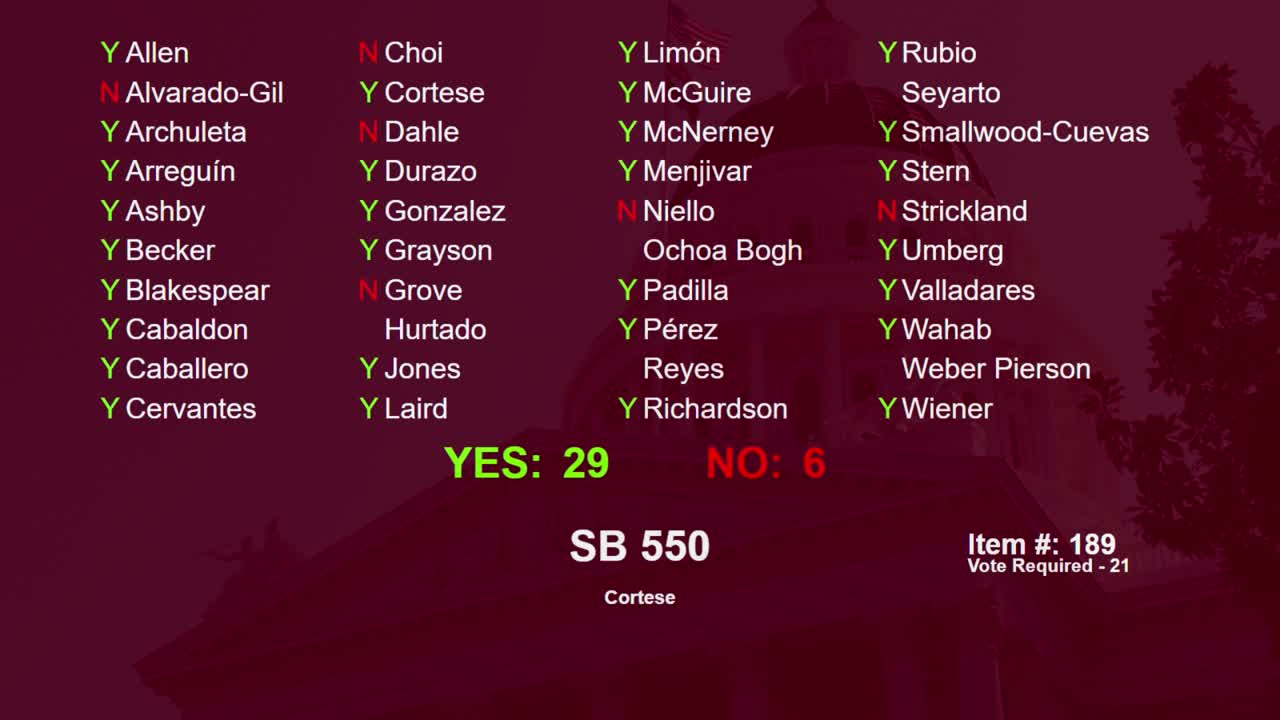 3MIN
Senate Floor
 20MIN
Senate Standing Committee on Judiciary
 56MIN
Senate Standing Committee on Transportation
Bill Author