SB 774: Department of Real Estate and the Bureau of Real Estate Appraisers: Bureau of Automotive Repair.
- Session Year: 2025-2026
- House: Senate
- Latest Version Date: 2025-10-13
Current Status:
Passed
(2025-10-13: Chaptered by Secretary of State. Chapter 786, Statutes of 2025.)
Introduced
In Committee
Awaiting First Chamber Vote
Passed First Chamber
In Committee
Awaiting Second Chamber Vote
Passed Second Chamber
Enacted
Existing law, the Automotive Repair Act, provides for the registration and regulation of automotive repair dealers by the Bureau of Automotive Repair in the Department of Consumer Affairs. A violation of these provisions is a misdemeanor unless otherwise specified. Existing law authorizes the Director of Consumer Affairs to adopt and enforce those rules and regulations that the director determines are reasonably necessary to carry out the purposes of the act and declare the policy of the bureau. Existing law authorizes the director to include in the citation system a process for informal review of and recommendation on citations, as specified. Existing law subjects the bureau to review by the appropriate policy committees of the Legislature, as specified, and requires that review to be performed as if the act were scheduled to be repealed on January 1, 2028.
Existing law authorizes the director to include in the citation system a process for an automotive repair dealer to prevent disclosure of the citation on the internet, as specified and subject to a certain eligibility requirement. Existing law also authorizes the bureau to require any employee of the automotive repair dealer who was involved in the violation resulting in the bureaus issuance of the citation to attend remedial training with the automotive repair dealer to prevent disclosure of the citation. Existing law repeals these provisions on July 1, 2026.
This bill would extend the effective date of these provisions until January 1, 2028. By extending these provisions, the violation of which is a crime, this bill would impose a state-mandated local program.
The Real Estate Law establishes the Department of Real Estate in the Business, Consumer Services, and Housing Agency to license and regulate real estate licensees under that law, including real estate brokers and real estate salespersons. The Real Estate Appraisers Licensing and Certification Law establishes within the Department of Consumer Affairs the Bureau of Real Estate Appraisers to license and regulate real estate appraisers. Under existing law, the powers and duties of the Department of Real Estate and the Bureau of Real Estate Appraisers under those laws, respectively, are subject to review by the appropriate policy committees of the Legislature as if those laws were to be repealed on January 1, 2026.
This bill would extend that date to January 1, 2030.
Existing law requires the department to register a service member or spouse of a service member who relocated to this state because of military orders for military service within this state and who holds a professional license in good standing outside of California, subject to satisfaction of specified requirements, and deems the person to be a licensee of the department for specified purposes.
This bill would add conforming provisions to the Real Estate Law.
Existing law requires the department to compile information on military, veteran, and spouse licensure and submit an annual report to the Legislature and specifies the information required to be included in the report.
This bill would require additional information to be included in the report, including the number of applicants who requested to apply military education, training, or experience towards meeting licensure requirements. The bill would require the department, in every application for licensure, to inquire as to whether the applicant is serving or has served in the military and whether the applicant intends to apply military experience and training toward licensure requirements. The bill would require the department to post specified information on the departments internet website about applying military experience and training toward licensure requirements.
This bill would delete obsolete provisions relating to applications for licensure received by the commissioner before October 1, 2007. The bill would deem a salesperson license issued to an applicant who applied before October 1, 2007, whose license was suspended for failing to satisfy specified requirements to be deemed expired 4 years following the date of issuance of the license. The bill would make conforming changes.
Existing law requires a fingerprint-based criminal history information check required by statute to be requested from the Department of Justice and to be applicable to the person identified in the referencing statute. Existing law also requires the agency or entity identified in the statute to submit to the Department of Justice fingerprint images and related information required by the Department of Justice of the types of applicants identified in the referencing statute, for the purpose of obtaining certain conviction and arrest information. Existing law requires the department to disseminate certain criminal history information when certain conditions are met, including that the information is to be used for employment, licensing, or certification purposes.
This bill would require the Department of Real Estate to submit to the Department of Justice fingerprint images and related information required by the Department of Justice for certain applicants and licensees, as specified. The bill would also require the Department of Justice to provide a state- or federal-level response pursuant to the above-described criminal history information dissemination provisions.
Existing law requires every real estate broker and salesperson licensee to provide their current email address to the commissioner.
This bill would specify that a licensees email address shall not be considered a public record subject to disclosure under the California Public Records Act. The bill would specify that information sent from an email account to a valid email address provided by the applicant or licensee is presumed to have been delivered to the email address provided.
Existing law authorizes the Real Estate Commissioner to require proof as they may deem advisable concerning the honesty and truthfulness of certain applicants for a license, designated agents, and others, as specified, before authorizing the issuance of a license for a location. Existing law also authorizes the commissioner to hold a hearing and to refuse to issue a license to an applicant who does not furnish satisfactory proof of their honesty and truthfulness or of the honesty and truthfulness of the corporate officers, directors, and shareholders. To assist in this determination, existing law requires the fingerprinting of every original applicant, including designated agents, officers, directors, and persons owning 25 percent or more of the shares of the corporate applicant.
This bill would also require, for that purpose, the fingerprinting of persons owning or controlling a beneficial ownership interest of 25 percent or more in the entity making application.
Existing law establishes, within the Real Estate Fund, a Consumer Recovery Account, which is funded by fees and fines imposed on licensees. Existing law authorizes an aggrieved person to file an application with the department for payment from the Consumer Recovery Account for the unpaid amount of a final judgment or an arbitration award that the aggrieved person has obtained against a defendant for fraud, misrepresentation, or deceit, made with intent to defraud, or conversion of trust funds, arising out of a transaction in which the defendant, while licensed, performed acts for which a license was required. Existing law specifies that all matters finally adjudicated in the underlying action are conclusive as to the judgment debtor and applicant in the proceeding against the Consumer Recovery Account. Existing law requires the claimant to serve a notice to the judgment debtor with a specified statement, and requires the commissioner to give notice of a decision rendered with respect to the application to the claimant and judgment debtor that contains a specified statement relating to denial or payment of the claim. Existing law provides that the license of the broker, salesperson, or prepaid rental listing service license shall be automatically suspended upon the date of payment from the Consumer Recovery Account.
This bill would instead specify that all matters finally adjudicated in the underlying action are conclusive if the final judgment was established by proof by clear and convincing evidence or the commissioner determined that the applicant provided clear and convincing evidence of the judgment debtors fraud, misrepresentation, deceit, or conversion of trust funds. The bill would authorize the commissioner to grant payment on an application if the final judgment was established by proof by preponderance of the evidence or a higher standard of proof. Under the bill, the above-described requirement for the automatic suspension of the license upon the date of payment from the Consumer Recovery Account would be conditioned on the final judgment being established by proof by clear and convincing evidence or the commissioner determining that the claimant provided clear and convincing evidence of the fraud, misrepresentation, deceit, or conversion of trust funds. The bill would revise the statements in the notices specified above, including revising the statement on the notice required to be given by the commission after the decision rendered, depending on whether the decision includes suspension of the judgment debtors license.
Existing law establishes the Real Estate Appraisers Regulation Fund, consisting of moneys raised by fees and assessments imposed pursuant to the Real Estate Appraisers Licensing and Certification Law. Existing law further establishes within that fund the Administration Account and the Recovery Account and requires 5% of the amount of any license or certificate fee under the Real Estate Appraisers Licensing and Certification Law to be credited to the Recovery Account, a continuously appropriated fund. Existing law requires the Bureau of Real Estate Appraisers to adopt regulations for the administration of the Recovery Account relating to claims, funding, and administrative procedures, as specified.
This bill would repeal the provisions providing for the adoption of regulations and would instead enact provisions relating to claims, funding, and the administration of the Recovery Account. The bill, among other things, would establish eligibility, application, and notice requirements and procedures for the bureaus consideration and investigation of applications. The bill would authorize the bureau to transfer funds between the Administration Account and the Recovery Account under specified circumstances. By authorizing the transfer of funds into a continuously appropriated fund, the bill would make an appropriation. The bill would require a real estate appraisers license to be automatically suspended upon payment from the Recovery Account of a settlement of a claim or toward satisfaction of a judgment based on clear and convincing evidence of fraud, misrepresentation, or deceit with intent to defraud. The bill would require a claimant who is an electronic filer who signs the application using an electronic signature to declare under penalty of perjury that the information submitted is true and correct, and would make it a misdemeanor for a person to file documents with false information. By expanding the crime of perjury and creating a new crime, the bill would impose a state-mandated local program. The bill would repeal all of the provisions relating to the Real Estate Appraisers Regulation Fund on January 1, 2030.
This bill would require the Bureau of Real Estate Appraisers, on and after July 1, 2026, to post specified information about the Recovery Account on the bureaus internet website, including eligibility requirements and the application process. The bill would require the bureau, upon receipt of a complaint by a licensee or a member of the public, to provide a notification to the complainant that includes information regarding eligibility and the application process. The bill would require the bureau, on or before January 1, 2027, and annually thereafter, to submit to the Legislature a report that includes specified information relating to the Recovery Account, including the balance of the account for the prior fiscal year and the total payments made from the Recovery Account.
This bill would require the bureau to conduct a study on the feasibility of mandatory licensing for real estate appraisers in California and to report its findings to the appropriate committees of the Legislature on or before December 31, 2028. The bill would require the report to include, among other things, the types of real estate appraisal assignments for which a license is currently not required in California and the bureaus recommendations on specified matters, including recommended amendments to existing law. The bill would repeal those provisions on January 1, 2030.
The bill would make other conforming and technical changes to various provisions of the Real Estate Law, including eliminating gendered pronouns and updating cross-references.
Existing constitutional provisions require that a statute that limits the right of access to the meetings of public bodies or the writings of public officials and agencies be adopted with findings demonstrating the interest protected by the limitation and the need for protecting that interest.
This bill would make legislative findings to that effect.
The California Constitution requires the state to reimburse local agencies and school districts for certain costs mandated by the state. Statutory provisions establish procedures for making that reimbursement.
This bill would provide that no reimbursement is required by this act for a specified reason.
Existing law, the Automotive Repair Act, provides for the registration and regulation of automotive repair dealers by the Bureau of Automotive Repair in the Department of Consumer Affairs. A violation of these provisions is a misdemeanor unless otherwise specified. Existing law authorizes the Director of Consumer Affairs to adopt and enforce those rules and regulations that the director determines are reasonably necessary to carry out the purposes of the act and declare the policy of the bureau. Existing law authorizes the director to include in the citation system a process for informal review of and recommendation on citations, as specified. Existing law subjects the bureau to review by the appropriate policy committees of the Legislature, as specified, and requires that review to be performed as if the act were scheduled to be repealed on January 1, 2028.
Existing law authorizes the director to include in the citation system a process for an automotive repair dealer to prevent disclosure of the citation on the internet, as specified and subject to a certain eligibility requirement. Existing law also authorizes the bureau to require any employee of the automotive repair dealer who was involved in the violation resulting in the bureaus issuance of the citation to attend remedial training with the automotive repair dealer to prevent disclosure of the citation. Existing law repeals these provisions on July 1, 2026.
This bill would extend the effective date of these provisions until January 1, 2028. By extending these provisions, the violation of which is a crime, this bill would impose a state-mandated local program.
The Real Estate Law establishes the Department of Real Estate in the Business, Consumer Services, and Housing Agency to license and regulate real estate licensees under that law, including real estate brokers and real estate salespersons. The Real Estate Appraisers Licensing and Certification Law establishes within the Department of Consumer Affairs the Bureau of Real Estate Appraisers to license and regulate real estate appraisers. Under existing law, the powers and duties of the Department of Real Estate and the Bureau of Real Estate Appraisers under those laws, respectively, are subject to review by the appropriate policy committees of the Legislature as if those laws were to be repealed on January 1, 2026.
This bill would extend that date to January 1, 2030.
Existing law requires the department to register a service member or spouse of a service member who relocated to this state because of military orders for military service within this state and who holds a professional license in good standing outside of California, subject to satisfaction of specified requirements, and deems the person to be a licensee of the department for specified purposes.
This bill would add conforming provisions to the Real Estate Law.
Existing law requires the department to compile information on military, veteran, and spouse licensure and submit an annual report to the Legislature and specifies the information required to be included in the report.
This bill would require additional information to be included in the report, including the number of applicants who requested to apply military education, training, or experience towards meeting licensure requirements. The bill would require the department, in every application for licensure, to inquire as to whether the applicant is serving or has served in the military and whether the applicant intends to apply military experience and training toward licensure requirements. The bill would require the department to post specified information on the departments internet website about applying military experience and training toward licensure requirements.
This bill would delete obsolete provisions relating to applications for licensure received by the commissioner before October 1, 2007. The bill would deem a salesperson license issued to an applicant who applied before October 1, 2007, whose license was suspended for failing to satisfy specified requirements to be deemed expired 4 years following the date of issuance of the license. The bill would make conforming changes.
Existing law requires a fingerprint-based criminal history information check required by statute to be requested from the Department of Justice and to be applicable to the person identified in the referencing statute. Existing law also requires the agency or entity identified in the statute to submit to the Department of Justice fingerprint images and related information required by the Department of Justice of the types of applicants identified in the referencing statute, for the purpose of obtaining certain conviction and arrest information. Existing law requires the department to disseminate certain criminal history information when certain conditions are met, including that the information is to be used for employment, licensing, or certification purposes.
This bill would require the Department of Real Estate to submit to the Department of Justice fingerprint images and related information required by the Department of Justice for certain applicants and licensees, as specified. The bill would also require the Department of Justice to provide a state- or federal-level response pursuant to the above described above-described criminal history information dissemination provisions.
Existing law requires every real estate broker and salesperson licensee to provide their current email address to the commissioner.
This bill would specify that a licensees email address shall not be considered a public record subject to disclosure under the California Public Records Act. The bill would specify that information sent from an email account to a valid email address provided by the applicant or licensee is presumed to have been delivered to the email address provided.
Existing law authorizes the Real Estate Commissioner to require proof as they may deem advisable concerning the honesty and truthfulness of certain applicants for a license, designated agents, and others, as specified, before authorizing the issuance of a license for a location. Existing law also authorizes the commissioner to hold a hearing and to refuse to issue a license to an applicant who does not furnish satisfactory proof of their honesty and truthfulness or of the honesty and truthfulness of the corporate officers, directors, and shareholders. To assist in this determination, existing law requires the fingerprinting of every original applicant, including designated agents, officers, directors, and persons owning 25 percent or more of the shares of the corporate applicant.
This bill would also require, for that purpose, the fingerprinting of persons owning or controlling a beneficial ownership interest of 25 percent or more in the entity making application.
Existing law establishes, within the Real Estate Fund, a Consumer Recovery Account, which is funded by fees and fines imposed on licensees. Existing law authorizes an aggrieved person to file an application with the department for payment from the Consumer Recovery Account for the unpaid amount of a final judgment or an arbitration award that the aggrieved person has obtained against a defendant for fraud, misrepresentation, or deceit, made with intent to defraud, or conversion of trust funds, arising out of a transaction in which the defendant, while licensed, performed acts for which a license was required. Existing law specifies that all matters finally adjudicated in the underlying action are conclusive as to the judgment debtor and applicant in the proceeding against the Consumer Recovery Account. Existing law requires the claimant to serve a notice to the judgment debtor with a specified statement, and requires the commissioner to give notice of a decision rendered with respect to the application to the claimant and judgment debtor that contains a specified statement relating to denial or payment of the claim. Existing law provides that the license of the broker, salesperson, or prepaid rental listing service license shall be automatically suspended upon the date of payment from the Consumer Recovery Account.
This bill would instead specify that all matters finally adjudicated in the underlying action are conclusive if the final judgment was established by proof by clear and convincing evidence or the commissioner determined that the applicant provided clear and convincing evidence of the judgment debtors fraud, misrepresentation, deceit, or conversion of trust funds. The bill would authorize the commissioner to grant payment on an application if the final judgment was established by proof by preponderance of the evidence or a higher standard of proof. Under the bill, the above-described requirement for the automatic suspension of the license upon the date of payment from the Consumer Recovery Account would be conditioned on the final judgment being established by proof by clear and convincing evidence or the commissioner determining that the claimant provided clear and convincing evidence of the fraud, misrepresentation, deceit, or conversion of trust funds. The bill would revise the statements in the notices specified above, including revising the statement on the notice required to be given by the commission after the decision rendered, depending on whether the decision includes suspension of the judgment debtors license.
Existing law establishes the Recovery Account, a continuously appropriated fund, in the Real Estate Appraisers Regulation Fund and requires 5% of the amount of any license or certificate fee collected pursuant to the Real Estate Appraisers Licensing and Certification Law to be credited to the Recovery Account.Existing law establishes the Real Estate Appraisers Regulation Fund, consisting of moneys raised by fees and assessments imposed pursuant to the Real Estate Appraisers Licensing and Certification Law. Existing law further establishes within that fund the Administration Account and the Recovery Account and requires 5% of the amount of any license or certificate fee under the Real Estate Appraisers Licensing and Certification Law to be credited to the Recovery Account, a continuously appropriated fund. Existing law requires the Bureau of Real Estate Appraisers to adopt regulations for the administration of the Recovery Account relating to claims, funding, and administrative procedures, as specified.
This bill would repeal the provisions providing for the adoption of regulations and would instead enact provisions relating to claims, funding, and the administration of the Recovery Account. The bill, among other things, would establish eligibility, application, and notice requirements and procedures for the bureaus consideration and investigation of applications. The bill would authorize the bureau to transfer funds between the Administration Account and the Recovery Account under specified circumstances. By authorizing the transfer of funds into a continuously appropriated fund, the bill would make an appropriation. The bill would require a real estate appraisers license to be automatically suspended upon payment from the Recovery Account of a settlement of a claim or toward satisfaction of a judgment based on clear and convincing evidence of fraud, misrepresentation, or deceit with intent to defraud. The bill would require a claimant who is an electronic filer who signs the application using an electronic signature to declare under penalty of perjury that the information submitted is true and correct, and would make it a misdemeanor for a person to file documents with false information. By expanding the crime of perjury and creating a new crime, the bill would impose a state-mandated local program. The bill would repeal all of the provisions relating to the Real Estate Appraisers Regulation Fund on January 1, 2030.
This bill would require the Bureau of Real Estate Appraisers, on and after July 1, 2026, to post specified information about the Recovery Account on the bureaus internet website, including eligibility requirements and the application process. The bill would require the bureau, upon receipt of a complaint by a licensee or a member of the public, to provide a notification to the complainant that includes information regarding eligibility and the application process. The bill would require the bureau, on or before January 1, 2027, and annually thereafter, to submit to the Legislature a report that includes specified information relating to the Recovery Account, including the balance of the account for the prior fiscal year and the total payments made from the Recovery Account.
This bill would require the bureau to conduct a study on the feasibility of mandatory licensing for real estate appraisers in California and to report its findings to the appropriate committees of the Legislature on or before December 31, 2028. The bill would require the report to include, among other things, the types of real estate appraisal assignments for which a license is currently not required in California and the bureaus recommendations on specified matters, including recommended amendments to existing law. The bill would repeal those provisions on January 1, 2030.
The bill would make other conforming and technical changes to various provisions of the Real Estate Law, including eliminating gendered pronouns and updating cross-references.
Existing constitutional provisions require that a statute that limits the right of access to the meetings of public bodies or the writings of public officials and agencies be adopted with findings demonstrating the interest protected by the limitation and the need for protecting that interest.
This bill would make legislative findings to that effect.
The California Constitution requires the state to reimburse local agencies and school districts for certain costs mandated by the state. Statutory provisions establish procedures for making that reimbursement.
This bill would provide that no reimbursement is required by this act for a specified reason.
Existing law, the Automotive Repair Act, provides for the registration and regulation of automotive repair dealers by the Bureau of Automotive Repair in the Department of Consumer Affairs. A violation of these provisions is a misdemeanor unless otherwise specified. Existing law authorizes the Director of Consumer Affairs to adopt and enforce those rules and regulations that the director determines are reasonably necessary to carry out the purposes of the act and declare the policy of the bureau. Existing law authorizes the director to include in the citation system a process for informal review of and recommendation on citations, as specified. Existing law subjects the bureau to review by the appropriate policy committees of the Legislature, as specified, and requires that review to be performed as if the act were scheduled to be repealed on January 1, 2028.
Existing law authorizes the director to include in the citation system a process for an automotive repair dealer to prevent disclosure of the citation on the internet, as specified and subject to a certain eligibility requirement. Existing law also authorizes the bureau to require any employee of the automotive repair dealer who was involved in the violation resulting in the bureaus issuance of the citation to attend remedial training with the automotive repair dealer to prevent disclosure of the citation. Existing law repeals these provisions on July 1, 2026.
This bill would extend the effective date of these provisions until January 1, 2028. By extending these provisions, the violation of which is a crime, this bill would impose a state-mandated local program.
The Real Estate Law establishes the Department of Real Estate in the Business, Consumer Services, and Housing Agency to license and regulate real estate licensees under that law, including real estate brokers and real estate salespersons. The Real Estate Appraisers Licensing and Certification Law establishes within the Department of Consumer Affairs the Bureau of Real Estate Appraisers to license and regulate real estate appraisers. Under existing law, the powers and duties of the Department of Real Estate and the Bureau of Real Estate Appraisers under those laws, respectively, are subject to review by the appropriate policy committees of the Legislature as if those laws were to be repealed on January 1, 2026.
This bill would extend that date to January 1, 2030.
Existing law requires the department to register a service member or spouse of a service member who relocated to this state because of military orders for military service within this state and who holds a professional license in good standing outside of California, subject to satisfaction of specified requirements, and deems the person to be a licensee of the department for specified purposes.
This bill would add conforming provisions to the Real Estate Law.
Existing law requires the department to compile information on military, veteran, and spouse licensure and submit an annual report to the Legislature and specifies the information required to be included in the report.
This bill would require additional information to be included in the report, including the number of applicants who requested to apply military education, training, or experience towards meeting licensure requirements. The bill would require the department, in every application for licensure, to inquire as to whether the applicant is serving or has served in the military and whether the applicant intends to apply military experience and training toward licensure requirements. The bill would require the department to post specified information on the departments internet website about applying military experience and training toward licensure requirements.
This bill would delete obsolete provisions relating to applications for licensure received by the commissioner before October 1, 2007. The bill would deem a salesperson license issued to an applicant who applied before October 1, 2007, whose license was suspended for failing to satisfy specified requirements to be deemed expired 4 years following the date of issuance of the license. The bill would make conforming changes.
Existing law requires a fingerprint-based criminal history information check required by statute to be requested from the Department of Justice and to be applicable to the person identified in the referencing statute. Existing law also requires the agency or entity identified in the statute to submit to the Department of Justice fingerprint images and related information required by the Department of Justice of the types of applicants identified in the referencing statute, for the purpose of obtaining certain conviction and arrest information. Existing law requires the department to disseminate certain criminal history information when certain conditions are met, including that the information is to be used for employment, licensing, or certification purposes.
This bill would require the Department of Real Estate to submit to the Department of Justice fingerprint images and related information required by the Department of Justice for certain applicants and licensees, as specified. The bill would also require the Department of Justice to provide a state- or federal-level response pursuant to the above described criminal history information dissemination provisions.
Existing law requires every real estate broker and salesperson licensee to provide their current email address to the commissioner.
This bill would specify that a licensees email address shall not be considered a public record subject to disclosure under the California Public Records Act. The bill would specify that information sent from an email account to a valid email address provided by the applicant or licensee is presumed to have been delivered to the email address provided.
Existing law authorizes the Real Estate Commissioner to require proof as they may deem advisable concerning the honesty and truthfulness of certain applicants for a license, designated agents, and others, as specified, before authorizing the issuance of a license for a location. Existing law also authorizes the commissioner to hold a hearing and to refuse to issue a license to an applicant who does not furnish satisfactory proof of their honesty and truthfulness or of the honesty and truthfulness of the corporate officers, directors, and shareholders. To assist in this determination, existing law requires the fingerprinting of every original applicant, including designated agents, officers, directors, and persons owning 25 percent or more of the shares of the corporate applicant.
This bill would also require, for that purpose, the fingerprinting of persons owning or controlling a beneficial ownership interest of 25 percent or more in the entity making application.
Existing law establishes, within the Real Estate Fund, a Consumer Recovery Account, which is funded by fees and fines imposed on licensees. Existing law authorizes an aggrieved person to file an application with the department for payment from the Consumer Recovery Account for the unpaid amount of a final judgment or an arbitration award that the aggrieved person has obtained against a defendant for fraud, misrepresentation, or deceit, made with intent to defraud, or conversion of trust funds, arising out of a transaction in which the defendant, while licensed, performed acts for which a license was required. Existing law specifies that all matters finally adjudicated in the underlying action are conclusive as to the judgment debtor and applicant in the proceeding against the Consumer Recovery Account. Existing law requires the claimant to serve a notice to the judgment debtor with a specified statement, and requires the commissioner to give notice of a decision rendered with respect to the application to the claimant and judgment debtor that contains a specified statement relating to denial or payment of the claim. Existing law provides that the license of the broker, salesperson, or prepaid rental listing service license shall be automatically suspended upon the date of payment from the Consumer Recovery Account.
This bill would instead specify that all matters finally adjudicated in the underlying action are conclusive if the final judgment was established by proof by clear and convincing evidence or the commissioner determined that the applicant provided clear and convincing evidence of the judgment debtors fraud, misrepresentation, deceit, or conversion of trust funds. The bill would authorize the commissioner to grant payment on an application if the final judgment was established by proof by preponderance of the evidence or a higher standard of proof. Under the bill, the above-described requirement for the automatic suspension of the license upon the date of payment from the Consumer Recovery Account would be conditioned on the final judgment being established by proof by clear and convincing evidence or the commissioner determining that the claimant provided clear and convincing evidence of the fraud, misrepresentation, deceit, or conversion of trust funds. The bill would revise the statements in the notices specified above, including revising the statement on the notice required to be given by the commission after the decision rendered, depending on whether the decision includes suspension of the judgment debtors license.
Existing law establishes the Recovery Account, a continuously appropriated fund, in the Real Estate Appraisers Regulation Fund and requires 5% of the amount of any license or certificate fee collected pursuant to the Real Estate Appraisers Licensing and Certification Law to be credited to the Recovery Account.
This bill would require the Bureau of Real Estate Appraisers, on and after July 1, 2026, to post specified information about the Recovery Account on the bureaus internet website, including eligibility requirements and the application process. The bill would require the bureau, upon receipt of a complaint by a licensee or a member of the public, to provide a notification to the complainant that includes information regarding eligibility and the application process. The bill would require the bureau, on or before January 1, 2027, and annually thereafter, to submit to the Legislature a report that includes specified information relating to the Recovery Account, including the balance of the account for the prior fiscal year and the total payments made from the Recovery Account.
This bill would require the bureau to conduct a study on the feasibility of mandatory licensing for real estate appraisers in California and to report its findings to the appropriate committees of the Legislature on or before December 31, 2028. The bill would require the report to include, among other things, the types of real estate appraisal assignments for which a license is currently not required in California and the bureaus recommendations on specified matters, including recommended amendments to existing law. The bill would repeal those provisions on January 1, 2030.
The bill would make other conforming and technical changes to various provisions of the Real Estate Law, including eliminating gendered pronouns and updating cross-references.
Existing constitutional provisions require that a statute that limits the right of access to the meetings of public bodies or the writings of public officials and agencies be adopted with findings demonstrating the interest protected by the limitation and the need for protecting that interest.
This bill would make legislative findings to that effect.
The California Constitution requires the state to reimburse local agencies and school districts for certain costs mandated by the state. Statutory provisions establish procedures for making that reimbursement.
This bill would provide that no reimbursement is required by this act for a specified reason.
Existing law, the Automotive Repair Act, provides for the registration and regulation of automotive repair dealers by the Bureau of Automotive Repair in the Department of Consumer Affairs. A violation of these provisions is a misdemeanor unless otherwise specified. Existing law authorizes the Director of Consumer Affairs to adopt and enforce those rules and regulations that the director determines are reasonably necessary to carry out the purposes of the act and declare the policy of the bureau. Existing law authorizes the director to include in the citation system a process for informal review of and recommendation on citations, as specified. Existing law subjects the bureau to review by the appropriate policy committees of the Legislature, as specified, and requires that review to be performed as if the act were scheduled to be repealed on January 1, 2028.
Existing law authorizes the director to include in the citation system a process for an automotive repair dealer to prevent disclosure of the citation on the internet, as specified and subject to a certain eligibility requirement. Existing law also authorizes the bureau to require any employee of the automotive repair dealer who was involved in the violation resulting in the bureaus issuance of the citation to attend remedial training with the automotive repair dealer to prevent disclosure of the citation. Existing law repeals these provisions on July 1, 2026.
This bill would extend the effective date of these provisions until January 1, 2028. By extending these provisions, the violation of which is a crime, this bill would impose a state-mandated local program.
The Real Estate Law establishes the Department of Real Estate in the Business, Consumer Services, and Housing Agency to license and regulate real estate licensees under that law, including real estate brokers and real estate salespersons. The Real Estate Appraisers Licensing and Certification Law establishes within the Department of Consumer Affairs the Bureau of Real Estate Appraisers to license and regulate real estate appraisers. Under existing law, the powers and duties of the Department of Real Estate and the Bureau of Real Estate Appraisers under those laws, respectively, are subject to review by the appropriate policy committees of the Legislature as if those laws were to be repealed on January 1, 2026.
This bill would extend that date to January 1, 2030. The
Existing law requires the department to register a service member or spouse of a service member who relocated to this state because of military orders for military service within this state and who holds a professional license in good standing outside of California, subject to satisfaction of specified requirements, and deems the person to be a licensee of the department for specified purposes.
This bill would add conforming provisions to the Real Estate Law.
Existing law requires the department to compile information on military, veteran, and spouse licensure and submit an annual report to the Legislature and specifies the information required to be included in the report.
This bill would require additional information to be included in the report, including the number of applicants who requested to apply military education, training, or experience towards meeting licensure requirements. The bill would require the department, in every application for licensure, to inquire as to whether the applicant is serving or has served in the military and whether the applicant intends to apply military experience and training toward licensure requirements. The bill would require the department to post specified information on the departments internet website about applying military experience and training toward licensure requirements.
This bill would delete obsolete provisions relating to applications for licensure received by the commissioner before October 1, 2007. The bill would deem a salesperson license issued to an applicant who applied before October 1, 2007, whose license was suspended for failing to satisfy specified requirements to be deemed expired 4 years following the date of issuance of the license. The bill would make conforming changes.
Existing law requires a fingerprint-based criminal history information check required by statute to be requested from the Department of Justice and to be applicable to the person identified in the referencing statute. Existing law also requires the agency or entity identified in the statute to submit to the Department of Justice fingerprint images and related information required by the Department of Justice of the types of applicants identified in the referencing statute, for the purpose of obtaining certain conviction and arrest information. Existing law requires the department to disseminate certain criminal history information when certain conditions are met, including that the information is to be used for employment, licensing, or certification purposes.
This bill would require the Department of Real Estate to submit to the Department of Justice fingerprint images and related information required by the Department of Justice for certain applicants and licensees, as specified. The bill would also require the Department of Justice to provide a state- or federal-level response pursuant to the above described criminal history information dissemination provisions.
Existing law requires every real estate broker and salesperson licensee to provide their current email address to the commissioner.
This bill would specify that a licensees email address shall not be considered a public record subject to disclosure under the California Public Records Act. The bill would specify that information sent from an email account to a valid email address provided by the applicant or licensee is presumed to have been delivered to the email address provided.
Existing law authorizes the Real Estate Commissioner to require proof as they may deem advisable concerning the honesty and truthfulness of certain applicants for a license, designated agents, and others, as specified, before authorizing the issuance of a license for a location. Existing law also authorizes the commissioner to hold a hearing and to refuse to issue a license to an applicant who does not furnish satisfactory proof of their honesty and truthfulness or of the honesty and truthfulness of the corporate officers, directors, and shareholders. To assist in this determination, existing law requires the fingerprinting of every original applicant, including designated agents, officers, directors, and persons owning 25 percent or more of the shares of the corporate applicant.
This bill would also require, for that purpose, the fingerprinting of persons owning or controlling a beneficial ownership interest of 25 percent or more in the entity making application.
Existing law establishes, within the Real Estate Fund, a Consumer Recovery Account, which is funded by fees and fines imposed on licensees. Existing law authorizes an aggrieved person to file an application with the department for payment from the Consumer Recovery Account for the unpaid amount of a final judgment or an arbitration award that the aggrieved person has obtained against a defendant for fraud, misrepresentation, or deceit, made with intent to defraud, or conversion of trust funds, arising out of a transaction in which the defendant, while licensed, performed acts for which a license was required. Existing law specifies that all matters finally adjudicated in the underlying action are conclusive as to the judgment debtor and applicant in the proceeding against the Consumer Recovery Account. Existing law requires the claimant to serve a notice to the judgment debtor with a specified statement, and requires the commissioner to give notice of a decision rendered with respect to the application to the claimant and judgment debtor that contains a specified statement relating to denial or payment of the claim. Existing law provides that the license of the broker, salesperson, or prepaid rental listing service license shall be automatically suspended upon the date of payment from the Consumer Recovery Account.
This bill would instead specify that all matters finally adjudicated in the underlying action are conclusive if the final judgment was established by proof by clear and convincing evidence or the commissioner determined that the applicant provided clear and convincing evidence of the judgment debtors fraud, misrepresentation, deceit, or conversion of trust funds. The bill would authorize the commissioner to grant payment on an application if the final judgment was established by proof by preponderance of the evidence or a higher standard of proof. Under the bill, the above-described requirement for the automatic suspension of the license upon the date of payment from the Consumer Recovery Account would be conditioned on the final judgment being established by proof by clear and convincing evidence or the commissioner determining that the claimant provided clear and convincing evidence of the fraud, misrepresentation, deceit, or conversion of trust funds. The bill would revise the statements in the notices specified above, including revising the statement on the notice required to be given by the commission after the decision rendered, depending on whether the decision includes suspension of the judgment debtors license.
The bill would make other conforming and technical changes to various provisions of the Real Estate Law, including eliminating gendered pronouns and updating cross-references.
Existing constitutional provisions require that a statute that limits the right of access to the meetings of public bodies or the writings of public officials and agencies be adopted with findings demonstrating the interest protected by the limitation and the need for protecting that interest.
This bill would make legislative findings to that effect.
The California Constitution requires the state to reimburse local agencies and school districts for certain costs mandated by the state. Statutory provisions establish procedures for making that reimbursement.
This bill would provide that no reimbursement is required by this act for a specified reason.
The Real Estate Law establishes the Department of Real Estate in the Business, Consumer Services, and Housing Agency to license and regulate real estate licensees under that law, including real estate brokers and real estate salespersons. The Real Estate Appraisers Licensing and Certification Law establishes within the Department of Consumer Affairs the Bureau of Real Estate Appraisers to license and regulate real estate appraisers. Under existing law, the powers and duties of the Department of Real Estate and the Bureau of Real Estate Appraisers under those laws, respectively, are subject to review by the appropriate policy committees of the Legislature as if those laws were to be repealed on January 1, 2026.
This bill would state the intent of the Legislature to evaluate the Department of Real Estate and the Bureau of Real Estate Appraisers through the joint legislative sunset review oversight process and to subsequently amend this bill to include recommendations produced through that process.Existing law requires the Department of Real Estate to compile information on military, veteran, and spouse licensure into an annual report for the Legislature. Existing law requires the commissioner to ascertain by written examination that the applicant has an understanding of the principles of real estate, among other things.This bill would make nonsubstantive changes to those provisions. extend that date to January 1, 2030. The bill would make other technical changes to various provisions of the Real Estate Law, including eliminating gendered pronouns and updating cross-references.
The Real Estate Law establishes the Department of Real Estate in the Business, Consumer Services, and Housing Agency to license and regulate real estate licensees under that law, including real estate brokers and real estate salespersons. The Real Estate Appraisers Licensing and Certification Law establishes within the Department of Consumer Affairs the Bureau of Real Estate Appraisers to license and regulate real estate appraisers. Under existing law, the powers and duties of the Department of Real Estate and the Bureau of Real Estate Appraisers under those laws, respectively, are subject to review by the appropriate policy committees of the Legislature as if those laws were to be repealed on January 1, 2026.
This bill would state the intent of the Legislature to evaluate the Department of Real Estate and the Bureau of Real Estate Appraisers through the joint legislative sunset review oversight process and to subsequently amend this bill to include recommendations produced through that process.
Existing law requires the Department of Real Estate to compile information on military, veteran, and spouse licensure into an annual report for the Legislature. Existing law requires the commissioner to ascertain by written examination that the applicant has an understanding of the principles of real estate, among other things.
This bill would make nonsubstantive changes to those provisions.
(a)(1)There is in the Department of Consumer Affairs a Bureau of Automotive Repair under the supervision and control of the director. The duty of enforcing and administering this chapter is vested in the chief who is responsible to the director. The director may adopt and enforce those rules and regulations that the director determines are reasonably necessary to carry out the purposes of this chapter and declare the policy of the bureau, including a system for the issuance of citations for violations of this chapter as specified in Section 125.9.
(2)(A)On or after July 1, 2023, the director may include in the citation system a process for informal review of and recommendation on citations, including establishment of an informal citation conference conducted by a panel of independent representatives appointed by the chief. The informal citation conference panel shall consist of three members, with one representative each from the bureau, the public, and the automotive repair industry.
(B)(i)The director may include in the citation system a process for an automotive repair dealer, upon successful completion of remedial training conducted by a provider certified pursuant to subdivision (d) of Section 9884.7, to prevent disclosure of the citation on the internet as provided in Section 27.
(ii)To be eligible for citation nondisclosure under this subparagraph, the automotive repair dealer shall not have attended remedial training in the prior 18-month period from the effective date of citation.
(iii)Any employee of the automotive repair dealer who was involved in the violation resulting in the bureaus issuance of the citation also may be required by the bureau to attend remedial training with the automotive repair dealer to prevent disclosure of the citation.
(3)Rules and regulations adopted pursuant to this subdivision shall be adopted pursuant to Chapter 3.5 (commencing with Section 11340) of Part 1 of Division 3 of Title 2 of the Government Code.
(b)Notwithstanding any other law, the powers and duties of the bureau, as set forth in this article and under the Automotive Repair Act, shall be subject to review by the appropriate policy committees of the Legislature. In that review, the bureau shall have the burden of demonstrating a compelling public need for the continued existence of the bureau and its regulatory program, and that its function is the least restrictive regulation consistent with the public health, safety, and welfare.
(c)This section shall be effective only until January 1, 2028, and as of that date is repealed.
SEC. 2.Section 9882 of the Business and Professions Code, as amended by Section 5 of Chapter 681 of the Statutes of 2023, is amended to read:9882.(a)(1)There is in the Department of Consumer Affairs a Bureau of Automotive Repair under the supervision and control of the director. The duty of enforcing and administering this chapter is vested in the chief who is responsible to the director. The director may adopt and enforce those rules and regulations that the director determines are reasonably necessary to carry out the purposes of this chapter and declare the policy of the bureau, including a system for the issuance of citations for violations of this chapter as specified in Section 125.9.
(2)The director may include in the citation system a process for informal review of and recommendation on citations, including establishment of an informal citation conference conducted by a panel of independent representatives appointed by the chief. The informal citation conference panel shall consist of three members, with one representative each from the bureau, the public, and the automotive repair industry.
(3)Rules and regulations adopted pursuant to this subdivision shall be adopted pursuant to Chapter 3.5 (commencing with Section 11340) of Part 1 of Division 3 of Title 2 of the Government Code.
(b)This section shall become operative on January 1, 2028.
SEC. 3.Section 10050 of the Business and Professions Code is amended to read:10050.(a)(1)There is in the Business, Consumer Services, and Housing Agency a Department of Real Estate, the chief officer of which department is named the Real Estate Commissioner.
(2)Notwithstanding any other law, the powers and duties of the department, as set forth in this part and Chapter 1 (commencing with Section 11000) of Part 2, shall be subject to review by the appropriate policy committees of the Legislature. The review shall be performed as if this part and that chapter were scheduled to be repealed as of January 1, 2030.
(b)It shall be the principal responsibility of the commissioner to enforce all laws in this part and Chapter 1 (commencing with Section 11000) of Part 2 in a manner that achieves the maximum protection for the buyers of real property and those persons dealing with real estate licensees.
(c)Wherever the term commissioner is used in this division, it means the Real Estate Commissioner.
SEC. 4.Section 10071 of the Business and Professions Code is amended to read:10071.The commissioner shall enforce the provisions of this part and of Chapter 1 (commencing with Section 11000) of Part 2. The commissioner has full power to regulate and control the issuance and revocation, both temporary and permanent, of all licenses to be issued under the provisions of this part, and to perform all other acts and duties provided in this part and Chapter 1 (commencing with Section 11000) of Part 2 and necessary for their enforcement.
SEC. 5.Section 10073 of the Business and Professions Code is amended to read:10073.The commissioner shall employ deputies, clerks, and employees as needed to discharge in the proper manner the duties imposed upon the commissioner by law.
SEC. 6.Section 10078 of the Business and Professions Code is amended to read:10078.(a)The commissioner shall adopt a seal with the words Real Estate Commissioner State of California and any other device as the commissioner may desire engraved thereon, by which the commissioner shall authenticate the proceedings of their office.
(b)Copies of all records and papers in the office of the commissioner certified under the hand and seal of the commissioner shall be received in evidence in all cases equally and with like effect as the originals.
SEC. 7.Section 10082 of the Business and Professions Code is amended to read:10082.The commissioner may publish or cause to be published at appropriate intervals a directory or list of licensed brokers and salespersons and may publish therewith any matter as the commissioner may deem pertinent to this part and Chapter 1 (commencing with Section 11000) of Part 2. The commissioner shall furnish one copy of the directory to each licensed broker upon request and payment of an appropriate charge based upon the cost of publication. The directory may contain copies of this part and Chapter 1 (commencing with Section 11000) of Part 2 and the rules and regulations of the commissioner.
SEC. 8.Section 10151 of the Business and Professions Code is amended to read:10151.(a)Application for the real estate salesperson license examination shall be made in writing to the commissioner. The commissioner may prescribe the format and content of the salesperson examination application. The application for the salesperson examination shall include valid contact information at which the department may contact the applicant and shall be accompanied by the real estate salesperson license examination fee.
(b)Persons who have been notified by the commissioner that they passed the real estate salesperson license examination may apply for a real estate salesperson license. A person applying for the salesperson examination may also apply for a real estate salesperson license. However, a license shall not be issued until the applicant passes the real estate salesperson license examination. If there is any change to the information contained in a real estate salesperson license application after the application has been submitted and before the license has been issued, the commissioner may require the applicant to submit a supplement to the application listing the changed information.
(c)(1)The commissioner may prescribe the format and content of the real estate salesperson license application. The application for the real estate salesperson license shall include valid contact information at which the department may contact the applicant.
(2)An application for the real estate salesperson license examination or for both the examination and license shall include evidence or certification, satisfactory to the commissioner, of successful completion at an accredited institution of a three-semester unit course, or the quarter equivalent thereof, or successful completion of an equivalent course of study as defined in Section 10153.5 in real estate principles as well as the successful completion at an accredited institution of a course in real estate practice as set forth in Section 10153.2, and one additional course as set forth in Section 10153.2, other than real estate principles, real estate practice, advanced legal aspects of real estate, advanced real estate finance, or advanced real estate appraisal. The applicant shall provide this evidence or certification to the commissioner prior to taking the real estate salesperson license examination.
(d)The commissioner shall waive the requirements of this section for the following applicants:
(1)An applicant who is a member of the State Bar of California.
(2)An applicant who has qualified to take the examination for an original real estate broker license by satisfying the requirements of Section 10153.2.
(e)Application for endorsement to act as a mortgage loan originator, as defined in Section 10166.01, shall be made either electronically or in writing as directed by the commissioner. The commissioner may prescribe the format and the content of the mortgage loan originator endorsement application, which shall meet the minimum requirements for licensing of a mortgage loan originator, pursuant to the Secure and Fair Enforcement for Mortgage Licensing Act of 2008 (Public Law 110-289).
SEC. 9.Section 10151.2 of the Business and Professions Code is amended to read:10151.2.(a)For purposes of this section, member of the Armed Forces of the United States includes the following persons and no others: all members of the United States Army, the United States Navy, the United States Air Force, the United States Space Force, the Marine Corps, the Merchant Marine in time of war, the Coast Guard, the National Guard, and all officers of the Public Health Service detailed by proper authority for duty either with the Army or the Navy.
(b)The commissioner shall inquire in every application for licensure under this part if the individual applying for licensure:
(1)Is, or previously was, a member of the Armed Forces of the United States.
(2)Intends to apply military experience towards broker licensure requirements.
(c)The commissioner shall expedite, and may assist, the initial licensure process for an applicant who supplies satisfactory evidence to the department that the applicant has served as an active duty member of the Armed Forces of the United States and was honorably discharged.
(d)The commissioner shall expedite the licensure process for an applicant who meets both of the following requirements:
(1)Supplies evidence satisfactory to the commissioner that the applicant is married to, or in a domestic partnership or other legal union with, an active duty member of the Armed Forces of the United States who is assigned to a duty station in this state under official active duty military orders.
(2)Holds a current license in another state, district, or territory of the United States in the profession or vocation for which the applicant seeks a license from the commissioner.
(e)As required by Section 115.10, the commissioner shall register applicants who are military service members or spouses of service members. Pursuant to subdivision (e) of Section 115.10, a person registered shall be deemed to be a licensee of the department for purposes of the laws administered by the department relating to standards of practice, discipline, and continuing education for the duration of the military orders described in paragraph (2) of subdivision (b) of Section 115.10, and the registration shall expire when those military orders expire. Pursuant to subdivision (f) of Section 115.10, the commissioner may take appropriate enforcement action against a person registered, including, but not limited to, revoking or suspending the registration of a person who does not meet the requirements of subdivision (b) of Section 115.10 or the laws applicable to licensees. This subdivision is declaratory of existing law.
(f)The commissioner shall post information on the departments internet website about the ability of applicants who have served as members of the Armed Forces of the United States to apply military experience towards broker licensure requirements.
SEC. 10.Section 10151.3 of the Business and Professions Code is amended to read:10151.3.The Department of Real Estate shall compile information on military, veteran, and spouse licensure into an annual report for the Legislature, which shall be submitted in conformance with Section 9795 of the Government Code. The report shall include all of the following:
(a)The number of applications for expedited licenses submitted by veterans and active duty spouses pursuant to subdivisions (c) and (d) of Section 10151.2.
(b)The number of licenses issued and denied per calendar year pursuant to subdivisions (c) and (d) of Section 10151.2.
(c)The average length of time between application and issuance of licenses pursuant to subdivisions (c) and (d) of Section 10151.2 per license type.
(d)The number of applicants for a broker license who request to apply military experience towards meeting licensure requirements.
(e)The number of applicants for a broker license whose military experience was accepted by the department to meet licensure requirements.
SEC. 11.Section 10152.5 is added to the Business and Professions Code, to read:10152.5.(a)Pursuant to subdivision (u) of Section 11105 of the Penal Code, the department shall submit to the Department of Justice fingerprint images and related information required by the Department of Justice for all of the following:
(1)Original applicants for a salesperson license, pursuant to Section 10151.
(2)Original applicants for a broker license, pursuant to Section 10150.
(3)Persons seeking to be designated as the officer of a broker who is a corporation, pursuant to Section 10211.
(4)Real estate salesperson licensees, as defined in Section 10016.
(5)Real estate broker licensees, as defined in Section 10015.
(6)Designated officers of a corporation licensed as a broker, as described in Section 10211.
(7)Persons who submit a petition for reinstatement of the persons license or the reduction of a penalty, pursuant to Section 11522 of the Government Code.
(b)The Department of Justice shall provide a state- or federal-level response, pursuant to subdivision (p) of Section 11105 of the Penal Code.
SEC. 12.Section 10153 of the Business and Professions Code is amended to read:10153.In addition to the proof of honesty and truthfulness required of any applicant for a real estate license, the commissioner shall ascertain by written examination that the applicant, and in case of a corporation applicant for a real estate brokers license that each officer, or agent thereof through whom it proposes to act as a real estate licensee, has all of the following:
(a)An appropriate knowledge of the English language, including reading, writing, and spelling and of arithmetical computations common to real estate and business opportunity practices.
(b)An understanding of the principles of real estate and business opportunity conveyancing, the general purposes and general legal effect of agency contracts, deposit receipts, deeds, mortgages, deeds of trust, chattel mortgages, bills of sale, land contracts of sale and leases, and of the principles of business and land economics and appraisals.
(c)A general and fair understanding of the obligations between principal and agent, of the principles of real estate and business opportunity practice and the canons of business ethics pertaining thereto, of the provisions of this part, of Chapter 1 (commencing with Section 11000) of Part 2, and of the regulations of the Real Estate Commissioner as contained in Title 10 of the California Code of Regulations.
SEC. 13.Section 10153.2 of the Business and Professions Code is amended to read:10153.2.(a)An applicant to take the examination for an original real estate broker license shall also submit evidence, satisfactory to the commissioner, of successful completion, at an accredited institution, of:
(1)A three-unit semester course, or the quarter equivalent thereof, in each of the following:
(A)Real estate practice, which shall include both of the following:
(i)A component on implicit bias, including education regarding the impact of implicit bias, explicit bias, and systemic bias on consumers, the historical and social impacts of those biases, and actionable steps students can take to recognize and address their own implicit biases.
(ii)A component on federal and state fair housing laws as those laws apply to the practice of real estate. The fair housing component shall include an interactive participatory component, during which the applicant shall roleplay as both a consumer and real estate professional.
(B)Legal aspects of real estate.
(C)Real estate appraisal.
(D)Real estate financing.
(E)Real estate economics or accounting.
(2)A three-unit semester course, or the quarter equivalent thereof, in three of the following:
(A)Advanced legal aspects of real estate.
(B)Advanced real estate finance.
(C)Advanced real estate appraisal.
(D)Business law.
(E)Escrows.
(F)Real estate principles.
(G)Property management.
(H)Real estate office administration.
(I)Mortgage loan brokering and lending.
(J)Computer applications in real estate.
(K)On and after July 1, 2004, California law that relates to common interest developments, including, but not limited to, topics addressed in the Davis-Stirling Common Interest Development Act (Part 5 (commencing with Section 4000) of Division 4 of the Civil Code) and in the Commercial and Industrial Common Interest Development Act (Part 5.3 (commencing with Section 6500) of Division 4 of the Civil Code).
(b)The commissioner shall waive the requirements of this section for an applicant who is a member of the State Bar of California and shall waive the requirements for which an applicant has successfully completed an equivalent course of study as determined under Section 10153.5.
SEC. 14.Section 10153.3 of the Business and Professions Code is repealed.SEC. 15.Section 10153.3 is added to the Business and Professions Code, to read:10153.3.(a)Licenses that were suspended pursuant to former Section 10153.4, as it read on December 31, 2025, and for which the current license status remains suspended due to former Section 10153.4, as that section read on December 31, 2025, shall be deemed expired. The expiration date shall be four years following the date of issuance of the license.
(b)The department shall update its records to reflect this change.
(c)This section shall remain in effect only until January 1, 2027, and as of that date is repealed.
SEC. 16.Section 10153.4 of the Business and Professions Code is repealed.SEC. 17.Section 10153.5 of the Business and Professions Code is amended to read:10153.5.As used in Sections 10151 and 10153.2, an equivalent course of study consists of courses at a private vocational school that have been found by the commissioner, upon consideration of an application for approval, to be equivalent in quality to the real estate courses offered by the colleges and universities accredited by the Western Association of Schools and Colleges.
As used in Sections 10151 and 10153.2, accredited institution shall mean a college or university that either:
(a)Is accredited by the Western Association of Schools and Colleges, or by any other regional accrediting agency recognized by the United States Department of Education.
(b)In the judgment of the commissioner, has a real estate curriculum equivalent in quality to that of the institutions accredited pursuant to subdivision (a).
SEC. 18.Section 10156.2 of the Business and Professions Code is amended to read:10156.2.An application on the form prescribed by the commissioner for the renewal of a license, filed before midnight of the last day of the period for which a previous license was issued, accompanied by the applicable renewal fee and good faith evidence of compliance with the provisions of Article 2.5 (commencing with Section 10170), entitles the applicant to continue operating under their existing license after its specified expiration date, if not previously suspended or revoked.
If the commissioner determines that the applicant has not complied with the continuing education requirements, they shall either (1) advise the applicant of the applicability of Section 10171.2 on an extended period for compliance; or (2) advise the applicant that their rights to operate under the prior license will expire five days from the date the notice is mailed, or on the date the license would normally expire, whichever is later; and the commissioners reason for that determination, and the right of the applicant to request a hearing on the decision. Nothing in this section shall prevent the commissioner from delaying the renewal of the license of a licensee pursuant to Section 10177.
SEC. 19.Section 10156.6 of the Business and Professions Code is amended to read:10156.6.A restricted license issued pursuant to Section 10156.5 as the commissioner in their discretion finds advisable in the public interest may be restricted:
(a)By term.
(b)To employment by a particular real estate broker, if a salesperson.
(c)By conditions to be observed in the exercise of the privileges granted.
SEC. 20.Section 10156.7 of the Business and Professions Code is amended to read:10156.7.(a)A restricted license issued pursuant to Section 10156.5 does not confer any property right in the privileges to be exercised thereunder, and the holder of a restricted license does not have the right to the renewal of the license.
(b)The commissioner may without hearing issue an order suspending the licensees right to further exercise any privileges granted under a restricted license pending final determination made after formal hearing.
SEC. 21.Section 10162 of the Business and Professions Code is amended to read:10162.(a)Every licensed real estate broker shall have and maintain a definite place of business in the State of California that serves as the brokers office for the transaction of business. This office shall be the place where the brokers license is displayed and where personal consultations with clients are held.
(b)A real estate license does not authorize the licensee to do business except from the location stipulated in the real estate license as issued or as altered pursuant to Section 10161.8.
(c)(1)Every applicant for a real estate broker or salesperson license shall provide to the commissioner their current office or mailing address, a current telephone number, and a current electronic mail address that they maintain or use to perform any activity that requires a real estate license at which the department may contact the licensee.
(2)Every real estate broker and salesperson licensee shall inform the commissioner of any change to their office or mailing address, telephone number, or electronic mail address no later than 30 days after making the change.
(3)The licensee email address provided to the department shall not be considered a public record and shall not be disclosed pursuant to a request under the California Public Records Act (Division 10 (commencing with Section 7920.000) of Title 1 of the Government Code), unless required by an order of a court of competent jurisdiction.
(4)Information sent from an email account of the department to a valid email address provided by an applicant or licensee is presumed to have been delivered to the email address provided.
(d)Notwithstanding Section 10185, a violation of this section is not a misdemeanor.
(e)For the purposes of this section, valid email address means an email address at which the applicant or licensee is currently receiving email at the time the application or license renewal is submitted to the department, or has been updated pursuant to paragraph (2) of subdivision (c).
SEC. 22.Section 10167.4 of the Business and Professions Code is amended to read:10167.4.The commissioner may require such proof as they may deem advisable concerning the honesty and truthfulness of (a) any applicant for a license as a prepaid rental listing service, (b) the designated agents of the applicant, (c) the officers, directors, and any persons owning 25 percent or more of the shares of any corporation making such an application, or (d)any person owning or controlling a beneficial ownership interest of 25 percent or more in the entity making application before authorizing the issuance of a license for a location. For this purpose, the commissioner may hold a hearing in accordance with Chapter 5 (commencing with Section 11500) of Part 1 of Division 3 of Title 2 of the Government Code and may refuse to issue a license to an applicant who does not furnish satisfactory proof of their honesty and truthfulness or of the honesty and truthfulness of the corporate officers, directors, and shareholders. To assist in this determination, the commissioner shall require the fingerprinting of every original applicant, including designated agents, officers, directors, persons owning 25 percent or more of the shares of the corporate applicant, and persons owning or controlling a beneficial ownership interest of 25 percent or more in the entity making application.
SEC. 23.Section 10167.45 is added to the Business and Professions Code, to read:10167.45.(a)Pursuant to subdivision (u) of Section 11105 of the Penal Code, the department shall submit to the Department of Justice fingerprint images and related information required by the Department of Justice for all of the following, related to prepaid rental listing services, as defined in Section 10167:
(1)Original applicants for a license as a prepaid rental listing service.
(2)Licensees with a license as a prepaid rental listing service.
(3)Persons who submit a petition for reinstatement of the persons license or the reduction of a penalty, pursuant to Section 11522 of the Government Code.
(b)The Department of Justice shall provide a state- or federal-level response, pursuant to subdivision (p) of Section 11105 of the Penal Code.
SEC. 24.Section 10170.5 of the Business and Professions Code is amended to read:10170.5.(a)Except as otherwise provided in Section 10170.8, a real estate license shall not be renewed unless the commissioner finds that the applicant for license renewal has, during the four-year period preceding the renewal application, successfully completed the 45 clock hours of education provided for in Section 10170.4, including all of the following:
(1)A three-hour course in ethics, professional conduct, and legal aspects of real estate, which shall include, but not be limited to, relevant legislation, regulations, articles, reports, studies, court decisions, treatises, and information of current interest.
(2)A three-hour course in agency relationships and duties in a real estate brokerage practice, including instruction in the disclosures to be made and the confidences to be kept in the various agency relationships between licensees and the parties to real estate transactions.
(3)A three-hour course in trust fund accounting and handling.
(4)A three-hour course in fair housing that shall include an interactive participatory component, during which the applicant shall roleplay as both a consumer and real estate professional.
(5)A three-hour course in risk management that shall include, but need not be limited to, principles, practices, and procedures calculated to avoid errors and omissions in the practice of real estate licensed activities.
(6)A two-hour course in implicit bias training that shall include both of the following:
(A)A component regarding the impact of implicit bias, explicit bias, and systemic bias on consumers and the historical and social impacts of those biases.
(B)Actionable steps licensees can take to recognize and address their own implicit biases.
(7)In addition to paragraphs (1) to (6), inclusive, a broker shall complete a three-hour course in the management of real estate offices and supervision of real estate licensed activities that shall include, but need not be limited to, the requirements described in subdivision (a) of Section 10159.7 and Section 10164.
(8)Not less than 18 clock hours of courses or programs related to consumer protection, and designated by the commissioner as satisfying this purpose in the commissioners approval of the offering of these courses or programs, which shall include, but not be limited to, forms of real estate financing relevant to serving consumers in the marketplace, land use regulation and control, pertinent consumer disclosures, agency relationships, capital formation for real estate development, fair practices in real estate, appraisal and valuation techniques, landlord-tenant relationships, energy conservation, environmental regulation and consideration, taxation as it relates to consumer decisions in real estate transactions, probate and similar disposition of real property, governmental programs such as revenue bond activities, redevelopment, and related programs, business opportunities, mineral, oil, and gas conveyancing, and California law that relates to managing community associations that own, operate, and maintain property within common interest developments, including, but not limited to, management, maintenance, and financial matters addressed in the Davis-Stirling Common Interest Development Act (Part 5 (commencing with Section 4000) of Division 4 of the Civil Code).
(9)Other courses and programs that will enable a licensee to achieve a high level of competence in serving the objectives of consumers who may engage the services of licensees to secure the transfer, financing, or similar objectives with respect to real property, including organizational and management techniques, including relevant information to assist a salesperson or broker in understanding how to be effectively supervised by a responsible broker or branch manager, that will significantly contribute to this goal.
(b)Except as otherwise provided in Section 10170.8, a real estate license shall not be renewed for a licensee who already has renewed under subdivision (a), unless the commissioner finds that the applicant for license renewal has, during the four-year period preceding the renewal application, successfully completed the 45 clock hours of education provided for in Section 10170.4, including a nine-hour update survey course that covers the subject areas specified in paragraphs (1) to (7), inclusive, of subdivision (a).
(c)Any denial of a license pursuant to this section shall be subject to Section 10100.
(d)For purposes of this section, successful completion of a course described in paragraphs (1) to (7), inclusive, of subdivision (a) means the passing of a final examination.
SEC. 25.Section 10471.1 of the Business and Professions Code is amended to read:10471.1.(a)The claimant shall serve a copy of the notice prescribed in subdivision (e) together with a copy of the application upon the judgment debtor by personal service, by certified mail, or by publication, as set forth in subdivision (b).
(b)If the judgment debtor holds an unexpired and unrevoked license issued by the department, service of the notice and a copy of the application may be made by certified mail addressed to the judgment debtor at the latest business or residence address on file with the department. If the judgment debtor does not hold an unexpired and unrevoked license issued by the department and personal service cannot be effected through the exercise of reasonable diligence, the claimant shall serve the judgment debtor by one publication of the notice in each of two successive weeks in a newspaper of general circulation published in the county in which the judgment debtor was last known to reside.
(c)If the application is served upon the judgment debtor by certified mail, service is complete five days after mailing if the place of address is within the State of California, 10 days after mailing if the place of address is outside the State of California but within the United States, and 20 days after mailing if the place of address is outside the United States. Personal service is complete on the date of service. Service by publication is complete upon completion of the second week of publication.
(d)If a judgment debtor wishes to contest payment of an application by the commissioner, the debtor shall mail or deliver a written response to the application addressed to the department at its headquarters office within 30 days after service of the notice and application, and shall mail or deliver a copy of the response to the claimant. If a judgment debtor fails to mail or deliver a timely response, the debtor shall have waived their right to present objections to payment.
(e)The notice served upon the judgment debtor shall include the following statement:
NOTICE: Based upon a judgment entered against you in favor of (name of claimant), application for payment from the Consumer Recovery Account of the Real Estate Fund is being made to the Department of Real Estate. If payment is made from the Consumer Recovery Account on an application where the final judgment was established by clear and convincing evidence or the Real Estate Commissioner determined that the claimant provided clear and convincing evidence of the judgment debtors fraud, misrepresentation, deceit, or conversion of trust funds, all licenses and license rights that you have under the Real Estate Law will be automatically suspended on the date of payment and cannot be reinstated until the Consumer Recovery Account has been reimbursed for the amount paid plus interest at the prevailing rate. If you wish to contest payment by the Real Estate Commissioner, you must file a written response to the application addressed to the Department of Real Estate at ___________ within 30 days after mailing, delivery, or publication of this notice and mail or deliver a copy of that response to the claimant. If you fail to do so, you will have waived your right to present your objections to payment. |
(f)If a judgment debtor fails to mail or deliver a written response to the application with the department within 30 days after personal service, mailing, or final publication of the notice, the judgment debtor shall not thereafter be entitled to notice of any action taken or proposed to be taken by the commissioner with respect to the application.
SEC. 26.Section 10471.4 of the Business and Professions Code is amended to read:10471.4.(a)In its consideration and investigation of an application, the department shall have recourse to all appropriate means of investigation and discovery available to it under Article 2 (commencing with Section 11180) of Chapter 2 of Part 1 of Division 3 of Title 2 of the Government Code.
(b)The commissioner may grant payment on an application if the final judgment satisfies the requirements of Section 10471 and was established by proof by preponderance of the evidence, or a higher standard of proof.
SEC. 27.Section 10471.5 of the Business and Professions Code is amended to read:10471.5.(a)The commissioner shall give notice of a decision rendered with respect to the application to the claimant and to a judgment debtor who has filed a timely response to the application in accordance with Section 10471.1.
(b)If the application is denied, the notice to the claimant and judgment debtor shall include the following:
Claimants application has been denied. If the claimant wishes to pursue the application in court, the claimant must file the application as follows in a superior court of this state not later than six months after receipt of this notice, pursuant to Section 10472 of the Business and Professions Code. If the underlying judgment is a California state court judgment, the application shall be filed in the court in which the underlying judgment was entered. If the underlying judgment is a federal court judgment, the application shall be filed in the superior court of any county within California that would have been a proper venue if the underlying lawsuit had been filed in a California state court, or in the Superior Court of the County of Sacramento.
(c)If the decision of the commissioner is to make a payment to the claimant out of the Consumer Recovery Account, the following notice shall be given to the judgment debtor along with a copy of the decision of the commissioner:
The decision of the Real Estate Commissioner on the application of ____ is to pay $____ from the Consumer Recovery Account. A copy of that decision is enclosed.
(d)If the decision of the commissioner is to make a payment to the claimant out of the Consumer Recovery Account and to suspend the license of the judgment debtor, the following notice shall be given to the judgment debtor along with a copy of the decision of the commissioner:
The decision of the Real Estate Commissioner on the application of ____is to pay $____ from the Consumer Recovery Account. A copy of that decision is enclosed.
Pursuant to Section 10475 of the Business and Professions Code, all of your licenses and license rights under the Real Estate Law will be suspended effective on the date of the payment, and you will not be eligible for reinstatement of any license issued under authority of the Real Estate Law until you have reimbursed the Consumer Recovery Account for this payment plus interest at the prevailing legal rate.
If you desire a judicial review of the suspension of your licenses and license rights, you may petition the superior court for a writ of mandamus. If the underlying judgment is a California state court judgment, the petition shall be filed in the court in which the judgment was entered. If the underlying judgment is a federal court judgment, the petition shall be filed in the superior court of any county within California that would have been a proper venue if the underlying lawsuit had been filed in a California state court, or in the Superior Court of the County of Sacramento. To be timely, the petition must be filed with the court within 30 days of receipt of this notice.
SEC. 28.Section 10472 of the Business and Professions Code is amended to read:10472.(a)A claimant against whom the commissioner has rendered a decision denying an application pursuant to Section 10471 may, within six months after the mailing of the notice of the denial, file a verified application in superior court for an Order Directing Payment Out of the Consumer Recovery Account based upon the grounds set forth in the application to the commissioner. If the underlying judgment is a California state court judgment, the application shall be filed in the court in which the underlying judgment was entered. If the underlying judgment is a federal court judgment, the application shall be filed in the superior court of any county within California that would have been a proper venue if the underlying lawsuit had been filed in a California state court, or in the Superior Court of the County of Sacramento.
(b)A copy of the verified application shall be served upon the commissioner and upon the judgment debtor. A certificate or affidavit of service shall be filed by the claimant with the court. Service on the commissioner may be made by certified mail addressed to the headquarters office of the bureau. Service upon a judgment debtor may be made in accordance with Section 10471.1. The notice served upon the judgment debtor shall read as follows:
NOTICE: An application has been filed with the court for a payment from the Consumer Recovery Account that was previously denied by the Real Estate Commissioner.
If the Department of Real Estate makes a payment from the Consumer Recovery Account pursuant to a court order, all of your licenses and license rights under the Real Estate Law may be suspended until the Consumer Recovery Account has been reimbursed for the amount paid plus interest at the prevailing rate.
If you wish to defend in court against this application, you must file a written response with the court within 30 days after having been served with a copy of the application. If you do not file a written response, you will have waived your right to defend against the application.
SEC. 29.Section 10473.1 of the Business and Professions Code is amended to read:10473.1.The judgment debtor may defend an action against the Consumer Recovery Account on their own behalf and shall have recourse to all appropriate means of defense and review, including examination of witnesses. All matters, including, but not limited to, the issues of fraud, misrepresentation, deceit, or conversion of trust funds, finally adjudicated in the underlying action are conclusive as to the judgment debtor and the applicant in the proceeding against the Consumer Recovery Account, if the final judgment was established by proof by clear and convincing evidence or the commissioner determined that the applicant provided clear and convincing evidence of the judgment debtors fraud, misrepresentation, deceit, or conversion of trust funds.
SEC. 30.Section 10475 of the Business and Professions Code is amended to read:10475.Should the commissioner pay from the Consumer Recovery Account any amount in settlement of a claim or toward satisfaction of a judgment against a licensed broker or salesperson or a person holding a prepaid rental listing service license, the license of the broker or salesperson or prepaid rental listing service licensee shall be automatically suspended upon the date of payment from the Consumer Recovery Account if the final judgment was established by proof by clear and convincing evidence or the commissioner determined that the claimant provided clear and convincing evidence of the fraud, misrepresentation, deceit, or conversion of trust funds. No broker or salesperson or prepaid rental listing service licensee shall be granted reinstatement until they have repaid in full, plus interest at the prevailing legal rate applicable to a judgment rendered in any court of this state, the amount paid from the Consumer Recovery Account on their account. A discharge in bankruptcy shall not relieve a person from the penalties and disabilities provided in this chapter.
SEC. 31.Section 11001 of the Business and Professions Code is amended to read:11001.The Real Estate Commissioner (hereafter referred to in this chapter as the commissioner) may adopt, amend, or repeal such rules and regulations as are reasonably necessary for the enforcement of this chapter. The commissioner may issue any order, permit, decision, demand, or requirement to effect this purpose. These rules, regulations, and orders shall be adopted pursuant to the provisions of the Administrative Procedure Act (Chapter 3.5 (commencing with Section 11340) of Part 1 of Division 3 of Title 2 of the Government Code).
SEC. 32.Section 11301 of the Business and Professions Code is amended to read:11301.(a)There is hereby created within the Department of Consumer Affairs a Bureau of Real Estate Appraisers to administer and enforce this part.
(b)Notwithstanding any other law, the powers and duties of the bureau, as set forth in this part, shall be subject to review by the appropriate policy committees of the Legislature. The review shall be performed as if this part were scheduled to be repealed as of January 1, 2030.
SEC. 33.Section 11411 of the Business and Professions Code is amended to read:11411.There shall be separate accounts in the Real Estate Appraisers Regulation Fund for purposes of administration and for purposes of recovery. These accounts shall be known respectively as the Administration Account and the Recovery Account. On and after January 1, 2026, 5 percent of the amount of any license or certificate fee collected in the 202425 fiscal year shall be transferred to the Recovery Account. On and after January 1, 2026, 5 percent of any license or certificate fee collected under this part shall be credited to the Recovery Account. The Recovery Account is a continuing appropriation for carrying out this chapter.
SEC. 34.Section 11411.5 is added to the Business and Professions Code, to read:11411.5.As used in this chapter, the following definitions apply:
(a)Application means an application for payment from the Recovery Account filed with the bureau pursuant to subdivision (a) of Section 11413.
(b)Claimant means an aggrieved person who files an application pursuant to subdivision (a) of Section 11413.
(c)Court of competent jurisdiction means a small claims, municipal, or superior court of the State of California, or a United States district court or a United States bankruptcy court sitting to conduct its affairs within the boundaries of the State of California.
(d)Digital signature has the same meaning as in subdivision (d) of Section 16.5 of the Government Code. The use of an electronic signature or a digital signature shall have the same force or effect as a wet signature.
(e)Electronic filer means a claimant or claimants attorney who electronically uploads or transmits to the bureau an application or document in electronic form at or through the bureaus internet website.
(f)Electronic signature has the same meaning as defined in subdivision (h) of Section 1633.2 of the Civil Code.
(g)Electronic submission means the upload or transmission of an application or document by electronic means at or through the bureaus internet website.
(h)Final judgment means a judgment, arbitration award, or criminal restitution order for which the period for appeal has expired, enforcement of which is not barred by the order of any court or by any statutory provision, and which has not been nullified or rendered void by any court order or statutory provision.
(i)Party means either the claimant, the judgment debtor, or the bureau.
(j)Person includes corporation, partnership, company, or firm.
(k)Recovery account means the separate account in the Real Estate Appraisers Regulation Fund established pursuant to Section 11411.
SEC. 35.Section 11412 of the Business and Professions Code is amended to read:11412.(a)On or before January 1, 2002, the director shall determine the number of complaint cases containing judicial findings of fraud that may be eligible for recovery. This information shall be used by the director to determine whether a real estate appraiser Recovery Account is necessary or whether to recommend that it should be eliminated.
(b)The statute of limitations for claims against the fund arising between the effective date of this part and the creation of the fund shall be tolled until the date the fund is created.
(c)On and after July 1, 2026, the bureau shall do both of the following:
(1)Post information on its internet website about the Recovery Account, including eligibility requirements and the application process.
(2)Upon receipt of a complaint by a licensee or a member of the public, provide a notification to the complainant that includes information regarding eligibility requirements and the application process.
(d)On or before January 1, 2028, and annually thereafter, the bureau shall submit to the Legislature a report in compliance with Section 9795 of the Government Code that includes, for the prior fiscal year, the balance of the Recovery Account, the number of applicants who applied for payment from the Recovery Account, the number of applicants whose claims were approved, and the total payments made from the Recovery Account.
SEC. 36.Section 11412.2 is added to the Business and Professions Code, to read:11412.2.(a)In addition to the amount paid into the Recovery Account as set forth in Section 11411, the director may authorize a transfer from the Administration Account to the Recovery Account of any amount deemed necessary.
(b)If the balance remaining in the Recovery Account contains more than four hundred thousand dollars ($400,000), the director may authorize the transfer of all or part of the surplus amount to the Administration Account.
(c)The director may authorize the return to the Recovery Account of all or any amount previously transferred to the Administration Account under this section.
SEC. 37.Section 11413 is added to the Business and Professions Code, to read:11413.(a)(1)When an aggrieved person obtains either (A) a final judgment in a court of competent jurisdiction, including, but not limited to, a criminal restitution order issued pursuant to subdivision (f) of Section 1202.4 of the Penal Code or Section 3663 of Title 18 of the United States Code, or (B) an arbitration award that includes findings of fact and conclusions of law rendered in accordance with the rules established by the American Arbitration Association or another recognized arbitration body, and in accordance with Sections 1281 to 1294.2, inclusive, of the Code of Civil Procedure when applicable, and when the arbitration award has been confirmed and reduced to judgment pursuant to Section 1287.4 of the Code of Civil Procedure, against a defendant based upon the defendants fraud, misrepresentation, or deceit with intent to defraud, and arising directly out of any transaction in which the defendant, while licensed under this part, performed acts for which a real estate appraisers license was required, the aggrieved person may, upon the judgment becoming final, file an application with the bureau for payment from the Recovery Account, within the limitations specified in Section 11418, of the amount unpaid on the judgment that represents an actual and direct loss to the claimant in the transaction.
(2)As used in this section, actual and direct loss excludes all of the following:
(A)Punitive or exemplary damages.
(B)Legal fees, attorneys fees, court costs, or arbitration fees.
(C)Nonpecuniary damages, such as inconvenience, aggravation, and emotional distress.
(b)The application shall be delivered in person, by certified mail, or electronically in a manner prescribed by the bureau, to an office of the bureau no later than one year after the judgment has become final.
(c)The application shall be made on a form prescribed by the bureau, verified by the claimant, and shall include the following:
(1)The name and address of the claimant.
(2)If the claimant is represented by an attorney, the name, business address, and telephone number of the attorney.
(3)The identification of the judgment, the amount of the claim and an explanation of its computation.
(4)A detailed narrative statement of the facts in explanation of the allegations of the complaint upon which the underlying judgment is based.
(5)(A)Except as provided in subparagraph (B), a statement by the claimant, signed under penalty of perjury, that the complaint upon which the underlying judgment is based was prosecuted conscientiously and in good faith. As used in this section, conscientiously and in good faith means that no party potentially liable to the claimant in the underlying transaction was intentionally and without good cause omitted from the complaint, that no party named in the complaint who otherwise reasonably appeared capable of responding in damages was dismissed from the complaint intentionally and without good cause, and that the claimant employed no other procedural means contrary to the diligent prosecution of the complaint in order to seek to qualify for the Recovery Account.
(B)For the purpose of an application based on a criminal restitution order, all of the following statements by the claimant:
(i)The claimant has not intentionally and without good cause failed to pursue any person potentially liable to the claimant in the underlying transaction other than a defendant who is the subject of a criminal restitution order.
(ii)The claimant has not intentionally and without good cause failed to pursue in a civil action for damages all persons potentially liable to the claimant in the underlying transaction who otherwise reasonably appeared capable of responding in damages other than a defendant who is the subject of a criminal restitution order.
(iii)The claimant employed no other procedural means contrary to the diligent prosecution of the complaint in order to seek to qualify for the Recovery Account.
(6)The name and address of the judgment debtor or, if not known, the names and addresses of persons who may know the judgment debtors present whereabouts.
(7)The following representations and information from the claimant:
(A)That the claimant is not a spouse of the judgment debtor nor a personal representative of the spouse.
(B)That the claimant has complied with all of the requirements of this chapter.
(C)That the judgment underlying the claim meets the requirements of subdivision (a).
(D)A description of searches and inquiries conducted by or on behalf of the claimant with respect to the judgment debtors assets liable to be sold or applied to satisfaction of the judgment, an itemized valuation of the assets discovered, and the results of actions by the claimant to have the assets applied to satisfaction of the judgment.
(E)That the claimant has diligently pursued collection efforts against all judgment debtors and all other persons liable to the claimant in the transaction that is the basis for the underlying judgment.
(F)That the underlying judgment and debt have not been discharged in bankruptcy, or, in the case of a bankruptcy proceeding that is open at or after the time of the filing of the application, that the judgment and debt have been declared to be nondischargeable.
(G)That the application was submitted to the bureau, as prescribed in subdivision (b), no later than one year after the underlying judgment became final.
(d)The application form shall include detailed instructions with respect to documentary evidence, pleadings, court rulings, the products of discovery in the underlying litigation, and a notice to the applicant of their obligation to protect the underlying judgment from discharge in bankruptcy, to be appended to the application.
(e)An application for payment from the Recovery Account that is based on a criminal restitution order shall comply with all of the requirements of this chapter. For the purpose of an application based on a criminal restitution order, the following terms have the following meanings:
(1)Complaint means the facts of the underlying transaction upon which the criminal restitution order is based.
(2)Judgment means the criminal restitution order.
(3)Judgment debtor means any defendant who is the subject of the criminal restitution order.
SEC. 38.Section 11413.1 is added to the Business and Professions Code, to read:11413.1.(a)The claimant shall serve a copy of the notice prescribed in subdivision (e) together with a copy of the application upon the judgment debtor by personal service, by certified mail, or by publication, as set forth in subdivision (b).
(b)If the judgment debtor holds an unexpired and unrevoked license issued by the bureau, service of the notice and a copy of the application may be made by certified mail addressed to the judgment debtor at the latest business or residence address on file with the bureau. If the judgment debtor does not hold an unexpired and unrevoked license issued by the bureau and personal service cannot be effected through the exercise of reasonable diligence, the claimant shall serve the judgment debtor by one publication of the notice in each of two successive weeks in a newspaper of general circulation published in the county in which the judgment debtor was last known to reside.
(c)If the application is served upon the judgment debtor by certified mail, service is complete five days after mailing if the place of address is within the State of California, 10 days after mailing if the place of address is outside the State of California but within the United States, and 20 days after mailing if the place of address is outside the United States. Personal service is complete on the date of service. Service by publication is complete upon completion of the second week of publication.
(d)If a judgment debtor wishes to contest payment of an application by the bureau, the debtor shall mail or deliver a written response to the application addressed to the bureau at its headquarters office within 30 days after service of the notice and application, and shall mail or deliver a copy of the response to the claimant. If a judgment debtor fails to mail or deliver a timely response, the debtor shall have waived their right to present objections to payment.
(e)The notice served upon the judgment debtor shall include the following statement:
NOTICE: Based upon a judgment entered against you in favor of (name of claimant), application for payment from the Recovery Account of the Real Estate Appraisers Regulatory Fund is being made to the Bureau of Real Estate Appraisers. If payment is made from the Recovery Account on an application where the final judgment was established by clear and convincing evidence or the Bureau of Real Estate Appraisers determined that the claimant provided clear and convincing evidence of the judgment debtors fraud, misrepresentation, or deceit with intent to defraud, all licenses and license rights that you have under the Real Estate Appraisers Licensing and Certification Law will be automatically suspended on the date of payment. Your license cannot be reinstated until the Recovery Account has been reimbursed for the amount paid plus interest at the prevailing rate. If you wish to contest payment by the Bureau of Real Estate Appraisers, you must file a written response to the application addressed to the Bureau of Real Estate Appraisers at ___________ within 30 days after mailing, delivery, or publication of this notice and mail or deliver a copy of that response to the claimant. If you fail to do so, you will have waived your right to present your objections to payment. |
(f)If a judgment debtor fails to mail or deliver a written response to the application with the bureau within 30 days after personal service, mailing, or final publication of the notice, the judgment debtor shall not thereafter be entitled to notice of any action proposed to be taken by the bureau with respect to the application.
SEC. 39.Section 11413.2 is added to the Business and Professions Code, to read:11413.2.(a)For all applications and documents submitted electronically to the bureau, the claimant or claimants attorney shall submit the application and supporting documentation as a single, noneditable but printable portable document format (PDF). The total file size shall not exceed 100 megabytes.
(b)Any electronically submitted application received by the bureau shall be considered filed on the date received by the bureau.
SEC. 40.Section 11413.3 is added to the Business and Professions Code, to read:11413.3.(a)The response by a judgment debtor shall contain a verification that a copy of the response was sent to the claimant or, if the claimant is represented by an attorney, to the claimants attorney, at the address specified in the application for the claimant or their attorney.
(b)If the judgment debtor is not represented by an attorney in objecting to payment of the application, the response shall contain the judgment debtors name, the address at which they wish to receive correspondence and notices relating to the application, and a telephone number where they can be reached during regular business hours. If the judgment debtor is represented by an attorney in objecting to the application, the response shall contain the name, business address, and telephone number of the attorney.
SEC. 41.Section 11413.4 is added to the Business and Professions Code, to read:11413.4.(a)A judgment debtor who has filed a response objecting to payment to a claimant from the Recovery Account may submit a written argument setting forth in detail the factual and legal bases, including all supporting documentation, upon which they believe the application should be denied. The argument may be submitted at any time from the filing of the response until 30 days after the date of mailing of the notice set forth in subdivision (c) of Section 11413.1, and shall be served upon the bureau and the claimant as specified in Section 11417.4.
(b)The claimant shall have 30 days after the mailing of argument by the judgment debtor in which to submit their own argument in favor of payment. The argument by the claimant shall be served upon the bureau and the judgment debtor as specified in Section 11417.4.
SEC. 42.Section 11414 is added to the Business and Professions Code, to read:11414.(a)If the bureau determines that the application as submitted by the claimant fails to comply substantially with the requirements of Section 11413 or with the requirements of a regulation adopted by the chief under authority of Section 11313, the bureau shall, within 45 days after receipt of the application, mail an itemized list of deficiencies to the claimant.
(b)The time within which the bureau is required to act under Section 11415 shall be measured from the date of receipt by the bureau of an application that is substantially complete. In the event of an irreconcilable dispute between the claimant and the bureau on the question of whether the application is substantially complete, the claimant may immediately file the claim with the court pursuant to Section 11417.3.
SEC. 43.Section 11414.1 is added to the Business and Professions Code, to read:11414.1.(a)An application for payment from the Recovery Account shall be made on a form prescribed by the bureau, shall contain the items specified by subdivision (c) of Section 11413, and shall contain all of the information specified in Section 11414.2, except as provided in subdivision (b) of this section. The application shall be verified by the claimant in the manner specified in Section 446 of the Code of Civil Procedure for the verification of a pleading. If executed outside of California, the information in the application and accompanying documents shall be verified before a person qualified to administer oaths within the jurisdiction where executed or certified under penalty of perjury in accordance with the provisions of subdivision (b) of Section 2015.5 of the Code of Civil Procedure.
(b)The application is deemed verified by claimant if electronically submitted to the bureau, provided that one of the following conditions is satisfied:
(1)If the claimant is the electronic filer, the claimant signs the application using an electronic signature and declares under penalty of perjury under the laws of the State of California that the information submitted is true and correct.
(2)If the claimants attorney is the electronic filer, the claimant signs the application using a digital signature.
(3)If the claimant affixes a wet signature on the printed application before electronically submitting the application to the bureau, the claimant or claimants attorney certifies that the original signed application is available for inspection and will be mailed to the bureau, upon the bureaus written request.
(c)The claimant may submit with the application less than all of the information specified in Section 11414.2 as constituting a substantially complete application if the claimant believes that the information submitted with the application is sufficient for the bureau to determine whether the application qualifies under Sections 11412.1 to 11419.3, inclusive, for payment from the Recovery Account. An application shall not be deemed substantially complete within the meaning of Section 11414.2 unless either of the following applies:
(1)The bureau determines that the information submitted is sufficient for the bureau to make a determination whether the application qualifies for payment from the Recovery Account and notifies the claimant.
(2)The application and supporting information meet all of the requirements specified in Section 11414.2.
(d)If any documents or other attachments are submitted with the application, the application shall contain a verification by the claimant that the documents are true and correct copies of the originals and, if the documents purport to be copies of documents filed in court, that they are true and correct copies of the originals filed with the court.
(e)The application shall contain the name and address of the claimant and, if the claimant is not being represented by an attorney in the filing of the application, a telephone number where the claimant can be reached during regular business hours. If the claimant is represented by an attorney in the filing of the application, the application shall contain the name, business address, and telephone number of the attorney.
SEC. 44.Section 11414.2 is added to the Business and Professions Code, to read:11414.2.Except as provided in Section 11414.1, an application for payment from the Recovery Account is substantially complete within the meaning of subdivision (b) of Section 11414 if it contains and complies with all of the following:
(a)Proof that the judgment debtor was served with the notice and application.
(b)A copy of the judgment showing it to be a final judgment and any findings of facts, conclusions of law, jury verdicts, jury special verdicts, statements of decisions, memorandum decisions, or any other indication by the court or jury of its decision and the reasons for the decision. If the original judgment was appealed, copies of the appellate decision and remittitur.
(c)Copies of the original complaint, answer, cross-complaints, answers to cross-complaints, and all amendments or other subsequent versions of any of those documents.
(d)Copies of any pretrial or posttrial briefs or settlement conference statements.
(e)A listing of all depositions and interrogatories taken in the underlying action, describing the party or parties taking the deposition or propounding the interrogatories, the deponent or person responding to interrogatories, and all persons present at any deposition.
(f)Copies of any demurrers or motions for summary judgment, supporting documents, and rulings thereon.
(g)Copies of all documents reflecting the terms of the underlying transaction, including, but not limited to, offers, counteroffers, escrow instructions, closing statements, deeds, notes, and deeds of trust.
(h)A detailed narrative description by the claimant under penalty of perjury of all the facts of the underlying transaction, including how the claimant was damaged by the judgment debtors and the roles of all other persons involved in the transaction.
(i)A description by the claimant of the basis for each element of damages.
(j)If any codefendant was dismissed from the underlying lawsuit, a statement of the reason for dismissal as to each codefendant.
(k)A list of the names of any witnesses who testified at the underlying trial and the present or last known addresses of the witnesses to the extent known by the claimant.
(l)A description of searches and inquiries conducted by or on behalf of the claimant with respect to the assets of the judgment debtor and the assets of all other persons liable to the claimant in the transaction, which assets may be liable to be sold or applied to the losses suffered by the claimants, an itemized valuation of the assets discovered, and the results of actions by the claimant to have the assets applied to the losses suffered by the claimant.
(m)If the claimant claimed any loss related to the transaction as a deduction on the claimants tax return, a description of the amount of the tax benefit derived therefrom.
(n)A statement whether the judgment debtor is known to have filed bankruptcy. If so, a statement whether the claimant was named as a creditor in the bankruptcy, filed a claim in the bankruptcy, and pursued an adversary complaint to have the debt determined to be nondischargeable. If the judgment debtor filed for bankruptcy and the claimant failed to take any of the foregoing actions, a statement as to why the claimant failed to take those actions.
(o)Abstracts of judgment bearing evidence of having been recorded in the county or counties in which the judgment debtor may possibly have assets.
(p)If any of the items specified in subdivisions (a) to (o), inclusive, are not included in the initial application, or are requested in a deficiency letter and not supplied, a statement under penalty of perjury that the claimant has made a diligent effort to locate and produce the items but has been unable to locate them or has found that they do not exist.
(q)All documents or copies of documents submitted to meet the requirements of this section shall be clear and legible.
(r)Certification by the claimant that all documents submitted are true and correct copies of the originals and, if the documents purport to be copies of documents filed in court, that they are true and correct copies of the originals filed with the court.
SEC. 45.Section 11415 is added to the Business and Professions Code, to read:11415.(a)The bureau shall render a final written decision on the application within 180 days after a completed application has been received unless the claimant agrees in writing to extend the time within which the bureau may render a decision.
(b)The bureau may deny or grant the application or may enter into a compromise with the claimant to pay less in settlement than the full amount of the claim. If the claimant refuses to accept a settlement of the claim offered by the bureau, the written decision of the bureau shall be to deny the claim or it shall be deemed denied if a written decision is not rendered within the time specified in subdivision (a). Evidence of settlement offers and discussions between the bureau and the claimant shall not be competent evidence in judicial proceedings undertaken by the claimant pursuant to Section 11417.3.
SEC. 46.Section 11415.1 is added to the Business and Professions Code, to read:11415.1.(a)If the bureau mailed one or more itemized lists of deficiencies to a claimant as provided by subdivision (a) of Section 11414, and if, after an unreasonable length of time the bureau has received no response to the latest list of deficiencies, the bureau may notify the claimant that unless the application is substantially complete within a specified period of time of not less than 30 days, the application will be denied.
(b)The determination of what constitutes an unreasonable length of time shall be within the discretion of the chief, taking into account the degree of difficulty in meeting the deficiencies specified. An unreasonable length of time shall not be deemed to be less than six months after the last mailing of a list of deficiencies.
(c)If the claimant has not received a response after the passing of the deadline specified by the bureau pursuant to subdivision (a), the bureau may deny the application.
SEC. 47.Section 11416 is added to the Business and Professions Code, to read:11416.(a)In its consideration and investigation of an application, the bureau shall have recourse to all appropriate means of investigation and discovery available to it under Article 2 (commencing with Section 11180) of Chapter 2 of Part 1 of Division 3 of Title 2 of the Government Code.
(b)The bureau may grant payment on an application if the final judgment satisfies the requirements of Section 11413 and was established by proof by preponderance of the evidence, or a higher standard of proof.
SEC. 48.Section 11417 is added to the Business and Professions Code, to read:11417.(a)The bureau shall give notice of a decision rendered with respect to the application to the claimant and to a judgment debtor pursuant to Section 11413.1.
(b)If the application is denied, the notice to the claimant and judgment debtor shall include the following:
Claimants application has been denied. If the claimant wishes to pursue the application in court, the claimant must file the application as follows in a superior court of this state not later than six months after receipt of this notice, pursuant to Section 11417.3 of the Business and Professions Code. If the underlying judgment is a California state court judgment, the application shall be filed in the court in which the underlying judgment was entered. If the underlying judgment is a federal court judgment, the application shall be filed in the superior court of any county within California that would have been a proper venue if the underlying lawsuit had been filed in a California state court, or in the Superior Court of the County of Sacramento.
(c)If the decision of the bureau is to make a payment to the claimant out of the Recovery Account, the following notice shall be given to the judgment debtor along with a copy of the decision of the bureau:
The decision of the Bureau of Real Estate Appraisers on the application of ____ is to pay $____ from the Recovery Account. A copy of that decision is enclosed.
(d)If the decision of the bureau is to make a payment to the claimant out of the Recovery Account and to suspend the license of the judgment debtor, the following notice shall be given to the judgment debtor along with a copy of the decision of the bureau:
The decision of the Bureau of Real Estate Appraisers on the application of ____ is to pay $____ from the Recovery Account. A copy of that decision is enclosed.
Pursuant to Section 11418.2 of the Business and Professions Code, all of your licenses and license rights under the Real Estate Appraisers Licensing and Certification Law will be suspended effective on the date of the payment, and you will not be eligible for reinstatement of any license issued under authority of the Real Estate Appraisers Licensing and Certification Law until you have reimbursed the Recovery Account for this payment plus interest at the prevailing legal rate.
If you desire a judicial review of the suspension of your licenses and license rights, you may petition the superior court for a writ of mandamus. If the underlying judgment is a California state court judgment, the petition shall be filed in the court in which the judgment was entered. If the underlying judgment is a federal court judgment, the petition shall be filed in the superior court of any county within California that would have been a proper venue if the underlying lawsuit had been filed in a California state court, or in the Superior Court of the County of Sacramento. To be timely, the petition must be filed with the court within 30 days of receipt of this notice.
SEC. 49.Section 11417.1 is added to the Business and Professions Code, to read:11417.1.(a)If the decision of the bureau is to make a payment out of the Recovery Account and the judgment debtor files a writ of mandamus as provided in subdivision (c) of Section 11417, no payment shall be made of the pending application unless and until the writ of mandamus has been denied and the denial has become final.
(b)If the writ of mandamus is granted on the basis that the claimant has not met the requirements for payment from the Recovery Account, the application shall be denied.
SEC. 50.Section 11417.2 is added to the Business and Professions Code, to read:11417.2.If, at any time prior to the rendering of a decision on an application, the bureau makes a preliminary determination that the aggregate valid applications of all aggrieved persons against that licensee are likely to exceed the limits of liability in Section 11418, the bureau shall, in lieu of further administrative proceedings, initiate a proration proceeding pursuant to Section 11418.1 in a superior court of any county in this state that would be a proper court for the filing of a denied application or writ of mandamus pursuant to Section 11417.
SEC. 51.Section 11417.3 is added to the Business and Professions Code, to read:11417.3.(a)A claimant against whom the bureau has rendered a decision denying an application pursuant to Section 11413 may, within six months after the mailing of the notice of the denial, file a verified application in superior court for an Order Directing Payment Out of the Recovery Account based upon the grounds set forth in the application to the bureau. If the underlying judgment is a California state court judgment, the application shall be filed in the court in which the underlying judgment was entered. If the underlying judgment is a federal court judgment, the application shall be filed in the superior court of any county within California that would have been a proper venue if the underlying lawsuit had been filed in a California state court, or in the Superior Court of the County of Sacramento.
(b)A copy of the verified application shall be served upon the bureau and upon the judgment debtor. A certificate or affidavit of service shall be filed by the claimant with the court. Service on the bureau may be made by certified mail addressed to the headquarters office of the bureau. Service upon a judgment debtor may be made in accordance with Section 11413.1. The notice served upon the judgment debtor shall read as follows:
NOTICE: An application has been filed with the court for a payment from the Recovery Account that was previously denied by the Bureau of Real Estate Appraisers. If the Bureau of Real Estate Appraisers makes a payment from the Recovery Account pursuant to a court order, all of your licenses and license rights under the Real Estate Appraisers Licensing and Certification Law may be suspended until the Recovery Account has been reimbursed for the amount paid plus interest at the prevailing rate. If you wish to defend in court against this application, you must file a written response with the court within 30 days after having been served with a copy of the application. If you do not file a written response, you will have waived your right to defend against the application. |
After initial service of the application on the bureau and the judgment debtor by the claimant as provided by subdivision (b) of Sections 11413 and subdivisions (a) and (b) of 11413.1, and after service of a response by the judgment debtor as provided by subdivision (c) of Sections 11413.1 and 11413.3, all parties shall be served with subsequent correspondence and notices by first class mail as follows:
(a)The Bureau shall be served at:
Bureau of Real Estate Appraisers 3075 Prospect Park Drive, Suite 190 Rancho Cordova, CA 95670 |
(b)The claimant shall be served at their address as specified in the application, or if the claimant is represented by an attorney, at the address of the attorney as specified in the application.
(c)The judgment debtor shall be served at their address as specified in the response or, if the judgment debtor is represented by an attorney, as specified in the response.
If the claimant or judgment debtor later wishes to be served at an address other than as specified above, the party shall notify the other parties by first class mail of the new address.
SEC. 53.Section 11417.5 is added to the Business and Professions Code, to read:11417.5.(a)The bureau and the judgment debtor shall each have 30 days after being served with the application in which to file a written response. The court shall thereafter set the matter for hearing upon the petition of the claimant. The court shall grant a request of the bureau for a continuance of as much as 30 days and may, upon a showing of good cause by any party, continue the hearing as the court deems appropriate.
(b)The claimant shall have the burden of proving compliance with the requirements of Section 11413 by competent evidence at an evidentiary hearing. The claimant shall be entitled to a de novo review of the merits of the application as contained in the administrative record.
(c)If the judgment debtor fails to file a written response to the application, the application may be compromised or settled by the bureau at any time during the court proceedings and the court shall, upon joint petition of the claimant and the bureau, issue an order directing payment out of the Recovery Account.
SEC. 54.Section 11417.6 is added to the Business and Professions Code, to read:11417.6.(a)Whenever the court proceeds upon an application under Section 11417.3, it shall order payment out of the Recovery Account only upon a determination that the aggrieved party has a valid cause of action within the purview of Section 11413, and has complied with Section 11417.3.
(b)The bureau may defend any such action on behalf of the Recovery Account and shall have recourse to all appropriate means of defense and review, including examination of witnesses and the right to relitigate any issues material and relevant in the proceeding against the Recovery Account that were determined in the underlying action on which the judgment in favor of the applicant was based. If the judgment in favor of the applicant was by default, stipulation, consent, or pursuant to Section 594 of the Code of Civil Procedure, or whenever the action against the licensee was defended by a trustee in bankruptcy, the applicant shall have the burden of proving that the cause of action against the licensee was for fraud, misrepresentation, or deceit with intent to defraud. Otherwise, the judgment shall create a rebuttable presumption of the fraud, misrepresentation, or deceit with intent to defraud. The presumption shall affect the burden of producing evidence.
(c)The bureau may move the court at any time to dismiss the application when it appears there are no triable issues and the petition is without merit. The motion may be supported by affidavit of any person or persons having knowledge of the facts, and may be made on the basis that the petition, and the judgment referred to therein, does not form the basis for a meritorious recovery claim within the purview of Section 11413; provided, however, the bureau shall give written notice at least 10 days before the motion.
(d)The bureau may, subject to court approval, compromise a claim based upon the application of an aggrieved party. The bureau shall not be bound by any compromise or stipulation of the judgment debtor.
SEC. 55.Section 11417.7 is added to the Business and Professions Code, to read:11417.7.The judgment debtor may defend an action against the Recovery Account on their own behalf and shall have recourse to all appropriate means of defense and review, including examination of witnesses. All matters relating to the issues of fraud, misrepresentation, or deceit with intent to defraud finally adjudicated in the underlying action are conclusive as to the judgment debtor and the applicant in the proceeding against the Recovery Account, if the final judgment was established by proof by clear and convincing evidence or the bureau determined that the applicant provided clear and convincing evidence of the judgment debtors fraud, misrepresentation, or deceit with intent to defraud.
SEC. 56.Section 11418 is added to the Business and Professions Code, to read:11418.Notwithstanding any other provision of this chapter and regardless of the number of persons aggrieved or real estate appraisals involved in a transaction or the number of judgments against a licensee, the liability of the Recovery Account shall not exceed the following amounts:
(a)For applications for payment from the Recovery Account filed on or after January 1, 2026, fifty thousand dollars ($50,000) for any one transaction and two hundred fifty thousand dollars ($250,000) for any one licensee.
(b)When multiple licensed real estate appraisers are involved in a transaction and the individual conduct of two or more licensees results in a judgment meeting the requirements of subdivision (a) of Section 11413, the claimant may seek recovery from the Recovery Account based on the judgment against any licensed real estate appraiser, subject to the limitations of this section and subparagraph (E) of paragraph (7) of subdivision (c) of Section 11413.
SEC. 57.Section 11418.1 is added to the Business and Professions Code, to read:11418.1.If the amount of liability of the Recovery Account as provided for in Section 11418 is insufficient to pay in full the valid claims of all aggrieved persons by whom claims have been filed against any one licensee, the amount shall be distributed among them in the ratio that their respective claims bear to the aggregate of the valid claims, or in any other manner as the court deems equitable. Distribution of any moneys shall be among the persons entitled to share therein, without regard to the order of priority in which their respective judgments may have been obtained or their claims have been filed. Upon petition of the bureau, the court may require all claimants and prospective claimants against one licensee to be joined in one action, to the end that the respective rights of all claimants to the Recovery Account may be equitably adjudicated and settled.
SEC. 58.Section 11418.2 is added to the Business and Professions Code, to read:11418.2.If the bureau pays from the Recovery Account any amount in settlement of a claim or toward satisfaction of a judgment against a licensed appraiser, the license of the appraiser shall be automatically suspended upon the date of payment from the Recovery Account if the final judgment was established by proof by clear and convincing evidence or the bureau determined that the claimant provided clear and convincing evidence of the fraud, misrepresentation, or deceit with intent to defraud. No appraiser licensee shall be granted reinstatement until they have repaid in full, plus interest at the prevailing legal rate applicable to a judgment rendered in any court of this state, the amount paid from the Recovery Account on their account. A discharge in bankruptcy shall not relieve a person from the penalties and disabilities provided in this chapter.
SEC. 59.Section 11418.3 is added to the Business and Professions Code, to read:11418.3.If, at any time, the money deposited in the Recovery Account is insufficient to satisfy any authorized claim or portion thereof, the bureau shall, when sufficient money has been deposited in the Recovery Account, satisfy the unpaid claims or portions thereof, in the order that the claims were approved, plus accumulated interest at the rate of 4 percent a year.
SEC. 60.Section 11418.4 is added to the Business and Professions Code, to read:11418.4.Any sums received by the bureau pursuant to any provisions of this chapter shall be deposited in the State Treasury and credited to the Recovery Account.
SEC. 61.Section 11419 is added to the Business and Professions Code, to read:11419.A person or the agent of any person shall not file with the bureau any notice, statement, or other document required under this chapter that is false or untrue or contains any willful, material misstatement of fact. A violation of this section is punishable by imprisonment in the county jail for a period of not more than one year or a fine of not more than one thousand dollars ($1,000), or both.
SEC. 62.Section 11419.1 is added to the Business and Professions Code, to read:11419.1.When the bureau has paid from the Recovery Account any sum to the judgment creditor, the bureau shall be subrogated to all of the rights of the judgment creditor and the judgment creditor shall assign all of their rights, titles, and interests in the judgment to the bureau, and any amount and interest recovered by the bureau on the judgment shall be deposited to the Recovery Account.
SEC. 63.Section 11419.2 is added to the Business and Professions Code, to read:11419.2.The failure of an aggrieved person to comply with this chapter shall constitute a waiver of any rights hereunder.
SEC. 64.Section 11419.3 is added to the Business and Professions Code, to read:11419.3.Nothing in this chapter limits the authority of the bureau to take disciplinary action against a licensee for a violation of this part or of the rules and regulations adopted by the chief. The repayment in full of all obligations to the Recovery Account by a licensee does not nullify or modify the effect of any other disciplinary proceeding brought pursuant to this part.
SEC. 65.Section 11420 is added to the Business and Professions Code, to read:11420.This chapter shall remain in effect only until January 1, 2030, and as of that date is repealed.
SEC. 66.Section 11425 is added to the Business and Professions Code, to read:11425.(a)The bureau shall conduct a one-time study on the feasibility of mandatory licensing for real estate appraisers in California. The bureau shall report its findings, in compliance with Section 9795 of the Government Code, to all appropriate committees of the Legislature on or before December 31, 2028. The report shall include, at a minimum, all of the following:
(1)The types of real estate appraisal assignments for which a license is currently not required in California, including the estimated population of individuals engaged in each type of appraisal assignment.
(2)Information from other states, including the scope of authorized activities in each state, license application and issuance costs, licensee populations, and any issues or consumer protection resulting from regulation in that state.
(3)The appraisal assignments that are recommended to be regulated in California, recommended exemptions, an implementation plan, recommended amendments to existing law, and an estimated timeline for implementation.
(4)Fiscal estimates, including estimated costs of implementing the recommendations, estimated revenue generated by the recommendations, and the potential impact to existing license fees.
(b)The bureau shall hold at least two public meetings prior to publication of the report to gather information from the public, consult with interested parties, and incorporate relevant stakeholder feedback.
(c)This section is repealed on January 1, 2030, pursuant to Section 10231.5 of the Government Code.
SEC. 67.The Legislature finds and declares that Section 21 of this act, which amends Section 10162 of the Business and Professions Code, imposes a limitation on the publics right of access to the meetings of public bodies or the writings of public officials and agencies within the meaning of Section 3 of Article I of the California Constitution. Pursuant to that constitutional provision, the Legislature makes the following findings to demonstrate the interest protected by this limitation and the need for protecting that interest:
This act balances the publics right to access records of the Department of Real Estate with the need to protect the privacy of applicants and licensees.
SEC. 68.No reimbursement is required by this act pursuant to Section 6 of Article XIIIB of the California Constitution because the only costs that may be incurred by a local agency or school district will be incurred because this act creates a new crime or infraction, eliminates a crime or infraction, or changes the penalty for a crime or infraction, within the meaning of Section 17556 of the Government Code, or changes the definition of a crime within the meaning of Section 6 of Article XIIIB of the California Constitution.
(a)(1)There is in the Department of Consumer Affairs a Bureau of Automotive Repair under the supervision and control of the director. The duty of enforcing and administering this chapter is vested in the chief who is responsible to the director. The director may adopt and enforce those rules and regulations that the director determines are reasonably necessary to carry out the purposes of this chapter and declare the policy of the bureau, including a system for the issuance of citations for violations of this chapter as specified in Section 125.9.
(2)(A)On or after July 1, 2023, the director may include in the citation system a process for informal review of and recommendation on citations, including establishment of an informal citation conference conducted by a panel of independent representatives appointed by the chief. The informal citation conference panel shall consist of three members, with one representative each from the bureau, the public, and the automotive repair industry.
(B)(i)The director may include in the citation system a process for an automotive repair dealer, upon successful completion of remedial training conducted by a provider certified pursuant to subdivision (d) of Section 9884.7, to prevent disclosure of the citation on the internet as provided in Section 27.
(ii)To be eligible for citation nondisclosure under this subparagraph, the automotive repair dealer shall not have attended remedial training in the prior 18-month period from the effective date of citation.
(iii)Any employee of the automotive repair dealer who was involved in the violation resulting in the bureaus issuance of the citation also may be required by the bureau to attend remedial training with the automotive repair dealer to prevent disclosure of the citation.
(3)Rules and regulations adopted pursuant to this subdivision shall be adopted pursuant to Chapter 3.5 (commencing with Section 11340) of Part 1 of Division 3 of Title 2 of the Government Code.
(b)Notwithstanding any other law, the powers and duties of the bureau, as set forth in this article and under the Automotive Repair Act, shall be subject to review by the appropriate policy committees of the Legislature. In that review, the bureau shall have the burden of demonstrating a compelling public need for the continued existence of the bureau and its regulatory program, and that its function is the least restrictive regulation consistent with the public health, safety, and welfare.
(c)This section shall be effective only until January 1, 2028, and as of that date is repealed.
SEC. 2.Section 9882 of the Business and Professions Code, as amended by Section 5 of Chapter 681 of the Statutes of 2023, is amended to read:9882.(a)(1)There is in the Department of Consumer Affairs a Bureau of Automotive Repair under the supervision and control of the director. The duty of enforcing and administering this chapter is vested in the chief who is responsible to the director. The director may adopt and enforce those rules and regulations that the director determines are reasonably necessary to carry out the purposes of this chapter and declare the policy of the bureau, including a system for the issuance of citations for violations of this chapter as specified in Section 125.9.
(2)The director may include in the citation system a process for informal review of and recommendation on citations, including establishment of an informal citation conference conducted by a panel of independent representatives appointed by the chief. The informal citation conference panel shall consist of three members, with one representative each from the bureau, the public, and the automotive repair industry.
(3)Rules and regulations adopted pursuant to this subdivision shall be adopted pursuant to Chapter 3.5 (commencing with Section 11340) of Part 1 of Division 3 of Title 2 of the Government Code.
(b)This section shall become operative on January 1, 2028.
SEC. 3.Section 10050 of the Business and Professions Code is amended to read:10050.(a)(1)There is in the Business, Consumer Services, and Housing Agency a Department of Real Estate, the chief officer of which department is named the Real Estate Commissioner.
(2)Notwithstanding any other law, the powers and duties of the department, as set forth in this part and Chapter 1 (commencing with Section 11000) of Part 2, shall be subject to review by the appropriate policy committees of the Legislature. The review shall be performed as if this part and that chapter were scheduled to be repealed as of January 1, 2030.
(b)It shall be the principal responsibility of the commissioner to enforce all laws in this part and Chapter 1 (commencing with Section 11000) of Part 2 in a manner that achieves the maximum protection for the buyers of real property and those persons dealing with real estate licensees.
(c)Wherever the term commissioner is used in this division, it means the Real Estate Commissioner.
SEC. 4.Section 10071 of the Business and Professions Code is amended to read:10071.The commissioner shall enforce the provisions of this part and of Chapter 1 (commencing with Section 11000) of Part 2. The commissioner has full power to regulate and control the issuance and revocation, both temporary and permanent, of all licenses to be issued under the provisions of this part, and to perform all other acts and duties provided in this part and Chapter 1 (commencing with Section 11000) of Part 2 and necessary for their enforcement.
SEC. 5.Section 10073 of the Business and Professions Code is amended to read:10073.The commissioner shall employ deputies, clerks, and employees as needed to discharge in the proper manner the duties imposed upon the commissioner by law.
SEC. 6.Section 10078 of the Business and Professions Code is amended to read:10078.(a)The commissioner shall adopt a seal with the words Real Estate Commissioner State of California and any other device as the commissioner may desire engraved thereon, by which the commissioner shall authenticate the proceedings of their office.
(b)Copies of all records and papers in the office of the commissioner certified under the hand and seal of the commissioner shall be received in evidence in all cases equally and with like effect as the originals.
SEC. 7.Section 10082 of the Business and Professions Code is amended to read:10082.The commissioner may publish or cause to be published at appropriate intervals a directory or list of licensed brokers and salespersons and may publish therewith any matter as the commissioner may deem pertinent to this part and Chapter 1 (commencing with Section 11000) of Part 2. The commissioner shall furnish one copy of the directory to each licensed broker upon request and payment of an appropriate charge based upon the cost of publication. The directory may contain copies of this part and Chapter 1 (commencing with Section 11000) of Part 2 and the rules and regulations of the commissioner.
SEC. 8.Section 10151 of the Business and Professions Code is amended to read:10151.(a)Application for the real estate salesperson license examination shall be made in writing to the commissioner. The commissioner may prescribe the format and content of the salesperson examination application. The application for the salesperson examination shall include valid contact information at which the department may contact the applicant and shall be accompanied by the real estate salesperson license examination fee.
(b)Persons who have been notified by the commissioner that they passed the real estate salesperson license examination may apply for a real estate salesperson license. A person applying for the salesperson examination may also apply for a real estate salesperson license. However, a license shall not be issued until the applicant passes the real estate salesperson license examination. If there is any change to the information contained in a real estate salesperson license application after the application has been submitted and before the license has been issued, the commissioner may require the applicant to submit a supplement to the application listing the changed information.
(c)(1)The commissioner may prescribe the format and content of the real estate salesperson license application. The application for the real estate salesperson license shall include valid contact information at which the department may contact the applicant.
(2)An application for the real estate salesperson license examination or for both the examination and license shall include evidence or certification, satisfactory to the commissioner, of successful completion at an accredited institution of a three-semester unit course, or the quarter equivalent thereof, or successful completion of an equivalent course of study as defined in Section 10153.5 in real estate principles as well as the successful completion at an accredited institution of a course in real estate practice as set forth in Section 10153.2, and one additional course as set forth in Section 10153.2, other than real estate principles, real estate practice, advanced legal aspects of real estate, advanced real estate finance, or advanced real estate appraisal. The applicant shall provide this evidence or certification to the commissioner prior to taking the real estate salesperson license examination.
(d)The commissioner shall waive the requirements of this section for the following applicants:
(1)An applicant who is a member of the State Bar of California.
(2)An applicant who has qualified to take the examination for an original real estate broker license by satisfying the requirements of Section 10153.2.
(e)Application for endorsement to act as a mortgage loan originator, as defined in Section 10166.01, shall be made either electronically or in writing as directed by the commissioner. The commissioner may prescribe the format and the content of the mortgage loan originator endorsement application, which shall meet the minimum requirements for licensing of a mortgage loan originator, pursuant to the Secure and Fair Enforcement for Mortgage Licensing Act of 2008 (Public Law 110-289).
SEC. 9.Section 10151.2 of the Business and Professions Code is amended to read:10151.2.(a)For purposes of this section, member of the Armed Forces of the United States includes the following persons and no others: all members of the United States Army, the United States Navy, the United States Air Force, the United States Space Force, the Marine Corps, the Merchant Marine in time of war, the Coast Guard, the National Guard, and all officers of the Public Health Service detailed by proper authority for duty either with the Army or the Navy.
(b)The commissioner shall inquire in every application for licensure under this part if the individual applying for licensure is, licensure:
(1)Is, or previously was, a member of the Armed Forces of the United States.
(2)Intends to apply military experience towards broker licensure requirements.
(c)The commissioner shall expedite, and may assist, the initial licensure process for an applicant who supplies satisfactory evidence to the department that the applicant has served as an active duty member of the Armed Forces of the United States and was honorably discharged.
(d)The commissioner shall expedite the licensure process for an applicant who meets both of the following requirements:
(1)Supplies evidence satisfactory to the commissioner that the applicant is married to, or in a domestic partnership or other legal union with, an active duty member of the Armed Forces of the United States who is assigned to a duty station in this state under official active duty military orders.
(2)Holds a current license in another state, district, or territory of the United States in the profession or vocation for which the applicant seeks a license from the commissioner.
(e)As required by Section 115.10, the commissioner shall register applicants who are military service members or spouses of service members. Pursuant to subdivision (e) of Section 115.10, a person registered shall be deemed to be a licensee of the department for purposes of the laws administered by the department relating to standards of practice, discipline, and continuing education for the duration of the military orders described in paragraph (2) of subdivision (b) of Section 115.10, and the registration shall expire when those military orders expire. Pursuant to subdivision (f) of Section 115.10, the commissioner may take appropriate enforcement action against a person registered, including, but not limited to, revoking or suspending the registration of a person who does not meet the requirements of subdivision (b) of section Section 115.10 or the laws applicable to licensees. This subdivision is declaratory of existing law.
(f)The commissioner shall post information on the departments internet website about the ability of applicants who have served as members of the Armed Forces of the United States to apply military experience towards broker licensure requirements.
SEC. 10.Section 10151.3 of the Business and Professions Code is amended to read:10151.3.The Department of Real Estate shall compile information on military, veteran, and spouse licensure into an annual report for the Legislature, which shall be submitted in conformance with Section 9795 of the Government Code. The report shall include all of the following:
(a)The number of applications for expedited licenses submitted by veterans and active duty spouses pursuant to subdivisions (c) and (d) of Section 10151.2.
(b)The number of licenses issued and denied per calendar year pursuant to subdivisions (c) and (d) of Section 10151.2.
(c)The average length of time between application and issuance of licenses pursuant to subdivisions (c) and (d) of Section 10151.2 per license type.
(d)The number of applicants for a broker license who request to apply military education, training, or experience towards meeting licensure requirements per license type. requirements.
(e)The number of applicants for a broker license whose military education, training, or experience was accepted by the department to meet licensure requirements per license type. requirements.
SEC. 11.Section 10151.4 is added to the Business and Professions Code, to read:10151.4.(a)The department shall inquire in every application for licensure if the individual applying for licensure meets either of the following:(1)Is serving in, or has previously served in, the military.(2)Intends to apply military experience and training toward licensure requirements.(b)The department shall post information on the departments internet website about the ability of veteran applicants to apply military experience and training towards licensure requirements.SEC. 12.SEC. 11.Section 10152.5 is added to the Business and Professions Code, to read:10152.5.(a)Pursuant to subdivision (u) of Section 11105 of the Penal Code, the department shall submit to the Department of Justice fingerprint images and related information required by the Department of Justice for all of the following:
(1)Original applicants for a salesperson license, pursuant to Section 10151.
(2)Original applicants for a broker license, pursuant to Section 10150.
(3)Persons seeking to be designated as the officer of a broker who is a corporation, pursuant to Section 10211.
(4)Real estate salesperson licensees, as defined in Section 10016.
(5)Real estate broker licensees, as defined in Section 10015.
(6)Designated officers of a corporation licensed as a broker, as described in Section 10211.
(7)Persons who submit a petition for reinstatement of the persons license or the reduction of a penalty, pursuant to Section 11522 of the Government Code.
(b)The Department of Justice shall provide a state- or federal-level response, pursuant to subdivision (p) of Section 11105 of the Penal Code.
SEC. 13.SEC. 12.Section 10153 of the Business and Professions Code is amended to read:10153.In addition to the proof of honesty and truthfulness required of any applicant for a real estate license, the commissioner shall ascertain by written examination that the applicant, and in case of a corporation applicant for a real estate brokers license that each officer, or agent thereof through whom it proposes to act as a real estate licensee, has all of the following:
(a)An appropriate knowledge of the English language, including reading, writing, and spelling and of arithmetical computations common to real estate and business opportunity practices.
(b)An understanding of the principles of real estate and business opportunity conveyancing, the general purposes and general legal effect of agency contracts, deposit receipts, deeds, mortgages, deeds of trust, chattel mortgages, bills of sale, land contracts of sale and leases, and of the principles of business and land economics and appraisals.
(c)A general and fair understanding of the obligations between principal and agent, of the principles of real estate and business opportunity practice and the canons of business ethics pertaining thereto, of the provisions of this part, of Chapter 1 (commencing with Section 11000) of Part 2, and of the regulations of the Real Estate Commissioner as contained in Title 10 of the California Code of Regulations.
SEC. 14.SEC. 13.Section 10153.2 of the Business and Professions Code is amended to read:10153.2.(a)An applicant to take the examination for an original real estate broker license shall also submit evidence, satisfactory to the commissioner, of successful completion, at an accredited institution, of:
(1)A three-unit semester course, or the quarter equivalent thereof, in each of the following:
(A)Real estate practice, which shall include both of the following:
(i)A component on implicit bias, including education regarding the impact of implicit bias, explicit bias, and systemic bias on consumers, the historical and social impacts of those biases, and actionable steps students can take to recognize and address their own implicit biases.
(ii)A component on federal and state fair housing laws as those laws apply to the practice of real estate. The fair housing component shall include an interactive participatory component, during which the applicant shall roleplay as both a consumer and real estate professional.
(B)Legal aspects of real estate.
(C)Real estate appraisal.
(D)Real estate financing.
(E)Real estate economics or accounting.
(2)A three-unit semester course, or the quarter equivalent thereof, in three of the following:
(A)Advanced legal aspects of real estate.
(B)Advanced real estate finance.
(C)Advanced real estate appraisal.
(D)Business law.
(E)Escrows.
(F)Real estate principles.
(G)Property management.
(H)Real estate office administration.
(I)Mortgage loan brokering and lending.
(J)Computer applications in real estate.
(K)On and after July 1, 2004, California law that relates to common interest developments, including, but not limited to, topics addressed in the Davis-Stirling Common Interest Development Act (Part 5 (commencing with Section 4000) of Division 4 of the Civil Code) and in the Commercial and Industrial Common Interest Development Act (Part 5.3 (commencing with Section 6500) of Division 4 of the Civil Code).
(b)The commissioner shall waive the requirements of this section for an applicant who is a member of the State Bar of California and shall waive the requirements for which an applicant has successfully completed an equivalent course of study as determined under Section 10153.5.
SEC. 15.SEC. 14.Section 10153.3 of the Business and Professions Code is repealed.SEC. 16.SEC. 15.Section 10153.3 is added to the Business and Professions Code, to read:10153.3.(a)Licenses that were suspended pursuant to this section, former Section 10153.4, as it read on December 31, 2025, and for which the current license status remains suspended due to former Section 10153.4, as that section read on December 31, 2025, shall be deemed expired. The expiration date shall be four years following the date of issuance of the license.
(b)The department shall update its records to reflect this change.
(c)This section shall remain in effect only until January 1, 2027, and as of that date is repealed.
SEC. 17.SEC. 16.Section 10153.4 of the Business and Professions Code is repealed.SEC. 18.SEC. 17.Section 10153.5 of the Business and Professions Code is amended to read:10153.5.As used in Sections 10151 and 10153.2, an equivalent course of study consists of courses at a private vocational school that have been found by the commissioner, upon consideration of an application for approval, to be equivalent in quality to the real estate courses offered by the colleges and universities accredited by the Western Association of Schools and Colleges.
As used in Sections 10151 and 10153.2, accredited institution shall mean a college or university that either:
(a)Is accredited by the Western Association of Schools and Colleges, or by any other regional accrediting agency recognized by the United States Department of Education.
(b)In the judgment of the commissioner, has a real estate curriculum equivalent in quality to that of the institutions accredited pursuant to subdivision (a).
SEC. 19.SEC. 18.Section 10156.2 of the Business and Professions Code is amended to read:10156.2.An application on the form prescribed by the commissioner for the renewal of a license, filed before midnight of the last day of the period for which a previous license was issued, accompanied by the applicable renewal fee and good faith evidence of compliance with the provisions of Article 2.5 (commencing with Section 10170), entitles the applicant to continue operating under their existing license after its specified expiration date, if not previously suspended or revoked.
If the commissioner determines that the applicant has not complied with the continuing education requirements, they shall either (1) advise the applicant of the applicability of Section 10171.2 on an extended period for compliance; or (2) advise the applicant that their rights to operate under the prior license will expire five days from the date the notice is mailed, or on the date the license would normally expire, whichever is later; and the commissioners reason for that determination, and the right of the applicant to request a hearing on the decision. Nothing in this section shall prevent the commissioner from delaying the renewal of the license of a licensee pursuant to Section 10177.
SEC. 20.SEC. 19.Section 10156.6 of the Business and Professions Code is amended to read:10156.6.A restricted license issued pursuant to Section 10156.5 as the commissioner in their discretion finds advisable in the public interest may be restricted:
(a)By term.
(b)To employment by a particular real estate broker, if a salesperson.
(c)By conditions to be observed in the exercise of the privileges granted.
SEC. 21.SEC. 20.Section 10156.7 of the Business and Professions Code is amended to read:10156.7.(a)A restricted license issued pursuant to Section 10156.5 does not confer any property right in the privileges to be exercised thereunder, and the holder of a restricted license does not have the right to the renewal of the license.
(b)The commissioner may without hearing issue an order suspending the licensees right to further exercise any privileges granted under a restricted license pending final determination made after formal hearing.
SEC. 22.SEC. 21.Section 10162 of the Business and Professions Code is amended to read:10162.(a)Every licensed real estate broker shall have and maintain a definite place of business in the State of California that serves as the brokers office for the transaction of business. This office shall be the place where the brokers license is displayed and where personal consultations with clients are held.
(b)A real estate license does not authorize the licensee to do business except from the location stipulated in the real estate license as issued or as altered pursuant to Section 10161.8.
(c)(1)Every applicant for a real estate broker or salesperson license shall provide to the commissioner their current office or mailing address, a current telephone number, and a current electronic mail address that they maintain or use to perform any activity that requires a real estate license. license at which the department may contact the licensee.
(2)Every real estate broker and salesperson licensee shall inform the commissioner of any change to their office or mailing address, telephone number, or electronic mail address no later than 30 days after making the change.
(3)The licensee email address provided to the department shall not be considered a public record and shall not be disclosed pursuant to a request under the California Public Records Act (Division 10 (commencing with Section 7920.000) of Title 1 of the Government Code), unless required by an order of a court of competent jurisdiction.
(4)Information sent from an email account of the department to a valid email address provided by an applicant or licensee is presumed to have been delivered to the email address provided.
(d)Notwithstanding Section 10185, a violation of this section is not a misdemeanor.
(e)For the purposes of this section, valid email address means an email address at which the applicant or licensee is currently receiving email at the time the application or license renewal is submitted to the department, or has been updated pursuant to paragraph (2) of subdivision (c).
SEC. 23.SEC. 22.Section 10167.4 of the Business and Professions Code is amended to read:10167.4.The commissioner may require such proof as they may deem advisable concerning the honesty and truthfulness of (a) any applicant for a license as a prepaid rental listing service, (b) the designated agents of the applicant, (c) the officers, directors, and any persons owning 25 percent or more of the shares of any corporation making such an application, or (d)any person owning or controlling a beneficial ownership interest of 25 percent or more in the entity making application before authorizing the issuance of a license for a location. For this purpose, the commissioner may hold a hearing in accordance with Chapter 5 (commencing with Section 11500) of Part 1 of Division 3 of Title 2 of the Government Code and may refuse to issue a license to an applicant who does not furnish satisfactory proof of their honesty and truthfulness or of the honesty and truthfulness of the corporate officers, directors, and shareholders. To assist in this determination, the commissioner shall require the fingerprinting of every original applicant, including designated agents, officers, directors, persons owning 25 percent or more of the shares of the corporate applicant, and persons owning or controlling a beneficial ownership interest of 25 percent or more in the entity making application.
SEC. 24.SEC. 23.Section 10167.45 is added to the Business and Professions Code, to read:10167.45.(a)Pursuant to subdivision (u) of Section 11105 of the Penal Code, the department shall submit to the Department of Justice fingerprint images and related information required by the Department of Justice for all of the following, related to prepaid rental listing services, as defined in Section 10167:
(1)Original applicants for a license as a prepaid rental listing service.
(2)Licensees with a license as a prepaid rental listing service.
(3)Persons who submit a petition for reinstatement of the persons license or the reduction of a penalty, pursuant to Section 11522 of the Government Code.
(b)The Department of Justice shall provide a state- or federal-level response, pursuant to subdivision (p) of Section 11105 of the Penal Code.
SEC. 25.SEC. 24.Section 10170.5 of the Business and Professions Code is amended to read:10170.5.(a)Except as otherwise provided in Section 10170.8, a real estate license shall not be renewed unless the commissioner finds that the applicant for license renewal has, during the four-year period preceding the renewal application, successfully completed the 45 clock hours of education provided for in Section 10170.4, including all of the following:
(1)A three-hour course in ethics, professional conduct, and legal aspects of real estate, which shall include, but not be limited to, relevant legislation, regulations, articles, reports, studies, court decisions, treatises, and information of current interest.
(2)A three-hour course in agency relationships and duties in a real estate brokerage practice, including instruction in the disclosures to be made and the confidences to be kept in the various agency relationships between licensees and the parties to real estate transactions.
(3)A three-hour course in trust fund accounting and handling.
(4)A three-hour course in fair housing that shall include an interactive participatory component, during which the applicant shall roleplay as both a consumer and real estate professional.
(5)A three-hour course in risk management that shall include, but need not be limited to, principles, practices, and procedures calculated to avoid errors and omissions in the practice of real estate licensed activities.
(6)A two-hour course in implicit bias training that shall include both of the following:
(A)A component regarding the impact of implicit bias, explicit bias, and systemic bias on consumers and the historical and social impacts of those biases.
(B)Actionable steps licensees can take to recognize and address their own implicit biases.
(7)In addition to paragraphs (1) to (6), inclusive, a broker shall complete a three-hour course in the management of real estate offices and supervision of real estate licensed activities that shall include, but need not be limited to, the requirements described in subdivision (a) of Section 10159.7 and Section 10164.
(8)Not less than 18 clock hours of courses or programs related to consumer protection, and designated by the commissioner as satisfying this purpose in the commissioners approval of the offering of these courses or programs, which shall include, but not be limited to, forms of real estate financing relevant to serving consumers in the marketplace, land use regulation and control, pertinent consumer disclosures, agency relationships, capital formation for real estate development, fair practices in real estate, appraisal and valuation techniques, landlord-tenant relationships, energy conservation, environmental regulation and consideration, taxation as it relates to consumer decisions in real estate transactions, probate and similar disposition of real property, governmental programs such as revenue bond activities, redevelopment, and related programs, business opportunities, mineral, oil, and gas conveyancing, and California law that relates to managing community associations that own, operate, and maintain property within common interest developments, including, but not limited to, management, maintenance, and financial matters addressed in the Davis-Stirling Common Interest Development Act (Part 5 (commencing with Section 4000) of Division 4 of the Civil Code).
(9)Other courses and programs that will enable a licensee to achieve a high level of competence in serving the objectives of consumers who may engage the services of licensees to secure the transfer, financing, or similar objectives with respect to real property, including organizational and management techniques, including relevant information to assist a salesperson or broker in understanding how to be effectively supervised by a responsible broker or branch manager, that will significantly contribute to this goal.
(b)Except as otherwise provided in Section 10170.8, a real estate license shall not be renewed for a licensee who already has renewed under subdivision (a), unless the commissioner finds that the applicant for license renewal has, during the four-year period preceding the renewal application, successfully completed the 45 clock hours of education provided for in Section 10170.4, including a nine-hour update survey course that covers the subject areas specified in paragraphs (1) to (7), inclusive, of subdivision (a).
(c)Any denial of a license pursuant to this section shall be subject to Section 10100.
(d)For purposes of this section, successful completion of a course described in paragraphs (1) to (7), inclusive, of subdivision (a) means the passing of a final examination.
SEC. 26.SEC. 25.Section 10471.1 of the Business and Professions Code is amended to read:10471.1.(a)The claimant shall serve a copy of the notice prescribed in subdivision (e) together with a copy of the application upon the judgment debtor by personal service, by certified mail, or by publication, as set forth in subdivision (b).
(b)If the judgment debtor holds an unexpired and unrevoked license issued by the department, service of the notice and a copy of the application may be made by certified mail addressed to the judgment debtor at the latest business or residence address on file with the department. If the judgment debtor does not hold an unexpired and unrevoked license issued by the department and personal service cannot be effected through the exercise of reasonable diligence, the claimant shall serve the judgment debtor by one publication of the notice in each of two successive weeks in a newspaper of general circulation published in the county in which the judgment debtor was last known to reside.
(c)If the application is served upon the judgment debtor by certified mail, service is complete five days after mailing if the place of address is within the State of California, 10 days after mailing if the place of address is outside the State of California but within the United States, and 20 days after mailing if the place of address is outside the United States. Personal service is complete on the date of service. Service by publication is complete upon completion of the second week of publication.
(d)If a judgment debtor wishes to contest payment of an application by the commissioner, the debtor shall mail or deliver a written response to the application addressed to the department at its headquarters office within 30 days after service of the notice and application, and shall mail or deliver a copy of the response to the claimant. If a judgment debtor fails to mail or deliver a timely response, the debtor shall have waived their right to present objections to payment.
(e)The notice served upon the judgment debtor shall include the following statement:
NOTICE: Based upon a judgment entered against you in favor of (name of claimant), application for payment from the Consumer Recovery Account of the Real Estate Fund is being made to the Department of Real Estate. If payment is made from the Consumer Recovery Account on an application where the final judgment was established by clear and convincing evidence or the Real Estate Commissioner determined that the claimant provided clear and convincing evidence of the judgment debtors fraud, misrepresentation, deceit, or conversion of trust funds, all licenses and license rights that you have under the Real Estate Law will be automatically suspended on the date of payment and cannot be reinstated until the Consumer Recovery Account has been reimbursed for the amount paid plus interest at the prevailing rate. If you wish to contest payment by the Real Estate Commissioner, you must file a written response to the application addressed to the Department of Real Estate at ___________ within 30 days after mailing, delivery, or publication of this notice and mail or deliver a copy of that response to the claimant. If you fail to do so, you will have waived your right to present your objections to payment. |
(f)If a judgment debtor fails to mail or deliver a written response to the application with the department within 30 days after personal service, mailing, or final publication of the notice, the judgment debtor shall not thereafter be entitled to notice of any action taken or proposed to be taken by the commissioner with respect to the application.
SEC. 27.SEC. 26.Section 10471.4 of the Business and Professions Code is amended to read:10471.4.(a)In its consideration and investigation of an application, the department shall have recourse to all appropriate means of investigation and discovery available to it under Article 2 (commencing with Section 11180) of Chapter 2 of Part 1 of Division 3 of Title 2 of the Government Code.
(b)The commissioner may grant payment on an application if the final judgment satisfies the requirements of Section 10471 and was established by proof by preponderance of the evidence, or a higher standard of proof.
SEC. 28.SEC. 27.Section 10471.5 of the Business and Professions Code is amended to read:10471.5.(a)The commissioner shall give notice of a decision rendered with respect to the application to the claimant and to a judgment debtor who has filed a timely response to the application in accordance with Section 10471.1.
(b)If the application is denied, the notice to the claimant and judgment debtor shall include the following:
Claimants application has been denied. If the claimant wishes to pursue the application in court, the claimant must file the application as follows in a superior court of this state not later than six months after receipt of this notice, pursuant to Section 10472 of the Business and Professions Code. If the underlying judgment is a California state court judgment, the application shall be filed in the court in which the underlying judgment was entered. If the underlying judgment is a federal court judgment, the application shall be filed in the superior court of any county within California that would have been a proper venue if the underlying lawsuit had been filed in a California state court, or in the Superior Court of the County of Sacramento.
(c)If the decision of the commissioner is to make a payment to the claimant out of the Consumer Recovery Account, the following notice shall be given to the judgment debtor along with a copy of the decision of the commissioner:
The decision of the Real Estate Commissioner on the application of ____ is to pay $____ from the Consumer Recovery Account. A copy of that decision is enclosed.
(d)If the decision of the commissioner is to make a payment to the claimant out of the Consumer Recovery Account and to suspend the license of the judgment debtor, the following notice shall be given to the judgment debtor along with a copy of the decision of the commissioner:
The decision of the Real Estate Commissioner on the application of ____is to pay $____ from the Consumer Recovery Account. A copy of that decision is enclosed.
Pursuant to Section 10475 of the Business and Professions Code, all of your licenses and license rights under the Real Estate Law will be suspended effective on the date of the payment, and you will not be eligible for reinstatement of any license issued under authority of the Real Estate Law until you have reimbursed the Consumer Recovery Account for this payment plus interest at the prevailing legal rate.
If you desire a judicial review of the suspension of your licenses and license rights, you may petition the superior court for a writ of mandamus. If the underlying judgment is a California state court judgment, the petition shall be filed in the court in which the judgment was entered. If the underlying judgment is a federal court judgment, the petition shall be filed in the superior court of any county within California that would have been a proper venue if the underlying lawsuit had been filed in a California state court, or in the Superior Court of the County of Sacramento. To be timely, the petition must be filed with the court within 30 days of receipt of this notice.
SEC. 29.SEC. 28.Section 10472 of the Business and Professions Code is amended to read:10472.(a)A claimant against whom the commissioner has rendered a decision denying an application pursuant to Section 10471 may, within six months after the mailing of the notice of the denial, file a verified application in superior court for an Order Directing Payment Out of the Consumer Recovery Account based upon the grounds set forth in the application to the commissioner. If the underlying judgment is a California state court judgment, the application shall be filed in the court in which the underlying judgment was entered. If the underlying judgment is a federal court judgment, the application shall be filed in the superior court of any county within California that would have been a proper venue if the underlying lawsuit had been filed in a California state court, or in the Superior Court of the County of Sacramento.
(b)A copy of the verified application shall be served upon the commissioner and upon the judgment debtor. A certificate or affidavit of service shall be filed by the claimant with the court. Service on the commissioner may be made by certified mail addressed to the headquarters office of the bureau. Service upon a judgment debtor may be made in accordance with Section 10471.1. The notice served upon the judgment debtor shall read as follows:
NOTICE: An application has been filed with the court for a payment from the Consumer Recovery Account that was previously denied by the Real Estate Commissioner.
If the Department of Real Estate makes a payment from the Consumer Recovery Account pursuant to a court order, all of your licenses and license rights under the Real Estate Law may be suspended until the Consumer Recovery Account has been reimbursed for the amount paid plus interest at the prevailing rate.
If you wish to defend in court against this application, you must file a written response with the court within 30 days after having been served with a copy of the application. If you do not file a written response, you will have waived your right to defend against the application.
SEC. 30.SEC. 29.Section 10473.1 of the Business and Professions Code is amended to read:10473.1.The judgment debtor may defend an action against the Consumer Recovery Account on their own behalf and shall have recourse to all appropriate means of defense and review, including examination of witnesses. All matters, including, but not limited to, the issues of fraud, misrepresentation, deceit, or conversion of trust funds, finally adjudicated in the underlying action are conclusive as to the judgment debtor and the applicant in the proceeding against the Consumer Recovery Account, if the final judgment was established by proof by clear and convincing evidence or the commissioner determined that the applicant provided clear and convincing evidence of the judgment debtors fraud, misrepresentation, deceit, or conversion of trust funds.
SEC. 31.SEC. 30.Section 10475 of the Business and Professions Code is amended to read:10475.Should the commissioner pay from the Consumer Recovery Account any amount in settlement of a claim or toward satisfaction of a judgment against a licensed broker or salesperson or a person holding a prepaid rental listing service license, the license of the broker or salesperson or prepaid rental listing service licensee shall be automatically suspended upon the date of payment from the Consumer Recovery Account if the final judgment was established by proof by clear and convincing evidence or the commissioner determined that the claimant provided clear and convincing evidence of the fraud, misrepresentation, deceit, or conversion of trust funds. No broker or salesperson or prepaid rental listing service licensee shall be granted reinstatement until they have repaid in full, plus interest at the prevailing legal rate applicable to a judgment rendered in any court of this state, the amount paid from the Consumer Recovery Account on their account. A discharge in bankruptcy shall not relieve a person from the penalties and disabilities provided in this chapter.
SEC. 32.SEC. 31.Section 11001 of the Business and Professions Code is amended to read:11001.The Real Estate Commissioner (hereafter referred to in this chapter as the commissioner) may adopt, amend, or repeal such rules and regulations as are reasonably necessary for the enforcement of this chapter. The commissioner may issue any order, permit, decision, demand, or requirement to effect this purpose. These rules, regulations, and orders shall be adopted pursuant to the provisions of the Administrative Procedure Act (Chapter 3.5 (commencing with Section 11340) of Part 1 of Division 3 of Title 2 of the Government Code).
SEC. 33.SEC. 32.Section 11301 of the Business and Professions Code is amended to read:11301.(a)There is hereby created within the Department of Consumer Affairs a Bureau of Real Estate Appraisers to administer and enforce this part.
(b)Notwithstanding any other law, the powers and duties of the bureau, as set forth in this part, shall be subject to review by the appropriate policy committees of the Legislature. The review shall be performed as if this part were scheduled to be repealed as of January 1, 2030.
SEC. 33.Section 11411 of the Business and Professions Code is amended to read:11411.There shall be separate accounts in the Real Estate Appraisers Regulation Fund for purposes of administration and for purposes of recovery. These accounts shall be known respectively as the Administration Account and the Recovery Account. On and after January 1, 2003, 2026, 5 percent of the amount of any license or certificate fee collected under this part in the 202425 fiscal year shall be transferred to the Recovery Account. On and after January 1, 2026, 5 percent of any license or certificate fee collected under this part shall be credited to the Recovery Account. The Recovery Account is a continuing appropriation for carrying out this chapter.
SEC. 34.Section 11411.5 is added to the Business and Professions Code, to read:11411.5.As used in this chapter, the following definitions apply:
(a)Application means an application for payment from the Recovery Account filed with the bureau pursuant to subdivision (a) of Section 11413.
(b)Claimant means an aggrieved person who files an application pursuant to subdivision (a) of Section 11413.
(c)Court of competent jurisdiction means a small claims, municipal, or superior court of the State of California, or a United States district court or a United States bankruptcy court sitting to conduct its affairs within the boundaries of the State of California.
(d)Digital signature has the same meaning as in subdivision (d) of Section 16.5 of the Government Code. The use of an electronic signature or a digital signature shall have the same force or effect as a wet signature.
(e)Electronic filer means a claimant or claimants attorney who electronically uploads or transmits to the bureau an application or document in electronic form at or through the bureaus internet website.
(f)Electronic signature has the same meaning as defined in subdivision (h) of Section 1633.2 of the Civil Code.
(g)Electronic submission means the upload or transmission of an application or document by electronic means at or through the bureaus internet website.
(h)Final judgment means a judgment, arbitration award, or criminal restitution order for which the period for appeal has expired, enforcement of which is not barred by the order of any court or by any statutory provision, and which has not been nullified or rendered void by any court order or statutory provision.
(i)Party means either the claimant, the judgment debtor, or the bureau.
(j)Person includes corporation, partnership, company, or firm.
(k)Recovery account means the separate account in the Real Estate Appraisers Regulation Fund established pursuant to Section 11411.
SEC. 34.SEC. 35.Section 11412 of the Business and Professions Code is amended to read:11412.(a)On or before January 1, 2002, the director shall determine the number of complaint cases containing judicial findings of fraud that may be eligible for recovery pursuant to future regulations that are closely analogous to those which have been adopted for the Real Estate Recovery Fund established in Chapter 6.5 (commencing with Section 10470) of Part 1. recovery. This information shall be used by the director to determine whether a real estate appraiser Recovery Account is necessary or whether to recommend that it should be eliminated.
(b)On or before January 1, 2004, regulations shall be adopted for administration of the Recovery Account, which shall include claims, funding, and administrative procedures closely analogous to those which have been adopted for the Real Estate Recovery Fund established in Chapter 6.5 (commencing with Section 10470) of Part 1. (c)(b)The statute of limitations for claims against the fund arising between the effective date of this part and the creation of the fund shall be tolled until the date the fund is created.
(d)(c)On and after July 1, 2026, the bureau shall do both of the following:
(1)Post information on its internet website about the Recovery Account, including eligibility requirements and the application process.
(2)Upon receipt of a complaint by a licensee or a member of the public, provide a notification to the complainant that includes information regarding eligibility requirements and the application process.
(e)(d)On or before January 1, 2028, and annually thereafter, the bureau shall submit to the Legislature a report in compliance with Section 9795 of the Government Code that includes, for the prior fiscal year, the balance of the Recovery Account, the number of applicants who applied for payment from the Recovery Account, the number of applicants whose claims were approved, and the total payments made from the Recovery Account.
SEC. 36.Section 11412.2 is added to the Business and Professions Code, to read:11412.2.(a)In addition to the amount paid into the Recovery Account as set forth in Section 11411, the director may authorize a transfer from the Administration Account to the Recovery Account of any amount deemed necessary.
(b)If the balance remaining in the Recovery Account contains more than four hundred thousand dollars ($400,000), the director may authorize the transfer of all or part of the surplus amount to the Administration Account.
(c)The director may authorize the return to the Recovery Account of all or any amount previously transferred to the Administration Account under this section.
SEC. 37.Section 11413 is added to the Business and Professions Code, to read:11413.(a)(1)When an aggrieved person obtains either (A) a final judgment in a court of competent jurisdiction, including, but not limited to, a criminal restitution order issued pursuant to subdivision (f) of Section 1202.4 of the Penal Code or Section 3663 of Title 18 of the United States Code, or (B) an arbitration award that includes findings of fact and conclusions of law rendered in accordance with the rules established by the American Arbitration Association or another recognized arbitration body, and in accordance with Sections 1281 to 1294.2, inclusive, of the Code of Civil Procedure when applicable, and when the arbitration award has been confirmed and reduced to judgment pursuant to Section 1287.4 of the Code of Civil Procedure, against a defendant based upon the defendants fraud, misrepresentation, or deceit with intent to defraud, and arising directly out of any transaction in which the defendant, while licensed under this part, performed acts for which a real estate appraisers license was required, the aggrieved person may, upon the judgment becoming final, file an application with the bureau for payment from the Recovery Account, within the limitations specified in Section 11418, of the amount unpaid on the judgment that represents an actual and direct loss to the claimant in the transaction.
(2)As used in this section, actual and direct loss excludes all of the following:
(A)Punitive or exemplary damages.
(B)Legal fees, attorneys fees, court costs, or arbitration fees.
(C)Nonpecuniary damages, such as inconvenience, aggravation, and emotional distress.
(b)The application shall be delivered in person, by certified mail, or electronically in a manner prescribed by the bureau, to an office of the bureau no later than one year after the judgment has become final.
(c)The application shall be made on a form prescribed by the bureau, verified by the claimant, and shall include the following:
(1)The name and address of the claimant.
(2)If the claimant is represented by an attorney, the name, business address, and telephone number of the attorney.
(3)The identification of the judgment, the amount of the claim and an explanation of its computation.
(4)A detailed narrative statement of the facts in explanation of the allegations of the complaint upon which the underlying judgment is based.
(5)(A)Except as provided in subparagraph (B), a statement by the claimant, signed under penalty of perjury, that the complaint upon which the underlying judgment is based was prosecuted conscientiously and in good faith. As used in this section, conscientiously and in good faith means that no party potentially liable to the claimant in the underlying transaction was intentionally and without good cause omitted from the complaint, that no party named in the complaint who otherwise reasonably appeared capable of responding in damages was dismissed from the complaint intentionally and without good cause, and that the claimant employed no other procedural means contrary to the diligent prosecution of the complaint in order to seek to qualify for the Recovery Account.
(B)For the purpose of an application based on a criminal restitution order, all of the following statements by the claimant:
(i)The claimant has not intentionally and without good cause failed to pursue any person potentially liable to the claimant in the underlying transaction other than a defendant who is the subject of a criminal restitution order.
(ii)The claimant has not intentionally and without good cause failed to pursue in a civil action for damages all persons potentially liable to the claimant in the underlying transaction who otherwise reasonably appeared capable of responding in damages other than a defendant who is the subject of a criminal restitution order.
(iii)The claimant employed no other procedural means contrary to the diligent prosecution of the complaint in order to seek to qualify for the Recovery Account.
(6)The name and address of the judgment debtor or, if not known, the names and addresses of persons who may know the judgment debtors present whereabouts.
(7)The following representations and information from the claimant:
(A)That the claimant is not a spouse of the judgment debtor nor a personal representative of the spouse.
(B)That the claimant has complied with all of the requirements of this chapter.
(C)That the judgment underlying the claim meets the requirements of subdivision (a).
(D)A description of searches and inquiries conducted by or on behalf of the claimant with respect to the judgment debtors assets liable to be sold or applied to satisfaction of the judgment, an itemized valuation of the assets discovered, and the results of actions by the claimant to have the assets applied to satisfaction of the judgment.
(E)That the claimant has diligently pursued collection efforts against all judgment debtors and all other persons liable to the claimant in the transaction that is the basis for the underlying judgment.
(F)That the underlying judgment and debt have not been discharged in bankruptcy, or, in the case of a bankruptcy proceeding that is open at or after the time of the filing of the application, that the judgment and debt have been declared to be nondischargeable.
(G)That the application was submitted to the bureau, as prescribed in subdivision (b), no later than one year after the underlying judgment became final.
(d)The application form shall include detailed instructions with respect to documentary evidence, pleadings, court rulings, the products of discovery in the underlying litigation, and a notice to the applicant of their obligation to protect the underlying judgment from discharge in bankruptcy, to be appended to the application.
(e)An application for payment from the Recovery Account that is based on a criminal restitution order shall comply with all of the requirements of this chapter. For the purpose of an application based on a criminal restitution order, the following terms have the following meanings:
(1)Complaint means the facts of the underlying transaction upon which the criminal restitution order is based.
(2)Judgment means the criminal restitution order.
(3)Judgment debtor means any defendant who is the subject of the criminal restitution order.
SEC. 38.Section 11413.1 is added to the Business and Professions Code, to read:11413.1.(a)The claimant shall serve a copy of the notice prescribed in subdivision (e) together with a copy of the application upon the judgment debtor by personal service, by certified mail, or by publication, as set forth in subdivision (b).
(b)If the judgment debtor holds an unexpired and unrevoked license issued by the bureau, service of the notice and a copy of the application may be made by certified mail addressed to the judgment debtor at the latest business or residence address on file with the bureau. If the judgment debtor does not hold an unexpired and unrevoked license issued by the bureau and personal service cannot be effected through the exercise of reasonable diligence, the claimant shall serve the judgment debtor by one publication of the notice in each of two successive weeks in a newspaper of general circulation published in the county in which the judgment debtor was last known to reside.
(c)If the application is served upon the judgment debtor by certified mail, service is complete five days after mailing if the place of address is within the State of California, 10 days after mailing if the place of address is outside the State of California but within the United States, and 20 days after mailing if the place of address is outside the United States. Personal service is complete on the date of service. Service by publication is complete upon completion of the second week of publication.
(d)If a judgment debtor wishes to contest payment of an application by the bureau, the debtor shall mail or deliver a written response to the application addressed to the bureau at its headquarters office within 30 days after service of the notice and application, and shall mail or deliver a copy of the response to the claimant. If a judgment debtor fails to mail or deliver a timely response, the debtor shall have waived their right to present objections to payment.
(e)The notice served upon the judgment debtor shall include the following statement:
NOTICE: Based upon a judgment entered against you in favor of (name of claimant), application for payment from the Recovery Account of the Real Estate Appraisers Regulatory Fund is being made to the Bureau of Real Estate Appraisers. If payment is made from the Recovery Account on an application where the final judgment was established by clear and convincing evidence or the Bureau of Real Estate Appraisers determined that the claimant provided clear and convincing evidence of the judgment debtors fraud, misrepresentation, or deceit with intent to defraud, all licenses and license rights that you have under the Real Estate Appraisers Licensing and Certification Law will be automatically suspended on the date of payment. Your license cannot be reinstated until the Recovery Account has been reimbursed for the amount paid plus interest at the prevailing rate. If you wish to contest payment by the Bureau of Real Estate Appraisers, you must file a written response to the application addressed to the Bureau of Real Estate Appraisers at ___________ within 30 days after mailing, delivery, or publication of this notice and mail or deliver a copy of that response to the claimant. If you fail to do so, you will have waived your right to present your objections to payment. |
(f)If a judgment debtor fails to mail or deliver a written response to the application with the bureau within 30 days after personal service, mailing, or final publication of the notice, the judgment debtor shall not thereafter be entitled to notice of any action proposed to be taken by the bureau with respect to the application.
SEC. 39.Section 11413.2 is added to the Business and Professions Code, to read:11413.2.(a)For all applications and documents submitted electronically to the bureau, the claimant or claimants attorney shall submit the application and supporting documentation as a single, noneditable but printable portable document format (PDF). The total file size shall not exceed 100 megabytes.
(b)Any electronically submitted application received by the bureau shall be considered filed on the date received by the bureau.
SEC. 40.Section 11413.3 is added to the Business and Professions Code, to read:11413.3.(a)The response by a judgment debtor shall contain a verification that a copy of the response was sent to the claimant or, if the claimant is represented by an attorney, to the claimants attorney, at the address specified in the application for the claimant or their attorney.
(b)If the judgment debtor is not represented by an attorney in objecting to payment of the application, the response shall contain the judgment debtors name, the address at which they wish to receive correspondence and notices relating to the application, and a telephone number where they can be reached during regular business hours. If the judgment debtor is represented by an attorney in objecting to the application, the response shall contain the name, business address, and telephone number of the attorney.
SEC. 41.Section 11413.4 is added to the Business and Professions Code, to read:11413.4.(a)A judgment debtor who has filed a response objecting to payment to a claimant from the Recovery Account may submit a written argument setting forth in detail the factual and legal bases, including all supporting documentation, upon which they believe the application should be denied. The argument may be submitted at any time from the filing of the response until 30 days after the date of mailing of the notice set forth in subdivision (c) of Section 11413.1, and shall be served upon the bureau and the claimant as specified in Section 11417.4.
(b)The claimant shall have 30 days after the mailing of argument by the judgment debtor in which to submit their own argument in favor of payment. The argument by the claimant shall be served upon the bureau and the judgment debtor as specified in Section 11417.4.
SEC. 42.Section 11414 is added to the Business and Professions Code, to read:11414.(a)If the bureau determines that the application as submitted by the claimant fails to comply substantially with the requirements of Section 11413 or with the requirements of a regulation adopted by the chief under authority of Section 11313, the bureau shall, within 45 days after receipt of the application, mail an itemized list of deficiencies to the claimant.
(b)The time within which the bureau is required to act under Section 11415 shall be measured from the date of receipt by the bureau of an application that is substantially complete. In the event of an irreconcilable dispute between the claimant and the bureau on the question of whether the application is substantially complete, the claimant may immediately file the claim with the court pursuant to Section 11417.3.
SEC. 43.Section 11414.1 is added to the Business and Professions Code, to read:11414.1.(a)An application for payment from the Recovery Account shall be made on a form prescribed by the bureau, shall contain the items specified by subdivision (c) of Section 11413, and shall contain all of the information specified in Section 11414.2, except as provided in subdivision (b) of this section. The application shall be verified by the claimant in the manner specified in Section 446 of the Code of Civil Procedure for the verification of a pleading. If executed outside of California, the information in the application and accompanying documents shall be verified before a person qualified to administer oaths within the jurisdiction where executed or certified under penalty of perjury in accordance with the provisions of subdivision (b) of Section 2015.5 of the Code of Civil Procedure.
(b)The application is deemed verified by claimant if electronically submitted to the bureau, provided that one of the following conditions is satisfied:
(1)If the claimant is the electronic filer, the claimant signs the application using an electronic signature and declares under penalty of perjury under the laws of the State of California that the information submitted is true and correct.
(2)If the claimants attorney is the electronic filer, the claimant signs the application using a digital signature.
(3)If the claimant affixes a wet signature on the printed application before electronically submitting the application to the bureau, the claimant or claimants attorney certifies that the original signed application is available for inspection and will be mailed to the bureau, upon the bureaus written request.
(c)The claimant may submit with the application less than all of the information specified in Section 11414.2 as constituting a substantially complete application if the claimant believes that the information submitted with the application is sufficient for the bureau to determine whether the application qualifies under Sections 11412.1 to 11419.3, inclusive, for payment from the Recovery Account. An application shall not be deemed substantially complete within the meaning of Section 11414.2 unless either of the following applies:
(1)The bureau determines that the information submitted is sufficient for the bureau to make a determination whether the application qualifies for payment from the Recovery Account and notifies the claimant.
(2)The application and supporting information meet all of the requirements specified in Section 11414.2.
(d)If any documents or other attachments are submitted with the application, the application shall contain a verification by the claimant that the documents are true and correct copies of the originals and, if the documents purport to be copies of documents filed in court, that they are true and correct copies of the originals filed with the court.
(e)The application shall contain the name and address of the claimant and, if the claimant is not being represented by an attorney in the filing of the application, a telephone number where the claimant can be reached during regular business hours. If the claimant is represented by an attorney in the filing of the application, the application shall contain the name, business address, and telephone number of the attorney.
SEC. 44.Section 11414.2 is added to the Business and Professions Code, to read:11414.2.Except as provided in Section 11414.1, an application for payment from the Recovery Account is substantially complete within the meaning of subdivision (b) of Section 11414 if it contains and complies with all of the following:
(a)Proof that the judgment debtor was served with the notice and application.
(b)A copy of the judgment showing it to be a final judgment and any findings of facts, conclusions of law, jury verdicts, jury special verdicts, statements of decisions, memorandum decisions, or any other indication by the court or jury of its decision and the reasons for the decision. If the original judgment was appealed, copies of the appellate decision and remittitur.
(c)Copies of the original complaint, answer, cross-complaints, answers to cross-complaints, and all amendments or other subsequent versions of any of those documents.
(d)Copies of any pretrial or posttrial briefs or settlement conference statements.
(e)A listing of all depositions and interrogatories taken in the underlying action, describing the party or parties taking the deposition or propounding the interrogatories, the deponent or person responding to interrogatories, and all persons present at any deposition.
(f)Copies of any demurrers or motions for summary judgment, supporting documents, and rulings thereon.
(g)Copies of all documents reflecting the terms of the underlying transaction, including, but not limited to, offers, counteroffers, escrow instructions, closing statements, deeds, notes, and deeds of trust.
(h)A detailed narrative description by the claimant under penalty of perjury of all the facts of the underlying transaction, including how the claimant was damaged by the judgment debtors and the roles of all other persons involved in the transaction.
(i)A description by the claimant of the basis for each element of damages.
(j)If any codefendant was dismissed from the underlying lawsuit, a statement of the reason for dismissal as to each codefendant.
(k)A list of the names of any witnesses who testified at the underlying trial and the present or last known addresses of the witnesses to the extent known by the claimant.
(l)A description of searches and inquiries conducted by or on behalf of the claimant with respect to the assets of the judgment debtor and the assets of all other persons liable to the claimant in the transaction, which assets may be liable to be sold or applied to the losses suffered by the claimants, an itemized valuation of the assets discovered, and the results of actions by the claimant to have the assets applied to the losses suffered by the claimant.
(m)If the claimant claimed any loss related to the transaction as a deduction on the claimants tax return, a description of the amount of the tax benefit derived therefrom.
(n)A statement whether the judgment debtor is known to have filed bankruptcy. If so, a statement whether the claimant was named as a creditor in the bankruptcy, filed a claim in the bankruptcy, and pursued an adversary complaint to have the debt determined to be nondischargeable. If the judgment debtor filed for bankruptcy and the claimant failed to take any of the foregoing actions, a statement as to why the claimant failed to take those actions.
(o)Abstracts of judgment bearing evidence of having been recorded in the county or counties in which the judgment debtor may possibly have assets.
(p)If any of the items specified in subdivisions (a) to (o), inclusive, are not included in the initial application, or are requested in a deficiency letter and not supplied, a statement under penalty of perjury that the claimant has made a diligent effort to locate and produce the items but has been unable to locate them or has found that they do not exist.
(q)All documents or copies of documents submitted to meet the requirements of this section shall be clear and legible.
(r)Certification by the claimant that all documents submitted are true and correct copies of the originals and, if the documents purport to be copies of documents filed in court, that they are true and correct copies of the originals filed with the court.
SEC. 45.Section 11415 is added to the Business and Professions Code, to read:11415.(a)The bureau shall render a final written decision on the application within 180 days after a completed application has been received unless the claimant agrees in writing to extend the time within which the bureau may render a decision.
(b)The bureau may deny or grant the application or may enter into a compromise with the claimant to pay less in settlement than the full amount of the claim. If the claimant refuses to accept a settlement of the claim offered by the bureau, the written decision of the bureau shall be to deny the claim or it shall be deemed denied if a written decision is not rendered within the time specified in subdivision (a). Evidence of settlement offers and discussions between the bureau and the claimant shall not be competent evidence in judicial proceedings undertaken by the claimant pursuant to Section 11417.3.
SEC. 46.Section 11415.1 is added to the Business and Professions Code, to read:11415.1.(a)If the bureau mailed one or more itemized lists of deficiencies to a claimant as provided by subdivision (a) of Section 11414, and if, after an unreasonable length of time the bureau has received no response to the latest list of deficiencies, the bureau may notify the claimant that unless the application is substantially complete within a specified period of time of not less than 30 days, the application will be denied.
(b)The determination of what constitutes an unreasonable length of time shall be within the discretion of the chief, taking into account the degree of difficulty in meeting the deficiencies specified. An unreasonable length of time shall not be deemed to be less than six months after the last mailing of a list of deficiencies.
(c)If the claimant has not received a response after the passing of the deadline specified by the bureau pursuant to subdivision (a), the bureau may deny the application.
SEC. 47.Section 11416 is added to the Business and Professions Code, to read:11416.(a)In its consideration and investigation of an application, the bureau shall have recourse to all appropriate means of investigation and discovery available to it under Article 2 (commencing with Section 11180) of Chapter 2 of Part 1 of Division 3 of Title 2 of the Government Code.
(b)The bureau may grant payment on an application if the final judgment satisfies the requirements of Section 11413 and was established by proof by preponderance of the evidence, or a higher standard of proof.
SEC. 48.Section 11417 is added to the Business and Professions Code, to read:11417.(a)The bureau shall give notice of a decision rendered with respect to the application to the claimant and to a judgment debtor pursuant to Section 11413.1.
(b)If the application is denied, the notice to the claimant and judgment debtor shall include the following:
Claimants application has been denied. If the claimant wishes to pursue the application in court, the claimant must file the application as follows in a superior court of this state not later than six months after receipt of this notice, pursuant to Section 11417.3 of the Business and Professions Code. If the underlying judgment is a California state court judgment, the application shall be filed in the court in which the underlying judgment was entered. If the underlying judgment is a federal court judgment, the application shall be filed in the superior court of any county within California that would have been a proper venue if the underlying lawsuit had been filed in a California state court, or in the Superior Court of the County of Sacramento.
(c)If the decision of the bureau is to make a payment to the claimant out of the Recovery Account, the following notice shall be given to the judgment debtor along with a copy of the decision of the bureau:
The decision of the Bureau of Real Estate Appraisers on the application of ____ is to pay $____ from the Recovery Account. A copy of that decision is enclosed.
(d)If the decision of the bureau is to make a payment to the claimant out of the Recovery Account and to suspend the license of the judgment debtor, the following notice shall be given to the judgment debtor along with a copy of the decision of the bureau:
The decision of the Bureau of Real Estate Appraisers on the application of ____ is to pay $____ from the Recovery Account. A copy of that decision is enclosed.
Pursuant to Section 11418.2 of the Business and Professions Code, all of your licenses and license rights under the Real Estate Appraisers Licensing and Certification Law will be suspended effective on the date of the payment, and you will not be eligible for reinstatement of any license issued under authority of the Real Estate Appraisers Licensing and Certification Law until you have reimbursed the Recovery Account for this payment plus interest at the prevailing legal rate.
If you desire a judicial review of the suspension of your licenses and license rights, you may petition the superior court for a writ of mandamus. If the underlying judgment is a California state court judgment, the petition shall be filed in the court in which the judgment was entered. If the underlying judgment is a federal court judgment, the petition shall be filed in the superior court of any county within California that would have been a proper venue if the underlying lawsuit had been filed in a California state court, or in the Superior Court of the County of Sacramento. To be timely, the petition must be filed with the court within 30 days of receipt of this notice.
SEC. 49.Section 11417.1 is added to the Business and Professions Code, to read:11417.1.(a)If the decision of the bureau is to make a payment out of the Recovery Account and the judgment debtor files a writ of mandamus as provided in subdivision (c) of Section 11417, no payment shall be made of the pending application unless and until the writ of mandamus has been denied and the denial has become final.
(b)If the writ of mandamus is granted on the basis that the claimant has not met the requirements for payment from the Recovery Account, the application shall be denied.
SEC. 50.Section 11417.2 is added to the Business and Professions Code, to read:11417.2.If, at any time prior to the rendering of a decision on an application, the bureau makes a preliminary determination that the aggregate valid applications of all aggrieved persons against that licensee are likely to exceed the limits of liability in Section 11418, the bureau shall, in lieu of further administrative proceedings, initiate a proration proceeding pursuant to Section 11418.1 in a superior court of any county in this state that would be a proper court for the filing of a denied application or writ of mandamus pursuant to Section 11417.
SEC. 51.Section 11417.3 is added to the Business and Professions Code, to read:11417.3.(a)A claimant against whom the bureau has rendered a decision denying an application pursuant to Section 11413 may, within six months after the mailing of the notice of the denial, file a verified application in superior court for an Order Directing Payment Out of the Recovery Account based upon the grounds set forth in the application to the bureau. If the underlying judgment is a California state court judgment, the application shall be filed in the court in which the underlying judgment was entered. If the underlying judgment is a federal court judgment, the application shall be filed in the superior court of any county within California that would have been a proper venue if the underlying lawsuit had been filed in a California state court, or in the Superior Court of the County of Sacramento.
(b)A copy of the verified application shall be served upon the bureau and upon the judgment debtor. A certificate or affidavit of service shall be filed by the claimant with the court. Service on the bureau may be made by certified mail addressed to the headquarters office of the bureau. Service upon a judgment debtor may be made in accordance with Section 11413.1. The notice served upon the judgment debtor shall read as follows:
NOTICE: An application has been filed with the court for a payment from the Recovery Account that was previously denied by the Bureau of Real Estate Appraisers. If the Bureau of Real Estate Appraisers makes a payment from the Recovery Account pursuant to a court order, all of your licenses and license rights under the Real Estate Appraisers Licensing and Certification Law may be suspended until the Recovery Account has been reimbursed for the amount paid plus interest at the prevailing rate. If you wish to defend in court against this application, you must file a written response with the court within 30 days after having been served with a copy of the application. If you do not file a written response, you will have waived your right to defend against the application. |
After initial service of the application on the bureau and the judgment debtor by the claimant as provided by subdivision (b) of Sections 11413 and subdivisions (a) and (b) of 11413.1, and after service of a response by the judgment debtor as provided by subdivision (c) of Sections 11413.1 and 11413.3, all parties shall be served with subsequent correspondence and notices by first class mail as follows:
(a)The Bureau shall be served at:
Bureau of Real Estate Appraisers 3075 Prospect Park Drive, Suite 190 Rancho Cordova, CA 95670 |
(b)The claimant shall be served at their address as specified in the application, or if the claimant is represented by an attorney, at the address of the attorney as specified in the application.
(c)The judgment debtor shall be served at their address as specified in the response or, if the judgment debtor is represented by an attorney, as specified in the response.
If the claimant or judgment debtor later wishes to be served at an address other than as specified above, the party shall notify the other parties by first class mail of the new address.
SEC. 53.Section 11417.5 is added to the Business and Professions Code, to read:11417.5.(a)The bureau and the judgment debtor shall each have 30 days after being served with the application in which to file a written response. The court shall thereafter set the matter for hearing upon the petition of the claimant. The court shall grant a request of the bureau for a continuance of as much as 30 days and may, upon a showing of good cause by any party, continue the hearing as the court deems appropriate.
(b)The claimant shall have the burden of proving compliance with the requirements of Section 11413 by competent evidence at an evidentiary hearing. The claimant shall be entitled to a de novo review of the merits of the application as contained in the administrative record.
(c)If the judgment debtor fails to file a written response to the application, the application may be compromised or settled by the bureau at any time during the court proceedings and the court shall, upon joint petition of the claimant and the bureau, issue an order directing payment out of the Recovery Account.
SEC. 54.Section 11417.6 is added to the Business and Professions Code, to read:11417.6.(a)Whenever the court proceeds upon an application under Section 11417.3, it shall order payment out of the Recovery Account only upon a determination that the aggrieved party has a valid cause of action within the purview of Section 11413, and has complied with Section 11417.3.
(b)The bureau may defend any such action on behalf of the Recovery Account and shall have recourse to all appropriate means of defense and review, including examination of witnesses and the right to relitigate any issues material and relevant in the proceeding against the Recovery Account that were determined in the underlying action on which the judgment in favor of the applicant was based. If the judgment in favor of the applicant was by default, stipulation, consent, or pursuant to Section 594 of the Code of Civil Procedure, or whenever the action against the licensee was defended by a trustee in bankruptcy, the applicant shall have the burden of proving that the cause of action against the licensee was for fraud, misrepresentation, or deceit with intent to defraud. Otherwise, the judgment shall create a rebuttable presumption of the fraud, misrepresentation, or deceit with intent to defraud. The presumption shall affect the burden of producing evidence.
(c)The bureau may move the court at any time to dismiss the application when it appears there are no triable issues and the petition is without merit. The motion may be supported by affidavit of any person or persons having knowledge of the facts, and may be made on the basis that the petition, and the judgment referred to therein, does not form the basis for a meritorious recovery claim within the purview of Section 11413; provided, however, the bureau shall give written notice at least 10 days before the motion.
(d)The bureau may, subject to court approval, compromise a claim based upon the application of an aggrieved party. The bureau shall not be bound by any compromise or stipulation of the judgment debtor.
SEC. 55.Section 11417.7 is added to the Business and Professions Code, to read:11417.7.The judgment debtor may defend an action against the Recovery Account on their own behalf and shall have recourse to all appropriate means of defense and review, including examination of witnesses. All matters relating to the issues of fraud, misrepresentation, or deceit with intent to defraud finally adjudicated in the underlying action are conclusive as to the judgment debtor and the applicant in the proceeding against the Recovery Account, if the final judgment was established by proof by clear and convincing evidence or the bureau determined that the applicant provided clear and convincing evidence of the judgment debtors fraud, misrepresentation, or deceit with intent to defraud.
SEC. 56.Section 11418 is added to the Business and Professions Code, to read:11418.Notwithstanding any other provision of this chapter and regardless of the number of persons aggrieved or real estate appraisals involved in a transaction or the number of judgments against a licensee, the liability of the Recovery Account shall not exceed the following amounts:
(a)For applications for payment from the Recovery Account filed on or after January 1, 2026, fifty thousand dollars ($50,000) for any one transaction and two hundred fifty thousand dollars ($250,000) for any one licensee.
(b)When multiple licensed real estate appraisers are involved in a transaction and the individual conduct of two or more licensees results in a judgment meeting the requirements of subdivision (a) of Section 11413, the claimant may seek recovery from the Recovery Account based on the judgment against any licensed real estate appraiser, subject to the limitations of this section and subparagraph (E) of paragraph (7) of subdivision (c) of Section 11413.
SEC. 57.Section 11418.1 is added to the Business and Professions Code, to read:11418.1.If the amount of liability of the Recovery Account as provided for in Section 11418 is insufficient to pay in full the valid claims of all aggrieved persons by whom claims have been filed against any one licensee, the amount shall be distributed among them in the ratio that their respective claims bear to the aggregate of the valid claims, or in any other manner as the court deems equitable. Distribution of any moneys shall be among the persons entitled to share therein, without regard to the order of priority in which their respective judgments may have been obtained or their claims have been filed. Upon petition of the bureau, the court may require all claimants and prospective claimants against one licensee to be joined in one action, to the end that the respective rights of all claimants to the Recovery Account may be equitably adjudicated and settled.
SEC. 58.Section 11418.2 is added to the Business and Professions Code, to read:11418.2.If the bureau pays from the Recovery Account any amount in settlement of a claim or toward satisfaction of a judgment against a licensed appraiser, the license of the appraiser shall be automatically suspended upon the date of payment from the Recovery Account if the final judgment was established by proof by clear and convincing evidence or the bureau determined that the claimant provided clear and convincing evidence of the fraud, misrepresentation, or deceit with intent to defraud. No appraiser licensee shall be granted reinstatement until they have repaid in full, plus interest at the prevailing legal rate applicable to a judgment rendered in any court of this state, the amount paid from the Recovery Account on their account. A discharge in bankruptcy shall not relieve a person from the penalties and disabilities provided in this chapter.
SEC. 59.Section 11418.3 is added to the Business and Professions Code, to read:11418.3.If, at any time, the money deposited in the Recovery Account is insufficient to satisfy any authorized claim or portion thereof, the bureau shall, when sufficient money has been deposited in the Recovery Account, satisfy the unpaid claims or portions thereof, in the order that the claims were approved, plus accumulated interest at the rate of 4 percent a year.
SEC. 60.Section 11418.4 is added to the Business and Professions Code, to read:11418.4.Any sums received by the bureau pursuant to any provisions of this chapter shall be deposited in the State Treasury and credited to the Recovery Account.
SEC. 61.Section 11419 is added to the Business and Professions Code, to read:11419.A person or the agent of any person shall not file with the bureau any notice, statement, or other document required under this chapter that is false or untrue or contains any willful, material misstatement of fact. A violation of this section is punishable by imprisonment in the county jail for a period of not more than one year or a fine of not more than one thousand dollars ($1,000), or both.
SEC. 62.Section 11419.1 is added to the Business and Professions Code, to read:11419.1.When the bureau has paid from the Recovery Account any sum to the judgment creditor, the bureau shall be subrogated to all of the rights of the judgment creditor and the judgment creditor shall assign all of their rights, titles, and interests in the judgment to the bureau, and any amount and interest recovered by the bureau on the judgment shall be deposited to the Recovery Account.
SEC. 63.Section 11419.2 is added to the Business and Professions Code, to read:11419.2.The failure of an aggrieved person to comply with this chapter shall constitute a waiver of any rights hereunder.
SEC. 64.Section 11419.3 is added to the Business and Professions Code, to read:11419.3.Nothing in this chapter limits the authority of the bureau to take disciplinary action against a licensee for a violation of this part or of the rules and regulations adopted by the chief. The repayment in full of all obligations to the Recovery Account by a licensee does not nullify or modify the effect of any other disciplinary proceeding brought pursuant to this part.
SEC. 65.Section 11420 is added to the Business and Professions Code, to read:11420.This chapter shall remain in effect only until January 1, 2030, and as of that date is repealed.
SEC. 35.SEC. 66.Section 11425 is added to the Business and Professions Code, to read:11425.(a)The bureau shall conduct a one-time study on the feasibility of mandatory licensing for real estate appraisers in California. The bureau shall report its findings, in compliance with Section 9795 of the Government Code, to all appropriate committees of the Legislature on or before December 31, 2028. The report shall include, at a minimum, all of the following:
(1)The types of real estate appraisal assignments for which a license is currently not required in California, including the estimated population of individuals engaged in each type of appraisal assignment.
(2)Information from other states, including the scope of authorized activities in each state, license application and issuance costs, licensee populations, and any issues or consumer protection resulting from regulation in that state.
(3)The appraisal assignments that are recommended to be regulated in California, recommended exemptions, an implementation plan, recommended amendments to existing law, and an estimated timeline for implementation.
(4)Fiscal estimates, including estimated costs of implementing the recommendations, estimated revenue generated by the recommendations, and the potential impact to existing license fees.
(b)The bureau shall hold at least two public meetings prior to publication of the report to gather information from the public, consult with interested parties, and incorporate relevant stakeholder feedback.
(c)This section is repealed on January 1, 2030, pursuant to Section 10231.5 of the Government Code.
SEC. 36.SEC. 67.The Legislature finds and declares that Section 22 21 of this act, which amends Section 10162 of the Business and Professions Code, imposes a limitation on the publics right of access to the meetings of public bodies or the writings of public officials and agencies within the meaning of Section 3 of Article I of the California Constitution. Pursuant to that constitutional provision, the Legislature makes the following findings to demonstrate the interest protected by this limitation and the need for protecting that interest:
This act balances the publics right to access records of the Department of Real Estate with the need to protect the privacy of applicants and licensees.
SEC. 37.SEC. 68.No reimbursement is required by this act pursuant to Section 6 of Article XIIIB of the California Constitution because the only costs that may be incurred by a local agency or school district will be incurred because this act creates a new crime or infraction, eliminates a crime or infraction, or changes the penalty for a crime or infraction, within the meaning of Section 17556 of the Government Code, or changes the definition of a crime within the meaning of Section 6 of Article XIIIB of the California Constitution.
(a)(1)There is in the Department of Consumer Affairs a Bureau of Automotive Repair under the supervision and control of the director. The duty of enforcing and administering this chapter is vested in the chief who is responsible to the director. The director may adopt and enforce those rules and regulations that the director determines are reasonably necessary to carry out the purposes of this chapter and declare the policy of the bureau, including a system for the issuance of citations for violations of this chapter as specified in Section 125.9.
(2)(A)On or after July 1, 2023, the director may include in the citation system a process for informal review of and recommendation on citations, including establishment of an informal citation conference conducted by a panel of independent representatives appointed by the chief. The informal citation conference panel shall consist of three members, with one representative each from the bureau, the public, and the automotive repair industry.
(B)(i)The director may include in the citation system a process for an automotive repair dealer, upon successful completion of remedial training conducted by a provider certified pursuant to subdivision (d) of Section 9884.7, to prevent disclosure of the citation on the internet as provided in Section 27.
(ii)To be eligible for citation nondisclosure under this subparagraph, the automotive repair dealer shall not have attended remedial training in the prior 18-month period from the effective date of citation.
(iii)Any employee of the automotive repair dealer who was involved in the violation resulting in the bureaus issuance of the citation also may be required by the bureau to attend remedial training with the automotive repair dealer to prevent disclosure of the citation.
(3)Rules and regulations adopted pursuant to this subdivision shall be adopted pursuant to Chapter 3.5 (commencing with Section 11340) of Part 1 of Division 3 of Title 2 of the Government Code.
(b)Notwithstanding any other law, the powers and duties of the bureau, as set forth in this article and under the Automotive Repair Act, shall be subject to review by the appropriate policy committees of the Legislature. In that review, the bureau shall have the burden of demonstrating a compelling public need for the continued existence of the bureau and its regulatory program, and that its function is the least restrictive regulation consistent with the public health, safety, and welfare.
(c)This section shall be effective only until January 1, 2028, and as of that date is repealed.
SEC. 2.Section 9882 of the Business and Professions Code, as amended by Section 5 of Chapter 681 of the Statutes of 2023, is amended to read:9882.(a)(1)There is in the Department of Consumer Affairs a Bureau of Automotive Repair under the supervision and control of the director. The duty of enforcing and administering this chapter is vested in the chief who is responsible to the director. The director may adopt and enforce those rules and regulations that the director determines are reasonably necessary to carry out the purposes of this chapter and declare the policy of the bureau, including a system for the issuance of citations for violations of this chapter as specified in Section 125.9.
(2)The director may include in the citation system a process for informal review of and recommendation on citations, including establishment of an informal citation conference conducted by a panel of independent representatives appointed by the chief. The informal citation conference panel shall consist of three members, with one representative each from the bureau, the public, and the automotive repair industry.
(3)Rules and regulations adopted pursuant to this subdivision shall be adopted pursuant to Chapter 3.5 (commencing with Section 11340) of Part 1 of Division 3 of Title 2 of the Government Code.
(b)This section shall become operative on January 1, 2028.
SEC. 3.Section 10050 of the Business and Professions Code is amended to read:10050.(a)(1)There is in the Business, Consumer Services, and Housing Agency a Department of Real Estate, the chief officer of which department is named the Real Estate Commissioner.
(2)Notwithstanding any other law, the powers and duties of the department, as set forth in this part and Chapter 1 (commencing with Section 11000) of Part 2, shall be subject to review by the appropriate policy committees of the Legislature. The review shall be performed as if this part and that chapter were scheduled to be repealed as of January 1, 2030.
(b)It shall be the principal responsibility of the commissioner to enforce all laws in this part and Chapter 1 (commencing with Section 11000) of Part 2 in a manner that achieves the maximum protection for the buyers of real property and those persons dealing with real estate licensees.
(c)Wherever the term commissioner is used in this division, it means the Real Estate Commissioner.
SEC. 4.Section 10071 of the Business and Professions Code is amended to read:10071.The commissioner shall enforce the provisions of this part and of Chapter 1 (commencing with Section 11000) of Part 2. The commissioner has full power to regulate and control the issuance and revocation, both temporary and permanent, of all licenses to be issued under the provisions of this part, and to perform all other acts and duties provided in this part and Chapter 1 (commencing with Section 11000) of Part 2 and necessary for their enforcement.
SEC. 5.Section 10073 of the Business and Professions Code is amended to read:10073.The commissioner shall employ deputies, clerks, and employees as needed to discharge in the proper manner the duties imposed upon the commissioner by law.
SEC. 6.Section 10078 of the Business and Professions Code is amended to read:10078.(a)The commissioner shall adopt a seal with the words Real Estate Commissioner State of California and any other device as the commissioner may desire engraved thereon, by which the commissioner shall authenticate the proceedings of their office.
(b)Copies of all records and papers in the office of the commissioner certified under the hand and seal of the commissioner shall be received in evidence in all cases equally and with like effect as the originals.
SEC. 7.Section 10082 of the Business and Professions Code is amended to read:10082.The commissioner may publish or cause to be published at appropriate intervals a directory or list of licensed brokers and salespersons and may publish therewith any matter as the commissioner may deem pertinent to this part and Chapter 1 (commencing with Section 11000) of Part 2. The commissioner shall furnish one copy of the directory to each licensed broker upon request and payment of an appropriate charge based upon the cost of publication. The directory may contain copies of this part and Chapter 1 (commencing with Section 11000) of Part 2 and the rules and regulations of the commissioner.
SEC. 8.Section 10151 of the Business and Professions Code is amended to read:10151.(a)Application for the real estate salesperson license examination shall be made in writing to the commissioner. The commissioner may prescribe the format and content of the salesperson examination application. The application for the salesperson examination shall include valid contact information at which the department may contact the applicant and shall be accompanied by the real estate salesperson license examination fee.
(b)Persons who have been notified by the commissioner that they passed the real estate salesperson license examination may apply for a real estate salesperson license. A person applying for the salesperson examination may also apply for a real estate salesperson license. However, a license shall not be issued until the applicant passes the real estate salesperson license examination. If there is any change to the information contained in a real estate salesperson license application after the application has been submitted and before the license has been issued, the commissioner may require the applicant to submit a supplement to the application listing the changed information.
(c)(1)The commissioner may prescribe the format and content of the real estate salesperson license application. The application for the real estate salesperson license shall include valid contact information at which the department may contact the applicant.
(2)An application for the real estate salesperson license examination or for both the examination and license shall include evidence or certification, satisfactory to the commissioner, of successful completion at an accredited institution of a three-semester unit course, or the quarter equivalent thereof, or successful completion of an equivalent course of study as defined in Section 10153.5 in real estate principles as well as the successful completion at an accredited institution of a course in real estate practice as set forth in Section 10153.2, and one additional course as set forth in Section 10153.2, other than real estate principles, real estate practice, advanced legal aspects of real estate, advanced real estate finance, or advanced real estate appraisal. The applicant shall provide this evidence or certification to the commissioner prior to taking the real estate salesperson license examination.
(d)The commissioner shall waive the requirements of this section for the following applicants:
(1)An applicant who is a member of the State Bar of California.
(2)An applicant who has qualified to take the examination for an original real estate broker license by satisfying the requirements of Section 10153.2.
(e)Application for endorsement to act as a mortgage loan originator, as defined in Section 10166.01, shall be made either electronically or in writing as directed by the commissioner. The commissioner may prescribe the format and the content of the mortgage loan originator endorsement application, which shall meet the minimum requirements for licensing of a mortgage loan originator, pursuant to the Secure and Fair Enforcement for Mortgage Licensing Act of 2008 (Public Law 110-289).
SEC. 9.Section 10151.2 of the Business and Professions Code is amended to read:10151.2.(a)For purposes of this section, member of the Armed Forces of the United States includes the following persons and no others: all members of the United States Army, the United States Navy, the United States Air Force, the United States Space Force, the Marine Corps, the Merchant Marine in time of war, the Coast Guard, the National Guard, and all officers of the Public Health Service detailed by proper authority for duty either with the Army or the Navy.
(b)The commissioner shall inquire in every application for licensure under this part if the individual applying for licensure is, or previously was, a member of the Armed Forces of the United States.
(c)The commissioner shall expedite, and may assist, the initial licensure process for an applicant who supplies satisfactory evidence to the department that the applicant has served as an active duty member of the Armed Forces of the United States and was honorably discharged.
(d)The commissioner shall expedite the licensure process for an applicant who meets both of the following requirements:
(1)Supplies evidence satisfactory to the commissioner that the applicant is married to, or in a domestic partnership or other legal union with, an active duty member of the Armed Forces of the United States who is assigned to a duty station in this state under official active duty military orders.
(2)Holds a current license in another state, district, or territory of the United States in the profession or vocation for which the applicant seeks a license from the commissioner.
(e)As required by Section 115.10, the commissioner shall register applicants who are military service members or spouses of service members. Pursuant to subdivision (e) of Section 115.10, a person registered shall be deemed to be a licensee of the department for purposes of the laws administered by the department relating to standards of practice, discipline, and continuing education for the duration of the military orders described in paragraph (2) of subdivision (b) of Section 115.10, and the registration shall expire when those military orders expire. Pursuant to subdivision (f) of Section 115.10, the commissioner may take appropriate enforcement action against a person registered, including, but not limited to, revoking or suspending the registration of a person who does not meet the requirements of subdivision (b) of section 115.10 or the laws applicable to licensees. This subdivision is declaratory of existing law.
SEC. 10.Section 10151.3 of the Business and Professions Code is amended to read:10151.3.The Department of Real Estate shall compile information on military, veteran, and spouse licensure into an annual report for the Legislature, which shall be submitted in conformance with Section 9795 of the Government Code. The report shall include all of the following:
(a)The number of applications for expedited licenses submitted by veterans and active duty spouses pursuant to subdivisions (c) and (d) of Section 10151.2.
(b)The number of licenses issued and denied per calendar year pursuant to subdivisions (c) and (d) of Section 10151.2.
(c)The average length of time between application and issuance of licenses pursuant to subdivisions (c) and (d) of Section 10151.2 per license type.
(d)The number of applicants who request to apply military education, training, or experience towards meeting licensure requirements per license type.
(e)The number of applicants whose military education, training, or experience was accepted by the department to meet licensure requirements per license type.
SEC. 11.Section 10151.4 is added to the Business and Professions Code, to read:10151.4.(a)The department shall inquire in every application for licensure if the individual applying for licensure meets either of the following:
(1)Is serving in, or has previously served in, the military.
(2)Intends to apply military experience and training toward licensure requirements.
(b)The department shall post information on the departments internet website about the ability of veteran applicants to apply military experience and training towards licensure requirements.
SEC. 12.Section 10152.5 is added to the Business and Professions Code, to read:10152.5.(a)Pursuant to subdivision (u) of Section 11105 of the Penal Code, the department shall submit to the Department of Justice fingerprint images and related information required by the Department of Justice for all of the following:
(1)Original applicants for a salesperson license, pursuant to Section 10151.
(2)Original applicants for a broker license, pursuant to Section 10150.
(3)Persons seeking to be designated as the officer of a broker who is a corporation, pursuant to Section 10211.
(4)Real estate salesperson licensees, as defined in Section 10016.
(5)Real estate broker licensees, as defined in Section 10015.
(6)Designated officers of a corporation licensed as a broker, as described in Section 10211.
(7)Persons who submit a petition for reinstatement of the persons license or the reduction of a penalty, pursuant to Section 11522 of the Government Code.
(b)The Department of Justice shall provide a state- or federal-level response, pursuant to subdivision (p) of Section 11105 of the Penal Code.
SEC. 13.Section 10153 of the Business and Professions Code is amended to read:10153.In addition to the proof of honesty and truthfulness required of any applicant for a real estate license, the commissioner shall ascertain by written examination that the applicant, and in case of a corporation applicant for a real estate brokers license that each officer, or agent thereof through whom it proposes to act as a real estate licensee, has all of the following:
(a)An appropriate knowledge of the English language, including reading, writing, and spelling and of arithmetical computations common to real estate and business opportunity practices.
(b)An understanding of the principles of real estate and business opportunity conveyancing, the general purposes and general legal effect of agency contracts, deposit receipts, deeds, mortgages, deeds of trust, chattel mortgages, bills of sale, land contracts of sale and leases, and of the principles of business and land economics and appraisals.
(c)A general and fair understanding of the obligations between principal and agent, of the principles of real estate and business opportunity practice and the canons of business ethics pertaining thereto, of the provisions of this part, of Chapter 1 (commencing with Section 11000) of Part 2, and of the regulations of the Real Estate Commissioner as contained in Title 10 of the California Code of Regulations.
SEC. 14.Section 10153.2 of the Business and Professions Code is amended to read:10153.2.(a)An applicant to take the examination for an original real estate broker license shall also submit evidence, satisfactory to the commissioner, of successful completion, at an accredited institution, of:
(1)A three-unit semester course, or the quarter equivalent thereof, in each of the following:
(A)Real estate practice, which shall include both of the following:
(i)A component on implicit bias, including education regarding the impact of implicit bias, explicit bias, and systemic bias on consumers, the historical and social impacts of those biases, and actionable steps students can take to recognize and address their own implicit biases.
(ii)A component on federal and state fair housing laws as those laws apply to the practice of real estate. The fair housing component shall include an interactive participatory component, during which the applicant shall roleplay as both a consumer and real estate professional.
(B)Legal aspects of real estate.
(C)Real estate appraisal.
(D)Real estate financing.
(E)Real estate economics or accounting.
(2)A three-unit semester course, or the quarter equivalent thereof, in three of the following:
(A)Advanced legal aspects of real estate.
(B)Advanced real estate finance.
(C)Advanced real estate appraisal.
(D)Business law.
(E)Escrows.
(F)Real estate principles.
(G)Property management.
(H)Real estate office administration.
(I)Mortgage loan brokering and lending.
(J)Computer applications in real estate.
(K)On and after July 1, 2004, California law that relates to common interest developments, including, but not limited to, topics addressed in the Davis-Stirling Common Interest Development Act (Part 5 (commencing with Section 4000) of Division 4 of the Civil Code) and in the Commercial and Industrial Common Interest Development Act (Part 5.3 (commencing with Section 6500) of Division 4 of the Civil Code).
(b)The commissioner shall waive the requirements of this section for an applicant who is a member of the State Bar of California and shall waive the requirements for which an applicant has successfully completed an equivalent course of study as determined under Section 10153.5.
SEC. 15.Section 10153.3 of the Business and Professions Code is repealed.SEC. 16.Section 10153.3 is added to the Business and Professions Code, to read:10153.3.(a)Licenses that were suspended pursuant to this section, as it read on December 31, 2025, and for which the current license status remains suspended due to former Section 10153.4, as that section read on December 31, 2025, shall be deemed expired. The expiration date shall be four years following the date of issuance of the license.
(b)The department shall update its records to reflect this change.
(c)This section shall remain in effect only until January 1, 2027, and as of that date is repealed.
SEC. 17.Section 10153.4 of the Business and Professions Code is repealed.SEC. 18.Section 10153.5 of the Business and Professions Code is amended to read:10153.5.As used in Sections 10151 and 10153.2, an equivalent course of study consists of courses at a private vocational school that have been found by the commissioner, upon consideration of an application for approval, to be equivalent in quality to the real estate courses offered by the colleges and universities accredited by the Western Association of Schools and Colleges.
As used in Sections 10151 and 10153.2, accredited institution shall mean a college or university that either:
(a)Is accredited by the Western Association of Schools and Colleges, or by any other regional accrediting agency recognized by the United States Department of Education.
(b)In the judgment of the commissioner, has a real estate curriculum equivalent in quality to that of the institutions accredited pursuant to subdivision (a).
SEC. 19.Section 10156.2 of the Business and Professions Code is amended to read:10156.2.An application on the form prescribed by the commissioner for the renewal of a license, filed before midnight of the last day of the period for which a previous license was issued, accompanied by the applicable renewal fee and good faith evidence of compliance with the provisions of Article 2.5 (commencing with Section 10170), entitles the applicant to continue operating under their existing license after its specified expiration date, if not previously suspended or revoked.
If the commissioner determines that the applicant has not complied with the continuing education requirements, they shall either (1) advise the applicant of the applicability of Section 10171.2 on an extended period for compliance; or (2) advise the applicant that their rights to operate under the prior license will expire five days from the date the notice is mailed, or on the date the license would normally expire, whichever is later; and the commissioners reason for that determination, and the right of the applicant to request a hearing on the decision. Nothing in this section shall prevent the commissioner from delaying the renewal of the license of a licensee pursuant to Section 10177.
SEC. 20.Section 10156.6 of the Business and Professions Code is amended to read:10156.6.A restricted license issued pursuant to Section 10156.5 as the commissioner in their discretion finds advisable in the public interest may be restricted:
(a)By term.
(b)To employment by a particular real estate broker, if a salesperson.
(c)By conditions to be observed in the exercise of the privileges granted.
SEC. 21.Section 10156.7 of the Business and Professions Code is amended to read:10156.7.(a)A restricted license issued pursuant to Section 10156.5 does not confer any property right in the privileges to be exercised thereunder, and the holder of a restricted license does not have the right to the renewal of the license.
(b)The commissioner may without hearing issue an order suspending the licensees right to further exercise any privileges granted under a restricted license pending final determination made after formal hearing.
SEC. 22.Section 10162 of the Business and Professions Code is amended to read:10162.(a)Every licensed real estate broker shall have and maintain a definite place of business in the State of California that serves as the brokers office for the transaction of business. This office shall be the place where the brokers license is displayed and where personal consultations with clients are held.
(b)A real estate license does not authorize the licensee to do business except from the location stipulated in the real estate license as issued or as altered pursuant to Section 10161.8.
(c)(1)Every applicant for a real estate broker or salesperson license shall provide to the commissioner their current office or mailing address, a current telephone number, and a current electronic mail address that they maintain or use to perform any activity that requires a real estate license.
(2)Every real estate broker and salesperson licensee shall inform the commissioner of any change to their office or mailing address, telephone number, or electronic mail address no later than 30 days after making the change.
(3)The licensee email address provided to the department shall not be considered a public record and shall not be disclosed pursuant to a request under the California Public Records Act (Division 10 (commencing with Section 7920.000) of Title 1 of the Government Code), unless required by an order of a court of competent jurisdiction.
(4)Information sent from an email account of the department to a valid email address provided by an applicant or licensee is presumed to have been delivered to the email address provided.
(d)Notwithstanding Section 10185, a violation of this section is not a misdemeanor.
(e)For the purposes of this section, valid email address means an email address at which the applicant or licensee is currently receiving email at the time the application or license renewal is submitted to the department, or has been updated pursuant to paragraph (2) of subdivision (c).
SEC. 23.Section 10167.4 of the Business and Professions Code is amended to read:10167.4.The commissioner may require such proof as they may deem advisable concerning the honesty and truthfulness of (a) any applicant for a license as a prepaid rental listing service, (b) the designated agents of the applicant, (c) the officers, directors, and any persons owning 25 percent or more of the shares of any corporation making such an application, or (d)any person owning or controlling a beneficial ownership interest of 25 percent or more in the entity making application before authorizing the issuance of a license for a location. For this purpose, the commissioner may hold a hearing in accordance with Chapter 5 (commencing with Section 11500) of Part 1 of Division 3 of Title 2 of the Government Code and may refuse to issue a license to an applicant who does not furnish satisfactory proof of their honesty and truthfulness or of the honesty and truthfulness of the corporate officers, directors, and shareholders. To assist in this determination, the commissioner shall require the fingerprinting of every original applicant, including designated agents, officers, directors, persons owning 25 percent or more of the shares of the corporate applicant, and persons owning or controlling a beneficial ownership interest of 25 percent or more in the entity making application.
SEC. 24.Section 10167.45 is added to the Business and Professions Code, to read:10167.45.(a)Pursuant to subdivision (u) of Section 11105 of the Penal Code, the department shall submit to the Department of Justice fingerprint images and related information required by the Department of Justice for all of the following, related to prepaid rental listing services, as defined in Section 10167:
(1)Original applicants for a license as a prepaid rental listing service.
(2)Licensees with a license as a prepaid rental listing service.
(3)Persons who submit a petition for reinstatement of the persons license or the reduction of a penalty, pursuant to Section 11522 of the Government Code.
(b)The Department of Justice shall provide a state- or federal-level response, pursuant to subdivision (p) of Section 11105 of the Penal Code.
SEC. 25.Section 10170.5 of the Business and Professions Code is amended to read:10170.5.(a)Except as otherwise provided in Section 10170.8, a real estate license shall not be renewed unless the commissioner finds that the applicant for license renewal has, during the four-year period preceding the renewal application, successfully completed the 45 clock hours of education provided for in Section 10170.4, including all of the following:
(1)A three-hour course in ethics, professional conduct, and legal aspects of real estate, which shall include, but not be limited to, relevant legislation, regulations, articles, reports, studies, court decisions, treatises, and information of current interest.
(2)A three-hour course in agency relationships and duties in a real estate brokerage practice, including instruction in the disclosures to be made and the confidences to be kept in the various agency relationships between licensees and the parties to real estate transactions.
(3)A three-hour course in trust fund accounting and handling.
(4)A three-hour course in fair housing that shall include an interactive participatory component, during which the applicant shall roleplay as both a consumer and real estate professional.
(5)A three-hour course in risk management that shall include, but need not be limited to, principles, practices, and procedures calculated to avoid errors and omissions in the practice of real estate licensed activities.
(6)A two-hour course in implicit bias training that shall include both of the following:
(A)A component regarding the impact of implicit bias, explicit bias, and systemic bias on consumers and the historical and social impacts of those biases.
(B)Actionable steps licensees can take to recognize and address their own implicit biases.
(7)In addition to paragraphs (1) to (6), inclusive, a broker shall complete a three-hour course in the management of real estate offices and supervision of real estate licensed activities that shall include, but need not be limited to, the requirements described in subdivision (a) of Section 10159.7 and Section 10164.
(8)Not less than 18 clock hours of courses or programs related to consumer protection, and designated by the commissioner as satisfying this purpose in the commissioners approval of the offering of these courses or programs, which shall include, but not be limited to, forms of real estate financing relevant to serving consumers in the marketplace, land use regulation and control, pertinent consumer disclosures, agency relationships, capital formation for real estate development, fair practices in real estate, appraisal and valuation techniques, landlord-tenant relationships, energy conservation, environmental regulation and consideration, taxation as it relates to consumer decisions in real estate transactions, probate and similar disposition of real property, governmental programs such as revenue bond activities, redevelopment, and related programs, business opportunities, mineral, oil, and gas conveyancing, and California law that relates to managing community associations that own, operate, and maintain property within common interest developments, including, but not limited to, management, maintenance, and financial matters addressed in the Davis-Stirling Common Interest Development Act (Part 5 (commencing with Section 4000) of Division 4 of the Civil Code).
(9)Other courses and programs that will enable a licensee to achieve a high level of competence in serving the objectives of consumers who may engage the services of licensees to secure the transfer, financing, or similar objectives with respect to real property, including organizational and management techniques, including relevant information to assist a salesperson or broker in understanding how to be effectively supervised by a responsible broker or branch manager, that will significantly contribute to this goal.
(b)Except as otherwise provided in Section 10170.8, a real estate license shall not be renewed for a licensee who already has renewed under subdivision (a), unless the commissioner finds that the applicant for license renewal has, during the four-year period preceding the renewal application, successfully completed the 45 clock hours of education provided for in Section 10170.4, including a nine-hour update survey course that covers the subject areas specified in paragraphs (1) to (7), inclusive, of subdivision (a).
(c)Any denial of a license pursuant to this section shall be subject to Section 10100.
(d)For purposes of this section, successful completion of a course described in paragraphs (1) to (7), inclusive, of subdivision (a) means the passing of a final examination.
SEC. 26.Section 10471.1 of the Business and Professions Code is amended to read:10471.1.(a)The claimant shall serve a copy of the notice prescribed in subdivision (e) together with a copy of the application upon the judgment debtor by personal service, by certified mail, or by publication, as set forth in subdivision (b).
(b)If the judgment debtor holds an unexpired and unrevoked license issued by the department, service of the notice and a copy of the application may be made by certified mail addressed to the judgment debtor at the latest business or residence address on file with the department. If the judgment debtor does not hold an unexpired and unrevoked license issued by the department and personal service cannot be effected through the exercise of reasonable diligence, the claimant shall serve the judgment debtor by one publication of the notice in each of two successive weeks in a newspaper of general circulation published in the county in which the judgment debtor was last known to reside.
(c)If the application is served upon the judgment debtor by certified mail, service is complete five days after mailing if the place of address is within the State of California, 10 days after mailing if the place of address is outside the State of California but within the United States, and 20 days after mailing if the place of address is outside the United States. Personal service is complete on the date of service. Service by publication is complete upon completion of the second week of publication.
(d)If a judgment debtor wishes to contest payment of an application by the commissioner, the debtor shall mail or deliver a written response to the application addressed to the department at its headquarters office within 30 days after service of the notice and application, and shall mail or deliver a copy of the response to the claimant. If a judgment debtor fails to mail or deliver a timely response, the debtor shall have waived their right to present objections to payment.
(e)The notice served upon the judgment debtor shall include the following statement:
NOTICE: Based upon a judgment entered against you in favor of (name of claimant), application for payment from the Consumer Recovery Account of the Real Estate Fund is being made to the Department of Real Estate. If payment is made from the Consumer Recovery Account on an application where the final judgment was established by clear and convincing evidence or the Real Estate Commissioner determined that the claimant provided clear and convincing evidence of the judgment debtors fraud, misrepresentation, deceit, or conversion of trust funds, all licenses and license rights that you have under the Real Estate Law will be automatically suspended on the date of payment and cannot be reinstated until the Consumer Recovery Account has been reimbursed for the amount paid plus interest at the prevailing rate. If you wish to contest payment by the Real Estate Commissioner, you must file a written response to the application addressed to the Department of Real Estate at ___________ within 30 days after mailing, delivery, or publication of this notice and mail or deliver a copy of that response to the claimant. If you fail to do so, you will have waived your right to present your objections to payment. |
(f)If a judgment debtor fails to mail or deliver a written response to the application with the department within 30 days after personal service, mailing, or final publication of the notice, the judgment debtor shall not thereafter be entitled to notice of any action taken or proposed to be taken by the commissioner with respect to the application.
SEC. 27.Section 10471.4 of the Business and Professions Code is amended to read:10471.4.(a)In its consideration and investigation of an application, the department shall have recourse to all appropriate means of investigation and discovery available to it under Article 2 (commencing with Section 11180) of Chapter 2 of Part 1 of Division 3 of Title 2 of the Government Code.
(b)The commissioner may grant payment on an application if the final judgment satisfies the requirements of Section 10471 and was established by proof by preponderance of the evidence, or a higher standard of proof.
SEC. 28.Section 10471.5 of the Business and Professions Code is amended to read:10471.5.(a)The commissioner shall give notice of a decision rendered with respect to the application to the claimant and to a judgment debtor who has filed a timely response to the application in accordance with Section 10471.1.
(b)If the application is denied, the notice to the claimant and judgment debtor shall include the following:
Claimants application has been denied. If the claimant wishes to pursue the application in court, the claimant must file the application as follows in a superior court of this state not later than six months after receipt of this notice, pursuant to Section 10472 of the Business and Professions Code. If the underlying judgment is a California state court judgment, the application shall be filed in the court in which the underlying judgment was entered. If the underlying judgment is a federal court judgment, the application shall be filed in the superior court of any county within California that would have been a proper venue if the underlying lawsuit had been filed in a California state court, or in the Superior Court of the County of Sacramento.
(c)If the decision of the commissioner is to make a payment to the claimant out of the Consumer Recovery Account, the following notice shall be given to the judgment debtor along with a copy of the decision of the commissioner:
The decision of the Real Estate Commissioner on the application of ____ is to pay $____ from the Consumer Recovery Account. A copy of that decision is enclosed.
(d)If the decision of the commissioner is to make a payment to the claimant out of the Consumer Recovery Account and to suspend the license of the judgment debtor, the following notice shall be given to the judgment debtor along with a copy of the decision of the commissioner:
The decision of the Real Estate Commissioner on the application of ____is to pay $____ from the Consumer Recovery Account. A copy of that decision is enclosed.
Pursuant to Section 10475 of the Business and Professions Code, all of your licenses and license rights under the Real Estate Law will be suspended effective on the date of the payment, and you will not be eligible for reinstatement of any license issued under authority of the Real Estate Law until you have reimbursed the Consumer Recovery Account for this payment plus interest at the prevailing legal rate.
If you desire a judicial review of the suspension of your licenses and license rights, you may petition the superior court for a writ of mandamus. If the underlying judgment is a California state court judgment, the petition shall be filed in the court in which the judgment was entered. If the underlying judgment is a federal court judgment, the petition shall be filed in the superior court of any county within California that would have been a proper venue if the underlying lawsuit had been filed in a California state court, or in the Superior Court of the County of Sacramento. To be timely, the petition must be filed with the court within 30 days of receipt of this notice.
SEC. 29.Section 10472 of the Business and Professions Code is amended to read:10472.(a)A claimant against whom the commissioner has rendered a decision denying an application pursuant to Section 10471 may, within six months after the mailing of the notice of the denial, file a verified application in superior court for an Order Directing Payment Out of the Consumer Recovery Account based upon the grounds set forth in the application to the commissioner. If the underlying judgment is a California state court judgment, the application shall be filed in the court in which the underlying judgment was entered. If the underlying judgment is a federal court judgment, the application shall be filed in the superior court of any county within California that would have been a proper venue if the underlying lawsuit had been filed in a California state court, or in the Superior Court of the County of Sacramento.
(b)A copy of the verified application shall be served upon the commissioner and upon the judgment debtor. A certificate or affidavit of service shall be filed by the claimant with the court. Service on the commissioner may be made by certified mail addressed to the headquarters office of the bureau. Service upon a judgment debtor may be made in accordance with Section 10471.1. The notice served upon the judgment debtor shall read as follows:
NOTICE: An application has been filed with the court for a payment from the Consumer Recovery Account that was previously denied by the Real Estate Commissioner.
If the Department of Real Estate makes a payment from the Consumer Recovery Account pursuant to a court order, all of your licenses and license rights under the Real Estate Law may be suspended until the Consumer Recovery Account has been reimbursed for the amount paid plus interest at the prevailing rate.
If you wish to defend in court against this application, you must file a written response with the court within 30 days after having been served with a copy of the application. If you do not file a written response, you will have waived your right to defend against the application.
SEC. 30.Section 10473.1 of the Business and Professions Code is amended to read:10473.1.The judgment debtor may defend an action against the Consumer Recovery Account on their own behalf and shall have recourse to all appropriate means of defense and review, including examination of witnesses. All matters, including, but not limited to, the issues of fraud, misrepresentation, deceit, or conversion of trust funds, finally adjudicated in the underlying action are conclusive as to the judgment debtor and the applicant in the proceeding against the Consumer Recovery Account, if the final judgment was established by proof by clear and convincing evidence or the commissioner determined that the applicant provided clear and convincing evidence of the judgment debtors fraud, misrepresentation, deceit, or conversion of trust funds.
SEC. 31.Section 10475 of the Business and Professions Code is amended to read:10475.Should the commissioner pay from the Consumer Recovery Account any amount in settlement of a claim or toward satisfaction of a judgment against a licensed broker or salesperson or a person holding a prepaid rental listing service license, the license of the broker or salesperson or prepaid rental listing service licensee shall be automatically suspended upon the date of payment from the Consumer Recovery Account if the final judgment was established by proof by clear and convincing evidence or the commissioner determined that the claimant provided clear and convincing evidence of the fraud, misrepresentation, deceit, or conversion of trust funds. No broker or salesperson or prepaid rental listing service licensee shall be granted reinstatement until they have repaid in full, plus interest at the prevailing legal rate applicable to a judgment rendered in any court of this state, the amount paid from the Consumer Recovery Account on their account. A discharge in bankruptcy shall not relieve a person from the penalties and disabilities provided in this chapter.
SEC. 32.Section 11001 of the Business and Professions Code is amended to read:11001.The Real Estate Commissioner (hereafter referred to in this chapter as the commissioner) may adopt, amend, or repeal such rules and regulations as are reasonably necessary for the enforcement of this chapter. The commissioner may issue any order, permit, decision, demand, or requirement to effect this purpose. These rules, regulations, and orders shall be adopted pursuant to the provisions of the Administrative Procedure Act (Chapter 3.5 (commencing with Section 11340) of Part 1 of Division 3 of Title 2 of the Government Code).
SEC. 33.Section 11301 of the Business and Professions Code is amended to read:11301.(a)There is hereby created within the Department of Consumer Affairs a Bureau of Real Estate Appraisers to administer and enforce this part.
(b)Notwithstanding any other law, the powers and duties of the bureau, as set forth in this part, shall be subject to review by the appropriate policy committees of the Legislature. The review shall be performed as if this part were scheduled to be repealed as of January 1, 2030.
SEC. 34.Section 11412 of the Business and Professions Code is amended to read:11412.(a)On or before January 1, 2002, the director shall determine the number of complaint cases containing judicial findings of fraud that may be eligible for recovery pursuant to future regulations that are closely analogous to those which have been adopted for the Real Estate Recovery Fund established in Chapter 6.5 (commencing with Section 10470) of Part 1. This information shall be used by the director to determine whether a real estate appraiser Recovery Account is necessary or whether to recommend that it should be eliminated.
(b)On or before January 1, 2004, regulations shall be adopted for administration of the Recovery Account, which shall include claims, funding, and administrative procedures closely analogous to those which have been adopted for the Real Estate Recovery Fund established in Chapter 6.5 (commencing with Section 10470) of Part 1.
(c)The statute of limitations for claims against the fund arising between the effective date of this part and the creation of the fund shall be tolled until the date the fund is created.
(d)On and after July 1, 2026, the bureau shall do both of the following:
(1)Post information on its internet website about the Recovery Account, including eligibility requirements and the application process.
(2)Upon receipt of a complaint by a licensee or a member of the public, provide a notification to the complainant that includes information regarding eligibility requirements and the application process.
(e)On or before January 1, 2028, and annually thereafter, the bureau shall submit to the Legislature a report in compliance with Section 9795 of the Government Code that includes, for the prior fiscal year, the balance of the Recovery Account, the number of applicants who applied for payment from the Recovery Account, the number of applicants whose claims were approved, and the total payments made from the Recovery Account.
SEC. 35.Section 11425 is added to the Business and Professions Code, to read:11425.(a)The bureau shall conduct a one-time study on the feasibility of mandatory licensing for real estate appraisers in California. The bureau shall report its findings, in compliance with Section 9795 of the Government Code, to all appropriate committees of the Legislature on or before December 31, 2028. The report shall include, at a minimum, all of the following:
(1)The types of real estate appraisal assignments for which a license is currently not required in California, including the estimated population of individuals engaged in each type of appraisal assignment.
(2)Information from other states, including the scope of authorized activities in each state, license application and issuance costs, licensee populations, and any issues or consumer protection resulting from regulation in that state.
(3)The appraisal assignments that are recommended to be regulated in California, recommended exemptions, an implementation plan, recommended amendments to existing law, and an estimated timeline for implementation.
(4)Fiscal estimates, including estimated costs of implementing the recommendations, estimated revenue generated by the recommendations, and the potential impact to existing license fees.
(b)The bureau shall hold at least two public meetings prior to publication of the report to gather information from the public, consult with interested parties, and incorporate relevant stakeholder feedback.
(c)This section is repealed on January 1, 2030, pursuant to Section 10231.5 of the Government Code.
SEC. 34.SEC. 36.The Legislature finds and declares that Section 22 of this act, which amends Section 10162 of the Business and Professions Code, imposes a limitation on the publics right of access to the meetings of public bodies or the writings of public officials and agencies within the meaning of Section 3 of Article I of the California Constitution. Pursuant to that constitutional provision, the Legislature makes the following findings to demonstrate the interest protected by this limitation and the need for protecting that interest:
This act balances the publics right to access records of the Department of Real Estate with the need to protect the privacy of applicants and licensees.
SEC. 35.SEC. 37.No reimbursement is required by this act pursuant to Section 6 of Article XIIIB of the California Constitution because the only costs that may be incurred by a local agency or school district will be incurred because this act creates a new crime or infraction, eliminates a crime or infraction, or changes the penalty for a crime or infraction, within the meaning of Section 17556 of the Government Code, or changes the definition of a crime within the meaning of Section 6 of Article XIIIB of the California Constitution.
(a)(1)There is in the Department of Consumer Affairs a Bureau of Automotive Repair under the supervision and control of the director. The duty of enforcing and administering this chapter is vested in the chief who is responsible to the director. The director may adopt and enforce those rules and regulations that the director determines are reasonably necessary to carry out the purposes of this chapter and declare the policy of the bureau, including a system for the issuance of citations for violations of this chapter as specified in Section 125.9.
(2)(A)On or after July 1, 2023, the director may include in the citation system a process for informal review of and recommendation on citations, including establishment of an informal citation conference conducted by a panel of independent representatives appointed by the chief. The informal citation conference panel shall consist of three members, with one representative each from the bureau, the public, and the automotive repair industry.
(B)(i)The director may include in the citation system a process for an automotive repair dealer, upon successful completion of remedial training conducted by a provider certified pursuant to subdivision (d) of Section 9884.7, to prevent disclosure of the citation on the internet as provided in Section 27.
(ii)To be eligible for citation nondisclosure under this subparagraph, the automotive repair dealer shall not have attended remedial training in the prior 18-month period from the effective date of citation.
(iii)Any employee of the automotive repair dealer who was involved in the violation resulting in the bureaus issuance of the citation also may be required by the bureau to attend remedial training with the automotive repair dealer to prevent disclosure of the citation.
(3)Rules and regulations adopted pursuant to this subdivision shall be adopted pursuant to Chapter 3.5 (commencing with Section 11340) of Part 1 of Division 3 of Title 2 of the Government Code.
(b)(1)Notwithstanding any other law, the powers and duties of the bureau, as set forth in this article and under the Automotive Repair Act, shall be subject to review by the appropriate policy committees of the Legislature. In that review, the bureau shall have the burden of demonstrating a compelling public need for the continued existence of the bureau and its regulatory program, and that its function is the least restrictive regulation consistent with the public health, safety, and welfare.
(2)The review required by this subdivision shall be performed as if this chapter were scheduled to be repealed as of January 1, 2028.(c)This section shall be effective only until July 1, 2026, January 1, 2028, and as of that date is repealed.
SEC. 2.Section 9882 of the Business and Professions Code, as amended by Section 5 of Chapter 681 of the Statutes of 2023, is amended to read:9882.(a)(1)There is in the Department of Consumer Affairs a Bureau of Automotive Repair under the supervision and control of the director. The duty of enforcing and administering this chapter is vested in the chief who is responsible to the director. The director may adopt and enforce those rules and regulations that the director determines are reasonably necessary to carry out the purposes of this chapter and declare the policy of the bureau, including a system for the issuance of citations for violations of this chapter as specified in Section 125.9.
(2)The director may include in the citation system a process for informal review of and recommendation on citations, including establishment of an informal citation conference conducted by a panel of independent representatives appointed by the chief. The informal citation conference panel shall consist of three members, with one representative each from the bureau, the public, and the automotive repair industry.
(3)Rules and regulations adopted pursuant to this subdivision shall be adopted pursuant to Chapter 3.5 (commencing with Section 11340) of Part 1 of Division 3 of Title 2 of the Government Code.
(b)(1)Notwithstanding any other law, the powers and duties of the bureau, as set forth in this article and under the Automotive Repair Act, shall be subject to review by the appropriate policy committees of the Legislature. In that review, the bureau shall have the burden of demonstrating a compelling public need for the continued existence of the bureau and its regulatory program, and that its function is the least restrictive regulation consistent with the public health, safety, and welfare.(2)The review required by this subdivision shall be performed as if this chapter were scheduled to be repealed as of January 1, 2028.(c)(b)This section shall become operative on July 1, 2026. January 1, 2028.
SECTION 1.SEC. 3.Section 10050 of the Business and Professions Code is amended to read:10050.(a)(1)There is in the Business, Consumer Services, and Housing Agency a Department of Real Estate, the chief officer of which department is named the Real Estate Commissioner.
(2)Notwithstanding any other law, the powers and duties of the department, as set forth in this part and Chapter 1 (commencing with Section 11000) of Part 2, shall be subject to review by the appropriate policy committees of the Legislature. The review shall be performed as if this part and that chapter were scheduled to be repealed as of January 1, 2030.
(b)It shall be the principal responsibility of the commissioner to enforce all laws in this part and Chapter 1 (commencing with Section 11000) of Part 2 in a manner that achieves the maximum protection for the buyers of real property and those persons dealing with real estate licensees.
(c)Wherever the term commissioner is used in this division, it means the Real Estate Commissioner.
SEC. 2.SEC. 4.Section 10071 of the Business and Professions Code is amended to read:10071.The commissioner shall enforce the provisions of this part and of Chapter 1 (commencing with Section 11000) of Part 2. The commissioner has full power to regulate and control the issuance and revocation, both temporary and permanent, of all licenses to be issued under the provisions of this part, and to perform all other acts and duties provided in this part and Chapter 1 (commencing with Section 11000) of Part 2 and necessary for their enforcement.
SEC. 3.SEC. 5.Section 10073 of the Business and Professions Code is amended to read:10073.The commissioner shall employ deputies, clerks, and employees as needed to discharge in the proper manner the duties imposed upon the commissioner by law.
SEC. 4.SEC. 6.Section 10078 of the Business and Professions Code is amended to read:10078.(a)The commissioner shall adopt a seal with the words Real Estate Commissioner State of California and any other device as the commissioner may desire engraved thereon, by which the commissioner shall authenticate the proceedings of their office.
(b)Copies of all records and papers in the office of the commissioner certified under the hand and seal of the commissioner shall be received in evidence in all cases equally and with like effect as the originals.
SEC. 5.SEC. 7.Section 10082 of the Business and Professions Code is amended to read:10082.The commissioner may publish or cause to be published at appropriate intervals a directory or list of licensed brokers and salespersons and may publish therewith any matter as the commissioner may deem pertinent to this part and Chapter 1 (commencing with Section 11000) of Part 2. The commissioner shall furnish one copy of the directory to each licensed broker upon request and payment of an appropriate charge based upon the cost of publication. The directory may contain copies of this part and Chapter 1 (commencing with Section 11000) of Part 2 and the rules and regulations of the commissioner.
SEC. 8.Section 10151 of the Business and Professions Code is amended to read:10151.(a)Application for the real estate salesperson license examination shall be made in writing to the commissioner. The commissioner may prescribe the format and content of the salesperson examination application. The application for the salesperson examination shall include valid contact information at which the department may contact the applicant and shall be accompanied by the real estate salesperson license examination fee.
(b)Persons who have been notified by the commissioner that they passed the real estate salesperson license examination may apply for a real estate salesperson license. A person applying for the salesperson examination may also apply for a real estate salesperson license. However, a license shall not be issued until the applicant passes the real estate salesperson license examination. If there is any change to the information contained in a real estate salesperson license application after the application has been submitted and before the license has been issued, the commissioner may require the applicant to submit a supplement to the application listing the changed information.
(c)(1)The commissioner may prescribe the format and content of the real estate salesperson license application. The application for the real estate salesperson license shall include valid contact information at which the department may contact the applicant.
(2)An application for the real estate salesperson license examination or for both the examination and license that is received by the commissioner on or after October 1, 2007, shall include evidence or certification, satisfactory to the commissioner, of successful completion at an accredited institution of a three-semester unit course, or the quarter equivalent thereof, or successful completion of an equivalent course of study as defined in Section 10153.5 in real estate principles as well as the successful completion at an accredited institution of a course in real estate practice as set forth in Section 10153.2, and one additional course as set forth in Section 10153.2, other than real estate principles, real estate practice, advanced legal aspects of real estate, advanced real estate finance, or advanced real estate appraisal. The applicant shall provide this evidence or certification to the commissioner prior to taking the real estate salesperson license examination.
(d)The commissioner shall waive the requirements of this section for the following applicants:
(1)An applicant who is a member of the State Bar of California.
(2)An applicant who has qualified to take the examination for an original real estate broker license by satisfying the requirements of Section 10153.2.
(e)Application for endorsement to act as a mortgage loan originator, as defined in Section 10166.01, shall be made either electronically or in writing as directed by the commissioner. The commissioner may prescribe the format and the content of the mortgage loan originator endorsement application, which shall meet the minimum requirements for licensing of a mortgage loan originator, pursuant to the Secure and Fair Enforcement for Mortgage Licensing Act of 2008 (Public Law 110-289).
SEC. 9.Section 10151.2 of the Business and Professions Code is amended to read:10151.2.(a)For purposes of this section, member of the Armed Forces of the United States includes the following persons and no others: all members of the United States Army, the United States Navy, the United States Air Force, the United States Space Force, the Marine Corps, the Merchant Marine in time of war, the Coast Guard, the National Guard, and all officers of the Public Health Service detailed by proper authority for duty either with the Army or the Navy.
(b)The commissioner shall inquire in every application for licensure under this part if the individual applying for licensure is, or previously was, a member of the Armed Forces of the United States.
(c)The commissioner shall expedite, and may assist, the initial licensure process for an applicant who supplies satisfactory evidence to the department that the applicant has served as an active duty member of the Armed Forces of the United States and was honorably discharged.
(d)The commissioner shall expedite the licensure process for an applicant who meets both of the following requirements:
(1)Supplies evidence satisfactory to the commissioner that the applicant is married to, or in a domestic partnership or other legal union with, an active duty member of the Armed Forces of the United States who is assigned to a duty station in this state under official active duty military orders.
(2)Holds a current license in another state, district, or territory of the United States in the profession or vocation for which the applicant seeks a license from the commissioner.
(e)As required by Section 115.10, the commissioner shall register applicants who are military service members or spouses of service members. Pursuant to subdivision (e) of Section 115.10, a person registered shall be deemed to be a licensee of the department for purposes of the laws administered by the department relating to standards of practice, discipline, and continuing education for the duration of the military orders described in paragraph (2) of subdivision (b) of Section 115.10, and the registration shall expire when those military orders expire. Pursuant to subdivision (f) of Section 115.10, the commissioner may take appropriate enforcement action against a person registered, including, but not limited to, revoking or suspending the registration of a person who does not meet the requirements of subdivision (b) of section 115.10 or the laws applicable to licensees. This subdivision is declaratory of existing law.
SEC. 6.SEC. 10.Section 10151.3 of the Business and Professions Code is amended to read:10151.3.The Department of Real Estate shall compile information on military, veteran, and spouse licensure into an annual report for the Legislature, which shall be submitted in conformance with Section 9795 of the Government Code. The report shall include all of the following:
(a)The number of applications for expedited licenses submitted by veterans and active duty spouses pursuant to paragraphs subdivisions (c) and (d) of Section 10151.2.
(b)The number of licenses issued and denied per calendar year pursuant to paragraphs subdivisions (c) and (d) of Section 10151.2.
(c)The average length of time between application and issuance of licenses pursuant to paragraphs subdivisions (c) and (d) of Section 10151.2 per license type.
(d)The number of applicants who request to apply military education, training, or experience towards meeting licensure requirements per license type.
(e)The number of applicants whose military education, training, or experience was accepted by the department to meet licensure requirements per license type.
SEC. 11.Section 10151.4 is added to the Business and Professions Code, to read:10151.4.(a)The department shall inquire in every application for licensure if the individual applying for licensure meets either of the following:
(1)Is serving in, or has previously served in, the military.
(2)Intends to apply military experience and training toward licensure requirements.
(b)The department shall post information on the departments internet website about the ability of veteran applicants to apply military experience and training towards licensure requirements.
SEC. 12.Section 10152.5 is added to the Business and Professions Code, to read:10152.5.(a)Pursuant to subdivision (u) of Section 11105 of the Penal Code, the department shall submit to the Department of Justice fingerprint images and related information required by the Department of Justice for all of the following:
(1)Original applicants for a salesperson license, pursuant to Section 10151.
(2)Original applicants for a broker license, pursuant to Section 10150.
(3)Persons seeking to be designated as the officer of a broker who is a corporation, pursuant to Section 10211.
(4)Real estate salesperson licensees, as defined in Section 10016.
(5)Real estate broker licensees, as defined in Section 10015.
(6)Designated officers of a corporation licensed as a broker, as described in Section 10211.
(7)Persons who submit a petition for reinstatement of the persons license or the reduction of a penalty, pursuant to Section 11522 of the Government Code.
(b)The Department of Justice shall provide a state- or federal-level response, pursuant to subdivision (p) of Section 11105 of the Penal Code.
SEC. 7.SEC. 13.Section 10153 of the Business and Professions Code is amended to read:10153.In addition to the proof of honesty and truthfulness required of any applicant for a real estate license, the commissioner shall ascertain by written examination that the applicant, and in case of a corporation applicant for a real estate brokers license that each officer, or agent thereof through whom it proposes to act as a real estate licensee, has all of the following:
(a)An appropriate knowledge of the English language, including reading, writing, and spelling and of arithmetical computations common to real estate and business opportunity practices.
(b)An understanding of the principles of real estate and business opportunity conveyancing, the general purposes and general legal effect of agency contracts, deposit receipts, deeds, mortgages, deeds of trust, chattel mortgages, bills of sale, land contracts of sale and leases, and of the principles of business and land economics and appraisals.
(c)A general and fair understanding of the obligations between principal and agent, of the principles of real estate and business opportunity practice and the canons of business ethics pertaining thereto, of the provisions of this part, of Chapter 1 (commencing with Section 11000) of Part 2, and of the regulations of the Real Estate Commissioner as contained in Title 10 of the California Code of Regulations.
SEC. 14.Section 10153.2 of the Business and Professions Code is amended to read:10153.2.(a)An applicant to take the examination for an original real estate broker license shall also submit evidence, satisfactory to the commissioner, of successful completion, at an accredited institution, of:
(1)A three-unit semester course, or the quarter equivalent thereof, in each of the following:
(A)Real estate practice, which shall include both of the following:
(i)A component on implicit bias, including education regarding the impact of implicit bias, explicit bias, and systemic bias on consumers, the historical and social impacts of those biases, and actionable steps students can take to recognize and address their own implicit biases.
(ii)A component on federal and state fair housing laws as those laws apply to the practice of real estate. The fair housing component shall include an interactive participatory component, during which the applicant shall roleplay as both a consumer and real estate professional.
(B)Legal aspects of real estate.
(C)Real estate appraisal.
(D)Real estate financing.
(E)Real estate economics or accounting.
(2)A three-unit semester course, or the quarter equivalent thereof, in three of the following:
(A)Advanced legal aspects of real estate.
(B)Advanced real estate finance.
(C)Advanced real estate appraisal.
(D)Business law.
(E)Escrows.
(F)Real estate principles.
(G)Property management.
(H)Real estate office administration.
(I)Mortgage loan brokering and lending.
(J)Computer applications in real estate.
(K)On and after July 1, 2004, California law that relates to common interest developments, including, but not limited to, topics addressed in the Davis-Stirling Common Interest Development Act (Part 5 (commencing with Section 4000) of Division 4 of the Civil Code) and in the Commercial and Industrial Common Interest Development Act (Part 5.3 (commencing with Section 6500) of Division 4 of the Civil Code).
(b)The commissioner shall waive the requirements of this section for an applicant who is a member of the State Bar of California and shall waive the requirements for which an applicant has successfully completed an equivalent course of study as determined under Section 10153.5.
(c)The commissioner shall extend credit under this section for any course completed to satisfy requirements of Section 10153.3 or 10153.4.(d)This section shall become operative on January 1, 2024.SEC. 15.Section 10153.3 of the Business and Professions Code is repealed.10153.3.(a)This section shall apply to an application for the real estate salesperson license examination, the real estate salesperson license, and for both the examination and license received by the commissioner prior to October 1, 2007.(b)Application for the real estate salesperson license examination pursuant to this section shall be made in writing to the commissioner. The commissioner may prescribe the format and content of the salesperson examination application. The application for the salesperson examination shall be accompanied by the real estate salesperson license examination fee.(c)In order to take the examination for a real estate salesperson license, an applicant under this section shall submit evidence or certification satisfactory to the commissioner of enrollment in, or successful completion at, an accredited institution of a three-unit semester course or the quarter equivalent thereof, or successful completion of an equivalent course of study as defined in Section 10153.5, in real estate principles. Evidence of enrollment satisfactory to the commissioner may include a statement from the applicant made under penalty of perjury.(d)An applicant under this section may take the real estate salesperson license examination within two years of the date their application was received by the commissioner. Notwithstanding subdivision (c), if the applicant fails to schedule an examination or to obtain a passing score on it within that time period, they shall be required to submit evidence or certification satisfactory to the commissioner of satisfactory completion at an accredited institution of the courses described in subdivision (c) of Section 10151 or satisfactory completion of an equivalent course of study as defined in Section 10153.5, before taking the examination.(e)An applicant under this section shall, prior to issuance of the real estate salesperson license, submit evidence or certification satisfactory to the commissioner of successful completion of the real estate principles course as described in subdivision (c) and of successful completion at an accredited institution or successful completion of an equivalent course of study as defined in Section 10153.5, of a course in real estate practice and one additional course set forth in Section 10153.2 other than real estate principles, real estate practice, advanced legal aspects of real estate, advanced real estate finance, or advanced real estate appraisal.(f)The commissioner shall waive the requirements of this section for an applicant who is a member of the State Bar of California, or who has completed an equivalent course of study, as determined under Section 10153.5, or who has qualified to take the examination for an original real estate broker license by satisfying the requirements of Section 10153.2.SEC. 16.Section 10153.3 is added to the Business and Professions Code, to read:10153.3.(a)Licenses that were suspended pursuant to this section, as it read on December 31, 2025, and for which the current license status remains suspended due to former Section 10153.4, as that section read on December 31, 2025, shall be deemed expired. The expiration date shall be four years following the date of issuance of the license.
(b)The department shall update its records to reflect this change.
(c)This section shall remain in effect only until January 1, 2027, and as of that date is repealed.
SEC. 17.Section 10153.4 of the Business and Professions Code is repealed.10153.4.(a)This section shall apply to an application for the real estate salesperson license examination, the real estate salesperson license, and for both the examination and license received by the commissioner prior to October 1, 2007, if the applicant obtains a passing score on the real estate salesperson license examination and submits a license application prior to October 1, 2007.(b)Application for the real estate salesperson license examination pursuant to this section shall be made in writing to the commissioner. The commissioner may prescribe the format and content of the salesperson examination application. The application for the salesperson examination shall be accompanied by the real estate salesperson license examination fee.(c)An applicant under this section shall comply with the requirements of subdivision (c) of Section 10153.3 in order to take the real estate salesperson license examination.(d)An applicant under this section who obtains a passing score on the real estate salesperson license examination prior to October 1, 2007, shall, prior to the issuance of the real estate salesperson license, submit evidence or certification satisfactory to the commissioner of successful completion at an accredited institution of a three-unit semester course, or the quarter unit equivalent thereof, or successful completion of an equivalent course of study as defined in Section 10153.5, in real estate principles as described in subdivision (c) of Section 10153.3. An applicant for an original real estate salesperson license under this section shall also, prior to the issuance of the license, or within 18 months after issuance, submit evidence or certification satisfactory to the commissioner of successful completion at an accredited institution or a private vocational school, as specified in Section 10153.5, of a course in real estate practice and one additional course set forth in Section 10153.2, other than real estate principles, real estate practice, advanced legal aspects of real estate, advanced real estate finance, or advanced real estate appraisal.(e)A salesperson who qualifies for a license pursuant to this section shall not be required for the first license renewal thereafter to complete the continuing education pursuant to Article 2.5 (commencing with Section 10170), except for the courses specified in paragraphs (1) to (4), inclusive, of subdivision (a) of Section 10170.5 or, on and after July 1, 2007, except for the courses specified in paragraphs (1) to (5), inclusive, of subdivision (a) of Section 10170.5.(f)The salesperson license issued to an applicant who has satisfied only the requirements of subdivision (c) at the time of issuance shall be automatically suspended effective 18 months after issuance if the licensee has failed to satisfy the requirements of subdivision (d). The suspension shall not be lifted until the suspended licensee has submitted the required evidence of course completion and the commissioner has given written notice to the licensee of the lifting of the suspension.(g)The original license issued to a salesperson shall clearly set forth the conditions of the license and shall be accompanied by a notice of the provisions of this section and of any regulations adopted by the commissioner to implement this section.(h)The commissioner shall waive the requirements of this section for any person who presents evidence of admission to the State Bar of California, and the commissioner shall waive the requirement for any course for which an applicant has completed an equivalent course of study as determined under Section 10153.5.SEC. 18.Section 10153.5 of the Business and Professions Code is amended to read:10153.5.As used in Sections 10151, 10153.2, 10153.3, and 10153.4, 10151 and 10153.2, an equivalent course of study consists of courses at a private vocational school that have been found by the commissioner, upon consideration of an application for approval, to be equivalent in quality to the real estate courses offered by the colleges and universities accredited by the Western Association of Schools and Colleges.
As used in Sections 10151, 10153.2, 10153.3, and 10153.4, 10151 and 10153.2, accredited institution shall mean a college or university that either:
(a)Is accredited by the Western Association of Schools and Colleges, or by any other regional accrediting agency recognized by the United States Department of Education.
(b)In the judgment of the commissioner, has a real estate curriculum equivalent in quality to that of the institutions accredited pursuant to subdivision (a).
SEC. 19.Section 10156.2 of the Business and Professions Code is amended to read:10156.2.An application on the form prescribed by the commissioner for the renewal of a license, filed before midnight of the last day of the period for which a previous license was issued, accompanied by the applicable renewal fee and good faith evidence of compliance with the provisions of Article 2.5 (commencing with Section 10170), entitles the applicant to continue operating under his or her their existing license after its specified expiration date, if not previously suspended or revoked.
If the commissioner determines that the applicant has not complied with the continuing education requirements, he or she they shall either (1) advise the applicant of the applicability of Section 10171.2 on an extended period for compliance; or (2) advise the applicant that his or her their rights to operate under the prior license will expire five days from the date the notice is mailed, or on the date the license would normally expire, whichever is later; and the commissioners reason for that determination, and the right of the applicant to request a hearing on the decision. Nothing in this section shall prevent the commissioner from delaying the renewal of the license of a licensee pursuant to Section 10177.
This section shall become operative on July 1, 2012.SEC. 20.Section 10156.6 of the Business and Professions Code is amended to read:10156.6.A restricted license issued pursuant to Section 10156.5 as the commissioner in his or her their discretion finds advisable in the public interest may be restricted:
(a)By term.
(b)To employment by a particular real estate broker, if a salesperson.
(c)By conditions to be observed in the exercise of the privileges granted.
(d)If a salesperson licensee or applicant has not complied with Section 10153.4 within 18 months after issuance of the license.SEC. 21.Section 10156.7 of the Business and Professions Code is amended to read:10156.7.(a)A restricted license issued pursuant to Section 10156.5 does not confer any property right in the privileges to be exercised thereunder, and the holder of a restricted license does not have the right to the renewal of the license.
(b)Except as provided in subdivision (c), the The commissioner may without hearing issue an order suspending the licensees right to further exercise any privileges granted under a restricted license pending final determination made after formal hearing.
(c)A restricted salesperson license containing a condition requiring compliance with Section 10153.4 shall be automatically suspended upon the licensees failure to comply with the condition. The suspension shall not be lifted until the suspended licensee has submitted the required evidence of course completion and the commissioner has given written notice to the licensee of the lifting of the suspension.SEC. 22.Section 10162 of the Business and Professions Code is amended to read:10162.(a)Every licensed real estate broker shall have and maintain a definite place of business in the State of California that serves as the brokers office for the transaction of business. This office shall be the place where the brokers license is displayed and where personal consultations with clients are held.
(b)A real estate license does not authorize the licensee to do business except from the location stipulated in the real estate license as issued or as altered pursuant to Section 10161.8.
(c)(1)Every applicant for a real estate broker and or salesperson licensee license shall provide to the commissioner their current office or mailing address, a current telephone number, and a current electronic mail address that they maintain or use to perform any activity that requires a real estate license, at which the department may contact the licensee. license.
(2)Every real estate broker and salesperson licensee shall inform the commissioner of any change to their office or mailing address, telephone number, or electronic mail address no later than 30 days after making the change.
(3)The licensee email address provided to the department shall not be considered a public record and shall not be disclosed pursuant to a request under the California Public Records Act (Division 10 (commencing with Section 7920.000) of Title 1 of the Government Code), unless required by an order of a court of competent jurisdiction.
(4)Information sent from an email account of the department to a valid email address provided by an applicant or licensee is presumed to have been delivered to the email address provided.
(d)Notwithstanding Section 10185, a violation of this section is not a misdemeanor.
(e)For the purposes of this section, valid email address means an email address at which the applicant or licensee is currently receiving email at the time the application or license renewal is submitted to the department, or has been updated pursuant to paragraph (2) of subdivision (c).
SEC. 23.Section 10167.4 of the Business and Professions Code is amended to read:10167.4.The commissioner may require such proof as he or she they may deem advisable concerning the honesty and truthfulness of (a) any applicant for a license as a prepaid rental listing service, (b) the designated agents of the applicant, (c) the officers, directors, and any persons owning 25 percent or more of the shares of any corporation making such an application, or (d)any person owning or controlling a beneficial ownership interest of 25 percent or more in the entity making application before authorizing the issuance of a license for a location. For this purpose, the commissioner may hold a hearing in accordance with Chapter 5 (commencing with Section 11500) of Part 1 of Division 3 of Title 2 of the Government Code and may refuse to issue a license to an applicant who does not furnish satisfactory proof of his or her their honesty and truthfulness or of the honesty and truthfulness of the corporate officers, directors, and shareholders. To assist in this determination, the commissioner shall require the fingerprinting of every original applicant applicant, including designated agents, officers, directors, and persons owning 25 percent or more of the shares of the corporate applicant. applicant, and persons owning or controlling a beneficial ownership interest of 25 percent or more in the entity making application.
SEC. 24.Section 10167.45 is added to the Business and Professions Code, to read:10167.45.(a)Pursuant to subdivision (u) of Section 11105 of the Penal Code, the department shall submit to the Department of Justice fingerprint images and related information required by the Department of Justice for all of the following, related to prepaid rental listing services, as defined in Section 10167:
(1)Original applicants for a license as a prepaid rental listing service.
(2)Licensees with a license as a prepaid rental listing service.
(3)Persons who submit a petition for reinstatement of the persons license or the reduction of a penalty, pursuant to Section 11522 of the Government Code.
(b)The Department of Justice shall provide a state- or federal-level response, pursuant to subdivision (p) of Section 11105 of the Penal Code.
SEC. 25.Section 10170.5 of the Business and Professions Code is amended to read:10170.5.(a)Except as otherwise provided in Sections 10153.4 and Section 10170.8, a real estate license shall not be renewed unless the commissioner finds that the applicant for license renewal has, during the four-year period preceding the renewal application, successfully completed the 45 clock hours of education provided for in Section 10170.4, including all of the following:
(1)A three-hour course in ethics, professional conduct, and legal aspects of real estate, which shall include, but not be limited to, relevant legislation, regulations, articles, reports, studies, court decisions, treatises, and information of current interest.
(2)A three-hour course in agency relationships and duties in a real estate brokerage practice, including instruction in the disclosures to be made and the confidences to be kept in the various agency relationships between licensees and the parties to real estate transactions.
(3)A three-hour course in trust fund accounting and handling.
(4)A three-hour course in fair housing that shall include an interactive participatory component, during which the applicant shall roleplay as both a consumer and real estate professional.
(5)A three-hour course in risk management that shall include, but need not be limited to, principles, practices, and procedures calculated to avoid errors and omissions in the practice of real estate licensed activities.
(6)A two-hour course in implicit bias training that shall include both of the following:
(A)A component regarding the impact of implicit bias, explicit bias, and systemic bias on consumers and the historical and social impacts of those biases.
(B)Actionable steps licensees can take to recognize and address their own implicit biases.
(7)In addition to paragraphs (1) to (6), inclusive, a broker shall complete a three-hour course in the management of real estate offices and supervision of real estate licensed activities that shall include, but need not be limited to, the requirements described in subdivision (a) of Section 10159.7 and Section 10164.
(8)Not less than 18 clock hours of courses or programs related to consumer protection, and designated by the commissioner as satisfying this purpose in the commissioners approval of the offering of these courses or programs, which shall include, but not be limited to, forms of real estate financing relevant to serving consumers in the marketplace, land use regulation and control, pertinent consumer disclosures, agency relationships, capital formation for real estate development, fair practices in real estate, appraisal and valuation techniques, landlord-tenant relationships, energy conservation, environmental regulation and consideration, taxation as it relates to consumer decisions in real estate transactions, probate and similar disposition of real property, governmental programs such as revenue bond activities, redevelopment, and related programs, business opportunities, mineral, oil, and gas conveyancing, and California law that relates to managing community associations that own, operate, and maintain property within common interest developments, including, but not limited to, management, maintenance, and financial matters addressed in the Davis-Stirling Common Interest Development Act (Part 5 (commencing with Section 4000) of Division 4 of the Civil Code).
(9)Other courses and programs that will enable a licensee to achieve a high level of competence in serving the objectives of consumers who may engage the services of licensees to secure the transfer, financing, or similar objectives with respect to real property, including organizational and management techniques, including relevant information to assist a salesperson or broker in understanding how to be effectively supervised by a responsible broker or branch manager, that will significantly contribute to this goal.
(b)Except as otherwise provided in Section 10170.8, a real estate license shall not be renewed for a licensee who already has renewed under subdivision (a), unless the commissioner finds that the applicant for license renewal has, during the four-year period preceding the renewal application, successfully completed the 45 clock hours of education provided for in Section 10170.4, including a nine-hour update survey course that covers the subject areas specified in paragraphs (1) to (7), inclusive, of subdivision (a).
(c)Any denial of a license pursuant to this section shall be subject to Section 10100.
(d)For purposes of this section, successful completion of a course described in paragraphs (1) to (7), inclusive, of subdivision (a) means the passing of a final examination.
(e)This section shall become operative on January 1, 2023.SEC. 26.Section 10471.1 of the Business and Professions Code is amended to read:10471.1.(a)The claimant shall serve a copy of the notice prescribed in subdivision (e) together with a copy of the application upon the judgment debtor by personal service, by certified mail, or by publication, as set forth in subdivision (b).
(b)If the judgment debtor holds an unexpired and unrevoked license issued by the department, service of the notice and a copy of the application may be made by certified mail addressed to the judgment debtor at the latest business or residence address on file with the department. If the judgment debtor does not hold an unexpired and unrevoked license issued by the department and personal service cannot be effected through the exercise of reasonable diligence, the claimant shall serve the judgment debtor by one publication of the notice in each of two successive weeks in a newspaper of general circulation published in the county in which the judgment debtor was last known to reside.
(c)If the application is served upon the judgment debtor by certified mail, service is complete five days after mailing if the place of address is within the State of California, 10 days after mailing if the place of address is outside the State of California but within the United States, and 20 days after mailing if the place of address is outside the United States. Personal service is complete on the date of service. Service by publication is complete upon completion of the second week of publication.
(d)If a judgment debtor wishes to contest payment of an application by the commissioner, the debtor shall mail or deliver a written response to the application addressed to the department at its headquarters office within 30 days after service of the notice and application, and shall mail or deliver a copy of the response to the claimant. If a judgment debtor fails to mail or deliver a timely response, the debtor shall have waived their right to present objections to payment.
(e)The notice served upon the judgment debtor shall include the following statement:
NOTICE: Based upon a judgment entered against you in favor of (name of claimant), application for payment from the Consumer Recovery Account of the Real Estate Fund is being made to the Department of Real Estate. If payment is made from the Consumer Recovery Account, Account on an application where the final judgment was established by clear and convincing evidence or the Real Estate Commissioner determined that the claimant provided clear and convincing evidence of the judgment debtors fraud, misrepresentation, deceit, or conversion of trust funds, all licenses and license rights that you have under the Real Estate Law will be automatically suspended on the date of payment and cannot be reinstated until the Consumer Recovery Account has been reimbursed for the amount paid plus interest at the prevailing rate. If you wish to contest payment by the Real Estate Commissioner, you must file a written response to the application addressed to the Department of Real Estate at ___________ within 30 days after mailing, delivery, or publication of this notice and mail or deliver a copy of that response to the claimant. If you fail to do so, you will have waived your right to present your objections to payment. |
(f)If a judgment debtor fails to mail or deliver a written response to the application with the department within 30 days after personal service, mailing, or final publication of the notice, the judgment debtor shall not thereafter be entitled to notice of any action taken or proposed to be taken by the commissioner with respect to the application.
SEC. 27.Section 10471.4 of the Business and Professions Code is amended to read:10471.4.(a)In its consideration and investigation of an application, the department shall have recourse to all appropriate means of investigation and discovery available to it under Article 2 (commencing with Section 11180) of Chapter 2 of Part 1 of Division 3 of Title 2 of the Government Code.
(b)The commissioner may grant payment on an application if the final judgment satisfies the requirements of Section 10471 and was established by proof by preponderance of the evidence, or a higher standard of proof.
SEC. 28.Section 10471.5 of the Business and Professions Code is amended to read:10471.5.(a)The commissioner shall give notice of a decision rendered with respect to the application to the claimant and to a judgment debtor who has filed a timely response to the application in accordance with Section 10471.1.
(b)If the application is denied, the notice to the claimant and judgment debtor shall include the following:
Claimants application has been denied. If the claimant wishes to pursue the application in court, the claimant must file the application as follows in a superior court of this state not later than six months after receipt of this notice, pursuant to Section 10472 of the Business and Professions Code. If the underlying judgment is a California state court judgment, the application shall be filed in the court in which the underlying judgment was entered. If the underlying judgment is a federal court judgment, the application shall be filed in the superior court of any county within California that would have been a proper venue if the underlying lawsuit had been filed in a California state court, or in the Superior Court of the County of Sacramento.
(c)If the decision of the commissioner is to make a payment to the claimant out of the Consumer Recovery Account, the following notice shall be given to the judgment debtor along with a copy of the decision of the commissioner:
The decision of the Real Estate Commissioner on the application of ____ is to pay $____ from the Consumer Recovery Account. A copy of that decision is enclosed. enclosed.
(d)If the decision of the commissioner is to make a payment to the claimant out of the Consumer Recovery Account and to suspend the license of the judgment debtor, the following notice shall be given to the judgment debtor along with a copy of the decision of the commissioner:
The decision of the Real Estate Commissioner on the application of ____is to pay $____ from the Consumer Recovery Account. A copy of that decision is enclosed.
Pursuant to Section 10475 of the Business and Professions Code, all of your licenses and license rights under the Real Estate Law will be suspended effective on the date of the payment, and you will not be eligible for reinstatement of any license issued under authority of the Real Estate Law until you have reimbursed the Consumer Recovery Account for this payment plus interest at the prevailing legal rate. rate.
If you desire a judicial review of the suspension of your licenses and license rights, you may petition the superior court for a writ of mandamus. If the underlying judgment is a California state court judgment, the petition shall be filed in the court in which the judgment was entered. If the underlying judgment is a federal court judgment, the petition shall be filed in the superior court of any county within California that would have been a proper venue if the underlying lawsuit had been filed in a California state court, or in the Superior Court of the County of Sacramento. To be timely, the petition must be filed with the court within 30 days of receipt of this notice.
SEC. 29.Section 10472 of the Business and Professions Code is amended to read:10472.(a)A claimant against whom the commissioner has rendered a decision denying an application pursuant to Section 10471 may, within six months after the mailing of the notice of the denial, file a verified application in superior court for an Order Directing Payment Out of the Consumer Recovery Account based upon the grounds set forth in the application to the commissioner. If the underlying judgment is a California state court judgment, the application shall be filed in the court in which the underlying judgment was entered. If the underlying judgment is a federal court judgment, the application shall be filed in the superior court of any county within California that would have been a proper venue if the underlying lawsuit had been filed in a California state court, or in the Superior Court of the County of Sacramento.
(b)A copy of the verified application shall be served upon the commissioner and upon the judgment debtor. A certificate or affidavit of service shall be filed by the claimant with the court. Service on the commissioner may be made by certified mail addressed to the headquarters office of the bureau. Service upon a judgment debtor may be made in accordance with Section 10471.1. The notice served upon the judgment debtor shall read as follows:
NOTICE: An application has been filed with the court for a payment from the Consumer Recovery Account that was previously denied by the Real Estate Commissioner.
If the Bureau Department of Real Estate makes a payment from the Consumer Recovery Account pursuant to a court order, all of your licenses and license rights under the Real Estate Law will be automatically may be suspended until the Consumer Recovery Account has been reimbursed for the amount paid plus interest at the prevailing rate.
If you wish to defend in court against this application, you must file a written response with the court within 30 days after having been served with a copy of the application. If you do not file a written response, you will have waived your right to defend against the application.
SEC. 30.Section 10473.1 of the Business and Professions Code is amended to read:10473.1.The judgment debtor may defend an action against the Consumer Recovery Account on his or her their own behalf and shall have recourse to all appropriate means of defense and review, including examination of witnesses. All matters, including, but not limited to, the issues of fraud, misrepresentation, deceit, or conversion of trust funds, finally adjudicated in the underlying action are conclusive as to the judgment debtor and the applicant in the proceeding against the Consumer Recovery Account. Account, if the final judgment was established by proof by clear and convincing evidence or the commissioner determined that the applicant provided clear and convincing evidence of the judgment debtors fraud, misrepresentation, deceit, or conversion of trust funds.
SEC. 31.Section 10475 of the Business and Professions Code is amended to read:10475.Should the commissioner pay from the Consumer Recovery Account any amount in settlement of a claim or toward satisfaction of a judgment against a licensed broker or salesperson or a person holding a prepaid rental listing service license, the license of the broker or salesperson or prepaid rental listing service licensee shall be automatically suspended upon the date of payment from the Consumer Recovery Account. Account if the final judgment was established by proof by clear and convincing evidence or the commissioner determined that the claimant provided clear and convincing evidence of the fraud, misrepresentation, deceit, or conversion of trust funds. No broker or salesperson or prepaid rental listing service licensee shall be granted reinstatement until he or she has they have repaid in full, plus interest at the prevailing legal rate applicable to a judgment rendered in any court of this state, the amount paid from the Consumer Recovery Account on his or her their account. A discharge in bankruptcy shall not relieve a person from the penalties and disabilities provided in this chapter.
SEC. 8.SEC. 32.Section 11001 of the Business and Professions Code is amended to read:11001.The Real Estate Commissioner (hereafter referred to in this chapter as the commissioner) may adopt, amend, or repeal such rules and regulations as are reasonably necessary for the enforcement of this chapter. The commissioner may issue any order, permit, decision, demand, or requirement to effect this purpose. These rules, regulations, and orders shall be adopted pursuant to the provisions of the Administrative Procedure Act (Chapter 3.5 (commencing with Section 11340) of Part 1 of Division 3 of Title 2 of the Government Code).
SEC. 9.SEC. 33.Section 11301 of the Business and Professions Code is amended to read:11301.(a)There is hereby created within the Department of Consumer Affairs a Bureau of Real Estate Appraisers to administer and enforce this part.
(b)Notwithstanding any other law, the powers and duties of the bureau, as set forth in this part, shall be subject to review by the appropriate policy committees of the Legislature. The review shall be performed as if this part were scheduled to be repealed as of January 1, 2030.
SEC. 34.The Legislature finds and declares that Section 22 of this act, which amends Section 10162 of the Business and Professions Code, imposes a limitation on the publics right of access to the meetings of public bodies or the writings of public officials and agencies within the meaning of Section 3 of Article I of the California Constitution. Pursuant to that constitutional provision, the Legislature makes the following findings to demonstrate the interest protected by this limitation and the need for protecting that interest:
This act balances the publics right to access records of the Department of Real Estate with the need to protect the privacy of applicants and licensees.
SEC. 35.No reimbursement is required by this act pursuant to Section 6 of Article XIIIB of the California Constitution because the only costs that may be incurred by a local agency or school district will be incurred because this act creates a new crime or infraction, eliminates a crime or infraction, or changes the penalty for a crime or infraction, within the meaning of Section 17556 of the Government Code, or changes the definition of a crime within the meaning of Section 6 of Article XIIIB of the California Constitution.
(a)(1)There is in the Business, Consumer Services, and Housing Agency a Department of Real Estate, the chief officer of which department is named the Real Estate Commissioner.
(2)Notwithstanding any other law, the powers and duties of the department, as set forth in this part and Chapter 1 (commencing with Section 11000) of Part 2, shall be subject to review by the appropriate policy committees of the Legislature. The review shall be performed as if this part and that chapter were scheduled to be repealed as of January 1, 2026. 2030.
(b)It shall be the principal responsibility of the commissioner to enforce all laws in this part and Chapter 1 (commencing with Section 11000) of Part 2 in a manner that achieves the maximum protection for the buyers of real property and those persons dealing with real estate licensees.
(c)Wherever the term commissioner is used in this division, it means the Real Estate Commissioner.
(d)This section shall become operative on July 1, 2018.SEC. 2.Section 10071 of the Business and Professions Code is amended to read:10071.The commissioner shall enforce the provisions of this part and of Chapter 1 (commencing with Section 11000) of Part 2. He The commissioner has full power to regulate and control the issuance and revocation, both temporary and permanent, of all licenses to be issued under the provisions of this part, and to perform all other acts and duties provided in this part and Chapter 1 (commencing with Section 11000) of Part 2 and necessary for their enforcement.
SEC. 3.Section 10073 of the Business and Professions Code is amended to read:10073.The commissioner shall employ such deputies, clerks clerks, and employees as he may need needed to discharge in the proper manner the duties imposed upon him the commissioner by law.
SEC. 4.Section 10078 of the Business and Professions Code is amended to read:10078.(a)The commissioner shall adopt a seal with the words Real Estate Commissioner State of California and such any other device as the commissioner may desire engraved thereon, by which he the commissioner shall authenticate the proceedings of his their office.
(b)Copies of all records and papers in the office of the commissioner certified under the hand and seal of the commissioner shall be received in evidence in all cases equally and with like effect as the originals.
SEC. 5.Section 10082 of the Business and Professions Code is amended to read:10082.The commissioner may publish or cause to be published at appropriate intervals a directory or list of licensed brokers and salespersons and may publish therewith such any matter as he the commissioner may deem pertinent to this part and Chapter 1 (commencing with Section 11000) of Part 2. He The commissioner shall furnish one copy of such the directory to each licensed broker upon his request and the payment of an appropriate charge based upon the cost of publication. Such The directory may contain copies of the Real Estate Law, this part and Chapter 1 (commencing with Section 11000) of Part 2 of Division 4 of the Business and Professions Code, and the Rules and Regulations rules and regulations of the Real Estate Commissioner. commissioner.
SEC. 2.SEC. 6.Section 10151.3 of the Business and Professions Code is amended to read:10151.3.The Department of Real Estate shall compile information on military, veteran, and spouse licensure into an annual report for the Legislature, which shall be submitted in conformance with Section 9795 of the Government Code. The report shall include all of the following:
(a)The number of applications for expedited licenses submitted by veterans and active duty spouses pursuant to paragraphs (c) and (d) of Section 10151.2.
(b)The number of licenses issued and denied per calendar year pursuant to paragraphs (c) and (d) of Section 10151.2.
(c)The average length of time between application and issuance of licenses pursuant to paragraphs (c) and (d) of Section 10151.2 per license type.
SEC. 3.SEC. 7.Section 10153 of the Business and Professions Code is amended to read:10153.In addition to the proof of honesty and truthfulness required of any applicant for a real estate license, the commissioner shall ascertain by written examination that the applicant, and in case of a corporation applicant for a real estate brokers license that each officer, or agent thereof through whom it proposes to act as a real estate licensee, has all of the following:
(a)An appropriate knowledge of the English language, including reading, writing, and spelling and of arithmetical computations common to real estate and business opportunity practices.
(b)An understanding of the principles of real estate and business opportunity conveyancing, the general purposes and general legal effect of agency contracts, deposit receipts, deeds, mortgages, deeds of trust, chattel mortgages, bills of sale, land contracts of sale and leases, and of the principles of business and land economics and appraisals.
(c)A general and fair understanding of the obligations between principal and agent, of the principles of real estate and business opportunity practice and the canons of business ethics pertaining thereto, of the provisions of this part, of Chapter 1 (commencing with Section 11000) of Part 2, and of the regulations of the Real Estate Commissioner as contained in Title 10 of the California Code of Regulations.
SEC. 8.Section 11001 of the Business and Professions Code is amended to read:11001.The Real Estate Commissioner (hereafter referred to in this chapter as the commissioner) may adopt, amend, or repeal such rules and regulations as are reasonably necessary for the enforcement of this chapter. He The commissioner may issue any order, permit, decision, demand demand, or requirement to effect this purpose. Such These rules, regulations, and orders shall be adopted pursuant to the provisions of the Administrative Procedure Act. Act (Chapter 3.5 (commencing with Section 11340) of Part 1 of Division 3 of Title 2 of the Government Code).
SEC. 9.Section 11301 of the Business and Professions Code is amended to read:11301.(a)There is hereby created within the Department of Consumer Affairs a Bureau of Real Estate Appraisers to administer and enforce this part.
(b)Notwithstanding any other law, the powers and duties of the bureau, as set forth in this part, shall be subject to review by the appropriate policy committees of the Legislature. The review shall be performed as if this part were scheduled to be repealed as of January 1, 2026. 2030.
It is the intent of the Legislature to do the following:
(a)Evaluate the Department of Real Estate through the joint legislative sunset review oversight process and to subsequently amend this bill to include recommendations produced through that process.
(b)Evaluate the Bureau of Real Estate Appraisers through the joint legislative sunset review oversight process and to subsequently amend this bill to include recommendations produced through that process.
SEC. 2.Section 10151.3 of the Business and Professions Code is amended to read:10151.3.(a)The Department of Real Estate shall compile information on military, veteran, and spouse licensure into an annual report for the Legislature, which shall be submitted in conformance with Section 9795 of the Government Code. The report shall include all of the following:
(1)
(a)The number of applications for expedited licenses submitted by veterans and active duty spouses pursuant to paragraphs (c) and (d) of Section 10151.2.
(2)
(b)The number of licenses issued and denied per calendar year pursuant to paragraphs (c) and (d) of Section 10151.2.
(3)
(c)The average length of time between application and issuance of licenses pursuant to paragraphs (c) and (d) of Section 10151.2 per license type.
(b)This section shall become operative only if Section 10151.2, as proposed to be added by Senate Bill 800 of the 202122 Regular Session, is enacted and takes effect.SEC. 3.Section 10153 of the Business and Professions Code is amended to read:10153.In addition to the proof of honesty and truthfulness required of any applicant for a real estate license, the commissioner shall ascertain by written examination that the applicant, and in case of a corporation applicant for a real estate brokers license that each officer, or agent thereof through whom it proposes to act as a real estate licensee, has all of the following:
(a)An appropriate knowledge of the English language, including reading, writing, and spelling and of arithmetical computations common to real estate and business opportunity practices.
(b)An understanding of the principles of real estate and business opportunity conveyancing, the general purposes and general legal effect of agency contracts, deposit receipts, deeds, mortgages, deeds of trust, chattel mortgages, bills of sale, land contracts of sale and leases, and of the principles of business and land economics and appraisals.
(c)A general and fair understanding of the obligations between principal and agent, of the principles of real estate and business opportunity practice and the canons of business ethics pertaining thereto, of the provisions of this part, of Chapter 1 (commencing with Section 11000) of Part 2, and of the regulations of the Real Estate Commissioner as contained in Title 10 of the California Administrative Code. Code of Regulations.
|
Date
|
Status
|
|---|---|
| Oct 13, 2025 | Chaptered by Secretary of State. Chapter 786, Statutes of 2025. |
| Oct 13, 2025 | Approved by the Governor. |
| Sep 23, 2025 | Enrolled and presented to the Governor at 2 p.m. |
| Sep 12, 2025 | In Senate. Concurrence in Assembly amendments pending. |
| Sep 12, 2025 | Assembly amendments concurred in. (Ayes 37. Noes 0. Page 2998.) Ordered to engrossing and enrolling. |
| Sep 11, 2025 | Read third time. Passed. (Ayes 79. Noes 0. Page 3276.) Ordered to the Senate. |
| Sep 4, 2025 | Ordered to third reading. |
| Sep 4, 2025 | Read third time and amended. |
| Sep 2, 2025 | Read second time. Ordered to third reading. |
| Aug 29, 2025 | From committee: Do pass. (Ayes 15. Noes 0.) (August 29). |
| Aug 20, 2025 | August 20 set for first hearing. Placed on APPR. suspense file. |
| Jul 9, 2025 | Read second time and amended. Re-referred to Com. on APPR. |
| Jul 8, 2025 | From committee: Do pass as amended and re-refer to Com. on APPR. (Ayes 17. Noes 0.) (July 8). |
| Jul 2, 2025 | From committee with author's amendments. Read second time and amended. Re-referred to Com. on B. & P. |
| Jun 5, 2025 | Referred to Com. on B. & P. |
| May 29, 2025 | In Assembly. Read first time. Held at Desk. |
| May 29, 2025 | Read third time. Passed. (Ayes 38. Noes 0. Page 1329.) Ordered to the Assembly. |
| May 27, 2025 | Ordered to special consent calendar. |
| May 23, 2025 | Read second time. Ordered to third reading. |
| May 23, 2025 | From committee: Do pass. (Ayes 6. Noes 0. Page 1213.) (May 23). |
| May 16, 2025 | Set for hearing May 23. |
| May 12, 2025 | May 12 hearing: Placed on APPR. suspense file. |
| May 2, 2025 | Set for hearing May 12. |
| May 1, 2025 | Re-referred to Com. on APPR. pursuant to Joint Rule 10.5. |
| Apr 30, 2025 | Read second time and amended. Ordered to third reading. |
| Apr 29, 2025 | From committee: Do pass as amended. (Ayes 11. Noes 0. Page 917.) (April 28). |
| Mar 18, 2025 | Set for hearing April 28. |
| Mar 12, 2025 | Referred to Com. on B. P. & E.D. |
| Feb 24, 2025 | Read first time. |
| Feb 24, 2025 | From printer. May be acted upon on or after March 24. |
| Feb 21, 2025 | Introduced. To Com. on RLS. for assignment. To print. |
|
Date
|
Description
|
Location
|
Votes
|
|
|---|---|---|---|---|
| Sep 12, 2025 | Unfinished Business SB774 Ashby Concurrence | Senate Floor |
Passed |
|
| Sep 11, 2025 | SB 774 Ashby Senate Third Reading By Berman | Assembly Floor |
Passed |
|
| Aug 29, 2025 | Do pass. | Assembly Standing Committee on Appropriations |
Passed |
|
| Jul 8, 2025 | Do pass as amended and be re-referred to the Committee on [Appropriations] | Assembly Standing Committee on Business and Professions |
Passed |
|
| May 29, 2025 | Special Consent SB774 Ashby | Senate Floor |
Passed |
|
| May 23, 2025 | Do pass | Senate Standing Committee on Appropriations |
Passed |
|
| May 12, 2025 | Placed on suspense file | Senate Standing Committee on Appropriations |
Passed |
|
| Apr 28, 2025 | Do pass as amended | Senate Standing Committee on Business, Professions and Economic Development |
Passed |
This list shows positions taken on this bill by organizations on the date displayed, which is linked to the original source.
Positions by individuals are not included.
SENATE RULES COMMITTEE Office of Senate Floor Analyses (916) 651-1520 Fax: (916) 327-4478 | SB 774 |
UNFINISHED BUSINESS
Bill No: SB 774
Author: Ashby (D)
Amended: 9/4/25
Vote: 21
SENATE BUS., PROF. & ECON. DEV. COMMITTEE: 11-0, 4/28/25
AYES: Ashby, Choi, Archuleta, Arreguín, Grayson, Menjivar, Niello, Smallwood-Cuevas, Strickland, Umberg, Weber Pierson
SENATE APPROPRIATIONS COMMITTEE: 6-0, 5/23/25
AYES: Caballero, Seyarto, Cabaldon, Grayson, Richardson, Wahab
NO VOTE RECORDED: Dahle
SENATE FLOOR: 38-0, 5/29/25
AYES: Allen, Alvarado-Gil, Archuleta, Arreguín, Ashby, Becker, Blakespear, Cabaldon, Caballero, Cervantes, Choi, Cortese, Dahle, Durazo, Gonzalez, Grayson, Grove, Hurtado, Jones, Laird, McGuire, McNerney, Menjivar, Niello, Ochoa Bogh, Padilla, Pérez, Richardson, Rubio, Seyarto, Smallwood-Cuevas, Stern, Strickland, Umberg, Valladares, Wahab, Weber Pierson, Wiener
NO VOTE RECORDED: Limón, Reyes
ASSEMBLY FLOOR: 79-0, 9/11/25 - See last page for vote
SUBJECT: Department of Real Estate and the Bureau of Real Estate Appraisers: Bureau of Automotive Repair
SOURCE: Author
DIGEST:
This bill makes various changes to the Real Estate Law and Real Estate Appraisers’ Licensing and Certification Law (Appraisers’ Law) stemming from the recent sunset review oversight of DRE and BREA and is the sunset bill for the Department of Real Estate (DRE or Department) and Bureau of Real Estate Appraisers (BREA or Bureau).
Assembly Amendments
require DRE to accept military experience for broker licensees and report data to the Legislature; revise DRE applicant fingerprint requirements to comply with Federal Bureau of Investigation requirements; exempt DRE licensee and applicant email addresses from disclosure under the Public Records Act; implement a system to administer and make payments from the BREA Recovery Account; require BREA to conduct outreach and post specified information to its website about the Recovery Account; require BREA to collect data on Recovery Account funding levels and the number of applicants and payees and report to the Legislature on an annual basis; require BREA to conduct a study about the feasibility of mandatory licensing for all types of real estate appraisals; remove outdated references and make other technical amendments to the DRE and BREA practice acts; and extend the sunset date for a pilot project that permits remedial training for minor violations by Bureau of Automotive Repair (BAR) licensees to coincide with BAR’s sunset review.
ANALYSIS:
Existing law:
- Establishes the Real Estate Law to provide for Department regulation of real estate salespersons, real estate brokers, transactions associated with the purchase or lease new homes or subdivided interests, and the sales of timeshare interests to consumers in California. (Business and Professions Code (BPC) §§ 10000 et seq.)
- Establishes the Department to administer the Real Estate Law. (BPC §§ 1004).
- Establishes Division 4, part 1, within the BPC to provide for DRE regulation of real estate salespersons and real estate brokers. (BPC §§ 10000 et seq.)
- Establishes Division 4, part 2, within the BPC to provide for Department administration of the Subdivided Lands Act and the Vacation Ownership and Timeshare Act of 2004. (BPC §§ 11000 et seq. and 11240 et seq.)
- Requires the DRE to annually report information on military, veteran, and spouse licensure to the Legislature, as specified. (BPC § 10151.3)
- Authorizes the Commissioner to require the fingerprints to be submitted either with the application to take the license examination or with the application for a real estate license. (BPC § 10152)
- Establishes and implements a Real Estate Recovery Program to benefit consumers who obtains a judgement that includes a restitution order or arbitration award based on a licensee who was found to be guilty of fraud, misrepresentation, or deceit, made with intent to defraud, or conversion of trust funds. (BPC §§ 10470 et seq.)
- Establishes the Appraisers’ Law to be administered and enforced by the Bureau and sets legislative review to be performed as if the Appraisers’ Law were to repeal on January 1, 2026. (BPC §§ 11300, 11301)
- Creates a Recovery Account within the Real Estate Appraisers Regulation Fund, establishes the Recovery Account as a continuous appropriation, and requires five percent of a license or certificate fee collected to be credited to the Recovery Account, effective January 1, 2003. (BPC § 11411)
- Requires BREA, on or before January 1, 2002, to determine the number of complaint cases containing judicial findings of fraud that may be eligible for payment from the Recovery Fund and requires the director to determine whether a real estate appraiser Recovery Account is necessary or whether to recommend that it should be eliminated. (BPC § 11412(a))
- Requires BREA, by January 1, 2004, to adopt Recovery Account regulations that include claims, funding, and administrative procedures closely analogous to those for the DREA Real Estate Recovery Fund. (BPC § 11412(b))
- Provides for the regulation of automotive repair under the Automotive Repair Act, which outlines the licensure requirements, scope of practice, and responsibilities of individuals who, for compensation, engage in the business of repairing or diagnosing malfunctions of motor vehicles. (BPC §§ 9880 et seq.)
- Establishes a citation system a process for an automotive repair dealer, upon successful completion of remedial training conducted by a certified provider to prevent disclosure of the citation on the internet as provided in BPC § 27 through July 1, 2026. (BPC § 9882(a)(2))
This bill extends the operations of the DRE by four years until January 1, 2030; sets the BREA’s legislative review date as if the Appraisers’ Law were to be repealed effective January 1, 2030; makes several policy reforms to enhance the DRE and BREA operations in meeting their consumer protection mandates; and extends the Bureau of Automotive Repair’s (BAR) remedial training program to January 1, 2028, to coincide with BAR’s next sunset review.
Background
Oversight Hearings and Sunset Review of Licensing Boards and Programs. In March 2024, the Senate Business, Professions and Economic Development Committee and the Assembly Committee on Business and Professions (Committees) began their comprehensive sunset review oversight of ten regulatory entities, including DRE and BREA. This bill and the accompanying sunset bills are intended to implement legislative changes as recommended by staff of the Committees, and which are reflected in the Background Papers prepared by Committee staff for each agency and program reviewed this year.
Background on the Department. DRE administers the following Acts: 1) Real Estate Law; 2) Subdivided Lands Act; and 3) Vacation Ownership and Timeshare Act of 2004. The Department issues approximately 430,000 licenses to those who: 1) represent sellers and buyers of real property or business opportunities, 2) represent tenants and landlords in renting or leasing real property or business opportunities, 3) assist persons involved in land transactions with the federal or state government, 4) solicit for, negotiate, or service mortgage loans, and 5) represent buyers and sellers in exchanges of real property sales contracts and provides services to those who are contract holders.
DRE Consumer Recovery Account Claim Evidentiary Standard. DRE administers the Consumer Recovery Account (CRA), a fund that provides compensation to consumers defrauded by real estate licensees who are unable to pay judgments. Before filing an application with DRE for CRA payment, consumers must first obtain a final judgment or criminal restitution order against the licensee. Since 1964, the Commissioner has paid over $65 million to victims of real estate fraud.
In 2019, the appellate court in Demoff v. Bell, et al. found that DRE violated a licensee’s due process rights when it automatically suspended the licensee’s real estate license following payment from the CRA pursuant to BCP § 10475, which requires automatic suspension of a license effective on the date of payment from the CRA because the standard of proof in the civil fraud actions is preponderance of the evidence unless there is a special finding supporting an award of punitive damages. This bill codifies a preponderance of the evidence burden of proof for consumers who file a recovery claim and removes automatic license suspension.
Complete Data Reporting to the Committees. The staff background paper for the Department’s previous sunset review stated in the New Issues section, “DRE does not track applicants offered military education, training, or experience toward meeting licensing or credentialing requirements. It is possible that some military experience will qualify as equivalent to the two years of salesperson experience necessary for the broker examination, but that information is reviewed on a case-by-case basis.” This bill requires the DRE to collect and annually report relevant military data to the Legislature. This bill also requires the DRE to post information for applicants with military experience to its website and update its application to include a question of whether the applicant has served in the military and intends to apply that experience toward licensure.
Background on BREA. The Bureau administers the Appraisers Law by issuing approximately 8,800 trainee, residential, certified residential, and certified general licenses. The Bureau is also responsible for approval of educational courses and providers for real estate appraisers, which include more than 1,800 pre-licensing and continuing education courses offered by approximately 70 Bureau-approved schools that provide appraisal education.
Real Estate Appraisers Regulatory Fund – Recovery Account. BPC § 11410 establishes the Real Estate Appraisers Regulation Fund (Fund). This Fund is to be comprised of separate accounts intended to fund the costs of Bureau administration and an account intended for recovery. “Recovery” in this case refers to a final judgement from a court of competent jurisdiction or an arbitration award that has been confirmed and reduced to judgement that orders restitution payment to a consumer by a licensee defendant based upon fraud, misrepresentation, or deceit made with intent to defraud, arising directly out of any transaction performed under the scope of the defendant’s license.
BPC § 11412 requires the Bureau, by January 1, 2002, to determine the number of complaint cases containing judicial findings of fraud that may be eligible for such a payment to inform regulations that would implement recovery payments similar to the recovery fund administered by the DRE as described by BPC § 10470 et seq. BPC § 11412 (b) requires the Bureau to adopt regulations analogous to those adopted for the DRE Real Estate Recovery Fund by January 1, 2004. However, the account was never created nor regulations adopted. This bill adopts language that is closely analogous to that which implements the DRE Recovery Account for BREA. This bill also requires BREA to provide information about the Recovery Account to complainants and post information, including eligibility criteria, to its website. Additionally, this bill requires BREA to report to the Legislature complaint, payment, and account balance data on an annual basis.
Declining License Population. The Bureau’s license population has steadily decreased since its peak of 20,080 in 2009. In addition to a stagnant housing market, real estate appraisers are only required to be licensed to conduct an appraisal for federally related transactions. Appraisal activity that does not require a licensed appraiser include: assessing property value for tax purposes or a tax appeal; conducting an assessment as part of an insurance claim; preparing the property for development or redevelopment; due diligence ahead of an enterprise merger or acquisition; assessing property value as part of a divorce settlement or probate; and eminent domain cases. While this list demonstrates appraisal activity not captured by the Bureau’s jurisdiction, it is not comprehensive. Several states regulate these type of appraisals, others only require licensure for FTRs like California, and others are “mandatory” states that require a license while including some exemptions. This bill requires the Bureau to conduct a one-time study on the feasibility of mandatory licensing for real estate appraisers in California.
FISCAL EFFECT: Appropriation: Yes Fiscal Com.: Yes Local: Yes
According to the Assembly Committee on Appropriations, the bill will result in ongoing costs of approximately $69.9 million annually to support 386.7 positions for the continued operation of DRE’s licensing and enforcement activities through January 1, 2030 and ongoing costs of approximately $6.7 million annually to support 28.8 positions for the continued operation of BREA’s licensing and enforcement activities through January 1, 2030. BREA estimates minor and absorbable costs to submit the Recovery Account report to the Legislature as we;; as one-time cost pressures over a two-year period of an unknown amount, potentially in the tens-of-thousands of dollars, to conduct a feasibility study on mandatory licensing for real estate appraisers and to report findings and recommendations to the Legislature by December 1, 2028. BAR anticipates minor and absorbable costs from the extension of the citation and remedial training programs for automotive repair dealers. The total cost to establish and implement the program was approximately $150,000 in 2021, including one-time costs. Ongoing costs to maintain the program are likely in the tens-of-thousands of dollars annually.
SUPPORT: (Verified 9/10/25)
None received
OPPOSITION: (Verified 9/10/25)
None received
ASSEMBLY FLOOR: 79-0, 9/11/25
AYES: Addis, Aguiar-Curry, Ahrens, Alanis, Alvarez, Arambula, Ávila Farías, Bains, Bauer-Kahan, Bennett, Berman, Boerner, Bonta, Bryan, Calderon, Caloza, Carrillo, Castillo, Chen, Connolly, Davies, DeMaio, Dixon, Elhawary, Ellis, Flora, Fong, Gabriel, Gallagher, Garcia, Gipson, Jeff Gonzalez, Mark González, Hadwick, Haney, Harabedian, Hart, Hoover, Irwin, Jackson, Johnson, Kalra, Krell, Lee, Lowenthal, Macedo, McKinnor, Muratsuchi, Nguyen, Ortega, Pacheco, Papan, Patel, Patterson, Pellerin, Petrie-Norris, Quirk-Silva, Ramos, Ransom, Celeste Rodriguez, Michelle Rodriguez, Rogers, Blanca Rubio, Sanchez, Schiavo, Schultz, Sharp-Collins, Solache, Soria, Stefani, Ta, Tangipa, Valencia, Wallis, Ward, Wicks, Wilson, Zbur, Rivas
NO VOTE RECORDED: Lackey
Prepared by: Yeaphana LaMarr / B.,P. & E.D. / (916) 651-4104
7/21/26 15:20:57
SENATE RULES COMMITTEE Office of Senate Floor Analyses (916) 651-1520 Fax: (916) 327-4478 | SB 774 |
UNFINISHED BUSINESS
Bill No: SB 774
Author: Ashby (D)
Amended: 9/4/25
Vote: 21
SENATE BUS., PROF. & ECON. DEV. COMMITTEE: 11-0, 4/28/25
AYES: Ashby, Choi, Archuleta, Arreguín, Grayson, Menjivar, Niello, Smallwood-Cuevas, Strickland, Umberg, Weber Pierson
SENATE APPROPRIATIONS COMMITTEE: 6-0, 5/23/25
AYES: Caballero, Seyarto, Cabaldon, Grayson, Richardson, Wahab
NO VOTE RECORDED: Dahle
SENATE FLOOR: 38-0, 5/29/25
AYES: Allen, Alvarado-Gil, Archuleta, Arreguín, Ashby, Becker, Blakespear, Cabaldon, Caballero, Cervantes, Choi, Cortese, Dahle, Durazo, Gonzalez, Grayson, Grove, Hurtado, Jones, Laird, McGuire, McNerney, Menjivar, Niello, Ochoa Bogh, Padilla, Pérez, Richardson, Rubio, Seyarto, Smallwood-Cuevas, Stern, Strickland, Umberg, Valladares, Wahab, Weber Pierson, Wiener
NO VOTE RECORDED: Limón, Reyes
ASSEMBLY FLOOR: 62-0, 9/11/25 – Roll call vote not available
SUBJECT: Department of Real Estate and the Bureau of Real Estate Appraisers: Bureau of Automotive Repair
SOURCE: Author
DIGEST:
This bill makes various changes to the Real Estate Law and Real Estate Appraisers’ Licensing and Certification Law (Appraisers’ Law) stemming from the recent sunset review oversight of DRE and BREA and is the sunset bill for the Department of Real Estate (DRE or Department) and Bureau of Real Estate Appraisers (BREA or Bureau).
Assembly Amendments
require DRE to accept military experience for broker licensees and report data to the Legislature; revise DRE applicant fingerprint requirements to comply with Federal Bureau of Investigation requirements; exempt DRE licensee and applicant email addresses from disclosure under the Public Records Act; implement a system to administer and make payments from the BREA Recovery Account; require BREA to conduct outreach and post specified information to its website about the Recovery Account; require BREA to collect data on Recovery Account funding levels and the number of applicants and payees and report to the Legislature on an annual basis; require BREA to conduct a study about the feasibility of mandatory licensing for all types of real estate appraisals; remove outdated references and make other technical amendments to the DRE and BREA practice acts; and extend the sunset date for a pilot project that permits remedial training for minor violations by Bureau of Automotive Repair (BAR) licensees to coincide with BAR’s sunset review.
ANALYSIS:
Existing law:
- Establishes the Real Estate Law to provide for Department regulation of real estate salespersons, real estate brokers, transactions associated with the purchase or lease new homes or subdivided interests, and the sales of timeshare interests to consumers in California. (Business and Professions Code (BPC) §§ 10000 et seq.)
- Establishes the Department to administer the Real Estate Law. (BPC §§ 1004).
- Establishes Division 4, part 1, within the BPC to provide for DRE regulation of real estate salespersons and real estate brokers. (BPC §§ 10000 et seq.)
- Establishes Division 4, part 2, within the BPC to provide for Department administration of the Subdivided Lands Act and the Vacation Ownership and Timeshare Act of 2004. (BPC §§ 11000 et seq. and 11240 et seq.)
- Requires the DRE to annually report information on military, veteran, and spouse licensure to the Legislature, as specified. (BPC § 10151.3)
- Authorizes the Commissioner to require the fingerprints to be submitted either with the application to take the license examination or with the application for a real estate license. (BPC § 10152)
- Establishes and implements a Real Estate Recovery Program to benefit consumers who obtains a judgement that includes a restitution order or arbitration award based on a licensee who was found to be guilty of fraud, misrepresentation, or deceit, made with intent to defraud, or conversion of trust funds. (BPC §§ 10470 et seq.)
- Establishes the Appraisers’ Law to be administered and enforced by the Bureau and sets legislative review to be performed as if the Appraisers’ Law were to repeal on January 1, 2026. (BPC §§ 11300, 11301)
- Creates a Recovery Account within the Real Estate Appraisers Regulation Fund, establishes the Recovery Account as a continuous appropriation, and requires five percent of a license or certificate fee collected to be credited to the Recovery Account, effective January 1, 2003. (BPC § 11411)
- Requires BREA, on or before January 1, 2002, to determine the number of complaint cases containing judicial findings of fraud that may be eligible for payment from the Recovery Fund and requires the director to determine whether a real estate appraiser Recovery Account is necessary or whether to recommend that it should be eliminated. (BPC § 11412(a))
- Requires BREA, by January 1, 2004, to adopt Recovery Account regulations that include claims, funding, and administrative procedures closely analogous to those for the DREA Real Estate Recovery Fund. (BPC § 11412(b))
- Provides for the regulation of automotive repair under the Automotive Repair Act, which outlines the licensure requirements, scope of practice, and responsibilities of individuals who, for compensation, engage in the business of repairing or diagnosing malfunctions of motor vehicles. (BPC §§ 9880 et seq.)
- Establishes a citation system a process for an automotive repair dealer, upon successful completion of remedial training conducted by a certified provider to prevent disclosure of the citation on the internet as provided in BPC § 27 through July 1, 2026. (BPC § 9882(a)(2))
This bill extends the operations of the DRE by four years until January 1, 2030; sets the BREA’s legislative review date as if the Appraisers’ Law were to be repealed effective January 1, 2030; makes several policy reforms to enhance the DRE and BREA operations in meeting their consumer protection mandates; and extends the Bureau of Automotive Repair’s (BAR) remedial training program to January 1, 2028, to coincide with BAR’s next sunset review.
Background
Oversight Hearings and Sunset Review of Licensing Boards and Programs. In March 2024, the Senate Business, Professions and Economic Development Committee and the Assembly Committee on Business and Professions (Committees) began their comprehensive sunset review oversight of ten regulatory entities, including DRE and BREA. This bill and the accompanying sunset bills are intended to implement legislative changes as recommended by staff of the Committees, and which are reflected in the Background Papers prepared by Committee staff for each agency and program reviewed this year.
Background on the Department. DRE administers the following Acts: 1) Real Estate Law; 2) Subdivided Lands Act; and 3) Vacation Ownership and Timeshare Act of 2004. The Department issues approximately 430,000 licenses to those who: 1) represent sellers and buyers of real property or business opportunities, 2) represent tenants and landlords in renting or leasing real property or business opportunities, 3) assist persons involved in land transactions with the federal or state government, 4) solicit for, negotiate, or service mortgage loans, and 5) represent buyers and sellers in exchanges of real property sales contracts and provides services to those who are contract holders.
DRE Consumer Recovery Account Claim Evidentiary Standard. DRE administers the Consumer Recovery Account (CRA), a fund that provides compensation to consumers defrauded by real estate licensees who are unable to pay judgments. Before filing an application with DRE for CRA payment, consumers must first obtain a final judgment or criminal restitution order against the licensee. Since 1964, the Commissioner has paid over $65 million to victims of real estate fraud.
In 2019, the appellate court in Demoff v. Bell, et al. found that DRE violated a licensee’s due process rights when it automatically suspended the licensee’s real estate license following payment from the CRA pursuant to BCP § 10475, which requires automatic suspension of a license effective on the date of payment from the CRA because the standard of proof in the civil fraud actions is preponderance of the evidence unless there is a special finding supporting an award of punitive damages. This bill codifies a preponderance of the evidence burden of proof for consumers who file a recovery claim and removes automatic license suspension.
Complete Data Reporting to the Committees. The staff background paper for the Department’s previous sunset review stated in the New Issues section, “DRE does not track applicants offered military education, training, or experience toward meeting licensing or credentialing requirements. It is possible that some military experience will qualify as equivalent to the two years of salesperson experience necessary for the broker examination, but that information is reviewed on a case-by-case basis.” This bill requires the DRE to collect and annually report relevant military data to the Legislature. This bill also requires the DRE to post information for applicants with military experience to its website and update its application to include a question of whether the applicant has served in the military and intends to apply that experience toward licensure.
Background on BREA. The Bureau administers the Appraisers Law by issuing approximately 8,800 trainee, residential, certified residential, and certified general licenses. The Bureau is also responsible for approval of educational courses and providers for real estate appraisers, which include more than 1,800 pre-licensing and continuing education courses offered by approximately 70 Bureau-approved schools that provide appraisal education.
Real Estate Appraisers Regulatory Fund – Recovery Account. BPC § 11410 establishes the Real Estate Appraisers Regulation Fund (Fund). This Fund is to be comprised of separate accounts intended to fund the costs of Bureau administration and an account intended for recovery. “Recovery” in this case refers to a final judgement from a court of competent jurisdiction or an arbitration award that has been confirmed and reduced to judgement that orders restitution payment to a consumer by a licensee defendant based upon fraud, misrepresentation, or deceit made with intent to defraud, arising directly out of any transaction performed under the scope of the defendant’s license.
BPC § 11412 requires the Bureau, by January 1, 2002, to determine the number of complaint cases containing judicial findings of fraud that may be eligible for such a payment to inform regulations that would implement recovery payments similar to the recovery fund administered by the DRE as described by BPC § 10470 et seq. BPC § 11412 (b) requires the Bureau to adopt regulations analogous to those adopted for the DRE Real Estate Recovery Fund by January 1, 2004. However, the account was never created nor regulations adopted. This bill adopts language that is closely analogous to that which implements the DRE Recovery Account for BREA. This bill also requires BREA to provide information about the Recovery Account to complainants and post information, including eligibility criteria, to its website. Additionally, this bill requires BREA to report to the Legislature complaint, payment, and account balance data on an annual basis.
Declining License Population. The Bureau’s license population has steadily decreased since its peak of 20,080 in 2009. In addition to a stagnant housing market, real estate appraisers are only required to be licensed to conduct an appraisal for federally related transactions. Appraisal activity that does not require a licensed appraiser include: assessing property value for tax purposes or a tax appeal; conducting an assessment as part of an insurance claim; preparing the property for development or redevelopment; due diligence ahead of an enterprise merger or acquisition; assessing property value as part of a divorce settlement or probate; and eminent domain cases. While this list demonstrates appraisal activity not captured by the Bureau’s jurisdiction, it is not comprehensive. Several states regulate these type of appraisals, others only require licensure for FTRs like California, and others are “mandatory” states that require a license while including some exemptions. This bill requires the Bureau to conduct a one-time study on the feasibility of mandatory licensing for real estate appraisers in California.
FISCAL EFFECT: Appropriation: Yes Fiscal Com.: Yes Local: Yes
According to the Assembly Committee on Appropriations, the bill will result in ongoing costs of approximately $69.9 million annually to support 386.7 positions for the continued operation of DRE’s licensing and enforcement activities through January 1, 2030 and ongoing costs of approximately $6.7 million annually to support 28.8 positions for the continued operation of BREA’s licensing and enforcement activities through January 1, 2030. BREA estimates minor and absorbable costs to submit the Recovery Account report to the Legislature as we;; as one-time cost pressures over a two-year period of an unknown amount, potentially in the tens-of-thousands of dollars, to conduct a feasibility study on mandatory licensing for real estate appraisers and to report findings and recommendations to the Legislature by December 1, 2028. BAR anticipates minor and absorbable costs from the extension of the citation and remedial training programs for automotive repair dealers. The total cost to establish and implement the program was approximately $150,000 in 2021, including one-time costs. Ongoing costs to maintain the program are likely in the tens-of-thousands of dollars annually.
SUPPORT: (Verified 9/10/25)
None received
OPPOSITION: (Verified 9/10/25)
None received
Prepared by: Yeaphana La Marr / B., P. & E.D. /
9/11/25 11:04:15
SENATE THIRD READING
STR Bill Id:SB 774
Author:(Ashby)
As Amended Ver:September 4, 2025
Majority vote
SUMMARY
Extends the sunset dates for the Department of Real Estate (DRE or Department) and the Bureau of Real Estate Appraisers (BREA or Bureau) to January 1, 2030, and makes additional technical changes, statutory improvements, and policy reforms to each entity's respective practice act in response to issues raised during the sunset review oversight process.
Major Provisions
- Extends the sunset dates for both the DRE and the BREA until January 1, 2030.
- Requires that the annual report submitted by the DRE to the Legislature regarding military license data include the number of applicants who request to apply military education, training, or experience towards meeting licensure requirements per license type, and how many requests were accepted by the DRE.
- Grants the Real Estate Commissioner authority to grant payment to an individual pursuant to the Consumer Recovery Account if the final judgement was established by proof by preponderance of the evidence, while maintaining that the automatic suspension of the respective license would still be conditioned on the final judgment being established by proof by clear and convincing evidence.
- Adds specific language regarding fingerprinting requirements for various DRE applicants and licensees.
- Provides that a licensee's email address shall not be disclosed as a public record pursuant to the California Public Records Act, unless required by an order of a court of competent jurisdiction.
- Requires that, on or after July 1, 2026, the BREA shall post information on its website related to the Real Estate Recovery Account, and provide notice to a complainant that includes information related to the Account.
- Requires that the BREA submit an annual report to the Legislature, beginning January 1, 2028, that includes the balance of the Recovery Account, the number of applicants who applied for payment from the Recovery Account, the number of applicants whose claims were approved, and the total payments made from the Recovery Account.
- Adds provisions to various sections of the Real Estate Appraisers' Licensing and Certification Law related to BREA's administration and enforcement of the Real Estate Recovery Account. These provisions are substantially similar to existing laws related to the administration and enforcement of the DRE's Consumer Recovery Account.
- Requires that the BREA shall conduct a one-time study on the feasibility
- Extends the Bureau of Automotive Repair's citation remedial training program to January 1, 2028.
- Makes various, non-substantive technical changes to the Real Estate Law.
COMMENTS
As part of the DRE and BREA's respective sunset reviews, a number of issues and priorities were raised by the board's staff, stakeholders, and legislative committees. These issues were first outlined in the "sunset reports" submitted to the Legislature by the entities in January. Subsequently, as part of the Joint Sunset hearings conducted by the Assembly Committee on Business and Professions and the Senate Business, Professions and Economic Development Committee, committees issued "background papers" highlighting recommendations to the DRE and the BREA regarding issues raised in their report. The background paper is available on the Committee's website: https://abp.assembly.ca.gov/jointsunsethearings. In early April, the DRE and the BREA responded to these recommendations and presented committee staff with potential reforms and statutory language to address various issues. As further detailed below, this bill addresses certain issues discussed in these reports and responses:
- DRE Issue no. 1: Data Tracking—Staff Recommendation in the Background Paper: DRE should inform the Committees when it plans to track applicants who offer military education, training, or experience toward meeting licensing or credentialing requirements. The Department should update its business practices to allow data collection and as part of its business modernization project, implement data reporting capability to meet requirements of sunset review. The Department should also work with the Committees before the next sunset review to identify data that are not applicable to DRE and those that should be reported.
- DRE Response to the Background Paper: The Department has the authority to accept relevant military service, education, or training toward meeting licensing requirements. As there is currently no requirement for applicants to identify if the submitted experience is related to military service, the Department does not separately track this type of experience nor the number of applicants who offered military education, training, or experience toward meeting licensing requirements. Going forward, in an effort to better track military experience used by applicants for licensure, the Department will add this category to its data tracking system so that staff can identify and document this information. The Department expects this functionality to be available within the next fiscal year.
The Department acknowledges the concerns regarding the availability of data and is taking decisive action to improve its data reporting. On February 25, 2025, per the Committee's request, the Department submitted additional information addressing 13 of the 19 data items cited above. The Department looks forward to working with the Committee to better identify data that should be reported and data that is not applicable to the Department for the purposes of future sunset reviews.
In addition, the Department is developing a comprehensive data warehouse to centralize its information efficiently to support more accurate data gathering and reporting. The plan is for the data warehouse to directly feed into the California Open Data Portal, making data more accessible to the public.
Committee Recommendation: The bill requires additional information to be included in the DRE annual military licensing data report, including the number of applicants who requested to apply military education, training, or experience towards meeting licensure requirements. The bill would additionally require the DRE to inquire as to whether the applicant for licensure is serving or has served in the military and whether the applicant intends to apply military experience and training toward licensure requirements. The bill requires the DRE to post specified information on its website about how one can apply military experience and training toward licensure requirements.
- DRE Issue no. 8: Applicant Fingerprint Authority—Staff Recommendation in Background Paper: The Department should conduct a comprehensive review of its fingerprint requirements to determine if any amendments are needed to implement the Department's intent for applicant and licensee fingerprinting to comply with P.L. 92-544. The Department should provide the Committees with proposed amendments necessary to ensure it continues to receive criminal reports and subsequent arrest records for all applicants and licensees to which the requirement applies.
DRE Response to the Background Paper: The Department has conducted a comprehensive review of its statutes and determined that, for applicants, state statute does not meet the requirements of federal Public Law 92-544 which outlines the criteria state laws must meet to grant access to federal level fingerprint-based criminal histories (background check information). The Department has drafted language to address the issue and is working with the California Department of Justice (CA DOJ) to refine the language and subsequently share with the Committees. […]
DRE is concerned that Business and Professions Code Section 10177 does not include the required elements outlined in Public Law 92-544. While DRE has not yet received an official communication from the FBI indicating it is out of compliance with Public Law 92-544 for purposes of applicant federal fingerprint-based background checks, it seeks to proactively work with CA DOJ to update the statute that authorizes DRE to receive federal fingerprint-based background checks so that it meets the requirements of Public Law 92-544. As the Department's statute for employee federal fingerprint-based background check data was identified as insufficient in December of 2022, DRE seeks to ensure it is compliant on the applicant statute as well.
Committee Recommendation: The bill adds fingerprinting language to relevant code sections regarding applicants for licensure, as recommended to the Committees by the DRE in consultation with the Department of Justice.
- DRE Issue no. 10: Consumer Recovery Account Claims—Staff Recommendation in the Background Paper: The Department should inform the Committees of how many consumers were denied CRA payments due to the higher evidentiary standard imposed after the Demoff v. Bell, et. al., decision and the total payments that would have been made had the standard not changed. The Department should also provide Committee staff with proposed language to address all issues relating to disbursing CRA funds as intended when the account was created.
DRE Response to the Background Paper: The Department has provided the Committee with proposed language to address the outlined issues related to disbursing Consumer Recovery Account funds and will attach an additional copy of the proposed language to the Department's sunset review responses.
The Department has invested additional staff time to work with Consumer Recovery Account applicants to gather additional documentation that will allow the Department to make payments from the Account under the higher evidentiary standard. However, even with this additional support, decisions on at least two cases were significantly delayed due to the Demoff court decision. Unfortunately, because of the Demoff decision, consumers filing claims to the Consumer Recovery Account who have obtained their underlying judgment via default now have to undergo additional obstacles in obtaining relief. This further exacerbates the timeframe a consumer must wait to receive recompense for the actions of a real estate licensee.
In addition, while uncertain as to the direct cause, it is notable that in the four years preceding the Demoff decision (excluding Fiscal Year 19/20), 69.25 claims were paid annually on average while after the Demoff decision (excluding Fiscal Year 19/20), only 11.5 claims were paid annually on average.
To prevent further delay and avoid withholding relief to consumers in the future, the Department has proposed language to address the court's concerns.
Committee Recommendation: The bill authorizes the DRE to grant payment to a consumer pursuant to the Consumer Recovery Account if the final judgement was established by proof by preponderance of the evidence or a higher standard of proof, while preserving the clear and convincing standard of proof for license suspensions or revocations. Additionally, recent floor amendments establish a similar process for the BREA pursuant to payments from their Recovery Account. Specifically, the bill would require a real estate appraiser's license to be automatically suspended upon payment from the Recovery Account of a settlement of a claim or toward satisfaction of a judgment based on clear and convincing evidence of fraud, misrepresentation, or deceit with intent to defraud.
- DRE Issue no. 11: Technical Changes—Committee Recommendation: The bill makes various technical changes to the Real Estate Law, including striking outdated references to the now-defunct conditional licensure program, eliminating gendered pronouns, striking non-operative statute, and updating various cross-references.
- BREA Issue no. 2 – Real Estate Appraisers Regulation Fund – Recovery Account – Staff Recommendation in the Background Paper: The Bureau should provide the Committees with its plan and timeline to comply with BPC Section 11411, which requires the Bureau to create a recovery account and fund the account with 5% of licensing revenue. The Bureau should begin informing complainants of the recovery account and criteria for eligibility. The Bureau should compile complaint data, as specified in BPC Section 11412 (a), and report that data, along with the account balance and actions taken to inform consumers of the recovery account during its next sunset review. This information will inform the Committees as to whether a recovery account is feasible and should be continued or whether the account should be considered for discontinuation.
BREA Response to the Background Paper: Since the Recovery Account was created in statute several decades ago, the Bureau has only been contacted by one potential claimant. The Bureau concurs with the staff recommendation from the Bureau's prior sunset report that the Recovery Account be removed from law. However, the Bureau welcomes the opportunity to collaborate with the Legislature to determine the need for the Recovery Account and if the need is there, to assess whether statutory changes are necessary to implement the Recovery Account.
The Bureau notes several factors that may impact implementation of the Recovery Account, including the Bureau's current fund balance and the impact any Recovery Account would have on future fee increases. Lastly, before deciding whether to establish a Recovery Account, there should be a review of complaints from recent years to assess whether the number of cases with judicial findings of fraud justifies the need for such an account.
Committee Recommendation: This bill requires the BREA to post information about the Recovery Account on its website by July 1, 2026, including eligibility requirements and application procedures. It further requires the BREA to, upon receipt of a complaint by a licensee or a member of the public, provide a notification to the complainant that includes information regarding eligibility requirements for the Recovery Account and its application process. Finally, this bill requires the BREA to submit an annual report to the Legislature, beginning January 1, 2026, regarding specified information about the recovery account.
Recent floor amendments repeal existing, broad statutory language directing the BREA to adopt regulations to implement the Recovery Account, and instead specifically enact the provisions to implement the claims, funding, and administration of the Recovery Account. Specifically, amendments enact language substantially similar to existing law found in BPC Sections 10470-10481, and 10 CCR Sections 3100-3109, which govern the administration and oversight of the Consumer Recovery Account administered by DRE. Among other administrative and operational processes, these amendments require that, on or after January 1, 2026, 5% of any license or certificate fee collected by the BREA shall be credited to the Recovery Account. Further, amendments would require that an appraiser's license be automatically suspended upon payment from the Recovery Account related to a judgement or settlement of a claim related to their license, as further detailed in the above DRE Issue no. 10.
BREA Issue no. 6 – Declining and Aging License Population – Staff Recommendation in the Background Paper: The Bureau should discuss strategies for increasing its license population, especially in the younger demographics. The Bureau should also inform the Committees whether expanding licensure requirements to non-FTR appraisals would be feasible and the impact it would have on consumers, the Bureau, and industry. The Bureau should inform the Committees of whether expanding the Bureau's jurisdiction would result in lowered fees for existing licensees and to what degree. Finally, if the Bureau recommends expansion, the Bureau should discuss whether there are valid exemptions and the rationale for those determinations.
BREA Response to the Background Paper: The Bureau plans to prioritize outreach to individuals just starting careers, removing barriers to entry, and enhancing career advancement pathways in its next strategic plan for 2025 – 2030. This may include outreach to high schools and colleges, collaboration with community colleges to implement Practicum programs, expanding the Practical Application of Real Estate Appraisal (PAREA) program in California, and enhancing the traditional supervisory model.
If there is legislative interest in expanding licensure requirements to all appraisals, the Bureau could consider conducting a comprehensive study related mandating appraisal licenses for either all, or a subset of appraisals, performed in California (currently appraisals are only mandated for federally related transactions). There are currently valid exemptions, which are opinions given by a real estate licensee, an engineer, or land surveyor in the ordinary course of the person's business as a Board of Professional Engineers Land Surveyors, and Geologists or licensee of the Department of Real Estate licensee. In addition, a probate referee who is not preparing an appraisal for a federally related transaction and acting pursuant to Sections 400 to 408, inclusive of the Probate code are excluded. Each of these exceptions are identified in BPC section 11302(b). The Bureau will continue to view these as exemptions when conducting the study. At the conclusion of the feasibility study, the Bureau may recommend expansion. The study will also consider if licensing fees can be lowered if mandatory licensure is required and expands the Bureau's licensing population.
Committee Recommendation: This bill requires the BREA to conduct a study on the feasibility of mandatory licensing for appraisers in California, and to report its findings to all appropriate committees of the Legislature on or before December 31, 2028. The report shall include, at a minimum, a summary of unlicensed appraisal activities in California and their participant populations, a review of regulatory practices and impacts in other states, detailed regulatory recommendations for California including potential exemptions and an implementation plan, and associated fiscal estimates such as implementation costs, projected revenue, and effects on current license fees.
According to the Author
This bill is necessary to make changes to the Department of Real Estate and the Bureau of Real Estate Appraisers to improve oversight of the regulated professions under their jurisdiction.
Arguments in Support
None on file.
Arguments in Opposition
None on file.
FISCAL COMMENTS
According to the Assembly Appropriations Committee:
- DRE:
- Ongoing costs of approximately $69.9 million (Real Estate Fund and other special funds) annually to support 386.7 positions for the continued operation of DRE's licensing and enforcement activities through January 1, 2030. This fund is fully self-supporting with fee revenue.
- DRE anticipates all costs resulting from the changes in this bill to be absorbable.
- BREA:
- Ongoing costs of approximately $6.7 million (Real Estate Appraisers Regulation Fund) annually to support 28.8 positions for the continued operation of BREA's licensing and enforcement activities through January 1, 2030. This fund is fully self-supporting with fee revenue.
- BREA estimates minor and absorbable costs to submit the Recovery Account report to the Legislature.
- One-time cost pressures over a two-year period of an unknown amount, potentially in the tens-of-thousands of dollars, to conduct a feasibility study on mandatory licensing for real estate appraisers and to report findings and recommendations to the Legislature by December 1, 2028. BREA indicates it plans to investigate this issue even without legislation and, therefore, anticipates costs to be absorbable. However, codifying the requirement obligates BREA to conduct the study and places potential pressure on BREA's budget.
- BAR anticipates minor and absorbable costs from the extension of the citation and remedial training programs for automotive repair dealers. The total cost to establish and implement the program was approximately $150,000 in 2021, including one-time costs. Ongoing costs to maintain the program are likely in the tens-of-thousands of dollars annually.
VOTES
SENATE FLOOR: 38-0-2
YES: Allen, Alvarado-Gil, Archuleta, Arreguín, Ashby, Becker, Blakespear, Cabaldon, Caballero, Cervantes, Choi, Cortese, Dahle, Durazo, Gonzalez, Grayson, Grove, Hurtado, Jones, Laird, McGuire, McNerney, Menjivar, Niello, Ochoa Bogh, Padilla, Pérez, Richardson, Rubio, Seyarto, Smallwood-Cuevas, Stern, Strickland, Umberg, Valladares, Wahab, Weber Pierson, Wiener
ABS, ABST OR NV: Limón, Reyes
ASM BUSINESS AND PROFESSIONS: 17-0-1
YES: Berman, Flora, Ahrens, Alanis, Bains, Caloza, Chen, Elhawary, Hadwick, Haney, Irwin, Jackson, Krell, Lowenthal, Macedo, Nguyen, Pellerin
ABS, ABST OR NV: Bauer-Kahan
ASM APPROPRIATIONS: 15-0-0
YES: Wicks, Sanchez, Arambula, Calderon, Caloza, Dixon, Elhawary, Fong, Mark González, Ahrens, Pacheco, Pellerin, Solache, Ta, Tangipa
UPDATED
VERSION: September 4, 2025
CONSULTANT: Edward Franco / B. & P. / (916) 319-3301 FN: 0001676
SENATE THIRD READING
STR Bill Id:SB 774
Author:(Ashby)
As Amended Ver:July 9, 2025
Majority vote
SUMMARY
Extends the sunset dates for the Department of Real Estate (DRE or Department) and the Bureau of Real Estate Appraisers (BREA or Bureau) to January 1, 2030, and makes additional technical changes, statutory improvements, and policy reforms to each entity′s respective practice act in response to issues raised during the sunset review oversight process.
Major Provisions
- Extends the sunset dates for both the DRE and the BREA until January 1, 2030.
- Requires that the annual report submitted by the DRE to the Legislature regarding military license data include the number of applicants who request to apply military education, training, or experience towards meeting licensure requirements per license type, and how many requests were accepted by the DRE.
- Grants the Real Estate Commissioner authority to grant payment to an individual pursuant to the Consumer Recovery Account if the final judgement was established by proof by preponderance of the evidence, while maintaining that the automatic suspension of the respective license would still be conditioned on the final judgment being established by proof by clear and convincing evidence.
- Adds specific language regarding fingerprinting requirements for various DRE applicants and licensees.
- Provides that a licensee′s email address shall not be disclosed as a public record pursuant to the California Public Records Act, unless required by an order of a court of competent jurisdiction.
- Extends the Bureau of Automotive Repair′s citation remedial training program to January 1, 2028.
- Makes various, non-substantive technical changes to the Real Estate Law.
COMMENTS
As part of the DRE′s sunset review, a number of issues and priorities were raised by the board′s staff, stakeholders, and legislative committees. These issues were first outlined in the DRE′s ″2024 California Department of Real Estate Sunset Review Report″ submitted to the Legislature in January. Subsequently, as part of the Joint Sunset hearings conducted by the Assembly Committee on Business and Professions and the Senate Business, Professions and Economic Development Committee, committees issued ″background papers″ highlighting recommendations to the DRE regarding issues raised in their report. The background paper is available on the Committee′s website: https://abp.assembly.ca.gov/jointsunsethearings. On April 3rd, the DRE responded to these recommendations and presented committee staff with potential reforms and statutory language to address various issues. As further detailed below, this bill addresses certain issues discussed in these reports and responses:
- Issue no. 1: Data Tracking—Staff Recommendation in the Background Paper: DRE should inform the Committees when it plans to track applicants who offer military education, training, or experience toward meeting licensing or credentialing requirements. The Department should update its business practices to allow data collection and as part of its business modernization project, implement data reporting capability to meet requirements of sunset review. The Department should also work with the Committees before the next sunset review to identify data that are not applicable to DRE and those that should be reported.
DRE Response to the Background Paper: The Department has the authority to accept relevant military service, education, or training toward meeting licensing requirements. As there is currently no requirement for applicants to identify if the submitted experience is related to military service, the Department does not separately track this type of experience nor the number of applicants who offered military education, training, or experience toward meeting licensing requirements. Going forward, in an effort to better track military experience used by applicants for licensure, the Department will add this category to its data tracking system so that staff can identify and document this information. The Department expects this functionality to be available within the next fiscal year.
The Department acknowledges the concerns regarding the availability of data and is taking decisive action to improve its data reporting. On February 25, 2025, per the Committee′s request, the Department submitted additional information addressing 13 of the 19 data items cited above. The Department looks forward to working with the Committee to better identify data that should be reported and data that is not applicable to the Department for the purposes of future sunset reviews.
In addition, the Department is developing a comprehensive data warehouse to centralize its information efficiently to support more accurate data gathering and reporting. The plan is for the data warehouse to directly feed into the California Open Data Portal, making data more accessible to the public.
Committee Recommendation: The bill requires additional information to be included in the DRE annual military licensing data report, including the number of applicants who requested to apply military education, training, or experience towards meeting licensure requirements. The bill would additionally require the DRE to inquire as to whether the applicant for licensure is serving or has served in the military and whether the applicant intends to apply military experience and training toward licensure requirements. The bill requires the DRE to post specified information on its website about how one can apply military experience and training toward licensure requirements.
- Issue no. 8: Applicant Fingerprint Authority—Staff Recommendation in Background Paper: The Department should conduct a comprehensive review of its fingerprint requirements to determine if any amendments are needed to implement the Department′s intent for applicant and licensee fingerprinting to comply with P.L. 92-544. The Department should provide the Committees with proposed amendments necessary to ensure it continues to receive criminal reports and subsequent arrest records for all applicants and licensees to which the requirement applies.
DRE Response to the Background Paper: The Department has conducted a comprehensive review of its statutes and determined that, for applicants, state statute does not meet the requirements of federal Public Law 92-544 which outlines the criteria state laws must meet to grant access to federal level fingerprint-based criminal histories (background check information). The Department has drafted language to address the issue and is working with the California Department of Justice (CA DOJ) to refine the language and subsequently share with the Committees.
In order to access criminal background check information from the Federal Bureau of Investigation (FBI), state statute must meet the criteria of Public Law 92-544. In fall of 2022, DRE received a letter from CA DOJ regarding its authority for employee FBI background checks. In 2023, trailer bill updated California Business and Professions Code Section 10073.5 to address the concerns of the FBI regarding DRE′s authority to access federal background checks for employees.
In spring 2024, DRE participated in a FBI review of CA DOJ and its administration of federal background check data. Based on those meetings, DRE learned that the FBI currently has Business and Professions Code Section 10177 on file via CA DOJ as the state statute that grants DRE authority for federal fingerprint-based background check data.
DRE is concerned that Business and Professions Code Section 10177 does not include the required elements outlined in Public Law 92-544. While DRE has not yet received an official communication from the FBI indicating it is out of compliance with Public Law 92-544 for purposes of applicant federal fingerprint-based background checks, it seeks to proactively work with CA DOJ to update the statute that authorizes DRE to receive federal fingerprint-based background checks so that it meets the requirements of Public Law 92-544. As the Department′s statute for employee federal fingerprint-based background check data was identified as insufficient in December of 2022, DRE seeks to ensure it is compliant on the applicant statute as well.
Committee Recommendation: The bill adds fingerprinting language to relevant code sections regarding applicants for licensure, as recommended to the Committees by the DRE in consultation with the Department of Justice.
- Issue no. 10: Consumer Recovery Account Claims—Staff Recommendation in the Background Paper: The Department should inform the Committees of how many consumers were denied CRA payments due to the higher evidentiary standard imposed after the Demoff v. Bell, et. al., decision and the total payments that would have been made had the standard not changed. The Department should also provide Committee staff with proposed language to address all issues relating to disbursing CRA funds as intended when the account was created.
DRE Response to the Background Paper: The Department has provided the Committee with proposed language to address the outlined issues related to disbursing Consumer Recovery Account funds and will attach an additional copy of the proposed language to the Department′s sunset review responses.
The Department has invested additional staff time to work with Consumer Recovery Account applicants to gather additional documentation that will allow the Department to make payments from the Account under the higher evidentiary standard. However, even with this additional support, decisions on at least two cases were significantly delayed due to the Demoff court decision. Unfortunately, because of the Demoff decision, consumers filing claims to the Consumer Recovery Account who have obtained their underlying judgment via default now have to undergo additional obstacles in obtaining relief. This further exacerbates the timeframe a consumer must wait to receive recompense for the actions of a real estate licensee.
In addition, while uncertain as to the direct cause, it is notable that in the four years preceding the Demoff decision (excluding Fiscal Year 19/20), 69.25 claims were paid annually on average while after the Demoff decision (excluding Fiscal Year 19/20), only 11.5 claims were paid annually on average.
To prevent further delay and avoid withholding relief to consumers in the future, the Department has proposed language to address the court′s concerns.
Committee Recommendation: The bill authorizes the DRE to grant payment to a consumer pursuant to the Consumer Recovery Account if the final judgement was established by proof by preponderance of the evidence or a higher standard of proof, while preserving the clear and convincing standard of proof for license suspensions or revocations.
Issue no. 11: Technical Changes—Committee Recommendation: The bill makes various technical changes to the Real Estate Law, including striking outdated references to the now-defunct conditional licensure program, eliminating gendered pronouns, striking non-operative statute, and updating various cross-references.
According to the Author
This bill is necessary to make changes to the Department of Real Estate and the Bureau of Real Estate Appraisers to improve oversight of the regulated professions under their jurisdiction.
Arguments in Support
None on file.
Arguments in Opposition
None on file.
FISCAL COMMENTS
According to the Assembly Appropriations Committee:
- DRE:
- Ongoing costs of approximately $69.9 million (Real Estate Fund and other special funds) annually to support 386.7 positions for the continued operation of DRE′s licensing and enforcement activities through January 1, 2030. This fund is fully self-supporting with fee revenue.
- DRE anticipates all costs resulting from the changes in this bill to be absorbable.
- BREA:
- Ongoing costs of approximately $6.7 million (Real Estate Appraisers Regulation Fund) annually to support 28.8 positions for the continued operation of BREA′s licensing and enforcement activities through January 1, 2030. This fund is fully self-supporting with fee revenue.
- BREA estimates minor and absorbable costs to submit the Recovery Account report to the Legislature.
- One-time cost pressures over a two-year period of an unknown amount, potentially in the tens-of-thousands of dollars, to conduct a feasibility study on mandatory licensing for real estate appraisers and to report findings and recommendations to the Legislature by December 1, 2028. BREA indicates it plans to investigate this issue even without legislation and, therefore, anticipates costs to be absorbable. However, codifying the requirement obligates BREA to conduct the study and places potential pressure on BREA′s budget.
- BAR anticipates minor and absorbable costs from the extension of the citation and remedial training programs for automotive repair dealers. The total cost to establish and implement the program was approximately $150,000 in 2021, including one-time costs. Ongoing costs to maintain the program are likely in the tens-of-thousands of dollars annually.
VOTES
SENATE FLOOR: 38-0-2
YES: Allen, Alvarado-Gil, Archuleta, Arreguín, Ashby, Becker, Blakespear, Cabaldon, Caballero, Cervantes, Choi, Cortese, Dahle, Durazo, Gonzalez, Grayson, Grove, Hurtado, Jones, Laird, McGuire, McNerney, Menjivar, Niello, Ochoa Bogh, Padilla, Pérez, Richardson, Rubio, Seyarto, Smallwood-Cuevas, Stern, Strickland, Umberg, Valladares, Wahab, Weber Pierson, Wiener
ABS, ABST OR NV: Limón, Reyes
ASM BUSINESS AND PROFESSIONS: 17-0-1
YES: Berman, Flora, Ahrens, Alanis, Bains, Caloza, Chen, Elhawary, Hadwick, Haney, Irwin, Jackson, Krell, Lowenthal, Macedo, Nguyen, Pellerin
ABS, ABST OR NV: Bauer-Kahan
ASM APPROPRIATIONS: 15-0-0
YES: Wicks, Sanchez, Arambula, Calderon, Caloza, Dixon, Elhawary, Fong, Mark González, Ahrens, Pacheco, Pellerin, Solache, Ta, Tangipa
UPDATED
VERSION: July 9, 2025
CONSULTANT: Edward Franco / B. & P. / (916) 319-3301 FN: 0001304
Date of Hearing: August 20, 2025
ASSEMBLY COMMITTEE ON APPROPRIATIONS
Buffy Wicks, Chair
SBPCA Bill Id:SB 774
Author:(Ashby) – As Amended Ver:July 9, 2025
Policy Committee: | Business and Professions | Vote: | 17 - 0 |
|
| ||
|
|
Urgency: No State Mandated Local Program: Yes Reimbursable: No
SUMMARY:
This bill extends the operations of the Department of Real Estate (DRE) and the Bureau of Real Estate Appraisers (BREA) to January 1, 2030, and makes other changes to real estate law recommended during the joint sunset review of DRE and BREA.
Separately, this bill extends the operation of the Bureau of Automotive Repair’s (BAR) citation remedial training program to January 1, 2028.
Specifically, in addition to numerous technical and clarifying changes, this bill:
- Extends the sunset dates for both DRE and BREA by four years, from January 1, 2026, to January 1, 2030.
- Requires the annual report submitted by DRE to the Legislature regarding military license data additionally include the number of applicants who request to apply military education, training, or experience towards meeting licensure requirements per license type, and the number of requests accepted by the DRE.
- Requires DRE, in every application for licensure, to inquire of the applicant about specified military service and training, and to post information on its website about military qualifications for licensure.
- Requires DRE to submit to the Department of Justice (DOJ) fingerprint images required by DOJ for specified applicants and licensees for various salesperson, broker, and prepaid retail listing services licenses.
- Specifies a licensee’s email address is not a public record subject to disclosure under the California Public Records Act, unless required by an order of a court of competent jurisdiction.
- Authorizes the Real Estate Commissioner to grant payment to an individual pursuant to the Consumer Recovery Account if the final judgement was established by proof by preponderance of the evidence, or a higher standard of proof.
- Clarifies the automatic suspension of the respective license upon the date of payment from the Consumer Recovery Account is conditioned on the final judgment being established by proof by clear and convincing evidence.
- Requires BREA, beginning July 1, 2026, to post specified information about its Recovery Account on its website, including eligibility requirements and the application process.
- Requires BREA, upon receipt of a complaint by a licensee or a member of the public, to provide a notification to the complainant that includes eligibility requirements and the application process.
- Requires BREA, by January 1, 2028, and annually thereafter, to submit to the Legislature a report detailing the balance of the Recovery Account, the number of applicants, the number of claims approved, and total payments made from the account.
- Requires the bureau to conduct a study on the feasibility of mandatory licensing for real estate appraisers in California, as specified, and to report its findings to the appropriate committees of the Legislature by December 31, 2028.
- Extends BAR’s citation remedial training program to January 1, 2028.
FISCAL EFFECT:
- DRE:
- Ongoing costs of approximately $69.9 million (Real Estate Fund and other special funds) annually to support 386.7 positions for the continued operation of DRE’s licensing and enforcement activities through January 1, 2030. This fund is fully self-supporting with fee revenue.
- DRE anticipates all costs resulting from the changes in this bill to be absorbable.
- BREA:
- Ongoing costs of approximately $6.7 million (Real Estate Appraisers Regulation Fund) annually to support 28.8 positions for the continued operation of BREA’s licensing and enforcement activities through January 1, 2030. This fund is fully self-supporting with fee revenue.
- BREA estimates minor and absorbable costs to submit the Recovery Account report to the Legislature.
- One-time cost pressures over a two-year period of an unknown amount, potentially in the tens-of-thousands of dollars, to conduct a feasibility study on mandatory licensing for real estate appraisers and to report findings and recommendations to the Legislature by December 1, 2028. BREA indicates it plans to investigate this issue even without legislation and, therefore, anticipates costs to be absorbable. However, codifying the requirement obligates BREA to conduct the study and places potential pressure on BREA’s budget.
- BAR anticipates minor and absorbable costs from the extension of the citation and remedial training programs for automotive repair dealers. The total cost to establish and implement the program was approximately $150,000 in 2021, including one-time costs. Ongoing costs to maintain the program are likely in the tens-of-thousands of dollars annually.
COMMENTS:
- Purpose. This bill is one of seven sunset review bills advancing this year. According to the author, “This bill is necessary to make changes to DRE and BREA to improve oversight of the regulated professions under their jurisdiction.”
- Background. DRE and BREA. DRE enforces the Real Estate Law, the Subdivided Lands Act, and the Vacation Ownership and Time-share Act of 2004. DRE licenses and regulates mortgage loan originators and real estate and prepaid listing service licensees; reviews and approves subdivision and timeshare offerings; and approves continuing education and pre-license courses. DRE licenses over 425,000 persons in California, including approximately 293,000 real estate sales persons and 132,000 real estate brokers.
BREA, within the Department of Consumer Affairs (DCA), licenses and regulates real estate appraisers in California and is responsible for the accreditation of educational courses and course providers for real estate appraiser licensing and certification. BREA issues about 8,800 licenses to real estate appraisers and appraisal management companies in California.
Oversight Hearings and Sunset Review. In March 2024, the Senate Business, Professions and Economic Development Committee and the Assembly Committee on Business and Professions (committees) began their comprehensive sunset review of ten regulatory entities, including DRE and BREA. The committees conducted three oversight hearings. This bill is one of seven sunset bills intended to implement legislative changes as recommended by staff of the committees, and reflected in the background papers prepared by committee staff for each agency and program reviewed this year.
BAR. The Automotive Repair Act (act) authorizes BAR to regulate the automotive repair industry in California. The act requires, among other things, that automotive repair dealers to register with BAR and be subject to specific requirements. BAR mediates consumer complaints, investigates violations of the act and related laws and regulations, and takes disciplinary action against registrants and licensees as authorized.
Existing law authorizes BAR to establish a process for informal review and recommendation on citations, including granting automotive repair dealers the ability to take a remedial training course to prevent disclosure of a citation on BAR’s website. These provisions include a sunset date of July 1, 2026. Since the implementation of this program, BAR and industry stakeholders indicate the remedial training program has been beneficial to licensees. BAR reports receiving no complaints or inquiries from the public regarding the program.
This bill extends the sunset date on the program to January 1, 2028, aligning it with the sunset date for BAR as a whole.
- Related Legislation. Two additional sunset review bills are pending in this committee -- SB 775 (Ashby), Board of Psychology and Board of Behavioral Sciences, and SB 776 (Ashby), Board of Optometry.
- Prior Legislation. SB 800 (Archuleta), Chapter 431, Statutes of 2021, extended the sunset dates of DRE and BREA to January 1, 2026, and made various changes to statute resulting from the joint sunset review of the entities, including expedited licensure for military personnel, veterans, and their spouses.
Analysis Prepared by: Jennifer Swenson / APPR. / (916) 319-2081
SENATE RULES COMMITTEE Office of Senate Floor Analyses (916) 651-1520 Fax: (916) 327-4478 | SB 774 |
THIRD READING
Bill No: SB 774
Author: Ashby (D)
Amended: 4/30/25
Vote: 21
SENATE BUS., PROF. & ECON. DEV. COMMITTEE: 11-0, 4/28/25
AYES: Ashby, Choi, Archuleta, Arreguín, Grayson, Menjivar, Niello, Smallwood-Cuevas, Strickland, Umberg, Weber Pierson
SENATE APPROPRIATIONS COMMITTEE: 6-0, 5/23/25
AYES: Caballero, Seyarto, Cabaldon, Grayson, Richardson, Wahab
NO VOTE RECORDED: Dahle
SUBJECT: Department of Real Estate and the Bureau of Real Estate Appraisers
SOURCE: Author
DIGEST:
This bill, the sunset bill for the Department of Real Estate (DRE or Department) and Bureau of Real Estate Appraisers (BREA or Bureau), makes various changes to the Real Estate Law and Real Estate Appraisers’ Licensing and Certification Law (Appraisers’ Law) stemming from the recent sunset review oversight of DRE and BREA.
ANALYSIS:
Existing Law:
- Establishes the Real Estate Law to provide for Department regulation of real estate salespersons, real estate brokers, transactions associated with the purchase or lease new homes or subdivided interests, and the sales of timeshare interests to consumers in California. (Business and Professions Code (BPC) §§ 10000 et seq.)
- Establishes the Department to administer the Real Estate Law. (BPC §§ 1004).
- Establishes Division 4, part 1, within the BPC to provide for Department regulation of real estate salespersons and real estate brokers. (BPC §§ 10000 et seq.)
- Establishes Division 4, part 2, within the BPC to provide for Department administration of the Subdivided Lands Act and the Vacation Ownership and Timeshare Act of 2004. (BPC §§ 11000 et seq. and 11240 et seq.)
- Requires the DRE to compile information on military, veteran, and spouse licensure into an annual report for the Legislature and must include all of the following:
- The number of applications for expedited licenses submitted by veterans and active duty spouses.
- The number of applications for expedited licenses submitted by veterans and active duty spouses.
b) The number of licenses issued and denied per calendar year; and
c) The average length of time between application and issuance of licenses per license type. (BPC § 10151.3)
- Requires the Commissioner of the DRE to ascertain by written examination that an applicant, and in case of a corporation applicant for a real estate broker’s license that each officer, or agent who applies to act as a real estate licensee, has all of the following:
a) Appropriate knowledge of the English language, including reading, writing, and spelling and of arithmetical computations common to real estate and business opportunity practices;
b) An understanding of the principles of real estate and business opportunity conveyancing, the general purposes and general legal effect of agency contracts, deposit receipts, deeds, mortgages, deeds of trust, chattel mortgages, bills of sale, land contracts of sale and leases, and of the principles of business and land economics and appraisals;
c) A general and fair understanding of the obligations between principal and agent, of the principles of real estate and business opportunity practice and the canons of business ethics pertaining thereto, of relevant provisions of the Real Estate Law and its implementing regulations. (BPC § 10153)
- Establishes the Appraisers’ Law to regulate real estate appraisers. (BPC § 11300)
- Establishes the Bureau to administer and enforce the Appraisers’ Law and sets legislative review to be performed as if the Appraisers’ Law were to repeal on January 1, 2026. (BPC § 11301)
This bill extends the operations of the Department by four years until January 1, 2030; sets the Bureau’s legislative review date as if the Appraisers’ Law were to be repealed effective January 1, 2030; and replaces gendered references to the Real Estate Commissioner with gender neutral language in the Real Estate Law.
Background
Oversight Hearings and Sunset Review of Licensing Boards and Programs. In March 2024, the Senate Business, Professions and Economic Development Committee and the Assembly Committee on Business and Professions (Committees) began their comprehensive sunset review oversight of ten regulatory entities, including DRE and BREA. The Committees conducted three oversight hearings. This bill and the accompanying sunset bills are intended to implement legislative changes as recommended by staff of the Committees, and which are reflected in the Background Papers prepared by Committee staff for each agency and program reviewed this year.
Background on DRE. The real estate industry has been regulated in California since 1917 when the Legislature passed the Real Estate Law and created the California Real Estate Commission. Following a lengthy constitutional challenge in the courts, the 1919 Realty Act created the State Real Estate Department, which became operational in November of 1919. The Department underwent several changes, including being structured as a bureau within the Department of Consumer Affairs (DCA) from 2012-2018. The current Department is the successor entity, which was created by SB 173 (Dodd, Chapter 828, Statutes of 2017).
The Department issues approximately 430,000 licenses to those who: 1) represent sellers and buyers of real property or business opportunities, 2) represent tenants and landlords in renting or leasing real property or business opportunities, 3) assist persons involved in land transactions with the federal or state government, 4) solicit for, negotiate, or service mortgage loans, and 5) represent buyers and sellers in exchanges of real property sales contracts and provides services to those who are contract holders.
DRE administers the following Acts:
1. Real Estate Law
3. Subdivided Lands Act
3. Vacation Ownership and Timeshare Act of 2004
The Department’s mission is, "To safeguard and promote the public interests in real estate matters through licensure, regulation, education, and enforcement."
Background on BREA. In 1989, the United States Congress passed Title XI of the Financial Institutions Reform, Recovery, and Enforcement Act (FIRREA), requiring all states to license and certify real estate appraisers who conduct appraisals for federally related transactions, which are sale transactions involving a federal agency in either the primary or secondary mortgage market. In response, the Legislature enacted the Real Estate Appraisers Licensing and Certification Law in 1990 through AB 527 (Hannigan and Polanco, Chapter 491, Statutes of 1990). The Office of Real Estate Appraisers (OREA) was established within the Business,
Transportation and Housing Agency, and charged with developing and implementing a real estate appraiser licensing and certification program compliant with the federal mandate. In 2012, Governor Brown submitted a reorganization plan to the Legislature and as a result, the OREA was established as a bureau within DCA on July 1, 2013.
The Bureau administers the Real Estate Appraisers Licensing and Certification Law by issuing approximately 8,800 trainee, residential, certified residential, and certified general licenses. The Bureau is also responsible for approval of educational courses and providers for real estate appraisers, which include more than 1,800 pre-licensing and continuing education courses offered by approximately 70 Bureau-approved schools that provide appraisal education.
The Bureau's mission is to, "Safeguard public trust by promoting professionalism in the real estate appraisal industry through licensing, education, and enforcement."
FISCAL EFFECT: Appropriation: No Fiscal Com.: Yes Local: No
According to the Senate Committee on Appropriations, the 2025-26 Governor’s Budget provides approximately $69.92 million and 386.7 positions to support the continued operation of the DRE’s licensing and enforcement activities and approximately $6.67 million and 28.8 positions to support the continued operation of the BREA’s licensing and enforcement activities. The DRE and BREA note the bill does not create any additional fiscal impacts.
SUPPORT: (Verified 5/23/25)
None received
OPPOSITION: (Verified 5/23/25)
None received
Prepared by: Yeaphana La Marr / B., P. & E.D. /
5/26/25 13:45:52
**** END ****
SENATE COMMITTEE ON APPROPRIATIONS
Senator Anna Caballero, Chair
2025 - 2026 Regular Session
SB 774 (Ashby) - Department of Real Estate and the Bureau of Real Estate Appraisers
Version: April 30, 2025 | Policy Vote: B., P. & E.D. 11 - 0 |
Urgency: No | Mandate: No |
Hearing Date: May 12, 2025 | Consultant: Janelle Miyashiro |
Bill Summary:
SB 774 is the sunset bill for the Department of Real Estate (DRE) and the Bureau of Real Estate Appraisers (BREA) and is intended to make changes recommended during the joint sunset review of the DRE and BREA.
Fiscal Impact:
The 2025-26 Governor’s Budget provides:
- Approximately $69.92 million (Real Estate Fund and other special funds) and 386.7 positions to support the continued operation of the DRE’s licensing and enforcement activities.
- Approximately $6.67 million (Real Estate Appraisers Regulation Fund) and 28.8 positions to support the continued operation of the BREA’s licensing and enforcement activities.
The DRE and BREA note the bill does not create any additional fiscal impacts.
Background:
In March 2024, the Senate Business, Professions and Economic Development Committee and the Assembly Committee on Business and Professions (Committees) began their comprehensive sunset review oversight of ten regulatory entities, including DRE and BREA. The Committees conducted three oversight hearings. This bill and the accompanying sunset bills are intended to implement legislative changes as recommended by staff of the Committees, and which are reflected in the Background Papers prepared by Committee staff for each agency and program reviewed this year.
Proposed Law:
- Extends the sunset of the DRE by four years until January 1, 2030.
- Sets the BREA’s legislative review date as if the Appraisers’ Law were to be repealed effective January 1, 2030.
- Replaces gendered references to the Real Estate Commissioner with gender neutral language in the Real Estate Law.
- Make other technical and conforming changes.
Related Legislation:
SB 775 (Ashby, 2025) is the Board of Psychology and Board of Behavioral Sciences sunset bill. SB 775 is pending in this committee.
SB 776 (Ashby, 2025) is the State Board of Optometry sunset bill. SB 776 is pending in this committee.
AB 1501 (Berman, 2025) is the Physician Assistant Board and Podiatric Medical Board of California sunset bill. AB 1501 is pending in the Assembly Appropriations Committee.
AB 1502 (Berman, 2025) is the California Veterinary Medical Board sunset bill. AB 1502 is pending in the Assembly Appropriations Committee.
AB 1503 (Berman, 2025) is the California State Board of Pharmacy sunset bill. AB 1503 is pending in the Assembly Appropriations Committee.
AB 1504 (Berman, 2025) is the California Massage Therapy Council sunset bill. AB 1504 is pending in the Assembly Appropriations Committee.
-- END --
SENATE RULES COMMITTEE Office of Senate Floor Analyses (916) 651-1520 Fax: (916) 327-4478 | SB 774 |
THIRD READING
Bill No: SB 774
Author: Ashby (D)
Introduced: 2/21/25
Vote: 21
SENATE BUS., PROF. & ECON. DEV. COMMITTEE: 11-0, 4/28/25
AYES: Ashby, Choi, Archuleta, Arreguín, Grayson, Menjivar, Niello, Smallwood-Cuevas, Strickland, Umberg, Weber Pierson
SUBJECT: Department of Real Estate and the Bureau of Real Estate Appraisers
SOURCE: Author
DIGEST:
This bill makes various changes to the Real Estate Law and Real Estate Appraisers’ Licensing and Certification Law (Appraisers’ Law) stemming from the recent sunset review oversight of the Department of Real Estate (DRE or Department) and Bureau of Real Estate Appraisers (BREA or Bureau).
ANALYSIS:
Existing Law:
- Establishes the Real Estate Law to provide for Department regulation of real estate salespersons, real estate brokers, transactions associated with the purchase or lease new homes or subdivided interests, and the sales of timeshare interests to consumers in California. (Business and Professions Code (BPC) §§ 10000 et seq.)
- Establishes the Department to administer the Real Estate Law. (BPC §§ 1004).
- Establishes Division 4, part 1, within the BPC to provide for Department regulation of real estate salespersons and real estate brokers. (BPC §§ 10000 et seq.)
- Establishes Division 4, part 2, within the BPC to provide for Department administration of the Subdivided Lands Act and the Vacation Ownership and Timeshare Act of 2004. (BPC §§ 11000 et seq. and 11240 et seq.)
- Requires the DRE to compile information on military, veteran, and spouse licensure into an annual report for the Legislature and must include all of the following:
- The number of applications for expedited licenses submitted by veterans and active duty spouses.
- The number of applications for expedited licenses submitted by veterans and active duty spouses.
b) The number of licenses issued and denied per calendar year; and
c) The average length of time between application and issuance of licenses per license type. (BPC § 10151.3)
- Requires the Commissioner of the DRE to ascertain by written examination that an applicant, and in case of a corporation applicant for a real estate broker’s license that each officer, or agent who applies to act as a real estate licensee, has all of the following:
a) Appropriate knowledge of the English language, including reading, writing, and spelling and of arithmetical computations common to real estate and business opportunity practices.
b) An understanding of the principles of real estate and business opportunity conveyancing, the general purposes and general legal effect of agency contracts, deposit receipts, deeds, mortgages, deeds of trust, chattel mortgages, bills of sale, land contracts of sale and leases, and of the principles of business and land economics and appraisals.
c) A general and fair understanding of the obligations between principal and agent, of the principles of real estate and business opportunity practice and the canons of business ethics pertaining thereto, of relevant provisions of the Real Estate Law and its implementing regulations. (BPC § 10153)
- Establishes the Appraisers’ Law to regulate real estate appraisers. (BPC § 11300)
- Establishes the Bureau to administer and enforce the Appraisers’ Law and sets legislative review to be performed as if the Appraisers’ Law were to repeal on January 1, 2026. (BPC § 11301)
This bill extends the operations of the Department by four years until January 1, 2030; set the Bureau’s legislative review date as if the Appraisers’ Law were to be repealed effective January 1, 2030; and replaces gendered references to the Real Estate Commissioner with gender neutral language in the Real Estate Law.
Background
Oversight Hearings and Sunset Review of Licensing Boards and Programs. In March 2024, the Senate Business, Professions and Economic Development Committee and the Assembly Committee on Business and Professions (Committees) began their comprehensive sunset review oversight of ten regulatory entities, including DRE and BREA. The Committees conducted three oversight hearings. This bill and the accompanying sunset bills are intended to implement legislative changes as recommended by staff of the Committees, and which are reflected in the Background Papers prepared by Committee staff for each agency and program reviewed this year.
Background on DRE. The real estate industry has been regulated in California since 1917 when the Legislature passed the Real Estate Law and created the California Real Estate Commission. Following a lengthy constitutional challenge in the courts, the 1919 Realty Act created the State Real Estate Department, which became operational in November of 1919. The Department underwent several changes, including being structured as a bureau within the Department of Consumer Affairs (DCA) from 2012-2018. The current Department is the successor entity, which was created by SB 173 (Dodd, Chapter 828, Statutes of 2017).
The Department issues approximately 430,000 licenses to those who: 1) represent sellers and buyers of real property or business opportunities, 2) represent tenants and landlords in renting or leasing real property or business opportunities, 3) assist persons involved in land transactions with the federal or state government, 4) solicit for, negotiate, or service mortgage loans, and 5) represent buyers and sellers in exchanges of real property sales contracts and provides services to those who are contract holders.
DRE administers the following Acts:
- Real Estate Law
- Subdivided Lands Act
- Vacation Ownership and Timeshare Act of 2004
The Department’s mission is, "To safeguard and promote the public interests in real estate matters through licensure, regulation, education, and enforcement."
Background on BREA. In 1989, the United States Congress passed Title XI of the Financial Institutions Reform, Recovery, and Enforcement Act (FIRREA), requiring all states to license and certify real estate appraisers who conduct appraisals for federally related transactions, which are sale transactions involving a federal agency in either the primary or secondary mortgage market. In response, the Legislature enacted the Real Estate Appraisers Licensing and Certification Law in 1990 through AB 527 (Hannigan and Polanco, Chapter 491, Statutes of 1990). The Office of Real Estate Appraisers (OREA) was established within the Business,
Transportation and Housing Agency, and charged with developing and implementing a real estate appraiser licensing and certification program compliant with the federal mandate. In 2012, Governor Brown submitted a reorganization plan to the Legislature and as a result, the OREA was established as a bureau within DCA on July 1, 2013.
The Bureau administers the Real Estate Appraisers Licensing and Certification Law by issuing approximately 8,800 trainee, residential, certified residential, and certified general licenses. The Bureau is also responsible for approval of educational courses and providers for real estate appraisers, which include more than 1,800 pre-licensing and continuing education courses offered by approximately 70 Bureau-approved schools that provide appraisal education.
The Bureau's mission is to, "Safeguard public trust by promoting professionalism in the real estate appraisal industry through licensing, education, and enforcement."
FISCAL EFFECT: Appropriation: No Fiscal Com.: No Local: No
SUPPORT: (Verified 4/30/25)
None received
OPPOSITION: (Verified 4/30/25)
None received
Prepared by: Yeaphana La Marr / B., P. & E.D. /
4/30/25 18:53:09
**** END ****
SENATE COMMITTEE ON
BUSINESS, PROFESSIONS AND ECONOMIC DEVELOPMENT
Senator Angelique Ashby, Chair
2025 - 2026 Regular
Bill No: SB 774 Hearing Date: April 28, 2025
Author: | Ashby | ||
Version: | February 21, 2025 | ||
Urgency: | No | Fiscal: | No |
Consultant: | Yeaphana La Marr | ||
Subject: Department of Real Estate and the Bureau of Real Estate Appraisers
SUMMARY:
States the Legislature’s intent to evaluate the Department of Real Estate (DRE or Department) and the Bureau of Real Estate Appraisers (BREA or Bureau) through the joint legislative sunset review oversight process and to subsequently amend this bill to include recommendations produced through that process.
Existing law:
- Establishes the Real Estate Law to provide for Department regulation of real estate salespersons, real estate brokers, transactions associated with the purchase or lease new homes or subdivided interests, and the sales of timeshare interests to consumers in California. (BPC §§ 10000 et seq.)
- Establishes the Department to administer the Real Estate Law. (BPC §§ 1004).
- Establishes Division 4, part 1, within the BPC to provide for Department regulation of real estate salespersons and real estate brokers. (BPC §§ 10000 et seq.)
- Establishes Division 4, part 2, within the BPC to provide for Department administration of the Subdivided Lands Act and the Vacation Ownership and Timeshare Act of 2004. (BPC §§ 11000 et seq. and 11240 et seq.)
- Requires the DRE to compile information on military, veteran, and spouse licensure into an annual report for the Legislature and must include all of the following:
- The number of applications for expedited licenses submitted by veterans and active duty spouses.
- The number of applications for expedited licenses submitted by veterans and active duty spouses.
b) The number of licenses issued and denied per calendar year; and
c) The average length of time between application and issuance of licenses per license type. (BPC § 10151.3)
- Requires the Commissioner of the DRE to ascertain by written examination that an applicant, and in case of a corporation applicant for a real estate broker’s license that each officer, or agent who applies to act as a real estate licensee, has all of the following:
a) Appropriate knowledge of the English language, including reading, writing, and spelling and of arithmetical computations common to real estate and business opportunity practices;
b) An understanding of the principles of real estate and business opportunity conveyancing, the general purposes and general legal effect of agency contracts, deposit receipts, deeds, mortgages, deeds of trust, chattel mortgages, bills of sale, land contracts of sale and leases, and of the principles of business and land economics and appraisals;
c) A general and fair understanding of the obligations between principal and agent, of the principles of real estate and business opportunity practice and the canons of business ethics pertaining thereto, of relevant provisions of the Real Estate Law and its implementing regulations. (BPC § 10153)
- Establishes the Real Estate Appraisers’ Licensing and Certification Law (Appraisers’ Law) to regulate real estate appraisers. (BPC § 11300)
- Establishes the Bureau to administer and enforce the Appraisers’ Law and sets legislative review to be performed as if the Appraisers’ Law were to repeal on January 1, 2026. (BPC § 11301)
This bill:
- States the Legislature’s intent to evaluate the Department of Real Estate through the joint legislative sunset review oversight process and to subsequently amend this bill to include recommendations produced through that process.
- States the Legislature’s intent to evaluate the Bureau of Real Estate Appraisers through the joint legislative sunset review oversight process and to subsequently amend this bill to include recommendations produced through that process.
- Makes technical and clarifying amendments to the Real Estate Law.
FISCAL EFFECT:
Unknown. This bill is keyed fiscal by Legislative Counsel.
COMMENTS:
- Purpose. This bill is one of three sunset bills sponsored by the Author. According to the Author, “this bill is necessary to make changes to the Department of Real Estate and the Bureau of Real Estate Appraisers to improve oversight of the regulated professions under their jurisdiction.”
- Background. Oversight Hearings and Sunset Review of Licensing Boards and Programs. In March 2024, the Senate Business, Professions and Economic Development Committee and the Assembly Committee on Business and Professions (Committees) began their comprehensive sunset review oversight of ten regulatory entities, including DRE and BREA. The Committees conducted three oversight hearings. This bill and the accompanying sunset bills are intended to implement legislative changes as recommended by staff of the Committees, and which are reflected in the Background Papers prepared by Committee staff for each agency and program reviewed this year.
- Background on DRE. The real estate industry has been regulated in California since 1917 when the Legislature passed the Real Estate Law and created the California Real Estate Commission. Following a lengthy constitutional challenge in the courts, the 1919 Realty Act created the State Real Estate Department, which became operational in November of 1919. The Department underwent several changes, including being structured as a bureau within the Department of Consumer Affairs (DCA) from 2012-2018. The current Department is the successor entity, which was created by SB 173 (Dodd, Chapter 828, Statutes of 2017).
The Department issues approximately 430,000 licenses to those who: 1) represent sellers and buyers of real property or business opportunities, 2) represent tenants and landlords in renting or leasing real property or business opportunities, 3) assist persons involved in land transactions with the federal or state government, 4) solicit for, negotiate, or service mortgage loans, and 5) represent buyers and sellers in exchanges of real property sales contracts and provides services to those who are contract holders.
DRE administers the following Acts:
1. Real Estate Law
3. Subdivided Lands Act
3. Vacation Ownership and Timeshare Act of 2004
The Department’s mission is, "To safeguard and promote the public interests in real estate matters through licensure, regulation, education, and enforcement."
- Sunset Review Oversight of the Department. The Department was reviewed through sunset review oversight in 2016 and 2020 through 2021. Due to the constraints of the COVID-19 pandemic on legislative business, the legislature extended the Department’s sunset date by one year, until January 1, 2026, to allow for a comprehensive review schedule. Following are select issues pertaining to the Department, along with background information concerning the particular issue. As the committees, the Department, and stakeholders continue to discuss statutory changes necessary to improve operations at DRE, following are issues that may be addressed through legislation or continued discussion, as raised during the Sunset Review Oversight Hearing of the Department, and those contained in the staff background paper.
a) Complete Data Reporting to the Committees.
Background: The staff background paper for the Department’s previous sunset review stated in the New Issues section, “DRE does not track applicants offered military education, training, or experience toward meeting licensing or credentialing requirements. It is possible that some military experience will qualify as equivalent to the two years of salesperson experience necessary for the broker examination, but that information is reviewed on a case-by-case basis.” The Committees made a recommendation that, “DRE should inform the Committees of why it does not track applicants offered military education, training, or experience toward meeting licensing or credentialing requirements.”
In its response, DRE stated, “DRE has not received any broker exam applications where the applicant specifically requested to receive credit for military education, training, or experience as equivalent experience in lieu of the statutorily required two years’ experience as a licensed salesperson. Should DRE receive such a request, it would be reviewed in accordance with the applicable statutes and regulations, and if deemed acceptable, the education and/or experience would be applied towards licensing requirements, and this information would be tracked in our database.”
In its 2025 sunset report update to prior issues, the Bureau provided the same response, nearly verbatim. Unfortunately, the lack of reported military data is not an anomaly. The Department also did not report multiple data sets and in some cases, used incorrect tables. A list of data for which there was no reporting is included in the Committee Background Paper.
Budget, licensing, and enforcement data are integral to the Committees’ ability to evaluate program performance and it is reasonable that DRE may have different reporting capability than the Department of Consumer Affairs (DCA). Additionally, DRE’s transfer from a bureau under the DCA to a standalone department may have left gaps in authority and reporting requirements.
Recommendations: DRE should inform the Committees when it plans to track applicants who offer military education, training, or experience toward meeting licensing or credentialing requirements. The Department should update its business practices to allow data collection and as part of its business modernization project, implement data reporting capability to meet requirements of sunset review. The Department should also work with the Committees before the next sunset review to identify data that are not applicable to DRE and those that should be reported.
b) DRE Disaster Response.
Background: California continues to experience severe weather events that result in damage to residential property. Disaster response is a priority for the state and is becoming more important to consumer protection each year as disasters – which can take years to recover from – compound. In 2023, the Governor closed 34 declared states of emergency that were issued between 2017 and 2022 in response to natural disasters. The closed declarations included 27 for fires impacting 25 counties, six for storms and earthquakes impacting 38 counties, and one for statewide fire weather.
Since 2023, the Governor has made multiple declarations, most recently in response to a series of fires that destroyed more than 15,000 structures in southern California and is projected to be the most costly disaster in California history at $250-$275 billion. Insurance is not anticipated to cover all costs of rebuilding and those impacted by the fires may choose to sell their property.
The Governor issued EO N-7-25 on January 6, 2025, in which he states having heard from individual homeowners, faith leaders, and business property owners who have received unsolicited offers to purchase their property, “which in many instances represent their life savings and family legacies, for amounts far less than fair market value prior to this emergency.” Victims who lose their home, business, or community to a disaster are vulnerable to predatory practices of those seeking to profit from victims’ desire to return to normal.
To curtail predatory activity, the EO prohibits making any unsolicited offer to purchase or otherwise acquire any interest in the real property for an amount less than the fair market value of the property or interest in the property to an owner of real property located in the affected areas for three months from the date of the order. The EO also orders the Department, in consultation with other agencies and departments, to determine the nature and scope of any unlawful, unfair, or fraudulent practices being used to take advantage of property owners. The Department is also required to notify the public of the nature of these practices, their rights under the law, relevant resources that may be available, and contact information for authorities to whom violations may be reported.
Because natural disasters are becoming increasingly prevalent and costly, SB 641 (Ashby of 2025) was introduced to codify provisions in the EO to prohibit making any unsolicited offer to an owner of real property located in impacted fire areas to purchase or otherwise acquire any interest in the real property for an amount less than the fair market value of the property or interest in the property.
Recommendations: The Department should inform the Committees of its licensees’ role in disaster recovery. The Department should discuss actions it has taken, or plans to take, to implement Executive Order (EO) N-7-25 to ensure that consumers are protected from predatory buyers during the rebuilding/selling process after a disaster, including outreach, licensee notifications or education, etc. The Department should inform the Committees of the lessons learned from its consultations with other agencies and departments to determine the nature and scope of unlawful, unfair, and fraudulent practices used to take advantage of property owners. Finally, the Department should discuss whether it is prepared to take enforcement action (e.g. citations, disciplinary action, or criminal referrals) against those who take advantage of those who are victims of a disaster after a disaster, relevant data about actions already taken, and whether the Department needs statutory authority to increase its effectiveness in protecting consumers after a disaster beyond those already included in SB 641.
- Emerging Technology, Including Artificial Intelligence.
Background: The rapid advancement of technology, and in particular, Artificial Intelligence (AI), has created opportunities to automate routine and common tasks that once needed humans to complete. As AI has incorporated increasingly complex algorithms that allow machine learning, the possibility of replacing less routine or mundane tasks has become an option. Consequently, proliferation of AI could lead to disruptions to industries that rely on analyzing data, such as activities conducted by real estate agents and brokers.
On September 6, 2023, the Governor issued EO N-12-23, to address challenges and opportunities arising from the advancement of AI, which the order references as generative artificial intelligence (GenAI). The Governor’s EO includes direction for various state entities, including, “Legal counsel for all State agencies, departments, and boards subject to my authority shall consider and periodically evaluate for any potential impact of GenAI on regulatory issues under the respective agency, department, or board’s authority and recommend necessary updates, where appropriate, as a result of this evolving technology.”
In 2024, the Department commissioned a report to study the impacts of AI on the real estate industry and make recommendations to DRE. The report, Agent-Next: PropTech and Future of Real Estate Information, defines “Property Technology” (PropTech) as “the innovative integration of various information technology tools – including hardware, software, and data analytics – into the real estate sector.” The study identifies benefits and issues resulting from the use of PropTech and makes recommendations for DRE to respond to issues before they significantly disrupt the real estate industry.
Benefits of incorporating AI into real estate operations are identified by the study and include that the use of AI may, “enhance operational efficiency, lower expenses, and deliver enhanced customer experiences. Moreover, PropTech can democratize the real estate industry, reduce barriers to entry, and make it more accessible to a broader spectrum of individuals.”
The study also identifies several potential issues, including:
- Algorithms based on biased or limited data that result in redlining practices that perpetuate existing inequalities;
- Reliance on automated decision-making processes that reduces human oversight; and
- Replacing human agents with digital platforms, causing unemployment for some licensees and a reduced license population.
The study evaluates various roles of a real estate agent and AI’s potential impact on each. For example, AI is expected to impact property showing responsibilities by replacing them with virtual showings, pricing models could replace advice from agents, and online platforms that expand an agents marketing reach. The study also identifies consumer protection concerns that would result from misuse of AI tools. These issues include, “data privacy, fairness and biases, misleading information, digital redlining, and model transparency.”
The study predicts that new technology will enable DRE to regulate licensees and the real estate industry, but could create legal challenges concerning enforcement when used by licensees. Regardless of the benefits or downsides of using AI to complete real estate related work, the study makes several recommendations so the Department is enabled to meet future challenges.
Recommendations: The Department should inform the Committees of whether it is equipped to investigate misuse of AI or other technology. The Department should discuss actions it has already taken, if any, to protect consumers, update regulations, and enable proper enforcement in cases using AI, while simultaneously keeping up with changes in real estate practices. Finally, the Department should inform the Committees of whether it needs legislative authority to address any concerns stemming from the use of AI in real estate transactions or to implement any recommendations from the study.
d) Consumer Recovery Account Claim Evidentiary Standard.
Background: DRE administers the Consumer Recovery Account (CRA), a fund that provides compensation to consumers defrauded by real estate licensees who are unable to pay judgments. Before filing an application with DRE for CRA payment, consumers must first obtain a final judgment or criminal restitution order against the licensee. The Commissioner determines if the criteria set by statute for payment are satisfied and issues a written decision granting or denying each application. Since 1964, the Commissioner has paid over $65 million to victims of real estate fraud.
In 2019, the appellate court in Demoff v. Bell, et al. found that DRE violated a licensee’s due process rights when it automatically suspended the licensee’s real estate license following payment from the CRA pursuant to BCP § 10475, which requires automatic suspension of a license effective on the date of payment from the CRA. Because the standard of proof in the civil fraud actions is preponderance of the evidence, unless there is a special finding supporting an award of punitive damages. Consequently, the resulting suspensions are also largely being based upon a preponderance of the evidence standard.
Although the court in Demoff had no constitutional concerns with the CRA statutes or DRE’s procedures for processing CRA applications, the court held that the Legislature cannot constitutionally authorize the imposition of professional discipline for fraud (i.e. suspension of a real estate license in CRA proceedings) when the consumer established fraud in the civil matter only by the preponderance of the evidence burden of proof. In other disciplinary cases, the Commissioner may only suspend a license if the applicant proved the licensee’s fraud by clear and convincing evidence (a comparatively higher evidentiary standard). This is consistent with due process requirements for professional license suspensions.
The Demoff decision has impacted DRE’s processing and approval of CRA applications, delaying or denying relief to consumers. Due to Demoff, the Commissioner must apply the clear and convincing evidence standard of proof to issue funds because it is attached to the standard required for suspending a license. This results in some consumers not receiving payment from the CRA when they likely would have been eligible before the Demoff decision.
By imposing the additional burden on the consumer to prove fraud by clear and convincing evidence, the Demoff decision affects consumers’ ability to recover from the harm perpetrated by a licensee. The appellate court in Demoff recognized in its decision that its ruling may place additional burdens on CRA applicants, but noted it was up to the Legislature to decide if the CRA statutes should be changed to permit payment using a preponderance of the evidence burden of proof.
By imposing the additional burden on the consumer to prove fraud by clear and convincing evidence, the Demoff decision affects consumers’ ability to recover from the harm perpetrated by a licensee. The appellate court in Demoff recognized in its decision that its ruling may place additional burdens on CRA applicants, but noted it was up to the Legislature to decide if the CRA statutes should be changed to permit payment using a preponderance of the evidence burden of proof.
Without statutory changes, consumers will continue to have limited access to financial support from the CRA in the aftermath of real estate related fraud. This hurts consumers who have already been victimized. This is especially timely as southern California rebuilds from the wildfires of early 2025 and preventing harm from real estate fraud is a top priority in this state.
Recommendations: The Department should inform the Committees of how many consumers were denied CRA payments due to the higher evidentiary standard imposed after the Demoff decision and the total payments that would have been made had the standard not changed. The Department should also provide Committee staff with proposed language to address all issues relating to disbursing CRA funds as intended when the account was created.
- Background on BREA. In 1989, the United States Congress passed Title XI of the Financial Institutions Reform, Recovery, and Enforcement Act (FIRREA), requiring all states to license and certify real estate appraisers who conduct appraisals for federally related transactions, which are sale transactions involving a federal agency in either the primary or secondary mortgage market. In response, the Legislature enacted the Real Estate Appraisers Licensing and Certification Law in 1990 through AB 527 (Hannigan and Polanco, Chapter 491, Statutes of 1990). The Office of Real Estate Appraisers (OREA) was established within the Business,
Transportation and Housing Agency, and charged with developing and implementing a real estate appraiser licensing and certification program compliant with the federal mandate. In 2012, Governor Brown submitted a reorganization plan to the Legislature and as a result, the OREA was established as a bureau within DCA on July 1, 2013.
The Bureau administers the Real Estate Appraisers Licensing and Certification Law by issuing approximately 8,800 trainee, residential, certified residential, and certified general licenses. The Bureau is also responsible for approval of educational courses and providers for real estate appraisers, which include more than 1,800 pre-licensing and continuing education courses offered by approximately 70 Bureau-approved schools that provide appraisal education.
The Bureau's mission is to, "Safeguard public trust by promoting professionalism in the real estate appraisal industry through licensing, education, and enforcement."
- Sunset Review Oversight of the Bureau. BREA was reviewed through sunset review oversight in 2016 and 2020 through 2021. Due to the constraints of the COVID-19 pandemic on legislative business, the legislature extended the Bureau’s sunset date, by one year, until January 1, 2026, in order to allow for a comprehensive review schedule. Following are select issues pertaining to BREA, along with background information concerning the particular issue. As the committees, the DCA, and stakeholders continue to discuss statutory changes necessary to improve operations at the Bureau, following are issues that may be addressed through legislation or continued discussion, as raised during the Sunset Review Oversight Hearing of BREA, and those contained in the staff background paper.
- Real Estate Appraisers Regulatory Fund – Recovery Account.
Background: BPC § 11410 establishes the Real Estate Appraisers Regulation Fund (Fund). This Fund is to be comprised of separate accounts intended to fund the costs of Bureau administration and an account intended for recovery. “Recovery” in this case refers to a final judgement from a court of competent jurisdiction or an arbitration award that has been confirmed and reduced to judgement that orders restitution payment to a consumer by a licensee defendant based upon the defendant’s fraud, misrepresentation, or deceit, made with intent to defraud, or conversion of trust funds, arising directly out of any transaction performed under the scope of the defendant’s license.
BPC § 11412 requires the Bureau, by January 1, 2002, to determine the number of complaint cases containing judicial findings of fraud that may be eligible for such a payment to inform regulations that would implement recovery payments similar to the recovery fund administered by the Department of Real Estate (DRE) as described by BPC § 10470 et seq. Further, BPC § 11412 (b) requires the Bureau to adopt regulations analogous to those adopted for the Real Estate Recovery Fund as administered by DRE by January 1, 2004.
The number of complaints should have informed the Bureau of whether the recovery account is necessary or should be eliminated. It is assumed a report had not been completed as the Bureau has not adopted regulations addressing recovery payments in regulation. However, the Bureau reported in its 2020 sunset report that only one claim has ever been received and the claimant did not seek recovery. In its current sunset report, the Bureau states there have not been any additional claims.
Having received only one claim may not be reflective of a well-behaving licentiate or an account that is unnecessary, but instead, may be a function of consumers not knowing the account exists. The former Office of Real Estate Appraisers (before the Governor’s reorganization of 2012) and the Bureau have not complied with requirements to create the account. Consequently, the lack of claims is not surprising – consumers would not be aware that the opportunity to file a claim exists because the account was never created.
It is surprising, however, that the Bureau would suggest (a second time) to eliminate the Recovery Account requirements when the issue of biased appraisals, and the financial harm it has caused people of color, has been recently well-documented. The Bureau is making significant strides toward educating its licensees about eliminating bias in performing appraisals, and the Bureau is conducting outreach to marginalized communities whose members may become victim of discrimination (or bias) when requesting a property appraisal. Details of articles and Bureau activities are contained in the Committee Background Paper.
The Fair Appraisal Act, enacted by passage of AB 948 (Holden, Chapter 352, Statutes of 2021), requires every real property sale contract to include a notice informing the buyer of their right to an unbiased appraisal and how to file a complaint with the Bureau, effective July 1, 2022. This bill also requires the Bureau to update its complaint form, track demographic information related to these complaints, and report that information to the Legislature by July 1, 2024.
Significantly, this bill also requires applicants to complete at least one hour of instruction in cultural competency, while continuing education must include training in cultural competency and bias elimination beginning January 1, 2023.
The Bureau revisited the unaddressed issue from its previous sunset review where it proposed BPC § 11411 and BPC § 11412 to be removed from statute because there has only been one claim filed.
Eliminating the recovery account before the Bureau realizes the impacts of the Fair Appraisal Act or the Bureau’s work to reduce bias in appraisals seems premature and may perpetuate the problems with biased appraisals by removing the possibility of financial redress for marginalized communities who may not know the Legislature intended for there to be a recovery account, especially because that account does not exist.
Recommendations: The Bureau should provide the Committees with its plan and timeline to comply with BPC § 11411, which requires the Bureau to create a recovery account and fund the account with 5% of licensing revenue. The Bureau should begin informing complainants of the recovery account and criteria for eligibility. The Bureau should compile complaint data, as specified in BPC § 11412 (a), and report that data, along with the account balance and actions taken to inform consumers of the recovery account during its next sunset review. This information will inform the Committees as to whether a recovery account is feasible and should be continued or whether the account should be considered for discontinuation.
- Emerging Technology, Including Artificial Intelligence.
- Emerging Technology, Including Artificial Intelligence.
Background: The rapid advancement of technology, and in particular, Artificial Intelligence (AI), has created opportunities to automate routine and common tasks that once relied on humans to complete. As AI has incorporated increasingly complex algorithms that allow machine learning, the possibility of replacing less routine or mundane tasks has become an option. Consequently, proliferation of AI could lead to disruptions to industries that rely on analyzing data, such as real estate appraisals.
On September 6, 2023, the Governor issued EO N-12-23, to address challenges and opportunities arising from the advancement of AI, which the order references as generative artificial intelligence (GenAI), which is discussed above in reference to the DRE.
The EO includes direction for various state entities, including, “Legal counsel for all State agencies, departments, and boards subject to my authority shall consider and periodically evaluate for any potential impact of GenAI on regulatory issues under the respective agency, department, or board’s authority and recommend necessary updates, where appropriate, as a result of this evolving technology.”
In 2024, DRE commissioned a report to study the impacts of AI on the real estate industry and make recommendations to DRE. The report, Agent-Next: PropTech and Future of Real Estate Information, defines “Property Technology” (PropTech) as “the innovative integration of various information technology tools – including hardware, software, and data analytics – into the real estate sector.”
Among the aspects of the real estate industry reviewed was the impact of PropTech on property valuation. Although specific to tasks performed by real estate brokers, such as price setting, the study highlights potential issues that could apply to real estate appraisers. For example, data analytics tools and platforms may result in efficiencies for industry and the public through equal access to information. However, the study predicts that PropTech’s capability to recommend pricing through electronic estimate models has potential to replace the need for licensees who provide this service.
The potential for AI to disrupt industry is compelling. The implications of AI on BREA and its licensees, specifically whether AI models may: 1) impact the number of licensees by replacing in person appraisals, 2) change methods for completing appraisal work, whether appraisers should embrace emerging technology, and the rationale for why or why not, 3) require the Bureau to incorporate AI into its enforcement strategy, and 4) require legislation to protect consumers from misuse, fraud, bias, and other ethical concerns.
Recommendations: The Bureau should inform the Committees of the potential impacts technology may have on the real estate appraisal industry and its declining license population. Is BREA equipped to investigate misuse of AI or other technology? The Bureau should discuss actions it has already taken, if any, to protect consumers, update regulations, and enable proper enforcement in cases using AI, while simultaneously keeping up with changes in real estate appraisal practices and moving the profession forward. Finally, the Bureau should inform the Committees of whether it needs legislative authority to address any concerns stemming from the use of AI in property valuation.
- Disaster and Emergency Response.
Background: The Governor issued EO N-7-25 on January 6, 2025, in which he cites having heard from individual homeowners, faith leaders, and business property owners who have received unsolicited offers to purchase their property, “which in many instances represent their life savings and family legacies, for amounts far less than fair market value prior to this emergency.” Lessons learned from recent disasters include knowledge that those who lose their home, business, or community due to a disaster are particularly vulnerable to predatory practices of those seeking to profit from victims’ uncertainty and desire to return to normal.
To curtail predatory activity, this EO prohibits making any unsolicited offer to purchase or otherwise acquire any interest in the real property for an amount less than the fair market value of the property or interest in the property to an owner of real property located in the affected areas for three months from the date of the order. The EO also orders DRE, in consultation with other agencies and departments, to determine the nature and scope of any unlawful, unfair, or fraudulent practices being used to take advantage of property owners. DRE is also required to notify the public of the nature of these practices, their rights under the law, relevant resources that may be available, and contact information for authorities to whom violations may be reported.
Recommendations: The Bureau should inform the Committees of its licensees’ role in disaster recovery. The Bureau should discuss actions it has taken, or plans to take, to ensure that consumers are protected from predatory buyers during the rebuilding/selling process after a disaster, including outreach, licensee notifications or education, etc. The Bureau should discuss whether it has worked, or is working with, DRE to collaborate on heightened consumer protection following a disaster. Finally, the Bureau should inform the Committees of whether it is prepared to take enforcement action (e.g. citations, disciplinary action, or criminal referrals) against those who are issuing undervalued appraisals after a disaster and of any amendments that may enhance that ability.
- Declining and Aging License Population.
Background: The Bureau’s license population has steadily decreased since its peak of 20,080 in 2009. Currently, the license population is half of what it was during the peak, with the population remaining fairly steady until fewer licensees renewed post-COVID. Additionally, the Bureau conducted a survey of its licenses and found 77% of respondents (1827 out of 2,309) are aged 50 or older and 49% of respondents have held their license for 25 years or longer. These statistics speak to the longevity of those in the industry, but as the licensee population ages and retire, younger applicants must replace them. However, entry into the profession is arduous and costly and may deter new applicants.
Currently, to obtain a trainee license, an applicant must have completed 150 hours of instruction in specified courses plus additional California-specific coursework within five years preceding the date of application. Trainees must also find an appraiser willing to train them so they can complete 1,000 hours of experience in no less than 6 months. The training requirement has proven to be a significant barrier, especially for those who do not have a relationship with an appraiser willing to supervise. The Bureau recently implemented PAREA to connect trainees with supervisors, which will decrease the impact of the supervisor barrier if effective.
In addition to a stagnant housing market, real estate appraisers are only required to be licensed to conduct an appraisal for federally related transactions, defined by BPC § 11302 (t) as, “any real estate-related financial transaction that a federal financial institutions regulatory agency engages in, contracts for or regulates and that requires the services of a state licensed real estate appraiser regulated by this part. This term also includes any transaction identified as such by a federal financial institutions regulatory agency.” Appraisal activity that does not require a licensed appraiser include, but are not limited to the following:
- Assessing property value for tax purposes or a tax appeal;
- Conducting an assessment as part of an insurance claim;
- Preparing the property for development or redevelopment;
- Due diligence ahead of an enterprise merger or acquisition;
- Assessing property value as part of a divorce settlement or probate; and
- Eminent domain cases
Although not comprehensive, the above list demonstrates appraisal activity not captured by the Bureau’s jurisdiction. Several states regulate these type of appraisals, others only require licensure for FTRs like California, and others are “mandatory” states that require a license while including some exemptions. In spite of the Bureau’s actions to make an appraiser license more obtainable, the cost of obtaining a license may serve as a disincentive, especially considering the substantial amount of appraisal activity that does not require a license.
Most of California’s licensing programs, particularly those under the DCA umbrella, set minimum standards for its licenses. However, the Bureau must comply with federal standards because only FTRs fall within the Bureau’s jurisdiction, i.e. the Bureau cannot propose changes intended to reduce barriers to licensure to this Legislature while also remaining compliant with federal requirements. Consideration should be given to whether there is a credible consumer protection value add if California were to expand license requirements to other types of appraisal activity.
Recommendations: The Bureau should discuss strategies for increasing its license population, especially in the younger demographics. The Bureau should also inform the Committees whether expanding licensure requirements to non-FTR appraisals would be feasible and the impact it would have on consumers, the Bureau, and industry. The Bureau should inform the Committees of whether expanding the Bureau’s jurisdiction would result in lowered fees for existing licensees and to what degree. Finally, if the Bureau recommends expansion, the Bureau should discuss whether there are valid exemptions and the rationale for those determinations.
- Inconsistencies between Statute and Regulations.
Background: Clarity in law is integral to gaining compliance from those engaging in activity authorized through licensure. Conversely, disagreement between statute and regulations, or lack of statutory authority to adopt regulations (although approved by the Office of Administrative Law), can create a confusing regulatory system in which licensees are expected to comply. This point is made evident by reviewing fees authorized, versus fees charged, by the Bureau. A cursory review of Bureau fees provides several conflicts between statute and the implementing regulations enacted under the authority statute provides.
Among the Bureau’s license fees, there is a “renewal application fee,” of $400. This is a departure from all other programs within the Department that only charge a single “renewal” fee. A distinct Bureau process is understandable considering the Bureau was previously a separate entity and not within the Department until the Governor’s reorganization in 2012. However, the Bureau’s statute only refers to “[i]nitial application fees” (BPC § 11400) and a renewal fee (BPC § 11405). It does not authorize a fee for a renewal application to be charged in addition to the renewal issuance fee.
Despite lacking authorization in statute to charge the fee, Bureau regulations establish an, “Application Review” fee for new, renewal, upgrade, reciprocal, reinstatement, Certificate of Registration, and Certificate of Registration renewal applications of $400 (10 CCR Section 3582 (b)(1)). Further, among the authorizing statutes listed in the regulation, none mention an application fee for upgrade, reciprocity, or Certificate of Registration renewal. Statute does reference a fee for reinstatement that must be paid after a disciplinary proceeding (BPC § 11409 (e)), but does not authorize an actual fee to be charged or set a maximum. Additionally, statute only references a Certificate of Registration in the context of cost recovery after discipline, not a license fee.
Recommendations: The Bureau should conduct a thorough review of its regulations to identify those for which there is no authorizing statute and inform the Committees of those conflicts. The Bureau should propose language to seek proper statutory authority to carry out established practices and/or a plan to adopt regulations to comply with its statutory authority for each conflict. Additionally, the Bureau should conduct a fee study to determine which fees should be charged and the appropriate amount of each fee. The Bureau should submit the fee study during the Bureau’s next sunset review or prior to seeking increased fee authority, whichever occurs first.
- Appraisal Management Company Enforcement.
Background: In the Bureau’s previous sunset review, BREA stated that difficulty working for AMCs is a reason for the Bureau’s declining license population. Specifically, the complaints received against AMCs primarily come from licensees who accuse the company of labor code violations, such as non-payment and low payment, as well as being blacklisted or having unreasonable requirements being placed on them to complete assignments. Although not addressed by the sunset report, the Bureau reports this issue is still prevalent.
Certainly, the Bureau is not the enforcement entity for violations of the Labor Code. However, Bureau regulations establish criteria to determine whether a crime, professional misconduct, or act is deemed to be substantially related to the qualifications, functions, or duties of a licensee when considering the denial, suspension, or revocation of a license. Those criteria include, “Crimes or Acts involving the use of fraud, deceit or dishonesty for profit or gain,” “Taking, appropriating or retaining the funds or property of another,” and “Evasion of a lawful debt or obligation, including but not limited to tax obligations…” (10 CCR § 3722). The substantially related criteria do not specify whether those acts are to be committed against a consumer or another licensee and as written, may be applicable to an AMCs unwillingness to properly pay its appraisers.
Recommendations: The Bureau should inform the Committees of how many complaints are filed against AMCs by appraiser licensees for payment issues. The Bureau should inform the Committees of how it handles these complaints, e.g. does the Bureau refer the licensee complainant to the Division of Labor Standards Enforcement (DLSE), does it close these complaints as non-jurisdictional, etc.? The Bureau should seek a legal opinion about whether substantial relationship criteria can be applied to these acts and inform the Committees of the opinion and rationale for its determination. Finally, the Bureau should inform the Committees of any amendments it needs to enhance its enforcement authority over AMCs.
- Bureau Structure and Place within State Government.
Background: The welfare of consumers is best preserved under the presence of a strong licensing and regulatory structure to oversee a real estate appraisal industry that can sustain its existence through license fees and other forms of revenue. Since its last sunset review, the Bureau has implemented significant policy changes to improve the Bureau’s effectiveness in protecting consumers, taken steps to achieve cost savings, and become a leader in the nation in addressing equitable and fair appraisals. At the same time, the Bureau has a declining license population, increasing pro rata, and declining reserves that calls into question the Bureau’s ability to sustain itself. Despite these looming issues, the Bureau did not submit new issues for consideration by the Legislature. Thus, the Legislature must consider whether the Bureau’s structure as a program within the DCA is in the best interest of consumers.
The Bureau continues to serve as an example nationwide of how to implement licensee education addressing bias. In addition to accomplishments already discussed, Chief Jemmott presented at the Appraisal Diversity Collaborations with Other Agencies Initiative (ADI) on April 1, 2023, an event sponsored by Fannie Mae, Freddie Mac, and the National Urban League. Additionally, on May 19, 2023, Chief Jemmott testified in Washington, D.C., at the Appraisal Subcommittee’s second hearing on appraisal bias to better understand current challenges and explore opportunities to improve the appraisal profession while combatting bias and promoting fair appraisals for all.
The Bureau’s position as a leader on the national level and as an administrator of federal laws and standards calls into question whether it makes sense for the Bureau to be buried under multiple levels of bureaucracy or whether it would be appropriate to return the Bureau to its former place as an office within an Agency. The Bureau should be responsive when called upon without unnecessary layers of approvals, review, and other impediments and delays.
Governor Newsom released a proposed FY 2025/26 state budget summary on January 10, 2024. The proposed budget creates a California Housing and Homeless Agency and a California Consumer Protection Agency using the formal governmental reorganization process. To accomplish a reorganization, the Governor must submit a proposed plan to the Little Hoover Commission, which will review the proposal on April 24 and 25, 2025.
The potential of an Agency reorganization while the Bureau is undergoing sunset review presents the Committees with a unique opportunity to consider whether the Bureau should remain under DCA. The Legislature, Bureau, administration, stakeholders, and others should give strong consideration to whether the Bureau should reside as a bureau in the DCA, a bureau or division in another department, an office with an Agency, or another structure.
Recommendations: The continued licensing and regulation of real estate appraisers and appraisal management companies is necessary to protect the interests of the public, including ensuring that these professionals comply with federal law and are able to do their job on federal transactions. However, strong consideration should be given to the Bureau’s most advantageous placement and structure, which would allow optimal administration of the real estate appraisers practice act, improve consumer protection, and allow the Bureau to continue in its role as leader on a national level. The Bureau should also continue to advocate for a well-trained workforce that contributes to the equitable and fair treatment of the public.
Related Legislation. SB 641 (Ashby of 2025) would require DRE to, expeditiously, and until 90 days following the end of a declared emergency, determine the nature and scope of any unlawful, unfair, or fraudulent practices employed by any individual or entity seeking to take advantage of property owners in the wake of the emergency, as specified. Would authorize DRE to suspend or revoke a DRE license at any time when a licensee makes an unsolicited offer to an owner of real property, on their own behalf or on behalf of a client, to purchase or otherwise acquire interest in the real property for less than fair market value of the property when that property is located in a declared federal, state, or local emergency or disaster area, and provides that violation subjects a licensee to a misdemeanor punishable by a fine of up to ten thousand dollars ($10,000), by imprisonment for up to six months, or both.
- Author’s Amendments. The author has submitted amendments to this bill to extend the sunset of the Department by four years until January 1, 2030; set the Bureau’s legislative review date as if the Appraisers’ Law were to be repealed effective January 1, 2030; and replace gendered references to the Real Estate Commissioner with gender neutral language in the Real Estate Law.
SUPPORT AND OPPOSITION:
Support:
None received
Opposition:
None received
-- END --
Discussed in Hearing
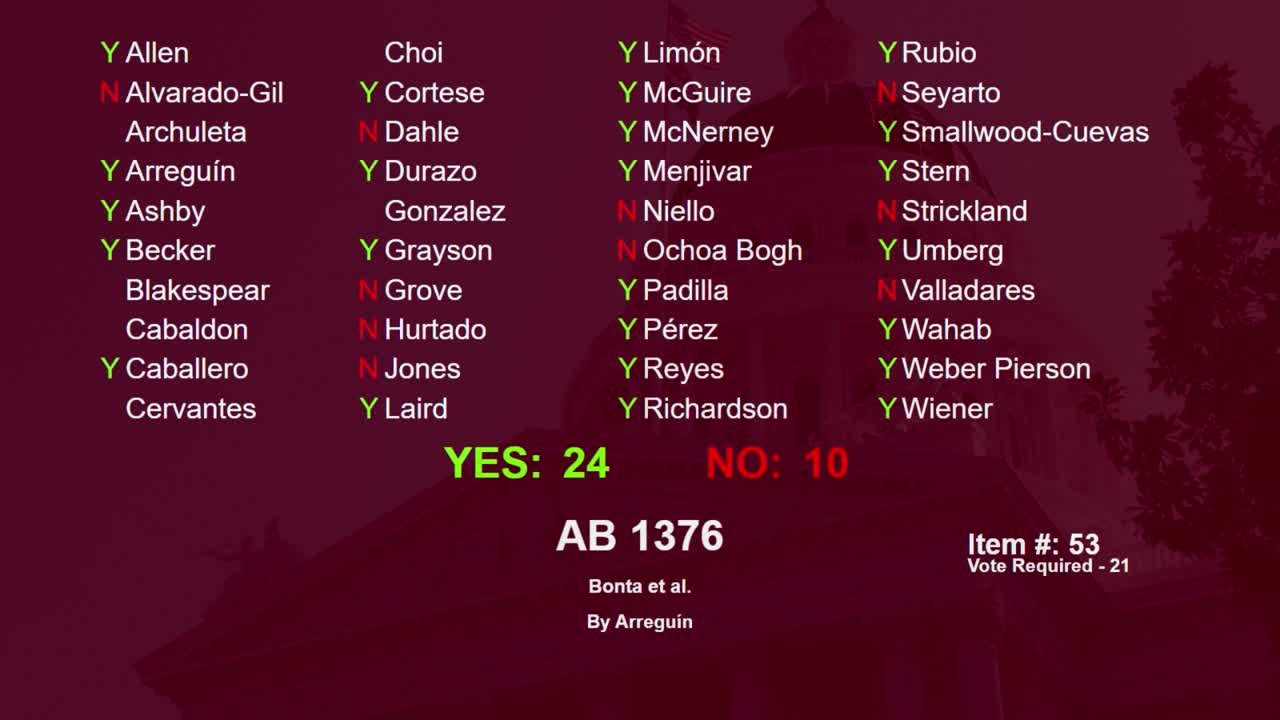 2MIN
Senate Floor
 4MIN
Assembly Floor
 5MIN
Assembly Standing Committee on Business and Professions
 4MIN
Senate Standing Committee on Business, Professions and Economic Development
Bill Author

Bill Co-Author(s):