SB 776: Optometry.
- Session Year: 2025-2026
- House: Senate
- Latest Version Date: 2025-10-13
Current Status:
Passed
(2025-10-13: Chaptered by Secretary of State. Chapter 788, Statutes of 2025.)
Introduced
In Committee
Awaiting First Chamber Vote
Passed First Chamber
In Committee
Awaiting Second Chamber Vote
Passed Second Chamber
Enacted
(1)Existing law, the Optometry Practice Act, until January 1, 2026, establishes the State Board of Optometry within the Department of Consumer Affairs and sets forth its powers and duties relating to the licensure and regulation of the practice of optometry. Under existing law, the board is responsible for the licensure and regulation of registered dispensing opticians, defined to mean spectacle lens dispensers, contact lens dispensers, nonresident ophthalmic lens dispensers, or registered dispensing ophthalmic businesses, as those terms are further defined. Existing law, until January 1, 2026, authorizes the board to appoint an executive officer to perform duties delegated by the board. Existing law establishes the Optometry Fund in the State Treasury and requires all money collected under the act to be paid into that fund and to be available, upon appropriation by the Legislature, to carry out the provisions of the act. Existing law prohibits the board from maintaining a reserve balance in the fund that is greater than 6 months of the appropriated operating expenses of the board in any fiscal year. Existing law makes a violation of the act, or the above-described provisions governing registered dispensing opticians, a crime.
This bill would extend the operation of the board and the authority to appoint an executive officer to January 1, 2030. The bill would increase the maximum permitted reserve balance in the fund to 24 months of the appropriated operating expenses of the board, as specified.
Existing law prescribes the minimum and maximum amounts of specified fees and penalties described in the act and set by the board, including renewal of an optometric license and delinquency for renewal of an optometric license. Existing law also specifies the minimum and maximum amounts of fees prescribed in connection with the application for registration, registration, and biennial registration renewal of nonresident ophthalmic lens dispensers and dispensing ophthalmic businesses and for certificates for spectacle lens dispensers and certificates for contact lens dispensers, which are deposited into the Optometry Fund and made available to the board upon appropriation.
This bill would increase the minimum and maximum fee described above. The bill would also delete provisions that prescribe the minimum and maximum amounts of fees imposed for a branch office license, the renewal of a branch office license, and the failure to pay the annual fee for renewal of a branch office license.
Existing law establishes under the board a dispensing optician committee to advise and make recommendations to the board regarding the regulation of dispensing opticians, spectacle lens dispensers, and contact lens dispensers. Existing law specifies that the committee shall consist of 5 members and describes the appointment, qualifications, and terms of those individuals.
This bill would reduce the number of members of the committee to 3 and would make other conforming changes regarding the appointment, qualifications, and terms of the members.
(2)Existing law prohibits a person from engaging in the practice of optometry without a valid, unrevoked California optometrist license and prohibits an individual from holding themselves out as a registered dispensing optician without, at that time, having a valid, unrevoked certificate. Existing law requires an applicant for licensure or registration with the board to meet certain requirements, including submitting an application on forms furnished by the board and providing satisfactory proof of having passed certain examinations. Existing law requires the applicant for an optometry license to execute an acknowledgment under penalty of perjury that the information provided is true and correct, as specified.
This bill would authorize the board to issue a probationary registration to an applicant subject to terms and conditions, including, but not limited to, enrollment and successful completion of a clinical training program. The bill would require an applicant for licensure, registration, or renewal of licensure or registration who possesses a valid email address, as defined, to report that email address to the board at the time of application. By expanding the crime of perjury, the bill would impose a state-mandated local program. The bill would specify that an email address provided pursuant to the above provisions shall not be considered a public record and shall not be disclosed, except as specified. The bill would provide that information sent from an email account of the board to a valid email address provided by an applicant, registrant, or licensee is presumed to have been delivered to the provided email address.
(3)Existing law prohibits a person located outside California from shipping, mailing, furnishing, or delivering in any manner, ophthalmic lenses at retail to a patient at a California address unless the person is registered with the board. Existing law requires a person subject to registration as described above to ship, mail, furnish, or deliver directly to a patient only spectacle lenses and replacement contact lenses provided pursuant to a valid prescription, as specified.
This bill would specify that the above-described provisions also apply to entities outside California.
(4)Under existing law, registered dispensing opticians are given certain powers and duties, regardless of their specific registration designation. In this regard, existing law authorizes a registered dispensing optician to fit and adjust spectacle lenses and frames or take facial measurements, as specified. Existing law also requires a registered dispensing optician who fits and adjusts spectacle lenses at a health facility or business location to provide to the patient certain written information.
This bill would revise the above-described provisions applicable to registered dispensing opticians to, instead, only apply to registered spectacle lens dispensers. By removing the authority of certain registrants to fit and adjust spectacle lenses and frames or take facial measurements under the provisions governing registered dispensing opticians, the violation of which is a crime, the bill would impose a state-mandated local program.
Existing law requires a registered dispensing optician fitting contact lenses to maintain accessible handwashing facilities on the premises, as specified. Existing law also requires a registered dispensing optician to comply with certain requirements related to eye examinations, contact lens fittings, and prescriptions, including a prohibition on conditioning the availability of an eye examination, contact lens fitting, or the release of a contact lens prescription on the patient agreeing to purchase contact lenses from that prescriber.
This bill would revise the above-described provisions applicable to registered dispensing opticians to, instead, only apply to registered contact lens dispensers.
Existing law requires ophthalmic lenses to be sold pursuant to a confirmed, written prescription, as specified. Existing law prohibits a dispenser from altering any of the specifications of an ophthalmic lens prescription, except as specified.
This bill would, instead, apply those requirements to the sale of contact lenses.
(5)Existing law requires individuals, corporations, and firms to submit an application, verified under oath by the signatory, for a certificate of registration from the California State Board of Optometry, as specified, and requires those entities receive that certificate before engaging in the business of a dispensing ophthalmic business. Existing law, for that purpose, defines dispensing ophthalmic business to mean an individual, corporation, or firm engaged in the business of filling prescriptions of physicians and surgeons licensed by the Medical Board of California or the Osteopathic Medical Board of California, or optometrists licensed by the California State Board of Optometry for prescription lenses and kindred products.
This bill would redefine dispensing ophthalmic business to mean either a person or entity that is engaged in the business of dispensing prescription ophthalmic devices, as defined, or a person or entity that has executed a lease, sublease, contract, or other written agreement with a licensed physician and surgeon or optometrist or a corporation or other business entity for which a licensed physician and surgeon or optometrist is a shareholder, director, or officer that offers, advertises, or performs optical services for the general public, as specified, and would make conforming changes. To the extent the bill would expand the entities subject to the registration requirements, the bill would impose a state-mandated local program by expanding both the crime of violating those provisions and the crime of perjury.
(6)Existing law requires, until July 1, 2035, the owner and operator of a mobile optometric office, as defined, to, among other things, register with the board. Existing law requires the owner and operator of a mobile optometric office to file a quarterly report, except as specified, on a form furnished by the board containing certain information, including a summary of all complaints received by each mobile optometric office, the disposition of those complaints, and referral information. Existing law requires the owner and operator of a mobile optometric office to provide each patient, and, if applicable, the patients caregiver or guardian, a consumer notice containing, among other things, information on followup care available for the patient, including a list of available Medi-Cal or volunteer optometrists. Existing law requires that list to be subject to inspection by the board. Existing law prohibits the owner and operator of a mobile optometric office from operating more than 12 mobile optometric offices within the first renewal period of 2 years.
This bill would instead require the owner and operator of a mobile optometric office to file that report annually, on or before January 1, and would delete the requirement for the report to include the above-described complaint and referral information. The bill would require the above-described consumer notice to be provided at the initial time services are rendered. The bill would require the above-described information on followup care for the patient to include, instead, a list of available Medi-Cal or volunteer optometrists in the area of service who may be able to see the patient for comprehensive services and for purposes of continuity of care, and the timeframe for which the mobile optometric office will be back in the area of service, if available. The bill would require that list to be provided annually to each location of service for a period of 2 years following the initial date of service. The bill would, instead, subject that information to inspection by the board. The bill would delete the above-described limitation on number of mobile optometric offices operated within the first renewal period of 2 years.
(7)Existing law required the board to issue a temporary license to practice optometry to a person who, among other things, applied for and was eligible for licensure, as specified, but who was unable to immediately take the Part III - Clinical Skills Examination due to the state of emergency, proclaimed by the Governor on March 4, 2020, in response to the COVID-19 pandemic. In connection with that temporary license, existing law imposed various requirements and restrictions on a temporary licensee and provided that a temporary license would expire upon the date the temporary licensee completed all requirements for licensure, as specified, or 6 months after the end of the state of emergency, whichever occurred first.
The act also requires the board to issue, upon application and payment of a specified fee, a retired license to an optometrist who holds a license that is current and active and, among other things, exempts a retired licensee from continuing education requirements, as specified.
This bill would require the board to issue, upon application and payment of a specified fee, a retired license to an optometrist who holds a license that is current.
This bill would also make a nonsubstantive change to update the name of the above examination.
(8)Existing law requires a prescriber or a registered dispensing optician, upon completion of an eye examination or, if applicable, a contact lens fitting process for a patient, to provide the patient with a signed copy of the patients contact lens prescription, unless that prescription meets specified standards. In this regard, existing law grants a prescriber professional discretion regarding the release of the contact lens prescription for patients who wear certain types of contact lenses.
This bill would delete the above-described exception to the requirement to provide a patient with a signed copy of the patients contact lens prescription. The bill would require a prescriber to abide by specified federal regulations pertaining to contact lens prescriptions and eye examinations.
(9)Existing constitutional provisions require that a statute that limits the right of access to the meetings of public bodies or the writings of public officials and agencies be adopted with findings demonstrating the interest protected by the limitation and the need for protecting that interest.
This bill would make legislative findings to that effect.
(10)The California Constitution requires the state to reimburse local agencies and school districts for certain costs mandated by the state. Statutory provisions establish procedures for making that reimbursement.
This bill would provide that no reimbursement is required by this act for a specified reason.
(1)Existing law, the Optometry Practice Act, until January 1, 2026, establishes the State Board of Optometry within the Department of Consumer Affairs and sets forth its powers and duties relating to the licensure and regulation of the practice of optometry. Under existing law, the board is responsible for the licensure and regulation of registered dispensing opticians, defined to mean spectacle lens dispensers, contact lens dispensers, nonresident ophthalmic lens dispensers, or registered dispensing ophthalmic businesses, as those terms are further defined. Existing law, until January 1, 2026, authorizes the board to appoint an executive officer to perform duties delegated by the board. Existing law establishes the Optometry Fund in the State Treasury and requires all money collected under the act to be paid into that fund and to be available, upon appropriation by the Legislature, to carry out the provisions of the act. Existing law prohibits the board from maintaining a reserve balance in the fund that is greater than 6 months of the appropriated operating expenses of the board in any fiscal year. Existing law makes a violation of the act, or the above-described provisions governing registered dispensing opticians, a crime.
This bill would extend the operation of the board and the authority to appoint an executive officer to January 1, 2030. The bill would increase the maximum permitted reserve balance in the fund to 24 months of the appropriated operating expenses of the board, as specified.
Existing law prescribes the minimum and maximum amounts of specified fees and penalties described in the act and set by the board, including renewal of an optometric license and delinquency for renewal of an optometric license. Existing law also specifies the minimum and maximum amounts of fees prescribed in connection with the application for registration, registration, and biennial registration renewal of nonresident ophthalmic lens dispensers and dispensing ophthalmic businesses and for certificates for spectacle lens dispensers and certificates for contact lens dispensers, which are deposited into the Optometry Fund and made available to the board upon appropriation.
This bill would increase the minimum and maximum fee described above. The bill would also delete provisions that prescribe the minimum and maximum amounts of fees imposed for a branch office license, the renewal of a branch office license, and the failure to pay the annual fee for renewal of a branch office license.
Existing law establishes under the board a dispensing optician committee to advise and make recommendations to the board regarding the regulation of dispensing opticians, spectacle lens dispensers, and contact lens dispensers. Existing law specifies that the committee shall consist of 5 members and describes the appointment, qualifications, and terms of those individuals.
This bill would reduce the number of members of the committee to 3 and would make other conforming changes regarding the appointment, qualifications, and terms of the members.
(2)Existing law prohibits a person from engaging in the practice of optometry without a valid, unrevoked California optometrist license and prohibits an individual from holding themselves out as a registered dispensing optician without, at that time, having a valid, unrevoked certificate. Existing law requires an applicant for licensure or registration with the board to meet certain requirements, including submitting an application on forms furnished by the board and providing satisfactory proof of having passed certain examinations. Existing law requires the applicant for an optometry license to execute an acknowledgement acknowledgment under penalty of perjury that the information provided is true and correct, as specified.
This bill would authorize the board to issue a probationary registration to an applicant subject to terms and conditions, including, but not limited to, enrollment and successful completion of a clinical training program. The bill would require an applicant for licensure, registration, or renewal of licensure or registration who possesses a valid email address, as defined, to report that email address to the board at the time of application. By expanding the crime of perjury, the bill would impose a state-mandated local program. The bill would specify that an email address provided pursuant to the above provisions shall not be considered a public record and shall not be disclosed, except as specified. The bill would provide that information sent from an email account of the board to a valid email address provided by an applicant, registrant, or licensee is presumed to have been delivered to the provided email address.
(3)Existing law prohibits a person located outside California from shipping, mailing, furnishing, or delivering in any manner, ophthalmic lenses at retail to a patient at a California address unless the person is registered with the board. Existing law requires a person subject to registration as described above to ship, mail, furnish, or deliver directly to a patient only spectacle lenses and replacement contact lenses provided pursuant to a valid prescription, as specified.
This bill would specify that the above-described provisions also apply to entities outside California.
(4)Under existing law, registered dispensing opticians are given certain powers and duties, regardless of their specific registration designation. In this regard, existing law authorizes a registered dispensing optician to fit and adjust spectacle lenses and frames or take facial measurements, as specified. Existing law also requires a registered dispensing optician who fits and adjusts spectacle lenses at a health facility or business location to provide to the patient certain written information.
This bill would revise the above-described provisions applicable to registered dispensing opticians to, instead, only apply to registered spectacle lens dispensers. By removing the authority of certain registrants to fit and adjust spectacle lenses and frames or take facial measurements under the provisions governing registered dispensing opticians, the violation of which is a crime, the bill would impose a state-mandated local program.
Existing law requires a registered dispensing optician fitting contact lenses to maintain accessible handwashing facilities on the premises, as specified. Existing law also requires a registered dispensing optician to comply with certain requirements related to eye examinations, contact lens fittings, and prescriptions, including a prohibition on conditioning the availability of an eye examination, contact lens fitting, or the release of a contact lens prescription on the patient agreeing to purchase contact lenses from that prescriber.
This bill would revise the above-described provisions applicable to registered dispensing opticians to, instead, only apply to registered contact lens dispensers.
Existing law requires ophthalmic lenses to be sold pursuant to a confirmed, written prescription, as specified. Existing law prohibits a dispenser from altering any of the specifications of an ophthalmic lens prescription, except as specified.
This bill would, instead, apply those requirements to the sale of contact lenses.
(5)Existing law requires individuals, corporations, and firms to submit an application, verified under oath by the signatory, for a certificate of registration from the California State Board of Optometry, as specified, and requires those entities receive that certificate before engaging in the business of a dispensing ophthalmic business. Existing law, for that purpose, defines dispensing ophthalmic business to mean an individual, corporation, or firm engaged in the business of filling prescriptions of physicians and surgeons licensed by the Medical Board of California or the Osteopathic Medical Board of California, or optometrists licensed by the California State Board of Optometry for prescription lenses and kindred products.
This bill would redefine dispensing ophthalmic business to mean either a person or entity that is engaged in the business of dispensing prescription ophthalmic devices, as defined, or a person or entity that has executed a lease, sublease, contract contract, or other written agreement with a licensed physician and surgeon or optometrist or a corporation or other business entity for which a licensed physician and surgeon or optometrist is a shareholder, director, or officer that offers, advertises, or performs optical services for the general public, as specified, and would make conforming changes. To the extent the bill would expand the entities subject to the registration requirements, the bill would impose a state-mandated local program by expanding both the crime of violating those provisions and the crime of perjury.
(6)Existing law requires, until July 1, 2035, the owner and operator of a mobile optometric office, as defined, to, among other things, register with the board. Existing law requires the owner and operator of a mobile optometric office to file a quarterly report, except as specified, on a form furnished by the board containing certain information, including a summary of all complaints received by each mobile optometric office, the disposition of those complaints, and referral information. Existing law requires the owner and operator of a mobile optometric office to provide each patient, and, if applicable, the patients caregiver or guardian, a consumer notice containing, among other things, information on followup care available for the patient, including a list of available Medi-Cal or volunteer optometrists. Existing law requires that list to be subject to inspection by the board. Existing law prohibits the owner and operator of a mobile optometric office from operating more than 12 mobile optometric offices within the first renewal period of 2 years.
This bill would instead require the owner and operator of a mobile optometric office to file that report annually, on or before January 1, and would delete the requirement for the report to include the above-described complaint and referral information. The bill would require the above-described consumer notice to be provided at the initial time services are rendered. The bill would require the above-described information on followup care for the patient to include, instead, a list of available Medi-Cal or volunteer optometrists in the area of service who may be able to see the patient for comprehensive services and for purposes of continuity of care, and the timeframe for which the mobile optometric office will be back in the area of service, if available. The bill would require that list to be provided annually to each location of service for a period of 2 years following the initial date of service. The bill would, instead, subject that information to inspection by the board. The bill would delete the above-described limitation on number of mobile optometric offices operated within the first renewal period of 2 years.
(7)Existing law required the board to issue a temporary license to practice optometry to a person who, among other things, applied for and was eligible for licensure, as specified, but who was unable to immediately take the Part III - Clinical Skills Examination due to the state of emergency, proclaimed by the Governor on March 4, 2020, in response to the COVID-19 pandemic. In connection with that temporary license, existing law imposed various requirements and restrictions on a temporary licensee and provided that a temporary license would expire upon the date the temporary licensee completed all requirements for licensure, as specified, or 6 months after the end of the state of emergency, whichever occurred first.
The act also requires the board to issue, upon application and payment of a specified fee, a retired license to an optometrist who holds a license that is current and active and, among other things, exempts a retired licensee from continuing education requirements, as specified.
This bill would require the board to issue, upon application and payment of a specified fee, a retired license to an optometrist who holds a license that is current.
This bill would also make a nonsubstantive change to update the name of the above examination.
(8)Existing law requires a prescriber or a registered dispensing optician, upon completion of an eye examination or, if applicable, a contact lens fitting process for a patient, to provide the patient with a signed copy of the patients contact lens prescription, unless that prescription meets specified standards. In this regard, existing law grants a prescriber professional discretion regarding the release of the contact lens prescription for patients who wear certain types of contact lenses.
This bill would delete the above-described exception to the requirement to provide a patient with a signed copy of the patients contact lens prescription. The bill would require a prescriber to abide by specified federal regulations pertaining to contact lens prescriptions and eye examinations.
(9)Existing constitutional provisions require that a statute that limits the right of access to the meetings of public bodies or the writings of public officials and agencies be adopted with findings demonstrating the interest protected by the limitation and the need for protecting that interest.
This bill would make legislative findings to that effect.
(10)The California Constitution requires the state to reimburse local agencies and school districts for certain costs mandated by the state. Statutory provisions establish procedures for making that reimbursement.
This bill would provide that no reimbursement is required by this act for a specified reason.
(1)Existing law, the Optometry Practice Act, until January 1, 2026, establishes the State Board of Optometry within the Department of Consumer Affairs and sets forth its powers and duties relating to the licensure and regulation of the practice of optometry. Under existing law, the board is responsible for the licensure and regulation of registered dispensing opticians, defined to mean spectacle lens dispensers, contact lens dispensers, nonresident ophthalmic lens dispensers, or registered dispensing ophthalmic businesses, as those terms are further defined. Existing law, until January 1, 2026, authorizes the board to appoint an executive officer to perform duties delegated by the board. Existing law establishes the Optometry Fund in the State Treasury and requires all money collected under the act to be paid into that fund and to be available, upon appropriation by the Legislature, to carry out the provisions of the act. Existing law prohibits the board from maintaining a reserve balance in the fund that is greater than 6 months of the appropriated operating expenses of the board in any fiscal year. Existing law makes a violation of the act, or the above-described provisions governing registered dispensing opticians, a crime.
This bill would extend the operation of the board and the authority to appoint an executive officer to January 1, 2030. The bill would increase the maximum permitted reserve balance in the fund to 24 months of the appropriated operating expenses of the board, as specified.
(2)Existing law prohibits a person from engaging in the practice of optometry without a valid, unrevoked California optometrist license and prohibits an individual from holding themselves out as a registered dispensing optician without, at that time, having a valid, unrevoked certificate. Existing law requires an applicant for licensure or registration with the board to meet certain requirements, including submitting an application on forms furnished by the board and providing satisfactory proof of having passed certain examinations. Existing law requires the applicant for an optometry license to execute an acknowledgement under penalty of perjury that the information provided is true and correct, as specified.
This bill would authorize the board to issue a probationary registration to an applicant subject to terms and conditions, including, but not limited to, enrollment and successful completion of a clinical training program. The bill would require an applicant for licensure, registration, or renewal of licensure or registration who possesses a valid email address, as defined, to report that email address to the board at the time of application. By expanding the crime of perjury, the bill would impose a state-mandated local program. The bill would specify that an email address provided pursuant to the above provisions shall not be considered a public record and shall not be disclosed, except as specified. The bill would provide that information sent from an email account of the board to a valid email address provided by an applicant, registrant, or licensee is presumed to have been delivered to the provided email address.
(3)Existing law prohibits a person located outside California from shipping, mailing, furnishing, or delivering in any manner, ophthalmic lenses at retail to a patient at a California address unless the person is registered with the board. Existing law requires a person subject to registration as described above to ship, mail, furnish, or deliver directly to a patient only spectacle lenses and replacement contact lenses provided pursuant to a valid prescription, as specified.
This bill would specify that the above-described provisions also apply to entities outside California.
(4)Under existing law, registered dispensing opticians are given certain powers and duties, regardless of their specific registration designation. In this regard, existing law authorizes a registered dispensing optician to fit and adjust spectacle lenses and frames or take facial measurements, as specified. Existing law also requires a registered dispensing optician who fits and adjusts spectacle lenses at a health facility or business location to provide to the patient certain written information.
This bill would revise the above-described provisions applicable to registered dispensing opticians to, instead, only apply to registered spectacle lens dispensers. By removing the authority of certain registrants to fit and adjust spectacle lenses and frames or take facial measurements under the provisions governing registered dispensing opticians, the violation of which is a crime, the bill would impose a state-mandated local program.
Existing law requires a registered dispensing optician fitting contact lenses to maintain accessible handwashing facilities on the premises, as specified. Existing law also requires a registered dispensing optician to comply with certain requirements related to eye examinations, contact lens fittings, and prescriptions, including a prohibition on conditioning the availability of an eye examination, contact lens fitting, or the release of a contact lens prescription on the patient agreeing to purchase contact lenses from that prescriber.
This bill would revise the above-described provisions applicable to registered dispensing opticians to, instead, only apply to registered contact lens dispensers.
Existing law requires ophthalmic lenses to be sold pursuant to a confirmed, written prescription, as specified. Existing law prohibits a dispenser from altering any of the specifications of an ophthalmic lens prescription, except as specified.
This bill would, instead, apply those requirements to the sale of contact lenses.
(5)Existing law requires individuals, corporations, and firms to submit an application, verified under oath by the signatory, for a certificate of registration from the California State Board of Optometry, as specified, and requires those entities receive that certificate before engaging in the business of a dispensing ophthalmic business. Existing law, for that purpose, defines dispensing ophthalmic business to mean an individual, corporation, or firm engaged in the business of filling prescriptions of physicians and surgeons licensed by the Medical Board of California or the Osteopathic Medical Board of California, or optometrists licensed by the California State Board of Optometry for prescription lenses and kindred products.
This bill would redefine dispensing ophthalmic business to mean either a person or entity that is engaged in the business of dispensing prescription ophthalmic devices, as defined, or a person or entity that has executed a lease, sublease, contract or other written agreement with a licensed physician and surgeon or optometrist or a corporation or other business entity for which a licensed physician and surgeon or optometrist is a shareholder, director, or officer that offers, advertises, or performs optical services for the general public, as specified, and would make conforming changes. To the extent the bill would expand the entities subject to the registration requirements, the bill would impose a state-mandated local program by expanding both the crime of violating those provisions and the crime of perjury.
(5)(6)Existing law requires, until July 1, 2035, the owner and operator of a mobile optometric office, as defined, to, among other things, register with the board. Existing law requires the owner and operator of a mobile optometric office to file a quarterly report, except as specified, on a form furnished by the board containing certain information, including a summary of all complaints received by each mobile optometric office, the disposition of those complaints, and referral information. Existing law requires the owner and operator of a mobile optometric office to provide each patient, and, if applicable, the patients caregiver or guardian, a consumer notice containing, among other things, information on followup care available for the patient, including a list of available Medi-Cal or volunteer optometrists. Existing law requires that list to be subject to inspection by the board. Existing law prohibits the owner and operator of a mobile optometric office from operating more than 12 mobile optometric offices within the first renewal period of 2 years.
This bill would instead require the owner and operator of a mobile optometric office to file that report annually, on or before January 1, and would delete the requirement for the report to include the above-described complaint and referral information. The bill would require the above-described consumer notice to be provided at the initial time services are rendered. The bill would require the above-described information on followup care for the patient to include, instead, a list of available Medi-Cal or volunteer optometrists in the area of service who may be able to see the patient for comprehensive services and for purposes of continuity of care, and the timeframe for which the mobile optometric office will be back in the area of service, if available. The bill would require that list to be provided annually to each location of service for a period of two 2 years following the initial date of service. The bill would, instead, subject that information to inspection by the board. The bill would delete the above-described limitation on number of mobile optometric offices operated within the first renewal period of two 2 years.
(6)(7)Existing law required the board to issue a temporary license to practice optometry to a person who, among other things, applied for and was eligible for licensure, as specified, but who was unable to immediately take the Part III - Clinical Skills Examination due to the state of emergency, proclaimed by the Governor on March 4, 2020, in response to the COVID-19 pandemic. In connection with that temporary license, existing law imposed various requirements and restrictions on a temporary licensee and provided that a temporary license would expire upon the date the temporary licensee completed all requirements for licensure, as specified, or 6 months after the end of the state of emergency, whichever occurred first.
The act also requires the board to issue, upon application and payment of a specified fee, a retired license to an optometrist who holds a license that is current and active and, among other things, exempts a retired licensee from continuing education requirements, as specified.
This bill would require the board to issue, upon application and payment of a specified fee, a retired license to an optometrist who holds a license that is current.
This bill would also make a nonsubstantive change to update the name of the above examination.
(7)(8)Existing law requires a prescriber or a registered dispensing optician, upon completion of an eye examination or, if applicable, a contact lens fitting process for a patient, to provide the patient with a signed copy of the patients contact lens prescription, unless that prescription meets specified standards. In this regard, existing law grants a prescriber professional discretion regarding the release of the contact lens prescription for patients who wear certain types of contact lenses.
This bill would delete the above-described exception to the requirement to provide a patient with a signed copy of the patients contact lens prescription. The bill would require a prescriber to abide by specified federal regulations pertaining to contact lens prescriptions and eye examinations.
(9)Existing constitutional provisions require that a statute that limits the right of access to the meetings of public bodies or the writings of public officials and agencies be adopted with findings demonstrating the interest protected by the limitation and the need for protecting that interest.
This bill would make legislative findings to that effect.
(8)(10)The California Constitution requires the state to reimburse local agencies and school districts for certain costs mandated by the state. Statutory provisions establish procedures for making that reimbursement.
This bill would provide that no reimbursement is required by this act for a specified reason.
(1)Existing law, the Optometry Practice Act, until January 1, 2026, establishes the State Board of Optometry within the Department of Consumer Affairs and sets forth its powers and duties relating to the licensure and regulation of the practice of optometry. Under existing law, the board is responsible for the licensure and regulation of registered dispensing opticians, defined to mean spectacle lens dispensers, contact lens dispensers, nonresident ophthalmic lens dispensers, or registered dispensing ophthalmic businesses, as those terms are further defined. Existing law, until January 1, 2026, authorizes the board to appoint an executive officer to perform duties delegated by the board. Existing law establishes the Optometry Fund in the State Treasury and requires all money collected under the act to be paid into that fund and to be available, upon appropriation by the Legislature, to carry out the provisions of the act. Existing law prohibits the board from maintaining a reserve balance in the fund that is greater than 6 months of the appropriated operating expenses of the board in any fiscal year. Existing law makes a violation of the act, or the above-described provisions governing registered dispensing opticians, a crime.
This bill would extend the operation of the board and the authority to appoint an executive officer to January 1, 2030. The bill would increase the maximum permitted reserve balance in the fund to 24 months of the appropriated operating expenses of the board, as specified.
(2)Existing law prohibits a person from engaging in the practice of optometry without a valid, unrevoked California optometrist license and prohibits an individual from holding themselves out as a registered dispensing optician without, at that time, having a valid, unrevoked certificate. Existing law requires an applicant for licensure or registration with the board to meet certain requirements, including submitting an application on forms furnished by the board and providing satisfactory proof of having passed certain examinations. Existing law requires the applicant for an optometry license to execute an acknowledgement under penalty of perjury that the information provided is true and correct, as specified.
This bill would authorize the board to issue a probationary registration to an applicant subject to terms and conditions, including, but not limited to, enrollment and successful completion of a clinical training program. The bill would require an applicant for licensure, registration, or renewal of licensure or registration who possesses a valid email address, as defined, to report that email address to the board at the time of application. By expanding the crime of perjury, the bill would impose a state-mandated local program. The bill would provide that information sent from an email account of the board to a valid email address provided by an applicant, registrant, or licensee is presumed to have been delivered to the provided email address.
(3)Existing law prohibits a person located outside California from shipping, mailing, furnishing, or delivering in any manner, ophthalmic lenses at retail to a patient at a California address unless the person is registered with the board. Existing law requires a person subject to registration as described above to ship, mail, furnish, or deliver directly to a patient only spectacle lenses and replacement contact lenses provided pursuant to a valid prescription, as specified.
This bill would specify that the above-described provisions also apply to entities outside California.
(4)Under existing law, registered dispensing opticians are given certain powers and duties, regardless of their specific registration designation. In this regard, existing law authorizes a registered dispensing optician to fit and adjust spectacle lenses and frames or take facial measurements, as specified. Existing law also requires a registered dispensing optician who fits and adjusts spectacle lenses at a health facility or business location to provide to the patient certain written information.
This bill would revise the above-described provisions applicable to registered dispensing opticians to, instead, only apply to registered spectacle lens dispensers. By removing the authority of certain registrants to fit and adjust spectacle lenses and frames or take facial measurements under the provisions governing registered dispensing opticians, the violation of which is a crime, the bill would impose a state-mandated local program.
Existing law requires a registered dispensing optician fitting contact lenses to maintain accessible handwashing facilities on the premises, as specified. Existing law also requires a registered dispensing optician to comply with certain requirements related to eye examinations, contact lens fittings, and prescriptions, including a prohibition on conditioning the availability of an eye examination, contact lens fitting, or the release of a contact lens prescription on the patient agreeing to purchase contact lenses from that prescriber.
This bill would revise the above-described provisions applicable to registered dispensing opticians to, instead, only apply to registered contact lens dispensers.
(5)Existing law requires, until July 1, 2035, the owner and operator of a mobile optometric office, as defined, to, among other things, register with the board. Existing law requires the owner and operator of a mobile optometric office to file a quarterly report, except as specified, on a form furnished by the board containing certain information, including a summary of all complaints received by each mobile optometric office, the disposition of those complaints, and referral information. Existing law requires the owner and operator of a mobile optometric office to provide each patient, and, if applicable, the patients caregiver or guardian, a consumer notice containing, among other things, information on followup care available for the patient, including a list of available Medi-Cal or volunteer optometrists. Existing law requires that list to be subject to inspection by the board. Existing law prohibits the owner and operator of a mobile optometric office from operating more than 12 mobile optometric offices within the first renewal period of 2 years.
This bill would instead require the owner and operator of a mobile optometric office to file that report annually, on or before January 1, and would delete the requirement for the report to include the above-described complaint and referral information. The bill would require the above-described consumer notice to be provided at the initial time services are rendered. The bill would require the above-described information on followup care for the patient to include, instead, a list of available Medi-Cal or volunteer optometrists in the area of service who may be able to see the patient for comprehensive services and for purposes of continuity of care, and the timeframe for which the mobile optometric office will be back in the area of service, if available. The bill would require that list to be provided annually to each location of service for a period of two years following the initial date of service. The bill would, instead, subject that information to inspection by the board. The bill would delete the above-described limitation on number of mobile optometric offices operated within the first renewal period of two years.
(6)Existing law required the board to issue a temporary license to practice optometry to a person who, among other things, applied for and was eligible for licensure, as specified, but who was unable to immediately take the Section Part III - Clinical Skills Examination due to the state of emergency, proclaimed by the Governor on March 4, 2020, in response to the COVID-19 pandemic. In connection with that temporary license, existing law imposed various requirements and restrictions on a temporary licensee and provided that a temporary license would expire upon the date the temporary licensee completed all requirements for licensure, as specified, or 6 months after the end of the state of emergency, whichever occurred first.
The act also requires the board to issue, upon application and payment of a specified fee, a retired license to an optometrist who holds a license that is current and active and, among other things, exempts a retired licensee from continuing education requirements, as specified.
This bill would require the board to issue, upon application and payment of a specified fee, a retired license to an optometrist who holds a license that is current.
This bill would also make a nonsubstantive change to update the name of the above examination.
(7)Existing law requires a prescriber or a registered dispensing optician, upon completion of an eye examination or, if applicable, a contact lens fitting process for a patient, to provide the patient with a signed copy of the patients contact lens prescription, unless that prescription meets specified standards. In this regard, existing law grants a prescriber professional discretion regarding the release of the contact lens prescription for patients who wear certain types of contact lenses.
This bill would delete the above-described exception to the requirement to provide a patient with a signed copy of the patients contact lens prescription. The bill would require a prescriber to abide by specified federal regulations pertaining to contact lens prescriptions and eye examinations.
(8)The California Constitution requires the state to reimburse local agencies and school districts for certain costs mandated by the state. Statutory provisions establish procedures for making that reimbursement.
This bill would provide that no reimbursement is required by this act for a specified reason.
(1)Existing law, the Optometry Practice Act, until January 1, 2026, establishes the State Board of Optometry within the Department of Consumer Affairs and sets forth its powers and duties relating to the licensure and regulation of the practice of optometry and registered dispensing opticians. optometry. Under existing law, the board is responsible for the licensure and regulation of registered dispensing opticians, defined to mean spectacle lens dispensers, contact lens dispensers, nonresident ophthalmic lens dispensers, or registered dispensing ophthalmic businesses, as those terms are further defined. Existing law, until January 1, 2026, authorizes the board to appoint an executive officer to perform duties delegated by the board. Existing law establishes the Optometry Fund in the State Treasury and requires all money collected under the act to be paid into that fund and to be available, upon appropriation by the Legislature, to carry out the provisions of the act. Existing law prohibits the board from maintaining a reserve balance in the fund that is greater than 6 months of the appropriated operating expenses of the board in any fiscal year. Existing law makes a violation of the act act, or the above-described provisions governing registered dispensing opticians, a crime.
This bill would extend the operation of the board and the authority to appoint an executive officer to January 1, 2030. The bill would increase the maximum permitted reserve balance in the fund to 24 months of the appropriated operating expenses of the board, as specified.
(2)Existing law prohibits a person from engaging in the practice of optometry without a valid, unrevoked California optometrist license and prohibits an individual from holding themselves out as a registered dispensing optician without, at that time, having a valid, unrevoked certificate. Existing law requires an applicant for licensure or registration with the board to meet certain requirements, including submitting an application on forms furnished by the board and providing satisfactory proof of having passed certain examinations. Existing law requires the applicant for an optometry license to execute an acknowledgement under penalty of perjury that the information provided is true and correct, as specified.
This bill would authorize the board to issue a probationary registration to an applicant subject to terms and conditions, including, but not limited to, enrollment and successful completion of a clinical training program. The bill would require an applicant for licensure, registration, or renewal of licensure or registration who possesses a valid email address, as defined, to report that email address to the board at the time of application. By expanding the crime of perjury, the bill would impose a state-mandated local program. The bill would provide that information sent from an email account of the board to a valid email address provided by an applicant, registrant, or licensee is presumed to have been delivered to the provided email address. The bill would specify that an email address provided pursuant to the above provisions shall not be considered a public record and shall not be disclosed, except as specified.
(3)Existing law prohibits a person located outside California from shipping, mailing, furnishing, or delivering in any manner, ophthalmic lenses at retail to a patient at a California address unless the person is registered with the board. Existing law requires a person subject to registration as described above to ship, mail, furnish, or deliver directly to a patient only spectacle lenses and replacement contact lenses provided pursuant to a valid prescription, as specified.
This bill would specify that the above-described provisions also apply to entities outside California.
(4)Existing law defines a registered dispensing optician to mean a spectacle lens dispenser, a contact lens dispenser, a nonresident ophthalmic lens dispenser, or a registered dispensing ophthalmic business, as those terms are further defined. Under existing law, registered dispensing opticians are given certain powers and duties, regardless of their specific registration designation. In this regard, existing law authorizes a registered dispensing optician to fit and adjust spectacle lenses and frames or take facial measurements, as specified. Existing law also requires a registered dispensing optician who fits and adjusts spectacle lenses at a health facility or business location to provide to the patient certain written information.
This bill would revise the above-described provisions applicable to registered dispensing opticians to, instead, only apply to registered spectacle lens dispensers. By removing the authority of certain registrants to fit and adjust spectacle lenses and frames or take facial measurements under the Optometry Act, provisions governing registered dispensing opticians, the violation of which is a crime, the bill would impose a state-mandated local program.
Existing law requires a registered dispensing optician fitting contact lenses to maintain accessible handwashing facilities on the premises, as specified. Existing law also requires a registered dispensing optician to comply with certain requirements related to eye examinations, contact lens fittings, and prescriptions, including a prohibition on conditioning the availability of an eye examination, contact lens fitting, or the release of a contact lens prescription on the patient agreeing to purchase contact lenses from that prescriber.
This bill would revise the above-described provisions applicable to registered dispensing opticians to, instead, only apply to registered contact lens dispensers.
(5)Existing law requires, until July 1, 2035, the owner and operator of a mobile optometric office, as defined, to, among other things, register with the board. Existing law requires the owner and operator of a mobile optometric office to file a quarterly report, except as specified, on a form furnished by the board containing certain information, including a summary of all complaints received by each mobile optometric office, the disposition of those complaints, and referral information.
This bill would instead require the owner and operator of a mobile optometric office to file that report annually, on or before January 1, and would delete the requirement for the report to include the above-described complaint and referral information.
(5)(6)Existing law required the board to issue a temporary license to practice optometry to a person who, among other things, applied for and was eligible for licensure, as specified, but who was unable to immediately take the Section III - Clinical Skills Examination due to the state of emergency, proclaimed by the Governor on March 4, 2020, in response to the COVID-19 pandemic. In connection with that temporary license, existing law imposed various requirements and restrictions on a temporary licensee and provided that a temporary license would expire upon the date the temporary licensee completed all requirements for licensure, as specified, or 6 months after the end of the state of emergency, whichever occurred first.
The act also requires the board to issue, upon application and payment of a specified fee, a retired license to an optometrist who holds a license that is current and active and, among other things, exempts a retired licensee from continuing education requirements, as specified.
This bill would require the board to issue, upon application and payment of a specified fee, a retired license to an optometrist who holds a license that is current.
This bill would also make a nonsubstantive change to update the name of the above examination.
(6)(7)Existing law requires a prescriber or a registered dispensing optician, upon completion of an eye examination or, if applicable, a contact lens fitting process for a patient, to provide the patient with a signed copy of the patients contact lens prescription, unless that prescription meets specified standards. In this regard, existing law grants a prescriber professional discretion regarding the release of the contact lens prescription for patients who wear certain types of contact lenses.
This bill would delete the above-described exception to the requirement to provide a patient with a signed copy of the patients contact lens prescription. The bill would require a prescriber to abide by specified federal regulations pertaining to contact lens prescriptions and eye examinations.
(7)Existing constitutional provisions require that a statute that limits the right of access to the meetings of public bodies or the writings of public officials and agencies be adopted with findings demonstrating the interest protected by the limitation and the need for protecting that interest.This bill would make legislative findings to that effect.(8)The California Constitution requires the state to reimburse local agencies and school districts for certain costs mandated by the state. Statutory provisions establish procedures for making that reimbursement.
This bill would provide that no reimbursement is required by this act for a specified reason.
(1)Existing law, the Optometry Practice Act, until January 1, 2026, establishes the State Board of Optometry within the Department of Consumer Affairs and sets forth its powers and duties relating to the licensure and regulation of the practice of optometry. optometry and registered dispensing opticians. Existing law, until January 1, 2026, authorizes the board to appoint an executive officer to perform duties delegated by the board. Existing law establishes the Optometry Fund in the State Treasury and requires all money collected under the act to be paid into that fund and to be available, upon appropriation by the Legislature, to carry out the provisions of the act. Existing law prohibits the board from maintaining a reserve balance in the fund that is greater than 6 months of the appropriated operating expenses of the board in any fiscal year. Existing law makes any a violation of the act a crime.
This bill would extend the operation of the board and the authority to appoint an executive officer to January 1, 2030. The bill would increase the maximum permitted reserve balance in the fund to 24 months of the appropriated operating expenses of the board, as specified.
(2)Existing law prohibits a person from engaging in the practice of optometry without a valid, unrevoked California optometrist license and prohibits an individual from holding themselves out as a registered dispensing optician without, at that time, having a valid, unrevoked certificate. Existing law requires an applicant for licensure or registration with the board to meet certain requirements, including submitting an application on forms furnished by the board and providing satisfactory proof of having passed certain examinations. Existing law requires the applicant for an optometry license to execute an acknowledgement under penalty of perjury that the information provided is true and correct, as specified.
This bill would authorize the board to issue a probationary registration to an applicant subject to terms and conditions, including, but not limited to, enrollment and successful completion of a clinical training program. The bill would require an applicant for licensure, registration, or renewal of licensure or registration who possesses a valid email address, as defined, to report that email address to the board at the time of application. By expanding the crime of perjury, the bill would impose a state-mandated local program. The bill would provide that information sent from an email account of the board to a valid email address provided by an applicant, registrant, or licensee is presumed to have been delivered to the provided email address. The bill would specify that an email address provided pursuant to the above provisions shall not be considered a public record and shall not be disclosed, except as specified.
(3)Existing law prohibits a person located outside California from shipping, mailing, furnishing, or delivering in any manner, ophthalmic lenses at retail to a patient at a California address unless the person is registered with the board. Existing law requires a person subject to registration as described above to ship, mail, furnish, or deliver directly to a patient only spectacle lenses and replacement contact lenses provided pursuant to a valid prescription, as specified.
This bill would specify that the above-described provisions also apply to entities outside California.
(4)Existing law defines a registered dispensing optician to mean a spectacle lens dispenser, a contact lens dispenser, a nonresident ophthalmic lens dispenser, or a registered dispensing ophthalmic business, as those terms are further defined. Under existing law, registered dispensing opticians are given certain powers and duties, regardless of their specific registration designation. In this regard, existing law authorizes a registered dispensing optician to fit and adjust spectacle lenses and frames or take facial measurements, as specified. Existing law also requires a registered dispensing optician who fits and adjusts spectacle lenses at a health facility or business location to provide to the patient certain written information.
This bill would revise the above-described provisions applicable to registered dispensing opticians to, instead, only apply to registered spectacle lens dispensers. By removing the authority of certain registrants to fit and adjust spectacle lenses and frames or take facial measurements under the Optometry Act, the violation of which is a crime, the bill would impose a state-mandated local program.
Existing law requires a registered dispensing optician fitting contact lenses to maintain accessible handwashing facilities on the premises, as specified. Existing law also requires a registered dispensing optician to comply with certain requirements related to eye examinations, contact lens fittings, and prescriptions, including a prohibition on conditioning the availability of an eye examination, contact lens fitting, or the release of a contact lens prescription on the patient agreeing to purchase contact lenses from that prescriber.
This bill would revise the above-described provisions applicable to registered dispensing opticians to, instead, only apply to registered contact lens dispensers.
Existing(5)Existing law required the board to issue a temporary license to practice optometry to a person who, among other things, applied for and was eligible for licensure, as specified, but who was unable to immediately take the Section III - Clinical Skills Examination due to the state of emergency, proclaimed by the Governor on March 4, 2020, in response to the COVID-19 pandemic. In connection with that temporary license, existing law imposed various requirements and restrictions on a temporary licensee and provided that a temporary license would expire upon the date the temporary licensee completed all requirements for licensure, as specified, or six 6 months after the end of the state of emergency, whichever occurred first.
The act also requires the board to issue, upon application and payment of a specified fee, a retired license to an optometrist who holds a license that is current and active and, among other things, exempts a retired licensee from continuing education requirements, as specified.
This bill would require the board to issue, upon application and payment of a specified fee, a retired license to an optometrist who holds a license that is current.
This bill would also make a nonsubstantive change to update the name of the above examination.
(6)Existing law requires a prescriber or a registered dispensing optician, upon completion of an eye examination or, if applicable, a contact lens fitting process for a patient, to provide the patient with a signed copy of the patients contact lens prescription, unless that prescription meets specified standards. In this regard, existing law grants a prescriber professional discretion regarding the release of the contact lens prescription for patients who wear certain types of contact lenses.
This bill would delete the above-described exception to the requirement to provide a patient with a signed copy of the patients contact lens prescription. The bill would require a prescriber to abide by specified federal regulations pertaining to contact lens prescriptions and eye examinations.
(7)Existing constitutional provisions require that a statute that limits the right of access to the meetings of public bodies or the writings of public officials and agencies be adopted with findings demonstrating the interest protected by the limitation and the need for protecting that interest.
This bill would make legislative findings to that effect.
(8)The California Constitution requires the state to reimburse local agencies and school districts for certain costs mandated by the state. Statutory provisions establish procedures for making that reimbursement.
This bill would provide that no reimbursement is required by this act for a specified reason.
Existing law, the Optometry Practice Act, establishes the State Board of Optometry within the Department of Consumer Affairs and sets forth its powers and duties relating to the licensure and regulation of the practice of optometry. Existing law makes any violation of the act a crime.
Existing law required the board to issue a temporary license to practice optometry to a person who, among other things, applied for and was eligible for licensure, as specified, but who was unable to immediately take the Section III - Clinical Skills Examination due to the state of emergency, proclaimed by the Governor on March 4, 2020, in response to the COVID-19 pandemic. In connection with that temporary license, existing law imposed various requirements and restrictions on a temporary licensee and provided that a temporary license would expire upon the date the temporary licensee completed all requirements for licensure, as specified, or six months after the end of the state of emergency, whichever occurred first.
The act also requires the board to issue, upon application and payment of a specified fee, a retired license to an optometrist who holds a license that is current and active and, among other things, exempts a retired licensee from continuing education requirements, as specified.
This bill would require the board to issue, upon application and payment of a specified fee, a retired license to an optometrist who holds a license that is current.
This bill would also make a nonsubstantive change to update the name of the above examination.
(a)(1)The expiration date of a contact lens prescription shall not be less than one year and shall not exceed two years from the date of issuance, unless the patients history or current circumstances establish a reasonable probability of changes in the patients vision of sufficient magnitude to necessitate reexamination earlier than one year, or the presence or probability of visual abnormalities related to ocular or systemic disease indicate the need for reexamination of the patient earlier than one year. If the expiration date of a prescription is less than one year, the health-related reasons for the limitation shall be documented in the patients medical record. In no circumstances shall the prescription expiration date be less than the period of time recommended by the prescriber for reexamination of the patient.
(2)For the purposes of this subdivision, the date of issuance is the date the patient receives a copy of the prescription.
(3)Establishing an expiration date that is not consistent with this section shall be regarded as unprofessional conduct by the board that issued the prescribers license to practice.
(b)Upon completion of the eye examination or, if applicable, the contact lens fitting process for a patient as described in subdivision (e), a prescriber or a registered dispensing optician shall provide the patient with a copy of the patients contact lens prescription signed by the prescriber. A prescriber of a contact lens shall abide by the rules pertaining to contact lens prescriptions and eye examinations adopted by the Federal Trade Commission pursuant to Part 315 of Title 16 of the Code of Federal Regulations.
(c)If a patient places an order with a contact lens seller other than a physician and surgeon, an optometrist, or a registered dispensing optician, the prescriber or the prescribers authorized agent shall, upon request of the contact lens seller and in the absence of the actual prescription, attempt to promptly confirm the information contained in the prescription through direct communication with the contact lens seller.
(d)The contact lens prescription shall include sufficient information for the complete and accurate filling of a prescription, including, but not limited to, the power, the material or manufacturer or both, the base curve or appropriate designation, the diameter when appropriate, and an appropriate expiration date. When a provider prescribes a private label contact lens for a patient, the prescription shall include the name of the manufacturer, the trade name of the private label brand, and, if applicable, the trade name of the equivalent national brand.
(e)The contact lens fitting process begins after the initial comprehensive eye examination, and includes an examination to determine the lens specifications, an initial evaluation of the fit of the lens on the patients eye, except in the case of a renewal prescription of an established patient, and followup examinations that are medically necessary, and ends when the prescriber or registered dispensing optician determines that an appropriate fit has been achieved, or in the case of a prescription renewal for an established patient, the prescriber determines that there is no change in the prescription.
(f)The payment of professional fees for the eye exam, fitting, and evaluation may be required prior to the release of the prescription, but only if the prescriber would have required immediate payment from the patient had the examination revealed that no ophthalmic devices were required. A prescriber or registered dispensing optician shall not charge the patient any fee as a condition to releasing the prescription to the patient. A prescriber may charge an additional fee for verifying ophthalmic devices dispensed by another seller if the additional fee is imposed at the time the verification is performed.
(g)A prescriber shall not condition the availability of an eye examination, a contact lens fitting, or the release of a contact lens prescription on a requirement that the patient agree to purchase contact lenses from that prescriber. A registered dispensing optician shall not condition the availability of a contact lens fitting on a requirement that the patient agrees to purchase contact lenses from that registered dispensing optician.
(h)A prescriber or a registered dispensing optician shall not place on the contact lens prescription, deliver to the patient, or require a patient to sign a form or notice waiving or disclaiming the liability or responsibility of the prescriber or registered dispensing optician for the accuracy of the ophthalmic devices dispensed by another seller. This prohibition against waivers and disclaimers shall not impose liability on a prescriber or registered dispensing optician for the ophthalmic devices dispensed by another seller pursuant to the prescribers prescription.
(i)The willful failure or refusal of a prescriber to comply with the provisions of this section shall constitute grounds for professional discipline, including, but not limited to, the imposition of a fine or the suspension or revocation of the prescribers license. The Medical Board of California, the Osteopathic Medical Board of California, and the California State Board of Optometry shall adopt regulations, to implement this subdivision, including, but not limited to, standards for processing complaints each receives regarding this subdivision.
(j)For the purposes of this section, prescriber means a physician and surgeon or an optometrist.
(k)Nothing in this section shall be construed to expand the scope of practice of a registered dispensing optician as defined in Sections 2542, 2543, and Chapter 5.5 (commencing with Section 2550).
SEC. 2.Section 2550 of the Business and Professions Code is amended to read:2550.For purposes of this chapter, the following definitions shall apply:
(a)Adjust and adjusting includes the following acts, either singly or in combination with others: adapting or manipulation of the ophthalmic device to fit the face of the consumer, pursuant and incidental to the filling of any prescription for lenses, spectacles, eyeglasses, contact lens, plano contact lens, and other ophthalmic devices as specified in Section 2541, and prescriptions.
(b)Board means the California State Board of Optometry.
(c)Dispensing optician, registered dispensing optician, and registrant mean any of the following individuals that are registered with the board:
(1)Spectacle lens dispenser means an individual who is registered with the board pursuant to Article 1.5 (commencing with Section 2559.1).
(2)Contact lens dispenser means an individual who is registered with the board pursuant to Article 2 (commencing with Section 2560).
(3)Nonresident ophthalmic lens dispenser means an entity that is registered with the board pursuant to Article 2.5 (commencing with Section 2564.70) which offers, advertises, and performs optical services to the general public.
(4)Registered dispensing ophthalmic business means an entity that is registered with the board pursuant to Article 2.7 (commencing with Section 2564.90).
(d)Fit and fitting mean doing any of the following acts, either singly or in combination with others, before the act of adjusting: designing, taking measurements to determine the size, shape, or specifications, and replacing the prescribed optical aids, pursuant and incidental to the filling of any prescription for lenses, spectacles, eyeglasses, contact lens, plano contact lens, and other ophthalmic devices as specified in Section 2541.
(e)Ophthalmic lens or ophthalmic device means any prescription lenses, spectacles, eyeglasses, contact lens, other ophthalmic devices that alter or change the visual powers of the human eye, or any prescription plano contact lens ordered by a physician and surgeon or optometrist.
(f)Prescription means an order made by a licensed physician and surgeon or licensed optometrist pursuant to Section 2541.1 or 2541.2.
(g)Unregistered individual means an individual who is not registered with the board pursuant to this chapter. The unregistered individual may perform any of the following:
(1)Fitting and adjusting of spectacle lenses under the direct responsibility and supervision of a duly registered spectacle lens dispenser pursuant to Section 2559.1.
(2)Fitting and adjusting of contact lenses under the direct responsibility and supervision of a duly registered contact lens dispenser pursuant to Section 2560.
SEC. 3.Section 2552 of the Business and Professions Code is amended to read:2552.(a)Each application made pursuant to this chapter shall be verified under oath by the person required to sign the application and shall designate the name, address, and direct business telephone number of the applicants employee who will be responsible for handling customer inquiries and complaints with respect to the business address for which registration is applied. An applicant shall report any changes to this information in writing to the board within 14 days.
(b)The applicant shall furnish such additional information or proof, oral or written, which the board may request, including information and proof relating to the provisions of Division 1.5 (commencing with Section 475).
(c)The board shall promptly notify any applicant if, as of the 30th day following the submission of an application under this chapter, the application and supporting documentation are not substantially complete and in proper form. The notification shall be in writing, shall state specifically what documents or other information are to be supplied by the applicant to the board, and shall be sent to the applicant by certified, electronic, or registered mail. Within 30 days of the applicants submission of the requested documents or information to the board, the board shall notify the applicant by certified, electronic, or registered mail if the board requires additional documents or information.
(d)An applicant for registration or renewal of registration who possesses a valid email address shall report that email address to the board at the time of application for registration or renewal.
(e)For purposes of this chapter, valid email address has the same meaning as that term is defined in Section 3024.5.
SEC. 4.Section 2553.5 of the Business and Professions Code is amended to read:2553.5.(a)A registered spectacle lens dispenser may fit and adjust spectacle lenses and frames or take facial measurements in any of the following locations:
(1)A health facility as defined in Section 1250 of the Health and Safety Code for a person admitted to that facility or an employee of that facility.
(2)A business location as defined in subdivision (e) for an employee or independent contractor of the person operating the business at that location.
(3)Any certified place of business pursuant to Section 2564.93.
(b)A registered spectacle lens dispenser who fits and adjusts spectacle lenses at a health facility or business location shall provide to the patient written information disclosing the registrants regular business address, certificate of registration number, phone number, and the name and phone number of the person designated by the licensee to receive complaints and inquiries, as specified in Section 2554.
(c)Nothing in this section shall be deemed to permit a registered contact lens dispenser to fit or adjust contact lenses at a health facility or at a business location, as defined in subdivision (e).
(d)A registered spectacle lens dispenser may fit and adjust spectacle lenses at a health facility or at a business location, as defined in subdivision (e), only if the dispenser is in personal attendance at a certified place of business pursuant to Section 2564.93 at least 40 percent of the dispensers regular working hours each week.
(e)Business location means the place at which any business employs more than 25 persons at any single business address, but shall not include a health facility, as defined in Section 1250 of the Health and Safety Code, or a certified place of business as specified in Section 2564.93.
(f)This section shall not affect the requirements regarding fitting and adjusting as set forth in Sections 2559.1 and 2560.
SEC. 5.Section 2555.6 is added to the Business and Professions Code, to read:2555.6.(a)In addition to the boards authority to deny an application for registration pursuant to Section 2555.5, the board, in its sole discretion, may issue a probationary registration to an applicant subject to terms and conditions, including, but not limited to, any of the following:
(1)Limiting practice to a supervised, structured environment in which the registrants activities shall be supervised by another optician registered by the board who is in good standing and is either of the following:
(A)Is registered in an equivalent class as the class the applicant is applying for registration in.
(B)Is a licensed optometrist or physician and surgeon in good standing.
(2)Total or partial restrictions on ophthalmic dispensing privileges.
(3)Continuing medical or psychiatric treatment.
(4)Ongoing participation in a specified rehabilitation program.
(5)Enrollment and successful completion of a clinical training program.
(6)Abstention from the use of alcohol or drugs.
(7)Restrictions against engaging in certain types of optician practices.
(8)Compliance with all provisions of this chapter.
(9)Any other terms and conditions deemed appropriate by the board.
(b)The board may modify or terminate the terms and conditions imposed on the probationary registration if the registrant petitions for modification or termination of terms and conditions of probation. A registrant shall not petition for modification or termination of terms and conditions until one year has passed from the effective date of the decision granting the probationary registration.
SEC. 6.Section 2558.1 of the Business and Professions Code is amended to read:2558.1.A registered dispensing optician shall not dispense a spectacle lens or contact lens prescription unless the prescription meets the requirements of Section 2541.1 or 2541.2, as applicable. A registered dispensing optician shall not dispense a spectacle lens prescription after the expiration date of the prescription unless so authorized pursuant to subdivision (e) of Section 2541.1. A person violating this section shall not be guilty of a misdemeanor pursuant to Section 2558. A violation of this section shall be considered unprofessional conduct by the board. A registered dispensing optician may defend this proceeding by establishing that the expiration date of the prescription was not established consistent with Section 2541.1. Nothing in this section shall be construed to authorize a registered dispensing optician to fill a prescription after the expiration date or to make any judgment regarding the appropriateness of the expiration date.
SEC. 7.Section 2559.1 of the Business and Professions Code is amended to read:2559.1.(a)An individual shall not fit and adjust spectacle lenses unless either of the following applies:
(1)The individual is a duly registered spectacle lens dispenser as provided in Section 2559.2.
(2)The individual is an unregistered individual who performs the fitting and adjusting under the direct responsibility and supervision of a duly registered spectacle lens dispenser whose certificate of registration is then conspicuously and prominently displayed on the premises.
(b)A supervising registered spectacle lens dispenser shall be physically present on the registered premises when an unregistered individual fits and adjusts spectacle lenses.
(c)The board shall not take action for a violation of subdivision (b) if either of the following apply:
(1)A supervising registered spectacle lens dispenser was not physically present on the registered premises due to reasonably unanticipated circumstances, including, but not limited to, illness, injury, family emergency, or the supervising registered spectacle lens dispensers termination or resignation, and reasonable action was taken to have another supervising registered spectacle lens dispenser be physically present on the registered premises.
(2)A supervising registered spectacle lens dispenser was not physically present due to a legally required employee meal or break period.
SEC. 8.Section 2560 of the Business and Professions Code is amended to read:2560.An individual shall not fit and adjust contact lenses, including plano contact lenses unless either of the following applies:
(a)The individual is a duly registered contact lens dispenser as provided in Section 2561.
(b)The individual is an unregistered individual who performs the fitting and adjusting under the direct responsibility and supervision of a duly registered contact lens dispenser who is then physically present on the registered premises. In no event shall a registered contact lens dispenser supervise more than three unregistered individuals.
SEC. 9.Section 2564.5 of the Business and Professions Code is amended to read:2564.5.A registered contact lens dispenser fitting contact lenses shall maintain accessible handwashing facilities on the premises and those facilities shall be used before each fitting of contact lenses. For purposes of this section, accessible handwashing facilities means a clean and sanitary sink with clean running water, disinfectant soap, and adequate drying devices such as a towel or electric hand dryer, which is physically separate from a lavatory or bathroom and is accessible to all relevant persons.
SEC. 10.Section 2564.6 of the Business and Professions Code is amended to read:2564.6.A registered contact lens dispenser shall comply with the applicable provisions of Section 2541.2.
SEC. 11.Section 2564.71 of the Business and Professions Code is amended to read:2564.71.(a)A person or entity located outside California shall not ship, mail, furnish, or deliver in any manner, ophthalmic lenses at retail to a patient at a California address unless the person is registered with the California State Board of Optometry.
(b)With regard to any person or entity subject to registration pursuant to this section, only spectacle lenses and replacement contact lenses provided pursuant to a valid prescription as described in Section 2564.76 may be shipped, mailed, furnished, or delivered directly to a patient.
SEC. 12.Section 2564.76 of the Business and Professions Code is amended to read:2564.76.(a)Contact lenses may be sold only upon receipt of a written prescription or a copy of a written prescription and may be sold in quantities consistent with the prescriptions established expiration date and the standard packaging of the manufacturer or vendor. If the written prescription or a copy of it is not available to the dispenser, the dispenser shall confirm the prescription by direct communication with the prescriber or the prescribers authorized agent before furnishing, shipping, mailing, or delivering any lens, and maintain a record of the communication. A prescription shall be deemed confirmed upon the occurrence of one of the following:
(1)The prescriber or the prescribers agent confirms the prescription by communication with the dispenser.
(2)The prescriber fails to communicate with the dispenser within eight business hours after the dispenser requests confirmation, or the prescriber fails to communicate with the dispenser by the next business day on or before the same time of day that the dispenser requested confirmation, whichever is sooner. For purposes of this paragraph, business day means each day except a Sunday or a federal holiday.
(b)If a prescriber communicates with a dispenser before the time period described in paragraph (2) of subdivision (a) elapses and informs the dispenser that the contact lens prescription is invalid, the dispenser shall not fill the prescription. The prescriber shall specify in the communication with the dispenser the basis for invalidating the prescription.
(c)A dispenser shall not alter any of the specifications of a contact lens prescription, other than the color, or substitute a different manufacturer, brand, or other physical property of the lens.
(d)Notwithstanding the provisions of this section, if the contact lens is manufactured by a company, but sold under multiple private labels by that same company to individual providers, the dispenser may fill the prescription with a contact lens manufactured by that company if the contact lens prescription and the related parameters are not substituted, changed, or altered for a different manufacturer or brand.
SEC. 13.Section 2564.79 of the Business and Professions Code is amended to read:2564.79.The amount of fees prescribed in connection with the registration of nonresident ophthalmic lens dispensers is that established by the following schedule:
(a)The application and registration fee for a nonresident ophthalmic lens dispenser shall be a minimum of five hundred dollars ($500) and shall not exceed six hundred dollars ($600).
(b)The biennial renewal fee shall be a minimum of three hundred dollars ($300) and shall not exceed four hundred dollars ($400).
(c)The delinquency fee shall be a minimum of fifty dollars ($50) and shall not exceed seventy-five dollars ($75).
(d)The fee for replacement of a lost, stolen, or destroyed registration shall be twenty-five dollars ($25).
(e)The California State Board of Optometry may periodically revise and fix by regulation the fees specified in subdivisions (a), (b), and (c), and these revised fees shall not exceed the reasonable regulatory cost.
(f)The fees collected pursuant to this chapter shall be deposited in the Optometry Fund, and shall be available, upon appropriation, to the California State Board of Optometry for the purposes of this chapter.
SEC. 14.Section 2564.90 of the Business and Professions Code is repealed.SEC. 15.Section 2564.90 is added to the Business and Professions Code, to read:2564.90.For purposes of this chapter, Dispensing Ophthalmic Business means a person or entity that meets either of the following criteria:
(a)Is engaged in the business of dispensing prescription ophthalmic devices, as defined in Section 2541.
(b)Satisfies both of the following requirements:
(1)Has executed a lease, sublease, contract, or other written agreement with a licensed physician and surgeon or optometrist, or a corporation or other business entity for which a licensed physician and surgeon or optometrist is a shareholder, director, or officer.
(2)Offers, advertises, or performs optical services for the general public on behalf of a licensed physician and surgeon or optometrist, or a corporation or other business entity for which a licensed physician and surgeon or optometrist is a shareholder, director, or officer.
SEC. 16.Section 2565 of the Business and Professions Code is amended to read:2565.The amount of fees prescribed in connection with the registration of dispensing ophthalmic businesses shall be as set forth in this section.
(a)The application and registration fee shall be a minimum of five hundred dollars ($500) and shall not exceed six hundred dollars ($600).
(b)The biennial renewal fee shall be a minimum of three hundred dollars ($300) and shall not exceed four hundred dollars ($400).
(c)The delinquency fee shall be a minimum of fifty dollars ($50) and shall not exceed seventy-five dollars ($75).
(d)The fee for replacement of a lost, stolen, or destroyed certificate shall be twenty-five dollars ($25).
(e)The California State Board of Optometry may periodically revise and fix by regulation the fees specified in subdivisions (a), (b), and (c), and these revised fees shall not exceed the reasonable regulatory cost.
SEC. 17.Section 2566 of the Business and Professions Code is amended to read:2566.The amount of fees prescribed in connection with certificates for contact lens dispensers is as follows:
(a)The application and registration fee for a registered contact lens dispenser shall be a minimum of five hundred dollars ($500) and shall not exceed six hundred dollars ($600).
(b)The biennial fee for the renewal of certificates shall be a minimum of three hundred dollars ($300) and shall not exceed four hundred dollars ($400).
(c)The delinquency fee shall be a minimum of fifty dollars ($50) and shall not exceed seventy-five dollars ($75).
(d)The California State Board of Optometry may by regulation provide for a refund of a portion of the application fee to applicants who do not meet the requirements for registration.
(e)The California State Board of Optometry may periodically revise and fix by regulation the fees specified in subdivisions (a), (b), and (c), and these revised fees shall not exceed the reasonable regulatory cost.
(f)The fee for replacement of a lost, stolen, or destroyed certificate is twenty-five dollars ($25).
SEC. 18.Section 2566.1 of the Business and Professions Code is amended to read:2566.1.The amount of fees prescribed in connection with certificates for spectacle lens dispensers shall be as set forth in this section:
(a)The application and registration fee shall be a minimum of five hundred dollars ($500) and shall not exceed six hundred dollars ($600).
(b)The biennial renewal fee shall be a minimum of three hundred dollars ($300) and shall not exceed four hundred dollars ($400).
(c)The delinquency fee shall be a minimum of fifty dollars ($50) and shall not exceed seventy-five dollars ($75).
(d)The fee for replacement of a lost, stolen, or destroyed certificate is twenty-five dollars ($25).
(e)The California State Board of Optometry may periodically revise and fix by regulation the fees specified in subdivisions (a), (b), and (c), and these revised fees shall not exceed the reasonable regulatory cost.
SEC. 19.Section 3003 of the Business and Professions Code is amended to read:3003.As used in this chapter, optometrist means a natural person who is licensed to practice optometry in this state under the authority of this chapter.
SEC. 20.Section 3004.5 is added to the Business and Professions Code, to read:3004.5.As used in this chapter, person means a natural person, partnership, corporation, limited liability company, or other organization, or any combination thereof.
SEC. 21.Section 3010.5 of the Business and Professions Code is amended to read:3010.5.(a)There is in the Department of Consumer Affairs a California State Board of Optometry in which the enforcement of this chapter is vested. The board consists of 11 members, 5 of whom shall be public members and one of the nonpublic members shall be an individual registered as a dispensing optician, spectacle lens dispenser, or contact lens dispenser. The registered dispensing member shall be registered pursuant to Chapter 5.5 (commencing with Section 2550) and in good standing with the board.
Six members of the board shall constitute a quorum.
(b)The board shall, with respect to conducting investigations, inquiries, and disciplinary actions and proceedings, have the authority previously vested in the board as created pursuant to former Section 3010. The board may enforce any disciplinary actions undertaken by that board.
(c)This section shall remain in effect only until January 1, 2030, and as of that date is repealed. Notwithstanding any other law, the repeal of this section renders the board subject to review by the appropriate policy committees of the Legislature.
SEC. 22.Section 3014.6 of the Business and Professions Code is amended to read:3014.6.(a)The board may appoint a person exempt from civil service who shall be designated as an executive officer and who shall exercise the powers and perform the duties delegated by the board and vested in the executive officer by this chapter.
(b)This section shall remain in effect only until January 1, 2030, and as of that date is repealed.
SEC. 23.Section 3020 of the Business and Professions Code is amended to read:3020.(a)There shall be established under the California State Board of Optometry a dispensing optician committee to advise and make recommendations to the board regarding the regulation of dispensing opticians, spectacle lens dispensers, and contact lens dispensers, registered pursuant to Chapter 5.5 (commencing with Section 2550). The committee shall consist of three members, one of whom shall be a registered dispensing optician registered pursuant to Chapter 5.5 (commencing with Section 2550), one of whom shall be a spectacle lens dispenser or contact lens dispenser registered pursuant to Chapter 5.5 (commencing with Section 2550), one of whom shall be either a public member or an optometrist licensed pursuant to this chapter. The appointments to the committee shall be made by the board and at least one appointed committee member shall be a sitting board member who meets the qualifications described in this section. The board shall stagger the terms of the initial members appointed. The filling of vacancies on the committee shall be made by the board.
(b)The committee shall be responsible for:
(1)Recommending registration standards and criteria for the registration of dispensing opticians, nonresident contact lens sellers, spectacle lens dispensers, and contact lens dispensers.
(2)Reviewing of the disciplinary guidelines relating to registered dispensing opticians, nonresident contact lens sellers, spectacle lens dispensers, and contact lens dispensers.
(3)Recommending to the board changes or additions to regulations adopted pursuant to Chapter 5.5 (commencing with Section 2550).
(4)Carrying out and implementing all responsibilities and duties imposed upon it pursuant to this chapter or as delegated to it by the board.
(c)The committee shall meet at least twice a year and as needed in order to conduct its business.
(d)Recommendations by the committee regarding scope of practice or regulatory changes or additions shall be approved, modified, or rejected by the board within 90 days of submission of the recommendation to the board. If the board rejects or significantly modifies the intent or scope of the recommendation, the committee may request that the board provide its reasons in writing for rejecting or significantly modifying the recommendation, which shall be provided by the board within 30 days of the request.
(e)Committee members shall serve a term of four years except for the initial staggered terms. A member may be reappointed, but no person shall serve as a member of the committee for more than two consecutive terms.
SEC. 24.Section 3024.5 is added to the Business and Professions Code, to read:3024.5.(a)Information sent from an email account of the board to a valid email address provided by an applicant, registrant, or licensee is presumed to have been delivered to the provided email address.
(b)In the interest of protecting the privacy of applicants, registrants, and licensees, an email address provided by an applicant, registrant, or licensee to the board pursuant to paragraph (14) of subdivision (a) of Section 3057 or subdivision (d) of Section 2552 shall not be considered a public record and shall not be disclosed pursuant to Section 27 or pursuant to a request under the California Public Records Act (Division 10 (commencing with Section 7920.000) of Title 1 of the Government Code), unless required pursuant to a court order by a court of competent jurisdiction.
(c)For purposes of this chapter, valid email address means an email address at which the applicant, registrant, or licensee is currently receiving emails at the time of application for licensure, registration, or renewal.
SEC. 25.Section 3046 of the Business and Professions Code is amended to read:3046.In order to obtain a license to practice optometry in California, an applicant shall be a natural person, have graduated from an accredited school of optometry, have passed the required examinations for licensure, not have met any of the grounds for denial established in Section 480, and not be currently required to register as a sex offender pursuant to Section 290 of the Penal Code. The proceedings under this section shall be in accordance with Chapter 5 (commencing with Section 11500) of Part 1 of Division 3 of Title 2 of the Government Code.
SEC. 26.Section 3046.1 of the Business and Professions Code is amended to read:3046.1.(a)The board shall issue a temporary license to practice optometry to a person who applies for and is eligible for licensure pursuant to Section 3046, but who is unable to immediately take the Part III - Patient Encounters and Performance Skills Examination developed by the National Board of Examiners in Optometry (NBEO), required for licensure under this chapter, due to the state of emergency, proclaimed by the Governor on March 4, 2020, in response to the COVID-19 pandemic. In addition to Section 3046, the person shall also satisfy all of the following conditions:
(1)The person has never been previously licensed to practice optometry in any state in the United States.
(2)The person pays to the board the applicable fee of one hundred dollars ($100), or a fee in an amount as determined by the board, not to exceed the reasonable cost of administering this section and submits an application to be a temporary licensee, as described in subdivision (j), to the board.
(3)The person has received approval from their accredited school of optometry that the person meets the educational requirements to practice optometry.
(4)The person satisfies all other conditions to licensure established by this chapter.
(b)A person holding a temporary license shall be subject to the same rights and restrictions that are afforded to a person holding a valid, unrevoked California optometrist license, except as set forth in this section. For the purposes of this chapter, temporary licensee means a person holding a temporary license pursuant to this section.
(c)A temporary licensee shall practice under the direct supervision of a supervising optometrist. For the purposes of this chapter, supervising optometrist means a California licensed optometrist that has been licensed for a minimum of five years and has been certified for the treatment of glaucoma, pursuant to subdivision (e) of Section 3041, and submits an application to be a supervising optometrist, as described in subdivision (k), to the board. A licensed physician practicing ophthalmology may also supervise a temporary licensee and shall be subject to all of the same reporting requirements as set forth in this section.
(d)Notwithstanding any other law, a temporary licensee may perform services as authorized by this chapter if both of the following requirements are met:
(1)The temporary licensee renders the services under the direct supervision of a supervising optometrist who is not subject to a disciplinary condition imposed by the board prohibiting that supervision or prohibiting the employment of a temporary licensee.
(2)The supervising optometrist is legally and professionally responsible for the actions of the temporary licensee.
(e)For the purposes of this chapter, direct supervision means that a supervising optometrist oversees the activities of, and accepts responsibility for, the services rendered by a temporary licensee. Direct supervision, as defined in this subdivision, requires that the supervising optometrist be physically present and immediately available in the facility or office in which the optometric services are being provided when the temporary licensee is with a patient.
(f)The supervising optometrist shall have a formal written procedure in place by which patients are informed that an optometrist with a temporary license will be performing the services. Additionally, the patient shall be informed that the supervising optometrist will be supervising the temporary licensee and the supervising optometrist will be identified to the patient. The temporary licensee shall note in the medical record the patients consent to this process prior to performing services authorized by this chapter.
(g)During the timeframe in which the temporary licensee holds a temporary license, the temporary licensee shall not open their own optometric office or place of practice.
(h)The temporary license shall expire either upon the date that the temporary licensee completes all of the requirements for licensure or six months after the date the state of emergency, proclaimed by the Governor on March 4, 2020, in response to the COVID-19 pandemic has ended, pursuant to Section 8629 of the Government Code, whichever occurs first.
(i)The supervising optometrist shall submit in writing to the board any violations of this chapter committed by the temporary licensee within 14 days of becoming aware of the violation.
(j)A person requesting to be a temporary licensee shall apply to the board pursuant to an application that shall be in substantially the following form, and may include any other information the board deems appropriate to safeguard the public from substandard optometric care, fraud, or other violation of this chapter:
Application for Temporary License
Pursuant to Section 3046.1 of the Business and Professions Code, the board shall issue a temporary license to practice optometry to any person who applies for and is eligible for licensure pursuant to Section 3046 of the Business and Professions Code, but who is unable to immediately take the Part III - Patient Encounters and Performance Skills Examination developed by the National Board of Examiners in Optometry (NBEO), required for licensure under this chapter, due to the state of emergency, proclaimed by the Governor on March 4, 2020, in response to the COVID-19 pandemic. If eligible, you must also meet and maintain the following requirements to be a temporary licensee:
(1)Never been previously licensed to practice optometry in any state in the United States; and
(2)Receive confirmation via transcript or other correspondence from your accredited school of optometry that you meet the educational requirements to practice optometry.
To apply to be a temporary licensee, provide documentation for item (2) above with your application. All documentation must be provided, or the application will be rejected.
First, Middle, and Last Name: |
Address (City, State, Zip Code): |
Phone Number: |
Email Address: |
Social Security or ITIN number: |
Date of Birth: |
Name of School of Optometry: |
Address of School of Optometry (City, State, Zip Code, Country): |
Date Degree Conferred: |
Name and License Number of Supervising Optometrist: |
Date you completed the CLRE: |
Regulations require the submission of fingerprints prior to issuance of the temporary license. Due to a change in the regulations, fingerprints are now checked by the Department of Justice (DOJ) and the Federal Bureau of Investigation (FBI). Live Scan is required for California residents and a Manual Fingerprint Card is required for non-California residents. |
I declare under penalty of perjury under the laws of the State of California that the information provided on this form and the attached documents or other requested proof of completion is true and accurate. I understand and agree that any misstatements of material facts may be cause for denial of the Application for Temporary License and disciplinary action by the State Board of Optometry. |
Applicant Signature: |
Date: |
(k)A person requesting to be a supervising optometrist shall apply to the board pursuant to an application that shall be in substantially the following form, and may include any other information the board deems appropriate to safeguard the public from substandard optometric care, fraud, or other violation of this chapter:
Application to be a Supervising Optometrist
Pursuant to Section 3046.1 of the Business and Professions Code, an individual may act as supervising optometrist to a temporary licensee, as defined in that section, if they meet the following conditions:
(1)Has been licensed for a minimum of five years; and
(2)Has been certified for the treatment of glaucoma pursuant to subdivision (e) of Section 3041.
To apply to be a supervising optometrist, provide documentation for items (1) and (2) above with your application. All documentation must be provided, or the application will be rejected.
First, Middle, and Last Name: |
Address of Record: |
Phone Number: |
Email Address: |
License Number: |
Name of temporary licensee whom you will be supervising: |
1. I declare under penalty of perjury under the laws of the State of California that the information provided on this form and the attached documents or other requested proof of completion is true and accurate. I understand and agree that any misstatements of material facts may be cause for denial of the application to be a Supervising Optometrist and disciplinary action by the State Board of Optometry. |
AND |
2. I declare under penalty of perjury under the laws of the State of California that I will comply with all duties as a supervising optometrist set forth in Section 3046.1 of the Business and Professions Code, and that pursuant to that section, I am legally and professionally responsible for the actions of the temporary licensee which may result in action being taken against my license in cases of temporary licensee misconduct. |
Applicant Signature: |
Date: |
(l)The board shall not be required to adopt regulations pursuant to the Administrative Procedure Act (Chapter 3.5 (commencing with Section 11340) of Part 1 of Division 3 of Title 2 of the Government Code) to carry out this section.
SEC. 27.Section 3057 of the Business and Professions Code is amended to read:3057.(a)The board may issue a license to practice optometry to a person who meets all of the following requirements:
(1)Has a degree as a doctor of optometry issued by an accredited school or college of optometry.
(2)Has successfully passed the licensing examination for an optometric license in another state.
(3)Submits proof that the person is licensed in good standing as of the date of application in every state where the person holds a license, including compliance with continuing education requirements.
(4)Is not subject to disciplinary action as set forth in subdivision (h) of Section 3110. If the person has been subject to disciplinary action, the board shall review that action to determine if it presents sufficient evidence of a violation of this chapter to warrant the submission of additional information from the person or the denial of the application for licensure.
(5)Has furnished a signed release allowing the disclosure of information from the National Practitioner Data Bank and, if applicable, the verification of registration status with the federal Drug Enforcement Administration. The board shall review this information to determine if it presents sufficient evidence of a violation of this chapter to warrant the submission of additional information from the person or the denial of the application for licensure.
(6)Has never had the persons license to practice optometry revoked or suspended in any state where the person holds a license. This paragraph shall become inoperative on July 1, 2018.
(7)(A)Is not subject to denial of an application for licensure based on any of the grounds listed in Section 480.
(B)Is not currently required to register as a sex offender pursuant to Section 290 of the Penal Code.
(8)Has met the minimum continuing education requirements set forth in Section 3059 for the current and preceding year.
(9)Has met the certification requirements of Section 3041.3 to use therapeutic pharmaceutical agents under subdivision (d) of Section 3041.
(10)Submits any other information as specified by the board to the extent it is required for licensure by examination under this chapter.
(11)Files an application on a form prescribed by the board, with an acknowledgment by the person executed under penalty of perjury and automatic forfeiture of license, of the following:
(A)That the information provided by the person to the board is true and correct, to the best of the persons knowledge and belief.
(B)That the person has not been convicted of an offense involving conduct that would violate Section 810.
(12)Pays an application fee in an amount equal to the application fee prescribed pursuant to subdivision (a) of Section 3152.
(13)Has successfully passed the boards jurisprudence examination.
(14)Has reported a valid email address to the board, if the person has a valid email address.
(b)If the board finds that the competency of a candidate for licensure pursuant to this section is in question, the board may require the passage of a written, practical, or clinical examination or completion of additional continuing education or coursework.
(c)In cases where the person establishes, to the boards satisfaction, that the person has been displaced by a federally declared emergency and cannot relocate to the persons state of practice within a reasonable time without economic hardship, the board may reduce or waive the fees required by paragraph (12) of subdivision (a).
(d)Any license issued pursuant to this section shall expire as provided in Section 3146, and may be renewed as provided in this chapter, subject to the same conditions as other licenses issued under this chapter.
(e)The term in good standing, as used in this section, means that a person under this section:
(1)Is not currently under investigation nor has been charged with an offense for any act substantially related to the practice of optometry by any public agency, nor entered into any consent agreement or subject to an administrative decision that contains conditions placed by an agency upon a persons professional conduct or practice, including any voluntary surrender of license, nor been the subject of an adverse judgment resulting from the practice of optometry that the board determines constitutes evidence of a pattern of incompetence or negligence.
(2)Has no physical or mental impairment related to drugs or alcohol, and has not been found mentally incompetent by a licensed psychologist or licensed psychiatrist so that the person is unable to undertake the practice of optometry in a manner consistent with the safety of a patient or the public.
SEC. 28.Section 3070.2 of the Business and Professions Code is amended to read:3070.2.(a)As used in this section, mobile optometric office means a trailer, van, or other means of transportation in which the practice of optometry, as defined in Section 3041, is performed and which is not affiliated with an approved optometry school in California.
(b)This section shall not apply to any of the following:
(1)Optometric services provided remotely by an approved optometry school in California that meets the requirements of Section 1507 of Title 16 of the California Code of Regulations.
(2)A licensee engaged in the practice of optometry at a facility defined in paragraph (1), (2), or (3) of subdivision (a) of Section 3070.1.
(3)A federally qualified health center, as defined in Section 1396d(l)(2)(B) of Title 42 of the United States Code.
(4)A nonprofit or charitable organization exempt from taxation pursuant to Section 501(c)(3), 501(c)(4), or 501(c)(6) of the Internal Revenue Code (26 U.S.C. Sec. 501(c)(3), 501(c)(4), or 501(c)(6)), which utilizes the volunteer services of licensees engaging in the temporary practice of optometry pursuant to subdivision (b) of Section 3070.
(5)A free clinic, as defined in subparagraph (B) of paragraph (1) of subdivision (a) of Section 1204 of the Health and Safety Code, which is operated by a clinic corporation, as defined in paragraph (3) of subdivision (b) of Section 1200 of the Health and Safety Code.
(6)A specialized vision health care service plan, as defined in subdivision (f) of Section 1345 of the Health and Safety Code, formed and existing pursuant to the provisions of the Nonprofit Corporation Law (Division 2 (commencing with Section 5000) of Title 1 of the Corporations Code).
(c)The ownership and operation of a mobile optometric office shall be limited to a nonprofit or charitable organization that is exempt from taxation pursuant to Section 501(c)(3) or 501(c)(4) of the United States Internal Revenue Code that provides optometric services to patients regardless of the patients ability to pay.
(1)The owner and operator of a mobile optometric office shall register with the board. The owner and operator of a mobile optometric office and the optometrist providing services shall not accept payment for services other than those provided through the Medi-Cal program or through any of the states programs under the Childrens Health Insurance Program (CHIP) under Title XIX (42 U.S.C. Sec. 1396 et seq.), or Title XXI (42 U.S.C. Sec. 1397aa et seq.), of the Social Security Act.
(2)The medical operations of the mobile optometric office shall be directed by a licensed optometrist and in every phase shall be under the exclusive control of the licensed optometrist, including the selection and supervision of optometric staff, the scheduling of patients, the amount of time the optometrist or optician spends with patients, the fees charged for optometric products and services, the examination procedures, the treatment provided to patients, and the followup care pursuant to this section.
(d)An owner and operator who has obtained approval from the board pursuant to paragraph (1) of subdivision (c) and wishes to operate a mobile optometric office shall apply for a permit from the board before beginning operation of each mobile optometric office. The application shall be made on a board-prescribed form that requests any information the board deems appropriate to register a mobile optometric office pursuant to this section. The form shall be accompanied by a nonrefundable fee of four hundred seventy-two dollars ($472). The board may increase the fee, as necessary to cover the reasonable regulatory costs of administration, to not more than six hundred dollars ($600).
(1)Upon approval of the permit, the board shall issue a unique identifying number for each mobile optometric office that shall be used in all reporting by the owner and operator to the board.
(2)Upon approval, the permit shall be valid until the next renewal date of the owner and operator registration.
(3)Mobile optometric office permits are specific to the vehicle registered with the board. Permits are not transferrable.
(4)An owner and operator may apply for renewal of the mobile optometric office permit by attesting to compliance with the requirements of this section and payment of the biennial renewal fee prescribed by the board.
(e)The owner and operator of the mobile optometric office registering with the board pursuant to subdivision (c) shall provide the following information to the board:
(1)The description of services to be rendered within the mobile optometric office.
(2)The names and optometry license numbers of optometrists, registration numbers of opticians, and names of any other persons who are providing patient care, as described in Section 2544.
(3)The dates of operation and cities or counties served.
(4)A description of how followup care will be provided.
(5)A catalog of complaints, if any.
(6)Articles of incorporation or acknowledgment of intent to operate and employer identification number demonstrating the owner and operator is a nonprofit or charitable organization that is exempt from taxation pursuant to Section 501(c)(3) or 501(c)(4) of the Internal Revenue Code.
(7)Any other information the board deems appropriate to safeguard the public from substandard optometric care, fraud, or other violation of this chapter.
(f)The owner and operator of the mobile optometric office, on a form prescribed by the board, shall file an annual report, on or before January 1 of each calendar year, containing the following information:
(1)A list of all visits made by each mobile optometric office, including dates of operation, address, care provided, and names and license numbers of optometrists and opticians who provided care.
(2)An updated and current list of licensed optometrists, registered opticians, and any other persons who have provided care within each mobile optometric office since the last reporting period.
(3)An updated and current list of licensed optometrists who are available for followup care as a result of a complaint on a volunteer basis or who accept Medi-Cal payments.
(4)Any other information the board deems appropriate to safeguard the public from substandard optometric care, fraud, or other violation of this chapter.
(g)The owner and operator of the mobile optometric office shall notify the board of any change to the information provided to the board pursuant to subdivision (e) within 14 days.
(h)(1)The owner and operator of the mobile optometric office shall provide each patient, and, if applicable, the patients caregiver or guardian, at the initial time services are rendered, a consumer notice prescribed by the board that includes the following:
(A)The name, license number, and contact information for the optometrist.
(B)Optometrists providing services at a mobile optometric office are regulated by the board and the contact information for filing a complaint with the board.
(C)Information on how to obtain a copy of the patients medical information.
(D)Information on followup care available for the patient, including a list of available Medi-Cal or volunteer optometrists in the area of service who may be able to see the patient for comprehensive services and for purposes of continuity of care, and the timeframe for which the mobile optometric office will be back in the area of service, if available. The list of available Medi-Cal or volunteer optometrists shall be updated every six months and provided annually to each location of service for a period of two years following the initial date of service. This information is subject to inspection by the board.
(E)Any other information the board deems appropriate to safeguard the public from substandard optometric care, fraud, or other violation of this chapter.
(2)The optometrist shall maintain a copy of the consumer notice described in paragraph (1) in the patients medical record.
(3)Upon request by the patients caregiver or guardian, a copy of the prescription made for the patient shall be provided.
(i)Any person who is employed by the owner and operator of the mobile optometric office to drive or transport the vehicle shall possess a valid drivers license.
(j)By January 1, 2026, the board shall adopt regulations establishing a registry for the owners and operators of mobile optometric offices and shall set a registration fee at an amount not to exceed the reasonable regulatory costs of administration.
(k)The board may adopt regulations to conduct quality assurance reviews for the owner and operator of a mobile optometric office and optometrists engaging in the practice of optometry at a mobile optometric office.
(l)The board shall not bring an enforcement action against an owner and operator of a mobile optometric office based solely on its affiliation status with an approved optometry school in California for remotely providing optometric service before January 1, 2026, or before the board adopts final regulations pursuant to subdivision (j), whichever is earlier.
(m)The owner and operator of a mobile optometric office shall maintain records in the following manner, which shall be made available to the board upon request for inspection:
(1)Records are maintained and made available to the patient in such a way that the type and extent of services provided to the patient are conspicuously disclosed. The disclosure of records shall be made at or near the time services are rendered and shall be maintained at the primary business office specified.
(2)The owner and operator of a mobile optometric office complies with all federal and state laws and regulations regarding the maintenance and protection of medical records, including, but not limited to, the federal Health Insurance Portability and Accountability Act of 1996 (42 U.S.C. Sec. 300gg).
(3)Pursuant to Section 3007, the owner and operator of the mobile optometric office keeps all necessary records for a minimum of seven years from the date of service in order to disclose fully the extent of services furnished to a patient. Any information included on a printed copy of an original document to a patient shall be certified by the owner and operator of the mobile optometric office as being true, accurate, and complete.
(4)If a prescription is issued to a patient, records shall be maintained for each prescription as part of the patients chart, including all of the following information about the optometrist:
(A)Name.
(B)Optometrist license number.
(C)The place of practice and the primary business office.
(D)Description of the goods and services for which the patient is charged and the amount charged. If no charge was made to the patient, a description of the goods and services provided.
(5)The owners and operators of the mobile optometric offices shall maintain accurate records of the mobile optometric offices, including vehicle registration numbers and the year, make, and model of each trailer or van.
(n)Any licensed optometrist who provides patient care in conjunction with a mobile optometric office shall obtain a statement of licensure pursuant to subdivision (a) of Section 3070 with the mobile optometric offices address as registered with the board. If the licensee is not practicing optometry at a location other than with the owner and operator of the mobile optometric office, then the licensee shall list as their primary address of record the owner and operator of the mobile optometric offices address as registered with the board.
(o) All examinations performed at the mobile optometric office shall be performed by a licensed optometrist who is certified to use therapeutic pharmaceutical agents pursuant to Section 3041.3.
(p)This section does not apply to optometry services defined in Section 3070.1.
(q)This section shall remain in effect only until July 1, 2035, and as of that date is repealed.
SEC. 29.Section 3145 of the Business and Professions Code is amended to read:3145.There is the Optometry Fund in the State Treasury. Unless otherwise provided, all money collected under the authority of this chapter shall be paid into this fund, and shall be available, upon appropriation of the Legislature, to carry out the purposes of this chapter. Pursuant to Section 128.5, the board shall not maintain a reserve balance in the fund that is greater than 24 months of the appropriated operating expenses of the board in any fiscal year.
SEC. 30.Section 3151 of the Business and Professions Code is amended to read:3151.(a)The board shall issue, upon application and payment of the fee described in Section 3152, a retired license to an optometrist who holds a license that is current.
(b)A licensee who has been issued a retired license is exempt from continuing education requirements pursuant to Section 3059. The holder of a retired license shall not be required to renew that license.
(c)The holder of a retired license shall not engage in the practice of optometry.
(d)An optometrist holding a retired license shall only be permitted to use the titles retired optometrist or optometrist, retired.
(e)The holder of a retired license issued for less than three years may reactivate the license to active status if the holder meets the requirements of Section 3147.
(f)The holder of a retired license issued for more than three years may reactivate the license to active status if the holder satisfies the requirements in Section 3147.6.
SEC. 31.Section 3152 of the Business and Professions Code is amended to read:3152.The amounts of fees and penalties prescribed by this chapter shall be established by the board in amounts not greater than those specified in the following schedule:
(a)The fee for applicants applying for a license shall not exceed two hundred seventy-five dollars ($275).
(b)The fee for renewal of an optometric license shall be a minimum of five hundred dollars ($500) and shall not exceed seven hundred dollars ($700).
(c)The fee for issuance of a license or upon change of name authorized by law of a person holding a license under this chapter shall not exceed twenty-five dollars ($25).
(d)The delinquency fee for renewal of an optometric license shall be a minimum of fifty dollars ($50) and shall not exceed seventy-five dollars ($75).
(e)The application fee for a certificate to perform lacrimal irrigation and dilation shall not exceed fifty dollars ($50).
(f)The application fee for a certificate to treat glaucoma shall not exceed fifty dollars ($50).
(g)The fee for approval of a continuing education course shall not exceed one hundred dollars ($100).
(h)The fee for issuance of a statement of licensure shall not exceed forty dollars ($40).
(i)The fee for biennial renewal of a statement of licensure shall not exceed forty dollars ($40).
(j)The delinquency fee for renewal of a statement of licensure shall not exceed twenty dollars ($20).
(k)The application fee for a fictitious name permit shall not exceed fifty dollars ($50).
(l)The renewal fee for a fictitious name permit shall not exceed fifty dollars ($50).
(m)The delinquency fee for renewal of a fictitious name permit shall not exceed twenty-five dollars ($25).
(n)The fee for a retired license shall not exceed twenty-five dollars ($25).
(o)The fee for a retired license with volunteer designation shall not exceed fifty dollars ($50).
(p)The biennial renewal fee for a retired license with volunteer designation shall not exceed fifty dollars ($50).
(q)The application fee for a certificate to administer immunizations shall not exceed fifty dollars ($50).
(r)The application fee for a home residence permit is fifty dollars ($50). The board may increase the fee to not more than one hundred dollars ($100).
(s)The renewal fee for a home residence permit is fifty dollars ($50). The board may increase the fee to not more than one hundred dollars ($100).
(t)The delinquency fee for a home residence permit is twenty-five dollars ($25). The board may increase the fee to not more than one hundred dollars ($100).
(u)The endorsement fee is forty dollars ($40). The board may increase the fee, as necessary to cover the reasonable regulatory costs of administration, to not more than sixty dollars ($60).
SEC. 32.The Legislature finds and declares that Section 24 of this act, which adds Section 3024.5 to the Business and Professions Code, imposes a limitation on the publics right of access to the meetings of public bodies or the writings of public officials and agencies within the meaning of Section 3 of Article I of the California Constitution. Pursuant to that constitutional provision, the Legislature makes the following findings to demonstrate the interest protected by this limitation and the need for protecting that interest:
This act balances the publics right to access records of the State Board of Optometry with the need to protect the privacy of applicants, registrants, and licensees.
SEC. 33.No reimbursement is required by this act pursuant to Section 6 of Article XIIIB of the California Constitution because the only costs that may be incurred by a local agency or school district will be incurred because this act creates a new crime or infraction, eliminates a crime or infraction, or changes the penalty for a crime or infraction, within the meaning of Section 17556 of the Government Code, or changes the definition of a crime within the meaning of Section 6 of Article XIIIB of the California Constitution.
(a)(1)The expiration date of a contact lens prescription shall not be less than one year and shall not exceed two years from the date of issuance, unless the patients history or current circumstances establish a reasonable probability of changes in the patients vision of sufficient magnitude to necessitate reexamination earlier than one year, or the presence or probability of visual abnormalities related to ocular or systemic disease indicate the need for reexamination of the patient earlier than one year. If the expiration date of a prescription is less than one year, the health-related reasons for the limitation shall be documented in the patients medical record. In no circumstances shall the prescription expiration date be less than the period of time recommended by the prescriber for reexamination of the patient.
(2)For the purposes of this subdivision, the date of issuance is the date the patient receives a copy of the prescription.
(3)Establishing an expiration date that is not consistent with this section shall be regarded as unprofessional conduct by the board that issued the prescribers license to practice.
(b)Upon completion of the eye examination or, if applicable, the contact lens fitting process for a patient as described in subdivision (e), a prescriber or a registered dispensing optician shall provide the patient with a copy of the patients contact lens prescription signed by the prescriber. A prescriber of a contact lens shall abide by the rules pertaining to contact lens prescriptions and eye examinations adopted by the Federal Trade Commission pursuant to Part 315 of Title 16 of the Code of Federal Regulations.
(c)If a patient places an order with a contact lens seller other than a physician and surgeon, an optometrist, or a registered dispensing optician, the prescriber or the prescribers authorized agent shall, upon request of the contact lens seller and in the absence of the actual prescription, attempt to promptly confirm the information contained in the prescription through direct communication with the contact lens seller.
(d)The contact lens prescription shall include sufficient information for the complete and accurate filling of a prescription, including, but not limited to, the power, the material or manufacturer or both, the base curve or appropriate designation, the diameter when appropriate, and an appropriate expiration date. When a provider prescribes a private label contact lens for a patient, the prescription shall include the name of the manufacturer, the trade name of the private label brand, and, if applicable, the trade name of the equivalent national brand.
(e)The contact lens fitting process begins after the initial comprehensive eye examination, and includes an examination to determine the lens specifications, an initial evaluation of the fit of the lens on the patients eye, except in the case of a renewal prescription of an established patient, and followup examinations that are medically necessary, and ends when the prescriber or registered dispensing optician determines that an appropriate fit has been achieved, or in the case of a prescription renewal for an established patient, the prescriber determines that there is no change in the prescription.
(f)The payment of professional fees for the eye exam, fitting, and evaluation may be required prior to the release of the prescription, but only if the prescriber would have required immediate payment from the patient had the examination revealed that no ophthalmic devices were required. A prescriber or registered dispensing optician shall not charge the patient any fee as a condition to releasing the prescription to the patient. A prescriber may charge an additional fee for verifying ophthalmic devices dispensed by another seller if the additional fee is imposed at the time the verification is performed.
(g)A prescriber shall not condition the availability of an eye examination, a contact lens fitting, or the release of a contact lens prescription on a requirement that the patient agree to purchase contact lenses from that prescriber. A registered dispensing optician shall not condition the availability of a contact lens fitting on a requirement that the patient agrees to purchase contact lenses from that registered dispensing optician.
(h)A prescriber or a registered dispensing optician shall not place on the contact lens prescription, deliver to the patient, or require a patient to sign a form or notice waiving or disclaiming the liability or responsibility of the prescriber or registered dispensing optician for the accuracy of the ophthalmic devices dispensed by another seller. This prohibition against waivers and disclaimers shall not impose liability on a prescriber or registered dispensing optician for the ophthalmic devices dispensed by another seller pursuant to the prescribers prescription.
(i)The willful failure or refusal of a prescriber to comply with the provisions of this section shall constitute grounds for professional discipline, including, but not limited to, the imposition of a fine or the suspension or revocation of the prescribers license. The Medical Board of California, the Osteopathic Medical Board of California, and the California State Board of Optometry shall adopt regulations, to implement this subdivision, including, but not limited to, standards for processing complaints each receives regarding this subdivision.
(j)For the purposes of this section, prescriber means a physician and surgeon or an optometrist.
(k)Nothing in this section shall be construed to expand the scope of practice of a registered dispensing optician as defined in Sections 2542, 2543, and Chapter 5.5 (commencing with Section 2550).
SEC. 2.Section 2550 of the Business and Professions Code is amended to read:2550.For purposes of this chapter, the following definitions shall apply:
(a)Adjust and adjusting includes the following acts, either singly or in combination with others: adapting or manipulation of the ophthalmic device to fit the face of the consumer, pursuant and incidental to the filling of any prescription for lenses, spectacles, eyeglasses, contact lens, plano contact lens, and other ophthalmic devices as specified in Section 2541, and prescriptions.
(b)Board means the California State Board of Optometry.
(c)Dispensing optician, registered dispensing optician, and registrant mean any of the following individuals that are registered with the board:
(1)Spectacle lens dispenser means an individual who is registered with the board pursuant to Article 1.5 (commencing with Section 2559.1).
(2)Contact lens dispenser means an individual who is registered with the board pursuant to Article 2 (commencing with Section 2560).
(3)Nonresident ophthalmic lens dispenser means an entity that is registered with the board pursuant to Article 2.5 (commencing with Section 2564.70) which offers, advertises, and performs optical services to the general public.
(4)Registered dispensing ophthalmic business means an entity that is registered with the board pursuant to Article 2.7 (commencing with Section 2564.90).
(d)Fit and fitting mean doing any of the following acts, either singly or in combination with others, before the act of adjusting: designing, taking measurements to determine the size, shape, or specifications, and replacing the prescribed optical aids, pursuant and incidental to the filling of any prescription for lenses, spectacles, eyeglasses, contact lens, plano contact lens, and other ophthalmic devices as specified in Section 2541.
(e)Ophthalmic lens or ophthalmic device means any prescription lenses, spectacles, eyeglasses, contact lens, other ophthalmic devices that alter or change the visual powers of the human eye, or any prescription plano contact lens ordered by a physician and surgeon or optometrist.
(f)Prescription means an order made by a licensed physician and surgeon or licensed optometrist pursuant to Section 2541.1 or 2541.2.
(g)Unregistered individual means an individual who is not registered with the board pursuant to this chapter. The unregistered individual may perform any of the following:
(1)Fitting and adjusting of spectacle lenses under the direct responsibility and supervision of a duly registered spectacle lens dispenser pursuant to Section 2559.1.
(2)Fitting and adjusting of contact lenses under the direct responsibility and supervision of a duly registered contact lens dispenser pursuant to Section 2560.
SEC. 3.Section 2552 of the Business and Professions Code is amended to read:2552.(a)Each application made pursuant to this chapter shall be verified under oath by the person required to sign the application and shall designate the name, address, and direct business telephone number of the applicants employee who will be responsible for handling customer inquiries and complaints with respect to the business address for which registration is applied. An applicant shall report any changes to this information in writing to the board within 14 days.
(b)The applicant shall furnish such additional information or proof, oral or written, which the board may request, including information and proof relating to the provisions of Division 1.5 (commencing with Section 475).
(c)The board shall promptly notify any applicant if, as of the 30th day following the submission of an application under this chapter, the application and supporting documentation are not substantially complete and in proper form. The notification shall be in writing, shall state specifically what documents or other information are to be supplied by the applicant to the board, and shall be sent to the applicant by certified, electronic, or registered mail. Within 30 days of the applicants submission of the requested documents or information to the board, the board shall notify the applicant by certified, electronic, or registered mail if the board requires additional documents or information.
(d)An applicant for registration or renewal of registration who possesses a valid email address shall report that email address to the board at the time of application for registration or renewal.
(e)For purposes of this chapter, valid email address has the same meaning as that term is defined in Section 3024.5.
SEC. 4.Section 2553.5 of the Business and Professions Code is amended to read:2553.5.(a)A registered spectacle lens dispenser may fit and adjust spectacle lenses and frames or take facial measurements in any of the following locations:
(1)A health facility as defined in Section 1250 of the Health and Safety Code for a person admitted to that facility or an employee of that facility.
(2)A business location as defined in subdivision (e) for an employee or independent contractor of the person operating the business at that location.
(3)Any certified place of business pursuant to Section 2564.93.
(b)A registered spectacle lens dispenser who fits and adjusts spectacle lenses at a health facility or business location shall provide to the patient written information disclosing the registrants regular business address, certificate of registration number, phone number, and the name and phone number of the person designated by the licensee to receive complaints and inquiries, as specified in Section 2554.
(c)Nothing in this section shall be deemed to permit a registered contact lens dispenser to fit or adjust contact lenses at a health facility or at a business location, as defined in subdivision (e).
(d)A registered spectacle lens dispenser may fit and adjust spectacle lenses at a health facility or at a business location, as defined in subdivision (e), only if the dispenser is in personal attendance at a certified place of business pursuant to Section 2564.93 at least 40 percent of the dispensers regular working hours each week.
(e)Business location means the place at which any business employs more than 25 persons at any single business address, but shall not include a health facility, as defined in Section 1250 of the Health and Safety Code, or a certified place of business as specified in Section 2564.93.
(f)This section shall not affect the requirements regarding fitting and adjusting as set forth in Sections 2559.1 and 2560.
SEC. 5.Section 2555.6 is added to the Business and Professions Code, to read:2555.6.(a)In addition to the boards authority to deny an application for registration pursuant to Section 2555.5, the board, in its sole discretion, may issue a probationary registration to an applicant subject to terms and conditions, including, but not limited to, any of the following:
(1)Limiting practice to a supervised, structured environment in which the registrants activities shall be supervised by another optician registered by the board who is in good standing and is either of the following:
(A)Is registered in an equivalent class as the class the applicant is applying for registration in.
(B)Is a licensed optometrist or physician and surgeon in good standing.
(2)Total or partial restrictions on ophthalmic dispensing privileges.
(3)Continuing medical or psychiatric treatment.
(4)Ongoing participation in a specified rehabilitation program.
(5)Enrollment and successful completion of a clinical training program.
(6)Abstention from the use of alcohol or drugs.
(7)Restrictions against engaging in certain types of optician practices.
(8)Compliance with all provisions of this chapter.
(9)Any other terms and conditions deemed appropriate by the board.
(b)The board may modify or terminate the terms and conditions imposed on the probationary registration if the registrant petitions for modification or termination of terms and conditions of probation. A registrant shall not petition for modification or termination of terms and conditions until one year has passed from the effective date of the decision granting the probationary registration.
SEC. 6.Section 2558.1 of the Business and Professions Code is amended to read:2558.1.A registered dispensing optician shall not dispense a spectacle lens or contact lens prescription unless the prescription meets the requirements of Section 2541.1 or 2541.2, as applicable. A registered dispensing optician shall not dispense a spectacle lens prescription after the expiration date of the prescription unless so authorized pursuant to subdivision (e) of Section 2541.1. A person violating this section shall not be guilty of a misdemeanor pursuant to Section 2558. A violation of this section shall be considered unprofessional conduct by the board. A registered dispensing optician may defend this proceeding by establishing that the expiration date of the prescription was not established consistent with Section 2541.1. Nothing in this section shall be construed to authorize a registered dispensing optician to fill a prescription after the expiration date or to make any judgment regarding the appropriateness of the expiration date.
SEC. 7.Section 2559.1 of the Business and Professions Code is amended to read:2559.1.(a)An individual shall not fit and adjust spectacle lenses unless either of the following applies:
(1)The individual is a duly registered spectacle lens dispenser as provided in Section 2559.2.
(2)The individual is an unregistered individual who performs the fitting and adjusting under the direct responsibility and supervision of a duly registered spectacle lens dispenser whose certificate of registration is then conspicuously and prominently displayed on the premises.
(b)A supervising registered spectacle lens dispenser shall be physically present on the registered premises when an unregistered individual fits and adjusts spectacle lenses.
(c)The board shall not take action for a violation of subdivision (b) if either of the following apply:
(1)A supervising registered spectacle lens dispenser was not physically present on the registered premises due to reasonably unanticipated circumstances, including, but not limited to, illness, injury, family emergency, or the supervising registered spectacle lens dispensers termination or resignation, and reasonable action was taken to have another supervising registered spectacle lens dispenser be physically present on the registered premises.
(2)A supervising registered spectacle lens dispenser was not physically present due to a legally required employee meal or break period.
SEC. 8.Section 2560 of the Business and Professions Code is amended to read:2560.An individual shall not fit and adjust contact lenses, including plano contact lenses unless either of the following applies:
(a)The individual is a duly registered contact lens dispenser as provided in Section 2561.
(b)The individual is an unregistered individual who performs the fitting and adjusting under the direct responsibility and supervision of a duly registered contact lens dispenser who is then physically present on the registered premises. In no event shall a registered contact lens dispenser supervise more than three unregistered individuals.
SEC. 9.Section 2564.5 of the Business and Professions Code is amended to read:2564.5.A registered contact lens dispenser fitting contact lenses shall maintain accessible handwashing facilities on the premises and those facilities shall be used before each fitting of contact lenses. For purposes of this section, accessible handwashing facilities means a clean and sanitary sink with clean running water, disinfectant soap, and adequate drying devices such as a towel or electric hand dryer, which is physically separate from a lavatory or bathroom and is accessible to all relevant persons.
SEC. 10.Section 2564.6 of the Business and Professions Code is amended to read:2564.6.A registered contact lens dispenser shall comply with the applicable provisions of Section 2541.2.
SEC. 11.Section 2564.71 of the Business and Professions Code is amended to read:2564.71.(a)A person or entity located outside California shall not ship, mail, furnish, or deliver in any manner, ophthalmic lenses at retail to a patient at a California address unless the person is registered with the California State Board of Optometry.
(b)With regard to any person or entity subject to registration pursuant to this section, only spectacle lenses and replacement contact lenses provided pursuant to a valid prescription as described in Section 2564.76 may be shipped, mailed, furnished, or delivered directly to a patient.
SEC. 12.Section 2564.76 of the Business and Professions Code is amended to read:2564.76.(a)Contact lenses may be sold only upon receipt of a written prescription or a copy of a written prescription and may be sold in quantities consistent with the prescriptions established expiration date and the standard packaging of the manufacturer or vendor. If the written prescription or a copy of it is not available to the dispenser, the dispenser shall confirm the prescription by direct communication with the prescriber or the prescribers authorized agent before furnishing, shipping, mailing, or delivering any lens, and maintain a record of the communication. A prescription shall be deemed confirmed upon the occurrence of one of the following:
(1)The prescriber or the prescribers agent confirms the prescription by communication with the dispenser.
(2)The prescriber fails to communicate with the dispenser within eight business hours after the dispenser requests confirmation, or the prescriber fails to communicate with the dispenser by the next business day on or before the same time of day that the dispenser requested confirmation, whichever is sooner. For purposes of this paragraph, business day means each day except a Sunday or a federal holiday.
(b)If a prescriber communicates with a dispenser before the time period described in paragraph (2) of subdivision (a) elapses and informs the dispenser that the contact lens prescription is invalid, the dispenser shall not fill the prescription. The prescriber shall specify in the communication with the dispenser the basis for invalidating the prescription.
(c)A dispenser shall not alter any of the specifications of a contact lens prescription, other than the color, or substitute a different manufacturer, brand, or other physical property of the lens.
(d)Notwithstanding the provisions of this section, if the contact lens is manufactured by a company, but sold under multiple private labels by that same company to individual providers, the dispenser may fill the prescription with a contact lens manufactured by that company if the contact lens prescription and the related parameters are not substituted, changed, or altered for a different manufacturer or brand.
SEC. 13.Section 2564.79 of the Business and Professions Code is amended to read:2564.79.The amount of fees prescribed in connection with the registration of nonresident ophthalmic lens dispensers is that established by the following schedule:
(a)The application and registration fee for a nonresident ophthalmic lens dispenser shall be a minimum of one hundred fifty dollars ($150) and shall not exceed two hundred dollars ($200). five hundred dollars ($500) and shall not exceed six hundred dollars ($600).
(b)The initial registration fee shall be a minimum of two hundred dollars ($200) and shall not exceed three hundred dollars ($300).(c)(b)The biennial renewal fee shall be a minimum of two hundred dollars ($200) and shall not exceed three hundred dollars ($300). ($300) and shall not exceed four hundred dollars ($400).
(d)(c)The delinquency fee shall be a minimum of fifty dollars ($50) and shall not exceed seventy-five dollars ($75).
(e)(d)The fee for replacement of a lost, stolen, or destroyed registration shall be twenty-five dollars ($25).
(f)(e)The California State Board of Optometry may periodically revise and fix by regulation the fees specified in subdivisions (a), (b), and (c), and (d), and these revised fees shall not exceed the reasonable regulatory cost.
(g)(f)The fees collected pursuant to this chapter shall be deposited in the Optometry Fund, and shall be available, upon appropriation, to the California State Board of Optometry for the purposes of this chapter.
SEC. 13.SEC. 14.Section 2564.90 of the Business and Professions Code is repealed.SEC. 14.SEC. 15.Section 2564.90 is added to the Business and Professions Code, to read:2564.90.For purposes of this chapter, Dispensing Ophthalmic Business means a person or entity that meets either of the following criteria:
(a)Is engaged in the business of dispensing prescription ophthalmic devices, as defined in section Section 2541.
(b)Satisfies both of the following requirements:
(1)Has executed a lease, sublease, contract contract, or other written agreement with a licensed physician and surgeon or optometrist, or a corporation or other business entity for which a licensed physician and surgeon or optometrist is a shareholder, director, or officer.
(2)Offers, advertises, or performs optical services for the general public on behalf of a licensed physician and surgeon or optometrist, or a corporation or other business entity for which a licensed physician and surgeon or optometrist is a shareholder, director, or officer.
SEC. 16.Section 2565 of the Business and Professions Code is amended to read:2565.The amount of fees prescribed in connection with the registration of dispensing ophthalmic businesses shall be as set forth in this section.
(a)The application fee for registration and registration fee shall be a minimum of one hundred fifty dollars ($150) and shall not exceed two hundred dollars ($200). five hundred dollars ($500) and shall not exceed six hundred dollars ($600).
(b)The initial registration fee shall be a minimum of two hundred dollars ($200) and shall not exceed three hundred dollars ($300).(c)(b)The biennial renewal fee shall be a minimum of two hundred dollars ($200) and shall not exceed three hundred dollars ($300). three hundred dollars ($300) and shall not exceed four hundred dollars ($400).
(d)(c)The delinquency fee shall be a minimum of fifty dollars ($50) and shall not exceed seventy-five dollars ($75).
(e)(d)The fee for replacement of a lost, stolen, or destroyed certificate shall be twenty-five dollars ($25).
(f)(e)The California State Board of Optometry may periodically revise and fix by regulation the fees specified in subdivisions (a), (b), and (c), and (d), and these revised fees shall not exceed the reasonable regulatory cost.
SEC. 17.Section 2566 of the Business and Professions Code is amended to read:2566.The amount of fees prescribed in connection with certificates for contact lens dispensers is as follows:
(a)The application and registration fee for a registered contact lens dispenser shall be a minimum of one hundred fifty dollars ($150) and shall not exceed two hundred dollars ($200). five hundred dollars ($500) and shall not exceed six hundred dollars ($600).
(b)The initial registration fee shall be a minimum of two hundred dollars ($200) and shall not exceed three hundred dollars ($300).(c)(b)The biennial fee for the renewal of certificates shall be a minimum of two hundred dollars ($200) and shall not exceed three hundred dollars ($300). ($300) and shall not exceed four hundred dollars ($400).
(d)(c)The delinquency fee shall be a minimum of fifty dollars ($50) and shall not exceed seventy-five dollars ($75).
(e)(d)The California State Board of Optometry may by regulation provide for a refund of a portion of the application fee to applicants who do not meet the requirements for registration.
(f)(e)The California State Board of Optometry may periodically revise and fix by regulation the fees specified in subdivisions (a), (b), and (c), and (d), and these revised fees shall not exceed the reasonable regulatory cost.
(g)(f)The fee for replacement of a lost, stolen, or destroyed certificate is twenty-five dollars ($25).
SEC. 18.Section 2566.1 of the Business and Professions Code is amended to read:2566.1.The amount of fees prescribed in connection with certificates for spectacle lens dispensers shall be as set forth in this section:
(a)The application for and registration fee shall be a minimum of one hundred fifty dollars ($150) and shall not exceed two hundred dollars ($200). five hundred dollars ($500) and shall not exceed six hundred dollars ($600).
(b)The initial registration fee shall be a minimum of two hundred dollars ($200) and shall not exceed three hundred dollars ($300).(c)(b)The biennial renewal fee shall be a minimum of two hundred dollars ($200) and shall not exceed three hundred dollars ($300). ($300) and shall not exceed four hundred dollars ($400).
(d)(c)The delinquency fee shall be a minimum of fifty dollars ($50) and shall not exceed seventy-five dollars ($75).
(e)(d)The fee for replacement of a lost, stolen, or destroyed certificate is twenty-five dollars ($25).
(f)(e)The California State Board of Optometry may periodically revise and fix by regulation the fees specified in subdivisions (a), (b), and (c), and (d), and these revised fees shall not exceed the reasonable regulatory cost.
SEC. 15.SEC. 19.Section 3003 of the Business and Professions Code is amended to read:3003.As used in this chapter, optometrist means a natural person who is licensed to practice optometry in this state under the authority of this chapter.
SEC. 16.SEC. 20.Section 3004.5 is added to the Business and Professions Code, to read:3004.5.As used in this chapter, person means a natural person, partnership, corporation, limited liability company, or other organization, or any combination thereof.
SEC. 17.SEC. 21.Section 3010.5 of the Business and Professions Code is amended to read:3010.5.(a)There is in the Department of Consumer Affairs a California State Board of Optometry in which the enforcement of this chapter is vested. The board consists of 11 members, 5 of whom shall be public members and one of the nonpublic members shall be an individual registered as a dispensing optician, spectacle lens dispenser, or contact lens dispenser. The registered dispensing member shall be registered pursuant to Chapter 5.5 (commencing with Section 2550) and in good standing with the board.
Six members of the board shall constitute a quorum.
(b)The board shall, with respect to conducting investigations, inquiries, and disciplinary actions and proceedings, have the authority previously vested in the board as created pursuant to former Section 3010. The board may enforce any disciplinary actions undertaken by that board.
(c)This section shall remain in effect only until January 1, 2030, and as of that date is repealed. Notwithstanding any other law, the repeal of this section renders the board subject to review by the appropriate policy committees of the Legislature.
SEC. 18.SEC. 22.Section 3014.6 of the Business and Professions Code is amended to read:3014.6.(a)The board may appoint a person exempt from civil service who shall be designated as an executive officer and who shall exercise the powers and perform the duties delegated by the board and vested in the executive officer by this chapter.
(b)This section shall remain in effect only until January 1, 2030, and as of that date is repealed.
SEC. 23.Section 3020 of the Business and Professions Code is amended to read:3020.(a)There shall be established under the California State Board of Optometry a dispensing optician committee to advise and make recommendations to the board regarding the regulation of dispensing opticians, spectacle lens dispensers, and contact lens dispensers, registered pursuant to Chapter 5.5 (commencing with Section 2550). The committee shall consist of five three members, one of whom shall be a registered dispensing optician registered pursuant to Chapter 5.5 (commencing with Section 2550), one of whom shall be a spectacle lens dispenser or contact lens dispenser registered pursuant to Chapter 5.5 (commencing with Section 2550), two one of whom shall be public members, and one of whom shall be a member of the board. Initial either a public member or an optometrist licensed pursuant to this chapter. The appointments to the committee shall be made by the board. board and at least one appointed committee member shall be a sitting board member who meets the qualifications described in this section. The board shall stagger the terms of the initial members appointed. The filling of vacancies on the committee shall be made by the board upon recommendations by the committee. board.
(b)The committee shall be responsible for:
(1)Recommending registration standards and criteria for the registration of dispensing opticians, nonresident contact lens sellers, spectacle lens dispensers, and contact lens dispensers.
(2)Reviewing of the disciplinary guidelines relating to registered dispensing opticians, nonresident contact lens sellers, spectacle lens dispensers, and contact lens dispensers.
(3)Recommending to the board changes or additions to regulations adopted pursuant to Chapter 5.5 (commencing with Section 2550).
(4)Carrying out and implementing all responsibilities and duties imposed upon it pursuant to this chapter or as delegated to it by the board.
(c)The committee shall meet at least twice a year and as needed in order to conduct its business.
(d)Recommendations by the committee regarding scope of practice or regulatory changes or additions shall be approved, modified, or rejected by the board within 90 days of submission of the recommendation to the board. If the board rejects or significantly modifies the intent or scope of the recommendation, the committee may request that the board provide its reasons in writing for rejecting or significantly modifying the recommendation, which shall be provided by the board within 30 days of the request.
(e)After the initial appointments by the board pursuant to subdivision (a), the Governor shall appoint the registered dispensing optician members and the public members. The committee shall submit a recommendation to the board regarding which board member should be appointed to serve on the committee, and the board shall appoint the member to serve. Committee members shall serve a term of four years except for the initial staggered terms. A member may be reappointed, but no person shall serve as a member of the committee for more than two consecutive terms.
SEC. 19.SEC. 24.Section 3024.5 is added to the Business and Professions Code, to read:3024.5.(a)Information sent from an email account of the board to a valid email address provided by an applicant, registrant, or licensee is presumed to have been delivered to the provided email address.
(b)In the interest of protecting the privacy of applicants, registrants, and licensees, an email address provided by an applicant, registrant, or licensee to the board pursuant to paragraph (14) of subdivision (a) of Section 3057 or subdivision (d) of Section 2552 shall not be considered a public record and shall not be disclosed pursuant to Section 27 or pursuant to a request under the California Public Records Act (Division 10 (commencing with Section 7920.000) of Title 1 of the Government Code), unless required pursuant to a court order by a court of competent jurisdiction.
(c)For purposes of this chapter, valid email address means an email address at which the applicant, registrant, or licensee is currently receiving emails at the time of application for licensure, registration, or renewal.
SEC. 20.SEC. 25.Section 3046 of the Business and Professions Code is amended to read:3046.In order to obtain a license to practice optometry in California, an applicant shall be a natural person, have graduated from an accredited school of optometry, have passed the required examinations for licensure, not have met any of the grounds for denial established in Section 480, and not be currently required to register as a sex offender pursuant to Section 290 of the Penal Code. The proceedings under this section shall be in accordance with Chapter 5 (commencing with Section 11500) of Part 1 of Division 3 of Title 2 of the Government Code.
SEC. 21.SEC. 26.Section 3046.1 of the Business and Professions Code is amended to read:3046.1.(a)The board shall issue a temporary license to practice optometry to a person who applies for and is eligible for licensure pursuant to Section 3046, but who is unable to immediately take the Part III - Patient Encounters and Performance Skills Examination developed by the National Board of Examiners in Optometry (NBEO), required for licensure under this chapter, due to the state of emergency, proclaimed by the Governor on March 4, 2020, in response to the COVID-19 pandemic. In addition to Section 3046, the person shall also satisfy all of the following conditions:
(1)The person has never been previously licensed to practice optometry in any state in the United States.
(2)The person pays to the board the applicable fee of one hundred dollars ($100), or a fee in an amount as determined by the board, not to exceed the reasonable cost of administering this section and submits an application to be a temporary licensee, as described in subdivision (j), to the board.
(3)The person has received approval from their accredited school of optometry that the person meets the educational requirements to practice optometry.
(4)The person satisfies all other conditions to licensure established by this chapter.
(b)A person holding a temporary license shall be subject to the same rights and restrictions that are afforded to a person holding a valid, unrevoked California optometrist license, except as set forth in this section. For the purposes of this chapter, temporary licensee means a person holding a temporary license pursuant to this section.
(c)A temporary licensee shall practice under the direct supervision of a supervising optometrist. For the purposes of this chapter, supervising optometrist means a California licensed optometrist that has been licensed for a minimum of five years and has been certified for the treatment of glaucoma, pursuant to subdivision (e) of Section 3041, and submits an application to be a supervising optometrist, as described in subdivision (k), to the board. A licensed physician practicing ophthalmology may also supervise a temporary licensee and shall be subject to all of the same reporting requirements as set forth in this section.
(d)Notwithstanding any other law, a temporary licensee may perform services as authorized by this chapter if both of the following requirements are met:
(1)The temporary licensee renders the services under the direct supervision of a supervising optometrist who is not subject to a disciplinary condition imposed by the board prohibiting that supervision or prohibiting the employment of a temporary licensee.
(2)The supervising optometrist is legally and professionally responsible for the actions of the temporary licensee.
(e)For the purposes of this chapter, direct supervision means that a supervising optometrist oversees the activities of, and accepts responsibility for, the services rendered by a temporary licensee. Direct supervision, as defined in this subdivision, requires that the supervising optometrist be physically present and immediately available in the facility or office in which the optometric services are being provided when the temporary licensee is with a patient.
(f)The supervising optometrist shall have a formal written procedure in place by which patients are informed that an optometrist with a temporary license will be performing the services. Additionally, the patient shall be informed that the supervising optometrist will be supervising the temporary licensee and the supervising optometrist will be identified to the patient. The temporary licensee shall note in the medical record the patients consent to this process prior to performing services authorized by this chapter.
(g)During the timeframe in which the temporary licensee holds a temporary license, the temporary licensee shall not open their own optometric office or place of practice.
(h)The temporary license shall expire either upon the date that the temporary licensee completes all of the requirements for licensure or six months after the date the state of emergency, proclaimed by the Governor on March 4, 2020, in response to the COVID-19 pandemic has ended, pursuant to Section 8629 of the Government Code, whichever occurs first.
(i)The supervising optometrist shall submit in writing to the board any violations of this chapter committed by the temporary licensee within 14 days of becoming aware of the violation.
(j)A person requesting to be a temporary licensee shall apply to the board pursuant to an application that shall be in substantially the following form, and may include any other information the board deems appropriate to safeguard the public from substandard optometric care, fraud, or other violation of this chapter:
Application for Temporary License
Pursuant to Section 3046.1 of the Business and Professions Code, the board shall issue a temporary license to practice optometry to any person who applies for and is eligible for licensure pursuant to Section 3046 of the Business and Professions Code, but who is unable to immediately take the Part III - Patient Encounters and Performance Skills Examination developed by the National Board of Examiners in Optometry (NBEO), required for licensure under this chapter, due to the state of emergency, proclaimed by the Governor on March 4, 2020, in response to the COVID-19 pandemic. If eligible, you must also meet and maintain the following requirements to be a temporary licensee:
(1)Never been previously licensed to practice optometry in any state in the United States; and
(2)Receive confirmation via transcript or other correspondence from your accredited school of optometry that you meet the educational requirements to practice optometry.
To apply to be a temporary licensee, provide documentation for item (2) above with your application. All documentation must be provided, or the application will be rejected.
First, Middle, and Last Name: |
Address (City, State, Zip Code): |
Phone Number: |
Email Address: |
Social Security or ITIN number: |
Date of Birth: |
Name of School of Optometry: |
Address of School of Optometry (City, State, Zip Code, Country): |
Date Degree Conferred: |
Name and License Number of Supervising Optometrist: |
Date you completed the CLRE: |
Regulations require the submission of fingerprints prior to issuance of the temporary license. Due to a change in the regulations, fingerprints are now checked by the Department of Justice (DOJ) and the Federal Bureau of Investigation (FBI). Live Scan is required for California residents and a Manual Fingerprint Card is required for non-California residents. |
I declare under penalty of perjury under the laws of the State of California that the information provided on this form and the attached documents or other requested proof of completion is true and accurate. I understand and agree that any misstatements of material facts may be cause for denial of the Application for Temporary License and disciplinary action by the State Board of Optometry. |
Applicant Signature: |
Date: |
(k)A person requesting to be a supervising optometrist shall apply to the board pursuant to an application that shall be in substantially the following form, and may include any other information the board deems appropriate to safeguard the public from substandard optometric care, fraud, or other violation of this chapter:
Application to be a Supervising Optometrist
Pursuant to Section 3046.1 of the Business and Professions Code, an individual may act as supervising optometrist to a temporary licensee, as defined in that section, if they meet the following conditions:
(1)Has been licensed for a minimum of five years; and
(2)Has been certified for the treatment of glaucoma pursuant to subdivision (e) of Section 3041.
To apply to be a supervising optometrist, provide documentation for items (1) and (2) above with your application. All documentation must be provided, or the application will be rejected.
First, Middle, and Last Name: |
Address of Record: |
Phone Number: |
Email Address: |
License Number: |
Name of temporary licensee whom you will be supervising: |
1. I declare under penalty of perjury under the laws of the State of California that the information provided on this form and the attached documents or other requested proof of completion is true and accurate. I understand and agree that any misstatements of material facts may be cause for denial of the application to be a Supervising Optometrist and disciplinary action by the State Board of Optometry. |
AND |
2. I declare under penalty of perjury under the laws of the State of California that I will comply with all duties as a supervising optometrist set forth in Section 3046.1 of the Business and Professions Code, and that pursuant to that section, I am legally and professionally responsible for the actions of the temporary licensee which may result in action being taken against my license in cases of temporary licensee misconduct. |
Applicant Signature: |
Date: |
(l)The board shall not be required to adopt regulations pursuant to the Administrative Procedure Act (Chapter 3.5 (commencing with Section 11340) of Part 1 of Division 3 of Title 2 of the Government Code) to carry out this section.
SEC. 22.SEC. 27.Section 3057 of the Business and Professions Code is amended to read:3057.(a)The board may issue a license to practice optometry to a person who meets all of the following requirements:
(1)Has a degree as a doctor of optometry issued by an accredited school or college of optometry.
(2)Has successfully passed the licensing examination for an optometric license in another state.
(3)Submits proof that the person is licensed in good standing as of the date of application in every state where the person holds a license, including compliance with continuing education requirements.
(4)Is not subject to disciplinary action as set forth in subdivision (h) of Section 3110. If the person has been subject to disciplinary action, the board shall review that action to determine if it presents sufficient evidence of a violation of this chapter to warrant the submission of additional information from the person or the denial of the application for licensure.
(5)Has furnished a signed release allowing the disclosure of information from the National Practitioner Data Bank and, if applicable, the verification of registration status with the federal Drug Enforcement Administration. The board shall review this information to determine if it presents sufficient evidence of a violation of this chapter to warrant the submission of additional information from the person or the denial of the application for licensure.
(6)Has never had the persons license to practice optometry revoked or suspended in any state where the person holds a license. This paragraph shall become inoperative on July 1, 2018.
(7)(A)Is not subject to denial of an application for licensure based on any of the grounds listed in Section 480.
(B)Is not currently required to register as a sex offender pursuant to Section 290 of the Penal Code.
(8)Has met the minimum continuing education requirements set forth in Section 3059 for the current and preceding year.
(9)Has met the certification requirements of Section 3041.3 to use therapeutic pharmaceutical agents under subdivision (d) of Section 3041.
(10)Submits any other information as specified by the board to the extent it is required for licensure by examination under this chapter.
(11)Files an application on a form prescribed by the board, with an acknowledgment by the person executed under penalty of perjury and automatic forfeiture of license, of the following:
(A)That the information provided by the person to the board is true and correct, to the best of the persons knowledge and belief.
(B)That the person has not been convicted of an offense involving conduct that would violate Section 810.
(12)Pays an application fee in an amount equal to the application fee prescribed pursuant to subdivision (a) of Section 3152.
(13)Has successfully passed the boards jurisprudence examination.
(14)Has reported a valid email address to the board, if the person has a valid email address.
(b)If the board finds that the competency of a candidate for licensure pursuant to this section is in question, the board may require the passage of a written, practical, or clinical examination or completion of additional continuing education or coursework.
(c)In cases where the person establishes, to the boards satisfaction, that the person has been displaced by a federally declared emergency and cannot relocate to the persons state of practice within a reasonable time without economic hardship, the board may reduce or waive the fees required by paragraph (12) of subdivision (a).
(d)Any license issued pursuant to this section shall expire as provided in Section 3146, and may be renewed as provided in this chapter, subject to the same conditions as other licenses issued under this chapter.
(e)The term in good standing, as used in this section, means that a person under this section:
(1)Is not currently under investigation nor has been charged with an offense for any act substantially related to the practice of optometry by any public agency, nor entered into any consent agreement or subject to an administrative decision that contains conditions placed by an agency upon a persons professional conduct or practice, including any voluntary surrender of license, nor been the subject of an adverse judgment resulting from the practice of optometry that the board determines constitutes evidence of a pattern of incompetence or negligence.
(2)Has no physical or mental impairment related to drugs or alcohol, and has not been found mentally incompetent by a licensed psychologist or licensed psychiatrist so that the person is unable to undertake the practice of optometry in a manner consistent with the safety of a patient or the public.
SEC. 23.SEC. 28.Section 3070.2 of the Business and Professions Code is amended to read:3070.2.(a)As used in this section, mobile optometric office means a trailer, van, or other means of transportation in which the practice of optometry, as defined in Section 3041, is performed and which is not affiliated with an approved optometry school in California.
(b)This section shall not apply to any of the following:
(1)Optometric services provided remotely by an approved optometry school in California that meets the requirements of Section 1507 of Title 16 of the California Code of Regulations.
(2)A licensee engaged in the practice of optometry at a facility defined in paragraph (1), (2), or (3) of subdivision (a) of Section 3070.1.
(3)A federally qualified health center, as defined in Section 1396d(l)(2)(B) of Title 42 of the United States Code.
(4)A nonprofit or charitable organization exempt from taxation pursuant to Section 501(c)(3), 501(c)(4), or 501(c)(6) of the Internal Revenue Code (26 U.S.C. Sec. 501(c)(3), 501(c)(4), or 501(c)(6)), which utilizes the volunteer services of licensees engaging in the temporary practice of optometry pursuant to subdivision (b) of Section 3070.
(5)A free clinic, as defined in subparagraph (B) of paragraph (1) of subdivision (a) of Section 1204 of the Health and Safety Code, which is operated by a clinic corporation, as defined in paragraph (3) of subdivision (b) of Section 1200 of the Health and Safety Code.
(6)A specialized vision health care service plan, as defined in subdivision (f) of Section 1345 of the Health and Safety Code, formed and existing pursuant to the provisions of the Nonprofit Corporation Law (Division 2 (commencing with Section 5000) of Title 1 of the Corporations Code).
(c)The ownership and operation of a mobile optometric office shall be limited to a nonprofit or charitable organization that is exempt from taxation pursuant to Section 501(c)(3) or 501(c)(4) of the United States Internal Revenue Code that provides optometric services to patients regardless of the patients ability to pay.
(1)The owner and operator of a mobile optometric office shall register with the board. The owner and operator of a mobile optometric office and the optometrist providing services shall not accept payment for services other than those provided through the Medi-Cal program or through any of the states programs under the Childrens Health Insurance Program (CHIP) under Title XIX (42 U.S.C. Sec. 1396 et seq.), or Title XXI (42 U.S.C. Sec. 1397aa et seq.), of the Social Security Act.
(2)The medical operations of the mobile optometric office shall be directed by a licensed optometrist and in every phase shall be under the exclusive control of the licensed optometrist, including the selection and supervision of optometric staff, the scheduling of patients, the amount of time the optometrist or optician spends with patients, the fees charged for optometric products and services, the examination procedures, the treatment provided to patients, and the followup care pursuant to this section.
(d)An owner and operator who has obtained approval from the board pursuant to paragraph (1) of subdivision (c) and wishes to operate a mobile optometric office shall apply for a permit from the board before beginning operation of each mobile optometric office. The application shall be made on a board-prescribed form that requests any information the board deems appropriate to register a mobile optometric office pursuant to this section. The form shall be accompanied by a nonrefundable fee of four hundred seventy-two dollars ($472). The board may increase the fee, as necessary to cover the reasonable regulatory costs of administration, to not more than six hundred dollars ($600).
(1)Upon approval of the permit, the board shall issue a unique identifying number for each mobile optometric office that shall be used in all reporting by the owner and operator to the board.
(2)Upon approval, the permit shall be valid until the next renewal date of the owner and operator registration.
(3)Mobile optometric office permits are specific to the vehicle registered with the board. Permits are not transferrable.
(4)An owner and operator may apply for renewal of the mobile optometric office permit by attesting to compliance with the requirements of this section and payment of the biennial renewal fee prescribed by the board.
(e)The owner and operator of the mobile optometric office registering with the board pursuant to subdivision (c) shall provide the following information to the board:
(1)The description of services to be rendered within the mobile optometric office.
(2)The names and optometry license numbers of optometrists, registration numbers of opticians, and names of any other persons who are providing patient care, as described in Section 2544.
(3)The dates of operation and cities or counties served.
(4)A description of how followup care will be provided.
(5)A catalog of complaints, if any.
(6)Articles of incorporation or acknowledgment of intent to operate and employer identification number demonstrating the owner and operator is a nonprofit or charitable organization that is exempt from taxation pursuant to Section 501(c)(3) or 501(c)(4) of the Internal Revenue Code.
(7)Any other information the board deems appropriate to safeguard the public from substandard optometric care, fraud, or other violation of this chapter.
(f)The owner and operator of the mobile optometric office, on a form prescribed by the board, shall file an annual report, on or before January 1 of each calendar year, containing the following information:
(1)A list of all visits made by each mobile optometric office, including dates of operation, address, care provided, and names and license numbers of optometrists and opticians who provided care.
(2)An updated and current list of licensed optometrists, registered opticians, and any other persons who have provided care within each mobile optometric office since the last reporting period.
(3)An updated and current list of licensed optometrists who are available for followup care as a result of a complaint on a volunteer basis or who accept Medi-Cal payments.
(4)Any other information the board deems appropriate to safeguard the public from substandard optometric care, fraud, or other violation of this chapter.
(g)The owner and operator of the mobile optometric office shall notify the board of any change to the information provided to the board pursuant to subdivision (e) within 14 days.
(h)(1)The owner and operator of the mobile optometric office shall provide each patient, and, if applicable, the patients caregiver or guardian, at the initial time services are rendered, a consumer notice prescribed by the board that includes the following:
(A)The name, license number, and contact information for the optometrist.
(B)Optometrists providing services at a mobile optometric office are regulated by the board and the contact information for filing a complaint with the board.
(C)Information on how to obtain a copy of the patients medical information.
(D)Information on followup care available for the patient, including a list of available Medi-Cal or volunteer optometrists in the area of service who may be able to see the patient for comprehensive services and for purposes of continuity of care, and the timeframe for which the mobile optometric office will be back in the area of service, if available. The list of available Medi-Cal or volunteer optometrists shall be updated every six months and provided annually to each location of service for a period of two years following the initial date of service. This information is subject to inspection by the board.
(E)Any other information the board deems appropriate to safeguard the public from substandard optometric care, fraud, or other violation of this chapter.
(2)The optometrist shall maintain a copy of the consumer notice described in paragraph (1) in the patients medical record.
(3)Upon request by the patients caregiver or guardian, a copy of the prescription made for the patient shall be provided.
(i)Any person who is employed by the owner and operator of the mobile optometric office to drive or transport the vehicle shall possess a valid drivers license.
(j)By January 1, 2026, the board shall adopt regulations establishing a registry for the owners and operators of mobile optometric offices and shall set a registration fee at an amount not to exceed the reasonable regulatory costs of administration.
(k)The board may adopt regulations to conduct quality assurance reviews for the owner and operator of a mobile optometric office and optometrists engaging in the practice of optometry at a mobile optometric office.
(l)The board shall not bring an enforcement action against an owner and operator of a mobile optometric office based solely on its affiliation status with an approved optometry school in California for remotely providing optometric service before January 1, 2026, or before the board adopts final regulations pursuant to subdivision (j), whichever is earlier.
(m)The owner and operator of a mobile optometric office shall maintain records in the following manner, which shall be made available to the board upon request for inspection:
(1)Records are maintained and made available to the patient in such a way that the type and extent of services provided to the patient are conspicuously disclosed. The disclosure of records shall be made at or near the time services are rendered and shall be maintained at the primary business office specified.
(2)The owner and operator of a mobile optometric office complies with all federal and state laws and regulations regarding the maintenance and protection of medical records, including, but not limited to, the federal Health Insurance Portability and Accountability Act of 1996 (42 U.S.C. Sec. 300gg).
(3)Pursuant to Section 3007, the owner and operator of the mobile optometric office keeps all necessary records for a minimum of seven years from the date of service in order to disclose fully the extent of services furnished to a patient. Any information included on a printed copy of an original document to a patient shall be certified by the owner and operator of the mobile optometric office as being true, accurate, and complete.
(4)If a prescription is issued to a patient, records shall be maintained for each prescription as part of the patients chart, including all of the following information about the optometrist:
(A)Name.
(B)Optometrist license number.
(C)The place of practice and the primary business office.
(D)Description of the goods and services for which the patient is charged and the amount charged. If no charge was made to the patient, a description of the goods and services provided.
(5)The owners and operators of the mobile optometric offices shall maintain accurate records of the mobile optometric offices, including vehicle registration numbers and the year, make, and model of each trailer or van.
(n)Any licensed optometrist who provides patient care in conjunction with a mobile optometric office shall obtain a statement of licensure pursuant to subdivision (a) of Section 3070 with the mobile optometric offices address as registered with the board. If the licensee is not practicing optometry at a location other than with the owner and operator of the mobile optometric office, then the licensee shall list as their primary address of record the owner and operator of the mobile optometric offices address as registered with the board.
(o) All examinations performed at the mobile optometric office shall be performed by a licensed optometrist who is certified to use therapeutic pharmaceutical agents pursuant to Section 3041.3.
(p)This section does not apply to optometry services defined in Section 3070.1.
(q)This section shall remain in effect only until July 1, 2035, and as of that date is repealed.
SEC. 24.SEC. 29.Section 3145 of the Business and Professions Code is amended to read:3145.There is the Optometry Fund in the State Treasury. Unless otherwise provided, all money collected under the authority of this chapter shall be paid into this fund, and shall be available, upon appropriation of the Legislature, to carry out the purposes of this chapter. Pursuant to Section 128.5, the board shall not maintain a reserve balance in the fund that is greater than 24 months of the appropriated operating expenses of the board in any fiscal year.
SEC. 25.SEC. 30.Section 3151 of the Business and Professions Code is amended to read:3151.(a)The board shall issue, upon application and payment of the fee described in Section 3152, a retired license to an optometrist who holds a license that is current.
(b)A licensee who has been issued a retired license is exempt from continuing education requirements pursuant to Section 3059. The holder of a retired license shall not be required to renew that license.
(c)The holder of a retired license shall not engage in the practice of optometry.
(d)An optometrist holding a retired license shall only be permitted to use the titles retired optometrist or optometrist, retired.
(e)The holder of a retired license issued for less than three years may reactivate the license to active status if the holder meets the requirements of Section 3147.
(f)The holder of a retired license issued for more than three years may reactivate the license to active status if the holder satisfies the requirements in Section 3147.6.
SEC. 31.Section 3152 of the Business and Professions Code is amended to read:3152.The amounts of fees and penalties prescribed by this chapter shall be established by the board in amounts not greater than those specified in the following schedule:
(a)The fee for applicants applying for a license shall not exceed two hundred seventy-five dollars ($275).
(b)The fee for renewal of an optometric license shall not exceed be a minimum of five hundred dollars ($500). ($500) and shall not exceed seven hundred dollars ($700).
(c)The annual fee for the renewal of a branch office license shall not exceed seventy-five dollars ($75).(d)The fee for a branch office license shall not exceed seventy-five dollars ($75).(e)The penalty for failure to pay the annual fee for renewal of a branch office license shall not exceed twenty-five dollars ($25). (f)(c)The fee for issuance of a license or upon change of name authorized by law of a person holding a license under this chapter shall not exceed twenty-five dollars ($25).
(g)(d)The delinquency fee for renewal of an optometric license shall not exceed be a minimum of fifty dollars ($50). ($50) and shall not exceed seventy-five dollars ($75).
(h)(e)The application fee for a certificate to perform lacrimal irrigation and dilation shall not exceed fifty dollars ($50).
(i)(f)The application fee for a certificate to treat glaucoma shall not exceed fifty dollars ($50).
(j)(g)The fee for approval of a continuing education course shall not exceed one hundred dollars ($100).
(k)(h)The fee for issuance of a statement of licensure shall not exceed forty dollars ($40).
(l)(i)The fee for biennial renewal of a statement of licensure shall not exceed forty dollars ($40).
(m)(j)The delinquency fee for renewal of a statement of licensure shall not exceed twenty dollars ($20).
(n)(k)The application fee for a fictitious name permit shall not exceed fifty dollars ($50).
(o)(l)The renewal fee for a fictitious name permit shall not exceed fifty dollars ($50).
(p)(m)The delinquency fee for renewal of a fictitious name permit shall not exceed twenty-five dollars ($25).
(q)(n)The fee for a retired license shall not exceed twenty-five dollars ($25).
(r)(o)The fee for a retired license with volunteer designation shall not exceed fifty dollars ($50).
(s)(p)The biennial renewal fee for a retired license with volunteer designation shall not exceed fifty dollars ($50).
(t)(q)The application fee for a certificate to administer immunizations shall not exceed fifty dollars ($50).
(u)(r)The application fee for a home residence permit is fifty dollars ($50). The board may increase the fee to not more than one hundred dollars ($100).
(v)(s)The renewal fee for a home residence permit is fifty dollars ($50). The board may increase the fee to not more than one hundred dollars ($100).
(w)(t)The delinquency fee for a home residence permit is twenty-five dollars ($25). The board may increase the fee to not more than one hundred dollars ($100).
(x)(u)The endorsement fee is forty dollars ($40). The board may increase the fee, as necessary to cover the reasonable regulatory costs of administration, to not more than sixty dollars ($60).
SEC. 26.SEC. 32.The Legislature finds and declares that Section 19 24 of this act, which adds Section 3024.5 to the Business and Professions Code, imposes a limitation on the publics right of access to the meetings of public bodies or the writings of public officials and agencies within the meaning of Section 3 of Article I of the California Constitution. Pursuant to that constitutional provision, the Legislature makes the following findings to demonstrate the interest protected by this limitation and the need for protecting that interest:
This act balances the publics right to access records of the State Board of Optometry with the need to protect the privacy of applicants, registrants, and licensees.
SEC. 27.SEC. 33.No reimbursement is required by this act pursuant to Section 6 of Article XIIIB of the California Constitution because the only costs that may be incurred by a local agency or school district will be incurred because this act creates a new crime or infraction, eliminates a crime or infraction, or changes the penalty for a crime or infraction, within the meaning of Section 17556 of the Government Code, or changes the definition of a crime within the meaning of Section 6 of Article XIIIB of the California Constitution.
(a)(1)The expiration date of a contact lens prescription shall not be less than one year and shall not exceed two years from the date of issuance, unless the patients history or current circumstances establish a reasonable probability of changes in the patients vision of sufficient magnitude to necessitate reexamination earlier than one year, or the presence or probability of visual abnormalities related to ocular or systemic disease indicate the need for reexamination of the patient earlier than one year. If the expiration date of a prescription is less than one year, the health-related reasons for the limitation shall be documented in the patients medical record. In no circumstances shall the prescription expiration date be less than the period of time recommended by the prescriber for reexamination of the patient.
(2)For the purposes of this subdivision, the date of issuance is the date the patient receives a copy of the prescription.
(3)Establishing an expiration date that is not consistent with this section shall be regarded as unprofessional conduct by the board that issued the prescribers license to practice.
(b)Upon completion of the eye examination or, if applicable, the contact lens fitting process for a patient as described in subdivision (e), a prescriber or a registered dispensing optician shall provide the patient with a copy of the patients contact lens prescription signed by the prescriber. A prescriber of a contact lens shall abide by the rules pertaining to contact lens prescriptions and eye examinations adopted by the Federal Trade Commission pursuant to Part 315 of Title 16 of the Code of Federal Regulations.
(c)If a patient places an order with a contact lens seller other than a physician and surgeon, an optometrist, or a registered dispensing optician, the prescriber or the prescribers authorized agent shall, upon request of the contact lens seller and in the absence of the actual prescription, attempt to promptly confirm the information contained in the prescription through direct communication with the contact lens seller.
(d)The contact lens prescription shall include sufficient information for the complete and accurate filling of a prescription, including, but not limited to, the power, the material or manufacturer or both, the base curve or appropriate designation, the diameter when appropriate, and an appropriate expiration date. When a provider prescribes a private label contact lens for a patient, the prescription shall include the name of the manufacturer, the trade name of the private label brand, and, if applicable, the trade name of the equivalent national brand.
(e)The contact lens fitting process begins after the initial comprehensive eye examination, and includes an examination to determine the lens specifications, an initial evaluation of the fit of the lens on the patients eye, except in the case of a renewal prescription of an established patient, and followup examinations that are medically necessary, and ends when the prescriber or registered dispensing optician determines that an appropriate fit has been achieved, or in the case of a prescription renewal for an established patient, the prescriber determines that there is no change in the prescription.
(f)The payment of professional fees for the eye exam, fitting, and evaluation may be required prior to the release of the prescription, but only if the prescriber would have required immediate payment from the patient had the examination revealed that no ophthalmic devices were required. A prescriber or registered dispensing optician shall not charge the patient any fee as a condition to releasing the prescription to the patient. A prescriber may charge an additional fee for verifying ophthalmic devices dispensed by another seller if the additional fee is imposed at the time the verification is performed.
(g)A prescriber shall not condition the availability of an eye examination, a contact lens fitting, or the release of a contact lens prescription on a requirement that the patient agree to purchase contact lenses from that prescriber. A registered dispensing optician shall not condition the availability of a contact lens fitting on a requirement that the patient agrees to purchase contact lenses from that registered dispensing optician.
(h)A prescriber or a registered dispensing optician shall not place on the contact lens prescription, deliver to the patient, or require a patient to sign a form or notice waiving or disclaiming the liability or responsibility of the prescriber or registered dispensing optician for the accuracy of the ophthalmic devices dispensed by another seller. This prohibition against waivers and disclaimers shall not impose liability on a prescriber or registered dispensing optician for the ophthalmic devices dispensed by another seller pursuant to the prescribers prescription.
(i)The willful failure or refusal of a prescriber to comply with the provisions of this section shall constitute grounds for professional discipline, including, but not limited to, the imposition of a fine or the suspension or revocation of the prescribers license. The Medical Board of California, the Osteopathic Medical Board of California, and the California State Board of Optometry shall adopt regulations, to implement this subdivision, including, but not limited to, standards for processing complaints each receives regarding this subdivision.
(j)For the purposes of this section, prescriber means a physician and surgeon or an optometrist.
(k)Nothing in this section shall be construed to expand the scope of practice of a registered dispensing optician as defined in Sections 2542, 2543, and Chapter 5.5 (commencing with Section 2550).
SEC. 2.Section 2550 of the Business and Professions Code is amended to read:2550.For purposes of this chapter, the following definitions shall apply:
(a)Adjust and adjusting includes the following acts, either singly or in combination with others: adapting or manipulation of the ophthalmic device to fit the face of the consumer, pursuant and incidental to the filling of any prescription for lenses, spectacles, eyeglasses, contact lens, plano contact lens, and other ophthalmic devices as specified in Section 2541, and prescriptions.
(b)Board means the California State Board of Optometry.
(c)Dispensing optician, registered dispensing optician, and registrant mean any of the following individuals that are registered with the board:
(1)Spectacle lens dispenser means an individual who is registered with the board pursuant to Article 1.5 (commencing with Section 2559.1).
(2)Contact lens dispenser means an individual who is registered with the board pursuant to Article 2 (commencing with Section 2560).
(3)Nonresident ophthalmic lens dispenser means an entity that is registered with the board pursuant to Article 2.5 (commencing with Section 2564.70) which offers, advertises, and performs optical services to the general public.
(4)Registered dispensing ophthalmic business means an entity that is registered with the board pursuant to Article 2.7 (commencing with Section 2564.90) that offers, advertises, and performs optical services for the general public. 2564.90).
(d)Fit and fitting mean doing any of the following acts, either singly or in combination with others, before the act of adjusting: designing, taking measurements to determine the size, shape, or specifications, and replacing the prescribed optical aids, pursuant and incidental to the filling of any prescription for lenses, spectacles, eyeglasses, contact lens, plano contact lens, and other ophthalmic devices as specified in Section 2541.
(e)Ophthalmic lens or ophthalmic device means any prescription lenses, spectacles, eyeglasses, contact lens, other ophthalmic devices that alter or change the visual powers of the human eye, or any prescription plano contact lens ordered by a physician and surgeon or optometrist.
(f)Prescription means an order made by a licensed physician and surgeon or licensed optometrist pursuant to Section 2541.1 or 2541.2.
(g)Unregistered individual means an individual who is not registered with the board pursuant to this chapter. The unregistered individual may perform any of the following:
(1)Fitting and adjusting of spectacle lenses under the direct responsibility and supervision of a duly registered spectacle lens dispenser pursuant to Section 2559.1.
(2)Fitting and adjusting of contact lenses under the direct responsibility and supervision of a duly registered contact lens dispenser pursuant to Section 2560.
SEC. 2.SEC. 3.Section 2552 of the Business and Professions Code is amended to read:2552.(a)Each application made pursuant to this chapter shall be verified under oath by the person required to sign the application and shall designate the name, address, and direct business telephone number of the applicants employee who will be responsible for handling customer inquiries and complaints with respect to the business address for which registration is applied. An applicant shall report any changes to this information in writing to the board within 14 days.
(b)The applicant shall furnish such additional information or proof, oral or written, which the board may request, including information and proof relating to the provisions of Division 1.5 (commencing with Section 475).
(c)The board shall promptly notify any applicant if, as of the 30th day following the submission of an application under this chapter, the application and supporting documentation are not substantially complete and in proper form. The notification shall be in writing, shall state specifically what documents or other information are to be supplied by the applicant to the board, and shall be sent to the applicant by certified, electronic, or registered mail. Within 30 days of the applicants submission of the requested documents or information to the board, the board shall notify the applicant by certified, electronic, or registered mail if the board requires additional documents or information.
(d)An applicant for registration or renewal of registration who possesses a valid email address shall report that email address to the board at the time of application for registration or renewal.
(e)For purposes of this chapter, valid email address has the same meaning as that term is defined in Section 3024.5.
SEC. 3.SEC. 4.Section 2553.5 of the Business and Professions Code is amended to read:2553.5.(a)A registered spectacle lens dispenser may fit and adjust spectacle lenses and frames or take facial measurements in any of the following locations:
(1)A health facility as defined in Section 1250 of the Health and Safety Code for a person admitted to that facility or an employee of that facility.
(2)A business location as defined in subdivision (e) for an employee or independent contractor of the person operating the business at that location.
(3)Any certified place of business pursuant to Section 2564.93.
(b)A registered spectacle lens dispenser who fits and adjusts spectacle lenses at a health facility or business location shall provide to the patient written information disclosing the registrants regular business address, certificate of registration number, phone number, and the name and phone number of the person designated by the licensee to receive complaints and inquiries, as specified in Section 2554.
(c)Nothing in this section shall be deemed to permit a registered contact lens dispenser to fit or adjust contact lenses at a health facility or at a business location, as defined in subdivision (e).
(d)A registered spectacle lens dispenser may fit and adjust spectacle lenses at a health facility or at a business location, as defined in subdivision (e), only if the dispenser is in personal attendance at a certified place of business pursuant to Section 2564.93 at least 40 percent of the dispensers regular working hours each week.
(e)Business location means the place at which any business employs more than 25 persons at any single business address, but shall not include a health facility, as defined in Section 1250 of the Health and Safety Code, or a certified place of business as specified in Section 2564.93.
(f)This section shall not affect the requirements regarding fitting and adjusting as set forth in Sections 2559.1 and 2560.
SEC. 4.SEC. 5.Section 2555.6 is added to the Business and Professions Code, to read:2555.6.(a)In addition to the boards authority to deny an application for registration pursuant to Section 2555.5, the board, in its sole discretion, may issue a probationary registration to an applicant subject to terms and conditions, including, but not limited to, any of the following:
(1)Limiting practice to a supervised, structured environment in which the registrants activities shall be supervised by another optician registered by the board who is in good standing and is either of the following:
(A)Is registered in an equivalent class as the class the applicant is applying for registration in.
(B)Is a licensed optometrist or physician and surgeon in good standing.
(2)Total or partial restrictions on ophthalmic dispensing privileges.
(3)Continuing medical or psychiatric treatment.
(4)Ongoing participation in a specified rehabilitation program.
(5)Enrollment and successful completion of a clinical training program.
(6)Abstention from the use of alcohol or drugs.
(7)Restrictions against engaging in certain types of optician practices.
(8)Compliance with all provisions of this chapter.
(9)Any other terms and conditions deemed appropriate by the board.
(b)The board may modify or terminate the terms and conditions imposed on the probationary registration if the registrant petitions for modification or termination of terms and conditions of probation. A registrant shall not petition for modification or termination of terms and conditions until one year has passed from the effective date of the decision granting the probationary registration.
SEC. 5.SEC. 6.Section 2558.1 of the Business and Professions Code is amended to read:2558.1.A registered dispensing optician shall not dispense a spectacle lens or contact lens prescription unless the prescription meets the requirements of Section 2541.1 or 2541.2, as applicable. A registered dispensing optician shall not dispense a spectacle lens prescription after the expiration date of the prescription unless so authorized pursuant to subdivision (e) of Section 2541.1. A person violating this section shall not be guilty of a misdemeanor pursuant to Section 2558. A violation of this section shall be considered unprofessional conduct by the board. A registered dispensing optician may defend this proceeding by establishing that the expiration date of the prescription was not established consistent with Section 2541.1. Nothing in this section shall be construed to authorize a registered dispensing optician to fill a prescription after the expiration date or to make any judgment regarding the appropriateness of the expiration date.
SEC. 6.SEC. 7.Section 2559.1 of the Business and Professions Code is amended to read:2559.1.(a)An individual shall not fit and adjust spectacle lenses unless either of the following applies:
(1)The individual is a duly registered spectacle lens dispenser as provided in Section 2559.2.
(2)The individual is an unregistered individual who performs the fitting and adjusting under the direct responsibility and supervision of a duly registered spectacle lens dispenser whose certificate of registration is then conspicuously and prominently displayed on the premises.
(b)A supervising registered spectacle lens dispenser shall be physically present on the registered premises when an unregistered individual fits and adjusts spectacle lenses.
(c)The board shall not take action for a violation of subdivision (b) if either of the following apply:
(1)A supervising registered spectacle lens dispenser was not physically present on the registered premises due to reasonably unanticipated circumstances, including, but not limited to, illness, injury, family emergency, or the supervising registered spectacle lens dispensers termination or resignation, and reasonable action was taken to have another supervising registered spectacle lens dispenser be physically present on the registered premises.
(2)A supervising registered spectacle lens dispenser was not physically present due to a legally required employee meal or break period.
SEC. 7.SEC. 8.Section 2560 of the Business and Professions Code is amended to read:2560.An individual shall not fit and adjust contact lenses, including plano contact lenses unless either of the following applies:
(a)The individual is a duly registered contact lens dispenser as provided in Section 2561.
(b)The individual is an unregistered individual who performs the fitting and adjusting under the direct responsibility and supervision of a duly registered contact lens dispenser who is then physically present on the registered premises. In no event shall a registered contact lens dispenser supervise more than three unregistered individuals.
SEC. 8.SEC. 9.Section 2564.5 of the Business and Professions Code is amended to read:2564.5.A registered contact lens dispenser fitting contact lenses shall maintain accessible handwashing facilities on the premises and those facilities shall be used before each fitting of contact lenses. For purposes of this section, accessible handwashing facilities means a clean and sanitary sink with clean running water, disinfectant soap, and adequate drying devices such as a towel or electric hand dryer, which is physically separate from a lavatory or bathroom and is accessible to all relevant persons.
SEC. 9.SEC. 10.Section 2564.6 of the Business and Professions Code is amended to read:2564.6.A registered contact lens dispenser shall comply with the applicable provisions of Section 2541.2.
SEC. 10.SEC. 11.Section 2564.71 of the Business and Professions Code is amended to read:2564.71.(a)A person or entity located outside California shall not ship, mail, furnish, or deliver in any manner, ophthalmic lenses at retail to a patient at a California address unless the person is registered with the California State Board of Optometry.
(b)With regard to any person or entity subject to registration pursuant to this section, only spectacle lenses and replacement contact lenses provided pursuant to a valid prescription as described in Section 2564.76 may be shipped, mailed, furnished, or delivered directly to a patient.
SEC. 12.Section 2564.76 of the Business and Professions Code is amended to read:2564.76.(a)Ophthalmic Contact lenses may be sold only upon receipt of a written prescription or a copy of a written prescription and may be sold in quantities consistent with the prescriptions established expiration date and the standard packaging of the manufacturer or vendor. If the written prescription or a copy of it is not available to the dispenser, the dispenser shall confirm the prescription by direct communication with the prescriber or the prescribers authorized agent before furnishing, shipping, mailing, or delivering any lens, and maintain a record of the communication. A prescription shall be deemed confirmed upon the occurrence of one of the following:
(1)The prescriber or the prescribers agent confirms the prescription by communication with the dispenser.
(2)The prescriber fails to communicate with the dispenser within eight business hours after the dispenser requests confirmation, or the prescriber fails to communicate with the dispenser by the next business day on or before the same time of day that the dispenser requested confirmation, whichever is sooner. For purposes of this paragraph, business day means each day except a Sunday or a federal holiday.
(b)If a prescriber communicates with a dispenser before the time period described in paragraph (2) of subdivision (a) elapses and informs the dispenser that the ophthalmic contact lens prescription is invalid, the dispenser shall not fill the prescription. The prescriber shall specify in the communication with the dispenser the basis for invalidating the prescription.
(c)A dispenser shall not alter any of the specifications of an ophthalmic a contact lens prescription, other than the color, or substitute a different manufacturer, brand, or other physical property of the lens.
(d)Notwithstanding the provisions of this section, if the ophthalmic contact lens is manufactured by a company, but sold under multiple private labels by that same company to individual providers, the dispenser may fill the prescription with an ophthalmic a contact lens manufactured by that company if the ophthalmic contact lens prescription and the related parameters are not substituted, changed, or altered for a different manufacturer or brand.
SEC. 13.Section 2564.90 of the Business and Professions Code is repealed.2564.90.Individuals, corporations, and firms engaged in the business of filling prescriptions of physicians and surgeons licensed by the Medical Board of California or the Osteopathic Medical Board of California, or optometrists licensed by the California State Board of Optometry for prescription lenses and kindred products shall be known as dispensing ophthalmic businesses and shall not engage in that business unless registered with the California State Board of Optometry.SEC. 14.Section 2564.90 is added to the Business and Professions Code, to read:2564.90.For purposes of this chapter, Dispensing Ophthalmic Business means a person or entity that meets either of the following criteria:
(a)Is engaged in the business of dispensing prescription ophthalmic devices, as defined in section 2541.
(b)Satisfies both of the following requirements:
(1)Has executed a lease, sublease, contract or other written agreement with a licensed physician and surgeon or optometrist, or a corporation or other business entity for which a licensed physician and surgeon or optometrist is a shareholder, director, or officer.
(2)Offers, advertises, or performs optical services for the general public on behalf of a licensed physician and surgeon or optometrist, or a corporation or other business entity for which a licensed physician and surgeon or optometrist is a shareholder, director, or officer.
SEC. 11.SEC. 15.Section 3003 of the Business and Professions Code is amended to read:3003.As used in this chapter, optometrist means a natural person who is licensed to practice optometry in this state under the authority of this chapter.
SEC. 12.SEC. 16.Section 3004.5 is added to the Business and Professions Code, to read:3004.5.As used in this chapter, person means a natural person, partnership, corporation, limited liability company, or other organization, or any combination thereof.
SEC. 13.SEC. 17.Section 3010.5 of the Business and Professions Code is amended to read:3010.5.(a)There is in the Department of Consumer Affairs a California State Board of Optometry in which the enforcement of this chapter is vested. The board consists of 11 members, 5 of whom shall be public members and one of the nonpublic members shall be an individual registered as a dispensing optician, spectacle lens dispenser, or contact lens dispenser. The registered dispensing member shall be registered pursuant to Chapter 5.5 (commencing with Section 2550) and in good standing with the board.
Six members of the board shall constitute a quorum.
(b)The board shall, with respect to conducting investigations, inquiries, and disciplinary actions and proceedings, have the authority previously vested in the board as created pursuant to former Section 3010. The board may enforce any disciplinary actions undertaken by that board.
(c)This section shall remain in effect only until January 1, 2030, and as of that date is repealed. Notwithstanding any other law, the repeal of this section renders the board subject to review by the appropriate policy committees of the Legislature.
SEC. 14.SEC. 18.Section 3014.6 of the Business and Professions Code is amended to read:3014.6.(a)The board may appoint a person exempt from civil service who shall be designated as an executive officer and who shall exercise the powers and perform the duties delegated by the board and vested in the executive officer by this chapter.
(b)This section shall remain in effect only until January 1, 2030, and as of that date is repealed.
SEC. 15.SEC. 19.Section 3024.5 is added to the Business and Professions Code, to read:3024.5.(a)Information sent from an email account of the board to a valid email address provided by an applicant, registrant, or licensee is presumed to have been delivered to the provided email address.
(b)In the interest of protecting the privacy of applicants, registrants, and licensees, an email address provided by an applicant, registrant, or licensee to the board pursuant to paragraph (14) of subdivision (a) of Section 3057 or subdivision (d) of Section 2552 shall not be considered a public record and shall not be disclosed pursuant to Section 27 or pursuant to a request under the California Public Records Act (Division 10 (commencing with Section 7920.000) of Title 1 of the Government Code), unless required pursuant to a court order by a court of competent jurisdiction.
(b)(c)For purposes of this chapter, valid email address means an email address at which the applicant, registrant, or licensee is currently receiving emails at the time of application for licensure, registration, or renewal.
SEC. 16.SEC. 20.Section 3046 of the Business and Professions Code is amended to read:3046.In order to obtain a license to practice optometry in California, an applicant shall be a natural person, have graduated from an accredited school of optometry, have passed the required examinations for licensure, not have met any of the grounds for denial established in Section 480, and not be currently required to register as a sex offender pursuant to Section 290 of the Penal Code. The proceedings under this section shall be in accordance with Chapter 5 (commencing with Section 11500) of Part 1 of Division 3 of Title 2 of the Government Code.
SEC. 17.SEC. 21.Section 3046.1 of the Business and Professions Code is amended to read:3046.1.(a)The board shall issue a temporary license to practice optometry to a person who applies for and is eligible for licensure pursuant to Section 3046, but who is unable to immediately take the Part III - Patient Encounters and Performance Skills Examination developed by the National Board of Examiners in Optometry (NBEO), required for licensure under this chapter, due to the state of emergency, proclaimed by the Governor on March 4, 2020, in response to the COVID-19 pandemic. In addition to Section 3046, the person shall also satisfy all of the following conditions:
(1)The person has never been previously licensed to practice optometry in any state in the United States.
(2)The person pays to the board the applicable fee of one hundred dollars ($100), or a fee in an amount as determined by the board, not to exceed the reasonable cost of administering this section and submits an application to be a temporary licensee, as described in subdivision (j), to the board.
(3)The person has received approval from their accredited school of optometry that the person meets the educational requirements to practice optometry.
(4)The person satisfies all other conditions to licensure established by this chapter.
(b)A person holding a temporary license shall be subject to the same rights and restrictions that are afforded to a person holding a valid, unrevoked California optometrist license, except as set forth in this section. For the purposes of this chapter, temporary licensee means a person holding a temporary license pursuant to this section.
(c)A temporary licensee shall practice under the direct supervision of a supervising optometrist. For the purposes of this chapter, supervising optometrist means a California licensed optometrist that has been licensed for a minimum of five years and has been certified for the treatment of glaucoma, pursuant to subdivision (e) of Section 3041, and submits an application to be a supervising optometrist, as described in subdivision (k), to the board. A licensed physician practicing ophthalmology may also supervise a temporary licensee and shall be subject to all of the same reporting requirements as set forth in this section.
(d)Notwithstanding any other law, a temporary licensee may perform services as authorized by this chapter if both of the following requirements are met:
(1)The temporary licensee renders the services under the direct supervision of a supervising optometrist who is not subject to a disciplinary condition imposed by the board prohibiting that supervision or prohibiting the employment of a temporary licensee.
(2)The supervising optometrist is legally and professionally responsible for the actions of the temporary licensee.
(e)For the purposes of this chapter, direct supervision means that a supervising optometrist oversees the activities of, and accepts responsibility for, the services rendered by a temporary licensee. Direct supervision, as defined in this subdivision, requires that the supervising optometrist be physically present and immediately available in the facility or office in which the optometric services are being provided when the temporary licensee is with a patient.
(f)The supervising optometrist shall have a formal written procedure in place by which patients are informed that an optometrist with a temporary license will be performing the services. Additionally, the patient shall be informed that the supervising optometrist will be supervising the temporary licensee and the supervising optometrist will be identified to the patient. The temporary licensee shall note in the medical record the patients consent to this process prior to performing services authorized by this chapter.
(g)During the timeframe in which the temporary licensee holds a temporary license, the temporary licensee shall not open their own optometric office or place of practice.
(h)The temporary license shall expire either upon the date that the temporary licensee completes all of the requirements for licensure or six months after the date the state of emergency, proclaimed by the Governor on March 4, 2020, in response to the COVID-19 pandemic has ended, pursuant to Section 8629 of the Government Code, whichever occurs first.
(i)The supervising optometrist shall submit in writing to the board any violations of this chapter committed by the temporary licensee within 14 days of becoming aware of the violation.
(j)A person requesting to be a temporary licensee shall apply to the board pursuant to an application that shall be in substantially the following form, and may include any other information the board deems appropriate to safeguard the public from substandard optometric care, fraud, or other violation of this chapter:
Application for Temporary License
Pursuant to Section 3046.1 of the Business and Professions Code, the board shall issue a temporary license to practice optometry to any person who applies for and is eligible for licensure pursuant to Section 3046 of the Business and Professions Code, but who is unable to immediately take the Part III - Patient Encounters and Performance Skills Examination developed by the National Board of Examiners in Optometry (NBEO), required for licensure under this chapter, due to the state of emergency, proclaimed by the Governor on March 4, 2020, in response to the COVID-19 pandemic. If eligible, you must also meet and maintain the following requirements to be a temporary licensee:
(1)Never been previously licensed to practice optometry in any state in the United States; and
(2)Receive confirmation via transcript or other correspondence from your accredited school of optometry that you meet the educational requirements to practice optometry.
To apply to be a temporary licensee, provide documentation for item (2) above with your application. All documentation must be provided, or the application will be rejected.
First, Middle, and Last Name: |
Address (City, State, Zip Code): |
Phone Number: |
Email Address: |
Social Security or ITIN number: |
Date of Birth: |
Name of School of Optometry: |
Address of School of Optometry (City, State, Zip Code, Country): |
Date Degree Conferred: |
Name and License Number of Supervising Optometrist: |
Date you completed the CLRE: |
Regulations require the submission of fingerprints prior to issuance of the temporary license. Due to a change in the regulations, fingerprints are now checked by the Department of Justice (DOJ) and the Federal Bureau of Investigation (FBI). Live Scan is required for California residents and a Manual Fingerprint Card is required for non-California residents. |
I declare under penalty of perjury under the laws of the State of California that the information provided on this form and the attached documents or other requested proof of completion is true and accurate. I understand and agree that any misstatements of material facts may be cause for denial of the Application for Temporary License and disciplinary action by the State Board of Optometry. |
Applicant Signature: |
Date: |
(k)A person requesting to be a supervising optometrist shall apply to the board pursuant to an application that shall be in substantially the following form, and may include any other information the board deems appropriate to safeguard the public from substandard optometric care, fraud, or other violation of this chapter:
Application to be a Supervising Optometrist
Pursuant to Section 3046.1 of the Business and Professions Code, an individual may act as supervising optometrist to a temporary licensee, as defined in that section, if they meet the following conditions:
(1)Has been licensed for a minimum of five years; and
(2)Has been certified for the treatment of glaucoma pursuant to subdivision (e) of Section 3041.
To apply to be a supervising optometrist, provide documentation for items (1) and (2) above with your application. All documentation must be provided, or the application will be rejected.
First, Middle, and Last Name: |
Address of Record: |
Phone Number: |
Email Address: |
License Number: |
Name of temporary licensee whom you will be supervising: |
1. I declare under penalty of perjury under the laws of the State of California that the information provided on this form and the attached documents or other requested proof of completion is true and accurate. I understand and agree that any misstatements of material facts may be cause for denial of the application to be a Supervising Optometrist and disciplinary action by the State Board of Optometry. |
AND |
2. I declare under penalty of perjury under the laws of the State of California that I will comply with all duties as a supervising optometrist set forth in Section 3046.1 of the Business and Professions Code, and that pursuant to that section, I am legally and professionally responsible for the actions of the temporary licensee which may result in action being taken against my license in cases of temporary licensee misconduct. |
Applicant Signature: |
Date: |
(l)The board shall not be required to adopt regulations pursuant to the Administrative Procedure Act (Chapter 3.5 (commencing with Section 11340) of Part 1 of Division 3 of Title 2 of the Government Code) to carry out this section.
SEC. 18.SEC. 22.Section 3057 of the Business and Professions Code is amended to read:3057.(a)The board may issue a license to practice optometry to a person who meets all of the following requirements:
(1)Has a degree as a doctor of optometry issued by an accredited school or college of optometry.
(2)Has successfully passed the licensing examination for an optometric license in another state.
(3)Submits proof that the person is licensed in good standing as of the date of application in every state where the person holds a license, including compliance with continuing education requirements.
(4)Is not subject to disciplinary action as set forth in subdivision (h) of Section 3110. If the person has been subject to disciplinary action, the board shall review that action to determine if it presents sufficient evidence of a violation of this chapter to warrant the submission of additional information from the person or the denial of the application for licensure.
(5)Has furnished a signed release allowing the disclosure of information from the National Practitioner Data Bank and, if applicable, the verification of registration status with the federal Drug Enforcement Administration. The board shall review this information to determine if it presents sufficient evidence of a violation of this chapter to warrant the submission of additional information from the person or the denial of the application for licensure.
(6)Has never had the persons license to practice optometry revoked or suspended in any state where the person holds a license. This paragraph shall become inoperative on July 1, 2018.
(7)(A)Is not subject to denial of an application for licensure based on any of the grounds listed in Section 480.
(B)Is not currently required to register as a sex offender pursuant to Section 290 of the Penal Code.
(8)Has met the minimum continuing education requirements set forth in Section 3059 for the current and preceding year.
(9)Has met the certification requirements of Section 3041.3 to use therapeutic pharmaceutical agents under subdivision (d) of Section 3041.
(10)Submits any other information as specified by the board to the extent it is required for licensure by examination under this chapter.
(11)Files an application on a form prescribed by the board, with an acknowledgment by the person executed under penalty of perjury and automatic forfeiture of license, of the following:
(A)That the information provided by the person to the board is true and correct, to the best of the persons knowledge and belief.
(B)That the person has not been convicted of an offense involving conduct that would violate Section 810.
(12)Pays an application fee in an amount equal to the application fee prescribed pursuant to subdivision (a) of Section 3152.
(13)Has successfully passed the boards jurisprudence examination.
(14)Has reported a valid email address to the board, if the person has a valid email address.
(b)If the board finds that the competency of a candidate for licensure pursuant to this section is in question, the board may require the passage of a written, practical, or clinical examination or completion of additional continuing education or coursework.
(c)In cases where the person establishes, to the boards satisfaction, that the person has been displaced by a federally declared emergency and cannot relocate to the persons state of practice within a reasonable time without economic hardship, the board may reduce or waive the fees required by paragraph (12) of subdivision (a).
(d)Any license issued pursuant to this section shall expire as provided in Section 3146, and may be renewed as provided in this chapter, subject to the same conditions as other licenses issued under this chapter.
(e)The term in good standing, as used in this section, means that a person under this section:
(1)Is not currently under investigation nor has been charged with an offense for any act substantially related to the practice of optometry by any public agency, nor entered into any consent agreement or subject to an administrative decision that contains conditions placed by an agency upon a persons professional conduct or practice, including any voluntary surrender of license, nor been the subject of an adverse judgment resulting from the practice of optometry that the board determines constitutes evidence of a pattern of incompetence or negligence.
(2)Has no physical or mental impairment related to drugs or alcohol, and has not been found mentally incompetent by a licensed psychologist or licensed psychiatrist so that the person is unable to undertake the practice of optometry in a manner consistent with the safety of a patient or the public.
SEC. 19.SEC. 23.Section 3070.2 of the Business and Professions Code is amended to read:3070.2.(a)As used in this section, mobile optometric office means a trailer, van, or other means of transportation in which the practice of optometry, as defined in Section 3041, is performed and which is not affiliated with an approved optometry school in California.
(b)This section shall not apply to any of the following:
(1)Optometric services provided remotely by an approved optometry school in California that meets the requirements of Section 1507 of Title 16 of the California Code of Regulations.
(2)A licensee engaged in the practice of optometry at a facility defined in paragraph (1), (2), or (3) of subdivision (a) of Section 3070.1.
(3)A federally qualified health center, as defined in Section 1396d(l)(2)(B) of Title 42 of the United States Code.
(4)A nonprofit or charitable organization exempt from taxation pursuant to Section 501(c)(3), 501(c)(4), or 501(c)(6) of the Internal Revenue Code (26 U.S.C. Sec. 501(c)(3), 501(c)(4), or 501(c)(6)), which utilizes the volunteer services of licensees engaging in the temporary practice of optometry pursuant to subdivision (b) of Section 3070.
(5)A free clinic, as defined in subparagraph (B) of paragraph (1) of subdivision (a) of Section 1204 of the Health and Safety Code, which is operated by a clinic corporation, as defined in paragraph (3) of subdivision (b) of Section 1200 of the Health and Safety Code.
(6)A specialized vision health care service plan, as defined in subdivision (f) of Section 1345 of the Health and Safety Code, formed and existing pursuant to the provisions of the Nonprofit Corporation Law (Division 2 (commencing with Section 5000) of Title 1 of the Corporations Code).
(c)The ownership and operation of a mobile optometric office shall be limited to a nonprofit or charitable organization that is exempt from taxation pursuant to Section 501(c)(3) or 501(c)(4) of the United States Internal Revenue Code that provides optometric services to patients regardless of the patients ability to pay.
(1)The owner and operator of a mobile optometric office shall register with the board. The owner and operator of a mobile optometric office and the optometrist providing services shall not accept payment for services other than those provided through the Medi-Cal program or through any of the states programs under the Childrens Health Insurance Program (CHIP) under Title XIX (42 U.S.C. Sec. 1396 et seq.), or Title XXI (42 U.S.C. Sec. 1397aa et seq.), of the Social Security Act.
(2)The medical operations of the mobile optometric office shall be directed by a licensed optometrist and in every phase shall be under the exclusive control of the licensed optometrist, including the selection and supervision of optometric staff, the scheduling of patients, the amount of time the optometrist or optician spends with patients, the fees charged for optometric products and services, the examination procedures, the treatment provided to patients, and the followup care pursuant to this section.
(d)An owner and operator who has obtained approval from the board pursuant to paragraph (1) of subdivision (c) and wishes to operate a mobile optometric office shall apply for a permit from the board before beginning operation of each mobile optometric office. The application shall be made on a board-prescribed form that requests any information the board deems appropriate to register a mobile optometric office pursuant to this section. The form shall be accompanied by a nonrefundable fee of four hundred seventy-two dollars ($472). The board may increase the fee, as necessary to cover the reasonable regulatory costs of administration, to not more than six hundred dollars ($600).
(1)Upon approval of the permit, the board shall issue a unique identifying number for each mobile optometric office that shall be used in all reporting by the owner and operator to the board.
(2)Upon approval, the permit shall be valid until the next renewal date of the owner and operator registration.
(3)Mobile optometric office permits are specific to the vehicle registered with the board. Permits are not transferrable.
(4)An owner and operator may apply for renewal of the mobile optometric office permit by attesting to compliance with the requirements of this section and payment of the biennial renewal fee prescribed by the board.
(e)The owner and operator of the mobile optometric office registering with the board pursuant to subdivision (c) shall provide the following information to the board:
(1)The description of services to be rendered within the mobile optometric office.
(2)The names and optometry license numbers of optometrists, registration numbers of opticians, and names of any other persons who are providing patient care, as described in Section 2544.
(3)The dates of operation and cities or counties served.
(4)A description of how followup care will be provided.
(5)A catalog of complaints, if any.
(6)Articles of incorporation or acknowledgment of intent to operate and employer identification number demonstrating the owner and operator is a nonprofit or charitable organization that is exempt from taxation pursuant to Section 501(c)(3) or 501(c)(4) of the Internal Revenue Code.
(7)Any other information the board deems appropriate to safeguard the public from substandard optometric care, fraud, or other violation of this chapter.
(f)The owner and operator of the mobile optometric office, on a form prescribed by the board, shall file an annual report, on or before January 1 of each calendar year, containing the following information:
(1)A list of all visits made by each mobile optometric office, including dates of operation, address, care provided, and names and license numbers of optometrists and opticians who provided care.
(2)An updated and current list of licensed optometrists, registered opticians, and any other persons who have provided care within each mobile optometric office since the last reporting period.
(3)An updated and current list of licensed optometrists who are available for followup care as a result of a complaint on a volunteer basis or who accept Medi-Cal payments.
(4)Any other information the board deems appropriate to safeguard the public from substandard optometric care, fraud, or other violation of this chapter.
(g)The owner and operator of the mobile optometric office shall notify the board of any change to the information provided to the board pursuant to subdivision (e) within 14 days.
(h)(1)The owner and operator of the mobile optometric office shall provide each patient, and, if applicable, the patients caregiver or guardian, at the initial time services are rendered, a consumer notice prescribed by the board that includes the following:
(A)The name, license number, and contact information for the optometrist.
(B)Optometrists providing services at a mobile optometric office are regulated by the board and the contact information for filing a complaint with the board.
(C)Information on how to obtain a copy of the patients medical information.
(D)Information on followup care available for the patient, including a list of available Medi-Cal or volunteer optometrists in the area of service who may be able to see the patient for comprehensive services and for purposes of continuity of care, and the timeframe for which the mobile optometric office will be back in the area of service, if available. The list of available Medi-Cal or volunteer optometrists shall be updated every six months and provided annually to each location of service for a period of two years following the initial date of service. This information is subject to inspection by the board.
(E)Any other information the board deems appropriate to safeguard the public from substandard optometric care, fraud, or other violation of this chapter.
(2)The optometrist shall maintain a copy of the consumer notice described in paragraph (1) in the patients medical record.
(3)Upon request by the patients caregiver or guardian, a copy of the prescription made for the patient shall be provided.
(i)Any person who is employed by the owner and operator of the mobile optometric office to drive or transport the vehicle shall possess a valid drivers license.
(j)By January 1, 2026, the board shall adopt regulations establishing a registry for the owners and operators of mobile optometric offices and shall set a registration fee at an amount not to exceed the reasonable regulatory costs of administration.
(k)The board may adopt regulations to conduct quality assurance reviews for the owner and operator of a mobile optometric office and optometrists engaging in the practice of optometry at a mobile optometric office.
(l)The board shall not bring an enforcement action against an owner and operator of a mobile optometric office based solely on its affiliation status with an approved optometry school in California for remotely providing optometric service before January 1, 2026, or before the board adopts final regulations pursuant to subdivision (j), whichever is earlier.
(m)The owner and operator of a mobile optometric office shall maintain records in the following manner, which shall be made available to the board upon request for inspection:
(1)Records are maintained and made available to the patient in such a way that the type and extent of services provided to the patient are conspicuously disclosed. The disclosure of records shall be made at or near the time services are rendered and shall be maintained at the primary business office specified.
(2)The owner and operator of a mobile optometric office complies with all federal and state laws and regulations regarding the maintenance and protection of medical records, including, but not limited to, the federal Health Insurance Portability and Accountability Act of 1996 (42 U.S.C. Sec. 300gg).
(3)Pursuant to Section 3007, the owner and operator of the mobile optometric office keeps all necessary records for a minimum of seven years from the date of service in order to disclose fully the extent of services furnished to a patient. Any information included on a printed copy of an original document to a patient shall be certified by the owner and operator of the mobile optometric office as being true, accurate, and complete.
(4)If a prescription is issued to a patient, records shall be maintained for each prescription as part of the patients chart, including all of the following information about the optometrist:
(A)Name.
(B)Optometrist license number.
(C)The place of practice and the primary business office.
(D)Description of the goods and services for which the patient is charged and the amount charged. If no charge was made to the patient, a description of the goods and services provided.
(5)The owners and operators of the mobile optometric offices shall maintain accurate records of the mobile optometric offices, including vehicle registration numbers and the year, make, and model of each trailer or van.
(n)Any licensed optometrist who provides patient care in conjunction with a mobile optometric office shall obtain a statement of licensure pursuant to subdivision (a) of Section 3070 with the mobile optometric offices address as registered with the board. If the licensee is not practicing optometry at a location other than with the owner and operator of the mobile optometric office, then the licensee shall list as their primary address of record the owner and operator of the mobile optometric offices address as registered with the board.
(o) All examinations performed at the mobile optometric office shall be performed by a licensed optometrist who is certified to use therapeutic pharmaceutical agents pursuant to Section 3041.3.
(p)This section does not apply to optometry services defined in Section 3070.1.
(q)This section shall remain in effect only until July 1, 2035, and as of that date is repealed.
SEC. 20.SEC. 24.Section 3145 of the Business and Professions Code is amended to read:3145.There is the Optometry Fund in the State Treasury. Unless otherwise provided, all money collected under the authority of this chapter shall be paid into this fund, and shall be available, upon appropriation of the Legislature, to carry out the purposes of this chapter. Pursuant to Section 128.5, the board shall not maintain a reserve balance in the fund that is greater than 24 months of the appropriated operating expenses of the board in any fiscal year.
SEC. 21.SEC. 25.Section 3151 of the Business and Professions Code is amended to read:3151.(a)The board shall issue, upon application and payment of the fee described in Section 3152, a retired license to an optometrist who holds a license that is current.
(b)A licensee who has been issued a retired license is exempt from continuing education requirements pursuant to Section 3059. The holder of a retired license shall not be required to renew that license.
(c)The holder of a retired license shall not engage in the practice of optometry.
(d)An optometrist holding a retired license shall only be permitted to use the titles retired optometrist or optometrist, retired.
(e)The holder of a retired license issued for less than three years may reactivate the license to active status if the holder meets the requirements of Section 3147.
(f)The holder of a retired license issued for more than three years may reactivate the license to active status if the holder satisfies the requirements in Section 3147.6.
SEC. 26.The Legislature finds and declares that Section 19 of this act, which adds Section 3024.5 to the Business and Professions Code, imposes a limitation on the publics right of access to the meetings of public bodies or the writings of public officials and agencies within the meaning of Section 3 of Article I of the California Constitution. Pursuant to that constitutional provision, the Legislature makes the following findings to demonstrate the interest protected by this limitation and the need for protecting that interest:
This act balances the publics right to access records of the State Board of Optometry with the need to protect the privacy of applicants, registrants, and licensees.
SEC. 22.SEC. 27.No reimbursement is required by this act pursuant to Section 6 of Article XIIIB of the California Constitution because the only costs that may be incurred by a local agency or school district will be incurred because this act creates a new crime or infraction, eliminates a crime or infraction, or changes the penalty for a crime or infraction, within the meaning of Section 17556 of the Government Code, or changes the definition of a crime within the meaning of Section 6 of Article XIIIB of the California Constitution.
(a)(1)The expiration date of a contact lens prescription shall not be less than one year and shall not exceed two years from the date of issuance, unless the patients history or current circumstances establish a reasonable probability of changes in the patients vision of sufficient magnitude to necessitate reexamination earlier than one year, or the presence or probability of visual abnormalities related to ocular or systemic disease indicate the need for reexamination of the patient earlier than one year. If the expiration date of a prescription is less than one year, the health-related reasons for the limitation shall be documented in the patients medical record. In no circumstances shall the prescription expiration date be less than the period of time recommended by the prescriber for reexamination of the patient.
(2)For the purposes of this subdivision, the date of issuance is the date the patient receives a copy of the prescription.
(3)Establishing an expiration date that is not consistent with this section shall be regarded as unprofessional conduct by the board that issued the prescribers license to practice.
(b)Upon completion of the eye examination or, if applicable, the contact lens fitting process for a patient as described in subdivision (e), a prescriber or a registered dispensing optician shall provide the patient with a copy of the patients contact lens prescription signed by the prescriber. A prescriber of a contact lens shall abide by the rules pertaining to contact lens prescriptions and eye examinations adopted by the Federal Trade Commission pursuant to Part 315 of Title 16 of the Code of Federal Regulations.
(c)If a patient places an order with a contact lens seller other than a physician and surgeon, an optometrist, or a registered dispensing optician, the prescriber or the prescribers authorized agent shall, upon request of the contact lens seller and in the absence of the actual prescription, attempt to promptly confirm the information contained in the prescription through direct communication with the contact lens seller.
(d)The contact lens prescription shall include sufficient information for the complete and accurate filling of a prescription, including, but not limited to, the power, the material or manufacturer or both, the base curve or appropriate designation, the diameter when appropriate, and an appropriate expiration date. When a provider prescribes a private label contact lens for a patient, the prescription shall include the name of the manufacturer, the trade name of the private label brand, and, if applicable, the trade name of the equivalent national brand.
(e)The contact lens fitting process begins after the initial comprehensive eye examination, and includes an examination to determine the lens specifications, an initial evaluation of the fit of the lens on the patients eye, except in the case of a renewal prescription of an established patient, and followup examinations that are medically necessary, and ends when the prescriber or registered dispensing optician determines that an appropriate fit has been achieved, or in the case of a prescription renewal for an established patient, the prescriber determines that there is no change in the prescription.
(f)The payment of professional fees for the eye exam, fitting, and evaluation may be required prior to the release of the prescription, but only if the prescriber would have required immediate payment from the patient had the examination revealed that no ophthalmic devices were required. A prescriber or registered dispensing optician shall not charge the patient any fee as a condition to releasing the prescription to the patient. A prescriber may charge an additional fee for verifying ophthalmic devices dispensed by another seller if the additional fee is imposed at the time the verification is performed.
(g)A prescriber shall not condition the availability of an eye examination, a contact lens fitting, or the release of a contact lens prescription on a requirement that the patient agree to purchase contact lenses from that prescriber. A registered dispensing optician shall not condition the availability of a contact lens fitting on a requirement that the patient agrees to purchase contact lenses from that registered dispensing optician.
(h)A prescriber or a registered dispensing optician shall not place on the contact lens prescription, deliver to the patient, or require a patient to sign a form or notice waiving or disclaiming the liability or responsibility of the prescriber or registered dispensing optician for the accuracy of the ophthalmic devices dispensed by another seller. This prohibition against waivers and disclaimers shall not impose liability on a prescriber or registered dispensing optician for the ophthalmic devices dispensed by another seller pursuant to the prescribers prescription.
(i)The willful failure or refusal of a prescriber to comply with the provisions of this section shall constitute grounds for professional discipline, including, but not limited to, the imposition of a fine or the suspension or revocation of the prescribers license. The Medical Board of California, the Osteopathic Medical Board of California, and the California State Board of Optometry shall adopt regulations, to implement this subdivision, including, but not limited to, standards for processing complaints each receives regarding this subdivision.
(j)For the purposes of this section, prescriber means a physician and surgeon or an optometrist.
(k)Nothing in this section shall be construed to expand the scope of practice of a registered dispensing optician as defined in Sections 2542, 2543, and Chapter 5.5 (commencing with Section 2550).
SEC. 2.Section 2552 of the Business and Professions Code is amended to read:2552.(a)Each application made pursuant to this chapter shall be verified under oath by the person required to sign the application and shall designate the name, address, and direct business telephone number of the applicants employee who will be responsible for handling customer inquiries and complaints with respect to the business address for which registration is applied. An applicant shall report any changes to this information in writing to the board within 14 days.
(b)The applicant shall furnish such additional information or proof, oral or written, which the board may request, including information and proof relating to the provisions of Division 1.5 (commencing with Section 475).
(c)The board shall promptly notify any applicant if, as of the 30th day following the submission of an application under this chapter, the application and supporting documentation are not substantially complete and in proper form. The notification shall be in writing, shall state specifically what documents or other information are to be supplied by the applicant to the board, and shall be sent to the applicant by certified, electronic, or registered mail. Within 30 days of the applicants submission of the requested documents or information to the board, the board shall notify the applicant by certified, electronic, or registered mail if the board requires additional documents or information.
(d)An applicant for registration or renewal of registration who possesses a valid email address shall report that email address to the board at the time of application for registration or renewal.
(e)For purposes of this chapter, valid email address has the same meaning as that term is defined in Section 3024.5.
SEC. 3.Section 2553.5 of the Business and Professions Code is amended to read:2553.5.(a)A registered spectacle lens dispenser may fit and adjust spectacle lenses and frames or take facial measurements in any of the following locations:
(1)A health facility as defined in Section 1250 of the Health and Safety Code for a person admitted to that facility or an employee of that facility.
(2)A business location as defined in subdivision (e) for an employee or independent contractor of the person operating the business at that location.
(3)Any certified place of business pursuant to Section 2564.93.
(b)A registered spectacle lens dispenser who fits and adjusts spectacle lenses at a health facility or business location shall provide to the patient written information disclosing the registrants regular business address, certificate of registration number, phone number, and the name and phone number of the person designated by the licensee to receive complaints and inquiries, as specified in Section 2554.
(c)Nothing in this section shall be deemed to permit a registered contact lens dispenser to fit or adjust contact lenses at a health facility or at a business location, as defined in subdivision (e).
(d)A registered spectacle lens dispenser may fit and adjust spectacle lenses at a health facility or at a business location, as defined in subdivision (e), only if the dispenser is in personal attendance at a certified place of business pursuant to Section 2564.93 at least 40 percent of the dispensers regular working hours each week.
(e)Business location means the place at which any business employs more than 25 persons at any single business address, but shall not include a health facility, as defined in Section 1250 of the Health and Safety Code, or a certified place of business as specified in Section 2564.93.
(f)This section shall not affect the requirements regarding fitting and adjusting as set forth in Sections 2559.1 and 2560.
SEC. 4.Section 2555.6 is added to the Business and Professions Code, to read:2555.6.(a)In addition to the boards authority to deny an application for registration pursuant to Section 2555.5, the board, in its sole discretion, may issue a probationary registration to an applicant subject to terms and conditions, including, but not limited to, any of the following:
(1)Limiting practice to a supervised, structured environment in which the registrants activities shall be supervised by another optician registered by the board who is in good standing and is either of the following:
(A)Is registered in an equivalent class as the class the applicant is applying for registration in.
(B)Is a licensed optometrist or physician and surgeon in good standing.
(2)Total or partial restrictions on ophthalmic dispensing privileges.
(3)Continuing medical or psychiatric treatment.
(4)Ongoing participation in a specified rehabilitation program.
(5)Enrollment and successful completion of a clinical training program.
(6)Abstention from the use of alcohol or drugs.
(7)Restrictions against engaging in certain types of optician practices.
(8)Compliance with all provisions of this chapter.
(9)Any other terms and conditions deemed appropriate by the board.
(b)The board may modify or terminate the terms and conditions imposed on the probationary registration if the registrant petitions for modification or termination of terms and conditions of probation. A registrant shall not petition for modification or termination of terms and conditions until one year has passed from the effective date of the decision granting the probationary registration.
SEC. 5.Section 2558.1 of the Business and Professions Code is amended to read:2558.1.A registered dispensing optician shall not dispense a spectacle lens or contact lens prescription unless the prescription meets the requirements of Section 2541.1 or 2541.2, as applicable. A registered dispensing optician shall not dispense a spectacle lens prescription after the expiration date of the prescription unless so authorized pursuant to subdivision (e) of Section 2541.1. A person violating this section shall not be guilty of a misdemeanor pursuant to Section 2558. A violation of this section shall be considered unprofessional conduct by the board. A registered dispensing optician may defend this proceeding by establishing that the expiration date of the prescription was not established consistent with Section 2541.1. Nothing in this section shall be construed to authorize a registered dispensing optician to fill a prescription after the expiration date or to make any judgment regarding the appropriateness of the expiration date.
SEC. 6.Section 2559.1 of the Business and Professions Code is amended to read:2559.1.(a)An individual shall not fit and adjust spectacle lenses unless either of the following applies:
(1)The individual is a duly registered spectacle lens dispenser as provided in Section 2559.2.
(2)The individual is an unregistered individual who performs the fitting and adjusting under the direct responsibility and supervision of a duly registered spectacle lens dispenser whose certificate of registration is then conspicuously and prominently displayed on the premises.
(b)A supervising registered spectacle lens dispenser shall be physically present on the registered premises when an unregistered individual fits and adjusts spectacle lenses.
(c)The board shall not take action for a violation of subdivision (b) if either of the following apply:
(1)A supervising registered spectacle lens dispenser was not physically present on the registered premises due to reasonably unanticipated circumstances, including, but not limited to, illness, injury, family emergency, or the supervising registered spectacle lens dispensers termination or resignation, and reasonable action was taken to have another supervising registered spectacle lens dispenser be physically present on the registered premises.
(2)A supervising registered spectacle lens dispenser was not physically present due to a legally required employee meal or break period.
SEC. 7.Section 2560 of the Business and Professions Code is amended to read:2560.An individual shall not fit and adjust contact lenses, including plano contact lenses unless either of the following applies:
(a)The individual is a duly registered contact lens dispenser as provided in Section 2561.
(b)The individual is an unregistered individual who performs the fitting and adjusting under the direct responsibility and supervision of a duly registered contact lens dispenser who is then physically present on the registered premises. In no event shall a registered contact lens dispenser supervise more than three unregistered individuals.
SEC. 8.Section 2564.5 of the Business and Professions Code is amended to read:2564.5.A registered contact lens dispenser fitting contact lenses shall maintain accessible handwashing facilities on the premises and those facilities shall be used before each fitting of contact lenses. For purposes of this section, accessible handwashing facilities means a clean and sanitary sink with clean running water, disinfectant soap, and adequate drying devices such as a towel or electric hand dryer, which is physically separate from a lavatory or bathroom and is accessible to all relevant persons.
SEC. 9.Section 2564.6 of the Business and Professions Code is amended to read:2564.6.A registered contact lens dispenser shall comply with the applicable provisions of Section 2541.2.
SEC. 10.Section 2564.71 of the Business and Professions Code is amended to read:2564.71.(a)A person or entity located outside California shall not ship, mail, furnish, or deliver in any manner, ophthalmic lenses at retail to a patient at a California address unless the person is registered with the California State Board of Optometry.
(b)With regard to any person or entity subject to registration pursuant to this section, only spectacle lenses and replacement contact lenses provided pursuant to a valid prescription as described in Section 2564.76 may be shipped, mailed, furnished, or delivered directly to a patient.
SEC. 11.Section 3003 of the Business and Professions Code is amended to read:3003.As used in this chapter, optometrist means a natural person who is licensed to practice optometry in this state under the authority of this chapter.
SEC. 12.Section 3004.5 is added to the Business and Professions Code, to read:3004.5.As used in this chapter, person means a natural person, partnership, corporation, limited liability company, or other organization, or any combination thereof.
SEC. 13.Section 3010.5 of the Business and Professions Code is amended to read:3010.5.(a)There is in the Department of Consumer Affairs a California State Board of Optometry in which the enforcement of this chapter is vested. The board consists of 11 members, five 5 of whom shall be public members and one of the nonpublic members shall be an individual registered as a dispensing optician, spectacle lens dispenser, or contact lens dispenser. The registered dispensing member shall be registered pursuant to Chapter 5.5 (commencing with Section 2550) and in good standing with the board.
Six members of the board shall constitute a quorum.
(b)The board shall, with respect to conducting investigations, inquiries, and disciplinary actions and proceedings, have the authority previously vested in the board as created pursuant to former Section 3010. The board may enforce any disciplinary actions undertaken by that board.
(c)This section shall remain in effect only until January 1, 2030, and as of that date is repealed. Notwithstanding any other law, the repeal of this section renders the board subject to review by the appropriate policy committees of the Legislature.
SEC. 14.Section 3014.6 of the Business and Professions Code is amended to read:3014.6.(a)The board may appoint a person exempt from civil service who shall be designated as an executive officer and who shall exercise the powers and perform the duties delegated by the board and vested in the executive officer by this chapter.
(b)This section shall remain in effect only until January 1, 2030, and as of that date is repealed.
SEC. 15.Section 3024.5 is added to the Business and Professions Code, to read:3024.5.(a)Information sent from an email account of the board to a valid email address provided by an applicant, registrant, or licensee is presumed to have been delivered to the provided email address.
(b)For purposes of this chapter, valid email address means an email address at which the applicant, registrant, or licensee is currently receiving emails at the time of application for licensure, registration, or renewal.
SEC. 16.Section 3046 of the Business and Professions Code is amended to read:3046.In order to obtain a license to practice optometry in California, an applicant shall be a natural person, have graduated from an accredited school of optometry, have passed the required examinations for licensure, not have met any of the grounds for denial established in Section 480, and not be currently required to register as a sex offender pursuant to Section 290 of the Penal Code. The proceedings under this section shall be in accordance with Chapter 5 (commencing with Section 11500) of Part 1 of Division 3 of Title 2 of the Government Code.
SEC. 17.Section 3046.1 of the Business and Professions Code is amended to read:3046.1.(a)The board shall issue a temporary license to practice optometry to a person who applies for and is eligible for licensure pursuant to Section 3046, but who is unable to immediately take the Section Part III - Patient Encounters and Performance Skills Examination developed by the National Board of Examiners in Optometry (NBEO), required for licensure under this chapter, due to the state of emergency, proclaimed by the Governor on March 4, 2020, in response to the COVID-19 pandemic. In addition to Section 3046, the person shall also satisfy all of the following conditions:
(1)The person has never been previously licensed to practice optometry in any state in the United States.
(2)The person pays to the board the applicable fee of one hundred dollars ($100), or a fee in an amount as determined by the board, not to exceed the reasonable cost of administering this section and submits an application to be a temporary licensee, as described in subdivision (j), to the board.
(3)The person has received approval from their accredited school of optometry that the person meets the educational requirements to practice optometry.
(4)The person satisfies all other conditions to licensure established by this chapter.
(b)A person holding a temporary license shall be subject to the same rights and restrictions that are afforded to a person holding a valid, unrevoked California optometrist license, except as set forth in this section. For the purposes of this chapter, temporary licensee means a person holding a temporary license pursuant to this section.
(c)A temporary licensee shall practice under the direct supervision of a supervising optometrist. For the purposes of this chapter, supervising optometrist means a California licensed optometrist that has been licensed for a minimum of five years and has been certified for the treatment of glaucoma, pursuant to subdivision (e) of Section 3041, and submits an application to be a supervising optometrist, as described in subdivision (k), to the board. A licensed physician practicing ophthalmology may also supervise a temporary licensee and shall be subject to all of the same reporting requirements as set forth in this section.
(d)Notwithstanding any other law, a temporary licensee may perform services as authorized by this chapter if both of the following requirements are met:
(1)The temporary licensee renders the services under the direct supervision of a supervising optometrist who is not subject to a disciplinary condition imposed by the board prohibiting that supervision or prohibiting the employment of a temporary licensee.
(2)The supervising optometrist is legally and professionally responsible for the actions of the temporary licensee.
(e)For the purposes of this chapter, direct supervision means that a supervising optometrist oversees the activities of, and accepts responsibility for, the services rendered by a temporary licensee. Direct supervision, as defined in this subdivision, requires that the supervising optometrist be physically present and immediately available in the facility or office in which the optometric services are being provided when the temporary licensee is with a patient.
(f)The supervising optometrist shall have a formal written procedure in place by which patients are informed that an optometrist with a temporary license will be performing the services. Additionally, the patient shall be informed that the supervising optometrist will be supervising the temporary licensee and the supervising optometrist will be identified to the patient. The temporary licensee shall note in the medical record the patients consent to this process prior to performing services authorized by this chapter.
(g)During the timeframe in which the temporary licensee holds a temporary license, the temporary licensee shall not open their own optometric office or place of practice.
(h)The temporary license shall expire either upon the date that the temporary licensee completes all of the requirements for licensure or six months after the date the state of emergency, proclaimed by the Governor on March 4, 2020, in response to the COVID-19 pandemic has ended, pursuant to Section 8629 of the Government Code, whichever occurs first.
(i)The supervising optometrist shall submit in writing to the board any violations of this chapter committed by the temporary licensee within 14 days of becoming aware of the violation.
(j)A person requesting to be a temporary licensee shall apply to the board pursuant to an application that shall be in substantially the following form, and may include any other information the board deems appropriate to safeguard the public from substandard optometric care, fraud, or other violation of this chapter:
Application for Temporary License
Pursuant to Section 3046.1 of the Business and Professions Code, the board shall issue a temporary license to practice optometry to any person who applies for and is eligible for licensure pursuant to Section 3046 of the Business and Professions Code, but who is unable to immediately take the Section Part III - Patient Encounters and Performance Skills Examination developed by the National Board of Examiners in Optometry (NBEO), required for licensure under this chapter, due to the state of emergency, proclaimed by the Governor on March 4, 2020, in response to the COVID-19 pandemic. If eligible, you must also meet and maintain the following requirements to be a temporary licensee:
(1)Never been previously licensed to practice optometry in any state in the United States; and
(2)Receive confirmation via transcript or other correspondence from your accredited school of optometry that you meet the educational requirements to practice optometry.
To apply to be a temporary licensee, provide documentation for item (2) above with your application. All documentation must be provided, or the application will be rejected.
First, Middle, and Last Name: |
Address (City, State, Zip Code): |
Phone Number: |
Email Address: |
Social Security or ITIN number: |
Date of Birth: |
Name of School of Optometry: |
Address of School of Optometry (City, State, Zip Code, Country): |
Date Degree Conferred: |
Name and License Number of Supervising Optometrist: |
Date you completed the CLRE: |
Regulations require the submission of fingerprints prior to issuance of the temporary license. Due to a change in the regulations, fingerprints are now checked by the Department of Justice (DOJ) and the Federal Bureau of Investigation (FBI). Live Scan is required for California residents and a Manual Fingerprint Card is required for non-California residents. |
I declare under penalty of perjury under the laws of the State of California that the information provided on this form and the attached documents or other requested proof of completion is true and accurate. I understand and agree that any misstatements of material facts may be cause for denial of the Application for Temporary License and disciplinary action by the State Board of Optometry. |
Applicant Signature: |
Date: |
(k)A person requesting to be a supervising optometrist shall apply to the board pursuant to an application that shall be in substantially the following form, and may include any other information the board deems appropriate to safeguard the public from substandard optometric care, fraud, or other violation of this chapter:
Application to be a Supervising Optometrist
Pursuant to Section 3046.1 of the Business and Professions Code, an individual may act as supervising optometrist to a temporary licensee, as defined in that section, if they meet the following conditions:
(1)Has been licensed for a minimum of five years; and
(2)Has been certified for the treatment of glaucoma pursuant to subdivision (e) of Section 3041.
To apply to be a supervising optometrist, provide documentation for items (1) and (2) above with your application. All documentation must be provided, or the application will be rejected.
First, Middle, and Last Name: |
Address of Record: |
Phone Number: |
Email Address: |
License Number: |
Name of temporary licensee whom you will be supervising: |
1. I declare under penalty of perjury under the laws of the State of California that the information provided on this form and the attached documents or other requested proof of completion is true and accurate. I understand and agree that any misstatements of material facts may be cause for denial of the application to be a Supervising Optometrist and disciplinary action by the State Board of Optometry. |
AND |
2. I declare under penalty of perjury under the laws of the State of California that I will comply with all duties as a supervising optometrist set forth in Section 3046.1 of the Business and Professions Code, and that pursuant to that section, I am legally and professionally responsible for the actions of the temporary licensee which may result in action being taken against my license in cases of temporary licensee misconduct. |
Applicant Signature: |
Date: |
(l)The board shall not be required to adopt regulations pursuant to the Administrative Procedure Act (Chapter 3.5 (commencing with Section 11340) of Part 1 of Division 3 of Title 2 of the Government Code) to carry out this section.
SEC. 18.Section 3057 of the Business and Professions Code is amended to read:3057.(a)The board may issue a license to practice optometry to a person who meets all of the following requirements:
(1)Has a degree as a doctor of optometry issued by an accredited school or college of optometry.
(2)Has successfully passed the licensing examination for an optometric license in another state.
(3)Submits proof that the person is licensed in good standing as of the date of application in every state where the person holds a license, including compliance with continuing education requirements.
(4)Is not subject to disciplinary action as set forth in subdivision (h) of Section 3110. If the person has been subject to disciplinary action, the board shall review that action to determine if it presents sufficient evidence of a violation of this chapter to warrant the submission of additional information from the person or the denial of the application for licensure.
(5)Has furnished a signed release allowing the disclosure of information from the National Practitioner Data Bank and, if applicable, the verification of registration status with the federal Drug Enforcement Administration. The board shall review this information to determine if it presents sufficient evidence of a violation of this chapter to warrant the submission of additional information from the person or the denial of the application for licensure.
(6)Has never had the persons license to practice optometry revoked or suspended in any state where the person holds a license. This paragraph shall become inoperative on July 1, 2018.
(7)(A)Is not subject to denial of an application for licensure based on any of the grounds listed in Section 480.
(B)Is not currently required to register as a sex offender pursuant to Section 290 of the Penal Code.
(8)Has met the minimum continuing education requirements set forth in Section 3059 for the current and preceding year.
(9)Has met the certification requirements of Section 3041.3 to use therapeutic pharmaceutical agents under subdivision (d) of Section 3041.
(10)Submits any other information as specified by the board to the extent it is required for licensure by examination under this chapter.
(11)Files an application on a form prescribed by the board, with an acknowledgment by the person executed under penalty of perjury and automatic forfeiture of license, of the following:
(A)That the information provided by the person to the board is true and correct, to the best of the persons knowledge and belief.
(B)That the person has not been convicted of an offense involving conduct that would violate Section 810.
(12)Pays an application fee in an amount equal to the application fee prescribed pursuant to subdivision (a) of Section 3152.
(13)Has successfully passed the boards jurisprudence examination.
(14)Has reported a valid email address to the board, if the person has a valid email address.
(b)If the board finds that the competency of a candidate for licensure pursuant to this section is in question, the board may require the passage of a written, practical, or clinical examination or completion of additional continuing education or coursework.
(c)In cases where the person establishes, to the boards satisfaction, that the person has been displaced by a federally declared emergency and cannot relocate to the persons state of practice within a reasonable time without economic hardship, the board may reduce or waive the fees required by paragraph (12) of subdivision (a).
(d)Any license issued pursuant to this section shall expire as provided in Section 3146, and may be renewed as provided in this chapter, subject to the same conditions as other licenses issued under this chapter.
(e)The term in good standing, as used in this section, means that a person under this section:
(1)Is not currently under investigation nor has been charged with an offense for any act substantially related to the practice of optometry by any public agency, nor entered into any consent agreement or subject to an administrative decision that contains conditions placed by an agency upon a persons professional conduct or practice, including any voluntary surrender of license, nor been the subject of an adverse judgment resulting from the practice of optometry that the board determines constitutes evidence of a pattern of incompetence or negligence.
(2)Has no physical or mental impairment related to drugs or alcohol, and has not been found mentally incompetent by a licensed psychologist or licensed psychiatrist so that the person is unable to undertake the practice of optometry in a manner consistent with the safety of a patient or the public.
SEC. 19.Section 3070.2 of the Business and Professions Code is amended to read:3070.2.(a)As used in this section, mobile optometric office means a trailer, van, or other means of transportation in which the practice of optometry, as defined in Section 3041, is performed and which is not affiliated with an approved optometry school in California.
(b)This section shall not apply to any of the following:
(1)Optometric services provided remotely by an approved optometry school in California that meets the requirements of Section 1507 of Title 16 of the California Code of Regulations.
(2)A licensee engaged in the practice of optometry at a facility defined in paragraph (1), (2), or (3) of subdivision (a) of Section 3070.1.
(3)A federally qualified health center, as defined in Section 1396d(l)(2)(B) of Title 42 of the United States Code.
(4)A nonprofit or charitable organization exempt from taxation pursuant to Section 501(c)(3), 501(c)(4), or 501(c)(6) of the Internal Revenue Code (26 U.S.C. Sec. 501(c)(3), 501(c)(4), or 501(c)(6)), which utilizes the volunteer services of licensees engaging in the temporary practice of optometry pursuant to subdivision (b) of Section 3070.
(5)A free clinic, as defined in subparagraph (B) of paragraph (1) of subdivision (a) of Section 1204 of the Health and Safety Code, which is operated by a clinic corporation, as defined in paragraph (3) of subdivision (b) of Section 1200 of the Health and Safety Code.
(6)A specialized vision health care service plan, as defined in subdivision (f) of Section 1345 of the Health and Safety Code, formed and existing pursuant to the provisions of the Nonprofit Corporation Law (Division 2 (commencing with Section 5000) of Title 1 of the Corporations Code).
(c)The ownership and operation of a mobile optometric office shall be limited to a nonprofit or charitable organization that is exempt from taxation pursuant to Section 501(c)(3) or 501(c)(4) of the United States Internal Revenue Code that provides optometric services to patients regardless of the patients ability to pay.
(1)The owner and operator of a mobile optometric office shall register with the board. The owner and operator of a mobile optometric office and the optometrist providing services shall not accept payment for services other than those provided through the Medi-Cal program or through any of the states programs under the Childrens Health Insurance Program (CHIP) under Title XIX (42 U.S.C. Sec. 1396 et seq.), or Title XXI (42 U.S.C. Sec. 1397aa et seq.), of the Social Security Act.
(2)The medical operations of the mobile optometric office shall be directed by a licensed optometrist and in every phase shall be under the exclusive control of the licensed optometrist, including the selection and supervision of optometric staff, the scheduling of patients, the amount of time the optometrist or optician spends with patients, the fees charged for optometric products and services, the examination procedures, the treatment provided to patients, and the followup care pursuant to this section.
(3)The owner and operator of a mobile optometric office shall not operate more than 12 mobile optometric offices within the first renewal period of two years, but may operate more than 12 offices after the first renewal period is complete.(d)An owner and operator who has obtained approval from the board pursuant to paragraph (1) of subdivision (c) and wishes to operate a mobile optometric office shall apply for a permit from the board before beginning operation of each mobile optometric office. The application shall be made on a board-prescribed form that requests any information the board deems appropriate to register a mobile optometric office pursuant to this section. The form shall be accompanied by a nonrefundable fee of four hundred seventy-two dollars ($472). The board may increase the fee, as necessary to cover the reasonable regulatory costs of administration, to not more than six hundred dollars ($600).
(1)Upon approval of the permit, the board shall issue a unique identifying number for each mobile optometric office that shall be used in all reporting by the owner and operator to the board.
(2)Upon approval, the permit shall be valid until the next renewal date of the owner and operator registration.
(3)Mobile optometric office permits are specific to the vehicle registered with the board. Permits are not transferrable.
(4)An owner and operator may apply for renewal of the mobile optometric office permit by attesting to compliance with the requirements of this section and payment of the biennial renewal fee prescribed by the board.
(e)The owner and operator of the mobile optometric office registering with the board pursuant to subdivision (c) shall provide the following information to the board:
(1)The description of services to be rendered within the mobile optometric office.
(2)The names and optometry license numbers of optometrists, registration numbers of opticians, and names of any other persons who are providing patient care, as described in Section 2544.
(3)The dates of operation and cities or counties served.
(4)A description of how followup care will be provided.
(5)A catalog of complaints, if any.
(6)Articles of incorporation or acknowledgment of intent to operate and employer identification number demonstrating the owner and operator is a nonprofit or charitable organization that is exempt from taxation pursuant to Section 501(c)(3) or 501(c)(4) of the Internal Revenue Code.
(7)Any other information the board deems appropriate to safeguard the public from substandard optometric care, fraud, or other violation of this chapter.
(f)(1)The owner and operator of the mobile optometric office, on a form prescribed by the board, shall file an annual report, on or before January 1 of each calendar year, containing the following information:
(A)(1)A list of all visits made by each mobile optometric office, including dates of operation, address, care provided, and names and license numbers of optometrists and opticians who provided care.
(B)(2)An updated and current list of licensed optometrists, registered opticians, and any other persons who have provided care within each mobile optometric office since the last reporting period.
(C)(3)An updated and current list of licensed optometrists who are available for followup care as a result of a complaint on a volunteer basis or who accept Medi-Cal payments.
(D)(4)Any other information the board deems appropriate to safeguard the public from substandard optometric care, fraud, or other violation of this chapter.
(2)During the first renewal period of two years, the owner and operator of the mobile optometric office may file the report required by paragraph (1) in a single, annual report on or before January 1 of each calendar year. The board shall not take an enforcement action against an owner or operator of a mobile optometric office for submitting the quarterly reports as a single, annual report pursuant to this paragraph.(g)The owner and operator of the mobile optometric office shall notify the board of any change to the information provided to the board pursuant to subdivision (e) within 14 days.
(h)(1)The owner and operator of the mobile optometric office shall provide each patient, and, if applicable, the patients caregiver or guardian, at the initial time services are rendered, a consumer notice prescribed by the board that includes the following:
(A)The name, license number, and contact information for the optometrist.
(B)Optometrists providing services at a mobile optometric office are regulated by the board and the contact information for filing a complaint with the board.
(C)Information on how to obtain a copy of the patients medical information.
(D)Information on followup care available for the patient, including a list of available Medi-Cal or volunteer optometrists. This list optometrists in the area of service who may be able to see the patient for comprehensive services and for purposes of continuity of care, and the timeframe for which the mobile optometric office will be back in the area of service, if available. The list of available Medi-Cal or volunteer optometrists shall be updated every six months and provided annually to each location of service for a period of two years following the initial date of service. This information is subject to the inspection by the board.
(E)Any other information the board deems appropriate to safeguard the public from substandard optometric care, fraud, or other violation of this chapter.
(2)The optometrist shall maintain a copy of the consumer notice described in paragraph (1) in the patients medical record.
(3)Upon request by the patients caregiver or guardian, a copy of the prescription made for the patient shall be provided.
(i)Any person who is employed by the owner and operator of the mobile optometric office to drive or transport the vehicle shall possess a valid drivers license.
(j)By January 1, 2026, the board shall adopt regulations establishing a registry for the owners and operators of mobile optometric offices and shall set a registration fee at an amount not to exceed the reasonable regulatory costs of administration.
(k)The board may adopt regulations to conduct quality assurance reviews for the owner and operator of a mobile optometric office and optometrists engaging in the practice of optometry at a mobile optometric office.
(l)The board shall not bring an enforcement action against an owner and operator of a mobile optometric office based solely on its affiliation status with an approved optometry school in California for remotely providing optometric service before January 1, 2026, or before the board adopts final regulations pursuant to subdivision (j), whichever is earlier.
(m)The owner and operator of a mobile optometric office shall maintain records in the following manner, which shall be made available to the board upon request for inspection:
(1)Records are maintained and made available to the patient in such a way that the type and extent of services provided to the patient are conspicuously disclosed. The disclosure of records shall be made at or near the time services are rendered and shall be maintained at the primary business office specified.
(2)The owner and operator of a mobile optometric office complies with all federal and state laws and regulations regarding the maintenance and protection of medical records, including, but not limited to, the federal Health Insurance Portability and Accountability Act of 1996 (42 U.S.C. Sec. 300gg).
(3)Pursuant to Section 3007, the owner and operator of the mobile optometric office keeps all necessary records for a minimum of seven years from the date of service in order to disclose fully the extent of services furnished to a patient. Any information included on a printed copy of an original document to a patient shall be certified by the owner and operator of the mobile optometric office as being true, accurate, and complete.
(4)If a prescription is issued to a patient, records shall be maintained for each prescription as part of the patients chart, including all of the following information about the optometrist:
(A)Name.
(B)Optometrist license number.
(C)The place of practice and the primary business office.
(D)Description of the goods and services for which the patient is charged and the amount charged. If no charge was made to the patient, a description of the goods and services provided.
(5)The owners and operators of the mobile optometric offices shall maintain accurate records of the mobile optometric offices, including vehicle registration numbers and the year, make, and model of each trailer or van.
(n)Any licensed optometrist who provides patient care in conjunction with a mobile optometric office shall obtain a statement of licensure pursuant to subdivision (a) of Section 3070 with the mobile optometric offices address as registered with the board. If the licensee is not practicing optometry at a location other than with the owner and operator of the mobile optometric office, then the licensee shall list as their primary address of record the owner and operator of the mobile optometric offices address as registered with the board.
(o) All examinations performed at the mobile optometric office shall be performed by a licensed optometrist who is certified to use therapeutic pharmaceutical agents pursuant to Section 3041.3.
(p)This section does not apply to optometry services defined in Section 3070.1.
(q)This section shall remain in effect only until July 1, 2035, and as of that date is repealed.
SEC. 20.Section 3145 of the Business and Professions Code is amended to read:3145.There is the Optometry Fund in the State Treasury. Unless otherwise provided, all money collected under the authority of this chapter shall be paid into this fund, and shall be available, upon appropriation of the Legislature, to carry out the purposes of this chapter. Pursuant to Section 128.5, the board shall not maintain a reserve balance in the fund that is greater than 24 months of the appropriated operating expenses of the board in any fiscal year.
SEC. 21.Section 3151 of the Business and Professions Code is amended to read:3151.(a)The board shall issue, upon application and payment of the fee described in Section 3152, a retired license to an optometrist who holds a license that is current.
(b)A licensee who has been issued a retired license is exempt from continuing education requirements pursuant to Section 3059. The holder of a retired license shall not be required to renew that license.
(c)The holder of a retired license shall not engage in the practice of optometry.
(d)An optometrist holding a retired license shall only be permitted to use the titles retired optometrist or optometrist, retired.
(e)The holder of a retired license issued for less than three years may reactivate the license to active status if the holder meets the requirements of Section 3147.
(f)The holder of a retired license issued for more than three years may reactivate the license to active status if the holder satisfies the requirements in Section 3147.6.
SEC. 22.No reimbursement is required by this act pursuant to Section 6 of Article XIIIB of the California Constitution because the only costs that may be incurred by a local agency or school district will be incurred because this act creates a new crime or infraction, eliminates a crime or infraction, or changes the penalty for a crime or infraction, within the meaning of Section 17556 of the Government Code, or changes the definition of a crime within the meaning of Section 6 of Article XIIIB of the California Constitution.
(a)(1)The expiration date of a contact lens prescription shall not be less than one year and shall not exceed two years from the date of issuance, unless the patients history or current circumstances establish a reasonable probability of changes in the patients vision of sufficient magnitude to necessitate reexamination earlier than one year, or the presence or probability of visual abnormalities related to ocular or systemic disease indicate the need for reexamination of the patient earlier than one year. If the expiration date of a prescription is less than one year, the health-related reasons for the limitation shall be documented in the patients medical record. In no circumstances shall the prescription expiration date be less than the period of time recommended by the prescriber for reexamination of the patient.
(2)For the purposes of this subdivision, the date of issuance is the date the patient receives a copy of the prescription.
(3)Establishing an expiration date that is not consistent with this section shall be regarded as unprofessional conduct by the board that issued the prescribers license to practice.
(b)Upon completion of the eye examination or, if applicable, the contact lens fitting process for a patient as described in subdivision (e), a prescriber or a registered dispensing optician shall provide the patient with a copy of the patients contact lens prescription signed by the prescriber. A prescriber of a contact lens shall abide by the rules pertaining to contact lens prescriptions and eye examinations adopted by the Federal Trade Commission pursuant to Part 315 of Title 16 of the Code of Federal Regulations.
(c)If a patient places an order with a contact lens seller other than a physician and surgeon, an optometrist, or a registered dispensing optician, the prescriber or the prescribers authorized agent shall, upon request of the contact lens seller and in the absence of the actual prescription, attempt to promptly confirm the information contained in the prescription through direct communication with the contact lens seller.
(d)The contact lens prescription shall include sufficient information for the complete and accurate filling of a prescription, including, but not limited to, the power, the material or manufacturer or both, the base curve or appropriate designation, the diameter when appropriate, and an appropriate expiration date. When a provider prescribes a private label contact lens for a patient, the prescription shall include the name of the manufacturer, the trade name of the private label brand, and, if applicable, the trade name of the equivalent national brand.
(e)The contact lens fitting process begins after the initial comprehensive eye examination, and includes an examination to determine the lens specifications, an initial evaluation of the fit of the lens on the patients eye, except in the case of a renewal prescription of an established patient, and followup examinations that are medically necessary, and ends when the prescriber or registered dispensing optician determines that an appropriate fit has been achieved, or in the case of a prescription renewal for an established patient, the prescriber determines that there is no change in the prescription.
(f)The payment of professional fees for the eye exam, fitting, and evaluation may be required prior to the release of the prescription, but only if the prescriber would have required immediate payment from the patient had the examination revealed that no ophthalmic devices were required. A prescriber or registered dispensing optician shall not charge the patient any fee as a condition to releasing the prescription to the patient. A prescriber may charge an additional fee for verifying ophthalmic devices dispensed by another seller if the additional fee is imposed at the time the verification is performed.
(g)A prescriber shall not condition the availability of an eye examination, a contact lens fitting, or the release of a contact lens prescription on a requirement that the patient agree to purchase contact lenses from that prescriber. A registered dispensing optician shall not condition the availability of a contact lens fitting on a requirement that the patient agrees to purchase contact lenses from that registered dispensing optician.
(h)A prescriber or a registered dispensing optician shall not place on the contact lens prescription, deliver to the patient, or require a patient to sign a form or notice waiving or disclaiming the liability or responsibility of the prescriber or registered dispensing optician for the accuracy of the ophthalmic devices dispensed by another seller. This prohibition against waivers and disclaimers shall not impose liability on a prescriber or registered dispensing optician for the ophthalmic devices dispensed by another seller pursuant to the prescribers prescription.
(i)The willful failure or refusal of a prescriber to comply with the provisions of this section shall constitute grounds for professional discipline, including, but not limited to, the imposition of a fine or the suspension or revocation of the prescribers license. The Medical Board of California, the Osteopathic Medical Board of California, and the California State Board of Optometry shall adopt regulations, to implement this subdivision, including, but not limited to, standards for processing complaints each receives regarding this subdivision.
(j)For the purposes of this section, prescriber means a physician and surgeon or an optometrist.
(k)Nothing in this section shall be construed to expand the scope of practice of a registered dispensing optician as defined in Sections 2542, 2543, and Chapter 5.5 (commencing with Section 2550).
SEC. 2.Section 2552 of the Business and Professions Code is amended to read:2552.(a)Each application made pursuant to this chapter shall be verified under oath by the person required to sign the application and shall designate the name, address, and direct business telephone number of the applicants employee who will be responsible for handling customer inquiries and complaints with respect to the business address for which registration is applied. An applicant shall report any changes to this information in writing to the board within 14 days.
(b)The applicant shall furnish such additional information or proof, oral or written, which the board may request, including information and proof relating to the provisions of Division 1.5 (commencing with Section 475).
(c)The board shall promptly notify any applicant if, as of the 30th day following the submission of an application under this chapter, the application and supporting documentation are not substantially complete and in proper form. The notification shall be in writing, shall state specifically what documents or other information are to be supplied by the applicant to the board, and shall be sent to the applicant by certified, electronic, or registered mail. Within 30 days of the applicants submission of the requested documents or information to the board, the board shall notify the applicant by certified, electronic, or registered mail if the board requires additional documents or information.
(d)An applicant for registration or renewal of registration who possesses a valid email address shall report that email address to the board at the time of application for registration or renewal.
(e)For purposes of this chapter, valid email address has the same meaning as that term is defined in Section 3024.5.
SEC. 3.Section 2553.5 of the Business and Professions Code is amended to read:2553.5.(a)A registered spectacle lens dispenser may fit and adjust spectacle lenses and frames or take facial measurements in any of the following locations:
(1)A health facility as defined in Section 1250 of the Health and Safety Code for a person admitted to that facility or an employee of that facility.
(2)A business location as defined in subdivision (e) for an employee or independent contractor of the person operating the business at that location.
(3)Any certified place of business pursuant to Section 2564.93.
(b)A registered spectacle lens dispenser who fits and adjusts spectacle lenses at a health facility or business location shall provide to the patient written information disclosing the registrants regular business address, certificate of registration number, phone number, and the name and phone number of the person designated by the licensee to receive complaints and inquiries, as specified in Section 2554.
(c)Nothing in this section shall be deemed to permit a registered contact lens dispenser to fit or adjust contact lenses at a health facility or at a business location, as defined in subdivision (e).
(d)A registered spectacle lens dispenser may fit and adjust spectacle lenses at a health facility or at a business location, as defined in subdivision (e), only if the dispenser is in personal attendance at a certified place of business pursuant to Section 2564.93 at least 40 percent of the dispensers regular working hours each week.
(e)Business location means the place at which any business employs more than 25 persons at any single business address, but shall not include a health facility, as defined in Section 1250 of the Health and Safety Code, or a certified place of business as specified in Section 2564.93.
(f)This section shall not affect the requirements regarding fitting and adjusting as set forth in Sections 2559.1 and 2560.
SEC. 4.Section 2555.6 is added to the Business and Professions Code, to read:2555.6.(a)In addition to the boards authority to deny an application for registration pursuant to Section 2555.5, the board, in its sole discretion, may issue a probationary registration to an applicant subject to terms and conditions, including, but not limited to, any of the following:
(1)Limiting practice to a supervised, structured environment in which the registrants activities shall be supervised by another optician registered by the board who is in good standing and is either of the following:
(A)Is registered in an equivalent class as the class the applicant is applying for registration in.
(B)Is a licensed optometrist or physician and surgeon in good standing.
(2)Total or partial restrictions on ophthalmic dispensing privileges.
(3)Continuing medical or psychiatric treatment.
(4)Ongoing participation in a specified rehabilitation program.
(5)Enrollment and successful completion of a clinical training program.
(6)Abstention from the use of alcohol or drugs.
(7)Restrictions against engaging in certain types of optician practices.
(8)Compliance with all provisions of this chapter.
(9)Any other terms and conditions deemed appropriate by the board.
(b)The board may modify or terminate the terms and conditions imposed on the probationary registration if the registrant petitions for modification or termination of terms and conditions of probation. A registrant shall not petition for modification or termination of terms and conditions until one year has passed from the effective date of the decision granting the probationary registration.
SEC. 5.Section 2558.1 of the Business and Professions Code is amended to read:2558.1.A registered dispensing optician shall not dispense a spectacle lens or contact lens prescription unless the prescription meets the requirements of Section 2541.1 or 2541.2, as applicable. A registered dispensing optician shall not dispense a spectacle lens prescription after the expiration date of the prescription unless so authorized pursuant to subdivision (e) of Section 2541.1. A person violating this section shall not be guilty of a misdemeanor pursuant to Section 2558. A violation of this section shall be considered unprofessional conduct by the board. A registered dispensing optician may defend this proceeding by establishing that the expiration date of the prescription was not established consistent with Section 2541.1. Nothing in this section shall be construed to authorize a registered dispensing optician to fill a prescription after the expiration date or to make any judgment regarding the appropriateness of the expiration date.
SEC. 6.Section 2559.1 of the Business and Professions Code is amended to read:2559.1.(a)An individual shall not fit and adjust spectacle lenses unless either of the following applies:
(1)The individual is a duly registered spectacle lens dispenser as provided in Section 2559.2.
(2)The individual is an unregistered individual who performs the fitting and adjusting under the direct responsibility and supervision of a duly registered spectacle lens dispenser whose certificate of registration is then conspicuously and prominently displayed on the premises.
(b)A supervising registered spectacle lens dispenser shall be physically present on the registered premises when an unregistered individual fits and adjusts spectacle lenses.
(c)The board shall not take action for a violation of subdivision (b) if either of the following apply:
(1)A supervising registered spectacle lens dispenser was not physically present on the registered premises due to reasonably unanticipated circumstances, including, but not limited to, illness, injury, family emergency, or the supervising registered spectacle lens dispensers termination or resignation, and reasonable action was taken to have another supervising registered spectacle lens dispenser be physically present on the registered premises.
(2)A supervising registered spectacle lens dispenser was not physically present due to a legally required employee meal or break period.
SEC. 7.Section 2560 of the Business and Professions Code is amended to read:2560.An individual shall not fit and adjust contact lenses, including plano contact lenses unless either of the following applies:
(a)The individual is a duly registered contact lens dispenser as provided in Section 2561.
(b)The individual is an unregistered individual who performs the fitting and adjusting under the direct responsibility and supervision of a duly registered contact lens dispenser who is then physically present on the registered premises. In no event shall a registered contact lens dispenser supervise more than three unregistered individuals.
SEC. 8.Section 2564.5 of the Business and Professions Code is amended to read:2564.5.A registered contact lens dispenser fitting contact lenses shall maintain accessible handwashing facilities on the premises and those facilities shall be used before each fitting of contact lenses. For purposes of this section, accessible handwashing facilities means a clean and sanitary sink with clean running water, disinfectant soap, and adequate drying devices such as a towel or electric hand dryer, which is physically separate from a lavatory or bathroom and is accessible to all relevant persons.
SEC. 9.Section 2564.6 of the Business and Professions Code is amended to read:2564.6.A registered contact lens dispenser shall comply with the applicable provisions of Section 2541.2.
SEC. 10.Section 2564.71 of the Business and Professions Code is amended to read:2564.71.(a)A person or entity located outside California shall not ship, mail, furnish, or deliver in any manner, ophthalmic lenses at retail to a patient at a California address unless the person is registered with the California State Board of Optometry.
(b)With regard to any person or entity subject to registration pursuant to this section, only spectacle lenses and replacement contact lenses provided pursuant to a valid prescription as described in Section 2564.76 may be shipped, mailed, furnished, or delivered directly to a patient.
SEC. 11.Section 3003 of the Business and Professions Code is amended to read:3003.As used in this chapter, optometrist means a natural person who is licensed to practice optometry in this state under the authority of this chapter.
SEC. 12.Section 3004.5 is added to the Business and Professions Code, to read:3004.5.As used in this chapter, person means a natural person, partnership, corporation, limited liability company, or other organization, or any combination thereof.
SEC. 13.Section 3010.5 of the Business and Professions Code is amended to read:3010.5.(a)There is in the Department of Consumer Affairs a California State Board of Optometry in which the enforcement of this chapter is vested. The board consists of 11 members, five of whom shall be public members and one of the nonpublic members shall be an individual registered as a dispensing optician, spectacle lens dispenser, or contact lens dispenser. The registered dispensing member shall be registered pursuant to Chapter 5.5 (commencing with Section 2550) and in good standing with the board.
Six members of the board shall constitute a quorum.
(b)The board shall, with respect to conducting investigations, inquiries, and disciplinary actions and proceedings, have the authority previously vested in the board as created pursuant to former Section 3010. The board may enforce any disciplinary actions undertaken by that board.
(c)This section shall remain in effect only until January 1, 2030, and as of that date is repealed. Notwithstanding any other law, the repeal of this section renders the board subject to review by the appropriate policy committees of the Legislature.
SEC. 14.Section 3014.6 of the Business and Professions Code is amended to read:3014.6.(a)The board may appoint a person exempt from civil service who shall be designated as an executive officer and who shall exercise the powers and perform the duties delegated by the board and vested in the executive officer by this chapter.
(b)This section shall remain in effect only until January 1, 2030, and as of that date is repealed.
SEC. 15.Section 3024.5 is added to the Business and Professions Code, to read:3024.5.(a)Information sent from an email account of the board to a valid email address provided by an applicant, registrant, or licensee is presumed to have been delivered to the provided email address.
(b)In the interest of protecting the privacy of applicants, registrants, and licensees, an email address provided by an applicant, registrant, or licensee to the board pursuant to paragraph (14) of subdivision (a) of Section 3057 or subdivision (d) of Section 2552 shall not be considered a public record and shall not be disclosed pursuant to Section 27 or pursuant to a request under the California Public Records Act (Division 10 (commencing with Section 7920.000) of Title 1 of the Government Code), unless required pursuant to a court order by a court of competent jurisdiction.(c)(b)For purposes of this chapter, valid email address means an email address at which the applicant, registrant, or licensee is currently receiving emails at the time of application for licensure, registration, or renewal.
SEC. 16.Section 3046 of the Business and Professions Code is amended to read:3046.In order to obtain a license to practice optometry in California, an applicant shall be a natural person, have graduated from an accredited school of optometry, have passed the required examinations for licensure, not have met any of the grounds for denial established in Section 480, and not be currently required to register as a sex offender pursuant to Section 290 of the Penal Code. The proceedings under this section shall be in accordance with Chapter 5 (commencing with Section 11500) of Part 1 of Division 3 of Title 2 of the Government Code.
SEC. 17.Section 3046.1 of the Business and Professions Code is amended to read:3046.1.(a)The board shall issue a temporary license to practice optometry to a person who applies for and is eligible for licensure pursuant to Section 3046, but who is unable to immediately take the Section III - Patient Encounters and Performance Skills Examination developed by the National Board of Examiners in Optometry (NBEO), required for licensure under this chapter, due to the state of emergency, proclaimed by the Governor on March 4, 2020, in response to the COVID-19 pandemic. In addition to Section 3046, the person shall also satisfy all of the following conditions:
(1)The person has never been previously licensed to practice optometry in any state in the United States.
(2)The person pays to the board the applicable fee of one hundred dollars ($100), or a fee in an amount as determined by the board, not to exceed the reasonable cost of administering this section and submits an application to be a temporary licensee, as described in subdivision (j), to the board.
(3)The person has received approval from their accredited school of optometry that the person meets the educational requirements to practice optometry.
(4)The person satisfies all other conditions to licensure established by this chapter.
(b)A person holding a temporary license shall be subject to the same rights and restrictions that are afforded to a person holding a valid, unrevoked California optometrist license, except as set forth in this section. For the purposes of this chapter, temporary licensee means a person holding a temporary license pursuant to this section.
(c)A temporary licensee shall practice under the direct supervision of a supervising optometrist. For the purposes of this chapter, supervising optometrist means a California licensed optometrist that has been licensed for a minimum of five years and has been certified for the treatment of glaucoma, pursuant to subdivision (e) of Section 3041, and submits an application to be a supervising optometrist, as described in subdivision (k), to the board. A licensed physician practicing ophthalmology may also supervise a temporary licensee and shall be subject to all of the same reporting requirements as set forth in this section.
(d)Notwithstanding any other law, a temporary licensee may perform services as authorized by this chapter if both of the following requirements are met:
(1)The temporary licensee renders the services under the direct supervision of a supervising optometrist who is not subject to a disciplinary condition imposed by the board prohibiting that supervision or prohibiting the employment of a temporary licensee.
(2)The supervising optometrist is legally and professionally responsible for the actions of the temporary licensee.
(e)For the purposes of this chapter, direct supervision means that a supervising optometrist oversees the activities of, and accepts responsibility for, the services rendered by a temporary licensee. Direct supervision, as defined in this subdivision, requires that the supervising optometrist be physically present and immediately available in the facility or office in which the optometric services are being provided when the temporary licensee is with a patient.
(f)The supervising optometrist shall have a formal written procedure in place by which patients are informed that an optometrist with a temporary license will be performing the services. Additionally, the patient shall be informed that the supervising optometrist will be supervising the temporary licensee and the supervising optometrist will be identified to the patient. The temporary licensee shall note in the medical record the patients consent to this process prior to performing services authorized by this chapter.
(g)During the timeframe in which the temporary licensee holds a temporary license, the temporary licensee shall not open their own optometric office or place of practice.
(h)The temporary license shall expire either upon the date that the temporary licensee completes all of the requirements for licensure or six months after the date the state of emergency, proclaimed by the Governor on March 4, 2020, in response to the COVID-19 pandemic has ended, pursuant to Section 8629 of the Government Code, whichever occurs first.
(i)The supervising optometrist shall submit in writing to the board any violations of this chapter committed by the temporary licensee within 14 days of becoming aware of the violation.
(j)A person requesting to be a temporary licensee shall apply to the board pursuant to an application that shall be in substantially the following form, and may include any other information the board deems appropriate to safeguard the public from substandard optometric care, fraud, or other violation of this chapter:
Application for Temporary License
Pursuant to Section 3046.1 of the Business and Professions Code, the board shall issue a temporary license to practice optometry to any person who applies for and is eligible for licensure pursuant to Section 3046 of the Business and Professions Code, but who is unable to immediately take the Section III - Patient Encounters and Performance Skills Examination developed by the National Board of Examiners in Optometry (NBEO), required for licensure under this chapter, due to the state of emergency, proclaimed by the Governor on March 4, 2020, in response to the COVID-19 pandemic. If eligible, you must also meet and maintain the following requirements to be a temporary licensee:
(1)Never been previously licensed to practice optometry in any state in the United States; and
(2)Receive confirmation via transcript or other correspondence from your accredited school of optometry that you meet the educational requirements to practice optometry.
To apply to be a temporary licensee, provide documentation for item (2) above with your application. All documentation must be provided, or the application will be rejected.
First, Middle, and Last Name: |
Address (City, State, Zip Code): |
Phone Number: |
Email Address: |
Social Security or ITIN number: |
Date of Birth: |
Name of School of Optometry: |
Address of School of Optometry (City, State, Zip Code, Country): |
Date Degree Conferred: |
Name and License Number of Supervising Optometrist: |
Date you completed the CLRE: |
Regulations require the submission of fingerprints prior to issuance of the temporary license. Due to a change in the regulations, fingerprints are now checked by the Department of Justice (DOJ) and the Federal Bureau of Investigation (FBI). Live Scan is required for California residents and a Manual Fingerprint Card is required for non-California residents. |
I declare under penalty of perjury under the laws of the State of California that the information provided on this form and the attached documents or other requested proof of completion is true and accurate. I understand and agree that any misstatements of material facts may be cause for denial of the Application for Temporary License and disciplinary action by the State Board of Optometry. |
Applicant Signature: |
Date: |
(k)A person requesting to be a supervising optometrist shall apply to the board pursuant to an application that shall be in substantially the following form, and may include any other information the board deems appropriate to safeguard the public from substandard optometric care, fraud, or other violation of this chapter:
Application to be a Supervising Optometrist
Pursuant to Section 3046.1 of the Business and Professions Code, an individual may act as supervising optometrist to a temporary licensee, as defined in that section, if they meet the following conditions:
(1)Has been licensed for a minimum of five years; and
(2)Has been certified for the treatment of glaucoma pursuant to subdivision (e) of Section 3041.
To apply to be a supervising optometrist, provide documentation for items (1) and (2) above with your application. All documentation must be provided, or the application will be rejected.
First, Middle, and Last Name: |
Address of Record: |
Phone Number: |
Email Address: |
License Number: |
Name of temporary licensee whom you will be supervising: |
1. I declare under penalty of perjury under the laws of the State of California that the information provided on this form and the attached documents or other requested proof of completion is true and accurate. I understand and agree that any misstatements of material facts may be cause for denial of the application to be a Supervising Optometrist and disciplinary action by the State Board of Optometry. |
AND |
2. I declare under penalty of perjury under the laws of the State of California that I will comply with all duties as a supervising optometrist set forth in Section 3046.1 of the Business and Professions Code, and that pursuant to that section, I am legally and professionally responsible for the actions of the temporary licensee which may result in action being taken against my license in cases of temporary licensee misconduct. |
Applicant Signature: |
Date: |
(l)The board shall not be required to adopt regulations pursuant to the Administrative Procedure Act (Chapter 3.5 (commencing with Section 11340) of Part 1 of Division 3 of Title 2 of the Government Code) to carry out this section.
SEC. 18.Section 3057 of the Business and Professions Code is amended to read:3057.(a)The board may issue a license to practice optometry to a person who meets all of the following requirements:
(1)Has a degree as a doctor of optometry issued by an accredited school or college of optometry.
(2)Has successfully passed the licensing examination for an optometric license in another state.
(3)Submits proof that the person is licensed in good standing as of the date of application in every state where the person holds a license, including compliance with continuing education requirements.
(4)Is not subject to disciplinary action as set forth in subdivision (h) of Section 3110. If the person has been subject to disciplinary action, the board shall review that action to determine if it presents sufficient evidence of a violation of this chapter to warrant the submission of additional information from the person or the denial of the application for licensure.
(5)Has furnished a signed release allowing the disclosure of information from the National Practitioner Data Bank and, if applicable, the verification of registration status with the federal Drug Enforcement Administration. The board shall review this information to determine if it presents sufficient evidence of a violation of this chapter to warrant the submission of additional information from the person or the denial of the application for licensure.
(6)Has never had the persons license to practice optometry revoked or suspended in any state where the person holds a license. This paragraph shall become inoperative on July 1, 2018.
(7)(A)Is not subject to denial of an application for licensure based on any of the grounds listed in Section 480.
(B)Is not currently required to register as a sex offender pursuant to Section 290 of the Penal Code.
(8)Has met the minimum continuing education requirements set forth in Section 3059 for the current and preceding year.
(9)Has met the certification requirements of Section 3041.3 to use therapeutic pharmaceutical agents under subdivision (d) of Section 3041.
(10)Submits any other information as specified by the board to the extent it is required for licensure by examination under this chapter.
(11)Files an application on a form prescribed by the board, with an acknowledgment by the person executed under penalty of perjury and automatic forfeiture of license, of the following:
(A)That the information provided by the person to the board is true and correct, to the best of the persons knowledge and belief.
(B)That the person has not been convicted of an offense involving conduct that would violate Section 810.
(12)Pays an application fee in an amount equal to the application fee prescribed pursuant to subdivision (a) of Section 3152.
(13)Has successfully passed the boards jurisprudence examination.
(14)Has reported a valid email address to the board, if the person has a valid email address.
(b)If the board finds that the competency of a candidate for licensure pursuant to this section is in question, the board may require the passage of a written, practical, or clinical examination or completion of additional continuing education or coursework.
(c)In cases where the person establishes, to the boards satisfaction, that the person has been displaced by a federally declared emergency and cannot relocate to the persons state of practice within a reasonable time without economic hardship, the board may reduce or waive the fees required by paragraph (12) of subdivision (a).
(d)Any license issued pursuant to this section shall expire as provided in Section 3146, and may be renewed as provided in this chapter, subject to the same conditions as other licenses issued under this chapter.
(e)The term in good standing, as used in this section, means that a person under this section:
(1)Is not currently under investigation nor has been charged with an offense for any act substantially related to the practice of optometry by any public agency, nor entered into any consent agreement or subject to an administrative decision that contains conditions placed by an agency upon a persons professional conduct or practice, including any voluntary surrender of license, nor been the subject of an adverse judgment resulting from the practice of optometry that the board determines constitutes evidence of a pattern of incompetence or negligence.
(2)Has no physical or mental impairment related to drugs or alcohol, and has not been found mentally incompetent by a licensed psychologist or licensed psychiatrist so that the person is unable to undertake the practice of optometry in a manner consistent with the safety of a patient or the public.
SEC. 19.Section 3070.2 of the Business and Professions Code is amended to read:3070.2.(a)As used in this section, mobile optometric office means a trailer, van, or other means of transportation in which the practice of optometry, as defined in Section 3041, is performed and which is not affiliated with an approved optometry school in California.
(b)This section shall not apply to any of the following:
(1)Optometric services provided remotely by an approved optometry school in California that meets the requirements of Section 1507 of Title 16 of the California Code of Regulations.
(2)A licensee engaged in the practice of optometry at a facility defined in paragraph (1), (2), or (3) of subdivision (a) of Section 3070.1.
(3)A federally qualified health center, as defined in Section 1396d(l)(2)(B) of Title 42 of the United States Code.
(4)A nonprofit or charitable organization exempt from taxation pursuant to Section 501(c)(3), 501(c)(4), or 501(c)(6) of the Internal Revenue Code (26 U.S.C. Sec. 501(c)(3), 501(c)(4), or 501(c)(6)), which utilizes the volunteer services of licensees engaging in the temporary practice of optometry pursuant to subdivision (b) of Section 3070.
(5)A free clinic, as defined in subparagraph (B) of paragraph (1) of subdivision (a) of Section 1204 of the Health and Safety Code, which is operated by a clinic corporation, as defined in paragraph (3) of subdivision (b) of Section 1200 of the Health and Safety Code.
(6)A specialized vision health care service plan, as defined in subdivision (f) of Section 1345 of the Health and Safety Code, formed and existing pursuant to the provisions of the Nonprofit Corporation Law (Division 2 (commencing with Section 5000) of Title 1 of the Corporations Code).
(c)The ownership and operation of a mobile optometric office shall be limited to a nonprofit or charitable organization that is exempt from taxation pursuant to Section 501(c)(3) or 501(c)(4) of the United States Internal Revenue Code that provides optometric services to patients regardless of the patients ability to pay.
(1)The owner and operator of a mobile optometric office shall register with the board. The owner and operator of a mobile optometric office and the optometrist providing services shall not accept payment for services other than those provided through the Medi-Cal program or through any of the states programs under the Childrens Health Insurance Program (CHIP) under Title XIX (42 U.S.C. Sec. 1396 et seq.), or Title XXI (42 U.S.C. Sec. 1397aa et seq.), of the Social Security Act.
(2)The medical operations of the mobile optometric office shall be directed by a licensed optometrist and in every phase shall be under the exclusive control of the licensed optometrist, including the selection and supervision of optometric staff, the scheduling of patients, the amount of time the optometrist or optician spends with patients, the fees charged for optometric products and services, the examination procedures, the treatment provided to patients, and the followup care pursuant to this section.
(3)The owner and operator of a mobile optometric office shall not operate more than 12 mobile optometric offices within the first renewal period of two years, but may operate more than 12 offices after the first renewal period is complete.
(d)An owner and operator who has obtained approval from the board pursuant to paragraph (1) of subdivision (c) and wishes to operate a mobile optometric office shall apply for a permit from the board before beginning operation of each mobile optometric office. The application shall be made on a board-prescribed form that requests any information the board deems appropriate to register a mobile optometric office pursuant to this section. The form shall be accompanied by a nonrefundable fee of four hundred seventy-two dollars ($472). The board may increase the fee, as necessary to cover the reasonable regulatory costs of administration, to not more than six hundred dollars ($600).
(1)Upon approval of the permit, the board shall issue a unique identifying number for each mobile optometric office that shall be used in all reporting by the owner and operator to the board.
(2)Upon approval, the permit shall be valid until the next renewal date of the owner and operator registration.
(3)Mobile optometric office permits are specific to the vehicle registered with the board. Permits are not transferrable.
(4)An owner and operator may apply for renewal of the mobile optometric office permit by attesting to compliance with the requirements of this section and payment of the biennial renewal fee prescribed by the board.
(e)The owner and operator of the mobile optometric office registering with the board pursuant to subdivision (c) shall provide the following information to the board:
(1)The description of services to be rendered within the mobile optometric office.
(2)The names and optometry license numbers of optometrists, registration numbers of opticians, and names of any other persons who are providing patient care, as described in Section 2544.
(3)The dates of operation and cities or counties served.
(4)A description of how followup care will be provided.
(5)A catalog of complaints, if any.
(6)Articles of incorporation or acknowledgment of intent to operate and employer identification number demonstrating the owner and operator is a nonprofit or charitable organization that is exempt from taxation pursuant to Section 501(c)(3) or 501(c)(4) of the Internal Revenue Code.
(7)Any other information the board deems appropriate to safeguard the public from substandard optometric care, fraud, or other violation of this chapter.
(f)(1)Except as provided in paragraph (2), the The owner and operator of the mobile optometric office, on a form prescribed by the board, shall file a quarterly report an annual report, on or before January 1 of each calendar year, containing the following information:
(A)A list of all visits made by each mobile optometric office, including dates of operation, address, care provided, and names and license numbers of optometrists and opticians who provided care.
(B)A summary of all complaints received by each mobile optometric office, the disposition of those complaints, and referral information.(C)(B)An updated and current list of licensed optometrists, registered opticians, and any other persons who have provided care within each mobile optometric office since the last reporting period.
(D)(C)An updated and current list of licensed optometrists who are available for followup care as a result of a complaint on a volunteer basis or who accept Medi-Cal payments.
(E)(D)Any other information the board deems appropriate to safeguard the public from substandard optometric care, fraud, or other violation of this chapter.
(2)During the first renewal period of two years, the owner and operator of the mobile optometric office may file the report required by paragraph (1) in a single, annual report on or before January 1 of each calendar year. The board shall not take an enforcement action against an owner or operator of a mobile optometric office for submitting the quarterly reports as a single, annual report pursuant to this paragraph.
(g)The owner and operator of the mobile optometric office shall notify the board of any change to the information provided to the board pursuant to subdivision (e) within 14 days.
(h)(1)The owner and operator of the mobile optometric office shall provide each patient, and, if applicable, the patients caregiver or guardian, a consumer notice prescribed by the board that includes the following:
(A)The name, license number, and contact information for the optometrist.
(B)Optometrists providing services at a mobile optometric office are regulated by the board and the contact information for filing a complaint with the board.
(C)Information on how to obtain a copy of the patients medical information.
(D)Information on followup care available for the patient, including a list of available Medi-Cal or volunteer optometrists. This list shall be updated every six months and is subject to the inspection by the board.
(E)Any other information the board deems appropriate to safeguard the public from substandard optometric care, fraud, or other violation of this chapter.
(2)The optometrist shall maintain a copy of the consumer notice described in paragraph (1) in the patients medical record.
(3)Upon request by the patients caregiver or guardian, a copy of the prescription made for the patient shall be provided.
(i)Any person who is employed by the owner and operator of the mobile optometric office to drive or transport the vehicle shall possess a valid drivers license.
(j)By January 1, 2026, the board shall adopt regulations establishing a registry for the owners and operators of mobile optometric offices and shall set a registration fee at an amount not to exceed the reasonable regulatory costs of administration.
(k)The board may adopt regulations to conduct quality assurance reviews for the owner and operator of a mobile optometric office and optometrists engaging in the practice of optometry at a mobile optometric office.
(l)The board shall not bring an enforcement action against an owner and operator of a mobile optometric office based solely on its affiliation status with an approved optometry school in California for remotely providing optometric service before January 1, 2026, or before the board adopts final regulations pursuant to subdivision (j), whichever is earlier.
(m)The owner and operator of a mobile optometric office shall maintain records in the following manner, which shall be made available to the board upon request for inspection:
(1)Records are maintained and made available to the patient in such a way that the type and extent of services provided to the patient are conspicuously disclosed. The disclosure of records shall be made at or near the time services are rendered and shall be maintained at the primary business office specified.
(2)The owner and operator of a mobile optometric office complies with all federal and state laws and regulations regarding the maintenance and protection of medical records, including, but not limited to, the federal Health Insurance Portability and Accountability Act of 1996 (42 U.S.C. Sec. 300gg).
(3)Pursuant to Section 3007, the owner and operator of the mobile optometric office keeps all necessary records for a minimum of seven years from the date of service in order to disclose fully the extent of services furnished to a patient. Any information included on a printed copy of an original document to a patient shall be certified by the owner and operator of the mobile optometric office as being true, accurate, and complete.
(4)If a prescription is issued to a patient, records shall be maintained for each prescription as part of the patients chart, including all of the following information about the optometrist:
(A)Name.
(B)Optometrist license number.
(C)The place of practice and the primary business office.
(D)Description of the goods and services for which the patient is charged and the amount charged. If no charge was made to the patient, a description of the goods and services provided.
(5)The owners and operators of the mobile optometric offices shall maintain accurate records of the mobile optometric offices, including vehicle registration numbers and the year, make, and model of each trailer or van.
(n)Any licensed optometrist who provides patient care in conjunction with a mobile optometric office shall obtain a statement of licensure pursuant to subdivision (a) of Section 3070 with the mobile optometric offices address as registered with the board. If the licensee is not practicing optometry at a location other than with the owner and operator of the mobile optometric office, then the licensee shall list as their primary address of record the owner and operator of the mobile optometric offices address as registered with the board.
(o) All examinations performed at the mobile optometric office shall be performed by a licensed optometrist who is certified to use therapeutic pharmaceutical agents pursuant to Section 3041.3.
(p)This section does not apply to optometry services defined in Section 3070.1.
(q)This section shall remain in effect only until July 1, 2035, and as of that date is repealed.
SEC. 19.SEC. 20.Section 3145 of the Business and Professions Code is amended to read:3145.There is the Optometry Fund in the State Treasury. Unless otherwise provided, all money collected under the authority of this chapter shall be paid into this fund, and shall be available, upon appropriation of the Legislature, to carry out the purposes of this chapter. Pursuant to Section 128.5, the board shall not maintain a reserve balance in the fund that is greater than 24 months of the appropriated operating expenses of the board in any fiscal year.
SEC. 20.SEC. 21.Section 3151 of the Business and Professions Code is amended to read:3151.(a)The board shall issue, upon application and payment of the fee described in Section 3152, a retired license to an optometrist who holds a license that is current.
(b)A licensee who has been issued a retired license is exempt from continuing education requirements pursuant to Section 3059. The holder of a retired license shall not be required to renew that license.
(c)The holder of a retired license shall not engage in the practice of optometry.
(d)An optometrist holding a retired license shall only be permitted to use the titles retired optometrist or optometrist, retired.
(e)The holder of a retired license issued for less than three years may reactivate the license to active status if the holder meets the requirements of Section 3147.
(f)The holder of a retired license issued for more than three years may reactivate the license to active status if the holder satisfies the requirements in Section 3147.6.
SEC. 21.The Legislature finds and declares that Section 15 of this act, which adds Section 3024.5 to the Business and Professions Code, imposes a limitation on the publics right of access to the meetings of public bodies or the writings of public officials and agencies within the meaning of Section 3 of Article I of the California Constitution. Pursuant to that constitutional provision, the Legislature makes the following findings to demonstrate the interest protected by this limitation and the need for protecting that interest:This act balances the publics right to access records of the State Board of Optometry with the need to protect the privacy of applicants, registrants, and licensees.SEC. 22.No reimbursement is required by this act pursuant to Section 6 of Article XIIIB of the California Constitution because the only costs that may be incurred by a local agency or school district will be incurred because this act creates a new crime or infraction, eliminates a crime or infraction, or changes the penalty for a crime or infraction, within the meaning of Section 17556 of the Government Code, or changes the definition of a crime within the meaning of Section 6 of Article XIIIB of the California Constitution.
(a)(1)The expiration date of a contact lens prescription shall not be less than one year and shall not exceed two years from the date of issuance, unless the patients history or current circumstances establish a reasonable probability of changes in the patients vision of sufficient magnitude to necessitate reexamination earlier than one year, or the presence or probability of visual abnormalities related to ocular or systemic disease indicate the need for reexamination of the patient earlier than one year. If the expiration date of a prescription is less than one year, the health-related reasons for the limitation shall be documented in the patients medical record. In no circumstances shall the prescription expiration date be less than the period of time recommended by the prescriber for reexamination of the patient.
(2)For the purposes of this subdivision, the date of issuance is the date the patient receives a copy of the prescription.
(3)Establishing an expiration date that is not consistent with this section shall be regarded as unprofessional conduct by the board that issued the prescribers license to practice.
(b)Upon completion of the eye examination or, if applicable, the contact lens fitting process for a patient as described in subdivision (f), (e), a prescriber or a registered dispensing optician shall provide the patient with a copy of the patients contact lens prescription signed by the prescriber, unless the prescription meets the standards set forth in subdivision (c). prescriber. A prescriber of a contact lens shall abide by the rules pertaining to contact lens prescriptions and eye examinations adopted by the Federal Trade Commission pursuant to Part 315 of Title 16 of the Code of Federal Regulations.
(c)A prescriber shall retain professional discretion regarding the release of the contact lens prescription for patients who wear the following types of contact lenses:(1)Rigid gas permeables.(2)Bitoric gas permeables.(3)Bifocal gas permeables.(4)Keratoconus lenses.(5)Custom designed lenses that are manufactured for an individual patient and are not mass produced.(d)(c)If a patient places an order with a contact lens seller other than a physician and surgeon, an optometrist, or a registered dispensing optician, the prescriber or his or her the prescribers authorized agent shall, upon request of the contact lens seller and in the absence of the actual prescription, attempt to promptly confirm the information contained in the prescription through direct communication with the contact lens seller.
(e)(d)The contact lens prescription shall include sufficient information for the complete and accurate filling of a prescription, including, but not limited to, the power, the material or manufacturer or both, the base curve or appropriate designation, the diameter when appropriate, and an appropriate expiration date. When a provider prescribes a private label contact lens for a patient, the prescription shall include the name of the manufacturer, the trade name of the private label brand, and, if applicable, the trade name of the equivalent national brand.
(f)(e)The contact lens fitting process begins after the initial comprehensive eye examination, and includes an examination to determine the lens specifications, an initial evaluation of the fit of the lens on the patients eye, except in the case of a renewal prescription of an established patient, and followup examinations that are medically necessary, and ends when the prescriber or registered dispensing optician determines that an appropriate fit has been achieved, or in the case of a prescription renewal for an established patient, the prescriber determines that there is no change in the prescription.
(g)(f)The payment of professional fees for the eye exam, fitting, and evaluation may be required prior to the release of the prescription, but only if the prescriber would have required immediate payment from the patient had the examination revealed that no ophthalmic devices were required. A prescriber or registered dispensing optician shall not charge the patient any fee as a condition to releasing the prescription to the patient. A prescriber may charge an additional fee for verifying ophthalmic devices dispensed by another seller if the additional fee is imposed at the time the verification is performed.
(h)(g)A prescriber shall not condition the availability of an eye examination, a contact lens fitting, or the release of a contact lens prescription on a requirement that the patient agree to purchase contact lenses from that prescriber. A registered dispensing optician shall not condition the availability of a contact lens fitting on a requirement that the patient agrees to purchase contact lenses from that registered dispensing optician.
(i)(h)A prescriber or a registered dispensing optician shall not place on the contact lens prescription, deliver to the patient, or require a patient to sign a form or notice waiving or disclaiming the liability or responsibility of the prescriber or registered dispensing optician for the accuracy of the ophthalmic devices dispensed by another seller. This prohibition against waivers and disclaimers shall not impose liability on a prescriber or registered dispensing optician for the ophthalmic devices dispensed by another seller pursuant to the prescribers prescription.
(j)(i)The willful failure or refusal of a prescriber to comply with the provisions of this section shall constitute grounds for professional discipline, including, but not limited to, the imposition of a fine or the suspension or revocation of the prescribers license. The Medical Board of California, the Osteopathic Medical Board of California, and the California State Board of Optometry shall adopt regulations, to implement this subdivision, including, but not limited to, standards for processing complaints each receives regarding this subdivision.
(k)(j)For the purposes of this section, prescriber means a physician and surgeon or an optometrist.
(l)(k)Nothing in this section shall be construed to expand the scope of practice of a registered dispensing optician as defined in Sections 2542, 2543, and Chapter 5.5 (commencing with Section 2550).
SEC. 2.Section 2552 of the Business and Professions Code is amended to read:2552.(a)Each application made pursuant to this chapter shall be verified under oath by the person required to sign the application and shall designate the name, address, and direct business telephone number of the applicants employee who will be responsible for handling customer inquiries and complaints with respect to the business address for which registration is applied. An applicant shall report any changes to this information in writing to the board within 14 days.
(b)The applicant shall furnish such additional information or proof, oral or written, which the board may request, including information and proof relating to the provisions of Division 1.5 (commencing with Section 475).
(c)The board shall promptly notify any applicant if, as of the 30th day following the submission of an application under this chapter, the application and supporting documentation are not substantially complete and in proper form. The notification shall be in writing, shall state specifically what documents or other information are to be supplied by the applicant to the board, and shall be sent to the applicant by certified, electronic, or registered mail. Within 30 days of the applicants submission of the requested documents or information to the board, the board shall notify the applicant by certified, electronic, or registered mail if the board requires additional documents or information.
(d)An applicant for registration or renewal of registration who possesses a valid email address shall report that email address to the board at the time of application for registration or renewal.
(e)For purposes of this chapter, valid email address has the same meaning as that term is defined in Section 3024.5.
SEC. 3.Section 2553.5 of the Business and Professions Code is amended to read:2553.5.(a)A registered dispensing optician spectacle lens dispenser may fit and adjust spectacle lenses and frames or take facial measurements in any of the following locations:
(1)A health facility as defined in Section 1250 of the Health and Safety Code for a person admitted to that facility or an employee of that facility.
(2)A business location as defined in subdivision (f) (e) for an employee or independent contractor of the person operating the business at that location.
(3)Any certified place of business pursuant to Section 2564.93.
(b)A registered dispensing optician spectacle lens dispenser who fits and adjusts spectacle lenses at a health facility or business location shall provide to the patient written information disclosing the registrants regular business address, certificate of registration number, phone number, and the name and phone number of the person designated by the licensee to receive complaints and inquiries, as specified in Section 2554.
(c)Nothing in this section shall be deemed to permit a registered dispensing optician or registered contact lens dispenser to fit or adjust contact lenses at a health facility or at a business location, as defined in subdivision (e).
(d)A registered spectacle lens dispenser may fit and adjust spectacle lenses at a health facility or at a business location, as defined in subdivision (e), only if the dispenser is in personal attendance at a certified place of business pursuant to Section 2564.93 at least 40 percent of the dispensers regular working hours each week.
(e)Business location means the place at which any business employs more than 25 persons at any single business address, but shall not include a health facility, as defined in Section 1250 of the Health and Safety Code, or a certified place of business as specified in Section 2564.93.
(f)This section shall not affect the requirements regarding fitting and adjusting as set forth in Sections 2559.1 and 2560.
SEC. 4.Section 2555.6 is added to the Business and Professions Code, to read:2555.6.(a)In addition to the boards authority to deny an application for registration pursuant to Section 2555.5, the board, in its sole discretion, may issue a probationary registration to an applicant subject to terms and conditions, including, but not limited to, any of the following:
(1)Limiting practice to a supervised, structured environment in which the registrants activities shall be supervised by another optician registered by the board who is in good standing and is either of the following:
(A)Is registered in an equivalent class as the class the applicant is applying for registration in.
(B)Is a licensed optometrist or physician and surgeon in good standing.
(2)Total or partial restrictions on ophthalmic dispensing privileges.
(3)Continuing medical or psychiatric treatment.
(4)Ongoing participation in a specified rehabilitation program.
(5)Enrollment and successful completion of a clinical training program.
(6)Abstention from the use of alcohol or drugs.
(7)Restrictions against engaging in certain types of optician practices.
(8)Compliance with all provisions of this chapter.
(9)Any other terms and conditions deemed appropriate by the board.
(b)The board may modify or terminate the terms and conditions imposed on the probationary registration if the registrant petitions for modification or termination of terms and conditions of probation. A registrant shall not petition for modification or termination of terms and conditions until one year has passed from the effective date of the decision granting the probationary registration.
SEC. 5.Section 2558.1 of the Business and Professions Code is amended to read:2558.1.A registered dispensing optician shall not dispense a spectacle lens or contact lens prescription unless the prescription meets the requirements of Section 2541.1. 2541.1 or 2541.2, as applicable. A registered dispensing optician shall not dispense a spectacle lens prescription after the expiration date of the prescription unless so authorized pursuant to subdivision (e) of Section 2541.1. A person violating this section shall not be guilty of a misdemeanor pursuant to Section 2558. A violation of this section shall be considered unprofessional conduct by the board. A registered dispensing optician may defend this proceeding by establishing that the expiration date of the prescription was not established consistent with Section 2541.1. Nothing in this section shall be construed to authorize a registered dispensing optician to fill a prescription after the expiration date or to make any judgment regarding the appropriateness of the expiration date.
SEC. 6.Section 2559.1 of the Business and Professions Code is amended to read:2559.1.(a)An individual shall not fit and adjust spectacle lenses unless that individual complies with the registration requirement of Section 2564.90, and unless either of the following applies:
(1)The individual is a duly registered spectacle lens dispenser as provided in Section 2559.2.
(2)The individual is an unregistered individual who performs the fitting and adjusting under the direct responsibility and supervision of a duly registered spectacle lens dispenser whose certificate of registration is then conspicuously and prominently displayed on the premises.
(b)A supervising registered optician spectacle lens dispenser shall be physically present on the registered premises when an unregistered individual fits and adjusts spectacle lenses.
(c)The board shall not take action for a violation of subdivision (b) if either of the following apply:
(1)A supervising registered optician spectacle lens dispenser was not physically present on the registered premises due to reasonably unanticipated circumstances, including, but not limited to, illness, injury, family emergency, or the supervising registered opticians spectacle lens dispensers termination or resignation, and reasonable action was taken to have another supervising registered optician spectacle lens dispenser be physically present on the registered premises.
(2)A supervising registered spectacle lens dispenser was not physically present due to a legally required employee meal or break period.
SEC. 7.Section 2560 of the Business and Professions Code is amended to read:2560.An individual shall not fit and adjust contact lenses, including plano contact lenses, unless that individual complies with the registration requirement of Section 2564.90, and lenses unless either of the following applies:
(a)The individual is a duly registered contact lens dispenser as provided in Section 2561.
(b)The individual is an unregistered individual who performs the fitting and adjusting under the direct responsibility and supervision of a duly registered contact lens dispenser who is then physically present on the registered premises. In no event shall a registered contact lens dispenser supervise more than three unregistered individuals.
SEC. 8.Section 2564.5 of the Business and Professions Code is amended to read:2564.5.A registered dispensing optician contact lens dispenser fitting contact lenses shall maintain accessible handwashing facilities on the premises and those facilities shall be used before each fitting of contact lenses. For purposes of this section, accessible handwashing facilities means a clean and sanitary sink with clean running water, disinfectant soap, and adequate drying devices such as a towel or electric hand dryer, which is physically separate from a lavatory or bathroom and is accessible to all relevant persons.
SEC. 9.Section 2564.6 of the Business and Professions Code is amended to read:2564.6.A registered dispensing optician contact lens dispenser shall comply with the applicable provisions of Section 2541.2.
SEC. 10.Section 2564.71 of the Business and Professions Code is amended to read:2564.71.(a)A person or entity located outside California shall not ship, mail, furnish, or deliver in any manner, ophthalmic lenses at retail to a patient at a California address unless the person is registered with the California State Board of Optometry.
(b)With regard to any person or entity subject to registration pursuant to this section, only spectacle lenses and replacement contact lenses provided pursuant to a valid prescription as described in Section 2564.76 may be shipped, mailed, furnished, or delivered directly to a patient.
SEC. 11.Section 3003 of the Business and Professions Code is amended to read:3003.As used in this chapter, optometrist means a natural person who is licensed to practice optometry in this state under the authority of this chapter.
SEC. 12.Section 3004.5 is added to the Business and Professions Code, to read:3004.5.As used in this chapter, person means a natural person, partnership, corporation, limited liability company, or other organization, or any combination thereof.
SEC. 13.Section 3010.5 of the Business and Professions Code is amended to read:3010.5.(a)There is in the Department of Consumer Affairs a California State Board of Optometry in which the enforcement of this chapter is vested. The board consists of 11 members, five of whom shall be public members and one of the nonpublic members shall be an individual registered as a dispensing optician, spectacle lens dispenser, or contact lens dispenser. The registered dispensing member shall be registered pursuant to Chapter 5.5 (commencing with Section 2550) and in good standing with the board.
Six members of the board shall constitute a quorum.
(b)The board shall, with respect to conducting investigations, inquiries, and disciplinary actions and proceedings, have the authority previously vested in the board as created pursuant to former Section 3010. The board may enforce any disciplinary actions undertaken by that board.
(c)This section shall remain in effect only until January 1, 2026, 2030, and as of that date is repealed. Notwithstanding any other law, the repeal of this section renders the board subject to review by the appropriate policy committees of the Legislature.
SEC. 14.Section 3014.6 of the Business and Professions Code is amended to read:3014.6.(a)The board may appoint a person exempt from civil service who shall be designated as an executive officer and who shall exercise the powers and perform the duties delegated by the board and vested in him or her the executive officer by this chapter.
(b)This section shall remain in effect only until January 1, 2026, 2030, and as of that date is repealed.
SEC. 15.Section 3024.5 is added to the Business and Professions Code, to read:3024.5.(a)Information sent from an email account of the board to a valid email address provided by an applicant, registrant, or licensee is presumed to have been delivered to the provided email address.
(b)In the interest of protecting the privacy of applicants, registrants, and licensees, an email address provided by an applicant, registrant, or licensee to the board pursuant to paragraph (14) of subdivision (a) of Section 3057 or subdivision (d) of Section 2552 shall not be considered a public record and shall not be disclosed pursuant to Section 27 or pursuant to a request under the California Public Records Act (Division 10 (commencing with Section 7920.000) of Title 1 of the Government Code), unless required pursuant to a court order by a court of competent jurisdiction.
(c)For purposes of this chapter, valid email address means an email address at which the applicant, registrant, or licensee is currently receiving emails at the time of application for licensure, registration, or renewal.
SEC. 16.Section 3046 of the Business and Professions Code is amended to read:3046.In order to obtain a license to practice optometry in California, an applicant shall be a natural person, have graduated from an accredited school of optometry, have passed the required examinations for licensure, not have met any of the grounds for denial established in Section 480, and not be currently required to register as a sex offender pursuant to Section 290 of the Penal Code. The proceedings under this section shall be in accordance with Chapter 5 (commencing with Section 11500) of Part 1 of Division 3 of Title 2 of the Government Code.
SEC. 2.SEC. 17.Section 3046.1 of the Business and Professions Code is amended to read:3046.1.(a)The board shall issue a temporary license to practice optometry to a person who applies for and is eligible for licensure pursuant to Section 3046, but who is unable to immediately take the Section III - Patient Encounters and Performance Skills Examination developed by the National Board of Examiners in Optometry (NBEO), required for licensure under this chapter, due to the state of emergency, proclaimed by the Governor on March 4, 2020, in response to the COVID-19 pandemic. In addition to Section 3046, the person shall also satisfy all of the following conditions:
(1)The person has never been previously licensed to practice optometry in any state in the United States.
(2)The person pays to the board the applicable fee of one hundred dollars ($100), or a fee in an amount as determined by the board, not to exceed the reasonable cost of administering this section and submits an application to be a temporary licensee, as described in subdivision (j), to the board.
(3)The person has received approval from their accredited school of optometry that the person meets the educational requirements to practice optometry.
(4)The person satisfies all other conditions to licensure established by this chapter.
(b)A person holding a temporary license shall be subject to the same rights and restrictions that are afforded to a person holding a valid, unrevoked California optometrist license, except as set forth in this section. For the purposes of this chapter, temporary licensee means a person holding a temporary license pursuant to this section.
(c)A temporary licensee shall practice under the direct supervision of a supervising optometrist. For the purposes of this chapter, supervising optometrist means a California licensed optometrist that has been licensed for a minimum of five years and has been certified for the treatment of glaucoma, pursuant to subdivision (e) of Section 3041, and submits an application to be a supervising optometrist, as described in subdivision (k), to the board. A licensed physician practicing ophthalmology may also supervise a temporary licensee and shall be subject to all of the same reporting requirements as set forth in this section.
(d)Notwithstanding any other law, a temporary licensee may perform services as authorized by this chapter if both of the following requirements are met:
(1)The temporary licensee renders the services under the direct supervision of a supervising optometrist who is not subject to a disciplinary condition imposed by the board prohibiting that supervision or prohibiting the employment of a temporary licensee.
(2)The supervising optometrist is legally and professionally responsible for the actions of the temporary licensee.
(e)For the purposes of this chapter, direct supervision means that a supervising optometrist oversees the activities of, and accepts responsibility for, the services rendered by a temporary licensee. Direct supervision, as defined in this subdivision, requires that the supervising optometrist be physically present and immediately available in the facility or office in which the optometric services are being provided when the temporary licensee is with a patient.
(f)The supervising optometrist shall have a formal written procedure in place by which patients are informed that an optometrist with a temporary license will be performing the services. Additionally, the patient shall be informed that the supervising optometrist will be supervising the temporary licensee and the supervising optometrist will be identified to the patient. The temporary licensee shall note in the medical record the patients consent to this process prior to performing services authorized by this chapter.
(g)During the timeframe in which the temporary licensee holds a temporary license, the temporary licensee shall not open their own optometric office or place of practice.
(h)The temporary license shall expire either upon the date that the temporary licensee completes all of the requirements for licensure or six months after the date the state of emergency, proclaimed by the Governor on March 4, 2020, in response to the COVID-19 pandemic has ended, pursuant to Section 8629 of the Government Code, whichever occurs first.
(i)The supervising optometrist shall submit in writing to the board any violations of this chapter committed by the temporary licensee within 14 days of becoming aware of the violation.
(j)A person requesting to be a temporary licensee shall apply to the board pursuant to an application that shall be in substantially the following form, and may include any other information the board deems appropriate to safeguard the public from substandard optometric care, fraud, or other violation of this chapter:
Application for Temporary License
Pursuant to Section 3046.1 of the Business and Professions Code, the board shall issue a temporary license to practice optometry to any person who applies for and is eligible for licensure pursuant to Section 3046 of the Business and Professions Code, but who is unable to immediately take the Section III - Patient Encounters and Performance Skills Examination developed by the National Board of Examiners in Optometry (NBEO), required for licensure under this chapter, due to the state of emergency, proclaimed by the Governor on March 4, 2020, in response to the COVID-19 pandemic. If eligible, you must also meet and maintain the following requirements to be a temporary licensee:
(1)Never been previously licensed to practice optometry in any state in the United States; and
(2)Receive confirmation via transcript or other correspondence from your accredited school of optometry that you meet the educational requirements to practice optometry.
To apply to be a temporary licensee, provide documentation for item (2) above with your application. All documentation must be provided, or the application will be rejected.
First, Middle, and Last Name: |
Address (City, State, Zip Code): |
Phone Number: |
Email Address: |
Social Security or ITIN number: |
Date of Birth: |
Name of School of Optometry: |
Address of School of Optometry (City, State, Zip Code, Country): |
Date Degree Conferred: |
Name and License Number of Supervising Optometrist: |
Date you completed the CLRE: |
Regulations require the submission of fingerprints prior to issuance of the temporary license. Due to a change in the regulations, fingerprints are now checked by the Department of Justice (DOJ) and the Federal Bureau of Investigation (FBI). Live Scan is required for California residents and a Manual Fingerprint Card is required for non-California residents. |
I declare under penalty of perjury under the laws of the State of California that the information provided on this form and the attached documents or other requested proof of completion is true and accurate. I understand and agree that any misstatements of material facts may be cause for denial of the Application for Temporary License and disciplinary action by the State Board of Optometry. |
Applicant Signature: |
Date: |
(k)A person requesting to be a supervising optometrist shall apply to the board pursuant to an application that shall be in substantially the following form, and may include any other information the board deems appropriate to safeguard the public from substandard optometric care, fraud, or other violation of this chapter:
Application to be a Supervising Optometrist
Pursuant to Section 3046.1 of the Business and Professions Code, an individual may act as supervising optometrist to a temporary licensee, as defined in that section, if they meet the following conditions:
(1)Has been licensed for a minimum of five years; and
(2)Has been certified for the treatment of glaucoma pursuant to subdivision (e) of Section 3041.
To apply to be a supervising optometrist, provide documentation for items (1) and (2) above with your application. All documentation must be provided, or the application will be rejected.
First, Middle, and Last Name: |
Address of Record: |
Phone Number: |
Email Address: |
License Number: |
Name of temporary licensee whom you will be supervising: |
1. I declare under penalty of perjury under the laws of the State of California that the information provided on this form and the attached documents or other requested proof of completion is true and accurate. I understand and agree that any misstatements of material facts may be cause for denial of the application to be a Supervising Optometrist and disciplinary action by the State Board of Optometry. |
AND |
2. I declare under penalty of perjury under the laws of the State of California that I will comply with all duties as a supervising optometrist set forth in Section 3046.1 of the Business and Professions Code, and that pursuant to that section, I am legally and professionally responsible for the actions of the temporary licensee which may result in action being taken against my license in cases of temporary licensee misconduct. |
Applicant Signature: |
Date: |
(l)The board shall not be required to adopt regulations pursuant to the Administrative Procedure Act (Chapter 3.5 (commencing with Section 11340) of Part 1 of Division 3 of Title 2 of the Government Code) to carry out this section.
SEC. 18.Section 3057 of the Business and Professions Code is amended to read:3057.(a)The board may issue a license to practice optometry to a person who meets all of the following requirements:
(1)Has a degree as a doctor of optometry issued by an accredited school or college of optometry.
(2)Has successfully passed the licensing examination for an optometric license in another state.
(3)Submits proof that he or she the person is licensed in good standing as of the date of application in every state where he or she the person holds a license, including compliance with continuing education requirements.
(4)Is not subject to disciplinary action as set forth in subdivision (h) of Section 3110. If the person has been subject to disciplinary action, the board shall review that action to determine if it presents sufficient evidence of a violation of this chapter to warrant the submission of additional information from the person or the denial of the application for licensure.
(5)Has furnished a signed release allowing the disclosure of information from the National Practitioner Data Bank and, if applicable, the verification of registration status with the federal Drug Enforcement Administration. The board shall review this information to determine if it presents sufficient evidence of a violation of this chapter to warrant the submission of additional information from the person or the denial of the application for licensure.
(6)Has never had his or her the persons license to practice optometry revoked or suspended in any state where the person holds a license. This paragraph shall become inoperative on July 1, 2018.
(7)(A)Is not subject to denial of an application for licensure based on any of the grounds listed in Section 480.
(B)Is not currently required to register as a sex offender pursuant to Section 290 of the Penal Code.
(8)Has met the minimum continuing education requirements set forth in Section 3059 for the current and preceding year.
(9)Has met the certification requirements of Section 3041.3 to use therapeutic pharmaceutical agents under subdivision (d) of Section 3041.
(10)Submits any other information as specified by the board to the extent it is required for licensure by examination under this chapter.
(11)Files an application on a form prescribed by the board, with an acknowledgment by the person executed under penalty of perjury and automatic forfeiture of license, of the following:
(A)That the information provided by the person to the board is true and correct, to the best of his or her the persons knowledge and belief.
(B)That the person has not been convicted of an offense involving conduct that would violate Section 810.
(12)Pays an application fee in an amount equal to the application fee prescribed pursuant to subdivision (a) of Section 3152.
(13)Has successfully passed the boards jurisprudence examination.
(14)Has reported a valid email address to the board, if the person has a valid email address.
(b)If the board finds that the competency of a candidate for licensure pursuant to this section is in question, the board may require the passage of a written, practical, or clinical examination or completion of additional continuing education or coursework.
(c)In cases where the person establishes, to the boards satisfaction, that he or she the person has been displaced by a federally declared emergency and cannot relocate to his or her the persons state of practice within a reasonable time without economic hardship, the board may reduce or waive the fees required by paragraph (12) of subdivision (a).
(d)Any license issued pursuant to this section shall expire as provided in Section 3146, and may be renewed as provided in this chapter, subject to the same conditions as other licenses issued under this chapter.
(e)The term in good standing, as used in this section, means that a person under this section:
(1)Is not currently under investigation nor has been charged with an offense for any act substantially related to the practice of optometry by any public agency, nor entered into any consent agreement or subject to an administrative decision that contains conditions placed by an agency upon a persons professional conduct or practice, including any voluntary surrender of license, nor been the subject of an adverse judgment resulting from the practice of optometry that the board determines constitutes evidence of a pattern of incompetence or negligence.
(2)Has no physical or mental impairment related to drugs or alcohol, and has not been found mentally incompetent by a licensed psychologist or licensed psychiatrist so that the person is unable to undertake the practice of optometry in a manner consistent with the safety of a patient or the public.
SEC. 19.Section 3145 of the Business and Professions Code is amended to read:3145.There is the Optometry Fund in the State Treasury. Unless otherwise provided, all money collected under the authority of this chapter shall be paid into this fund, and shall be available, upon appropriation of the Legislature, to carry out the purposes of this chapter. The Pursuant to Section 128.5, the board shall not maintain a reserve balance in the fund that is greater than six 24 months of the appropriated operating expenses of the board in any fiscal year.
SEC. 3.SEC. 20.Section 3151 of the Business and Professions Code is amended to read:3151.(a)The board shall issue, upon application and payment of the fee described in Section 3152, a retired license to an optometrist who holds a license that is current.
(b)A licensee who has been issued a retired license is exempt from continuing education requirements pursuant to Section 3059. The holder of a retired license shall not be required to renew that license.
(c)The holder of a retired license shall not engage in the practice of optometry.
(d)An optometrist holding a retired license shall only be permitted to use the titles retired optometrist or optometrist, retired.
(e)The holder of a retired license issued for less than three years may reactivate the license to active status if the holder meets the requirements of Section 3147.
(f)The holder of a retired license issued for more than three years may reactivate the license to active status if the holder satisfies the requirements in Section 3147.6.
SEC. 21.The Legislature finds and declares that Section 15 of this act, which adds Section 3024.5 to the Business and Professions Code, imposes a limitation on the publics right of access to the meetings of public bodies or the writings of public officials and agencies within the meaning of Section 3 of Article I of the California Constitution. Pursuant to that constitutional provision, the Legislature makes the following findings to demonstrate the interest protected by this limitation and the need for protecting that interest:
This act balances the publics right to access records of the State Board of Optometry with the need to protect the privacy of applicants, registrants, and licensees.
SEC. 22.No reimbursement is required by this act pursuant to Section 6 of Article XIIIB of the California Constitution because the only costs that may be incurred by a local agency or school district will be incurred because this act creates a new crime or infraction, eliminates a crime or infraction, or changes the penalty for a crime or infraction, within the meaning of Section 17556 of the Government Code, or changes the definition of a crime within the meaning of Section 6 of Article XIIIB of the California Constitution.
It is the intent of the Legislature to evaluate the State Board of Optometry through the joint legislative sunset review oversight process and to subsequently effectuate any recommendations produced through that process.
SEC. 2.Section 3046.1 of the Business and Professions Code is amended to read:3046.1.(a)The board shall issue a temporary license to practice optometry to any a person who applies for and is eligible for licensure pursuant to Section 3046, but who is unable to immediately take the Section III - Clinical Skills Patient Encounters and Performance Skills Examination developed by the National Board of Examiners in Optometry (NBEO), required for licensure under this chapter, due to the state of emergency, proclaimed by the Governor on March 4, 2020, in response to the COVID-19 pandemic. In addition to Section 3046, the person shall also satisfy all of the following conditions:
(1)The person has never been previously licensed to practice optometry in any state in the United States.
(2)The person pays to the board the applicable fee of one hundred dollars ($100), or a fee in an amount as determined by the board, not to exceed the reasonable cost of administering this section and submits an application to be a temporary licensee, as described in subdivision (j), to the board.
(3)The person has received approval from their accredited school of optometry that the person meets the educational requirements to practice optometry.
(4)The person satisfies all other conditions to licensure established by this chapter.
(b)A person holding a temporary license shall be subject to the same rights and restrictions that are afforded to a person holding a valid, unrevoked California optometrist license, except as set forth in this section. For the purposes of this chapter, temporary licensee means a person holding a temporary license pursuant to this section.
(c)A temporary licensee shall practice under the direct supervision of a supervising optometrist. For the purposes of this chapter, supervising optometrist means a California licensed optometrist that has been licensed for a minimum of five years and has been certified for the treatment of glaucoma, pursuant to subdivision (e) of Section 3041, and submits an application to be a supervising optometrist, as described in subdivision (k), to the board. A licensed physician practicing ophthalmology may also supervise a temporary licensee and shall be subject to all of the same reporting requirements as set forth in this section.
(d)Notwithstanding any other law, a temporary licensee may perform services as authorized by this chapter if both of the following requirements are met:
(1)The temporary licensee renders the services under the direct supervision of a supervising optometrist who is not subject to a disciplinary condition imposed by the board prohibiting that supervision or prohibiting the employment of a temporary licensee.
(2)The supervising optometrist is legally and professionally responsible for the actions of the temporary licensee.
(e)For the purposes of this chapter, direct supervision means that a supervising optometrist oversees the activities of, and accepts responsibility for, the services rendered by a temporary licensee. Direct supervision, as defined in this subdivision, requires that the supervising optometrist be physically present and immediately available in the facility or office in which the optometric services are being provided when the temporary licensee is with a patient.
(f)The supervising optometrist shall have a formal written procedure in place by which patients are informed that an optometrist with a temporary license will be performing the services. Additionally, the patient shall be informed that the supervising optometrist will be supervising the temporary licensee and the supervising optometrist will be identified to the patient. The temporary licensee shall note in the medical record the patients consent to this process prior to performing services authorized by this chapter.
(g)During the timeframe in which the temporary licensee holds a temporary license, the temporary licensee shall not open their own optometric office or place of practice.
(h)The temporary license shall expire either upon the date that the temporary licensee completes all of the requirements for licensure or six months after the date the state of emergency, proclaimed by the Governor on March 4, 2020, in response to the COVID-19 pandemic has ended, pursuant to Section 8629 of the Government Code, whichever occurs first.
(i)The supervising optometrist shall submit in writing to the board any violations of this chapter committed by the temporary licensee within 14 days of becoming aware of the violation.
(j)A person requesting to be a temporary licensee shall apply to the board pursuant to an application that shall be in substantially the following form, and may include any other information the board deems appropriate to safeguard the public from substandard optometric care, fraud, or other violation of this chapter:
Application for Temporary License
Pursuant to Section 3046.1 of the Business and Professions Code, the board shall issue a temporary license to practice optometry to any person who applies for and is eligible for licensure pursuant to Section 3046 of the Business and Professions Code, but who is unable to immediately take the Section III - Clinical Skills Patient Encounters and Performance Skills Examination developed by the National Board of Examiners in Optometry (NBEO), required for licensure under this chapter, due to the state of emergency, proclaimed by the Governor on March 4, 2020, in response to the COVID-19 pandemic. If eligible, you must also meet and maintain the following requirements to be a temporary licensee:
(1)Never been previously licensed to practice optometry in any state in the United States; and
(2)Receive confirmation via transcript or other correspondence from your accredited school of optometry that you meet the educational requirements to practice optometry.
To apply to be a temporary licensee, provide documentation for item (2) above with your application. All documentation must be provided, or the application will be rejected.
First, Middle, and Last Name: |
Address (City, State, Zip Code): |
Phone Number: |
Email Address: |
Social Security or ITIN number: |
Date of Birth: |
Name of School of Optometry: |
Address of School of Optometry (City, State, Zip Code, Country): |
Date Degree Conferred: |
Name and License Number of Supervising Optometrist: |
Date you completed the CLRE: |
Regulations require the submission of fingerprints prior to issuance of the temporary license. Due to a change in the regulations, fingerprints are now checked by the Department of Justice (DOJ) and the Federal Bureau of Investigation (FBI). Live Scan is required for California residents and a Manual Fingerprint Card is required for non-California residents. |
I declare under penalty of perjury under the laws of the State of California that the information provided on this form and the attached documents or other requested proof of completion is true and accurate. I understand and agree that any misstatements of material facts may be cause for denial of the Application for Temporary License and disciplinary action by the State Board of Optometry. |
Applicant Signature: |
Date: |
(k)A person requesting to be a supervising optometrist shall apply to the board pursuant to an application that shall be in substantially the following form, and may include any other information the board deems appropriate to safeguard the public from substandard optometric care, fraud, or other violation of this chapter:
Application to be a Supervising Optometrist
Pursuant to Section 3046.1 of the Business and Professions Code, an individual may act as supervising optometrist to a temporary licensee, as defined in that section, if they meet the following conditions:
(1)Has been licensed for a minimum of five years; and
(2)Has been certified for the treatment of glaucoma pursuant to subdivision (e) of Section 3041.
To apply to be a supervising optometrist, provide documentation for items (1) and (2) above with your application. All documentation must be provided, or the application will be rejected.
First, Middle, and Last Name: |
Address of Record: |
Phone Number: |
Email Address: |
License Number: |
Name of temporary licensee whom you will be supervising: |
1. I declare under penalty of perjury under the laws of the State of California that the information provided on this form and the attached documents or other requested proof of completion is true and accurate. I understand and agree that any misstatements of material facts may be cause for denial of the application to be a Supervising Optometrist and disciplinary action by the State Board of Optometry. |
AND |
2. I declare under penalty of perjury under the laws of the State of California that I will comply with all duties as a supervising optometrist set forth in Section 3046.1 of the Business and Professions Code, and that pursuant to that section, I am legally and professionally responsible for the actions of the temporary licensee which may result in action being taken against my license in cases of temporary licensee misconduct. |
Applicant Signature: |
Date: |
(l)The board shall not be required to adopt regulations pursuant to the Administrative Procedure Act (Chapter 3.5 (commencing with Section 11340) of Part 1 of Division 3 of Title 2 of the Government Code) to carry out this section.
SEC. 3.Section 3151 of the Business and Professions Code is amended to read:3151.(a)The board shall issue, upon application and payment of the fee described in Section 3152, a retired license to an optometrist who holds a license that is current and active. current.
(b)A licensee who has been issued a retired license is exempt from continuing education requirements pursuant to Section 3059. The holder of a retired license shall not be required to renew that license.
(c)The holder of a retired license shall not engage in the practice of optometry.
(d)An optometrist holding a retired license shall only be permitted to use the titles retired optometrist or optometrist, retired.
(e)The holder of a retired license issued for less than three years may reactivate the license to active status if he or she the holder meets the requirements of Section 3147.
(f)The holder of a retired license issued for more than three years may reactivate the license to active status if he or she the holder satisfies the requirements in Section 3147.6.
|
Date
|
Status
|
|---|---|
| Oct 13, 2025 | Chaptered by Secretary of State. Chapter 788, Statutes of 2025. |
| Oct 13, 2025 | Approved by the Governor. |
| Sep 23, 2025 | Enrolled and presented to the Governor at 2 p.m. |
| Sep 13, 2025 | In Senate. Concurrence in Assembly amendments pending. |
| Sep 13, 2025 | Assembly amendments concurred in. (Ayes 37. Noes 0. Page 3038.) Ordered to engrossing and enrolling. |
| Sep 12, 2025 | Read third time. Passed. (Ayes 78. Noes 2. Page 3404.) Ordered to the Senate. |
| Sep 3, 2025 | Read second time. Ordered to third reading. |
| Sep 2, 2025 | Read second time and amended. Ordered to second reading. |
| Aug 29, 2025 | From committee: Do pass as amended. (Ayes 11. Noes 0.) (August 29). |
| Aug 20, 2025 | August 20 set for first hearing. Placed on APPR. suspense file. |
| Jul 8, 2025 | From committee: Do pass and re-refer to Com. on APPR. (Ayes 17. Noes 0.) (July 8). Re-referred to Com. on APPR. |
| Jul 2, 2025 | From committee with author's amendments. Read second time and amended. Re-referred to Com. on B. & P. |
| Jun 16, 2025 | Referred to Com. on B. & P. |
| Jun 5, 2025 | In Assembly. Read first time. Held at Desk. |
| Jun 4, 2025 | Read third time. Passed. (Ayes 39. Noes 0. Page 1523.) Ordered to the Assembly. |
| Jun 2, 2025 | Ordered to special consent calendar. |
| May 27, 2025 | Read second time. Ordered to third reading. |
| May 23, 2025 | Read second time and amended. Ordered to second reading. |
| May 23, 2025 | From committee: Do pass as amended. (Ayes 6. Noes 0. Page 1213.) (May 23). |
| May 16, 2025 | Set for hearing May 23. |
| May 12, 2025 | May 12 hearing: Placed on APPR. suspense file. |
| May 6, 2025 | Set for hearing May 12. |
| May 1, 2025 | Read second time and amended. Re-referred to Com. on APPR. |
| Apr 30, 2025 | From committee: Do pass as amended and re-refer to Com. on APPR. (Ayes 11. Noes 0. Page 917.) (April 28). |
| Apr 24, 2025 | From committee with author's amendments. Read second time and amended. Re-referred to Com. on B. P. & E.D. |
| Mar 18, 2025 | Set for hearing April 28. |
| Mar 12, 2025 | Referred to Com. on B. P. & E.D. |
| Feb 24, 2025 | Read first time. |
| Feb 24, 2025 | From printer. May be acted upon on or after March 24. |
| Feb 21, 2025 | Introduced. To Com. on RLS. for assignment. To print. |
|
Date
|
Description
|
Location
|
Votes
|
|
|---|---|---|---|---|
| Sep 13, 2025 | Unfinished Business SB776 Ashby Concurrence | Senate Floor |
Passed |
|
| Sep 12, 2025 | SB 776 Ashby Senate Third Reading By Berman | Assembly Floor |
Passed |
|
| Sep 12, 2025 | Unfinished Business SB776 Ashby Concurrence | Senate Floor |
Passed |
|
| Aug 29, 2025 | Do pass as amended. | Assembly Standing Committee on Appropriations |
Passed |
|
| Jul 8, 2025 | Do pass and be re-referred to the Committee on [Appropriations] | Assembly Standing Committee on Business and Professions |
Passed |
|
| Jun 4, 2025 | Special Consent SB776 Ashby | Senate Floor |
Passed |
|
| May 23, 2025 | Do pass as amended | Senate Standing Committee on Appropriations |
Passed |
|
| May 12, 2025 | Placed on suspense file | Senate Standing Committee on Appropriations |
Passed |
|
| Apr 28, 2025 | Do pass as amended, but first amend, and re-refer to the Committee on [Appropriations] | Senate Standing Committee on Business, Professions and Economic Development |
Passed |
This list shows positions taken on this bill by organizations on the date displayed, which is linked to the original source.
Positions by individuals are not included.
|
Organization
|
Position
|
Date
|
|---|---|---|
| California Optometric Association (COA) | ** Support | |
| California State Board of Optometry | ** Support | |
| NATIONAL VISION INC. | ** Support | |
| Vision to Learn | ** Support |
SENATE RULES COMMITTEE Office of Senate Floor Analyses (916) 651-1520 Fax: (916) 327-4478 | SB 776 |
UNFINISHED BUSINESS
Bill No: SB 776
Author: Ashby (D)
Amended: 9/2/25
Vote: 21
SENATE BUS., PROF. & ECON. DEV. COMMITTEE: 11-0, 4/28/25
AYES: Ashby, Choi, Archuleta, Arreguín, Grayson, Menjivar, Niello, Smallwood-Cuevas, Strickland, Umberg, Weber Pierson
SENATE APPROPRIATIONS COMMITTEE: 6-0, 5/23/25
AYES: Caballero, Seyarto, Cabaldon, Grayson, Richardson, Wahab
NO VOTE RECORDED: Dahle
SENATE FLOOR: 39-0, 6/4/25
AYES: Allen, Alvarado-Gil, Archuleta, Arreguín, Ashby, Becker, Blakespear, Cabaldon, Caballero, Cervantes, Choi, Cortese, Dahle, Durazo, Gonzalez, Grayson, Grove, Hurtado, Jones, Laird, Limón, McGuire, McNerney, Menjivar, Niello, Ochoa Bogh, Padilla, Pérez, Richardson, Rubio, Seyarto, Smallwood-Cuevas, Stern, Strickland, Umberg, Valladares, Wahab, Weber Pierson, Wiener
NO VOTE RECORDED: Reyes
ASSEMBLY FLOOR: 78-2, 9/12/25 - See last page for vote
SUBJECT: Optometry
SOURCE: Author
DIGEST:
This bill extends the sunset date for the California Board of Optometry (Board) until January 1, 2030 and makes additional technical changes, statutory improvements, and policy reforms in response to issues raised during the Board’s sunset review oversight process.
Assembly Amendments
revise the membership of the dispensing optician committee, increase a license and renewal fee and various fee caps, require applicants, registrants and licensees to provide an email address to the Board, if available, revise the definition of ophthalmic business, reduce and revise the membership on the dispensing optician committee, and make other technical changes.
ANALYSIS:
Existing law establishes the CBO to license and regulate optometrists, registered dispensing opticians, contact lens dispensers, spectacle lens dispensers, nonresident contact lens dispensers, and register MOOs. Sunsets the CBO and its authority to appoint an Executive Officer on January1, 2026. (Business and Professions Code (BPC) §§ 3010.5, 3014.6)
This bill:
- Requires a prescriber of a contact lens to abide by the rules pertaining to contact lens prescriptions and eye examinations adopted by the Federal Trade Commission, as specified, and deletes any exemption to provide a patent with a copy of a contact lens prescription.
- Requires an applicant for an optometrist license or optician registration who possess a valid email address to report that email address to the Board at the time of application or renewal, as specified.
- Authorizes the Board to issue a probationary registration to a dispensing optician registration applicant, subject to terms and conditions including but not limited to, any of the following:
- Limiting practice to a supervised, structured environment in which the registrant’s activities are supervised by another optician registered by the Board, as specified;
- Total or partial restrictions on ophthalmic dispensing privileges;
- Continuing medical or psychiatric treatment, ongoing participation in a specified rehabilitation program, enrollment and successful completion of a clinical training program, or abstention from the use of drugs or alcohol; or,
- Restrictions against engaging in certain types of optician practices; and, any other terms and conditions deemed appropriate by the Board.
- Authorizes the Board to modify or terminate the terms and conditions imposed on the probationary registration if the registrant petitions the Board, as specified.
- Defines “person” for purposes of the optometry act to mean a natural person, partnership, corporation, Limited Liability Company or other organization, or any combination thereof.
- Defines “valid email address” to mean an email address at which the applicant, registrant, or licensee is currently receiving emails at the time of application for licensure, registration or renewal.
- Deletes the cap of 12 on the number of MOOs that an owner or operator can operate during the initial registration period.
- Revises the information a MOO is required to provide to a patient to include a timeframe for when the MOO will return to the service area, and the list of optometrists available for comprehensive care and requires the information be provided to the service locations for two years following the initial date of service.
- Increases various fee caps for registration and renewal fees and increases the renewal and registration fee for a nonresident ophthalmic lens dispenser, as specified.
- Revises the composition of the dispensing optician committee, as specified.
- Makes numerous other technical, clarifying, and conforming changes.
Background
Board of Optometry and Sunset Review Oversight of the Board. The Board issues licenses to individual optometrists and the business locations at which an optometrist practices, through a Statement of Licensure. In addition, the Board registers MOOs for those non-profit entities providing mobile optometric services. The Board additionally registers four categories of RDOs including: Registered Dispensing Ophthalmic Business; Registered Spectacle Lens Dispenser; Registered Contact Lens Dispenser; and, Nonresident Ophthalmic Lens Dispenser. This bill and the accompanying sunset bills aim to implement legislative changes as recommended by staff of the Committees, which are reflected in the Background Papers prepared by Committee staff for each agency and program reviewed this year.
Email Addresses. As reported in the Board’s 2025 Sunset Review Report, the Board believes requiring an email address from applicants and its licensing population would be useful. Board-communication via email allows the Board to communicate timely information about licensure renewal and law changes in a more expeditious and cost efficient manner. Emails may help the Board communicate important licensing and emergency response updates to its licensees and registrants more swiftly. This bill requires applicants and licensees to provide an email address to the Board at the time of application or renewal, if an email address is available.
Mobile Optometric Offices Quarterly Reporting. AB 896 established safeguards in order to ensure that the optometric care provided in MOOs is consistent with care provided in traditional optometric practices. MOOs must be owned solely by a nonprofit or charitable organization, they must register with the Board, no more than 12 MOOs can be operated by one owner or operator within the first renewal period, and medical operations are to be directed solely by a licensed optometrist. Additionally, MOOs must provide the Board with details about business operations, including the name and license number of all optometrists, optician registration numbers, a catalog of complaints, dates of operations, and the counties or cities served by the MOO. BPC § 3070.2 requires an owner and operator of a MOO to file a quarterly report with the Board that contains detailed information including the following: a) A list of all visits made by each MOO, including dates of operation, address, care provided, and names and license numbers of optometrists and opticians who provided care. b) A summary of all complaints received by each MOO, the disposition of those complaints, and referral information. c) An updated and current list of licensed optometrists, registered opticians, and any other persons who have provided care within each MOO, since the last reporting period. d) An updated and current list of licensed optometrists who are available for follow-up care as a result of a complaint on a volunteer basis or who accept Medi-Cal payments. e) Any other information the Board deems appropriate to safeguard the public from substandard care, fraud, or other violations of the optometry practice act. Because reports are required quarterly, the owner or operator of a MOO is subject to Board enforcement for any non-compliance.
In addition, current law requires the owner or operator of a MOO to provide each patient, and if applicable, the patient’s caregiver or guardian, a consumer notice prescribed by the Board with specified information including an optometrist’s license number, contact information, a statement on how the patient can obtain copy of the medical records, information on follow up care, and upon request a copy of the patient’s prescription. Current law already requires an optometrist to provide a copy of a prescription to a patient. The consumer information and reporting requirements for MOOs is vital to the Board’s consumer protection mandate; however, current law does not specify what the Board is to do with the quarterly information provided by the MOOs, and it is unclear why duplicative prescription information is needed in statute. This bill requires the reports be submitted annually instead of quarterly. This bill will also revise the information that must be provided to a patient at the time of service and will require a MOO to provide information on the timeframe when the MOO will return to the service area and list of optometrists who may be able to provide comprehensive care following a prescription of glasses to ensure continuity of care and that a patient is able to locate follow up services as needed.
Mandatory Reserve Level. Pursuant to BPC § 3145, the Board is prohibited from maintaining a fund reserve balance that is greater than six months of the appropriated operating expenses of the Board in any Fiscal Year. For other boards and bureaus under the DCA, with the exception of the Contractors State License Board and the Respiratory Care Board, they abide by BPC § 128.5, which prohibits board and bureaus from having a fund reserve greater than two-years operating budget. If the funds have more than two-years, they are to reduce licensing fees. This bill permits the Board to have a reserve level of not more than 24 months, consistent with other licensing boards at the DCA. In addition, this bill increases various fee caps and increases the renewal and initial and application fees for a nonresident ophthalmic lens dispenser registration.
Limit on the Number of Mobile Optometric Offices. In 2021, during the Board’s last sunset review, AB 1534 (Low, Chapter 630, Statutes of 2021), among other changes, established an arbitrary limit of 12 for the number of MOOs that a nonprofit corporation or charitable organization could own and operate for the first licensure period. After the first renewal period, the cap of 12 is lifted and the MOO registrant is permitted to own and operate as many MOOs as they choose. This bill removes the cap of 12 during the first initial registration period.
Probationary Registration. As noted in the Board’s 2025 Sunset Review Report, the Board requests the authority to issue a probationary registration to optician registrants. This would be consistent with their authority for optometric applicants. This bill creates a probationary registration for dispensing optician applicants.
Federal Contact Lens Rule Under California law, BPC § 2541.2(c), a prescriber is required to retain professional discretion regarding the release of the contact lens prescription for patients who wear the following types of contact lenses: (1) Rigid gas permeables. (2) Bitoric gas permeables. (3) Bifocal gas permeables. (4) Keratoconus lenses. (5) Custom designed lenses that are manufactured for an individual patient and are not mass produced. However, the federal contact lens rule does not permit an exemption for specified types of lenses. As noted in the Board’s 2025 Sunset Review Report, the Board seeks clarification as to whether state and federal law conflict and a potential resolution to conform state law to federal law by deleting the exemption for contact lens dispensers to provide the patient a copy of their prescription. This bill clarifies that licensees and registrants in California are subject to the provisions of the federal contact lens rule, and deletes the current exemption.
Technical Changes May Improve Effectiveness of the Act and Board Operations. Because of numerous statutory changes and implementation delays, code sections can become confusing, contain provisions that are no longer applicable, make references to outdated report requirements, or cross-reference code sections that are no longer relevant. This bill makes numerous technical and clarifying changes, including updates to terminology. In addition, this bill extends the sunset date of the Board and its authority to appoint an executive officer until January 1, 2030.
Comments
1-800 Contacts has a support if amended position on this bill and notes the following, “… One of the most significant hurdles consumers face ordering glasses online is obtaining their glasses prescription, including the patient’s pupillary distance, or PD. This is used to ensure that eyeglass lenses are correctly aligned with the wearer's pupils, optimizing vision clarity and comfort. It is essential for prescription glasses, progressive lenses, and bifocals and helps to prevent eye strain, blurriness, and discomfort. “Currently, PD is not a measurement that is given to consumers with their eyeglass prescription parameters. Since it is not required as part of the prescription, providers do not give this necessary measurement, some will charge a fee, while others give the measurement only if the consumer orders glasses from that same clinic. Many patients never receive this vital measurement. Online consumers are placed at a significant disadvantage in obtaining a glasses prescription for themselves and in obtaining PD. Consumers are often frustrated by the hurdles they face buying glasses online and will often succumb to higher prices and reduced options. California glasses customers should be afforded the same prescription portability rights they have received for years as contact lens consumers…We believe that closing this anti-competitive loophole for consumers enables them to shop more broadly, ultimately driving savings and satisfaction for consumers. Requiring PD on every eyeglass prescription would provide consumers with all the information they need to shop around in the marketplace for the best pricing and most convenient solutions that fit their needs. Additionally, the contact lens rule states that prescribers “provide any person designated to act on behalf of the patient with a copy of the patient's contact lens prescription by electronic or other means within forty (40) business hours of receipt of the request.” We believe this same provision should apply to glasses prescriptions. This allows a designee, the online seller of glasses or otherwise, to act for the consumer to obtain a copy of the patient’s prescription and enables the consumer to shop competitively.”
FISCAL EFFECT: Appropriation: No Fiscal Com.: Yes Local: Yes
According to the Assembly Committee on Appropriations, the Board does not anticipate significant costs to implement provisions of this bill. The Department of Consumer Affairs Office of Information Services estimates absorbable costs of $1,000 to remove the governing rule that limits the number of mobile optometric offices to 12 during the first two years from its online licensing and enforcement system.
SUPPORT: (Verified 9/11/25)
California State Board of Optometry
National Vision INC.
Vision to Learn
OPPOSITION: (Verified 9/11/25)
None received
ARGUMENTS IN SUPPORT: Supporters note support for the continuation of the Board.
ASSEMBLY FLOOR: 78-2, 9/12/25
AYES: Addis, Aguiar-Curry, Ahrens, Alanis, Alvarez, Arambula, Ávila Farías, Bains, Bauer-Kahan, Bennett, Berman, Boerner, Bonta, Bryan, Calderon, Caloza, Carrillo, Castillo, Chen, Connolly, Davies, Dixon, Elhawary, Ellis, Flora, Fong, Gabriel, Gallagher, Garcia, Gipson, Jeff Gonzalez, Mark González, Hadwick, Haney, Harabedian, Hart, Hoover, Irwin, Jackson, Kalra, Krell, Lackey, Lee, Lowenthal, Macedo, McKinnor, Muratsuchi, Nguyen, Ortega, Pacheco, Papan, Patel, Patterson, Pellerin, Petrie-Norris, Quirk-Silva, Ramos, Ransom, Celeste Rodriguez, Michelle Rodriguez, Rogers, Blanca Rubio, Sanchez, Schiavo, Schultz, Sharp-Collins, Solache, Soria, Stefani, Ta, Tangipa, Valencia, Wallis, Ward, Wicks, Wilson, Zbur, Rivas
NOES: DeMaio, Johnson
Prepared by: Elissa Silva / B.,P. & E.D. / (916) 651-4104
7/22/26 11:05:18
**** END ****
SENATE RULES COMMITTEE Office of Senate Floor Analyses (916) 651-1520 Fax: (916) 327-4478 | SB 776 |
UNFINISHED BUSINESS
Bill No: SB 776
Author: Ashby (D)
Amended: 9/2/25 in Assembly
Vote: 21
SENATE BUS., PROF. & ECON. DEV. COMMITTEE: 11-0, 4/28/25
AYES: Ashby, Choi, Archuleta, Arreguín, Grayson, Menjivar, Niello, Smallwood-Cuevas, Strickland, Umberg, Weber Pierson
SENATE APPROPRIATIONS COMMITTEE: 6-0, 5/23/25
AYES: Caballero, Seyarto, Cabaldon, Grayson, Richardson, Wahab
NO VOTE RECORDED: Dahle
SENATE FLOOR: 39-0, 6/4/25
AYES: Allen, Alvarado-Gil, Archuleta, Arreguín, Ashby, Becker, Blakespear, Cabaldon, Caballero, Cervantes, Choi, Cortese, Dahle, Durazo, Gonzalez, Grayson, Grove, Hurtado, Jones, Laird, Limón, McGuire, McNerney, Menjivar, Niello, Ochoa Bogh, Padilla, Pérez, Richardson, Rubio, Seyarto, Smallwood-Cuevas, Stern, Strickland, Umberg, Valladares, Wahab, Weber Pierson, Wiener
NO VOTE RECORDED: Reyes
ASSEMBLY FLOOR: 60-1, 9/12/25 – Roll call is not available
SUBJECT: Optometry
SOURCE: Author
DIGEST:
This bill extends the sunset date for the California Board of Optometry (Board) until January 1, 2030 and makes additional technical changes, statutory improvements, and policy reforms in response to issues raised during the Board’s sunset review oversight process.
Assembly Amendments
revise the membership of the dispensing optician committee, increase a license and renewal fee and various fee caps, require applicants, registrants and licensees to provide an email address to the Board, if available, revise the definition of ophthalmic business, reduce and revise the membership on the dispensing optician committee, and make other technical changes.
ANALYSIS:
Existing law establishes the CBO to license and regulate optometrists, registered dispensing opticians, contact lens dispensers, spectacle lens dispensers, nonresident contact lens dispensers, and register MOOs. Sunsets the CBO and its authority to appoint an Executive Officer on January1, 2026. (Business and Professions Code (BPC) §§ 3010.5, 3014.6)
This bill:
- Requires a prescriber of a contact lens to abide by the rules pertaining to contact lens prescriptions and eye examinations adopted by the Federal Trade Commission, as specified, and deletes any exemption to provide a patent with a copy of a contact lens prescription.
- Requires an applicant for an optometrist license or optician registration who possess a valid email address to report that email address to the Board at the time of application or renewal, as specified.
- Authorizes the Board to issue a probationary registration to a dispensing optician registration applicant, subject to terms and conditions including but not limited to, any of the following:
- Limiting practice to a supervised, structured environment in which the registrant’s activities are supervised by another optician registered by the Board, as specified;
- Total or partial restrictions on ophthalmic dispensing privileges;
- Continuing medical or psychiatric treatment, ongoing participation in a specified rehabilitation program, enrollment and successful completion of a clinical training program, or abstention from the use of drugs or alcohol; or,
- Restrictions against engaging in certain types of optician practices; and, any other terms and conditions deemed appropriate by the Board.
- Authorizes the Board to modify or terminate the terms and conditions imposed on the probationary registration if the registrant petitions the Board, as specified.
- Defines “person” for purposes of the optometry act to mean a natural person, partnership, corporation, Limited Liability Company or other organization, or any combination thereof.
- Defines “valid email address” to mean an email address at which the applicant, registrant, or licensee is currently receiving emails at the time of application for licensure, registration or renewal.
- Deletes the cap of 12 on the number of MOOs that an owner or operator can operate during the initial registration period.
- Revises the information a MOO is required to provide to a patient to include a timeframe for when the MOO will return to the service area, and the list of optometrists available for comprehensive care and requires the information be provided to the service locations for two years following the initial date of service.
- Increases various fee caps for registration and renewal fees and increases the renewal and registration fee for a nonresident ophthalmic lens dispenser, as specified.
- Revises the composition of the dispensing optician committee, as specified.
- Makes numerous other technical, clarifying, and conforming changes.
Background
Board of Optometry and Sunset Review Oversight of the Board. The Board issues licenses to individual optometrists and the business locations at which an optometrist practices, through a Statement of Licensure. In addition, the Board registers MOOs for those non-profit entities providing mobile optometric services. The Board additionally registers four categories of RDOs including: Registered Dispensing Ophthalmic Business; Registered Spectacle Lens Dispenser; Registered Contact Lens Dispenser; and, Nonresident Ophthalmic Lens Dispenser. This bill and the accompanying sunset bills aim to implement legislative changes as recommended by staff of the Committees, which are reflected in the Background Papers prepared by Committee staff for each agency and program reviewed this year.
Email Addresses. As reported in the Board’s 2025 Sunset Review Report, the Board believes requiring an email address from applicants and its licensing population would be useful. Board-communication via email allows the Board to communicate timely information about licensure renewal and law changes in a more expeditious and cost efficient manner. Emails may help the Board communicate important licensing and emergency response updates to its licensees and registrants more swiftly. This bill requires applicants and licensees to provide an email address to the Board at the time of application or renewal, if an email address is available.
Mobile Optometric Offices Quarterly Reporting. AB 896 established safeguards in order to ensure that the optometric care provided in MOOs is consistent with care provided in traditional optometric practices. MOOs must be owned solely by a nonprofit or charitable organization, they must register with the Board, no more than 12 MOOs can be operated by one owner or operator within the first renewal period, and medical operations are to be directed solely by a licensed optometrist. Additionally, MOOs must provide the Board with details about business operations, including the name and license number of all optometrists, optician registration numbers, a catalog of complaints, dates of operations, and the counties or cities served by the MOO. BPC § 3070.2 requires an owner and operator of a MOO to file a quarterly report with the Board that contains detailed information including the following: a) A list of all visits made by each MOO, including dates of operation, address, care provided, and names and license numbers of optometrists and opticians who provided care. b) A summary of all complaints received by each MOO, the disposition of those complaints, and referral information. c) An updated and current list of licensed optometrists, registered opticians, and any other persons who have provided care within each MOO, since the last reporting period. d) An updated and current list of licensed optometrists who are available for follow-up care as a result of a complaint on a volunteer basis or who accept Medi-Cal payments. e) Any other information the Board deems appropriate to safeguard the public from substandard care, fraud, or other violations of the optometry practice act. Because reports are required quarterly, the owner or operator of a MOO is subject to Board enforcement for any non-compliance.
In addition, current law requires the owner or operator of a MOO to provide each patient, and if applicable, the patient’s caregiver or guardian, a consumer notice prescribed by the Board with specified information including an optometrist’s license number, contact information, a statement on how the patient can obtain copy of the medical records, information on follow up care, and upon request a copy of the patient’s prescription. Current law already requires an optometrist to provide a copy of a prescription to a patient. The consumer information and reporting requirements for MOOs is vital to the Board’s consumer protection mandate; however, current law does not specify what the Board is to do with the quarterly information provided by the MOOs, and it is unclear why duplicative prescription information is needed in statute. This bill requires the reports be submitted annually instead of quarterly. This bill will also revise the information that must be provided to a patient at the time of service and will require a MOO to provide information on the timeframe when the MOO will return to the service area and list of optometrists who may be able to provide comprehensive care following a prescription of glasses to ensure continuity of care and that a patient is able to locate follow up services as needed.
Mandatory Reserve Level. Pursuant to BPC § 3145, the Board is prohibited from maintaining a fund reserve balance that is greater than six months of the appropriated operating expenses of the Board in any Fiscal Year. For other boards and bureaus under the DCA, with the exception of the Contractors State License Board and the Respiratory Care Board, they abide by BPC § 128.5, which prohibits board and bureaus from having a fund reserve greater than two-years operating budget. If the funds have more than two-years, they are to reduce licensing fees. This bill permits the Board to have a reserve level of not more than 24 months, consistent with other licensing boards at the DCA. In addition, this bill increases various fee caps and increases the renewal and initial and application fees for a nonresident ophthalmic lens dispenser registration.
Limit on the Number of Mobile Optometric Offices. In 2021, during the Board’s last sunset review, AB 1534 (Low, Chapter 630, Statutes of 2021), among other changes, established an arbitrary limit of 12 for the number of MOOs that a nonprofit corporation or charitable organization could own and operate for the first licensure period. After the first renewal period, the cap of 12 is lifted and the MOO registrant is permitted to own and operate as many MOOs as they choose. This bill removes the cap of 12 during the first initial registration period.
Probationary Registration. As noted in the Board’s 2025 Sunset Review Report, the Board requests the authority to issue a probationary registration to optician registrants. This would be consistent with their authority for optometric applicants. This bill creates a probationary registration for dispensing optician applicants.
Federal Contact Lens Rule Under California law, BPC § 2541.2(c), a prescriber is required to retain professional discretion regarding the release of the contact lens prescription for patients who wear the following types of contact lenses: (1) Rigid gas permeables. (2) Bitoric gas permeables. (3) Bifocal gas permeables. (4) Keratoconus lenses. (5) Custom designed lenses that are manufactured for an individual patient and are not mass produced. However, the federal contact lens rule does not permit an exemption for specified types of lenses. As noted in the Board’s 2025 Sunset Review Report, the Board seeks clarification as to whether state and federal law conflict and a potential resolution to conform state law to federal law by deleting the exemption for contact lens dispensers to provide the patient a copy of their prescription. This bill clarifies that licensees and registrants in California are subject to the provisions of the federal contact lens rule, and deletes the current exemption.
Technical Changes May Improve Effectiveness of the Act and Board Operations. Because of numerous statutory changes and implementation delays, code sections can become confusing, contain provisions that are no longer applicable, make references to outdated report requirements, or cross-reference code sections that are no longer relevant. This bill makes numerous technical and clarifying changes, including updates to terminology. In addition, this bill extends the sunset date of the Board and its authority to appoint an executive officer until January 1, 2030.
Comments
1-800 Contacts has a support if amended position on this bill and notes the following, “… One of the most significant hurdles consumers face ordering glasses online is obtaining their glasses prescription, including the patient’s pupillary distance, or PD. This is used to ensure that eyeglass lenses are correctly aligned with the wearer's pupils, optimizing vision clarity and comfort. It is essential for prescription glasses, progressive lenses, and bifocals and helps to prevent eye strain, blurriness, and discomfort. “Currently, PD is not a measurement that is given to consumers with their eyeglass prescription parameters. Since it is not required as part of the prescription, providers do not give this necessary measurement, some will charge a fee, while others give the measurement only if the consumer orders glasses from that same clinic. Many patients never receive this vital measurement. Online consumers are placed at a significant disadvantage in obtaining a glasses prescription for themselves and in obtaining PD. Consumers are often frustrated by the hurdles they face buying glasses online and will often succumb to higher prices and reduced options. California glasses customers should be afforded the same prescription portability rights they have received for years as contact lens consumers…We believe that closing this anti-competitive loophole for consumers enables them to shop more broadly, ultimately driving savings and satisfaction for consumers. Requiring PD on every eyeglass prescription would provide consumers with all the information they need to shop around in the marketplace for the best pricing and most convenient solutions that fit their needs. Additionally, the contact lens rule states that prescribers “provide any person designated to act on behalf of the patient with a copy of the patient's contact lens prescription by electronic or other means within forty (40) business hours of receipt of the request.” We believe this same provision should apply to glasses prescriptions. This allows a designee, the online seller of glasses or otherwise, to act for the consumer to obtain a copy of the patient’s prescription and enables the consumer to shop competitively.”
FISCAL EFFECT: Appropriation: No Fiscal Com.: Yes Local: Yes
According to the Assembly Committee on Appropriations, the Board does not anticipate significant costs to implement provisions of this bill. The Department of Consumer Affairs Office of Information Services estimates absorbable costs of $1,000 to remove the governing rule that limits the number of mobile optometric offices to 12 during the first two years from its online licensing and enforcement system.
SUPPORT: (Verified 9/11/25)
California State Board of Optometry
National Vision INC.
Vision to Learn
OPPOSITION: (Verified 9/11/25)
None received
ARGUMENTS IN SUPPORT: Supporters note support for the continuation of the Board.
Prepared by: Elissa Silva / B., P. & E.D. / 916-651-4104
9/12/25 20:17:59
**** END ****
SENATE THIRD READING
STR Bill Id:SB 776
Author:(Ashby)
As Amended Ver:September 2, 2025
Majority vote
SUMMARY
Extends the sunset date for the California Board of Optometry (Board) until January 1, 2030 and makes additional technical changes, statutory improvements, and policy reforms in response to issues raised during the Board's sunset review oversight process.
Major Provisions
- Extends the repeal date on the Board until January 1, 2030.
- Clarifies that the federal contact lens rule governs when a prescriber of contact lenses is required to provide a patient's prescription.
- Establishes a definition of "dispensing ophthalmic business."
- Requires registrants and licensees to provide the Board with a valid email address at the time of an application for an initial or renewed registration or license, exempts those email addresses from the California Public Records Act, and provides that information sent to an applicant, registrant, or licensee by the Board via email is presumed to have been delivered.
- Authorizes the Board to issue a probationary registration to an RDO applicant.
- Clarifies that only natural persons may be licensed to practice optometry in California and defines "person" for purposes of the Optometry Practice Act.
- Specifies that the temporary license issued by the Board is for applicants who cannot take the Part III - Patient Encounters and Performance Skills Examination from the National Board of Examiners in Optometry (NBEO).
- Removes the current restriction limiting the owner and operator of a mobile optometry officer to no more than 12 offices within the first two-year renewal period.
- Changes the reporting requirement for owners and operators of mobile optometric officers from quarterly to annual reports to the Board and removes the requirement that the report include a summary of all complaints received by each mobile optometric office, the disposition of those complaints, and referral information.
- Clarifies how and when the consumer notice must be provided by the owner and operator of a mobile optometric office to consumers.
- Adjusts the minimum and maximum amounts that the Board may charge in fees for the registration or certification of various individuals and entities regulated by the Board.
- Recasts the membership of the Dispensing Optician Committee (DOC).
COMMENTS
California Board of Optometry. The Board is the regulatory entity responsible for licensing and overseeing the optometry profession. As of January 2025, the Board licenses approximately 7,800 optometrists and registers approximately 1,185 Registered Dispensing Ophthalmic Businesses, 3,300 Registered Spectacle Lens Dispensers, 1,370 Registered Contact Lens Dispensers, and 23 Nonresident Ophthalmic Lens Dispensers. The Board is also responsible for issuing certifications for optometrists to use Diagnostic Pharmaceutical Agents; Therapeutic Pharmaceutical Agents (TPA); TPA with Lacrimal Irrigation and Dilation; and TPA with Glaucoma Certification; and TPA with Lacrimal Irrigation and Dilation and Glaucoma Certification. The Board additionally issues statements of licensure and fictitious name permits.
Sunset review. In order to ensure that California's myriad professional boards and bureaus are meeting the state's public protection priorities, authorizing statutes for these regulatory bodies are subject to statutory dates of repeal, at which point the entity "sunsets" unless the date is extended by the Legislature. The sunset process provides a regular forum for discussion around the successes and challenges of various programs and the consideration of proposed changes to laws governing the regulation of professionals. Currently, the sunset review process applies to approximately three dozen different boards and bureaus under the Department of Consumer Affairs, as well as the Department of Real Estate and three nongovernmental nonprofit councils. The background paper for the Board's sunset review oversight hearing contained a total of 20 issues and recommendations, each of which is eligible to result in statutory changes enacted through the Board's sunset bill.
Mobile Optometric Offices. Issue no. 3 in the sunset background paper for the Board considered whether reporting requirements for mobile optometric offices (MOOs) should be streamlined. AB 896 (Low) of 2020 authorized a new pathway under the Optometry Practice Act that permitted the operation of MOOs, without a requirement that the MOO be connected to an optometry school. The MOO program now allows a nonprofit (501(c)(3)) or a charitable organization (501(c)(4)) to provide mobile optometric services to patients regardless of the patient's ability to pay, under a registration program administered by the Board.
AB 896 established safeguards to ensure that the optometric care provided in MOOs is consistent with the standard of care. MOOs must be owned solely by a nonprofit or charitable organization, must register with the Board, no more than 12 MOOs can be operated by one owner or operator within the first renewal period, and medical operations are to be directed solely by a licensed optometrist. Additionally, MOOs must provide the Board with details about business operations, including the name and license number of all optometrists, optician registration numbers, a catalog of complaints, dates of operations, and the counties or cities served by the MOO.
The language enacted through AB 896 requires an owner and operator of a MOO to file a quarterly report with the Board, and the owner or operator of a MOO is subject to Board enforcement for any non-compliance. Although MOOs are required to report quarterly to the Board, there is no statutory directive for the Board to do anything with the information provided in those reports. In addition, current law requires the owner or operator of a MOO to provide each patient, and if applicable, the patient's caregiver or guardian, a consumer notice prescribed by the Board with specified information including an optometrist's license number, contact information, a statement on how the patient can obtain copy of the medical records, information on follow up care, and upon request a copy of the patient's prescription.
Current law already requires an optometrist to provide a copy of a prescription to a patient. The consumer information and reporting requirements for MOOs is vital to the Board's consumer protection mandate. However, current law does not specify what the Board is to do with the quarterly information provided by the MOOs, and it's unclear why duplicative prescription information is needed in statute. The sunset background paper proposed streamlining the reporting requirements for MOOs to ensure the Board only receives information that is necessary for the regulation and enforcement of MOOs. The Board was further directed to advise the Committees as to whether it believed the prescription requirements for MOOs should be consistent with existing law. Following that discussion, this bill was amended to change the quarterly reporting requirements to annual reporting and to amend the information that must be provided by MOOs.
Issue no. 14 also raised the question of whether the current 12-office cap on mobile optometric offices still makes sense. During the Board's last sunset review, AB 1534 (Low), among other changes, established a limit of 12 for the number of MOOs that a nonprofit corporation or charitable organization could own and operate for the first licensure period. After the first renewal period, the cap is lifted and the MOO registrant is permitted to own and operate as many MOOs as they choose. This contrasts with the limit on the number of optometric practices that optometrists are permitted because that cap of 11 is maintained throughout the life of the license.
Prior to 2019, a licensed optometrist was technically allowed to own only two physical locations. SB 1386 (McGuire) of 2018 statutorily increased the cap to 11, the number of offices that an optometrist, or two or more optometrists in partnership, could own. MOOs were established legislatively after the enactment of SB 1386, therefore a cap on the number of MOOs was not considered as part of that legislation. Although it is likely that the cap of 12 for MOOs was included to match the current cap on the number of brick-and-mortar optometry offices, the benefit is unclear as to why an initial cap of 12 for MOOs is necessary and what consumer protection benefits it provides, given that they are allowed to increase to more than 12 after the initial licensure period. The Board only recently began accepting applications for the MOO program beginning in January 2025. Although AB 896 was chaptered into law four years ago, it took the Board a number of years to establish the regulations for the registration program. During the time period after the bill was signed into law, MOOs were able to provide services pending the Board's progress in establishing regulations.
Given that MOO operators are non-profit or charitable organizations, the limit on the number of mobile offices could impact services for vulnerable populations. It is unclear what the consumer protection benefit is to a limited number of MOOs during the first renewal period. This bill would eliminate the 12-office cap for MOOs during their first renewal period.
Landlord-Tenant Relationships. Issue no. 12 in the sunset background paper discussed longstanding issues with implementation of AB 684 (Alejo/Bonilla) of 2015, which entrusted the Board with responsibility to enforce laws and regulations governing the business relationships between optometrists and opticians. That bill additionally made a number of changes to the requirements for optical retailers to make eye exams available to customers and enacted a myriad of new consumer protections in exchange for clarifying what types of relationships between optometrists and retailers would be lawful. As a result, the majority of optical retailers in California are able to additionally offer eye examinations without inappropriately intermingling the sale of optometric products and the optometric care provided to a patient.
According to the Board, it is aware of optical retail establishments who claim that their use of corporate structure and contractual relationships eliminate any Board authority to regulate them. As noted by the Board, there is a specific retailer in California with multiple store locations, which they claim are exempt from Board regulation because they contract with an ophthalmologist who subleases space from their retail store. This retailer also claims not to dispense or fit and adjust any lenses because all fitting, adjusting, and dispensing is performed in the subleased space by the ophthalmologist. The distinction is invisible to the consumer.
In order to enhance current law to make it clear that any retail entity which offers, advertises, or performs optical services for the general public must be registered with the Board, the Board recommended the Legislature amend current law to require registration as a dispensing ophthalmic business for all optical companies that manufacture, sell, or distribute lenses, frames, and other optical or optometric supplies and products, to physicians and optometrists, when the optical company also acts as a landlord and subleases space to the physician or optometrist, and their corporation, and when the optical company offers, advertises, and performs optical services for the general public. This bill would effectuate that recommendation, including through the establishment of a formal definition of "dispensing ophthalmic business."
Definition of Person. Issue no. 13 in the sunset background paper for the Board discussed the existing statutory definition of "person" and whether updates were needed. Section 3040 of the Optometry Practice Act makes it unlawful for a person to engage in the practice of optometry or to advertise or hold themselves out as an optometrist without a valid, unrevoked California optometrist license. However, there is not a current definition of "person" in the Act. Until a recent enforcement case brought by the Board, the lack of a definition for "person" in the optometry practice act had not been an issue. During a recent enforcement case, the Board issued a citation which alleged a violation of the Section 3040, because the business was advertising or holding themselves out as an optometrist. In an administrative law hearing, the judge determined that "by its own terms, section 3040 applies to natural persons. Nowhere in the Optometry Practice Act is 'person' defined to include a business entity." Although the Board argued against the judge's reading of the law, the judge determined that "if the legislature wished to define "person" in the Optometry Practice Act to include a business entity it could have done so, as it has done elsewhere."
Without a clear statutory definition of "person" within the Optometry Practice Act, the Board could potentially face additional challenges in taking enforcement actions against entities operating as "optometrists" without the appropriate license. There are other practice acts within the Business and Professions Code that have previously defined "person." The Board's sunset report to the Committees requested language to statutorily define "person" in the Optometry Practice Act to clarify that only a natural person may be licensed as an optometrist. That language is included in this bill.
Federal Contact Lens Rule and Conflict with California Statute. As discussed in Issue no. 18 of the sunset background paper, pursuant to the current federal contact lens rule, a prescriber (an optometrist or physician) is required to provide a patient with a copy of their prescription, whether it is requested or not, and the prescriber must maintain documentation that they provided the copy of the prescription to their patient. Under California law, a prescriber is required to retain professional discretion regarding the release of the contact lens prescription for patients who wear certain types of contact lenses. However, the federal contact lens rule does not permit an exemption for specified types of lenses.
As noted in the Board's sunset report to the Committees, the Board is seeking clarification as to whether state and federal law conflict and a potential resolution to conform state law to federal law by deleting the exemption for contact lens dispensers to provide the patient a copy of their prescription. The sunset background paper requested information from the Board regarding how California law should be amended to remove any discretion for a prescriber to not provide a patient's contact lens prescription to conform to the federal rule. This bill clarifies that licensees and registrants in California are subject to the provisions of the federal contact lens rule, and deletes the current exemption.
Dispensing Optician Committee. Issue no. 1 in the sunset background paper noted that the DOC has not met for a number of years. The DOC is required to advise and make recommendations to the Board regarding the regulation of dispensing opticians, spectacle lens dispensers, and contact lens dispensers. The Committee is comprised of five members, including one registered dispensing optician, either one spectacle lens dispenser or contact lens dispenser, two public members, and a current member of the Board. All appointments to the DOC are gubernatorial appointments. The DOC is required to meet twice a year, and as needed to conduct business. Any recommendations made by the DOC regarding scope of practice or regulatory changes must be approved, modified, or rejected by the Board within 90 days. Between the years 2017-2021, the DOC met at least twice a year as required by statute. However, at the time of sunset review, the DOC had not met since April 2021, due to a lack of appointed committee membership. This was the second sunset review of the Board since the establishment of DOC. This bill would address these issues by reducing the number of members required for appointment to the DOC and make other changes to the DOC's composition.
Projected Fund Deficit. Issue no. 4 in the sunset background paper considered whether the Board will need to seek a fee increase. As noted by the Board in its report, the Board has been operating with a structural deficit for the last three fiscal years (FYs), and the Board's projected reserve level is one month in FY 2025-26. According to updated budget information, the Board is now projected to have a negative reserve level in FY 2027-28. In order to address the Board's current structural deficit, the Board reports that it has relied on a combination of spending reserves and salary savings through staff vacancies to manage the fund. In addition, effective July 1, 2024, the Board, via regulations raised the majority of its licensing and registration fees to their statutorily maximum.
As the Board may continue to sacrifice staff positions for salary savings, there is concern that the Board will not be able to maintain its current licensing timeframes and further extend the already long enforcement process. During FYs 2022-23 and 2023-24, the Board has reduced its administration expenses from 26% in FY 2021-22 to 19%. In addition, the Board expended less on enforcement in FY 2023-24, then it did during the previous three FYs. The Board has slowly increased fees to the statutory maximum over the last decade through the regulatory process. The last two statutory fee increases for this Board occurred in 1993 and 2009 respectively. Recognizing the need for additional revenue to maintain fiscal solvency, this bill would increase the minimum and maximum fees that may be charged by the Board for various services.
Continued Operation. Issue no. 20 in the sunset background paper for the Board posed the traditional question of whether the licensing and regulation of optometrists and dispensing opticians be continued and be regulated by the current Board membership. The sunset background paper recommended that the Board should be continued, and reviewed again on a future date to be determined. This bill would extend the Board's sunset date by four years.
According to the Author
"This bill is the sunset review vehicle for the California Board of Optometry, authored by the Chair of the Senate Committee on Business, Professions, and Economic Development. The bill extends the sunset date for the Board and enacts technical changes, statutory improvements, and policy reforms in response to issues raised during the Board's sunset review oversight process."
Arguments in Support
The California Optometric Association (COA) supports this bill, writing: "COA supports the enforcement enhancements in SB 776, particularly the new definition of 'person' that clarifies that corporations may be held accountable for unlicensed practice. Aligning the Optometric Practice Act with the Medical Practice Act ensures corporate entities cannot exploit loopholes to evade oversight." COA further writes: "COA looks forward to continued collaboration with the Committee and stands ready to support efforts that promote high-quality, accessible, and equitable eye care in California."
Arguments in Opposition
There is no opposition on file.
FISCAL COMMENTS
According to the Assembly Committee on Appropriations, extending the operations of the Board will cost approximately $4.3 million per year; the Board does not anticipate significant costs to implement other provisions of this bill. In addition, the Department of Consumer Affairs Office of Information Services estimates absorbable costs of $1,000 to remove the governing rule that limits the number of mobile optometric offices to 12 during the first two years from its online licensing and enforcement system.
VOTES
SENATE FLOOR: 39-0-1
YES: Allen, Alvarado-Gil, Archuleta, Arreguín, Ashby, Becker, Blakespear, Cabaldon, Caballero, Cervantes, Choi, Cortese, Dahle, Durazo, Gonzalez, Grayson, Grove, Hurtado, Jones, Laird, Limón, McGuire, McNerney, Menjivar, Niello, Ochoa Bogh, Padilla, Pérez, Richardson, Rubio, Seyarto, Smallwood-Cuevas, Stern, Strickland, Umberg, Valladares, Wahab, Weber Pierson, Wiener
ABS, ABST OR NV: Reyes
ASM BUSINESS AND PROFESSIONS: 17-0-1
YES: Berman, Flora, Ahrens, Alanis, Bains, Caloza, Chen, Elhawary, Hadwick, Haney, Irwin, Jackson, Krell, Lowenthal, Macedo, Nguyen, Pellerin
ABS, ABST OR NV: Bauer-Kahan
ASM APPROPRIATIONS: 11-0-4
YES: Wicks, Arambula, Calderon, Caloza, Elhawary, Fong, Mark González, Ahrens, Pacheco, Pellerin, Solache
ABS, ABST OR NV: Sanchez, Dixon, Ta, Tangipa
UPDATED
VERSION: September 2, 2025
CONSULTANT: Robert Sumner / B. & P. / (916) 319-3301 FN: 0001365
Date of Hearing: August 20, 2025
ASSEMBLY COMMITTEE ON APPROPRIATIONS
Buffy Wicks, Chair
SBPCA Bill Id:SB 776
Author:(Ashby) – As Amended Ver:July 2, 2025
Policy Committee: | Business and Professions | Vote: | 17 - 0 |
|
| ||
|
|
Urgency: No State Mandated Local Program: Yes Reimbursable: No
SUMMARY:
This bill extends the operations of the California State Board of Optometry Board (Board) until January 1, 2030, and makes changes in response to issues raised in the sunset review process.
Specifically, this bill:
- Extends the repeal date on the Board and its authority to appoint an executive officer until January 1, 2030.
- Establishes a definition of “dispensing ophthalmic business.”
- Requires registrants and licensees provide the Board with a valid email address at the time of an application for an initial or renewed registration or license, exempts those email addresses from the California Public Records Act, and provides that information sent to an applicant, registrant, or licensee by the Board via email is presumed to have been delivered.
- Authorizes the Board to issue a probationary registration to a registered dispensing optician (RDO) applicant.
- Removes the limit on the owner and operator of a mobile optometric office (MOO) to no more than 12 offices within the first two-year renewal period.
- Changes the frequency with which owners and operators of MOOs must report to the Board, from quarterly to annually, and removes the requirement that the report include a summary of all complaints received by each MOO, the disposition of those complaints, and referral information.
- Changes the maximum reserve balance the Board may maintain in the Optometry Fund, from six months, to 24 months.
- Makes various additional substantive, technical, and clarifying changes to the Optometry Practice Act.
FISCAL EFFECT:
Extending the operations of the Board will cost approximately $4.3 million per year (Optometry Fund, Professions and Vocations Fund). The Board does not anticipate significant costs to implement other provisions of this bill.
In addition, the Department of Consumer Affairs (DCA) Office of Information Services estimates absorbable costs of $1,000 to remove the governing rule that limits the number of mobile optometric offices to 12 during the first two years from its online licensing and enforcement system.
COMMENTS:
- Purpose. Each year, the Assembly Committee on Business and Professions and the Senate Committee on Business, Professions, and Economic Development hold joint sunset review oversight hearings to review the licensing boards under the DCA. The DCA boards are responsible for protecting consumers and the public and regulating the professionals they license. The sunset review process provides an opportunity for the Legislature, DCA, boards, and stakeholders to discuss the boards’ performance and make recommendations for improvements.
Each board subject to review has an enacting statute with a repeal date. Each board’s authority must be extended by the Legislature before the repeal date; otherwise the board will lose its statutory mandate. This bill extends the repeal date for the Board. - Background. California Board of Optometry. The Board licenses approximately 7,800 optometrists and registers approximately 1,185 registered dispensing ophthalmic businesses, 3,300 registered spectacle lens dispensers, 1,370 registered contact lens dispensers, and 23 nonresident ophthalmic lens dispensers. The Board also issues certifications for optometrists to use diagnostic pharmaceutical agents, therapeutic pharmaceutical agents (TPA); TPA with lacrimal irrigation and dilation; and TPA with glaucoma certification; and TPA with lacrimal irrigation and dilation and glaucoma certification. The Board additionally issues statements of licensure and fictitious name permits.
Issues Raised during Sunset Review. The background paper for the Board’s sunset review oversight hearing contained 20 issues and recommendations, many of which are addressed in this bill.
Analysis Prepared by: Allegra Kim / APPR. / (916) 319-2081
SENATE RULES COMMITTEE Office of Senate Floor Analyses (916) 651-1520 Fax: (916) 327-4478 | SB 776 |
THIRD READING
Bill No: SB 776
Author: Ashby (D)
Amended: 5/23/25
Vote: 21
SENATE BUS., PROF. & ECON. DEV. COMMITTEE: 11-0, 4/28/25
AYES: Ashby, Choi, Archuleta, Arreguín, Grayson, Menjivar, Niello, Smallwood-Cuevas, Strickland, Umberg, Weber Pierson
SENATE APPROPRIATIONS COMMITTEE: 6-0, 5/23/25
AYES: Caballero, Seyarto, Cabaldon, Grayson, Richardson, Wahab
NO VOTE RECORDED: Dahle
SUBJECT: Optometry
SOURCE: Author
DIGEST:
The sunset bill for the Board of Optometry (CBO or Board), this bill requires applicants for a license or registration to provide the Board with a valid email address if they have one, adds a definition of person, permits the Board to issue a probationary registration for a dispensing optician applicant, as specified, revises reporting requirements for mobile optometric offices (MOOs) and eliminates the cap on the number of MOOs that can operate during the initial registration period, and makes numerous technical and clarifying provisions related to provisions in the Optometry Practice Act (Act).
ANALYSIS:
Existing law:
- Establishes the CBO to license and regulate optometrists, registered dispensing opticians, contact lens dispensers, spectacle lens dispensers, nonresident contact lens dispensers, and register MOOs. Sunsets the CBO and its authority to appoint an Executive Officer on January1, 2026. (Business and Professions Code (BPC) §§ 3010.5, 3014.6)
- Prohibits a person from engaging in the practice of optometry or to advertise or hold oneself out as an optometrist without a valid license. (BPC § 3040)
- Requires the owner and operator of a MOO to register with the CBO, and prohibits the owner or operator of a MOO and the optometrists providing services in the MOO, from accepting payment for services, other than those provided through the Medi-Cal program or through any of the state’s programs under the Children’s Health Insurance Program or the Social Security Act, as specified. (BPC § 3070.2(c)(1))
- Prohibits the owner or operator of a MOO from operating more than 12 MOOs within the first renewal period and authorizes a MOO to operate more than 12 after the first renewal period. (BPC § 3070.2(c)(3))
- Requires the owner and operator of a MOO to file a quarterly report with the CBO containing specified information: (BPC § 3070.2(d))
- Requires each certificate of registration as a dispensing optician to be displayed in a conspicuous place at the certified place of business. The certificate is not transferable, but on application to the board there may be registered a change of address of the certificate. (BPC § 2553)
- Requires upon a prescriber or a registered dispensing optician to provide the patient with a copy of the patient’s contact lens prescription signed by the prescriber, unless the prescription meets specified standards. (BPC § 2541.2)
This bill:
- Requires a prescriber of a contact lens to abide by the rules pertaining to contact lens prescriptions and eye examinations adopted by the Federal Trade Commission, as specified, and deletes any exemption to provide a patent with a copy of a contact lens prescription.
- Requires an applicant for an optometrist license or optician registration who possess a valid email address to report that email address to the Board at the time of application or renewal, as specified.
- Authorizes the Board to issue a probationary registration to a dispensing optician registration applicant, subject to terms and conditions including but not limited to, any of the following:
- Limiting practice to a supervised, structured environment in which the registrant’s activities are supervised by another optician registered by the Board, as specified;
- Total or partial restrictions on ophthalmic dispensing privileges;
- Continuing medical or psychiatric treatment, ongoing participation in a specified rehabilitation program, enrollment and successful completion of a clinical training program, or abstention from the use of drugs or alcohol; or,
- Restrictions against engaging in certain types of optician practices; and, any other terms and conditions deemed appropriate by the Board.
- Authorizes the Board to modify or terminate the terms and conditions imposed on the probationary registration if the registrant petitions the Board, as specified.
- Defines “person” for purposes of the optometry act to mean a natural person, partnership, corporation, Limited Liability Company or other organization, or any combination thereof.
- Defines “valid email address” to mean an email address at which the applicant, registrant, or licensee is currently receiving emails at the time of application for licensure, registration or renewal.
- Deletes the cap of 12 on the number of MOOs that an owner or operator can operate during the initial registration period.
- Revises the information a MOO is required to provide to a patient to include a timeframe for when the MOO will return to the service area, and the list of optometrists available for comprehensive care and requires the information be provided to the service locations for two years following the initial date of service.
- Makes numerous other technical, clarifying, and conforming changes.
Background
Board of Optometry and Sunset Review Oversight of the Board. The Board issues licenses to individual optometrists and the business locations at which an optometrist practices, through a Statement of Licensure. In addition, the Board registers MOOs for those non-profit entities providing mobile optometric services. The Board additionally registers four categories of RDOs including: Registered Dispensing Ophthalmic Business; Registered Spectacle Lens Dispenser; Registered Contact Lens Dispenser; and, Nonresident Ophthalmic Lens Dispenser. This bill and the accompanying sunset bills aim to implement legislative changes as recommended by staff of the Committees, which are reflected in the Background Papers prepared by Committee staff for each agency and program reviewed this year.
Email Addresses. As reported in the Board’s 2025 Sunset Review Report, the Board believes requiring an email address from applicants and its licensing population would be useful. Board-communication via email allows the Board to communicate timely information about licensure renewal and law changes in a more expeditious and cost efficient manner. Emails may help the Board communicate important licensing and emergency response updates to its licensees and registrants more swiftly. This bill requires applicants and licensees to provide an email address to the Board at the time of application or renewal, if an email address is available.
Mobile Optometric Offices Quarterly Reporting. AB 896 established safeguards in order to ensure that the optometric care provided in MOOs is consistent with care provided in traditional optometric practices. MOOs must be owned solely by a nonprofit or charitable organization, they must register with the Board, no more than 12 MOOs can be operated by one owner or operator within the first renewal period, and medical operations are to be directed solely by a licensed optometrist. Additionally, MOOs must provide the Board with details about business operations, including the name and license number of all optometrists, optician registration numbers, a catalog of complaints, dates of operations, and the counties or cities served by the MOO. BPC § 3070.2 requires an owner and operator of a MOO to file a quarterly report with the Board that contains detailed information including the following: a) A list of all visits made by each MOO, including dates of operation, address, care provided, and names and license numbers of optometrists and opticians who provided care. b) A summary of all complaints received by each MOO, the disposition of those complaints, and referral information. c) An updated and current list of licensed optometrists, registered opticians, and any other persons who have provided care within each MOO, since the last reporting period. d) An updated and current list of licensed optometrists who are available for follow-up care as a result of a complaint on a volunteer basis or who accept Medi-Cal payments. e) Any other information the Board deems appropriate to safeguard the public from substandard care, fraud, or other violations of the optometry practice act. Because reports are required quarterly, the owner or operator of a MOO is subject to Board enforcement for any non-compliance.
In addition, current law requires the owner or operator of a MOO to provide each patient, and if applicable, the patient’s caregiver or guardian, a consumer notice prescribed by the Board with specified information including an optometrist’s license number, contact information, a statement on how the patient can obtain copy of the medical records, information on follow up care, and upon request a copy of the patient’s prescription. Current law already requires an optometrist to provide a copy of a prescription to a patient. The consumer information and reporting requirements for MOOs is vital to the Board’s consumer protection mandate; however, current law does not specify what the Board is to do with the quarterly information provided by the MOOs, and it is unclear why duplicative prescription information is needed in statute. This bill requires the reports be submitted annually instead of quarterly. This bill will also revise the information that must be provided to a patient at the time of service and will require a MOO to provide information on the timeframe when the MOO will return to the service area and list of optometrists who may be able to provide comprehensive care following a prescription of glasses to ensure continuity of care and that a patient is able to locate follow up services as needed.
Mandatory Reserve Level. Pursuant to BPC § 3145, the Board is prohibited from maintaining a fund reserve balance that is greater than six months of the appropriated operating expenses of the Board in any Fiscal Year. For other boards and bureaus under the DCA, with the exception of the Contractors State License Board and the Respiratory Care Board, they abide by BPC § 128.5, which prohibits board and bureaus from having a fund reserve greater than two-years operating budget. If the funds have more than two-years, they are to reduce licensing fees. This bill permits the Board to have a reserve level of not more than 24 months, consistent with other licensing boards at the DCA.
Limit on the Number of Mobile Optometric Offices. In 2021, during the Board’s last sunset review, AB 1534 (Low, Chapter 630, Statutes of 2021), among other changes, established an arbitrary limit of 12 for the number of MOOs that a nonprofit corporation or charitable organization could own and operate for the first licensure period. After the first renewal period, the cap of 12 is lifted and the MOO registrant is permitted to own and operate as many MOOs as they choose. This bill removes the cap of 12 during the first initial registration period.
Probationary Registration. As noted in the Board’s 2025 Sunset Review Report, the Board requests the authority to issue a probationary registration to optician registrants. This would be consistent with their authority for optometric applicants. This bill creates a probationary registration for dispensing optician applicants.
Federal Contact Lens Rule Under California law, BPC § 2541.2(c), a prescriber is required to retain professional discretion regarding the release of the contact lens prescription for patients who wear the following types of contact lenses: (1) Rigid gas permeables. (2) Bitoric gas permeables. (3) Bifocal gas permeables. (4) Keratoconus lenses. (5) Custom designed lenses that are manufactured for an individual patient and are not mass produced. However, the federal contact lens rule does not permit an exemption for specified types of lenses. As noted in the Board’s 2025 Sunset Review Report, the Board seeks clarification as to whether state and federal law conflict and a potential resolution to conform state law to federal law by deleting the exemption for contact lens dispensers to provide the patient a copy of their prescription. This bill clarifies that licensees and registrants in California are subject to the provisions of the federal contact lens rule, and deletes the current exemption.
Technical Changes May Improve Effectiveness of the Act and Board Operations. Because of numerous statutory changes and implementation delays, code sections can become confusing, contain provisions that are no longer applicable, make references to outdated report requirements, or cross-reference code sections that are no longer relevant. This bill makes numerous technical and clarifying changes, including updates to terminology. In addition, this bill extends the sunset date of the Board and its authority to appoint an executive officer until January 1, 2030.
Comments
1-800 Contacts has a support if amended position on this bill and notes the following, “… One of the most significant hurdles consumers face ordering glasses online is obtaining their glasses prescription, including the patient’s pupillary distance, or PD. This is used to ensure that eyeglass lenses are correctly aligned with the wearer's pupils, optimizing vision clarity and comfort. It is essential for prescription glasses, progressive lenses, and bifocals and helps to prevent eye strain, blurriness, and discomfort. “Currently, PD is not a measurement that is given to consumers with their eyeglass prescription parameters. Since it is not required as part of the prescription, providers do not give this necessary measurement, some will charge a fee, while others give the measurement only if the consumer orders glasses from that same clinic. Many patients never receive this vital measurement. Online consumers are placed at a significant disadvantage in obtaining a glasses prescription for themselves and in obtaining PD. Consumers are often frustrated by the hurdles they face buying glasses online and will often succumb to higher prices and reduced options. California glasses customers should be afforded the same prescription portability rights they have received for years as contact lens consumers…We believe that closing this anti-competitive loophole for consumers enables them to shop more broadly, ultimately driving savings and satisfaction for consumers. Requiring PD on every eyeglass prescription would provide consumers with all the information they need to shop around in the marketplace for the best pricing and most convenient solutions that fit their needs. Additionally, the contact lens rule states that prescribers “provide any person designated to act on behalf of the patient with a copy of the patient's contact lens prescription by electronic or other means within forty (40) business hours of receipt of the request.” We believe this same provision should apply to glasses prescriptions. This allows a designee, the online seller of glasses or otherwise, to act for the consumer to obtain a copy of the patient’s prescription and enables the consumer to shop competitively.”
FISCAL EFFECT: Appropriation: No Fiscal Com.: Yes Local: Yes
According to the Senate Committee on Appropriations, this bill will result in minor and absorbable workload to the Board to issue probationary registrations and an associated potential savings from reduced Attorney General (AG) costs. Currently, the Board must deny an applicant for licensure before it can issue a restricted license. Denying an applicant involves working with the Deputy AG, which incurs costs. The Board notes that in the past four fiscal years, it has spent approximately $10,000 in AG costs related to filing appeals regarding licensure denials. Authorizing the Board to issue a probationary registration may reduce the number of denied applications that could result in an appeal. The bill will also result in unknown administrative workload to the Board to review any increase in MOO applications and to issue registrations but fee revenue may offset the Board’s administrative costs to some extent.
SUPPORT: (Verified 5/23/25)
National Vision INC.
OPPOSITION: (Verified 5/23/25)
None received
ARGUMENTS IN SUPPORT: National Vision, Inc. writes in support and notes, “NVI respects and appreciates the work of the California Board of Optometry to both protect California consumers of optometry services and preserve the integrity of the optometry profession.”
Prepared by: Elissa Silva / B., P. & E.D. / 916-651-4104
5/27/25 14:39:41
**** END ****
SENATE COMMITTEE ON
Senator Anna Caballero, Chair
2025 - 2026 Regular Session
SB 776 (Ashby) - Optometry
Version: | Policy Vote: |
Urgency: | Mandate: |
Hearing Date: | Consultant: |
Bill Summary:
SB 776 is the sunset bill for the Board of Optometry and makes changes recommended during the joint sunset review of the Board.
*********** ANALYSIS ADDENDUM – SUSPENSE FILE ***********
The following information is revised to reflect amendments
adopted by the committee on May 23, 2025
Fiscal Impact:
- Minor and absorbable workload to the Board to issue probationary registrations.
- The Board notes that the authorization to issue a probationary registration as provided by this bill may result in potential savings from reduced Attorney General (AG) costs. Currently, the Board must deny an applicant for licensure before it can issue a restricted license. Denying an applicant involves working with the Deputy AG, which incurs costs. The Board notes that in the past four fiscal years, it has spent approximately $10,000 in AG costs related to filing appeals regarding licensure denials. Authorizing the Board to issue a probationary registration may reduce the number of denied applications that could result in an appeal.
- Unknown administrative workload to the Board to review any increase in mobile optometric office (MOO) applications and to issue registrations (Optometry Fund). Fee revenue may offset the Board’s administrative costs to some extent.
Author Amendments:
- Delete the limit on the number of MOOs an owner and operator is authorized to operate during the initial two-year registration period.
- Specify the notice provided by a MOO to each patient or the patient’s caregiver or guardian be given at the initial time services are rendered.
- Specify information provided by a MOO on follow-up care include a list of Medi-Cal or volunteer optometrists in the area of service who may be able to see the patient, for purposes of continuity of care.
- Make other technical and conforming changes.
-- END --
SENATE COMMITTEE ON
Senator Anna Caballero, Chair
2025 - 2026 Regular Session
SB 776 (Ashby) - Optometry
Version: | Policy Vote: |
Urgency: | Mandate: |
Hearing Date: | Consultant: |
Bill Summary:
SB 776 is the sunset bill for the Board of Optometry and makes changes recommended during the joint sunset review of the Board.
Fiscal Impact:
The 2025-26 Governor’s Budget provides approximately $4.10 million (Optometry Fund) and 17.4 positions to support the continued operation of the Board’s licensing and enforcement activities.
The Board notes that the authorization to issue a probationary registration as provided by this bill may result in potential savings from reduced Attorney General (AG) costs. Currently, the Board must deny an applicant for licensure before it can issue a restricted license. Denying an applicant involves working with the Deputy AG, which incurs costs. The Board notes that in the past four fiscal years, it has spent approximately $10,000 in AG costs related to filing appeals regarding licensure denials. Authorizing the Board to issue a probationary registration may reduce the number of denied applications that could result in an appeal.
Workload to the Board to issue probationary registrations is anticipated to be minor and absorbable within current resources.
Background:
In March 2024, the Senate Business, Professions and Economic Development Committee and the Assembly Committee on Business and Professions (Committees) began their comprehensive sunset review oversight of ten regulatory entities, including the Board of Optometry. The Committees conducted three oversight hearings. This bill and the accompanying sunset bills are intended to implement legislative changes as recommended by staff of the Committees, and which are reflected in the Background Papers prepared by Committee staff for each agency and program reviewed this year.
Proposed Law:
- Requires a prescriber of a contact lens to abide by the rules pertaining to contact lens prescriptions and eye examinations adopted by the Federal Trade Commission, as specified, and deletes any exemption to provide a patent with a copy of a contact lens prescription.
- Requires an applicant for an optometrist license or optician registration who possess a valid email address to report that email address to the Board at the time of application or renewal, as specified.
- Authorizes the Board to issue a probationary registration to an applicant for a dispensing optician registration, subject to terms and conditions.
- Authorizes the Board to modify or terminate the terms and conditions imposed on the probationary registration if the registrant petitions the Board, as specified.
- Defines “person” for purposes of the Optometry Act to mean “a natural person, partnership, corporation, limited liability company or other organization, or any combination thereof.
- Defines “valid email address” to mean an email address at which the applicant, registrant, or licensee is currently receiving emails at the time of application for licensure, registration or renewal.
- Changes the requirement for the owner and operator of a mobile optometric office (MOO) to report to the Board quarterly, to instead require the MOO to submit the report annually by January 1 of each calendar year.
- Deletes the requirement that the MOO provide complaint information and complaint referral information as part of its quarterly report.
- Increases the maximum permitted reserve balance in the Optometry Fund from six to 24 months.
- Makes numerous other technical, clarifying and conforming changes.
Related Legislation:
SB 774 (Ashby, 2025) is the Department of Real Estate and Bureau of Real Estate Appraisers sunset bill. SB 774 is pending in this committee.
SB 775 (Ashby, 2025) is the Board of Psychology and Board of Behavioral Sciences sunset bill. SB 775 is pending in this committee.
AB 1501 (Berman, 2025) is the Physician Assistant Board and Podiatric Medical Board of California sunset bill. AB 1501 is pending in the Assembly Appropriations Committee.
AB 1502 (Berman, 2025) is the California Veterinary Medical Board sunset bill. AB 1502 is pending in the Assembly Appropriations Committee.
AB 1503 (Berman, 2025) is the California State Board of Pharmacy sunset bill. AB 1503 is pending in the Assembly Appropriations Committee.
AB 1504 (Berman, 2025) is the California Massage Therapy Council sunset bill. AB 1504 is pending in the Assembly Appropriations Committee.
-- END --
SENATE COMMITTEE ON
BUSINESS, PROFESSIONS AND ECONOMIC DEVELOPMENT
Senator Angelique Ashby, Chair
2025 - 2026 Regular
Bill No: SB 776 Hearing Date: April 28, 2025
Author: | Ashby | ||
Version: |
| ||
Urgency: | Fiscal: | ||
Consultant: | |||
Subject: Optometry: licensure
SUMMARY:
Requires applicants for a license or registration to provide the Board of Optometry (CBO or Board) with a valid email address if they have one, adds a definition of person, permits the Board to issue probationary registrations for dispensing optician applicants, as specified, and makes numerous technical and clarifying provisions related to provisions in the Optometry Practice Act (Act).
Existing law:
- Establishes the CBO to license and regulate optometrists, registered dispensing opticians, contact lens dispensers, spectacle lens dispensers, and nonresident contact lens dispensers and register Mobile Optometric Offices. (Business and Professions Code (BPC) § 3010.5)
- Sunsets the CBO and its authority to appoint an Executive Officer on January 1, 2026. (BPC §§ 3010.5, 3014.6)
- States that it is unlawful for a person to engage in the practice of optometry or to advertise or hold himself or herself out as an optometrist without a valid, unrevoked California optometrist license, as specified. (BPC § 3040)
- States that the practice of optometry includes the diagnosing, prevention, treatment and management of disorders and dysfunctions of the visual system, under the optometry practice act (act), as well as the provision of habilitative or rehabilitative optometric services and specifically authorizes an optometrist who is certified to use therapeutic pharmaceutical agents to diagnose and treat the human eye for various enumerated conditions, as specified. (BPC § 3041)
- Prohibits a person from engaging in the practice of optometry or to advertise or hold oneself out as an optometrist without a valid, unrevoked license. (BPC § 3040)
- Requires each licensed optometrist, before engaging in the practice of optometry, to notify the CBO in writing of the address or addresses where the licensee is to engage in the practice of optometry and of any changes to the licensee’s change of practice. After providing the address or addresses and place of practice information to the CBO, the licensee must obtain a statement of licensure from the CBO, which is to be placed in all practice locations other than the optometrist’s primary place of practice, unless the licensee is practicing temporarily, as specified. (BPC § 3070(a)(b))
- Requires the owner of and operator of a Mobile Optometric Office (MOO) to register with the CBO, and prohibits the owner or operator of a MOO and the optometrists providing services in the MOO from accepting payment for services, other than those provided through the Medi-Cal program or through any of the state’s programs under the Children’s Health Insurance Program or the Social Security Act, as specified. (BPC § 3070.2(c)(1))
- Limits the ownership and operator of a MOO to a non-profit or charitable organization exempt from taxation pursuant to section 501(c)(3) or 501(c)(4) of the United States Internal Revenue Code that provides optometric services to patients regardless of the patient’s ability to pay. (BPC § 3070.2(c))
- Defines “MOO” to mean a trailer, van, or other means of transportation in which the practice of optometry is performed and which is not affiliated with an approved school of optometry in California. (BPC § 3070.2(a))
- Prohibits the owner or operator of a MOO from operating more than 12 MOO within the first renewal period of two years, but authorizes a MOO to operate more than 12 after the first renewal period. (BPC § 3070.2(c)(3))
- Requires the owner or operator of a MOO to apply for a permit from the CBO before beginning operation of a MOO, on a form prescribed by the CBO, along with a fee of $472, and authorizes the CBO to increase the fee, as necessary to cover the reasonable regulatory costs of administration, to not more than $600. (BPC § 3070.2(d))
- Requires the owner and operator of the MOO to file a quarterly report with the CBO containing the following information:
- A list of all visits made by each MOO, including dates of operation, address, care provided, and names and license numbers of optometrists and opticians who provided care.
- A summary of all complaints received by each MOO, the disposition of those complaints, and referral information;
- An updated and current list of licensed optometrists, registered opticians, and any other persons who have provided care within each MOO since the last reporting period;
- An updated and current list of licensed optometrists who are available for follow-up care as a result of a complaint on a volunteer basis or who accept Medi-Cal payments;
- Any other information the CBO deems appropriate to safeguard the public from substandard care, fraud, or other violations of the optometry practice act. (BPC § 3070.2(d))
- Defines Dispensing optician,” “registered dispensing optician,” and “registrant” to mean any of the following individuals that are registered with the CBO:
- Spectacle lens dispenser” means an individual who is registered with the Board. (BPC § 2559.1)
- Contact lens dispenser. (BPC § 2560)
- Nonresident ophthalmic lens dispenser” means an entity that is registered; (BPC § 2564.70)
- Registered dispensing ophthalmic business” means an entity that is registered with the Board, as specified. (BPC § 2550)
- Requires each certificate of registration as a dispensing optician to at all times displayed in a conspicuous place at the certified place of business. The certificate shall not be transferable, but on application to the board there may be registered a change of address of the certificate. (BPC § 2553)
- Provides the locations in which a spectacle lens dispenser may fit and adjust spectacle lens and frames or take facial measurements, as specified. (BPC § 2553.5)
- Requires a spectacle lens prescription to include all of the following:
- The dioptric power of the lens. When the prescription needed by the patient has not changed since the previous examination, the prescriber may write on the prescription form “copy lenses currently worn” instead.
- The expiration date of the prescription.
- The date of the issuance of the prescription.
- The name, address, telephone number, prescriber’s license number, and signature of the prescribing optometrist or physician and surgeon.
- The name of the person to whom the prescription is issued. (BPC § 2541.1(a))
- Requires upon completion of an eye examination or, if applicable, the contact lens fitting process for a patient, as specified, a prescriber or a registered dispensing optician to provide the patient with a copy of the patient’s contact lens prescription signed by the prescriber, unless the prescription meets the standards set forth below:
- A prescriber retains professional discretion regarding the release of the contact lens prescription for patients who wear the following types of contact lenses:
- Rigid gas permeables.
- Bitoric gas permeables.
- Bifocal gas permeables.
- Keratoconus lenses.
- Custom designed lenses that are manufactured for an individual patient and are not mass produced. (BPC § 2541.2)
- Rigid gas permeables.
This bill:
- Requires a prescriber of a contact lens to abide by the rules pertaining to contact lens prescriptions and eye examinations adopted by the Federal Trade Commission, as specified, and deletes any exemption to provide a patent with a copy of a contact lens prescription.
- Requires an applicant for an optometrist license or optician registration who possess a valid email address to report that email address to the Board at the time of application or renewal, as specified.
- Authorizes the Board to issue a probationary registration to an applicant for a dispensing optician registration, subject to terms and conditions including but not limited to, any of the following:
- Limiting practice to a supervised, structured environment in which the registrant’s activities are supervised by another optician registered by the Board, who is in good standing and is either of the following:
- Is registered in an equivalent class as the class applicant is applying for registration in; or,
- Is a licensed physician and surgeon in good standing;
- Is registered in an equivalent class as the class applicant is applying for registration in; or,
- Total or partial restrictions on ophthalmic dispensing privileges;
- Continuing medical or psychiatric treatment;
- Ongoing participation in a specified rehabilitation program;
- Enrollment and successful completion of a clinical training program;
- Abstention from the use of drugs or alcohol;
- Restrictions against engaging in certain types of optician practices; and,
- Any other terms and conditions deemed appropriate by the Board.
- Authorizes the Board to modify or terminate the terms and conditions imposed on the probationary registration if the registrant petitions the Board, as specified.
- Defines “person” for purposes of the optometry act to mean “a natural person, partnership, corporation, limited liability company or other organization, or any combination thereof.
- Defines “valid email address” to mean an email address at which the applicant, registrant, or licensee is currently receiving emails at the time of application for licensure, registration or renewal.
- Makes numerous other technical, clarifying and conforming changes.
FISCAL EFFECT:
Unknown. This bill is keyed fiscal by Legislative Counsel.
COMMENTS:
- Purpose. This bill makes various technical updates and revisions along with policy changes to enhance operations and efficiencies at the Board stemming from the Board’s participation in the Committee’s 2025 sunset review process. This bill is one of three sunset bills sponsored by the Author. According to the Author, “this bill is necessary to make changes to the Board to improve oversight of the regulated professions under its jurisdiction.”
- Oversight Hearings and Sunset Review of Licensing Boards and Programs. In early 2025, the Senate Business, Professions and Economic Development Committee and the Assembly Committee on Business and Professions (Committees) began their comprehensive sunset review oversight of 10 regulatory entities including the Board. The Committees conducted three oversight hearings in March of this year. This bill and the accompanying sunset bills aim to implement legislative changes as recommended by staff of the Committees, which are reflected in the Background Papers prepared by Committee staff for each agency and program reviewed this year.
- Board of Optometry and Sunset Review Oversight of the Board. The Board is responsible for the licensure, registration and regulation of the optometry and optician professions. The Board issues licenses to individual optometrists, and the business locations at which an optometrist practices through a Statement of Licensure. In addition, the Board registers MOOs for those non-profit entities providing mobile optometric services. The Board additionally registers four categories of RDOs including: Registered Dispensing Ophthalmic Business; Registered Spectacle Lens Dispenser; Registered Contact Lens Dispenser; and, Nonresident Ophthalmic Lens Dispenser. In total, the Board’s licensing population is around 13,000. With around 7,700 licensed optometrists, California is home to one of the largest licensed populations of optometrists in the nation.
a) Issue #2. Email Addresses.
Background. As reported in the Board’s 2025 Sunset Review Report, the Board believes requiring an email address from applicants and its licensing population would be useful. Board-communication via email allows the Board to communicate timely information about licensure renewal and law changes in a more expeditious and cost efficient manner. As noted by the Board, the current examination vendor communicates with applicants via email, and requiring an applicant email (if they have one) would assist the Board in providing timely updates about examination status. Emails may help the Board communicate important licensing and emergency response updates to its licensees and registrants more swiftly. The Board reports that it spent approximately $43,000 on printing and posting in FY 2023-24, including mailing renewal notices along with other printing and postage. Although the Board does not have estimated fiscal savings, communication via email will likely streamline staff time and other Board resources. This bill requires applicants and licensees to provide an email address to the Board at the time of application or renewal, if an email address is available.
b) Issue #3. Mobile Optometric Offices Quarterly Reporting.
Background. AB 896 established safeguards in order to ensure that the optometric care provided in MOOs is consistent with care provided for current optometric practice. MOOs must be owned solely by a nonprofit or charitable organization, they must register with the Board, no more than 12 MOOs can be operated by one owner or operator within the first renewal period, and medical operations are to be directed solely by a licensed optometrist. Additionally, MOOs must provide the Board with details about business operations, including the name and license number of all optometrists, optician registration numbers, a catalog of complaints, dates of operations, and the counties or cities served by the MOO.
BPC § 3070.2 requires an owner and operator of a MOO to file a quarterly report with the Board that contains detailed information including the following: a) A list of all visits made by each MOO, including dates of operation, address, care provided, and names and license numbers of optometrists and opticians who provided care. b) A summary of all complaints received by each MOO, the disposition of those complaints, and referral information. c) An updated and current list of licensed optometrists, registered opticians, and any other persons who have provided care within each MOO, since the last reporting period. d) An updated and current list of licensed optometrists who are available for follow-up care as a result of a complaint on a volunteer basis or who accept Medi-Cal payments. e) Any other information the Board deems appropriate to safeguard the public from substandard care, fraud, or other violations of the optometry practice act. Because reports are required quarterly, the owner or operator of a MOO is subject to Board enforcement for any non-compliance. Although MOOs are required to report quarterly to the Board, there is no statutory directive for the Board to do anything with the information provided in those reports.
In addition, current law requires the owner or operator of a MOO to provide each patient, and if applicable, the patient’s caregiver or guardian, a consumer notice prescribed by the Board with specified information including an optometrist’s license number, contact information, a statement on how the patient can obtain copy of the medical records, information on follow up care, and upon request a copy of the patient’s prescription. Current law already requires an optometrist to provide a copy of a prescription to a patient. The consumer information and reporting requirements for MOOs is vital to the Board’s consumer protection mandate; however, current law does not specify what the Board is to do with the quarterly information provided by the MOOs, and it is unclear why duplicative prescription information is needed in statute.
c) Issue #5. Mandatory Reserve Level.
Background. Pursuant to BPC § 3145, the Board is prohibited from maintaining a fund reserve balance that is greater than six months of the appropriated operating expenses of the Board in any Fiscal Year (FY). The Board notes in the 2025 Sunset Review Report, that it had reserve levels up to 15 months in FY 2020-21, 13 months in FY 2021-22, and eight months in FY 2023-24, well above the six-month limit.
For all other boards and bureaus under the DCA, with the exception of the Contractors State License Board and the Respiratory Care Board, they abide by BPC § 128.5, which prohibits board and bureaus from having a fund reserve greater than two-years operating budget. If the funds have more than two-years, they are to reduce licensing fees. This bill permits the Board to have a reserve level of not more than 24 months, consistent with other licensing boards at the DCA.
d) Issue #14. Limit on the Number of Mobile Optometric Offices
Background. In 2021, during the Board’s last sunset review, AB 1534 (Low, Chapter 630, Statutes of 2021), among other changes, established an arbitrary limit of 12 for the number of MOOs that a nonprofit corporation or charitable organization could own and operate for the first licensure period. After the first renewal period, the cap of 12 is lifted and the MOO registrant is permitted to own and operate as many MOOs as they choose. This contrasts with the limit on the number of optometric practices that optometrists are permitted because that cap of 11 is maintained throughout the life of the license.
Although it is likely that the cap of 12 for MOOs was included to match the current cap on the number of Brick-and-Mortar optometry offices; the benefit is unclear as to why an initial cap of 12 for MOOs is necessary and what consumer protection benefits it provides, given that they are allowed to increase to more than 12 after the initial licensure period.
e) Issue #15. Probationary Registration.
Background. As noted in the Board’s 2025 Sunset Review Report, the Board is requesting a statutory change to allow the Board to issue a probationary registration to optician registrants, consistent with their authority for optometric applicants. This bill creates a probationary registration for dispensing optician applicants.
f) Issue #18. Federal Contact Lens Rule.
Background. Under California law, BPC § 2541.2(c), a prescriber is required to retain professional discretion regarding the release of the contact lens prescription for patients who wear the following types of contact lenses: (1) Rigid gas permeables. (2) Bitoric gas permeables. (3) Bifocal gas permeables. (4) Keratoconus lenses. (5) Custom designed lenses that are manufactured for an individual patient and are not mass produced. However, the federal contact lens rule does not permit an exemption for specified types of lenses.
As noted in the Board’s 2025 Sunset Review Report, the Board is seeking clarification as to whether state and federal law conflict and a potential resolution to conform state law to federal law by deleting the exemption for contact lens dispensers to provide the patient a copy of their prescription. This bill clarifies that licensees and registrants in California are subject to the provisions of the federal contact lens rule, and deletes the current exemption.
g) Issue #19. Technical Changes May Improve Effectiveness of the Act and Board Operations.
Background. There may be a number of non-substantive and technical changes to the optometry practice act and the optician practice act to correct deficiencies or other inconsistencies in law. Because of numerous statutory changes and implementation delays, code sections can become confusing, contain provisions that are no longer applicable, make references to outdated report requirements, or cross-reference code sections that are no longer relevant. The Board’s sunset review is an appropriate time to review, recommend, and make necessary statutory changes. For example, in August 2024, the title of Part III of the national examination changed from Clinical Skills” to Patient Encounters and Performance Skills. As a result, there are two sections in BPC § 3046.1 where the reference to Clinical Skills should be updated with the revised name of the examination, the Patient Encounters and Performance Skills. This bill makes numerous technical and clarifying changes, including updates to terminology. In addition, this bill extends the sunset date of the Board and its authority to appoint an executive officer until January 1, 2030.
- Related Legislation. AB 2327 (Wendy Carillo, Chapter 391, Statutes of 2024) Extends the sunset date for a registration program within the California State Board of Optometry (CBO) that allows nonprofits and charitable organizations to provide optometric services through mobile optometric offices (MOO) and extends the CBO’s timeframe to complete regulations for the registration program and extends the exemption from enforcement, as specified.
AB 1534 (Committee on Business and Professions, Chapter 630, Statutes of 2021), made a number of changes and updates to the operations of the CBO), which among other provisions clarified the requirements for operating a MOO, increased financial penalties for violations of the nonresident ophthalmic lens dispenser act, specified lease agreements between licensed physician and optometrists, and specified Medical Board of California disciplinary authority.
AB 896 (Low, Chapter 121, Statutes of 2020) authorized the operation of a MOO owned by a charitable organization, as specified, and merged the Dispensing Optician Fund with the Optometry Fund into one, single Optometry Fund.
- Arguments in Support. National Vision, Inc. writes in support, “NVI respects and appreciates the work of the California Board of Optometry to both protect
California consumers of optometry services and preserve the integrity of the optometry profession.”
- Policy Considerations, Issues for Continued Discussions, and Suggested Author’s Amendments.
Cap on the number of MOOs during initial registration period. The limit on the number of MOOs a non-profit entity is permitted to operate during the initial registration period warrants further considerations in an effort to remove that limit. In order to lift the cap, discussions with stakeholders should continue to ensure that lifting the cap does not impact follow up care and services for those individuals who have received services from a MOO during its initial licensure period. To address this, the author should continue to work with stakeholders to ensure proper follow up care is provided.
Optical Business Registrations. The Board notes in its 2025 Sunset Review Report continued challenges with optical companies and retailers not abiding by the current registration requirements. Pursuant to BPC § 655(f), an ophthalmologist or their corporation are authorized to contract with, or employ optometrists and unlicensed optometric assistants, and enter into a contract or landlord-tenant relationship with a health plan, optical company, or registered dispensing optician to provide both optometric care and retail sales of prescription eyewear at one location. According to the Board, it is aware of optical retail establishments who claim their use of corporate structure and contractual relationships, eliminate any Board authority to regulate them. The Author should continue to work with stakeholders to address this issue.
Reporting Requirements. To address issues related to the quarterly reporting requirements for MOOs, the author should amend the bill to require a MOO to submit the report annually to the Board, before January 1, of each year, instead of every three months to ensure that the Board only receives relevant information and will be able to review it as necessary without redundancy.
In addition, the author should amend the bill to delete the requirement that the MOO provide complaint information and complaint referral information as part of its quarterly report because the MOO is required to provide a consumer notice which includes information on providing complaints to the Board.
SUPPORT AND OPPOSITION:
Support:
National Vision INC.
Opposition:
None received.
-- END --
Discussed in Hearing
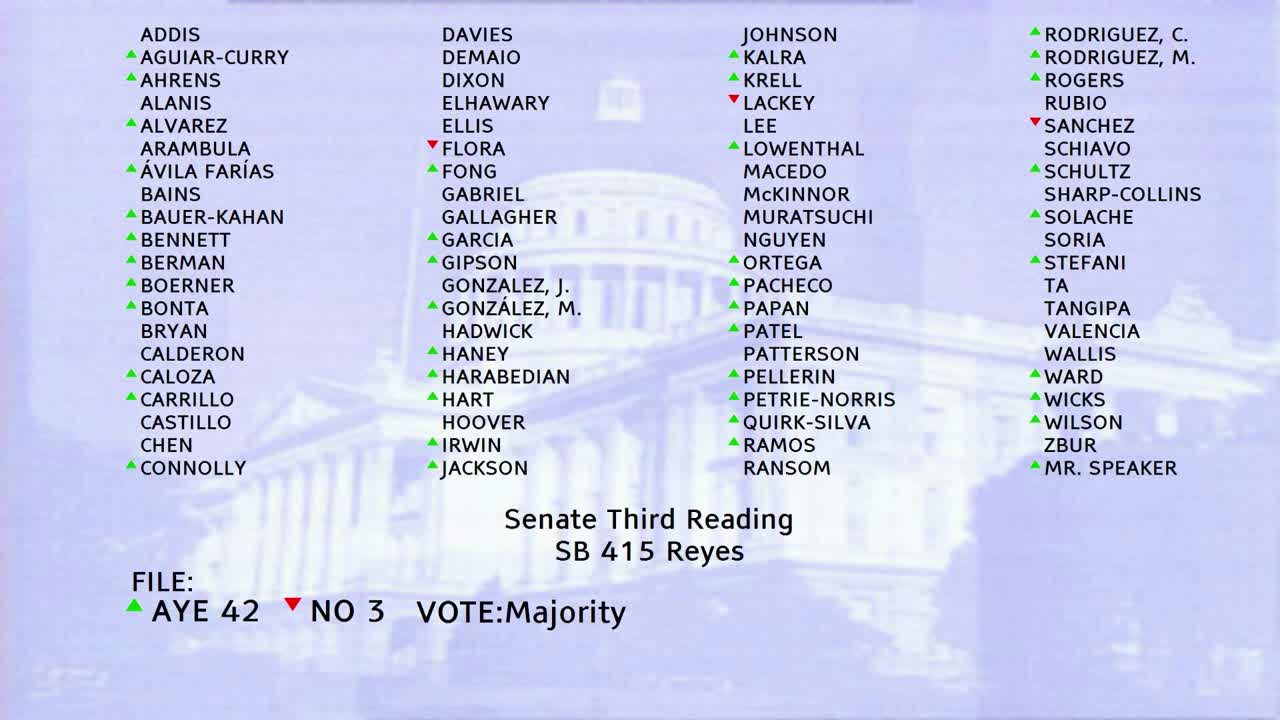 58SEC
Assembly Floor
 2MIN
Senate Floor
 5MIN
Assembly Standing Committee on Business and Professions
 9MIN
Senate Standing Committee on Business, Professions and Economic Development
Bill Author

Bill Co-Author(s):