SB 793: Public safety: lighters: standards: prohibition.
- Session Year: 2025-2026
- House: Senate
- Latest Version Date: 2025-10-01
Current Status:
Passed
(2025-10-01: Chaptered by Secretary of State. Chapter 235, Statutes of 2025.)
Introduced
In Committee
Awaiting First Chamber Vote
Passed First Chamber
In Committee
Awaiting Second Chamber Vote
Passed Second Chamber
Enacted
Existing law requires the State Fire Marshal to specify standards for the design of cigarette lighters using an 80% acceptance criterion with respect to safety features that prevent operation of the lighters by children 5 years of age or younger. Existing law prohibits a person from selling, offering for sale, or distributing a cigarette lighter that does not comply with those standards.
This bill would prohibit a person from selling, offering for sale, or distributing a lighter, as defined, or a lighting rod or gas match, that does not comply with specified ASTM International standards, except as specified. The bill would also prohibit a person from selling, offering for sale, or distributing a lighter that infringes on certain intellectual property rights, except as specified.
Existing law requires the State Fire Marshal to specify standards for the design of cigarette lighters using an 80% acceptance criterion with respect to safety features that prevent operation of the lighters by children 5 years of age or younger. Existing law prohibits a person from selling, offering for sale, or distributing a cigarette lighter that does not comply with those standards.
This bill would prohibit a person from selling, offering for sale, or distributing a lighter, as defined, or a lighting rod or gas match, that does not comply with specified ASTM International standards or standards, except as specified. The bill would also prohibit a person from selling, offering for sale, or distributing a lighter that infringes on certain intellectual property rights, except as specified.
Existing law requires the State Fire Marshal to specify standards for the design of cigarette lighters using an 80% acceptance criterion with respect to safety features that prevent operation of the lighters by children 5 years of age or younger. Existing law prohibits a person from selling, offering for sale, or distributing a cigarette lighter that does not comply with those standards.
This bill would prohibit a person from selling, offering for sale, or distributing a lighter, as defined, that does not comply with specified ASTM International standards or that infringes on certain intellectual property rights, as specified.
(a)(1)Subject to paragraph (2), no person shall sell, offer for sale, or distribute a counterfeit lighter or an unsafe lighter.
(2)Paragraph (1) does not apply to either of the following:
(A)The interstate transportation of counterfeit lighters or unsafe lighters.
(B)The storage of counterfeit lighters or unsafe lighters in a warehouse or distribution center in this state if the warehouse or distribution center is not open to the public for the purposes of retail sale or distribution.
(b)For purposes of this section, the following definitions apply:(1)Counterfeit lighter means a lighter that infringes on an intellectual property right of a citizen of the United States or a person that is protected by federal or state intellectual property law.
(2)Lighter means an electrical or mechanical device that operates using any type of fuel and that is intended for use in igniting a cigar, cigarette, fireplace, grill, pipe, or utility.
(3)Unsafe lighter means any of the following:
(A)A lighter used for igniting cigars, cigarettes, or pipes that does not comply with ASTM International Standard F400.
(B)A lighter used to ignite fireplaces, grills, or utilities that does not comply with ASTM International Standard F2201.
(C)A lighting rod or gas match that does not comply with ASTM International Standard F2201.
(a)(1)Subject to paragraph (2), no person shall sell, offer for sale, or distribute a counterfeit lighter or an unsafe lighter.
(2)Paragraph (1) does not apply to either of the following:
(A)The interstate transportation of counterfeit lighters or unsafe lighters.
(B)The storage of counterfeit lighters or unsafe lighters in a warehouse or distribution center in this state if the warehouse or distribution center is not open to the public for the purposes of retail sale or distribution.
(b)For purposes of this section, the following definitions apply:(1)Counterfeit lighter means a lighter that infringes on an intellectual property right of a citizen of the United States or a person that is protected by federal or state intellectual property law.
(2)Lighter means an electrical or mechanical device that operates using any type of fuel and that is intended for use in igniting a cigar, cigarette, fireplace, grill, pipe, or utility.
(3)Unsafe lighter means either any of the following:
(A)A lighter used for igniting cigars, cigarettes, or pipes that does not comply with ASTM International standard F400 and that is intended for use in igniting a cigar, cigarette, or pipe. Standard F400.
(B)A lighter used to ignite fireplaces, grills, or utilities that does not comply with ASTM International standard F2201 and that is intended for use in igniting a fireplace, grill or utility. Standard F2201.
(C)A lighting rod or gas match that does not comply with ASTM International Standard F2201.
(a)(1)Subject to paragraph (2), no person shall sell, offer for sale, or distribute a counterfeit lighter or an unsafe lighter.
(2)Paragraph (1) does not apply to either of the following:
(A)The interstate transportation of counterfeit lighters or unsafe lighters.
(B)The storage of counterfeit lighters or unsafe lighters in a warehouse or distribution center in this state if the warehouse or distribution center is not open to the public for the purposes of retail sale or distribution.
(b)For purposes of this section, the following definitions apply:
(1)Counterfeit lighter means a lighter that infringes on an intellectual property right of a citizen of the United States or a person that is protected by federal or state intellectual property law.
(2)Lighter means an electrical or mechanical device that operates using any type of fuel and that is intended for use in igniting a cigar, cigarette, fireplace, grill, pipe, or utility.
(3)Unsafe lighter means either of the following:
(A)A lighter that does not comply with ASTM International standard F400-20 F400 and that is intended for use in igniting a cigar, cigarette, or pipe.
(B)A lighter that does not comply with ASTM International standard F2201-20 F2201 and that is intended for use in igniting a fireplace, grill or utility.
(a)(1)Subject to paragraph (2), no person shall sell, offer for sale, or distribute a counterfeit lighter or an unsafe lighter.
(2)Paragraph (1) does not apply to either of the following:
(A)The interstate transportation of counterfeit lighters or unsafe lighters.
(B)The storage of counterfeit lighters or unsafe lighters in a warehouse or distribution center in this state if the warehouse or distribution center is not open to the public for the purposes of retail sale or distribution.
(b)For purposes of this section, the following definitions apply:
(1)Counterfeit lighter means a lighter that infringes on an intellectual property right of a citizen of the United States or a person that is protected by federal or state intellectual property law.
(2)Lighter means an electrical or mechanical device that operates using any type of fuel and that is intended for use in igniting a cigar, cigarette, fireplace, grill, pipe, or utility.
(3)Unsafe lighter means either of the following:
(A)A lighter that does not comply with ASTM International standard F400-20 and that is intended for use in igniting a cigar, cigarette, or pipe.
(B)A lighter that does not comply with ASTM International standard F2201-20 and that is intended for use in igniting a fireplace, grill or utility.
|
Date
|
Status
|
|---|---|
| Oct 1, 2025 | Chaptered by Secretary of State. Chapter 235, Statutes of 2025. |
| Oct 1, 2025 | Approved by the Governor. |
| Sep 22, 2025 | Enrolled and presented to the Governor at 11 a.m. |
| Sep 11, 2025 | Assembly amendments concurred in. (Ayes 40. Noes 0. Page 2876.) Ordered to engrossing and enrolling. |
| Sep 9, 2025 | In Senate. Concurrence in Assembly amendments pending. |
| Sep 9, 2025 | Read third time. Passed. (Ayes 80. Noes 0. Page 3093.) Ordered to the Senate. |
| Sep 3, 2025 | Read second time. Ordered to third reading. |
| Sep 2, 2025 | Read second time and amended. Ordered to second reading. |
| Aug 29, 2025 | From committee: Do pass as amended. (Ayes 11. Noes 0.) (August 29). |
| Aug 20, 2025 | August 20 set for first hearing. Placed on APPR. suspense file. |
| Jul 9, 2025 | From committee: Do pass and re-refer to Com. on APPR. with recommendation: To consent calendar. (Ayes 12. Noes 0.) (July 8). Re-referred to Com. on APPR. |
| Jul 1, 2025 | From committee: Do pass and re-refer to Com. on JUD. with recommendation: To consent calendar. (Ayes 7. Noes 0.) (June 30). Re-referred to Com. on JUD. |
| Jun 9, 2025 | Referred to Coms. on E.M and JUD. |
| May 8, 2025 | In Assembly. Read first time. Held at Desk. |
| May 8, 2025 | Read third time. Passed. (Ayes 36. Noes 0. Page 1050.) Ordered to the Assembly. |
| May 1, 2025 | Read second time. Ordered to consent calendar. |
| Apr 30, 2025 | From committee: Do pass. Ordered to consent calendar. (Ayes 13. Noes 0. Page 943.) (April 29). |
| Apr 8, 2025 | Set for hearing April 29. |
| Apr 8, 2025 | From committee: Do pass and re-refer to Com. on JUD. (Ayes 15. Noes 0. Page 704.) (April 8). Re-referred to Com. on JUD. |
| Mar 27, 2025 | Set for hearing April 8. |
| Mar 24, 2025 | From committee with author's amendments. Read second time and amended. Re-referred to Com. on G.O. |
| Mar 12, 2025 | Referred to Coms. on G.O. and JUD. |
| Feb 24, 2025 | Read first time. |
| Feb 24, 2025 | From printer. May be acted upon on or after March 24. |
| Feb 21, 2025 | Introduced. To Com. on RLS. for assignment. To print. |
|
Date
|
Description
|
Location
|
Votes
|
|
|---|---|---|---|---|
| Sep 11, 2025 | Unfinished Business SB793 Archuleta Concurrence | Senate Floor |
Passed |
|
| Sep 9, 2025 | SB 793 Archuleta Senate Third Reading By Ransom | Assembly Floor |
Passed |
|
| Aug 29, 2025 | Do pass as amended. | Assembly Standing Committee on Appropriations |
Passed |
|
| Jul 8, 2025 | Do pass and be re-referred to the Committee on [Appropriations] with recommendation: To Consent Calendar | Assembly Standing Committee on Judiciary |
Passed |
|
| Jun 30, 2025 | Do pass and be re-referred to the Committee on [Judiciary] with recommendation: To Consent Calendar | Assembly Standing Committee on Emergency Management |
Passed |
|
| May 8, 2025 | Consent Calendar 2nd SB793 Archuleta | Senate Floor |
Passed |
|
| Apr 29, 2025 | Do pass and be ordered to the Consent Calendar | Senate Standing Committee on Judiciary |
Passed |
|
| Apr 8, 2025 | Do pass, but first be re-referred to the Committee on [Judiciary] | Senate Standing Committee on Governmental Organization |
Passed |
This list shows positions taken on this bill by organizations on the date displayed, which is linked to the original source.
Positions by individuals are not included.
|
Organization
|
Position
|
Date
|
|---|---|---|
| BIC | ** Support | |
| Bic Corporation | ** Support | |
| California Police Chiefs Association | ** Support | |
| California State Firefighters Association | ** Support | |
| California State Firefighters’ Association | ** Support | |
| League Of California Cities | ** Support | |
| lighter manufacturers | ** Support | |
| local government and public safety associations | ** Support | |
| U.S. Lighter Association | ** Support | |
| United Steelworker Local 134L | ** Support |
SENATE RULES COMMITTEE Office of Senate Floor Analyses (916) 651-1520 Fax: (916) 327-4478 | SB 793 |
UNFINISHED BUSINESS
Bill No: SB 793
Author: Archuleta (D)
Amended: 9/2/25
Vote: 21
SENATE GOVERNMENTAL ORG. COMMITTEE: 15-0, 4/8/25
AYES: Padilla, Valladares, Archuleta, Ashby, Blakespear, Cervantes, Dahle, Hurtado, Jones, Ochoa Bogh, Richardson, Rubio, Smallwood-Cuevas, Wahab, Weber Pierson
SENATE JUDICIARY COMMITTEE: 13-0, 4/29/25
AYES: Umberg, Niello, Allen, Arreguín, Ashby, Caballero, Durazo, Laird, Stern, Valladares, Wahab, Weber Pierson, Wiener
SENATE FLOOR: 36-0, 5/8/25 (Consent)
AYES: Allen, Alvarado-Gil, Archuleta, Arreguín, Ashby, Becker, Blakespear, Cabaldon, Caballero, Cervantes, Choi, Cortese, Dahle, Durazo, Gonzalez, Grayson, Grove, Jones, Laird, Limón, McGuire, McNerney, Menjivar, Niello, Ochoa Bogh, Padilla, Pérez, Richardson, Seyarto, Smallwood-Cuevas, Stern, Strickland, Umberg, Wahab, Weber Pierson, Wiener
NO VOTE RECORDED: Hurtado, Reyes, Rubio, Valladares
ASSEMBLY FLOOR: 80-0, 9/9/25 - See last page for vote
SUBJECT: Public safety: lighters: standards: prohibition
SOURCE: Author
DIGEST:
This bill prohibits a person from selling, offering for sale, or distributing a lighter – or a lighting rod or gas match – that does not comply with specified American Society for Testing and Materials (ASTM) International standards, except as specified; and, prohibits a person from selling, offering for sale, or distributing a lighter that infringes on certain intellectual property rights, except as specified.
Assembly Amendments
of 9/2/25 define an “unsafe lighter” to mean a lighter used for igniting cigars, cigarettes, or pipes that does not comply with ASTM International Standard 400 or a lighter used to ignite fireplaces, grills, or utilities that does not comply with ASTM International Standard F2201, and add a lighting rod or gas match that does not comply with ASTM International Standard F2201.
ANALYSIS:
Existing law:
- Requires the State Fire Marshal (SFM), by January 1, 1994, to adopt regulations that specify standards for the special design of cigarette lighters, using an 80% acceptance criterion with respect to safety features that prevent operation of the lighters by children five years of age or younger.
- Provides that if federal standards for the special design of cigarette lighters are adopted, the federal standards shall take precedence over a regulation adopted pursuant to above, and the regulation shall have no force or effect.
- Prohibits a person from selling, offering for sale, or distributing a lighter, as defined, that does not comply with specified ASTM International standards or that infringes on certain intellectual property rights, as specified.
This bill:
- Prohibits a person from selling, offering for sale, or distributing a counterfeit lighter or an unsafe lighter, as specified.
- Specifies that the above prohibition does not apply to the interstate transportation of counterfeit lighters or unsafe lighters, or the storage of counterfeit lighters or unsafe lighters in a warehouse or distribution centers in this state if the warehouse or distribution center is not open to the public for the purposes of retail sale or distribution.
- Defines “counterfeit lighter” to mean a lighter that infringes on an intellectual property right of a citizen of the United States or a person that is protected by federal or state intellectual property law.
- Defines “lighter” to mean an electrical or mechanical device that operates using any type of fuel and that is intended for use in igniting a cigar, cigarette, fireplace, grill, pipe, or utility.
- Defines “unsafe lighter” to mean either of the following:
- A lighter used for igniting cigars, cigarettes, or pipes that does not comply with ASTM International Standard 400.
- A lighter used to ignite fireplaces, grills, or utilities that does not comply with ASTM International Standard F2201.
- A lighting rod or gas match that does not comply with ASTM International Standard F2201.
Background
Author’s Statement. According to the author’s office, “the proliferation of unsafe, unregulated lighters has become an increasingly serious public safety hazard. Unnecessary and tragic fires can result from the use of unsafe lighters, which do not have child resistant features, a flame extinguishing time of two seconds or less, or flame height restrictions, all of which are specified in the ASTM International standards for cigarette and utility lighters. China and other countries have imported counterfeit, unsafe pocket and utility lighters into the United States for decades. More than 300 million imported lighters entered the U.S. in just 2017 alone, with 70% of third party lighters tested failing ASTM International standards.”
Further, “these unregulated items have led to thousands of injuries, millions of dollars in damages, and hundreds of deaths including children. Without federal action to protect the public from these dangerous imported products, California must follow states like Wisconsin and Connecticut who have proactively banned the sale or distribution of non-ASTM compliant lighters. By requiring that lighters meet ASTM International standards, California will protect the public, and especially our children, from unsafe and counterfeit lighters that fail to ensure the safety of users.”
Firesetting in Childhood and Adolescence. According to a 2013 report by Frontiers in Public Health titled, “Firesetting in Childhood and Adolescence,” in 2010, the United States fire departments “responded to 44,940 fires started by someone, usually a child, playing with fires. These fires caused 90 civilian deaths, 890 civilian injuries, and $210 million in direct property damage. Preschoolers and kindergartners are most likely to start these fires, while playing with matches or lighters and most likely to die in these fires.”
According to the Nationwide Children’s Hospital internet website, children often “link fire with celebration and fun – such as blowing out candles on a birthday cake, toasting marshmallows over bonfires, or watching fireworks displays. Many children are naturally curious about fire and find it exciting to watch a flame appear from a lighter or a match. However, young children are not able to understand the dangers of fire. Every year, children playing with fire cause hundreds of deaths and injuries.”
ASTM International standard F400. This consumer safety specification covers all flame-producing consumer products commonly known as cigarette lighters, pipe lighters, and cigar lighters and such similar devices. The standard mandates that lighters must require deliberate manual action to ignite – often necessitating multiple independent motions or a minimum force – to reduce the risk of accidental ignition. It specifies limits on flame height based on lighter type and requires that lighters rapidly extinguish their flame – within two to five seconds after the user’s action – and undergo stringent tests for structural integrity. These tests include drop tests, temperature tests at elevated conditions, and continuous burn tests, all designed to ensure that the lighter does not experience fuel leakage, structural damage, or unintended ignition.
The standard also addresses fuel containment by limiting the fuel volume to no more than 85% of the reservoir and ensuring that the fuel weight does not exceed 10 grams, while also requiring that the external design is free of sharp edges that could injure users.
ASTM International standard F2201. This standard applies to utility lighters – devices commonly used to ignite appliances such as grills, fireplaces, and camp stoves, often referred to as grill lighters, lighting rods, or gas matches. The standard sets forth performance and design requirements intended to minimize potential hazards during both normal use and reasonably foreseeable misuses. It mandates that utility lighters require deliberate manual action for ignition, typically involving multiple independent motions or a minimum actuating force, as specified, to prevent accidental ignition. The specification details limits on the maximum flame height.
The standard also requires that any fuel shipped with the lighter does not exceed 85% of the fuel chamber’s capacity and that appropriate safety information, including clear labeling and warnings (such as “KEEP AWAY FROM CHILDREN” and “DANGER: Extremely Flammable. Contents Under Pressure”), is provided to ensure proper and safe use.
Prior/Related Legislation
AB 625 (Lieu, 2009) would have prohibited the sale, distribution, or promotion of novelty lighters, as defined. (Vetoed by Governor Schwarzenegger)
AB 757 (Roybal-Allard, Chapter 914, Statutes of 1991) required the SFM to adopt regulations, as specified, that set forth the standards for the design of cigarette lighters that result in those lighters being significantly difficult for children under five years of age to operate, as defined. This bill suspended the effectiveness of those regulations if and when federal standards for that purpose are in effect.
FISCAL EFFECT: Appropriation: No Fiscal Com.: No Local: No
According to the Assembly Appropriations Committee, possible costs to the Department of Justice (DOJ) of an unknown amount (Unfair Competition Law Fund). Although this bill does not contain express language about enforcement, a violation of the prohibition is an unlawful business practice enforceable by DOJ under the Unfair Competition Law (UCL). DOJ reports no fiscal impact from this bill, indicating DOJ does not anticipate pursuing enforcement actions as a result of this bill. However, if conditions change and DOJ does undertake enforcement actions, DOJ will incur related staff workload costs, potentially in cumulative excess of $150,000.
Cost pressures (General Fund (GF) or Trial Court Trust Fund (TCTF)) of an unknown amount, potentially in cumulative excess of $150,000, to the courts in additional workload by creating a new prohibition enforceable under the UCL. A claim under the UCL may be brought by either a public prosecutor or a person who lost money or property as the result of the unlawful conduct. It is unclear how many actions may be filed statewide, but the estimated workload cost of one hour of court time is $1,000. Although courts are not funded on the basis of workload, increased pressure on staff and the TCTF may create a demand for increased court funding from the GF to perform existing duties. The Budget Act of 2025 provides $82 million ongoing GF to the TCTF for court operations.
SUPPORT: (Verified 9/8/25)
BIC
California Police Chiefs Association
California State Firefighters’ Association
League of California Cities
U.S. Lighter Association
United Steelworker Local 134L
OPPOSITION: (Verified 9/8/25)
None received
In support of this bill, BIC writes that, “SB 793 prohibits the sale of counterfeit or unsafe lighters in California. Your bill also protects retailers and providers an opportunity to educate sellers of lighters on the importance of safety standards, and how US intellectual property law protects them from unknowingly selling counterfeit lighters.”
Further, “[s]imilar legislation has passed in Connecticut (2022), Wisconsin (2023), Tennessee (2024), and Virginia (2024). We believe if California, as the most populous state in the country, were to adopt SB 793, it would send a strong signal to other states and nationally that the safety of families and property are a priority.”
ASSEMBLY FLOOR: 9/9/25 80-0
AYES: Addis, Aguiar-Curry, Ahrens, Alanis, Alvarez, Arambula, Ávila Farías, Bains, Bauer-Kahan, Bennett, Berman, Boerner, Bonta, Bryan, Calderon, Caloza, Carrillo, Castillo, Chen, Connolly, Davies, DeMaio, Dixon, Elhawary, Ellis, Flora, Fong, Gabriel, Gallagher, Garcia, Gipson, Jeff Gonzalez, Mark González, Hadwick, Haney, Harabedian, Hart, Hoover, Irwin, Jackson, Johnson, Kalra, Krell, Lackey, Lee, Lowenthal, Macedo, McKinnor, Muratsuchi, Nguyen, Ortega, Pacheco, Papan, Patel, Patterson, Pellerin, Petrie-Norris, Quirk-Silva, Ramos, Ransom, Celeste Rodriguez, Michelle Rodriguez, Rogers, Blanca Rubio, Sanchez, Schiavo, Schultz, Sharp-Collins, Solache, Soria, Stefani, Ta, Tangipa, Valencia, Wallis, Ward, Wicks, Wilson, Zbur, Rivas
Prepared by: Brian Duke / G.O. / (916) 651-1530
7/22/26 11:41:22
**** END ****
SENATE RULES COMMITTEE Office of Senate Floor Analyses (916) 651-1520 Fax: (916) 327-4478 | SB 793 |
UNFINISHED BUSINESS
Bill No: SB 793
Author: Archuleta (D)
Amended: 9/2/25 in Assembly
Vote: 21
SENATE GOVERNMENTAL ORG. COMMITTEE: 15-0, 4/8/25
AYES: Padilla, Valladares, Archuleta, Ashby, Blakespear, Cervantes, Dahle, Hurtado, Jones, Ochoa Bogh, Richardson, Rubio, Smallwood-Cuevas, Wahab, Weber Pierson
SENATE JUDICIARY COMMITTEE: 13-0, 4/29/25
AYES: Umberg, Niello, Allen, Arreguín, Ashby, Caballero, Durazo, Laird, Stern, Valladares, Wahab, Weber Pierson, Wiener
SENATE FLOOR: 36-0, 5/8/25 (Consent)
AYES: Allen, Alvarado-Gil, Archuleta, Arreguín, Ashby, Becker, Blakespear, Cabaldon, Caballero, Cervantes, Choi, Cortese, Dahle, Durazo, Gonzalez, Grayson, Grove, Jones, Laird, Limón, McGuire, McNerney, Menjivar, Niello, Ochoa Bogh, Padilla, Pérez, Richardson, Seyarto, Smallwood-Cuevas, Stern, Strickland, Umberg, Wahab, Weber Pierson, Wiener
NO VOTE RECORDED: Hurtado, Reyes, Rubio, Valladares
ASSEMBLY FLOOR: 62-0, 9/9/25 – Roll call not available.
SUBJECT: Public safety: lighters: standards: prohibition
SOURCE: Author
DIGEST:
This bill prohibits a person from selling, offering for sale, or distributing a lighter – or a lighting rod or gas match – that does not comply with specified American Society for Testing and Materials (ASTM) International standards, except as specified; and, prohibits a person from selling, offering for sale, or distributing a lighter that infringes on certain intellectual property rights, except as specified.
Assembly Amendments
of 9/2/25 define an “unsafe lighter” to mean a lighter used for igniting cigars, cigarettes, or pipes that does not comply with ASTM International Standard 400 or a lighter used to ignite fireplaces, grills, or utilities that does not comply with ASTM International Standard F2201, and add a lighting rod or gas match that does not comply with ASTM International Standard F2201.
ANALYSIS:
Existing law:
- Requires the State Fire Marshal (SFM), by January 1, 1994, to adopt regulations that specify standards for the special design of cigarette lighters, using an 80% acceptance criterion with respect to safety features that prevent operation of the lighters by children five years of age or younger.
- Provides that if federal standards for the special design of cigarette lighters are adopted, the federal standards shall take precedence over a regulation adopted pursuant to above, and the regulation shall have no force or effect.
- Prohibits a person from selling, offering for sale, or distributing a lighter, as defined, that does not comply with specified ASTM International standards or that infringes on certain intellectual property rights, as specified.
This bill:
- Prohibits a person from selling, offering for sale, or distributing a counterfeit lighter or an unsafe lighter, as specified.
- Specifies that the above prohibition does not apply to the interstate transportation of counterfeit lighters or unsafe lighters, or the storage of counterfeit lighters or unsafe lighters in a warehouse or distribution centers in this state if the warehouse or distribution center is not open to the public for the purposes of retail sale or distribution.
- Defines “counterfeit lighter” to mean a lighter that infringes on an intellectual property right of a citizen of the United States or a person that is protected by federal or state intellectual property law.
- Defines “lighter” to mean an electrical or mechanical device that operates using any type of fuel and that is intended for use in igniting a cigar, cigarette, fireplace, grill, pipe, or utility.
- Defines “unsafe lighter” to mean either of the following:
- A lighter used for igniting cigars, cigarettes, or pipes that does not comply with ASTM International Standard 400.
- A lighter used to ignite fireplaces, grills, or utilities that does not comply with ASTM International Standard F2201.
- A lighting rod or gas match that does not comply with ASTM International Standard F2201.
Background
Author’s Statement. According to the author’s office, “the proliferation of unsafe, unregulated lighters has become an increasingly serious public safety hazard. Unnecessary and tragic fires can result from the use of unsafe lighters, which do not have child resistant features, a flame extinguishing time of two seconds or less, or flame height restrictions, all of which are specified in the ASTM International standards for cigarette and utility lighters. China and other countries have imported counterfeit, unsafe pocket and utility lighters into the United States for decades. More than 300 million imported lighters entered the U.S. in just 2017 alone, with 70% of third party lighters tested failing ASTM International standards.”
Further, “these unregulated items have led to thousands of injuries, millions of dollars in damages, and hundreds of deaths including children. Without federal action to protect the public from these dangerous imported products, California must follow states like Wisconsin and Connecticut who have proactively banned the sale or distribution of non-ASTM compliant lighters. By requiring that lighters meet ASTM International standards, California will protect the public, and especially our children, from unsafe and counterfeit lighters that fail to ensure the safety of users.”
Firesetting in Childhood and Adolescence. According to a 2013 report by Frontiers in Public Health titled, “Firesetting in Childhood and Adolescence,” in 2010, the United States fire departments “responded to 44,940 fires started by someone, usually a child, playing with fires. These fires caused 90 civilian deaths, 890 civilian injuries, and $210 million in direct property damage. Preschoolers and kindergartners are most likely to start these fires, while playing with matches or lighters and most likely to die in these fires.”
According to the Nationwide Children’s Hospital internet website, children often “link fire with celebration and fun – such as blowing out candles on a birthday cake, toasting marshmallows over bonfires, or watching fireworks displays. Many children are naturally curious about fire and find it exciting to watch a flame appear from a lighter or a match. However, young children are not able to understand the dangers of fire. Every year, children playing with fire cause hundreds of deaths and injuries.”
ASTM International standard F400. This consumer safety specification covers all flame-producing consumer products commonly known as cigarette lighters, pipe lighters, and cigar lighters and such similar devices. The standard mandates that lighters must require deliberate manual action to ignite – often necessitating multiple independent motions or a minimum force – to reduce the risk of accidental ignition. It specifies limits on flame height based on lighter type and requires that lighters rapidly extinguish their flame – within two to five seconds after the user’s action – and undergo stringent tests for structural integrity. These tests include drop tests, temperature tests at elevated conditions, and continuous burn tests, all designed to ensure that the lighter does not experience fuel leakage, structural damage, or unintended ignition.
The standard also addresses fuel containment by limiting the fuel volume to no more than 85% of the reservoir and ensuring that the fuel weight does not exceed 10 grams, while also requiring that the external design is free of sharp edges that could injure users.
ASTM International standard F2201. This standard applies to utility lighters – devices commonly used to ignite appliances such as grills, fireplaces, and camp stoves, often referred to as grill lighters, lighting rods, or gas matches. The standard sets forth performance and design requirements intended to minimize potential hazards during both normal use and reasonably foreseeable misuses. It mandates that utility lighters require deliberate manual action for ignition, typically involving multiple independent motions or a minimum actuating force, as specified, to prevent accidental ignition. The specification details limits on the maximum flame height.
The standard also requires that any fuel shipped with the lighter does not exceed 85% of the fuel chamber’s capacity and that appropriate safety information, including clear labeling and warnings (such as “KEEP AWAY FROM CHILDREN” and “DANGER: Extremely Flammable. Contents Under Pressure”), is provided to ensure proper and safe use.
Prior/Related Legislation
AB 625 (Lieu, 2009) would have prohibited the sale, distribution, or promotion of novelty lighters, as defined. (Vetoed by Governor Schwarzenegger)
AB 757 (Roybal-Allard, Chapter 914, Statutes of 1991) required the SFM to adopt regulations, as specified, that set forth the standards for the design of cigarette lighters that result in those lighters being significantly difficult for children under five years of age to operate, as defined. This bill suspended the effectiveness of those regulations if and when federal standards for that purpose are in effect.
FISCAL EFFECT: Appropriation: No Fiscal Com.: No Local: No
According to the Assembly Appropriations Committee, possible costs to the Department of Justice (DOJ) of an unknown amount (Unfair Competition Law Fund). Although this bill does not contain express language about enforcement, a violation of the prohibition is an unlawful business practice enforceable by DOJ under the Unfair Competition Law (UCL). DOJ reports no fiscal impact from this bill, indicating DOJ does not anticipate pursuing enforcement actions as a result of this bill. However, if conditions change and DOJ does undertake enforcement actions, DOJ will incur related staff workload costs, potentially in cumulative excess of $150,000.
Cost pressures (General Fund (GF) or Trial Court Trust Fund (TCTF)) of an unknown amount, potentially in cumulative excess of $150,000, to the courts in additional workload by creating a new prohibition enforceable under the UCL. A claim under the UCL may be brought by either a public prosecutor or a person who lost money or property as the result of the unlawful conduct. It is unclear how many actions may be filed statewide, but the estimated workload cost of one hour of court time is $1,000. Although courts are not funded on the basis of workload, increased pressure on staff and the TCTF may create a demand for increased court funding from the GF to perform existing duties. The Budget Act of 2025 provides $82 million ongoing GF to the TCTF for court operations.
SUPPORT: (Verified 9/8/2025)
BIC
California Police Chiefs Association
California State Firefighters’ Association
League of California Cities
U.S. Lighter Association
United Steelworker Local 134L
OPPOSITION: (Verified 9/8/2025)
None received
ARGUMENTS IN SUPPORT: In support of this bill, BIC writes that, “SB 793 prohibits the sale of counterfeit or unsafe lighters in California. Your bill also protects retailers and providers an opportunity to educate sellers of lighters on the importance of safety standards, and how US intellectual property law protects them from unknowingly selling counterfeit lighters.”
Further, “[s]imilar legislation has passed in Connecticut (2022), Wisconsin (2023), Tennessee (2024), and Virginia (2024). We believe if California, as the most populous state in the country, were to adopt SB 793, it would send a strong signal to other states and nationally that the safety of families and property are a priority.”
Prepared by: Brian Duke / G.O. / (916) 651-1530
9/9/25 14:34:41
**** END ****
SENATE THIRD READING
STR Bill Id:SB 793
Author:(Archuleta)
As Amended Ver:September 02, 2025
Majority vote
SUMMARY
This bill prohibits the sale and distribution of lighters that do not meet American Society for Testing and Materials (ASTM) International standards, as specified, and infringe upon intellectual property rights, as specified.
Major Provisions
- Prohibits a person from selling, offering for sale, or distributing a counterfeit or unsafe lighter.
- Exempts, from the above prohibition, the interstate transportation of counterfeit lighters or unsafe lighters and the storage of counterfeit lighters or unsafe lighters in warehouses or distribution centers not open to the public for the purpose of retail sale or distribution.
- Defines counterfeit lighter as a lighter that infringes on an intellectual property right of a citizen of the United States or a person that is protected by federal or state intellectual property law.
- Defines lighter as an electrical or mechanical device that operates using any type of fuel and that is intended for use in igniting a cigar, cigarette, fireplace, grill, pipe, or utility.
- Defines an unsafe lighter as either a lighter used for igniting a cigar, cigarette, or pipe that does not comply with ASTM International standard F400, a lighter used for igniting a fireplace, grill or utility that does not comply with ASTM International standard F2201, or a lightning rod or gas match that does not comply with ASTM International standard F2201.
COMMENTS
Federal Regulations on Lighters: The U.S. Consumer Product Safety Commission regulations related to lighters, found in Title 16 of the Code of Federal Regulations subsection 1210.4 for lighters and 1212.4 for multi-purpose lighters, declare the following:
Both lighters and multi-purpose lighters must utilize a child-resistant mechanism or system that:
- prevents at least 85% of the children in a controlled test group from "activating" the lighter
- automatically resets for each subsequent use
- does not impair the safe operation of the lighter when the lighter is used in a normal and convenient manner
- operates for the reasonably expected life of the lighter
- cannot be easily overridden or undone
In addition to the requirements noted above, multi-purpose lighters that allow for a hands-free operation must:
- require operation of an additional feature (e.g., lock or switch)
- use a manual mechanism for turning off the flame
- automatically reset when, or before, the user lets go of the lighter when the hands-free function is not used OR when turning off the flame after the hands-free feature is used
Lighters are also subject to labeling requirements, including the date of manufacture and identification of the manufacturer or importer. If a lighter is sold with fuel that meets the definition of a hazardous substance, the lighter must also include cautionary labeling requirements, as specified by the Federal Hazardous Substances Act.
ASTM International standard F400: This consumer safety specification covers all flame-producing consumer products commonly known as cigarette lighters, pipe lighters, and cigar lighters and such similar devices. The standard mandates that lighters must require deliberate manual action to ignite – often necessitating multiple independent motions or a minimum force – to reduce the risk of accidental ignition. It specifies limits on flame height based on lighter type and requires that lighters rapidly extinguish their flame – within two to five seconds after the user's action – and undergo stringent tests for structural integrity. These tests include drop tests, temperature tests at elevated conditions, and continuous burn tests, all designed to ensure that the lighter does not experience fuel leakage, structural damage, or unintended ignition.
The standard also addresses fuel containment by limiting the fuel volume to no more than 85% of the reservoir and ensuring that the fuel weight does not exceed 10 grams, while also requiring that the external design is free of sharp edges that could injure users.
ASTM International standard F2201: This standard applies to utility lighters – devices commonly used to ignite appliances such as grills, fireplaces, and camp stoves, often referred to as grill lighters, lighting rods, or gas matches. The standard sets forth performance and design requirements intended to minimize potential hazards during both normal use and reasonably foreseeable misuses. It mandates that utility lighters require deliberate manual action for ignition, typically involving multiple independent motions or a minimum actuating force, as specified, to prevent accidental ignition. The specification details limits on the maximum flame height.
The standard also requires that any fuel shipped with the lighter does not exceed 85% of the fuel chamber's capacity and that appropriate safety information, including clear labeling and warnings (such as "KEEP AWAY FROM CHILDREN" and "DANGER: Extremely Flammable. Contents Under Pressure"), is provided to ensure proper and safe use.
Lighter Association: The Lighter Association is a non-profit trade association formed by the U.S. lighter industry in 1986. The Association represents the industry's interests before federal and state regulatory bodies and the U.S. Congress. This association is registered in support of this bill.
To be a member of the Lighter Association, all manufacturing and distributing members must comply with ASTM F400 and ASTM F2201 standards, per Article 4 of the Associations bylaws. Members of the lighter Association include Bic Corporation and Zippo Manufacturing Co.
According to the Author
"The proliferation of unsafe, unregulated lighters has become an increasingly serious public safety hazard. Unnecessary and tragic fires can result from the use of unsafe lighters which do not have child resistant features, a flame extinguishing time of 2 seconds or less, or flame height restrictions; all of which are specified in the ASTM International standards for cigarette and utility lighters. China and other countries have imported counterfeit, unsafe pocket and utility lighters into the United States for decades. More than 300 million imported lighters entered the U.S. in just 2017 alone, with 70% of third party lighters tested failing ASTM International standards. These unregulated items have led to thousands of injuries, millions of dollars in damages, and hundreds of deaths including children. Without federal action to protect the public from these dangerous imported products, California must follow states like Wisconsin and Connecticut who have proactively banned the sale or distribution of non-ASTM compliant lighters. By requiring that lighters meet ASTM International standards, California will protect the public, and especially our children, from unsafe and counterfeit lighters that fail to ensure the safety of users."
Arguments in Support
The Lighter Association writes in support, "The Lighter Association strongly supports SB 793 prohibiting the sale of unsafe and counterfeit lighters. The bill addresses two very important, but distinct issues. The first is the proliferation of counterfeit products in this country. While a fake Gucci bag may trouble the buyer, a fake BIC or Zippo lighter may injure or kill the buyer. Lighter Association members manufacture lighters to very exacting standards and test the product repeatedly to ensure that it is safe for consumers to use. Counterfeit lighters simply mimic the style of real lighters and are poorly made and unsafe."
They continue, "In addition to counterfeit, there is a whole category of disposable and refillable lighters that are Imported into the US from lighter manufacturers in China, Vietnam and other countries that are not manufactured in accordance with ASTM F400 (for pocket lighters) and F2201 (for grill or utility lighters). These lighters leak fuel, have excessive flame height and "spit and sputter.""
Arguments in Opposition
None on file.
FISCAL COMMENTS
According to the Assembly Committee on Appropriations:
- Possible costs to the Department of Justice (DOJ) of an unknown amount (Unfair Competition Law Fund). Although this bill does not contain express language about enforcement, a violation of the prohibition is an unlawful business practice enforceable by DOJ under the Unfair Competition Law (UCL). DOJ reports no fiscal impact from this bill, indicating DOJ does not anticipate pursuing enforcement actions as a result of this bill. However, if conditions change and DOJ does undertake enforcement actions, DOJ will incur related staff workload costs, potentially in cumulative excess of $150,000.
- Cost pressures (General Fund (GF) or Trial Court Trust Fund (TCTF)) of an unknown amount, potentially in cumulative excess of $150,000, to the courts in additional workload by creating a new prohibition enforceable under the UCL. A claim under the UCL may be brought by either a public prosecutor or a person who lost money or property as the result of the unlawful conduct. It is unclear how many actions may be filed statewide, but the estimated workload cost of one hour of court time is $1,000. Although courts are not funded on the basis of workload, increased pressure on staff and the TCTF may create a demand for increased court funding from the GF to perform existing duties. The Budget Act of 2025 provides $82 million ongoing GF to the TCTF for court operations.
VOTES
SENATE FLOOR: 36-0-4
YES: Allen, Alvarado-Gil, Archuleta, Arreguín, Ashby, Becker, Blakespear, Cabaldon, Caballero, Cervantes, Choi, Cortese, Dahle, Durazo, Gonzalez, Grayson, Grove, Jones, Laird, Limón, McGuire, McNerney, Menjivar, Niello, Ochoa Bogh, Padilla, Pérez, Richardson, Seyarto, Smallwood-Cuevas, Stern, Strickland, Umberg, Wahab, Weber Pierson, Wiener
ABS, ABST OR NV: Hurtado, Reyes, Rubio, Valladares
ASM EMERGENCY MANAGEMENT: 7-0-0
YES: Ransom, Hadwick, Arambula, Bains, Bennett, Calderon, DeMaio
ASM JUDICIARY: 12-0-0
YES: Kalra, Dixon, Hart, Bryan, Connolly, Harabedian, Macedo, Pacheco, Papan, Sanchez, Stefani, Zbur
ASM APPROPRIATIONS: 11-0-4
YES: Wicks, Arambula, Calderon, Caloza, Elhawary, Fong, Mark González, Ahrens, Pacheco, Pellerin, Solache
ABS, ABST OR NV: Sanchez, Dixon, Ta, Tangipa
UPDATED
VERSION: September 02, 2025
CONSULTANT: Ryan Fleming / E.M. / (916) 319-3802 FN: 0001476
Date of Hearing: August 20, 2025
ASSEMBLY COMMITTEE ON APPROPRIATIONS
Buffy Wicks, Chair
SBPCA Bill Id:SB 793
Author:(Archuleta) – As Amended Ver:March 24, 2025
Policy Committee: | Emergency Management | Vote: | 7 - 0 |
Judiciary | 12 - 0 | ||
|
|
Urgency: No State Mandated Local Program: No Reimbursable: No
SUMMARY:
This bill prohibits a person from selling or distributing a lighter that does not comply with certain American Society for Testing and Materials (ASTM) International standards or that infringes on certain intellectual property rights.
FISCAL EFFECT:
- Possible costs to the Department of Justice (DOJ) of an unknown amount (Unfair Competition Law Fund). Although this bill does not contain express language about enforcement, a violation of the prohibition is an unlawful business practice enforceable by DOJ under the Unfair Competition Law (UCL). DOJ reports no fiscal impact from this bill, indicating DOJ does not anticipate pursuing enforcement actions as a result of this bill. However, if conditions change and DOJ does undertake enforcement actions, DOJ will incur related staff workload costs, potentially in cumulative excess of $150,000.
- Cost pressures (General Fund (GF) or Trial Court Trust Fund (TCTF)) of an unknown amount, potentially in cumulative excess of $150,000, to the courts in additional workload by creating a new prohibition enforceable under the UCL. A claim under the UCL may be brought by either a public prosecutor or a person who lost money or property as the result of the unlawful conduct. It is unclear how many actions may be filed statewide, but the estimated workload cost of one hour of court time is $1,000. Although courts are not funded on the basis of workload, increased pressure on staff and the TCTF may create a demand for increased court funding from the GF to perform existing duties. The Budget Act of 2025 provides $82 million ongoing GF to the TCTF for court operations.
COMMENTS:
- Purpose. According to the author:
More than 300 million imported lighters entered the U.S. in just 2017 alone, with 70% of third party lighters tested failing ASTM International standards. These unregulated items have led to thousands of injuries, millions of dollars in damages, and hundreds of deaths including children. Without federal action to protect the public from these dangerous imported products, California must follow states like Wisconsin and Connecticut who have proactively banned the sale or distribution of non-ASTM compliant lighters.
This bill is supported by lighter manufacturers and local government and public safety associations.
- Counterfeit or Unsafe Lighters. Existing law directs the State Fire Marshal to adopt regulations to ensure lighter manufacturers include safety features in their lighters to deter accidental ignitions. However, counterfeit and unsafe lighters that do not include such features, largely imported from abroad and sold through online retailers, are beginning to proliferate in the state. This bill prohibits the sale or distribution of “counterfeit” or “unsafe” lighters. This bill defines a counterfeit lighter as one that infringes on an intellectual property right of a U.S. citizen or a person protected by federal or state intellectual property law, and an unsafe lighter as one that does not comply with specified ASTM International standards.
Analysis Prepared by: Irene Ho / APPR. / (916) 319-2081
Date of Hearing: June 30, 2025
ASSEMBLY COMMITTEE ON EMERGENCY MANAGEMENT
Rhodesia Ransom, Chair
SBPCA Bill Id:SB 793
Author:(Archuleta) – As Amended Ver:March 24, 2025
SENATE VOTE: 36-0
SUBJECT: Public safety: lighters: standards: prohibition
SUMMARY: This bill prohibits the sale and distribution of lighters that infringe upon intellectual property rights, as specified, and do not meet American Society for Testing and Materials (ASTM) International standards, as specified. Specifically, this bill:
- Prohibits a person from selling, offering for sale, or distributing a counterfeit or unsafe lighter.
- Exempts, from the above prohibition, the interstate transportation of counterfeit lighters or unsafe lighters and the storage of counterfeit lighters or unsafe lighters in warehouses or distribution centers not open to the public for the purpose of retail sale or distribution.
- Defines counterfeit lighter as a lighter that infringes on an intellectual property right of a citizen of the United States or a person that is protected by federal or state intellectual property law.
- Defines lighter as an electrical or mechanical device that operates using any type of fuel and that is intended for use in igniting a cigar, cigarette, fireplace, grill, pipe, or utility.
- Defines an unsafe lighter as a lighter that does not comply with ASTM International standard F400 and that is intended for use in igniting a cigar, cigarette, or pipe or a lighter that does not comply with ASTM International standard F2201 and that is intended for use in igniting a fireplace, grill or utility.
EXISTING LAW:
- Requires the State Fire Marshal (SFM) to adopt regulations that specify standards for the special design of cigarette lighters, using an 80 percent acceptance criterion with respect to safety features that prevent operation of the lighters by children five years of age or younger. (Health & Safety Code § 14942)
- Provides that if federal standards for the special design of cigarette lighters are adopted, the federal standards shall take precedence over a regulation adopted pursuant to above, and the regulation shall have no force or effect. (Health & Safety Code § 14942)
- Prohibits a person from selling, offering for sale, or distributing a lighter, as defined, that does not comply with the SFM’s regulations. (Health & Safety Code § 14943)
- Specifies any violation of the SFM’s lighter regulations is guilty of an infraction and is to be punished by a fine of $100 for each cigarette lighter sold in violation of these provisions. (Health & Safety Code § 14943)
FISCAL EFFECT: This bill is not keyed fiscal.
COMMENTS:
Purpose of the bill: According to the author, “The proliferation of unsafe, unregulated lighters has become an increasingly serious public safety hazard. Unnecessary and tragic fires can result from the use of unsafe lighters which do not have child resistant features, a flame extinguishing time of 2 seconds or less, or flame height restrictions; all of which are specified in the ASTM International standards for cigarette and utility lighters. China and other countries have imported counterfeit, unsafe pocket and utility lighters into the United States for decades. More than 300 million imported lighters entered the U.S. in just 2017 alone, with 70% of third party lighters tested failing ASTM International standards. These unregulated items have led to thousands of injuries, millions of dollars in damages, and hundreds of deaths including children. Without federal action to protect the public from these dangerous imported products, California must follow states like Wisconsin and Connecticut who have proactively banned the sale or distribution of non-ASTM compliant lighters. By requiring that lighters meet ASTM International standards, California will protect the public, and especially our children, from unsafe and counterfeit lighters that fail to ensure the safety of users.”
Equity impact: According to the author’s staff, there are no known equity impacts resulting from enactment of this bill.
U.S. Consumer Product Safety Commission Regulations on Lighters: The U.S. Consumer Product Safety Commission (CPSC) is an independent federal regulatory agency whose mission is to ensure that consumer products are safe. The CPSC defines a cigarette lighter as a “flame-producing product that consumers commonly use to light cigarettes, cigars, and pipes, although it may be used to light other materials. The term ‘lighter’ does not include matches or any other lighting device intended primarily to light materials other than smoking materials. ” Additionally, a multipurpose lighter is defined as “any lighter used by consumers to ignite items such as candles, fuel for fireplaces, charcoal or gas-fired grills, campfires, camp stoves, lanterns, fuel-fired appliances or devices, or pilot lights, or for uses such as soldering or brazing.”
Under the 1994 Child Safety Protection Act, the CPSC has the authority to mandate safety standards and recall products that are considered dangerous. Their regulations can be found in Title 16 of the Code of Federal Regulations subsection 1210.4 for lighters and 1212.4 for multi-purpose lighters. These regulations declare the following:
Both lighters and multi-purpose lighters must utilize a child-resistant mechanism or system that:
- prevents at least 85% of the children in a controlled test group from “activating” the lighter
- automatically resets for each subsequent use
- does not impair the safe operation of the lighter when the lighter is used in a normal and convenient manner
- operates for the reasonably expected life of the lighter
- cannot be easily overridden or undone
In addition to the requirements noted above, multi-purpose lighters that allow for a hands-free operation must:
- require operation of an additional feature (e.g., lock or switch)
- use a manual mechanism for turning off the flame
- automatically reset when, or before, the user lets go of the lighter when the hands-free function is not used OR when turning off the flame after the hands-free feature is used
Lighters are also subject to labeling requirements, including the date of manufacture and identification of the manufacturer or importer. If a lighter sold with fuel that meets the definition of a hazardous substance, the lighter must also include cautionary labeling requirements, as specified by the Federal Hazardous Substances Act.
American Society for Testing and Materials (ASTM) International: ASTM International is a nonprofit entity that develops and publishes technical standards for testing and classifying materials of all kinds. ASTM has developed over 12,000 standards— many of which are used in over 140 countries, including the United States where ASTM serves as the administrator for the United States Technical Advisory Group. They also serve as the administrator for the International Organization for Standardization Technical Committee and their subcommittees.
ASTM International standard F400: This consumer safety specification covers all flame-producing consumer products commonly known as cigarette lighters, pipe lighters, and cigar lighters and such similar devices. The standard mandates that lighters must require deliberate manual action to ignite – often necessitating multiple independent motions or a minimum force – to reduce the risk of accidental ignition. It specifies limits on flame height based on lighter type and requires that lighters rapidly extinguish their flame – within two to five seconds after the user’s action – and undergo stringent tests for structural integrity. These tests include drop tests, temperature tests at elevated conditions, and continuous burn tests, all designed to ensure that the lighter does not experience fuel leakage, structural damage, or unintended ignition.
The standard also addresses fuel containment by limiting the fuel volume to no more than 85% of the reservoir and ensuring that the fuel weight does not exceed 10 grams, while also requiring that the external design is free of sharp edges that could injure users.
ASTM International standard F2201: This standard applies to utility lighters – devices commonly used to ignite appliances such as grills, fireplaces, and camp stoves, often referred to as grill lighters, lighting rods, or gas matches. The standard sets forth performance and design requirements intended to minimize potential hazards during both normal use and reasonably foreseeable misuses. It mandates that utility lighters require deliberate manual action for ignition, typically involving multiple independent motions or a minimum actuating force, as specified, to prevent accidental ignition. The specification details limits on the maximum flame height.
The standard also requires that any fuel shipped with the lighter does not exceed 85% of the fuel chamber’s capacity and that appropriate safety information, including clear labeling and warnings (such as “KEEP AWAY FROM CHILDREN” and “DANGER: Extremely Flammable. Contents Under Pressure”), is provided to ensure proper and safe use.
Lighter Association: The Lighter Association is a non-profit trade association formed by the U.S. lighter industry in 1986. The Association represents the industry's interests before federal and state regulatory bodies and the U.S. Congress. This association is registered in support of this bill.
To be a member of the Lighter Association, all manufacturing and distributing members must comply with ASTM F400 and ASTM F2201 standards, per Article 4 of the Associations bylaws. Members of the lighter Association include: Beacon Power, Inc.; Bic Corporation; Great Lakes Marketing; Swedish Match North America; Ten-E Packaging Services; Tokai International Holdings, Inc.; and Zippo Manufacturing Co.
Double Referral: This bill was referred to this committee and the Committee on the Judiciary.
Arguments in Support: The Lighter Association writes in support, “The Lighter Association strongly supports SB 793 prohibiting the sale of unsafe and counterfeit lighters. The bill addresses two very important, but distinct issues. The first is the proliferation of counterfeit products in this country. While a fake Gucci bag may trouble the buyer, a fake BIC or Zippo lighter may injure or kill the buyer. Lighter Association members manufacture lighters to very exacting standards and test the product repeatedly to ensure that it is safe for consumers to use. Counterfeit lighters simply mimic the style of real lighters and are poorly made and unsafe.”
They continue, “In addition to counterfeit, there is a whole category of disposable and refillable lighters that are Imported into the US from lighter manufacturers in China, Vietnam and other countries that are not manufactured in accordance with ASTM F400 (for pocket lighters) and F2201 (for grill or utility lighters). These lighters leak fuel, have excessive flame height and "spit and sputter."”
Related and Prior Legislation:
AB 625 (Lieu) of 2009 would have prohibited the sale, distribution, or promotion of novelty lighters, as defined. (Vetoed by Governor Schwarzenegger)
AB 757 (Roybal-Allard, Chapter 914, Statutes of 1991) required the SFM to adopt regulations, as specified, that set forth the standards for the design of cigarette lighters that result in those lighters being significantly difficult for children under five years of age to operate, as defined. The bill suspended the effectiveness of those regulations if and when federal standards for that purpose are in effect.
REGISTERED SUPPORT / OPPOSITION:
Support
Bic Corporation
California Police Chiefs Association
California State Firefighters' Association
League of California Cities
Lighter Association, INC.
United Steelworker Local 134l
Opposition
None on file.
Analysis Prepared by: Ryan Fleming / E.M. / (916) 319-3802
SENATE RULES COMMITTEE Office of Senate Floor Analyses (916) 651-1520 Fax: (916) 327-4478 | SB 793 |
CONSENT
Bill No: SB 793
Author: Archuleta (D)
Amended: 3/24/25
Vote: 21
SENATE GOVERNMENTAL ORG. COMMITTEE: 15-0, 4/8/25
AYES: Padilla, Valladares, Archuleta, Ashby, Blakespear, Cervantes, Dahle, Hurtado, Jones, Ochoa Bogh, Richardson, Rubio, Smallwood-Cuevas, Wahab, Weber Pierson
SENATE JUDICIARY COMMITTEE: 13-0, 4/29/25
AYES: Umberg, Niello, Allen, Arreguín, Ashby, Caballero, Durazo, Laird, Stern, Valladares, Wahab, Weber Pierson, Wiener
SUBJECT: Public safety: lighters: standards: prohibition
SOURCE: Author
DIGEST:
This bill prohibits a person from selling, offering for sale, or distributing a lighter that does not comply with specified American Society for Testing and Materials (ASTM) International standards or that infringes on certain intellectual property rights, as specified.
ANALYSIS:
Existing law:
- Required the State Fire Marshal (SFM), by January 1, 1994, to adopt regulations that specify standards for the special design of cigarette lighters, using an 80% acceptance criterion with respect to safety features that prevent operation of the lighters by children five years of age or younger.
- Provides that if federal standards for the special design of cigarette lighters are adopted, the federal standards shall take precedence over a regulation adopted pursuant to above, and the regulation shall have no force or effect.
- Prohibits a person from selling, offering for sale, or distributing a lighter, as defined, that does not comply with specified ASTM International standards or that infringes on certain intellectual property rights, as specified.
This bill:
- Prohibits a person from selling, offering for sale, or distributing a counterfeit lighter or an unsafe lighter, as specified.
- Specifies that the above prohibition does not apply to the interstate transportation of counterfeit lighters or unsafe lighters, or the storage of counterfeit lighters or unsafe lighters in a warehouse or distribution centers in this state if the warehouse or distribution center is not open to the public for the purposes of retail sale or distribution.
- Defines “counterfeit lighter” to mean a lighter that infringes on an intellectual property right of a citizen of the United States or a person that is protected by federal or state intellectual property law.
- Defines “lighter” to mean an electrical or mechanical device that operates using any type of fuel and that is intended for use in igniting a cigar, cigarette, fireplace, grill, pipe, or utility.
- Defines “unsafe lighter” to mean either of the following:
- A lighter that does not comply with ASTM International standard F400 and that is intended for use in igniting a cigar, cigarette, or pipe.
- A lighter that does not comply with ASTM International standard F2201 and that is intended for use in igniting a fireplace, grill, or utility.
Background
Author Statement. According to the author’s office, “the proliferation of unsafe, unregulated lighters has become an increasingly serious public safety hazard. Unnecessary and tragic fires can result from the use of unsafe lighters, which do not have child resistant features, a flame extinguishing time of two seconds or less, or flame height restrictions, all of which are specified in the ASTM International standards for cigarette and utility lighters. China and other countries have imported counterfeit, unsafe pocket and utility lighters into the United States for decades. More than 300 million imported lighters entered the U.S. in just 2017 alone, with 70% of third party lighters tested failing ASTM International standards.”
Further, “these unregulated items have led to thousands of injuries, millions of dollars in damages, and hundreds of deaths including children. Without federal action to protect the public from these dangerous imported products, California must follow states like Wisconsin and Connecticut who have proactively banned the sale or distribution of non-ASTM compliant lighters. By requiring that lighters meet ASTM International standards, California will protect the public, and especially our children, from unsafe and counterfeit lighters that fail to ensure the safety of users.”
Firesetting in Childhood and Adolescence. According to a 2013 report by Frontiers in Public Health titled, “Firesetting in Childhood and Adolescence,” in 2010, the United States fire departments “responded to 44,940 fires started by someone, usually a child, playing with fires. These fires caused 90 civilian deaths, 890 civilian injuries, and $210 million in direct property damage. Preschoolers and kindergartners are most likely to start these fires, while playing with matches or lighters and most likely to die in these fires.”
According to the Nationwide Children’s Hospital internet website, children often “link fire with celebration and fun – such as blowing out candles on a birthday cake, toasting marshmallows over bonfires, or watching fireworks displays. Many children are naturally curious about fire and find it exciting to watch a flame appear from a lighter or a match. However, young children are not able to understand the dangers of fire. Every year, children playing with fire cause hundreds of deaths and injuries.”
Nationwide Children’s Hospital notes that children playing with fire set more than 20,000 fires every year, fires started by children playing cause an average of 150 deaths and nearly 1,000 injuries every year, and children usually play with fire in a hidden place – such as a bedroom or closet. In these places, clothing, mattresses, and bedding can easily catch fire. However, it is worth noting that it is not clear these fires are the result of “counterfeit” or “unsafe” lighters.
Code of Federal Regulations. Under the 1994 Child Safety Protection Act, the United States Consumer Product Safety Commission (CPSC) – an independent federal regulatory agency – was authorized to established safety rules for cigarette lighters and multi-purpose lighters that can be operated by children. In 1996, the CPSC established a mandatory safety standard requiring disposable and novelty lighters to be “child resistant,” meaning 85% of the children in a controlled test group must not be able to operate the lighters. These requirements are intended to make lighters subject to the standard’s provisions resistant to successful operation by children younger than five years of age. The requirements for cigarette lighters are codified at 16 CFR part 1210. The requirements for multi-purpose lighters are codified at 16 CFR part 1212.
According to CPSC’s website titled “Lighters Business Guidance,” a cigarette lighter is a “flame-producing product that consumers commonly use to light cigarettes, cigars, and pipes, although it may be used to light other materials. The term ‘lighter’ does not include matches or any other lighting device intended primarily to light materials other than smoking materials. When used in reference to the requirements at 16 CFR part 1210, the term ‘lighter’ only includes ‘disposable lighters’ and ‘novelty lighters.’”
A “multi-purpose lighter is any lighter used by consumers to ignite items such as candles, fuel for fireplaces, charcoal or gas-fired grills, campfires, camp stoves, lanterns, fuel-fired appliances or devices, or pilot lights, or for uses such as soldering or brazing. Some multi-purpose lighters have a feature that allows for hands-free operation. The term ‘multi-purpose lighter’ specifically excludes: devices intended primarily for igniting cigarettes, cigars, and pipes (whether or not they are already subject to 16 CFR part 1210); devices containing more than 10 oz. of fuel; matches.”
Both lighters and multi-purpose lighters must utilize a child-resistant mechanism or system that:
- Prevents at least 85% of the children from “activating” the lighters (see test protocol at 16 CFR § 1210.4 for lighters 16 CFR § 1212.4 for multi-purpose lighters).
- Automatically resets for each subsequent use.
- Does not impair the safe operation of the lighter when the lighter is used in a normal and convenient manner.
- Operates for the reasonably expected life of the lighter.
- Cannot be easily overridden or undone.
In addition to the requirements noted above, multi-purpose lighters that allow for a hands-free operation must:
- Require operation of an additional feature (e.g., lock or switch).
- Use a manual mechanism for turning off the flame.
- Automatically reset when, or before, the user lets go of the lighter when the hands-free function is not used OR when turning off the flame after the hands-free feature is used.
Lighters must be labeled with: date of manufacture (must be specific to the month); identification of the manufacturer or importer (private labeler is also acceptable as long as seller can provide identity of the manufacturer or importer to the consumer). Such labeling may be in code form. Lighters that are sold with fuel may meet the definition of a hazardous substance and, if so, are subject to the cautionary labeling requirements of the Federal Hazardous Substances Act. For lighters that do not meet the definition of a hazardous substance because they are sold without fuel, CPSC strongly recommends firms comply with the cautionary labeling requirements because of the product’s intended use.
CPSC’s federal lighter regulations were approved after AB 757 (Roybal-Allard, Chapter 904, Statutes of 1991) which directed the SFM to adopt regulations setting forth the standards for the design of cigarette lighters that result in those lighters being significantly difficult for children under five years of age to operate, as defined. That bill suspended the effectiveness of those SFM regulations if and when federal standards for that purpose are in effect, which became the reality in 1993.
AB 757 additionally prohibited the sale and distribution of lighters that do not comply with the standards to be adopted by the SFM and made a violation of that prohibition an infraction punishable by a fine of up to $100 for each lighter sold in violation of the prohibition. Similarly to the above requirement, AB 757 made the prohibition inoperative upon the adoption of federal regulations. Although the subsequent federal regulations rendered AB 757 inoperative, the statute remains on the books.
This bill prohibits a person from selling, offering for sale, or distributing a “counterfeit lighter” that infringes on an intellectual property right of a citizen of the U.S., as specified; or an “unsafe lighter” that does not comply with ASTM International standard F400 or F2201.
According to the Senate Judiciary Committee analysis of the bill, “Unlike AB 757, this bill does not contain an enforcement provision. This means that the prohibition would need to be enforced through other existing statutory frameworks, such as the Unfair Competition Law (UCL). (Bus. & Prof. Code §§ 17200 et seq.) The UCL provides remedies for “anything that can properly be called a business practice and that at the same time is forbidden by law.” (Cel-Tech Communications, Inc. v. Los Angeles Cellular Telephone Co. (1999) 20 Cal.4th 163, 180 [citations omitted].) Additionally, the Attorney General has authority to enforce the laws of this state and bring an action to enforce the prohibition in this bill. As the bill moves through the Legislative process, the author may wish to consider including a specific enforcement mechanism in the bill.”
ASTM International standard F400. This consumer safety specification covers all flame-producing consumer products commonly known as cigarette lighters, pipe lighters, and cigar lighters and such similar devices. The standard mandates that lighters must require deliberate manual action to ignite – often necessitating multiple independent motions or a minimum force – to reduce the risk of accidental ignition. It specifies limits on flame height based on lighter type and requires that lighters rapidly extinguish their flame – within two to five seconds after the user’s action – and undergo stringent tests for structural integrity. These tests include drop tests, temperature tests at elevated conditions, and continuous burn tests, all designed to ensure that the lighter does not experience fuel leakage, structural damage, or unintended ignition.
The standard also addresses fuel containment by limiting the fuel volume to no more than 85% of the reservoir and ensuring that the fuel weight does not exceed 10 grams, while also requiring that the external design is free of sharp edges that could injure users.
ASTM International standard F2201. This standard applies to utility lighters – devices commonly used to ignite appliances such as grills, fireplaces, and camp stoves, often referred to as grill lighters, lighting rods, or gas matches. The standard sets forth performance and design requirements intended to minimize potential hazards during both normal use and reasonably foreseeable misuses. It mandates that utility lighters require deliberate manual action for ignition, typically involving multiple independent motions or a minimum actuating force, as specified, to prevent accidental ignition. The specification details limits on the maximum flame height.
The standard also requires that any fuel shipped with the lighter does not exceed 85% of the fuel chamber’s capacity and that appropriate safety information, including clear labeling and warnings (such as “KEEP AWAY FROM CHILDREN” and “DANGER: Extremely Flammable. Contents Under Pressure”), is provided to ensure proper and safe use.
Related/Prior Legislation
AB 625 (Lieu) of 2009 would have prohibited the sale, distribution, or promotion of novelty lighters, as defined. (Vetoed by Governor Schwarzenegger)
AB 757 (Roybal-Allard, Chapter 914, Statutes of 1991) required the SFM to adopt regulations, as specified, that set forth the standards for the design of cigarette lighters that result in those lighters being significantly difficult for children under five years of age to operate, as defined. The bill suspended the effectiveness of those regulations if and when federal standards for that purpose are in effect.
FISCAL EFFECT: Appropriation: No Fiscal Com.: No Local: No
SUPPORT: (Verified 5/5/25)
BIC
California State Firefighters’ Association
United Steelworker Local 134L
U.S. Lighter Association
OPPOSITION: (Verified 5/5/25)
None received
ARGUMENTS IN SUPPORT: In support of the bill, BIC writes that, “SB 793 prohibits the sale of counterfeit or unsafe lighters in California. Your bill also protects retailers and providers an opportunity to educate sellers of lighters on the importance of safety standards, and how US intellectual property law protects them from unknowingly selling counterfeit lighters.”
Further, “[s]imilar legislation has passed in Connecticut (2022), Wisconsin (2023), Tennessee (2024), and Virginia (2024). We believe if California, as the most
populous state in the country, were to adopt SB 793, it would send a strong signal to other states and nationally that the safety of families and property are a priority.”
Prepared by: Brian Duke / G.O. / (916) 651-1530
5/5/25 16:40:57
Senator Thomas Umberg, Chair
2025-2026 Regular Session
Bill No: SB 793 (Author:Archuleta)
Version: March 24, 2025
Hearing Date: April 29, 2025
Fiscal: No
Urgency: No
Consultant: AM
SUBJECT
Public safety: lighters: standards: prohibition
DIGEST
This bill prohibits a person from selling, offering for sale, or distributing a counterfeit or unsafe lighter, except as specified.
EXECUTIVE SUMMARY
According to the author, unregulated and unsafe lighters pose a serious public safety hazard. This bill seeks to address this issue by prohibiting a person from selling, offering for sale, or distributing a lighter that does not comply with specified American Society for Testing and Materials (ASTM) standards, which is defined in the bill as either an unsafe lighter or a counterfeit lighter, which infringes on certain intellectual property rights. Supporters of the bill contend that low-quality, non-compliant, imported lighters are prevalent in the U.S. market and that an overwhelming majority of them fail safety standards set forth by ASTM International. This means they can lead to serious fires, damage to property, or injuries to consumers, customers, and their families. The bill is author sponsored and supported by the BIC Corporation, the California Police Chiefs Association, the Lighter Association, and United Steelworker Local 134L. The Committee received no timely opposition. The bill passed the Senate Governmental Organization Committee on a vote of 15 to 0.
PROPOSED CHANGES TO THE LAW
Existing federal law:
- Requires a lighter to be resistant to successful operation by at least 85 percent of the child-test panel when tested.
- Requires any lighter subject to the standard to be issued a certificate of compliance by the manufactures, as prescribed, and be tested, as required. (16 C.F.R. Part 1210.)
Existing state law:
- Requires the State Fire Marshal (SFM) to adopt regulations that specify standards for the special design of cigarette lighters, using an 80 percent acceptance criterion with respect to safety features that prevent operation of the lighters by children five years of age or younger. (Health & Saf. Code § 14942(a).)
- Provides that if federal standards for the special design of cigarette lighters are adopted, the federal standards shall take precedence over a regulation adopted pursuant to above, and the regulation shall have no force or effect. (Health & Saf. Code § 14942(a).)
- Prohibits a person from selling, offering for sale, or distributing a lighter, as defined, that does not comply with the standards set by 1), above.
- Any person who violates these provisions is guilty of an infraction and is to be punished by a fine of $100 for each cigarette lighter sold in violation of these provisions. (Health & Saf. Code § 14943.)
This bill:
- Prohibits a person from selling, offering for sale, or distributing a counterfeit lighter or an unsafe lighter.
- Provides that this does not apply to either: the interstate transportation of counterfeit lighters or unsafe lighters; or the storage of counterfeit lighters or unsafe lighters in a warehouse or distribution center in this state if the warehouse or distribution center is not open to the public for the purposes of retail sale or distribution.
- Defines “counterfeit lighter” to mean a lighter that infringes on an intellectual property right of a citizen of the United States or a person that is protected by federal or state intellectual property law.
- Defines “lighter” to mean an electrical or mechanical device that operates using any type of fuel and that is intended for use in igniting a cigar, cigarette, fireplace, grill, pipe, or utility.
- Defines “unsafe lighter” to mean either of the following:
- a lighter that does not comply with ASTM International standard F400 and that is intended for use in igniting a cigar, cigarette, or pipe; or
- a lighter that does not comply with ASTM International standard F2201 and that is intended for use in igniting a fireplace, grill, or utility.
COMMENTS
- Stated need for the bill
The author writes:
The proliferation of unsafe, unregulated lighters has become an increasingly serious public safety hazard. Unnecessary and tragic fires can result from the use of unsafe lighters which do not have child resistant features, a flame extinguishing time of 2 seconds or less, or flame height restrictions; all of which are specified in the ASTM International standards for cigarette and utility lighters. China and other countries have imported counterfeit, unsafe pocket and utility lighters into the United States for decades. More than 300 million imported lighters entered the U.S. in just 2017 alone, with 70% of third party lighters tested failing ASTM International standards. These unregulated items have led to thousands of injuries, millions of dollars in damages, and hundreds of deaths including children. Without federal action to protect the public from these dangerous imported products, California must follow states like Wisconsin and Connecticut who have proactively banned the sale or distribution of non-ASTM compliant lighters. By requiring that lighters meet ASTM International standards, California will protect the public, and especially our children, from unsafe and counterfeit lighters that fail to ensure the safety of users.
- Background
- Federal and state requirements
Existing federal law prescribes requirements for lighters and multi-purpose lighters, including that they contain a child-resistant mechanism that requires a lighter to be resistant to successful operation by at least 85 percent of the child-test panel when tested. (16 C.F.R. § 1210.4 & 1212.4.) Additionally, the child-resistant mechanism must automatically reset for each subsequent use, not impair the safe operation of the lighter when the lighter is used in a normal and convenient manner, operate for the reasonably expected life of the lighter, and not be easily overridden or undone. (Ibid.) Multi-purpose lighters must require the use of an additional feature to operate (such as a lock or switch), have a manual mechanism for turning the flame off, and automatically resets. (Ibid.)
AB 757 (Roybal-Allard, Ch. 904, Stats. 1991) required the SFM to adopt regulations that specify standards for the special design of cigarette lighters, using an 80 percent acceptance criterion with respect to safety features that prevent operation of the lighters by children five years of age or younger. AB 757 provided that if federal standards were more stringent then they would control and it would not be operative. In 1994, the federal standards above were adopted and the provisions of AB 757 ceased to be operative. AB 757 had an enforcement mechanism included in its prohibition which provided that any person in violation is guilty of an infraction and is to be punished by a fine of $100 for each cigarette lighter sold in violation of the standards adopted by the SFM.
- Public safety hazard
The Senate Governmental Organization Committee analysis of this bill noted that:
According to a 2013 report by Frontiers in Public Health titled, “Firesetting in Childhood and Adolescence,” in 2010, the United States fire departments “responded to 44,940 fires started by someone, usually a child, playing with fires. These fires caused 90 civilian deaths, 890 civilian injuries, and $210 million in direct property damage. Preschoolers and kindergartners are most likely to start these fires, while playing with matches or lighters and most likely to die in these fires.”[…]
Nationwide Children’s Hospital notes that children playing with fire set more than 20,000 fires every year, fires started by children playing cause an average of 150 deaths and nearly 1,000 injuries every year, and children usually play with fire in a hidden place – such as a bedroom or closet. In these places, clothing, mattresses, and bedding can easily catch fire. However, it is worth noting that it is not clear these fires are the result of “counterfeit” or “unsafe” lighters.[1]
- Issue bill seeks to address
This bill prohibits a person from selling, offering for sale, or distributing a counterfeit lighter or an unsafe lighter. A “counterfeit lighter” means a lighter that infringes on an intellectual property right of a citizen of the United States or a person that is protected by federal or state intellectual property law. An “unsafe lighter” means a lighter that does not comply with ASTM International standard F400 and that is intended for use in igniting a cigar, cigarette, or pipe, or a lighter that does not comply with ASTM International standard F2201 and that is intended for use in igniting a fireplace, grill or utility. The author notes that Wisconsin and Connecticut have enacted similar prohibitions.
The Senate Governmental Organization Committee analysis of this bill noted that the ASTM International standard F400 encompasses all flame-producing consumer products commonly known as cigarette lighters, pipe lighters, and cigar lighters and such similar devices. “The standard mandates that lighters must require deliberate manual action to ignite – often necessitating multiple independent motions or a minimum force – to reduce the risk of accidental ignition. It specifies limits on flame height based on lighter type and requires that lighters rapidly extinguish their flame – within two to five seconds after the user’s action – and undergo stringent tests for structural integrity. These tests include drop tests, temperature tests at elevated conditions, and continuous burn tests, all designed to ensure that the lighter does not experience fuel leakage, structural damage, or unintended ignition.”[2]
The ASTM International standard F2201 applies to utility lighters, which are commonly used to ignite appliances and often referred to as grill lighters. “The standard sets forth performance and design requirements intended to minimize potential hazards during both normal use and reasonably foreseeable misuses. It mandates that utility lighters require deliberate manual action for ignition, typically involving multiple independent motions or a minimum actuating force, as specified, to prevent accidental ignition. The specification details limits on the maximum flame height.”[3]
- Bill does not contain a specific enforcement mechanism
Unlike AB 757, this bill does not contain an enforcement provision. This means that the prohibition would need to be enforced through other existing statutory frameworks, such as the Unfair Competition Law (UCL). (Bus. & Prof. Code §§ 17200 et seq.) The UCL provides remedies for “anything that can properly be called a business practice and that at the same time is forbidden by law.” (Cel-Tech Communications, Inc. v. Los Angeles Cellular Telephone Co. (1999) 20 Cal.4th 163, 180 [citations omitted].) Additionally, the Attorney General has authority to enforce the laws of this state and bring an action to enforce the prohibition in this bill. As the bill moves through the Legislative process, the author may wish to consider including a specific enforcement mechanism in the bill.
- Statements in support
The U.S. Lighter Association writes in support, stating:
The bill addresses two very important, but distinct issues. The first is the proliferation of counterfeit products in this country. While a fake Gucci bag may trouble the buyer, a fake BIC or Zippo lighter may injure or kill the buyer. Lighter Association members manufacture lighters to very exacting standards and test the product repeatedly to ensure that it is safe for consumers to use. Counterfeit lighters simply mimic the style of real lighters and are poorly made and unsafe.
In addition to counterfeit [lighters], there is a whole category of disposable and refillable lighters that are imported into the US from lighter manufacturers in China, Vietnam and other countries that are not manufactured in accordance with ASTM F400 (for pocket lighters) and F2201 (for grill or utility lighters). These lighters leak fuel, have excessive flame height and "spit and sputter".
SUPPORT
BIC Corporation
California Police Chiefs Association
Lighter Association
United Steelworker Local 134L
OPPOSITION
None received.
RELATED LEGISLATION
Pending Legislation: None known.
Prior Legislation:
AB 625 (Lieu, 2009) would have prohibited the sale, distribution, or promotion of novelty lighters, as defined. AB 625 was vetoed by then Governor Schwarzenegger, writing “[w]hile reducing the risks of accidental fires is important, there is simply no evidence that novelty lighters are any more to blame for incidents of accidental fires than other types of lighters or matches. In addition, this measure would place additional burdens on both state and local authorities at a time of severe budget reductions.”
AB 757 (Roybal-Allard, Ch. 914, Stats. 1991) required the SFM to adopt regulations, as specified, that set forth the standards for the design of cigarette lighters that result in those lighters being significantly difficult for children under five years of age to operate, as defined., and provided that these regulations would become inoperative if and when more stringent federal standards for that purpose came into effect.
PRIOR VOTES:
Senate Governmental Organization Committee (Ayes 15, Noes 0)
**************
SENATE COMMITTEE ON GOVERNMENTAL ORGANIZATION
Senator Steve Padilla
Chair
2025 - 2026 Regular
Bill No: SB Hearing Date: 4/8/2025
Author: | Archuleta | ||
Version: | Amended | ||
Urgency: | Fiscal: | ||
Consultant: | |||
SUBJECT:
DIGEST: This bill prohibits a person from selling, offering for sale, or distributing a lighter that does not comply with specified American Society for Testing and Materials (ASTM) International standards or that infringes on certain intellectual property rights, as specified.
ANALYSIS:
Existing law:
- Required the State Fire Marshal (SFM), by January 1, 1994, to adopt regulations that specify standards for the special design of cigarette lighters, using an 80% acceptance criterion with respect to safety features that prevent operation of the lighters by children five years of age or younger.
- Provides that if federal standards for the special design of cigarette lighters are adopted, the federal standards shall take precedence over a regulation adopted pursuant to above, and the regulation shall have no force or effect.
- Prohibits a person from selling, offering for sale, or distributing a lighter, as defined, that does not comply with specified ASTM International standards or that infringes on certain intellectual property rights, as specified.
This bill:
- Prohibits a person from selling, offering for sale, or distributing a counterfeit lighter or an unsafe lighter, as specified.
- Specifies that the above prohibition does not apply to the interstate transportation of counterfeit lighters or unsafe lighters, or the storage of counterfeit lighters or unsafe lighters in a warehouse or distribution centers in this state if the warehouse or distribution center is not open to the public for the purposes of retail sale or distribution.
- Defines “counterfeit lighter” to mean a lighter that infringes on an intellectual property right of a citizen of the United States or a person that is protected by federal or state intellectual property law.
- Defines “lighter” to mean an electrical or mechanical device that operates using any type of fuel and that is intended for use in igniting a cigar, cigarette, fireplace, grill, pipe, or utility.
- Defines “unsafe lighter” to mean either of the following:
- A lighter that does not comply with ASTM International standard F400 and that is intended for use in igniting a cigar, cigarette, or pipe.
- A lighter that does not comply with ASTM International standard F2201 and that is intended for use in igniting a fireplace, grill, or utility.
Background
Author Statement. According to the author’s office, “the proliferation of unsafe, unregulated lighters has become an increasingly serious public safety hazard. Unnecessary and tragic fires can result from the use of unsafe lighters, which do not have child resistant features, a flame extinguishing time of two seconds or less, or flame height restrictions, all of which are specified in the ASTM International standards for cigarette and utility lighters. China and other countries have imported counterfeit, unsafe pocket and utility lighters into the United States for decades. More than 300 million imported lighters entered the U.S. in just 2017 alone, with 70% of third party lighters tested failing ASTM International standards.”
Further, “these unregulated items have led to thousands of injuries, millions of dollars in damages, and hundreds of deaths including children. Without federal action to protect the public from these dangerous imported products, California must follow states like Wisconsin and Connecticut who have proactively banned the sale or distribution of non-ASTM compliant lighters. By requiring that lighters meet ASTM International standards, California will protect the public, and especially our children, from unsafe and counterfeit lighters that fail to ensure the safety of users.”
Firesetting in Childhood and Adolescence. According to a 2013 report by Frontiers in Public Health titled, “Firesetting in Childhood and Adolescence,” in 2010, the United States fire departments “responded to 44,940 fires started by someone, usually a child, playing with fires. These fires caused 90 civilian deaths, 890 civilian injuries, and $210 million in direct property damage. Preschoolers and kindergartners are most likely to start these fires, while playing with matches or lighters and most likely to die in these fires.”
According to the Nationwide Children’s Hospital internet website, children often “link fire with celebration and fun – such as blowing out candles on a birthday cake, toasting marshmallows over bonfires, or watching fireworks displays. Many children are naturally curious about fire and find it exciting to watch a flame appear from a lighter or a match. However, young children are not able to understand the dangers of fire. Every year, children playing with fire cause hundreds of deaths and injuries.”
Nationwide Children’s Hospital notes that children playing with fire set more than 20,000 fires every year, fires started by children playing cause an average of 150 deaths and nearly 1,000 injuries every year, and children usually play with fire in a hidden place – such as a bedroom or closet. In these places, clothing, mattresses, and bedding can easily catch fire. However, it is worth noting that it is not clear these fires are the result of “counterfeit” or “unsafe” lighters.
Code of Federal Regulations. Under the 1994 Child Safety Protection Act, the United States Consumer Product Safety Commission (CPSC) – an independent federal regulatory agency – was authorized to established safety rules for cigarette lighters and multi-purpose lighters that can be operated by children. In 1996, the CPSC established a mandatory safety standard requiring disposable and novelty lighters to be “child resistant,” meaning 85% of the children in a controlled test group must not be able to operate the lighters. These requirements are intended to make lighters subject to the standard’s provisions resistant to successful operation by children younger than five years of age. The requirements for cigarette lighters are codified at 16 CFR part 1210. The requirements for multi-purpose lighters are codified at 16 CFR part 1212.
According to CPSC’s website titled “Lighters Business Guidance,” a cigarette lighter is a “flame-producing product that consumers commonly use to light cigarettes, cigars, and pipes, although it may be used to light other materials. The term ‘lighter’ does not include matches or any other lighting device intended primarily to light materials other than smoking materials. When used in reference to the requirements at 16 CFR part 1210, the term ‘lighter’ only includes ‘disposable lighters’ and ‘novelty lighters.’”
A “multi-purpose lighter is any lighter used by consumers to ignite items such as candles, fuel for fireplaces, charcoal or gas-fired grills, campfires, camp stoves, lanterns, fuel-fired appliances or devices, or pilot lights, or for uses such as soldering or brazing. Some multi-purpose lighters have a feature that allows for hands-free operation. The term ‘multi-purpose lighter’ specifically excludes: devices intended primarily for igniting cigarettes, cigars, and pipes (whether or not they are already subject to 16 CFR part 1210); devices containing more than 10 oz. of fuel; matches.”
Both lighters and multi-purpose lighters must utilize a child-resistant mechanism or system that:
- Prevents at least 85% of the children from “activating” the lighters (see test protocol at 16 CFR § 1210.4 for lighters 16 CFR § 1212.4 for multi-purpose lighters).
- Automatically resets for each subsequent use.
- Does not impair the safe operation of the lighter when the lighter is used in a normal and convenient manner.
- Operates for the reasonably expected life of the lighter.
- Cannot be easily overridden or undone.
In addition to the requirements noted above, multi-purpose lighters that allow for a hands-free operation must:
- Require operation of an additional feature (e.g., lock or switch).
- Use a manual mechanism for turning off the flame.
- Automatically reset when, or before, the user lets go of the lighter when the hands-free function is not used OR when turning off the flame after the hands-free feature is used.
Lighters must be labeled with: date of manufacture (must be specific to the month); identification of the manufacturer or importer (private labeler is also acceptable as long as seller can provide identity of the manufacturer or importer to the consumer). Such labeling may be in code form. Lighters that are sold with fuel may meet the definition of a hazardous substance and, if so, are subject to the cautionary labeling requirements of the Federal Hazardous Substances Act (FHSA). For lighters that do not meet the definition of a hazardous substance because they are sold without fuel, CPSC strongly recommends firms comply with the cautionary labeling requirements because of the product’s intended use.
CPSC’s federal lighter regulations were approved after AB 757 (Roybal-Allard, Chapter 904, Statutes of 1991) which directed the SFM to adopt regulations setting forth the standards for the design of cigarette lighters that result in those lighters being significantly difficult for children under five years of age to operate, as defined. That bill suspended the effectiveness of those SFM regulations if and when federal standards for that purpose are in effect, which became the reality in 1993.
AB 757 additionally prohibited the sale and distribution of lighters that do not comply with the standards to be adopted by the SFM and made a violation of that prohibition an infraction punishable by a fine of up to $100 for each lighter sold in violation of the prohibition. Similarly to the above requirement, AB 757 made the prohibition inoperative upon the adoption of federal regulations. Although the subsequent federal regulations rendered AB 757 inoperative, the statute remains on the books.
This bill prohibits a person from selling, offering for sale, or distributing a “counterfeit lighter” that infringes on an intellectual property right of a citizen of the U.S., as specified; or an “unsafe lighter” that does not comply with ASTM International standard F400 or F2201.
Supporters argue that low-quality, non-compliant, imported lighters are prevalent in the U.S. market and that an overwhelming majority of these lighters fail safety standards set forth by ASTM International, meaning they can lead to serious fires, damage to property, or injuries to consumers, customers, and their families.
ASTM International standard F400. This consumer safety specification covers all flame-producing consumer products commonly known as cigarette lighters, pipe lighters, and cigar lighters and such similar devices. The standard mandates that lighters must require deliberate manual action to ignite – often necessitating multiple independent motions or a minimum force – to reduce the risk of accidental ignition. It specifies limits on flame height based on lighter type and requires that lighters rapidly extinguish their flame – within two to five seconds after the user’s action – and undergo stringent tests for structural integrity. These tests include drop tests, temperature tests at elevated conditions, and continuous burn tests, all designed to ensure that the lighter does not experience fuel leakage, structural damage, or unintended ignition.
The standard also addresses fuel containment by limiting the fuel volume to no more than 85% of the reservoir and ensuring that the fuel weight does not exceed 10 grams, while also requiring that the external design is free of sharp edges that could injure users.
ASTM International standard F2201. This standard applies to utility lighters – devices commonly used to ignite appliances such as grills, fireplaces, and camp stoves, often referred to as grill lighters, lighting rods, or gas matches. The standard sets forth performance and design requirements intended to minimize potential hazards during both normal use and reasonably foreseeable misuses. It mandates that utility lighters require deliberate manual action for ignition, typically involving multiple independent motions or a minimum actuating force, as specified, to prevent accidental ignition. The specification details limits on the maximum flame height.
The standard also requires that any fuel shipped with the lighter does not exceed 85% of the fuel chamber’s capacity and that appropriate safety information, including clear labeling and warnings (such as “KEEP AWAY FROM CHILDREN” and “DANGER: Extremely Flammable. Contents Under Pressure”), is provided to ensure proper and safe use.
Prior/Related Legislation
AB 625 (Lieu, 2009) would have prohibited the sale, distribution, or promotion of novelty lighters, as defined. (Vetoed by Governor Schwarzenegger)
AB 757 (Roybal-Allard, Chapter 914, Statutes of 1991) required the SFM to adopt regulations, as specified, that set forth the standards for the design of cigarette lighters that result in those lighters being significantly difficult for children under five years of age to operate, as defined. This bill suspended the effectiveness of those regulations if and when federal standards for that purpose are in effect.
FISCAL EFFECT: Appropriation: No Fiscal Com.: No Local: No
SUPPORT:
BIC
California State Firefighters’ Association
U.S. Lighter Association
United Steelworker Local 134L
OPPOSITION:
None received
ARGUMENTS IN SUPPORT: In support of the bill, BIC writes that, “SB 793 prohibits the sale of counterfeit or unsafe lighters in California. Your bill also protects retailers and providers an opportunity to educate sellers of lighters on the importance of safety standards, and how US intellectual property law protects them from unknowingly selling counterfeit lighters.”
Further, “[s]imilar legislation has passed in Connecticut (2022), Wisconsin (2023), Tennessee (2024), and Virginia (2024). We believe if California, as the most populous state in the country, were to adopt SB 793, it would send a strong signal to other states and nationally that the safety of families and property are a priority.”
DUAL-REFERRAL: Senate Governmental Organization Committee & Senate Judiciary Committee
Discussed in Hearing
 55SEC
Senate Floor
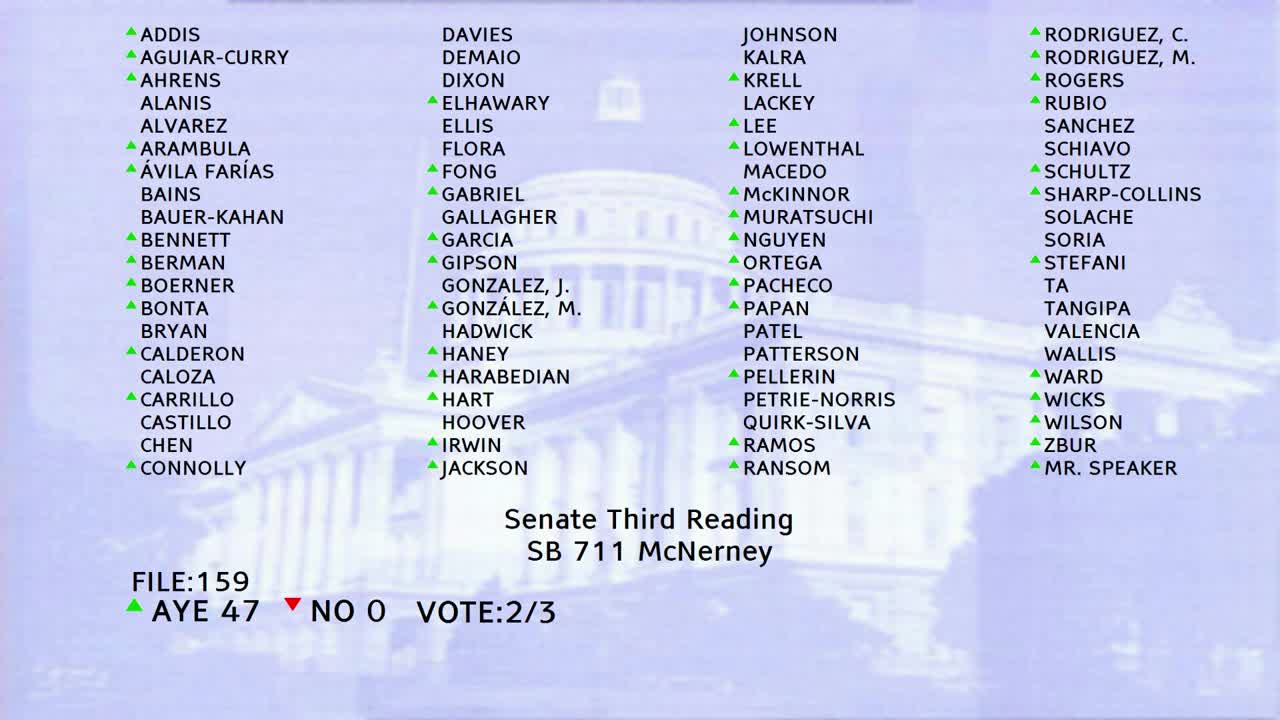 2MIN
Assembly Floor
 6MIN
Senate Standing Committee on Governmental Organization
Bill Author

Bill Co-Author(s):