SB 864: Tribal gaming: compact ratification.
- Session Year: 2025-2026
- House: Senate
- Latest Version Date: 2025-10-01
Current Status:
Passed
(2025-10-01: Chaptered by Secretary of State. Chapter 244, Statutes of 2025.)
Introduced
In Committee
Awaiting First Chamber Vote
Passed First Chamber
In Committee
Awaiting Second Chamber Vote
Passed Second Chamber
Enacted
Existing federal law, the Indian Gaming Regulatory Act of 1988, provides for the negotiation and execution of tribal-state gaming compacts for the purpose of authorizing certain types of gaming on Indian lands within a state. The California Constitution authorizes the Governor to negotiate and conclude those compacts, subject to ratification by the Legislature. Existing law expressly ratifies a number of tribal-state gaming compacts, and amendments to tribal-state gaming compacts, between the State of California and specified Indian tribes.
The California Environmental Quality Act (CEQA) requires a lead agency to prepare, or cause to be prepared, and certify the completion of, an environmental impact report on a project, as defined, that it proposes to carry out or approve that may have a significant effect on the environment, as defined, or to adopt a negative declaration if it finds that the project will not have that effect.
This bill would ratify the tribal-state gaming compact entered into between the State of California and the Cher-Ae Heights Indian Community of the Trinidad Rancheria, the first amendment to the compact between the State of California and the Pinoleville Pomo Nation, California, and the first amendment to the compact between the State of California and the Sycuan Band of the Kumeyaay Nation. The bill would provide that, in deference to tribal sovereignty, certain actions related to these compacts are not projects for the purposes of CEQA.
This bill would declare that it is to take effect immediately as an urgency statute.
Existing law, the Gambling Control Act, establishes the California Gambling Control Commission, which is responsible for licensing and regulating various gambling activities and establishments. Existing law requires the commission to maintain a public record of every vote at its principal office.This bill would additionally require the commission to post a public record of every vote on the commissions internet website no later than the close of business on the 2nd business day after the meeting at which the vote was taken.Existing law, the Gambling Control Act, establishes the California Gambling Control Commission, which is responsible for licensing and regulating various gambling activities and establishments. Existing law requires the commission to maintain a public record of every vote at its principal office.
This bill would additionally require the commission to post a public record of every vote on the commissions internet website no later than the close of business on the 2nd business day after the meeting at which the vote was taken.
(a)The following tribal-state gaming compacts and amended compacts entered into in accordance with the federal Indian Gaming Regulatory Act of 1988 (18 U.S.C. Secs. 1166 to 1168, inclusive, and 25 U.S.C. Sec. 2701 et seq.), are hereby ratified:
(1)The compact between the State of California and the Cher-Ae Heights Indian Community of the Trinidad Rancheria, executed on July 11, 2025.
(2)The first amendment to the compact between the State of California and the Pinoleville Pomo Nation, California, executed on July 30, 2025.
(3)The first amendment to the compact between the State of California and the Sycuan Band of the Kumeyaay Nation, executed on July 30, 2025.
(b)(1)In deference to tribal sovereignty, none of the following shall be deemed a project for purposes of the California Environmental Quality Act (Division 13 (commencing with Section 21000) of the Public Resources Code):
(A)The execution of a tribal-state gaming compact ratified by this section.
(B)The execution of an amended tribal-state gaming compact ratified by this section.
(C)The execution of an intergovernmental agreement between a tribe and a county or city government negotiated pursuant to the express authority of, or as expressly referenced in, a tribal-state gaming compact or amended compact ratified by this section.
(D)The execution of an intergovernmental agreement between a tribe and the Department of Transportation, or other state agency, negotiated pursuant to the express authority of, or as expressly referenced in, a tribal-state gaming compact or amended compact ratified by this section.
(E)The on-reservation impacts of compliance with the terms of a tribal-state gaming compact or amended compact ratified by this section.
(2)Except as expressly provided in this section, this subdivision does not exempt a city, county, or city and county, or the Department of Transportation, or any state agency or local jurisdiction, from the requirements of the California Environmental Quality Act.
SEC. 2.This act is an urgency statute necessary for the immediate preservation of the public peace, health, or safety within the meaning of Article IV of the California Constitution and shall go into immediate effect. The facts constituting the necessity are:
In order to enhance the economic development, stability, and self-sufficiency of the Cher-Ae Heights Indian Community of the Trinidad Rancheria, the Pinoleville Pomo Nation, California, and the Sycuan Band of the Kumeyaay Nation, and to protect the interests of those tribes and their members, the surrounding communities, and the California public at the earliest possible time, it is necessary that this act take effect immediately.
SECTION 1.Section 19819 of the Business and Professions Code is amended to read:19819.(a)The commission shall establish and maintain a general office for the transaction of its business in Sacramento. The commission may hold meetings at any place within the state when the interests of the public may be better served.(b)A public record of every vote shall be maintained at the commissions principal office and posted on the commissions internet website no later than the close of business on the second business day after the meeting at which the vote was taken.(c)A majority of the membership of the commission is a quorum of the commission. The concurring vote of three members of the commission shall be required for any official action of the commission or for the exercise of any of the commissions duties, powers, or functions.(d)Except as otherwise provided in this chapter, Article 9 (commencing with Section 11120) of Chapter 1 of Part 1 of Division 3 of Title 2 of the Government Code applies to meetings of the commission. Notwithstanding Section 11125.1 of the Government Code, documents, which are filed with the commission by the department for the purpose of evaluating the qualifications of an applicant, are exempt from disclosure under Division 10 (commencing with Section 7920.000) of Title 1 of the Government Code.(a)The commission shall establish and maintain a general office for the transaction of its business in Sacramento. The commission may hold meetings at any place within the state when the interests of the public may be better served.
(b)A public record of every vote shall be maintained at the commissions principal office. office and posted on the commissions internet website no later than the close of business on the second business day after the meeting at which the vote was taken.
(c)A majority of the membership of the commission is a quorum of the commission. The concurring vote of three members of the commission shall be required for any official action of the commission or for the exercise of any of the commissions duties, powers, or functions.
(d)Except as otherwise provided in this chapter, Article 9 (commencing with Section 11120) of Chapter 1 of Part 1 of Division 3 of Title 2 of the Government Code applies to meetings of the commission. Notwithstanding Section 11125.1 of the Government Code, documents, which are filed with the commission by the department for the purpose of evaluating the qualifications of an applicant, are exempt from disclosure under Division 10 (commencing with Section 7920.000) of Title 1 of the Government Code.
|
Date
|
Status
|
|---|---|
| Oct 1, 2025 | Chaptered by Secretary of State. Chapter 244, Statutes of 2025. |
| Oct 1, 2025 | Approved by the Governor. |
| Sep 22, 2025 | Enrolled and presented to the Governor at 2 p.m. |
| Sep 11, 2025 | Urgency clause adopted. |
| Sep 11, 2025 | Assembly amendments concurred in. (Ayes 40. Noes 0. Page 2877.) Ordered to engrossing and enrolling. |
| Sep 9, 2025 | In Senate. Concurrence in Assembly amendments pending. |
| Sep 9, 2025 | Read third time. Urgency clause adopted. Passed. (Ayes 79. Noes 0. Page 3068.) Ordered to the Senate. |
| Sep 3, 2025 | Read third time and amended. |
| Sep 3, 2025 | Ordered to third reading. |
| Aug 19, 2025 | Ordered to third reading. |
| Aug 19, 2025 | From inactive file. |
| Aug 18, 2025 | Notice of intention to remove from inactive file given by Assembly Member Aguiar-Curry. |
| Jul 10, 2025 | From consent calendar on motion of Assembly Member Garcia. |
| Jul 10, 2025 | Ordered to inactive file. |
| Jul 3, 2025 | Read second time. Ordered to consent calendar. |
| Jul 2, 2025 | From committee: Do pass. Ordered to consent calendar. (Ayes 14. Noes 0.) (July 2). |
| Jun 26, 2025 | From committee: Do pass and re-refer to Com. on APPR. with recommendation: To consent calendar. (Ayes 22. Noes 0.) (June 25). Re-referred to Com. on APPR. |
| May 19, 2025 | Referred to Com. on G.O. |
| May 8, 2025 | In Assembly. Read first time. Held at Desk. |
| May 8, 2025 | Read third time. Passed. (Ayes 36. Noes 0. Page 1052.) Ordered to the Assembly. |
| May 6, 2025 | Read second time. Ordered to consent calendar. |
| May 5, 2025 | From committee: Be ordered to second reading pursuant to Senate Rule 28.8 and ordered to consent calendar. |
| Apr 25, 2025 | Set for hearing May 5. |
| Apr 22, 2025 | From committee: Do pass and re-refer to Com. on APPR. with recommendation: To consent calendar. (Ayes 14. Noes 0. Page 831.) (April 22). Re-referred to Com. on APPR. |
| Apr 8, 2025 | Set for hearing April 22. |
| Apr 2, 2025 | Referred to Com. on G.O. |
| Mar 21, 2025 | From printer. May be acted upon on or after April 20. |
| Mar 20, 2025 | Introduced. Read first time. To Com. on RLS. for assignment. To print. |
|
Date
|
Description
|
Location
|
Votes
|
|
|---|---|---|---|---|
| Sep 11, 2025 | Unfinished Business SB864 Padilla et al. Urgency Clause Concurrence | Senate Floor |
Passed |
|
| Sep 9, 2025 | SB 864 Padilla Third Reading Urgency By Ramos | Assembly Floor |
Passed |
|
| Jul 2, 2025 | Do pass. To Consent Calendar. | Assembly Standing Committee on Appropriations |
Passed |
|
| Jun 25, 2025 | Do pass and be re-referred to the Committee on [Appropriations] with recommendation: To Consent Calendar | Assembly Standing Committee on Governmental Organization |
Passed |
|
| May 8, 2025 | Consent Calendar 2nd SB864 G.O. (Padilla) | Senate Floor |
Passed |
|
| Apr 22, 2025 | Do pass, but first be re-referred to the Committee on [Appropriations] with the recommendation: To Consent Calendar | Senate Standing Committee on Governmental Organization |
Passed |
This list shows positions taken on this bill by organizations on the date displayed, which is linked to the original source.
Positions by individuals are not included.
|
Organization
|
Position
|
Date
|
|---|---|---|
| Governor's Office | ** Support |
SENATE RULES COMMITTEE Office of Senate Floor Analyses (916) 651-1520 Fax: (916) 327-4478 | SB 864 |
UNFINISHED BUSINESS
Bill No: SB 864
Author: Padilla (D), et al.
Amended: 9/3/25
Vote: 27- Urgency
PRIOR SENATE VOTE NOT RELEVANT
NOTE: On August 26, 2025, the Senate Governmental Organization Committee held an informational hearing on the tribal-state gaming compact between the Cher-Ae Heights Indian Community of the Trinidad Rancheria, California, and amendments to the tribal-state gaming compact between the State of California and the Pinoleville Pomo Nation, and amendments to the tribal state gaming compact between the State of California and the Sycuan Band of Kumeyaay nation.
ASSEMBLY FLOOR: 79-0, 9/9/25 - See last page for vote
SUBJECT: Tribal gaming: compact ratification
SOURCE: Author
DIGEST:
This bill ratifies the Tribal-State Gaming Compact between the State of California and the Cher-Ae Heights Indian Community of the Trinidad Rancheria, California, executed on July 11, 2025. This bill also ratifies two separate amendments to the tribal-state gaming compacts entered into between the State of California and the Pinoleville Pomo Nation, California, and the Sycuan Band of Kumeyaay Nation.
Assembly Amendments
of 9/3/25 delete the contents of this bill and instead ratify the tribal-state gaming compact between the State of California and the Cher-Ae Heights Indian Community of the Trinidad Rancheria, California, and two separate amendments to the tribal-state gaming compacts entered into between the State of California and the Pinoleville Pomo Nation, California, and the Sycuan Band of Kumeyaay Nation.
ANALYSIS:
Existing law:
- Provides, under the Indian Gaming Regulatory Act (IGRA), for the negotiation and conclusion of compacts between federally recognized Indian tribes and the State for the purpose of conducting Class III gaming activities on Indian lands within a State as a means of promoting tribal economic development, self-sufficiency, and strong tribal governments.
- Authorizes expressly a number of tribal-state gaming compacts between the State of California and specified Indian tribes.
- Authorizes the conduct of Class III gaming activities to the extent such activities are permitted by state law, a gaming compact has been concluded by a federally recognized tribe and the State, and the compact has been approved by the Secretary of the Interior.
- Limits the operation of Class III gaming activities to Indian lands acquired on or before October 17, 1988. Provides, for certain exceptions to conduct gaming activities on Indian lands acquired after October 17, 1988.
- Defines “Indian lands” to mean all lands within the limits of any Indian reservation, and any lands title to which is either held in trust by the United States for the benefit of any Indian tribe, or individual, or held by any Indian tribe or individual subject to restriction by the U.S. against alienation and over which an Indian tribe exercises governmental power.
- Requires the State to negotiate to conclude a compact in good faith with an Indian tribe having jurisdiction over the Indian lands upon which the Class III gaming activity is to be conducted. Provides the U.S. district courts with jurisdiction over any cause of action initiated by a tribal government alleging that the State failed to negotiate in good faith to conclude a compact. Prescribes the remedy, mediation supervised by the courts, if it is found that the State failed to negotiate in good faith to conclude a compact.
- Authorizes the Governor, under the California Constitution, to negotiate and conclude compacts, subject to ratification by the Legislature.
This bill:
- Ratifies the tribal-state gaming compact between the State of California and the Cher-Ae Heights Indian Community of the Trinidad Rancheria, California, executed on July 11, 2025.
- Ratifies two separate amendments to the tribal-state gaming compacts entered into between the State of California and the Pinoleville Pomo Nation, California, and the Sycuan Band of Kumeyaay Nation.
- Provides that, in deference to tribal sovereignty, certain actions are not deemed projects for purposes of the California Environmental Quality Act (CEQA); and, stipulate, except as expressly provided, that none of the provisions shall be construed to exempt a city, county, or city and county, or the Department of Transportation from CEQA requirements.
- Contains an urgency clause.
Background
Cher-Ae Heights Indian Community of the Trinidad Rancheria Compact. The tribal-state gaming compact between the Cher-Ae Heights Indian Community of the Trinidad Rancheria, California, was executed on July 11, 2025.
The compact authorizes the Tribe to operate a maximum of 1,200 slot machines at no more than three gaming facilities located on eligible Indian lands held in trust for the Tribe, and located within the boundaries of the Tribe’s reservation.
The Tribe has agreed to pay the State its pro rata share of costs the State incurs for the performance of its duties under the Compact. The Compact does not require the Tribe to pay into the Revenue Sharing Trust Fund (RSTF) or the Tribal Nation Grant Fund (TNGF). If the Tribe operates 350 slot machines the compact requires the Tribe to pay 0.5% of Net Win to an Impact Mitigation Fund and distribute those funds to neighboring jurisdictions or charitable fire or emergency service entities to mitigate impacts resulting from the operation of the Gaming Facility, or other purposes as the Tribe and the recipient entity may agree.
Certain terms of the Compact related to licensing, regulatory, patron protection, and public health provisions are substantially the same as recent compacts. Specifically, the Compact includes a Tribal Labor Relations Ordinance (TLRO), which provides that gaming may commence only after the Tribe has adopted a TLRO that allows for a secret ballot election and union neutrality.
The Compact’s preamble notes that the Tribe and the State have concluded that this compact protects the interests of the Tribe and its members, the surrounding community, and the California public, and will promote and secure long-term stability, mutual respect, and mutual benefit.
The Cher-Ae Heights Indian Community of the Trinidad Rancheria, California is a federally recognized tribe in Humboldt County, California. Today, the Tribe operates the Heights Casino in Trinidad, California. The casino is open 24 hours Thursday thru Sunday, and features over 50,000 square-feet of casino gaming floor, a 400-person Bingo Hall, and over 300 slots, blackjack tables, and more. Additionally, the casino’s internet website features a live webcam stream of the Trinidad Harbor provided by North Coast News and the Cher-Ae Heights Casino.
Once effective (legislative ratification and federal approval required), this Compact will be in full force and effect for 25 years following the effective date.
First Amendment to the Tribal-State Compact Between the State of California and the Pinoleville Pomo Nation, California. The amendment to the tribal-state faming compact between the State of California and the Pinoleville Pomo Nation was executed on July 30, 2025. The amendment amends an existing 2011 compact, which the Tribe has never gamed under, in line with the State’s more recent tribal-state compacts. The amended compact also serves to avoid potential litigation after the Ninth Circuit’s decision in the Chicken Ranch Case.
In 2011, the Tribe entered into a new tribal-state compact that authorized the Tribe to operate up to 900 slot machines at one gaming facility located on those Indian lands held in trust for the Tribe. Under terms of the 2011 Compact, the Tribe agreed to pay $900 per slot machine into the RSTF if the Tribe operates more than 350 slot machines and $1,950 per slot machine if the Tribe operates more than 750 slot machines.
According to the amended compact’s preamble, the State and the Tribe have concluded that this amendment protects the interests of the Tribe and its members, the surrounding community, and the California public, and will promote and secure long-term stability, mutual respect, and mutual benefits. The Pinoleville Pomo Nation, California, is a federally recognized Indian tribe in Mendocino County, California. The Tribe currently has an enrolled population of approximately 300 members, most of whom reside in or around Ukiah, California. While the Tribe entered into a tribal-state gaming compact with the State of California in 2011, the Tribe does not currently operate a casino.
First Amendment to the Tribal-State Compact Between the State of California and the Sycuan Band of the Kumeyaay Nation. The amendment to the tribal-state compact between the State of California and the Sycuan Band of the Kumeyaay nation was executed on July 30, 2025. The amendment amends an existing 2015 compact, to avoid potential litigation after the Ninth Circuit’s decision in Chicken Ranch.
The amended compact also includes a 20-year extension in exchange for the Tribe agreeing not to challenge the revenue terms during the life of the compact. Finally, the amended compact prohibits both the Tribe and the State from directly or indirectly initiating, or participating in any action or lawsuit challenging the enforceability of the definitions in the Compact, except as expressly mutually agreed to by both parties. Additionally, both parties shall not encourage, assist, or cause any person, organization, or entity to do so. The amended compact also prohibits the Tribe from directly or indirectly initiating or participating in any action or lawsuit arising from or relating to the validity or enforceability of the Compact’s provisions relating to the Special Distribution Fund, the RSTF, or the TNGF, regardless of any subsequent court or administrative interpretation of the validity of those provisions under IGRA for the duration of the term of this Compact.
In 2015, the Tribe entered into a new tribal-state compact that authorized the Tribe to operate up to 2,500 slot machines at no more than two gaming facilities located on those Indian lands held in trust for the Tribe. Under terms of the 2015 Compact, the Tribe agreed to pay the State its pro rata share of the costs the State incurs for the performance of its duties under the Compact as well as four and three quarters percent (4.75%) of its “gross gaming revenue,” to be shared with tribes that are not gaming or that otherwise are not substantially benefiting from gaming. Additionally, the Compact provides a framework for the sharing of gaming revenue with the County of San Diego and other local jurisdictions.
The Sycuan Band of the Kumeyaay Nation is a federally recognized tribe of Mission Indians from Southern California, near El Cajon. The Tribe currently operates the Sycuan Casino Resort, which includes 2,400 slot machines along with casino table games, Asian Casino games, bingo, blackjack, and poker.
Indian Gaming Regulatory Act. In 1988, Congress enacted IGRA to provide a statutory basis for the operation and regulation of gaming on Indian lands. IGRA provides that an Indian tribe may conduct gaming activity on Indian lands if the activity “is not specifically prohibited by federal law and is conducted within a State which does not prohibit such gaming activity.”
IGRA distinguishes between three classes of gaming (Class I, Class II, and Class III) and provides for different forms of regulation for each class. Class I gaming includes “social games” for minor prizes or “traditional forms of Indian gaming.” Class II gaming is defined to include bingo and card games that are explicitly authorized by the laws of the state, or that are not explicitly prohibited by the laws of the state and are played at any location in the State, so long as the card games are played in conformity with those laws and regulations. Class III gaming includes such things as slot machines, casino games, and banked card games such as black jack and baccarat. Class III gaming may only be conducted under terms of a compact negotiated between an Indian tribe and a State.
IGRA was enacted against a legal background in which Indian tribes and individuals generally are exempt from state taxation within their own territory. IGRA provides that with the exception of assessments permitted under the statute, to defray the State’s costs of regulating gaming activity, IGRA shall not be interpreted as conferring upon a State authority to impose any tax, fee, charge, or other assessment upon an Indian tribe to engage in Class III activity. Nor may a State refuse to enter into negotiations based on the lack of authority to impose such a tax, fee, charge, or other assessment.
When a tribe requests negotiations for a Class III compact, IGRA requires the State to negotiate with the Indian tribe in good faith. IGRA provides a comprehensive process to prevent an impasse in compact negotiations, which is triggered when a tribe files suit alleging that the State has refused to negotiate or has failed to negotiate in good faith.
Before 2000, the California Constitution prohibited Class III gaming. In 2000, California voters approved Proposition 1A, which had been proposed by the Governor and passed by the Legislature. Proposition 1A amended the California Constitution to permit the State to negotiate compacts with federally recognized Indian tribes for certain Class III gaming activities. Because non-Indian parties were still forbidden from operating gaming facilities, Proposition 1A granted Indian tribes a “constitutionally protected monopoly on most types of Class III games in California.”
Chicken Ranch Rancheria Decisions. In 2021, the Chicken Ranch Rancheria of Me-Wuk Indians, along with four other tribes—the Blue Lake Rancheria, Chemehuevi Indian Tribe, Hopland Band of Pomo Indians, and Robinson Rancheria—filed suit against the State of California and Governor Gavin Newsom. The tribes alleged that the state violated IGRA by failing to negotiate new Class III gaming compacts in good faith.
According to the complaint, California insisted on compact terms covering family law, environmental regulation, and tort liability—subjects that the tribes argued were outside IGRA’s limited scope, which allows negotiation only on matters directly related to the operation of gaming activities. In July 2022, the Ninth Circuit Court of Appeals upheld the district court’s finding that California’s demands exceeded IGRA’s bounds and therefore constituted bad-faith negotiations. The court ordered the parties to move forward under IGRA’s remedial process. Under that process, if the parties are ultimately not able to agree on a compact, a mediator reviews each side’s “last best offer” and selects the proposal that best aligns with federal law, and the U.S. Department of the Interior (through the Assistant Secretary for Indian Affairs) issues Secretarial Procedures regulating the tribe’s gaming operation without state involvement.
This outcome was viewed by Indian tribes as a significant affirmation of tribal sovereignty and a rejection of state overreach in tribal gaming regulation. The Governor’s office believes the terms of this Compact are consistent with this court decision
Revenue Sharing Trust Fund (RSTF). Existing law creates in the State Treasury the RSTF for the receipt and deposit of moneys derived from gaming device license fees that are paid into the RSTF pursuant to the terms of specified tribal-state gaming compacts for the purpose of making distributions to non-compacted California tribes (e.g., federally-recognized non-gaming tribes and tribes that operate casinos with fewer than 350 slot machines).
Revenue in the RSTF is available to the California Gambling Control Commission, upon appropriation by the Legislature, for making distributions of $1.1 million annually to non-compact tribes. The RSTF was created as part of the 1999 compacts, which, in conjunction with the passage of Proposition 1A, created gaming compacts with approximately 60 California tribes. Non-compact tribes are considered third-party beneficiaries of the 1999 compacts.
Tribal Nation Grant Fund. This particular fund was created to complement the RSTF and provides for the distribution of funds to non-gaming tribes, upon application of such tribes for purposes related to effective self-governance, self-determined community, and economic development. Payments from this fund are intended to be made to non-gaming tribes on a “need” basis, upon application.
FISCAL EFFECT: Appropriation: No Fiscal Com.: Yes Local: No
SUPPORT: (Verified 9/4/25)
None received
OPPOSITION: (Verified 9/4/25)
None received
ASSEMBLY FLOOR: 79-0, 9/9/25
AYES: Addis, Aguiar-Curry, Ahrens, Alanis, Alvarez, Arambula, Ávila Farías, Bains, Bauer-Kahan, Bennett, Berman, Boerner, Bonta, Bryan, Calderon, Caloza, Carrillo, Castillo, Connolly, Davies, DeMaio, Dixon, Elhawary, Ellis, Flora, Fong, Gabriel, Gallagher, Garcia, Gipson, Jeff Gonzalez, Mark González, Hadwick, Haney, Harabedian, Hart, Hoover, Irwin, Jackson, Johnson, Kalra, Krell, Lackey, Lee, Lowenthal, Macedo, McKinnor, Muratsuchi, Nguyen, Ortega, Pacheco, Papan, Patel, Patterson, Pellerin, Petrie-Norris, Quirk-Silva, Ramos, Ransom, Celeste Rodriguez, Michelle Rodriguez, Rogers, Blanca Rubio, Sanchez, Schiavo, Schultz, Sharp-Collins, Solache, Soria, Stefani, Ta, Tangipa, Valencia, Wallis, Ward, Wicks, Wilson, Zbur, Rivas
NO VOTE RECORDED: Chen
Prepared by: Felipe Lopez / G.O. / (916) 651-1530
7/28/26 11:20:49
**** END ****
SENATE RULES COMMITTEE Office of Senate Floor Analyses (916) 651-1520 Fax: (916) 327-4478 | SB 864 |
UNFINISHED BUSINESS
Bill No: SB 864
Author: Padilla (D), et al.
Amended: 9/3/25
Vote: 27 - Urgency
PRIOR SENATE VOTE NOT RELEVANT
NOTE: On August 26, 2025, the Senate Governmental Organization Committee held an informational hearing on the tribal-state gaming compact between the Cher-Ae Heights Indian Community of the Trinidad Rancheria, California, and amendments to the tribal-state gaming compact between the State of California and the Pinoleville Pomo Nation, and amendments to the tribal state gaming compact between the State of California and the Sycuan Band of Kumeyaay nation.
ASSEMBLY FLOOR: 64-0, 9/9/25 – Roll call vote not available.
SUBJECT: Tribal gaming: compact ratification
SOURCE: Author
DIGEST:
This bill ratifies the Tribal-State Gaming Compact between the State of California and the Cher-Ae Heights Indian Community of the Trinidad Rancheria, California, executed on July 11, 2025. This bill also ratifies two separate amendments to the tribal-state gaming compacts entered into between the State of California and the Pinoleville Pomo Nation, California, and the Sycuan Band of Kumeyaay Nation.
Assembly Amendments
of 9/3/25 delete the contents of this bill and instead ratify the tribal-state gaming compact between the State of California and the Cher-Ae Heights Indian Community of the Trinidad Rancheria, California, and two separate amendments to the tribal-state gaming compacts entered into between the State of California and the Pinoleville Pomo Nation, California, and the Sycuan Band of Kumeyaay Nation.
ANALYSIS:
Existing law:
- Provides, under the Indian Gaming Regulatory Act (IGRA), for the negotiation and conclusion of compacts between federally recognized Indian tribes and the State for the purpose of conducting Class III gaming activities on Indian lands within a State as a means of promoting tribal economic development, self-sufficiency, and strong tribal governments.
- Authorizes expressly a number of tribal-state gaming compacts between the State of California and specified Indian tribes.
- Authorizes the conduct of Class III gaming activities to the extent such activities are permitted by state law, a gaming compact has been concluded by a federally recognized tribe and the State, and the compact has been approved by the Secretary of the Interior.
- Limits the operation of Class III gaming activities to Indian lands acquired on or before October 17, 1988. Provides, for certain exceptions to conduct gaming activities on Indian lands acquired after October 17, 1988.
- Defines “Indian lands” to mean all lands within the limits of any Indian reservation, and any lands title to which is either held in trust by the United States for the benefit of any Indian tribe, or individual, or held by any Indian tribe or individual subject to restriction by the U.S. against alienation and over which an Indian tribe exercises governmental power.
- Requires the State to negotiate to conclude a compact in good faith with an Indian tribe having jurisdiction over the Indian lands upon which the Class III gaming activity is to be conducted. Provides the U.S. district courts with jurisdiction over any cause of action initiated by a tribal government alleging that the State failed to negotiate in good faith to conclude a compact. Prescribes the remedy, mediation supervised by the courts, if it is found that the State failed to negotiate in good faith to conclude a compact.
- Authorizes the Governor, under the California Constitution, to negotiate and conclude compacts, subject to ratification by the Legislature.
This bill:
- Ratifies the tribal-state gaming compact between the State of California and the Cher-Ae Heights Indian Community of the Trinidad Rancheria, California, executed on July 11, 2025.
- Ratifies two separate amendments to the tribal-state gaming compacts entered into between the State of California and the Pinoleville Pomo Nation, California, and the Sycuan Band of Kumeyaay Nation.
- Provides that, in deference to tribal sovereignty, certain actions are not deemed projects for purposes of the California Environmental Quality Act (CEQA); and, stipulate, except as expressly provided, that none of the provisions shall be construed to exempt a city, county, or city and county, or the Department of Transportation from CEQA requirements.
- Contains an urgency clause.
Background
Cher-Ae Heights Indian Community of the Trinidad Rancheria Compact. The tribal-state gaming compact between the Cher-Ae Heights Indian Community of the Trinidad Rancheria, California, was executed on July 11, 2025.
The compact authorizes the Tribe to operate a maximum of 1,200 slot machines at no more than three gaming facilities located on eligible Indian lands held in trust for the Tribe, and located within the boundaries of the Tribe’s reservation.
The Tribe has agreed to pay the State its pro rata share of costs the State incurs for the performance of its duties under the Compact. The Compact does not require the Tribe to pay into the Revenue Sharing Trust Fund (RSTF) or the Tribal Nation Grant Fund (TNGF). If the Tribe operates 350 slot machines the compact requires the Tribe to pay 0.5% of Net Win to an Impact Mitigation Fund and distribute those funds to neighboring jurisdictions or charitable fire or emergency service entities to mitigate impacts resulting from the operation of the Gaming Facility, or other purposes as the Tribe and the recipient entity may agree.
Certain terms of the Compact related to licensing, regulatory, patron protection, and public health provisions are substantially the same as recent compacts. Specifically, the Compact includes a Tribal Labor Relations Ordinance (TLRO), which provides that gaming may commence only after the Tribe has adopted a TLRO that allows for a secret ballot election and union neutrality.
The Compact’s preamble notes that the Tribe and the State have concluded that this compact protects the interests of the Tribe and its members, the surrounding community, and the California public, and will promote and secure long-term stability, mutual respect, and mutual benefit.
The Cher-Ae Heights Indian Community of the Trinidad Rancheria, California is a federally recognized tribe in Humboldt County, California. Today, the Tribe operates the Heights Casino in Trinidad, California. The casino is open 24 hours Thursday thru Sunday, and features over 50,000 square-feet of casino gaming floor, a 400-person Bingo Hall, and over 300 slots, blackjack tables, and more. Additionally, the casino’s internet website features a live webcam stream of the Trinidad Harbor provided by North Coast News and the Cher-Ae Heights Casino.
Once effective (legislative ratification and federal approval required), this Compact will be in full force and effect for 25 years following the effective date.
First Amendment to the Tribal-State Compact Between the State of California and the Pinoleville Pomo Nation, California. The amendment to the tribal-state faming compact between the State of California and the Pinoleville Pomo Nation was executed on July 30, 2025. The amendment amends an existing 2011 compact, which the Tribe has never gamed under, in line with the State’s more recent tribal-state compacts. The amended compact also serves to avoid potential litigation after the Ninth Circuit’s decision in the Chicken Ranch Case.
In 2011, the Tribe entered into a new tribal-state compact that authorized the Tribe to operate up to 900 slot machines at one gaming facility located on those Indian lands held in trust for the Tribe. Under terms of the 2011 Compact, the Tribe agreed to pay $900 per slot machine into the RSTF if the Tribe operates more than 350 slot machines and $1,950 per slot machine if the Tribe operates more than 750 slot machines.
According to the amended compact’s preamble, the State and the Tribe have concluded that this amendment protects the interests of the Tribe and its members, the surrounding community, and the California public, and will promote and secure long-term stability, mutual respect, and mutual benefits. The Pinoleville Pomo Nation, California, is a federally recognized Indian tribe in Mendocino County, California. The Tribe currently has an enrolled population of approximately 300 members, most of whom reside in or around Ukiah, California. While the Tribe entered into a tribal-state gaming compact with the State of California in 2011, the Tribe does not currently operate a casino.
First Amendment to the Tribal-State Compact Between the State of California and the Sycuan Band of the Kumeyaay Nation. The amendment to the tribal-state compact between the State of California and the Sycuan Band of the Kumeyaay nation was executed on July 30, 2025. The amendment amends an existing 2015 compact, to avoid potential litigation after the Ninth Circuit’s decision in Chicken Ranch.
The amended compact also includes a 20-year extension in exchange for the Tribe agreeing not to challenge the revenue terms during the life of the compact. Finally, the amended compact prohibits both the Tribe and the State from directly or indirectly initiating, or participating in any action or lawsuit challenging the enforceability of the definitions in the Compact, except as expressly mutually agreed to by both parties. Additionally, both parties shall not encourage, assist, or cause any person, organization, or entity to do so. The amended compact also prohibits the Tribe from directly or indirectly initiating or participating in any action or lawsuit arising from or relating to the validity or enforceability of the Compact’s provisions relating to the Special Distribution Fund, the RSTF, or the TNGF, regardless of any subsequent court or administrative interpretation of the validity of those provisions under IGRA for the duration of the term of this Compact.
In 2015, the Tribe entered into a new tribal-state compact that authorized the Tribe to operate up to 2,500 slot machines at no more than two gaming facilities located on those Indian lands held in trust for the Tribe. Under terms of the 2015 Compact, the Tribe agreed to pay the State its pro rata share of the costs the State incurs for the performance of its duties under the Compact as well as four and three quarters percent (4.75%) of its “gross gaming revenue,” to be shared with tribes that are not gaming or that otherwise are not substantially benefiting from gaming. Additionally, the Compact provides a framework for the sharing of gaming revenue with the County of San Diego and other local jurisdictions.
The Sycuan Band of the Kumeyaay Nation is a federally recognized tribe of Mission Indians from Southern California, near El Cajon. The Tribe currently operates the Sycuan Casino Resort, which includes 2,400 slot machines along with casino table games, Asian Casino games, bingo, blackjack, and poker.
Indian Gaming Regulatory Act. In 1988, Congress enacted IGRA to provide a statutory basis for the operation and regulation of gaming on Indian lands. IGRA provides that an Indian tribe may conduct gaming activity on Indian lands if the activity “is not specifically prohibited by federal law and is conducted within a State which does not prohibit such gaming activity.”
IGRA distinguishes between three classes of gaming (Class I, Class II, and Class III) and provides for different forms of regulation for each class. Class I gaming includes “social games” for minor prizes or “traditional forms of Indian gaming.” Class II gaming is defined to include bingo and card games that are explicitly authorized by the laws of the state, or that are not explicitly prohibited by the laws of the state and are played at any location in the State, so long as the card games are played in conformity with those laws and regulations. Class III gaming includes such things as slot machines, casino games, and banked card games such as black jack and baccarat. Class III gaming may only be conducted under terms of a compact negotiated between an Indian tribe and a State.
IGRA was enacted against a legal background in which Indian tribes and individuals generally are exempt from state taxation within their own territory. IGRA provides that with the exception of assessments permitted under the statute, to defray the State’s costs of regulating gaming activity, IGRA shall not be interpreted as conferring upon a State authority to impose any tax, fee, charge, or other assessment upon an Indian tribe to engage in Class III activity. Nor may a State refuse to enter into negotiations based on the lack of authority to impose such a tax, fee, charge, or other assessment.
When a tribe requests negotiations for a Class III compact, IGRA requires the State to negotiate with the Indian tribe in good faith. IGRA provides a comprehensive process to prevent an impasse in compact negotiations, which is triggered when a tribe files suit alleging that the State has refused to negotiate or has failed to negotiate in good faith.
Before 2000, the California Constitution prohibited Class III gaming. In 2000, California voters approved Proposition 1A, which had been proposed by the Governor and passed by the Legislature. Proposition 1A amended the California Constitution to permit the State to negotiate compacts with federally recognized Indian tribes for certain Class III gaming activities. Because non-Indian parties were still forbidden from operating gaming facilities, Proposition 1A granted Indian tribes a “constitutionally protected monopoly on most types of Class III games in California.”
Chicken Ranch Rancheria Decisions. In 2021, the Chicken Ranch Rancheria of Me-Wuk Indians, along with four other tribes—the Blue Lake Rancheria, Chemehuevi Indian Tribe, Hopland Band of Pomo Indians, and Robinson Rancheria—filed suit against the State of California and Governor Gavin Newsom. The tribes alleged that the state violated IGRA by failing to negotiate new Class III gaming compacts in good faith.
According to the complaint, California insisted on compact terms covering family law, environmental regulation, and tort liability—subjects that the tribes argued were outside IGRA’s limited scope, which allows negotiation only on matters directly related to the operation of gaming activities. In July 2022, the Ninth Circuit Court of Appeals upheld the district court’s finding that California’s demands exceeded IGRA’s bounds and therefore constituted bad-faith negotiations. The court ordered the parties to move forward under IGRA’s remedial process. Under that process, if the parties are ultimately not able to agree on a compact, a mediator reviews each side’s “last best offer” and selects the proposal that best aligns with federal law, and the U.S. Department of the Interior (through the Assistant Secretary for Indian Affairs) issues Secretarial Procedures regulating the tribe’s gaming operation without state involvement.
This outcome was viewed by Indian tribes as a significant affirmation of tribal sovereignty and a rejection of state overreach in tribal gaming regulation. The Governor’s office believes the terms of this Compact are consistent with this court decision
Revenue Sharing Trust Fund (RSTF). Existing law creates in the State Treasury the RSTF for the receipt and deposit of moneys derived from gaming device license fees that are paid into the RSTF pursuant to the terms of specified tribal-state gaming compacts for the purpose of making distributions to non-compacted California tribes (e.g., federally-recognized non-gaming tribes and tribes that operate casinos with fewer than 350 slot machines).
Revenue in the RSTF is available to the California Gambling Control Commission, upon appropriation by the Legislature, for making distributions of $1.1 million annually to non-compact tribes. The RSTF was created as part of the 1999 compacts, which, in conjunction with the passage of Proposition 1A, created gaming compacts with approximately 60 California tribes. Non-compact tribes are considered third-party beneficiaries of the 1999 compacts.
Tribal Nation Grant Fund. This particular fund was created to complement the RSTF and provides for the distribution of funds to non-gaming tribes, upon application of such tribes for purposes related to effective self-governance, self-determined community, and economic development. Payments from this fund are intended to be made to non-gaming tribes on a “need” basis, upon application.
FISCAL EFFECT: Appropriation: No Fiscal Com.: Yes Local: No
SUPPORT: (Verified 9/4/25)
None received
OPPOSITION: (Verified 9/4/25)
None received
Prepared by: Felipe Lopez / G.O. / (916) 651-1530
9/9/25 12:37:10
**** END ****
SENATE THIRD READING
STR Bill Id:SB 864
Author:(Padilla)
As Amended Ver:September 3, 2025
2/3 vote. Urgency
SUMMARY
- The bill would ratify a Tribal-State Gaming Compact between the State of California and the Cher-Ae Heights Indian Community of the Trinidad Rancheria, executed on July 11, 2025.
- The bill would ratify amendments to separate Tribal-State Gaming Compacts between the State of California and the:
- The Pinoleville Pomo Nation, California, executed on July 30, 2025.
- The Sycuan Band of the Kumeyaay Nation, executed on July 30, 2025.
Major Provisions
- Ratify the Tribal-State Compact between the State of California and the Cher-Ae Heights Indian Community of the Trinidad Rancheria, executed on July 11, 2025.
- Ratify the First Amendment to the Tribal-State Compact between the State of California and the Pinoleville Pomo Nation, California, executed on July 30, 2025.
- Ratify the First Amendment to the Tribal-State Compact between the State of California and the Sycuan Band of the Kumeyaay Nation, executed on July 30, 2025.
- Provide that, in deference to tribal sovereignty, certain actions are not deemed projects for purposes of the California Environmental Quality Act (CEQA); and, stipulate, except as expressly provided, that none of the provisions shall be construed to exempt a city, county, or city and county, or the Department of Transportation, or any state agency or local jurisdiction, from CEQA requirements.
- Declare that it is to take effect immediately as an urgency statute.
Existing Law:
- Provides, under the Indian Gaming Regulatory Act (IGRA), for the negotiation and conclusion of compacts between federally recognized Indian tribes and the State for the purpose of conducting Class III gaming activities on Indian lands within a State as a means of promoting tribal economic development, self-sufficiency, and strong tribal governments.
- Authorizes expressly a number of tribal-state gaming compacts between the State of California and specified Indian tribes.
- Authorizes the conduct of Class III gaming activities to the extent such activities are permitted by state law, a gaming compact has been concluded by a federally recognized tribe and the State, and the compact has been approved by the Secretary of the Interior.
- Limits the operation of Class III gaming activities to Indian lands acquired on or before October 17, 1988. Provides exceptions to conduct gaming activities on Indian lands acquired after October 17, 1988.
- Defines Indian lands to mean all lands within the limits of any Indian reservation, and any lands title to which is either held in trust by the United States (U.S.) for the benefit of any Indian tribe, or individual, or held by any Indian tribe or individual subject to restriction by the U.S. against alienation and over which an Indian tribe exercises governmental power.
- Requires the State to negotiate to conclude a compact in good faith with an Indian tribe having jurisdiction over the Indian lands upon which the Class III gaming activity is to be conducted. Provides the U.S. district courts with jurisdiction over any cause of action initiated by a tribal government alleging that the State failed to negotiate in good faith to conclude a compact. Prescribes the remedy, mediation supervised by the courts, if it is found that the State failed to negotiate in good faith to conclude a compact.
- Authorizes the Governor, under the California Constitution, to negotiate and conclude compacts, subject to ratification by the Legislature.
COMMENTS
Note: On September 2, 2025, the Assembly Committee on Governmental Organization held an informational hearing on the content of the separate Tribal-State Class III Gaming Compacts between the State of California and the above-mentioned tribes.
Background on Cher-Ae Heights Indian Community of the Trinidad Rancheria Compact:
The Tribal-State Gaming Compact between the State of California (State) and the Cher-Ae Heights Indian Community of the Trinidad Rancheria (Tribe), a federally recognized Indian tribe was executed on July 11, 2025 on a sovereign government-to-government basis pursuant to the IGRA. The Tribe is located in Humboldt County, California. The Tribe is governed by a democratically elected five-person community council.
In 1999, the Tribe and the State entered into the tribal-state compact (1999 Compact), which enabled the Tribe, through revenues generated by its gaming operation, to improve the governance, environment, education, health, safety, and general welfare of its citizens, to promote a strong tribal government and self-sufficiency, and to provide essential government services to its citizens.
Today, the Tribe operates the Heights Casino in Trinidad, California. The casino opened its doors in 1988 as a 20,000 square-foot tilt-up or as it was described by tribal members "a tin building" bingo hall. In 2002, the casino expanded to a 50,000 square foot gaming facility with a new look, an expanded bingo hall, 300 slot machines, table games, the Firewater Lounge and the Sunset Restaurant overlooking Trinidad Head. The Heights Casino has continued to evolve by continually bringing in the newest and most exciting cutting-edge slot machines and games.
This new Compact authorizes the Tribe to operate a maximum of 1,200 slot machines at no more than three gaming facilities located on eligible Indian lands held in trust for the Tribe, and located within the boundaries of the Tribe's reservation.
The Tribe has agreed to pay the State its pro rata share of costs the State incurs for the performance of its duties under the Compact. The Compact does not require the Tribe to pay into the Revenue Sharing Trust Fund (RSTF) or the Tribal Nation Grant Fund (TNGF).
If the Tribe operates 350 slot machines the Compact requires the Tribe to pay 0.5% of Net Win to an Impact Mitigation Fund and distribute those funds to neighboring jurisdictions or charitable fire or emergency service entities to mitigate impacts resulting from the operation of the gaming facility, or other purposes as the Tribe and the recipient entity may agree.
Certain terms of the Compact related to licensing, regulatory, patron protection, and public health provisions are substantially the same as recent compacts. Specifically, the Compact includes a Tribal Labor Relations Ordinance (TLRO), which provides that gaming may commence only after the Tribe has adopted a TLRO that allows for a secret ballot election and union neutrality.
The Compact provides that in the event the exclusive right of Indian tribes to operate Class III gaming in California pursuant to the California Constitution is abrogated by the enactment, amendment, or repeal of a state statute or constitutional provision or the conclusive and dispositive judicial construction of a statute or the State Constitution by a California appellate court after the effective date of this Compact, that gaming devices may lawfully be operated by non-Indian entities, the Tribe shall have the right to terminate this Compact, as specified.
The Compact includes a Force Majeure clause which, in the event of a force majeure event beyond the Tribe's control that cause the Tribe's gaming facility to be inoperable or operate at significantly less capacity, the Tribe and the State agree to meet and confer for the purposes of discussing the event and appropriate actions.
The Compact's preamble notes that the Tribe and the State have concluded that this compact protects the interests of the Tribe and its members, the surrounding community, and the California public, and will promote and secure long-term stability, mutual respect, and mutual benefit.
Once effective (legislative ratification and federal approval required), this Compact will be in full force and effect for 25 years following the effective date.
Background on the Sycuan Band of the Kumeyaay Nation Compact:
The Sycuan Band of the Kumeyaay Nation (Tribe) is a federally recognized tribe of Mission Indians from Southern California, located in an unincorporated area of San Diego County just east of El Cajon, California. The Tribe currently operates the Sycuan Casino Resort, located approximately 30 minutes from downtown San Diego. Originally opened in 1983 as a modest one-room Bingo Palace, the resort has since evolved into one of the region's premier gaming and hospitality destinations. According to the Tribe's official website, the casino floor features over 2,300 diverse slot machines and 50 classic table games, including poker, blackjack, craps, and roulette. In 2019, a $260 million expansion project was completed, introducing a 12-story luxury hotel with more than 300 guest rooms and 57 suites.
The Tribe's business enterprises have evolved from traditional Kumeyaay practices to a diversified portfolio including not only gaming but hospitality and real state. Other than the Casino Resort, the Tribe also owns a golf course, the Marina Gateway Company, and is a joint owner of the San Diego FC soccer team.
The Amendment to the Tribal-State Gaming Compact (Amended Compact) between the State of California (State) and the Tribe was executed on July 30, 2025. The Amended Compact amends an existing 2015 Compact, to avoid potential litigation after the Ninth Circuit's decision in Chicken Ranch Rancheria of Me-Wuk Indians v. California (See below). The Amended Compact also includes a 20-year extension in exchange for the Tribe agreeing not to challenge the revenue terms during the life of the Compact. The Tribe's current 2015 Compact is set to expire in 2040.
In 2015, the Tribe entered into a new tribal-state compact, ratified by AB 795 (Atkins, Chapter 520, Statutes of 2015), which authorized the operation of up to 2,500 slot machines at no more than two gaming facilities located on Indian lands held in trust for the Tribe. Under the terms of the Compact, the Tribe agreed to pay the State its pro rata share of costs incurred in performing its duties under the agreement, as well as 4.75% of its "gross gaming revenue". These funds are designated for distribution to non-gaming tribes or those not substantially benefiting from gaming. Additionally, the Compact establishes a framework for sharing gaming revenue with the County of San Diego and other local jurisdictions.
The Amended Compact's preamble notes that "the United States Court of Appeals for the Ninth Circuit's decision in Chicken Ranch Rancheria of Me-Wuk Indians v. California, 42 F.4th 1024 (9th Cir 2022) clarified what provisions may be included in tribal-state Class III gaming compacts entered into pursuant to the IGRA."
According to the Amended Compact's preamble, "a dispute arose between the Tribe and the State relating to the validity and interpretation of the 2015 Compact that were implicated by the decision in Chicken Ranch. The Tribe and the State engaged in dispute resolution pursuant to Section 13.0 of the Tribe's 2015 Compact. In order to resolve any and all current and potential disputes concerning improper interpretation of the 2015 Compact arising from the Ninth Circuit's decision in Chicken Ranch, the Tribe and the State have agreed to amend the 2015 Compact."
Consistent with the Chicken Ranch Decision, the Amended Compact deletes provisions in the 2015 Compact that required the Tribe to prepare a tribal environmental impact report analyzing the potentially significant off-reservation environmental impacts of the construction of a gaming facility.
Consistent with the Chicken Ranch Decision and in alignment with recent compacts, the Amended Compact removes provisions from the Tribe's 2015 Compact that required the Tribe, with respect to the earnings of any person employed at the gaming facility, to comply with all earnings withholding orders for support of a child, spouse, or former spouse.
The Amended Compact changes the definition of "gaming facility" to mean the buildings or structures in which Class III Gaming, as authorized by this Compact is conducted. This change is consistent with recent tribal-state compacts and aligns with the Chicken Ranch Decision.
The Amended Compact prohibits both the Tribe and the State from directly or indirectly initiating, or participating in any action or lawsuit challenging the enforceability of the definitions in the Compact, except as expressly mutually agreed to by both parties. Additionally, both parties shall not encourage, assist, or cause any person, organization, or entity to do so. The Amended Compact also prohibits the Tribe from directly or indirectly initiating or participating in any action or lawsuit arising from or relating to the validity or enforceability of the Compact's provisions relating to the SDF, the RSTF, or the TNGF, regardless of any subsequent court or administrative interpretation of the validity of those provisions under IGRA for the duration of the term of this Compact.
The Amended Compact deletes current tort law provisions in their 2015 Compact and instead requires the Tribe to establish written procedures for the disposition of tort claims arising from personal injury or property damage alleged to have been suffered by any person who is a patron of the gaming facility. The Tribe is required to provide coverage in an amount no less than $10 million per occurrence.
Consistent with more recent compacts, the Amended Compact provides that if the State authorizes any person to conduct a new form of Class III gaming not expressly authorizes in this Amended Compact, the State shall enter into good-faith negotiations for the purpose of adding the newly authorized Class III gaming activity and making other appropriate related amendments.
The Tribe's current 2015 Compact is set to expire in 2040, the Amended Compact provides a 20-year extension, meaning that this Amended Compact will now expire on December 31, 2060.
Background on the Pinoleville Pomo Nation, California Compact:
The Amendment to the Tribal-State Gaming Compact (Amended Compact) between the State of California (State) and the Pinoleville Pomo Nation, California (Tribe) was executed on July 30, 2025. It modifies a previously ratified 2011 Compact to better align with more recent Class III tribal-state gaming compacts that were ratified by Legislature (Gov. Code Section12012.25) and approved by the Secretary of the Interior. Additionally, the Amended Compact helps to mitigate the risk of potential litigation following the Ninth Circuit's decision in the Chicken Ranch case (see below).
The Tribe is a federally recognized Indian tribe situated in Mendocino County, California. Its reservation, known as the Pinoleville Rancheria, encompasses approximately 100 acres along the northern edge of the county. The Tribe has an enrolled membership of about 300 individuals, with most residing in or near the city of Ukiah. Tribal governance is administered by a seven-member elected Tribal Council.
In 2011, the Tribe entered into a new Class III tribal-state compact, ratified by AB 1418 (Hall), Chapter 412, Statutes of 2011. This agreement authorizes the Tribe to operate up to 900 gaming devices (slot machines), as well as any banking or percentage card games, and other devices or games permitted under California law. These operations are limited to a single gaming facility located on Indian lands held in trust for the Tribe. Under the 2011 Compact, the Tribe is required to contribute up to 15 percent of the casino's net win from gaming devices to support local government services and to fund gambling mitigation and regulatory efforts. The compact also included provisions to safeguard the health and safety of employees and patrons, along with environmental protection measures that must be implemented during both the construction and operation of the gaming facility. The compact remains in effect through December 31, 2031.
It is important to note that the Tribe has never constructed or operated a gaming facility pursuant to the terms of the approved 2011 Class III gaming compact with the State.
According to the Amended Compact's preamble, the State and the Tribe agree that this Amended Compact provides the Tribe with substantial economic benefit by reducing the total amount of payments that the Tribe would otherwise owe under the 2011 Compact and by enhancing the Tribe's ability to access tribal-government financing.
The Amended Compact changes the definition of "gaming facility" or "facility" to mean the buildings or structures in which Class III gaming, as authorized by this Compact, is conducted. This change is consistent with recent tribal-state compacts and aligns with the Chicken Ranch Decision.
The Amended Compact deletes the current payment formula in the 2011 Compact and instead requires the Tribe pay to the State, on a pro rata basis, the costs the State incurs for the performance of all its duties under this Compact, as established by the monies appropriated in the annual Budget Act for the performance of their duties under the Class III gaming compacts. This change aligns the Tribe's compact with recent tribal-state compacts.
The Amended Compact deletes the current payment formula that the Tribe is required to pay into the RSTF under their 2011 compact. The Amended Compact does not require the Tribe to pay into either the RSTF or the TNGF. This change is consistent with recent tribal-state compacts which generally do not require tribes who operate less than 1,200 slot machines to pay into either the RSTF or the TNGF.
If the Tribe operates 350 slot machines, the Amended Compact requires the Tribe to pay 0.5% of Net Win to an Impact Mitigation Fund and distribute those funds to for purposes of providing assistance to fire protection districts and non-tribal law enforcement, emergency services, and service agencies with demonstrated impacts from the gaming facility.
Similar to recent compacts, the Amended Compact requires the Tribe to establish written procedures for the disposition of tort claims arising from personal injury or property damage alleged to have been suffered by any person who is a patron of the gaming facility. The Tribe is required to provide coverage in an amount no less than $2 million per occurrence with an annual aggregate limit not less than $5 million.
Similar to recent compacts and consistent with the Chicken Ranch Decision, the Amended Compact deletes current provisions in the Tribe's 2011 Compact that require the Tribe, with respect to the earnings of any person employed at the gaming facility, to comply with all earnings withholding orders for support of a child, spouse, or former spouse.
Consistent with the Chicken Ranch Decision, the Amended Compact deletes provisions in the 2011 Compact that required the Tribe to prepare a tribal environmental impact report analyzing the potentially significant off-reservation environmental impacts of the construction of a gaming facility.
Upon all the necessary approvals, the Amended Compact will be valid until December 31, 2031.
Additional Background Information:
Compact Ratification. The State Constitution, as amended by Proposition 1A of March 2000, permits Indian tribes to conduct and operate slot machines, lottery games, and banked and percentage card games on Indian land. These gambling activities shall only occur if:
- The Governor and an Indian tribe reach agreement on a compact;
- The Legislature approves the compact, and
- The federal government approves the compact. Pursuant to IGRA, the Secretary may only disapprove a proposed Compact where the Compact violates IGRA, any other provision of Federal law that does not relate to jurisdiction over gaming on Indian lands, or the trust obligation of the United States to Indians. 25 U.S.C. Section 2710(d)(8)(B).
The Governor is the designated State officer responsible for negotiating and executing, on behalf of the State, Tribal-State gaming compacts with federally recognized Indian tribes located within the State of California. Following completion of negotiations, the Governor shall submit a copy of any executed Tribal-State compact to both houses of the Legislature for ratification and shall submit a copy of the executed compact to the Secretary of State. The compact provides that it shall not be presented to the Legislature for a ratification vote until the Tribe has provided the written proof and will provide written proof to the Governor the tribal governing body has ratified it.
Indian Gaming Regulatory Act. In 1988, Congress enacted the IGRA to provide a statutory basis for the operation and regulation of gaming on Indian lands. IGRA provides that an Indian tribe may conduct gaming activity on Indian lands if the activity "is not specifically prohibited by federal law and is conducted within a State which does not prohibit such gaming activity." IGRA further provided for general regulatory oversight at the federal level and created the National Indian Gaming Commission.
IGRA distinguishes between three classes of gaming (Class I, Class II, and Class III) and provides for different forms of regulation for each class. Class I gaming includes "social games" for minor prizes or "traditional forms of Indian gaming." Class II gaming is defined to include bingo and card games that are explicitly authorized by the laws of the state, or that are not explicitly prohibited by the laws of the state and are played at any location in the State, so long as the card games are played in conformity with those laws and regulations. All other games are Class III, except for certain social or traditional forms of gaming. Class III games include, but are not limited to the following: baccarat, blackjack, slot machines, and electronic or electromechanical facsimiles of any game of chance. Class III gaming may only be conducted under terms of a compact negotiated between an Indian tribe and a State.
IGRA was enacted against a legal background in which Indian tribes and individuals generally are exempt from state taxation within their own territory. IGRA provides that with the exception of assessments permitted under the statute, to defray the State's costs of regulating gaming activity, IGRA shall not be interpreted as conferring upon a State authority to impose any tax, fee, charge, or other assessment upon an Indian tribe to engage in Class III activity. Nor may a State refuse to enter into negotiations based on the lack of authority to impose such a tax, fee, charge, or other assessment.
When a tribe requests negotiations for a Class III compact, IGRA requires the State to negotiate with the Indian tribe in good faith. IGRA provides a comprehensive process to prevent an impasse in compact negotiations, which is triggered when a tribe files suit alleging that the State has refused to negotiate or has failed to negotiate in good faith.
Chicken Ranch Rancheria Decision. In 2021, the Chicken Ranch Rancheria of Me-Wuk Indians, along with four other tribes—the Blue Lake Rancheria, Chemehuevi Indian Tribe, Hopland Band of Pomo Indians, and Robinson Rancheria—filed suit against the State of California and Governor Gavin Newsom. The tribes alleged that the state violated IGRA by failing to negotiate new Class III gaming compacts in good faith.
According to the complaint, California insisted on compact terms covering family law, environmental regulation, and tort liability—subjects that the tribes argued were outside IGRA's limited scope, which allows negotiation only on matters directly related to the operation of gaming activities. In July 2022, the Ninth Circuit Court of Appeals upheld the district court's finding that California's demands exceeded IGRA's bounds and therefore constituted bad-faith negotiation. The court ordered the parties to move forward under IGRA's remedial process. Under that process, if the parties are ultimately not able to agree on a compact, a mediator reviews each side's "last best offer" and selects the proposal that best aligns with federal law, and the U.S. Department of the Interior (through the Assistant Secretary for Indian Affairs) issues Secretarial Procedures regulating the tribe's gaming operation without state involvement.
This outcome was viewed by Indian tribes as a significant affirmation of tribal sovereignty and a rejection of state overreach in tribal gaming regulation. The Governor's office believes the terms of this Compact are consistent with this court decision.
Rincon Decision. In 2004, the Rincon Band of Mission Indians sued the State of California in federal court after negotiations for a new gambling agreement with then-Governor Schwarzenegger fell apart. The Tribe believed the Governor was violating federal law by insisting that tribes pay money into the state's General Fund in exchange for more slot machines.
In July 2011, the U.S. Supreme Court declined to review a Ninth Circuit Court's decision that ruled the state could not require the Rincon Band tribe to pay a percentage of slot machine revenue into California's General Fund for more gaming devices. The Ninth Circuit had affirmed a lower court decision that the new financial concessions were nothing more than a state tax on tribal casino revenues, which is prohibited by IGRA. The court concluded that a "non-negotiable, mandatory payment of 10% of net win into the State treasury for unrestricted use yields public revenue and is [therefore] a tax and that the court was therefore required to consider the State's demand as evidence of bad faith under IGRA's statutes."
The Rincon decision has changed the dynamics of tribal-state compact negotiations in California.
According to the Author
None on file
Arguments in Support
None on file
Arguments in Opposition
None on file
FISCAL COMMENTS
Unknown
VOTES
SENATE FLOOR: Votes not relevant
YES:
ABS, ABST OR NV:
ASM GOVERNMENTAL ORGANIZATION: Votes not relevant
YES:
ASM APPROPRIATIONS: Votes not relevant
YES:
ABS, ABST OR NV:
UPDATED
VERSION: September 3, 2025
CONSULTANT: Eric Johnson / G.O. / (916) 319-2531 FN: 0001636
SENATE THIRD READING
STR Bill Id:SB 864
Author:(Padilla)
As Amended Ver:September 3, 2025
2/3 vote. Urgency
SUMMARY
1) The bill would ratify a Tribal-State Gaming Compact between the State of California and the Cher-Ae Heights Indian Community of the Trinidad Rancheria, executed on July 11, 2025.
2) The bill would ratify amendments to separate Tribal-State Gaming Compacts between the State of California and the:
- The Pinoleville Pomo Nation, California, executed on July 30, 2025.
- The Sycuan Band of the Kumeyaay Nation, executed on July 30, 2025.
Major Provisions
1) Ratify the Tribal-State Compact between the State of California and the Cher-Ae Heights Indian Community of the Trinidad Rancheria, executed on July 11, 2025.
2) Ratify the First Amendment to the Tribal-State Compact between the State of California and the Pinoleville Pomo Nation, California, executed on July 30, 2025.
3) Ratify the First Amendment to the Tribal-State Compact between the State of California and the Sycuan Band of the Kumeyaay Nation, executed on July 30, 2025.
4) Provide that, in deference to tribal sovereignty, certain actions are not deemed projects for purposes of the California Environmental Quality Act (CEQA); and, stipulate, except as expressly provided, that none of the provisions shall be construed to exempt a city, county, or city and county, or the Department of Transportation, or any state agency or local jurisdiction, from CEQA requirements.
5) Declare that it is to take effect immediately as an urgency statute.
Existing Law:
- Provides, under the Indian Gaming Regulatory Act (IGRA), for the negotiation and conclusion of compacts between federally recognized Indian tribes and the State for the purpose of conducting Class III gaming activities on Indian lands within a State as a means of promoting tribal economic development, self-sufficiency, and strong tribal governments.
- Authorizes expressly a number of tribal-state gaming compacts between the State of California and specified Indian tribes.
- Authorizes the conduct of Class III gaming activities to the extent such activities are permitted by state law, a gaming compact has been concluded by a federally recognized tribe and the State, and the compact has been approved by the Secretary of the Interior.
- Limits the operation of Class III gaming activities to Indian lands acquired on or before October 17, 1988. Provides exceptions to conduct gaming activities on Indian lands acquired after October 17, 1988.
- Defines Indian lands to mean all lands within the limits of any Indian reservation, and any lands title to which is either held in trust by the United States (U.S.) for the benefit of any Indian tribe, or individual, or held by any Indian tribe or individual subject to restriction by the U.S. against alienation and over which an Indian tribe exercises governmental power.
- Requires the State to negotiate to conclude a compact in good faith with an Indian tribe having jurisdiction over the Indian lands upon which the Class III gaming activity is to be conducted. Provides the U.S. district courts with jurisdiction over any cause of action initiated by a tribal government alleging that the State failed to negotiate in good faith to conclude a compact. Prescribes the remedy, mediation supervised by the courts, if it is found that the State failed to negotiate in good faith to conclude a compact.
- Authorizes the Governor, under the California Constitution, to negotiate and conclude compacts, subject to ratification by the Legislature.
COMMENTS
Note: On September 2, 2025, the Assembly Committee on Governmental Organization held an informational hearing on the content of the separate Tribal-State Class III Gaming Compacts between the State of California and the above-mentioned tribes.
Background on Cher-Ae Heights Indian Community of the Trinidad Rancheria Compact:
The Tribal-State Gaming Compact between the State of California (State) and the Cher-Ae Heights Indian Community of the Trinidad Rancheria (Tribe), a federally recognized Indian tribe was executed on July 11, 2025 on a sovereign government-to-government basis pursuant to the IGRA. The Tribe is located in Humboldt County, California. The Tribe is governed by a democratically elected five-person community council.
In 1999, the Tribe and the State entered into the tribal-state compact (1999 Compact), which enabled the Tribe, through revenues generated by its gaming operation, to improve the governance, environment, education, health, safety, and general welfare of its citizens, to promote a strong tribal government and self-sufficiency, and to provide essential government services to its citizens.
Today, the Tribe operates the Heights Casino in Trinidad, California. The casino opened its doors in 1988 as a 20,000 square-foot tilt-up or as it was described by tribal members "a tin building" bingo hall. In 2002, the casino expanded to a 50,000 square foot gaming facility with a new look, an expanded bingo hall, 300 slot machines, table games, the Firewater Lounge and the Sunset Restaurant overlooking Trinidad Head. The Heights Casino has continued to evolve by continually bringing in the newest and most exciting cutting-edge slot machines and games.
This new Compact authorizes the Tribe to operate a maximum of 1,200 slot machines at no more than three gaming facilities located on eligible Indian lands held in trust for the Tribe, and located within the boundaries of the Tribe's reservation.
The Tribe has agreed to pay the State its pro rata share of costs the State incurs for the performance of its duties under the Compact. The Compact does not require the Tribe to pay into the Revenue Sharing Trust Fund (RSTF) or the Tribal Nation Grant Fund (TNGF).
If the Tribe operates 350 slot machines the Compact requires the Tribe to pay 0.5% of Net Win to an Impact Mitigation Fund and distribute those funds to neighboring jurisdictions or charitable fire or emergency service entities to mitigate impacts resulting from the operation of the gaming facility, or other purposes as the Tribe and the recipient entity may agree.
Certain terms of the Compact related to licensing, regulatory, patron protection, and public health provisions are substantially the same as recent compacts. Specifically, the Compact includes a Tribal Labor Relations Ordinance (TLRO), which provides that gaming may commence only after the Tribe has adopted a TLRO that allows for a secret ballot election and union neutrality.
The Compact provides that in the event the exclusive right of Indian tribes to operate Class III gaming in California pursuant to the California Constitution is abrogated by the enactment, amendment, or repeal of a state statute or constitutional provision or the conclusive and dispositive judicial construction of a statute or the State Constitution by a California appellate court after the effective date of this Compact, that gaming devices may lawfully be operated by non-Indian entities, the Tribe shall have the right to terminate this Compact, as specified.
The Compact includes a Force Majeure clause which, in the event of a force majeure event beyond the Tribe's control that cause the Tribe's gaming facility to be inoperable or operate at significantly less capacity, the Tribe and the State agree to meet and confer for the purposes of discussing the event and appropriate actions.
The Compact's preamble notes that the Tribe and the State have concluded that this compact protects the interests of the Tribe and its members, the surrounding community, and the California public, and will promote and secure long-term stability, mutual respect, and mutual benefit.
Once effective (legislative ratification and federal approval required), this Compact will be in full force and effect for 25 years following the effective date.
Background on the Sycuan Band of the Kumeyaay Nation Compact:
The Sycuan Band of the Kumeyaay Nation (Tribe) is a federally recognized tribe of Mission Indians from Southern California, located in an unincorporated area of San Diego County just east of El Cajon, California. The Tribe currently operates the Sycuan Casino Resort, located approximately 30 minutes from downtown San Diego. Originally opened in 1983 as a modest one-room Bingo Palace, the resort has since evolved into one of the region's premier gaming and hospitality destinations. According to the Tribe's official website, the casino floor features over 2,300 diverse slot machines and 50 classic table games, including poker, blackjack, craps, and roulette. In 2019, a $260 million expansion project was completed, introducing a 12-story luxury hotel with more than 300 guest rooms and 57 suites.
The Tribe's business enterprises have evolved from traditional Kumeyaay practices to a diversified portfolio including not only gaming but hospitality and real state. Other than the Casino Resort, the Tribe also owns a golf course, the Marina Gateway Company, and is a joint owner of the San Diego FC soccer team.
The Amendment to the Tribal-State Gaming Compact (Amended Compact) between the State of California (State) and the Tribe was executed on July 30, 2025. The Amended Compact amends an existing 2015 Compact, to avoid potential litigation after the Ninth Circuit's decision in Chicken Ranch Rancheria of Me-Wuk Indians v. California (See below). The Amended Compact also includes a 20-year extension in exchange for the Tribe agreeing not to challenge the revenue terms during the life of the Compact. The Tribe's current 2015 Compact is set to expire in 2040.
In 2015, the Tribe entered into a new tribal-state compact, ratified by AB 795 (Atkins, Chapter 520, Statutes of 2015), which authorized the operation of up to 2,500 slot machines at no more than two gaming facilities located on Indian lands held in trust for the Tribe. Under the terms of the Compact, the Tribe agreed to pay the State its pro rata share of costs incurred in performing its duties under the agreement, as well as 4.75% of its "gross gaming revenue". These funds are designated for distribution to non-gaming tribes or those not substantially benefiting from gaming. Additionally, the Compact establishes a framework for sharing gaming revenue with the County of San Diego and other local jurisdictions.
The Amended Compact's preamble notes that "the United States Court of Appeals for the Ninth Circuit's decision in Chicken Ranch Rancheria of Me-Wuk Indians v. California, 42 F.4th 1024 (9th Cir 2022) clarified what provisions may be included in tribal-state Class III gaming compacts entered into pursuant to the IGRA."
According to the Amended Compact's preamble, "a dispute arose between the Tribe and the State relating to the validity and interpretation of the 2015 Compact that were implicated by the decision in Chicken Ranch. The Tribe and the State engaged in dispute resolution pursuant to Section 13.0 of the Tribe's 2015 Compact. In order to resolve any and all current and potential disputes concerning improper interpretation of the 2015 Compact arising from the Ninth Circuit's decision in Chicken Ranch, the Tribe and the State have agreed to amend the 2015 Compact."
Consistent with the Chicken Ranch Decision, the Amended Compact deletes provisions in the 2015 Compact that required the Tribe to prepare a tribal environmental impact report analyzing the potentially significant off-reservation environmental impacts of the construction of a gaming facility.
Consistent with the Chicken Ranch Decision and in alignment with recent compacts, the Amended Compact removes provisions from the Tribe's 2015 Compact that required the Tribe, with respect to the earnings of any person employed at the gaming facility, to comply with all earnings withholding orders for support of a child, spouse, or former spouse.
The Amended Compact changes the definition of "gaming facility" to mean the buildings or structures in which Class III Gaming, as authorized by this Compact is conducted. This change is consistent with recent tribal-state compacts and aligns with the Chicken Ranch Decision.
The Amended Compact prohibits both the Tribe and the State from directly or indirectly initiating, or participating in any action or lawsuit challenging the enforceability of the definitions in the Compact, except as expressly mutually agreed to by both parties. Additionally, both parties shall not encourage, assist, or cause any person, organization, or entity to do so. The Amended Compact also prohibits the Tribe from directly or indirectly initiating or participating in any action or lawsuit arising from or relating to the validity or enforceability of the Compact's provisions relating to the SDF, the RSTF, or the TNGF, regardless of any subsequent court or administrative interpretation of the validity of those provisions under IGRA for the duration of the term of this Compact.
The Amended Compact deletes current tort law provisions in their 2015 Compact and instead requires the Tribe to establish written procedures for the disposition of tort claims arising from personal injury or property damage alleged to have been suffered by any person who is a patron of the gaming facility. The Tribe is required to provide coverage in an amount no less than $10 million per occurrence.
Consistent with more recent compacts, the Amended Compact provides that if the State authorizes any person to conduct a new form of Class III gaming not expressly authorizes in this Amended Compact, the State shall enter into good-faith negotiations for the purpose of adding the newly authorized Class III gaming activity and making other appropriate related amendments.
The Tribe's current 2015 Compact is set to expire in 2040, the Amended Compact provides a 20-year extension, meaning that this Amended Compact will now expire on December 31, 2060.
Background on the Pinoleville Pomo Nation, California Compact:
The Amendment to the Tribal-State Gaming Compact (Amended Compact) between the State of California (State) and the Pinoleville Pomo Nation, California (Tribe) was executed on July 30, 2025. It modifies a previously ratified 2011 Compact to better align with more recent Class III tribal-state gaming compacts that were ratified by Legislature (Gov. Code Section12012.25) and approved by the Secretary of the Interior. Additionally, the Amended Compact helps to mitigate the risk of potential litigation following the Ninth Circuit's decision in the Chicken Ranch case (see below).
The Tribe is a federally recognized Indian tribe situated in Mendocino County, California. Its reservation, known as the Pinoleville Rancheria, encompasses approximately 100 acres along the northern edge of the county. The Tribe has an enrolled membership of about 300 individuals, with most residing in or near the city of Ukiah. Tribal governance is administered by a seven-member elected Tribal Council.
In 2011, the Tribe entered into a new Class III tribal-state compact, ratified by AB 1418 (Hall), Chapter 412, Statutes of 2011. This agreement authorizes the Tribe to operate up to 900 gaming devices (slot machines), as well as any banking or percentage card games, and other devices or games permitted under California law. These operations are limited to a single gaming facility located on Indian lands held in trust for the Tribe. Under the 2011 Compact, the Tribe is required to contribute up to 15 percent of the casino's net win from gaming devices to support local government services and to fund gambling mitigation and regulatory efforts. The compact also included provisions to safeguard the health and safety of employees and patrons, along with environmental protection measures that must be implemented during both the construction and operation of the gaming facility. The compact remains in effect through December 31, 2031.
It is important to note that the Tribe has never constructed or operated a gaming facility pursuant to the terms of the approved 2011 Class III gaming compact with the State.
According to the Amended Compact's preamble, the State and the Tribe agree that this Amended Compact provides the Tribe with substantial economic benefit by reducing the total amount of payments that the Tribe would otherwise owe under the 2011 Compact and by enhancing the Tribe's ability to access tribal-government financing.
The Amended Compact changes the definition of "gaming facility" or "facility" to mean the buildings or structures in which Class III gaming, as authorized by this Compact, is conducted. This change is consistent with recent tribal-state compacts and aligns with the Chicken Ranch Decision.
The Amended Compact deletes the current payment formula in the 2011 Compact and instead requires the Tribe pay to the State, on a pro rata basis, the costs the State incurs for the performance of all its duties under this Compact, as established by the monies appropriated in the annual Budget Act for the performance of their duties under the Class III gaming compacts. This change aligns the Tribe's compact with recent tribal-state compacts.
The Amended Compact deletes the current payment formula that the Tribe is required to pay into the RSTF under their 2011 compact. The Amended Compact does not require the Tribe to pay into either the RSTF or the TNGF. This change is consistent with recent tribal-state compacts which generally do not require tribes who operate less than 1,200 slot machines to pay into either the RSTF or the TNGF.
If the Tribe operates 350 slot machines, the Amended Compact requires the Tribe to pay 0.5% of Net Win to an Impact Mitigation Fund and distribute those funds to for purposes of providing assistance to fire protection districts and non-tribal law enforcement, emergency services, and service agencies with demonstrated impacts from the gaming facility.
Similar to recent compacts, the Amended Compact requires the Tribe to establish written procedures for the disposition of tort claims arising from personal injury or property damage alleged to have been suffered by any person who is a patron of the gaming facility. The Tribe is required to provide coverage in an amount no less than $2 million per occurrence with an annual aggregate limit not less than $5 million.
Similar to recent compacts and consistent with the Chicken Ranch Decision, the Amended Compact deletes current provisions in the Tribe's 2011 Compact that require the Tribe, with respect to the earnings of any person employed at the gaming facility, to comply with all earnings withholding orders for support of a child, spouse, or former spouse.
Consistent with the Chicken Ranch Decision, the Amended Compact deletes provisions in the 2011 Compact that required the Tribe to prepare a tribal environmental impact report analyzing the potentially significant off-reservation environmental impacts of the construction of a gaming facility.
Upon all the necessary approvals, the Amended Compact will be valid until December 31, 2031.
Additional Background Information:
Compact Ratification. The State Constitution, as amended by Proposition 1A of March 2000, permits Indian tribes to conduct and operate slot machines, lottery games, and banked and percentage card games on Indian land. These gambling activities shall only occur if:
1) The Governor and an Indian tribe reach agreement on a compact;
2) The Legislature approves the compact, and
3) The federal government approves the compact. Pursuant to IGRA, the Secretary may only disapprove a proposed Compact where the Compact violates IGRA, any other provision of Federal law that does not relate to jurisdiction over gaming on Indian lands, or the trust obligation of the United States to Indians. 25 U.S.C. Section 2710(d)(8)(B).
The Governor is the designated State officer responsible for negotiating and executing, on behalf of the State, Tribal-State gaming compacts with federally recognized Indian tribes located within the State of California. Following completion of negotiations, the Governor shall submit a copy of any executed Tribal-State compact to both houses of the Legislature for ratification and shall submit a copy of the executed compact to the Secretary of State. The compact provides that it shall not be presented to the Legislature for a ratification vote until the Tribe has provided the written proof and will provide written proof to the Governor the tribal governing body has ratified it.
Indian Gaming Regulatory Act. In 1988, Congress enacted the IGRA to provide a statutory basis for the operation and regulation of gaming on Indian lands. IGRA provides that an Indian tribe may conduct gaming activity on Indian lands if the activity "is not specifically prohibited by federal law and is conducted within a State which does not prohibit such gaming activity." IGRA further provided for general regulatory oversight at the federal level and created the National Indian Gaming Commission.
IGRA distinguishes between three classes of gaming (Class I, Class II, and Class III) and provides for different forms of regulation for each class. Class I gaming includes "social games" for minor prizes or "traditional forms of Indian gaming." Class II gaming is defined to include bingo and card games that are explicitly authorized by the laws of the state, or that are not explicitly prohibited by the laws of the state and are played at any location in the State, so long as the card games are played in conformity with those laws and regulations. All other games are Class III, except for certain social or traditional forms of gaming. Class III games include, but are not limited to the following: baccarat, blackjack, slot machines, and electronic or electromechanical facsimiles of any game of chance. Class III gaming may only be conducted under terms of a compact negotiated between an Indian tribe and a State.
IGRA was enacted against a legal background in which Indian tribes and individuals generally are exempt from state taxation within their own territory. IGRA provides that with the exception of assessments permitted under the statute, to defray the State's costs of regulating gaming activity, IGRA shall not be interpreted as conferring upon a State authority to impose any tax, fee, charge, or other assessment upon an Indian tribe to engage in Class III activity. Nor may a State refuse to enter into negotiations based on the lack of authority to impose such a tax, fee, charge, or other assessment.
When a tribe requests negotiations for a Class III compact, IGRA requires the State to negotiate with the Indian tribe in good faith. IGRA provides a comprehensive process to prevent an impasse in compact negotiations, which is triggered when a tribe files suit alleging that the State has refused to negotiate or has failed to negotiate in good faith.
Chicken Ranch Rancheria Decision. In 2021, the Chicken Ranch Rancheria of Me-Wuk Indians, along with four other tribes—the Blue Lake Rancheria, Chemehuevi Indian Tribe, Hopland Band of Pomo Indians, and Robinson Rancheria—filed suit against the State of California and Governor Gavin Newsom. The tribes alleged that the state violated IGRA by failing to negotiate new Class III gaming compacts in good faith.
According to the complaint, California insisted on compact terms covering family law, environmental regulation, and tort liability—subjects that the tribes argued were outside IGRA's limited scope, which allows negotiation only on matters directly related to the operation of gaming activities. In July 2022, the Ninth Circuit Court of Appeals upheld the district court's finding that California's demands exceeded IGRA's bounds and therefore constituted bad-faith negotiation. The court ordered the parties to move forward under IGRA's remedial process. Under that process, if the parties are ultimately not able to agree on a compact, a mediator reviews each side's "last best offer" and selects the proposal that best aligns with federal law, and the U.S. Department of the Interior (through the Assistant Secretary for Indian Affairs) issues Secretarial Procedures regulating the tribe's gaming operation without state involvement.
This outcome was viewed by Indian tribes as a significant affirmation of tribal sovereignty and a rejection of state overreach in tribal gaming regulation. The Governor's office believes the terms of this Compact are consistent with this court decision.
Rincon Decision. In 2004, the Rincon Band of Mission Indians sued the State of California in federal court after negotiations for a new gambling agreement with then-Governor Schwarzenegger fell apart. The Tribe believed the Governor was violating federal law by insisting that tribes pay money into the state's General Fund in exchange for more slot machines.
In July 2011, the U.S. Supreme Court declined to review a Ninth Circuit Court's decision that ruled the state could not require the Rincon Band tribe to pay a percentage of slot machine revenue into California's General Fund for more gaming devices. The Ninth Circuit had affirmed a lower court decision that the new financial concessions were nothing more than a state tax on tribal casino revenues, which is prohibited by IGRA. The court concluded that a "non-negotiable, mandatory payment of 10% of net win into the State treasury for unrestricted use yields public revenue and is [therefore] a tax and that the court was therefore required to consider the State's demand as evidence of bad faith under IGRA's statutes."
The Rincon decision has changed the dynamics of tribal-state compact negotiations in California.
According to the Author
None on file
Arguments in Support
None on file
Arguments in Opposition
None on file
FISCAL COMMENTS
Unknown
VOTES
SENATE FLOOR: Votes not relevant
YES:
ABS, ABST OR NV:
ASM GOVERNMENTAL ORGANIZATION: Votes not relevant
YES:
ASM APPROPRIATIONS: Votes not relevant
YES:
ABS, ABST OR NV:
UPDATED
VERSION: September 3, 2025
CONSULTANT: Eric Johnson / G.O. / (916) 319-2531 FN: 0001636
SENATE THIRD READING
STR Bill Id:SB 864
Author:(Committee on Governmental Organization)
As Introduced Ver:September 3, 2025
Majority vote
SUMMARY
- The bill would ratify a Tribal-State Gaming Compact between the State of California and the Cher-Ae Heights Indian Community of the Trinidad Rancheria, executed on July 11, 2025.
- The bill would ratify amendments to separate Tribal-State Gaming Compacts between the State of California and the:
- The Pinoleville Pomo Nation, California, executed on July 30, 2025.
- The Sycuan Band of the Kumeyaay Nation, executed on July 30, 2025.
Major Provisions
- Ratify the Tribal-State Compact between the State of California and the Cher-Ae Heights Indian Community of the Trinidad Rancheria, executed on July 11, 2025.
- Ratify the First Amendment to the Tribal-State Compact between the State of California and the Pinoleville Pomo Nation, California, executed on July 30, 2025.
- Ratify the First Amendment to the Tribal-State Compact between the State of California and the Sycuan Band of the Kumeyaay Nation, executed on July 30, 2025.
- Provide that, in deference to tribal sovereignty, certain actions are not deemed projects for purposes of the California Environmental Quality Act (CEQA); and, stipulate, except as expressly provided, that none of the provisions shall be construed to exempt a city, county, or city and county, or the Department of Transportation, or any state agency or local jurisdiction, from CEQA requirements.
- Declare that it is to take effect immediately as an urgency statute.
Existing Law:
- Provides, under the Indian Gaming Regulatory Act (IGRA), for the negotiation and conclusion of compacts between federally recognized Indian tribes and the State for the purpose of conducting Class III gaming activities on Indian lands within a State as a means of promoting tribal economic development, self-sufficiency, and strong tribal governments.
- Authorizes expressly a number of tribal-state gaming compacts between the State of California and specified Indian tribes.
- Authorizes the conduct of Class III gaming activities to the extent such activities are permitted by state law, a gaming compact has been concluded by a federally recognized tribe and the State, and the compact has been approved by the Secretary of the Interior.
- Limits the operation of Class III gaming activities to Indian lands acquired on or before October 17, 1988. Provides exceptions to conduct gaming activities on Indian lands acquired after October 17, 1988.
- Defines Indian lands to mean all lands within the limits of any Indian reservation, and any lands title to which is either held in trust by the United States (U.S.) for the benefit of any Indian tribe, or individual, or held by any Indian tribe or individual subject to restriction by the U.S. against alienation and over which an Indian tribe exercises governmental power.
- Requires the State to negotiate to conclude a compact in good faith with an Indian tribe having jurisdiction over the Indian lands upon which the Class III gaming activity is to be conducted. Provides the U.S. district courts with jurisdiction over any cause of action initiated by a tribal government alleging that the State failed to negotiate in good faith to conclude a compact. Prescribes the remedy, mediation supervised by the courts, if it is found that the State failed to negotiate in good faith to conclude a compact.
- Authorizes the Governor, under the California Constitution, to negotiate and conclude compacts, subject to ratification by the Legislature.
COMMENTS
Note: On September 2, 2025, the Assembly Committee on Governmental Organization held an informational hearing on the content of the separate Tribal-State Class III Gaming Compacts between the State of California and the above-mentioned tribes.
Background on Cher-Ae Heights Indian Community of the Trinidad Rancheria Compact:
The Tribal-State Gaming Compact between the State of California (State) and the Cher-Ae Heights Indian Community of the Trinidad Rancheria (Tribe), a federally recognized Indian tribe was executed on July 11, 2025 on a sovereign government-to-government basis pursuant to the IGRA. The Tribe is located in Humboldt County, California. The Tribe is governed by a democratically elected five-person community council.
In 1999, the Tribe and the State entered into the tribal-state compact (1999 Compact), which enabled the Tribe, through revenues generated by its gaming operation, to improve the governance, environment, education, health, safety, and general welfare of its citizens, to promote a strong tribal government and self-sufficiency, and to provide essential government services to its citizens.
Today, the Tribe operates the Heights Casino in Trinidad, California. The casino opened its doors in 1988 as a 20,000 square-foot tilt-up or as it was described by tribal members "a tin building" bingo hall. In 2002, the casino expanded to a 50,000 square foot gaming facility with a new look, an expanded bingo hall, 300 slot machines, table games, the Firewater Lounge and the Sunset Restaurant overlooking Trinidad Head. The Heights Casino has continued to evolve by continually bringing in the newest and most exciting cutting-edge slot machines and games.
This new Compact authorizes the Tribe to operate a maximum of 1,200 slot machines at no more than three gaming facilities located on eligible Indian lands held in trust for the Tribe, and located within the boundaries of the Tribe's reservation.
The Tribe has agreed to pay the State its pro rata share of costs the State incurs for the performance of its duties under the Compact. The Compact does not require the Tribe to pay into the Revenue Sharing Trust Fund (RSTF) or the Tribal Nation Grant Fund (TNGF).
If the Tribe operates 350 slot machines the Compact requires the Tribe to pay 0.5% of Net Win to an Impact Mitigation Fund and distribute those funds to neighboring jurisdictions or charitable fire or emergency service entities to mitigate impacts resulting from the operation of the gaming facility, or other purposes as the Tribe and the recipient entity may agree.
Certain terms of the Compact related to licensing, regulatory, patron protection, and public health provisions are substantially the same as recent compacts. Specifically, the Compact includes a Tribal Labor Relations Ordinance (TLRO), which provides that gaming may commence only after the Tribe has adopted a TLRO that allows for a secret ballot election and union neutrality.
The Compact provides that in the event the exclusive right of Indian tribes to operate Class III gaming in California pursuant to the California Constitution is abrogated by the enactment, amendment, or repeal of a state statute or constitutional provision or the conclusive and dispositive judicial construction of a statute or the State Constitution by a California appellate court after the effective date of this Compact, that gaming devices may lawfully be operated by non-Indian entities, the Tribe shall have the right to terminate this Compact, as specified.
The Compact includes a Force Majeure clause which, in the event of a force majeure event beyond the Tribe's control that cause the Tribe's gaming facility to be inoperable or operate at significantly less capacity, the Tribe and the State agree to meet and confer for the purposes of discussing the event and appropriate actions.
The Compact's preamble notes that the Tribe and the State have concluded that this compact protects the interests of the Tribe and its members, the surrounding community, and the California public, and will promote and secure long-term stability, mutual respect, and mutual benefit.
Once effective (legislative ratification and federal approval required), this Compact will be in full force and effect for 25 years following the effective date.
Background on the Sycuan Band of the Kumeyaay Nation Compact:
The Sycuan Band of the Kumeyaay Nation (Tribe) is a federally recognized tribe of Mission Indians from Southern California, located in an unincorporated area of San Diego County just east of El Cajon, California. The Tribe currently operates the Sycuan Casino Resort, located approximately 30 minutes from downtown San Diego. Originally opened in 1983 as a modest one-room Bingo Palace, the resort has since evolved into one of the region's premier gaming and hospitality destinations. According to the Tribe's official website, the casino floor features over 2,300 diverse slot machines and 50 classic table games, including poker, blackjack, craps, and roulette. In 2019, a $260 million expansion project was completed, introducing a 12-story luxury hotel with more than 300 guest rooms and 57 suites.
The Tribe's business enterprises have evolved from traditional Kumeyaay practices to a diversified portfolio including not only gaming but hospitality and real state. Other than the Casino Resort, the Tribe also owns a golf course, the Marina Gateway Company, and is a joint owner of the San Diego FC soccer team.
The Amendment to the Tribal-State Gaming Compact (Amended Compact) between the State of California (State) and the Tribe was executed on July 30, 2025. The Amended Compact amends an existing 2015 Compact, to avoid potential litigation after the Ninth Circuit's decision in Chicken Ranch Rancheria of Me-Wuk Indians v. California (See below). The Amended Compact also includes a 20-year extension in exchange for the Tribe agreeing not to challenge the revenue terms during the life of the Compact. The Tribe's current 2015 Compact is set to expire in 2040.
In 2015, the Tribe entered into a new tribal-state compact, ratified by AB 795 (Atkins, Chapter 520, Statutes of 2015), which authorized the operation of up to 2,500 slot machines at no more than two gaming facilities located on Indian lands held in trust for the Tribe. Under the terms of the Compact, the Tribe agreed to pay the State its pro rata share of costs incurred in performing its duties under the agreement, as well as 4.75% of its "gross gaming revenue". These funds are designated for distribution to non-gaming tribes or those not substantially benefiting from gaming. Additionally, the Compact establishes a framework for sharing gaming revenue with the County of San Diego and other local jurisdictions.
The Amended Compact's preamble notes that "the United States Court of Appeals for the Ninth Circuit's decision in Chicken Ranch Rancheria of Me-Wuk Indians v. California, 42 F.4th 1024 (9th Cir 2022) clarified what provisions may be included in tribal-state Class III gaming compacts entered into pursuant to the IGRA."
According to the Amended Compact's preamble, "a dispute arose between the Tribe and the State relating to the validity and interpretation of the 2015 Compact that were implicated by the decision in Chicken Ranch. The Tribe and the State engaged in dispute resolution pursuant to Section 13.0 of the Tribe's 2015 Compact. In order to resolve any and all current and potential disputes concerning improper interpretation of the 2015 Compact arising from the Ninth Circuit's decision in Chicken Ranch, the Tribe and the State have agreed to amend the 2015 Compact."
Consistent with the Chicken Ranch Decision, the Amended Compact deletes provisions in the 2015 Compact that required the Tribe to prepare a tribal environmental impact report analyzing the potentially significant off-reservation environmental impacts of the construction of a gaming facility.
Consistent with the Chicken Ranch Decision and in alignment with recent compacts, the Amended Compact removes provisions from the Tribe's 2015 Compact that required the Tribe, with respect to the earnings of any person employed at the gaming facility, to comply with all earnings withholding orders for support of a child, spouse, or former spouse.
The Amended Compact changes the definition of "gaming facility" to mean the buildings or structures in which Class III Gaming, as authorized by this Compact is conducted. This change is consistent with recent tribal-state compacts and aligns with the Chicken Ranch Decision.
The Amended Compact prohibits both the Tribe and the State from directly or indirectly initiating, or participating in any action or lawsuit challenging the enforceability of the definitions in the Compact, except as expressly mutually agreed to by both parties. Additionally, both parties shall not encourage, assist, or cause any person, organization, or entity to do so. The Amended Compact also prohibits the Tribe from directly or indirectly initiating or participating in any action or lawsuit arising from or relating to the validity or enforceability of the Compact's provisions relating to the SDF, the RSTF, or the TNGF, regardless of any subsequent court or administrative interpretation of the validity of those provisions under IGRA for the duration of the term of this Compact.
The Amended Compact deletes current tort law provisions in their 2015 Compact and instead requires the Tribe to establish written procedures for the disposition of tort claims arising from personal injury or property damage alleged to have been suffered by any person who is a patron of the gaming facility. The Tribe is required to provide coverage in an amount no less than $10 million per occurrence.
Consistent with more recent compacts, the Amended Compact provides that if the State authorizes any person to conduct a new form of Class III gaming not expressly authorizes in this Amended Compact, the State shall enter into good-faith negotiations for the purpose of adding the newly authorized Class III gaming activity and making other appropriate related amendments.
The Tribe's current 2015 Compact is set to expire in 2040, the Amended Compact provides a 20-year extension, meaning that this Amended Compact will now expire on December 31, 2060.
Background on the Pinoleville Pomo Nation, California Compact:
The Amendment to the Tribal-State Gaming Compact (Amended Compact) between the State of California (State) and the Pinoleville Pomo Nation, California (Tribe) was executed on July 30, 2025. It modifies a previously ratified 2011 Compact to better align with more recent Class III tribal-state gaming compacts that were ratified by Legislature (Gov. Code Section 12012.25) and approved by the Secretary of the Interior. Additionally, the Amended Compact helps to mitigate the risk of potential litigation following the Ninth Circuit's decision in the Chicken Ranch case (see below).
The Tribe is a federally recognized Indian tribe situated in Mendocino County, California. Its reservation, known as the Pinoleville Rancheria, encompasses approximately 100 acres along the northern edge of the county. The Tribe has an enrolled membership of about 300 individuals, with most residing in or near the city of Ukiah. Tribal governance is administered by a seven-member elected Tribal Council.
In 2011, the Tribe entered into a new Class III tribal-state compact, ratified by AB 1418 (Hall), Chapter 412, Statutes of 2011. This agreement authorizes the Tribe to operate up to 900 gaming devices (slot machines), as well as any banking or percentage card games, and other devices or games permitted under California law. These operations are limited to a single gaming facility located on Indian lands held in trust for the Tribe. Under the 2011 Compact, the Tribe is required to contribute up to 15 percent of the casino's net win from gaming devices to support local government services and to fund gambling mitigation and regulatory efforts. The compact also included provisions to safeguard the health and safety of employees and patrons, along with environmental protection measures that must be implemented during both the construction and operation of the gaming facility. The compact remains in effect through December 31, 2031.
It is important to note that the Tribe has never constructed or operated a gaming facility pursuant to the terms of the approved 2011 Class III gaming compact with the State.
According to the Amended Compact's preamble, the State and the Tribe agree that this Amended Compact provides the Tribe with substantial economic benefit by reducing the total amount of payments that the Tribe would otherwise owe under the 2011 Compact and by enhancing the Tribe's ability to access tribal-government financing.
The Amended Compact changes the definition of "gaming facility" or "facility" to mean the buildings or structures in which Class III gaming, as authorized by this Compact, is conducted. This change is consistent with recent tribal-state compacts and aligns with the Chicken Ranch Decision.
The Amended Compact deletes the current payment formula in the 2011 Compact and instead requires the Tribe pay to the State, on a pro rata basis, the costs the State incurs for the performance of all its duties under this Compact, as established by the monies appropriated in the annual Budget Act for the performance of their duties under the Class III gaming compacts. This change aligns the Tribe's compact with recent tribal-state compacts.
The Amended Compact deletes the current payment formula that the Tribe is required to pay into the RSTF under their 2011 compact. The Amended Compact does not require the Tribe to pay into either the RSTF or the TNGF. This change is consistent with recent tribal-state compacts which generally do not require tribes who operate less than 1,200 slot machines to pay into either the RSTF or the TNGF.
If the Tribe operates 350 slot machines, the Amended Compact requires the Tribe to pay 0.5% of Net Win to an Impact Mitigation Fund and distribute those funds to for purposes of providing assistance to fire protection districts and non-tribal law enforcement, emergency services, and service agencies with demonstrated impacts from the gaming facility.
Similar to recent compacts, the Amended Compact requires the Tribe to establish written procedures for the disposition of tort claims arising from personal injury or property damage alleged to have been suffered by any person who is a patron of the gaming facility. The Tribe is required to provide coverage in an amount no less than $2 million per occurrence with an annual aggregate limit not less than $5 million.
Similar to recent compacts and consistent with the Chicken Ranch Decision, the Amended Compact deletes current provisions in the Tribe's 2011 Compact that require the Tribe, with respect to the earnings of any person employed at the gaming facility, to comply with all earnings withholding orders for support of a child, spouse, or former spouse.
Consistent with the Chicken Ranch Decision, the Amended Compact deletes provisions in the 2011 Compact that required the Tribe to prepare a tribal environmental impact report analyzing the potentially significant off-reservation environmental impacts of the construction of a gaming facility.
Upon all the necessary approvals, the Amended Compact will be valid until December 31, 2031.
Additional Background Information:
Compact Ratification. The State Constitution, as amended by Proposition 1A of March 2000, permits Indian tribes to conduct and operate slot machines, lottery games, and banked and percentage card games on Indian land. These gambling activities shall only occur if:
- The Governor and an Indian tribe reach agreement on a compact;
- The Legislature approves the compact, and
- The federal government approves the compact. Pursuant to IGRA, the Secretary may only disapprove a proposed Compact where the Compact violates IGRA, any other provision of Federal law that does not relate to jurisdiction over gaming on Indian lands, or the trust obligation of the United States to Indians. 25 U.S.C. Section 2710(d)(8)(B).
The Governor is the designated State officer responsible for negotiating and executing, on behalf of the State, Tribal-State gaming compacts with federally recognized Indian tribes located within the State of California. Following completion of negotiations, the Governor shall submit a copy of any executed Tribal-State compact to both houses of the Legislature for ratification and shall submit a copy of the executed compact to the Secretary of State. The compact provides that it shall not be presented to the Legislature for a ratification vote until the Tribe has provided the written proof and will provide written proof to the Governor the tribal governing body has ratified it.
Indian Gaming Regulatory Act. In 1988, Congress enacted the IGRA to provide a statutory basis for the operation and regulation of gaming on Indian lands. IGRA provides that an Indian tribe may conduct gaming activity on Indian lands if the activity "is not specifically prohibited by federal law and is conducted within a State which does not prohibit such gaming activity." IGRA further provided for general regulatory oversight at the federal level and created the National Indian Gaming Commission.
IGRA distinguishes between three classes of gaming (Class I, Class II, and Class III) and provides for different forms of regulation for each class. Class I gaming includes "social games" for minor prizes or "traditional forms of Indian gaming." Class II gaming is defined to include bingo and card games that are explicitly authorized by the laws of the state, or that are not explicitly prohibited by the laws of the state and are played at any location in the State, so long as the card games are played in conformity with those laws and regulations. All other games are Class III, except for certain social or traditional forms of gaming. Class III games include, but are not limited to the following: baccarat, blackjack, slot machines, and electronic or electromechanical facsimiles of any game of chance. Class III gaming may only be conducted under terms of a compact negotiated between an Indian tribe and a State.
IGRA was enacted against a legal background in which Indian tribes and individuals generally are exempt from state taxation within their own territory. IGRA provides that with the exception of assessments permitted under the statute, to defray the State's costs of regulating gaming activity, IGRA shall not be interpreted as conferring upon a State authority to impose any tax, fee, charge, or other assessment upon an Indian tribe to engage in Class III activity. Nor may a State refuse to enter into negotiations based on the lack of authority to impose such a tax, fee, charge, or other assessment.
When a tribe requests negotiations for a Class III compact, IGRA requires the State to negotiate with the Indian tribe in good faith. IGRA provides a comprehensive process to prevent an impasse in compact negotiations, which is triggered when a tribe files suit alleging that the State has refused to negotiate or has failed to negotiate in good faith.
Chicken Ranch Rancheria Decision. In 2021, the Chicken Ranch Rancheria of Me-Wuk Indians, along with four other tribes—the Blue Lake Rancheria, Chemehuevi Indian Tribe, Hopland Band of Pomo Indians, and Robinson Rancheria—filed suit against the State of California and Governor Gavin Newsom. The tribes alleged that the state violated IGRA by failing to negotiate new Class III gaming compacts in good faith.
According to the complaint, California insisted on compact terms covering family law, environmental regulation, and tort liability—subjects that the tribes argued were outside IGRA's limited scope, which allows negotiation only on matters directly related to the operation of gaming activities. In July 2022, the Ninth Circuit Court of Appeals upheld the district court's finding that California's demands exceeded IGRA's bounds and therefore constituted bad-faith negotiation. The court ordered the parties to move forward under IGRA's remedial process. Under that process, if the parties are ultimately not able to agree on a compact, a mediator reviews each side's "last best offer" and selects the proposal that best aligns with federal law, and the U.S. Department of the Interior (through the Assistant Secretary for Indian Affairs) issues Secretarial Procedures regulating the tribe's gaming operation without state involvement.
This outcome was viewed by Indian tribes as a significant affirmation of tribal sovereignty and a rejection of state overreach in tribal gaming regulation. The Governor's office believes the terms of this Compact are consistent with this court decision.
Rincon Decision. In 2004, the Rincon Band of Mission Indians sued the State of California in federal court after negotiations for a new gambling agreement with then-Governor Schwarzenegger fell apart. The Tribe believed the Governor was violating federal law by insisting that tribes pay money into the state's General Fund in exchange for more slot machines.
In July 2011, the U.S. Supreme Court declined to review a Ninth Circuit Court's decision that ruled the state could not require the Rincon Band tribe to pay a percentage of slot machine revenue into California's General Fund for more gaming devices. The Ninth Circuit had affirmed a lower court decision that the new financial concessions were nothing more than a state tax on tribal casino revenues, which is prohibited by IGRA. The court concluded that a "non-negotiable, mandatory payment of 10% of net win into the State treasury for unrestricted use yields public revenue and is [therefore] a tax and that the court was therefore required to consider the State's demand as evidence of bad faith under IGRA's statutes."
The Rincon decision has changed the dynamics of tribal-state compact negotiations in California.
According to the Author
None on file
Arguments in Support
None on file
Arguments in Opposition
None on file
FISCAL COMMENTS
Unknown
VOTES
SENATE FLOOR: 36-0-4
YES: Allen, Alvarado-Gil, Archuleta, Arreguín, Ashby, Becker, Blakespear, Cabaldon, Caballero, Cervantes, Choi, Cortese, Dahle, Durazo, Gonzalez, Grayson, Grove, Jones, Laird, Limón, McGuire, McNerney, Menjivar, Niello, Ochoa Bogh, Padilla, Pérez, Richardson, Seyarto, Smallwood-Cuevas, Stern, Strickland, Umberg, Wahab, Weber Pierson, Wiener
ABS, ABST OR NV: Hurtado, Reyes, Rubio, Valladares
ASM GOVERNMENTAL ORGANIZATION: 22-0-0
YES: Blanca Rubio, Davies, Alvarez, Berman, Bryan, Carrillo, Alanis, Fong, Gabriel, Gipson, Hoover, McKinnor, Nguyen, Pacheco, Ramos, Michelle Rodriguez, Sanchez, Solache, Soria, Ta, Valencia, Wallis
ASM APPROPRIATIONS: 14-0-1
YES: Wicks, Sanchez, Arambula, Calderon, Nguyen, Dixon, Elhawary, Aguiar-Curry, Hart, Pacheco, Pellerin, Solache, Ta, Tangipa
ABS, ABST OR NV: Mark González
UPDATED
VERSION: September 3, 2025
CONSULTANT: Eric Johnson / G.O. / (916) 319-2531 FN: 0001631
SENATE THIRD READING
STR Bill Id:SB 864
Author:(Committee on Governmental Organization)
As Introduced Ver:March 20, 2025
Majority vote
SUMMARY
This bill requires the California Gambling Control Commission (CGCC or Commission) to post a public record of every vote on its Internet Web site no later than two business days after the meeting at which the vote was taken.
Major Provisions
States the CGCC shall post a public record of every vote on its Internet Web site no later than two business days after the meeting at which the vote was taken.
COMMENTS
Background.
The Act provides the CGCC with jurisdiction over the operation of gambling establishments in California. The Act requires every owner, lessee, or employee of a gambling establishment to obtain and maintain a valid state gambling license. The Act assigns the CGCC the responsibility of assuring that gambling licenses are not issued to, or held by, unqualified or disqualified persons, or by persons whose operations are conducted in a manner that is harmful to the public health, safety, or welfare.
The Act directs the Commission to issue licenses only to those persons of good character, honesty and integrity, whose prior activities, criminal record, if any; reputation, habits and associations do not pose a threat to the public interest of this state. The Department of Justice (DOJ) conducts background and field investigations and enforces the provisions of the Act in this regard.
The Act currently requires the CGCC to maintain a public record at the Commission's principal office. However, there is no requirement that the vote be placed anywhere on the CGCC's internet website.
This bill requires the CGCC to post any vote taken by the Commission on its Internet Web site no later than the close of business of the second business day after the meeting at which the vote was taken.
According to the Author
According to the author's office, "While current law requires the CGCC to keep records of votes that are taken during proceedings of the Commission, there is no requirement that those votes be posted anywhere on the Internet. As such, members of the public have a difficult time staying informed on votes taken by the CGCC. SB 864 simply provides transparency for members of the public who want to be informed on the Commission's proceedings."
Arguments in Support
None on file
Arguments in Opposition
None on file
FISCAL COMMENTS
According to the Assembly Appropriations Committee analysis, "Minor and absorbable costs to the CGCC."
VOTES
SENATE FLOOR: 36-0-4
YES: Allen, Alvarado-Gil, Archuleta, Arreguín, Ashby, Becker, Blakespear, Cabaldon, Caballero, Cervantes, Choi, Cortese, Dahle, Durazo, Gonzalez, Grayson, Grove, Jones, Laird, Limón, McGuire, McNerney, Menjivar, Niello, Ochoa Bogh, Padilla, Pérez, Richardson, Seyarto, Smallwood-Cuevas, Stern, Strickland, Umberg, Wahab, Weber Pierson, Wiener
ABS, ABST OR NV: Hurtado, Reyes, Rubio, Valladares
ASM GOVERNMENTAL ORGANIZATION: 22-0-0
YES: Blanca Rubio, Davies, Alvarez, Berman, Bryan, Carrillo, Alanis, Fong, Gabriel, Gipson, Hoover, McKinnor, Nguyen, Pacheco, Ramos, Michelle Rodriguez, Sanchez, Solache, Soria, Ta, Valencia, Wallis
ASM APPROPRIATIONS: 14-0-1
YES: Wicks, Sanchez, Arambula, Calderon, Nguyen, Dixon, Elhawary, Aguiar-Curry, Hart, Pacheco, Pellerin, Solache, Ta, Tangipa
ABS, ABST OR NV: Mark González
UPDATED
VERSION: March 20, 2025
CONSULTANT: Eric Johnson / G.O. / (916) 319-2531 FN: 0001173
Date of Hearing: June 25, 2025
ASSEMBLY COMMITTEE ON GOVERNMENTAL ORGANIZATION
Blanca Rubio, Chair
SBPCA Bill Id:SB 864
Author:(Committee on Governmental Organization) – As Introduced Ver:March 20, 2025
SENATE VOTE: 36-0
SUBJECT: Gambling Control Act
SUMMARY: This bill requires the California Gambling Control Commission (CGCC or Commission) to post a public record of every vote on its Internet Web site no later than two business days after the meeting at which the vote was taken. Specifically, this bill:
1) States the CGCC shall post a public record of every vote on its Internet Web site no later than two business days after the meeting at which the vote was taken.
EXISTING LAW:
1) Provides, under the Gambling Control Act (Act), for the licensure and regulation of various legalized gambling activities and establishments by the Commission and the investigation and enforcement of those activities and establishments by the Department of Justice (DOJ).
2) Requires the Commission to keep a record of all proceedings at its regular and special meetings and to make these records open to public inspection.
3) Requires DOJ to maintain a file of all applications for licenses under the Act and a record of all actions taken with respect to those applications, and to make this file and record open to public inspections.
FISCAL EFFECT: This bill is keyed fiscal by Legislative Counsel.
COMMENTS:
Purpose of the bill. According to the author’s office, “While current law requires the CGCC to keep records of votes that are taken during proceedings of the Commission, there is no requirement that those votes be posted anywhere on the Internet. As such, members of the public have a difficult time staying informed on votes taken by the CGCC. SB 864 simply provides transparency for members of the public who want to be informed on the Commission’s proceedings.”
Background.
The Act provides the CGCC with jurisdiction over the operation of gambling establishments in California. The Act requires every owner, lessee, or employee of a gambling establishment to obtain and maintain a valid state gambling license. The Act assigns the CGCC the responsibility of assuring that gambling licenses are not issued to, or held by, unqualified or disqualified persons, or by persons whose operations are conducted in a manner that is harmful to the public health, safety, or welfare.
The Act directs the Commission to issue licenses only to those persons of good character, honesty and integrity, whose prior activities, criminal record, if any; reputation, habits and associations do not pose a threat to the public interest of this state. The DOJ conducts background and field investigations and enforces the provisions of the Act in this regard. The Act currently requires the CGCC to maintain a public record at the Commission’s principal office. However, there is no requirement that the vote be placed anywhere on the CGCC’s internet website.
SB 864 requires the CGCC to post any vote taken by the Commission on its Internet Web site no later than the close of business of the second business day after the meeting at which the vote was taken.
Prior legislation. SB 1154 (Alvarado-Gil), of 2024. Would have required the CGCC to post a public record of every vote on its Internet Web site no later than two business days after the meeting at which the vote was taken. (Never Heard by the Senate Committee on Governmental Organization)
SB 346 (Ochoa-Bogh), of 2023. Would have required the CGCC to post a public record of every vote on its Internet Web site no later than two business days after the meeting at which the vote was taken. (Never Heard by the Assembly Committee on Governmental Organization)
SB 899 (Governmental Organization), of 2022. Would have required the CGCC to post a public record of every vote on its Internet Web site no later than two business days after the meeting at which the vote was taken. (Held on the Assembly Floor Inactive File)
SB 302 (Governmental Organization), of 2021. Would have required the CGCC to post a public record of every vote on its Internet Web site no later than two business days after the meeting at which the vote was taken. (Gut and amended to an unrelated issue)
REGISTERED SUPPORT / OPPOSITION:
Support
None on file
Opposition
None on file
Analysis Prepared by: Eric Johnson / G.O. / (916) 319-2531
SENATE RULES COMMITTEE Office of Senate Floor Analyses (916) 651-1520 Fax: (916) 327-4478 | SB 864 |
CONSENT
Bill No: SB 864
Author: Committee on Governmental Organization
Introduced: 3/20/25
Vote: 21
SENATE GOVERNMENTAL ORG. COMMITTEE: 14-0, 4/22/25
AYES: Padilla, Valladares, Archuleta, Ashby, Blakespear, Cervantes, Dahle, Jones, Ochoa Bogh, Richardson, Rubio, Smallwood-Cuevas, Wahab, Weber Pierson
NO VOTE RECORDED: Hurtado
SENATE APPROPRIATIONS COMMITTEE: Senate Rule 28.8
SUBJECT: Gambling Control Act
SOURCE: Author
DIGEST: This bill requires the California Gambling Control Commission (Commission) to post a public record of every vote on its Internet Web site no later than two business days after the meeting at which the vote was taken.
ANALYSIS:
Existing law:
- Provides, under the Gambling Control Act (Act), for the licensure and regulation of various legalized gambling activities and establishments by the Commission and the investigation and enforcement of those activities and establishments by the Department of Justice (DOJ).
- Requires the Commission to keep a record of all proceedings at its regular and special meetings and to make these records open to public inspection.
- Requires DOJ to maintain a file of all applications for licenses under the Act and a record of all actions taken with respect to those applications, and to make this file and record open to public inspections.
This bill requires the Commission to post a public record of every vote on its Internet Web site no later than two business days after the meeting at which the vote was taken.
Background
Author Statement. According to the author’s office, “while current law requires the [Commission] to keep records of votes that are taken during proceedings of the Commission, there is no requirement that those votes be posted anywhere on the Internet. As such, members of the public have a difficult time staying informed on votes taken by the Commission. SB 864 simply provides transparency for members of the public who want to be informed on the Commission’s proceedings.”
Gambling Control Act. The Act provides the Commission with jurisdiction over the operation of gambling establishments in California. The Act requires every owner, lessee, or employee of a gambling establishment to obtain and maintain a valid state gambling license. The Act assigns the Commission the responsibility of assuring that gambling licenses are not issued to, or held by, unqualified or disqualified persons, or by persons whose operations are conducted in a manner that is harmful to the public health, safety, or welfare.
The Act directs the Commission to issue licenses only to those persons of good character, honesty and integrity, whose prior activities, criminal record, if any; reputation, habits and associations do not pose a threat to the public interest of this state. The DOJ conducts background and field investigations and enforces the provisions of the Act in this regard. The Act currently requires the Commission to maintain a public record at the Commission’s principal office. However, there is no requirement that the vote be placed anywhere on the Commission’s internet website.
This bill requires the Commission to post any vote taken by the Commission on its Internet Web site no later than the close of business of the second business day after the meeting at which the vote was taken.
Related/Prior Legislation
SB 1154 (Alvarado-Gil, 2024) would have required the Commission to post a public record of every vote on its Internet Web site no later than two business days after the meeting at which the vote was taken. (Never Heard in the Senate Governmental Organization Committee)
SB 346 (Ochoa-Bogh, 2023) would have required the Commission to post a public record of every vote on its Internet Web site no later than two business days after the meeting at which the vote was taken. (Never Heard in the Assembly Governmental Organization Committee)
SB 899 (Governmental Organization, 2022) would have required the Commission to post a public record of every vote on its Internet Web site no later than two business days after the meeting at which the vote was taken. (Held on the Assembly Floor Inactive File)
SB 302 (Governmental Organization, 2021) would have required the Commission to post a public record of every vote on its Internet Web site no later than two business days after the meeting at which the vote was taken. (Gutted and Amended to an Unrelated Issue)
FISCAL EFFECT: Appropriation: No Fiscal Com.: Yes Local: No
SUPPORT: (Verified 5/5/25)
None received
OPPOSITION: (Verified 5/5/25)
Prepared by: Felipe Lopez / G.O. / (916) 651-1530
5/7/25 16:12:00
**** END ****
SENATE RULES COMMITTEE Office of Senate Floor Analyses (916) 651-1520 Fax: (916) 327-4478 | SB 864 |
CONSENT
Bill No: SB 864
Author: Committee on Governmental Organization
Introduced: 3/20/25
Vote: 21
SENATE GOVERNMENTAL ORG. COMMITTEE: 14-0, 4/22/25
AYES: Padilla, Valladares, Archuleta, Ashby, Blakespear, Cervantes, Dahle, Jones, Ochoa Bogh, Richardson, Rubio, Smallwood-Cuevas, Wahab, Weber Pierson
NO VOTE RECORDED: Hurtado
SENATE APPROPRIATIONS COMMITTEE: Senate Rule 28.8
SUBJECT: Gambling Control Act
SOURCE: Author
DIGEST: This bill requires the California Gambling Control Commission (Commission) to post a public record of every vote on its Internet Web site no later than two business days after the meeting at which the vote was taken.
ANALYSIS:
Existing law:
- Provides, under the Gambling Control Act (Act), for the licensure and regulation of various legalized gambling activities and establishments by the Commission and the investigation and enforcement of those activities and establishments by the Department of Justice (DOJ).
- Requires the Commission to keep a record of all proceedings at its regular and special meetings and to make these records open to public inspection.
- Requires DOJ to maintain a file of all applications for licenses under the Act and a record of all actions taken with respect to those applications, and to make this file and record open to public inspections.
This bill requires the Commission to post a public record of every vote on its Internet Web site no later than two business days after the meeting at which the vote was taken.
Background
Author Statement. According to the author’s office, “while current law requires the [Commission] to keep records of votes that are taken during proceedings of the Commission, there is no requirement that those votes be posted anywhere on the Internet. As such, members of the public have a difficult time staying informed on votes taken by the Commission. SB 864 simply provides transparency for members of the public who want to be informed on the Commission’s proceedings.”
Gambling Control Act. The Act provides the Commission with jurisdiction over the operation of gambling establishments in California. The Act requires every owner, lessee, or employee of a gambling establishment to obtain and maintain a valid state gambling license. The Act assigns the Commission the responsibility of assuring that gambling licenses are not issued to, or held by, unqualified or disqualified persons, or by persons whose operations are conducted in a manner that is harmful to the public health, safety, or welfare.
The Act directs the Commission to issue licenses only to those persons of good character, honesty and integrity, whose prior activities, criminal record, if any; reputation, habits and associations do not pose a threat to the public interest of this state. The DOJ conducts background and field investigations and enforces the provisions of the Act in this regard. The Act currently requires the Commission to maintain a public record at the Commission’s principal office. However, there is no requirement that the vote be placed anywhere on the Commission’s internet website.
This bill requires the Commission to post any vote taken by the Commission on its Internet Web site no later than the close of business of the second business day after the meeting at which the vote was taken.
Related/Prior Legislation
SB 1154 (Alvarado-Gil, 2024) would have required the Commission to post a public record of every vote on its Internet Web site no later than two business days after the meeting at which the vote was taken. (Never Heard in the Senate Governmental Organization Committee)
SB 346 (Ochoa-Bogh, 2023) would have required the Commission to post a public record of every vote on its Internet Web site no later than two business days after the meeting at which the vote was taken. (Never Heard in the Assembly Governmental Organization Committee)
SB 899 (Governmental Organization, 2022) would have required the Commission to post a public record of every vote on its Internet Web site no later than two business days after the meeting at which the vote was taken. (Held on the Assembly Floor Inactive File)
SB 302 (Governmental Organization, 2021) would have required the Commission to post a public record of every vote on its Internet Web site no later than two business days after the meeting at which the vote was taken. (Gutted and Amended to an Unrelated Issue)
FISCAL EFFECT: Appropriation: No Fiscal Com.: Yes Local: No
SUPPORT: (Verified 5/5/25)
None received
OPPOSITION: (Verified 5/5/25)
Prepared by: Felipe Lopez / G.O. / (916) 651-1530
5/7/25 16:16:58
**** END ****
SENATE COMMITTEE ON GOVERNMENTAL ORGANIZATION
Senator Steve Padilla
Chair
2025 - 2026 Regular
Bill No: 864 Hearing Date: 4/22/2025
Author: | |||
Version: | 3/20/2025 Introduced | ||
Urgency: | No | Fiscal: | Yes |
Consultant: | Felipe Lopez | ||
SUBJECT: Gambling Control Act
DIGEST: This bill requires the California Gambling Control Commission (Commission) to post a public record of every vote on its Internet Web site no later than two business days after the meeting at which the vote was taken.
ANALYSIS:
Existing law:
- Provides, under the Gambling Control Act (Act), for the licensure and regulation of various legalized gambling activities and establishments by the Commission and the investigation and enforcement of those activities and establishments by the Department of Justice (DOJ).
- Requires the Commission to keep a record of all proceedings at its regular and special meetings and to make these records open to public inspection.
- Requires DOJ to maintain a file of all applications for licenses under the Act and a record of all actions taken with respect to those applications, and to make this file and record open to public inspections.
This bill requires the Commission to post a public record of every vote on its Internet Web site no later than two business days after the meeting at which the vote was taken.
Background
Author Statement. According to the author’s office, “while current law requires the [Commission] to keep records of votes that are taken during proceedings of the Commission, there is no requirement that those votes be posted anywhere on the Internet. As such, members of the public have a difficult time staying informed on votes taken by the Commission. SB 864 simply provides transparency for members of the public who want to be informed on the Commission’s proceedings.”
Gambling Control Act. The Act provides the Commission with jurisdiction over the operation of gambling establishments in California. The Act requires every owner, lessee, or employee of a gambling establishment to obtain and maintain a valid state gambling license. The Act assigns the Commission the responsibility of assuring that gambling licenses are not issued to, or held by, unqualified or disqualified persons, or by persons whose operations are conducted in a manner that is harmful to the public health, safety, or welfare.
The Act directs the Commission to issue licenses only to those persons of good character, honesty and integrity, whose prior activities, criminal record, if any; reputation, habits and associations do not pose a threat to the public interest of this state. The DOJ conducts background and field investigations and enforces the provisions of the Act in this regard. The Act currently requires the Commission to maintain a public record at the Commission’s principal office. However, there is no requirement that the vote be placed anywhere on the Commission’s internet website.
This bill requires the Commission to post any vote taken by the Commission on its Internet Web site no later than the close of business of the second business day after the meeting at which the vote was taken.
Prior/Related Legislation
SB 1154 (Alvarado-Gil, 2024) would have required the Commission to post a public record of every vote on its Internet Web site no later than two business days after the meeting at which the vote was taken. (Never Heard in the Senate Governmental Organization Committee)
SB 346 (Ochoa-Bogh, 2023) would have required the Commission to post a public record of every vote on its Internet Web site no later than two business days after the meeting at which the vote was taken. (Never Heard in the Assembly Governmental Organization Committee)
SB 899 (Governmental Organization, 2022) would have required the Commission to post a public record of every vote on its Internet Web site no later than two business days after the meeting at which the vote was taken. (Held on the Assembly Floor Inactive File)
SB 302 (Governmental Organization, 2021) would have required the Commission to post a public record of every vote on its Internet Web site no later than two business days after the meeting at which the vote was taken. (Gutted and Amended to an Unrelated Issue)
SB 869 (Governmental Organization, 2020) would have required the Commission to post a public record of every vote on its Internet Web site no later than two business days after the meeting at which the vote was taken. (Gutted and Amended to an Unrelated Issue)
SB 286 (Governmental Organization, 2019) would have required the Commission to post a public record of every vote on its Internet Web site no later than two business days after the meeting at which the vote was taken. (Gutted and Amended to an Unrelated Issue)
AB 1827 (Governmental Organization, 2019) would require the Commission to post a public record of each of its votes on its Internet Web site. (Died in the Senate Inactive File)
FISCAL EFFECT: Appropriation: Fiscal Com.: Local:
SUPPORT:
None received
OPPOSITION:
None received
Discussed in Hearing
View Older Hearings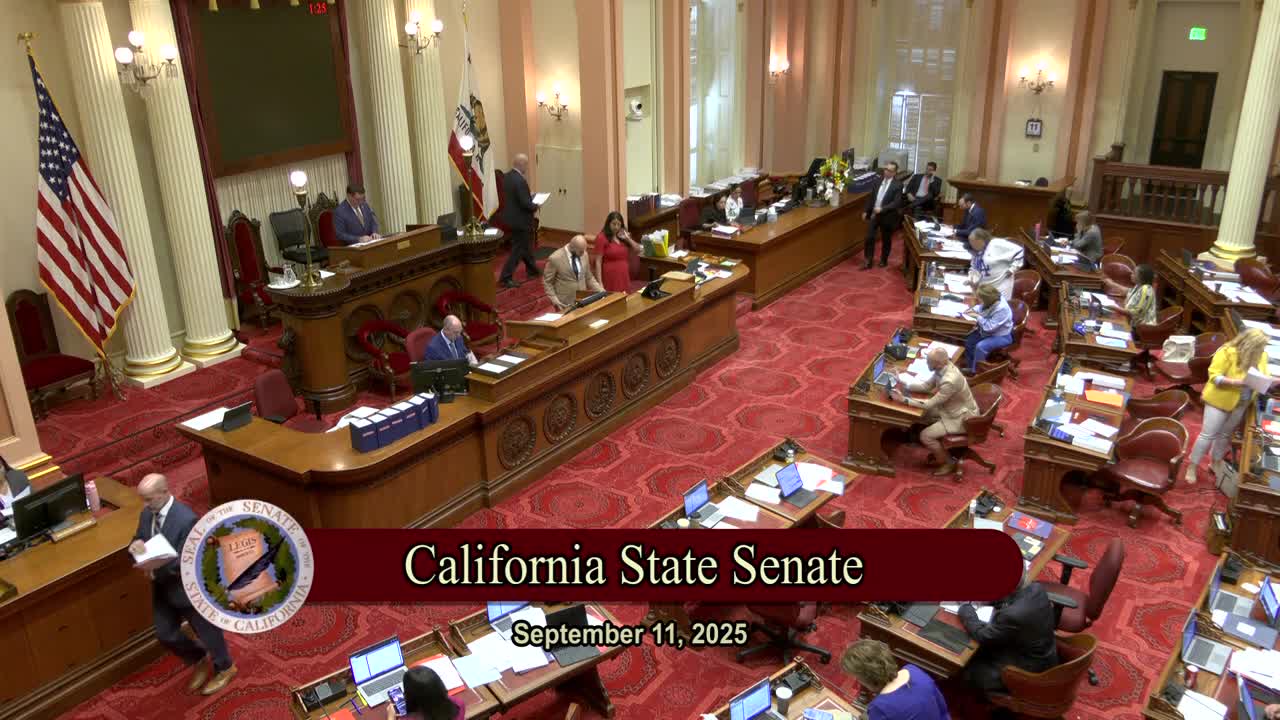
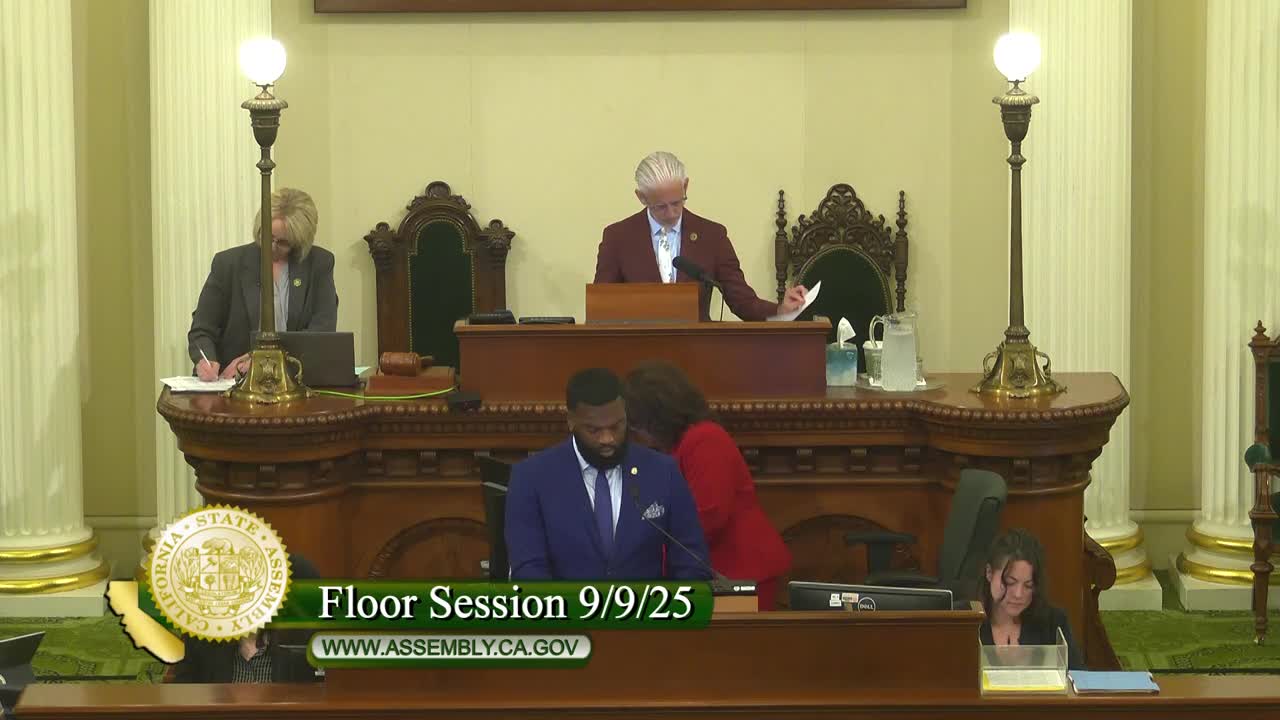
Bill Author

Bill Co-Author(s):