SJR 12: Proposed 2026–2031 National Outer Continental Shelf Oil and Gas Leasing Program: opposition.
- Session Year: 2025-2026
- House: Senate
- Latest Version Date: 2026-08-11
Current Status:
Passed
(2026-08-11: Chaptered by Secretary of State. Res. Chapter 166, Statutes of 2026.)
Introduced
In Committee
Awaiting First Chamber Vote
Passed First Chamber
In Committee
Awaiting Second Chamber Vote
Passed Second Chamber
Enacted
This measure would request that the federal Bureau of Ocean Energy Management hold public hearings in California on the proposed 20262031 National Outer Continental Shelf Oil and Gas Leasing Program, prepare an environmental impact statement to accompany the program, and provide the public the opportunity to comment on a draft programmatic environmental impact statement for potential offshore oil and gas leasing in California. The measure would strongly and unequivocally oppose any new offshore drilling and declare unequivocal support for the current federal prohibition on new oil or gas drilling in federal waters offshore of the Pacific coast.
This measure would request that the federal Bureau of Ocean Energy Management hold public hearings in California on the proposed 20262031 National Outer Continental Shelf Oil and Gas Leasing Program, prepare an environmental impact statement to accompany the program, and provide the public the opportunity to comment on a draft programmatic environmental impact statement for potential offshore oil and gas leasing in California. The measure would strongly and unequivocally oppose any new offshore drilling and declare unequivocal support for the current federal prohibition on new oil or gas drilling in federal waters offshore of the Pacific coast.
This measure would request that the federal Bureau of Ocean Energy Management hold public hearings in California on the proposed 20262031 National Outer Continental Shelf Oil and Gas Leasing Program and Program, prepare a programmatic an environmental impact statement to accompany the program. program, and provide the public the opportunity to comment on a draft programmatic environmental impact statement for potential offshore oil and gas leasing in California. The measure would strongly and unequivocally oppose any new offshore drilling and declare unequivocal support for the current federal prohibition on new oil or gas drilling in federal waters offshore of the Pacific coast.
This measure would request that the federal Bureau of Ocean Energy Management hold public hearings in California on the proposed 20262031 National Outer Continental Shelf Oil and Gas Leasing Program and prepare a programmatic environmental impact statement to accompany the program. The measure would strongly and unequivocally oppose any new offshore drilling and declare unequivocal support for the current federal prohibition on new oil or gas drilling in federal waters offshore of the Pacific coast.
WHEREAS, Californias iconic coastal and marine waters are one of our states most precious resources and, as elected officials, it is our duty to ensure the long-term viability of Californias coastal and ocean ecosystems, climate, wildlife, and thriving multibillion dollar fishing, tourism, and recreation sectors; and
WHEREAS, The United States Department of the Interiors draft proposed 20262031 National Outer Continental Shelf Oil and Gas Leasing Program would permit 34 potential offshore lease sales across 1.27 billion acres of federal waters, including 6 new leases across northern, central, and southern California in areas where there have not been any newly executed leases for offshore oil and gas development since the Reagan administration; and
WHEREAS, The federal Bureau of Ocean Energy Management is not preparing an environmental impact statement for preparation of the 20262031 National Outer Continental Shelf Oil and Gas Leasing Program, unlike it has done for previous five-year plans, and is not intending to provide the public the opportunity to comment on a draft programmatic environmental impact statement for potential offshore oil and gas leasing in California; and
WHEREAS, There have been no new offshore oil and gas leases issued in state waters since the 1969 blowout of a well in federal waters that dumped an estimated 3,000,000 gallons of crude oil into the Pacific Ocean near the County of Santa Barbara coastline, devastating wildlife, marine ecosystems, and tourism, and igniting the modern-day environmental movement in the process; and
WHEREAS, Major spills have continued to occur along the California coast, including the 2015 Refugio oil spill, which spilled approximately 140,000 gallons of crude oil along the Gaviota Coast and soiled approximately 3,700 acres of wildlife habitat while killing hundreds of marine mammals and birds and closing fisheries and state parks, and the 2021 San Pedro pipeline oil spill, which spilled approximately 25,000 gallons of crude oil off the coast of the City of Huntington Beach, soiled approximately 900 acres of wildlife habitat, impacted 13 protected areas, caused fishing closures, and affected numerous species, including the federally protected western snowy plover; and
WHEREAS, Beginning in 1921, and many times since, the California Legislature has enacted laws that withdrew certain offshore areas from oil and gas leasing, and by 1989, the states offshore oil and gas leasing moratorium was in place; and
WHEREAS, In 1994, the California Legislature enacted Assembly Bill 2444 (Chapter 970 of the Statutes of 1994) that made findings that offshore oil and gas production in certain areas of the states waters poses an unacceptably high risk of damage and disruption to the marine environment; and
WHEREAS, In the same bill, the Legislature enacted the California Coastal Sanctuary Act of 1994, which included all of the states unleased waters subject to tidal influence and prohibited new oil and gas leases in the sanctuary, unless the President of the United States, the Governor of California, and the California Legislature took further action to authorize that extraction; and
WHEREAS, In 2018, California enacted Senate Bill 834 (Chapter 309 of the Statutes of 2018) and Assembly Bill 1775 (Chapter 310 of the Statutes of 2018) to prohibit the State Lands Commission from entering into any new lease or other conveyance authorizing new construction of oil- and gas-related infrastructure on tidelands and submerged lands within state waters associated with Pacific Outer Continental Shelf leases issued after January 1, 2018; and
WHEREAS, In 2024, California enacted Senate Bill 704 (Chapter 292 of the Statutes of 2023) to amend the California Coastal Act of 1976 to ensure that any future attempts to expand offshore oil drilling off the states coast must fully comply with all enforceable policies of the California Coastal Act of 1976; and
WHEREAS, Twenty-seven municipalities in California adopted local ordinances that prohibit or require a vote of the people to approve zoning changes for onshore facilities that support offshore oil and gas development; and
WHEREAS, At least 100 municipalities across the west coast of the United States have adopted local resolutions opposing any expansion of offshore oil and gas drilling; and
WHEREAS, The existing offshore oil platforms in federal waters off the California coast have reached or are reaching the end of their productive lives, averaging over 46 years in age with one almost 60 years old, about one-third serve expired leases, and offshore oil production is relatively expensive compared to production on land, reducing its economic viability, particularly as the state moves toward clean energy solutions; and
WHEREAS, In December 2023, the United States Department of the Interior published its final 20242029 National Outer Continental Shelf Oil and Gas Leasing Program, which did not include any offshore oil and gas lease sales on the Pacific shelf; and
WHEREAS, On January 6, 2025, President Joseph Biden issued a memorandum to withdraw, among other areas, all of the Pacific planning areas from future oil and gas leasing pursuant to Section 12(a) of the Outer Continental Shelf Lands Act (OCSLA; 43 U.S.C. Sec. 1341(a)), to ensure the region can remain healthy and safe from the risk of oil spills resulting from development that would do little, if anything, to meet the nations energy needs; and
WHEREAS, Consistent with the mission of the United States military to protect the American people and our homeland, waters off the California coast host a significant number of military installations, key logistics routes, and special use airspace. Offshore oil and gas development and associated spills in areas where our servicemembers routinely operate would impede critical training, testing, and other military readiness efforts compromising national security; and
WHEREAS, According to the National Oceanic and Atmospheric Administration, in 2021, a healthy, clean, and biodiverse ocean supports more than 350,000 jobs, paying over $12 billion in wages, and generating almost $26 billion in annual economic activity through fishing, tourism, and recreation along Californias coast. Expanding drilling would threaten the industries that sustain our coastal communities while providing minimal economic benefit in return; and
WHEREAS, The Legislature has led the nation with its landmark climate change legislation, ambitiously requiring that statewide greenhouse gas emissions be reduced to at least 85 percent below their 1990 level by 2045, achieve net zero greenhouse gas emissions by 2045, achieve a renewables portfolio standard of 100 percent by 2045, and conserve 30 percent of Californias lands and coastal waters by 2030. California must lead the nation in fostering the transition away from offshore fossil fuel production to protect both our climate and oceans from the damaging impacts of climate change, which will affect all life on earth for generations to come; and
WHEREAS, Members of the United States Senate and the United States House of Representatives representing California have, over successive Congresses into this Congress, introduced bills to permanently protect Californias coasts from oil and gas leasing disposition and new drilling with our support; now, therefore, be it
Resolved by the Senate and the Assembly of the State of California, jointly, That the Legislature considers new oil and gas offshore drilling to be a threat to the nations and the states ocean environment and wildlife, ancestral lands and waters of California Native American tribes, marine and coastal economy, national security, and the well-being of all Californians, and it is inconsistent with the states ambitious renewable energy goal; and be it further
Resolved, That the Legislature requests that the federal Bureau of Ocean Energy Management hold public hearings on the proposed leasing plan in the State of California to ensure that all Californians have an opportunity to have their voices heard; and be it further
Resolved, That the Legislature requests that the federal Bureau of Ocean Energy Management prepare an environmental impact statement to accompany the 20262031 National Outer Continental Shelf Oil and Gas Leasing Program and provide the public the opportunity to comment on a draft programmatic environmental impact statement for potential offshore oil and gas leasing in California; and be it further
Resolved, That the Legislature strongly and unequivocally opposes any new offshore drilling, including the federal governments proposed leasing plan, which would expose the entire California coast to new offshore drilling and the accompanying risks to coastal environment, fishing, tourism, and recreation from an oil spill, and urges the United States Secretary of the Interior to remove California from the plan; and be it further
Resolved, That the Legislature declares unequivocal support for the current federal prohibition on new oil or gas drilling in federal waters offshore of the Pacific coast, its opposition to the proposed five-year National Outer Continental Shelf Oil and Gas Leasing Program or any attempts to modify that prohibition, and its determination to consider any appropriate actions to maintain the current prohibition; and be it further
Resolved, That the Secretary of the Senate transmit copies of this resolution to the President and Vice President of the United States, to the Governor of California, to the Majority and Minority Leaders of the United States Senate, to the Speaker and Minority Leader of the United States House of Representatives, to each Senator and Representative from California in the Congress of the United States, to the Secretary of the United States Department of the Interior, to the Acting Director of the Bureau of Ocean Energy Management, and to each member of the California State Senate and Assembly.
WHEREAS, Californias iconic coastal and marine waters are one of our states most precious resources and, as elected officials, it is our duty to ensure the long-term viability of Californias coastal and ocean ecosystems, climate, wildlife, and thriving multibillion dollar fishing, tourism, and recreation sectors; and
WHEREAS, The United States Department of the Interiors draft proposed 20262031 National Outer Continental Shelf Oil and Gas Leasing Program would permit 34 potential offshore lease sales across 1.27 billion acres of federal waters, including 6 new leases across northern, central, and southern California in areas where there have not been any newly executed leases for offshore oil and gas development since the Reagan administration; and
WHEREAS, The federal Bureau of Ocean Energy Management is not preparing a programmatic environmental impact statement nor thoroughly considering the environmental impacts of this action in the preparation of the 20262031 National Outer Continental Shelf Oil and Gas Leasing Program; andWHEREAS, The federal Bureau of Ocean Energy Management is not preparing an environmental impact statement for preparation of the 20262031 National Outer Continental Shelf Oil and Gas Leasing Program, unlike it has done for previous five-year plans, and is not intending to provide the public the opportunity to comment on a draft programmatic environmental impact statement for potential offshore oil and gas leasing in California; and
WHEREAS, There have been no new offshore oil and gas leases issued in state waters since the 1969 blowout of a well in federal waters that dumped an estimated 3,000,000 gallons of crude oil into the Pacific Ocean near the County of Santa Barbara coastline, devastating wildlife, marine ecosystems, and tourism, and igniting the modern-day environmental movement in the process; and
WHEREAS, Major spills have continued to occur along the California coast, including the 2015 Refugio oil spill, which spilled approximately 140,000 gallons of crude oil along the Gaviota Coast and soiled approximately 3,700 acres of wildlife habitat while killing hundreds of marine mammals and birds and closing fisheries and state parks, and the 2021 San Pedro pipeline oil spill, which spilled approximately 25,000 gallons of crude oil off the coast of the City of Huntington Beach, soiled approximately 900 acres of wildlife habitat, impacted 13 protected areas, caused fishing closures, and affected numerous species, including the federally protected western snowy plover; and
WHEREAS, Beginning in 1921, and many times since, the California Legislature has enacted laws that withdrew certain offshore areas from oil and gas leasing, and by 1989, the states offshore oil and gas leasing moratorium was in place; and
WHEREAS, In 1994, the California Legislature enacted Assembly Bill 2444 (Chapter 970 of the Statutes of 1994) that made findings that offshore oil and gas production in certain areas of the states waters poses an unacceptably high risk of damage and disruption to the marine environment; and
WHEREAS, In the same bill, the Legislature enacted the California Coastal Sanctuary Act of 1994, which included all of the states unleased waters subject to tidal influence and prohibited new oil and gas leases in the sanctuary, unless the President of the United States, the Governor of California, and the California Legislature took further action to authorize that extraction; and
WHEREAS, In 2018, California enacted Senate Bill 834 (Chapter 309 of the Statutes of 2018) and Assembly Bill 1775 (Chapter 310 of the Statutes of 2018) to prohibit the State Lands Commission from entering into any new lease or other conveyance authorizing new construction of oil- and gas-related infrastructure on tidelands and submerged lands within state waters associated with Pacific Outer Continental Shelf leases issued after January 1, 2018; and
WHEREAS, In 2024, California enacted Senate Bill 704 (Chapter 292 of the Statutes of 2023) to amend the California Coastal Act of 1976 to ensure that any future attempts to expand offshore oil drilling off the states coast must fully comply with all enforceable policies of the California Coastal Act of 1976; and
WHEREAS, Twenty-seven municipalities in California adopted local ordinances that prohibit or require a vote of the people to approve zoning changes for onshore facilities that support offshore oil and gas development; and
WHEREAS, At least 100 municipalities across California the west coast of the United States have adopted local resolutions opposing any expansion of offshore oil and gas drilling; and
WHEREAS, The existing offshore oil platforms in federal waters off the California coast have reached or are reaching the end of their productive lives, averaging over 46 years in age with one almost 60 years old, about one-third serve expired leases, and offshore oil production is relatively expensive compared to production on land, reducing its economic viability, particularly as the state moves toward clean energy solutions; and
WHEREAS, In December 2023, the United States Department of the Interior published its final 20242029 National Outer Continental Shelf Oil and Gas Leasing Program, which did not include any offshore oil and gas lease sales on the Pacific shelf; and
WHEREAS, On January 6, 2025, President Joseph Biden issued a memorandum to withdraw, among other areas, all of the Pacific planning areas from future oil and gas leasing pursuant to Section 12(a) of the Outer Continental Shelf Lands Act (OCSLA; 43 U.S.C. Sec. 1341(a)), to ensure the region can remain healthy and safe from the risk of oil spills resulting from development that would do little, if anything, to meet the nations energy needs; and
WHEREAS, Consistent with the mission of the United States military to protect the American people and our homeland, waters off the California coast host a significant number of military installations, key logistics routes, and special use airspace. Offshore oil and gas development and associated spills in areas where our servicemembers routinely operate would impede critical training, testing, and other military readiness efforts compromising national security; and
WHEREAS, According to the National Oceanic and Atmospheric Administration, in 2021, a healthy, clean, and biodiverse ocean supports more than 350,000 jobs, paying over $12 billion in wages, and generating almost $26 billion in annual economic activity through fishing, tourism, and recreation along Californias coast. Expanding drilling would threaten the industries that sustain our coastal communities while providing minimal economic benefit in return; and
WHEREAS, The Legislature has led the nation with its landmark climate change legislation, ambitiously requiring that statewide greenhouse gas emissions be reduced to at least 85 percent below their 1990 level by 2045, achieve net zero greenhouse gas emissions by 2045, achieve a renewables portfolio standard of 100 percent by 2045, and conserve 30 percent of Californias lands and coastal waters by 2030. California must lead the nation in fostering the transition away from offshore fossil fuel production to protect both our climate and oceans from the damaging impacts of climate change, which will affect all life on earth for generations to come; and
WHEREAS, Members of the United States Senate and the United States House of Representatives representing California have, over successive Congresses into this Congress, introduced bills to permanently protect Californias coasts from oil and gas leasing disposition and new drilling with our support; now, therefore, be it
Resolved by the Senate and the Assembly of the State of California, jointly, That the Legislature considers new oil and gas offshore drilling to be a threat to the nations and the states ocean environment and wildlife, ancestral lands and waters of California Native American tribes, marine and coastal economy, national security, and the well-being of all Californians, and it is inconsistent with the states ambitious renewable energy goal; and be it further
Resolved, That the Legislature requests that the federal Bureau of Ocean Energy Management hold public hearings on the proposed leasing plan in the State of California to ensure that all Californians have an opportunity to have their voices heard; and be it further
Resolved, That the Legislature requests that the federal Bureau of Ocean Energy Management prepare a programmatic environmental impact statement to accompany the 20262031 National Outer Continental Shelf Oil and Gas Leasing Program; and be it furtherResolved, That the Legislature requests that the federal Bureau of Ocean Energy Management prepare an environmental impact statement to accompany the 20262031 National Outer Continental Shelf Oil and Gas Leasing Program and provide the public the opportunity to comment on a draft programmatic environmental impact statement for potential offshore oil and gas leasing in California; and be it further
Resolved, That the Legislature strongly and unequivocally opposes any new offshore drilling, including the federal governments proposed leasing plan, which would expose the entire California coast to new offshore drilling and the accompanying risks to coastal environment, fishing, tourism, and recreation from an oil spill, and urges the United States Secretary of the Interior to remove California from the plan; and be it further
Resolved, That the Legislature declares unequivocal support for the current federal prohibition on new oil or gas drilling in federal waters offshore of the Pacific coast, its opposition to the proposed five-year National Outer Continental Shelf Oil and Gas Leasing Program or any attempts to modify that prohibition, and its determination to consider any appropriate actions to maintain the current prohibition; and be it further
Resolved, That the Secretary of the Senate transmit copies of this resolution to the President and Vice President of the United States, to the Governor of California, to the Majority and Minority Leaders of the United States Senate, to the Speaker and Minority Leader of the United States House of Representatives, to each Senator and Representative from California in the Congress of the United States, to the Secretary of the United States Department of the Interior, to the Acting Director of the Bureau of Ocean Energy Management, and to each member of the California State Senate and Assembly.
WHEREAS, Californias iconic coastal and marine waters are one of our states most precious resources and, as elected officials, it is our duty to ensure the long-term viability of Californias coastal and ocean ecosystems, climate, wildlife, and thriving multibillion dollar fishing, tourism, and recreation sectors; and
WHEREAS, The United States Department of the Interiors draft proposed 20262031 National Outer Continental Shelf Oil and Gas Leasing Program would permit 34 potential offshore lease sales across 1.27 billion acres of federal waters, including 6 new leases across northern, central, and southern California in areas where there have not been any newly executed leases for offshore oil and gas development since the Reagan administration; and
WHEREAS, The federal Bureau of Ocean Energy Management is not preparing a programmatic environmental impact statement nor thoroughly considering the environmental impacts of this action in the preparation of the 20262031 National Outer Continental Shelf Oil and Gas Leasing Program; and
WHEREAS, There have been no new offshore oil and gas leases issued in state waters since the 1969 blowout of a well in federal waters that dumped an estimated 3,000,000 gallons of crude oil into the Pacific Ocean near the County of Santa Barbara coastline, devastating wildlife, marine ecosystems, and tourism, and igniting the modern-day environmental movement in the process; and
WHEREAS, Major spills have continued to occur along the California coast, including the 2015 Refugio oil spill, which spilled approximately 140,000 gallons of crude oil along the Gaviota Coast and soiled approximately 3,700 acres of wildlife habitat while killing hundreds of marine mammals and birds and closing fisheries and state parks, and the 2021 San Pedro pipeline oil spill, which spilled approximately 25,000 gallons of crude oil off the coast of the City of Huntington Beach, soiled approximately 900 acres of wildlife habitat, impacted 13 protected areas, caused fishing closures, and affected numerous species, including the federally protected western snowy plover; and
WHEREAS, Beginning in 1921, and many times since, the California Legislature has enacted laws that withdrew certain offshore areas from oil and gas leasing, and by 1989, the states offshore oil and gas leasing moratorium was in place; and
WHEREAS, In 1994, the California Legislature enacted Assembly Bill 2444 (Chapter 970 of the Statutes of 1994) that made findings that offshore oil and gas production in certain areas of the states waters poses an unacceptably high risk of damage and disruption to the marine environment; and
WHEREAS, In the same bill, the Legislature enacted the California Coastal Sanctuary Act of 1994, which included all of the states unleased waters subject to tidal influence and prohibited new oil and gas leases in the sanctuary, unless the President of the United States, the Governor of California, and the California Legislature took further action to authorize that extraction; and
WHEREAS, In 2018, California enacted Senate Bill 834 (Chapter 309 of the Statutes of 2018) and Assembly Bill 1775 (Chapter 310 of the Statutes of 2018) to prohibit the State Lands Commission from entering into any new lease or other conveyance authorizing new construction of oil- and gas-related infrastructure on tidelands and submerged lands within state waters associated with Pacific Outer Continental Shelf leases issued after January 1, 2018; and
WHEREAS, In 2024, California enacted Senate Bill 704 (Chapter 292 of the Statutes of 2023) to amend the California Coastal Act of 1976 to ensure that any future attempts to expand offshore oil drilling off the states coast must fully comply with all enforceable policies of the California Coastal Act of 1976; and
WHEREAS, Twenty-seven municipalities in California adopted local ordinances that prohibit or require a vote of the people to approve zoning changes for onshore facilities that support offshore oil and gas development; and
WHEREAS, At least 100 municipalities across California have adopted local resolutions opposing any expansion of offshore oil and gas drilling; and
WHEREAS, The existing offshore oil platforms in federal waters off the California coast have reached or are reaching the end of their productive lives, averaging over 46 years in age with one almost 60 years old, about one-third serve expired leases, and offshore oil production is relatively expensive compared to production on land, reducing its economic viability, particularly as the state moves toward clean energy solutions; and
WHEREAS, In December 2023, the United States Department of the Interior published its final 20242029 National Outer Continental Shelf Oil and Gas Leasing Program, which did not include any offshore oil and gas lease sales on the Pacific shelf; and
WHEREAS, On January 6, 2025, President Joseph Biden issued a memorandum to withdraw, among other areas, all of the Pacific planning areas from future oil and gas leasing pursuant to Section 12(a) of the Outer Continental Shelf Lands Act (OCSLA; 43 U.S.C. Sec. 1341(a)), to ensure the region can remain healthy and safe from the risk of oil spills resulting from development that would do little, if anything, to meet the nations energy needs; and
WHEREAS, Consistent with the mission of the United States military to protect the American people and our homeland, waters off the California coast host a significant number of military installations, key logistics routes, and special use airspace. Offshore oil and gas development and associated spills in areas where our servicemembers routinely operate would impede critical training, testing, and other military readiness efforts compromising national security; and
WHEREAS, According to the National Oceanic and Atmospheric Administration, in 2021, a healthy, clean, and biodiverse ocean supports more than 350,000 jobs, paying over $12 billion in wages, and generating almost $26 billion in annual economic activity through fishing, tourism, and recreation along Californias coast. Expanding drilling would threaten the industries that sustain our coastal communities while providing minimal economic benefit in return; and
WHEREAS, The Legislature has led the nation with its landmark climate change legislation, ambitiously requiring that statewide greenhouse gas emissions be reduced to at least 85 percent below their 1990 level by 2045, achieve net zero greenhouse gas emissions by 2045, achieve a renewables portfolio standard of 100 percent by 2045, and conserve 30 percent of Californias lands and coastal waters by 2030. California must lead the nation in fostering the transition away from offshore fossil fuel production to protect both our climate and oceans from the damaging impacts of climate change, which will affect all life on earth for generations to come; and
WHEREAS, Members of the United States Senate and the United States House of Representatives representing California have, over successive Congresses into this Congress, introduced bills to permanently protect Californias coasts from oil and gas leasing disposition and new drilling with our support; now, therefore, be it
Resolved by the Senate and the Assembly of the State of California, jointly, That the Legislature considers new oil and gas offshore drilling to be a threat to the nations and the states ocean environment and wildlife, ancestral lands and waters of California Native American tribes, marine and coastal economy, national security, and the well-being of all Californians, and it is inconsistent with the states ambitious renewable energy goal; and be it further
Resolved, That the Legislature requests that the federal Bureau of Ocean Energy Management hold public hearings on the proposed leasing plan in the State of California to ensure that all Californians have an opportunity to have their voices heard; and be it further
Resolved, That the Legislature requests that the federal Bureau of Ocean Energy Management prepare a programmatic environmental impact statement to accompany the 20262031 National Outer Continental Shelf Oil and Gas Leasing Program; and be it further
Resolved, That the Legislature strongly and unequivocally opposes any new offshore drilling, including the federal governments proposed leasing plan, which would expose the entire California coast to new offshore drilling and the accompanying risks to coastal environment, fishing, tourism, and recreation from an oil spill, and urges the United States Secretary of the Interior to remove California from the plan; and be it further
Resolved, That the Legislature declares unequivocal support for the current federal prohibition on new oil or gas drilling in federal waters offshore of the Pacific coast, its opposition to the proposed five-year National Outer Continental Shelf Oil and Gas Leasing Program or any attempts to modify that prohibition, and its determination to consider any appropriate actions to maintain the current prohibition; and be it further
Resolved, That the Secretary of the Senate transmit copies of this resolution to the President and Vice President of the United States, to the Governor of California, to the Majority and Minority Leaders of the United States Senate, to the Speaker and Minority Leader of the United States House of Representatives, to each Senator and Representative from California in the Congress of the United States, to the Secretary of the United States Department of the Interior, to the Acting Director of the Bureau of Ocean Energy Management, and to each member of the California State Senate and Assembly.
|
Date
|
Status
|
|---|---|
| Aug 11, 2026 | Chaptered by Secretary of State. Res. Chapter 166, Statutes of 2026. |
| Aug 11, 2026 | Enrolled and filed with the Secretary of State at 1 p.m. |
| Aug 4, 2026 | In Senate. Ordered to engrossing and enrolling. |
| Aug 3, 2026 | Read. Adopted. (Ayes 56. Noes 13. Page 6038.) Ordered to the Senate. |
| Aug 3, 2026 | Read. Adopted. Ordered to the Senate. |
| Aug 3, 2026 | Coauthors revised. |
| Jun 9, 2026 | From committee: Be adopted. Ordered to third reading. (Ayes 9. Noes 4.) (June 8). |
| May 26, 2026 | Referred to Com. on NAT. RES. |
| Apr 23, 2026 | In Assembly. Held at Desk. |
| Apr 23, 2026 | Read. Adopted. (Ayes 27. Noes 8.) Ordered to the Assembly. |
| Apr 23, 2026 | Read. Adopted. (Ayes 27. Noes 8. Page 4030.) Ordered to the Assembly. |
| Mar 24, 2026 | From committee: Be adopted. Ordered to third reading. (Ayes 5. Noes 1.) (March 24). |
| Mar 24, 2026 | From committee: Be adopted. Ordered to third reading. (Ayes 5. Noes 1. Page 3660.) (March 24). |
| Mar 16, 2026 | From committee with author's amendments. Read second time and amended. Re-referred to Com. on N.R. & W. |
| Mar 11, 2026 | Set for hearing March 24. |
| Jan 21, 2026 | Re-referred to Com. on N.R. & W. |
| Jan 13, 2026 | Introduced. Referred to Com. on RLS. |
|
Date
|
Description
|
Location
|
Votes
|
|
|---|---|---|---|---|
| Aug 3, 2026 | SJR 12 Laird Senate Third Reading By Hart | Assembly Floor |
Passed |
|
| Jun 8, 2026 | Be adopted and re-referred to the Committee on [Appropriations] | Assembly Standing Committee on Natural Resources |
Passed |
|
| Jun 8, 2026 | Be adopted. To third reading. | Assembly Standing Committee on Natural Resources |
Passed |
|
| Apr 23, 2026 | Senate 3rd Reading SJR12 Laird et al. | Senate Floor |
Passed |
|
| Mar 24, 2026 | Be adopted. Ordered to third reading | Senate Standing Committee on Natural Resources and Water |
Passed |
This list shows positions taken on this bill by organizations on the date displayed, which is linked to the original source.
Positions by individuals are not included.
|
Organization
|
Position
|
Date
|
|---|---|---|
| 350 Humboldt | ** Support | |
| 350 Santa Barbara | ** Support | |
| Active San Gabriel Valley | ** Support | |
| Azul | ** Support | |
| Azul, Bixby Residential, Inc. | ** Support | |
| Bixby Residential, Inc. | ** Support | |
| California Coastal Protection Network | ** Support | |
| California Coastkeeper Alliance | ** Support | |
| California Environmental Voters | ** Support | |
| California Land Watch | ** Support | |
| Calwild | ** Support | |
| Catholic Charities of Stockton | ** Support | |
| Center For Biological Diversity | ** Support | |
| Center For Environmental Health | ** Support | |
| city of carlsbad | ** Support | |
| Clean Water Action | ** Support | |
| cleanearth4kids.org | ** Support | |
| Climate Action California | ** Support | |
| Climate First: Replacing Oil & Gas | ** Support | |
| Climate First: Replacing Oil & Gas (CFROG) | ** Support | |
| Cluesb | ** Support | |
| Coastal Corridor Alliance | ** Support | |
| Defenders Of Wildlife | ** Support | |
| Earth Island Institute – International Marine Mammal Project | ** Support | |
| Environment California | ** Support | |
| Environmental Action Committee of West Marin | ** Support | |
| Environmental Defense Center | ** Support | |
| Environmental Justice Catholic Charities of Stockton | ** Support | |
| Fish On | ** Support | |
| Friends Committee On Legislation Of California | ** Support | |
| FutureSwell | ** Support | |
| Heal the Ocean | ** Support | |
| Humboldt Waterkeeper | ** Support | |
| International Marine Mammal Project of Earth Island Institute | ** Support | |
| League Of California Cities | ** Support | |
| Monterey Bay Aquarium | ** Support | |
| Ocean Conservancy | ** Support | |
| Ocean Conservation Research | ** Support | |
| Oceana | ** Support | |
| Orange County Coastkeeper | ** Support | |
| Resource Renewal Institute | ** Support | |
| San Francisco Baykeeper | ** Support | |
| Santa Barbara Channelkeeper | ** Support | |
| Santa Cruz Climate Action Network | ** Support | |
| Save Our Shores | ** Support | |
| Save The Bay | ** Support | |
| Sempervirens Fund | ** Support | |
| Sierra Club California | ** Support | |
| Surfrider Foundation | ** Support | |
| The CORE Project | ** Support | |
| Tomales Bay Foundation | ** Support | |
| Turtle Island Restoration Network | ** Support | |
| Wildcoast | ** Support |
SENATE THIRD READING
STR Bill Id:SJR 12
Author:(Laird)
As Amended Ver:March 16, 2026
Majority vote
SUMMARY
Declares the Legislature′s strong and unequivocal opposition to the proposed leasing of federal lands offshore California for oil and gas development given the risks to coastal resources, recreation and economy, and the Legislature′s commitment to take action to maintain the existing prohibition on new federal leasing.
Major Provisions
- Resolves that the Legislature considers new oil and gas offshore drilling to be a threat to the nation′s and the state′s ocean environment and wildlife, ancestral lands and waters of California Native American tribes, marine and coastal economy, national security, and the well-being of all Californians, and that it is inconsistent with the state′s ambitious renewable energy goals.
- Requests the federal Bureau of Ocean Energy Management (BOEM) to hold public hearings on the proposed leasing plan in California.
- Requests BOEM to prepare a programmatic environmental impact statement to accompany the 2026–2031 National Outer Continental Shelf Oil and Gas Leasing Program.
- Requests BOEM to prepare an environmental impact statement to accompany the 2026–2031 National Outer Continental Shelf Oil and Gas Leasing Program and provide the public the opportunity to comment on a draft programmatic environmental impact statement for potential offshore oil and gas leasing in California.
- Resolves that the Legislature strongly and unequivocally opposes any new offshore drilling, including the federal government′s proposed leasing plan, which would expose the entire California coast to new offshore drilling and the accompanying risks to coastal environment, fishing, tourism, and recreation from an oil spill, and urges the United States (U.S.) Secretary of the Interior to remove California from the plan.
- Resolves that the Legislature declares unequivocal support for the current federal prohibition on new oil or gas drilling in federal waters offshore of the Pacific coast, its opposition to the proposed five-year National Outer Continental Shelf Oil and Gas Leasing Program or any attempts to modify that prohibition, and its determination to consider any appropriate actions to maintain the current prohibition.
COMMENTS
- State moratorium on offshore oil drilling. Since 1938, SLC has had jurisdiction over the leasing of oil and gas from offshore state lands. Between 1938 and 1968, more than 50 offshore oil and gas leases were issued by SLC. Under standard protocol, the leases that SLC issued were either devoid of a fixed end date or were subsequently amended to remove an end date. The lease terms typically provide that the leases last as long as oil and gas is being produced in paying or commercial quantities. When production ceases, a lease is quitclaimed back to SLC once the infrastructure has been removed and the lease terms satisfied.
SLC established a moratorium on new offshore oil and gas leases after the 1969 oil spill in Santa Barbara, though ten of those leases issued before 1969 continue operations.
In 1994, the California Legislature enacted AB 2444 (O′Connell), Chapter 970, Statutes of 1994, establishing the California Coastal Sanctuary Act of 1994. This Act placed the entire coast from the Mexican border north to the California-Oregon border in a permanent sanctuary, except for those offshore lands subject to a lease for the extraction of oil or gas in effect on January 1, 1995, and those waters in the Sacramento/San Joaquin Delta east of the Carquinez Bridges.
In 2018, California enacted SB 834 (Jackson), Chapter 309, Statutes of 2018, and AB 1775 (Muratsuchi), Chapter 310, Statutes of 2018, to prohibit SLC from entering into any new lease or other conveyance authorizing new construction of oil- and gas-related infrastructure on tidelands and submerged lands within state waters associated with Pacific Outer Continental Shelf leases issued after January 1, 2018.
Generally, state lands extend three miles from the coast; beyond this distance is under federal jurisdiction. The federal government imposed a moratorium on new leases in federal waters off California in 1984. In January of 2025, President Biden blocked drilling for oil in more than 625 million acres of U.S. ocean — the entire East Coast and West Coast, the eastern Gulf of Mexico, and a portion of the Bering Sea. President Biden′s action prohibited new leases in the identified regions. Courts have found that the federal Offshore Continental Shelf Lands Act allows a president to protect waters indefinitely and doesn′t include any explicit provision for removing that protection.
- Trump Administration′s proposal for offshore oil drilling. President Trump signed an executive order on the first day of his second term reversing President Biden′s ban on future offshore oil drilling off both U.S. coasts. A federal court subsequently struck down President Biden′s order to withdraw federal waters from oil development. In November 2025, the Trump Administration announced new oil drilling off the California and Florida coasts for the first time in decades and proposed six offshore lease sales between 2027 and 2030 in areas along the California coast.
The U.S. Department of the Interior′s draft proposed 2026–2031 National Outer Continental Shelf Oil and Gas Leasing Program would permit 34 potential offshore lease sales across 1.27 billion acres of federal waters, including 6 new leases across northern, central, and southern California in areas where there have not been any newly executed leases for offshore oil and gas development since the Reagan Administration.
As a result of the conflict in Iran and the closure of the Strait of Hormuz, oil prices have skyrocketed, topping $120 per barrel in May. In early March, to buffer increasing gas prices, President Trump signed an executive order invoking the Defense Production Act (DPA) to override state regulators to increase domestic supply of crude oil into the California market by approximately 17%.
A Center for Biological Diversity analysis[1] predicts that the federal Administration′s latest offshore drilling plan could result in up to 886 oil spills off California, releasing roughly 1.9 million gallons of oil on our coast.
BOEM is not preparing an environmental impact statement for preparation of the 2026–2031 National Outer Continental Shelf Oil and Gas Leasing Program, unlike it has done for the previous five-year plans, and is not intending to provide the public the opportunity to comment on a draft programmatic environmental impact statement for potential offshore oil and gas leasing in California.
Exacerbating California′s carbon neutrality goal challenges, President Trump is paying $885 million to two energy companies to voluntarily walk away from their BOEM-issued leases for offshore wind off California′s coast in exchange for the offshore wind developers making an equal investment to develop U.S. oil and gas assets, energy infrastructure, or liquefied natural gas projects.
- SJR 12. This resolution requests that BOEM hold public hearings on the proposed leasing plan and to prepare programmatic environmental impact statements and resolves that the Legislature strongly and unequivocally opposes any new offshore drilling.
According to the Author
California′s coast is integral to our environment, economy, and identity. The federal administration′s proposed 2026–2031 National Outer Continental Shelf Oil and Gas Leasing Program would open up California′s coast to new drilling and increase fossil fuel emissions and have devastating impacts on marine ecosystems and coastal communities. Senate Joint Resolution 12 affirms the California Legislature′s opposition to the proposed plan and our commitment to protect marine ecosystems, transition to clean energy, and support coastal economies. This resolution makes clear that Californians, as well as leaders across the country, oppose a reckless offshore drilling plan that ignores environmental risks and input from the public.
Arguments in Support
A coalition of supporters state:
Waters off California′s more than 3,000 miles of iconic coastline are an invaluable treasure to Californians, supporting globally significant epicenters of biodiversity, multi-billion-dollar fisheries and tourism-dependent businesses, military readiness, and irreplaceable resources of cultural and historical significance. This is why more than 100 municipalities across the West Coast and nearly every coastal county in California have adopted positions opposing any expansion of offshore oil and gas drilling off our state.
Arguments in Opposition
None on file
FISCAL COMMENTS
Nonfiscal
VOTES
SENATE FLOOR: 27-8-5
YES: Allen, Archuleta, Arreguín, Ashby, Becker, Blakespear, Cabaldon, Caballero, Cervantes, Cortese, Durazo, Gonzalez, Grayson, Laird, Limón, McGuire, McNerney, Menjivar, Padilla, Pérez, Richardson, Rubio, Smallwood-Cuevas, Stern, Umberg, Weber Pierson, Wiener
NO: Alvarado-Gil, Choi, Dahle, Grove, Jones, Niello, Seyarto, Valladares
ABS, ABST OR NV: Hurtado, Ochoa Bogh, Reyes, Strickland, Wahab
ASM NATURAL RESOURCES: 9-4-1
YES: Bryan, Connolly, Garcia, Haney, Kalra, Pellerin, Schultz, Wicks, Zbur
NO: Ellis, Alanis, Hoover, Macedo
ABS, ABST OR NV: Muratsuchi
UPDATED
VERSION: March 16, 2026
CONSULTANT: Paige Brokaw / NAT. RES. / (916) 319-2092 FN: 0003157
SENATE THIRD READING
STR Bill Id:SJR 12
Author:(Laird)
As Amended Ver:March 16, 2026
Majority vote
SUMMARY
Declares the Legislature′s strong and unequivocal opposition to the proposed leasing of federal lands offshore California for oil and gas development given the risks to coastal resources, recreation and economy, and the Legislature′s commitment to take action to maintain the existing prohibition on new federal leasing.
Major Provisions
- Resolves that the Legislature considers new oil and gas offshore drilling to be a threat to the nation′s and the state′s ocean environment and wildlife, ancestral lands and waters of California Native American tribes, marine and coastal economy, national security, and the well-being of all Californians, and that it is inconsistent with the state′s ambitious renewable energy goals.
- Requests BOEM to hold public hearings on the proposed leasing plan in California.
- Requests BOEM to prepare a programmatic environmental impact statement to accompany the 2026–2031 National Outer Continental Shelf Oil and Gas Leasing Program.
- Requests BOEM to prepare an environmental impact statement to accompany the 2026–2031 National Outer Continental Shelf Oil and Gas Leasing Program and provide the public the opportunity to comment on a draft programmatic environmental impact statement for potential offshore oil and gas leasing in California.
- Resolves that the Legislature strongly and unequivocally opposes any new offshore drilling, including the federal government′s proposed leasing plan, which would expose the entire California coast to new offshore drilling and the accompanying risks to coastal environment, fishing, tourism, and recreation from an oil spill, and urges the United States (U.S.) Secretary of the Interior to remove California from the plan.
- Resolves that the Legislature declares unequivocal support for the current federal prohibition on new oil or gas drilling in federal waters offshore of the Pacific coast, its opposition to the proposed five-year National Outer Continental Shelf Oil and Gas Leasing Program or any attempts to modify that prohibition, and its determination to consider any appropriate actions to maintain the current prohibition.
COMMENTS
- State moratorium on offshore oil drilling. Since 1938, SLC has had jurisdiction over the leasing of oil and gas from offshore state lands. Between 1938 and 1968, more than 50 offshore oil and gas leases were issued by SLC. Under standard protocol, the leases that SLC issued were either devoid of a fixed end date or were subsequently amended to remove an end date. The lease terms typically provide that the leases last as long as oil and gas is being produced in paying or commercial quantities. When production ceases, a lease is quitclaimed back to SLC once the infrastructure has been removed and the lease terms satisfied.
SLC established a moratorium on new offshore oil and gas leases after the 1969 oil spill in Santa Barbara, though ten of those leases issued before 1969 continue operations.
In 1994, the California Legislature enacted AB 2444 (O′Connell), Chapter 970, Statutes of 1994, establishing the California Coastal Sanctuary Act of 1994. This Act placed the entire coast from the Mexican border north to the California-Oregon border in a permanent sanctuary, except for those offshore lands subject to a lease for the extraction of oil or gas in effect on January 1, 1995, and those waters in the Sacramento/San Joaquin Delta east of the Carquinez Bridges.
In 2018, California enacted SB 834 (Jackson), Chapter 309, Statutes of 2018, and AB 1775 (Muratsuchi), Chapter 310, Statutes of 2018, to prohibit SLC from entering into any new lease or other conveyance authorizing new construction of oil- and gas-related infrastructure on tidelands and submerged lands within state waters associated with Pacific Outer Continental Shelf leases issued after January 1, 2018.
Generally, state lands extend three miles from the coast; beyond this distance is under federal jurisdiction. The federal government imposed a moratorium on new leases in federal waters off California in 1984. In January of 2025, President Biden blocked drilling for oil in more than 625 million acres of U.S. ocean — the entire East Coast and West Coast, the eastern Gulf of Mexico, and a portion of the Bering Sea. President Biden′s action prohibited new leases in the identified regions. Courts have found that the federal Offshore Continental Shelf Lands Act allows a president to protect waters indefinitely and doesn′t include any explicit provision for removing that protection.
- Trump Administration′s proposal for offshore oil drilling. President Trump signed an executive order on the first day of his second term reversing President Biden′s ban on future offshore oil drilling off both U.S. coasts. A federal court subsequently struck down President Biden′s order to withdraw federal waters from oil development. In November 2025, the Trump Administration announced new oil drilling off the California and Florida coasts for the first time in decades and proposed six offshore lease sales between 2027 and 2030 in areas along the California coast.
The U.S. Department of the Interior′s draft proposed 2026–2031 National Outer Continental Shelf Oil and Gas Leasing Program would permit 34 potential offshore lease sales across 1.27 billion acres of federal waters, including 6 new leases across northern, central, and southern California in areas where there have not been any newly executed leases for offshore oil and gas development since the Reagan Administration.
As a result of the conflict in Iran and the closure of the Strait of Hormuz, oil prices have skyrocketed, topping $120 per barrel in May. In early March, to buffer increasing gas prices, President Trump signed an executive order invoking the Defense Production Act (DPA) to override state regulators to increase domestic supply of crude oil into the California market by approximately 17%.
A Center for Biological Diversity analysis[1] predicts that the federal Administration′s latest offshore drilling plan could result in up to 886 oil spills off California, releasing roughly 1.9 million gallons of oil on our coast.
BOEM is not preparing an environmental impact statement for preparation of the 2026–2031 National Outer Continental Shelf Oil and Gas Leasing Program, unlike it has done for the previous five-year plans, and is not intending to provide the public the opportunity to comment on a draft programmatic environmental impact statement for potential offshore oil and gas leasing in California.
Exacerbating California′s carbon neutrality goal challenges, President Trump is paying $885 million to two energy companies to voluntarily walk away from their BOEM-issued leases for offshore wind off California′s coast in exchange for the offshore wind developers making an equal investment to develop U.S. oil and gas assets, energy infrastructure, or liquefied natural gas projects.
- SJR 12. This resolution requests that BOEM hold public hearings on the proposed leasing plan and to prepare programmatic environmental impact statements and resolves that the Legislature strongly and unequivocally opposes any new offshore drilling.
According to the Author
California′s coast is integral to our environment, economy, and identity. The federal administration′s proposed 2026–2031 National Outer Continental Shelf Oil and Gas Leasing Program would open up California′s coast to new drilling and increase fossil fuel emissions and have devastating impacts on marine ecosystems and coastal communities. Senate Joint Resolution 12 affirms the California Legislature′s opposition to the proposed plan and our commitment to protect marine ecosystems, transition to clean energy, and support coastal economies. This resolution makes clear that Californians, as well as leaders across the country, oppose a reckless offshore drilling plan that ignores environmental risks and input from the public.
Arguments in Support
A coalition of supporters state:
Waters off California′s more than 3,000 miles of iconic coastline are an invaluable treasure to Californians, supporting globally significant epicenters of biodiversity, multi-billion-dollar fisheries and tourism-dependent businesses, military readiness, and irreplaceable resources of cultural and historical significance. This is why more than 100 municipalities across the West Coast and nearly every coastal county in California have adopted positions opposing any expansion of offshore oil and gas drilling off our state.
Arguments in Opposition
None on file
FISCAL COMMENTS
Nonfiscal
VOTES
SENATE FLOOR: 27-8-5
YES: Allen, Archuleta, Arreguín, Ashby, Becker, Blakespear, Cabaldon, Caballero, Cervantes, Cortese, Durazo, Gonzalez, Grayson, Laird, Limón, McGuire, McNerney, Menjivar, Padilla, Pérez, Richardson, Rubio, Smallwood-Cuevas, Stern, Umberg, Weber Pierson, Wiener
NO: Alvarado-Gil, Choi, Dahle, Grove, Jones, Niello, Seyarto, Valladares
ABS, ABST OR NV: Hurtado, Ochoa Bogh, Reyes, Strickland, Wahab
ASM NATURAL RESOURCES: 9-4-1
YES: Bryan, Connolly, Garcia, Haney, Kalra, Pellerin, Schultz, Wicks, Zbur
NO: Ellis, Alanis, Hoover, Macedo
ABS, ABST OR NV: Muratsuchi
UPDATED
VERSION: March 16, 2026
CONSULTANT: Paige Brokaw / NAT. RES. / (916) 319-2092 FN: 0003157
Date of Hearing: June 8, 2026
ASSEMBLY COMMITTEE ON NATURAL RESOURCES
Isaac G. Bryan, Chair
SBPCA Bill Id:SJR 12
Author:(Laird) – As Amended Ver:March 16, 2026
SENATE VOTE: 27-8
SUBJECT: Proposed 2026–2031 National Outer Continental Shelf Oil and Gas Leasing Program: opposition
SUMMARY: Declares the Legislature’s strong and unequivocal opposition to the proposed leasing of federal lands offshore California for oil and gas development given the risks to coastal resources, recreation and economy, and the Legislature’s commitment to take action to maintain the existing prohibition on new federal leasing.
EXISTING LAW:
- Requires, pursuant to Governor Newsom’s direction, the Air Resources Board to evaluate how to phase out oil extraction by 2045 through the climate change scoping plan, the state’s comprehensive, multi-year regulatory and programmatic plan to achieve required reductions in greenhouse gas emissions. (Executive Order N-79-20)
- Provides the State Lands Commission (SLC) exclusive jurisdiction over all ungranted tidelands and submerged lands owned by the state, and of the beds of navigable rivers, streams, lakes, bays, estuaries, inlets, and straits, including tidelands and submerged lands or any interest therein, whether within or beyond the boundaries of the state as established by law, which have been or may be acquired by the state. (Public Resources Code (PRC) 6301)
- Establishes the California Environmental Quality Act to provide a process to identify the significant effects on the environment of a project, to identify alternatives to the project, and to indicate the manner in which those significant effects can be mitigated or avoided, and provides specified exemptions for wildfire risk reduction projects. (PRC 21000 et seq.)
- Establishes the Outer Continental Shelf Lands Act of 1953 establishing the federal Bureau of Ocean Energy Management (BOEM) to manage development of U.S. Outer Continental Shelf energy, mineral, and geological resources in an environmentally and economically responsible way. (43 United States Code 1331–1356c)
THIS RESOLUTION:
- Resolves that the Legislature considers new oil and gas offshore drilling to be a threat to the nation’s and the state’s ocean environment and wildlife, ancestral lands and waters of California Native American tribes, marine and coastal economy, national security, and the well-being of all Californians, and that it is inconsistent with the state’s ambitious renewable energy goals.
- Requests BOEM to hold public hearings on the proposed leasing plan in California.
- Requests BOEM to prepare a programmatic environmental impact statement to accompany the 2026–2031 National Outer Continental Shelf Oil and Gas Leasing Program.
- Requests BOEM to prepare an environmental impact statement to accompany the 2026–2031 National Outer Continental Shelf Oil and Gas Leasing Program and provide the public the opportunity to comment on a draft programmatic environmental impact statement for potential offshore oil and gas leasing in California.
- Resolves that the Legislature strongly and unequivocally opposes any new offshore drilling, including the federal government’s proposed leasing plan, which would expose the entire California coast to new offshore drilling and the accompanying risks to coastal environment, fishing, tourism, and recreation from an oil spill, and urges the United States (U.S.) Secretary of the Interior to remove California from the plan.
- Resolves that the Legislature declares unequivocal support for the current federal prohibition on new oil or gas drilling in federal waters offshore of the Pacific coast, its opposition to the proposed five-year National Outer Continental Shelf Oil and Gas Leasing Program or any attempts to modify that prohibition, and its determination to consider any appropriate actions to maintain the current prohibition.
FISCAL EFFECT: Nonfiscal
COMMENTS:
- State moratorium on offshore oil drilling. Since 1938, SLC has had jurisdiction over the leasing of oil and gas from offshore state lands. Between 1938 and 1968, more than 50 offshore oil and gas leases were issued by SLC. Under standard protocol, the leases that SLC issued were either devoid of a fixed end date or were subsequently amended to remove an end date. The lease terms typically provide that the leases last as long as oil and gas is being produced in paying or commercial quantities. When production ceases, a lease is quitclaimed back to SLC once the infrastructure has been removed and the lease terms satisfied.
SLC established a moratorium on new offshore oil and gas leases after the 1969 oil spill in Santa Barbara (photos below[1]), though ten of those leases issued before 1969 continue operations.


In 1994, the California Legislature enacted AB 2444 (O'Connell), Chapter 970, Statutes of 1994, establishing the California Coastal Sanctuary Act of 1994. This Act placed the entire coast from the Mexican border north to the California-Oregon border in a permanent sanctuary, except for those offshore lands subject to a lease for the extraction of oil or gas in effect on January 1, 1995, and those waters in the Sacramento/San Joaquin Delta east of the Carquinez Bridges.
In 2018, California enacted SB 834 (Jackson), Chapter 309, Statutes of 2018, and AB 1775 (Muratsuchi), Chapter 310, Statutes of 2018, to prohibit SLC from entering into any new lease or other conveyance authorizing new construction of oil- and gas-related infrastructure on tidelands and submerged lands within state waters associated with Pacific Outer Continental Shelf leases issued after January 1, 2018.
Generally, state lands extend three miles from the coast; beyond this distance is under federal jurisdiction. The federal government imposed a moratorium on new leases in federal waters off California in 1984. In January of 2025, President Biden blocked drilling for oil in more than 625 million acres of U.S. ocean — the entire East Coast and West Coast, the eastern Gulf of Mexico, and a portion of the Bering Sea. President Biden's action prohibited new leases in the identified regions. Courts have found that the federal Offshore Continental Shelf Lands Act allows a president to protect waters indefinitely and doesn't include any explicit provision for removing that protection.
- Trump Administration’s proposal for offshore oil drilling. President Trump signed an executive order on the first day of his second term reversing President Biden's ban on future offshore oil drilling off both U.S. coasts. A federal court subsequently struck down President Biden's order to withdraw federal waters from oil development. In November 2025, the Trump Administration announced new oil drilling off the California and Florida coasts for the first time in decades and proposed six offshore lease sales between 2027 and 2030 in areas along the California coast.
The U.S. Department of the Interior’s draft proposed 2026–2031 National Outer Continental Shelf Oil and Gas Leasing Program would permit 34 potential offshore lease sales across 1.27 billion acres of federal waters, including 6 new leases across northern, central, and southern California in areas where there have not been any newly executed leases for offshore oil and gas development since the Reagan Administration.
As a result of the conflict in Iran and the closure of the Strait of Hormuz, oil prices have skyrocketed, topping $120 per barrel in May. In early March, to buffer increasing gas prices, President Trump signed an executive order invoking the Defense Production Act (DPA) to override state regulators to increase domestic supply of crude oil into the California market by approximately 17%.
A Center for Biological Diversity analysis[2] predicts that the federal Administration’s latest offshore drilling plan could result in up to 886 oil spills off California, releasing roughly 1.9 million gallons of oil on our coast.
BOEM is not preparing an environmental impact statement for preparation of the 2026–2031 National Outer Continental Shelf Oil and Gas Leasing Program, unlike it has done for the previous five-year plans, and is not intending to provide the public the opportunity to comment on a draft programmatic environmental impact statement for potential offshore oil and gas leasing in California.
Exacerbating California’s carbon neutrality goal challenges, President Trump is paying $885 million to two energy companies to voluntarily walk away from their BOEM-issued leases for offshore wind off California’s coast in exchange for the offshore wind developers making an equal investment to develop U.S. oil and gas assets, energy infrastructure, or liquefied natural gas projects.
- SJR 12. This resolution requests that BOEM hold public hearings on the proposed leasing plan and to prepare programmatic environmental impact statements and resolves that the Legislature strongly and unequivocally opposes any new offshore drilling.
- Author’s statement:
California’s coast is integral to our environment, economy, and identity. The federal administration’s proposed 2026–2031 National Outer Continental Shelf Oil and Gas Leasing Program would open up California’s coast to new drilling and increase fossil fuel emissions and have devastating impacts on marine ecosystems and coastal communities. Senate Joint Resolution 12 affirms the California Legislature’s opposition to the proposed plan and our commitment to protect marine ecosystems, transition to clean energy, and support coastal economies. This resolution makes clear that Californians, as well as leaders across the country, oppose a reckless offshore drilling plan that ignores environmental risks and input from the public.
REGISTERED SUPPORT / OPPOSITION:
Support
350 Humboldt
350 Santa Barbara
Active San Gabriel Valley
Azul
Bixby Residential, INC.
California Coastal Protection Network
California Coastkeeper Alliance
California Environmental Voters
California Land Watch
Calwild
Catholic Charities of Stockton
Center for Biological Diversity
Center for Environmental Health
City of Carlsbad
Clean Water Action
Cleanearth4kids.org
Climate Action California
Climate First: Replacing Oil & Gas (CFROG)
Cluesb
Coastal Corridor Alliance
Defenders of Wildlife
Environment California
Environmental Action Committee of West Marin
Environmental Defense Center
Fish on
Friends Committee on Legislation of California
Futureswell
Heal the Ocean
Humboldt Waterkeeper
International Marine Mammal Project of Earth Island Institute
League of California Cities
Monterey Bay Aquarium
Ocean Conservancy
Ocean Conservation Research
Oceana
Orange County Coastkeeper
Resource Renewal Institute
San Francisco Baykeeper
Santa Barbara Channelkeeper
Santa Cruz Climate Action Network
Save Our Shores
Save the Bay
Sempervirens Fund
Sierra Club California
Surfrider Foundation
The Core Project
Tomales Bay Foundation
Turtle Island Restoration Network
Wildcoast
Opposition
None on file
Analysis Prepared by: Paige Brokaw / NAT. RES. /
SENATE RULES COMMITTEE Office of Senate Floor Analyses (916) 651-4171 | SJR 12 |
THIRD READING
Bill No: SJR 12
Author: Laird (D), et al.
Amended: 3/16/26
Vote: 21
SENATE NATURAL RES. & WATER COMMITTEE: 5-1, 3/24/26
AYES: Becker, Allen, Cabaldon, Laird, Stern
NOES: Grove
NO VOTE RECORDED: Seyarto
SUBJECT: Proposed 2026–2031 National Outer Continental Shelf Oil and Gas Leasing Program: opposition
SOURCE: Author
DIGEST:
This resolution declares the Legislature’s strong and unequivocal opposition to the proposed leasing of federal lands offshore California for oil and gas development given the risks to coastal resources, recreation and economy, and the Legislature’s commitment to take action to maintain the existing prohibition on new federal leasing; and requests the US Bureau of Ocean Engineering Management (BOEM) hold public meetings in the state in advance of any proposed leasing to receive input and prepare an appropriate environmental document for the proposed leasing, among other provisions.
ANALYSIS:
Existing federal law:
- Establishes the Outer Continental Shelf Lands Act (OCSLA)(43 U.S.C. §§1331 et seq.) that declares, among other things, that it is the national policy that the OCS is a vital national resource reserve held by the federal government for the public, which should be available for expeditious and orderly development, subject to environmental safeguards, in a manner that is consistent with the maintenance of competition and other national needs.
- Defines the OCS as all submerged lands lying between the seaward extent of the state jurisdiction and the seaward extent of federal jurisdiction.
Existing state law establishes the California Coastal Sanctuary Act of 1994 (Public Resources Code §§6240 et seq.) which prohibits the State Lands Commission from issuing new oil and gas leases for unleased state tide and submerged lands underlying the Pacific Ocean, as specified. Existing leases are authorized to remain in production.
This resolution:
- States that the California Legislature:
- Considers new oil and gas offshore drilling to be a threat to the nation’s and the state’s ocean environment and wildlife, ancestral lands and waters of California Native American tribes, marine and coastal economy, national security, and the well-being of all Californians; and inconsistent with the state’s ambitious renewable energy goal.
- Requests that BOEM hold public hearings on the proposed leasing plan in the State of California to ensure that all Californians have an opportunity to be heard.
- Requests that BOEM prepare a programmatic environmental impact statement to accompany the 2026 – 2031 National OSC Leasing Program.
- Strongly and unequivocally oppose any new offshore drilling, including the federal government’s proposed leasing plan, which would expose the entire California Coast to new offshore drilling and the accompanying risks to coastal environment, fishing, tourism, and recreation from an oil spill.
- Urges the US Secretary of the Interior to remove California from the federal government’s proposed leasing plan.
- Declares unequivocal support for the current federal prohibition on new oil or gas drilling in federal waters offshore of the Pacific coast, its opposition to the proposed five-year National OSC Leasing Program or any attempts to modify that prohibition, and its determination to consider any appropriate actions to maintain that prohibition.
- Requires the Secretary of the Senate to transmit copies of the resolution to the President and Vice President of the United States, the Governor of California, certain US Senate and Congressional leaders, the Senators and US Representatives from California, the Secretary of the US Department of the Interior, the Acting Director of BOEM, and each member of the California Legislature.
- Makes numerous findings in support of the resolution including, among others:
- In 2018 the Legislature passed and the Governor signed two bills – SB 834 (Jackson, Chapter 309, Statutes of 2018) and AB 1775 (Muratsuchi, Chapter 310, Statutes of 2018) to prohibit the commission from issuing new leases in support of the construction of new federal OCS oil and gas leases.
- In 2024, the Legislature passed and the Governor signed SB 704 (Min, Chapter 292, Statutes of 2024) to require that any new federal OCS oil and gas development had to fully comply with the California Coastal Act of 1976.
- Twenty-seven municipalities in California have passed ordinances prohibiting or requiring the vote of the people to approve zoning changes to support onshore facilities to support offshore oil and gas production. Over 100 local jurisdictions on the US West Coast have adopted resolutions opposed to an expansion of offshore oil and gas development.
- According to the National Oceanic and Atmospheric Administration, in 2021 the healthy, clean, and biodiverse ocean supports more than 350,000 jobs, paying over $12 billion in wages, and generating almost $26 billion in annual economic activity through fishing, tourism, and recreation.
Background
There are 30 federal OCS oil and gas leases offshore California. No new federal leases have been issued since 1984. The Biden Administration removed offshore California and the rest of the Pacific Coast from future federal OCS oil and gas leasing permanently in January 2025. The Trump Administration has moved to offer 6 federal OCS oil and gas lease areas offshore California as part of the 11th National OCS Oil and Gas Leasing program.
[Additional information regarding this resolution may be found in the Senate Natural Resources and Water Committee’s analysis.]
FISCAL EFFECT: Appropriation: No Fiscal Com.: No Local: No
SUPPORT: (Verified 3/24/26)
350 Humboldt
350 Santa Barbara
Active San Gabriel Valley
Azul, Bixby Residential, Inc.
California Coastal Protection Network
California Coastkeeper Alliance
California Environmental Voters
California Land Watch
Center for Biological Diversity
Center for Environmental Health
Clean Water Action
Defenders of Wildlife
CalWild
CleanEarth4Kids.org
Climate Action California,
Climate First: Replacing Oil & Gas
Coastal Corridor Alliance
Earth Island Institute – International Marine Mammal Project
Environment California
Environmental Action Committee of West Marin
Environmental Defense Center
Environmental Justice Catholic Charities of Stockton
Fish On
Friends Committee on Legislation of California
FutureSwell
Heal the Ocean
Humboldt Waterkeeper
League of California Cities
Monterey Bay Aquarium
Ocean Conservancy
Ocean Conservation Research
Oceana
Orange County Coastkeeper
Resource Renewal Institute
San Francisco Baykeeper
Santa Barbara Channelkeeper
Santa Cruz Climate Action Network
Save Our Shores
Save The Bay
Sempervirens Fund
Sierra Club California
Surfrider Foundation
The CORE Project
Tomales Bay Foundation
Turtle Island Restoration Network
WILDCOAST
OPPOSITION: (Verified 3/24/26)
None received
ARGUMENTS IN SUPPORT: According to the author, “California’s coast is integral to our environment, economy, and identity. The federal administration’s proposed 2026–2031 National Outer Continental Shelf Oil and Gas Leasing Program would open up California’s coast to new drilling and increase fossil fuel emissions and have devastating impacts on marine ecosystems and coastal communities. Senate Joint Resolution 12 affirms the California Legislature’s opposition to the proposed plan and our commitment to protect marine ecosystems, transition to clean energy, and support coastal economies. This resolution makes clear that Californians, as well as leaders across the country, oppose a reckless offshore drilling plan that ignores environmental risks and input from the public.”
Prepared by: Katharine Moore / N.R. & W. / (916) 651-4116
3/25/26 16:15:08
**** END ****
SENATE COMMITTEE ON NATURAL RESOURCES AND WATER
Senator Josh Becker, Chair
2025 - 2026 Regular
Bill No: SJR Hearing Date: March 24, 2026
Author: | |||
Version: | Amended | ||
Urgency: | Fiscal: | ||
Consultant: | |||
Subject: Proposed 2026–2031 National Outer Continental Shelf Oil and Gas Leasing Program: opposition
SUMMARY
This resolution would declare the Legislature’s strong and unequivocal opposition to the proposed leasing of federal lands offshore California for oil and gas development given the risks to coastal resources, recreation and economy, and the Legislature’s commitment to take action to maintain the existing prohibition on new federal leasing; and request the US Bureau of Ocean Engineering Management (BOEM) hold public meetings in the state in advance of any proposed leasing to receive input and prepare an appropriate environmental document for the proposed leasing, among other provisions.
BACKGROUND AND EXISTING LAW
Oil and gas production in California
According to the US Energy Information Administration, California ranked 8th in oil production among the 50 states at about 113 million barrels[1] in 2024. That year, the majority of the state’s oil production is from onshore fields in Kern County, and an estimated 4 – 5%[2] (about 5 million barrels) was produced in fields offshore Los Angeles and Orange Counties within the state’s jurisdiction. Associated gas is produced with the oil from many fields, and there is gas production alone from some fields, particularly farther north in the state.
In addition, oil and gas are produced from federal Outer Continental Shelf (OCS) waters offshore California. In general, state waters extend out 3 miles from the state’s coastline, and federal waters are beyond that. The figure on page 2 shows federal OCS offshore production from 1968 through 2022[3]. Note that production peaked in the mid-1990s and has been falling since. Production decreased notably following the major 2015 Refugio Beach oil spill of 140,000 gallons offshore Gaviota due to a corroded pipeline that the federal government ordered to return to service despite the pipeline not meeting previously-agreed upon safety requirements, lack of state and local permitting, court injunctions against re-start without notice and other conditions being met, and other litigation, among other numerous issues. Note additionally that in 2021 the major oil spill of approximately 25,000 gallons off of Huntington Beach from a pipeline in federal waters further decreased federal OCS production to about 2.7 million barrels per year.
Offshore oil and gas production in state and federal waters
According to the State Lands Commission (commission), the Legislature, beginning in 1921 and repeatedly since, has passed laws that exclude offshore areas of the state from oil and gas leasing.
According to the commission, it issued over fifty offshore oil and gas leases between 1938 and 1968. In general, lease terms provide for the leases to remain in effect so long as oil and gas production continues in paying or commercial quantities. When production ceases, a lease should be quitclaimed back to the commission once the infrastructure has been removed and the lease terms satisfied.
In January 1969 – only 2 years after federal OCS leasing began, a blowout occurred on a well drilled from one of the platforms in federal waters off of Santa Barbara which resulted in a spill of approximately 3 – 4 million gallons of crude oil. This spill oiled two hundred square miles of ocean and thirty-five miles of state coastline, and killed thousands of animals. The commission has not issued any new oil and gas leases since. The 1969 Santa Barbara oil spill was the largest in the nation until the Deepwater Horizon spill in the Gulf of Mexico in 2010.
Existing law establishes the commission in the California Natural Resources Agency. The commission has exclusive jurisdiction over ungranted tidelands and submerged lands owned by the state. The commission has had exclusive jurisdiction over the leasing of offshore state lands for oil and gas production since 1938. The commission also issues right-of-way leases for pipelines necessary to support offshore OCS oil and gas infrastructure, and onshore oil and gas infrastructure located in tidelands may also require a commission lease. The powers of the commission as to the leasing or granting of rights or privileges to lands owned by the state may also be conferred upon a local trustee of granted public trust lands to which those lands have been granted.
Existing law establishes the California Coastal Sanctuary Act of 1994 (Public Resources Code (PRC) §§6240 et seq.) which extended the then-California coastal sanctuary and removed the authority of the commission to issue new oil and gas leases for unleased tide and submerged lands underlying the Pacific Ocean with limited exceptions – in the event of an energy supply emergency resulting in certain government actions, as specified, and if a state oil and gas reservoir is being drained from federal waters. Legislative findings state that “offshore oil and gas production in certain areas of state waters poses an unacceptably high risk of damage and disruption to the marine environment of the state.” (PRC §6241)
Existing law establishes the federal Outer Continental Shelf Lands Act (OCSLA)(43 U.S.C. §§1331 et seq.) defines the OCS as all submerged lands lying between the seaward extent of the state jurisdiction and the seaward extent of federal jurisdiction.
The OCSLA declares, among other things, that it is the national policy that the OCS is a vital national resource reserve held by the federal government for the public, which should be made available for expeditious and orderly development, subject to environmental safeguards, in a manner that is consistent with the maintenance of competition and other national needs.
There are 30 existing active oil and gas leases under the OCSLA in federal waters offshore California. The leases cover approximately 153,000 acres and include 23 oil and gas platforms and hundreds of miles of pipeline. Of the 23 platforms, 20 are used for oil and gas production, one is used for processing, and two (Gail and Grace) are beginning the process of decommissioning. All 23 of the platforms are located off southern California (primarily offshore Santa Barbara, but also Ventura, Los Angeles, and Orange Counties).
The U.S. Department of Interior (DOI) is required to prepare, periodically revise, and maintain an oil and gas leasing program that consists of a schedule or proposed lease sales indicating, as precisely as possible, the size, timing, and location of leasing activity that DOI determines will best meet national energy needs for the five-year period following its approval or re-approval.
Priority leasing considerations are provided to areas where the combination of previous experience; local, state and national laws and policies; and expressions of industry interest indicate that potential leasing and development activities could be expected to proceed in an orderly manner.
The federal government imposed a moratorium on new leases in federal waters off of California in 1984. In 1990, President George H. W. Bush prevented leases from being issued in federal OCS waters offshore California and other states for 10 years under the OCSLA. President Bill Clinton extended this freeze through 2012. President George W. Bush, however, terminated the freeze in 2008, but no new leases were subsequently issued. President Barack Obama instituted a moratorium on new leases under the OCSLA from December 2016 through 2022.
However, in January 2018, the Trump Administration announced plans to reopen the then-current federal leasing plan and specifically included all of the California OCS in its initial proposal. Then-DOI Secretary Zinke stated in testimony before the U.S. Senate that he doubted that oil and gas exploration would occur in the Pacific region.
The potential reopening of federal OCS oil and gas leasing off the coast in the first Trump Administration generated considerable immediate resistance in California. Numerous state entities (including, for example, the Secretary of California Natural Resources Agency, the commission, the Attorney General, the Ocean Protection Council and the California Coastal Commission) opposed the proposed leasing, as did then-Governor Brown. Both of the state’s U.S. Senators, many members of its Congressional delegation, and members of the Legislature also publicly opposed new leasing.
Many factors were cited in opposing renewed oil and gas operations offshore in the federal OCS. These include identified flaws in the process currently being following by federal authorities, insignificant benefit of increased OCS oil and gas production to the state, significant risks to the coastal economy (including to tourism, recreation, and fisheries, among other things), significant risks to the environment (including marine protected areas), and scenic and other values, lack of apparent industry interest, changes to the energy markets, and climate change, among other things.
The efforts during the first Trump Administration to return to offshore federal OCS leasing off California waters eventually failed. The subsequent Biden Administration removed offshore California and the rest of the Pacific coast from future federal OCS oil and gas leasing permanently in January 2025 citing the need to protect the region from the risk of oil spills that would do little to meet the nation’s energy needs. The 2024 – 2029 federal OCS oil and gas leasing program developed during the Biden Administration focused new oil and gas leasing in the Gulf of Mexico only.
The second Trump Administration has moved to reverse the January 2025 drilling ban as part of a new 11th National OCS Oil and Gas Leasing program (National OCS Leasing Program). All of the Pacific coast, including six potential sales off the coast of California, has been proposed for inclusion. In addition, citing time constraints, BOEM has announced it is not preparing an environmental impact statement (EIS) for the 2026 – 2031 National OCS Leasing Program, unlike those that had been prepared previously for earlier 5-year programs, and is not intending to provide the public an opportunity to comment on a draft programmatic EIS specific to offshore California leasing[4].
Similar to previous recent attempts to reopen federal OCS oil and gas leasing offshore California, there is considerable opposition. The commission recently approved a resolution in opposition and Governor Newsom has stated his Administration’s opposition.
PROPOSED RESOLUTION
This resolution would:
- State that the California Legislature:
- Considers new oil and gas offshore drilling to be a threat to the nation’s and the state’s ocean environment and wildlife, ancestral lands and waters of California Native American tribes, marine and coastal economy, national security, and the well-being of all Californians; and inconsistent with the state’s ambitious renewable energy goal.
- Requests that BOEM hold public hearings on the proposed leasing plan in the State of California to ensure that all Californians have an opportunity to be heard.
- Requests that BOEM prepare a programmatic environmental impact statement to accompany the 2026 – 2031 National OSC Leasing Program.
- Strongly and unequivocally oppose any new offshore drilling, including the federal government’s proposed leasing plan, which would expose the entire California Coast to new offshore drilling and the accompanying risks to coastal environment, fishing, tourism, and recreation from an oil spill.
- Urges the US Secretary of the Interior to remove California from the federal government’s proposed leasing plan.
- Declares unequivocal support for the current federal prohibition on new oil or gas drilling in federal waters offshore of the Pacific coast, its opposition to the proposed five-year National OSC Leasing Program or any attempts to modify that prohibition, and its determination to consider any appropriate actions to maintain that prohibition.
- Require the Secretary of the Senate to transmit copies of the resolution to the President and Vice President of the United States, the Governor of California, certain US Senate and Congressional leaders, the Senators and US Representatives from California, the Secretary of the US Department of the Interior, the Acting Director of BOEM, and each member of the California Legislature.
- Make numerous findings in support of the resolution including, among others:
- In 2018 the Legislature passed and the Governor signed two bills – SB 834 (Jackson, Chapter 309, Statutes of 2018) and AB 1775 (Muratsuchi, Chapter 310, Statutes of 2018) to prohibit the commission from issuing new leases in support of the construction of new federal OCS oil and gas leases.
- In 2024, the Legislature passed and the Governor signed SB 704 (Min, Chapter 292, Statutes of 2024) to require that any new federal OCS oil and gas development had to fully comply with the California Coastal Act of 1976.
- Twenty-seven municipalities in California have passed ordinances prohibiting or requiring the vote of the people to approve zoning changes to support onshore facilities to support offshore oil and gas production. Over 100 local jurisdictions on the US West Coast have adopted resolutions opposed to an expansion of offshore oil and gas development.
- According to the National Oceanic and Atmospheric Administration, in 2021 the healthy, clean, and biodiverse ocean supports more than 350,000 jobs, paying over $12 billion in wages, and generating almost $26 billion in annual economic activity through fishing, tourism, and recreation.
ARGUMENTS IN SUPPORT
According to the author, “California’s coast is integral to our environment, economy, and identity. The federal administration’s proposed 2026–2031 National Outer Continental Shelf Oil and Gas Leasing Program would open up California’s coast to new drilling and increase fossil fuel emissions and have devastating impacts on marine ecosystems and coastal communities. Senate Joint Resolution 12 affirms the California Legislature’s opposition to the proposed plan and our commitment to protect marine ecosystems, transition to clean energy, and support coastal economies. This resolution makes clear that Californians, as well as leaders across the country, oppose a reckless offshore drilling plan that ignores environmental risks and input from the public.”
ARGUMENTS IN OPPOSITION
None received
COMMENTS
BOEM taking steps to rescind additional offshore bonding requirements. In February 2024, the US Government Accountability Office (GAO) released a report that found that the DOI needed to improve offshore OCS decommissioning enforcement and mitigate related risks. It found that the DOI held only about $3.5 billion in bonds against about $40 - $70 billion of potential decommissioning costs. BOEM recently announced that the additional bonding requirements imposed following the study would be rescinded.
Fracking in federal waters offshore California. In March 2026, BOEM issued a Notice of Intent to prepare an EIS for a proposed update to the Santa Clara Unit development and production plan, which would include the use of hydraulic fracturing of 16 existing wells at Platform Gilda (offshore Ventura County). Onshore and offshore in state waters fracking of oil and gas wells is illegal in California. At least one previous EIS for an offshore California OCS lease was found by a court to treat fracking inadequately.
Sable Offshore. On March 13, 2026, President Trump signed an Executive Order delegating authority to the Secretary of the US Department of Energy to invoke the Defense Production Act in the event of an energy emergency, among other provisions. Secretary Wright subsequently ordered the Santa Ynez Unit offshore California to restart production, including using the pipeline that was the source of the 2015 Refugio Beach oil spill. The ability to restart production by Sable Offshore was already the subject of litigation between multiple state and federal entities, environmental advocates, and Sable Offshore. Subsequently to Secretary Wright’s actions, the California Department of Parks and Recreation rejected Sable Offshore’s application to use pipeline placed through Gaviota State Park and ordered Sable Offshore to “immediately remove” the pipeline. On March 16, 2026, the commission voted to join litigation against the Executive Order and to consider taking action to terminate its leases that Sable Offshore operates under. On March 19, 2026, the California Coastal Commission wrote a letter to Sable Offshore stating that it needed a coastal development permit to re-start the pipeline and that its actions to re-start the pipeline were likely in violation of two separate court injunctions.
Sable Offshore says it has 540,000 barrels of oil in storage and plans to start selling oil on April 1.
Recent related resolutions
SR 73 (McGuire, enrolled February 2018) provided that the Senate strongly urged federal authorities to permanently safeguard and protect the California coast from new federal oil and gas leasing and declared the Senate’s unequivocal support for the existing federal prohibition on new oil or gas leasing in federal waters offshore the Pacific Coast, and its opposition to any efforts to lift that prohibition, as provided.
AJR 29 (Limón, Chapter 19, Resolutions of 2018) provided that the Legislature strongly and unequivocally support the current federal prohibition on new oil and gas drilling in federal waters offshore California, opposed the Trump Administration’s proposal to remove safety and environmental protections related to offshore drilling operations, and opposed the Trump Administration’s proposed leasing plan that would expose the state to new offshore drilling, urge that California be removed from the proposed leasing plan and request that the BOEM hold more than one public hearing in the state to receive comment, as provided.
SR 51 (McGuire, enrolled July 2017) provided that the Senate strongly urged the President and the U.S. Congress to permanently safeguard and protect federal waters offshore the Pacific Coast from new oil and gas leasing, and declared the Senate’s unequivocal support of the current prohibition on new oil or gas drilling in federal waters offshore of the Pacific Coast, opposed any changes to the new 5-year federal leasing program to lift that prohibition or any attempts to modify that prohibition, and stated its determination to take appropriate action in response, as provided.
SR 35 (Jackson, enrolled May 2017) provided that the Senate strongly and unequivocally supports the current federal prohibition on new oil or gas drilling in federal waters offshore California, opposed attempt to modify the prohibition, and pledged to consider actions to maintain that prohibition, as provided.
AJR 51 (Nava, Chapter 146, Resolutions of 2008) requested the US Congress continue the federal offshore oil and gas leasing moratorium for the 2009 fiscal year and later years, and opposed certain related federal energy policies, among other things.
AJR 55 (Nava, Chapter 137, Resolutions of 2006) requested that the UC Congress continue the federal offshore oil and gas leasing moratorium for fiscal year 2007 and later years, and expressed opposition to certain provisions of proposed federal energy policies and legislation.
AJR 14 (Yee, Chapter 94, Resolutions of 2005) requested that the US Congress continue the federal offshore oil and gas leasing moratorium for fiscal year 2006 and beyond, and expressed opposition to certain provisions of proposed federal energy policies and legislation.
SJR 2 (Alpert/O’Connell, Chapter 86, Resolutions of 1999) memorialized President Clinton to extend the moratorium on federal offshore oil and gas leases to certain leases awarded prior to the moratorium or to terminate those leases.
SUGGESTED AMENDMENTS: none
SUPPORT
350 Humboldt
350 Santa Barbara
Active San Gabriel Valley
Azul, Bixby Residential, Inc.
California Coastal Protection Network
California Coastkeeper Alliance
California Environmental Voters
California Land Watch
Center for Biological Diversity
Center for Environmental Health
Defenders of Wildlife
CalWild
CleanEarth4Kids.org
Climate Action California,
Climate First: Replacing Oil & Gas (CFROG)
Coastal Corridor Alliance
Earth Island Institute – International Marine Mammal Project
Environment California
Environmental Action Committee of West Marin
Environmental Defense Center
Environmental Justice Catholic Charities of Stockton
Fish On
Friends Committee on Legislation of California
FutureSwell
Heal the Ocean
Humboldt Waterkeeper
Monterey Bay Aquarium
Ocean Conservancy
Ocean Conservation Research
Oceana
Orange County Coastkeeper
Resource Renewal Institute
San Francisco Baykeeper
Santa Barbara Channelkeeper
Save Our Shores
Save The Bay
Sempervirens Fund
Sierra Club California
Surfrider Foundation
The CORE Project
Tomales Bay Foundation
Turtle Island Restoration Network
WILDCOAST
an individual
OPPOSITION
None received
-- END --
Oil production data from CalGEM. ↑
Given the limitations of the public version of WellSTAR and late CalGEM summary reports, the fraction of offshore state production for 2024 was estimated from known 2022 and 2023 data. ↑
Data from CalGEM and BOEM. 2022 is the most recent year with verifiable data available. ↑
BOEM recently announced a Notice of Intent to prepare the programmatic EIS (PEIS). Due to cited time limitations, BOEM announced that the comment period for both the NOI and the PEIS would be combined. ↑
Discussed in Hearing
 8MIN
Assembly Floor
 8MIN
Assembly Standing Committee on Natural Resources
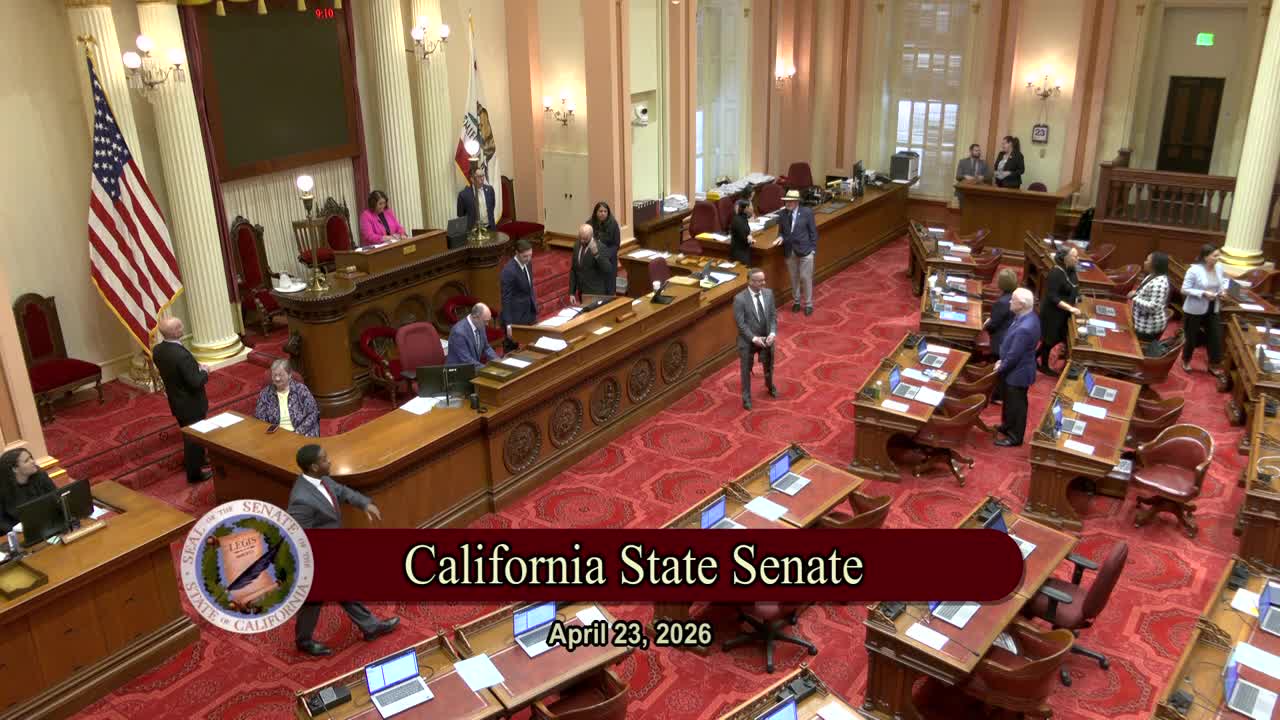 28MIN
Senate Floor
 17MIN
Senate Standing Committee on Natural Resources and Water
Bill Author

Bill Co-Author(s):